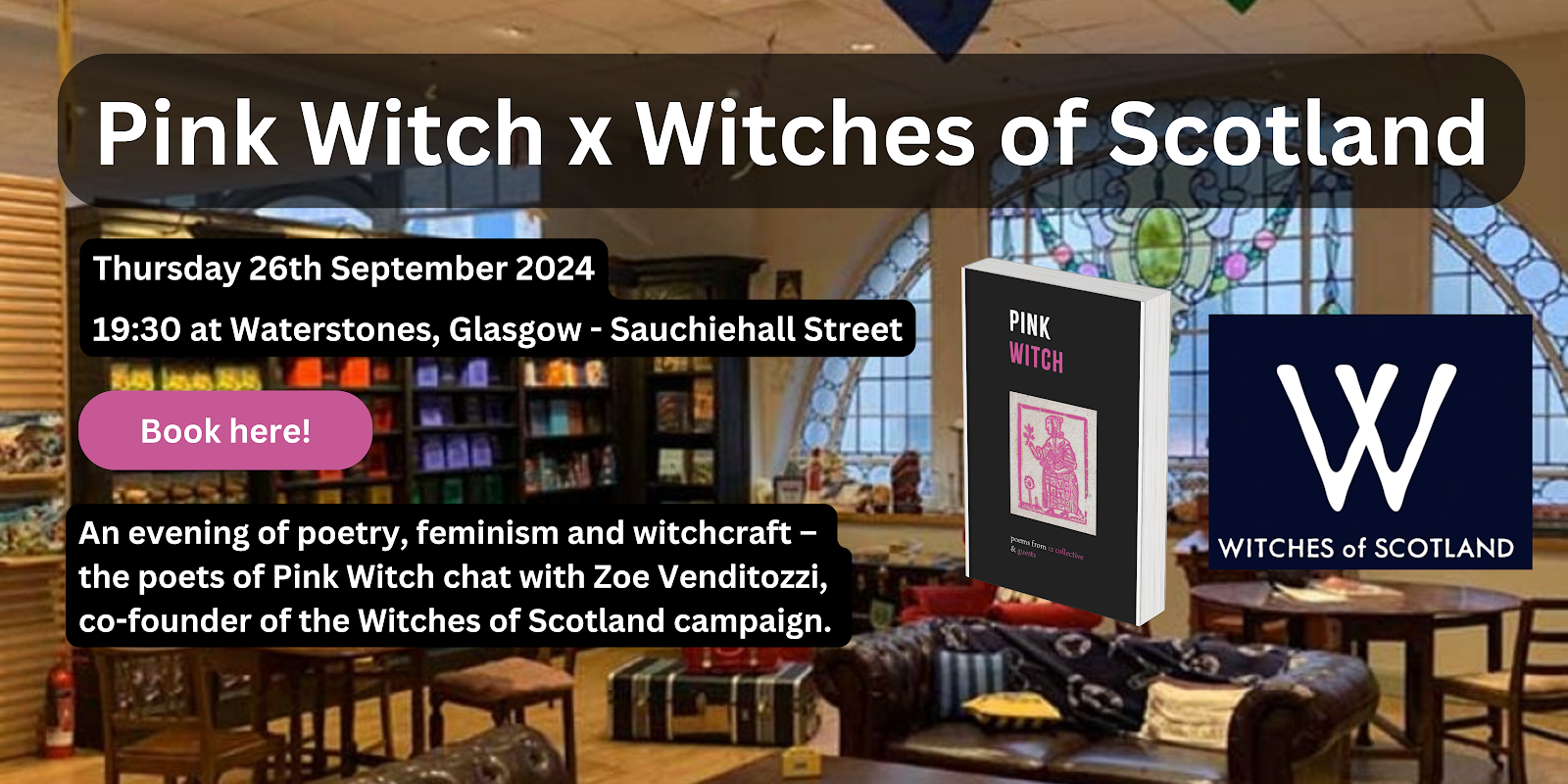
Earlier this year I published some poems in the anthology Pink Witch. Some of the other anthologised poets will be reading and in conversation with Zoe Venditozzi, co-founder of the Witches of Scotland campaign on 26th September. Event starts at 7:30pm and is at the Sauchiehall Waterstones in Glasgow.
‘An evening of poetry, feminism and witchcraft with the poets of Pink Witch chat with Zoe Venditozzi, co-founder of the Witches of Scotland.
A chance aside by Zoe Venditozzi of the Witches of Scotland campaign inspired the poems of Pink Witch, which question identity, vilification and the names historically used to constrain women. Now for the first time, the poets chat with Zoe and discuss the inspiration behind these dark, insightful and frequently humorous pieces. Witches of Scotland is a campaign for a legal pardon, an apology and a national monument for the thousands of people executed for witchcraft in Scotland. The campaign was set up by Zoe Venditozzi and Claire Mitchell KC. Their podcast has over 70 episodes. Pink Witch is topical, intimate and eclectic, in turns sombre and funny, lighthearted and reflective, by some of Scotland’s best women poets.’
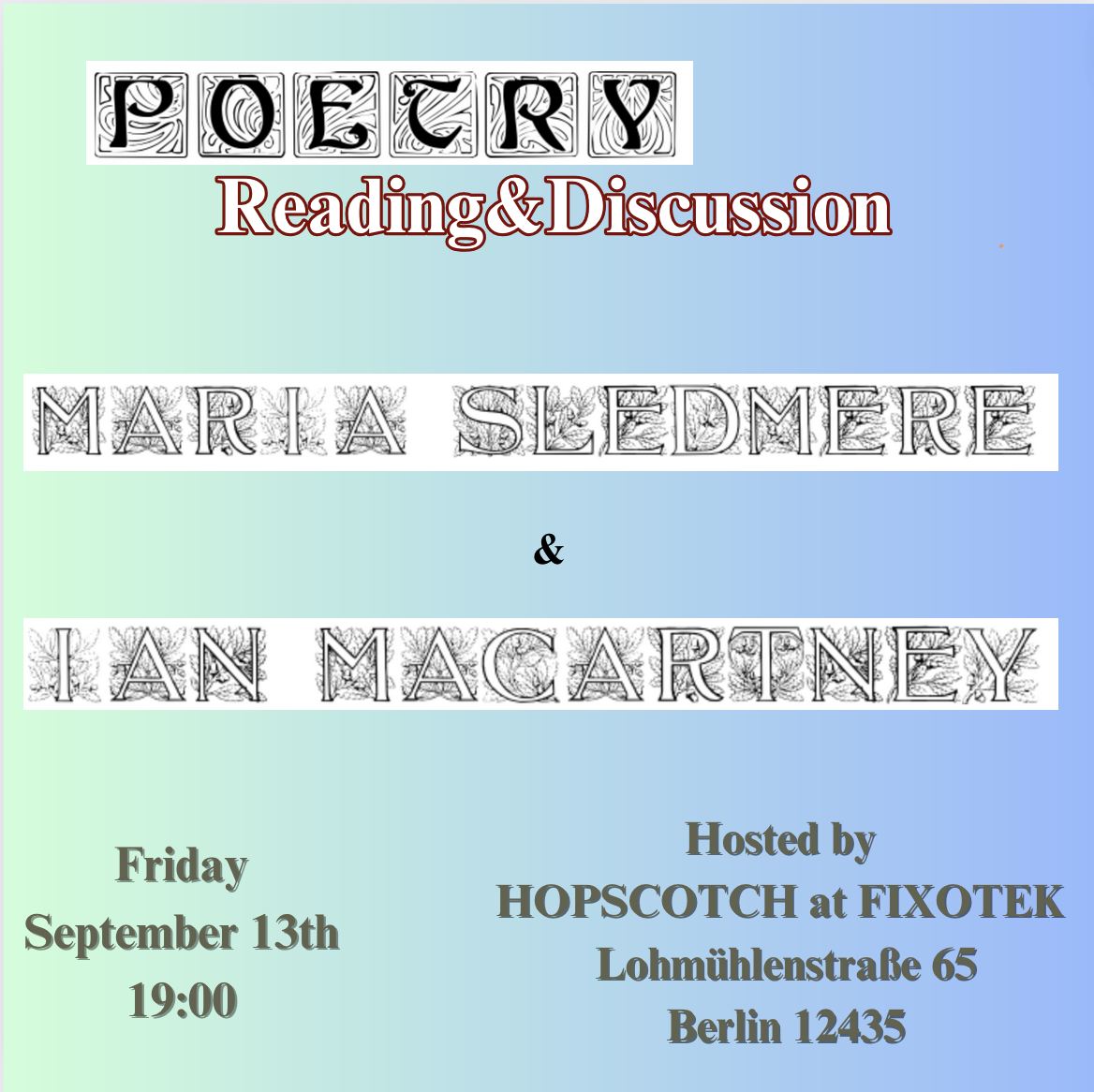
Cool news. Will be in Berlin weekend of 12-15th September doing two readings. It would be lovely to see some of you there!
Friday 13th September, 7pm POETRY: Reading & Discussion with Maria Sledmere & Ian Macartney 7pm, FIXOTEK, Lohmühlenstraße 65, Berlin, Germany 12435
Thanks to Hopscotch for hosting!
No tickets just show up.
&
Sunday 15th September 2024 1-3pm, ChertLüdde Potsdamer Straße, Berlin
Reading with Ian Macartney, Max Parnell and Ari Níelsson from 1-3 PM, followed by an open mic at 4pm. This performance event is part of Ali Eyal & David Horvitz’s exhibition, A new garden from old wounds, whose title is taken from a poem of mine, ‘Deciduous‘ which was recently published by berlin lit.
In their duo exhibition, A new garden from old wounds, artists Ali Eyal and David Horvitz explore geographical and conceptual distances, delve into the intricate boundaries of memories and emotions, and investigate how fragmentary elements can come together to form a new enduring presence. The exhibition brings together new and existing works that interconnect with each other as separate fragments of a single unit.
Opening Reception: 12 September 2024, 6 – 9 pm
11 September – 12 October 2024 ChertLüdde Potsdamer
I’m thrilled to be reading at the launch of Stacy Skolnik’s The Ginny Suite this Saturday at Burning House Books. The novel is one of my favourites in a long time — a pearlescent, speculative many splintered tale of mystery, hysteria and the world fuckery of technology evermore. I savoured it and reread certain pages with a dreamy clarity because deja vu was the narrative logic that I could most accurately access. When I finished it, nestled at the airport waiting lounge, I immediately wanted to read it again but I’m almost afraid to. I talked with Courtney over email and we agreed that the book lodged in our brains. That might be the most proper description. It crystallised the eerie fourth space feeling of proximate and synthesised intelligence. It was strange and razor-edged and a glut of forms and genres stitched up in this thing called the novel. My favourite thing about the novel is when it can serve as a kind of nervous container of multiple ideas and concepts playing out in time. The book itself is experiential prosthesis.
More info:
‘Information didn’t need to be remembered; it remembered her…’
A mysterious global syndrome is affecting women, causing symptoms of submissiveness and aphasia. While the number of sufferers grows, so does our protagonist’s paranoia—of the media, her doctors, and her husband. In the age of misinformation, AI, and surveillance technology, The Ginny Suite asks how much—and who—we’re willing to sacrifice in the name of progress.
Born in Belfast on Valentine’s Day, Suki Hollywood is a writer and poet. Her work has been featured in Gutter, Deleuzine, SPAM, Water Wings and more. Her debut novel ‘Jesus Freaks – a queer thriller – is available now via wwww.sukihollywood.com.
Maria Sledmere’s latest collection is ‘Cinders’ with Krupskaya Books, 2024. She is managing editor of SPAM Press and a Lecturer in English & Creative Writing at the University of Strathclyde. With Kevin Leomo, she is one half of Project Somnolence: a portable lab for exploring speculative approaches to sleep across art, literature and daily life. Her next book, ‘Midsummer Song (Hypercritique)’ is forthcoming with NoUP Press in 2024.
Stacy Skolnik is the author of the poetry collection mrsblueeyes123.com (self-released, 2019), the chapbook Sparrows (Belladonna* Collaborative, 2023), the workbook From the Punitive to the Ludic: Prompts for Writing Public Apologies (with Thomas Laprade for Montez Press Radio, KAJE, 2022), and the chapbook Rat Park (with Katie Della-Valle, Montez Press, 2018). She is a co-founder and co-director of Montez Press Radio, the Lower East Side-based broadcast and performance platform. The Ginny Suite is her debut novel.
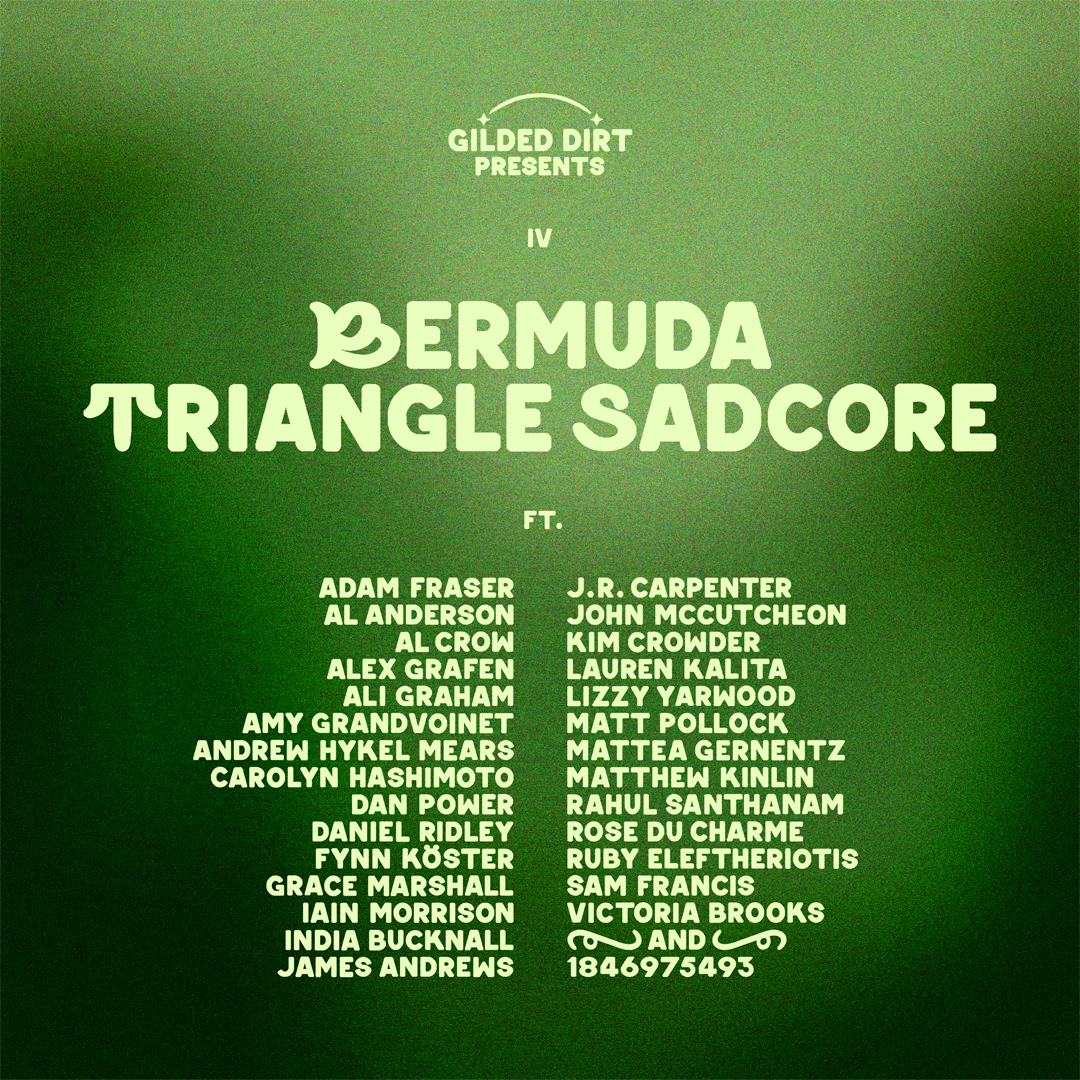
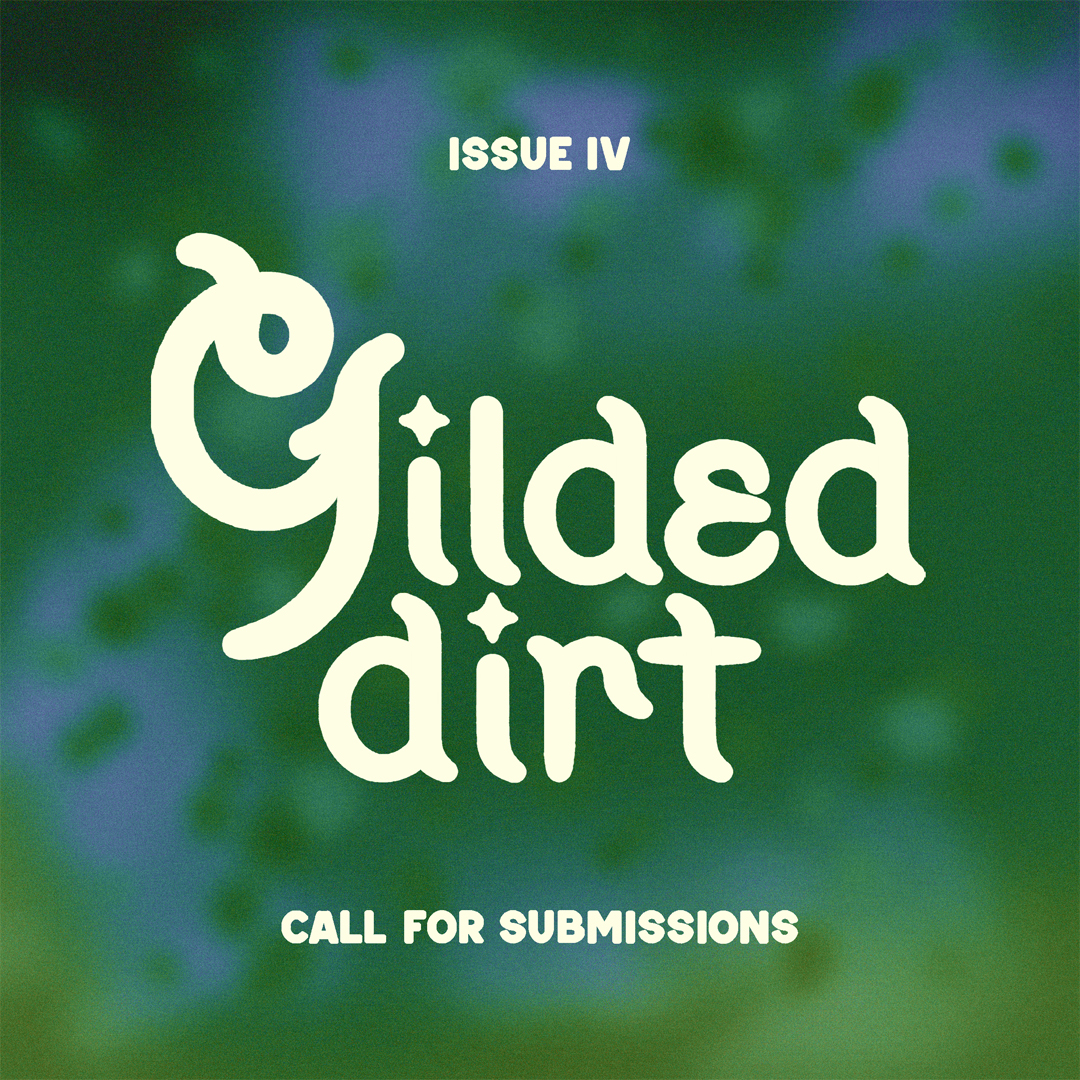
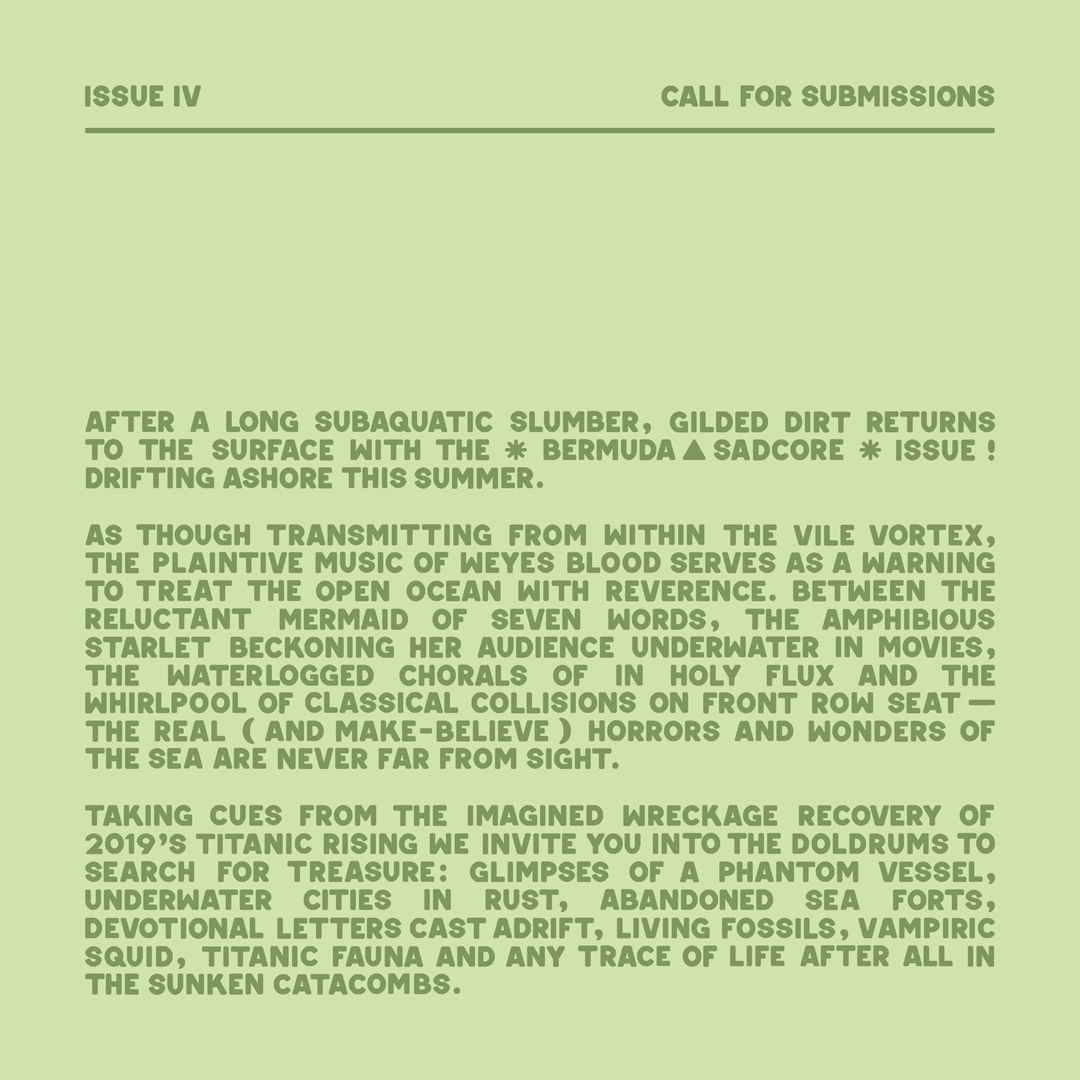
After a long subaquatic slumber Gilded Dirt has returned to the surface with the BERMUDA ▲ SADCORE issue ! Drifting ashore this summer !
As though transmitting from within the ‘vile vortex’, the plaintive music of Weyes Blood serves as a warning to treat the open ocean with reverence. Between the reluctant mermaid of Seven Words, the amphibious starlet beckoning her audience underwater in Movies, the waterlogged chorals of In Holy Flux and the whirlpool of classical collisions on Front Row Seat – the real (and make-believe) horrors and wonders of the sea are never far from sight.
Taking cues from the imagined wreckage recovery of 2019’s Titanic Rising, we invite you into the doldrums in search of treasure; glimpses of a phantom vessel, underwater cities in rust, abandoned sea forts, devotional letters cast adrift, living fossils, vampiric squid, titanic fauna and any trace of life after all in the sunken catacombs.
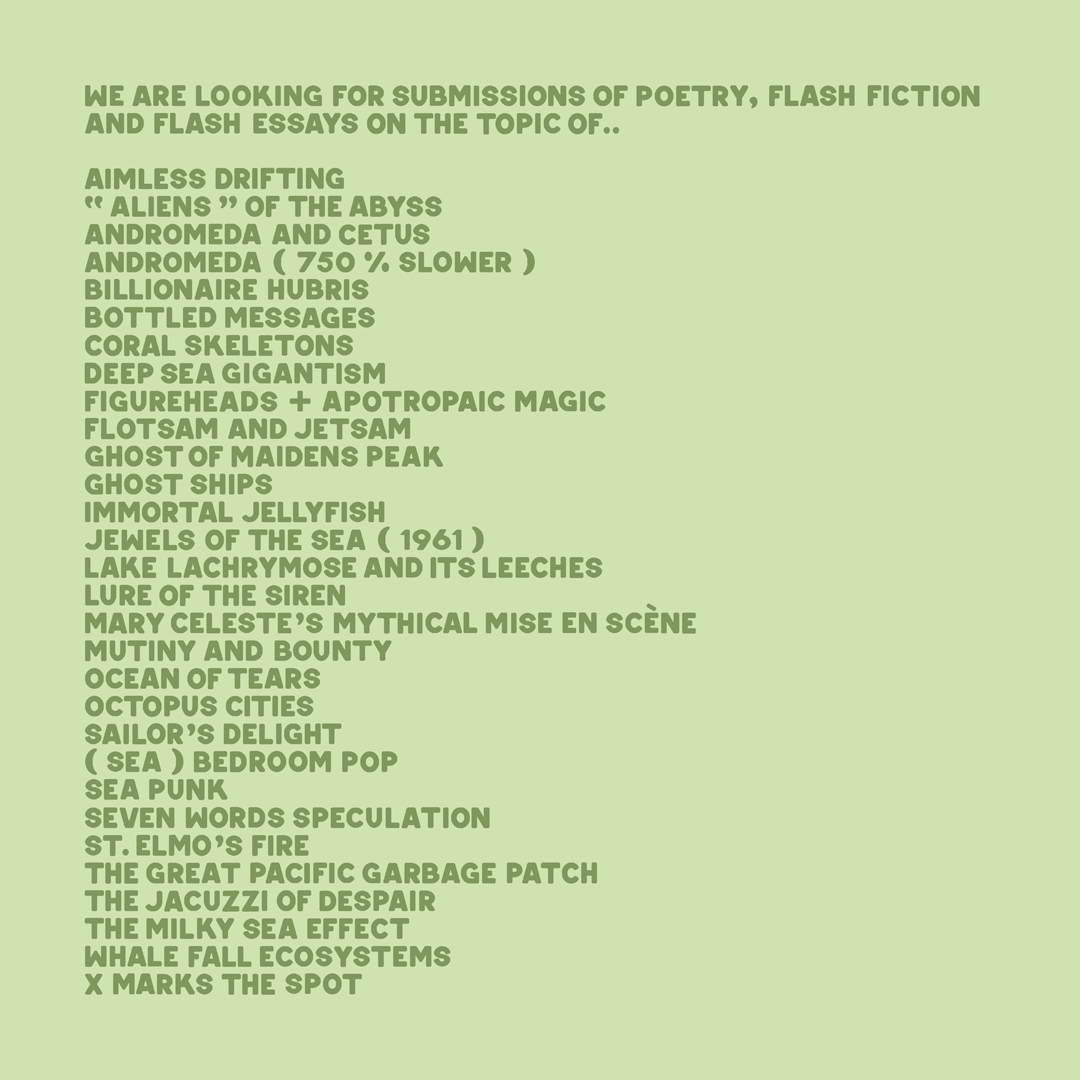
We are looking for submissions of poetry, flash fiction and flash essays on the topic of..
aimless drifting.. “aliens” of The Abyss.. Andromeda + Cetus.. Andromeda (750% Slower).. billionaire hubris.. bottled messages.. coral skeletons.. deep-sea gigantism.. figureheads + apotropaic magic.. flotsam and jetsam.. Ghost of Maiden’s Peak.. ghost ships.. immortal jellyfish.. Jewels of the Sea (1961).. Lake Lachrymose and its leeches.. lure of the siren.. Mary Celeste’s mythical mise en scène.. mutiny -and- bounty.. Ocean of Tears.. octopus cities.. Sailers Delight (sea)bedroom pop.. Sea Punk.. Seven Words speculation.. St. Elmos fire.. The Great Pacific Garbage Patch.. The Jacuzzi of Despair.. The Milky Sea Effect.. whale-fall ecosystems.. x marks the spot..
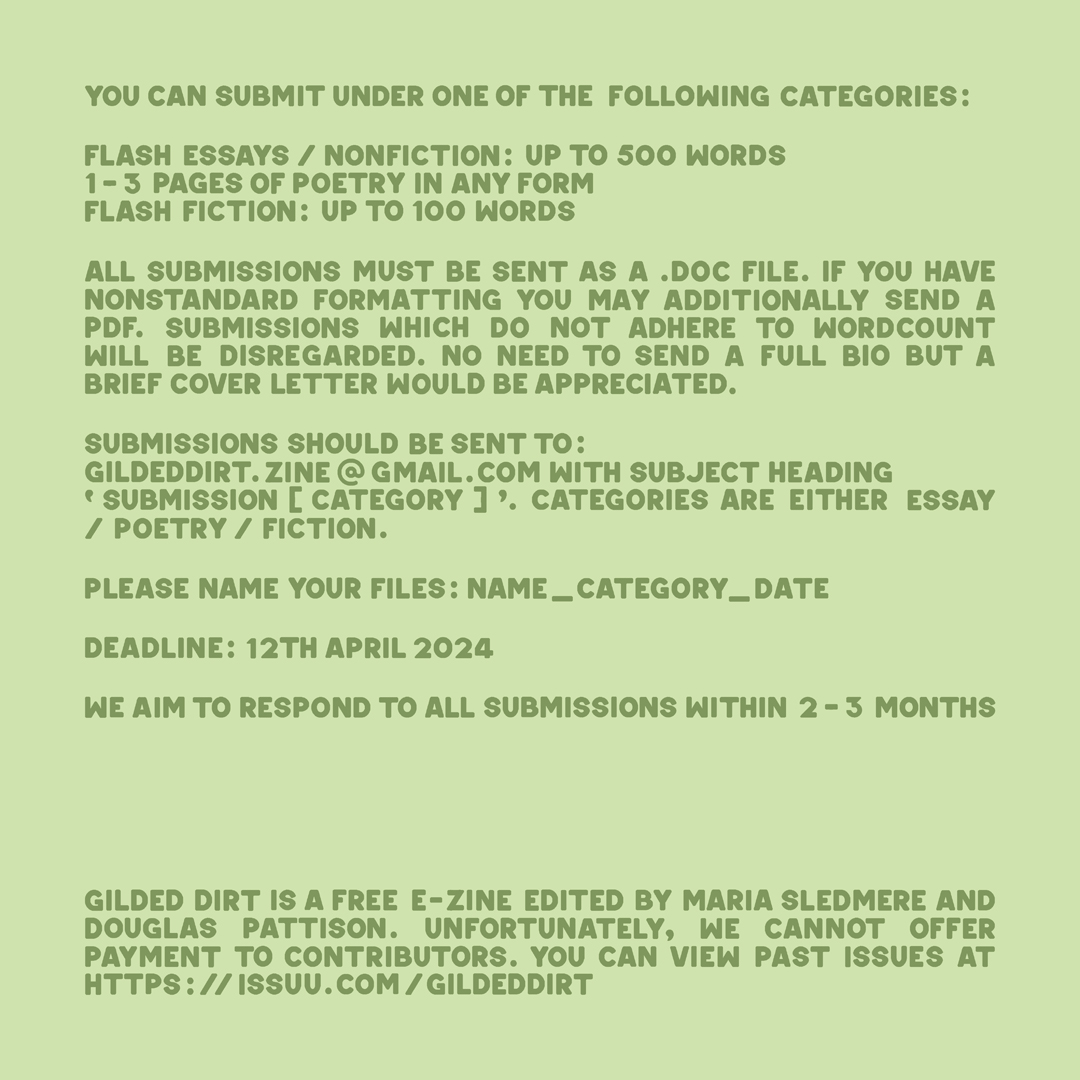
You can submit under ONE of the following categories:
Flash essays / nonfiction: up to 500 words
1-3 pages of poetry in any form
Flash fiction: up to 100 words
All submissions must be sent as a .doc file. If you have nonstandard formatting you may additionally send a pdf. Submissions which do not adhere to word count will be disregarded. No need to send a full bio but a brief cover letter is appreciated.
Submissions should be sent to: gildeddirt.zine@gmail.com with subject heading ‘SUBMISSION: [CATEGORY]’. Categories are either ESSAY/POETRY/FICTION.
Please name your files: NAME_CATEGORY_DATE
Deadline: 12th April 2024
We aim to respond to all submissions within 2-3 months.
Gilded Dirt is a free e-zine edited by Douglas Pattison and Maria Sledmere. Unfortunately, we cannot offer payment to contributors. You can view past issues at
This is a talk about meadows. A meadow is a place of expanse and exposure, where Man shoots the mother deer in the Disney classic Bambi (1942). It is a site of slag heaps, fly-tipping, wild and opportunistic overgrowth; the edge land between industrial estates sprung up with buddleia against the odds. Ambling between creative and critical approaches, this talk makes a case for the gerund meadowing as a conceptual and methodological imperative for porous and cross-pollinating consciousness. The excesses of meadows suggest how we might glean forms of abundance and ongoingness from the discards of capitalist efficiency. We will take seriously the imperative ‘go touch grass’, not as pastoral consolation or escape but rather as a cultivating logic of regeneration. The aesthetic tendencies of meadowing — dense citation practise, polyrhythmia, borrowing from the im/possibilities of dream — are entwined with an ecological ethic of entanglement and suspension.
I am going to be in New York(!) for a few days in December, doing some readings with a motley crew of Scottish poets: Colin Herd, Jane Goldman, Iain Morrison, Nicky Melville.
So far, confirmed events are:
Sunday 17th, 12-3pm – Scottish Poetry Brunch at Torn Page. RSVP.
Monday 18th, 6:30-8pm – Poetry: A Christmastime Gathering with Four Scottish Poets at Frenchtown Bookshop. More info.
If you have any recommendations of cool things happening between the 16-21st of December in NY, hit me up!
Tomorrow I’m giving a paper on Caspar Heinemann, Sophia Dahlin and Callie Gardner at ‘Imagining Queer Ecologies’, a one-day online symposium hosted by the British Society for Literature and Science and the University of Oxford. [online]
Here’s the abstract:
‘In contrast to biodiversity’, argues Karlheinz A. Geißler, ‘“chronodiversity” is terra incognita’. This paper takes up the challenge to explore chronodiversity (the extent to which individuals have differing experiences of temporality) in a queer ecological context. Following Catriona Sandilands’ call for queer ecology to stress ‘an articulatory practice in which sex and nature are understood in light of multiple trajectories of power and matter’, I will look at contemporary poets whose negotiation of pastoral and lyrical modes offers a temporal experience of embodied difference. I am concerned with how queer poetry intervenes in modes of temporalisation which bind existence to a standardised temporal logic of consumption, expenditure, reproduction and labour. While pastoral is often associated with nostalgic and reactionary structures of feeling, I consider poets whose engagement with pastoral tendencies constitutes an ‘allergic’ aesthetic/ethic. Given that ‘allergy’ is rooted in both allos (‘other, different, or strange’) and ergon (‘activity’), it is fruitful to examine how poets reactivate pastoral modes through a queer and critical reimagining of desire and time. Reading poems by Sophia Dahlin, Callie Gardner and Caspar Heinemann, I consider formal strategies such as complex sentences, lists, imagery, lyrical present tense, citation and space, to dramatise the emotional and temporal conundrums of queer pastoral. I argue that these poets explore the possibilities of ‘queer asynchronies’ (Elizabeth Freeman, Time Binds) to rethink environmental consciousness in terms of (allergic) pastoral erotics which variously reflect and refuse the organising logics of heterocapitalist chrononormativity.
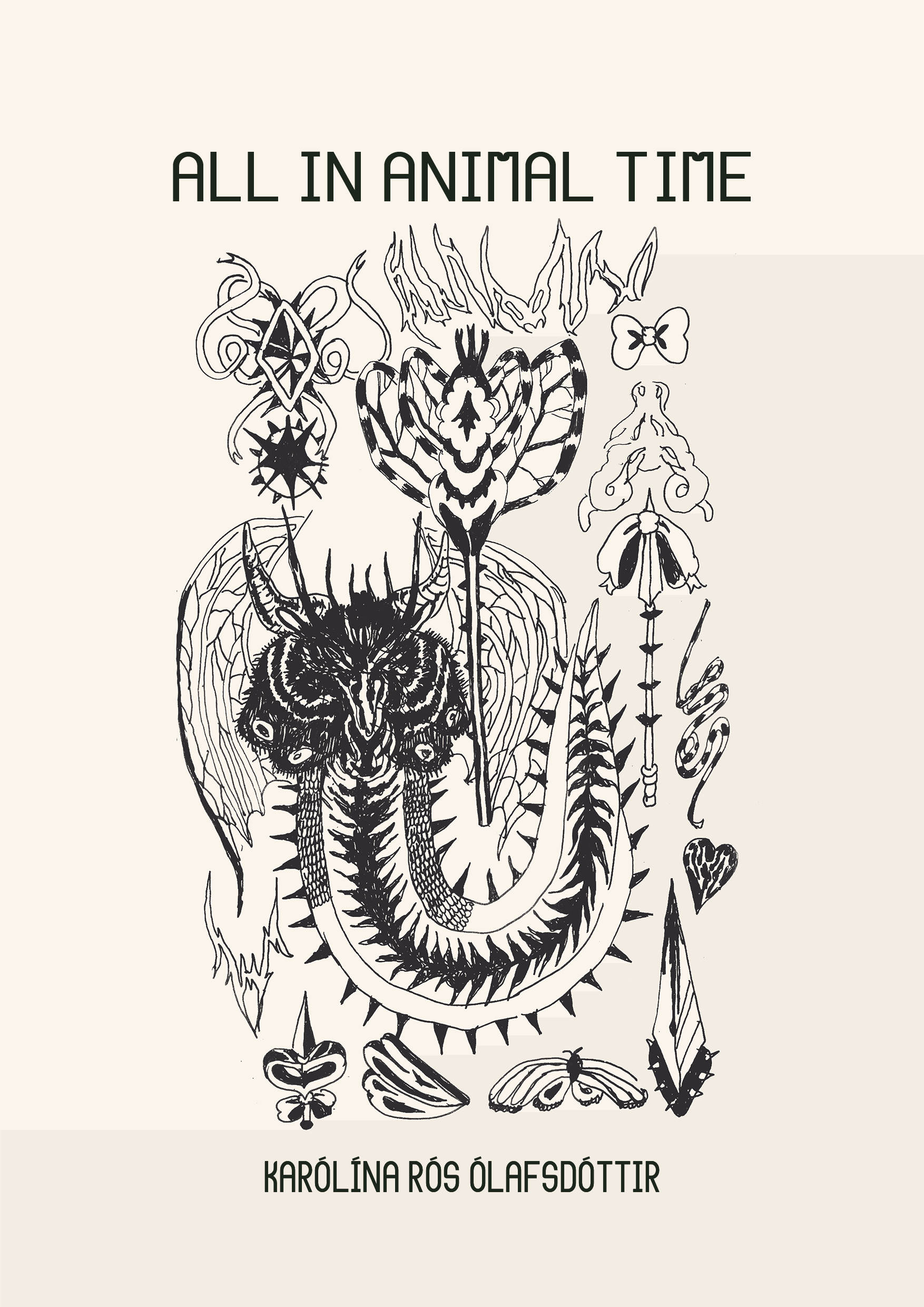
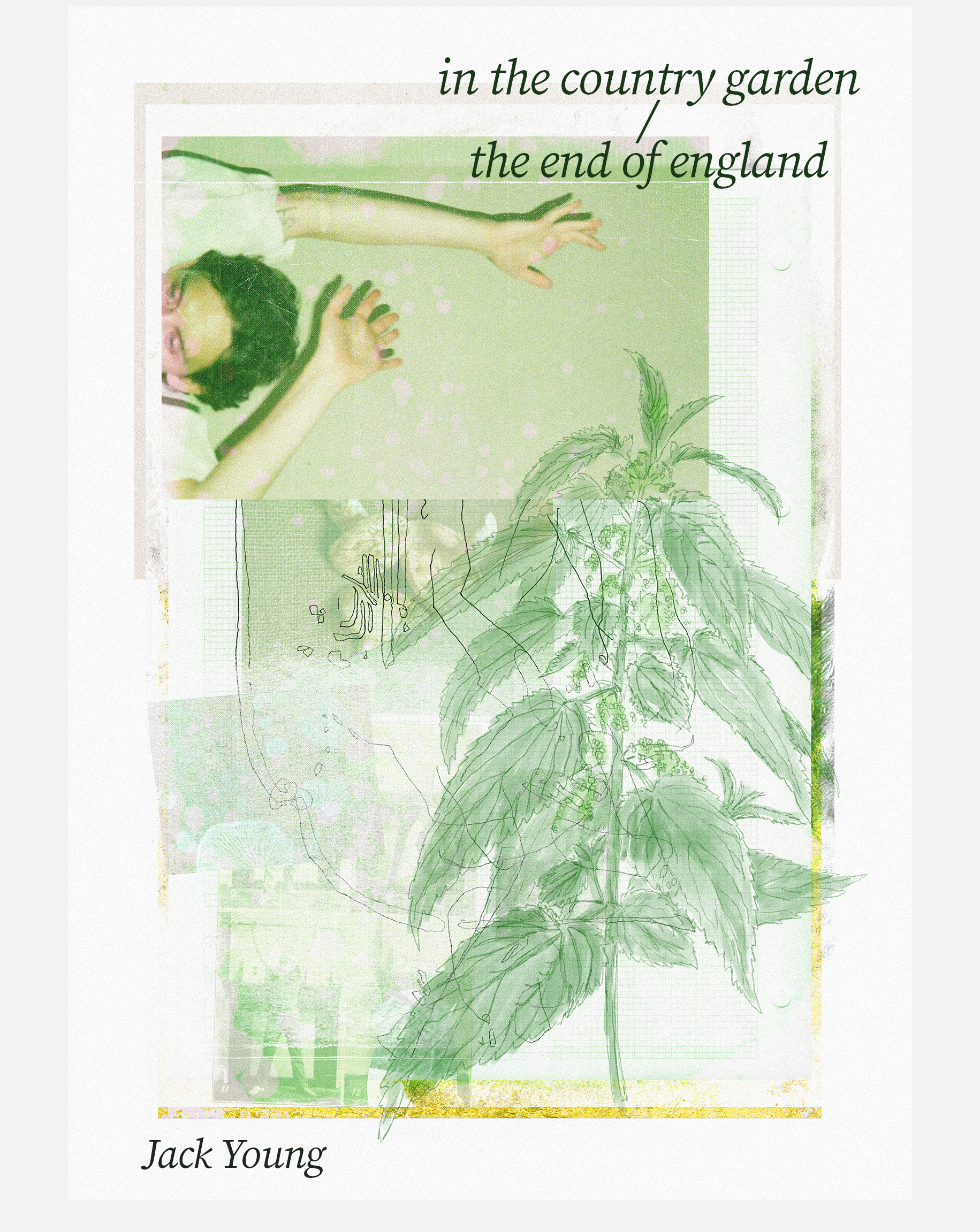
Over the past few months I’ve had the pleasure of working with two excellent poets, Jack Young and Karólína Rós Ólafsdóttir, on bringing to life their pamphlets in the country garden /the end of england and All in Animal Time. It’s been a fair few months since SPAM published anything physical (our most recent print publication was Cocoa and Nothing back in February) and coordinating everything for season 7 reminded me why I love doing this in the first place. There is something magical and alchemical that happens in the process of getting something from email to book in a series of whirlwind zoom(ies) and frantic whatsapps and editorial ping pong and delicious in-depth reading. I love figuring out solutions to a design problem, shunting things around, letting things bleed into the edges or splash into place, phone calls about word choice and line breaks. Generous margins and snaky wee texts / embarking upon font quests.
We got to know our authors, who are based in Bristol and Iceland, variously over the pandemic through Zoom workshops and the great poetry boulevard that is gmail. You can read one of Jack’s poems in SPAM005 and one of Karó’s in SPAM004. The SPAM editors are big fans of their work and we were delighted that both authors had pamphlets that kind of grew out of the poems in the magazine. This season has a lil rainbow-shrouded eco flavour: poems of the anthropocene everyday, poems of queer pastoral, poems in animal time (as per David Berman’s advice). J&K are poets with a real interest in the scholarly work of poetry as much as the playful. These are really thoughtful works which traverse everything from decolonising botany to Commander Keen, the dietary needs of black holes and the sonnets of rats and punctuation marks. Ugh I really love them! Thinking about these pamphlets is like coming up on coffee with sunlight pouring through the morning and having adequate sleep and remembering why the little things really fucking matter. It’s like the libido of the knotweed exerting pressure to break concrete and escape the walled garden which is like beautiful open source software. I am so lucky to have worked with these poets and also to have collabed with my co-editors Mau Baiocco, Kirsty Dunlop and Ian Macartney in bringing them to fruition. Long live SPAM!
Coordinating this pamphlet series also reminded me that publishing is an act of worldbuilding, brick by paper brick, pixel by pixel. It’s like: how do we give birth constantly to the word-pearls of what you wanted by accident of so many factors to have an idea for ~ ~ it’s like……a gift, a life-changing conversation, a journal entry for the language of flowers, a frolic through girl city’s sugar cubes and the delicious lumpencoal of the poem. Stop to admire the ‘four-star review sycamore’ (KRO) while you’re at it.
We worked with two v talented artists, Maura Sappilo and Sam Williams on cover design. Thank you Jack and Maura!!!
If you’re in Glasgow, please come along to our launch on the 10th November, where we’ll also have a reading from Edinburgh poet Murid L. Keshtmand and there will be many a pamphlet on sale and a lil wine & snack to be had.
PEOPLE OF THE PRESS! If you’d like to review the book, interview one of the authors, have them on your podcast or stock copies of the pamphlets in your store, please email spamzine.editors@gmail.com.
You can preorder the books at inflation-resistant prices => spamzine.co.uk/shop.
You can watch two Instagram live sessions with Jack and Karó here, where we talk about the thinking behind the pamphlets, inspirations and the craft of writing.



 mariaology