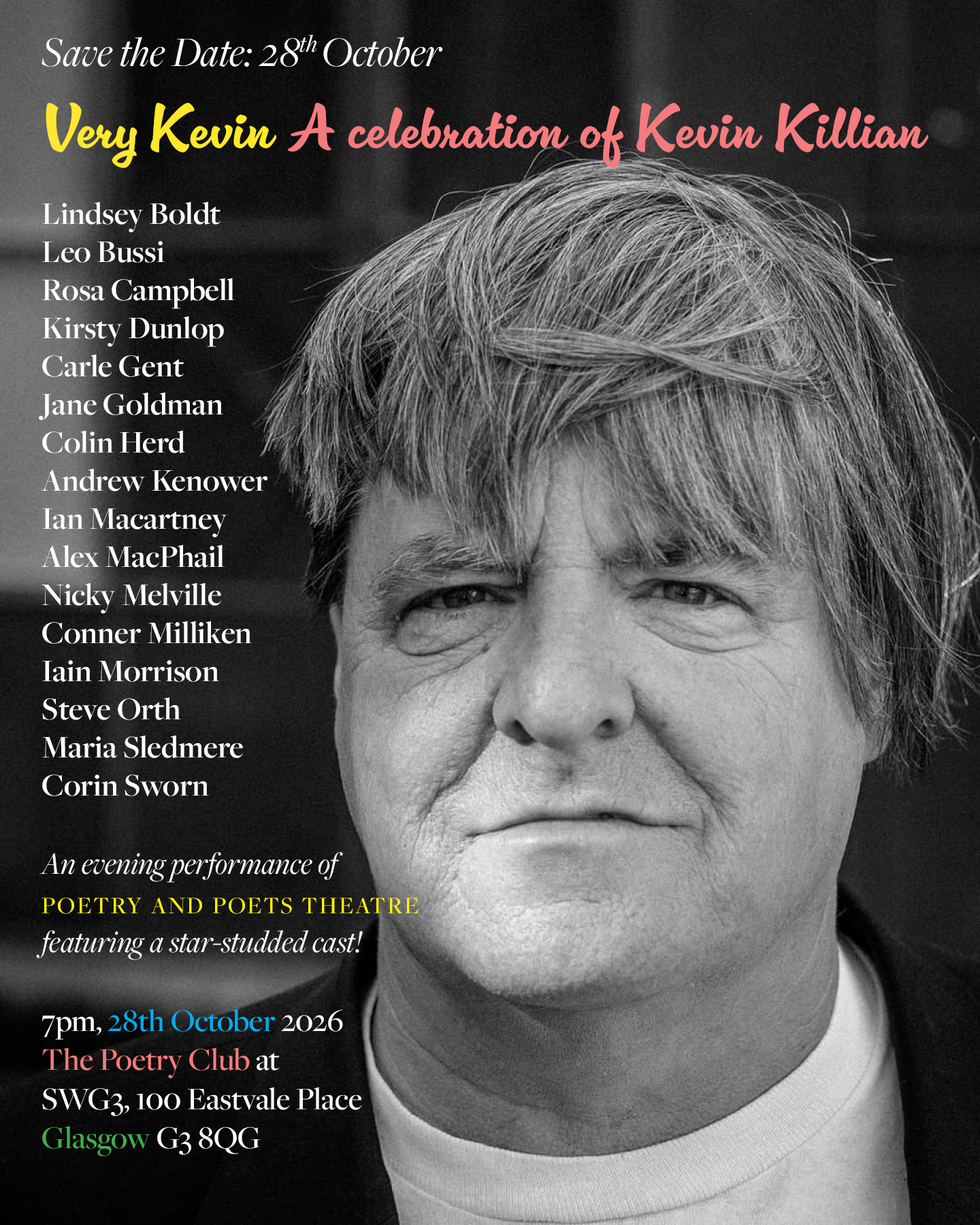
Wednesday, October 28 • 7 PM – 9:30 PM [doors at 6:45pm]
An evening performance of poetry and poets theatre featuring a star-studded cast!
Kevin Killian (1952-2019) last visited Glasgow to read at The Poetry Club in 2018. To celebrate his extraordinary life, work and inspiration to generations of writers, three Scottish poets are teaming up with three Bay Area poets to host an evening of Killian’s poetry along with an exclusive performance of one of his plays. There will be readings and performances from writers, artists and students and an opportunity to browse some of his publications, courtesy of Burning House Books.
Kevin Killian was an American poet, writer, editor, and playwright. He was a co-founder of the Poets Theatre performance group in San Francisco and a leading writer in the New Narrative movement. You can find out more about Kevin’s life and work here.
This event is organised by Colin Herd and Nicky Melville (University of Glasgow) and Maria Sledmere (University of Strathclyde) along with visiting poets Lindsey Boldt, Andrew Kenower and Steve Orth.
Access:The Poetry Club is on the ground floor with an accessible toilet and bar located in the venue. Please email access@swg3.tv or call us on 0141 337 1731 with any enquiries. This will be a seated event; arrive early to secure a seat or if you need to reserve one for accessibility reasons, please email maria.sledmere[at]strath.ac.uk.
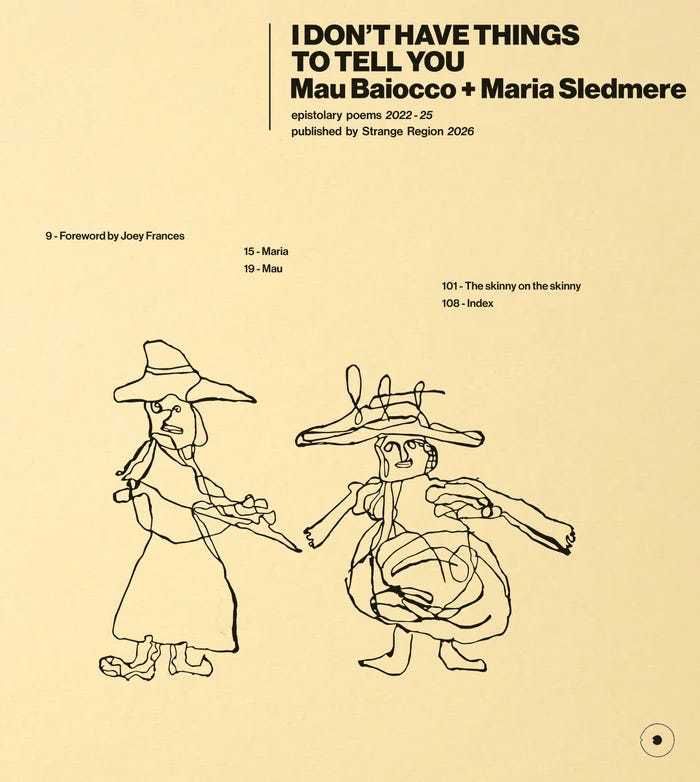
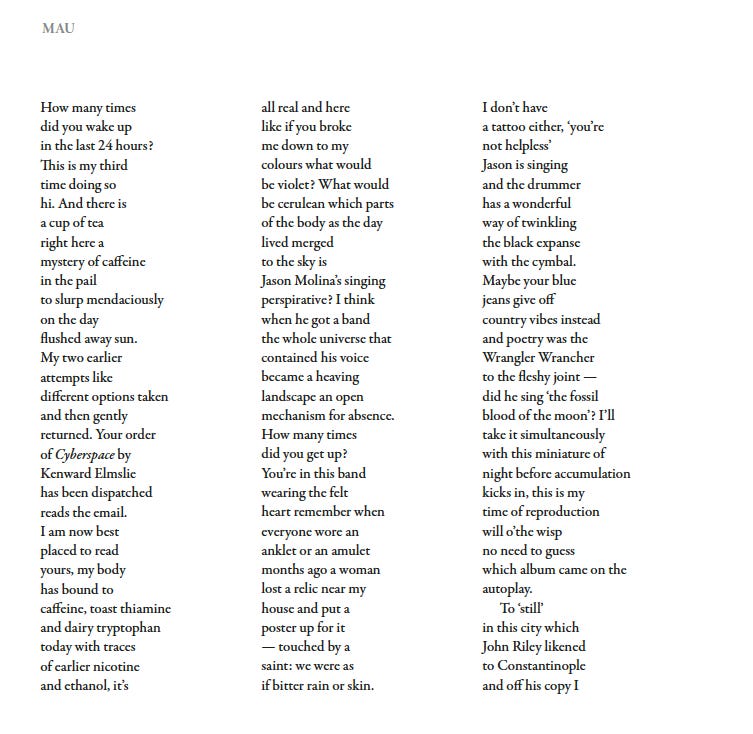
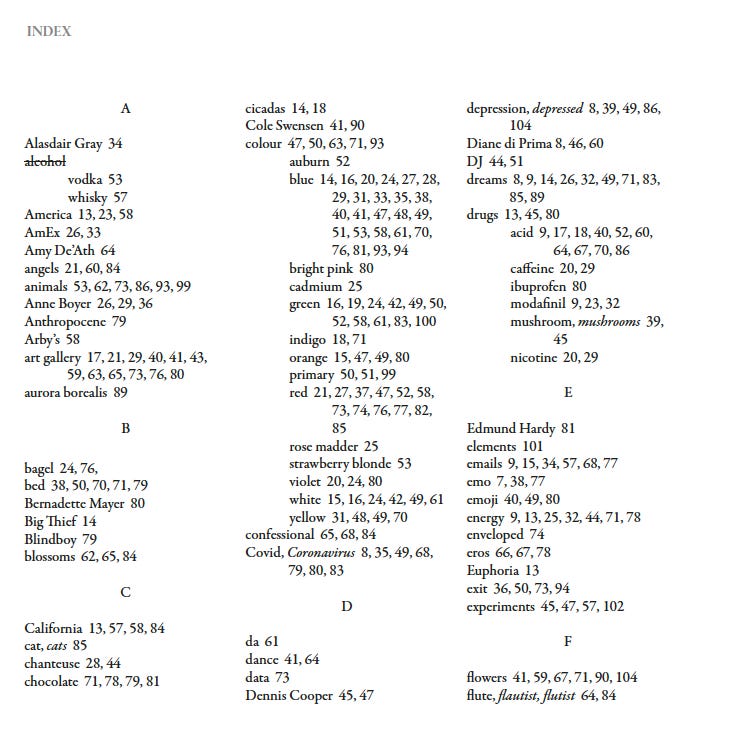
There’s a new book coming out. Ribbons of collaborative epistolaries with Mau Baiocco, presented in skinny columns, writ between 2022-2025, the years of emergence from lockdown and still in the viral fug of Covid, its long durée and continuous shaping of economic, social and poetic relations. On the 23rd March 2022, Mau writes to me: ‘I don’t have / things to / tell you but / to run along / it’. The shaky glitter of that ‘it’ can be traced across the whole collection, morphing in what it refers to — a French horn, an original thought, a flower painted by Degas. It’s a bit like a syntactical kaleidoscope where the grammar changes according to voice, something to look through, the long telescopic look in (to another’s brain) that’s poetry. Blink and you’ll miss it. We wrote to each other with the initial burst of correspondent excitement: back when I was a graduate teaching assistant working in one university and a part-time, fixed term lecturer in another, striking intermittently at both as part of a long campaign that began before lockdown; back when Mau was working in a gallery in Leeds and metabolising observational extremes into playful meditations on value, art and human behaviour. In the course of the book we get sick, have birthdays, fly transatlantic, witness resigning cabinets, respond to so much art and music, write of many friends and loves, muse on various colours and substances. We run along.
To run along the length of a fabric is to cut, move, align parallel to the selvage, the warp yarns of the textile’s spine, along the grainline, running parallel, threads with the least amount of stretch, the highest strength — could this be our poetics? In the book, I write about a task I was given at primary school: to untangle the long streamer ribbons or dance wands we were given to play with at breaktime, in an effort to curb presumably our violent outbursts and bullying. O how we loved our e-numbers! And how we loved colours! These streamers were thick, luxurious, brightly coloured: red, green, yellow or blue. We would wave them around like it was May Day, loving the euphoria of colour until it got boring and then we’d joust with them, whacking the long plastic sticks against each other like swords. Why am I telling you this? For to write one another yielding the giant streamer pen would always result in a sort of euphoria, now to bounce into jousting, pretending that we were on ponies. As I write this, people are jousting on Lime bikes in London Fields and once again medievalism is trending.
However, there is or was no fight in us. Only energy of neon, some knots, a sing-along strong or louche. Our jousting wands become streaming rivers in möbius formation. Mau and I are gemini twins, having nurtured a sort of telepathy from years of exchanging gossip and poetry (including, with Luce Lovell, our sonnets for hooch), from years of standing in front of art, finding our painterly doubles, eating curry at the indoor market, flicking through chapbooks, reading Lee Harwood in the rain. The fight was to have this space to think, it slivered into the work of email, analogue in a perverse way to have this medium which didn’t expect an instant response. We found energy from what was around us. The little things to notice, plus: all of our friends. This was a book co-written in a way by a whole collective, wayward and not nameable. Joey Frances writes of this so well in his foreword to the book, ‘the conditions that mediate the possibilities of writing’, ‘comparing notes on all the shit we did and all the shit we could yet do’. Yes — I love the provisional curve of the ‘yet’, how future possibility spirals outwards in these poems because we needed to write with dream all the time, daydream and nocturnal slumbercore of the narrative variety, episodic flashes of light that tell us dull life could be otherwise. Our ribbons fray into threads of everyone.
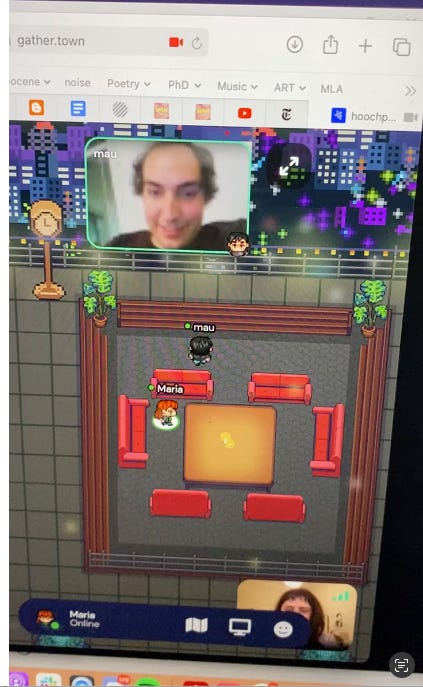
We connect via the internet constantly, something worth saying and saying again. In lockdown, Mau and I would show up as wide-eyed UK poets in various international poetry Zooms — readings in New York most often, dreaming from face-tiles a city of stoners and sleepless lights. We kept a sidebar discussion going on a secret poetry Discord, blue-dark-deck that became the afterparty, the dingy bar. Mau would go to two events simultaneously on different computers. Now we would call that poetrymaxxing. I write of feeling ‘like the goddess modem / of puerile form’, somehow fused electrical to a higher grace via the tenement broadband that served my days. I am childishly silly and yet talking to gods, poets we love so much, the domestic dreameries of Bernadette Mayer, the ‘singing / perspirative’ of Jason Molina. Asking Peter Gizzi a question about light and speed via ~the chat, nervously in 2020. Our poetry metabolises that experience not as diaristic self-reflection but as chatty missive, epistemic flirtation. I like that now I know what you know, as you know I for I.
This book tries to pull everything in and yet still maintains the feeling of attempt, desirous of almost; a kind of delirious voice note written down, not quite getting to the point. A poetics of incomplete documentation and utopian meta-commentary on what we would need to fulfil our commitment to this undefined Project. A chemical obsession with what would be the right conditions to read each other, how to curate the perfect take, correspondence — a word that means to pledge, promise or to answer, with prefix of together, with, together-with-this-promise was to write a skinny poem. ‘I do not always understand what you say. / Once, when you said, across, you meant along. / What is, is by its nature, on display’ (Schuyler). Oh how we love James Schuyler. This poet at the window, embraced in the mortal combat of syntax, to paraphrase something Stephen Yenser wrote of Schuyler’s line breaks. We wanted the skinny, the crop of the day, for someone to bring us the lilies; we broke lines because to do so offered a sense of autonomy, almost like eating.
The first phase of the book has the heightened bubbling of new correspondence, moving quickly along, the feeling of having found a form. Curious and exploratory, performatives of witness and ‘psychological androgyny’ borrowed from the Romantics. The second phase of the book occurs when time jumps across from 16th July 2022 to 23rd April 2024. I’m back into Mau’s inbox with tales of the softest breakup. We ask if it’s worth trying again, we indulge into a leisurely to and fro, the poems feel different, there’s a shift in the language and from Saturn’s return, so much has changed and now we are both teaching, feeling out ‘life in the ashes’ and ‘the starry shared / humiliation of reading’. Is there a new self-consciousness in the form? Now it is something we move across…
…and we shape it into a book: I don’t have things to tell you, a title whose premise is refusal. Like the gemini tendency to answer the phone in burnout, saying I’ve got nothing and then launching into love’s digressive everything. The poems are presented mostly chronologically, excepting a centrefold poem of sorts, Mau’s poem on the occasion of visiting California, the aforementioned foreword by Joey Frances and a closing essay by me, ‘The skinny on the skinny’, followed by an index which collects the book’s referential whimsies.
We have continued the emails since finishing this manuscript, something submitted to the Strange Region open call at the start of the year and now being graciously published by Joe in Bristol. Joe has been amazing. He’s typeset the thing beautifully in triple columns, taken our linguistical quirks as a necessary poetics to preserve, found us a cover image of illustrated Martians worthy of the aspiring Spicerean forms within. In the book where the cover images originally hail from, Psychical Research and the Resurrection (1908), James H. Hyslop writes: ‘We went all around. The people are different in different places’. Yes, the kaleidoscope changes. That’s this book. The two of us swapping hats and cities.
You can preorder it now from the publisher, or catch us at our Glasgow launch on 21st November at MF Books. More dates to be announced soon. Please invite us to your city!
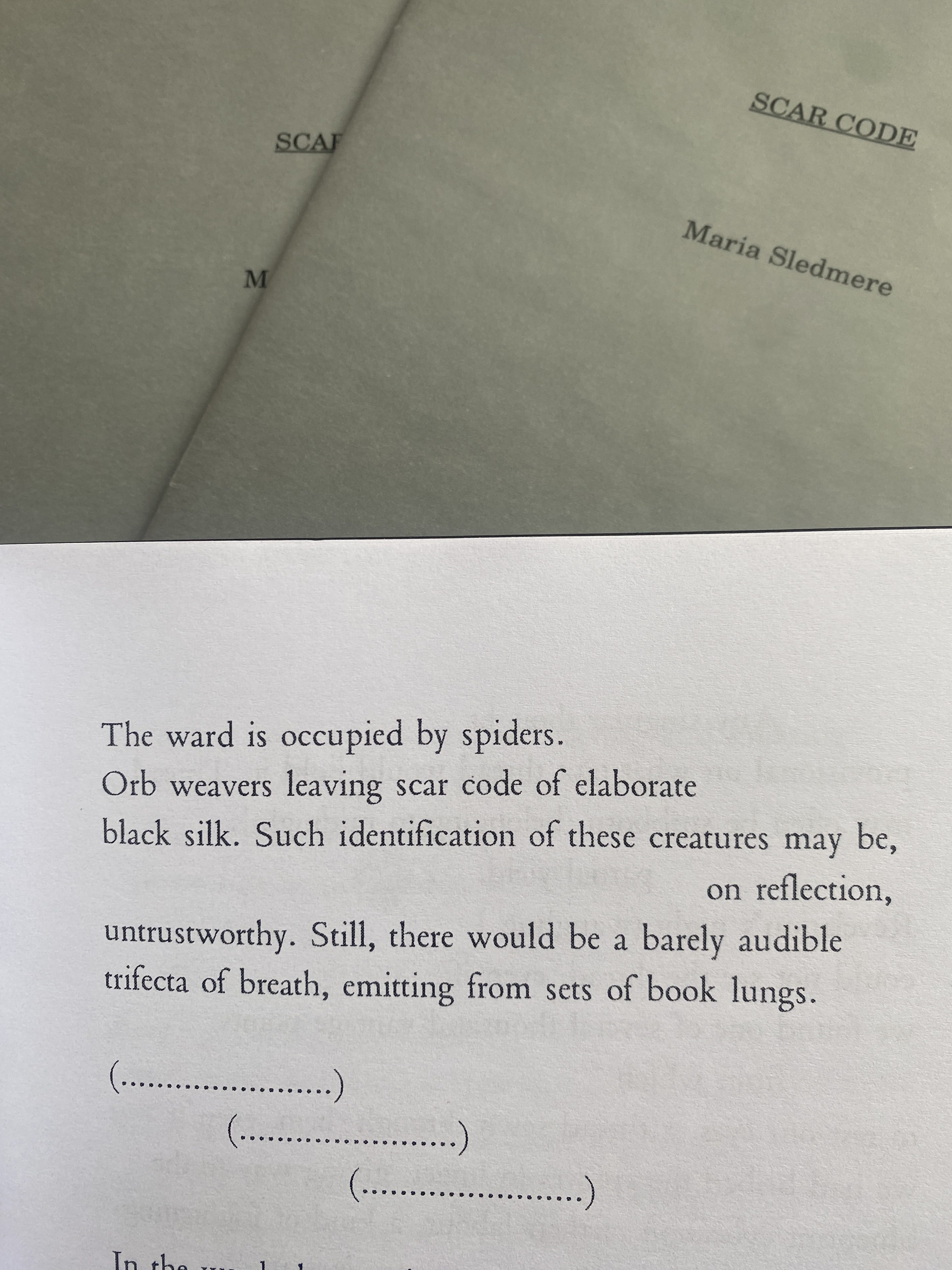
Anticipatory grief, sleep and spiderwork come together in my prosimetric pamphlet, Scar Code, the first from new pamphlet press Weather Band (produced by Robyn Skyrme of the Crisis Crystal reading series). Originally written for the Ek Symposium and exhibition hosted at Glasgow Project Room in September 2025, I developed it into a fuller sequence at Robyn’s invitation. It picks up some themes on threads, spiders and entanglements from my monograph Midsummer Song, and responds ekphrastically to Chiharu Shiota’s installation Sleeping is like death (2016).
A more formal abstract:
What happens when ekphrasis is conceived of as performance in the context of artwork concerned with sleep and dreams? Commencing with a verse description of Chiharu Shiota’s thread installations, I take my cue from T.J. Clark to consider the limits of ekphrasis as tool for ‘converting’ visual into verbal representations as a possibility for recreating the ‘experience’ of ‘thinking in’ the artwork (2022). As Shiota’s elaborate, sleep-themed threadworks, notably Sleeping is Like Death (2016) evoke an interwoven neural net, whose nocturnal scenes are withheld from the viewer via webs of abstraction, I offer sentences of hypercritique as ‘drawings in space’ (Shiota) whose weaving is a dreamwork: enacting via intuition a space for the unknowable. This intuition is partly premised on the rhythmic, affective and imagistic affordances of poetic language.
In the ward, three patients lie asleep. The spiders entered them long ago, not by the usual oral route, but via the silk of sleep itself.
‘The experiment, now wide awake, continued: I have long known about the Mass and what it conceals – dreamed of how it draws all other masses to it and claims them. I have long known about the Mass, known that it’s approaching; it’s there at the threshold, waiting, lurking, longing. I’m now looking for a body that wants to get to know the Mass as I have always wanted to, without knowing how. A body that wants to filter the feeling of an incomparable depth and a place completely surrounded by itself – a body that endures a loneliness lacking rightful designation and knows that such an experience can neither be shared nor explained. I wish for that body to be by my side and at the same time I want it to know that what I’m asking for is immense.’ (Balsam Karam, Event Horizon, translated by Saskia Vogel, 2018/2026, p. 34)
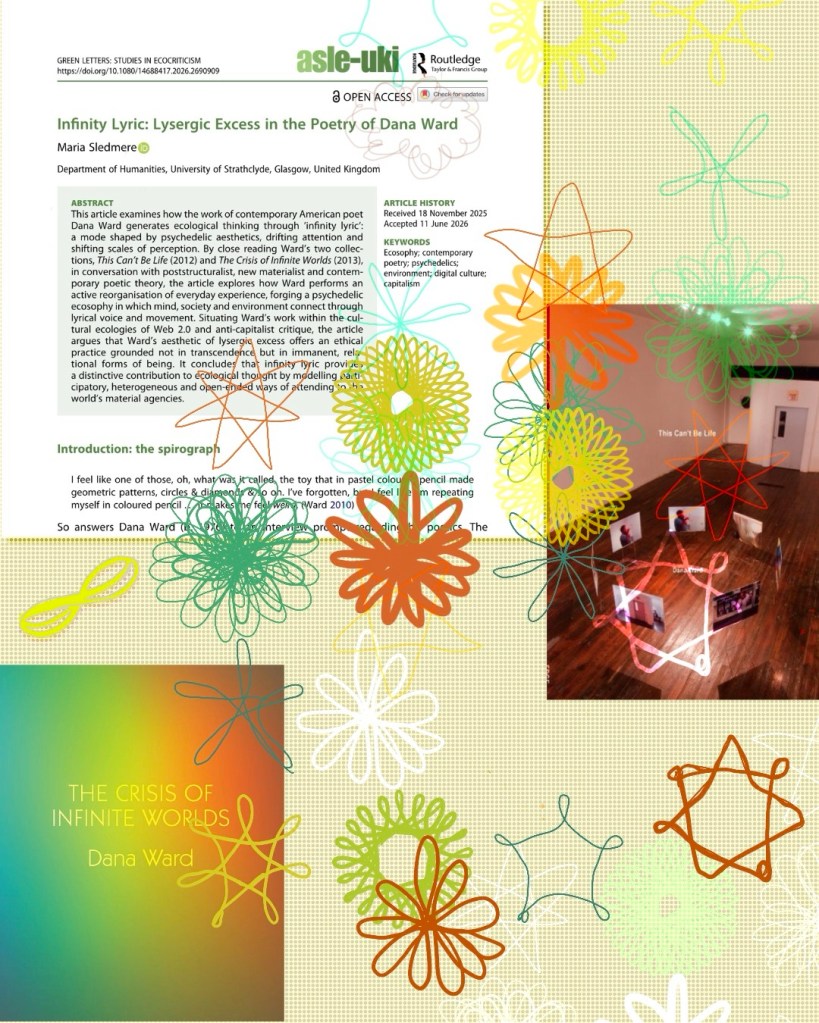
My new article, ‘Lysergic Excess in the Poetry of Dana Ward’, is now live over at Green Letters, as part of a special issue theme of ‘Psychedelic Ecologies’.
Abstract:
This article examines how the work of contemporary American poet Dana Ward generates ecological thinking through ‘infinity lyric’: a mode shaped by psychedelic aesthetics, drifting attention and shifting scales of perception. By close reading Ward’s two collec- tions, This Can’t Be Life (2012) and The Crisis of Infinite Worlds (2013), in conversation with poststructuralist, new materialist and contem- porary poetic theory, the article explores how Ward performs an active reorganisation of everyday experience, forging a psychedelic ecosophy in which mind, society and environment connect through lyrical voice and movement. Situating Ward’s work within the cul- tural ecologies of Web 2.0 and anti-capitalist critique, the article argues that Ward’s aesthetic of lysergic excess offers an ethical practice grounded not in transcendence but in immanent, rela- tional forms of being. It concludes that infinity lyric provides a distinctive contribution to ecological thought by modelling parti- cipatory, heterogeneous and open-ended ways of attending to the world’s material agencies.
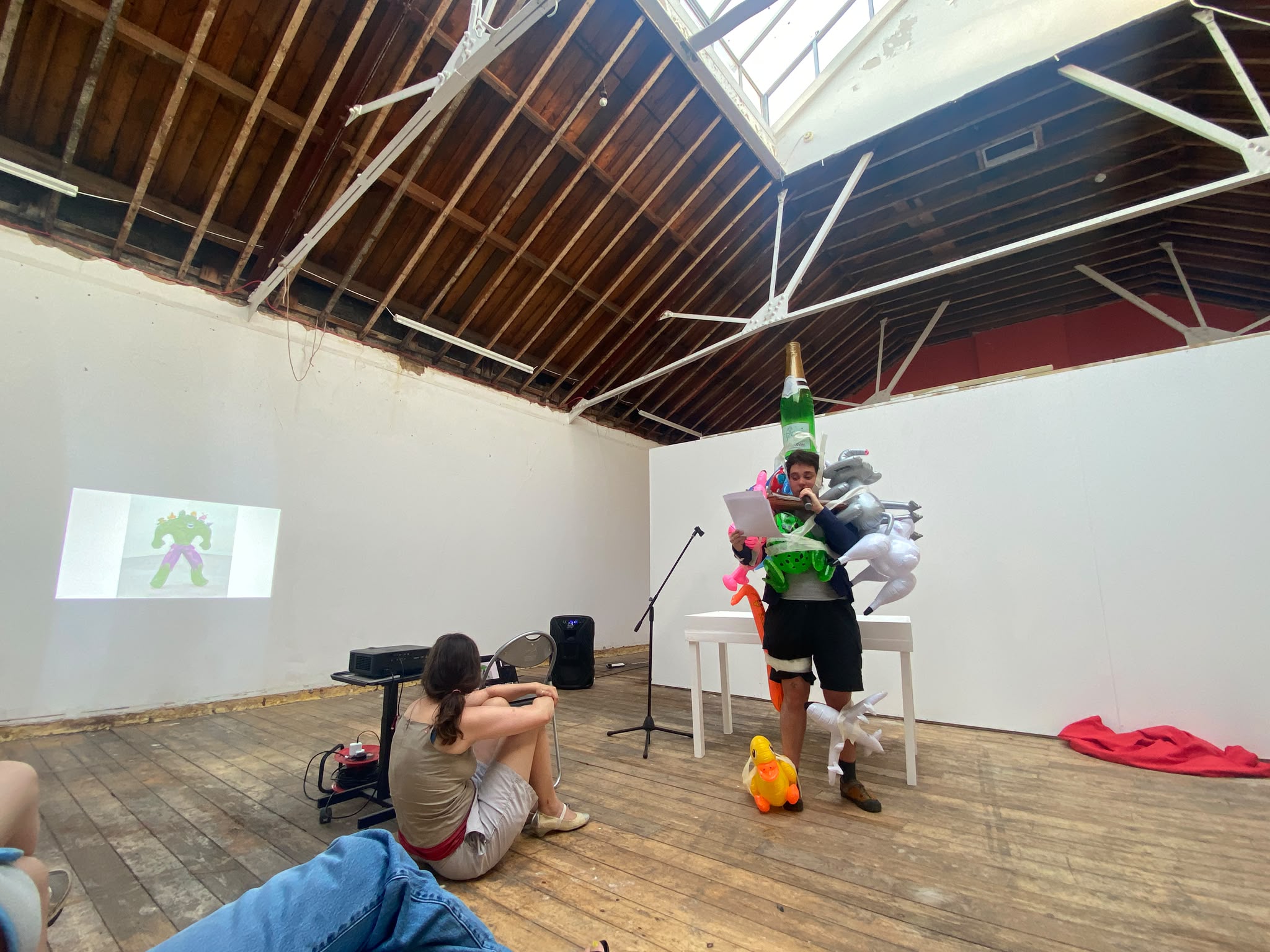
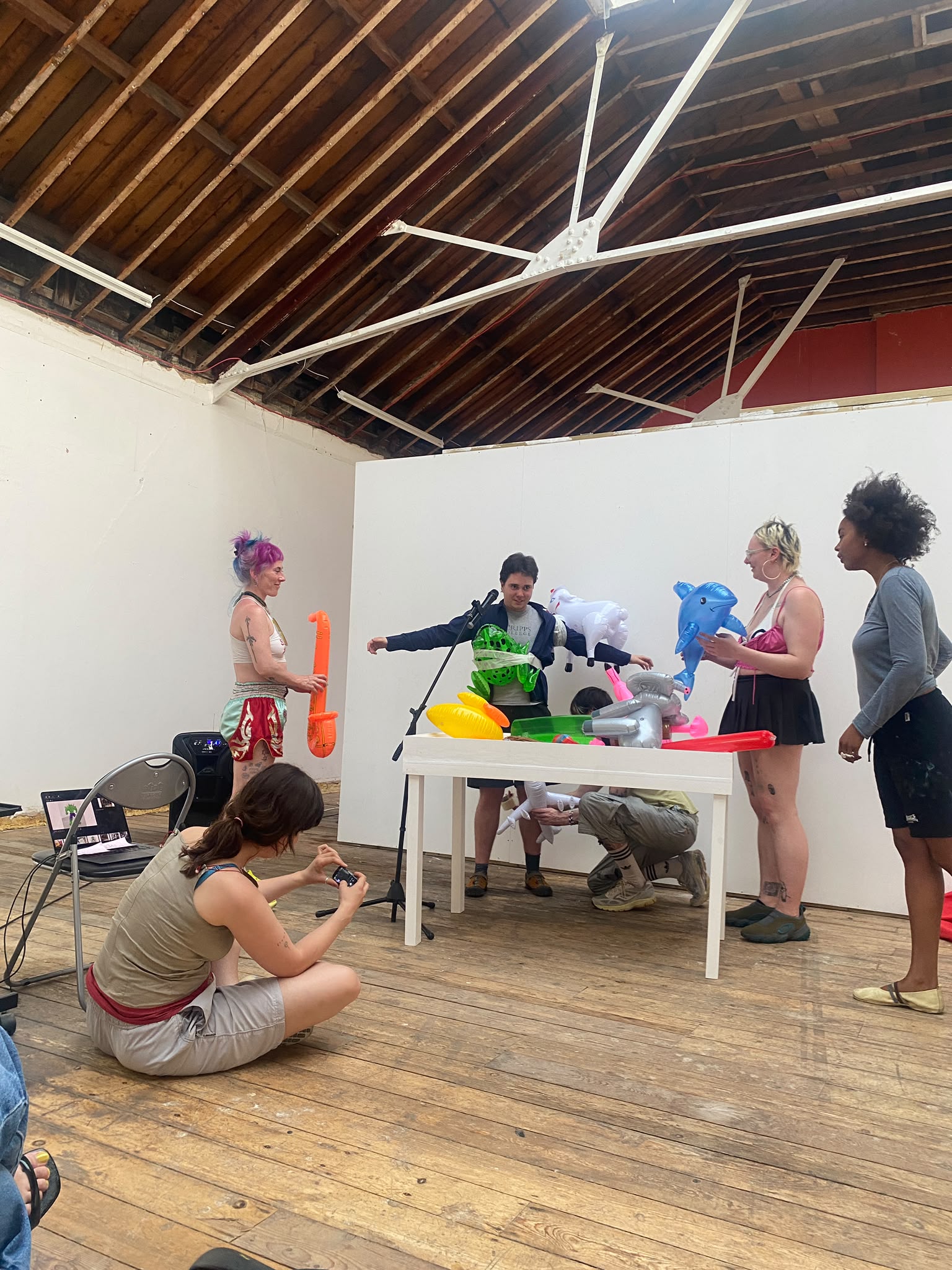
Last night I got to hear two incredible performance lectures from D Mortimer and Leo Bussi. In the first, Mortimer talked about influence, whirligig methodology, spiral dances, decomposition, disturbance and Genet’s play Deathwatch, while periodically strumming an electric guitar. It was virtuosic! In the second, Leo talked about his love for Jeff Koons’ Hulk (Friends) by telling the story of his falling for Koons after poring over art books in the GSA library and celebrating his work’s ‘real-fake performance’ and ‘sentimental horseshit’. We looked at ‘paintings which actualised what [Leo] hoped [his] work would do’, a version of abundance felt as emptiness, Andrea Long Chu’s definition of desire, metaphors of puncture, fantasies of ‘masculinity interrupted by attachment’, gender as citation, strength as atmospheric. He had the audience blow up a number of inflatables – champagne bottle, dolphin, yasssified horsie, parrot, frog, elephant, saxophone, caveman club, airplane, flamingo, duck – then strap each one to his body with duct tape. A great deal of ripping and balancing was felt and heard. He crawled to a hole in the floor to see what was underneath as I passed him the microphone, saying ekphrasis might be experienced ‘as the holes in the residency’s floor’. But just as the beach might not always be locatable beneath the paving stones, abundance isn’t always found under the residency’s floor – Leo said something like what he had seen down there was something of a disappointment. One thinks of a sort of virtual ekphrasis. For ekphrasis was in the air, a humming poem-to-come, even if the found objects could not be conjured to satisfaction. Other things I thought about: inflation and the economy, ecological readings of species coexistence on the human body (Hulk ecologies??), Leo as the angel of inflatables (in a sort of Antony Gormley, statuesque way), steroid bod as empty calorie capitalism, cuteness and kitsch as dramaturgies of gender, the politics of anthropomorphism. Leo concluded by reflecting on how we are more interested in looking at each other, in talking about art, than we often are in the art itself. And how that can be very specific, historical and contextual. In some sense performing his art object of choice, via a process of collage and becoming-object, Leo made us really look at how we look.
This event took place at The Writers’ Room in London. Check out what they are doing here.
(Unfortunately in the first half of the event I was too sun-dazed to take a picture.)
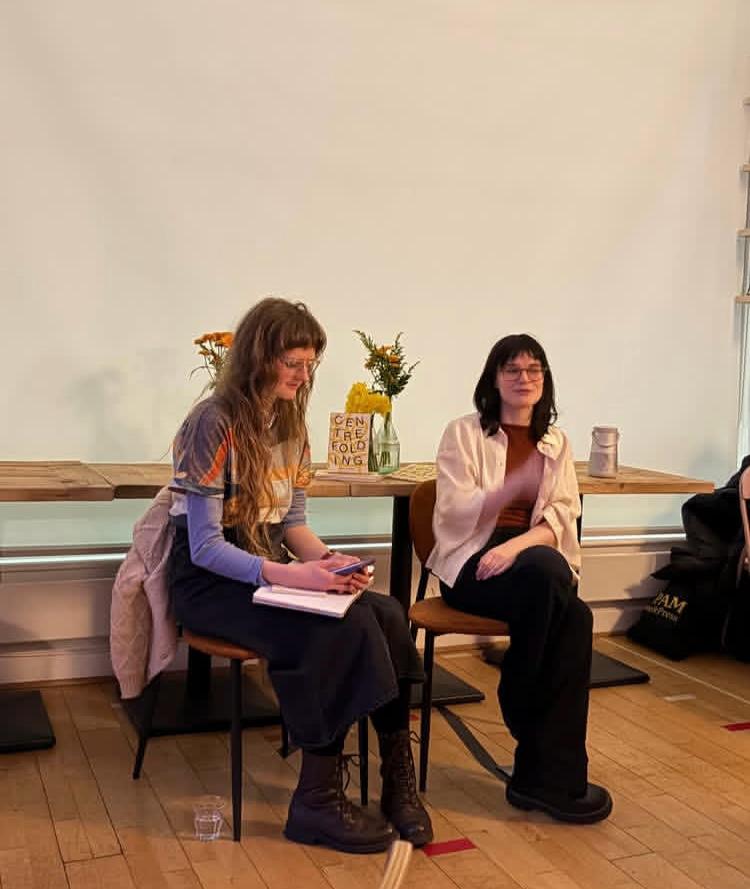
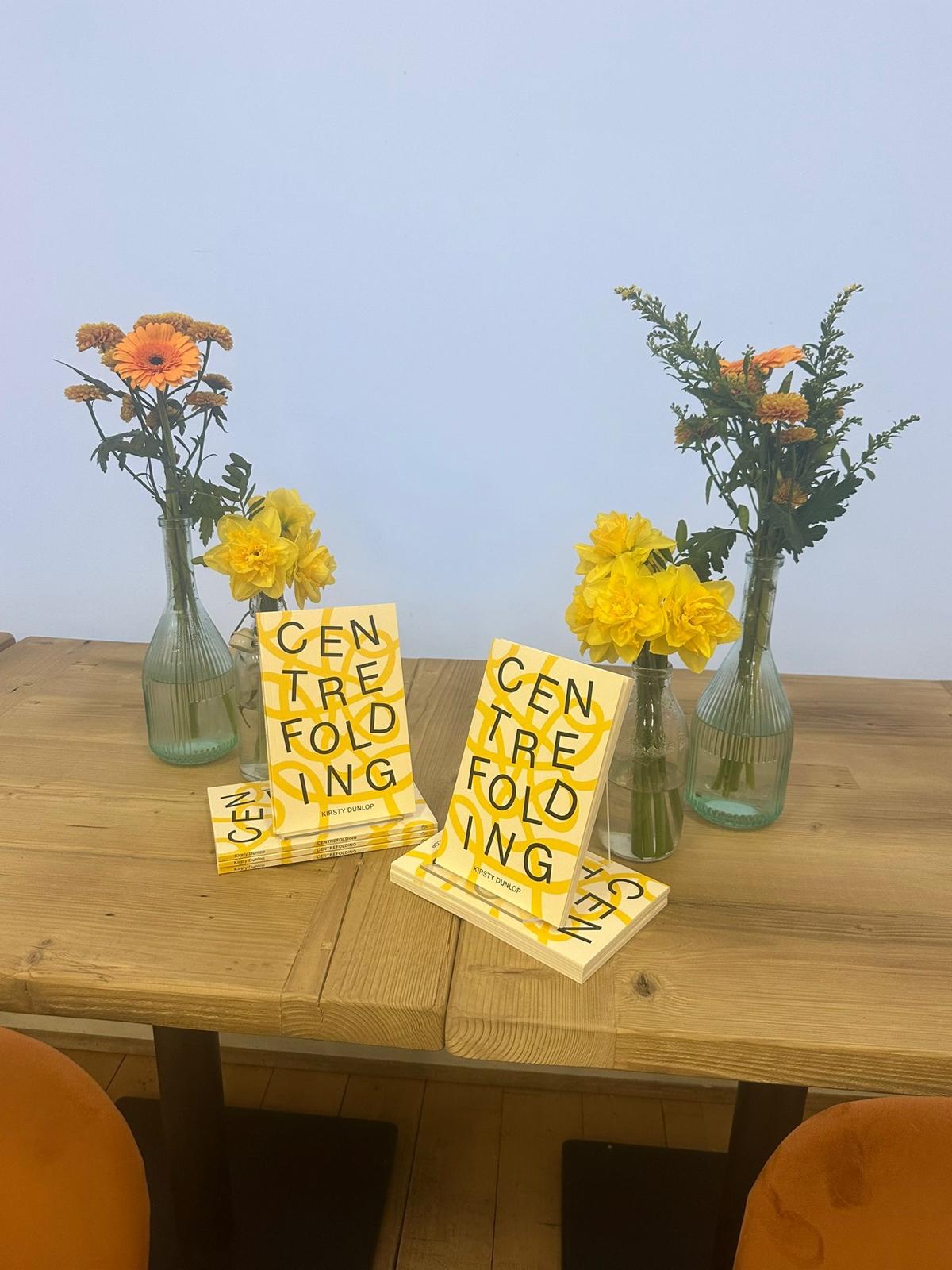
This is my introduction to the Edinburgh launch of Kirsty Dunlop’s Centrefolding (sincere corkscrew, 2026) taking place at Argonaut Books on 23 March 2026. Below you’ll find the audio recording.
First fold: picture the scene. You walk into a large building with metallic cladding and an enticing revolving door. Everything is atrium: echo, wide-panelled windows, open ceilings, flickering screens, a sense of upward levelling gesturing towards the reflective light of infinity. The acoustics are such that a phone call 30 metres away is audible, mixed in with the whirr of unnecessary AC, obnoxious public Zoom calls and the sound of bio-engineers cutting business deals over limp sandwiches. You sit down at a table because there are many tables, arranged with no discernible logic i.e. skew-whiff, chaos on wheels. You observe an apple core oxidising in the airless afternoon. Outside, another building is being constructed. Cladding going up, men in neon orange operating a crane, authentic cherry blossoms swaying beneath them. You split open the spine of a svelte yellow book that has been abandoned, seductively, beside the apple core. Against a black screen in the book’s near-centre, you see the universal sign for buffering, a loading terminal of found language. Certain words present themselves luminously over others: ‘chemically’, ‘error message’, ‘quadrupling’, ‘loitering’, ‘squeezing’, ‘piss’, ‘rose’, ‘ecstatic’, ‘kissing’, ‘a thrum continues’. A narrator levitates mysteriously from the spread before you. Was it this the voice who ate the apple? Such thought is interrupted by a man nearby, addressing something unseen on his laptop: ‘when you see the standard feedback field, what exactly do you mean?’ and then ‘in a sense what you are doing is a quantum stochastic unravelling’.
Welcome, everyone, to the Centre. ‘The dispersed rhythm of a wandering’, writes Lisa Robertson in Nilling, ‘— musical and conceptual — is what its folds conduct’.
This overhearing of the feedback field, the quantum stochastic unravelling, is the perfect threshold, the perfect fold, from which your encounter with this book commences.
Imagine this from the outside, seen at night, as our narrator describes it: ‘the Centre, glowing like an alien presence’.
What we are launching tonight is a remarkable achievement, a provocation, a satire, a first novella, a tenacious experiment, an alien escaped from the lab of Scottish fiction, a flight of fancy so daring its completion depended on a dare set by a senior employee of the actual Centre. Also known as: a stochastic unravelling of theory, praxis and IRL experience. Tonight, we are launching Kirsty Dunlop’s Centrefolding, published by the sincere corkscrew, a Glasgow-based small press founded in 2021.
A little about the author:
Dr Kirsty Dunlop is a multimedia writer, editor, researcher and musician based in Glasgow. She recently completed her Doctorate of Fine Arts in Creative Writing at the University of Glasgow, entitled ‘Emergent Gameplay, Emergent Essaying’ which explored the possibilities of hybrid New Media writing through a digital-born collection. She is Editor-in-Chief of SPAM Press.
Reading this novella is like slipping in and out of a wild stream of fantasies crowdsourced during a conference hosted by the Department of Emotions. And yet the world is so clearly that of our inimitable narrator, so wholly seen through their distinctive, sign-hungry imaginary.
Like the king of poststructuralism, Jacques Derrida, Kirsty Dunlop’s sign is in Cancer. And Cancers are known for their strong emotions. But the astrological isn’t the only sign we’re focusing on here. In his critique of the sign, Derrida sent any notion of the ‘centre’ into a chain of ceaseless deferral and free play. It is in this cascade of signification that Kirsty’s prose takes flight. Takes flight under the shimmering sign of Ali Smith’s sentences, Muriel Spark’s intentional loitering, the crush poetics of Geraldine Snell’s overlove and satirical flair of campus novels and workplace fiction in general — one thinks of Emily Segal’s Mercury in Retrograde, an autofictive account of working at a trend-forecasting startup, or Joshua Ferris’ Then We Came to the End, atale of white-collar workers at an ad agency, dreading the fate of unemployment during an economic downturn.
Tonight we are Centrefolding. Kirsty has written what Daisy Lafarge aptly calls a ‘future cult classic’, a line I can’t help but hear in Charli XCX’s voice in the way she sings ‘club classics’ and three times again for good measure. It had me snorting with laughter on the subway and choking on the apple of knowledge exchange and sin. I’m so excited to be here with you in the wonderful Argonaut Books to discuss the novella that captures economic precarity, friendship, solidarity, loitering and the neoliberalisation of the academy like nothing else. First up we’re going to have a performance from the amazing Kevin Leomo in collaboration with Kirsty and…the Centre itself! Then we’ll have a reading from Kirsty followed by some questions from me. We’ll open up the floor to your questions and finish on a final reading.
I’ll just introduce Kevin now.
Kevin Leomo is a Scottish-Filipino sound artist, researcher, and curator. He directs the sound artist collective Sound Thought and is one half of Project Somnolence with Maria Sledmere. He is a board member for the Scottish Music Centre and the Anti-Racism Observatory for Scotland. Kevin works as the Community and Engagement Manager for the College of Arts & Humanities at the University of Glasgow and Co-Director of the Creatives of Colour Festival.
6pm, 27th May – TEN YEARS OF SPAM Poetry Party, London, Old Queen’s Head – with Will Harris, Jay Gao, Nisha Ramayya, Mau Baiocco, Leo Bussi, Dom Hale, Crispin Best, Samantha Walton, Alice Hill-Woods, Maya Uppal, Denise Bonetti, Kirsty Dunlop. Ticketed.
7:30pm, 28th May – Is it Dirty?, Roland Ross 231 Northdown Road Margate – with Mau Baiocco, Henry Madd, Kat Cutler-MacKenzie, Harry Brooks-Kent, Vasilisa Forbes, Rosella Dello Ioio. Unticketed.
7pm, 29th May – Poet’s Prose #1, Housman’s Books, London – with Kirsty Dunlop. Ticketed.
7pm, 3rd June – Broken Sleep Books Showcase, Typewronger Books, Edinburgh – with Ricky Monahan Brown and Ian Macartney. Ticketed.
7:30pm, 10th June – Patch City: a poetry reading, SERF, 23-25 Wharf St, Leeds – with Jay Gao, Alycia Pirmohamed, Bonnie Hancell. Unticketed.
7pm, 2nd July – Second Space: a night of spoken word and music with Fuck This, Strangers Wave, Colin Herd, D.A.M., Medha Singh and James Flowerdew, Leith Depot, Edinburgh
Time and details tbc – 18th July – London
6:30pm, 6th August – Poetry reading with Valerie Hsiung at Good Press, Glasgow – with Lucille Ling, Lady Red Ego, Nat Raha, Nisha Ramayya, Valerie Hsiung
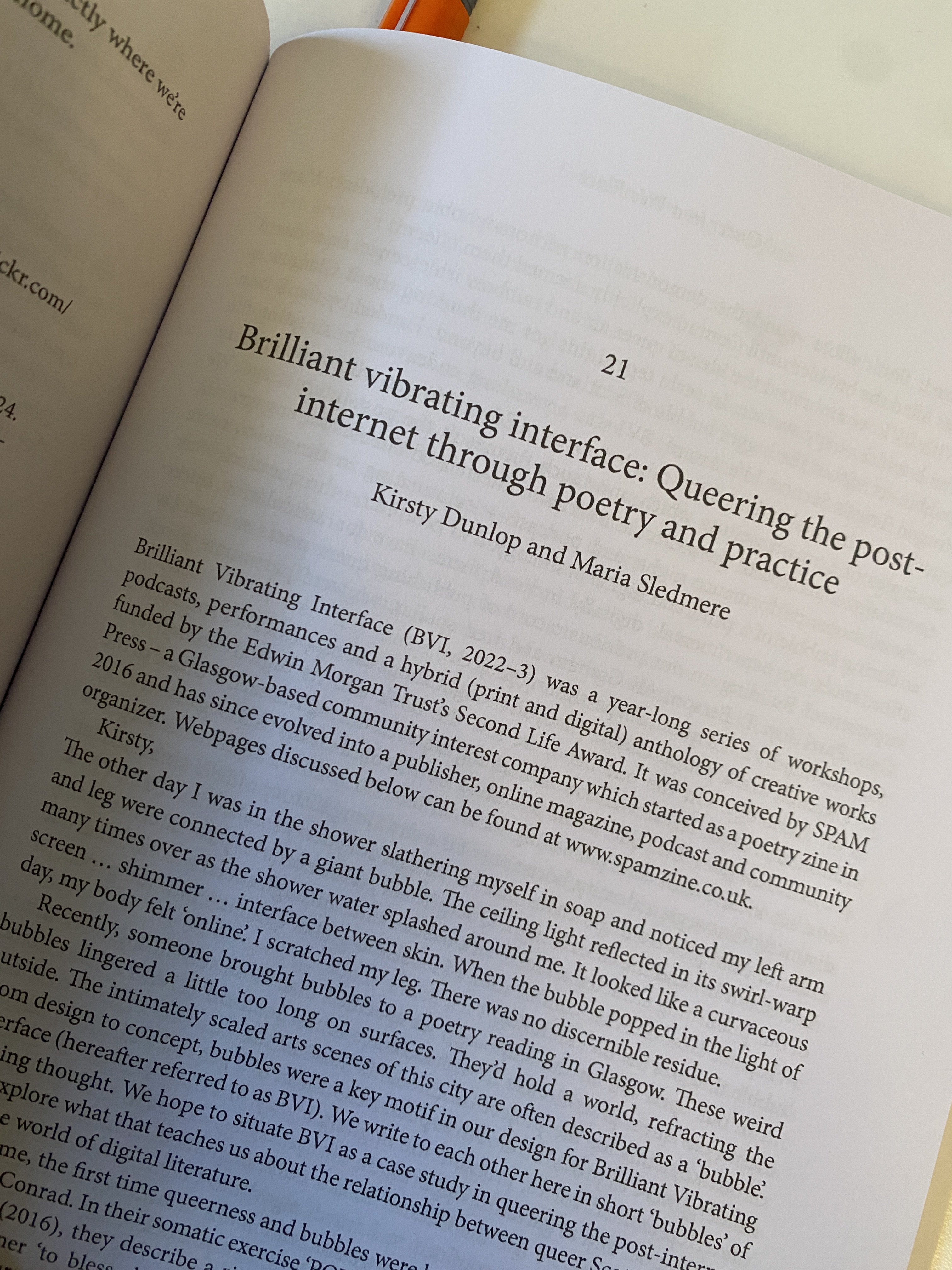
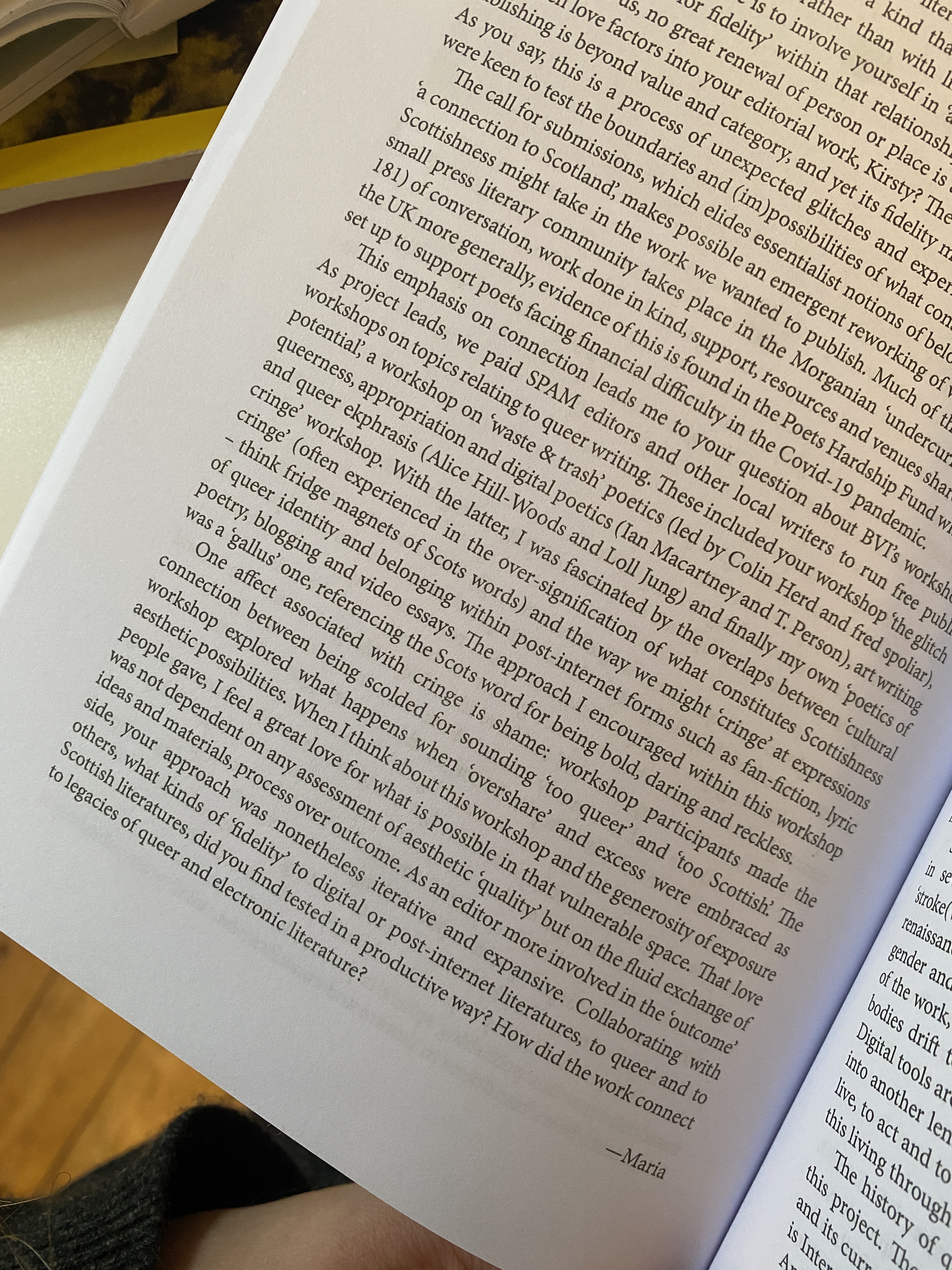
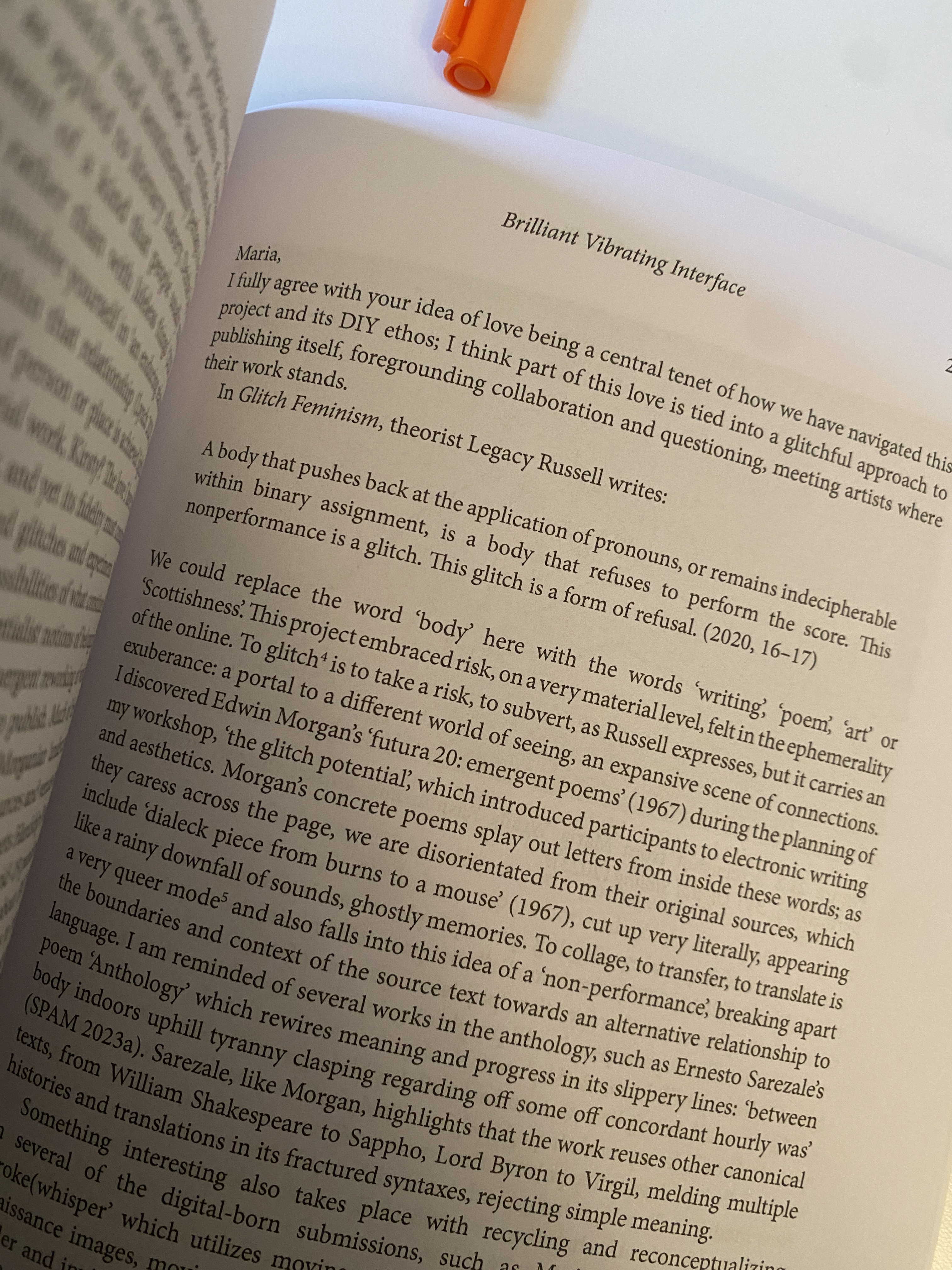
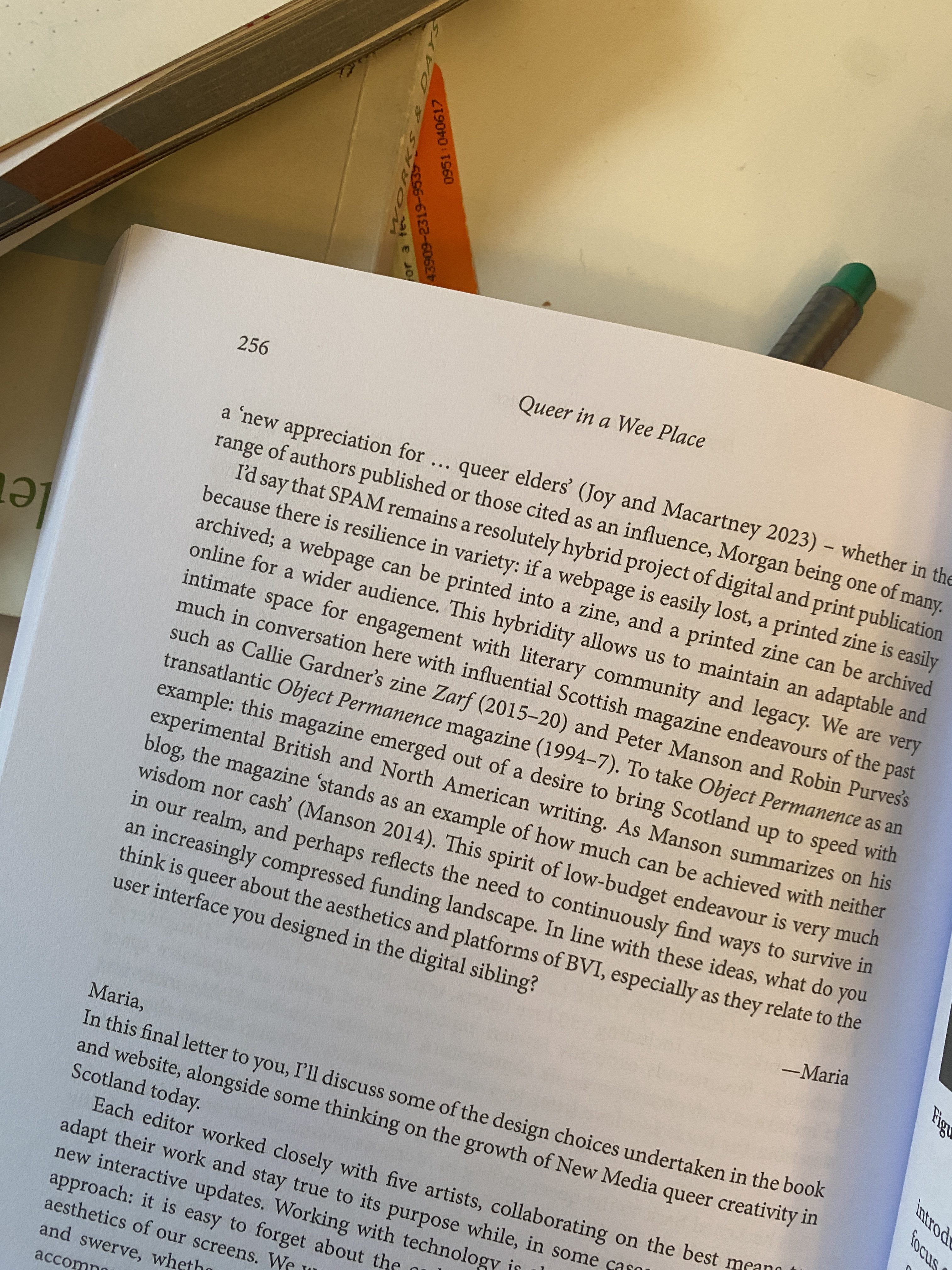
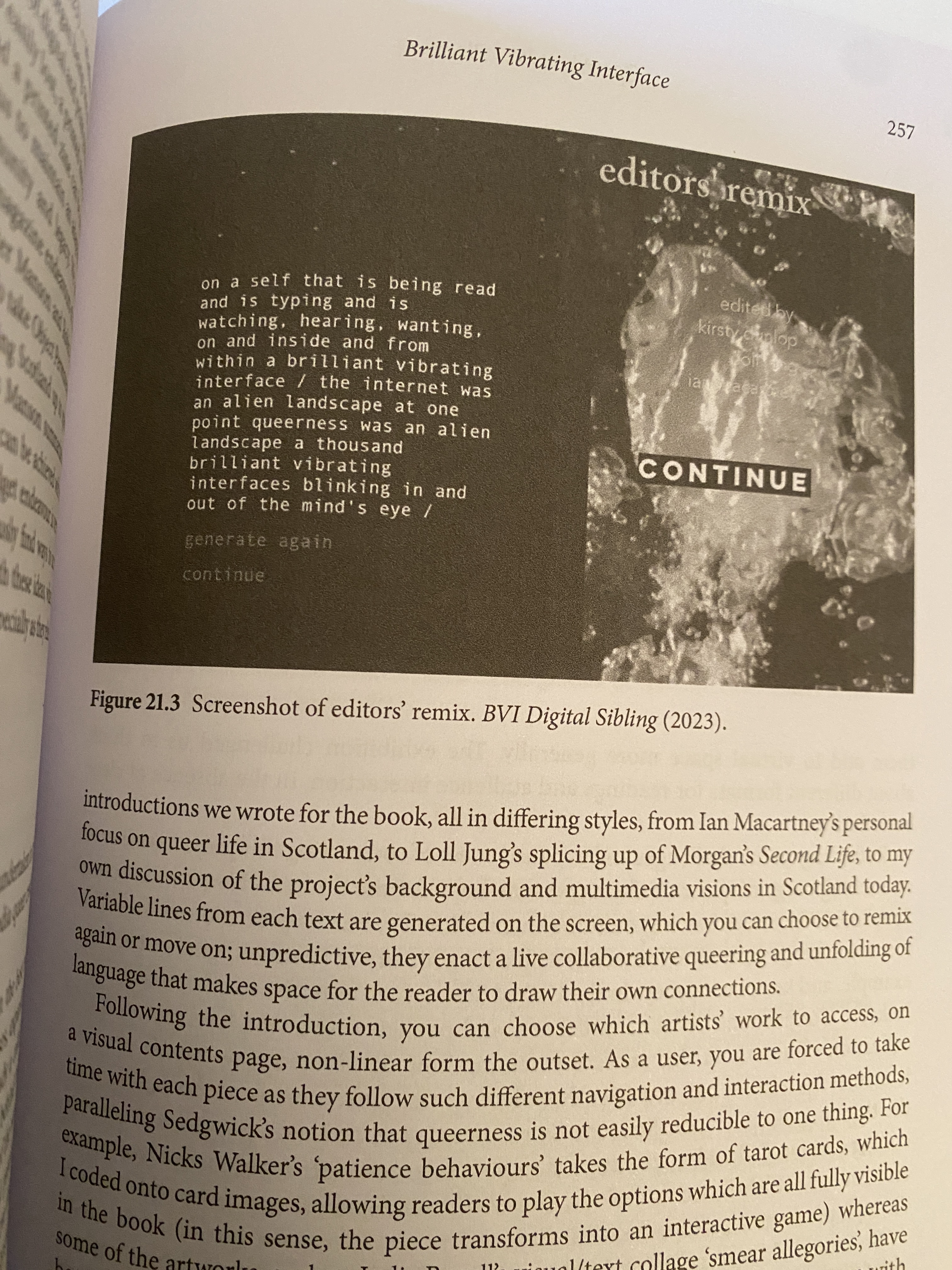
In 2022, SPAM Press obtained some funding from the Edwin Morgan Trust’s Second Life Award to run a year-long project titled Brilliant Vibrating Interface: Queering the Post-internet through Poetry and Practice. My co-investigators on the project were Kirsty Dunlop (SPAM’s current editor-in-chief), Alice Hill-Woods and Loll Jung, with Ian Macartney later joining to co-edit our print publication. We squeezed a lot of activity out of that money: community workshops online and in Glasgow, a few reading events, print publication, ‘digital sibling’ and physical installation, podcasts and an online magazine interview with contemporary sonneteers.
Recently, Kirsty and I wrote an epistolary chapter reflecting on the project and its significance in terms of identity, inequality, belonging, poetry scenes, queerness, Glasgow and the labour of love that is small press publishing. In our chapter we talk about the format of the project, Scottish literary scenes from the nineties to present day and the challenges and rewards of moving between print and digital (what we call SPAM’s ‘resolutely hybrid project’). We explore in more depth the poetry and visual art which found a home in our project and proffer up some poetics for how to think about queerness in the context of ‘small nations’ such as Scotland. This takes us everywhere from CAConrad’s bubbles to Legacy Russell’s glitch feminism to Edwin Morgan’s sumptuous strawberries.
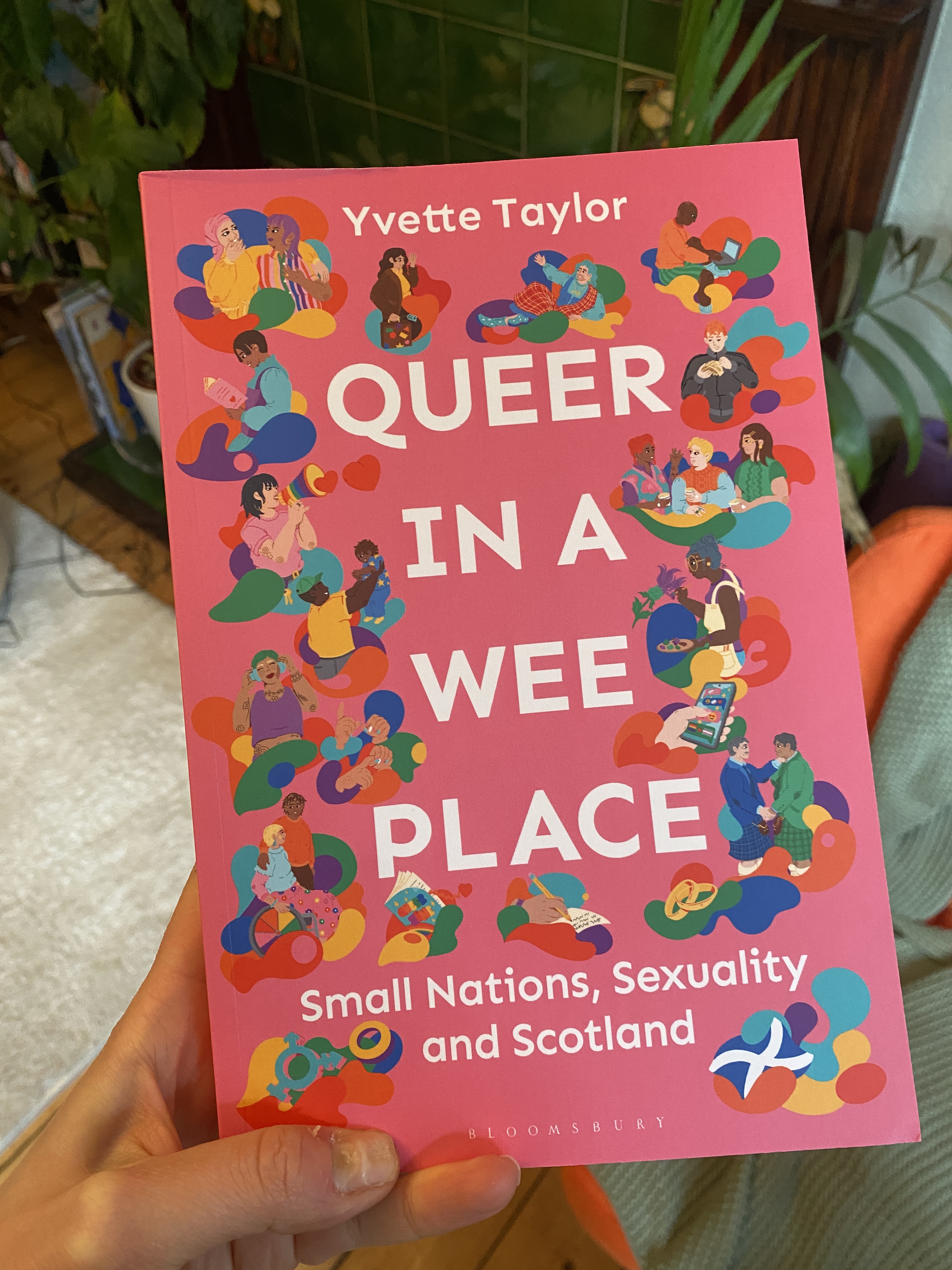
The chapter is out now as part of an anthology, Queer in a Wee Place: Small Nations, Sexuality & Scotland. To quote from the publisher’s website, the book ‘explores identity, inequality and belonging in animated conversations about how queerness moves through place – and how place, in turn, shapes queer lives’. Queer in a Wee Place contains chapters written by researchers of many disciplines and practices – from sociologists to poets – on subjects ranging from the utopic gaze on queer film to legacy and queer elders, disabled queer student experiences of higher education, Scotland’s menstrual landscape, hate crime and queer provincialisms.
The book is available in paperback form for what is a very reasonable price (for an academic book!) from Bloomsbury. You can ask your library to order it in for you 🙂
You can also read it for free via Bloomsbury’s Open Access service here.
Our archive of materials relating to Brilliant Vibrating Interface, including workshop handouts, podcast episodes, interviews and the online exhibition (what we called a ‘Digital Sibling’) can all be found at http://www.spamzine.co.uk and on the EMT website.