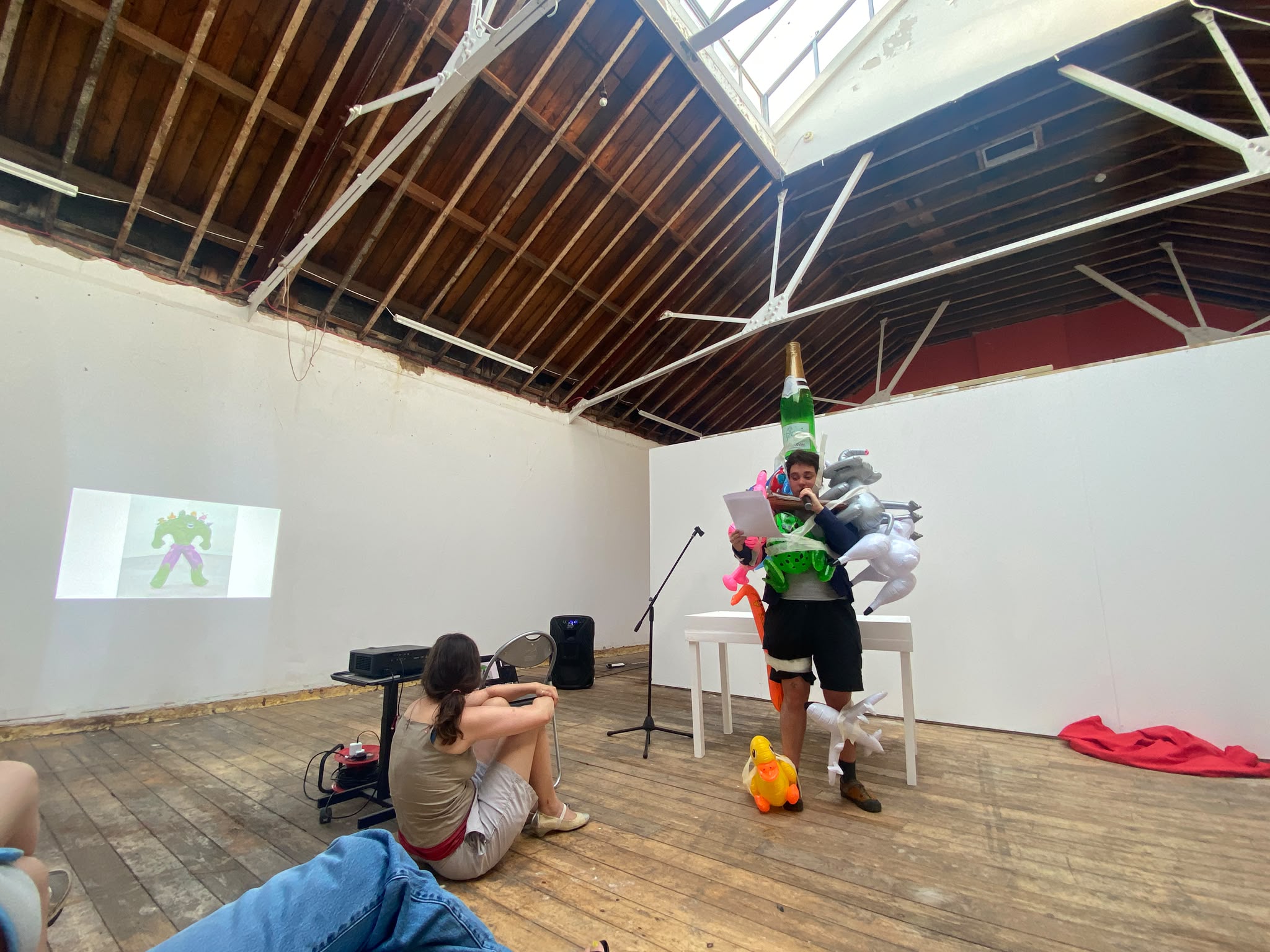
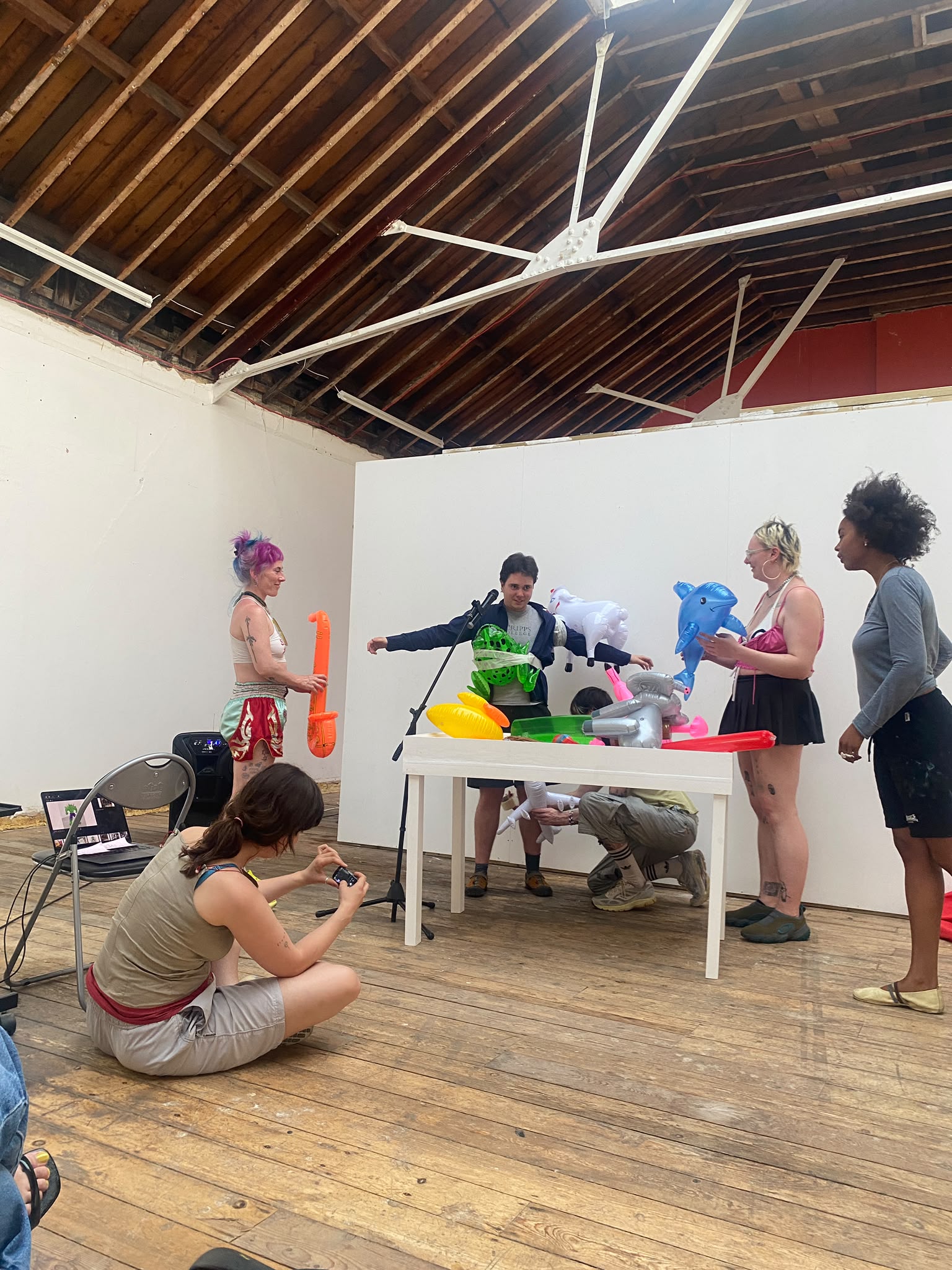
Last night I got to hear two incredible performance lectures from D Mortimer and Leo Bussi. In the first, Mortimer talked about influence, whirligig methodology, spiral dances, decomposition, disturbance and Genet’s play Deathwatch, while periodically strumming an electric guitar. It was virtuosic! In the second, Leo talked about his love for Jeff Koons’ Hulk (Friends) by telling the story of his falling for Koons after poring over art books in the GSA library and celebrating his work’s ‘real-fake performance’ and ‘sentimental horseshit’. We looked at ‘paintings which actualised what [Leo] hoped [his] work would do’, a version of abundance felt as emptiness, Andrea Long Chu’s definition of desire, metaphors of puncture, fantasies of ‘masculinity interrupted by attachment’, gender as citation, strength as atmospheric. He had the audience blow up a number of inflatables – champagne bottle, dolphin, yasssified horsie, parrot, frog, elephant, saxophone, caveman club, airplane, flamingo, duck – then strap each one to his body with duct tape. A great deal of ripping and balancing was felt and heard. He crawled to a hole in the floor to see what was underneath as I passed him the microphone, saying ekphrasis might be experienced ‘as the holes in the residency’s floor’. But just as the beach might not always be locatable beneath the paving stones, abundance isn’t always found under the residency’s floor – Leo said something like what he had seen down there was something of a disappointment. One thinks of a sort of virtual ekphrasis. For ekphrasis was in the air, a humming poem-to-come, even if the found objects could not be conjured to satisfaction. Other things I thought about: inflation and the economy, ecological readings of species coexistence on the human body (Hulk ecologies??), Leo as the angel of inflatables (in a sort of Antony Gormley, statuesque way), steroid bod as empty calorie capitalism, cuteness and kitsch as dramaturgies of gender, the politics of anthropomorphism. Leo concluded by reflecting on how we are more interested in looking at each other, in talking about art, than we often are in the art itself. And how that can be very specific, historical and contextual. In some sense performing his art object of choice, via a process of collage and becoming-object, Leo made us really look at how we look.
This event took place at The Writers’ Room in London. Check out what they are doing here.
(Unfortunately in the first half of the event I was too sun-dazed to take a picture.)
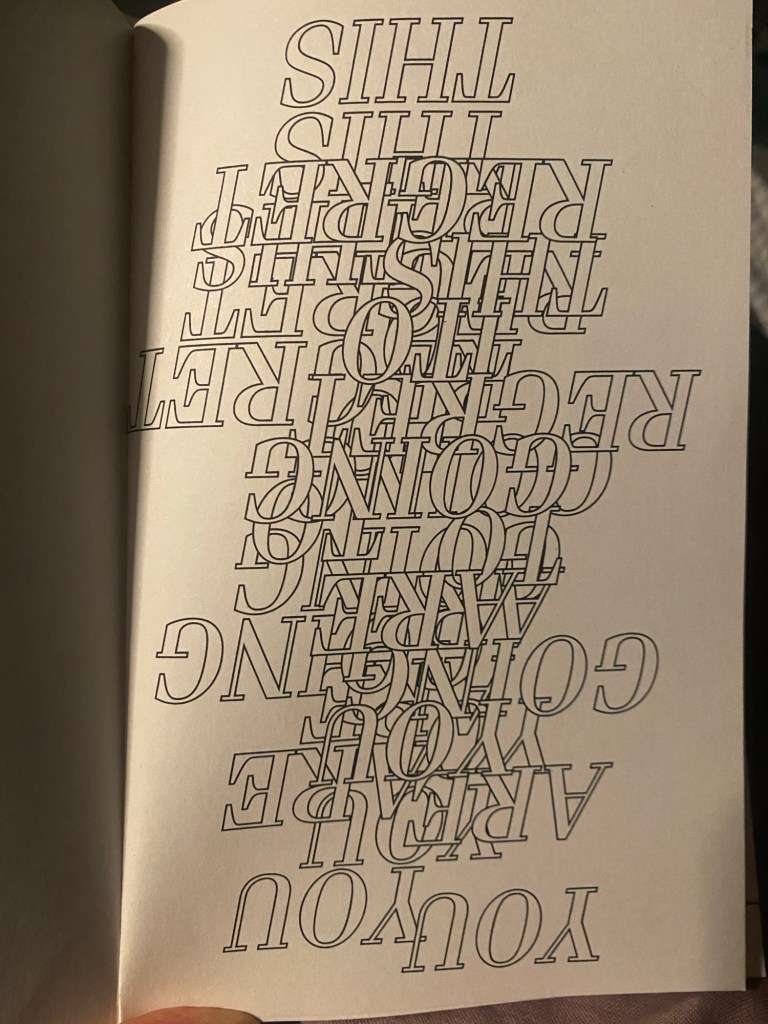
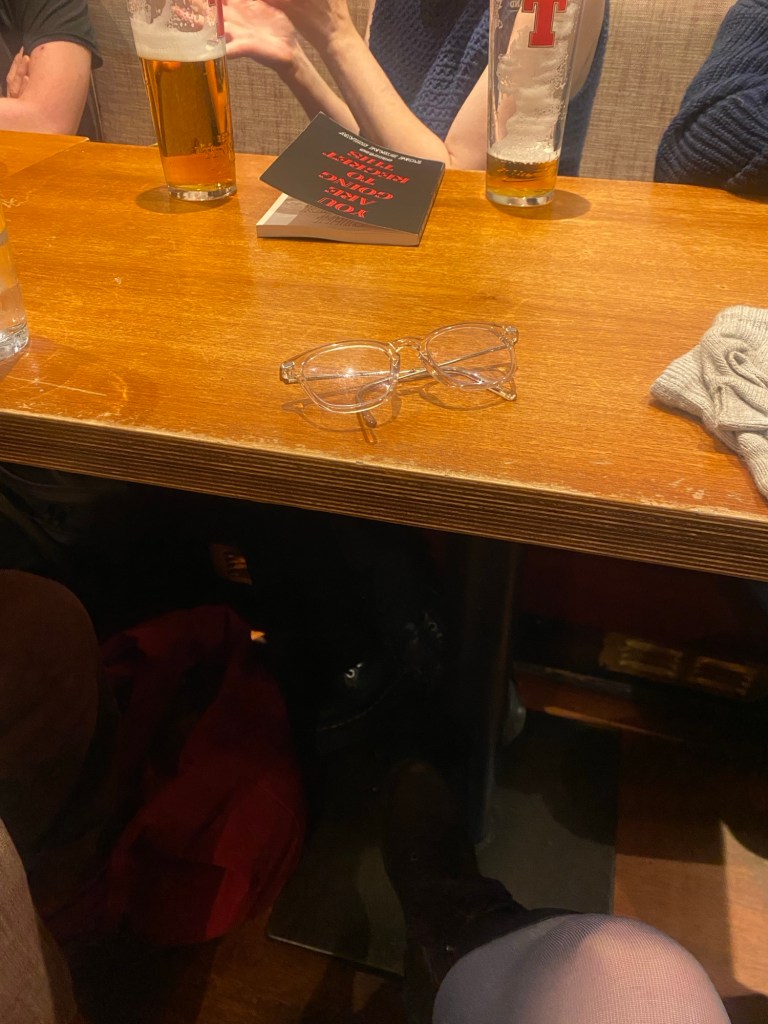
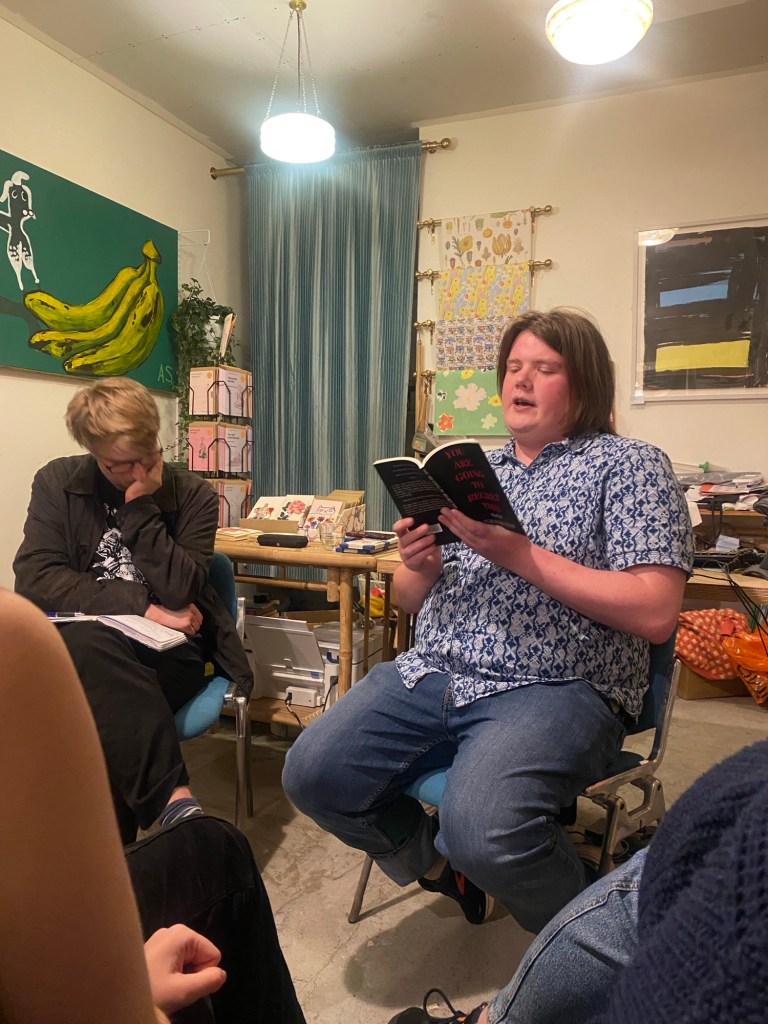
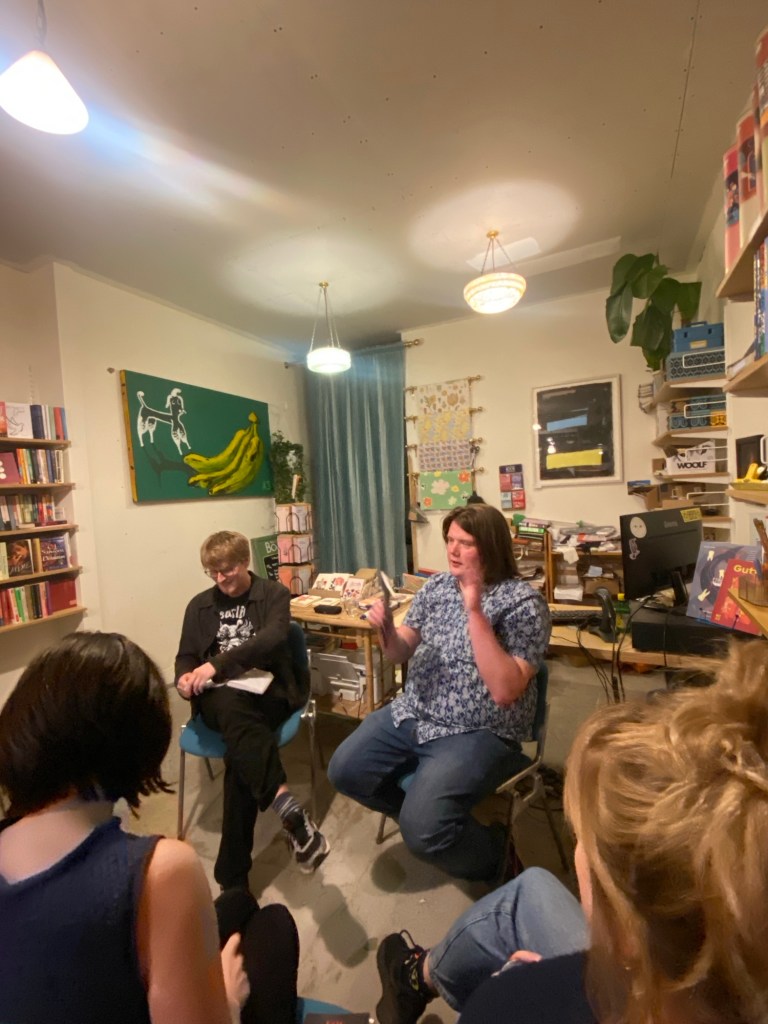
Tonight was the book launch for Tom Byam Shaw’s new short story collection, You Are Going to Regret This. Despite Storm Amy, Mount Florida Books was packed which is always so good to see (stay tuned as we’ll hopefully have another SPAM launch there before the year is out!). Tom read some pieces from the book — extracts from ‘Retail’ and ‘Arcana’. In conversation with Ian Macartney they talked about the New Weird, monstrosities and cannibalism as metaphors for capitalism, the world falling apart while people shop, continuity vs cataclysm, hauntology, real stories, Aberdeen, Glasgow, the Anderston motorway underpass (also a soft spot for me though I’m also partial to the Cowcaddens). They talked about a time when the Aberdeen open mic scene was so saturated there would be like seven different nights to choose from and regular performers would become minor local celebs. The shaping of each others’ work (both were members of the Re-Analogue art collective). At one point the word nice was said in a spiralling, elliptical comic-sweet way — I think they were reflecting on earlier days of friendship — and Katia was like this is nice ! bringing us into the present, that’s the point. The book looks great and sincere corkscrew really pulled a good number on the design. It will probably lure you into the basement which will smell of brand new trainers and you will have to confront something terrible. Everyone kept saying ‘for fans of Alison Rumfitt’. Yeah!
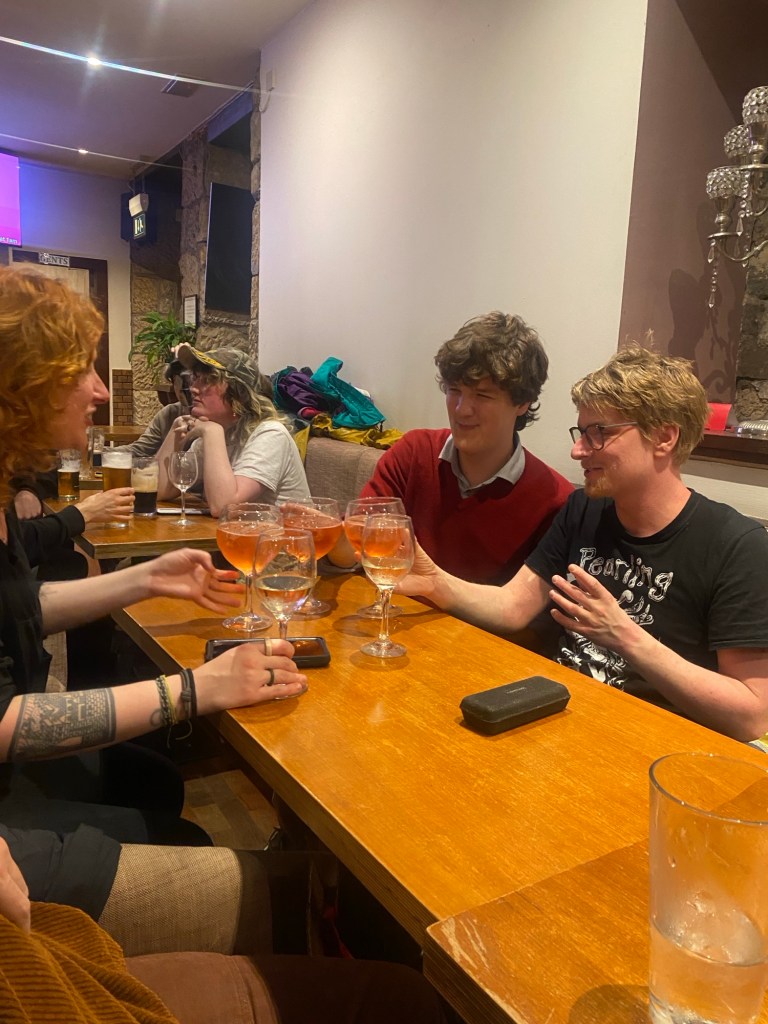
Afterwards we bandied out to The Ivory Hotel and with key questions bundled from some poetic eavesdropping of K’s café memories, I made people talk about the what and why of poetry, lifting these questions wholesale from said memories. Maybe having ‘a night off’ from poetry put me in this mood. Thanks to all who contributed. Everything was Guinness-flavoured and first thought.
J., Z. and K. shared their childhood guinea pig stories and we swapped anecdotes of encounters with rats (at home and in the workplace). The sorrow of a tiny animal curled around the absence of another.
Tonight I wore what can only be described as a billowing tent and cycled in the rain to the SPAM x sincere corkscrew AFK event. Summer is over, sorry. The newish Away from Keyboard series has so far featured poets-poets-poets — local and visiting — with some exceptional forays into prose. Tonight’s affair was premised more on the prose-y variety, with flash fiction, short stories aplenty, but also music and poets reading to music. A London poet recently said all the poets are now doing ‘sonic poetics’ and this trend has made its way north. I’ve been wanting something more durational for a while. Longer readings that feel like a proper ‘set’. Having sound in the mix trains us to listen longer because we are listening beyond listening for ‘meaning’. This event was set up nicely so that the first few performers did their punchier sets and then the final two were longer. I wasn’t involved in organising this one so also quite nice to just sit back a bit.
First up was Anna Walsh. My first time seeing them read after much hype from Kirsty over the years. Their short story pamphlet Stag Do / Fantasy Hornjust came out with brand new London-based indie, Ssnake Press. Anna read a piece set in PureGym, ‘the best spin class in Shawlands’. It was funny, closely attuned, turning a sharp lens to the ennui and im/possibilities of desire, and made me think about the gym as a terrain of fantasy triangulated by disgust and expenditure. A toxic combination that is fun to sublimate through multitasking on the StairMaster, whether you are sending emails or texting e-girls. The observational plane of fiction would then cut up into self-reflexive moments of becoming-object. Here are my thighs. They are moving shapes. Sweaty hair. Here is the screen showing a beach. The pink disinfectant spray. In my notebook I wrote: What can you trust of how human relations conspire in the endorphin farm?
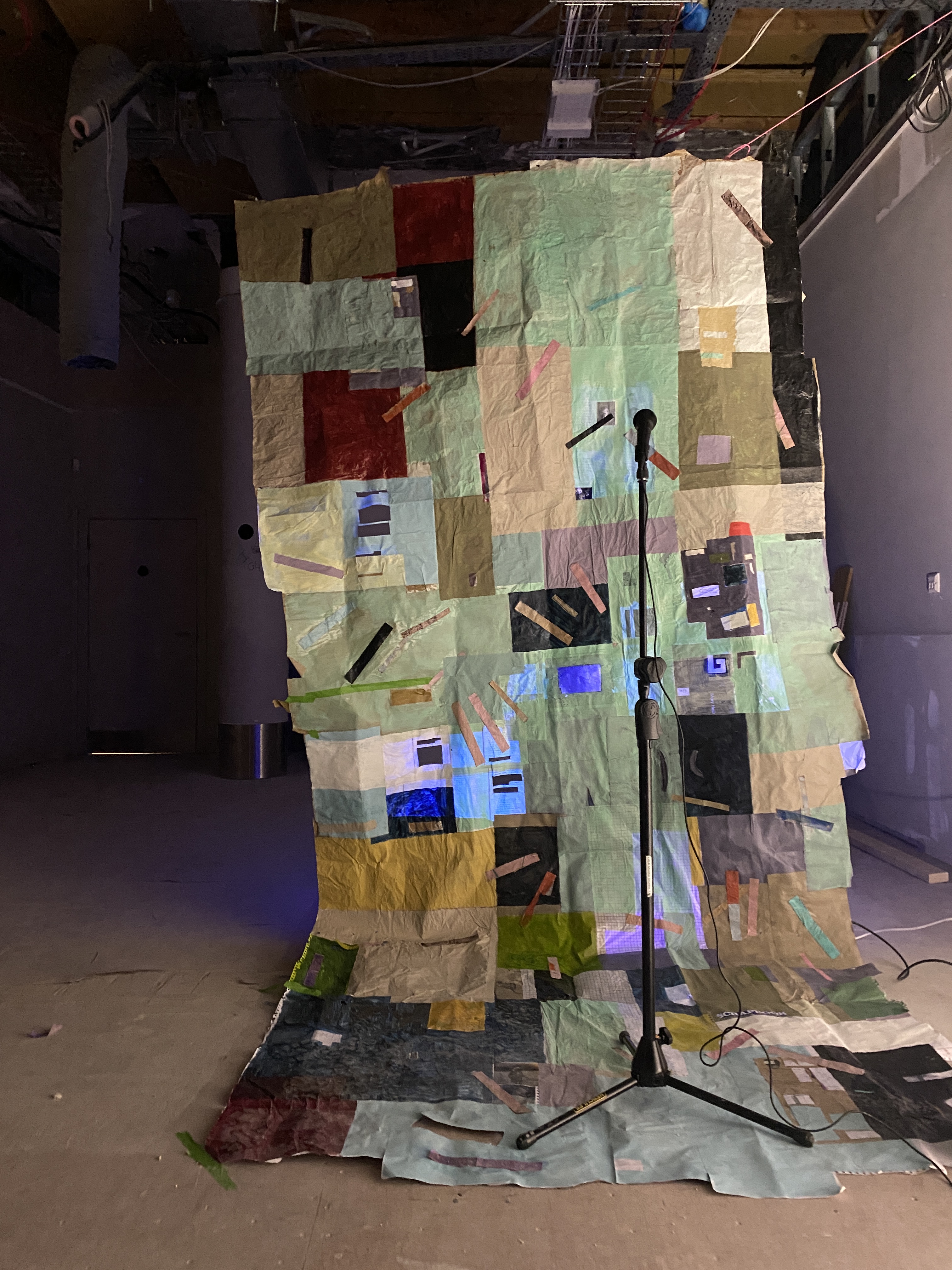
Sean reads with a beam of light splitting the room
Anna’s reading was short and sweet, followed by the blazing Tom Byam Shaw who delivered some hits from the cesspools of late capitalism. A disturbing anecdote featuring a licentious coworker at Footlocker. The reterritorialising of terror as gender reveal party… ‘We have a gender…it’s a war!’. A story about Chernobyl Cat Girl at the rave, ‘a party without respite or rest’. These are fictions which tremble with the hurtling premise of assured combustion. Tom’s book is coming out soon with sincere corkscrew. Launch at Mount Florida Books on the 3rd October. Following Tom was Sean Turner McLeod. Nobody knows if they have ever heard Sean read before. His author photo definitely wins best prize (if you didn’t see it, he’s standing in a picturesque river looking fierce af, exhaling dragon-quantities of vape smoke). He has been published ‘widely and discreetly’ and his work is great, witty, delivering its critique in lashes of sardonic commentary on everything from the gentrification of Glasgow to self-hating ghostwriters, poverty tourism, the Sunday night tv spectre of our Scottish childhoods, Neil Oliver, whose ‘voice made you drink’ (intone that darkly). Sean is good at verbal sparring and he essays with ease around many things vivid, for instance, the ‘controversial’ Joan Eardley painting of a male nude. Sean, I hope we will hear you read more!
Ian reading playlist poem in Xiu Xiu tee. Poets drinks of choice: IPA, tap water, whisky
After a break we had Ian Macartney, cohost of the night, deliver a virtuosic list poem about playlists. A smart, discursive cascade which was hallmark Macartney, traversing pop culture, geopolitics and counterfactual plot twists of recent Scottish history. One of the first lines was ‘The playlist is a commons’. Ian is a true lover of songs and the anguish of how much love for the playlist is distorted by the cynical, algo-ploy of subscription profiteering comes across in the poem’s argumentative rivulets and sparkle. It got me thinking to how so much of this blog used to be ‘playlist posts’ where I’d diarise lightly around a playlist, as a way of marking time. At some point, I fell out of love with the playlist form. Too long, sprawling and tantalised by algorithms, I lost the ardour for ‘looking’ that precedes any possible curation. What then soundtracked my life since I stopped making monthly playlists? An album, or a single song. So how did that transform the flow of time itself? Did I get ‘too old’ for playlists? There was a loud tone. It was found resounding in everything. Summer’s faded peach. Plaster peach. Crooning afternoons. This one plucked lyric. Is that true though? I remember having a collaborative playlist (‘E-WASTED’) for my 30th birthday party and on the night, the pub wouldn’t let us turn it up loud enough to hear it. But we played it anyway, all 24 hours and 54 minutes, knowing it was there, knowing we’d never get through it. Registering time in its variety. I wrote in my notebook: Once the modal curation of the playlist was a way into writing but then I stopped thinking of songs in their lily pad potential to cross the river of whatever mood or walk you were caught in. So what, did I wear the songs instead? I let them wear me out and I wore them to death. The songs were hot freaks! Ian’s playlist poem was a poem of nowness, enacting its ‘repetitive pattern in space’. I heard a girl downstairs shriek ‘Bye, love you!’ and thought — that’s one for the playlist. Add ‘Bye, love you!’. Midway through the reading, Ian holds up a piece of paper revealing an obscure, eleven-sided shape. I hope the mathematical reality of the poem is some kind of angel number squaring of 11 and for the playlist to transform from anaphoric placeholder to the reflexive imperative — play [the] list — as you wish. Start the poem. Perform. An eleven-sided playlist for being born again. For this to be a gesture of love, obviously. & ofc, fuck Spotify – tho I have spent over half my life listing songs on its lifeless interface.
Maddie reads!Zeo and viola!
Following Ian, Madeleine McCluskey of Big Red Cat zine read some short stories with a fairytale flair. There was an island setting, ‘spindly earrings’ and ‘menthol cigarettes’. A girl who dies. Friendship, hunger, ‘a burrow formed where lunch ought to be’. I thought about the cruelty of fiction and how we must die and plotting towards endings and hunger as a grammar of prolonging. A few performers this eve list 1999 as their d.o.b. in the author bios and it got me thinking to what a fin de siècle aesthetic might be like. I wouldn’t say anxiety was a running theme exactly. Neoliberal hell obv. But maybe an archipelagic consciousness of hopping between — something about working with what is shorn up amidst so much erosion [more thoughts needed]. Elsewhere supplants elsewhere’s interminable now. We had another break then Zeo Fawcett did a set of live viola playing with backing tracks and singing. He is so so talented and the songs were unique and compelling, shifting the tone of the evening. He had this story about missing out on hanging outside Boots being an emo because of having Gaelic singing lessons as a teenager. Sometimes I wish I’d had the Gaelic singing lessons instead of hanging outside the Odeon being an emo. There was a song called ‘Feeling really impermanent right now’. Later, I start to identify too much with a rain drop running down the window in a memory of a bus window in a 00s tv show.
Charlie & Texture Texturescattered poems & tartan carpet
Introducing Charlie McIlwain to his Texture Texture outfit, Ian attests to the success of their connection, claiming that ’email is the way forward’. Honestly not enough people in the room questioned the boldness of this claim. I want him to be right about it though and briefly I parenthesise all communication to the epistolary promise of endless more soons like the swooning glut that would end platform capitalism and reunite us with wild cognition, in just enough time to save the world. For now, this chance pairing of Charlie and Ian will do. This is a fucking great set of surreal, whipsmart k-hole cantos delivered with register switch ups that surprised at every turn. Hilarious and devastating, with fitting improvised drone from Ian. I thought of Spicer’s radio and how there would be aliens in the ancient walls of The Doublet dictating this through the frequencies of wave machine. One regular punter from downstairs popped in by accident and stood in mesmerised bewilderment (nah, rly he was just giving glaikit) before turning back and losing the opportunity to have his head blown off by poetry. We had ‘white fire violetted daddy’, we had ‘sleep is just cloth’, ‘you can use your ass like an appliance’, we had literally two pairs of glasses, ‘stop killing Lorca’, imploring ‘the language is in trouble’ folded into ponderings borrowed from W.S. Graham, we had ‘Hegel ate a crow’, ‘the furniture will not endure perception’, we had Brian Wilson and John Clare ‘and shall I know that sleep again’. Listening was like trying to trip talk with someone who is not tripping and in the duration of that performance (idk 30 mins or so?) I let myself (what comprises brain matter of synapse and syntax) be scrambled by signifying mayhem and enjoyed every minute. Go buy Charlie’s Elegy [Model Interaction Trend] now you fools!
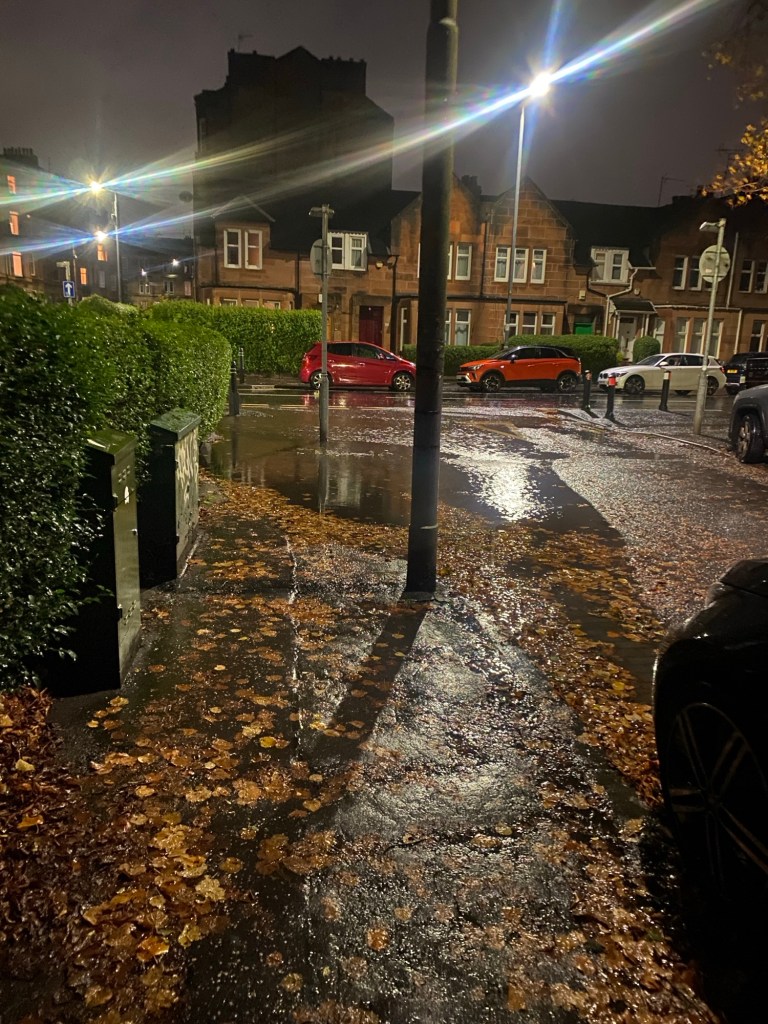
When I found the remnants of some kind of pop-up carnival show on Kelvin Way, cycling home, dis-articulated along the road in luminous obstacle, I knew I was still riding through Charlie’s poem.
~
Thank you for reading! This write-up is for K. and anyone else who couldn’t make it – plus I forgot to record the audio for this one sorry! but one day we will upload the mp3s from AFKs of yore…and this one will be remembered in the hearts & minds of all who attended… xx
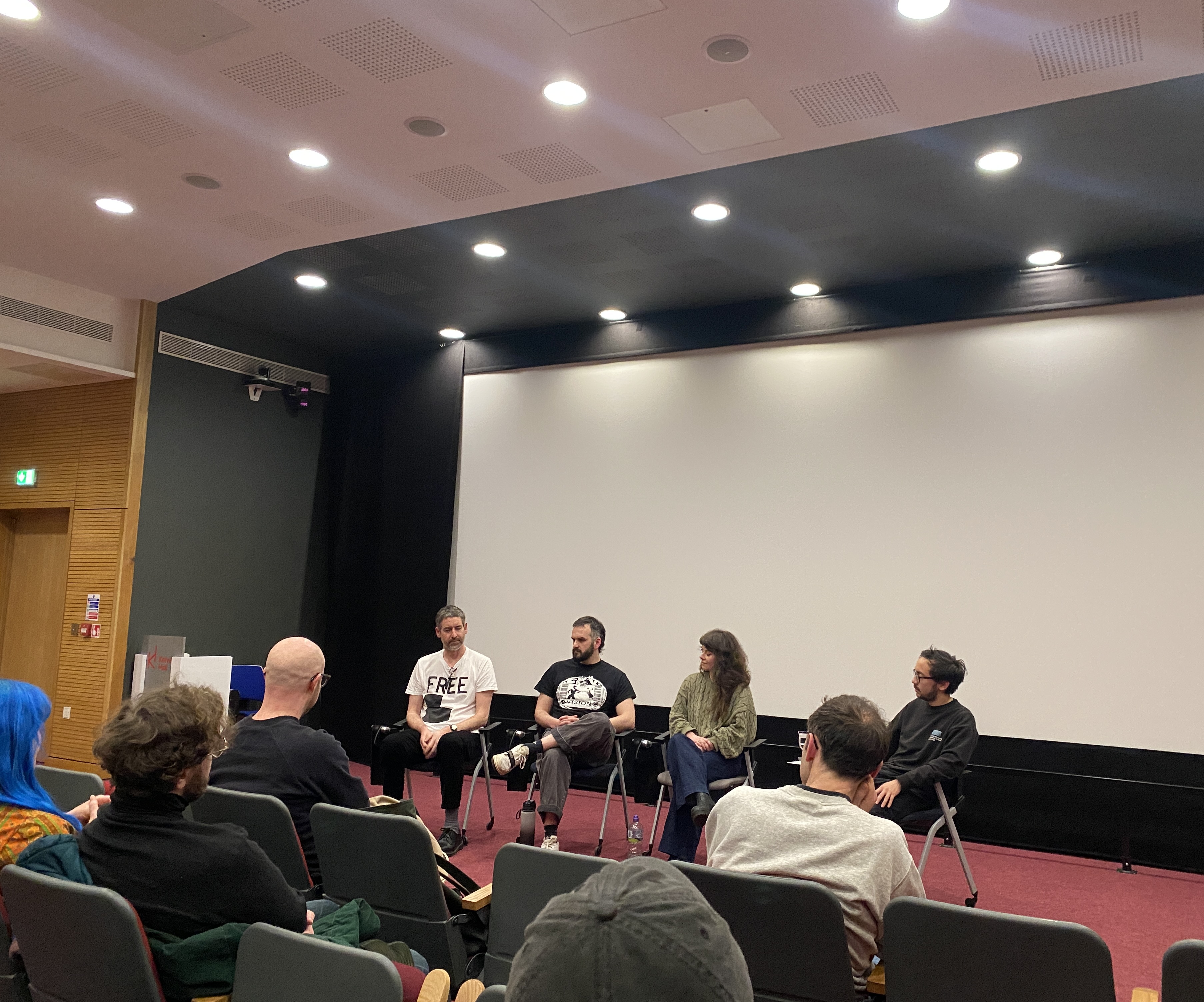
(From left, Scott Myles, Lewis Cook, Suzi Cook, Kevin Leomo)
Last night I went to the Thinking Culture event: ‘I Dream of Wires – Film Screening and Panel Discussion’. It’s this film about modular synthesisers and the people who build, use and ultimately love them. Some people collect dozens of these instruments and get scared to record. The studio assemblages are like hyperobjects. It goes from being a musical thing to a techy thing, or this sublime encounter with wires. Some of the talking heads did say they were more like engineers, or more into hardware or just playing around. I found the film inspiring and charming. It was so great to hear from unabashed enthusiasts, some of whom comically shit-talked the digital in a way that was deeply satisfying. Anyone from Trent Reznor to Gary Newman, Legowelt, Doepfer and Modcan. You start seeing the tech itself as this circuitboard for attuning people globally who love something niche in a powerful way. That attunement is also to possibility. The circuitboard after all is an instrument. I loved watching guys hot wire stuff, or whatever it’s called, kind of moving around intricate cables, sparks, connections. It’s one of my favourite things, to let people go off on something they adore in this totally nerdy way. For the love of technicality. The way that the modular synths are more than vintage revivals.
Afterwards, there was a panel chaired by Kevin Leomo with artist Scott Myles and musicians Suzi Cook and Lewis Cook of the band Free Love, who now run Glasgow Library of Synthesized Sound (GLOSS), the UK’s first electronic musical instrument library. Myles has this exhibition, Head in a Bell, finishing up at GoMA right now, containing the Instrument for the People of Glasgow, a social sculpture made up of donations he blagged from Eurorack synthesiser manufacturers across the world. One of the things that struck me again and again in the film and the discussion was this notion of the social, especially in terms of the civic — that which relates to the duties or activities of folks living in a particular locale. Obviously much of this is urban, but I’m curious about the rural life of the synth (remote cabin studios notwithstanding).
One thread of the discussion I latched onto was around what is creativity and why does this question matter in the age of AI. Pretty soon, Lewis said, we’re going to have software that can simulate very well a track that sounds like it was recorded on tape in say, 1984. So why bother to make the track. What is the ‘worth’ in that labour, everyone ponders. Lewis, and I’m paraphrasing here, said he likes to come at instruments more as a wilful amateur than from a position of mastery. He talked about ‘approaching an instrument with a kind of naivety’. It would kind of get in the way if he knew everything an instrument does with that technical oversight. I was thinking about the relationship between creativity, play and amateurism (or what we might call newly coming to the thing, being a dabbler, a devotee etc) in terms of the vernacular possibilities of the modular synth. This is all very raw and speculative thinking, as a blog befits. Towards the end of I Dream of Wires, we have a lovely slowed-down shot of children interacting with a modular synthesiser which is placed outside. The effect is almost pastoral: sunlight on young faces, their curiosity blatant, the different colours of their little outfits standing brightly against the cool palette of the tech. The idea being: what would it be like to come at this as children? As well as: what will the musicians of tomorrow do with this tech?
This idea of the vernacular is one I nab from poetry. In Nilling (2012), Lisa Robertson writes:
a vernacular loosely gathers whatever singular words and cadences move a given situation, a given meeting, as it is being lived by its speakers. Characterised […] by wit, excess, plasticity, admixture, surge, caesura, the wildness of a newly turned metaphor, polylinguality and inappropriateness, the vernacular is the name for the native complexity of each beginner as she quickens.
What does it mean to ‘meet’ the technology of the past in the present? We could swap ‘singular words and cadences’ for samples, patches, presets and think about how improvisation turns a kind of ‘wildness’ into the surprise of new genres. Confronting the interface of a modular synthesiser is intimidating but also freeing because it is a machine that gives. And it will make a sound if you physically interact with it. And you keep building on that. In the film, social connection was mentioned again and again. Whether in shots of happy clubbers dancing away, the hands-on interactions of the Superbooth trade fair or in the social hub of Schneidersladen, a legendary synth store in Berlin, the film circles back to the idea that while there is a collector’s market for this stuff, it’s not always locked away. Even the hoarders like to come out and play sometimes, swap tricks or demonstrate. I like Robertson’s phrase ‘the native complexity of each beginner as she quickens’ as a description for what it means to come at an instrument, face on, learning through doing. Quickening.
The opening question for the panel was ‘When did you first get into electronic music?’ and the answers were a delightful mix of classical training, chance and play. I remember being fourteen trying to play Enter Shikari songs on my friend’s microKORG and this particular instrument being legendary in her self-mythology, like something that landed out of the sky. I remember raucous chiptune gigs, energy drinks, GBX anthems, nineties industrial and the explosive synths of happy hardcore with their Koonsian sheen and total west coast of Scotland Id. I remember how all of this was mediated through hardware: specifically, the Sony Ericsson phone, crackling home computer speakers or the way things sounded IRL massive so much to ring in our ears for days.
When we think about the transitional moment we are living through, with the accelerated capacities and tentacular reach of artificial intelligence, we should consider what we as human beings want from our creativity. This was a resounding proposition from the panel. The importance of social connection, spontaneity: how just being here at this event was also making me think and write again. The kinds of energy, power, connection you get from being in the room. Scott talked beautifully about how the modular synth was a way of ‘shaping electricity’; that could also form the plasticity of a certain musical vernacular. I thought about whether presets could serve as chronotopes hailing us back and forth in deterritorialised place and time. Again, remaking the vernacular. How creativity doesn’t always need efficiency. Lewis said something interesting about convergence of divergent thought. How you work with the practical and the abstract, sometimes needing a bit of one to go into the other. Efficiency can get in the way of meaning and feeling. You have auto-generated the perfect 2010s Eurobeat song. Now what? Slowing down the process can also quicken the senses. It’s how we get excited. Figuring it out. Connecting.
Lewis mentioned that some of the guys on the film had a ‘model railway’ vibe about them, the way they collected and connected synths and narrated that practice. It made me think about how that model railway art of making these insular sonic worlds allows for imagination and mind-wandering play, but you then have to actually connect it to the social to get the extra utopian jolt. This can sometimes be intimate and personal: the ‘ecstatic companionship’ (Scott) of listening to drone music. It could also be energising and collective. The music could stay boutique in the studio or it could be this charge, this conduit to reaching others. I like to think about everyone listening to drone in their bedrooms as tuning into some field of collective frequencies, the oceanic feeling of being apart, together.
Lewis said that one of the goals of GLOSS was to think through how to make a ‘luxury instrument’ available in a wider context, especially in such a divided city as Glasgow. When asked what piece of advice might you give to people interested in making their own electronic music, this is what the panel said (again, paraphrasing):
Suzi: celebrate your changing self and don’t be afraid of warping and letting that shape your practice
Lewis: don’t take yourself too seriously
Scott: always be doing, making sound and music, do it and don’t always try to understand it; keep making stuff and also redoing the thing; don’t be intimidated
Someone, I think Suzi, said ‘part of the balance is bringing in the chaos’. So I will go about my day with that Robertsonian wildness and celebrate indeterminacy, chance encounters, happy accidents.
~
This event was hosted by Thinking Culture. There will be a related gig at QMU in April.
Painting by Gabriella Day, installed at 16 Nicholson Street (15th February 2025)
Snapfish was the app for picture-making with smile transistors of the print medium formerly digital doing it all in reverse. This was a theory fiction of sorts in that it referenced real-world Instagrams of the known in the room a knowing nod to the downtown of Glasgow housed as it was in Stories. What does it mean, Iphgenia Baal asks, for there to be a function called that, Stories. Our narrative sense is tabular and it’s no longer radical to put that logic to language and yet how else to express the compression effect of so much content in the 24hour window of when you wanted to say it. Say it with images and captions, the macrofication of everything somehow blowing up tiny moments a thought-unit could never be solar. The big sleep is a phrase she used and sensed somehow this was to come off Instagram and be as small as a baby in your own head you could seek relief in that, a gram of an instant like whatever the polaroid was supposed to. Develop immediacy in situ. Ravers must have had weddings according to the story and maybe to scroll past Sinead O’Connor clickbait and the manifest premise of Instagram mystics was to get at it: story. Children were political subtweets they didn’t consent to. I felt figural arrangements of the app hopping in negative space by which I mean, I was moved by the performance of app phenomenon / it’s giving ‘Home’. Who else is upset by the pivot to video and its attendant emphasis on the rectangle. I walked past a tree in the park and announced it looks like a television because it had a triangle kind of portal shape from where it had snapped in the storm and in my head in that instant a television could be a triangle. You could say ‘Snapfish’. Drew was like what’s the catch. Kirsty says three is her favourite number and Gabby says famously it is the magic one. Kirsty says it is all about triangles. At the end of Melancholia they sit in that triangle structure of sticks and wait for oblivion. What if there was an Instagram comprised of triangles always cutting the roundness of life off suitably into angles, spikes, slashes? I already feel so cubism. Gloria says she doesn’t like being in buildings that are in a state of decay. There are lovely metal bars draping like industrial stalactites and these kind of waffle insulations that give me trypophobia and the realisation that if I were to look at a waffle of any kind on an acid trip probably it would end badly — or worse, it would never end. Now thinking about endless waffle reproduction in fractal everafter it’s like I could float up to the ceiling and be a reverse maple syrup or ketchup bleeding upwards into the texture. That kind of schtick. Traditional reading is supplanted by ‘pure tapping’ because we all said so and Baal said in the story of many stories the tabs that indicate each one had shrunk to little dots since there were so many stories, barely room on screen to map them all. Oops an ellipsis. I remember the era where celebs having minor breakdowns in public would document them lavishly on the story function and the learning we did in that witnessing, as so-and-so saw and was never to be seen again at the bottom left for all the algorithm exchanged of your intimate pivotals. To come off the app, peel a tab; what’s it called almost a Berocca of presence I took densely to remember my friends. Let it melt fully into your gums before coming. Back in the room. Has anyone else had such random encounters on Hackney Road as the ones documented in Baal’s story of stories almost the same person with red curly hair running around in the rain trying to get home in some Covid Christmas, wedded to parasociality’s actual crisis. Too cold to undo my dirty-white jeans. We’d get stranded without narrative sugarcane to suck on and get over with. Afterwards, Leo says ‘I will never look at weddings the same’. fred spoliar in mesh reads a love poem inspired by the entwining of drunk ‘straight couples’ on the bus back from south side, implying all heterosexuals live north of the river and there is a conclusion to the poem’s occasion like ‘it’s love in its offensive modes I want’, striving for utopian couplets only to vivisect grace revealing all hope is a raindrop. Daisy says on Valentine’s Day a maggot fell on her hand, newly born, in front of the television. I said that’s a poem and sorry it will be so annoying to write it — the lovebug writes itself onto the nose. Warm hatching seems nice on a freezing Saturday. We are each to each our body heat. A real lentil would have been more wholesome. I hurt and was changed by the browser world. When fred said ‘yes I have hope’, the light in the room went out for real. Nell says there are two necessities (light, heat) but we can only have one. Well, to pretend iridesce I could take to the streets and try not to get hit by it. To walk around in these poems of memory another south of some city to would give up its public parks for spring and weedling trying to get at the same idea to fashion as intro. Weeds signify your lack of presence. Yes it’s baroque and if you don’t like it you can foil-wrap your heart and lob it politically. Playing the livestream in other locales as if to be thrice-selved only in poetry. When you conflate action with love, have you lost your love’s calibration in service of fucks? There is no cut-cookie of cautionary theory so much to break this in gently. Yes, the private property was and is a lie. This is why we squat in our art. I would feel better hanging upside down like the chrysalis I make of this endless chrysalis. Still, shareholders are why we can’t make the world we want and so fred reads the line ‘so frostwork adores a mitten on the fence’ or something to that effect. I pluck briefly that mitten to give to some kid / who will inherit my chilblains / their frazzled capillaries replace / this chrysalis. Sonnet we can’t be taped laboriously to a Hollywood applied rose blush of the dusk and blush drama of fervent childhood. Living situations fell apart like broken desultory Temu jewellery. We migrated the apps and tried not to fall in the Seine. Our sentences unfortunately were full of lead. Lillian Ross-Millard said ‘I make performance for video’ and there were the collected notes of chromophobia, fear of colour or a personal aversion to its manifest hues. The migraine dramaturgy of yellow and blue. Something felt pixelated like it genuinely lacked substance, could not outline itself for love nor money. Ross-Millard said the cold was felt in her solar plexus and I fell into that line ‘like getting your period and finding a wasp in the toilet bowl’ so much stinging in the sweet place. Like if you look at an object for long enough you can make of it Void. There was an account of the real life ballerinas catching fire during a performance of The Tempest. Real life ballerinas on fire I felt my sentences plié. I was replete with horror of what had been earlier told to me. This is sufficient fire for the world for now; meaning it’s time to perform it. Burn off the colour in everything / with the calories of a panic attack. When Myles Westman read, knelt down and softly, I wrote the phrase ‘unearth radio blood’, unsure of its origin. A loop played over the elegy and we circled the fateful day. Lines like fire licks. Systems, cataclysms. Lastly, Sam Keogh read about holes, butterflies, rorschachs. Said the word ‘rorschach’ several times as if making a rorschach of signification itself, sonic imprint: a little over then underflourished, quivering ink, accented. I thought of gross incidentals in industrial kitchens. For that to be a sort of lichen. Shipworms. Perils of them burrowing into silky poems. I wanted that honeycomb in the horrible waffle but not to stop. Waspish as a florid piss. Footnote telepathy. Parasite. Enamoured American soda. Fructose, cigarettes. Aluminium bonfire of remnant lager. Dogs. Squalor. Now I will go to the airport.
So wonderful to hear Iain Morrison, Laynie Browne, Julia Bloch and Al Filreis in conversation at the Kelly Writers House, discussing two versions of the late Callie Gardner’s ‘when will my love return from the culture war?’.
I wanna show up for poetry every day for the rest of my life. There’s this word for when food continues to cook itself — carry-over — like tortiglioni warm and slippery in the colander needing to be eaten. I wish poetry could do that. A. says it does, doesn’t it? When you remember a line sometime down the line and it occurs to you: a new meaning. Or when the poem you wrote marinades in the background all to be felt with alternative pressure. I guess to write then is to throw out your salt or chuck a glass of water behind you as you leave the door of the document. Poem to set out for the day each day.
When I say I want to show up for poetry it’s not just that I want to hear or write or feel it live. Is it that I want to pay it attention? Who or what is poetry and where do I go to do this?
Right now, I’m going to fiction.
Recently I attended a joint book launch at Waterstones, Glasgow with Elle Nash and Kirsty Logan. Nash said the thing about fiction, her philosophy, is that she wants it to bring the reader to their knees. Logan said she wanted fiction to be like telling the reader a story. Both are forms of surrendering and/or attention. I don’t remember being held in the cosy space of storytelling at school because my brain was off on its own adventures. I categorically could not pay attention. Or maybe I practised another form of attention. I had it for free, and didn’t need to pay anyone anything. Something I was scolded for. Maria, pay attention. Was I failing to pay some kind of respect to the storyteller? Part of me wanted that form of listening attention so badly, to be wrapped up in the words of another and so in the folds of the room, but I just couldn’t surrender like that. I would look around the class and be hyper aware of a hundred things at once. The pins and needles in my feet; the subtle vocal inflections of the reader; the question of whether or not this teacher had sex and surely they had because they said they had kids but could I imagine them having sex and then when I tried I could not stop imagining them having sex and it was awful; what would there be for dinner tonight and would I have to cook it; does anyone in this room have a cute dog; when will I be old enough to smoke; which of these characters should I care about; why does my nose itch; when will I get my first period; why does my friend think everyone’s a lesbian; is everyone a lesbian; what does the word bedraggled mean; I think I know what lethargy means; what is the word for….; when can we go outside; I hate going outside; wonder why the publisher gave the book that cover; wonder why there are dots in the ceiling tiles; whose body odour is that etc etc etc. I’ve already forgot what this paragraph was supposed to do or say. At some point in my school years I would just nod off.
I have never been someone who could digest a book, slowly and thoughtfully, and then be able to recount the significant actions and characters and narrative highlights back in a considered, ordered and clarified way. I come at it sideways and can’t talk about it without finding a new angle each time. I need to talk to people about books who can work with the zig zag.
I need writing to ‘strike’ like a match or lightning. I need to read to fall off the edge of reading.
Piece of feedback from a student: you know you teach better off the book.
Been thinking a lot about what that means and what the book is and how to cultivate a kindness towards an open style of teaching.
Been thinking about the way Emma Stone drives that aubergine Dodge muscle in the new Yorgos Lanthimos movie, Kind of Kindness (2024).
Sometimes I can’t pay attention to my own teaching. It happens on auto-pilot and I’m saying things and all of a sudden it’s the breathless bell supplement of the passing hour and people are packing their bags, and bizarrely I’m starving and it’s over. What does it mean to trust the other self that takes over? To walk into every classroom unsure of what will happen?
Sometimes, crash. Often, swerve.
I would describe my reading style as lackadaisical, dyspeptic, errant, passionate, half-awake. Why would I expect my students also to listen with 100% unadulterated attention, when this is how I go about my own learning?
At her recent Good Press event for the launch of Lessons of Decal, Sophie Seita spoke of asking her audiences to ‘absorb [her] words like a piece of music, where the words come in and out of consciousness’. To be given permission for that form of drift and daydream to be okay is a huge relief. If I’m at some event where it feels cool to whip out your phone and notebook, I usually enjoy it a lot more. It’s relaxing to pay attention by not paying all your attention. Allowing my attention to go stereo is sometimes the best way to listen (this was one of the things I loved about the poet Callie Gardner, the way they would often whip out a notebook during a reading, and by extension granting a kind of permission for others to do the same). Seita spoke on what a non-extractive form of attention might be, and might it be that more ambient, absorbing, blurring and responsive mode. I sometimes let the sentences snake around me, other times they cut little jewels, hardening and cleaving and polishing the soft matter of my thoughts. Sometimes I mishear, overhear. In lockdown readings and lectures, I’d participate heartily in the flowing ticker-tape of the Zoom chat and its various overspills onto group chats and discords. I liked the sense of multiplying conversations happening simultaneously, emoji splurging.
I went recently to Inside Voices, a free night of ambient music and poetry held at King Tuts and hosted by anoraq. I love these nights because I always fill up my notebook. There were readings from Medha Singh and Ian Macartney, a performance by Dronehopper. While listening, I pondered especially what the percussive parts of language were. Little coughs, plosives, hovers of breath while the performer altered their pace of attention.
I take this to mean affirmation of porosity between texts, but nonetheless one that holds true to the material reality of a text’s construction.
There’s an iPhone that crops up in some kind of poem and whatever it’s doing there, I start to see it running the whole text, a little monstrously. The poetic subject becoming a mediating interface. When I asked the jetpack AI to give me more emoji string, it granted me a handful more stars.
I like books for being (in)complete worlds perforated with holes (words and the gaps between them). A night (sky), variably rich.
My lover sees me drop the book and flop sideways three times before taking it off me and shutting the light. I try to read and the whir of sentences stirring up is somehow the kind of stimulus to send me to sleep.
When I wake early, as I often do, to the dawn screeching of gulls, I keep the light off and try to read by the dark. It’s every sixth or seventh word I miss. The full stops slide away, smudge into dimness, and I read sentences continually — sloshing into one another.
Sometimes I think I read off the book. Like, the reading comes not when my eyeballs are actually skimming the lines on the page but in some kind of preliminary or afterglow moment.
What about the content?
I once had to do a medical questionnaire that asked me if I ever struggled to understand the motivations and emotional behaviours of fictional characters. This was a fascinating question. I let it cook for a few days before answering on the numbered scale.
Hovering with my ballpoint, I kept thinking of that Virginia Woolf quote from ‘Mr Bennett and Mrs Brown’ (1924): ‘On or about December 1910 human character changed’.
Maybe I didn’t know why characters did things, even as I sat in rooms and offices and Zooms with students, discussing with great sincerity and intent the mechanics and motivations of fictional bone collectors, world-savers, serial killers, suffering girlfriends etc. Maybe I could only attend, momentarily, their tendencies; and so fathom a pattern or path from there.
What does it mean to give your full attention, to pay attention or to offer it?
I’ve started to think paying attention means there might be such a thing as ‘attention debt’. Is that the same as ‘attention deficit’? If I were to somehow skip the NHS diagnostic waiting lists to find myself looking at a special time-release pill on a silver platter, would that pill buy me attention? And would I somehow have to give it back, eventually, foreclosed or with massive accruals of cognitive interest? I start to think about the speed of my heartbeat in time to attention.
When I press my ear to your chest, and it’s your heartbeat I hear: am I witnessing the cost of attention?
Paying attention = being a cognitive agent of capitalism?
Does the heart hold the indelible mark of other attentions?
I would save all my heartbeats for you in a heartbeat. I hold them back from work. I save them in service of love and its ghosts.
Sometimes I want to be sharp; other times it’s better to blur.
Why do we say ‘pay attention’ and not ‘give attention’ or ‘do attention’? There’s a pretty useful article on this over at Grammarphobia:
English acquired the verb “pay” in the early 1200s by way of Anglo-Norman and Old French (it was paiier or paier in Old French), according to the OED.
The Old French verb meant, among other things, “to be reconciled to someone,” Oxford says, reflecting its classical Latin ancestor pacare (to appease or pacify), derived from pax (peace).
As the Chambers Dictionary of Etymology explains, “The meaning in Latin of pacify or satisfy developed through Medieval Latin into that of pay a creditor, and so to pay, generally, in the Romance languages.”
Some of the earliest meanings of “pay” in English are obsolete today—including to pacify, or to be pleasing or satisfactory to someone.
But senses relating to handing over money—or whatever is figuratively owed to someone—are just as old, and of course they’re still with us.
If I say pay attention, I’m not exactly doing so in the service of pacifying or pleasing. Much more likely that you’d take the phrase the way you’d take ‘pay your debt’ or ‘pay your letting agent’.
I don’t want attention to be an extractable value, but it is. We know that most of presenteeism at work is about being able to perform your paying attention for the sake of appearances. It isn’t really about productivity.
What if I let go of that presenteeism in other areas of life which demand attention? What if we got much more into improvising what makes for good listening? What if I wanted to watch television as a way of processing a complex emotional conundrum while also laughing my ass off at another life?
Would I write more? Would I understand human character?
Would I ~frolic in the generative plenitude of non-instrumental value?
✦
In 2017/2018, I saw Iain Morrison perform some of his Moving Gallery Notes at Market Gallery, back when it was in Dennistoun. The video I’ve linked above begins something like ‘right now, the time is 97%’. I feel my attention brimming like a healthy battery. Morrison’s poetic works comprise notes made while at various gallery events and artist talks. He describes the project as ‘a sequence that samples a chain of events, encounters, conversations, meetings, empty spaces and all the other things that make up the life of an arts organisation making its way through changing contemporary contexts’. Listening to the work is less about being presented with ‘content’ and more about being provided a poetic architecture in which to indulge great reverie. The content itself is also fascinating. Morrison’s gallery notes encompass everything from embodied experience to the yield of eavesdropping. The initial ‘splurge’ or ‘stream’ of notes goes handwritten onto the page, from the context of an event, and eventually gets whittled into lineated poetry. I found this description from Morrison’s blog, Permanent Positions, particularly useful:
The reason ‘notes’ is in the title of this and my earlier series, is because my first step for each poem is to choose an event at the gallery and write notes during it. When I’m making the notes I mostly write continuously, allowing whatever I’m thinking about – whether it’s things people are saying, or things occurring by association in my head – to stream onto the page, at the speed I can write at. My objective while doing this is to not worry about the appropriateness or relevance of what I write down. I try to get material down on paper, and there’s a hope that I can use my embodied presence – a thinking body in the space – to make myself into a recorder, one that acknowledges its subjectiveness, of the event. So this stage of writing can be a splurge. It usually is. I will edit these notes at the next part of the process.
This seems to me an ambient method of composition. It is open to digression, refuses to ignore the body and sees the self as both subject and ‘recorder’. Not so much Spicer’s radio here as the ZOOM H1n versatile pocket recorder.
Moving Gallery Notes is of course also a work of ekphrasis.
For my birthday, K. gave me a copy of Danielle Dutton’s Prairie, Dresses, Art, Other (2024). Halfway into this delicious compilation of fiction and nonfiction is an essay on ekphrasis which discusses, among other things, Rindy Sam’s kissing of a Cy Twombly canvas in 2007 and Eley Williams’ short story ‘Smote, or When I Find I Cannot Kiss You in Front of a Print by Bridget Riley’ (2015). The idea of ekphrasis is presented as a kiss, a mark left more or left indelibly from one work to the next. Soon I will write a poem called ‘kissing cy twombly’ because aside from the brilliant parenthesis of the act itself, sullying a white canvas and paying one ceremonial euro to the artist for the privilege, it sounds like a CSS song or something. So I will commence the writing of the poem from the idea that I am speaking to Lovefoxxx or sprinkling tongue-glitter on crayola-smeared Moleskine.
I write this painting my nails Essie (un)guilty pleasures and trying not to leave such a mark on my MacBook keys. What shade of green is this? It’s too late. Everyone who has seen my laptop knows the key letters are tapped out beyond repair. Skin friction has caused the letters to smudge and blur into pools of acidic white light.
Milton writes of ‘th’ Arch Angel’, about to speak, in Paradise Lost: ‘Attention held them mute’. Meanwhile, ‘Tears, such as Angels weep, burst forth’.
Have I cried on my laptop sufficient to melt its keys? Do I write from speech or silence?
The OED reminds me that one can ‘attract, call, draw, arrest, fix‘ attention.
Thou art to wink.
What if we wept for attention. Made its call. Applied the right fixative.
Now we say something like ‘oh that therapy session totally ate‘.
✦
What I like about blogs is that they are deliberately undercooked. You basically serve them up to the world before you’ve had time to stew, finesse and perfect the product. This one I wrote this weekend while procrastinating emails, on a rickety bus and then rushed with sips of coffee before heading out to a festival. It’s pretty al dente okay sorry you’re gonna have to chew on it. I like that I can look at a blog post and think ‘that’s a fucking mess’ and then immediately post it.
I do think I am capable of being floored by good fiction. When I read Nash’s latest novel, Deliver Me (2024), I was sick with flu but the flu was on a kind of continuum with the book. I kept texting everyone: ‘no one writes sex and the body like Elle Nash!’. I read it feverishly, dreamed in it and let certain scenes linger in my psyche long after I’d folded the last page. I read it with a curiosity I don’t think I’ve had since the way I used to read the internet. By which I mean: I devoured its voices.
Similar thing happened when I devoured Thomas Mann’s The Magic Mountain (1924) in January. I was listening to the audiobook version and continually would have to stop what I was doing (walking to work, cleaning, washing my hair) to make copious notes. All such fiction makes me weak at the knees. And you know, it isn’t the characters or the plot that do this to me, but the language. Its essaying of life, presence, intimacy, repetition. The way narrative is a temporal prosody conducting attention.
I liked hearing about Nash and Logan’s manifestos for fiction, what they hoped to give readers, because it made me realise my own liminal, elusive bar for contact. I think about the text as a space, not just for the conveyance of meaning but explicitly for bearing its im/possibility and by extension, its potential for ellipsis, disappearance. That’s where the fun begins.
Maybe what I wanna do is s(w)erve attention. Keep showing up.
Che Go Eun, a hole in a boat and a deep hole (2024)
Dear pain,
That’s how the light gets in. Fractal emanations of screaming the dark is a luxury the dark the dark. I listen to the radio and a mother talks of her autistic child preferring the dark — thriving in it, coming to life.
We soft-light to protect the unsaid stories.
Our bodies twist in the dark and we make an inconsistent work of pain-pleasure. The mattress gives out: pools of blood, ink, sweat, coffee, sex. I feel better when the sun comes up and when the sun goes down, wine-dark. It’s what’s in-between that’s the problem.
I keep thinking about Fred Moten’s luminous correspondence, ostensibly between Andrea Geyer and Margaret Kelly:
My friend, I have discovered in the antagonism between my work and dead letter that the project returns as an amazing field and air of correspondence, a transgenerational lotion of breathing, a revue of breath, a general bouquet in the grace of your asking in friendship since the day we met, and our braiding and breathing of a correspondence that we are now and have been working together in the atmosphere of our comrades, that we literally breathe them as a kind of braiding, an insistence of revolt as garment, a tapestry for the touched wall of a spaceship we noticed on the way to school, that off dimensionality of the cloud from our perspective, which I want to say is real not graphed, which I want to say is both a function of, and still untainted by the terrible business of, the Dutch masters, so that it’s impossible to tell the top from the side, though there was some kind of emanation or emendation that we all saw as a smooth flatness, like a table the cloud prepared of its own accord, a spread platform for spreading our metastatic air, our beautiful, is ourreal.
To make a pain of you, stop being a pain, I’d form a cartography of the nerves so rich you’d never know I’d outmatched the major scale. A map does not function in service of security. Anyone who has seen me read (and attempt to follow) a map knows this.
What is so gorgeous about the Moten quote above is its ph(r)asal longing: an ongoingness open to improvisation and constant sentence desuetude. Language like you don’t even need it, breathing all the same beyond what’s essential. Take this key. Braiding and breathing a coital somnolence of the body, twice rung out in language / only us leaving voice notes for what clicks pearls together, minor, deep in the distance.
Emollient longing of writing between pith and pronoun, what is prepared by the passing between. Our breath, clouds; mattering.
‘•.¸♡ ♡¸.•’
I saw the spaceship too. Didn’t you?
Intimacy, I told someone recently, feels like the opposite to what capitalism wants of us. Intimacy is worldsharing, ourreal, a grammar of humours, kisses and shibboleths. You know my pain and I know yours. We make a joke of it. What escapes serious talk but our serious dreams. So when we’re all in the gallery, we switch to our senses to make language-sense of ourreal, cellular vibe spread. It’s a room replete with the sonic ecology that is feeling all my fucking feelings (Clémentine Coupau): aka hook me up to ‘electronic components, dimensions variable’. The little paper lantern is a miniature version of my own IKEA lampshade. The problem with my IKEA lampshade is that I had to tear it a bit to change the lightbulb. I have a torn lantern. Magic hands. That’s how the light gets in. Paper = skin. Creamy light.
Che Go Eun 최 고 은, a hole in a boat and a deep hole (2024)
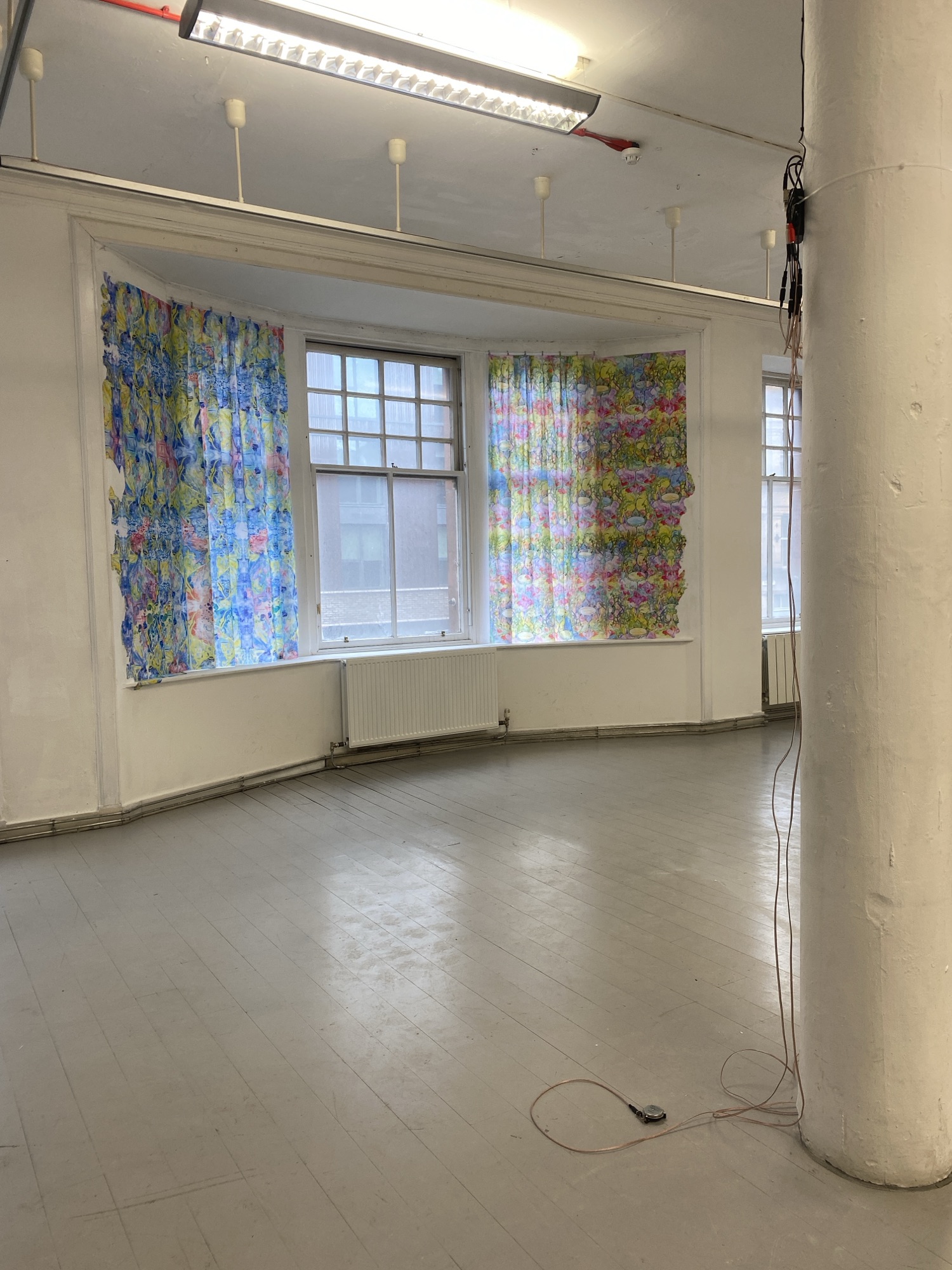
Aside from lanterns, the other homeware alluded to are curtains. Che Go Eun’s a hole in a boat and a deep hole is composed in collaboration with artificial intelligence. The artist inserted diary notes into an AI image generator which ‘transformed [their] intimate reflections and resulted in images’. Watercolour drawings were then made in response to those results, with the artist ‘reappropriating’ their ‘own feelings back from the AI’. This tension between creativity, data and predictive imaging results in a fascinating, speculative assemblage of arabesque, thorn and psychedelic colour. The nod to William Morris/Arts & Crafts reminds us of the collaborative handicraft that has gone into the piece’s imaginary and manifestation. Diary phrases such as ‘art nouveau’, ‘harder I am sinking’, ‘throw all my stress into the hole’ are woven into the fabric of these drapes which suggest both privacy and opening, light and shade. The work is gauzy. There’s a real street, a construction site behind it. Trongate: name as lozenge. What Moten says in the same letter-poem as quoted above, ‘a gauze of reckoning’. Threads, braids: stress, tension. I want to wrap the code-baroque of the fabric around my body like I’m a silkworm going in reverse, all the way back to its gross and sultry, larval conception. I keep hearing that the internet is just the unconscious. I see a bag of squishie candies in a vending machine and think: ugh, silkworms.
‘•.¸♡ ♡¸.•’
Back IRL, it’s raining with the pelting dreich that only a Glaschu April delivers, and I arrive at Trongate 103 having walked through Dennistoun listening to Elliott Smith. I’m not feeling morose; I’m just in touch with my feelings. As if they were tangible: animatronics, statuettes, pets. I’m still on a medication that holds such whimpering demands at just enough distance to be considered somehow ornamental — torrents no more. Once I would torrent my day in their favour. Let someone seed me. Now, I might choose to pick them up, put them back down, or smash them into oblivion. Let my soul have the architecture of a bleeding gate.
As I enter the exhibition, the invigilator says something about one of the objects we’re allowed to touch. I forget immediately what they say because I am greedy for colour and form, not meaning. So the whole time I am looking at the exhibits wondering: which of you may be touched? A finger trace of the curtains, time slider on video screen, glass surface of framing, kinesiology tape cut into bows and ribbons.
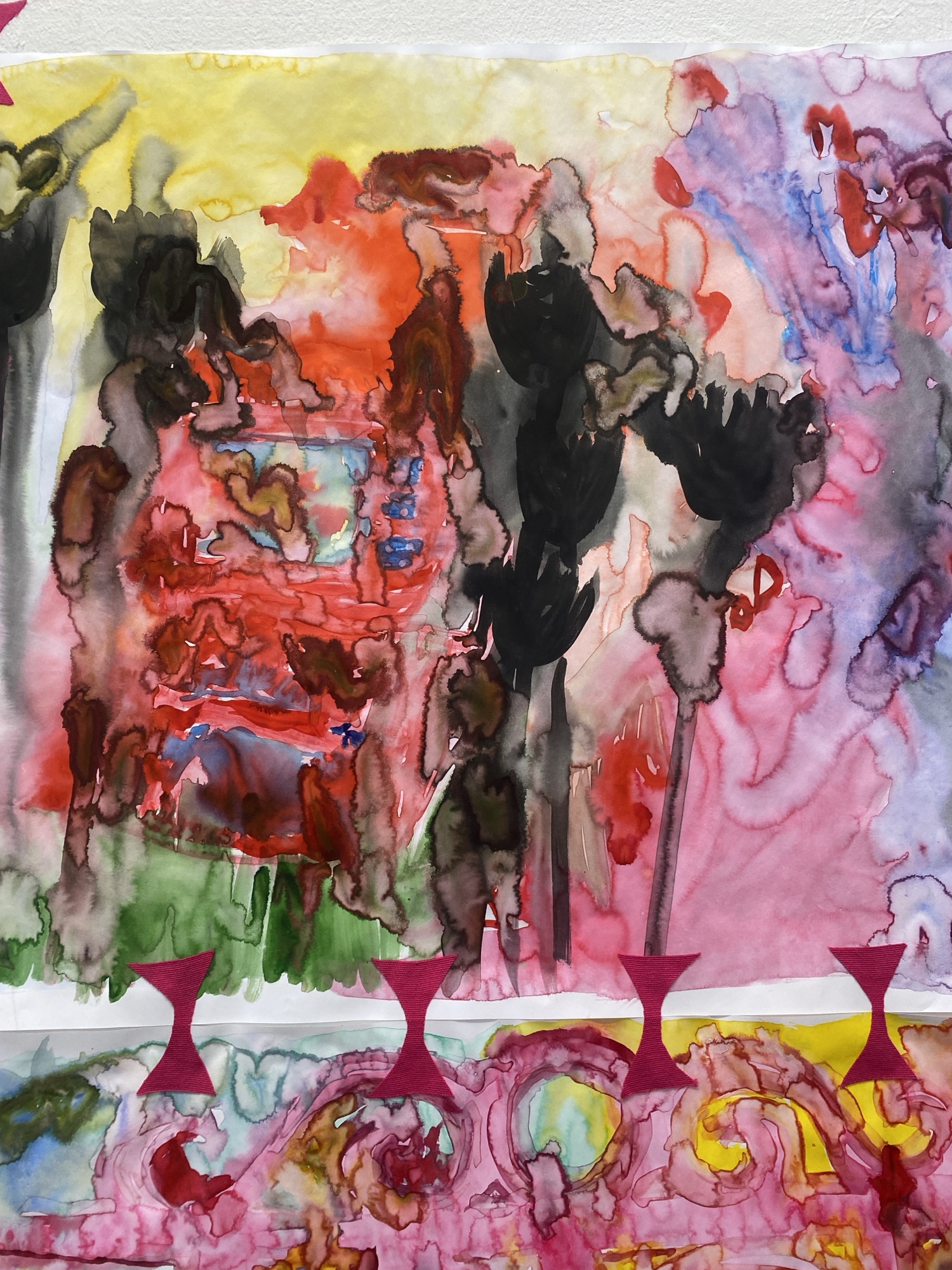
Daisy Lafarge, Gate Theory of Pain (III) (2024)
Touch is not in itself untainted. I am in love with Lafarge’s black tulips; their painful, precious tendrils.
‘•.¸♡ ♡¸.•’
Some people gave me advice on how to do better: thirsty in the flowerbed for some aphids fed upon 200 ladybugs to eat/moult more often than not they would die as fast as any plant blocked sunlight to pay (dustfall / bonnie / smitten ) should the wind ever blow you a raven
‘•.¸♡ ♡¸.•’
Mau and I try to diagnose the Mandelbrot set-seemingness of Lafarge’s watercolour fractals. The sequence ‘remains bounded in absolute value’. This is a beautiful phrase I find on Wikipedia. ‘It is one of the best-known examples of mathematical visualisation, mathematical beauty’. I could watch the little fractal gif forever like giving birth to myself over and over as a starfish with 7000 eyes & infinite narcissism. As it stands, that boundedness is a gate: pink, the colour of doll-flesh. I think of tentacles, elliptical phone calls, inflammation. We agree that almost all the art in the room is art that could be done on the phone. It’s not just about doodlecore but the intimate, desultory gesture of the line itself, and what’s on either side of it.
Not to get kinda kinky but the other day we were explaining ‘lucky pierre’ in the pub (because of Frank O’Hara the poet we all love and love most of all to discuss in the pub). In his ‘Personism: A Manifesto’, O’Hara talks about the poem in supplementary relation to people. Intimacy again. Sure, he wrote it while ‘in love with […] a blond’, which makes it all the more true and golden:
I went back to work and wrote a poem for this person. While I was writing it I was realising that if I wanted to I could use the telephone instead of writing the poem, and so Personism was born. It’s a very exciting movement which will undoubtedly have lots of adherents. It puts the poem squarely between the poet and the person, Lucky Pierre style, and the poem is correspondingly gratified. The poem is at last between two persons instead of two pages.
As Moten’s poem from The Service Porch is framed between two persons, so the epistolary heat is folded into Personism. It’s not letters but speech itself that gets electric. So what Mau and I mean by ‘this is art that could be done on the telephone’ is perhaps something about how the work takes place in correspondence between two or more bodies. Lafarge describes her paintings ‘as a means of pure distraction’, made during ‘episodes of severe chronic pain’, ‘remote NHS chronic pain sessions’ and ‘in phone queues and conversation with Adult Disability Payment (Social Security Scotland)’. The trembling of watercolour is an apt form for the bleeding edges that connect the power imbalance of someone trying to get support and the person with the power to connect them to it. It’s the art of turning away, seeking psychic space, without letting total go of the line.
How often do we find ourselves at the gate, with no end of wanting to both know and not-know what’s beyond it?
Wrought/not I.
‘•.¸♡ ♡¸.•’
I love gates. I love especially baroque ones with curlicues. I grew up with a broken gate which soon got removed. What did we have to keep in, or shut out? It was black and gold and the paint flaked off very beautifully. You might describe it as ‘tawdry’. I probably have false memories about this gate. Sometimes the screech of its opening hinges my dreams. Lafarge’s gate might be a homophonic pun on ‘gait’ (and so referencing the debilitating effects of chronic pain on one’s ability to walk freely). The painting, titled Gate Theory of Pain (III), no doubt references Ronald Melzack and Patrick Wall’s 1965 paper on ‘The Gate Theory of Pain’. In the words of Lorne M. Mendell:
The [Gate Theory of Pain] dealt explicitly with the apparent conflict in the 1960s between the paucity of sensory neurons that responded selectively to intense stimuli and the well-established finding that stimulation of the small fibres in peripheral nerves is required for the stimulus to be described as painful. It incorporated recently discovered mechanisms of presynaptic control of synaptic transmission from large and small sensory afferents which was suggested to “gate” incoming information depending on the balance between these inputs.
The Gate Theory concerns sensory fibres, transmission cells and their respective levels of activity. The idea is that painless sensations can supplant and so quell sensations that are painful. The process involves a blocking (a closed gate) of input to transmission cells. When the gate is left open, the sensory input gets through to transmission cells and produces pain. An example of the therapeutic application of this theory is transcutaneous electrical nerve stimulation (TENS), massage, acupuncture, vibration and mindfulness-based pain management (MBPM). While gazing at Lafarge’s vivid watercolours, one senses that pain is not suspended in the art of painting so much as calibrated, channelled, short-circuited. We keep commenting on the bleeding edge.
Aniara Omann, Resting on an icy couch (mother, grandmother, grandfather, big brother, older sister, little sister) (2020-2024)
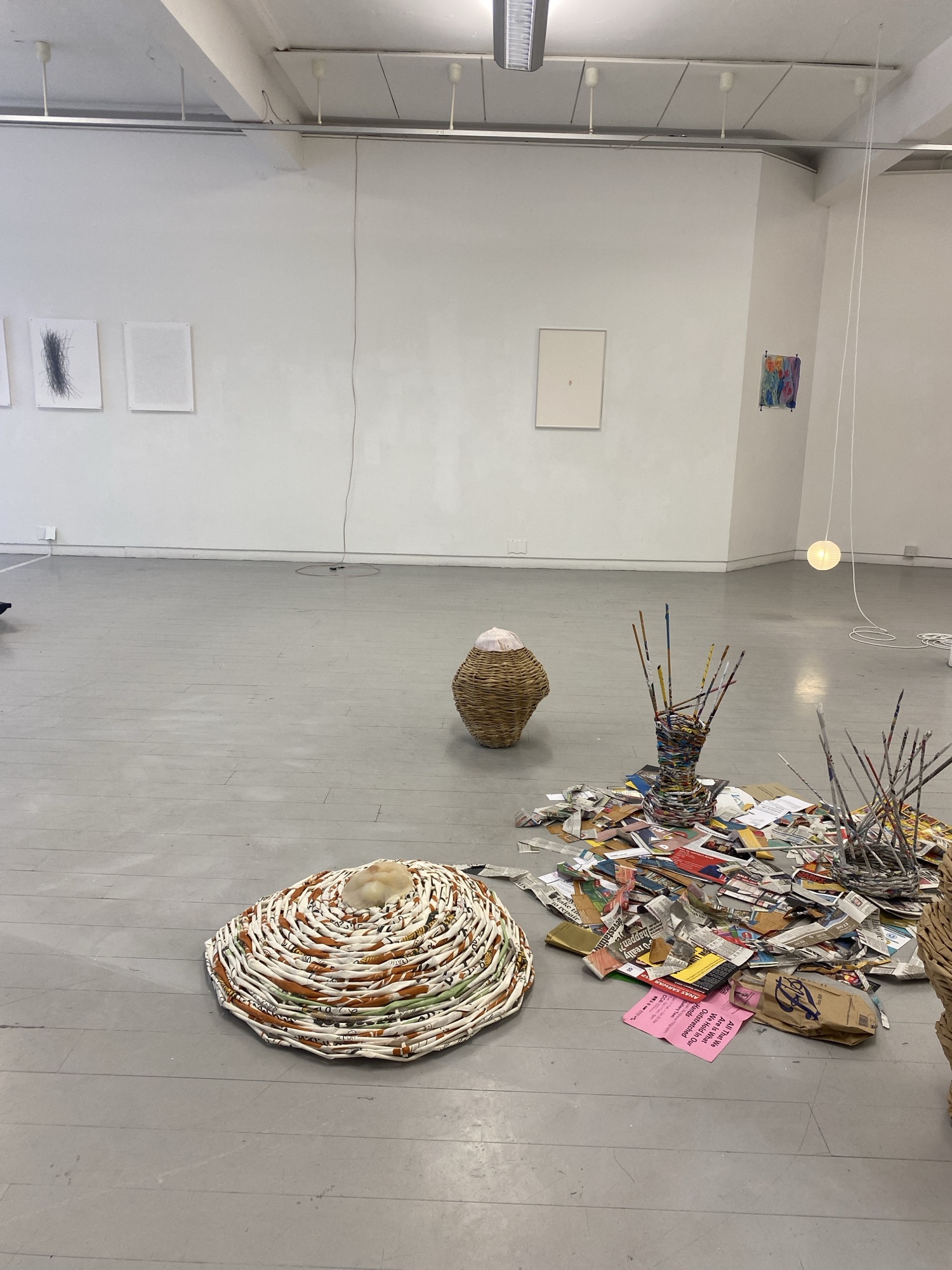
Elsewhere in the exhibition, ideas of feedback loop, intimacy, daily life and relationality are also manifest. Feronia Wennborg and Simon Weins’ soft tissue plays with sound transduction to install a ‘lo-fi sound system that lives at the periphery of perception’. This installation of contact-based sound production manifests the pair’s ‘long-distance collaboration’ in felt space. Aniara Omann’s haunting paper baskets, plugged by family faces, makes a ragged philosophy of grief and panic. The raggedness betrays a struggle for focus which is played out through the woundful (I meant to say wonderful, but this works better) arrangement of loose paper, woven baskets, the sense of things cut, twisted, recycled. Omann describes wearing the clothes of their sister, who died: ‘If anyone complimented me on a garment I had inherited from her, I would say it was a gift from a family member’. In that sense, we could think about the paper baskets as fragile amphora for an archival underworld. The baskets are not perfect, machine-made. They retain the expressive and painful grace of their making. They are a flammable structure, woven from newspaper clippings, election flyers, prescription papers, envelopes, bills. What is it to find a way of wearing something? Wrap your troubles in dreams. Shuffle for sources. The difference is a question of agencies; and yet either way the gesture remains. The gift: it has to be infinite.
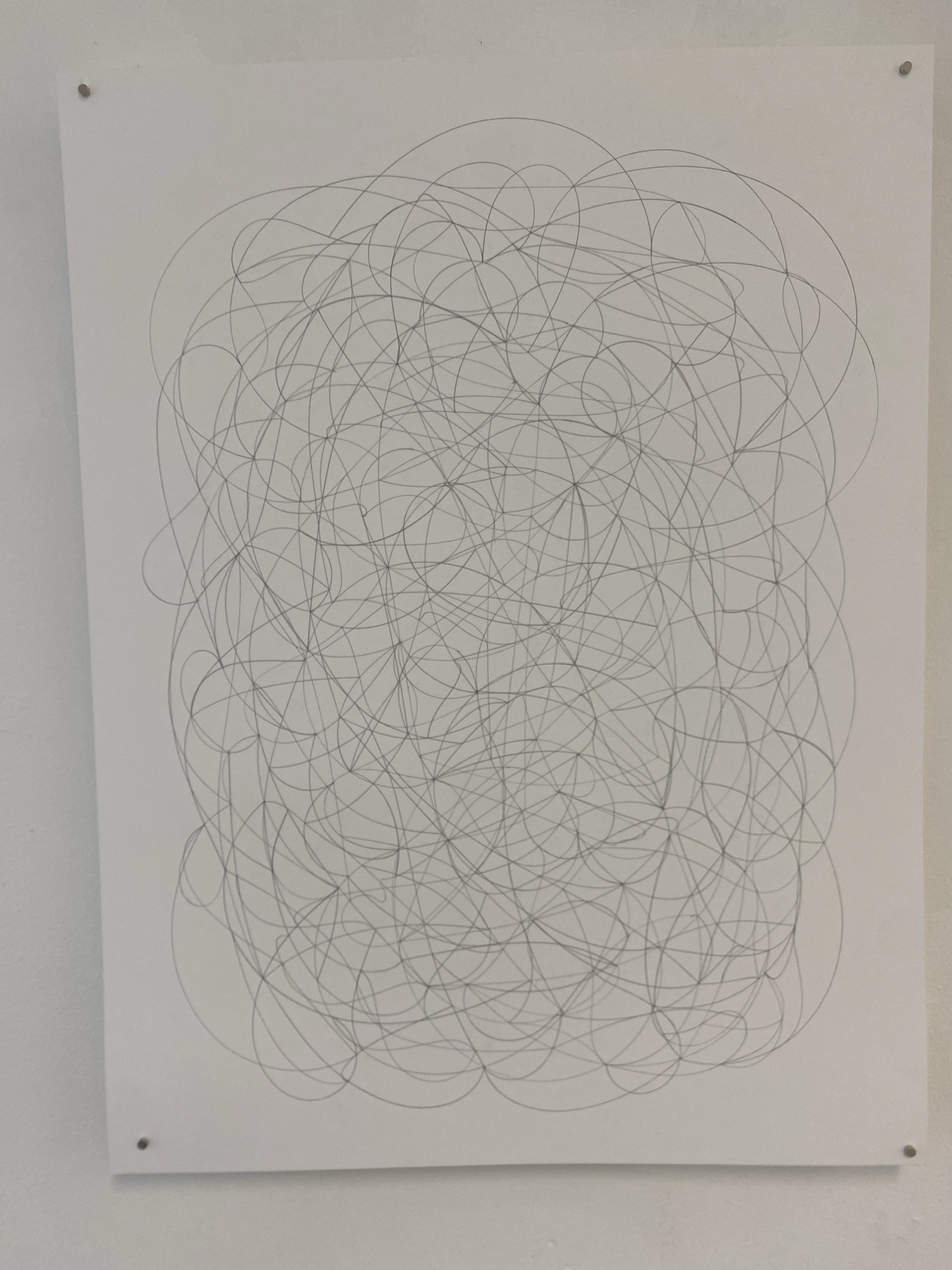
Elísabet Brynhildardótti, The Lines- Hesitant line, Obediant line, Indecisive line, Decisive line (2023)
When someone says ‘hold the line’. Please hold the line. Please hold the handrail and take care on the stairs. Will you please hold? What’s at the end of that hold? I have been trying to get a medical appointment for weeks. They keep putting me on hold, hanging up. I phone up a doctor’s surgery which is based in a shopping mall at precisely 08:30, when the lines open, and immediately the lines (the queue) are full. How do I envision those lines? Swirling and spiralling around the postcode lottery of where we live, tangled and fizzing with people trying to find words for the pain they’re in. I think of my mum in lockdown, endlessly on the phone 500 miles away from the fact of trying to get prescriptions and medical treatment for my nan. It’s pretty mild for me, my current need to be on the line: among other things, fucked-up hearing, tinnitus, crackling I hear like static between the two sides of my skull. Sometimes a pleasurable hum in the morning, like ultrasound waves in the skeins of my pillow. On hold to the doctor’s office, you become a line. The hidden labour of the chronically ill is this beholden quality, the line with its insecurities. It’s getting thinner. There is no guarantee that the line will lead to something: its pulsing, throbbing insistence on being anything but spirogram music. The irony of disconnect. Give me a point; an appointment; a person at the other end.
Who would pick up the line would do so, of course, in the dead of night. In Stigmata: Escaping Texts, Helene Cixous writes:
It is the dead of night. I sense I am going to write. You, whom I accompany, you sense you are going to draw. Your night is waiting.
The figure which announces itself, which is going to make its appearance, the poet-of-drawings doesn’t see it. The model only appears to be outside. In truth it is invisible, but present, it lives inside the poet-of-drawings. You who pray with the pen, you feel it, hear it, dictate. Even if there is a landscape, a person, there outside—no, it’s from inside the body that the drawing-of-the-poet rises to the light of day. […] The drawing is without a stop.
Hélène Cixous, Stigmata: Escaping Texts, trans. by y Catherine A.F. MacGillivray (1998)
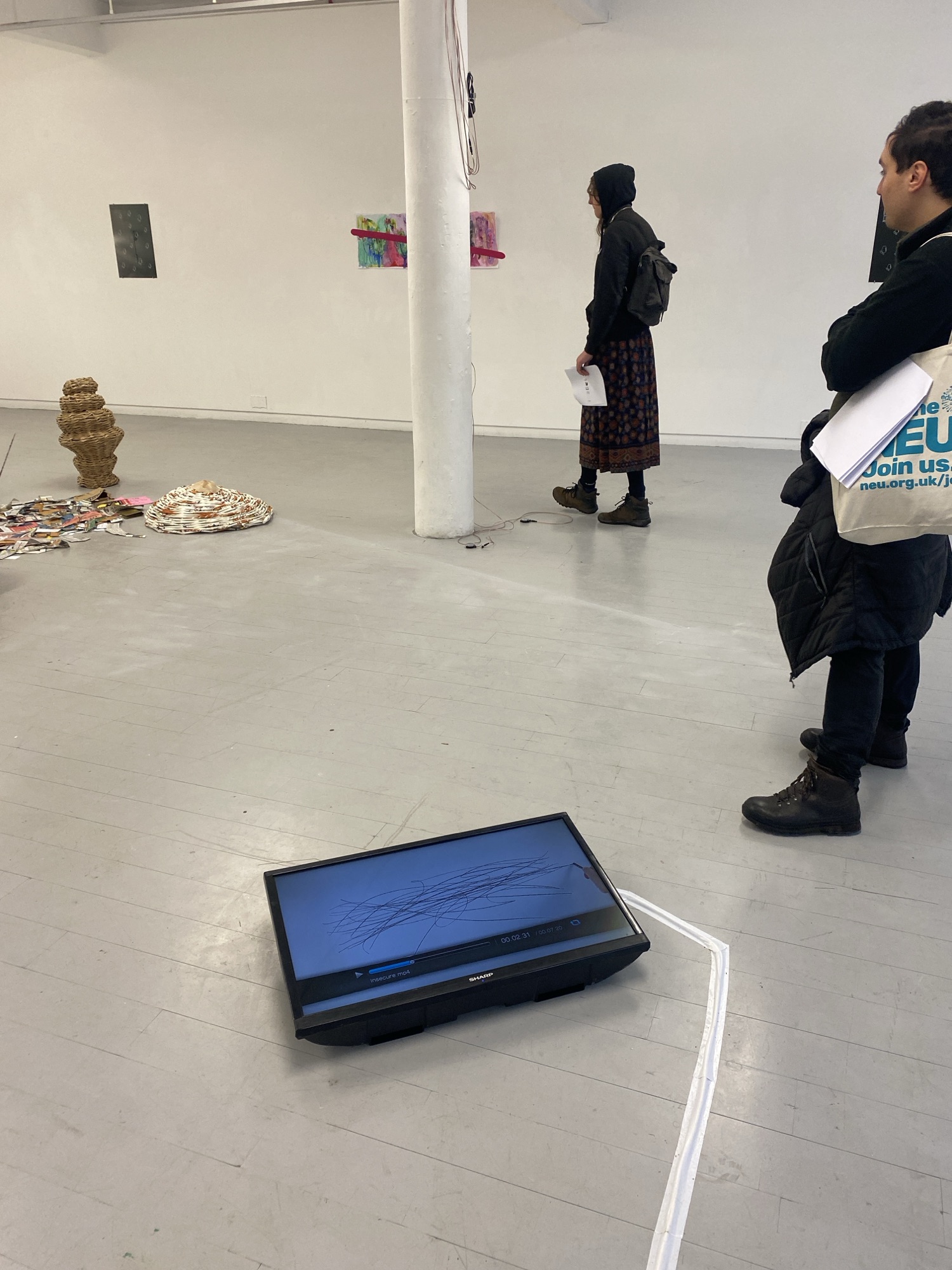
What I see in iNsEcurE (whose inconsistent casing recalls the long identifiers of medical-grade pharmaceuticals, the vowel-like howling insistence, the trembling name) are poets-of-drawings. The asemic work of line, layer and bleed is an avid supplement for writing itself. Who can write while in pain? Who’s afraid of the dark? Who’s afraid of the blank? It is in the night of writing, unnannounced. What is that invisible presence but pain itself? There is no ‘outside’ to pain, once you’re inside it. And yet the gate theory does imply a certain threshold. Relief bucks at the gate. Still, we draw from the well of it moving inside us. You can’t stop it. The appearance of the outside is only gauzy separation.
‘•.¸♡ ♡¸.•’
When I thought I had endometriosis and lived in the hormone torture of latent, duplicate pubescence, resulting from the long-durée of various quiet disorders, I wrote spiky little poems for a pamphlet called Cherry Nightshade. I didn’t yet know about the gate theory of pain but I saw all the poems in a dream_garden festering behind a gate. Well, more like a trellis. Ground cherries contain solanine and solanidine alkaloids: toxins which are lethal, and all the more lethal for their immaturity. Tart cherries have soporific qualities. I wanted sleep to envelop me in perfect velvet. My speaker was a jumping nerve, a shitty little internet silkworm.
What did I get from staring so long at the gate? I fell asleep on the line and the vine grew around me.
I love this exhibition for what it teaches us about art between bodies, how light interacts with feeling-colour, Moten’s ourreal in its total ambience, the drilling outside is part of that thrum in your skull, the way I love to look at my friends as they look at art, tulip mania, mourning vessels, the exquisite difference between red and pink, the meaning of panic touch, pain as the body’s great epistolary effort, fragility, attention’s relationship to healing, what it means to be gratified (if at all). I am grateful for the sharing of insecurity at the heart of the works, and for what they offer by way of being with pain. A bearing, a cloud platform, an intricacy. Standing at the gate.
‘•.¸♡ ♡¸.•’
Further notes:
medical filigree
acid yellowing
mau touches a sound magnet
‘insecurity fuels consumerism’
light source
biofeedback
neon bandage
organelle ballet
tesselate attentions
the puzzle pieces do not technically touch
go into the hole
golden shovel
’emoji repertoire’
give me a viable body
‘cast latex, apple seeds, sawdust’
‘I am still earning less than living wage through my art practice’
Becoming a line was catastrophic, but it was, still more unexpectedly (if that’s possible) prodigious. All of myself had to pass through that line. And through its horrible joltings. Metaphysics taken over by mechanics. Forced through the same path, my thoughts, and the vibration.
Henri Michaus, Miserable Miracle (2002) – quoted by Elísabet Brynhildardótti in the exhibition handout
iNsEcurE is open at Glasgow Project Room, Trongate 103, First Floor G51 5HD between 29th March-7th April. It is organised by Aniara Omann and supported by Creative Scotland and Hope Scott Trust.
A few weekends ago marked a whole year since my exhibition with Jack O’Flynn, The Palace of Humming Trees, curated by Katie O’Grady. It was the height of summer, electrified by lightning storms and rain showers which sent the city streets flooding my ankle boots. I sat in the exhibition watching the auras of animals, drifting in and out of presence, doodling, planning short fiction I’d never write. The rain came down through the ceiling, just a little, and caught in a bucket. I texted in streams.
Something of the exhibition magicked itself into existence. We were all ’93 babies. Making things happen felt so easy. There were synchronicities and invincibilities. When Katie and I hung out at Phillies, we won the quiz. Jack and I wove this hyperplane of fantasy from the gestures of clay and line, whittling and glitter cast wide across floorboard and spiderweb. It was a strange time, the summer of 2021. I was also partially in the numb haze of grief. There was a delta wave but not like the deep sleep of the sea. People brought champagne and flowers to the opening. I wore a long white dress and wished the days were as long as they used to be. The Earth spins too fast.
Partly I wanted to write in the choral voice of many creatures speaking to one another. The process felt like a lyric surrender to this collective, their hyperintelligence of humming and stammer that spoke through pores, chitin, liquid. I don’t know where they learned all this. There was a sun virus in the emails we sent the summer before it. Time freckled on my arms. I could draw out the muscle ache from cycling more. It was possible then.
Anyway, about this experience of writing. A porous voice. Here’s an artist’s talk from a recent conference.
First delivered at Hear them speak: Voice in literature, culture, and the arts 10th June 2022
K Allado-McDowell, ‘And they showed me that their life was a pattern of hyperspace’
Who might be the ‘they’ in K Allado-McDowell’s statement? Taken from Pharmako-AI, published in 2021 and the first book to be co-authored with the neural network GPT-3, a system trained on extensive web data (from Google Books to Wikipedia), the quote suggests voice, presence and identity are questions of patterning, replication, weaving, plurality. Recurrent in Allado-McDowell’s book is the figure of the spider and its web, in a kind of constant movement like thought itself.
I was travelling north on a train when I began writing The Palace of Humming Trees, a book-length exhibition poem which forges energy fields of dreamy relation between many species of animal, mineral and element. Late spring and the fields I could forget about, texting myself more poem. The motion of the train according inverse to the downward scroll of the document. All the while seeing spiders in the corner of my vision, emitting great clots of silk. Commissioned by curator Katie O’Grady and made in collaboration with the artist Jack O’Flynn (both from Cork, Ireland), the exhibition was to offer something of a ‘hyperspace’ to its viewers: somewhere in which voices coalesced, formed new modalities of being and relation, new webs. In a Tank Magazine interview with K Allado-McDowell, Nora N. Khan notes that hyperspace ‘is an abstract space in which we perceive patterns of information and then shape them in language in order to communicate’. Having a big, serial and open field poem adjacent to visual work premised on bold, ecstatic colour and texture was to perform multiplicities of voice within an otherwise abstracted work. Inspired by Timothy Morton’s ideas of ‘dark ecology’, adrienne maree brown’s ‘pleasure activism’ and Ursula Le Guin’s ‘carrier bag theory of fiction’, I wanted to think about that communication as a form of attunement through which we gather, desire and coexist as ecological beings.
In The Palace of Humming Trees, the lyric voice is taken as that trembling spider silk assembling worlds. Spider silk is a protein fibre which embodies the inside of the spider woven on the outside for shelter, cocoon, courtship or the trapping of prey. It’s five times stronger than steel and is now being synthesised to make everything from body armour to surgical thread and parachutes. I began imagining the twangling of droplets on silk strands as the visualisation of a deep vibration, perhaps the wood wide web – something humming in and between trees. The world of the exhibition was inspired by the Irish folktale, The Hostel of the Rowan Trees, also known as Fairy Palace of the Quicken Trees. In the story, trees of scarlet fruit provide refuge, but the fruit itself (the quicken berries) are highly desirable to the point of despair. The rowan was brought from the land of promise, and its berries offer rejuvenation. With these symbolic undertones of danger and desire in mind, we wanted to explore a mythic ‘palace’ which merged the digitality of hyperspace with the organic textures of woodland and the chromatic intensity of dream, fantasy and ethical relation.
At the heart of our project was a notion of infinity. Hyperspace suggests that our ecological sense of world, surrounds, habitat, umwelt is always being reassembled. I wondered if infinity could somehow be voiced in a way that wasn’t just postmodern recursion or echo. What does it mean to be open to a state of infinity? To let many worlds pass through you all at once, making diamond-like instants and gossamer patterns of prosody?
Infinity became our figure for ambience. As spider silk is densely structured, and the neural net densely layered, so the notion of ambience captures, in Brian Eno’s words ‘many levels of listening attention’. To walk through the door of The Palace of Humming Trees was to enter a portal of multiplicity. You could take any route you liked around the room, moving between sculptures of hyperfoxes and sparklehorses, lichenous forms, ceramic butterflies of psychedelic hue and illustrated groves where trees shimmered green, orange, purple and blue. You could also scan a QR code and choose to listen to a recording of the poem, voiced by Jack, Katie and I and accompanied by Dalian Rynne’s sonic dreamscapes. To hear something ‘humming’ is to sense its presence, even if you can’t wholly understand it; humming implies electromagnetic vibration, birds and bees, a weather event or tectonic movement. We weren’t interested in translating the more-than-human voice so much as bringing it into the forcefield of lyric poetry, and through that expansive patterning achieve ‘infinity states’ of reassembled meaning, of felt experience that could not be crystallised into singularities of being. Visitors took pictures, sketched Jack’s sculptures, ran their fingers through the luminous plaster dust, placed to highlight the debris or excess of our clay animals. Something always in the process of creation or decay, incomplete. Corporeal, yet infinite.
One of the many voicings of this project was Letters from a Sun Virus, a correspondence between Jack and I that occurred over the first Covid lockdown, documented at the back of the exhibition book. While the email exchange had distinct senders and receivers, the you and I, over time in collaborating and sharing work between the visual and textual, our voices were beginning to mingle. Sometimes this co-voicing was painterly; other times musical, inflected with the characteristic intonation and energy of our respective speech patterns, moods, expressions. An entry from April 2020 reads: ‘…the wateriness of the poem. I had completely forgotten about all that blur. It’s like all the brush of the ocean and one which seems the idea to spill that way. Almost like a pressure, lines that go on and hair turning into the sea, each one of kinetic energy then finds all these points’. To assemble the correspondence for publication, I plugged it through text remixers, copying, pasting and rearranging phrases to enhance that sense of two voices repatterning one another. A ceaseless quest for points; for elements acting upon objects, emotions. Denise Riley has written of ‘inner speech’ as a strange oxymoron, where one hears voice at the moment of issuing voice inside us – a kind of running commentary that hums without actually humming. The letters suggest a kind of inner voice infected by the anticipated response of the other, rendering intimacies of collaboration which form a sticky substance, sentences and mobius formations holding time’s play and repeat – ‘Unending loop of my dream resins / not to complete the palace infinity of these trees’. Imagining the many of them speaking.
In Texts for Nothing, Samuel Beckett writes:
Whose voice, no one’s, there is no one, there’s a voice without a mouth, and somewhere a kind of hearing, something compelled to hear, and somewhere a hand, it calls that a hand, it wants to make a hand, or if not a hand something somewhere that can leave a trace, of what is made, of what is said, you can’t do with less, no, that’s romancing, more romancing, there is nothing but a voice murmuring a trace.
To ask whose voice in The Palace of Humming Trees is to hear sound bouncing as light, romancing, refracting in what Katie, the curator, calls a many-panelled ‘vivarium of humming thought’. To say ‘there is no one’ is to declare at once absence and the impossibility of presence as a singularity, there is no ONE. What if voice was infectious, modular, sporous, erotically charged, in common? Early in the project, I had this conversation with Jack where he told me that sometimes in the process of sculpture, he’ll try turning something upside down, or inside out, to revitalise the work. Make it strange or more-than. To sculpt by hand is to ‘leave a trace, of what is made’, and to write is to leave a trace ‘of what is said’. I wondered if the inner speech of the lyric ‘I’ could be turned inside out, to be exposed to the grain, the noise, the weather. A voice that touches is and is being touched, traced, smudged. I imagine this book as a glasshouse, somewhere between inside and outside, shelter and exposure; a chamber music of alchemical voicings, always repatterning, transforming each other. Sound and light. A place of invitation, ritual attention, metamorphosis. Many selves stuck to the web of a visual, expansive language.
Hyperfox – photo by Sean Patrick Campbell (French Street Studios, 2021)
It’s been a fair while since I posted. Struggling through Covid, another supercold (emerald phlegm forever), more transitions, finishing my thesis, April snow, more streaming of the body and ache, but here we are. It’s good to get words down. I can’t smell or taste anything at all right now (coffee is just…neutral earthiness, sweet potatoes are…mush of the orange variety, bread is…send help) — so the vicarious pleasure of language is all the more heightened. Sometimes it’s a barrier: why read about anything when your senses don’t respond? I’m drawn to the elliptical which doesn’t hold me for too long. I want to be let go or dissolve a bit. Like eking my reading through a fine mesh of muslin, a semi-permeable membrane of comprehension. Or pull it over my head, this paragraph, the whole fabric of the thing. I was gonna write about a month’s worth of reading: mostly while walking west to east along the polluted, outer commuter belt of the city; on trains between Glasgow, Inverness, London, Leeds; in frail, unwaking mornings; at the park, in that golden week, sitting in the grass with salad from Juicy and daffodils. Instead I wrote about sleep.
*
Finally I got round to reading Ottessa Moshfegh’s My Year of Rest and Relaxation (2018), a book I wanted to read especially because a trusted friend described the ending to me as ‘disappointing’. I love to glut myself on disappointment. For some reason the novel produced a similar effect on me as Tom McCarthy’s Remainder (2005), in that the pleasure was all in the premise. I would love to exist endlessly in the loop that is prolonged sleep or the reconstruction of a highly specific sensory memory. I want these novels to just go on and on like that. Of course, there has to be escalation, as per the rules of plot or ~human nature~. Is it true we can’t circle the mobius loop forever? That after a while the pleasure is desensitised, and we need to dialup on the extremity? McCarthy’s novel sort of preserves that perfect figure of eight in its set-piece ending, and you’re left with the image adrift to loop back on the primal, inciting moment of falling debris and trauma. I found the Moshfegh ending ‘cheap’ in that it seemed to cash in its bulimic character for a kind of tragedy whose fate was to fall. Bulimia, I can say, is generally an experience of permanent insolvency in the body, resulting in a loop time of binge and purge. You pay the debts of fasting by devouring; you pay the debts of eating by purging and fasting. Rinse, brush teeth, ouch, repeat. The sociologist Jock Young talks of ‘bulimic society’ as one where the poorest and most marginalised are often the most culturally enmeshed in the desperate iconography and desire economy of consumerism. The most excluded populations, according to this view, absorb images of what is apparently available under the veil of late-capitalism; but simultaneously they are rejected from accessing this culture themselves due to material inequality and class difference. As Young puts it: ‘a bulimic society where massive cultural inclusion is accompanied by systematic structural exclusion. It is a society that has both strong centrifugal and centripetal currents: it absorbs and it rejects’. But does capitalism spit us out or do we boak back? This is why I am scared to go on TikTok, like fear of lifestyle saturation to the point of nauseating breakdown.
Often powerpoint slides defining bulimia for this sociological context mention an ‘abnormally voracious appetite or unnaturally constant hunger’. In Moshfegh’s novel, the character Reva (an insurance broker) is constantly eating or constantly fasting; something our protagonist describes with pity or nonchalance. Reva is tragic because she wants too much what the protagonist effortlessly has by birth: beauty, thinness, style, money. Thinness is kind of the ur-sign for WASP privilege in the aftermath of the heroin chic fin de siècle. Reva is jealous of the protagonist’s weight loss, steals her pills. Both women are after control (or its relinquishing) in a world in freefall.
This is a period novel: set in the early 2000s, New York in the lead up to 9/11. It’s full of that inertia following the boom of the 1990s. The desire to just sleep in the unit of a single year is like a microcosm for not just an end of history, as per Fukuyama, but a refusal of history altogether as this thing that keeps growling, accumulating, disrupting sleep. I kind of buy into Reva’s bulimia as something about the consequence of being voraciously invested in a world that wants to expel you, sure. The sky’s big whitey’s the limit around Manhattan. Chewing on this feels productive. The violence of the novel is primarily in the gallery where the narrator starts out working. The gallery’s prized artist, a young man called Ping Xi, has these ‘dog pieces’: a ‘taxidermied […] variety of pure breeds’, which are rumoured to make their way into the artist’s exhibition via premature slaughter and industrial freezing. The work apparently ‘marked the end of the sacred in art’. The narrator is kind of offhand disgusted but eventually comes to identify with the young animals in the freezer, waiting to be thawed into art. Writing can be a bit like self-cannibalism; the denial of which leaves you stoked for a snack.
There are several kinds of hunger in the novel: primarily for sleep and food, but also for meaning, intimacy, loyalty. Love is a strange relation that moves uneasily between two girlfriends whose friendship is based on a premise of inequality and co-dependency. The hungers are sated by devouring emptiness. Sleep, junk food, fleeting talks. That bit in Melancholia where Justine screws her face up deliciously and says the meatloaf tastes like ashes. When I realised the same of my dinner, I didn’t even react.
We look more peaceful when sleeping. It’s worth lauding, like Lana singingPretty when I cryyyyyyyyyy………….
O, and the concept of the sad nap:
There was no work to do, nothing I had to counteract or compensate for because there was nothing at all, period. And yet I was aware of the nothingness. I was awake in the sleep somehow. I felt good. Almost happy.
But coming out of that sleep was excruciating. My entire life flashed before my eyes in the worst way possible, my mind refilling itself with all my lame memories, every little thing that had brought me to where I was.
(Moshfegh, My Year of Rest and Relaxation)
The brutal awakening cashes in on the extra expenditure of napping. I’ve written in a poem somewhere, ‘I wish I could sleep forever’. It’s different from wanting to die. It’s more like, wanting to feel aware of the nothingness and calm in its premise. Nobody needs anything from you and you can’t give anything back. It’s restful or at least prolongs the promise of rest. Stay awake super late to relish the idea that you could go to bed. I don’t remember the last time I woke up feeling energised by sleep. </3 I remember listening to an interview with the editor of Dazed where he talks about sleep being his great reset. I remember thinking wow sick cool. Whatever mental health thing he’s going through, sleep will heal it. Sleep can otherwise be a kind of emulsion of depression. You’re in the weight of it spreading right through you. I carry sleep along even when I don’t ‘have’ it.
I want you mostly in the morning when my soul is weak from dreaming (Weyes Blood, ‘Seven Words’)
I used to wake up extra early before school to steal back from sleep. I felt sleep would eat me alive. I used that time to browse the internet, write, read. Eat shitty muesli. Puke.
I’d sleep in class. Teachers would bring it up at parent’s night. I just couldn’t understand why everyone else wasn’t regularly passing out over their schoolbooks.
The perma-arousal of bulimia is a counternarrative to the inorganic sleep cycles pursued by the novel’s main character. I got a similar vibe from watching Cheryl Dunn’s Moments Like This Never Last, a documentary snapshot of the pre- and post-9/11 world of New York’s underground, showcasing Dash Snow’s graffiti and outsider art. Dash is always cheating sleep to go tag, paint, take pictures. There’s a ton of cocaine and consequence. 9/11 had toppled right through all of that leaving a wound. You know by the law of entropy that it can’t be sustained, this life, writing on the walls and all that. Maybe tagging is also about a kind of hunger-purge. Colour’s aerosol vom marking time, presence, ideas. It’s permanent, but then someone can just go clean it up; the ultimate fuck you.
Whose space does this belong to? Remainder is a novel about gentrification, the white guy’s obsessive reorganising of London spaces as precursor for the gentrification of Brixton. A novel of the zombie flaneur, fuelled on flat whites, iPad swipes and vape juice, as Omer Fast’s 2016 movie adaptation brings into focus. Moshfegh’s novel is set around the same time, but her protagonist is decidedly not a flaneur, even if she carries that vibe of the waking dead. She barely leaves her apartment to get coffees from the local bodega, and when she does venture further it has all the amnesiac disaster of a night on the NY tiles with Meg Superstar Princess, furs and all. I find this zombie existence an irresistible metaphor for the numbing effect of late-capitalism: we are overstimulated and aroused to the point of just turning off. It’s banal to say that, sure. What’s great about the Meg Superstar Princess blog girl revival is the way the writing itself is charged with like, full off-kilter zaniness. The opposite of zombie. It’s like barhopping around A Thousand Plateaus — cheap wine in one hand, vintage Android in the other —to the tune of Charli XCX and it’s absolute chaos: ‘spitting e pillz out my mouth, trying to live normal, disco n apz’. You get smashed. You’re alive! I’ll have it in writing because I can’t really have it elsewhere rn, the same way I sleep but I can’t really sleep. Apps (f)or naps?
For all this tangent on (post)pandemic hedonism (let’s say post to mean, posting and not to signal some wholescale shift in era), it’s weird how history just hits you in the face at the end of Moshfegh’s novel. Falling debris, bits of glass. Words:
On September 11, I went out and bought a new TV/VCR at Best Buy so I could record the news coverage of the planes crashing into the Twin Towers. […] I watched the videotape over and over to soothe myself that day. And I continue to watch it, usually on a lonely afternoon, or any other time I doubt that life is worth living, or when I need courage, or when I am bored.
(Moshfegh, My Year of Rest and Relaxation)
Earlier in the novel, she’s frustrated when someone replaces her VCR player with a DVD player, even though she doesn’t have any DVDs. She kind of hates the concept of the DVD. She likes the process of rewind. Video tapes, with their seriality, make you confront duration; whereas DVDs allow easy random access to specific scenes. The over and overness of Moshfegh’s careful, clean, lethargic prose is at once soothing and disturbing. When the pandemic first hit, I couldn’t stream anything because the thought of having all that content at my fingertips seemed appalling. Like accessing a trillion orderly dreams of someone else at the very moment I couldn’t even touch another person. Maybe video tapes would’ve been different. The residue of wave matter at the edge. The analogue sense of fossilised images, decaying in visible time.
In a poem called ‘Along the Strand’, Eileen Myles is like,
The times of the day, the ones with names, they are the stripes of sex unlike romance who dreamlike is a continuous walker
I love the rhythmanalysis of daily life here. VHS stripes in descending order of luminance: white, yellow, cyan, green, magenta, red, blue and black. How the speaker clings to named moments of the day as like khora: receptacles unseen for adhesive feelings. ‘Vigorous twilight’, ‘noon’ you slip into, ‘Morning’ as ‘something / I could stay with’. The times of day are lovers. If romance is continuous walking, there’s not a lot of romance in My Year of Rest and Relaxation. So after reading the novel I’m sorta stuck on wanting the romance of sleep again. Exhalations as stripes of sex. Like when you have a new partner and after a few weeks of breathless sleeplessness suddenly the first thing you realise is how well you’re sleeping, like being beside them all night just fixed your life. And so to be in love you know noon tastes different, and twilight has a lilac halo. And you’re sharing this shiny sticky static in the air like asterisks, so much more to say.
*
Sleep. After a long walk, I remember circling South Norwood Lake and humming Elliott Smith’s ‘Twilight’, because of the time. You asked me to sing it. I had a low voice, a high voice. I was just waking up; the air was all lavender, leaves in fall.