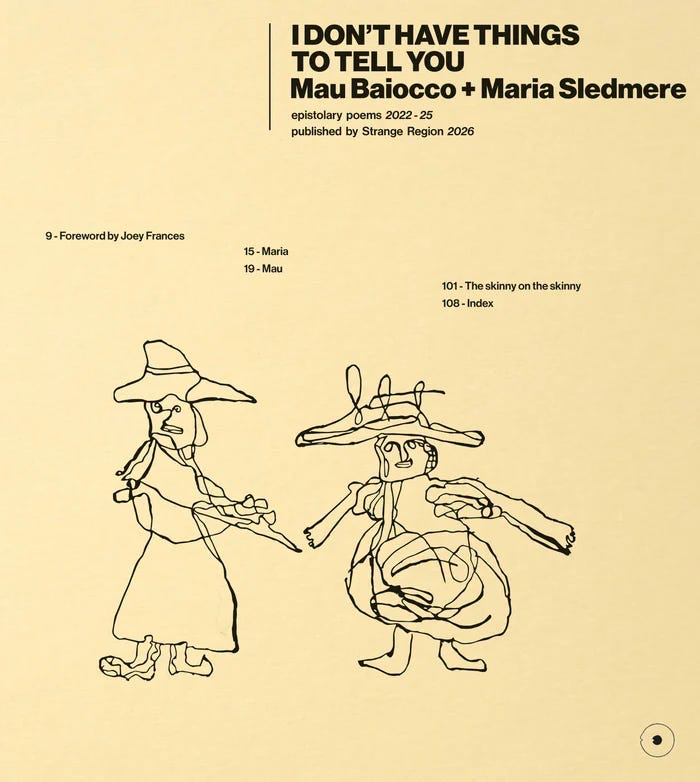
There’s a new book coming out. Ribbons of collaborative epistolaries with Mau Baiocco, presented in skinny columns, writ between 2022-2025, the years of emergence from lockdown and still in the viral fug of Covid, its long durée and continuous shaping of economic, social and poetic relations. On the 23rd March 2022, Mau writes to me: ‘I don’t have / things to / tell you but / to run along / it’. The shaky glitter of that ‘it’ can be traced across the whole collection, morphing in what it refers to — a French horn, an original thought, a flower painted by Degas. It’s a bit like a syntactical kaleidoscope where the grammar changes according to voice, something to look through, the long telescopic look in (to another’s brain) that’s poetry. Blink and you’ll miss it. We wrote to each other with the initial burst of correspondent excitement: back when I was a graduate teaching assistant working in one university and a part-time, fixed term lecturer in another, striking intermittently at both as part of a long campaign that began before lockdown; back when Mau was working in a gallery in Leeds and metabolising observational extremes into playful meditations on value, art and human behaviour. In the course of the book we get sick, have birthdays, fly transatlantic, witness resigning cabinets, respond to so much art and music, write of many friends and loves, muse on various colours and substances. We run along.
To run along the length of a fabric is to cut, move, align parallel to the selvage, the warp yarns of the textile’s spine, along the grainline, running parallel, threads with the least amount of stretch, the highest strength — could this be our poetics? In the book, I write about a task I was given at primary school: to untangle the long streamer ribbons or dance wands we were given to play with at breaktime, in an effort to curb presumably our violent outbursts and bullying. O how we loved our e-numbers! And how we loved colours! These streamers were thick, luxurious, brightly coloured: red, green, yellow or blue. We would wave them around like it was May Day, loving the euphoria of colour until it got boring and then we’d joust with them, whacking the long plastic sticks against each other like swords. Why am I telling you this? For to write one another yielding the giant streamer pen would always result in a sort of euphoria, now to bounce into jousting, pretending that we were on ponies. As I write this, people are jousting on Lime bikes in London Fields and once again medievalism is trending.
However, there is or was no fight in us. Only energy of neon, some knots, a sing-along strong or louche. Our jousting wands become streaming rivers in möbius formation. Mau and I are gemini twins, having nurtured a sort of telepathy from years of exchanging gossip and poetry (including, with Luce Lovell, our sonnets for hooch), from years of standing in front of art, finding our painterly doubles, eating curry at the indoor market, flicking through chapbooks, reading Lee Harwood in the rain. The fight was to have this space to think, it slivered into the work of email, analogue in a perverse way to have this medium which didn’t expect an instant response. We found energy from what was around us. The little things to notice, plus: all of our friends. This was a book co-written in a way by a whole collective, wayward and not nameable. Joey Frances writes of this so well in his foreword to the book, ‘the conditions that mediate the possibilities of writing’, ‘comparing notes on all the shit we did and all the shit we could yet do’. Yes — I love the provisional curve of the ‘yet’, how future possibility spirals outwards in these poems because we needed to write with dream all the time, daydream and nocturnal slumbercore of the narrative variety, episodic flashes of light that tell us dull life could be otherwise. Our ribbons fray into threads of everyone.
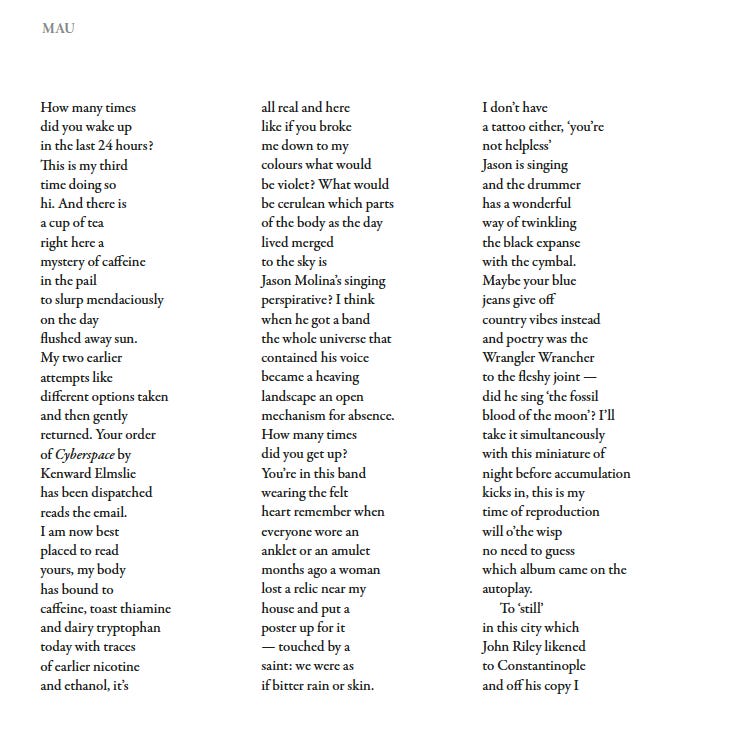
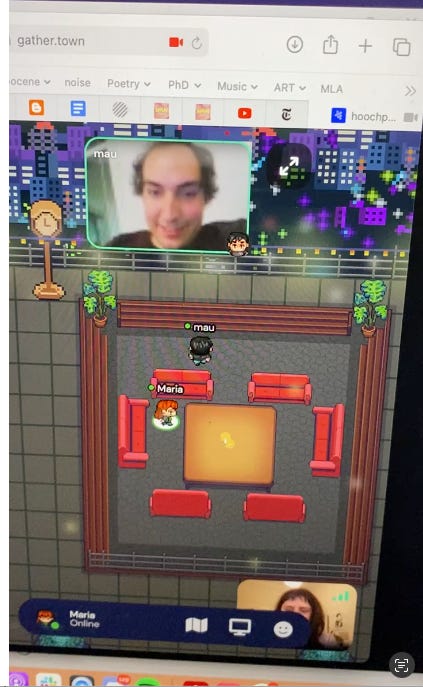
We connect via the internet constantly, something worth saying and saying again. In lockdown, Mau and I would show up as wide-eyed UK poets in various international poetry Zooms — readings in New York most often, dreaming from face-tiles a city of stoners and sleepless lights. We kept a sidebar discussion going on a secret poetry Discord, blue-dark-deck that became the afterparty, the dingy bar. Mau would go to two events simultaneously on different computers. Now we would call that poetrymaxxing. I write of feeling ‘like the goddess modem / of puerile form’, somehow fused electrical to a higher grace via the tenement broadband that served my days. I am childishly silly and yet talking to gods, poets we love so much, the domestic dreameries of Bernadette Mayer, the ‘singing / perspirative’ of Jason Molina. Asking Peter Gizzi a question about light and speed via ~the chat, nervously in 2020. Our poetry metabolises that experience not as diaristic self-reflection but as chatty missive, epistemic flirtation. I like that now I know what you know, as you know I for I.
This book tries to pull everything in and yet still maintains the feeling of attempt, desirous of almost; a kind of delirious voice note written down, not quite getting to the point. A poetics of incomplete documentation and utopian meta-commentary on what we would need to fulfil our commitment to this undefined Project. A chemical obsession with what would be the right conditions to read each other, how to curate the perfect take, correspondence — a word that means to pledge, promise or to answer, with prefix of together, with, together-with-this-promise was to write a skinny poem. ‘I do not always understand what you say. / Once, when you said, across, you meant along. / What is, is by its nature, on display’ (Schuyler). Oh how we love James Schuyler. This poet at the window, embraced in the mortal combat of syntax, to paraphrase something Stephen Yenser wrote of Schuyler’s line breaks. We wanted the skinny, the crop of the day, for someone to bring us the lilies; we broke lines because to do so offered a sense of autonomy, almost like eating.
The first phase of the book has the heightened bubbling of new correspondence, moving quickly along, the feeling of having found a form. Curious and exploratory, performatives of witness and ‘psychological androgyny’ borrowed from the Romantics. The second phase of the book occurs when time jumps across from 16th July 2022 to 23rd April 2024. I’m back into Mau’s inbox with tales of the softest breakup. We ask if it’s worth trying again, we indulge into a leisurely to and fro, the poems feel different, there’s a shift in the language and from Saturn’s return, so much has changed and now we are both teaching, feeling out ‘life in the ashes’ and ‘the starry shared / humiliation of reading’. Is there a new self-consciousness in the form? Now it is something we move across…
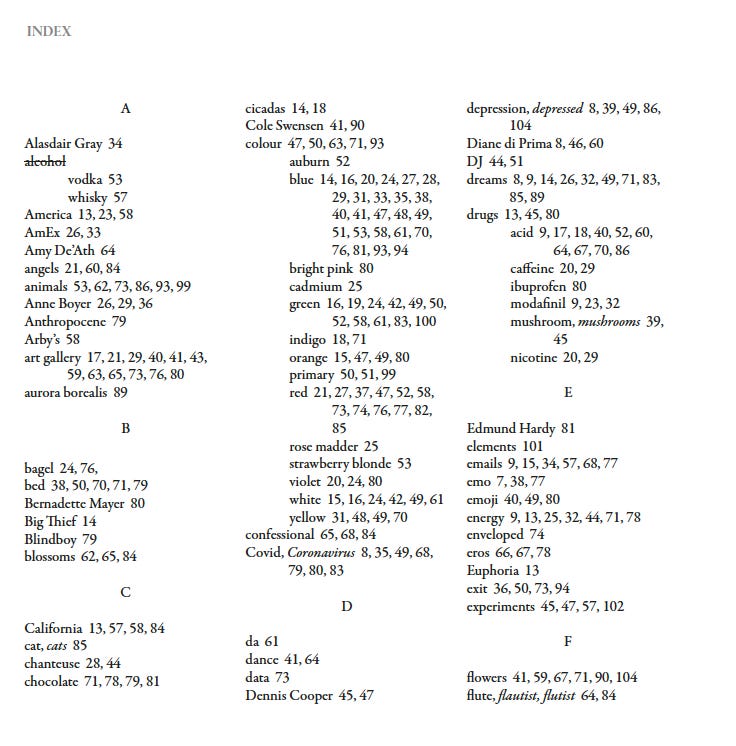
…and we shape it into a book: I don’t have things to tell you, a title whose premise is refusal. Like the gemini tendency to answer the phone in burnout, saying I’ve got nothing and then launching into love’s digressive everything. The poems are presented mostly chronologically, excepting a centrefold poem of sorts, Mau’s poem on the occasion of visiting California, the aforementioned foreword by Joey Frances and a closing essay by me, ‘The skinny on the skinny’, followed by an index which collects the book’s referential whimsies.
We have continued the emails since finishing this manuscript, something submitted to the Strange Region open call at the start of the year and now being graciously published by Joe in Bristol. Joe has been amazing. He’s typeset the thing beautifully in triple columns, taken our linguistical quirks as a necessary poetics to preserve, found us a cover image of illustrated Martians worthy of the aspiring Spicerean forms within. In the book where the cover images originally hail from, Psychical Research and the Resurrection (1908), James H. Hyslop writes: ‘We went all around. The people are different in different places’. Yes, the kaleidoscope changes. That’s this book. The two of us swapping hats and cities.
You can preorder it now from the publisher, or catch us at our Glasgow launch on 21st November at MF Books. More dates to be announced soon. Please invite us to your city!

