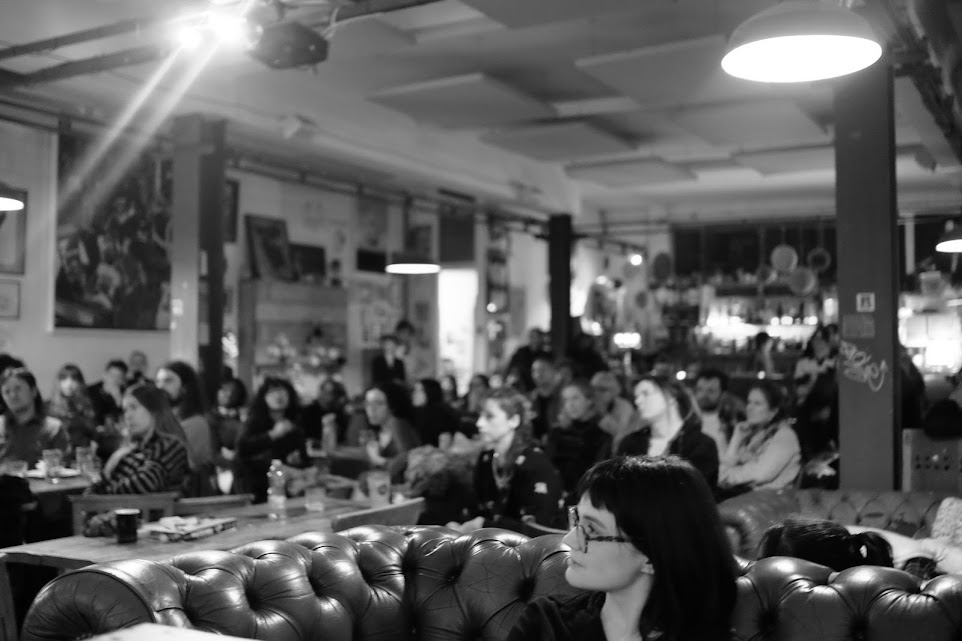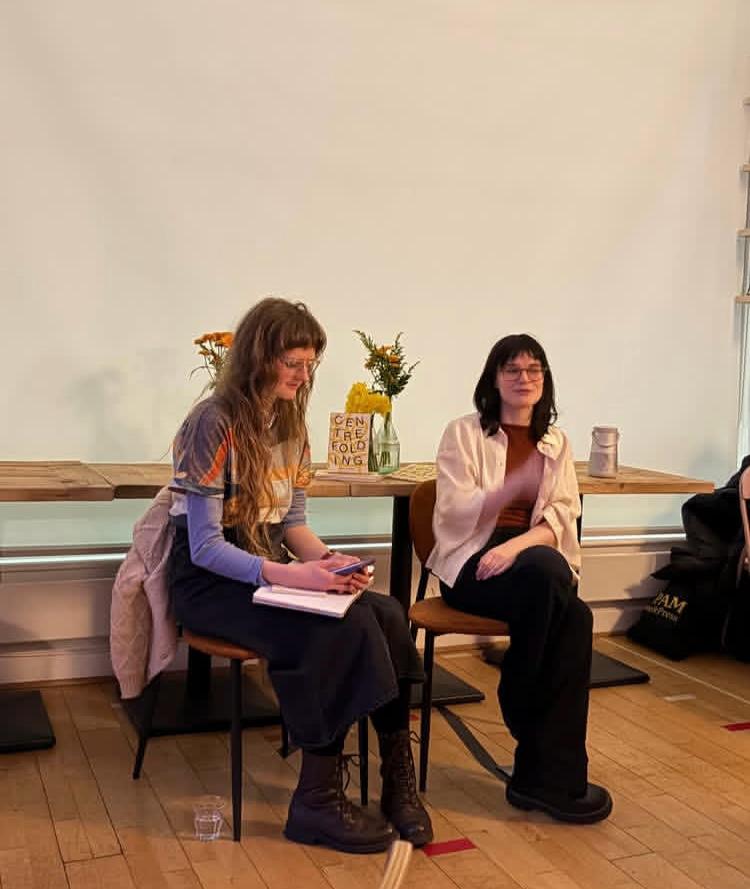
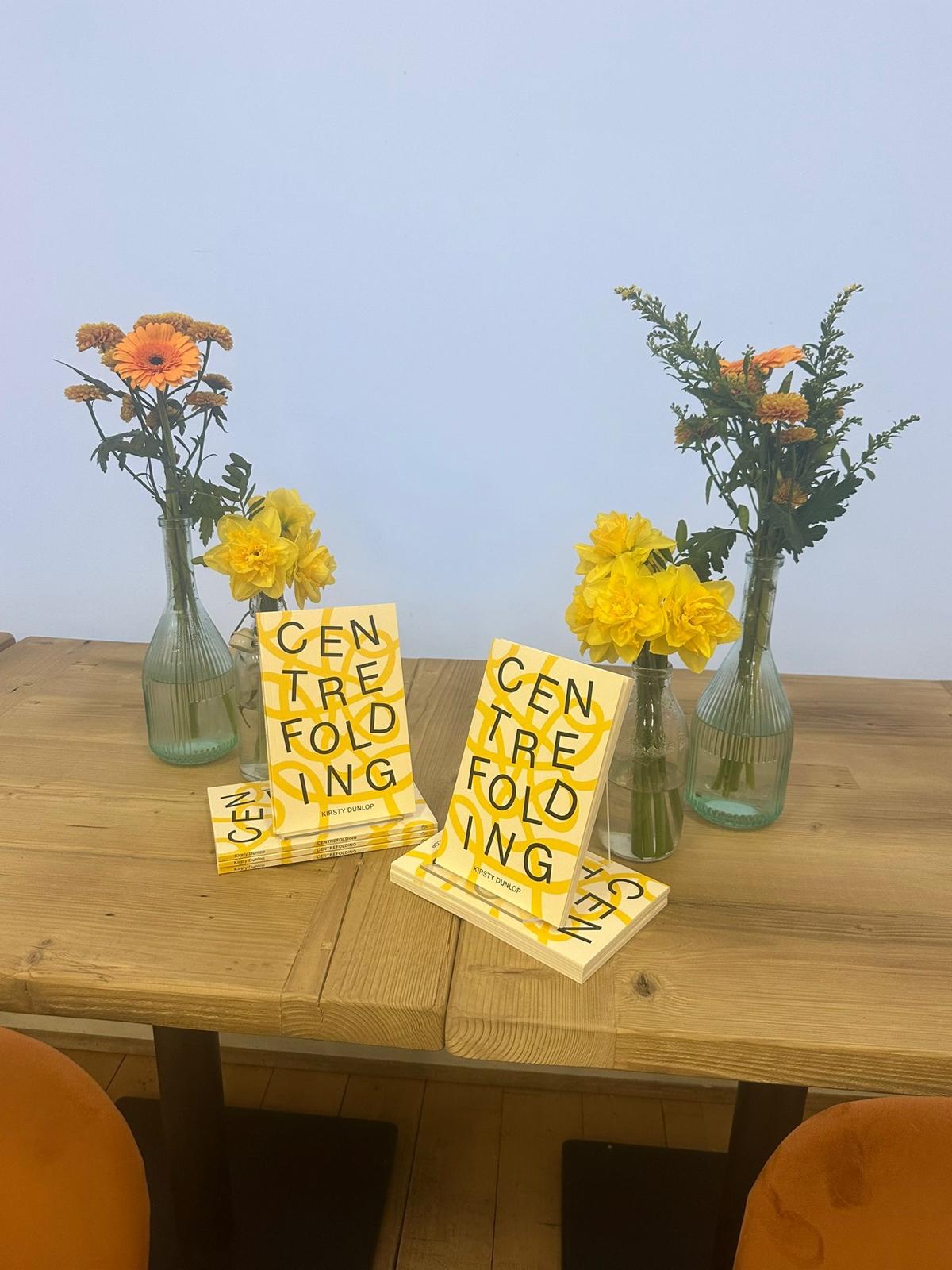
Edinburgh Centrefolding Launch with Kirsty Dunlop 28/3/26

This is my introduction to the Edinburgh launch of Kirsty Dunlop’s Centrefolding (sincere corkscrew, 2026) taking place at Argonaut Books on 23 March 2026. Below you’ll find the audio recording.

First fold: picture the scene. You walk into a large building with metallic cladding and an enticing revolving door. Everything is atrium: echo, wide-panelled windows, open ceilings, flickering screens, a sense of upward levelling gesturing towards the reflective light of infinity. The acoustics are such that a phone call 30 metres away is audible, mixed in with the whirr of unnecessary AC, obnoxious public Zoom calls and the sound of bio-engineers cutting business deals over limp sandwiches. You sit down at a table because there are many tables, arranged with no discernible logic i.e. skew-whiff, chaos on wheels. You observe an apple core oxidising in the airless afternoon. Outside, another building is being constructed. Cladding going up, men in neon orange operating a crane, authentic cherry blossoms swaying beneath them. You split open the spine of a svelte yellow book that has been abandoned, seductively, beside the apple core. Against a black screen in the book’s near-centre, you see the universal sign for buffering, a loading terminal of found language. Certain words present themselves luminously over others: ‘chemically’, ‘error message’, ‘quadrupling’, ‘loitering’, ‘squeezing’, ‘piss’, ‘rose’, ‘ecstatic’, ‘kissing’, ‘a thrum continues’. A narrator levitates mysteriously from the spread before you. Was it this the voice who ate the apple? Such thought is interrupted by a man nearby, addressing something unseen on his laptop: ‘when you see the standard feedback field, what exactly do you mean?’ and then ‘in a sense what you are doing is a quantum stochastic unravelling’. 

Welcome, everyone, to the Centre. ‘The dispersed rhythm of a wandering’, writes Lisa Robertson in Nilling, ‘— musical and conceptual — is what its folds conduct’.

This overhearing of the feedback field, the quantum stochastic unravelling, is the perfect threshold, the perfect fold, from which your encounter with this book commences. 

Imagine this from the outside, seen at night, as our narrator describes it: ‘the Centre, glowing like an alien presence’. 

What we are launching tonight is a remarkable achievement, a provocation, a satire, a first novella, a tenacious experiment, an alien escaped from the lab of Scottish fiction, a flight of fancy so daring its completion depended on a dare set by a senior employee of the actual Centre. Also known as: a stochastic unravelling of theory, praxis and IRL experience. Tonight, we are launching Kirsty Dunlop’s Centrefolding, published by the sincere corkscrew, a Glasgow-based small press founded in 2021. 

A little about the author

Dr Kirsty Dunlop is a multimedia writer, editor, researcher and musician based in Glasgow. She recently completed her Doctorate of Fine Arts in Creative Writing at the University of Glasgow, entitled ‘Emergent Gameplay, Emergent Essaying’ which explored the possibilities of hybrid New Media writing through a digital-born collection. She is Editor-in-Chief of SPAM Press.

Reading this novella is like slipping in and out of a wild stream of fantasies crowdsourced during a conference hosted by the Department of Emotions. And yet the world is so clearly that of our inimitable narrator, so wholly seen through their distinctive, sign-hungry imaginary. 

Like the king of poststructuralism, Jacques Derrida, Kirsty Dunlop’s sign is in Cancer. And Cancers are known for their strong emotions. But the astrological isn’t the only sign we’re focusing on here. In his critique of the sign, Derrida sent any notion of the ‘centre’ into a chain of ceaseless deferral and free play. It is in this cascade of signification that Kirsty’s prose takes flight. Takes flight under the shimmering sign of Ali Smith’s sentences, Muriel Spark’s intentional loitering, the crush poetics of Geraldine Snell’s overlove and satirical flair of campus novels and workplace fiction in general — one thinks of Emily Segal’s Mercury in Retrograde, an autofictive account of working at a trend-forecasting startup, or Joshua Ferris’ Then We Came to the End, a tale of white-collar workers at an ad agency, dreading the fate of unemployment during an economic downturn. 

Tonight we are Centrefolding. Kirsty has written what Daisy Lafarge aptly calls a ‘future cult classic’, a line I can’t help but hear in Charli XCX’s voice in the way she sings ‘club classics’ and three times again for good measure. It had me snorting with laughter on the subway and choking on the apple of knowledge exchange and sin. I’m so excited to be here with you in the wonderful Argonaut Books to discuss the novella that captures economic precarity, friendship, solidarity, loitering and the neoliberalisation of the academy like nothing else. First up we’re going to have a performance from the amazing Kevin Leomo in collaboration with Kirsty and…the Centre itself! Then we’ll have a reading from Kirsty followed by some questions from me. We’ll open up the floor to your questions and finish on a final reading. 

I’ll just introduce Kevin now. 

Kevin Leomo is a Scottish-Filipino sound artist, researcher, and curator. He directs the sound artist collective Sound Thought and is one half of Project Somnolence with Maria Sledmere. He is a board member for the Scottish Music Centre and the Anti-Racism Observatory for Scotland. Kevin works as the Community and Engagement Manager for the College of Arts & Humanities at the University of Glasgow and Co-Director of the Creatives of Colour Festival.

Stream Kirsty Dunlop – Edinburgh Centrefolding Launch 2026-03-28 – Fireside Chat with Maria Sledmere by Andrew Kenower | Listen online for free on SoundCloud

Order a copy of Centrefolding here.

~

Recording: Andrew Kenower
Photos: Adeel Ali and Maria Sledmere
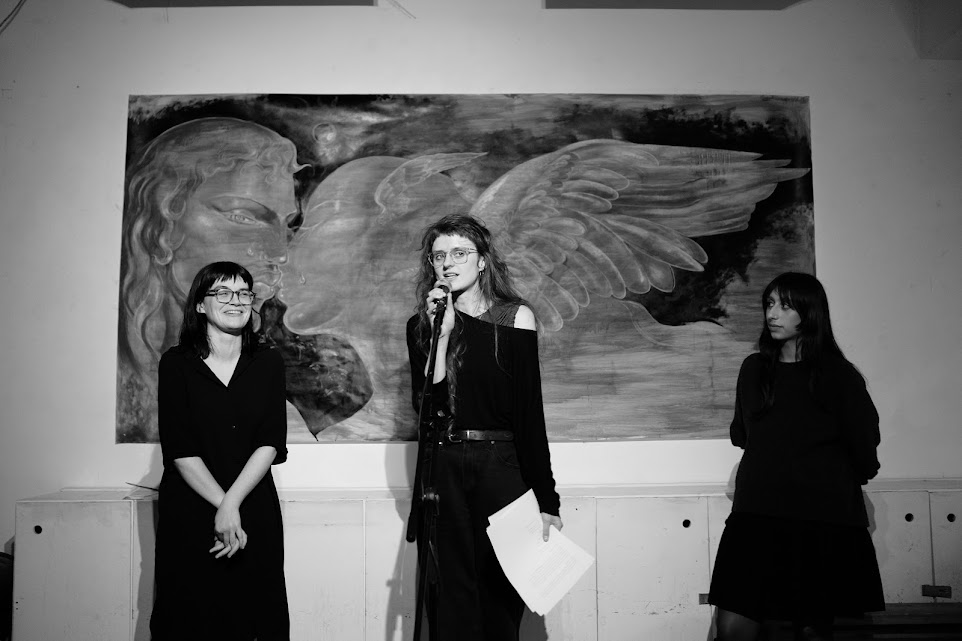
Scene report: AFK#9 at the Peckham Pelican

We started Away from Keyboard almost a year ago to the day. Despite hosting readings for a decade, SPAM had never previously run a regular night and we’d been talking about it for years since things started reopening after god knows how many lockdowns we had in Glasgow. After a hefty era spent solely ‘at keyboard’ it was time to get poets in a room again. What I like about a bimonthly series is it’s flexible enough to work around poets who might be in town anyway, there’s time for curation and building a kind of ‘snowball sampling’ effect of poets to invite via who shows up and who recommends who. The lineups are usually about five or six readers reading for 10-15 minutes each, which catches the sweet spot between a big, rapid-fire performance showcase and more sustained readings. While sometimes they can be really fun and a great way to get exposed to a wide range of writing, I’ve always struggled with big group readings because any potential associations, threads and lineages between the poets get lost in overdrive. I tune out. When you’ve got just five minutes on-stage, poets tend to read a particular kind of snappy and ‘polished’ poem and there isn’t room for the kind of variation and trajectory that comes from building a proper ‘set’. 10-15 minutes also leaves room to try out new work too.

Our ninth AFK took place last Thursday at our old haunt, the Peckham Pelican. Huge gratitude to them especially Stu who helped us lock in the date. Let me just say how hard it is to book venues for poetry. Can someone make a big database of suitable venues please? The big problem in Glasgow is finding a space that is affordable, accessible and relatively stable. Everyone remotely in the Glasgow orbital will know about the decimation of our arts spaces in recent months (CCA and Listen Gallery have just closed). In London, the big problem seems to be finding a venue that won’t require a whopping minimum bar spend way out the league of our skint poetry community. Alas alas. Still, every bar we’ve worked with we’ve worked with because of a poet working at that bar. Keep it in the family. I love the Pelican and its happy hour negronis (‘Peli-gronis’), the friendly bar staff, big space, wonky bookshelf. I love how in London there is almost always transport home after dark, whereas in Glasgow you have to negotiate ride-shares on Ubers (an option newly available to me now I caved and finally moved south) or try and line up two buses, one of which is guaranteed to not show up, leaving you stranded in a vortex of raging seagulls and vape shops (‘town’), or in the industrial hinterlands of Tradeston. Online, I’ve seen recent movement in campaigning for better transport in Glasgow and I hope something comes of it. The amount of times I have walked 1.5 hours home after midnight…

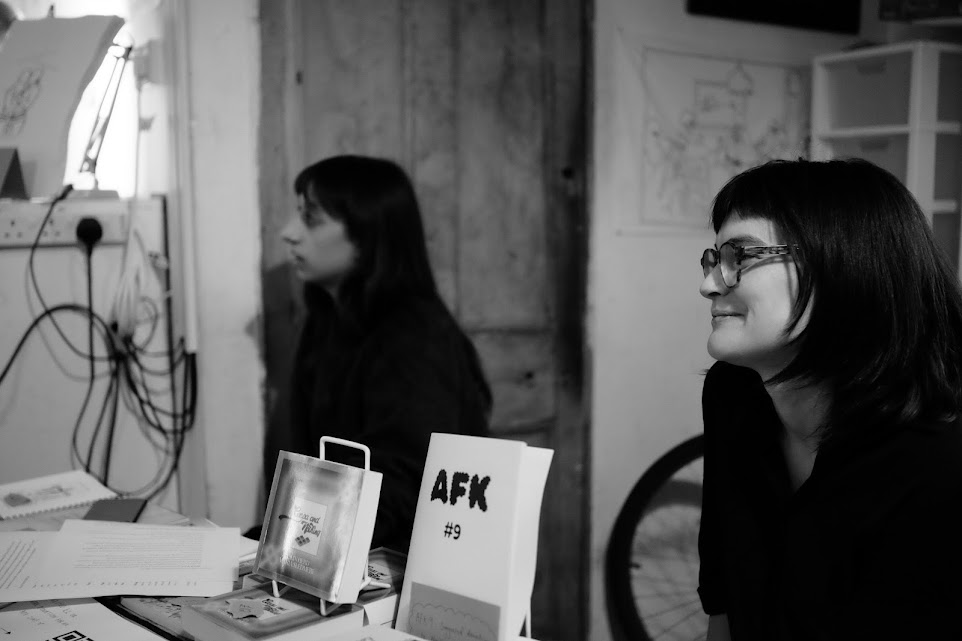
Before the reading, Maya, Mau, Kirsty and I got food at Peckham Market. Eating before a poetry reading is something I only learned how to do a few years ago and it makes a difference. No more blinding headaches! No more yearning to leave early! No more one drink too many! I recommend it. We had our book table set up in a jiffy cuz we’re getting really pro at that now. We had so many books it spilled out onto a bench and the nearby countertop. We thought there wasn’t much SPAM stock left but a surprise abundance of Thirteen Morisettes and Cocoa and Nothings showed up, plus some bonus books to sell from the readers. The AFK#9 zines sold out so quickly I didn’t even get a copy to take home! One of the things I enjoy about book-tabling is talking to people who come by to peruse. If you are a poet never be shy about introducing yourself at these things…we live in Glasgow and it helps to keep us in the wider loop 🙂

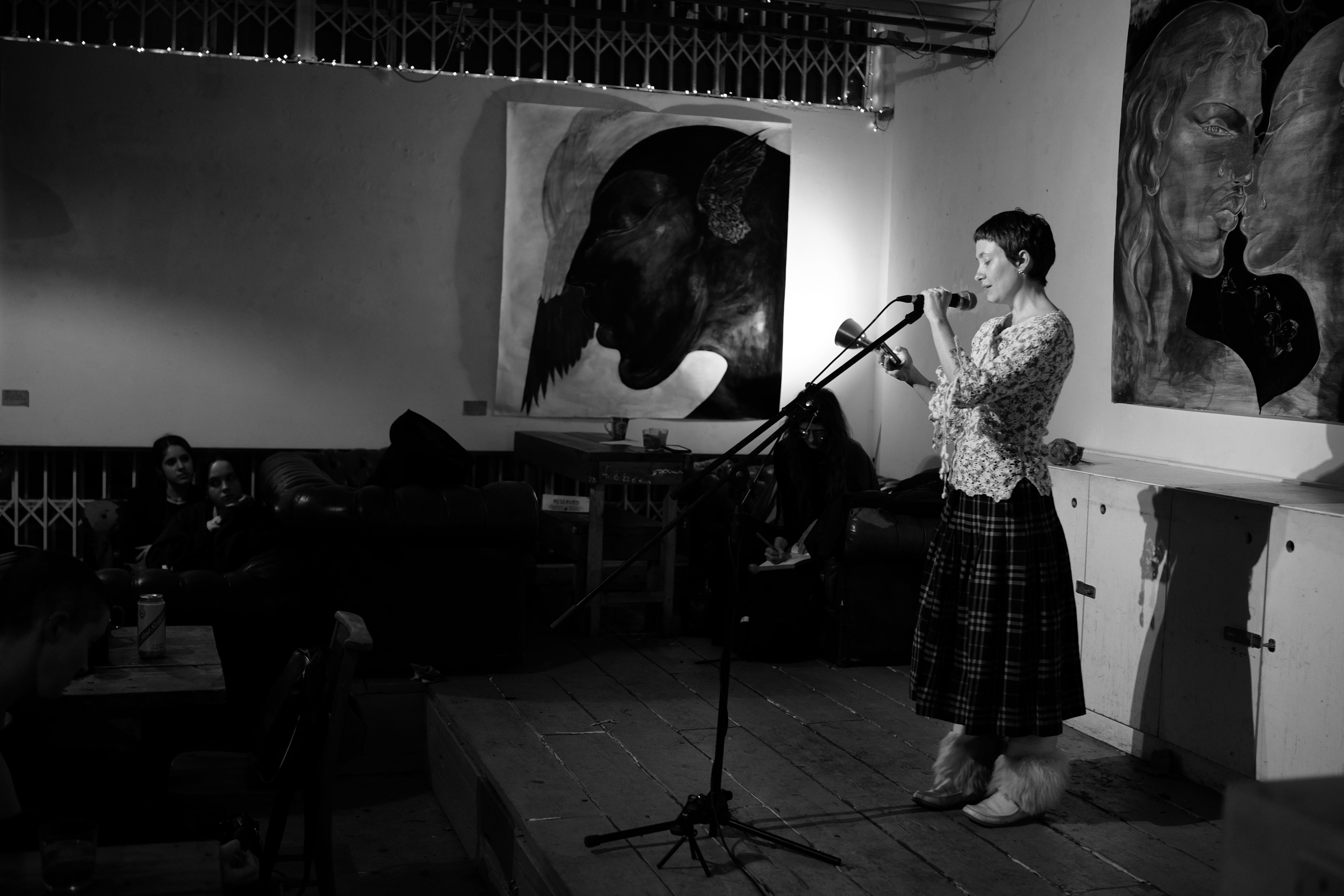
First up was Phoebe Eccles, who surely won outfit of the evening with her yeti boots, kilt and crocheted bell-sleeve combo, topped off with an enviably chic pixie cut. Eccles’ poetry did some Lynchian fish-catching, delivered timely political barbs, ran its hands through Milton’s silky hair and popped out some tulpa spoilers from Twin Peaks: The Return. I wrote down ‘The independent life of meat’ and a dream poem in which a child in a cave headbutts stalactites (or was it stalagmites?). Eccles’ work is playful and sharp, with a discursive feel to it that is able to weave in urgent recent events to the pulse of cultural analysis. The poetry had a similar to texture to some of David Lynch’s CGI creations in The Return: sort of glistening and disturbing, meat-like, surely not quite of this world but only because they are also so…tulpa? Virtual-material? 

Next was Dora Maludi, who began with ‘Fear of dog’: a stunning, swerving poem about ownership, being on the leash, love, thread, fear, birth. I wrote down ‘failure as an embroidered emblem’, ‘it is not normal to lick weaponry’, ‘the anatomy was spectral and well-meaning’, ‘woof like you mean it’. It’s a good ethic to howl like you mean it. What does that look like in a poem? It’s almost like Maludi took the skeins of that howl – the shimmering microscopic particle matter – as a skyward formation swooping upwards and elsewhere in her reading. She also read from a ‘dental memoir’ which among other things describes menstruating all over the Ed Atkins retrospective at the Tate. I wrote down ‘microplastic and dandy’. I think microplastics came up in a couple of readings. Talking of skeins, I told everyone about how last time I was at the dentist the radio was playing ‘Geese’ and how much that upset me because I love Geese and this means a lot to me because for a long time friends described me as ‘gooseblind’ because I couldn’t recognise a goose from a lineup of idk ducks, and now that I knew what geese looked like and in fact loved the band Geese, I couldn’t have these neurological connections ruined by the everyday pain of a scale and polish. My dumb segue comment did not have room to explain that context so there it is.

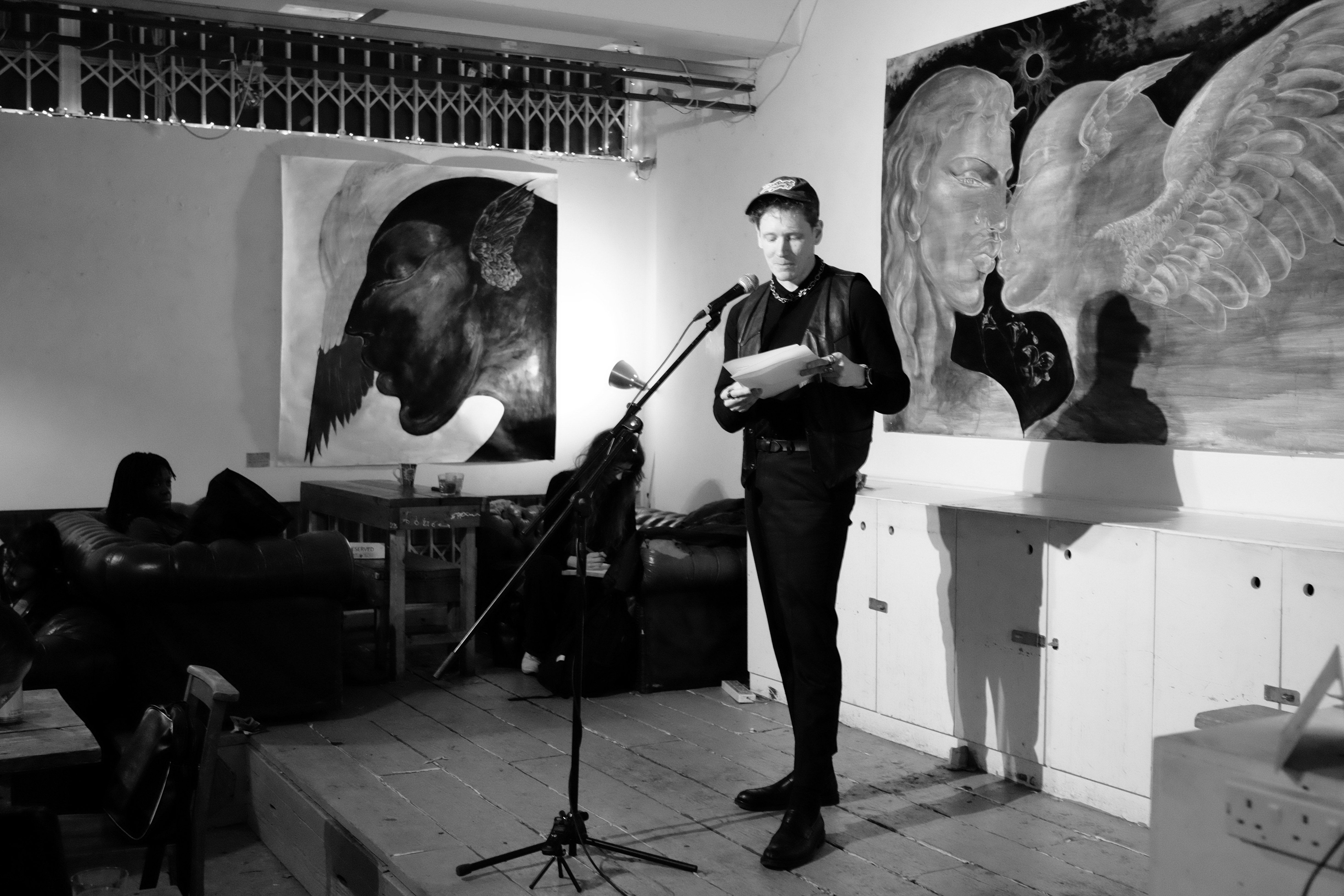
JD Howse followed, dressed all in black to match the SPAM editrixes, delivering a ghost story followed by a suite of new sonnets written, I found out later, in the span of a week. The ghost story took me somewhere, a kind of crumbling maybe seaside place — the geographical admixture of Robyn Skyrme and Ann Quin. A hotel crumbles over a promenade, there’s a fire pit, twigs. I wrote: ‘the sky pulled around us like bedsheets’ and imagined this wholeheartedly, being swaddled or suffocated in a shapeshifting quilt of cloud. ‘Cinders in the wind…smouldering as my body dissipates with yours’. The sonnets featured foxes, O’Hara being read in the rose garden (instigating personal flashback to reading Stephen Rodefer in the Berkeley Rose Garden — more poetry must be read in rose gardens), ‘morning attempts to ontologise what remains’, ‘orange tulips, almost neon, brought ot my door’. The images are vividly memorable, the twisting arguments of the sonnet form deployed to bathos and humour amongst sincerity, ‘I fell in love with you because / I thought it would be funny’. Ah how slant-assonance makes a mockery of love’s ass! 

After the break, Poppy Cockburn took to the stage. We’d had a chat about our love for a little lace or gauze on an otherwise plain shirt and how to source the garment of your dreams via pursuit and digital fluking. Cockburn is masterful at grabbing the dynamics of poem-as-poem and holding it to the light like a prism scattering wit. She understands how to tap into polydimensional performance resonance which maybe comes from her prowess as both poet and PR strategist. Sometimes you laugh and sometimes you feel like here’s a side to existence thrown into relief, something you didn’t know you needed to see. At the start of the reading, poor Poppy had to compete with Joni Mitchell who was still playing over the bar’s PA. Good-naturedly she hummed along until the staff turned down Joni. She read from her debut collection, Naked Oyster, which was put out by If A Leaf Falls last year. On the cover, a smudged Grecian-cum-vaporwave head looks plaintively down as it floats above textural shrinkwrap. This ‘look’ is a good capture of affect and I started to think maybe they need to replace the heads of the angels in Crystal Palace Park. Cockburn’s pithy works are reminiscent of Chelsey Minnis, Bunny Rodgers, Maria Hardin and Nadia de Vries, but she has this distinctively English streak of deadpan that sets it apart. Her performance explored humility, haplessness in love, sirens, wash cycles, driving, secrecy, words as ‘silks on a slow cycle’, bad men, lost feelings. I wrote down ‘POETRY IS HUMILIATING AND THERE IS NO GETTING AWAY FROM IT’ (all-caps possibly mine), ‘music journalists are full of shimmer’ and ‘I don’t have an opinion / I’m just an ambient orb’ which felt like a gurlesque take on the ‘geometrical turn’ I’m seeing everywhere after years of formless oozing. Pretty sure shape-loving Ian Macartney had an orb-themed house party once. You’ll have to ask him about it.

Our penultimate reader was Irish writer Francis Jones, who read from their Veer2 pamphlet Storm Drain. The opening repetitions reminded me of poetic markov chaining. A throwback to Howse’s twigs, we had ‘I scrub myself with cream with bits of bark in it’, how face-scrubbing makes you late for work. A spiderweb ‘like a pube in my teeth / but my own body’. Amidst this becoming-animal body horror there was an ‘unbelievable hibiscus’ and ‘major airways act[ing] furious’, ‘a grotesque stateliness’. Jones’ mentioning of the grotesque cascaded the next day into a conversation with two other poets, Katy Lewis Hood and Jared Stanley, about who or what the current grotesque poets are. I was thinking about that Dean Kissick article ‘The Vulgar Image’ which my south side reading group (affectionately titled Communal Nude) read in playful dialogue with Robert Glück’s inimitable Margery Kempe, thinking about iconography and desire and morphology, slop and narrative, collage and seam/i/less/ness. Hit me up if you have suggestions as to who are the new grotesque poets. Interestingly, grotesque comes from the Italian grottesca from opera or pittura grottesca meaning work resembling that found in a grotto. We had this conversation about the grotesque in Peltz Gallery while looking at Melanie Smith’s Tixinda, a Snail’s Purple and meditating on the gorgeousness and grossness of purple, its excess, as it is extracted from the sea snail Plicopurpura pansa. It was warm and kind of grotto-like in the gallery. Katy told me they discovered recently that the snail’s gel people are putting in beauty products is not extracted from sexually exciting the snail but in fact putting them into a state of panic. I started thinking about our cultural fetish for glass skin and the ecopoethic implications of putting the substance of another species’ panic attack on your face everyday. The last thing I wrote down during Jones’ reading was ‘love transports in moisture’. 

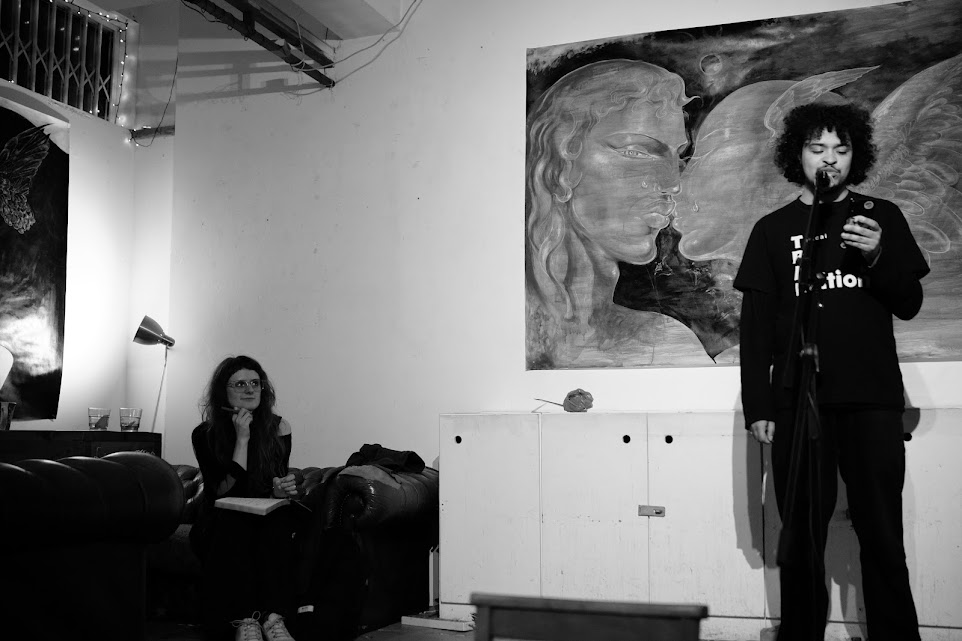
Talking of corporeal serums, William Aghoghobe topped off the night with wax and ‘the extreme extent of human secretions’ revealed in an autobiographical piece about his experience working in a university library. Aghoghobe is a very atmospheric writer and a kind of sculptor of images that sometimes coagulate and sometimes melt into motion. He read about doppelgangers, spores, frames within frames, dirt, the Walthamstow Marshes and marshy doubling of object pronouns, ‘I am only as much as my garments’. What does it mean to be a figure, like actually? All this talk of materiality made it very hard to resist pulling out the stuffing in the beat-up ‘green room’ sofas and somehow become-sofa myself but I did resist by writing down words instead. We had tales from the level 7 annex, tales from fire alarms, ‘mountains of keys’, plastics, being ‘a spectacle worker’ and dealing with an unfortunate ‘ghost-shitter’. Aghoghobe reads with bags of charm and a surrealism befitting the grotesquerie of the modern everyday. 

And so concludes my roundup of AFK#9! Our next reading will take place in Glasgow on the 9th March, with lineup soon to be announced. Thanks to everyone who came down to the Pelican! Other dates for your diary are: 

20th March – Kirsty Dunlop’s book launch for Centrefolding at Mount Florida Books (in conversation with Ian Macartney)

27th March – Kirsty Dunlop’s book launch for Centrefolding at Argonaut Books (in conversation with me + performance from Kevin Leomo)

30th April – Launch of Iphgenia Baal’s new SPAM book at Peckham Pelican (details tbc)

27th May – SPAM 10-year anniversary party at The Old Queens Head on Essex Road, London (details tbc)

Also stay tuned for news of SPAM’s Glasgow anniversary party!

~

All photographs are by Mau Baiocco.

Books I read in 2025

Leah Wilson (ed.), A Friday Night Lights Companion: Love, Loss, and Football in Dillon, Texas (2011)

Barrett Watten, Steve Benson, Carla Harryman, Tom Mandel, Ron Silliman, Kit Robinson, Lyn Hejinian, Rae Armantrout, Ted Pearson, The Grand Piano: Part 3 (2007)

Molly Brodak, Cipher (2020)

Jonathan Coe, The House of Sleep (1997)

Blake Butler, Molly (2023)

Alessandra Thom, Summer Hours (2025)

Clark Coolidge, The Crystal Text (1986)

Virginia Woolf, The Waves (1931)

David Lynch, Catching the Big Fish: Meditation, Consciousness, and Creativity (2006)

Tatiana Luboviski-Acosta, La Movida (2022)

Ted Rees, Thanksgiving (2020)

Laynie Browne, Intaglio Daughters (2023) 

Laynie Browne, Acts of Levitation (2002)

Ida Marie Hede, Adorable trans. by Sherilyn Nicolette Hellberg (2017/2021) 

Hélène Cixous, Hemlock, trans. by Beverley Bie Brahic (2008/2011)

Juliana Spahr, Ars Poeticas (2025)

Jameson Fitzpatrick, Pricks in the Tapestry (2020)

Lisa Fishman, Dear, Read (2002)

Julien Poirier, Out of Print (2016)

Juliana Spahr, This Connection of Everything with Lungs (2005)

Bianca Rae Messinger, pleasureis amiracle (2025)

Rachel Blau DuPlessis, Days and Works (2017)

Jennifer Soong, My Earliest Person (2025)

Barrett Watten, Steve Benson, Carla Harryman, Tom Mandel, Ron Silliman, Kit Robinson, Lyn Hejinian, Rae Armantrout, Ted Pearson, The Grand Piano: Part 4 (2007)

Duncan Hannah, 20th Century Boy: Notebooks of the Seventies (2018)

Ariana Reines, The Rose (2025)

Brenda Hillman, Death Tractates (1992)

Peter Gizzi, Fierce Elegy (2023)

Anne Vickery and John Hawke (eds), Poetry and the Trace (2013)

Emily Segal, Mercury in Retrograde (2020)

Michael Nardone, Convivialities (2025)

Steven Zultanski, Help (2025)

Ariel Goldberg, The Estrangement Principle (2016)

Danielle Vogel, A Library of Light (2022) 

Fanny Howe, Selected Poems (2000)

Alice Notley, Early Works (2023)

Stephanie Anderson (ed.), Women in Independent Publishing: A History of Unsung Innovators 1953-1989 (2024)

Ariana Reines, Coeur de Lion (2007)

Yanyi, The Year of Blue Water (2019)

Lucy Ives, Human Events (2016)

Chloe García Roberts, Fire Eater: A Translator’s Theology (2024)

Charles Olson, The Maximus Poems (1960)

Alan Davies, Raw War (2012)

Rebecca Wolff, One Morning— (2015)

Alice Notley, The Descent of Alette (1996)

Sean Pierson, The Perfect Season (2024)

Dom Hale, First Nettles (2025)

Syd Staiti, Seldom Approaches (2022)

Gillian Rose, Love’s Work (1995)

Imogen Cassels, Mother; beautiful things (2017)

Hesse K. Disquiet Drive (2024)

Elisabeth Kübler-Ross and David Kessler, On Grief and Grieving (2005)

Louise Glück, Marigold and Rose (2022)

Tom Raworth, Cancer (2025)

Boaz Yosef Friedman, Born in a burning house (2025)

Ada Smailbegović, The Cloud Notebook (2023)

Marie de Quartrebarbes, The Vitals, trans. by Aiden Farrell (2025)

Vigdis Hjorth, Is Mother Dead: A Novel, trans. by Charlotte Barslund (2022)

Isaac Jarnot, Robert Duncan: The Ambassador from Venus (2012)

Lina Scheynius, Diary of an Ending, trans. by Saskia Vogel (2025)

Tom Byam Shaw, You Are Going to Regret This (2025)

Bruce Boone, My Walk with Bob (1979)

David Larsen, The Thorn (2005)

Joan Didion, The Year of Magical Thinking (2005)

Hélène Cixous, Hyperdream, trans. by Beverley Bie Brahic (2009)

Danny Hayward, Training Exercises (2024)

Matthew Goulish, Kingfisher (2024)

Suzanna Scanlon, Committed: On Meaning and Madwomen (2024)

Mark Frost, The Secret History of Twin Peaks (2024)

Alex Marsh, Holding Pattern (2025)

Robert Glück, Margery Kempe (1994)

Michael W. Clune, White Out: The Secret Life of Heroin (2013)

Madeline Cash, Earth Angel (2023)

Tom Crompton, Wishbone Valley (2024)

Maggie Nelson, Bluets (2009)

Courtney Bush, The Lamb with the Talking Scroll (2025)

Bruce Boone, Century of Clouds (1980)

Evan Dando, Rumours of My Demise (2025)

Juliana Spahr and David Buuck, An Army of Lovers (2013)

Kevin Davies, The Golden Age of Paraphernalia (2008)

Tom Raworth, Structure from Motion (2015)

Rainer Diana Hamilton, Lilacs (2025)

Bernadette Mayer, Midwinter Day (1982)

Al Anderson, The Tired Angel (2025)

J.H. Prynne, Duets Infer Duty (2020)

Miranda July, All Fours (2024)

Intro for Maria Hardin 1/11/25

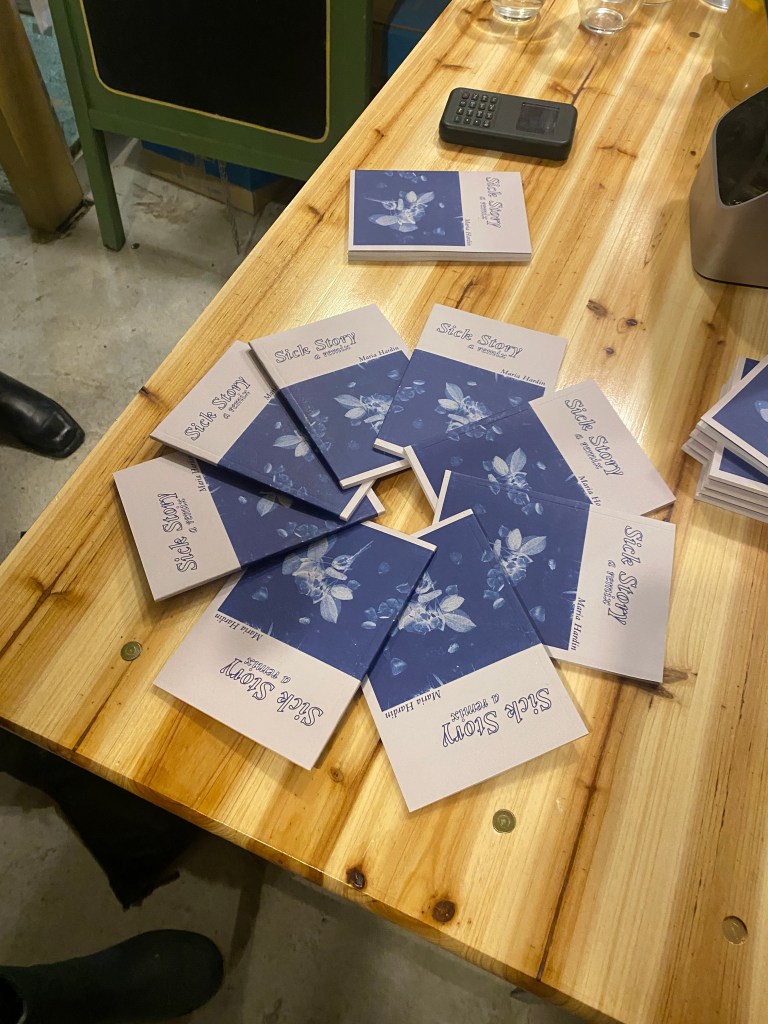
Pamphlets titled Sick Story spread into a spiral on a wooden table

Last night SPAM Press hosted the wonderful Swedish-American poet Maria Hardin at Mount Florida Books, Glasgow, alongside readings from Kate Paul and Jane Hartshorn. Here is the intro I read for Maria.

I want to begin by reading a poem by the late Rhiannon Auriol, who was a kind, talented and sharp-minded poet. She had a voice that felt genuinely fresh and we were always excited to get something new from her in our inbox. We published her in the Plaza and our online magazine several times and when it came to putting the lineup for tonight together, both Kirsty and I had the thought: I wish we could invite Rhiannon to read with Maria. Rhiannon forever.

Here’s the poem, which was published in pif magazine back in 2021.

I drop into this poem and I am petalled. I have put my hand in the new burr grinder of how I am learning to read in grief. This self-petalling is a relief. I will soften! I will become rose water, distilled into essence! Energised by short lines! There is something ugly-beautiful about my becoming rose-water of the nominative. Yes I was born with the middle name ‘Rose’ and also the first name Maria. Rhiannon writes of ‘the moon particularly / at sea’. Maria and I share a name meaning ‘of the sea’. We found each other via the kismet of poetry, and her poem called ‘Mariaology’ which features ‘a cascade of every maria’ which I first received as an iPhone photo. Last week I was researching something and stumbled on the phrase from the website MindBodyGreen which said, perfectly: ‘caffeine can disrupt your hormonal cascade’. I don’t know what a hormonal cascade is but I know I have felt it in poetry. Yes, for you I’d drop everything.

By some miracle of the ether Maria is now here in Glasgow tonight and we are launching her pamphlet and I am CAFFEINATED. My being caffeinated will never truly replenish my energy. There is a tale here. Rest without respite. Sick Story. I like to think of this as a sister pamphlet to Maria’s earlier work Sick Sonnets and also a cellular cascade of the voltas played within them. We have dying bees and the premise if not promise of healing. In Maria’s sick sonnet ‘Glossolalia’ the Steinian rose becomes a rat becoming also a rose and the speaker reads ‘emotional responses to the end of nature’. I have always loved the general mood of melancholia in Maria’s work, the way a speaker can latch, mutate and render ornate a feeling, an image whose origins remain mysterious. One never feels quite settled; there is a rat-like restlessness. Is that it? But also the still, slow burgeoning and wilting of the rose. Of devotion. Hours of languishing. The void is decorated all the better to feel it. The void is remixed. If there could be endless Proustian bedtime there could also be a pain psalm and a ‘baited lamb’. 

Sick Story looks for alternative narratives in its telling of chronic illness. It asks ‘what is the shape of a sick story?’, with an eye to Bernadette Mayer’s Story and Ursula Le Guin’s ‘carrier bag theory of fiction’ by way of explanation. For Le Guin, the carrier bag narrative is shaped like a bag, not the arrow of phallocentric linearity. Mayer’s Steinian Story bundles riddles, matter, anecdote, the stuff of ‘things’. Nothing feels pre-determined, destined for an ending; rather, all times rub their quantum shoulders in the bag. Have you ever rummaged in public for your medicine? Have you ever written notes on the back of your hand, worried the ballpoint would seep beneath your skin and stain something irrevocably navy? Have you ever shaken your life up so much you could almost smell its perfume? 

Here is a snippet of Mayer’s Story:

Voices fall.

It may be seen feeding on this under one of those tropical things.

The time or place of starting. 

He throws a hat on a seal’s head and a piece of his pack into a whale’s mouth, marking their characteristics. 

Lamp, lucite and plastic. 

I saw one once in a book, but I didn’t rip it to shreds, or even divide it, as I could

have (snap), but left it whole (shot), which it could never be unless it were left 

that way. 

Will that have anything to do with this? (67)

Mayer’s storied ingredients are packed upon each other like the storeys of a building. She disrupts the assumed causality of narrative with a prompt — that of the child’s or editor’s: ‘Will that have anything to do with this?’. I am at the soft mercy of every bedtime story. Once gathered into the bag, is everything relevant? And where does it take us. Details are listed like precious cues. Lamp, lucite and plastic. The pronoun ‘it’ bears wild liberty in its free-kicking materiality. I trample ‘it’ under the ‘perfect lucite heel’ to which the speaker of ‘Mariaology’ prays. I sub ‘it’ under light, lux, something solid and transparent — the supposed clarity of what I am trying to say, what does it all mean. What is the ‘time and place of starting’ when it comes to illness? From where do voices petal and fall? Are they, like rain, a kind of interference? Mayer asks ‘What did the rose do?’ after the word ‘History’. I think Maria is answering that question in her remix. We invent from adjacency some kind of story. Is the rose sick, is it guilty? How to place these scenes. I think of something Jane wrote in the same issue of SPAM magazine where we first published Maria: ‘Houses appear / where once there was marshland, a thin burn threading / between them.’ My imagination shrinks these houses to the size of pages and now I want to live in them. And you can too.

Here’s Maria Hardin, thanks everyone.

🌹

You can buy Sick Story from SPAM Press here.
It is SUCH a cute edition (A6 pocket-sized) and the writing will stay with you a long time. Carry it with you!

You can buy Maria’s debut collection, Cute Girls Watch While I Eat Aether (2024) from Action Books here.

Here is a long essay I wrote about roses, via Idlewild/Stein/Lana Del Rey/Joyce et al, back in 2017.

A second smaller heart: on writing The Indigo Hours

The first song I was ever obsessed with was Suzanne Vega’s ‘Marlene on the Wall’. It was on a compilation CD called Simply Acoustic that I’d found somewhere in the house. I’d listen to it over and over again on the CD player in my room. What I loved about this song was its narrative possibility. The protagonist triangulates her love affairs under the watchful eye of ‘Marlene’ looking down at her from the wall. My child’s mind made up all kinds of stories about this. Marlene could be an older sister, a mentor, maybe the lover of one of the men that passed through the life of her. Marlene seemed cold. She was not a jealous lover, she didn’t act out. Anything advised by Marlene is provisional, ‘what she might have told me’. I imagined her having very thick eyeliner.

For a long while, Marlene was a kind of angel to me. I saw her wherever I saw people on the wall. A Picasso print of a woman drinking coffee on a balcony. I haven’t been able to source this painting except to remember there was long dark wavy hair, the colours purple and yellow, coffee. I remember thinking it looked a little like my mother. It’s not something we kept when we had to clear her flat this summer. Maybe I took a picture, but I don’t want to look for it. Marlene showed up in my dreams. Marlene was there in my imaginary stories. I could never tell if she was the protagonist of a life or someone to whom things were done. She seemed to encapsulate a distant sexual maturity while also representing ‘the impossible’ and so, the untouchable.

*

I see 2018 as an apex year in my life. I remember dazzling summer nights, two kingfishers, kissing in the midst of cinders, hiding, my phone pinging constantly, no homework, sparkle emoji. This was the year I wrote the novella that Broken Sleep are publishing next week. I started writing The Indigo Hours partly in solidarity with a close friend who was writing a novella for her Masters degree. I was a year out from my MLitt and waiting to start a PhD. I don’t think we shared any work in progress; we just swapped manuscripts when we’d got to the end. I don’t remember writing this book. I don’t remember if I wrote it on my phone, a library computer, the Chromebook in the restaurant I worked at. Maybe it bounced between these locales. Maybe the bouncing was painful. It involved data loss. When I meditated today the AI-generated female voice said ‘find a point in your breath and this will be your anchor’. The point in my breath is a ‘flashing’ spot in my chest. It is an anxiety motor. It cannot be my heart because it is too centred. But of course it is my heart. Sometimes I think I have a second smaller heart lodged in my sternum, where I used to get an ache from purging. This heart is blue, a mottled and gold-streaked blue, and it is rare like the blue version of the rose, my middle name. Semi-precious.

I wanted to tell this story about two people kissing illicitly in a garden, surrounded by white poppies and mystery. I wanted to write about the indigo hour of midsummer dawn, when you are up all night with someone, the breath before a comedown, before it’s all over. I wanted to write about a relationship that felt like that and whose dramaturgy was always the dawn. I wanted to write about something that was ending over and over again, and the ending wasn’t the point. There was a life and people drifted in and out of it. I wanted to write about arousal and attention, sentiment and giving up.

The summer before The Indigo Hours took shape, I was writing a thesis about the curatorial novel, about object-oriented ontology. I was interested in what Ben Lerner says about fiction staging encounters with other art forms. For that to be embodied and taking place in a credible present. I was interested in the refrain of unseasonable warmth that haunts his novel 10:04, the way the narrator might have these hotspots of medial feeling owing to places in New York City where he received such and such a text. I was reading a lot of books that take place in the disintegration of some kind of love affair — Joanna Walsh’s Break.up and Lydia Davis’ The End of the Story (also loaned by the novella-writing friend). I don’t remember the plots of these books at all but I see them essentially as ‘novels that walk around, receiving and metabolising messages’.

Turning to write myself, I wanted to create a fictional world in the aperture of indigo, the special hours of Scottish nights in June and July where it never really gets dark — there remains this blueish glow to the sky. I knew these hours to be indigo because I didn’t really know what indigo looked like, only that it was some kind of shade of blue and everyone seemed to disagree about how light or dark it was. A morning and eveningness, a not quite. More like a mineral or texture.

How deep in the woods to go to get this indigo. How deep in love did we go, or in druggy reverie. It all felt so subjective, translucent. The love I was writing about was already belated, collaged and distributed unevenly through various places, fantasies and timelines. What could I say about it? This love that made an ‘I’ into both subject and object. That distorted the closure we had been raised on to believe was love’s destiny. It was an ambient intimacy, then. It was in medias res, ongoing. The midtone of indigo. In the process of editing the raggedy manuscript (what I referred to, in an email to the poet Callie Gardner, as ‘the trashy wee thing’) a couple years later, I discovered the phenomenon of indigo children. Since then I have learned more about what it means to be an indigo from the writer Laynie Browne. I relate this to a phenomenon of emotional & intellectual hyper-attentiveness my ex and I used to refer to as ‘shine’, also to a feeling of hyper-empathy and sensitivity not just to the mood of a room but to the mood of anything more-than-human. If you are capable of shine, if you are inclined to indigo, your presence might follow a gradient opacity. In Committed: On Meaning and Madwomen, Suzanne Scanlon has a chapter ‘Melting’ which talks about what it feels like to have ‘no glue’ and no security: ‘You could melt into another person, or melt into a place like this [a psychiatric hospital]’. This melting is akin to what Stephen King calls ‘the shining’ or what others call ‘sensitivity, insecurity, shyness. Fragility’ (Scanlon). I’m interested in how to put that kind of melting character on the page. What would her voice sound like?

A vessel, a leaky container…a watercolour palette smudging ceaselessly in stroke after stroke…Being an indigo is a lonely experience but one that lights up at the world. Pure indigo has a high melting point; when heated, it will eventually decompose or sublimate. For some people, reading indigo must surely be excruciating. For others, it is true. I think indigos come from elsewhere, they remember other times, their memories mutate and take form in their dreams, they bear an awful gift, they don’t belong to any fixed thing. What could be their future, is it possible. It doesn’t have to be something that makes you special. There is a kind of love that makes you indigo, opens you. For a lot of my life and even now, I walk around like an animal or an open wound. These are cheap metaphors. It is more that I walk around like the weather. No, I walk around like indigo. I freeze-dry experiences into crystals and exhale them on the page. I can’t say whether this produces realism; it’s very smudged.

Trying to put Marlene on the page was an act of transmutation. I read Timothy Morton on beauty’s perception as an act of ‘attunement’. I wondered if my attempt at fiction was really just an attempt at sensing beauty. But there is a lot of horrible stuff in this book. A lot takes place in the shadows. A lot of the scenes are decontextualised and in a sense ‘free-floating’. We don’t get heightened climaxes and denouements so much as vignettes melting into one another. In Reading Machines: Ambient Writing and the Poetics of Atmospheric Media, Alec Mapes-Frances talks about the ambient poetics of Lisa Robertson and Tan Lin as a ‘vaporisation of the lyric subject or self’. I saw Marlene as a soluble force more than as a coherent character, a stable subject. Marlene was a problem to be solved; she was able to be dissolved. I needed the temporal mode of fiction to play this out over time, place and encounter. Ambience refers to the surroundings of something, the environment, a kind of base existence (there is light, it is blue; there is this mood; the room is cool) tinted with some accompaniment, encompassing. Can we plot ambience the way we might plot time? This was something I was concerned with when writing the book.

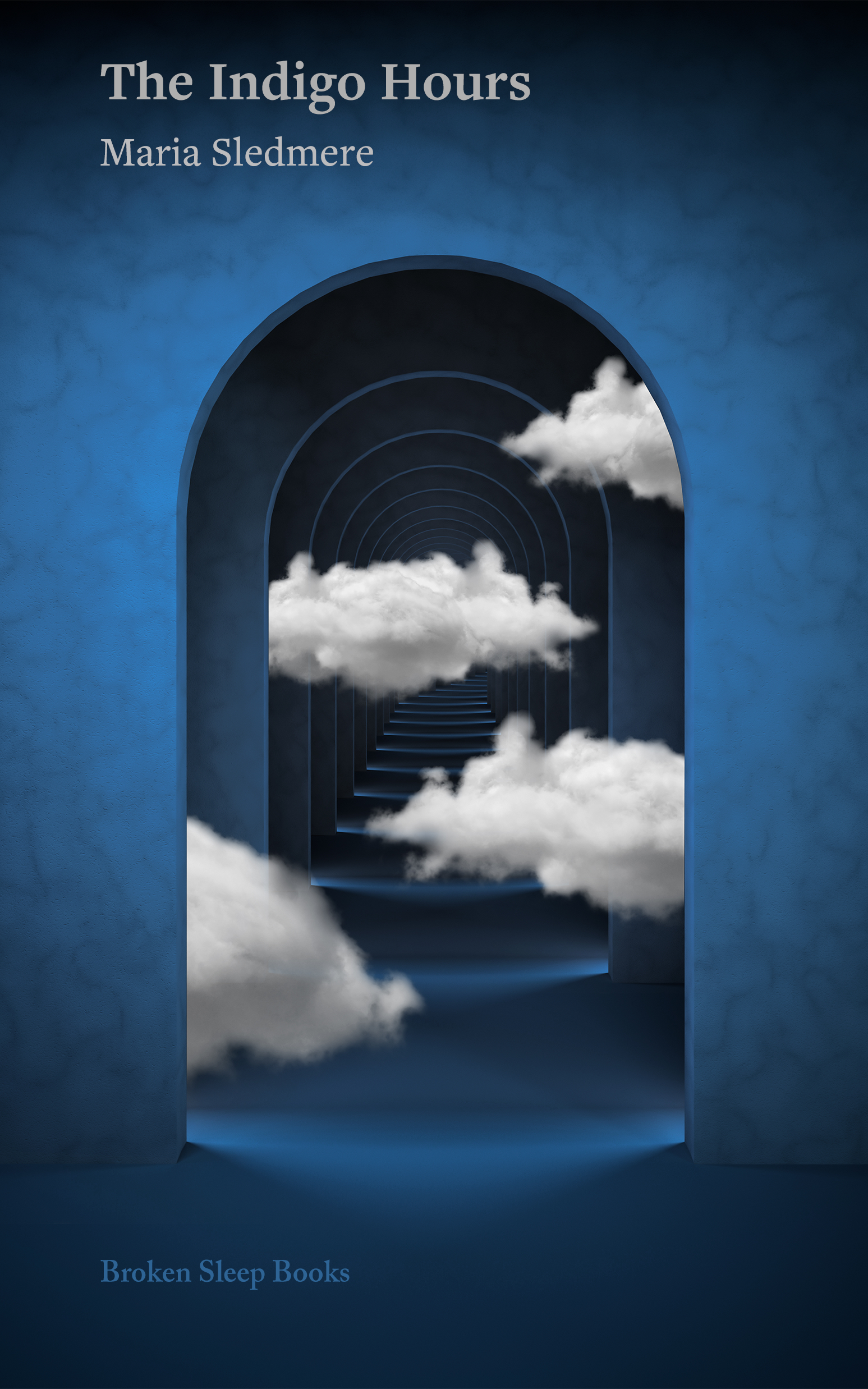
My friend Stuart read an early version of the manuscript and said something about it being constructed around several pillars or towers. I think he was referring to place, as it stands in the story. The central (unnamed) city, Berlin and the prairie. I imagined these towers as constructed of fragile pixels. A little data moshed and crumbling. The movement through the story might be closer to a dérive or distracted wandering (I imagine readers skipping over, revisiting, forging microloops as I did in the writing). Insofar as I can remember writing the book (which I cannot) I was doing so in order to ‘read’ a relationship. This took place in a series of loops and compressions. Similar things said, the same mistakes, rotations of closeness and distance. My towers were constructed to make something semi-permanent of a very dissolving time. Aaron Kent’s cover for the book invites you to choose from various alcoves and passageways, or drift onwards into mise-en-abyme. All the while, in the company of clouds. I recently rewatched season 2 of Twin Peaks and the finale, in which Agent Cooper slips in and out of red curtains while seeking Annie, or answers, resonates. Disorientation. Passing through thresholds. Trying to save your love from evil. And what if it was not one love, but a concatenation of shadows?

Evil was also the ravages of shame and depression, the doubling of seeing the dark in yourself. Or, depression was a particularly sensitivity to evil. I get into these loops about it. There is so much evil in the world. For much of my life, I have not felt like a person. There are clouds drifting in that part of my soul that is supposed to feel warm and full. “I am okay” etc. I am like a child, lily-padding over the clouds. The same child that needed Marlene to guide me. I experienced love as something annihilating and so bright. The blue-heart anchoring pain in my chest. Hawk tells Cooper that if you go into the Black Lodge ‘with imperfect courage, it will utterly annihilate your soul’. What does it mean to give your narrator courage? I wanted her to have the courage of suffering and to see that in others. To suffer what would never work out. A constellation of burst blood vessels around the eyes. To have the strength to look in them, for that look to be a holding place, then a continental shelf, then nothing.

A foothold, even. For someone climbing the tower, trying to get to the kissable moment again and again. For the tower to be a text. I go to the tower, I spiral in stairwells, I see a prairie stretching farther and farther, I get so thirsty.

*

Are such towers architectures of refuge or incarceration? Here’s a passage from Hélène Cixous’ Hyperdream, a novel about grief, love, friendships, telephones and mother-daughter relationships (I will never not be obsessed with):

We don’t stop killing ourselves. We die one another here and there my beloved and I, it’s an obsession, it’s an exorcism, it’s a feint, what we are feigning I have no idea is it a sin a maneuver a vaccination the taming of a python the fixing-up of the cage, it’s an inclination, we don’t stop rubbing up against our towers touching our lips to them

Haunting the novel is this allusion to 9/11, but the towers as totems seem also to be something else, much more imaginary: ‘I saw it shimmer in my thoughts’, Cixous says of her ‘dearly beloved originary tower’. In an early document for The Indigo Hours I had this epigraph I haven’t since been able to locate from Morton, something about beauty being a homeopathic dose of death. I see my love go out the wrong door, I see a certain look, a turning back. Towers of collapsing sand. I see Marlene on the wall. Marlene from a tower. Marlene as the mother-tower, no, the sister. All my life I have said, who is she? She whose name means ‘star of the sea’. I rap at the door of Montaigne’s library tower. It survived a fire.

The homeopathic dose of beauty, like Cixous’ vaccination, prepares us for exquisite loss (and so soaring, to tower over). In a way, The Indigo Hours quite simply plots the disintegration of a what is now called a situationship. But really it is a book about everything happening in one plane, each shifting tense another groove of growing older. Growing into the old you were before. Essaying through this experience via encounters with art — everything from installations to Lana Del Rey (on whose early albums the narrator delivers protracted sermons — this being a book loosely about finding meaning in the spiritual emptiness of the 2010s). No, it is a book about things and time and pleasure.

Only recently did I look up the meaning of the song ‘Marlene on the Wall’. Apparently Marlene was the German actress, Marlene Dietrich, whose heavy gaze looks down from a poster. Maybe this is why my protagonist so frequently visits Berlin. Vega talks about writing the song for Dietrich after turning on the TV one night, her ‘beautiful face in close-up’. ‘Marlene on the Wall’ is a coming-of-age song, it’s also about power and violence, beauty and changing. There’s a butchershop but also a rose tattoo. I saw the song as an eternal love story with destruction as its anchor point. ‘Even if I am in love with you’ being the parenthesis through which to begin the working backwards of what Joanna Walsh calls the ‘fresh and terrible’. If I carried around that song I also carried the ghost-image of Marlene’s televised face in monochrome. How alien those brows, the beauty of another time. When I read fiction, when I edit fiction, when I approach a story, so often my question is ‘so what?’ I am looking not for answers, but for experience. Fingerprints.

Vega’s opening: ‘Even if I am in love with you / All this to say, what’s it to you?’ could be the central premise of The Indigo Hours. So for this book to be ambient is to be deeply interested in the ‘it’. Of love, of the being-in, of melting into the world, being washed continuously in its blood, its indigo, its chlorinated swimming pools. To look for explanation is one of many reasons for fiction. If Marlene peeled off the wall, I saw her growing along some trellis as a rare blue flower, a wallflower but livid and shedding, changing. I would write to water her, I would coax my clouds for a little rain.

Blurbing The Indigo HoursAmy Grandvoinet (brilliant critic of Surrealist & avant-garde psychogeographies) writes generously of ‘a languageful love pulsing constant’. A blue heart plucked and buried in the book, behind some cloudy curtain. This heart is sequined to the rhythm of life. If there is a cadence to the book it is love and love’s chaos sewn into patchwork. Marlene returns to Berlin to see her friend. She sees an old friend and cannot bear to reach him because there is this substance between them. She paraphrases T. S. Eliot’s ‘Burnt Norton’, she almost leaps the mirror fence. There are indigo seeds in these stories. I hope whoever reads it finds their own pulsing constant.

You can order the book from the publisher here. It is out on the 31st October.

AFK x sincere corkscrew at The Doublet, 14/9/25

Kirsty & Ian introduce the evening

Tonight I wore what can only be described as a billowing tent and cycled in the rain to the SPAM x sincere corkscrew AFK event. Summer is over, sorry. The newish Away from Keyboard series has so far featured poets-poets-poets — local and visiting — with some exceptional forays into prose. Tonight’s affair was premised more on the prose-y variety, with flash fiction, short stories aplenty, but also music and poets reading to music. A London poet recently said all the poets are now doing ‘sonic poetics’ and this trend has made its way north. I’ve been wanting something more durational for a while. Longer readings that feel like a proper ‘set’. Having sound in the mix trains us to listen longer because we are listening beyond listening for ‘meaning’. This event was set up nicely so that the first few performers did their punchier sets and then the final two were longer. I wasn’t involved in organising this one so also quite nice to just sit back a bit.

First up was Anna Walsh. My first time seeing them read after much hype from Kirsty over the years. Their short story pamphlet Stag Do / Fantasy Horn just came out with brand new London-based indie, Ssnake Press. Anna read a piece set in PureGym, ‘the best spin class in Shawlands’. It was funny, closely attuned, turning a sharp lens to the ennui and im/possibilities of desire, and made me think about the gym as a terrain of fantasy triangulated by disgust and expenditure. A toxic combination that is fun to sublimate through multitasking on the StairMaster, whether you are sending emails or texting e-girls. The observational plane of fiction would then cut up into self-reflexive moments of becoming-object. Here are my thighs. They are moving shapes. Sweaty hair. Here is the screen showing a beach. The pink disinfectant spray. In my notebook I wrote: What can you trust of how human relations conspire in the endorphin farm?

Sean reads with a beam of light splitting the room

Anna’s reading was short and sweet, followed by the blazing Tom Byam Shaw who delivered some hits from the cesspools of late capitalism. A disturbing anecdote featuring a licentious coworker at Footlocker. The reterritorialising of terror as gender reveal party… ‘We have a gender…it’s a war!’. A story about Chernobyl Cat Girl at the rave, ‘a party without respite or rest’. These are fictions which tremble with the hurtling premise of assured combustion. Tom’s book is coming out soon with sincere corkscrew. Launch at Mount Florida Books on the 3rd October. Following Tom was Sean Turner McLeod. Nobody knows if they have ever heard Sean read before. His author photo definitely wins best prize (if you didn’t see it, he’s standing in a picturesque river looking fierce af, exhaling dragon-quantities of vape smoke). He has been published ‘widely and discreetly’ and his work is great, witty, delivering its critique in lashes of sardonic commentary on everything from the gentrification of Glasgow to self-hating ghostwriters, poverty tourism, the Sunday night tv spectre of our Scottish childhoods, Neil Oliver, whose ‘voice made you drink’ (intone that darkly). Sean is good at verbal sparring and he essays with ease around many things vivid, for instance, the ‘controversial’ Joan Eardley painting of a male nude. Sean, I hope we will hear you read more!

Ian reading playlist poem in Xiu Xiu tee. Poets drinks of choice: IPA, tap water, whisky

After a break we had Ian Macartney, cohost of the night, deliver a virtuosic list poem about playlists. A smart, discursive cascade which was hallmark Macartney, traversing pop culture, geopolitics and counterfactual plot twists of recent Scottish history. One of the first lines was ‘The playlist is a commons’. Ian is a true lover of songs and the anguish of how much love for the playlist is distorted by the cynical, algo-ploy of subscription profiteering comes across in the poem’s argumentative rivulets and sparkle. It got me thinking to how so much of this blog used to be ‘playlist posts’ where I’d diarise lightly around a playlist, as a way of marking time. At some point, I fell out of love with the playlist form. Too long, sprawling and tantalised by algorithms, I lost the ardour for ‘looking’ that precedes any possible curation. What then soundtracked my life since I stopped making monthly playlists? An album, or a single song. So how did that transform the flow of time itself? Did I get ‘too old’ for playlists? There was a loud tone. It was found resounding in everything. Summer’s faded peach. Plaster peach. Crooning afternoons. This one plucked lyric. Is that true though? I remember having a collaborative playlist (‘E-WASTED’) for my 30th birthday party and on the night, the pub wouldn’t let us turn it up loud enough to hear it. But we played it anyway, all 24 hours and 54 minutes, knowing it was there, knowing we’d never get through it. Registering time in its variety. I wrote in my notebook: Once the modal curation of the playlist was a way into writing but then I stopped thinking of songs in their lily pad potential to cross the river of whatever mood or walk you were caught in. So what, did I wear the songs instead? I let them wear me out and I wore them to death. The songs were hot freaks! Ian’s playlist poem was a poem of nowness, enacting its ‘repetitive pattern in space’. I heard a girl downstairs shriek ‘Bye, love you!’ and thought — that’s one for the playlist. Add ‘Bye, love you!’. Midway through the reading, Ian holds up a piece of paper revealing an obscure, eleven-sided shape. I hope the mathematical reality of the poem is some kind of angel number squaring of 11 and for the playlist to transform from anaphoric placeholder to the reflexive imperative — play [the] list — as you wish. Start the poem. Perform. An eleven-sided playlist for being born again. For this to be a gesture of love, obviously. & ofc, fuck Spotify – tho I have spent over half my life listing songs on its lifeless interface.

Maddie reads!
Zeo and viola!

Following Ian, Madeleine McCluskey of Big Red Cat zine read some short stories with a fairytale flair. There was an island setting, ‘spindly earrings’ and ‘menthol cigarettes’. A girl who dies. Friendship, hunger, ‘a burrow formed where lunch ought to be’. I thought about the cruelty of fiction and how we must die and plotting towards endings and hunger as a grammar of prolonging. A few performers this eve list 1999 as their d.o.b. in the author bios and it got me thinking to what a fin de siècle aesthetic might be like. I wouldn’t say anxiety was a running theme exactly. Neoliberal hell obv. But maybe an archipelagic consciousness of hopping between — something about working with what is shorn up amidst so much erosion [more thoughts needed]. Elsewhere supplants elsewhere’s interminable now. We had another break then Zeo Fawcett did a set of live viola playing with backing tracks and singing. He is so so talented and the songs were unique and compelling, shifting the tone of the evening. He had this story about missing out on hanging outside Boots being an emo because of having Gaelic singing lessons as a teenager. Sometimes I wish I’d had the Gaelic singing lessons instead of hanging outside the Odeon being an emo. There was a song called ‘Feeling really impermanent right now’. Later, I start to identify too much with a rain drop running down the window in a memory of a bus window in a 00s tv show.

Introducing Charlie McIlwain to his Texture Texture outfit, Ian attests to the success of their connection, claiming that ’email is the way forward’. Honestly not enough people in the room questioned the boldness of this claim. I want him to be right about it though and briefly I parenthesise all communication to the epistolary promise of endless more soons like the swooning glut that would end platform capitalism and reunite us with wild cognition, in just enough time to save the world. For now, this chance pairing of Charlie and Ian will do. This is a fucking great set of surreal, whipsmart k-hole cantos delivered with register switch ups that surprised at every turn. Hilarious and devastating, with fitting improvised drone from Ian. I thought of Spicer’s radio and how there would be aliens in the ancient walls of The Doublet dictating this through the frequencies of wave machine. One regular punter from downstairs popped in by accident and stood in mesmerised bewilderment (nah, rly he was just giving glaikit) before turning back and losing the opportunity to have his head blown off by poetry. We had ‘white fire violetted daddy’, we had ‘sleep is just cloth’, ‘you can use your ass like an appliance’, we had literally two pairs of glasses, ‘stop killing Lorca’, imploring ‘the language is in trouble’ folded into ponderings borrowed from W.S. Graham, we had ‘Hegel ate a crow’, ‘the furniture will not endure perception’, we had Brian Wilson and John Clare ‘and shall I know that sleep again’. Listening was like trying to trip talk with someone who is not tripping and in the duration of that performance (idk 30 mins or so?) I let myself (what comprises brain matter of synapse and syntax) be scrambled by signifying mayhem and enjoyed every minute. Go buy Charlie’s Elegy [Model Interaction Trend] now you fools!

When I found the remnants of some kind of pop-up carnival show on Kelvin Way, cycling home, dis-articulated along the road in luminous obstacle, I knew I was still riding through Charlie’s poem.

~

Thank you for reading! This write-up is for K. and anyone else who couldn’t make it – plus I forgot to record the audio for this one sorry! but one day we will upload the mp3s from AFKs of yore…and this one will be remembered in the hearts & minds of all who attended… xx

New book: The Indigo Hours

🦋🌫️🍋‍🟩The Indigo Hours…forthcoming with Broken Sleep Books

In 2018, I wrote a novella about erratic romance/Romance and the lyrical space-times of its (im)possibility. The fictional ~situationship at the heart of this work is stretched into, over and through various places — real and imagined — which the narrator digs into as pockets of presence and meaning. With its wandering, non-linear plot, I’d describe The Indigo Hours as ambient fiction. It’s a little eclipse of a book. It was ambiently written (leisurely, over one summer, as a dare) and may invite ambient reading. Which is to say, a textual experience more inclined to ‘going round’ a thing, attuning to its surrounds, getting lost, adjusting the frequency of (dis)interest. This is like dating a semi-transparent person. To adore the ghosts of both of you. How might love halo or envelope one’s personhood? How might love’s presence be felt ambiently in the objects and subjects of everyday life? The work tests love against memory, song, travel and friendship. I was interested in the phenomenon of blue — specifically indigo — as a desiring filter. Indigo as a singularity. Indigo as language of variable opacity. Denim wash (to go someplace). The supernatural inflection of indigo children (as a vocalised attempt at performing divergence of attention, durée and feeling). The book is full of aura, fleeting connections, music, art, intimacy and loss. It will be out on Hallowe’en, 31st October 2025. 

Some nice things people have said: 

The Indigo Hours’ lyrical prose, daubed from a free-associating palette of sensory psychedelia, becomes a portal into a ‘blossomy blossomy realm of the possible,’ where sadness is a sexuality, jealousies cause for celebration, and love a drunken texture. Painterly, tender, and spatially generous, this affecting novella rewards re-reading, like a magic eye that reveals a new image, and perhaps new self, with every glance.

— Poppy Cockburn

The Indigo Hours is watery fortification. Beneath li’l triads of asterisk constellations, Maria Sledmere tells a post-Romantic tale of moonlit precarity and passion among pools & thunderstorms & prairies & airports, where feeling wretched wandering midnight miles is a complex freedom, as exposure on cobalt-lit webcams, dozing/dosing to dub deep trap techno, bruises so Blühen. Yet under cosmic circumstances that augur heartbreak, Maria gifts us the deep assurance of ancient-blue auras and a languageful love pulsing constant. For insomniacs-or-otherwise against analgesia’s ‘“who cares”’, a most vital and tender-prone tonic.

— Amy Grandvoinet

Preorder now from the publisher.

x x x x x x x

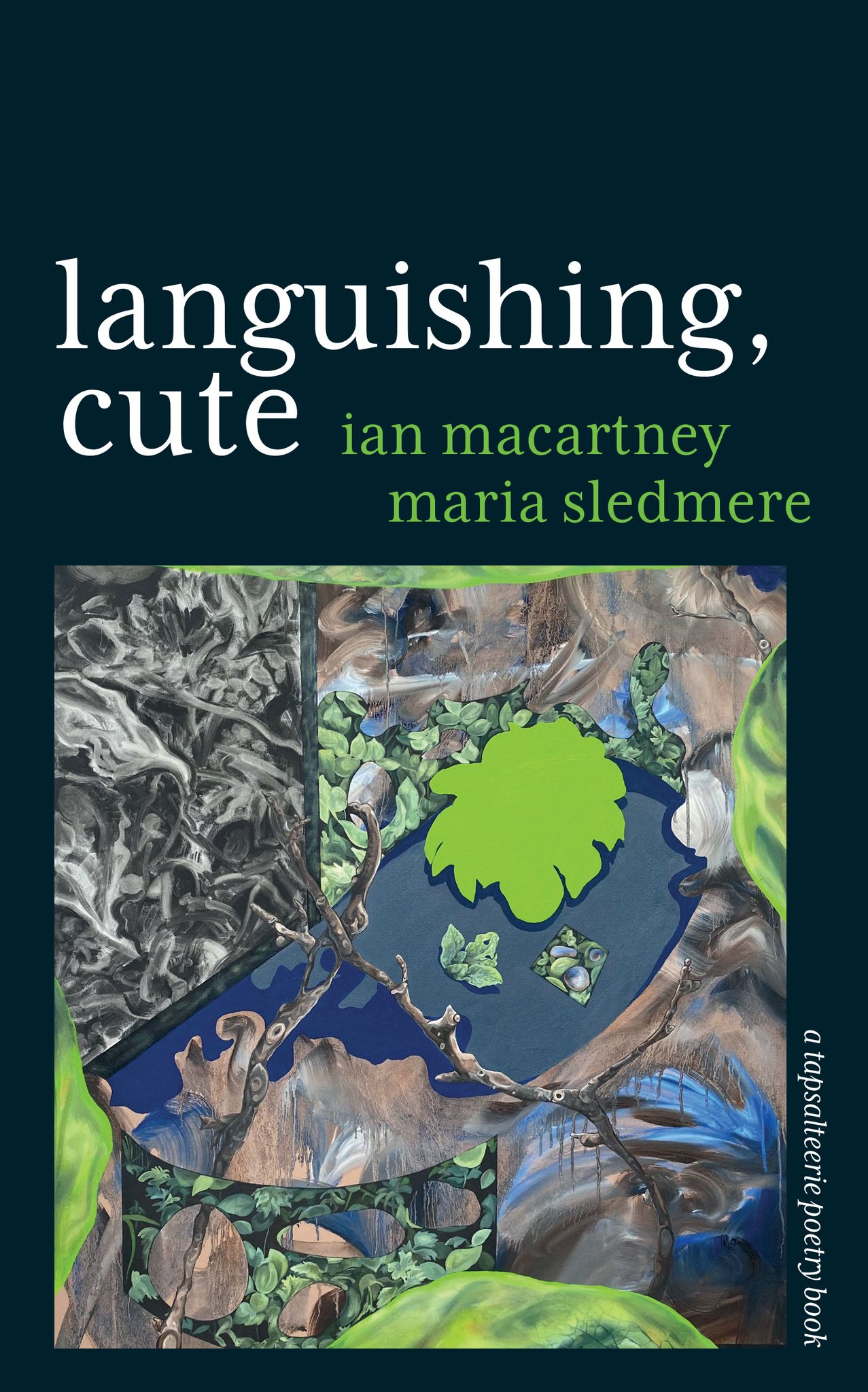
Languishing, cute is in the world!

In August 2022, which legitimately feels a whole fat wormhole ago, Ian Macartney and I found ourselves working in Edinburgh for part of the summer. We met up at after-hours cafes (more prevalent in the capital, what you playing at Glasgow?) and walked around the Botanical Gardens where the staff promised ~*’Instagram flowers’*~ and we talked about our hopes and dreams and struggles as booksellers and teachers. Part of the emergent narrative concerned utopian ideals of Scottish infrastructure, where one could zip to Lerwick in a hyperloop heartbeat (all élan, not El*n) or at the very least catch a local bus on time, or unlock a hidden realm below the loch of Linlithg(l)ow. Part of it was about friendship, love and pop music. We were listening nonstop to Caroline Polachek and feeling okay about it. Pretty good actually. There was her vocal flipping over the crags, at sunset. I remember purifying my heart with orange liquor. Wearing a lot of lilac. Bleeding ink into industrial bedsheets. We were thinking about pivotal points where our childhoods overlapped with culture. We wrote things in documents and met in the months ahead. I did a lot of chaos cycles, late, trying to meet Ian at say, the Mitchell Library to go over some edits. A lot of awful things happened in the months intervening but there was this document we could splash land into and like turn on the light. Poetry’s coy ambience zonked up to warp speed. I liked doing this project a lot. I’m glad it’s in the world.

I think it’s in the same universe as say, An Aura of Plasma Around the Sun and Ian’s 2024 essay for Futch Journal, ‘solarity, reclaimed’.

We’re publishing the full collection, Languishing, cute with the wonderful Tapsalteerie, an indie press based in rural Aberdeenshire. Ian’s worked with them before via their pamphlet imprint Stewed Rhubarb Press and they published some of my poems in the 2019 anthology, edited by Calum Rodger, titled makar/unmakar: twelve contemporary poets in Scotland. We’re big fans of Duncan Lockerbie, Tapsalteerie’s founder and editor, who does so much for Scottish poetry and beyond.

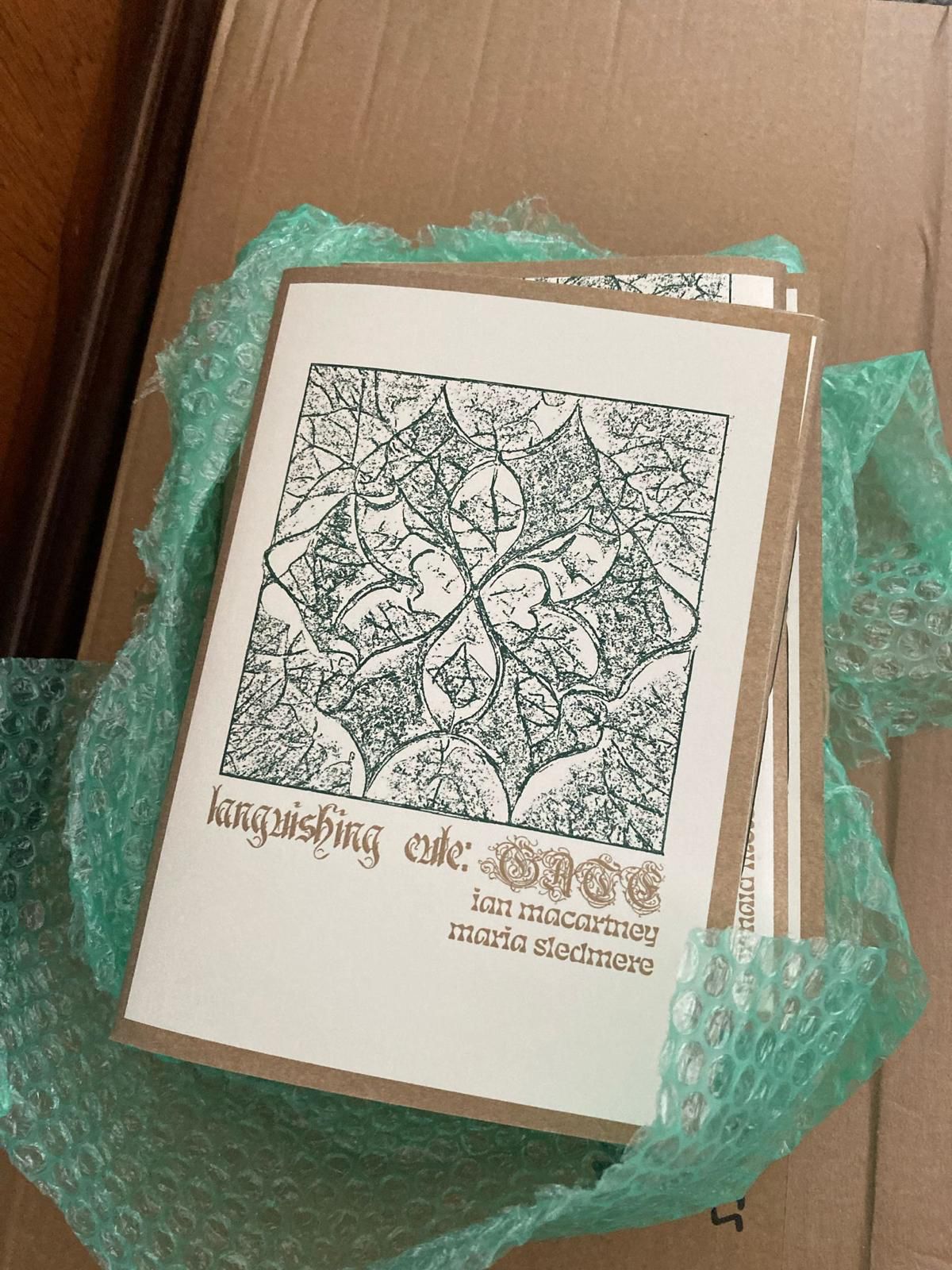
We’re also publishing, thanks to the exquisite printing of Earthbound Press, a separate riso pamphlet of b-sides titled The Gate. Look out for that at our launch events…

From the publisher

languishing, cute presents a collection of jittery missives that propels the speculative Scottish canon of Morgan, Gray and Mitchison into a maximalist ‘high femme goth surrealism’ via hyperpop, Celtic futurism and digital culture. Here the poets tend towards e-pistolary contemplations of retro-adolescence, fizzy ecology and mercurial slippy gurlhood to complicate notions of Scottish identity, nationhood, ecology, nostalgia and more.

Nice things people have said:

languishing, cute is the opposite of a flyting — that traditional bare-knuckles fight between two poets. Rather, the two poets here offer their worlds to each other in the gift of friendship and they listen back: it’s not a duel, it’s a jewel. Where they meet is in a place of Anglophone avant-garde stimulants — locating codes include Francesca Lisette’s Teens, Edwin Morgan, Tim Atkins and Peter Manson — and the dancefloor has Bunny Is A Rider pumping out in up-melancholy and autotune. At times this is glitch-poetry, funny, para-kitsch and mesmeric. At other times there are the amplitudes of tenderness and self-effacement in a palette of citrus and greenest day-glo. What’s also fascinating is the pressing together of the virtual and its tics with its mineral and viscose underpin, all via the very human. It’s a leap from body/mind to capital/digital and back again, flickering, a visit to Silicon Brig-a-Doon you’ll want to be the first to Insta.

– Richard Price

[…] Messy as a teenage tumblr, flashy as a strobe light, this is two exceptionally generous poets bouncing off the walls of the backrooms with the energy of a thousand monster energies… here ~The Glitch~ is not a glitch but a stitch between windows, the glue between a b2b set, the rhythmic green hills of algorithmic infinity … and yet these re-mixes and e-mails traverse an internet of metal and cable, the business of poetry is conducted by staples through sheets of reconstituted tree::: there’s something old-school, decidedly analogue about all this. It feels like you could feel it. It feels like the push of a button, the caress of a bright cool screen. Actually no it feels warm and coarse, a cosy transmission rumbling, re-tuning itself like you’re flicking from station to radio station, flickering between noise & dialectical noise, patterns emerging in the static as the ether unknots itself, and the stuff of life comes spilling out […]

– Dan Power

Endless aureate refreshment from Maria Sledmere and Ian Macartney, languishing, cute is a collection with all its push notifications turned on that still finds headspace to pay attention on the DL to form and poetic inheritance. There’s Sledmere’s elliptical take on William Carlos Williams’ fridge raid (with Kylie Minogue R osé instead of plums), the odd sestina, and plentiful nods to that Scottish experimentalist Edwin Morgan range from embedded songs of the Loch Nes[s]presso Monster to Macartney’s predictive geographies in time-travelling poems indebted to Morgan’s Sonnets from Scotland.

With spins to further Scottish topographies from Maybole to Lerwick, Sledmere and Macartney are often found shuttling east and west ‘w/ eloquent glitches’ across Scotland’s central belt, heading increasingly into CAPITALS when Macartney’s voice announces us into Superedinburgh Vaporwaverley/Edenbruh/the London of Scotland.

The internet’s vertigo is never far away from poems presenting like listicles. Sadly for any wannabe monetised content, in languishing, cute these poets may be trading futures, but their hacked hypernature is funding nobody’s wellness retreat.

– Iain Morrison 


ORDER HERE FROM THE PUBLISHER


LAUNCH EVENTS

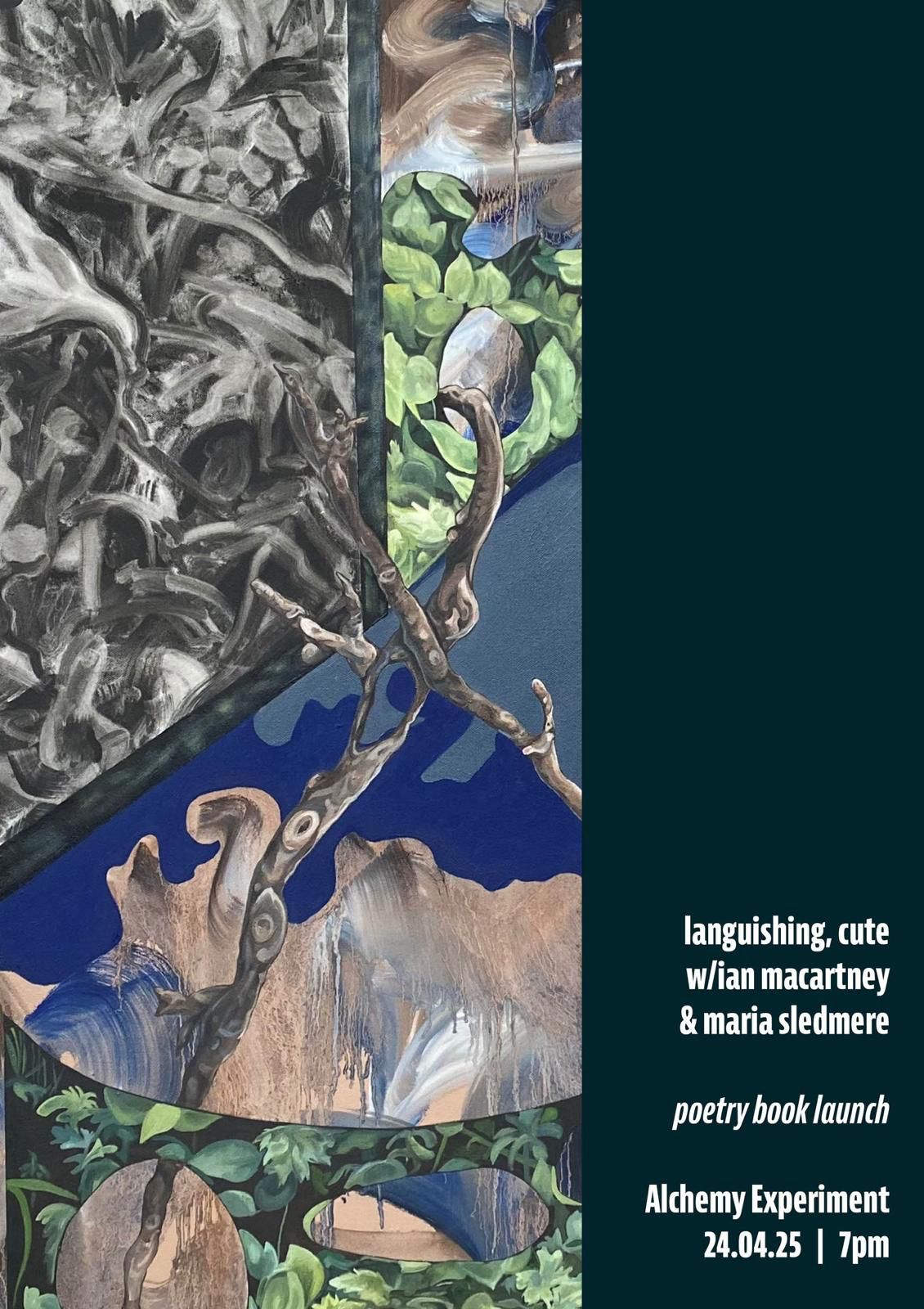
24th April, 7pm — The Alchemy Experiment, Glasgow (free entry – details)

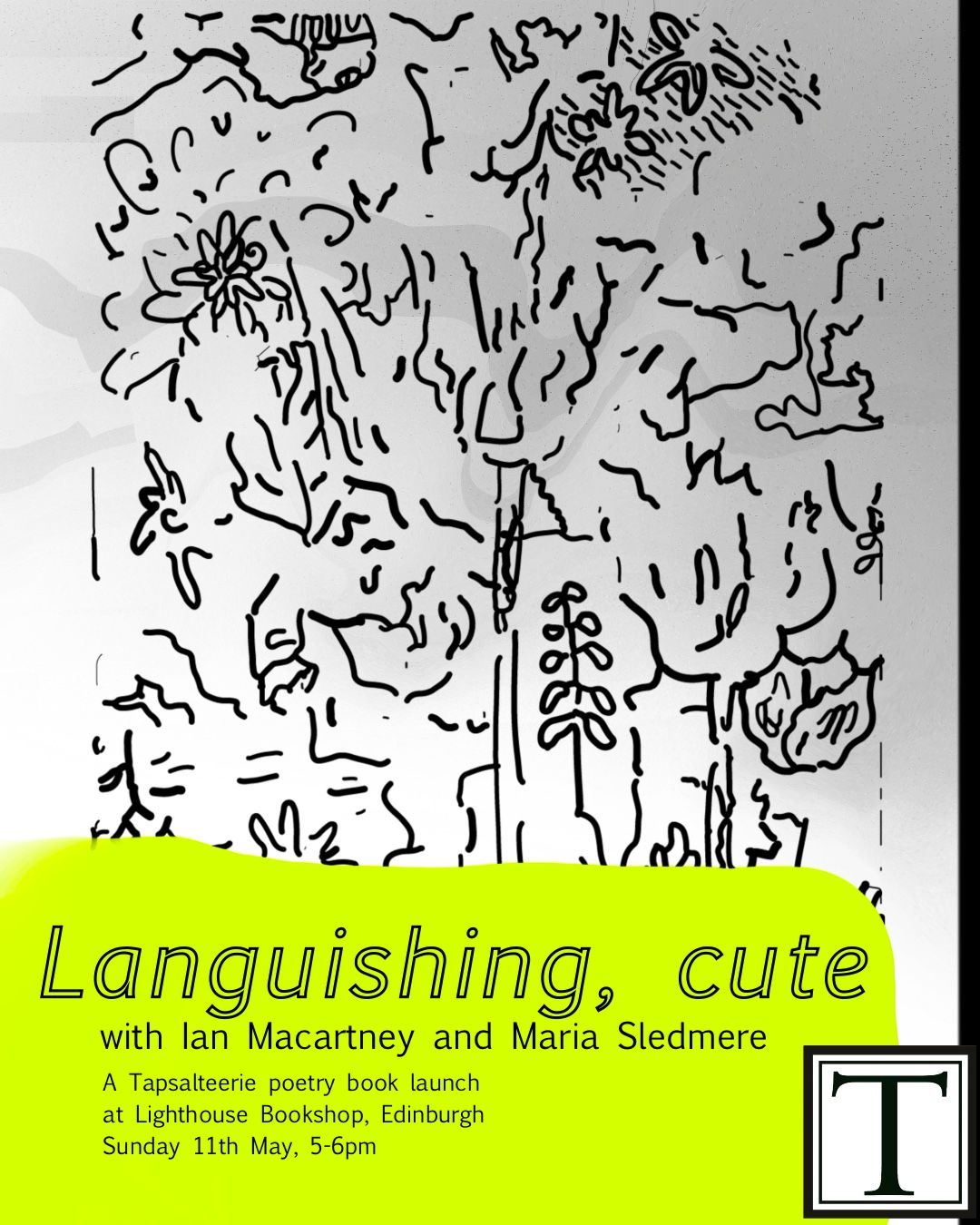
11th May, 5pm — Lighthouse Books, Edinburgh (arrive promptly! – details)

Every book I read in 2024

In loose order of reading. This year I made a vow to not let work ‘get in the way’ of reading. I was talking to a colleague about how every subject/specialism has one thing they are supposed to be really good at and actually kind of suck at. We agreed English & Creative Writing staff are often pretty bad at this thing that should be their lifeblood: reading. To prioritise reading is to affirm the necessity of thinking. I felt so burned out with the circuitry of the 2010s and the zoomageddon of lockdown, all those screens. Reading in scroll-time. I still love reading in scroll-time, but on the move only. Or in the midst of something else doing. It took me three years to get back into immersive, situated, FOCUSED reading again. I mean staying up all night to finish a book, crying at sentences, holding something to the light and putting it down and stopping and starting because you want to savour something and all the world of it following you into dreams. All reading started to plug into work. Good work. Channels. If I’m honest, I haven’t written a lot this year. I needed a break from concepts. I did a lot of editing and proofing and reading. I wrote a lot of emails and did a LOT of marking. I think of marking as writing time. It eats into writing time but it’s also a practice of sentence-making, observation, editing, rewriting. Eileen Myles says somewhere that when they write people recommendation letters and do interviews etc that’s a form of writing. So really there are very few ‘fallow’ periods. You’re always writing something to someone, for something or not. I have written over a monograph’s worth of student feedback this year, maybe more. Each paragraph of feedback is a micro-essay, a snapshot of orientation, a patchwork sample which stitches multiple discourses (genre, criteria, instinct, history) in ascent to encouragement and improvement. So all that feedback, I’m trying to say, means I also read a hell of a lot of student work. Hundreds of scripts. Marking trains my eye as a reader and writer. Still learning to toggle between different kinds of reading. Refusing the active/passive binary in favour of a continuum of generative involvement. A lot of what I read below was in-between other reading, but some of it is more explicitly ‘work’ reading. Or: reading as a way of connecting with friends, colleagues — their beautiful brains. Or: preparation for something as yet unknown. Working through personal syllabi. Refreshing the palette.

~

Robert Glück, About Ed (2023)

Jacques Derrida, H.C. for Life, That Is to Say…, trans. by Laurent Milesi and Stefan Herbrechter (2006)

Walter Benjamin, The Storyteller: Tales Out of Loneliness, trans. by Sam Dolbear, Esther Leslie, Sebastian Truskolaski, Antonia Grousdanidou (2023)

Marie Darrieussecq, Sleepless, trans. by Penny Hueston (2021/2023)

Joey Frances, Takeaway Night (2024)

Teju Cole, Black Paper (2021)

George Saunders, A Swim in the Pond in the Rain (2021)

Megan Ridgeway, The Magpie (2024)

Thomas Mann, The Magic Mountain, trans. by John E. Woods (1924)

Andrew O’Hagan, Mayflies (2021)

Tabitha Lasley, Sea State (2021)

Zadie Smith, Intimations (2020)

Jean Genet, Prisoner of Love, trans. by Barbara Bray (1986)

Donna Tartt, The Secret History (1992) 

Oli Hazzard, Sleepers Awake (2024)

Courtney Bush, Every Book is About the Same Thing (2021)

Hélène Cixous, Abstracts and Brief Chronicles of the Time, trans. by Beverley Bie Brahic (2016)

McKenzie Wark, Raving (2023)

Rachael Allen, God Complex (2024)

Elle Nash, Deliver Me (2024)

Joshua Cohen, The Netanyahus (2021)

Andrew Meehan, Instant Fires (2022)

Michael Eigen, Ecstasy (2001)

Noah Ross, The Dogs (2024)

Jennifer Soong, Comeback Death (2024)

Barbara Browning, The Gift (2017)

Cynthia Cruz, The Melancholia of Class (2021)

Courtney Bush, I Love Information (2023)

Clarice Lispector, The Hour of the Star (1977)

Barbara Browning, The Correspondence Artist (2011)

Hilary White, Holes (2024)

Laynie Browne, Everyone and Her Resemblances (2024)

Deborah Meadows, Representing Absence (2004)

Holly Pester, The Lodger (2024)

Terese Marie Mailhot, Heartberries (2018)

Kim Gordon, Girl in a Band (2015)

Lauren Levin, Nightwork (2021)

Oddný Eir, Land of Love and Ruins, trans. by Philip Roughton (2016)

Danielle Dutton, Prairie, Dresses, Art, Other (2024)

Elvia Wilk, Oval (2019)

Nisha Ramayya, Fantasia (2024)

Joanne Kyger, On Time (2015) 

Jean Day, Late Human (2021)

Lisa Jarnot, Black Dog Songs (2003)

Roland Barthes, Camera Lucida (1980)

Mariana Enriquez, Things We Lost in the Fire (2016)

Ben Smith, Doggerland (2019)

Ricky Monaghan Brown, Terminal (2024)

Wendy Lotterman, A Reaction to Someone Coming In (2023)

Joseph Mosconi, Fright Catalog (2013)

Tao Lin, Taipei (2013)

Haytham El Wardany, The Book of Sleep, trans. by Robin Moger (2020)  

Lucy Ives, Life is Everywhere (2022)

Maria Hardin, Cute Girls Watch When I Eat Aether (2024)

Brian Whitener, The 90s (2022)

Jamie Bunyor, A stone worn smooth (2022)

Lucy Ives, The Hermit (2016)

Brenda Hillman, Cascadia (2001) 

Bhanu Kapil, Incubation: a space for monsters (2006)

Peter Reich, A Book of Dreams (1973)

Steve Orth, The Life and Times of Steve Orth (2020)

Lindsey Boldt, Weirding (2022)

Christa Wolf, The Quest for Christa T. (1970)

Hannah Levine, Greasepaint (2024)

Joe Luna, Old News (2024)

Maggie O’Sullivan, earth (2024)

Ian Macartney, sun-drunk (2024)

Sébastien Bovie, Longing for Lo-fi: Glimpsing back through technology (2023)

Steven Zultanski, Relief (2021)

Lionel Ruffel, I Can’t Sleep. trans. by Claire Finch (2021)

Noémi Lefebvre, The Poetics of Work, trans. by Sophie Lewis (2021)

Cynthia Cruz, Disquieting: Essays on Silence (2019)

Marie Buck and Matthew Walker, Spoilers (2024)

Ed Steck, David Horvitz Newly Found Bas Jan Ader Film (2021)

Ammiel Alcalay and Joanne Kyger, Joanne Kyger: Letters to & From (2012)

Lyn Hejinian, Fall Creek (2024)

Etel Adnan and Laure Adler, The Beauty of Light: Interviews, trans. by Ethan Mitchell (2024)

Rick Emerson, Unmask Alice: LSD, Satanic Panic, and the Imposter Behind the World’s Most Notorious Diaries (2022)

Stephen Collis and Jordan Scott, Decomp (2013)

Miye Lee, Dallergut Dream Department Store, trans. by Sandy Joosun Lee (2023)

Barrett Watten, Steve Benson, Carla Harryman, Tom Mandel, Ron Silliman, Kit Robinson, Lyn Hejinian, Rae Armantrout, Ted Pearson, The Grand Piano: Part 1 (2006/2010)

Ottessa Moshfegh, My Year of Rest and Relaxation (2018)

Ian Macartney, Darksong (2024)

Chris Tysh, Continuity Girl (2000)

Barrett Watten, Steve Benson, Carla Harryman, Tom Mandel, Ron Silliman, Kit Robinson, Lyn Hejinian, Rae Armantrout, Ted Pearson, The Grand Piano: Part 2 (2007/2017)

Andrew Durbin, Mature Themes (2014)

Johanne Lykke Holm, Strega, trans. by Saskia Vogel (2022) 

Anthony Low, The Georgic Revolution (1985)

Robin Blaser, The Fire: Collected Essays of Robin Blaser (2006)

Daniel Feinberg, Some Sun (2024)

Maria Hardin, Sick Story (2022)

Lieke Marsman, The Opposite of a Person, trans. by Sophie Collins (2022)

Nadia de Vries, Thistle, trans. by Sarah Timmer Harvey (2024)

Rodge Glass, Joshua in the Sky: A Blood Memoir (2024)

Sarah Moss, My Good Bright Wolf (2024)

Giovanbattista Tusa, Terra Cosmica (2024)

Gabrielle de la Puente and Zarina Muhammad, Poor Artists (2024)

Andrew Meehan, Best Friends (2025)

Courtney Bush, Isn’t this Nice? (2019)

Meghann Boltz, Cautionary Tale (2021)

Ariana Reines, Wave of Blood (2024) 

Dalia Neis, The Swarm (2022)

Ian Macartney, Secret Agent Orca Twelve (2024)

Nicholson Baker, The Mezzanine (1988)

Kurt Vonnegut, Cat’s Cradle (1963)

Molly Brodak, A Little Middle of the Night (2010)

Bernadette Mayer, Midwinter Day (1982)

Anna Kavan, Ice (1967)

Molly Brodak, Bandit (2016)

Charles Bernstein, Content’s Dream: Essays 1975-1984 (1986)

Anna Gurton-Wachter, My Midwinter Poem (2020)

Midsummer Song (Hypercritique)

In 2018, I started a Doctorate of Fine Arts in Creative Writing at the University of Glasgow. I also started a new diary. In October, the month it all started, I wrote about duplicate footsteps and permanent landfills. I wrote of lacking the energy to dance, being lost in the forest, looking for safety among swirling leaves. Can’t remember if the forest was real or metaphorical. I wrote seemingly in lieu of being able to actually venture beyond the confines of my working life. Over three years and three months, I went through multiple iterations of research focus. I looked at foam, clouds, technicity, glitter, quotidian measures, fire and cinders. I fell asleep on coaches circling lochan sunsets. I produced a list of figures for how we might conceptualise this project. It was a sort of Escherian dollshouse, a self-deconstruction of building this place to think. I thought about Bhanu Kapil dropping her book in the river. I thought about doing a writer’s residency within the confines of a square-shaped digital platform. I wrote of ‘An angel tossing her gunpowder sequins’ and ethical eating, ‘how so often you are so paralysed between two choices that you just don’t eat at all’. I wondered what kind of home this work would make for me. This was a material question: thanks to the Scottish Graduate School of Arts & Humanities, it was a funded period. It paid me through Covid-19.

These were my original research questions:

  • How can creative and critical writing interrogate and depict the apparent tensions between the Anthropocene’s deep-time and the quotidian context of our ecological orientations?
  • What hybrid critical-creative forms might open up possibilities for a future ecological art, one which builds productive ways of ‘tuning in’ to a non-anthropocentric experience, with reflexive attention to the artistic and technological media involved in this process?
  • How might ‘the everyday’ provide a temporal and formal mode through which to develop a critical, interdisciplinary Anthropocene aesthetics, negotiating ecological questions of affect, sensory relations, ethics and responsibility at scales both macro and micro, human and nonhuman?

It is up to the reader to decide how far the end result fulfilled or strayed from these lines of enquiry.

Six years on, having graduated from being a baby scholar-poet, I am really thrilled this project has found a dream home with No University Press, a new imprint from Tenement Press. The ‘no’ of refusal feels appropriate to this project, which very much concerns the affordances and limits of an academic and institutional mode when thinking through (im)possible questions of ecological thought and living on. Working with Benjamin Pickford and Dominic Jaeckle, editors at Tenement, I was able to bring the project’s creative detours and modalities to life in its final book form: Midsummer Song (Hypercritique). This is definitely the most ambitious work of my life. It’s 469 pages of critique, poetics, meadow work, illustration and elegy. I see the whole book as a big song, a study, an architectural attempt at making an ecological home in lyric.

Somewhere between an academic monograph and performative dreamwork, poetry and poetics, conceptualism and the commonplace.

You can order the book direct from Tenement here or from Asterism here.

You can read a full description of the book and access endorsements, sample poems and other materials here.

I will be touring the book at some upcoming dates in Glasgow, Edinburgh, Manchester and London:

09.11.24                      Peter Barlow’s Cigarette /
                                        with Maria Sledmere,
                                        Harriet Tarlo & Lucy Wilkinson
                                        The Carlton Club, Whalley Range
                                        Manchester
                                        See here.

05.11.24                      Midsummer Song / Readings & Discussion
                                        Maria Sledmere,
                                        David Farrier
                                        & Colin Herd
                                        Fruitmarket Gallery, Edinburgh
                                        See here.

26.10.24                      Midsummer Song / Readings & Discussion
                                        Maria Sledmere,
                                        Chris McCabe
                                        Small Publishers Fair
                                        Conway Hall, London
                                        See here.

22.10.24                     Midsummer Song / Readings & Discussion
                                        Maria Sledmere,
                                        Carl Lavery
                                        & Colin Herd
                                        Advanced Research Centre,
                                        University of Glasgow / (Online via Zoom)
                                        See here.