6pm, 27th May – TEN YEARS OF SPAM Poetry Party, London, Old Queen’s Head – with Will Harris, Jay Gao, Nisha Ramayya, Mau Baiocco, Leo Bussi, Dom Hale, Crispin Best, Samantha Walton, Alice Hill-Woods, Maya Uppal, Denise Bonetti, Kirsty Dunlop. Ticketed.
7:30pm, 28th May – Is it Dirty?, Roland Ross 231 Northdown Road Margate – with Mau Baiocco, Henry Madd, Kat Cutler-MacKenzie, Harry Brooks-Kent, Vasilisa Forbes, Rosella Dello Ioio. Unticketed.
7pm, 29th May – Poet’s Prose #1, Housman’s Books, London – with Kirsty Dunlop. Ticketed.
7pm, 3rd June – Broken Sleep Books Showcase, Typewronger Books, Edinburgh – with Ricky Monahan Brown and Ian Macartney. Ticketed.
7:30pm, 10th June – Patch City: a poetry reading, SERF, 23-25 Wharf St, Leeds – with Jay Gao, Alycia Pirmohamed, Bonnie Hancell. Unticketed.
7pm, 2nd July – Second Space: a night of spoken word and music with Fuck This, Strangers Wave, Colin Herd, D.A.M., Medha Singh and James Flowerdew, Leith Depot, Edinburgh
Time and details tbc – 18th July – London
6:30pm, 6th August – Poetry reading with Valerie Hsiung at Good Press, Glasgow – with Lucille Ling, Lady Red Ego, Nat Raha, Nisha Ramayya, Valerie Hsiung
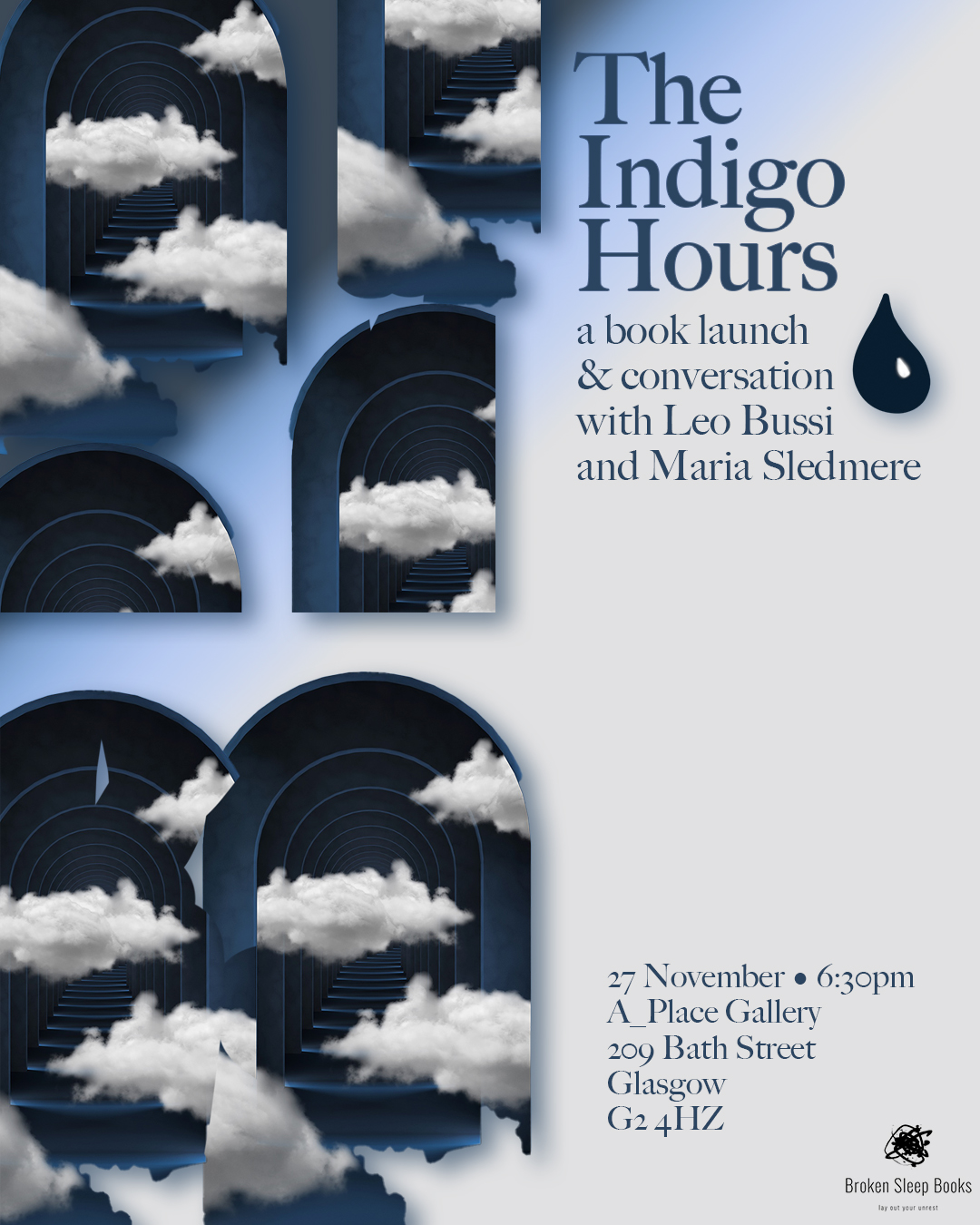
Glasgow friends! November is a busy month. See you there. I’m excited to be in conversation with the legendary Leo Bussi. Format is: readings from both of us (POETRY+PROSE) then a conversation and Q&A. Topics to discuss may include art & music writing, ambient literature, auto-theory/fiction, homage, love, everydayness, plotting the situationship and more. Books will be available from both authors.
Starts at 6:30pm sharpish. Venue: A_Place Gallery on Bath Street. Full details on the eventbrite:
Really excited to be a guest at Creative Conversations next Monday at the University of Glasgow. This is my alma mater (in fact, I ended up doing all three of my degrees there) and I’m grateful to be returning to talk about my work. I’ve been attending the series on and off for nearly a decade and have seen so many wonderful writers in the chapel. It’s free and open to the public. You can also join online. Hope to see some of you there 🙂
In 2018, I started a Doctorate of Fine Arts in Creative Writing at the University of Glasgow. I also started a new diary. In October, the month it all started, I wrote about duplicate footsteps and permanent landfills. I wrote of lacking the energy to dance, being lost in the forest, looking for safety among swirling leaves. Can’t remember if the forest was real or metaphorical. I wrote seemingly in lieu of being able to actually venture beyond the confines of my working life. Over three years and three months, I went through multiple iterations of research focus. I looked at foam, clouds, technicity, glitter, quotidian measures, fire and cinders. I fell asleep on coaches circling lochan sunsets. I produced a list of figures for how we might conceptualise this project. It was a sort of Escherian dollshouse, a self-deconstruction of building this place to think. I thought about Bhanu Kapil dropping her book in the river. I thought about doing a writer’s residency within the confines of a square-shaped digital platform. I wrote of ‘An angel tossing her gunpowder sequins’ and ethical eating, ‘how so often you are so paralysed between two choices that you just don’t eat at all’. I wondered what kind of home this work would make for me. This was a material question: thanks to the Scottish Graduate School of Arts & Humanities, it was a funded period. It paid me through Covid-19.
These were my original research questions:
How can creative and critical writing interrogate and depict the apparent tensions between the Anthropocene’s deep-time and the quotidian context of our ecological orientations?
What hybrid critical-creative forms might open up possibilities for a future ecological art, one which builds productive ways of ‘tuning in’ to a non-anthropocentric experience, with reflexive attention to the artistic and technological media involved in this process?
How might ‘the everyday’ provide a temporal and formal mode through which to develop a critical, interdisciplinary Anthropocene aesthetics, negotiating ecological questions of affect, sensory relations, ethics and responsibility at scales both macro and micro, human and nonhuman?
It is up to the reader to decide how far the end result fulfilled or strayed from these lines of enquiry.
Six years on, having graduated from being a baby scholar-poet, I am really thrilled this project has found a dream home with No University Press, a new imprint from Tenement Press. The ‘no’ of refusal feels appropriate to this project, which very much concerns the affordances and limits of an academic and institutional mode when thinking through (im)possible questions of ecological thought and living on. Working with Benjamin Pickford and Dominic Jaeckle, editors at Tenement, I was able to bring the project’s creative detours and modalities to life in its final book form: Midsummer Song (Hypercritique). This is definitely the most ambitious work of my life. It’s 469 pages of critique, poetics, meadow work, illustration and elegy. I see the whole book as a big song, a study, an architectural attempt at making an ecological home in lyric.
Somewhere between an academic monograph and performative dreamwork, poetry and poetics, conceptualism and the commonplace.
You can order the book direct from Tenement here or from Asterism here.
You can read a full description of the book and access endorsements, sample poems and other materials here.
I will be touring the book at some upcoming dates in Glasgow, Edinburgh, Manchester and London:
09.11.24 Peter Barlow’s Cigarette / with Maria Sledmere, Harriet Tarlo & Lucy Wilkinson The Carlton Club, Whalley Range Manchester See here.
05.11.24 Midsummer Song / Readings & Discussion Maria Sledmere, David Farrier & Colin Herd Fruitmarket Gallery, Edinburgh See here.
26.10.24 Midsummer Song / Readings & Discussion Maria Sledmere, Chris McCabe Small Publishers Fair Conway Hall, London See here.
22.10.24 Midsummer Song / Readings & Discussion Maria Sledmere, Carl Lavery & Colin Herd Advanced Research Centre, University of Glasgow / (Online via Zoom) See here.
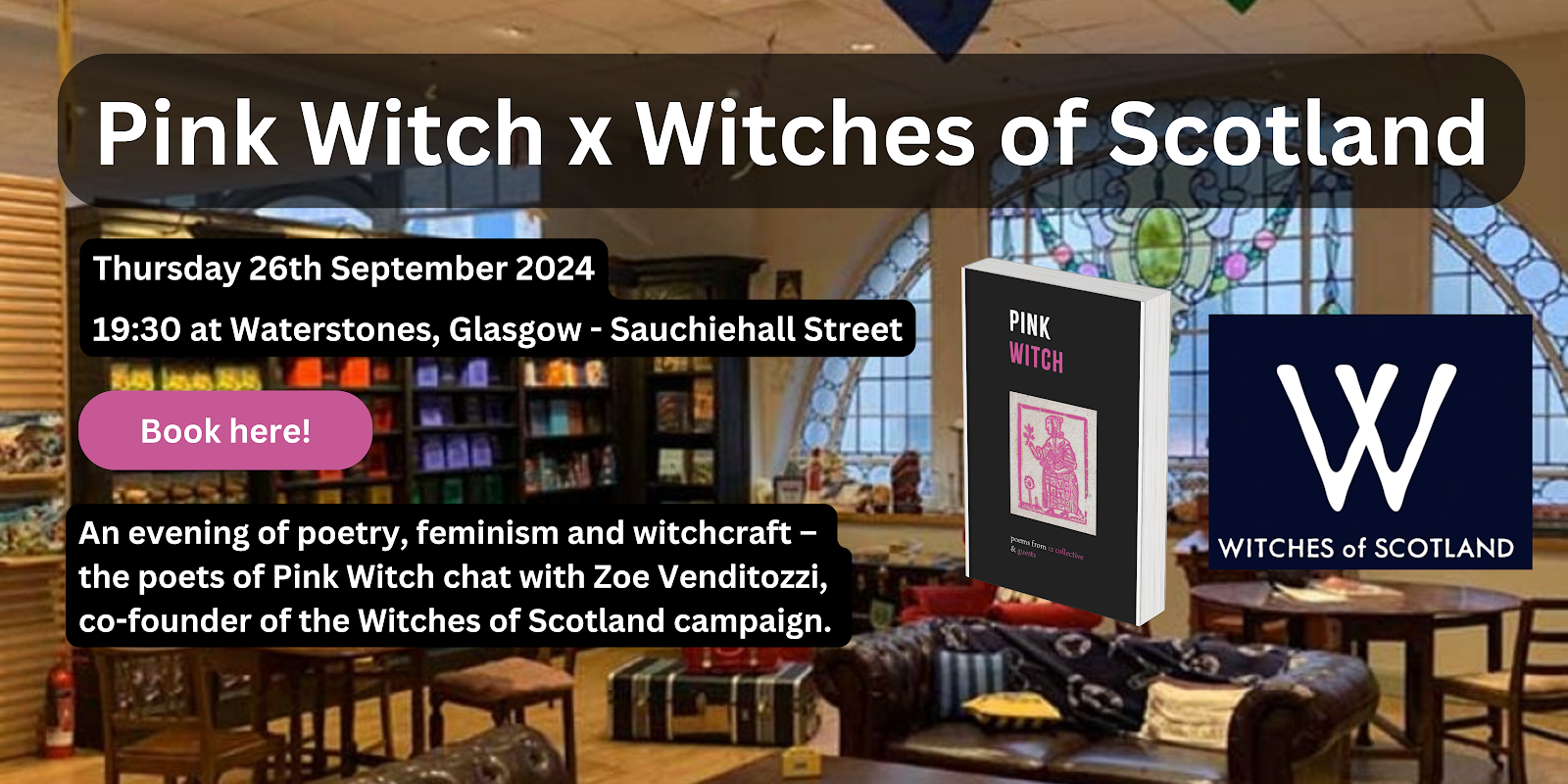
Earlier this year I published some poems in the anthology Pink Witch. Some of the other anthologised poets will be reading and in conversation with Zoe Venditozzi, co-founder of the Witches of Scotland campaign on 26th September. Event starts at 7:30pm and is at the Sauchiehall Waterstones in Glasgow.
‘An evening of poetry, feminism and witchcraft with the poets of Pink Witch chat with Zoe Venditozzi, co-founder of the Witches of Scotland.
A chance aside by Zoe Venditozzi of the Witches of Scotland campaign inspired the poems of Pink Witch, which question identity, vilification and the names historically used to constrain women. Now for the first time, the poets chat with Zoe and discuss the inspiration behind these dark, insightful and frequently humorous pieces. Witches of Scotland is a campaign for a legal pardon, an apology and a national monument for the thousands of people executed for witchcraft in Scotland. The campaign was set up by Zoe Venditozzi and Claire Mitchell KC. Their podcast has over 70 episodes. Pink Witch is topical, intimate and eclectic, in turns sombre and funny, lighthearted and reflective, by some of Scotland’s best women poets.’
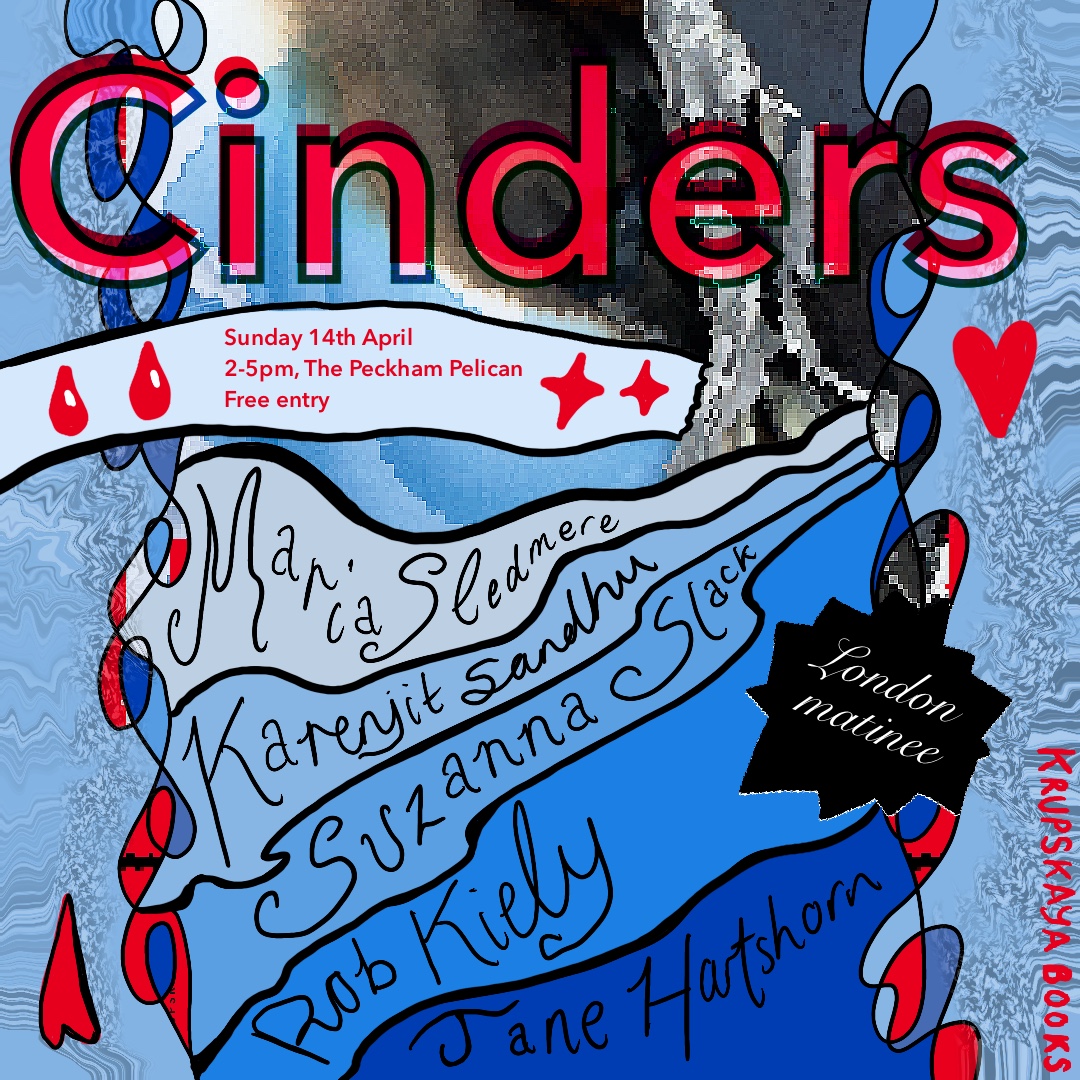
Thrilled to be bringing the Cinders ball to London for a lil matinee at Peckham Pelican on Sunday 14th April. I’ll be accompanied by a dream line-up. There will be books for sale (card only). Hope to see you there!
Event starts at 2pm and will be finished by 5pm.
Entry is free and unticketed.
Accessibility:
The Peckham Pelican is a ground level venue with step-free access, gender neutral and disabled toilets. You can find out more about the venue here.
Readers:
Jane Hartshorn is a poet and PhD candidate at the University of Kent, writing about the lived experience of chronic illness. Her pamphlets include Blowfly (in collaboration with ossa prints), Soft Tissue Rarely Preserves (in collaboration with Valeska Noemi), In the Sick Hour (Takeaway Press, 2020) and Tract (Litmus Publishing, 2017). Her work has been published by Footnote Press, Boudicca Press, Dostoyevsky Wannabe, Lucy Writers, The Polyphony, and SPAM. She is founder of CHASE Medical Humanities Network and teaches poetry to medical students at University of Southampton. @jeahartshorn janehartshorn.weebly.com
Robert Kiely is the author of ROB, Gelpack Allegory, and simmering of a declarative void. He is an editor at veer books.
Karenjit Sandhu’s publications include Poetic Fragments from the Irritating Archive (Guillemot Press), young girls! (the87Press) and Baby 19 (intergraphia books). Her practice comprises poetry, performance and artists’ books. She is a member of the British Art Network and Lecturer in Art at the Reading School of Art.
Suzanna Slack is the author of Happy Birthday Story, Is This It?, The Poor Children, The Shedding, Luxury Profile, White Spirit Videotelephony and Gummi Zone. Their work has been published by Solstis Literary Magazine, Datableed, Hot Pink Literary Magazine and others. They are seeking assistance with their next work!
Maria Sledmere is the author of books including Cinders (Krupskaya), AnAura of Plasma Around the Sun (Hem Press) and Visions & Feed (HVTN Press). She is managing editor of SPAM Press and a Lecturer in English & Creative Writing at the University of Strathclyde.
I am going to be in New York(!) for a few days in December, doing some readings with a motley crew of Scottish poets: Colin Herd, Jane Goldman, Iain Morrison, Nicky Melville.
So far, confirmed events are:
Sunday 17th, 12-3pm – Scottish Poetry Brunch at Torn Page. RSVP.
Monday 18th, 6:30-8pm – Poetry: A Christmastime Gathering with Four Scottish Poets at Frenchtown Bookshop. More info.
If you have any recommendations of cool things happening between the 16-21st of December in NY, hit me up!
21st June, 6pm – Poetry & Food workshop with Colin Herd (The Alchemy Experiment, Glasgow)
22nd June, 9:30am – Performing your research: a poets theatre workshop at SGSAH Summer School (The Studio, Glasgow)
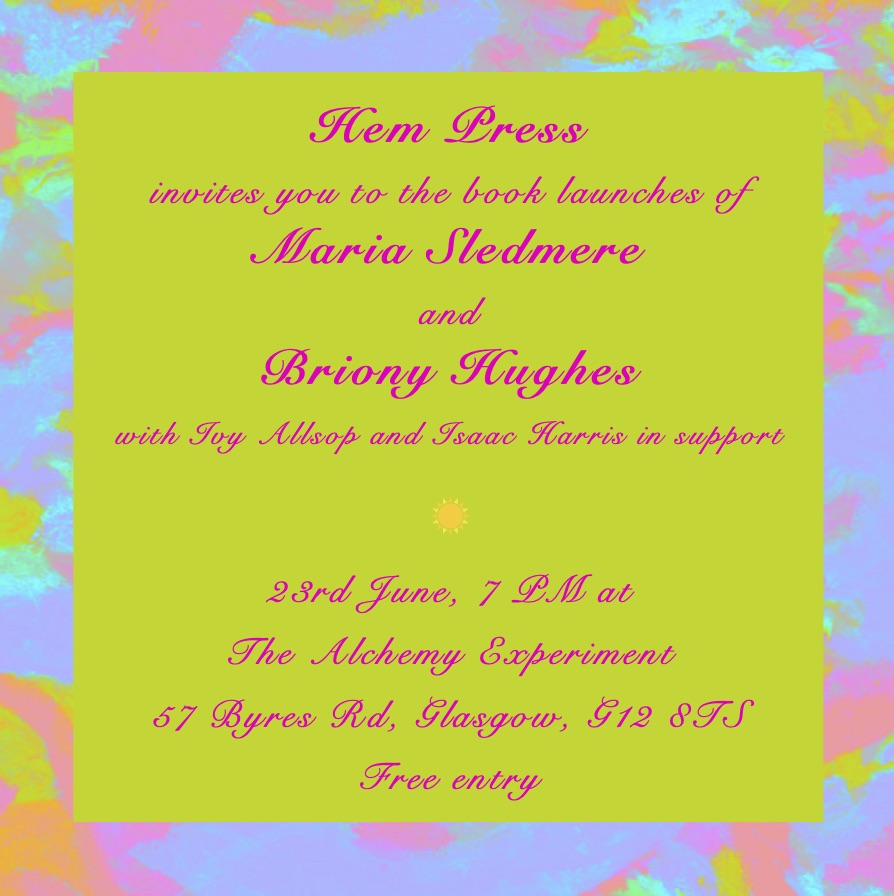
23rd June, 7pm – Launch for An Aura of Plasma Around the Sun with Briony Hughes, Ivy Allsop and Isaac Harris (The Alchemy Experiment, Glasgow)
2nd July, 4pm – Fundraiser for ‘Kindness Street Team’ with Pleasure Pool, Gabo, J. D. Twitch, Sofay, Leo Bussi, DJ Michael (Queen’s Park bandstand, Glasgow)
5th July, 7:30pm – Glasgow Review of Books (re)launch (The Old Hairdressers, Glasgow)
7th July, 9:45am – Somnolent Cartographies: The Sonic Ecologies of Sleep all-day workshop (Civic House, Glasgow)
A few weekends ago marked a whole year since my exhibition with Jack O’Flynn, The Palace of Humming Trees, curated by Katie O’Grady. It was the height of summer, electrified by lightning storms and rain showers which sent the city streets flooding my ankle boots. I sat in the exhibition watching the auras of animals, drifting in and out of presence, doodling, planning short fiction I’d never write. The rain came down through the ceiling, just a little, and caught in a bucket. I texted in streams.
Something of the exhibition magicked itself into existence. We were all ’93 babies. Making things happen felt so easy. There were synchronicities and invincibilities. When Katie and I hung out at Phillies, we won the quiz. Jack and I wove this hyperplane of fantasy from the gestures of clay and line, whittling and glitter cast wide across floorboard and spiderweb. It was a strange time, the summer of 2021. I was also partially in the numb haze of grief. There was a delta wave but not like the deep sleep of the sea. People brought champagne and flowers to the opening. I wore a long white dress and wished the days were as long as they used to be. The Earth spins too fast.
Partly I wanted to write in the choral voice of many creatures speaking to one another. The process felt like a lyric surrender to this collective, their hyperintelligence of humming and stammer that spoke through pores, chitin, liquid. I don’t know where they learned all this. There was a sun virus in the emails we sent the summer before it. Time freckled on my arms. I could draw out the muscle ache from cycling more. It was possible then.
Anyway, about this experience of writing. A porous voice. Here’s an artist’s talk from a recent conference.
First delivered at Hear them speak: Voice in literature, culture, and the arts 10th June 2022
K Allado-McDowell, ‘And they showed me that their life was a pattern of hyperspace’
Who might be the ‘they’ in K Allado-McDowell’s statement? Taken from Pharmako-AI, published in 2021 and the first book to be co-authored with the neural network GPT-3, a system trained on extensive web data (from Google Books to Wikipedia), the quote suggests voice, presence and identity are questions of patterning, replication, weaving, plurality. Recurrent in Allado-McDowell’s book is the figure of the spider and its web, in a kind of constant movement like thought itself.
I was travelling north on a train when I began writing The Palace of Humming Trees, a book-length exhibition poem which forges energy fields of dreamy relation between many species of animal, mineral and element. Late spring and the fields I could forget about, texting myself more poem. The motion of the train according inverse to the downward scroll of the document. All the while seeing spiders in the corner of my vision, emitting great clots of silk. Commissioned by curator Katie O’Grady and made in collaboration with the artist Jack O’Flynn (both from Cork, Ireland), the exhibition was to offer something of a ‘hyperspace’ to its viewers: somewhere in which voices coalesced, formed new modalities of being and relation, new webs. In a Tank Magazine interview with K Allado-McDowell, Nora N. Khan notes that hyperspace ‘is an abstract space in which we perceive patterns of information and then shape them in language in order to communicate’. Having a big, serial and open field poem adjacent to visual work premised on bold, ecstatic colour and texture was to perform multiplicities of voice within an otherwise abstracted work. Inspired by Timothy Morton’s ideas of ‘dark ecology’, adrienne maree brown’s ‘pleasure activism’ and Ursula Le Guin’s ‘carrier bag theory of fiction’, I wanted to think about that communication as a form of attunement through which we gather, desire and coexist as ecological beings.
In The Palace of Humming Trees, the lyric voice is taken as that trembling spider silk assembling worlds. Spider silk is a protein fibre which embodies the inside of the spider woven on the outside for shelter, cocoon, courtship or the trapping of prey. It’s five times stronger than steel and is now being synthesised to make everything from body armour to surgical thread and parachutes. I began imagining the twangling of droplets on silk strands as the visualisation of a deep vibration, perhaps the wood wide web – something humming in and between trees. The world of the exhibition was inspired by the Irish folktale, The Hostel of the Rowan Trees, also known as Fairy Palace of the Quicken Trees. In the story, trees of scarlet fruit provide refuge, but the fruit itself (the quicken berries) are highly desirable to the point of despair. The rowan was brought from the land of promise, and its berries offer rejuvenation. With these symbolic undertones of danger and desire in mind, we wanted to explore a mythic ‘palace’ which merged the digitality of hyperspace with the organic textures of woodland and the chromatic intensity of dream, fantasy and ethical relation.
At the heart of our project was a notion of infinity. Hyperspace suggests that our ecological sense of world, surrounds, habitat, umwelt is always being reassembled. I wondered if infinity could somehow be voiced in a way that wasn’t just postmodern recursion or echo. What does it mean to be open to a state of infinity? To let many worlds pass through you all at once, making diamond-like instants and gossamer patterns of prosody?
Infinity became our figure for ambience. As spider silk is densely structured, and the neural net densely layered, so the notion of ambience captures, in Brian Eno’s words ‘many levels of listening attention’. To walk through the door of The Palace of Humming Trees was to enter a portal of multiplicity. You could take any route you liked around the room, moving between sculptures of hyperfoxes and sparklehorses, lichenous forms, ceramic butterflies of psychedelic hue and illustrated groves where trees shimmered green, orange, purple and blue. You could also scan a QR code and choose to listen to a recording of the poem, voiced by Jack, Katie and I and accompanied by Dalian Rynne’s sonic dreamscapes. To hear something ‘humming’ is to sense its presence, even if you can’t wholly understand it; humming implies electromagnetic vibration, birds and bees, a weather event or tectonic movement. We weren’t interested in translating the more-than-human voice so much as bringing it into the forcefield of lyric poetry, and through that expansive patterning achieve ‘infinity states’ of reassembled meaning, of felt experience that could not be crystallised into singularities of being. Visitors took pictures, sketched Jack’s sculptures, ran their fingers through the luminous plaster dust, placed to highlight the debris or excess of our clay animals. Something always in the process of creation or decay, incomplete. Corporeal, yet infinite.
One of the many voicings of this project was Letters from a Sun Virus, a correspondence between Jack and I that occurred over the first Covid lockdown, documented at the back of the exhibition book. While the email exchange had distinct senders and receivers, the you and I, over time in collaborating and sharing work between the visual and textual, our voices were beginning to mingle. Sometimes this co-voicing was painterly; other times musical, inflected with the characteristic intonation and energy of our respective speech patterns, moods, expressions. An entry from April 2020 reads: ‘…the wateriness of the poem. I had completely forgotten about all that blur. It’s like all the brush of the ocean and one which seems the idea to spill that way. Almost like a pressure, lines that go on and hair turning into the sea, each one of kinetic energy then finds all these points’. To assemble the correspondence for publication, I plugged it through text remixers, copying, pasting and rearranging phrases to enhance that sense of two voices repatterning one another. A ceaseless quest for points; for elements acting upon objects, emotions. Denise Riley has written of ‘inner speech’ as a strange oxymoron, where one hears voice at the moment of issuing voice inside us – a kind of running commentary that hums without actually humming. The letters suggest a kind of inner voice infected by the anticipated response of the other, rendering intimacies of collaboration which form a sticky substance, sentences and mobius formations holding time’s play and repeat – ‘Unending loop of my dream resins / not to complete the palace infinity of these trees’. Imagining the many of them speaking.
In Texts for Nothing, Samuel Beckett writes:
Whose voice, no one’s, there is no one, there’s a voice without a mouth, and somewhere a kind of hearing, something compelled to hear, and somewhere a hand, it calls that a hand, it wants to make a hand, or if not a hand something somewhere that can leave a trace, of what is made, of what is said, you can’t do with less, no, that’s romancing, more romancing, there is nothing but a voice murmuring a trace.
To ask whose voice in The Palace of Humming Trees is to hear sound bouncing as light, romancing, refracting in what Katie, the curator, calls a many-panelled ‘vivarium of humming thought’. To say ‘there is no one’ is to declare at once absence and the impossibility of presence as a singularity, there is no ONE. What if voice was infectious, modular, sporous, erotically charged, in common? Early in the project, I had this conversation with Jack where he told me that sometimes in the process of sculpture, he’ll try turning something upside down, or inside out, to revitalise the work. Make it strange or more-than. To sculpt by hand is to ‘leave a trace, of what is made’, and to write is to leave a trace ‘of what is said’. I wondered if the inner speech of the lyric ‘I’ could be turned inside out, to be exposed to the grain, the noise, the weather. A voice that touches is and is being touched, traced, smudged. I imagine this book as a glasshouse, somewhere between inside and outside, shelter and exposure; a chamber music of alchemical voicings, always repatterning, transforming each other. Sound and light. A place of invitation, ritual attention, metamorphosis. Many selves stuck to the web of a visual, expansive language.
Hyperfox – photo by Sean Patrick Campbell (French Street Studios, 2021)
Excited to be reading with Max Parnell, Nadia de Vries and Jane Goldman to celebrate four new books from Dostoyevsky Wannabe. Please come and feel free to ask us questions. Zoom events are sort of underground now, and I miss a lot of ppl I only really see at them. Am I doomed to be a lil zoom fish forever. Put on yr VR goggles or like, consult the mystic feline, fractal sunflower, swoon.