Meadow Fractals for A Soft Landing

Sam Williams’ project, A Soft Landing, is ‘an online resource inspired by the activity of communal gardens and city allotments. It is a space where volunteers are invited to share, learn, contribute and care for themselves and others, through the sharing of material that could be used for nourishment, growth, pleasure, education or healing’.

I like this website because it’s what I want from the internet, a place to share and graft and cut and paste, to nourish and discover something unexpected. You tend a little plot and see what grows from it. I used to live near Woodlands Community Garden and loved seeing the flora and fauna change throughout the seasons, people volunteering, pulling out weeds and planting. Something of A Soft Landing is in this spirit: you might get asked to respond or contribute, you might volunteer yourself. You never really know what might crop up in the meantime, which is why there’s a satisfying ethic to ‘checking back’.

I’m happy to find a home for an ongoing and incomplete series, Meadow Fractals, among the leaf matter and stems of other makers. It features a sestina after Kevin Killian (and isn’t the sestina the most fractal traditional form?), plus some weird and tessellating meadow illustrations done on an MS Paint simulator. Long live Paint. You can find the full selection at a-soft-landing.com (look for the dark grey tendrils).

In recent months, I’ve also been reading Sean Roy Parker’s Fermental Health substack, which has got me excited about blogging, and even food again. Do have a read! 🌱

A Breath

A BREATH


Writing in the gloaming I would even call meadow, its scorched-out centre you can probably see from a helicopter, a drone, should you choose the option of aerial photography and remote capture in a time of social distancing. Should you have access to that tech, perhaps in a speculative way; should you have access, the way children have access because they discuss so thoroughly the possibilities, and they do this illicitly into the night. My excellent stenography skills, if we are calling this shorthand, were honed from adolescent hours on Microsoft Instant Messenger, affectionately known as MSN. Any one of us born in that particular bracket of the fin de siècle will understand what it means to spend time in one’s room alone, not quite as in ‘Adam’s Song’, but touching the void through sign-ins, statuses, emoticons, nudges. To live in the delirium of many glimmering windows. I wanted to call you up from my bower, listening to ‘Lime Tree’ on repeat because it carries me away; I wanted to call you up, but could I bear to put down my pen for this. You will never know if I am writing or typing; ‘this kind of thing’ bears no performative ellipsis. Had I known anyway what you would say, as someone who needs access to their own face to talk, something is coming away for free. We have been watching each other watch our own expressions: as with emoticons, each manner of the face feels curated. Some of us collapse on the phone. In the fractal reality of self-isolation, I divvy up zoomy contingencies of speech. When was the last time I talked without seeing my own face. Deleuze and Guattari argue that faces ‘define zones of frequency or probability’: the face ‘constructs the wall that the signifier needs in order to bounce off of’. Hoping to give you a meadow — multifarious and mysterious plenty — I yet give you the wall or the screen. A zoomy contingency that you are happy, that you had signed out of the chat. Against it I file down my voice to its lower registers, taking the edge off an earnestness. If you could measure the frequency of sleep, perhaps architects of the dream-state would salve the true riddles of twenty-first century expression. I wanted to call you up with a slow, perfected drawl, relay how I was hanging upside down from my bower. How I imagine the song to end is a very beautiful flower, floating down the river, but that is only how the song begins. It really ends with a daydream, ‘now that living is no good’, and the singer is lost and found as they enter the woods, barefoot like a child. Why am I telling you all this, barefoot like a child, now that I cannot tell the woods from the trees in my nameless life. And Coleridge sings, this lime tree my prison, my prison / feels like prism. If a wood haloed the meadow, if a moat, if a liquid loop — arboreal, molten, stupid. Walking in the scorched-out meadow an hour or more to be here, sometimes dreaming of this place, needing to be here — no longer a meadow for having been burned. What occurred to ruin the centre. I want to bounce, bounce, bounce with it. All my friends active now and forever. I stumble on the grammar of an instant; are you online, are you online in the meadow, I am calling you up to say this. I am checking-in, the way people used to on Facebook. What is the name of this place? The meadow goes undocumented. What is the probability that your face means the shape of a grassland, a patch of unruly narcissi, a noticing gesture that I would say I have been here before. At least in dreams. Someone is trying to brand the meadow. In quarantine, my old longing for those messaging days recurs. We all talked on that singular platform, confessed under pseudonyms, and ever since I have been lost in the trees of each channel — their foliage concealing the one true thing. Someone is trying to sell the meadow. Infinite recursion of memes and secrets and finance. There was a purity to MSN, something about its frequency. Namelessness. You see what I mean? Sometimes in the poem, I mean the scorched-out cindering middle of the poem, you take grace enough to say fuck it, hiya, wait, no, I can’t hear you. You hold ‘us’ in brackets. If I could timestamp the start to end of that, like debt. One time C. messaged me on Instagram to ask what is really meant by the gloaming. What time of day was this asked, did that matter? I think gloaming would be different at four in the morning to noon; but what did I give as reply? A quick skim of the platforms comes up with nothing. Besides, soon my battery will die in the old archaeology of dissolving thought. There was a purpose in calling you up for this, and now ants are crawling all over my notebook. Nothing has touched me for weeks. I want to say I have a lascivious craving for seaweed flakes, tousled hair, disco kisses, regular breakfasts, offline status, cetirizine, romance and saffron cakes. I have been touching nothing; lately asking myself what is it we do that makes us fruit. The blossoms are stirring on Montague Street. And you click and collect, you drag us backwards. I know that faceless, somewhere you construct the wall. Last night I ran down Great Western Road, my Spotify shuffling back to ‘Adam’s Song’, ‘Tomorrow holds such better days’. I felt burdened by the days inside the days, their seeming neon-fold, ‘the time goes by’ in the flicker of your eyelid. Because my eyes are screen-burned, hot-taken, hypothetical, exhausted; because my eyes looked too long at the meadow. Its torrified heart reduced to this logo. Because your eyes held green astride creamy lindens, to only open the same elsewhere, ‘No sound is dissonant which tells of Life’, etc. I was overwhelmed by the sweetness of power chords, the lines about apple juice spilled in the hall, harmony, the burden of a loss the size of adolescence itself. St. John’s Wort doled in the morning, soft-bitter ersatz taste of the sunlight and sensitive. I have no heart for war but air. How did I get here, on the brink of my phone battery’s untimely death, filling my notebook in the moonless April? Otherwise it would happen, haze, my father posting endless on his wall, unbeknownst to the standard quota expected on the book of the face. This feels so banal and yet I am telling you the grass is beautiful, endless, strange. Marigolds cluster around glitching trees, impossible to reach. If I could I would give you a pool of marigolds. Only just realised pool is loop backwards. Yellow and / I drag into blue and backwards to call you. I’m sorry I’ve been listening to ‘Lime Tree’ again — it’s just that this song came out in 2007, I was only fourteen, yellow + blue make green, I was starving and ever since then I’ve thought of this story. Something you could cut out from inside you, could burn from the meadow. A little kernel of narrative you tap with your tongue and your teeth, you give to me slowly. I want to leave the message to assure you, ‘It’s done’. Would you know I was talking about the disease? I was coming down from my bower, coming down, breezeless and sleepy, wishing I could call you up and quote the line, ‘Don’t be so amazing / Or I’ll miss you too much’. I wish I could climb through a window to see you, smooth myself right through the glass. Could I miss what I had not yet touched, in April’s middling haze of something receding. All those years you had told me to eat. Oh you know and you know and you don’t. Remember those hours? If we could give them back, little gifts of death, as Derrida says, like an ethics. It’s only me. I’m sorry if calling freaked you out from inside the machine. What I wanted to say was, it made me ecstatic, on GWR, zoomy the song and the voice and I could see Venus so bright in the sky. And the sky was rich as ganache, thick filled with more sky; Matty would say like chocolate, or saffron, or debt. Such a spooky ecstasy! (<3) The calorific night…I write you this so as to cut into it, hazy, reflecting, give you a slice of my dreams. Whatever anyone says feels charged with history, so I want this to be utterly redundant, depletable, delectable, careless as crossing the road without cars in the city that now never wakes or sleeps, but only deletes. The adventitious device, zoning close to us, is taking a photo. Is this a kind of labour. There are such archives beyond access they try for. Here, I will be always the small green light in lieu of a meadow, the lyrical unfinishing of cringe to know this. A breath I took / You can just call me up. 

— 17th April 2020

With the Boys

July was such a busy month but one of its delights was working on the design for this book, With the Boys by fred spoliar. I’ve been so buzzed about upcoming SPAM releases (more to be announced soon) and what better way to kick off our 2021 roster than with this vivid purgatorial rush of a book. The cover design is a collage layering of illustrations, colour effects and old woodcuts (including those vomiting sun battle scenes which divide the book into sections and contribute to the faux ye olde vibe) which gesture to the book’s primal scene (imo): the confrontation with the boy laying down >insert meme here: “you winning son??”< as the OG basis for all the boys, are we for or against them, might we let them rest? As fred reminded me at a recent reading in Crystal Palace Park, “masculinity is no joke maria” and this book explores how the cascades of climate crisis, austerity, property relations, ‘fake news’, ongoing colonialism, racial capitalism, transphobia and pandemic are all bundled up in the ancient, ever-mutating violence of patriarchy. The demands the boys place on us and those placed on the boys, we understand them in a camaraderie of the here-and-now that is our future ancestral citation, cracking a cold one for the world that is burning ice and going online. With the Boys is a book of post-internet poetry, an adventure story, a lyric dalliance with historical epic in synchronic form. It’s a book that refuses linear models of transition, progress and accumulation, and ideas of history as a totality; a book that finds residues of love and care among masculinity’s ‘trashfire’ (in Al Anderson’s words). I want to think of it partly in the realm of Keats’ ‘negative capability’, the idea of lyric identification as doubt, the pluralism of the boys as a quivering flame or rippling plasma, capable of being more than what essentialist gender ideology would deem the boys. Your ‘brain on elegy’, your ‘stupid hurt’, your ‘buzzcut chorus’ and ‘apple products’ – humming, ubiquitous, they belong to all of us, in a way.

Process sketches for the book cover.

There is something about a (re)birth in this book; fred has called it ‘a purgation’. Something been set on fire or released, the way of touching abysses of sleepless thinking and facing up, fuck, to the impossibilities of work and not-work. To morph, mourn, join together, be commoning or calling out, be warm or hard or wet or sore, be there and gone. One thing that resounds is the refrain, the sonorous sense (something Verity Spott commented on at our recent launch, and something I love about Verity’s work also) of lyric in the book as a musical sprawl, fever, affirmation. For me, this is totally synaesthetic and electric, ‘a crucial magenta song’ and ‘like aleatory dance departing’ in the sacred gatherings of the rats — the animals that survived 2020 (their epic and terrible year) and will go on thriving beyond us. Like, we are not supposed to be here. Like, we crawl over the language that won’t want to hold us and we throw out this ask. Are we to be comrades? Sometimes you read fiery poetry that enflames and hisses (kisses) and makes you want to attend the protest, make the call, offer your body to the line (the book’s closing poem, ‘kludge time‘, was written in response to the recent Kenmure Street anti-raid action), and With the Boys summons this fire, but also sings in the muscly erotics of its cinders. These cinders which catch in the breath before and after the poem, which can’t be reduced to this or that reading; which burn with occasional satire, twinge and catch of meaning.

You want to say the boys are a folk knowledge, they are song, they are the startup code that ceaselessly reboots until lyric glitches in ‘fertile crevices’. They are a compost, the dregs of bad schooling, an institution of historical impotence, a gesture of care and play (‘I push you on the swings’), an orientation towards the vibe, a grammar of suspension ‘stopping by the interchange‘, a big fucking ‘nova‘ that hopes to find you well. Hi, hello, hi. *WAVE*. Everyone in some sense knows them. They are obviously so much more. I’m this hush-breath away from saying the boys are a hyperobject. You decide. The boys are shoegaze distortion all over capital’s weeping, the road less travelled, dazzling and pregnant and ‘wilding’. They will do your makeup and hum the ‘harmonic law to / love to leave to love’ — bright pink and chartreuse. You better have a go at them.

With the Boys is available for £8 from SPAM Press. You can get in touch with the editors for review copies or to stock in your bookstore at spamzine.editors[at]gmail.com.

The Palace of Humming Trees

Excited to announce a collaborative exhibition with artist Jack O’Flynn and curator Katie O’Grady, happening until 8th August at French Street Studios in Glasgow.

~

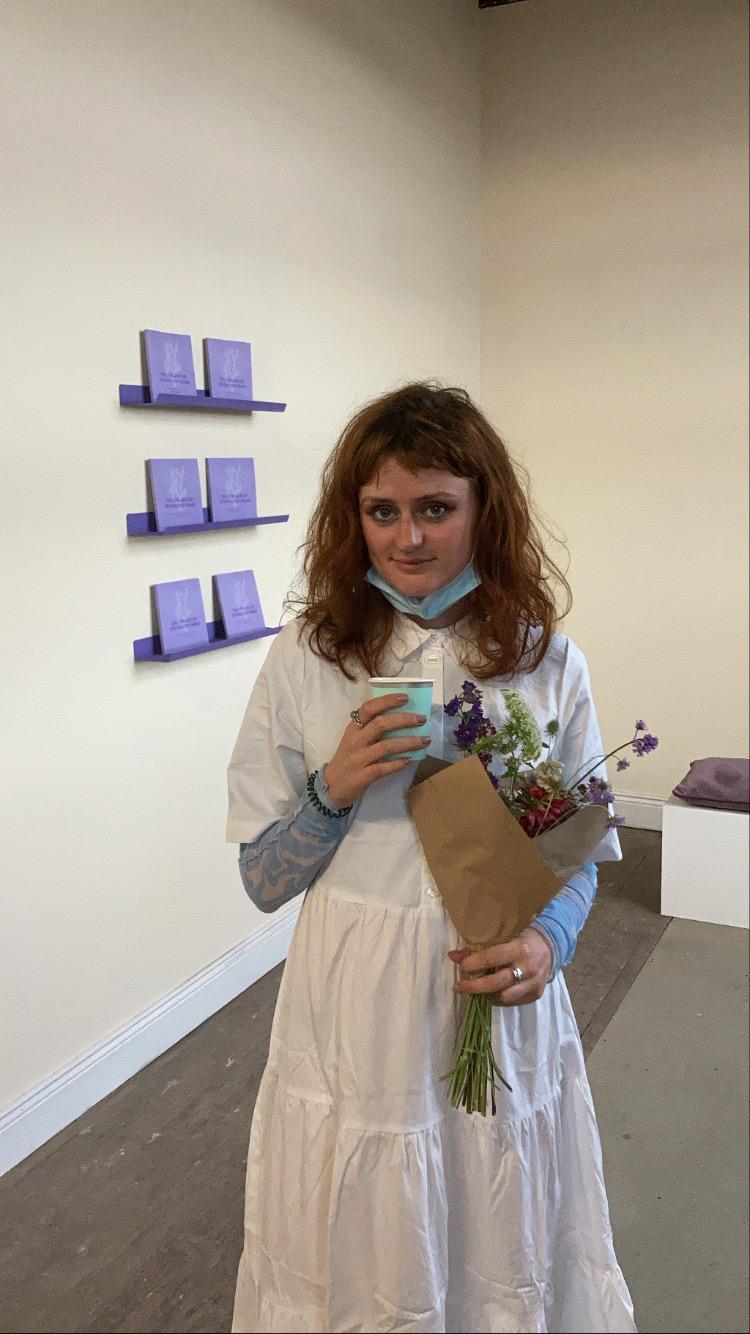
The Palace of Humming Trees is a collaborative project between artist Jack O’Flynn, writer Maria Sledmere and curator Katie O’Grady which took place from April to August 2021. This collaboration will be showcased in an exhibition at French Street Studios, Glasgow, featuring new works from O’Flynn and Sledmere which travel through poetry, sculptural entities and dreams of impossible possibilities.

This project was formed in a concert – along mixtapes, Tarot readings, zoom calls and shared research. We present it here as multiple sensual journeys; to an exhibition of hyper-foxes and tenderly crumbling foliage, through a publication of lichenous illusions and rummaging thought and in a selection of music and voices which trailed our imaginings. 

Intertwining themes of ecological thought, world building and re-enchantment we sought to un-ravel the question: how can we act and think in this present moment to ensure positive change to our relationship with the world around us? The action and thinking which we wandered became located in small and monumental formats – enacted in the everyday and in how we create and build the future. We were enveloped by uncertain certainty, whether apparent through non-human thought, the possibilities of visual art and poetry or the endorsement of magic. Living in a world brimming with unease by climate crisis and extreme inequality – brought upon by extractive capital, far-right strategies and carceral logics – we wished to communicate a different model of awareness that could refuse these structures and re-imagine being a Being. 

Exploring this sentiment O’Flynn and Sledmere have created a body of work that opens a portal to a forest of vibrating thought. One of galloping states, lockdown meanderings and a lyrical suffusion through language and art that prompts how we can think and imagine differently. 

Please enjoy this digital showcase of The Palace of Huming Trees and, if you can, come to visit its physical iteration at French Street Studios, 103 – 109 French Street, Glasgow. Open July 30th to August 8th 11 AM to 5 PM (closed Monday and Tuesday) with a preview on July 29th 6 PM – 9 PM. Book to attend exhibition via Eventbrite here and to attend preview here.

More info at the exhibition website.

The exhibition also comes with a book of poetry, illustration and essaying, The Palace of Humming Trees.

Available to order for £12.99 – Contact details for ordering available on the website above.