On Words, Romanticism, Ramblings and Meanderings

I am coming to the end of the Glasgow Uni Creative Writing Society’s ‘Flash Fiction February’ Challenge. The aim is to write one piece of flash fiction a day, following prompts that are posted on the blog. The best thing I have probably achieved since I wrote my 10,000 word ‘The Quest’ story (complete with self-made Photoshop image and realistic fire effects) aged eleven is successfully averaging at least 700 words a day for a whole month (some days writing 700, other days moving upwards of 1300…). The reward is not just having a little portfolio of stories to go back and edit in the summer, but the habit of discipline that’s been earned. I have learned that I need the motivation of ‘completing something’, and that sharing one’s work and discussing it with others helps to feel better about writing. There is also the satisfaction of word count. If I averaged at least 700 a day, then that’s at least 19,600 for all of February. If I doubled my word count and did that for two months, I’d have a respectable 80,000 word novel. It’s an encouraging fact. Even if the content is sometimes pretty crap, I have something to work with! I just have to keep up the daily habit. It’s a bit like crack, only not so addictive, and cheaper. And, well, you have to work for its effects.

One of my fascinations is with the daily routines of successful writers. Not necessarily just literary authors, but philosophers, artists, journalists – even mathematicians. Anyone who gives up a significant chunk of their day to solitary writing, creating or just working. There is a fabulous blog called ‘Daily Routines’ which is the ultimate procrastination: putting off work by reading about how others work. It’s refreshing to see that not everyone needs a wee dram or French cocktail to get the imagination flowing, though it seems to be a recurring theme. As well as the time of day and the choice of stimulant, I’m a little bit obsessed with peoples’ medium: the effects of the pen, pencil or keyboard; how one’s writing implement impacts upon their style, speed and even argument.

Susan Sontag. Source: nymag.com

For instance, Susan Sontag on her writing routine:

I write with a felt-tip pen, or sometimes a pencil, on yellow or white legal pads, that fetish of American writers. I like the slowness of writing by hand. Then I type it up and scrawl all over that. And keep on retyping it, each time making corrections both by hand and directly on the typewriter, until I don’t see how to make it any better. Up to five years ago, that was it. Since then there is a computer in my life. After the second or third draft it goes into the computer, so I don’t retype the whole manuscript anymore, but continue to revise by hand on a succession of hard-copy drafts from the computer.

[…]

I write in spurts. I write when I have to because the pressure builds up and I feel enough confidence that something has matured in my head and I can write it down. But once something is really under way, I don’t want to do anything else. I don’t go out, much of the time I forget to eat, I sleep very little. It’s a very undisciplined way of working and makes me not very prolific. But I’m too interested in many other things.

One day I want to write a big essay looking at how writing style changes according to how you get the words on the page (I even bought a beautiful typewriter to test that out). I love the idea that Sontag uses layers and layers in her writing and editing: the process of writing on top of writing, of scrawling and scoring out like the palimpsest diary Cathy in Wuthering Heights creates on the margins of a bible. Like Heidegger with his under-erasure being.

I also find it fascinating how people can study and write with music playing around them. I used to be a lover of total silence: a pure space in which I find the need to fill up the void with words. Now I can sometimes do with a bit of ambient sound: coffee shop clattering, birdsong, falling rain and so on. It makes a difference whether you are in the actual space (writing in a real garden or a coffee shop, for instance) or in the hyperreal zone of generated sounds (there are excellent Youtube sources of ambient sound, from whale-song to fire crackling in a grate). One will distract me to write about immediate details, the other soothes you into a weird creative ‘roll’ where you can pour out your words or nonsense like code streaming out in hyperspace. OK, I’m being self-indulgent.

And indeed, there is a self-indulgent aestheticisim to all of this: the endless procrastination involved in selecting the correct font for a piece, the need to rearrange one’s desk or shuffle books or change your pen or whatever it is. Yet there is something more important here that relates to publishing itself and the way literature often gets sucked into a commercial vacuum (think of the likes of the Brownings’ letters or Shakespeare’s sonnets which get beautifully repackaged in time for Valentine’s Day) . The original text is beautified by the paratext, and what is left is perhaps more of a consumer object than a discourse of words and sentences. There is an emphasis on white space, the chic luxury of thick paper and the gaps between printed letters. James Fenton said that, ‘what happened to poetry in the twentieth century was that it began to be written for the page’. But what is this page? Is it the sublime landscape of print paper stretching out its possibilities of unblemished whiteness? Or perhaps the virtual page: the ever-changing Internet archive that risks the dreaded 404, this page is missing; that risks alteration and collaboration and manipulation – and is this not a good thing? It is poetry changing, in transition; undergoing the morphological process of the human into cyborg. An automated computer voice reading aloud, staggering over the dashes and tildas and sharps, the onomatopoeia and enjambment like a child having a crack at reading Derrida. Il n’ya pas hors text: there is nothing outside the text/there is no outside-text (he writes in Of Grammatology).  When somebody reads aloud I imagine the words before me, drawing out of the page like butterflies coming to life; I can’t help it, it’s the way I learned to play with poetry. The world I like is the enclosed, shy space between the black ink and the reader’s eyes, the moving lips so silent.

The Mariner's ship and the Albatross. Source: thestage.co.uk
The Mariner’s ship and the Albatross. Source: thestage.co.uk

Like the ‘fluttering stranger’ that Coleridge observes as a child at school in ‘Frost at Midnight’, words in poetry become strange: there is an uneasiness to them that we cannot quite place. Verbs, adjectives and nouns are not what our teachers told us. You cannot fix them to a blackboard, and anyway chalk crumbles. While butterflies might be pinned down and classified by their colours, words are dependent on each other for meaning. So signification sifts in swirls of dreamy reading, and the mind makes connections. The imagination stirs and sometimes forgets them. Footnotes adorn the margins and confuse us, as they perhaps do in Coleridge’s ‘The Rime of the Ancient Mariner’, where we are driven into warmer but often more perplexing territory, as Coleridge’s gloss is less an academic explanation, and more a multiplicity of voices. At once, he joins in the action, ‘Like vessel, like crew!’ – yes, ‘her skin was white as leprosy’ – and we too catch this virus, moving between microbes of words that open and mutate through the strangest imagery. We shift between and through things with Coleridge’s metonymy, as in the gloss: ‘[a]nd its ribs are seen as bars on the face of the setting sun’. What are we to make of this being, ‘a Death’: an embodied spirit whose translucency both stirs and disturbs and amuses us, all at once? Aesthetics and meaning all blur into one.

Mount Snowdon. Photo by by Scott Wylie. https://www.flickr.com/photos/scotbot

With Romanticism what we often get is the journey, the progression through space, selves and substance, and through visual experiences: the sublime, picturesque and the beautiful. Not to mention the ugliness of Frankenstein’s monster, mirrored in Mary Shelley’s own monstrously patchworked collation of tropes and terrors and texts (imagine being raised on Milton but growing up like Rousseau  – being both Satan and a noble savage – now that is Otherness embodied, surely?). We follow Wordsworth up Snowdon and along the Alps in his glorious Prelude, with the seamless switch between interior musings and the expansive, golden panoramic shot that reveals the gaping ice and mountains, the tracks the subject’s wandering thinness:

The unfettered clouds and region of the heavens,
Tumult and peace, the darkness and the light,
Were all like workings of one mind, the features
Of the same face, blossoms upon one tree,
Characters of the great Apocalypse,
The types and symbols of eternity,
Of first, and last, and midst, and without end.

(Wordsworth, Book VI of The Thirteen-book Prelude, lines 566-572).

Where nature itself merges into one terrifying being, where opposites uncannily forgo their differences to become ‘features | of the same face’ and still the sweet ‘blossoms upon one tree’, we are in a sublime landscape, and then in the pastoral garden. The subject stamps himself upon the mountains, as the mountains are stamped upon him; we recall, with the help of the OED, the varied meanings of the term ‘character’: as both noun (a literary figure of self/person; a sign or symbol used in writing, print, computing; a code; the properties of a substance) and verb (‘to distinguish by particular marks, signs, or features’). Wordsworth’s figure is the self encoded in the text, the lonesome Romantic imprinted in his white sublime of Snowdon, going deep into the very properties of the rock itself. All is viscous, melting subject into object. All is, as Timothy Morton so aptly puts it, a mesh: where there can be nothing ‘out there’, as we are all a set of strangenesses, part of an existence that is always coexistence; and yet we are not simply part of a holistic collective, but connected in our differences, in our mutations that separate, stick and undo us. There are those clouds which seem ‘unfettered’ and yet even they cannot rise above the poet’s vision, the tacky link of aesthetic projection that takes nature from unified cliché  to a space of wilderness in which things move between abstraction and reification, and humans move with them in the ambiguous space between – like those viruses that multiply and mutate, ‘first, and last, and midst, and without end’.

This dangerous, homogenised idea of ‘landscape’ can be undone by thinking of it textually: as a palimpsest too of sorts, where human language adds layers to our understanding, alters our relationship with nonhuman things of the living and non-living. In writing and reading ‘nature poetry’, we are reconfiguring our place in the mesh; just as a drop of colour upon a single Paint pixel shifts the impression of the whole picture.

While Romanticism takes us on these messy forays into psyches and space, in the twentieth century we have, as Fenton has suggested, the poem as object: the poem as visual play on the page. The attempt to make the poem an object, to get to the very basics of objects. Think of Ezra Pound’s Imagism: ‘The apparition of these faces in a crowd; | Petals on a wet, black bough’ (‘In a Station of the Metro’). Think of William Carlos Williams’s notorious modernist poem, ‘The Red Wheelbarrow’, in which Williams’s poetics bring the object into stark and colourful being, like an object being rendered on some kind of graphic design program. Assonance coats our visual impressions so that we can almost taste what we see, the wheelbarrow ‘glazed with rain’. On the page, the poem too is a spilling of rain, of long lines dripping into single words, of basic objects hardening, forming. The ‘red wheel | barrow’; the ‘white | chickens’.

The Yellow Book. Source: http://www.johncoulthart.com/feuilleton/tag/fin-de-siecle/

There is also the lovely aestheticism of the fin de siècle: the beautiful margins and separation of art and text in the The Yellow Book, and of course Husymans’s jewel-encrusted tortoise, which eventually dies from the weight of its ridiculous embellishments. Does a text too collapse under the weight of its stylistic ornamentation? The fashion for minimalism perhaps gives way to this assumption, and yet what about the explosive textuality of Finnegans Wake, Gravity’s Rainbow; anything by Henry James, or for that matter, Angela Carter? Art for art’s sake is not a dip into vacuity, but is necessarily a political statement, a textual position, after all. An attempt to escape the shading blinds of ideology. You might write a dissertation on the politics of purple prose; you might float buoyantly along the clear river of Wikipedia readings.

And now I have lost my place in the forest and cannot find the light again. Birds tweet shrilly and their song is like stars tinkling and various shades of darkness hang in blue drapes from the bowers of pine trees. If I look around I see the jewel of every dew drop glisten and I know that it is twilight. I am looking for something particular: that silent speck of a presence; that which evades me every time I turn over each new leaf. Only I know that I cannot see, cannot see the gathering of these particles; the light is fading and soon the day will close its drapes.

These are just words after all, and who would cling to them?

Some further words:

Derrida, Jacques, 1967. Of Grammatology.

Edgar, Simon, ‘Landscape as Story’, Available at: http://www.lucentgroup.co.uk/the-landscape-as-story.html

Morton, Timothy, 2010. The Ecological Thought.

Huysmans, J. K. 1884. À rebours.

On Brutalism

Photo by Subflux: https://www.flickr.com/photos/subflux

One of the first things you notice when you come to university in Glasgow is the building that passed you by on the open days: Boyd Orr. Orr…ore…or? With such connotations of alchemy, alternation and mechanical process – the extraction of mineral from rock – you’d be forgiven for thinking this building might have that rare quality of metallic extraction. The glint of some loveliness got from the mined core of the earth – or at least some relic of its crust. Boyd Orr himself, as Wikipedia tells me, was a Scottish teacher, doctor, biologist and politician, who also bagged himself the Nobel Peace Prize for work relating to wartime nutrition. Fitting, perhaps, that this man who dabbled in the arts of healthy eating would give his name to a building that some have found physically repulsive and ugly – if anything, unhealthy.

Still, nutrition involves mining particles of food for their usefulness. Finding all the vitamins as a geologist might take ore from a rock. There is something abject about all this: wrenching nature inside out, textually taking apart her insides with the bland incisiveness of a knife (the linguistic thrills of science course-books). The molten loveliness of erosion, rocks, temporal process – we can reduce them to names and building blocks.  And so we have Boyd Orr, that building of much usefulness and much disgust. The beast of a building that somehow you find yourself in, day after day, traipsing up the stairs for lectures, waiting for someone to give you their jewels of information. You came here thinking you’d be living the Harry Potter high-life in the extravagantly gothic main building, chased by ghosts and granted with turret views. Instead, you end up four floors up in a building that sends its gross sneer across the otherwise lovely architectural landscape of the West End.

Source: theglasgowstory.com

Whatever you might say about Boyd Orr – with its dirty-white panels, greying windows and greyer walls, with the greenish mould that creeps up its underside like seaweed on a rock and the ugly stark jut of its body against the surrounding skyline – you must say that it is a fine example of Brutalist architecture. The heyday of Brutalism was the period between 1950 to the mid-1970s, a reaction to the modernism of the early twentieth-century. Most examples of Brutalism tend to be found in governmental or institutional buildings (university libraries, shopping malls, high-rise housing), whilst corporate buildings have always favoured a more glassy, futurist chic. The thing that strikes you first about a Brutalist building is its sheer expression of, well, concrete. It hits you with the blunt materiality of a prison or fortress, and you know, it does take a while to get used to going inside. Sometimes it seems impossible that such a monolithic block is carved out inside with such things as canteens and toilets and classrooms. Part of its statuesque aura relates to its positioning: right on the corner of University Avenue and Byres Road, where the surrounding buildings are much smaller or indeed older (and prettier for that matter). There’s no getting away from this eyesore, this monument to an industrial modernity that seems now to be receding in the mise-en-abyme of contemporary metallic panelling, plexi-glass and plastic coating.

Edinburgh's Scottish Parliament Building. Photo by UncleBucko. https://www.flickr.com/photos/unclebucko
Edinburgh’s Scottish Parliament Building. Photo by UncleBucko. https://www.flickr.com/photos/unclebucko
Glasgow School of Art. Photo by gillfoto https://www.flickr.com/photos/gillfoto/

Like the rest of Glasgow’s culture, its architecture is a tale of two cities. There’s the legacy of our colonial history, with flourishes of opulence on every corner; but there’s also the leftovers of 1970s ‘slum’ housing, the crumbling tenements where once upon a time (and, unfortunately, perhaps still today) a whole family would share a bedroom and washing was done at the ‘steamie’. In one street you might have a bizarre Art Deco number next to some crumbling sandstone tenements, or a gleaming new-build sprung up alongside Victorian houses with massive (single-glazed and listed) bay windows. There’s the black-and-white nostalgia of the Gorbals and then there’s the grandiose Park Circus, sat atop Kelvingrove Park looking out with picturesque views over the city. There’s the famous Carpet Factory, the Rennie Mackintosh Art School, the various churches, mosques and synagogues with their unique homage to Roman and Eastern styles. There’s the uncomfortable fact that much of Glasgow’s beautiful marmoreal and sandstone glory is built on the slave trade. We also have the bug-like SECC resting next to the Clyde as if we were in Sydney, the Royal Concert Hall that crowns the top of Buchanan Street, the new Hydro that more than anything resembles a UFO. It’s definitely a city of eclectic architecture. While we might not have the equivalent architectural (and indeed financial) notoriety of Edinburgh’s Scottish Parliament building (which in my family alone has been called ‘horrible’, ‘interesting’, ‘a waste of money’, ‘too modern’ and ‘more of an art gallery than a parliament’), we were in 1999 designated the UK City of Architecture and Design, beating the likes of London, Liverpool and of course, Edinburgh. You only have to reflect on the response to last year’s Art School fire to recognise how seriously we take our physical landscape and architectural heritage (even if it is often covered with ad posters and graffiti).

Photo by Susan Casey https://www.flickr.com/photos/susancasey/
The Gorbals, 1968. Photo by Susan Casey https://www.flickr.com/photos/susancasey/

Anyway, back to Brutalism. The key word related to its style, aside from concrete, is perhaps ‘function’. Stripped to its core elements, Brutalist architecture involves repeated ‘modular elements’ which are grouped together to form the whole. This is the raw fragmentation of modernism, here transformed into something with instrumental purpose, something solid that seeks to counteract the airy dissolution of modernity. ‘All that is solid melts into air’, Marx said. With Brutalism, the response is to make things as solid as possible. How ironic that Marx predicted a revolutionary dissolution of oppressive social structures, whilst the ‘proletariat’ in question remain literally trapped inside buildings which encase them in a physical manifestation of the very (metaphoric) solidity which binds them socially – the hard class structure, the poverty cycle and so on. And perhaps also ironic that some of these buildings were erected at a time when industrial labour was entering its decline in Britain and elsewhere, especially in Glasgow towards the end of the 1970s, as Thatcher came to power and that mineral source of wealth and opportunity (going back to ore of course) – mining – was dissolved from the national economy.

There is also the uncanniness of paradox attached to the fact that when one observes a Brutalist building, it is often difficult to discern its function due to the sheer vastness of its functionality. This relates back to what Edmund Burke in 1757 defined as ‘the sublime’:

The passion caused by the great and sublime in nature […] is Astonishment; and astonishment is that state of the soul, in which all its motions are suspended, with some degree of horror. In this case the mind is so entirely filled with its object, that it cannot entertain any other.

Burke was talking about the sublime as it was caused by scenes of nature: mountains, chasms, forests that seem to stretch on forever. However, as urban landscapes increasingly eat into our countryside, it seems fitting that we might consider the vastness of their proportions – or indeed, their ugliness – a kind of sublime in themselves. What else do we feel than a kind of passionate ‘horror’ as we find ourselves faced for the first time with buildings like London’s Trellick Tower and Barbican Centre or India’s Palace of Assembly? All those pattern-like repetition of squares resembling a Kantian ‘mathematical sublime’, whereby an overflow of signifiers stretching out into tedious infinity bears the threat of all meanings, distinctions and associations collapsing into one long metonymic chain leading to nothing but more signifiers. It’s enough to give you a headache, and quite ironic that Boyd Orr is next to the equally hideous though somewhat-smaller Mathematics Building.

Trellick Tower. Photo by Martin Hearn https://www.flickr.com/photos/martinhearn/

Central to Burke’s idea of the sublime is the notion of the pleasure associated with terror: as we gaze at something which overwhelms us, we find ourselves staring into the abyss of meaninglessness, on the sheer precipice where representation itself collapses. St. Augustine suggested that the ugly was that which embodied formlessness in its lack of beauty. This aesthetics of excess or hideous terror appears curiously inappropriate for a style of building whose very purpose was built on form as function. We might think of Frankenstein’s monster, whose ugliness stems not only from the fact that he is composed of the flesh of dead cadavers, but also his sheer pointlessness – the fact that he is a ‘blot upon the Earth’, as Mary Shelley has him lament. Might we consider the likes of Boyd Orr a horrible, monstrous ‘blot’ upon our sacred streets? Or is this more than a question of mere aesthetics?

As Romantic poets readdressed the Neoclassical distaste for the gross pointlessness mountains (favouring, as Alexander Pope’s Windsor Forest perhaps best exemplifies, a view of nature as ordered and harmonious) by fetishising the psychologically disruptive experience of the sublime (in the way that Coleridge, de Quincey et al also favoured the psychologically disruptive experiences of opium), today’s generation are raising Brutalism to idolised status rather than rejecting it as a mere eyesore. Sure, you will have the many students who moan about Boyd Orr’s appearance on their campus, but you will have an equal number of enthusiasts on the likes of Tumblr posting Brutalist architecture onto their blogroll, alongside your Banksys and softcore erotica and fan-fiction all that other Tumblr jazz. Stark black and white photographs record an almost antiquarian fascination with the aesthetics of these buildings and their value as some relic of a solid past we can’t quite get back to in our shiny era of crazy postmodern architecture.

Photo by Tom Donald: https://www.flickr.com/photos/clearwood/

But is there an ethical problem underlying this fetishising of some Brutalist buildings? They are, after all, often the homes of many people living in relative poverty. Sometimes, these buildings are just down the road from areas of affluence and architectural extravagance. I don’t need to mention specific areas for you to think of places in Glasgow, because there are certainly many. It’s a problem related to the way that urban decay is appropriated as a kind of dark backdrop upon which a white, middle-class guy sorts his life out. There’s always been the ethnographer’s dilemma of how ethical it is making a living out of describing poor conditions without doing anything about it politically or practically. I suppose what I’m getting at though is that there’s something a bit more uncomfortable about using these buildings as ‘cool’ aestheticism, a mere viewing-spot on the blasé scroll of online photography. Still, I don’t think there are clear answers to this; and maybe it’s good to share images, because sharing raises awareness.  You just have to keep in mind the whole problem of ‘poverty porn’, and the notion that by glorifying certain buildings you are also glorifying a particular experience of poverty, however unintentional your actions.

Photo by  https://www.flickr.com/photos/22087304@N07/
The Red Road flats. Photo by <p&p> https://www.flickr.com/photos/22087304@N07/

Indeed, this perhaps is what made me so uncomfortable about last year’s plans to demolish the iconic Red Road tower blocks and transmit the demolition live as part of the Opening Ceremony of the Commonwealth Games. While it is of course good that the Games involved building new, much more accommodating and safer houses to replace these crumbling relics of Glasgow’s past, I don’t agree that it should’ve been broadcast to add a ‘bang’ to the Opening Ceremony. London gets magnificent fireworks for the Olympics, we get…glorified demolition? Destroying a symbol of poverty doesn’t destroy poverty itself, however easy it makes it look. Luckily, these controversial plans were scrapped in the end after much public opposition (which just shows again how much Glaswegians care about their physical environment and the social consciousness within it). Regeneration is underway with the Games’ legacy and of course it is a great thing, but there is no need to sanctimoniously erase history in front of the world to show that you’re doing it.

jg-ballard-high-rise

This points to the whole issue of Brutalism’s somewhat brutal decline since the 1980s, especially in Britain. Vocalised distaste from public figures, the association with urban decay, problems with graffiti, cramped living conditions and its starkly cold, almost totalitarian appearance, all contributed to this decline. Another contribution to this decline perhaps came from British Literature’s concrete guru, J. G. Ballard, as his novel High Rise (1975) documents a dystopian, Lord of the Flies situation where the closed conditions of a high-rise building lead to a swift degeneration of the residents lives. The enclosed spatiality of place itself gives rise to a carnival of savagery and violence, where primitive desires are unleashed in this isolated environment. The opening line perhaps gives you a good indication of where Ballard is going with this novel: ‘Later, as he sat on his balcony eating the dog, Dr Robert Laing reflected on the unusual events that had taken place within this huge apartment building during the previous three months.’ There is a strain of dark humour running through the text, as well as the shock value of its exposure of human nature placed in its urban limits. You get the sense that Ballard secretly revels in both the sheer surreal ugly inhumanity of it all, whilst critiquing the politics of urban planning that might one day lead to such a scenario.

Overall, I’m not sure where my position on Boyd Orr lies. There are days where I’m walking to uni along Highburgh Road and when Boyd Orr looms out of a cloudy winter sky my spirits sink like a puddle of snow slush. But there are times when you can’t help but notice the strange beauty of copper-coloured sunlight flashing upon its windows at dusk, as if a thousand eyes were staring out of those cold, impersonal walls. I think there’s value in preserving these buildings, not just because they possess a kind of chic urban sublime, but because they remind us of the ideals our society once held, even if they were misguided, flawed or impossible. I suppose I’d rather stare at the stark reality of an ugly monster, a decrepit Boyd Orr, than lose myself in the illusory surfaces of the glassy Wolfson Medical School, or the kitsch blue and green panels of the neo-Brutalist Fraser Building. I’d rather a chunk of dull glowing ore than a perfect rhinestone…

fraser_building_030411_aw
The Fraser Building opposite Glasgow Uni Library

Cumbrae: A Fragment

Source: openroadscotland.com

I have this memory of being nestled in the cleft of a rock on the isle of Cumbrae, my bike propped up beside me as I sit watching the sea and eating fizzy laces (they were cola-flavoured, or maybe strawberry). I’m on the rugged side of the island, where yellow eyes and strange animal faces are painted onto cliff walls and sometimes if you stare hard enough at the ocean you can see seals. On the other side of the island, you have the little town of Millport, with all the white and pastel-coloured houses looking out onto the harbour. Everything is still, soft, crisp – the texture of sorbet – so that the only sounds you can hear are the steady lap of the waves sloshing against rocks, and the occasional cry of a wandering cormorant. The island to me is like the shyest of kisses: the kind that taste of rain and raise your spirits. Yes, I’m eleven years old and I feel invincible.

You see, I’m on a bike ride, travelling twelve miles right round the island. I’m wearing jeans with the bottoms rolled up and spattered with black oil from the chain; I’m gripping the handlebars so tight I can feel the blood burn and tingle in the tips of my fingers. I’m pedalling even faster than my sporty brother and my father and I know I’m going somewhere because the landscape changes the faster I go. Life rushes by like a montage peeling back luscious scenery. I pass other families on their bikes but they don’t see me; I’m caught on the drift of the wind that they’re battling and I’m going faster than they could imagine. The sun is on my back and I’m flushed and my hair tangles around me, caught in the straps of my rucksack. I want to get there first; I want to be the first one to reach the secret beach.

You can stand there in your bare feet and I remember the cockle-shell rocks, greenish with sea leeches and weeds. Nearer the sea the sand is velvety thick and oozes up between your toes. My child’s eye spots the starfish and sea anemones, and I wish I had a jar to take some home. I’m teasing my brother about something and he throws a stone into the ocean, watching it bounce five times over the waves. Sullenly I watch it. Then in my head I tell everyone I’m a mermaid and paddle in the shallows, looking out for the shoals of fish that swim by in miniature shimmers. We’d wander back up to the rocks and pick our seat; and that’s where I’m sitting, now, in this moment, looking out to the mainland without worrying about a thing. I’m just admiring the craggy shapes of the distant cliffs and the way the cloud looks like billows of cigarette smoke coating the landscape.

The worries would come later, in the dreamy space that opens before sleep. I’m trying to get at the dregs of this memory. The exact details of colour and light, the way that the April air felt and the shapes of circling time. You go right round the island and come back to the start. You paint the strokes of the green hilltops and the silver belt of the road. It’s nearing summer so the day drifts endlessly through night; it doesn’t get dark properly here, not really. Not until the depths of winter. A shower of rain that’s a spray of glitter. Maybe there’s a lighthouse shooting beams of white across the bay. Ships passing ghostlike in the night and you wouldn’t even know. I remember the cold blasts of wind you get on the ferry, with the horn of other boats and the marvelled awe of other children looking out towards the harbour. I call up all these things and wish for more.

Source: openroadscotland.com

Maybe all that remains of this memory are the sea-smoothed shards collected in a jar that sits on the sill of some window in my mind. You can remove the lid and pick the best colours, turn them over separately in your palm, but you can’t make them real again. Time has softened the sharpness of their edges, added layers of distortion to their rays of shifting colour. Hold one up to the light and you will see the bubbles that mark each year that’s passed, arranged in no order other than chaos.

Somewhere, there is the shimmering bleep of slot machines from the cheap casino room of a ferry. A man asking for tickets and a car stuck on the gangway. The taste of peanut butter sarnies gritted with sand, the crispness of silver foil in my hand. If I close my eyes, dizzy and thirsty, I am back there, my body nauseous with the pull of the sea, the boat rocking to and fro with the turn of the words that mutter on my tongue. My hair whips over my face and it smells of salt and seaweed and I can feel the island growing ever so closer to me as the ocean moves towards the setting sun. It’s not that I’m eleven again – nothing is the same twice over – but it’s the feeling of a memory that you can hold up to the light, watch it distorted, watch it glimmering bright.

Mushrooms at Dusk

mushroom

She found the quality of light at this time of year awfully confusing. Dull grey in the morning, silver streams of mist that lick the sky like butter from your fingers. The twilight haze of three o’clock, where the amber lamps come out like fireflies and shadows gather ominously across the sky. Maybe a wisp of some foreign wind, darkling in the fade towards four, where she’d be sitting at her window, wondering. It was the time of year to tend to the garden, pile up the heaps of leaves, clusters of rotting pinecones and acorns that clotted in the soil. The earth was hardening for winter, and soon the frost would come, eating into the grass like a glittering poison. She’d see it as she dressed in 7am sunlight, the whitish mist making crystals at her window. Everything still and beautiful.

It was a luxury, to be home now. She waited for the seasons to change, right at the hinge between autumn and winter, before she made her journey. Asleep on the train, dreaming of being small again, so small in the bubble of childish memory. She could smell the peanut crunch of M&Ms, the sparkling particles of someone’s perfume. Soon, soon she’d be home. The place grew tighter every year, as she grew fatter on the milk of new years and their offerings of plastic joys and flattened dreams. She stood in the kitchen, watching the steam swirl out of her first cup of tea. No new mugs, of course. Later, she would press her face to the window and her breath would fog a dewy canvas, and with one finger she’d draw pentagrams, like she always used to. There’d be the rubbery squeak of skin on glass.

No-one was at home now, just her in the wide archives of the house. In the dusty shelves that made her sneeze, and the picture postcards, she imagined a thousand phantoms. They were pretty phantoms, ornamented with the smiles of children and the pinkish sheen of memory. They did not speak to her, but she was somewhat comforted by their silence. What counted was the presence, the ghosted sigh of a skin-prick or coldness. She would wait till her parents got home and read books, in that nook between the banister and the cabinet on the landing. Imagining herself as Jo in Little Women, taking great bites out of Braeburn apples, lines of prose flying before her eyes. She did not fit there as well as she did as a child. The wood cut into her arm as she read the strange poems covered in gold-frosted dust. Somebody had been spraying glitter in the study, making Christmas decorations. That was a long time ago.

***

Morning came like a murmuring of starlings, and slipped away again just as quickly. Her body was heavy, her limbs tree-trunks of aching muscle. She felt she had been away again, and the new hours were another return. She worked them over in her mind, pondering the way their shapes formed with her hunger and sleepiness. Moulding, slowly. At the window she stood and yawned. Some machine was whirring away, making her coffee. The smell dissipated through the room with its warm opulence, stirring her brain to life. Yes. She peered closely into the garden, staring at strange dark shapes which clumped in the fronds of long grass. Most peculiar. Later she would investigate. She ate her breakfast of burnt toast with the radio humming in the background, speaking of a war somewhere, and then advertisements for hair salons and special restaurants. Onto her toast she spooned pools of blackberry jam that looked like crushed rubies, and the soury sweetness bit at her tongue between her teeth. She chewed loudly and grinning, the wine-coloured juice staining her lips. Afterwards, she left everything on the table: the crumbs peppering the wood like a pixie’s debris.

It was almost enough just to be here, out of the shouting sirens, the madness of the city. Home, she supposed. She sat at her laptop, fingers clicking ruthlessly at the keys. She was writing a message to someone, a sad story about why she would no longer remember them. She would keep it saved, locked deep in her computer’s hard-drive, and then one day send it. When she had the person’s address. When the time was right; which it wasn’t just yet.

Everything stretched out like the languid yawn of a giant, just a long morning and the gape of afternoon, uncertain evening. The sheerness of time was narcotic, rendering tiny signals that pulsated in her brain. She was at once sleepy and electrified. She rushed up the stairs to check something in her room, but her phone was dead and all that was there were her clothes strewn across the carpet. She messed around looking for things to read. She highlighted her favourite words in the dictionary. It was a big dictionary, and a whole hour shed away like the flake of skin that layers the top of a scar. She remembered only a handful of this vocabulary: sapphire, salience, stardust, Saprotrophic. She was cleaning the window with lemon vinegar, making sweeping lanes in the film of dirt. A thin moon peered out of the weary sky like a wink. Saprotrophic…she had forgotten something. Ah…the mysterious clumps in the garden! Of course, they were mushrooms, only mushrooms…

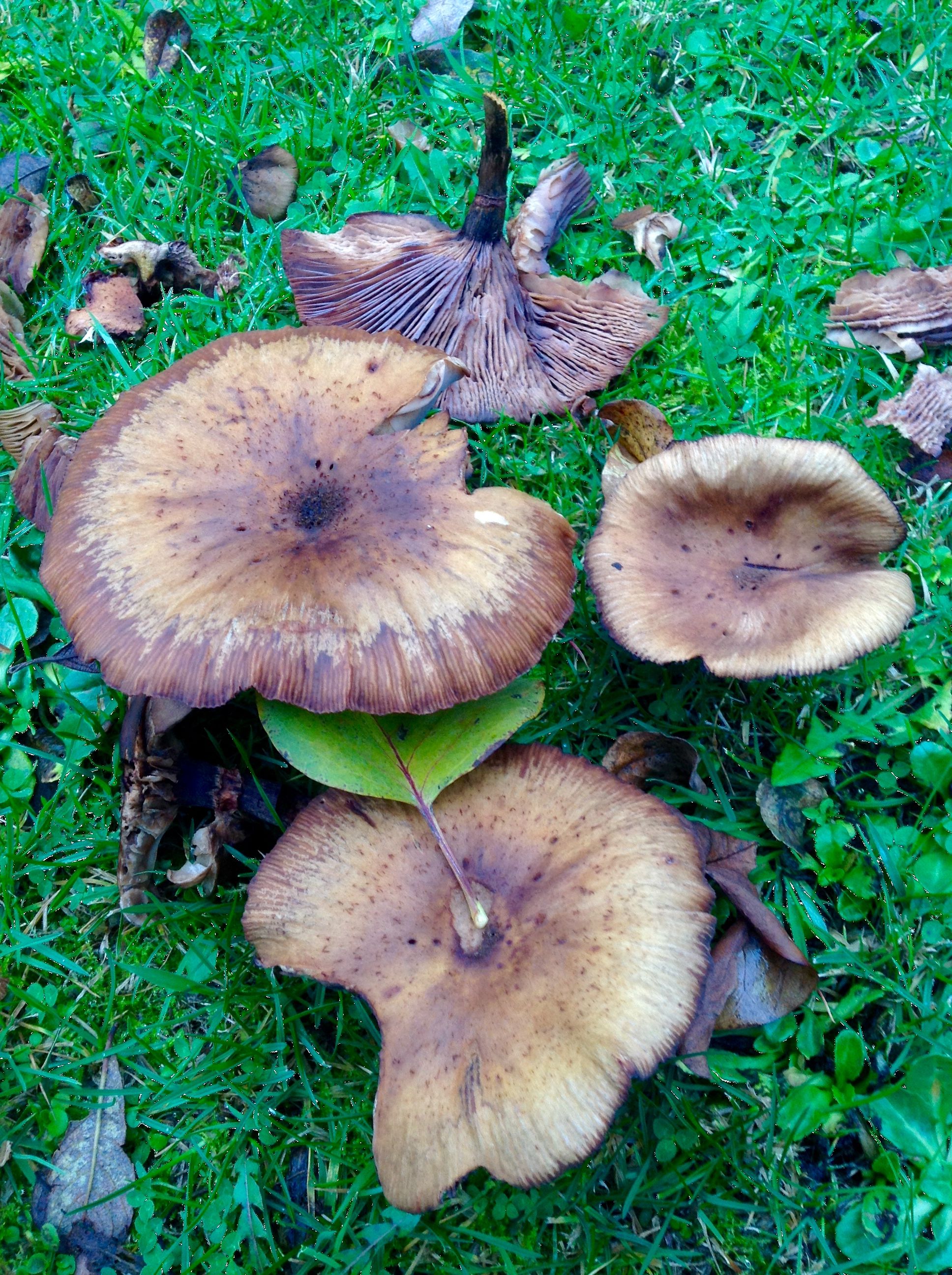
She pulled on her mother’s wellies and trod out into the garden, up the concrete steps. The air was very still; mournful, even. It smelled of wood-smoke, and somewhere she could hear the crackling snaps of burning tinder. Plumes of it rose against the blueish dusk in dark arabesques. She sighed contentedly. The clumps were even more abundant than she’d thought; the whole garden was teeming with their shadowy figures. She knelt down to inspect some. She thought of the honey fungus they’d found out in a forest once, clinging prettily to a rotting stump. In the sunset glistenings that glazed the silhouetted trees, she had thought she could almost see fairies, fluttering above the mushrooms. They were lovely mushrooms, with their smooth peachy caps. Her friend had said they were edible; but you could not be sure with wild ones, so they left them alone, like a living relic, noting their path. The toadstools she saw now in the garden were a putrid brownish colour, etched with black lines and little white spots. They were ugly in a kind of otherworldly way. Ethereal, even.

Her knees were going numb from bending so she stood up and did a lap of the garden to get her circulation back. She was recalling things. The party where a boy brought out a sandwich bag of suspicious-looking vegetables, frying them on somebody’s pan. She’d stood in the doorway of the kitchen, her mind full of cheap red wine, watching the way the little things unfurled in the buttery oil, their spindly stalks stretched out like tentacles, their heads jiggling like jellyfish. As they started to sizzle and wilt, they let out a curious, bitter smell. The boy had shared them among his friends and then they had disappeared for most of the night. Later, one of them was hanging upside down in a tree at the village park, and he was reciting streams of Byron’s poetry. Sometimes, she still heard his voice, even now, reverberating through the dark.

The cold was coming out of its slumber and creeping into her bones. She stood still, wrapping her cardigan tight around her. She crouched down again and dug her nails into the earth. A weird feeling gripped her, a feeling tinged with homesickness. She pulled nothing out of the ground, no trace of seed or root. She stood up again. The quietness made her feel smaller than ever, but her mind was huge and overbearing, stretching itself across the matter of the garden. It all glared in her vision like the close-up shots of a dream. She wished some sound would break the silence. A bird-cry, even. But the little creatures were so quick with their wings that they made no noise as they flew between branches. She was trembling now, remembering everything.

The fungus at her feet now looked like the severed heads of something. She had to breathe.

If only a car would start in the drive, or a plane fly overhead…something, something!

They say that magic makes you happier. And she thought there was a thing she could do, before going inside again to the womblike comforts of heat and sleep. She brushed through the grass with her wellied feet, and stood in the centre of one of the fairy rings. It was a near perfect circle. She stared first at the mushroomy clumps at her feet, then up at the sky. It bore the dramatic flashes of an expressionist painting: great bolts of violet wounded the blue, and rivulets of yellow broke away from the horizon, approaching amber and spiralling, spiralling. Then she found again the moon. Brighter now, it was a sharp crescent, the fold of an eyelid. She waited, waited. Her body was cold and her skin prickled like coral on a sea-washed rock.

The clouds began to gather, slowly at first then fast like an army.

You could smell it in the air, the sourish dampness that held as a breath.

She closed her eyes and the rain came. She felt the initial sprinkles that bounced off her skin, the cries of birds as they darted into the hawthorns for shelter. Drizzles of silver slashing the landscape. A downpour of water and chilly air. She stuck her tongue out for the cold shock and the sharp taste. The crescendo sound of it showering louder, coming down thick and heavy from the west in globules fat as teardrops. She opened her eyes and her hair streamed down her face like seaweed, clinging to the marble of her skin. She felt it surge within her, the waterfall sounds of this injured nature. A grumble of thunder. Something stirring in her chest, a rush in her pulse. Almost like someone was watching her, a million things flashing around her. Her laughter was lost in the cavernous sound of the rainstorm, another echo pirouetting through the chambers of memory. And as she stood there, the fungus and mushrooms soaked up their nectar, before crumpling to a wasted doom. The rain had poured through and through her, and she felt hollow and purged as a mermaid tossed from the sea to a tomb. And she was the still point in the tempest around her, her body soft and sad with its sickness. This was it; home was just this, wild and true, the beatific glow of a hullabaloo.

Autumn Reflections

IMG_1999

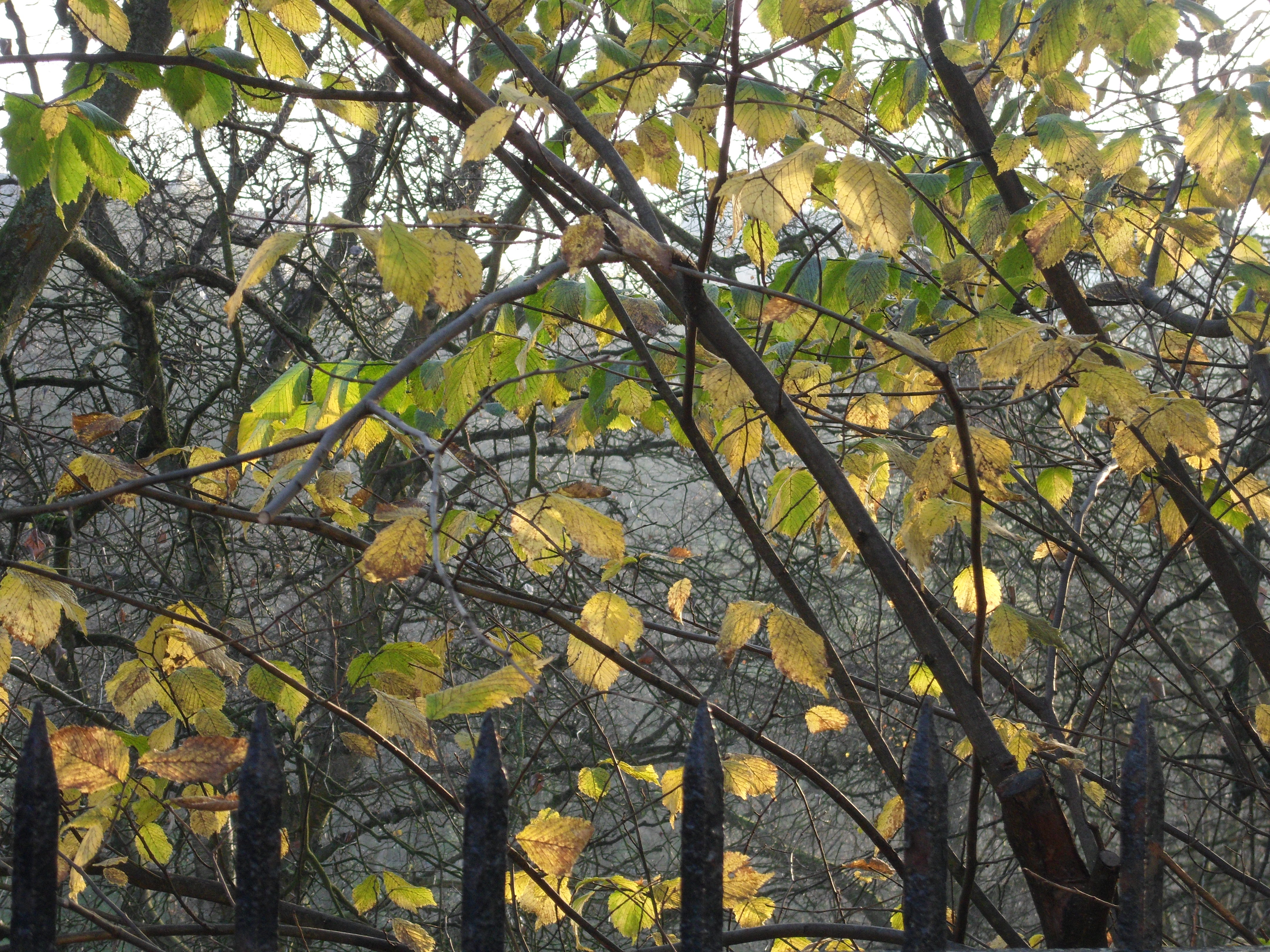
The dawn cracks open the sky like a chestnut, and gold light pours on the concrete and grass like showers of molten topaz. Somehow it’s October and I’m wondering how I got here. Where the summer has disappeared, along with the warm air and the billowing roses, with August and its hydrangeas; it seems time has elasticated itself, and snapped at the strangest of places. Everything may break free now. The world slows down, as trees shake themselves clean of another year. Leaves cascade on the ground, and as I walk I hear the susurrations of their skeletons, rustling like the sound of rain at night.

Autumn is a quiet season. We retreat inwards. Gone are the sparkles of summer voices, the throb of fashionable neon and jet planes soaring to boozy utopias. The Pimms is perhaps swapped for something richer, sweeter, warming. A good cider, red wine, some inventive cocktail combining Kahlua and caramel-flavoured tequila. You think of those people hanging out of balconies, their bare skin glowing in the cold air, the slivery iridescence of cigarette smoke curling from their nostrils. There are the box-sets, the television dinners. Going out is such an effort; it is the not knowing, the tentativeness of the weather. Things would be easier if the sky kept to its promises.

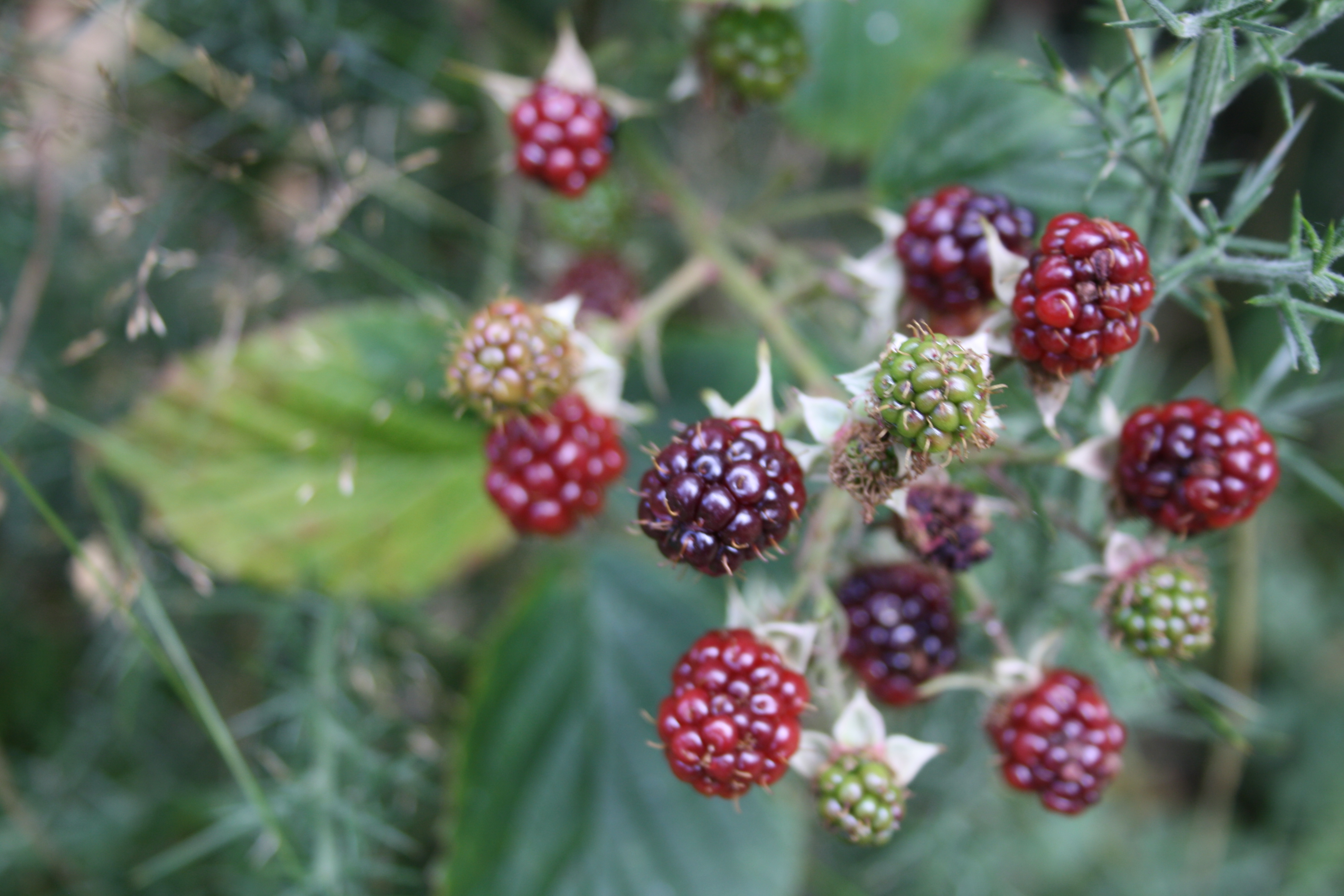
I wanted to go blackberry-picking this year. I found a place along the Kelvin where they sprawl out of the bramble-bushes, poking like fat sapphires through wire mesh fences. I need to find some leafy suburb for conkers. When I was little, we spent the October holidays at my Nan’s in Milton Keynes. There was a copse of horse-chestnut trees and every year we brought back a black bin-bag full of conkers, and I’d shine them up with vinegar and nail varnish before taking them into school. There’s something incredibly satisfying about the way they feel in your palm, solid and smooth, nourishing somehow. I didn’t quite make it in time for the blackberries, but I did the walk again all the same, sweeping my feet through the trails of leaves. Autumn had left its burnished light, a shimmer on the river. I love the feelings of these late afternoons, where darkness is like a comforting hug, handed through chasms of stars and amber.

IMG_1333

Once, we had a school project, to gather up all the fallen leaves we could find and press them into a picture behind glass. A lesson in natural materials, perhaps, in arranging colour. We were flattening the landscape, making art; in the veiny intricacies of each leaf lies a million hidden histories. We’ll never know, and they’ll fade and die eventually.

Autumn is always a time of nostalgia. It is that paradoxical time where death reveals itself through visceral beauty. The life forces of summer unfurl and wither and fall away, and yet there is a beautiful melancholy in the sad palette of reds and golds and browns, the snuffling of squirrels amongst tufts of bracken. Everything is scattered: the husks and roots and fragments. You find them in the strangest of places, tucked not only in forests but flowing out of drains, wedged in concrete and windowpanes. People spend their Sundays loafing with films and Scrabble and roast dinners. Or maybe they don’t anymore; but maybe they did once.

SAM_0240

By September, we’re back at school, back at uni. Fresh starts amidst the fall. Sharpened pencils, the smell of polished leather. The heating goes on for chilly mornings. Socks warmed up on radiators. That was before I had a flat of my own, and became too stingy. The wind, like some malicious spirit of winter, slips through my single-glazed windows, blasts the rose from my cheeks. I make do with the illusory effect of candles, the quick fix of hot water bottles. You can warm anything with the scent of nutmeg and cinnamon, a flash of cayenne pepper. Stodgy soups and slabs of bread. I watch the pumpkins fill up in the shops, imagining a sea of faces, waiting to be painted on. Or carved out. Stacks of apples to be bobbed, pubs to be terrorised by the horrid costumes adorned by students. Halloween is not quite what it was when I was younger. I miss the parties with the clouds of cobwebs and incense haunting the rooms of my house, fake spiders draped from the chandelier; the echoing sound of dub-step, and the taste of vodka and food colouring. Edible brains and blood-coloured fizzy laces. The sugar-rush; the hungover fall and slumber. Soon there’ll be fireworks, splintering pigments across the sky. As ever, I’ll watch them from the high-up floors of the library. Remember being in first year, where I sat on a Saturday night, my eyes blinking at a computer screen as I read Byron’s poem ‘Darkness’, for a seminar. The rockets flared and pinks, yellows and blues blossomed in flowers of light as I imagined his vision of desperate apocalypse.

That same semester of uni I sat in a cold lecture theatre, teeth chattering as I pressed my face into a perfumed scarf, the animated man standing on the podium in a tweed jacket reciting snatches of Shelley:

O wild West Wind, thou breath of Autumn’s being,
Thou, from whose unseen presence the leaves dead
Are driven, like ghosts from an enchanter fleeing,

Yellow, and black, and pale, and hectic red,
Pestilence-stricken multitudes […]

And I, feeling so small and new and ignorant in the world, was sucked in by the spirit of the wild West Wind, not knowing how it would take hold of me and make me fall in love with this city that I have now grown so used to. Fallen into, as one sinks into a favourite old sofa. The ‘hectic red’ is blood-like, beautiful, sinister. Isn’t it lovely, to imagine every leaf a little ghost, cast away from its tree into a journey of exploration and retreat? Wearing the plum-coloured lipstick, the thick mascara and black coat; could not I be one of the ‘pestilence-stricken multitudes’? For autumn is infectious; her colours allure like the striped warnings of insects, the ‘Smoking Kills’ labels on cigarettes…we cannot help but buy her palettes, absorb her force through woollen fabrics…

image source: ladyhollyshawblog.wordpress.com

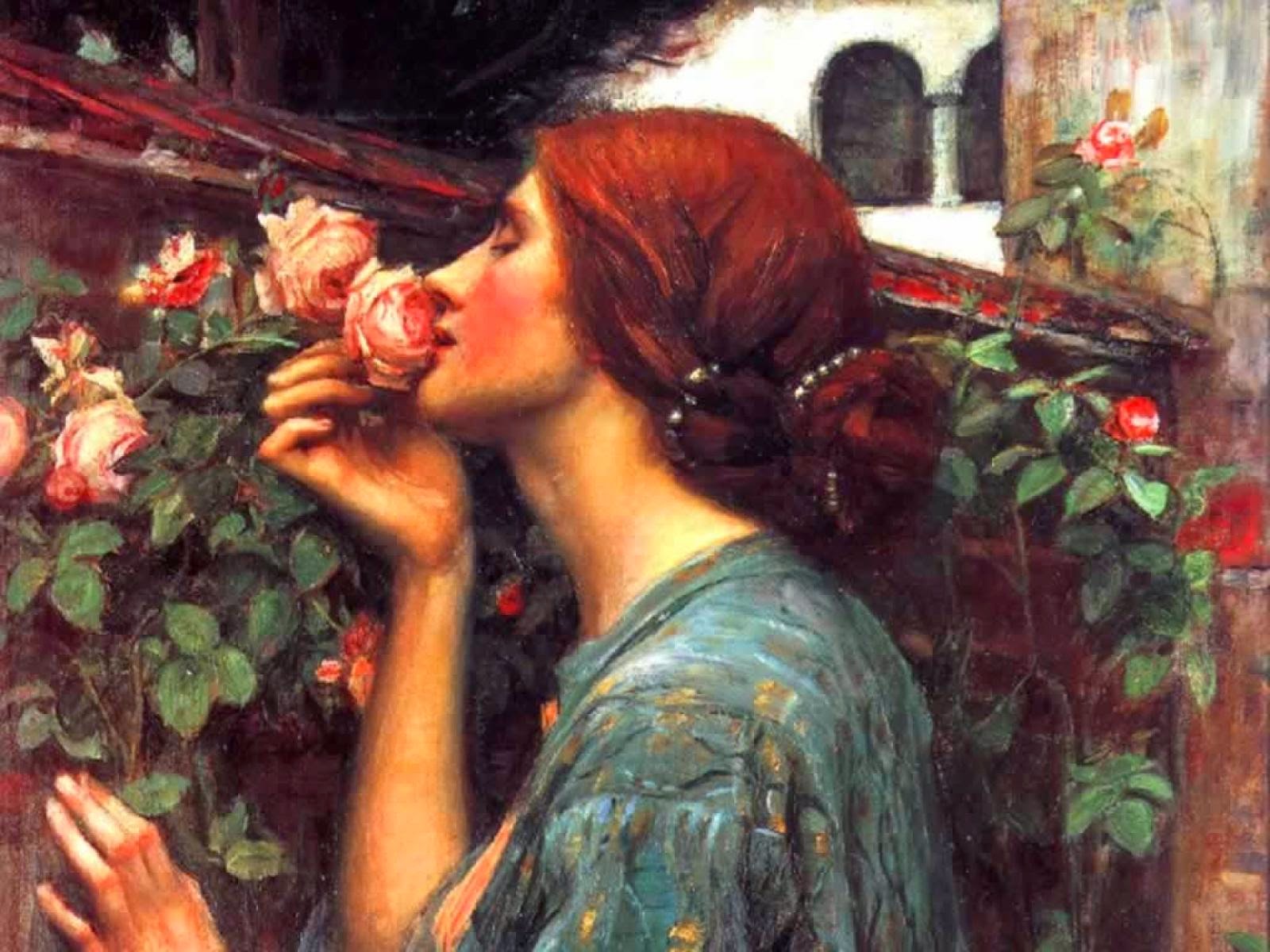
Slowly, it would be nice to become more ginger, adding redness to my hair through soft washes of auburn. I would like to have hair the colour of leaves, as they enter that strangely vibrant stage of fading. From fire to fawn. Can you not imagine the smell of the roses as they wilt for winter, so luscious in the fat of their fragrance? There are roses, still, weathering the rainfall and cold. There are white ones on University Avenue, dripping with raindrops; their petals lie about them like the shredded remains of love notes.

By the time autumn has ended and entered the shrine-like stasis of winter, I will have forgotten my sorrows, finished my dissertation. This is all hope and relief; but isn’t that what autumn is: the sparkle of Christmas festivities on the horizon, the embracing of frugality and calm after a toxic summer? Apple pie, with ice cream and Amaretto, instead of beer and salad? An ethereal, rustic beauty that inspires fountains of poetry? For what better thing to do on a crisp autumn evening, than to sit at the window with a cup of tea, leafing the pages of a book and feeling purer – not just a hipster, defined by the vague fashions of everything around you – but a lost soul re-enacting the perfect scene of reading, as it plays out through the ages. For global warming might prolong the first fall of snow, but for now autumn will always be coming, and there is nothing quite like language to capture the tinctures of foliage, the crunch of acorns underfoot – the endless song of autumn’s calling. Right now it is raining – a luxurious, slow rain that pours through the one o’clock darkness – but next time the weather is good, I will go to Victoria Park and watch the swans, white against the scarlet leaves, the silver glass of the pond.

Unwearied still, lover by lover,
They paddle in the cold
Companionable streams or climb the air;
Their hearts have not grown old;
Passion or conquest, wander where they will,
Attend upon them still.

(W. B. Yeats, ‘The Wild Swans at Poole’).

Ten Things for Autumn: 

  1. Apple Pie Soup http://thesoupfairy.tumblr.com/post/19640840152/apple-pie-soup-literally-my-favourite-soup-ever
  2. Blackberry gin! http://www.deliciousmagazine.co.uk/recipes/blackberry-gin
  3. Burgundy lipstick http://www.cosmopolitan.com/style-beauty/beauty/how-to/a4900/rules-for-wearing-burgundy-lipstick/
  4. Dante Gabriel Rossetti, ‘Autumn Song’ http://poetry.about.com/od/poems/l/blrossettiautumn.htmhttp://poetry.about.com/od/poems/l/blrossettiautumn.htm
  5. Manic Street Preachers, ‘Autumn Song’ https://www.youtube.com/watch?v=Cw9tazfA3aY
  6. Go foraging for mushrooms and fruit, or just fairy-spotting
  7. Cinnamon-stick candle http://www.yankeecandle.co.uk/en/restofworld/shop-by-fragrance/cinnamon-stick/icat/cinnamonstick?setpagenum=
  8. Ginger tea http://www.ecogreenstore.co.uk/index.php?main_page=product_info&products_id=1372&gclid=CjwKEAjw2f2hBRCdg76qqNXfkCsSJABYAycPz_Ug8Seq2xidtaVJGBOBCdbZNqgIe2J0dfvrqB6pGBoCgTXw_wcB
  9. A tartan scarf
  10. The Alasdair Gray exhibition at Kelvingrove http://www.glasgowlife.org.uk/museums/kelvingrove/current-exhibition/Alasdair-Gray/Pages/default.aspx
IMG_0019
mushrooms in Greyfriar’s Kirkyard, Edinburgh

three haiku for tomorrow:

sky of fire opal
opens a new morning of
coldness and woodsmoke.

a new harvest moon:
I could take all these gold days
for some old solstice.

these trees shed apples
to sour in the turning ground
as those other hours.
Places of Memory

IMG_0794
Glasgow Uni spire seen from Kelvingrove Park

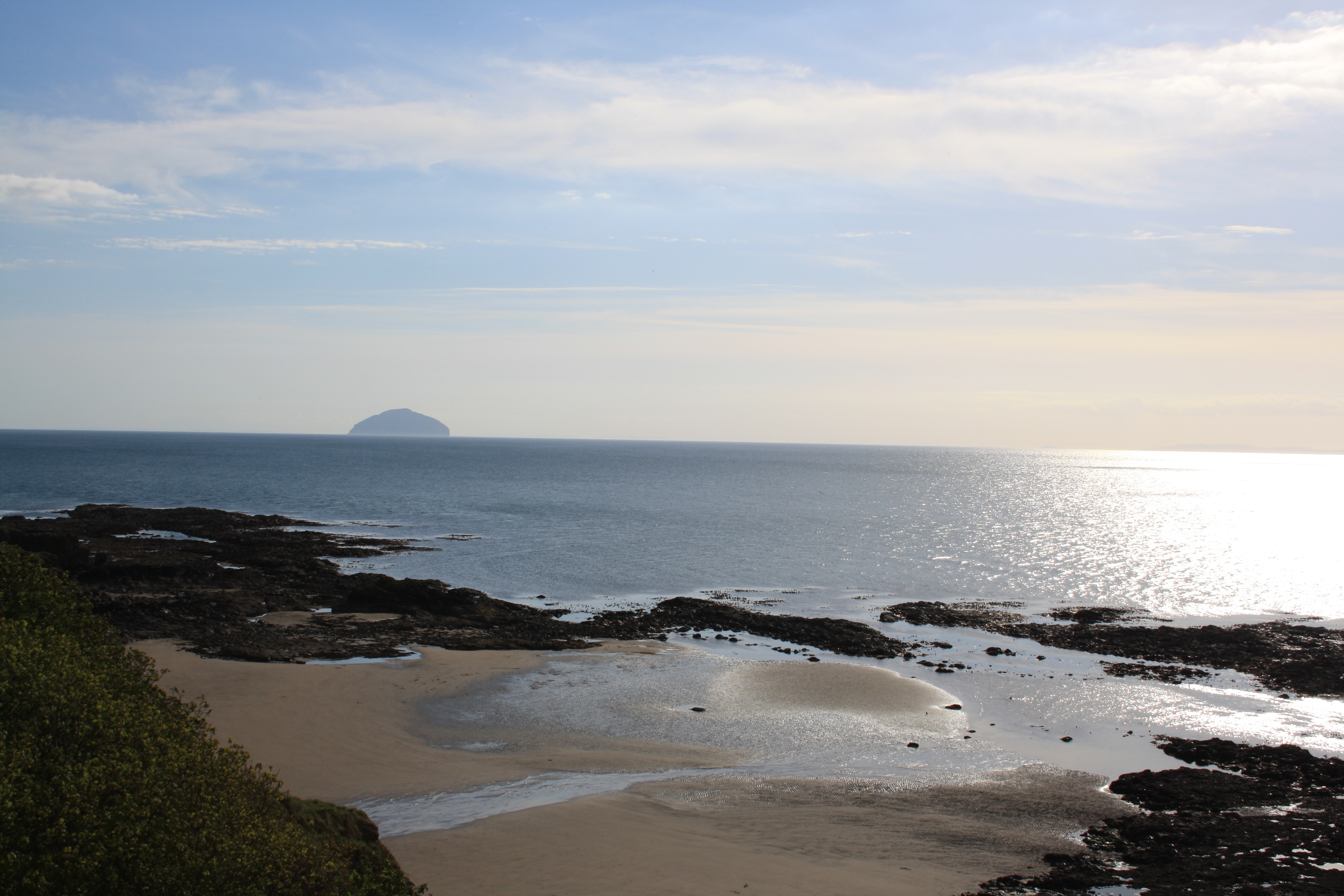
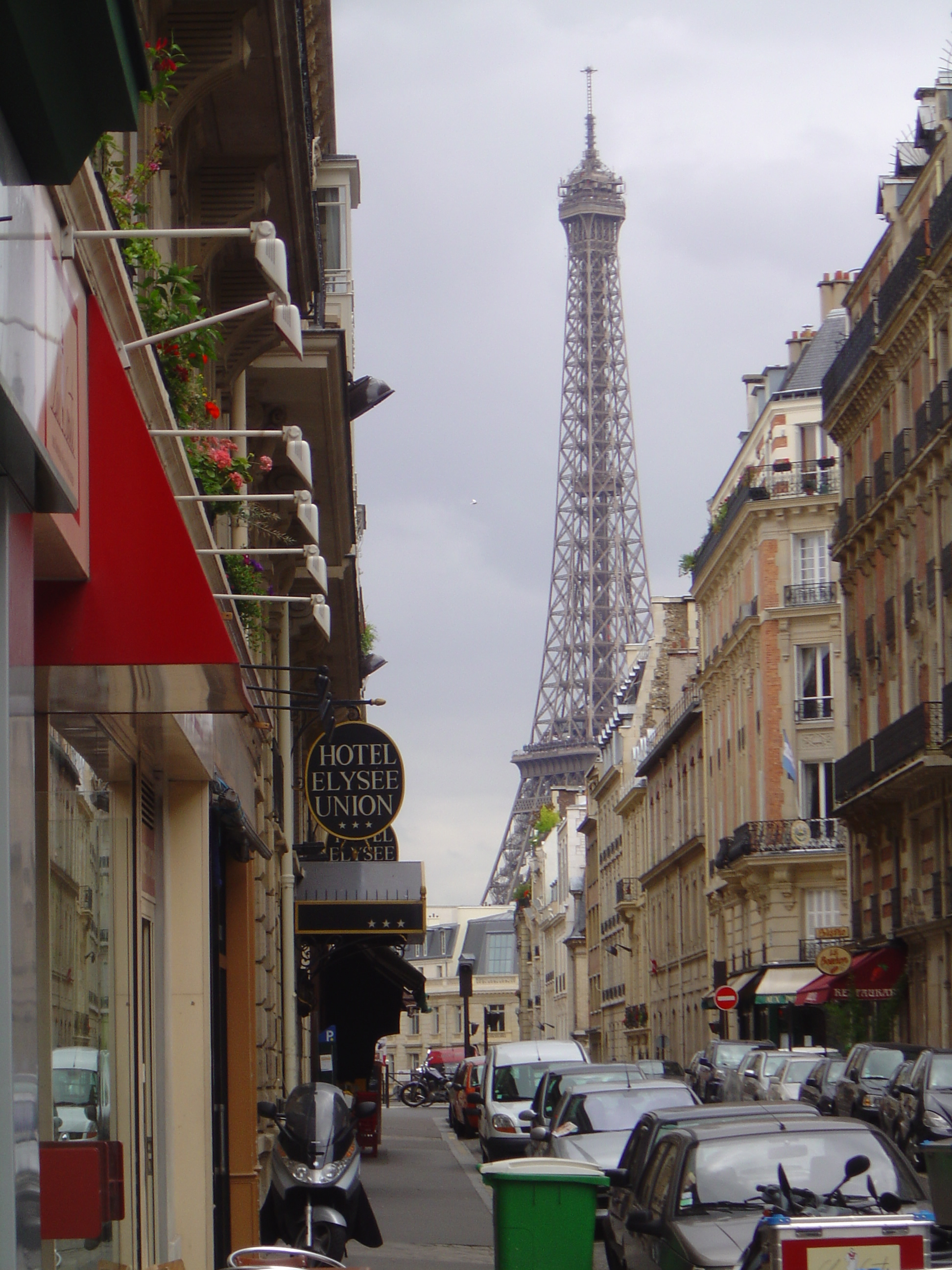
There is a sense in which selfhood is just a scattering of remembrances, remembrances dependent on places. Everywhere in which I have been encodes some trail, some trace of memory. As a child whenever we went on walks I would magic things into being, imagining worlds on top of worlds, layering enchanted spaces and creatures upon the reality of adolescent landscapes. I’d see fantastic beings darting in rocky streams, strange birds sweeping from forest canopies, a thousand intriguing microbes, exotic in colour, swirling on the ground amidst the paws of my (real-life) dog. And even as I grow older, shedding away these whimsical worlds, I keep the magic of perception, imbuing the places I visit with a mental significance. As some store their spatial memories in smartphones, clicking them into flattened snapshots, I try to inscribe them in my mind as networks of sentiment – of senses, thought and memory. There is this particular spot in Kelvingrove Park, with the perfect view of the Glasgow Uni spire and a quiet pool of sunlight that occurs in May at about 4 o’clock; the spot where after my first year exams I sat lazily making daisy chains and reading Laurie Lee’s nostalgically beautiful Cider With Rosie. There is that salt smell and clacking of pebbles, the quick breeze that is Brighton Beach and with it many far off summers, of paddling cold feet and minty sticks of rock. Weird innocence. There is that favourite place in Culzean, a small jutting of cliff that looks out to a glittering dusk-covered ocean and the eerie mound of the Ailsa Craig. So many times I have sat up there with various friends and family and each time I am a different person, bound together perhaps only by the chains of associations set off by this location. Although I was brought up in the country, my mind is also a sprawl of urban spaces: the wintry, bustling streets of Paris at New Year, the seagull strewn alleyways of Ayr, Glasgow’s gritty pavements and eclectic skyline of the modern and the gothic, Edinburgh with its panoramic view of hillside, castle, parliament and sea. What makes all these places somehow special is my relationship to them both cognitively and spatially – in other words, psychogeographically – a sense of pulsating interconnections based on walking, on exploring the world on foot.

SAM_0650

IMG_2920
Ailsa Craig

Someone who has written extensively on his psychogeographic travels is the author Will Self, who ambles everywhere, in the search for new perspectives of space – walking famously from his house in England to New York (albeit with the help of an aeroplane), exploring the curious border spaces between urban and rural, airport and field. Self worries that in the contemporary world of globalisation and machine transport, we are becoming increasingly confined to ‘micro-worlds’ which offer restricted, miniature universes of hotels, airports, clubs and bars that bear little difference from city to city, in the sense that they are being used for the same purpose, and we rarely escape them. The frequency with which tourists, travellers and the like will take a taxi cab, subway or train rather than exploring on foot results in a limited perspective of urban space. There is no chance to stand back and observe one’s situatedness in relation to the built environment, to gauge one’s relationship to north, to the cathedral, the river; to form the intricate networks of association and recollection that pattern themselves around street-walking. I want to make a plea for this street-walking, not just as a fitness alternative to the stuffy mundanity of the gym but as an exercise in perception, in self-formation. (Sometimes, sounding pretentious or perhaps overly poetic is worth getting my point across, especially if it’s a pretty simple point about the joys of that most archaic of sports: walking.)

SAM_0867
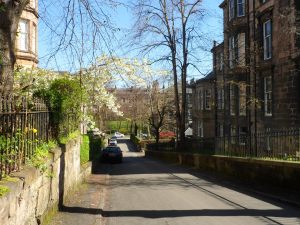
street in Dowanhill

I feel like I’m naturally bad at driving. I don’t like being in control of a dangerous vehicle; yes, that’s one reason, and a reason certainly more justified after delving into J. G. Ballard’s dystopian account of sex, violence and dangerous driving in Crash. The car, as a vehicle of speed charged with the excitement of modernity – see Marinetti’s ‘The Futurist Manifesto’ – is the antithesis of the slow pacing of walking. With a great driving instructor, I took lessons for over a year and while I enjoyed the freedom of leaving my small town and gliding (at my shy snail’s pace) along country roads, I don’t think I’m cut out to drive powerful vehicles. Even a bike I manage only at a push. I spend too long getting distracted by pretty sunsets, sheep, or the name of a passing cafe.

So I guess rather than machine-obsessed Marinetti, I’m more aligned with the modernism of the flâneur, the original ‘street-walker’ who spent his/her time sauntering the streets (usually of Paris) and losing his/herself in the crowd. Charles Baudelaire describes the flâneur in The Painter of Modern Life: 

The crowd is his element, as the air is that of birds and water of fishes. His passion and his profession are to become one flesh with the crowd. For the perfect flâneur, for the passionate spectator, it is an immense joy to set up house in the heart of the multitude, amid the ebb and flow of movement, in the midst of the fugitive and the infinite. To be away from home and yet to feel oneself everywhere at home.

There is something strangely ‘natural’ in becoming a liminal figure, between observation and participation, haunting the city streets and drinking the atmosphere of the crowd as if it were the very sustenance of life itself. Moreover, this sense of haunting can be literal, as stepping among a wealth of sensations recalls dreaded memories and fugue states of psychological wandering, as the narrator of Jean Rhys’ novel, Good Morning, Midnight suggests:

Twelve o’clock on a fine autumn day, and nothing to worry about. Some money to spend and nothing to worry about.
But careful, careful! Don’t get excited. You know what happens when you get excited and exalted, don’t you?….Yes….And then, you know how you collapse like a pricked balloon, don’t you ? Having no staying power….Yes, exactly….So, no excitement. This is going to be a quiet, sane fortnight. Not too much drinking, avoidance of certain cafes, of certain streets, of certain spots, and everything will go off beautifully. The thing is to have a programme, not to leave any thing to chance – no gaps. No trailing around aimlessly with cheap gramophone records starting up in your head, no ‘Here this happened, here that happened’. Above all, no crying in public, no crying at all if I can help it.
Thinking all this, I pass the exact place for my after dinner drink. It’s a cafe on the Avenue de l’Observatoire, which always seems to be empty. I remember it like this before.

The narrator, Sasha, speaks in ellipses, in the strange silences and drifting prose of a vagabond, losing her mind to the networks of memory that haunt and map out her present.

And while Rhys’ flaneur is at times made painfully aware of herself by her own solitude amidst the Parisian crowds, sometimes in the city, one actually craves the claustrophobia of people and buildings and even the nasty proliferation of pigeons. It is maybe a kind of sublime, where one forgets one’s self in the overwhelming hustle and bustle. I remember my first time walking into Glasgow city centre on foot via Argyle and St Vincent Street. Standing breathless at the crossing of the A804 I looked up to the massive glass-coated buildings, beaming off bright April sunlight. There’s a feeling there that I don’t think I’ll ever quite replicate, that of a young adult from a little town, now encountering for the first time alone the vastness and slightly daunting excitement of the metropolis. It is a vision of the city infinitely different from seeing the big buildings from the safety of the backseat of a car; a vision that seems much more urgent on foot, with the vehicles rushing around you and the commercial structures seeming so much grander from the pavement. And it is funny now, how I walk past these buildings so often and they seem diminished; I have adopted more of a blasé, Simmelian attitude to an urban environment that once appeared so compelling. The only solution to this, of course, is to explore new places, gain new perspectives.

It isn’t easy to explore new places when you are notoriously bad at navigation. I didn’t take Modern Studies over Geography for nothing; I genuinely find it a problem grasping my location through maps, to mentally situate myself. Instead of compass coordinates or street names, I tend to place myself in relation to strange landmarks: a telephone box with wild flowers sprouting out the side, an antique shop where the man sits outside polishing wood and making sandwiches, a crumbling wall or peculiar tree that grows by a river. My brain is more of a mesh of colours and markers than a standardised map of labelled coordinates; I know my space through unstable nodes of remembered landmarks which shift and change  and alter my spatial awareness. Perhaps this is why Glasgow (or even just the West End) no longer seems the same, huge place it once did when I first came to uni. Perhaps this is why I always tend to get lost in new places, because I can’t follow a steady route without getting distracted by the allure of a pretty residential estate or a path that detours miles along a canal.

An example of this is my sense of Victoria Park. Victoria Park often comes up weirdly in Limmy’s Show as a place where the fences demand repainting, but that isn’t my only notion of it. Victoria Park is a strange place in its location: a kind of island of green surrounded by motorway. And it is quite difficult to get to, requiring knowledge of the underpass and the correct entrances. I’m better at it now, but before I used to set out for it, following the trail set out by my portable Google Map, and then get confused and lost, ending up wandering aimlessly around Whiteinch. I don’t really know why I forgot how to get there, after the first time I stumbled across it. It flashed in my mind only as a bizarre mirage, almost like Mirage Island from Pokemon Ruby & Sapphire, appearing to me only on certain days when the weather was right and I was in the proper frame of mind necessary for navigation. I actually had to search online for photos of the place, to make sure I really had been there, to make sure it existed at all. The seeming elusiveness of the Park gave it an ethereal quality that remains today, even though I have now memorised exactly the route to get there.  And it’s not that difficult at all, really. Barely thirty minutes from my flat. Yet arriving upon that still, wide silver pond with its hordes of swans, I feel like I have found a peaceful, otherworldly territory. And then I hear the Glaswegian accent of a fellow walker with his dog, and the illusion shatters somewhat.

IMG_2643
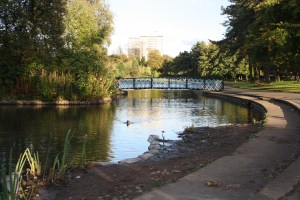
Victoria Park in autumn

Glasgow is peppered with these secret spaces, and as the old etymology goes, it is in a strong sense a ‘dear green place’. There are so many parks and walkways I have yet to discover. I have found canals and strolls along the river, where you could be anywhere – until you spot a stunning piece of architecture peeping through the trees. And like all the places of my childhood, I feel like Glasgow is now a part of me: I have a  hidden history that exists among the old buildings, the pretty parks and streets. I don’t think I’d have such a strong sense of rootedness if I hadn’t explored the city always on foot; if I’d always gotten the Clockwork Orange (the subway) rather than meandering through various roots to town, would I have stumbled upon Park Circus, or the spring blossom that lights up Great Western Road? Living in the country is lovely, but when you are in a city, all it takes is a walk out the door and down a few streets and suddenly you are part of a crowd; not just a crowd of people, but a crowd of forgotten memories and historic spirits, of buildings that bear the souls of all those who have set foot inside them. The city has a certain music to it, different from the birdsong and breeze and tractor groans of the country, lively and beautiful and ambient all the same. Personally, I believe that you can only experience this music in its pure form by using your good old legs and walking the  metropolis. I’d like to end with one of my favourite passages of psychogeography, from Joyce’s A Portrait of the Artist as a Young Man, where the young Stephen Dedalus is discovering Dublin for the first time:

Dublin was a new and complex sensation. […] In the beginning he contented himself with circling timidly round the neighbouring square or, at most, going half way down one of the side streets but when he had made a skeleton map of the city in his mind he followed boldly one of its central lines until he reached the customhouse. He passed unchallenged among the docks and along the quays wondering at the multitude of corks that lay bobbing on the surface of the water in a thick yellow scum, at the crowds of quay porters and the rumbling carts and the ill-dressed bearded policeman. The vastness and strangeness of the life suggested to him by the bales of merchandise stocked along the walls or swung aloft out of the holds of steamers wakened again in him theunrest which had sent him wandering in the evening from garden to garden in search of Mercedes. And amid this new bustling life he might have fancied himself in another Marseille but that hemissed the bright sky and the sum-warmed trellises of the wineshops.

Yes, I’ll leave you with that lovely, assonant image of sun-warmed trellises and bright skies and wineshops…because it’s always nice to imagine a sunnier world on top of the real one.

(all photos taken by me)

Bus Travel: Why I’m Not a Fan

broken down bus
broken down bus

Getting the bus for most people isn’t a problem, in fact for many it is an inevitable stage of the everyday routine. Buses get people to work, school, holiday destinations – and, more importantly, buses get people home. Yet, for almost everyone who gets them, buses are frankly a right pain in the arse.

My relationship with the humble bus all started when I was fourteen and began travelling into town by myself and with friends, which necessitated a move away from the convenient but uncool parental taxi service towards less convenient but slightly more socially-acceptable public transportation. At first, the idea of being on a bus was exciting: leaning my head against the window feeling the roar of the wind outside as we rushed along, talking to strangers, listening to music as I watched the hills go by rather than being forced to listen to Steve Wright’s Sunday Love Song’s on Radio 2 (sorry Mum). Admittedly, trains were better suited to the wind-in-your-hair function, but back in the day, train times in Ayrshire were rather less frequent than the bus ones. And so, the greater half of my adolescent years was spent riding buses, or more likely waiting endlessly for them to arrive.

In fact, I’m sure I can blur much of my teenage years into an eternity of waiting in the rain at myriad bus stops. It is generally a standard principle that a bus is either five minutes early, and disappears before you get a chance to run like an idiot after it, or else it’s 45 minutes late and the driver and all passengers look grumpier than Nick Clegg.

It is also a standard principle that those waiting for a bus will generally unite at a bus stop with the social glue of the Great British Moan. Whilst this is a gloomy disposition that reflects our weather, it nevertheless provides a useful way of connecting disparate generations. Elderly people love to talk about buses. My nan, like many other people’s grandparents, has probably memorised her local bus timetable. She knows their numbers, she knows which ones are reliable and which ones to avoid. She likes to moan about the drivers and the rising prices. Well, I do too. Some of our best intergenerational bonding has stemmed from conversations complaining about buses.

Regardless of the positives that can come out of poor service, the sheer cost of travelling by bus in my opinion is rendering void any novelty value they might still retain. Buses are getting extortionate. The slogans about cheap travel for students plastered on the back of our local buses are a joke. To make the eight mile journey from Maybole to Ayr it would set me back almost £4 (for a single ticket), when I can get to Glasgow with my third-off young person’s railcard for just over £5 – a journey over five times the distance. Not to mention the substantial luxury of train travel in comparison to buses, where leg room is smaller and the chance of being flung violently into the person in front/beside/behind you is considerably higher.

On a train, I have access to lots of comforts. I might be able to charge my phone. I will be greeted on occasion by a friendly ticket officer, rather than a bus driver irate with the stresses of traffic and grumpy passengers. I have a little table if I want to drink my coffee, write or read a magazine (perhaps the complementary Metro). Late night train travel allows a snapshot into local nightlife, although sometimes it isn’t necessary to take the late train to see this, however. It is not unusual to see someone casually open a can of Tennents at ten in the morning, or to witness a band of rowdy men (on a stag-do, or on their way back/to a rugby/football match) cajoling the ticket conductor and singing rude songs. A hazard of both bus and train travel is the lonesome teenager playing awful dance tunes out loud through the tinny speakers on his/her phone. This was the mode through which I experienced my delightful first exposure to Carly Rae Jepsen’s ‘Call Me Maybe’. So, don’t get me wrong, train travel is by no means a leisurely experience. Anyone who has undergone the horror of taking the evening train back from Ayr to Glasgow on a hot day, will know this. Being packed into a tightly enclosed space with a load of highly-intoxicated, sunburned, tired and aggravated Glaswegians who have just spent a day by the beach is far from light pleasantry.
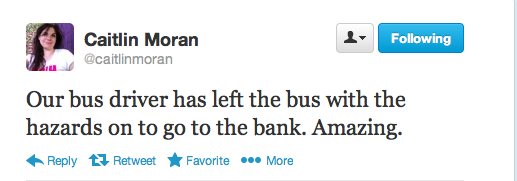
Yet while trains have their problems, at least they are generally reliable. By reliable, all I mean is that they tend to head from one place to another, stopping at fixed destinations on the way. Recently, commentator Caitlin Moran tweeted that:

Screen Shot 2013-06-27 at 15.25.21

To some people (particularly those who are drivers and rarely take public transport) this disruption to service might seem astonishing. To me, it’s comically familiar. Growing up, I used to regularly get the 361 bus to travel to my friend’s house in a tiny far-out village. It stopped in many different farm towns and villages, and was notorious for its lateness, tendency not to show up and the antics of its drivers. I loved that bus, although it was a bloody nightmare. It was the bus we had to get at nine in the morning after a rough night of partying, and journey along those endless winding roads, being thrown between seats, trying our best not to throw up. It was the bus whose driver has, on separate occasions, pulled up by the side of the road to get a chippy, to take a piss in a ditch and to buy a pack of cigarettes (which said driver proceeded to smoke outside of the bus while we waited patiently inside).

Caitlin Moran later added that everyone on the bus was being ‘very British’ and politely pretending that nothing was wrong. I would like to suggest that such awkward manners are less visible during bus travel in Scotland (well, I can’t speak for everywhere, but at least South West Scotland). As soon as the bus driver accidentally stalls, or refuses some twenty-year-old chancer a half, cue the cries of (and I quote) “ya fucking fanny” and “fuck you wee man”, and general laughter and goading from the other passengers. Well, some of us will try to turn our heads, but generally being on a bus seems to be a more raucous affair than it is down south

Raucous indeed; maybe even adventurous. The notorious 361 was also the bus that one day broke down in the middle of nowhere, while I was on it. Being a highly trained professional, the driver attempted to ring someone ‘in the know’, but succeeded only in engaging what sounded like an exchange of swear words and incomprehensible banter. It being the middle of nowhere, his phone signal then suddenly went and the call was cut off. Said driver left the bus and began angrily kicking at the wheels and inspecting the engine, before standing outside lighting cigarette after cigarette and turning his head around to admire the rural landscape. Meanwhile inside the vehicle, a group of middle aged women on the back seats had pulled out cans of fizzy juice and with conspiratorial giggles were proceeding to top them up from a bottle of vodka. Procuring paper cups from their Farmfoods bags, they offered their concoctions around the bus with much bravado, cursing the uselessness of the driver. As said drive returned to the bus after getting through presumably to his manager, rather than being calmly offered a refund and a possible replacement means of transport, we were told we would have to wait until they could get the sputtering vehicle itself repaired. My friend and I decided it would be miles quicker to walk to the nearest village, where she lived and could provide me with a lift home.

As we wandered the several miles, on a Friday night in July sunshine, quite content with this little drama, the 361 suddenly trundled past us. Arrogantly, it honked its horn  but did not stop to let us on board. We didn’t wave our fists, but just laughed incredulously and kept on walking. Service to rely on.

Following my initial recreational experience with buses as a means of getting into town to meet friends, during my latter means of school I learned what it was like for working people who had to get the bus everyday. I had taken subjects in a college and school in a different town which required several bus rides a day, so that I was hopping around from place to place and finding the majority of my week spent perched on the edge of my seat, trying to read while resisting the urge to vomit (whether said nausea was induced by the driver’s furious attack on bends or by the body odour of the man/woman in front of me I could never tell, probably it was both). I spent so many hours waiting in the frozen cold at bus stops with a bunch of old people wrapped up like Eskimos, or other college students standing catatonically puffing on cigarettes. How I longed to smoke in those days, just for something hot to travel fast to my lungs. Frequently I wore two pairs of gloves at once.

There was one day a week, a Thursday, when I had to get four buses a day, and that truly was hell. But it was also amusing, like the times nearing summer when for some reason the normal-sized bus was replaced with a monster of a holiday coach, which provided a bit of midweek excitement. Or when a woman, looking like she had dressed in my brother’s preteen sportswear wardrobe, got on lugging a titanic-sized flat screen television and proceeded to hug it to her seat like a warm fuzzy bear. Or witnessing the fights that broke out when some kid tried to get on as the bus was pulling away, and the driver exploded into fits of rage and cursing about the arrogance of youth.

Maybe I’m doing bus travel a disservice; maybe taking the bus isn’t what it was a few years ago. Maybe post-recession it’s all got a bit more efficient. I don’t know and maybe I won’t find out, because these days I do everything I can to boycott buses. Walking everywhere helps, and investing in a value-for-money railcard. At least I’m being green.

What I will say about buses is that they are, for good or for bad, a communal experience. Inevitably some ghost from primary school past will float on and treat you with a journey’s worth of gossip about old teachers, or a slightly ominous man in a tracksuit will strike up a fascinating conversation about his egg sandwich with you, or a pair in front of you will keep turning around to inform you each time the bus driver picks his nose and looks straight in his mirror. Maybe there isn’t that kind of intimacy on the train…unless, like the trains where I’m from, the train often has to stop for extended periods after hitting a cow on the line, and what unfolds is like something from a Martin McDonagh script: a gross and darkly hilarious suspension of regular social norms where conversations turn to graphic depictions of absurd animal violence, and people who would normally take a glimpse at one another and then look the other way are suddenly engaged in furious conversation like old mates. I guess waiting for some specialist to come and ‘remove the animal’ (read: scrape cow guts off the train) has its dramatic effects.

Coming to some kind of conclusion, I admit this article has been a bit of a rant, but I hope it is more a record of experiences than a whole-hearted attack on bus travel. After all, it will always have that nostalgic quality: the acrid smell of body odour, stale perfume and freshly-opened cheese and onion crisps; the thundering voices of the half-deaf passengers trying to speak on their brick-like mobile phones; the grimace of the bus driver as he realises he has to count your change from a tenner. Or maybe just the excitement of travelling to college for the first time, or going to a friend’s house and surreptitiously sipping vodka from a plastic coke bottle whilst discussing the forthcoming antics of the evening. When you take a bus, you definitely feel like you are going somewhere (I suppose it bloody well should considering the cost), and there is always the added fun of staring out at the scenery and batting away the wasps, flies and other natural paraphernalia that comes flying in the open windows.

Yes, the bus is certainly the most humble means of transport. Nevertheless, it has to be said that I’d rather walk.

Explorations in Nostalgia: Midnight in Paris

file000675462020

Why is there a certain nostalgic quality to rain? Rain can be beautiful to imagine: the quietly rushing sound it stirs as it starts to fall, the peaceful pattering it makes on roofs and windowpanes, the tingle of droplets on your skin, the way it clings in watery beads to your lashes, the sweet earthy scent it trails as it vanishes from the vapory air. Thinking of rain conjures images of afternoons hiding indoors with a good book, of splashing in puddles as a child, of running makeup, of the high romance of kissing outside in a storm, and the satisfaction of coming home, changing into dry clothes and getting warm.

Most people living in Glasgow would be less lyrical about the drizzle that bursts ever too frequently upon the city. Rain can be a pain. Rain can mean struggling with a broken umbrella, feeling cold droplets drip down your back; it can mean delayed tennis matches, ruined picnics and cancelled plans. Yet rain is also one vein through which we are transported smoothly to some heart of our past; often our recollection of events and people is framed by weather, and rain can add a cinematic backdrop to memory that reflects the misted quality of nostalgia. It has a certain sense of deja vu, of transient confusion. I remember being here before, and it was raining. Like this…or was it somewhere else?

Yet rain is perhaps, like memory, never as lovely as we imagine or remember it to be. It is part of our wistful fantasies.

Woody Allen’s film Midnight in Paris opens with a beautiful montage of Paris in the rain, accompanied by accordion music. The shots slip effortlessly between postcard highlights of the city and panoramas of people in the street with umbrellas. It sets the scene for the film’s at times poignant but mostly witty and lighthearted exploration of nostalgia.

I first went to see Midnight in Paris at the kooky little Grosvenor Cinema on Ashton Lane in Glasgow’s West End. An appropriate venue, seeing as it is modeled on an old-fashioned picture-house, with red carpeting, plush seats, vintage interior design, glamour and the availability of wine.

Midnight in Paris is a pastiche of genres, styles, characters and references. Not only does it include an array of (slightly caricatured) figures from the 1920s creative scene in Paris, but it also welds together flashes of political satire with Hollywood rom-com and magical realism.

The film’s protagonist Gil is a Hollywood script-writer discontented with his sell-out job and longing to produce something creative in his writing. Perhaps there is a certain irony here: a search for authenticity staged within a film that is playfully anything but ‘original’. A trip to Paris with his fiancé and her parents, Gil hopes, will provide the spark of enchantment. The first conversation of the film sets up the juxtaposition between the romantic Gil and his pragmatic wife, who appropriately later has an affair with the ‘pedantic’ ‘pseudo-intellectual’ Paul:

 Gil: Can you picture how drop dead gorgeous this city is in the rain? Imagine this town in the ’20s. Paris in the ’20s, in the rain. The artists and writers!

Inez: Why does every city have to be in the rain? What’s wonderful about getting wet?

Already we get the sense that Gil wanders a little too much into his imagination, particularly his imagination of the past – of Paris in the 1920s. Gil’s first actual delve into the past occurs one evening when after the stroke of midnight a strange black cab stops to pick him up, full of revelers drinking wine and champagne. Through this mysterious portal, he is transported back in time to Paris in the 1920s. The film handles the visuals sparklingly well, with stunning 20s costumes, cocktails and the lovely decor of the bars and clubs. It’s all quite magical and dazzling, and we experience the wonder Gil must feel as he is teleported into his favourite fantasy. It certainly got me excited for Baz Luhrmann’s soon-to-be-released The Great Gatsby.

Except unlike us, the audience, Gil becomes a participant in his fantasy, not merely a spectator. Among his adventures, Gil encounters a plethora of characters from the 1920s literary and arts scene, including Hemingway, Dali, the Fitzgeralds, Picasso and Gertrude Stein. There is definitely an element of caricature here, which reflects the play of irony and pastiche characteristic of the post-modern: the film reminds us that these characters are just representations of real figures, who themselves were in a sense self-styled personas, who we knew predominantly through their art. From Dali’s raving about rhinoceroses, to Hemingway’s speeches about war and truth and sincerity, Allen plays with exaggeration to enrich the sense of fantasy and nostalgia. There is a scene where Zelda Fitzgerald is trying to commit suicide because she thinks her husband does not love her and Gil, trying to stop her jumping, tells her that he ‘knows’ that F. Scott Fitzgerald really does love her. Why? she asks. How can Gil possibly know? He’s read all the books and biographies about and by Scott, of course. I think the film here raises an interesting question about subjectivity and literature: what is the real version of events? What is the truth behind the writing? It seems that there isn’t one: instead there are all the fragmented perspectives of those involved, and those who write the books. Right now I’m reading Zelda’s novel Save Me the Waltz, which critics say is Zelda’s version of the semi-autobiographical events of Scott’s Tender is the Night, both depicting the breakdown of minds and marriages, but from the different perspectives of wife and husband. Gil’s attempts to claim that he can know better than the woman involved only underline the absurdity of any narrative which claims ultimate objectivity.

Gil’s encounters with the resurrected ghosts of the 1920s stage a playful juxtaposition of past and present. His quotative use of ‘like’ and his mundane discussions about his relationship to Inez contrast heavily with the stylish and hyper-surreal world he finds himself in. For example, his conversation with Adriana (Allen’s fictional amalgamated embodiment of Picasso’s lovers) about his engagement to Inez highlights the time and culture gap, but also the disparity between reality and fantasy. He realises that there is in fact very little he and Inez have in common, which perhaps suggests that his engagement itself was built on a fantasy. Gil admits that they have a ‘little bit of a disconnect with the big things’ but at least they agree on the little things:

Gil: I will say that we both like Indian food, not all Indian food, but the pita bread, we both like pita bread, I guess it’s called naan.

The likelihood of the super-stylish flapper Adriana knowing what pita bread is, let alone having eaten it, is pretty slim. In addition to this, Gil’s comic response to Hemingway’s question as to whether he’d ever been hunting – “only for bargains” – presents the playful irony of the film’s exploration of past and present, and the discrepancy between the dramatic, larger-than-life lives led by the characters of a by-gone age and the inane realities of the present.

Another funny encounter between past and present occurs when Gil gets into a cab driven by T.S. Eliot and exclaims:

Gil: Thomas Stearns Eliot? T.S. Eliot? T.S. Eliot? Prufrock is like my mantra.

The comedy here is that this reflects how many of us would behave – awkwardly unrestrained – if we were thrust into a world where we could meet our long-dead heroes. There is the hilarious sense that Gil is behaving as a teenage girl would if they encountered Justin Beiber. And yet he is not meeting the teeny-bopper Beiber, but one of the twentieth century’s finest poets (with all the linguistic prestige that entails). The film collapses the language of the present incongruously with the literary visage of the past.

Gil’s general obsession with the literature of the 20s is reflected in his view that Eliot’s poem ‘The Love Song of J. Alfred Prufrock’ is his ‘mantra’. This itself is an interesting mise-en-abyme of intertextuality, as Prufrock itself is a thoroughly intertextual poem, referring for example to Dante. It is also a difficult poem, an internal monologue that follows a complex and fragmented pattern of thoughts which seem to have no definite direction and nor indeed association. Yet its line, ‘Let us go then, you and I’ creates an evocation that resonates throughout Midnight in Paris. It is a speech act, an announcement: let us go. The film itself is built on such a contract of ‘let us go’, asking the audience to suspend their disbelief with regards to the unexplained time travel and enjoy the magic, follow the journey and watch as it restores reality only to thrust us back into fantasy.

Let us go’ seems to suggest an address to time itself – come with me, time, follow my fantasy – but also of linking arms or minds with someone and going someplace else. Time travel can be a solitary or a joint affair. Gil travels back in time to the fin de siecle with Picasso’s lover Adriana, because this Golden Age is Adriana’s fantasy. Here he realises that there is no Golden Age, the Golden Age myth is just a nostalgic longing to escape one’s present: ‘that’s what the present is. It’s a little unsatisfying because life is unsatisfying.’ We tend to travel when we are unsatisfied with where we are right now.

The spellbinding world that Gil occupies by night is by far the best part of the film, and Allen frustrates audiences by delaying these ventures with the mundanity of the film’s present narrative. Gil has to follow his spoilt-brat fiancé around shopping for furniture, have dinner with her ultra-conservative parents and trail around with Inez’s ‘pedantic’ lecturer friend Paul. There are slightly tedious scenes about lost earrings, relationship breakdowns and dinner-table conversations which leave us irritated with the twenty-first century rom-com drama, and desperate, like Gil, for the exciting narrative in the past. These temporal fluxes from past to present serve to delay and prolong the audience’s desire to go back into the past, and so highlight the unsatisfactory nature of the present in comparison with rose-tinted history.

Despite the occasional bore of the present, there are some gems slipped in by Allen amongst the rom-com rubble. These include the parodic representation of Inez’s conservative snobbery and naivety – ‘Inez: You always take the side of the help. That’s why Daddy says you’re a communist’. Also, Gil’s mocking of the Tea Party movement, calling them ‘crypto-fascist airhead zombies’. The film is not entirely an adventure into the past but also an aping of the absurdities of the present – from politics to romantic relationships.

And so back to memory. In the film there is the repeated question of ‘is nostalgia denial?’ Denial of the present, denial of reality, denial of the irretrievability of the past. Nostalgia can relate to more fantastic recollections of a past, a past that was only accessible in the first place through mediation such as literature, film and art – the very instruments of romanticism and fantasy. This is definitely the kind of nostalgia Gil suffers or experiences, but there is another kind of nostalgia that is more personal. This kind of nostalgia was famously articulated by Marcel Proust in his book In Search of Lost Time, in a scene where the narrator experiences an involuntary trigger of memory caused by a tea-soaked cake:

An exquisite pleasure had invaded my senses, something isolated, detached, with no suggestion of its origin. And at once the vicissitudes of life had become indifferent to me, its disasters innocuous, its brevity illusory—this new sensation having on me the effect which love has of filling me with a precious essence; or rather this essence was not in me it was me. I had ceased now to feel mediocre, contingent, mortal. Whence could it have come to me, this all-powerful joy? I sensed that it was connected with the taste of the tea and the cake, but that it infinitely transcended those savors, could not, indeed, be of the same nature.” (Marcel Proust, “The Cookie” from In Search of Lost Time).

This kind of nostalgia is one most of us can identify with: the slightly uncanny sparking of a past personal memory from some kind of sensory trigger. That is how perfume gains its emotional quality, through the way its scent weaves swirls of associations between our past loves, lives and histories, and stirs these up again for us from one whiff in the present. Each time I put on my Body Shop Japanese Cherry Blossom, I fondly and wistfully remember (and long for) my holiday in Rome. As Proust describes it, the unintended evocation of a past memory makes us feel as if we transcend time and morality, collapses our identity ‘this essence was not in me it was me’ and produces an ‘all-powerful joy’. Food is nostalgic because it combines different senses: taste, smell, touch, sight. From your granny’s best soup to those warm chewy cookies they used to make at school, our gustatory pleasures are a minefield of nostalgic resonances.

The point here is that nostalgia is not just an affliction, a slightly unhealthy yearning to escape the present and return to a past that has been forever forlorn in the timeline of history. Nostalgia can be pleasurable, even if the pleasure is a little bittersweet – that feeling of longing and sadness for the person you once were or once loved when you hear the opening bars of an old song. Gil’s nostalgia perhaps goes too far: his novel is set in a nostalgia shop, and he spends his real life dreaming of forgotten times. His fiance accuses him of having a ‘brain tumour’ when he begins talking about the past as if it were real. This is an interesting image, as it suggests something psychologically corrupting about the past: it seeps into the present inevitably and transforms the way we experience the here and now. It is a kind of everyday madness.

Yet Midnight in Paris leaves us with a vision of nostalgia that encapsulates its positive effects. Gil’s decision to break up with his ill-suited fiance, and the final scene where he walks into the rainy Parisian night culminates in a strange blurring of his reality and fantasy. He has finally made grown-up, significant choices, but he has also walked into the sweet allure of a romance that reverberates with his early fantasies of Paris in the rain. It is an elusive, probably unrealistic ending, but this is the magic of the movie. Woody Allen gives us the happy, fulfilled ending we’ve been hoping for – it’s not quite the kissing in the rain at the end of Breakfast at Tiffany’s but the rain still provides an amorous atmosphere – and this ending, quite nostalgically, recalls all the dreams Gil has at the beginning of the film, and all the familiar romance films of bygone times that end similarly. So this is nostalgia: the little dab of illusion to soften the edges of reality.

Further reading:

Nostalgia: Sweet Remembrance. Available at: http://www.psychologytoday.com/articles/200605/nostalgia-sweet-remembrance

Proust, M. 1913-1927. In Search of Lost Time. 

file0001794106155

Why Don’t We Just Cull Humans?

DSC_2614Why Don’t We Just Cull Humans?

Picture the wild deer: all elegant neck, soft fur, tawny eyes staring back at you like butter wouldn’t melt. The stag too: a rare glimpse of those striking antlers flashing through forest leaves or the wire mesh of a fence, gazing gallantly over the hillside – a little like a proud lord, a patriarch admiring his land. There is something quite British about the graceful deer; something evocative of country outings, of heritage and sprawling estates, of heads rather unceremoniously stuck on pub walls.

Today, there are more deer in the UK than in any time since the last Ice Age[1]. It seems poetry is the wrong way to go about this; deer have become a real issue.

On the radio this morning I heard reports proclaiming new figures representing an excess in numbers of British deer. Deer, it is argued, in their proliferation, are posing a serious threat to British biodiversity. The overspill of deer will lead to more traffic accidents, more damage to crops and a drain on natural resources. With estimates of the current deer population positing 1.5 million, new research has suggested it will be necessary to kill off 50% to 60% of the animals to fully address the problem[2].

The above arguments may seem persuasive reasons for tackling ‘The Deer Problem’, but I would like to step back and question these fundamental justifications given for widespread slaughtering. I want to question the idea that the – let’s face it, unintentional – disruption of food-chains by deer warrants their culling.

My objection to culling derives not from an inherent concern with the ethics of killing animals – the morality of the practice of culling is another difficult issue – but from the premises given to defend culling by appeals to the negative consequences of an excessive deer population.

The problem I have with culling can be understood by considering a convincing argument offered by Australian philosopher and rights activist Peter Singer. Singer declares, somewhat radically, that ‘all animals are equal’[3]. Yet this statement is not as controversial as it appears. By ‘equal’, he means not that we should treat all animals the same – Singer is not justifying giving rabbits the right to vote or freedom of speech to chickens – but that we should give equal interest to all creatures, regardless of species. Singer points out that any claim asserting the superiority of human beings over other animals is arbitrary, speciesist.

Speciesist? Why?

Consider the reason we typically give for justifying the accordance of moral supremacy to humans:

1) Humans are rational creatures, or at least significantly more rational than other animals, and this makes our lives intrinsically more valuable.

Singer’s problem with this is that not all humans are rational. What about a child with Downs Syndrome, or a person in a coma? What makes them more superior to say a highly-intelligent primate if they lack rationality? Consequently, Singer states, any attempt to argue for human rights over animals is going to run into the problem of speciesism, since there can be no universal claim for the rationality of all humans. Speciesism is just like racism or sexism, in that it appeals to untenable claims about the essentially superior ‘nature’ of a particular race or sex which gloss over the reality that not every person within a race, sex or species shares these characteristics. If the sexist argues that men should be paid more because all men are more intelligent than women, his argument is rendered invalid by the stark fact that this is a sweeping, fallacious generalisation. Likewise, the speciesist cannot justify exploiting animals for human need by claiming humans are intrinsically superior because all humans are more rational than animals.

Therefore, for example, an argument justifying animal vivisection to support the more-valuable lives of humans (by exploring cures for cancer) will have to concede that this argument also, logically, licenses vivisection on non-rational humans. And I think most people would agree this seems a little distasteful.

Singer’s argument is compelling: the only relevant consideration that unites all humans, then, is sentience – the experience of pain and pleasure. An experience inherent to the lives of most animals and all humans.

Back to deer then.

The justification for culls is primarily their threat to the food-chain: too many deer means too much consumption of natural resources, too much disruption to the natural environment which other animals are dependent on. Deer, munching and treading and stomping all over our country’s flora and fauna, are threatening other wildlife. All very well.

But what about us? Aren’t we a threat to wildlife? What about our fossil fuel omissions, waste disposal, annihilation of forestry for paper, our excessive industry, infrastructure? Our pollution of lakes and rivers? Surely all this amounts to much more destruction than an overabundance of deer trampling on the landscape and eating too many acorns?

Well, it may be argued that we are humans; we are entitled to do these things because they fuel our rational progress towards more enriching lives. What gives us the right to think the world is ours to destroy, but not that of the deer? I would argue that our threat to the food-chain is significantly greater than that of our deer population, and yet I hear of no ecological experts advocating human culling.

Let’s be clear: I am not advocating human culling. But think about it: are we morally justified in killing deer because too many of them destroy the environment, when we wouldn’t do the same to humans, whose excessive population is also consuming too much of Mother Nature’s milk, and tainting it with acid rain in the process? If there is no relevant moral distinction between humans and animals, I find arguments which devalue animal life in favour of maintaining human interest deeply problematic. And after all, this isn’t just about preserving nature for nature’s sake, this is about preserving nature for people – for farmers, ramblers and future generations.

I acknowledge that there may be other reasons why culling might be justified – I am no environmental expert. Reducing deer numbers may work in the favour of their species, as too many deer means many will starve due to lack of resources. It is obvious how this can be turned around to humans: again, most people would object to human-culling because there isn’t enough bread to go round. Therefore, if there is no plausible moral distinction between humans and animals, then culling is difficult to morally justify, even if it produces certain good consequences.

It’s a thorny issue, and one that people often don’t consider; culling doesn’t seem to raise the same controversy as animal testing, hunting or meat-eating, because it is seen as a largely benevolent, if a little unpleasant, way of improving conditions for people and wildlife. I believe, however, that we should be concerned – at the very least, philosophically – with the flawed argument that lies at the heart of culling practices.