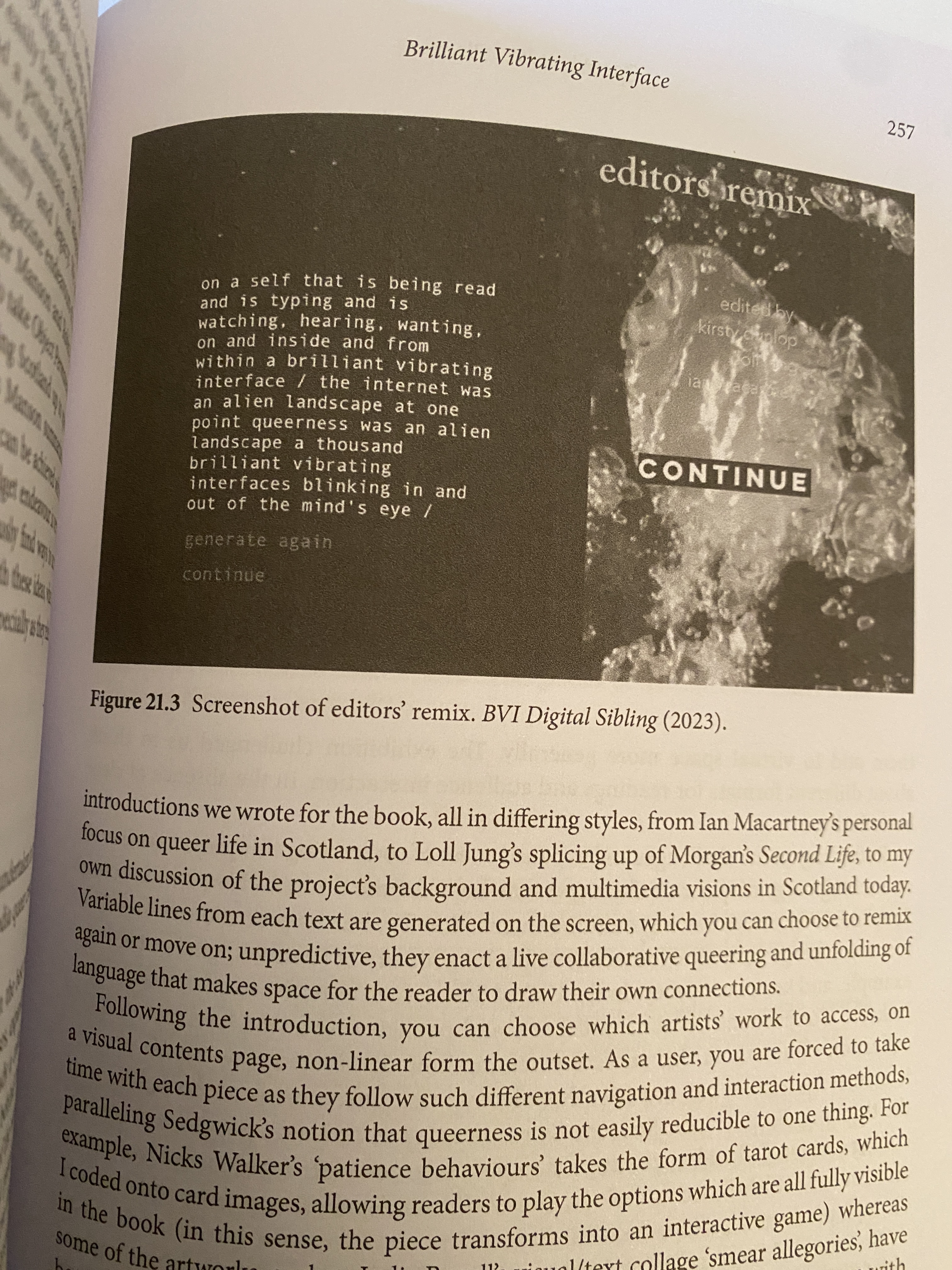
In 2022, SPAM Press obtained some funding from the Edwin Morgan Trust’s Second Life Award to run a year-long project titled Brilliant Vibrating Interface: Queering the Post-internet through Poetry and Practice. My co-investigators on the project were Kirsty Dunlop (SPAM’s current editor-in-chief), Alice Hill-Woods and Loll Jung, with Ian Macartney later joining to co-edit our print publication. We squeezed a lot of activity out of that money: community workshops online and in Glasgow, a few reading events, print publication, ‘digital sibling’ and physical installation, podcasts and an online magazine interview with contemporary sonneteers.
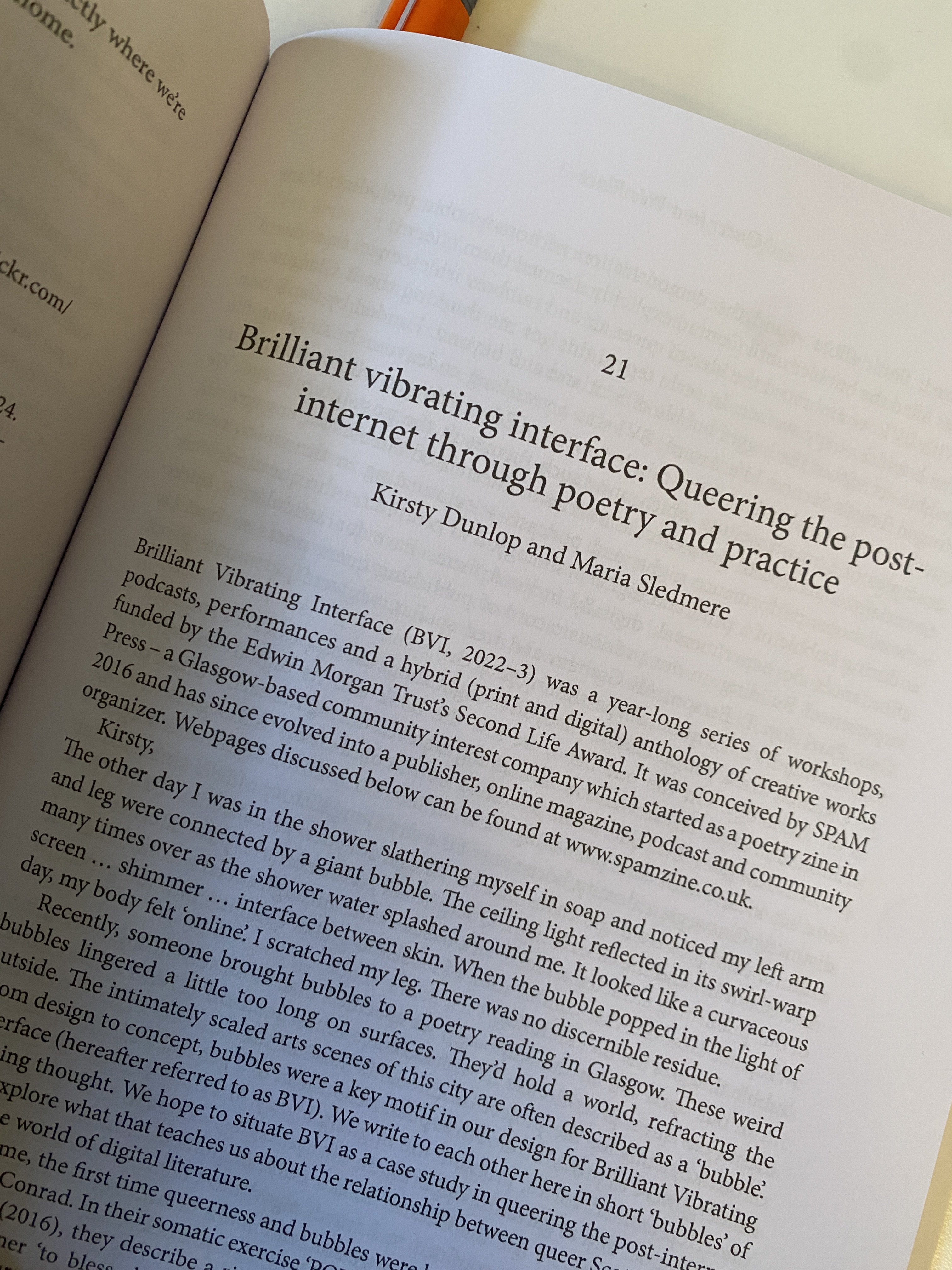
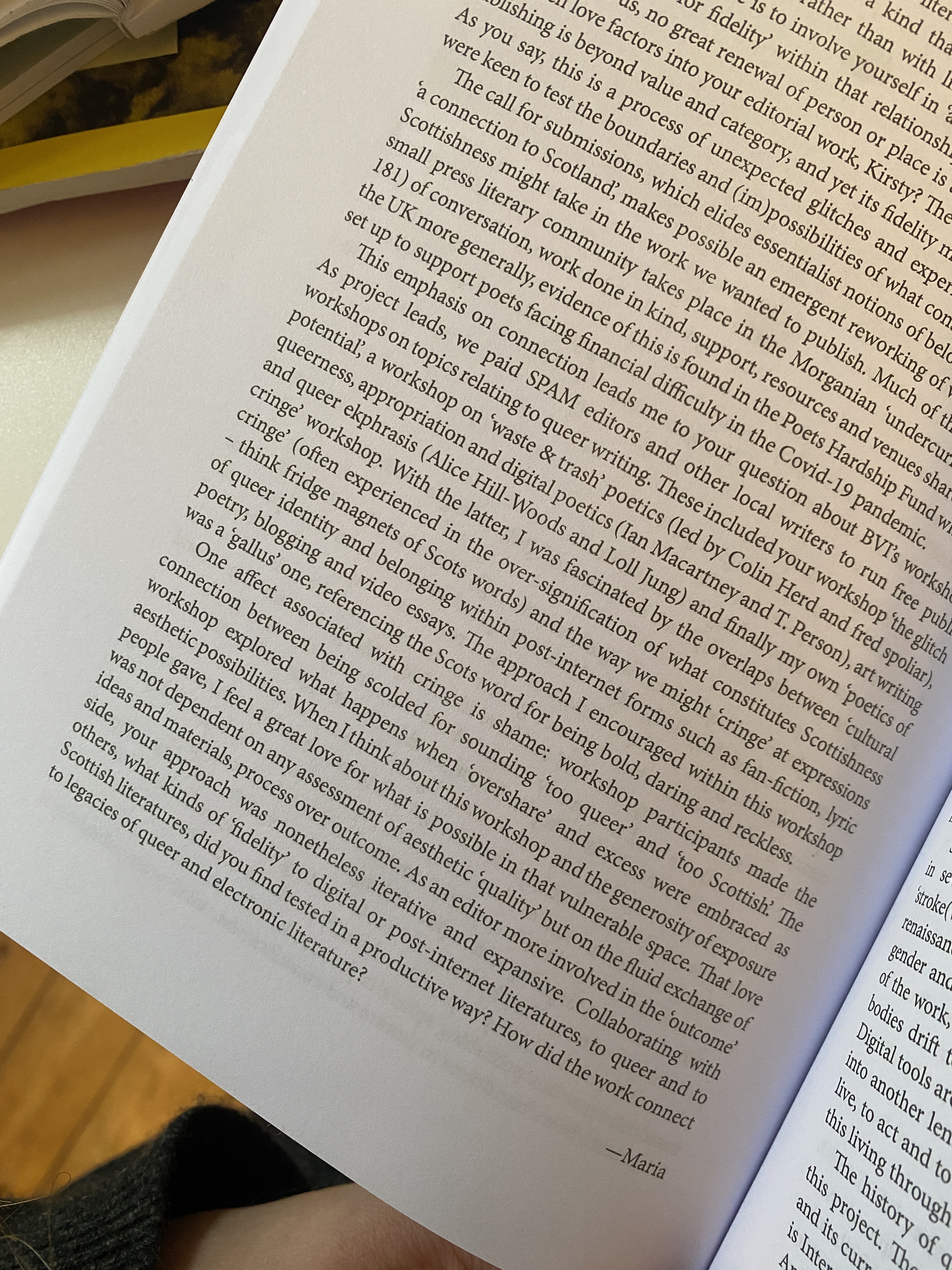
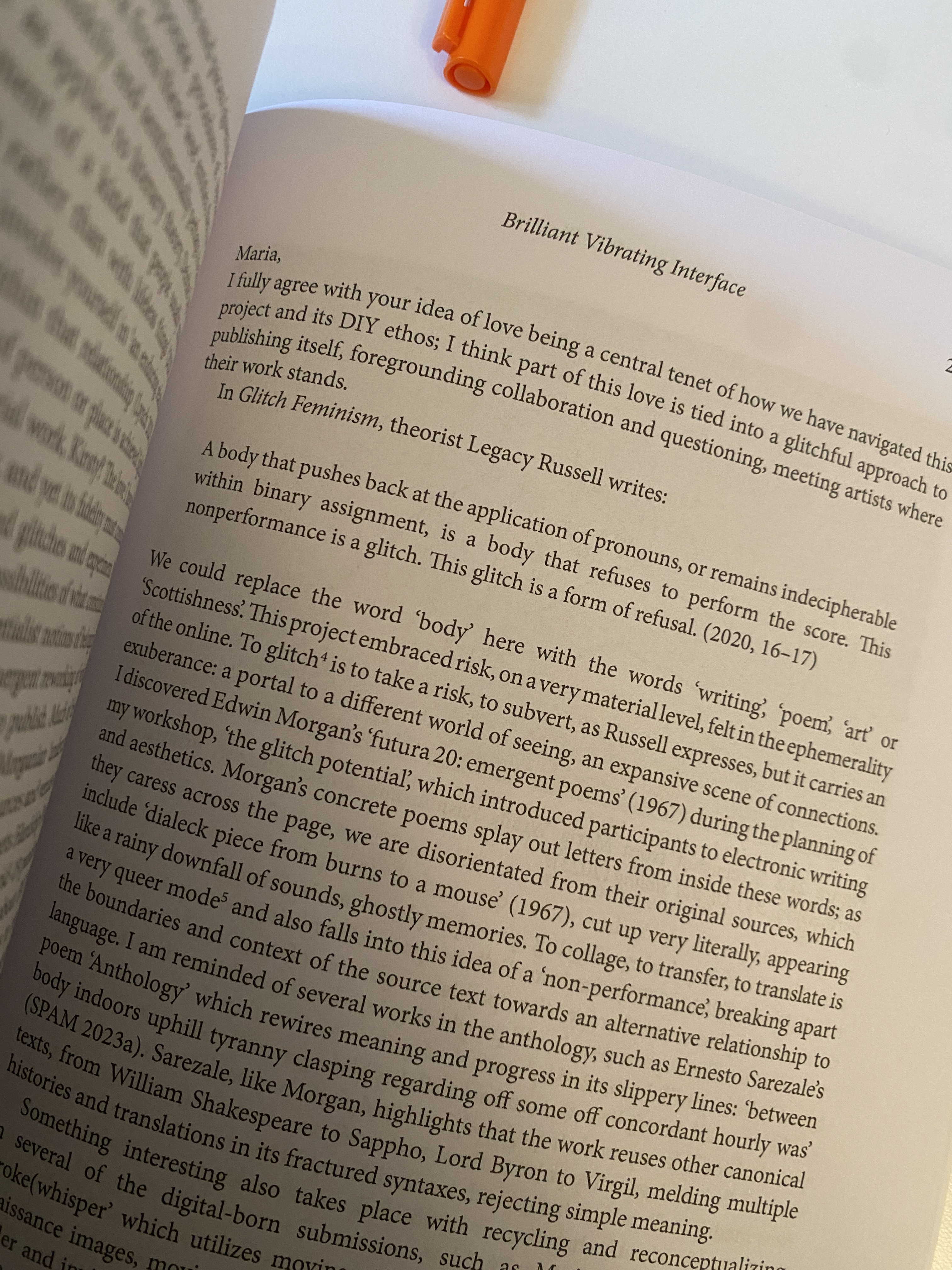
Recently, Kirsty and I wrote an epistolary chapter reflecting on the project and its significance in terms of identity, inequality, belonging, poetry scenes, queerness, Glasgow and the labour of love that is small press publishing. In our chapter we talk about the format of the project, Scottish literary scenes from the nineties to present day and the challenges and rewards of moving between print and digital (what we call SPAM’s ‘resolutely hybrid project’). We explore in more depth the poetry and visual art which found a home in our project and proffer up some poetics for how to think about queerness in the context of ‘small nations’ such as Scotland. This takes us everywhere from CAConrad’s bubbles to Legacy Russell’s glitch feminism to Edwin Morgan’s sumptuous strawberries.
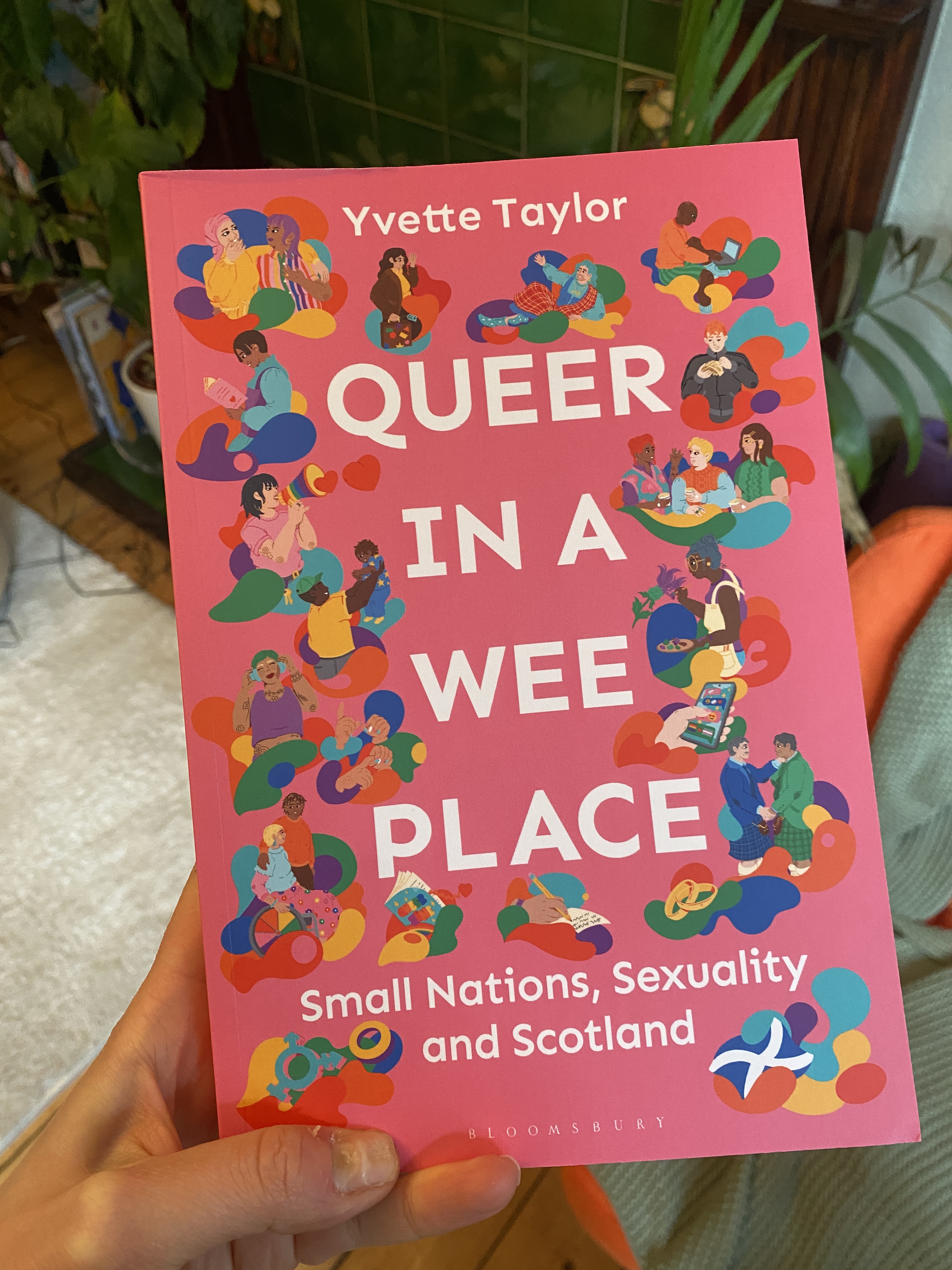
The chapter is out now as part of an anthology, Queer in a Wee Place: Small Nations, Sexuality & Scotland. To quote from the publisher’s website, the book ‘explores identity, inequality and belonging in animated conversations about how queerness moves through place – and how place, in turn, shapes queer lives’. Queer in a Wee Place contains chapters written by researchers of many disciplines and practices – from sociologists to poets – on subjects ranging from the utopic gaze on queer film to legacy and queer elders, disabled queer student experiences of higher education, Scotland’s menstrual landscape, hate crime and queer provincialisms.
The book is available in paperback form for what is a very reasonable price (for an academic book!) from Bloomsbury. You can ask your library to order it in for you 🙂
You can also read it for free via Bloomsbury’s Open Access service here.
Our archive of materials relating to Brilliant Vibrating Interface, including workshop handouts, podcast episodes, interviews and the online exhibition (what we called a ‘Digital Sibling’) can all be found at http://www.spamzine.co.uk and on the EMT website.
We started Away from Keyboard almost a year ago to the day. Despite hosting readings for a decade, SPAM had never previously run a regular night and we’d been talking about it for years since things started reopening after god knows how many lockdowns we had in Glasgow. After a hefty era spent solely ‘at keyboard’ it was time to get poets in a room again. What I like about a bimonthly series is it’s flexible enough to work around poets who might be in town anyway, there’s time for curation and building a kind of ‘snowball sampling’ effect of poets to invite via who shows up and who recommends who. The lineups are usually about five or six readers reading for 10-15 minutes each, which catches the sweet spot between a big, rapid-fire performance showcase and more sustained readings. While sometimes they can be really fun and a great way to get exposed to a wide range of writing, I’ve always struggled with big group readings because any potential associations, threads and lineages between the poets get lost in overdrive. I tune out. When you’ve got just five minutes on-stage, poets tend to read a particular kind of snappy and ‘polished’ poem and there isn’t room for the kind of variation and trajectory that comes from building a proper ‘set’. 10-15 minutes also leaves room to try out new work too.
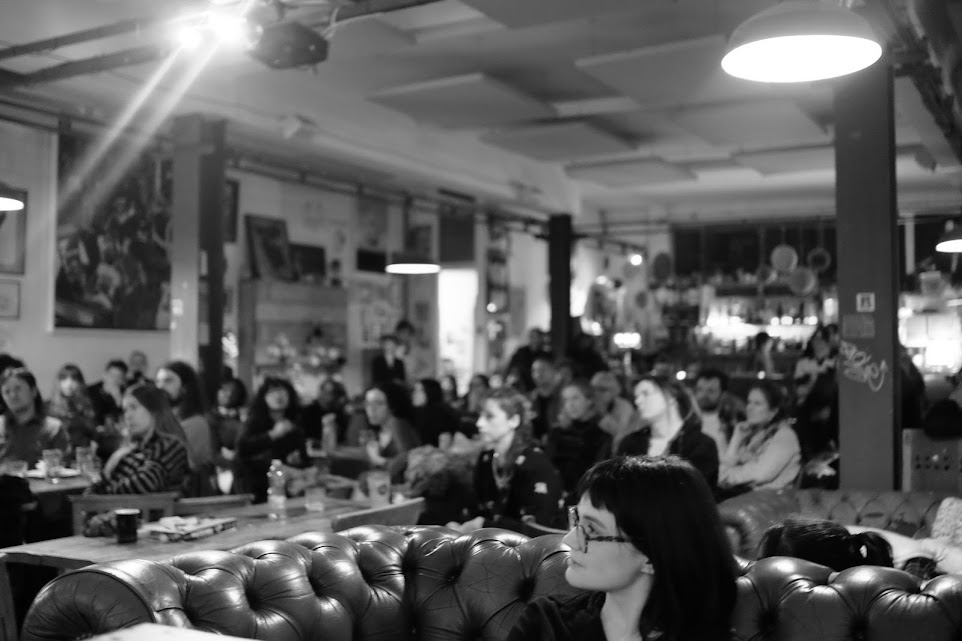
Our ninth AFK took place last Thursday at our old haunt, the Peckham Pelican. Huge gratitude to them especially Stu who helped us lock in the date. Let me just say how hard it is to book venues for poetry. Can someone make a big database of suitable venues please? The big problem in Glasgow is finding a space that is affordable, accessible and relatively stable. Everyone remotely in the Glasgow orbital will know about the decimation of our arts spaces in recent months (CCA and Listen Gallery have just closed). In London, the big problem seems to be finding a venue that won’t require a whopping minimum bar spend way out the league of our skint poetry community. Alas alas. Still, every bar we’ve worked with we’ve worked with because of a poet working at that bar. Keep it in the family. I love the Pelican and its happy hour negronis (‘Peli-gronis’), the friendly bar staff, big space, wonky bookshelf. I love how in London there is almost always transport home after dark, whereas in Glasgow you have to negotiate ride-shares on Ubers (an option newly available to me now I caved and finally moved south) or try and line up two buses, one of which is guaranteed to not show up, leaving you stranded in a vortex of raging seagulls and vape shops (‘town’), or in the industrial hinterlands of Tradeston. Online, I’ve seen recent movement in campaigning for better transport in Glasgow and I hope something comes of it. The amount of times I have walked 1.5 hours home after midnight…
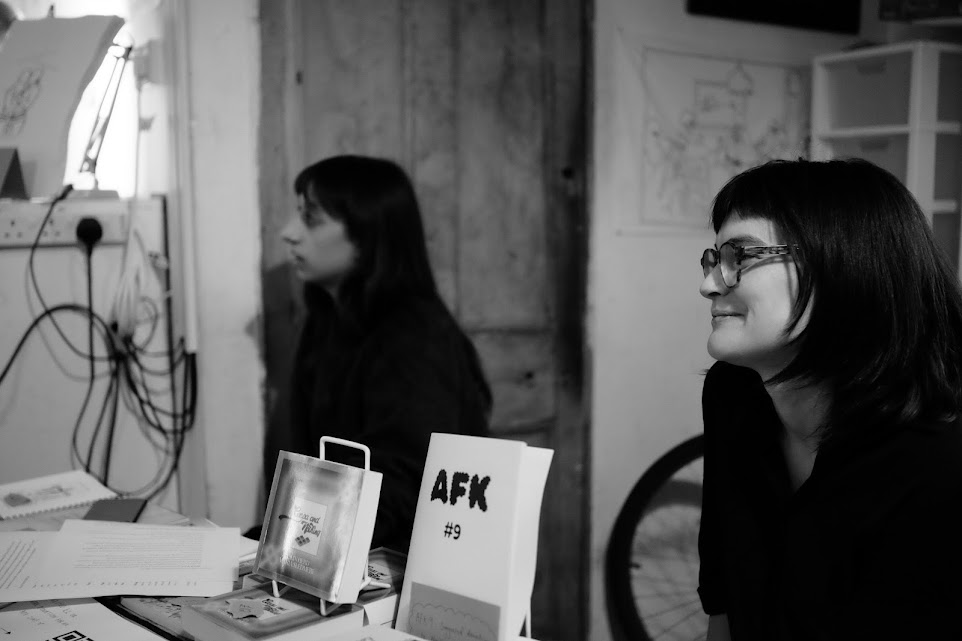
Before the reading, Maya, Mau, Kirsty and I got food at Peckham Market. Eating before a poetry reading is something I only learned how to do a few years ago and it makes a difference. No more blinding headaches! No more yearning to leave early! No more one drink too many! I recommend it. We had our book table set up in a jiffy cuz we’re getting really pro at that now. We had so many books it spilled out onto a bench and the nearby countertop. We thought there wasn’t much SPAM stock left but a surprise abundance of Thirteen Morisettes and Cocoa and Nothings showed up, plus some bonus books to sell from the readers. The AFK#9 zines sold out so quickly I didn’t even get a copy to take home! One of the things I enjoy about book-tabling is talking to people who come by to peruse. If you are a poet never be shy about introducing yourself at these things…we live in Glasgow and it helps to keep us in the wider loop 🙂
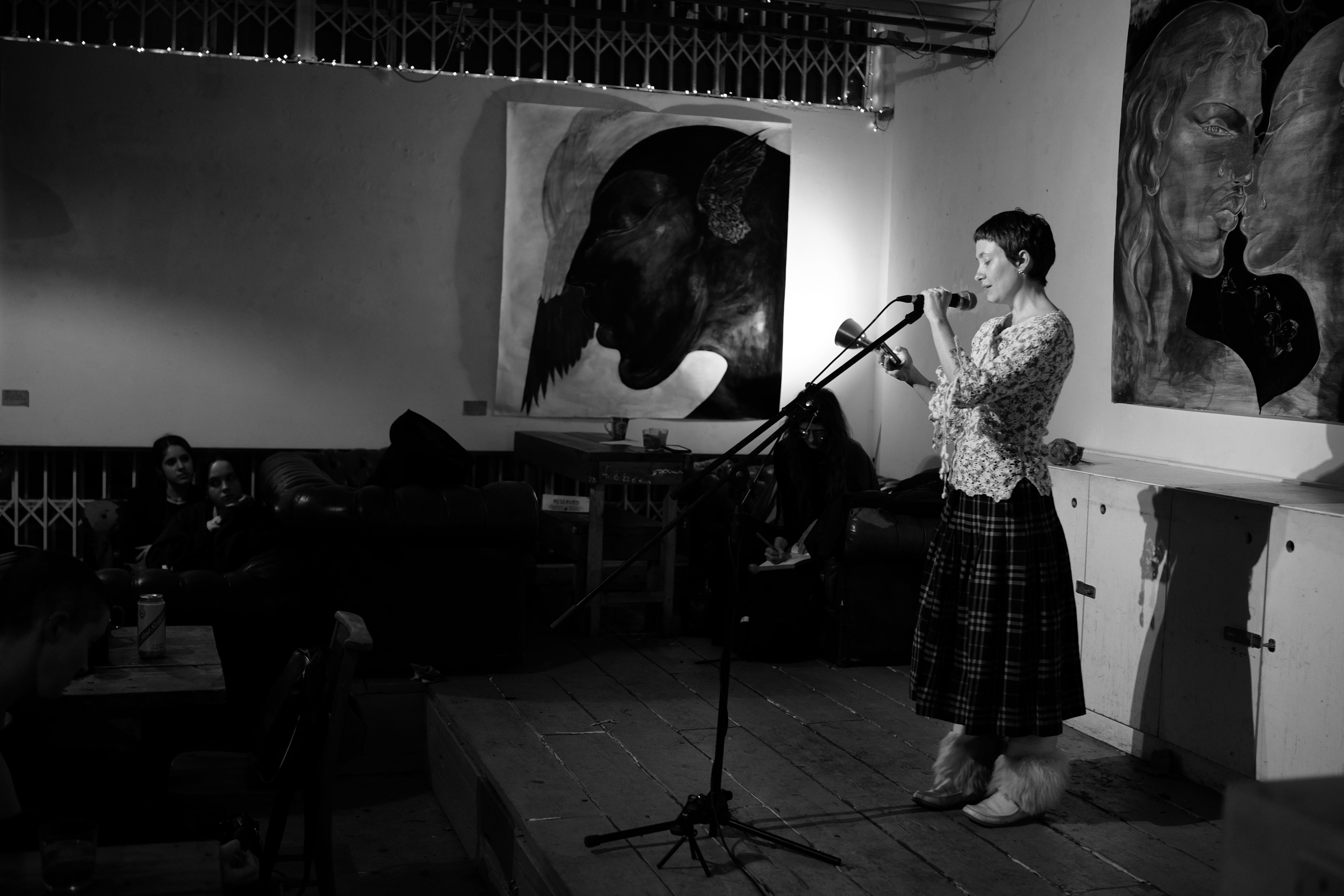
First up was Phoebe Eccles, who surely won outfit of the evening with her yeti boots, kilt and crocheted bell-sleeve combo, topped off with an enviably chic pixie cut. Eccles’ poetry did some Lynchian fish-catching, delivered timely political barbs, ran its hands through Milton’s silky hair and popped out some tulpa spoilers from Twin Peaks: The Return. I wrote down ‘The independent life of meat’ and a dream poem in which a child in a cave headbutts stalactites (or was it stalagmites?). Eccles’ work is playful and sharp, with a discursive feel to it that is able to weave in urgent recent events to the pulse of cultural analysis. The poetry had a similar to texture to some of David Lynch’s CGI creations in The Return: sort of glistening and disturbing, meat-like, surely not quite of this world but only because they are also so…tulpa? Virtual-material?
Next was Dora Maludi, who began with ‘Fear of dog’: a stunning, swerving poem about ownership, being on the leash, love, thread, fear, birth. I wrote down ‘failure as an embroidered emblem’, ‘it is not normal to lick weaponry’, ‘the anatomy was spectral and well-meaning’, ‘woof like you mean it’. It’s a good ethic to howl like you mean it. What does that look like in a poem? It’s almost like Maludi took the skeins of that howl – the shimmering microscopic particle matter – as a skyward formation swooping upwards and elsewhere in her reading. She also read from a ‘dental memoir’ which among other things describes menstruating all over the Ed Atkins retrospective at the Tate. I wrote down ‘microplastic and dandy’. I think microplastics came up in a couple of readings. Talking of skeins, I told everyone about how last time I was at the dentist the radio was playing ‘Geese’ and how much that upset me because I love Geese and this means a lot to me because for a long time friends described me as ‘gooseblind’ because I couldn’t recognise a goose from a lineup of idk ducks, and now that I knew what geese looked like and in fact loved the band Geese, I couldn’t have these neurological connections ruined by the everyday pain of a scale and polish. My dumb segue comment did not have room to explain that context so there it is.
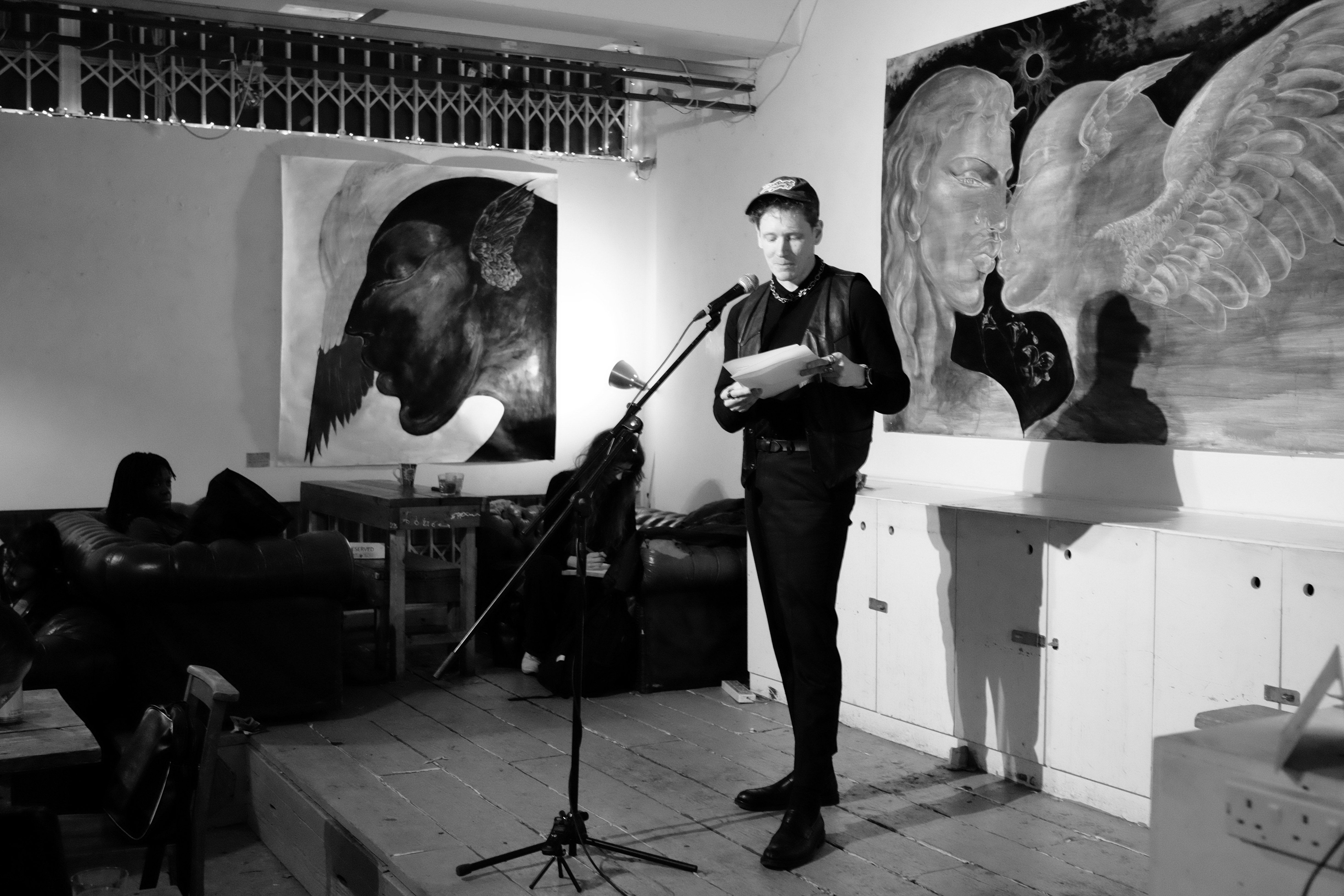
JD Howse followed, dressed all in black to match the SPAM editrixes, delivering a ghost story followed by a suite of new sonnets written, I found out later, in the span of a week. The ghost story took me somewhere, a kind of crumbling maybe seaside place — the geographical admixture of Robyn Skyrme and Ann Quin. A hotel crumbles over a promenade, there’s a fire pit, twigs. I wrote: ‘the sky pulled around us like bedsheets’ and imagined this wholeheartedly, being swaddled or suffocated in a shapeshifting quilt of cloud. ‘Cinders in the wind…smouldering as my body dissipates with yours’. The sonnets featured foxes, O’Hara being read in the rose garden (instigating personal flashback to reading Stephen Rodefer in the Berkeley Rose Garden — more poetry must be read in rose gardens), ‘morning attempts to ontologise what remains’, ‘orange tulips, almost neon, brought ot my door’. The images are vividly memorable, the twisting arguments of the sonnet form deployed to bathos and humour amongst sincerity, ‘I fell in love with you because / I thought it would be funny’. Ah how slant-assonance makes a mockery of love’s ass!
After the break, Poppy Cockburn took to the stage. We’d had a chat about our love for a little lace or gauze on an otherwise plain shirt and how to source the garment of your dreams via pursuit and digital fluking. Cockburn is masterful at grabbing the dynamics of poem-as-poem and holding it to the light like a prism scattering wit. She understands how to tap into polydimensional performance resonance which maybe comes from her prowess as both poet and PR strategist. Sometimes you laugh and sometimes you feel like here’s a side to existence thrown into relief, something you didn’t know you needed to see. At the start of the reading, poor Poppy had to compete with Joni Mitchell who was still playing over the bar’s PA. Good-naturedly she hummed along until the staff turned down Joni. She read from her debut collection, Naked Oyster, which was put out by If A Leaf Falls last year. On the cover, a smudged Grecian-cum-vaporwave head looks plaintively down as it floats above textural shrinkwrap. This ‘look’ is a good capture of affect and I started to think maybe they need to replace the heads of the angels in Crystal Palace Park. Cockburn’s pithy works are reminiscent of Chelsey Minnis, Bunny Rodgers, Maria Hardin and Nadia de Vries, but she has this distinctively English streak of deadpan that sets it apart. Her performance explored humility, haplessness in love, sirens, wash cycles, driving, secrecy, words as ‘silks on a slow cycle’, bad men, lost feelings. I wrote down ‘POETRY IS HUMILIATING AND THERE IS NO GETTING AWAY FROM IT’ (all-caps possibly mine), ‘music journalists are full of shimmer’ and ‘I don’t have an opinion / I’m just an ambient orb’ which felt like a gurlesque take on the ‘geometrical turn’ I’m seeing everywhere after years of formless oozing. Pretty sure shape-loving Ian Macartney had an orb-themed house party once. You’ll have to ask him about it.
Our penultimate reader was Irish writer Francis Jones, who read from their Veer2 pamphlet Storm Drain. The opening repetitions reminded me of poetic markov chaining. A throwback to Howse’s twigs, we had ‘I scrub myself with cream with bits of bark in it’, how face-scrubbing makes you late for work. A spiderweb ‘like a pube in my teeth / but my own body’. Amidst this becoming-animal body horror there was an ‘unbelievable hibiscus’ and ‘major airways act[ing] furious’, ‘a grotesque stateliness’. Jones’ mentioning of the grotesque cascaded the next day into a conversation with two other poets, Katy Lewis Hood and Jared Stanley, about who or what the current grotesque poets are. I was thinking about that Dean Kissick article ‘The Vulgar Image’ which my south side reading group (affectionately titled Communal Nude) read in playful dialogue with Robert Glück’s inimitable Margery Kempe, thinking about iconography and desire and morphology, slop and narrative, collage and seam/i/less/ness. Hit me up if you have suggestions as to who are the new grotesque poets. Interestingly, grotesque comes from the Italian grottesca from opera or pittura grottesca meaning work resembling that found in a grotto. We had this conversation about the grotesque in Peltz Gallery while looking at Melanie Smith’s Tixinda, a Snail’s Purple and meditating on the gorgeousness and grossness of purple, its excess, as it is extracted from the sea snail Plicopurpura pansa. It was warm and kind of grotto-like in the gallery. Katy told me they discovered recently that the snail’s gel people are putting in beauty products is not extracted from sexually exciting the snail but in fact putting them into a state of panic. I started thinking about our cultural fetish for glass skin and the ecopoethic implications of putting the substance of another species’ panic attack on your face everyday. The last thing I wrote down during Jones’ reading was ‘love transports in moisture’.
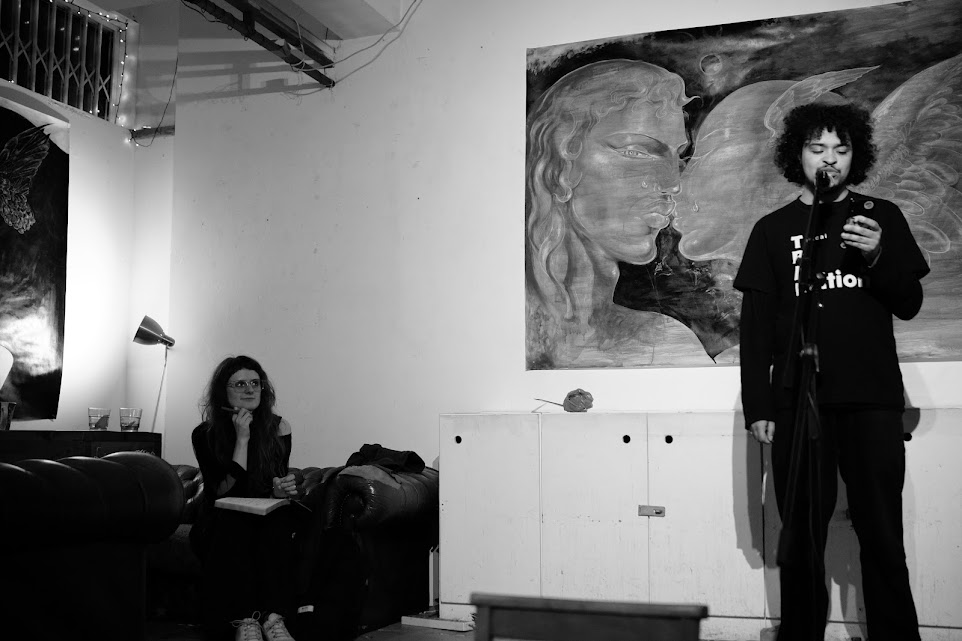
Talking of corporeal serums, William Aghoghobe topped off the night with wax and ‘the extreme extent of human secretions’ revealed in an autobiographical piece about his experience working in a university library. Aghoghobe is a very atmospheric writer and a kind of sculptor of images that sometimes coagulate and sometimes melt into motion. He read about doppelgangers, spores, frames within frames, dirt, the Walthamstow Marshes and marshy doubling of object pronouns, ‘I am only as much as my garments’. What does it mean to be a figure, like actually? All this talk of materiality made it very hard to resist pulling out the stuffing in the beat-up ‘green room’ sofas and somehow become-sofa myself but I did resist by writing down words instead. We had tales from the level 7 annex, tales from fire alarms, ‘mountains of keys’, plastics, being ‘a spectacle worker’ and dealing with an unfortunate ‘ghost-shitter’. Aghoghobe reads with bags of charm and a surrealism befitting the grotesquerie of the modern everyday.
And so concludes my roundup of AFK#9! Our next reading will take place in Glasgow on the 9th March, with lineup soon to be announced. Thanks to everyone who came down to the Pelican! Other dates for your diary are:
20th March – Kirsty Dunlop’s book launch for Centrefolding at Mount Florida Books (in conversation with Ian Macartney)
27th March – Kirsty Dunlop’s book launch for Centrefolding at Argonaut Books (in conversation with me + performance from Kevin Leomo)
30th April – Launch of Iphgenia Baal’s new SPAM book at Peckham Pelican (details tbc)
27th May – SPAM 10-year anniversary party at The Old Queens Head on Essex Road, London (details tbc)
Also stay tuned for news of SPAM’s Glasgow anniversary party!
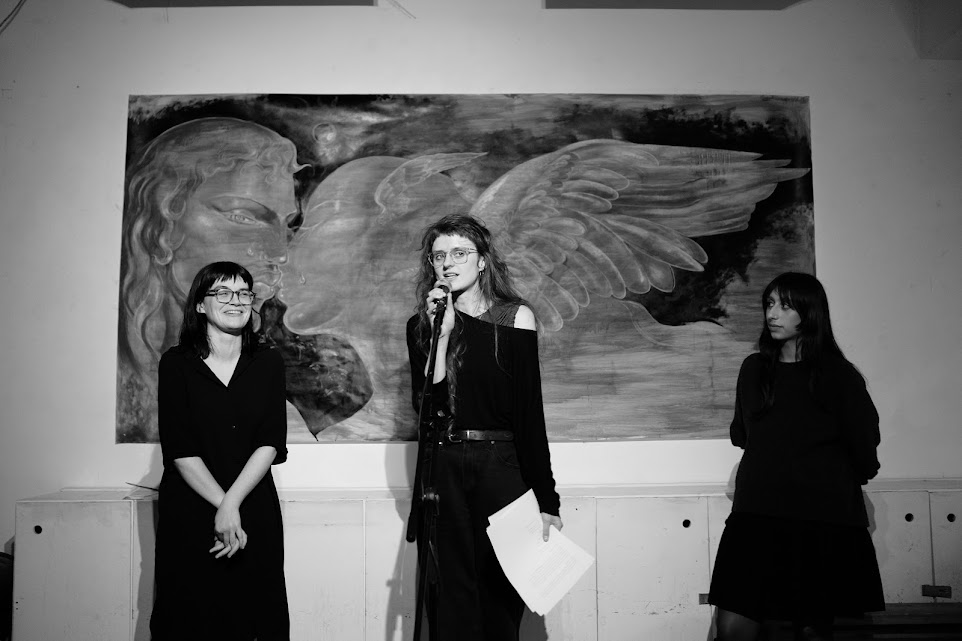
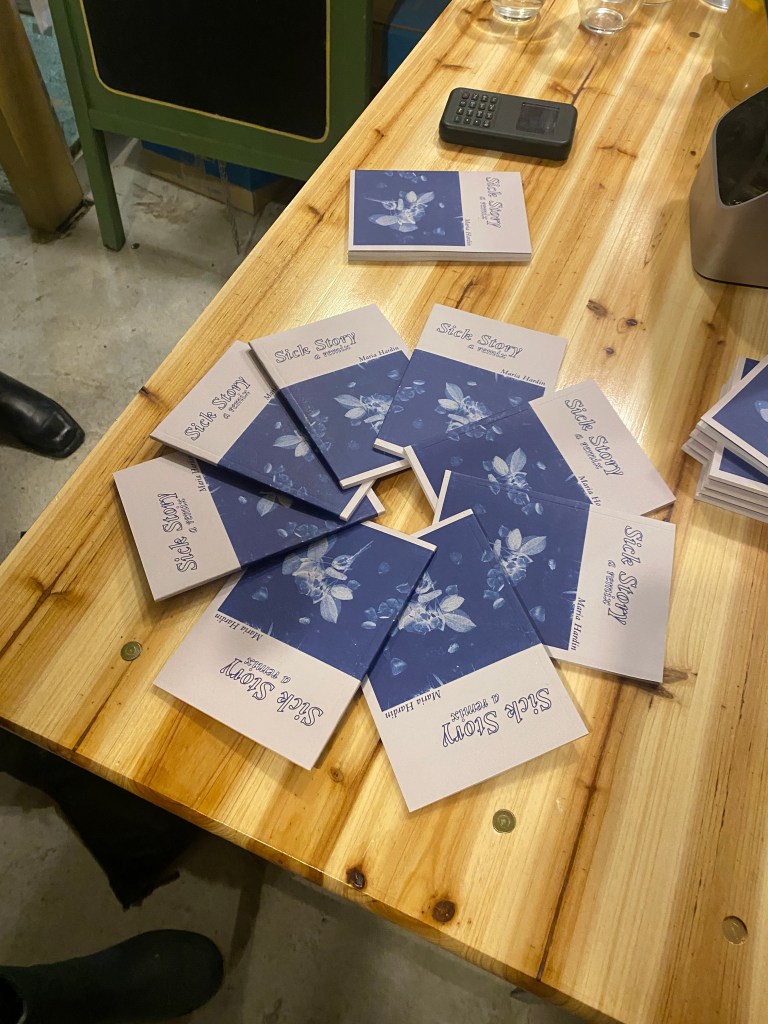
Last night SPAM Press hosted the wonderful Swedish-American poet Maria Hardin at Mount Florida Books, Glasgow, alongside readings from Kate Paul and Jane Hartshorn. Here is the intro I read for Maria.
I want to begin by reading a poem by the late Rhiannon Auriol, who was a kind, talented and sharp-minded poet. She had a voice that felt genuinely fresh and we were always excited to get something new from her in our inbox. We published her in the Plaza and our online magazine several times and when it came to putting the lineup for tonight together, both Kirsty and I had the thought: I wish we could invite Rhiannon to read with Maria. Rhiannon forever.
Here’s the poem, which was published in pif magazine back in 2021.
I drop into this poem and I am petalled. I have put my hand in the new burr grinder of how I am learning to read in grief. This self-petalling is a relief. I will soften! I will become rose water, distilled into essence! Energised by short lines! There is something ugly-beautiful about my becoming rose-water of the nominative. Yes I was born with the middle name ‘Rose’ and also the first name Maria. Rhiannon writes of ‘the moon particularly / at sea’. Maria and I share a name meaning ‘of the sea’. We found each other via the kismet of poetry, and her poem called ‘Mariaology’ which features ‘a cascade of every maria’ which I first received as an iPhone photo. Last week I was researching something and stumbled on the phrase from the website MindBodyGreen which said, perfectly: ‘caffeine can disrupt your hormonal cascade’. I don’t know what a hormonal cascade is but I know I have felt it in poetry. Yes, for you I’d drop everything.
By some miracle of the ether Maria is now here in Glasgow tonight and we are launching her pamphlet and I am CAFFEINATED. My being caffeinated will never truly replenish my energy. There is a tale here. Rest without respite. Sick Story. I like to think of this as a sister pamphlet to Maria’s earlier work Sick Sonnets and also a cellular cascade of the voltas played within them. We have dying bees and the premise if not promise of healing. In Maria’s sick sonnet ‘Glossolalia’ the Steinian rose becomes a rat becoming also a rose and the speaker reads ‘emotional responses to the end of nature’. I have always loved the general mood of melancholia in Maria’s work, the way a speaker can latch, mutate and render ornate a feeling, an image whose origins remain mysterious. One never feels quite settled; there is a rat-like restlessness. Is that it? But also the still, slow burgeoning and wilting of the rose. Of devotion. Hours of languishing. The void is decorated all the better to feel it. The void is remixed. If there could be endless Proustian bedtime there could also be a pain psalm and a ‘baited lamb’.
Sick Story looks for alternative narratives in its telling of chronic illness. It asks ‘what is the shape of a sick story?’, with an eye to Bernadette Mayer’s Story and Ursula Le Guin’s ‘carrier bag theory of fiction’ by way of explanation. For Le Guin, the carrier bag narrative is shaped like a bag, not the arrow of phallocentric linearity. Mayer’s Steinian Story bundles riddles, matter, anecdote, the stuff of ‘things’. Nothing feels pre-determined, destined for an ending; rather, all times rub their quantum shoulders in the bag. Have you ever rummaged in public for your medicine? Have you ever written notes on the back of your hand, worried the ballpoint would seep beneath your skin and stain something irrevocably navy? Have you ever shaken your life up so much you could almost smell its perfume?
Here is a snippet of Mayer’s Story:
Voices fall.
It may be seen feeding on this under one of those tropical things.
The time or place of starting.
He throws a hat on a seal’s head and a piece of his pack into a whale’s mouth, marking their characteristics.
Lamp, lucite and plastic.
I saw one once in a book, but I didn’t rip it to shreds, or even divide it, as I could
have (snap), but left it whole (shot), which it could never be unless it were left
that way.
Will that have anything to do with this? (67)
Mayer’s storied ingredients are packed upon each other like the storeys of a building. She disrupts the assumed causality of narrative with a prompt — that of the child’s or editor’s: ‘Will that have anything to do with this?’. I am at the soft mercy of every bedtime story. Once gathered into the bag, is everything relevant? And where does it take us. Details are listed like precious cues. Lamp, lucite and plastic. The pronoun ‘it’ bears wild liberty in its free-kicking materiality. I trample ‘it’ under the ‘perfect lucite heel’ to which the speaker of ‘Mariaology’ prays. I sub ‘it’ under light, lux, something solid and transparent — the supposed clarity of what I am trying to say, what does it all mean. What is the ‘time and place of starting’ when it comes to illness? From where do voices petal and fall? Are they, like rain, a kind of interference? Mayer asks ‘What did the rose do?’ after the word ‘History’. I think Maria is answering that question in her remix. We invent from adjacency some kind of story. Is the rose sick, is it guilty? How to place these scenes. I think of something Jane wrote in the same issue of SPAM magazine where we first published Maria: ‘Houses appear / where once there was marshland, a thin burn threading / between them.’ My imagination shrinks these houses to the size of pages and now I want to live in them. And you can too.
Here’s Maria Hardin, thanks everyone.
🌹
You can buy Sick Story from SPAM Press here. It is SUCH a cute edition (A6 pocket-sized) and the writing will stay with you a long time. Carry it with you!
You can buy Maria’s debut collection, Cute Girls Watch While I Eat Aether (2024) from Action Books here.
Here is a long essay I wrote about roses, via Idlewild/Stein/Lana Del Rey/Joyce et al, back in 2017.
Fans of poetry! This is an amazing, free to access archive of Bay Area audio recordings that just went live — Andrew’s been working on putting it together for a while now.
‘The Kenower series collects recordings donated by Andrew Kenower of Woolsey Heights and A Voice Box. These recordings present Bay Area readings from the aughts to the present, with a particular focus on those that receive little to no funding and run outside of institutions and commercial spaces, typically in homes, galleries, backyards, and parks, such as Artifact, Canessa Park, and The (New) Reading Series.’
I don’t know if it’s summer or just plain warm for walking around in search of dark-bitter reprieve pulled the Ace of Pentacles in Maureen’s the pledge of a seed planted in manifest pasture walking up the Grand Parade to have Mau grab my arm and pull me into due embrace since they were just getting breakfast, sloshing oysters with Dom I keep saying it’s good to be with everyone the neighbours are rehearsing a play I sit on the floor and arrange paperwork phoning it all back like I failed to see the love in front of me fertile and with selenium
wishing I could have bottled the birdsong of Brace Cove so much to trap myself in notes also reeling around the English Market with poets wishing we were Irish ordering whisky with Luce if you ever want to talk, we say if you ever need whatever
the Beamish flows easily it is less than five euros. I have yet to burn my fingers on ice, to go home into caring situations with dutiful infinite replenishment of ice instead I run up Shandon arriving late for Maggie O’Sullivan, early enough to catch her words as Eden-variety everafters flying around our garden of poetry I was locked from initially, outside in the street awaiting my call
that poem about a mother opening her belly that poem incants a fact, you are present sometimes being born you will always be able to talk to me I weep through the reading, it’s easy to constellate far away suffering in greener syntax just across the sea to afterwards hug Maggie, thank you we have no idea how powerful words are to leap, mutate and glow in defiance of the law how hard it was for all of us just to get here
everything we’ve been through will be again but I don’t have a generation we see wagtails on the lawn sonograms of gathering voice what is it to be intimidatingly full of life Gloria singing of sailing Carl making faces at the baby making faces at poetry as we remember Callie being smart and funny and so singular as to outlast all of it eating dosa while watching Ellen Dillon’s killer reading then a cuckoo went off on someone’s phone, hello pastoral
those oysters were universal tell me about your shoes
guess I will inherit my father’s spiral cutlery
all the better to eat what cannot be stomached of home-cooked nowheres rich in cortisol
what I want is raw and clear
saw a little grey dog at my feet during Keith Tuma’s performance not a real dog, offhand come to comfort me because dogs smell cancer even when someone else’s lives like a phantom accord on your aura and in the forever ward of poetry who will get away with autumn
my life is a spatiotemporal displacement filtering love’s dimensionality
I want to go back to Dogtown rose petals steeped in promises
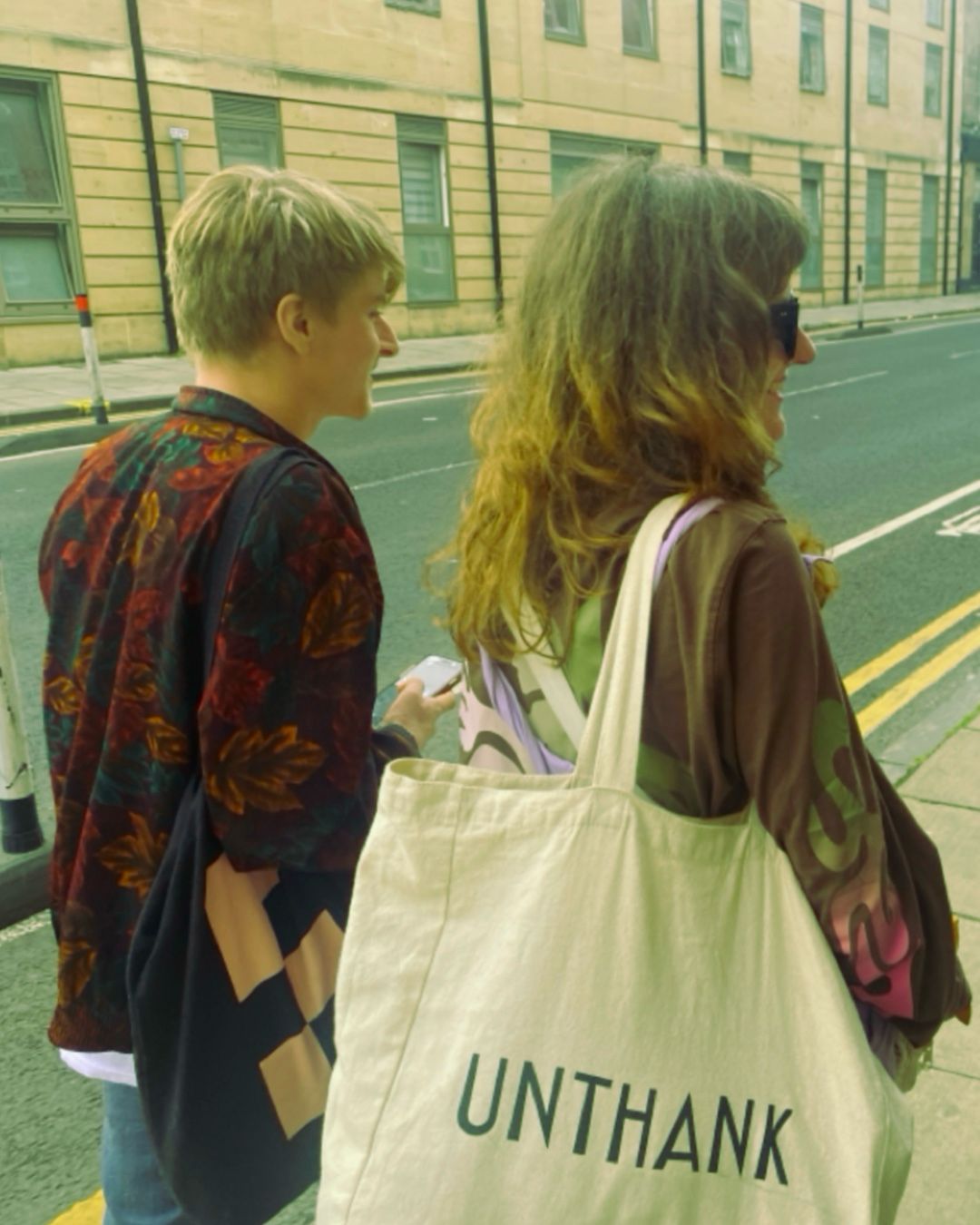
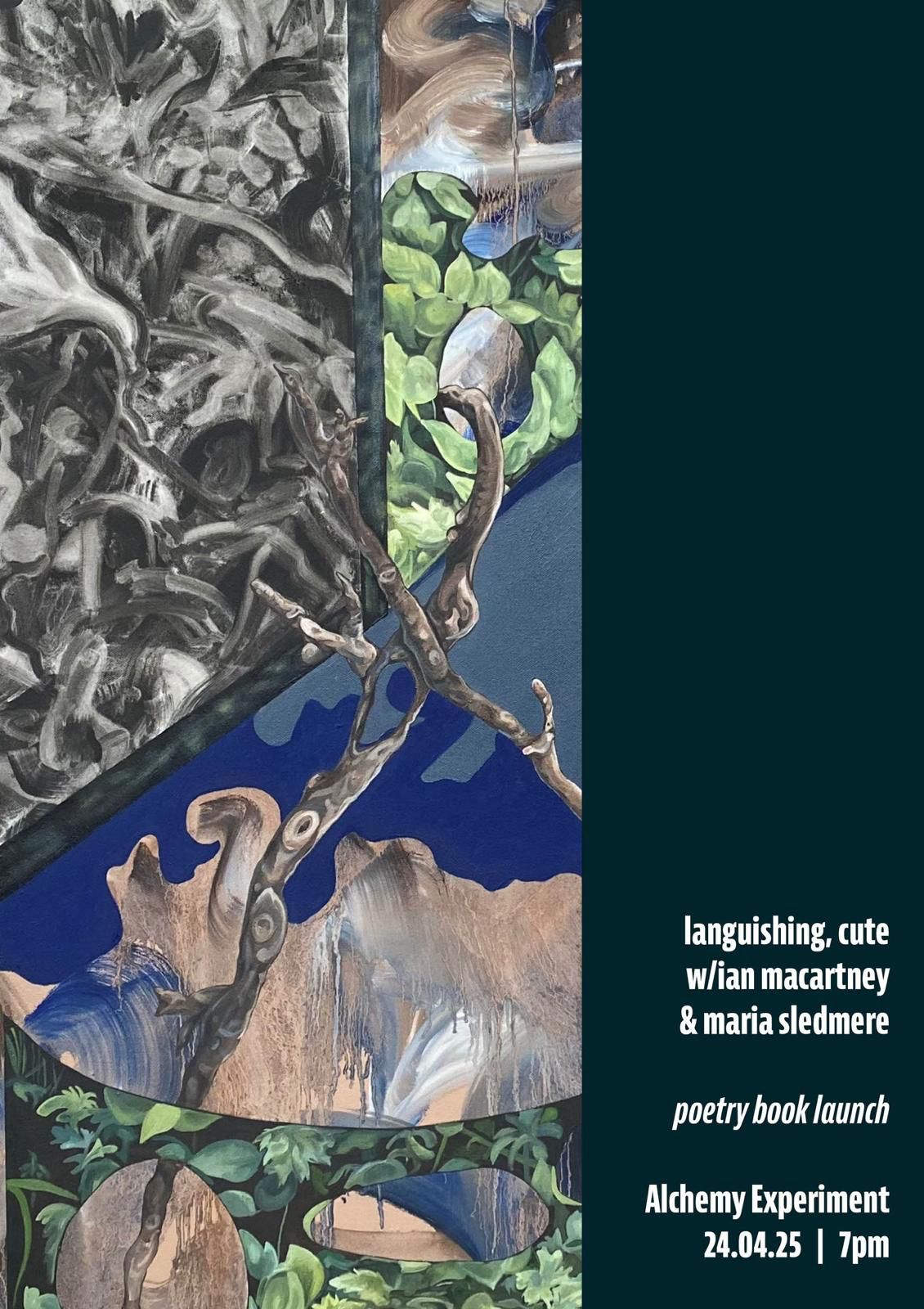
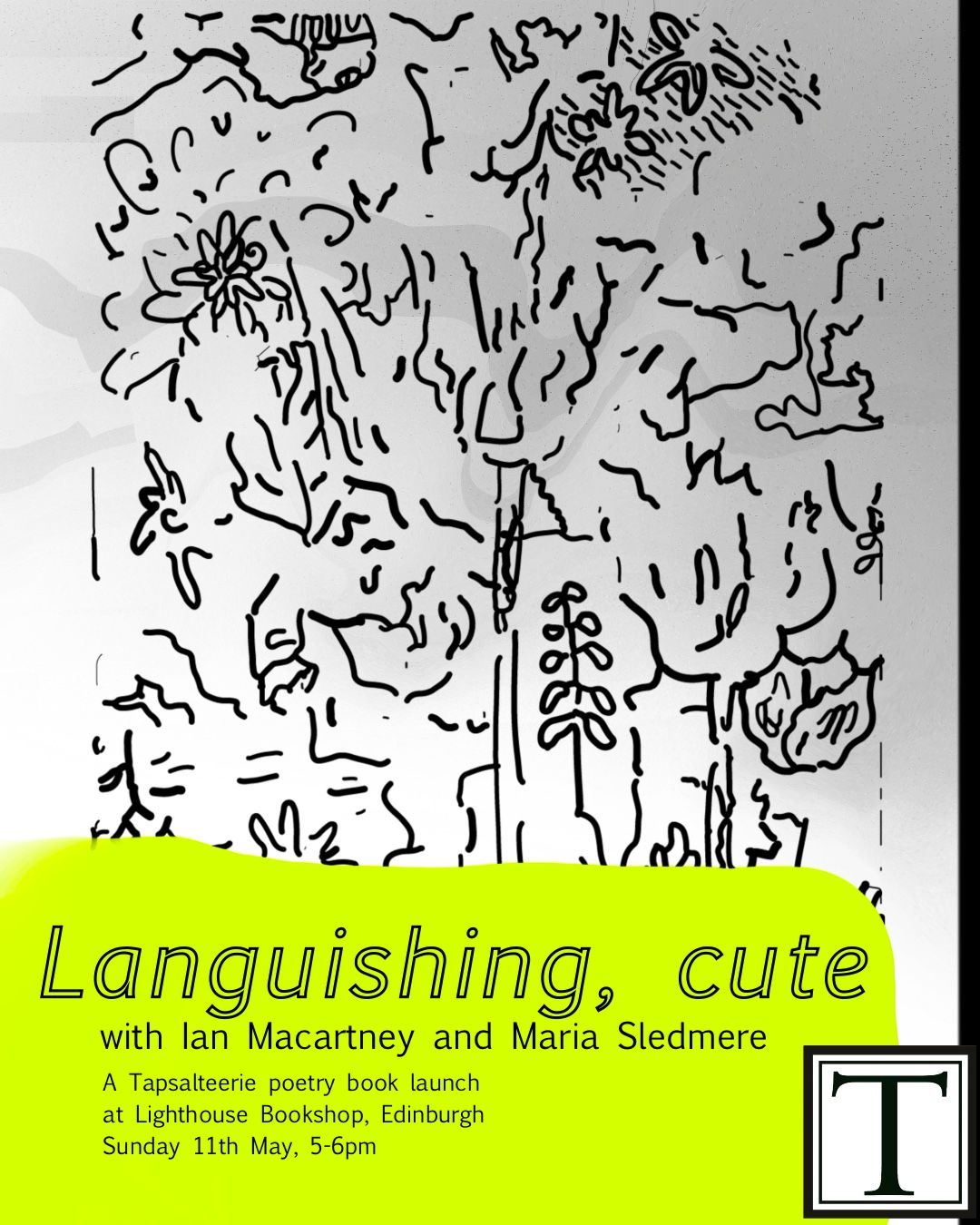
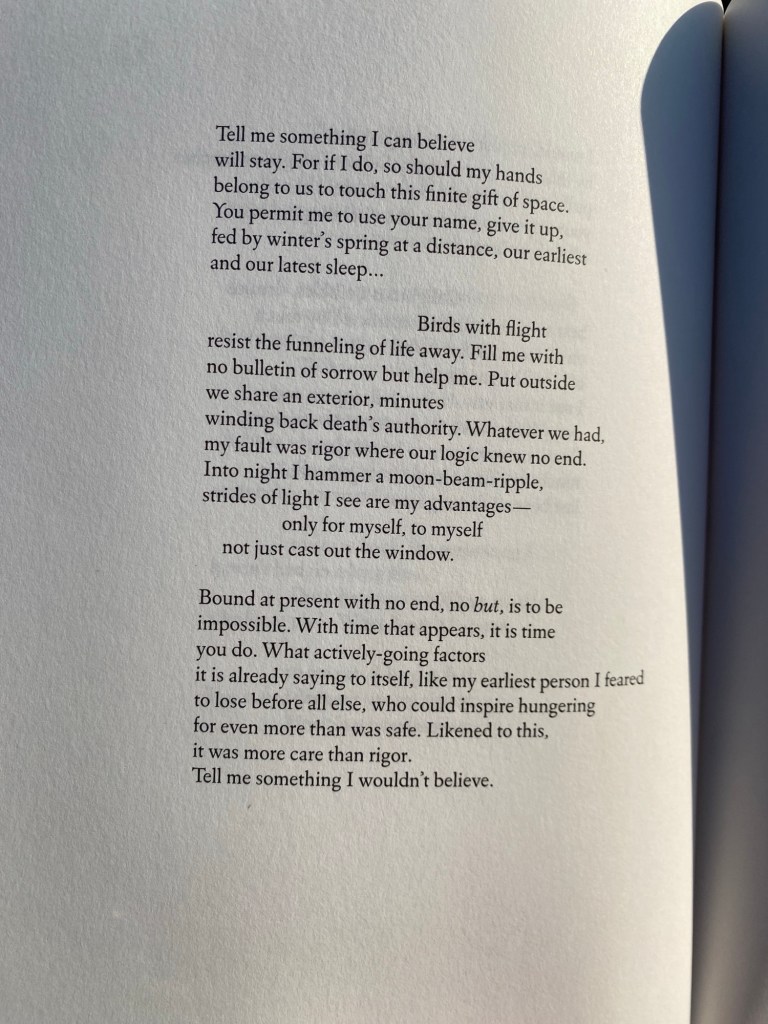
In August 2022, which legitimately feels a whole fat wormhole ago, Ian Macartney and I found ourselves working in Edinburgh for part of the summer. We met up at after-hours cafes (more prevalent in the capital, what you playing at Glasgow?) and walked around the Botanical Gardens where the staff promised ~*’Instagram flowers’*~ and we talked about our hopes and dreams and struggles as booksellers and teachers. Part of the emergent narrative concerned utopian ideals of Scottish infrastructure, where one could zip to Lerwick in a hyperloop heartbeat (all élan, not El*n) or at the very least catch a local bus on time, or unlock a hidden realm below the loch of Linlithg(l)ow. Part of it was about friendship, love and pop music. We were listening nonstop to Caroline Polachek and feeling okay about it. Pretty good actually. There was her vocal flipping over the crags, at sunset. I remember purifying my heart with orange liquor. Wearing a lot of lilac. Bleeding ink into industrial bedsheets. We were thinking about pivotal points where our childhoods overlapped with culture. We wrote things in documents and met in the months ahead. I did a lot of chaos cycles, late, trying to meet Ian at say, the Mitchell Library to go over some edits. A lot of awful things happened in the months intervening but there was this document we could splash land into and like turn on the light. Poetry’s coy ambience zonked up to warp speed. I liked doing this project a lot. I’m glad it’s in the world.
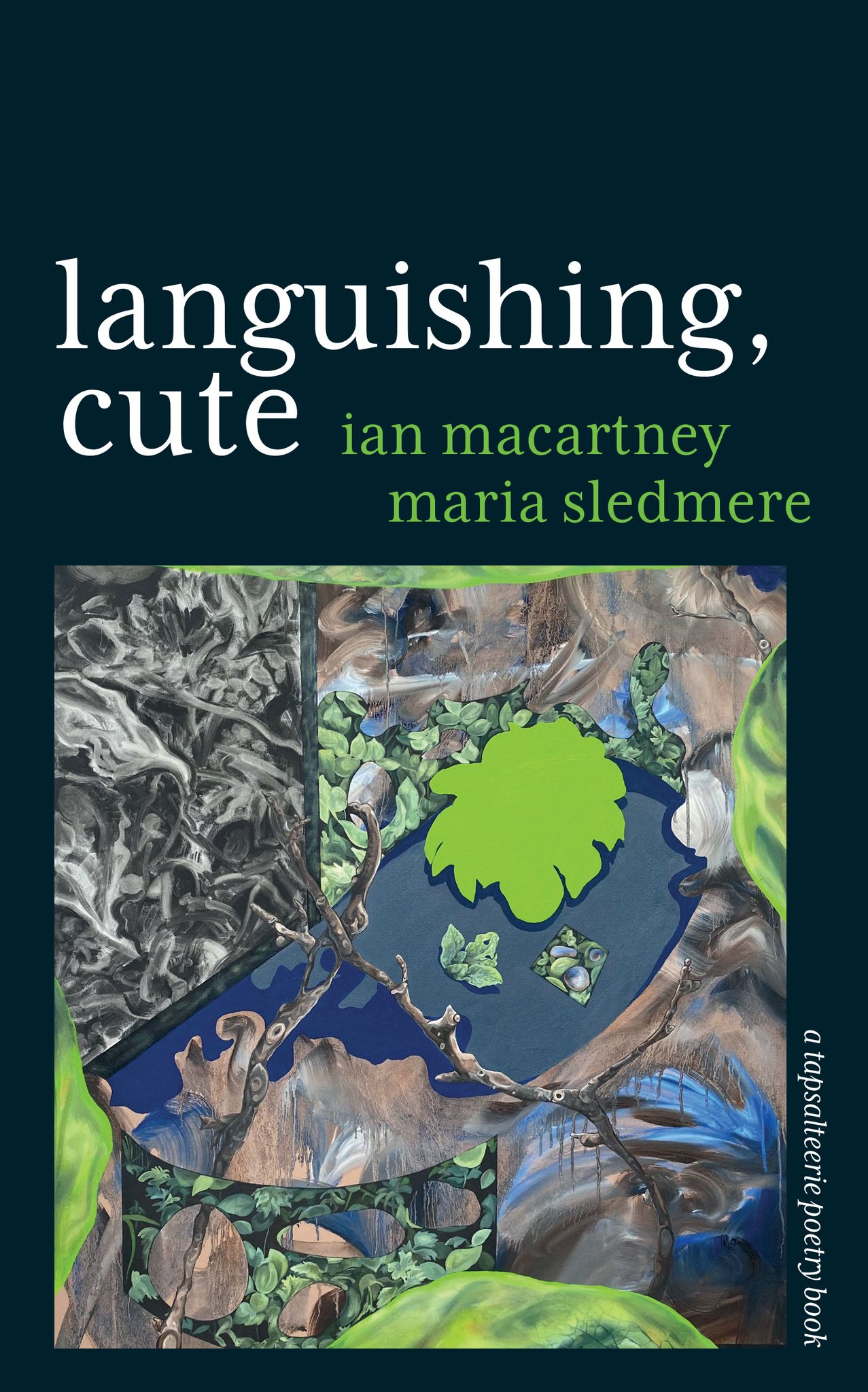
We’re publishing the full collection, Languishing, cute with the wonderful Tapsalteerie, an indie press based in rural Aberdeenshire. Ian’s worked with them before via their pamphlet imprint Stewed Rhubarb Press and they published some of my poems in the 2019 anthology, edited by Calum Rodger, titled makar/unmakar: twelve contemporary poets in Scotland. We’re big fans of Duncan Lockerbie, Tapsalteerie’s founder and editor, who does so much for Scottish poetry and beyond.
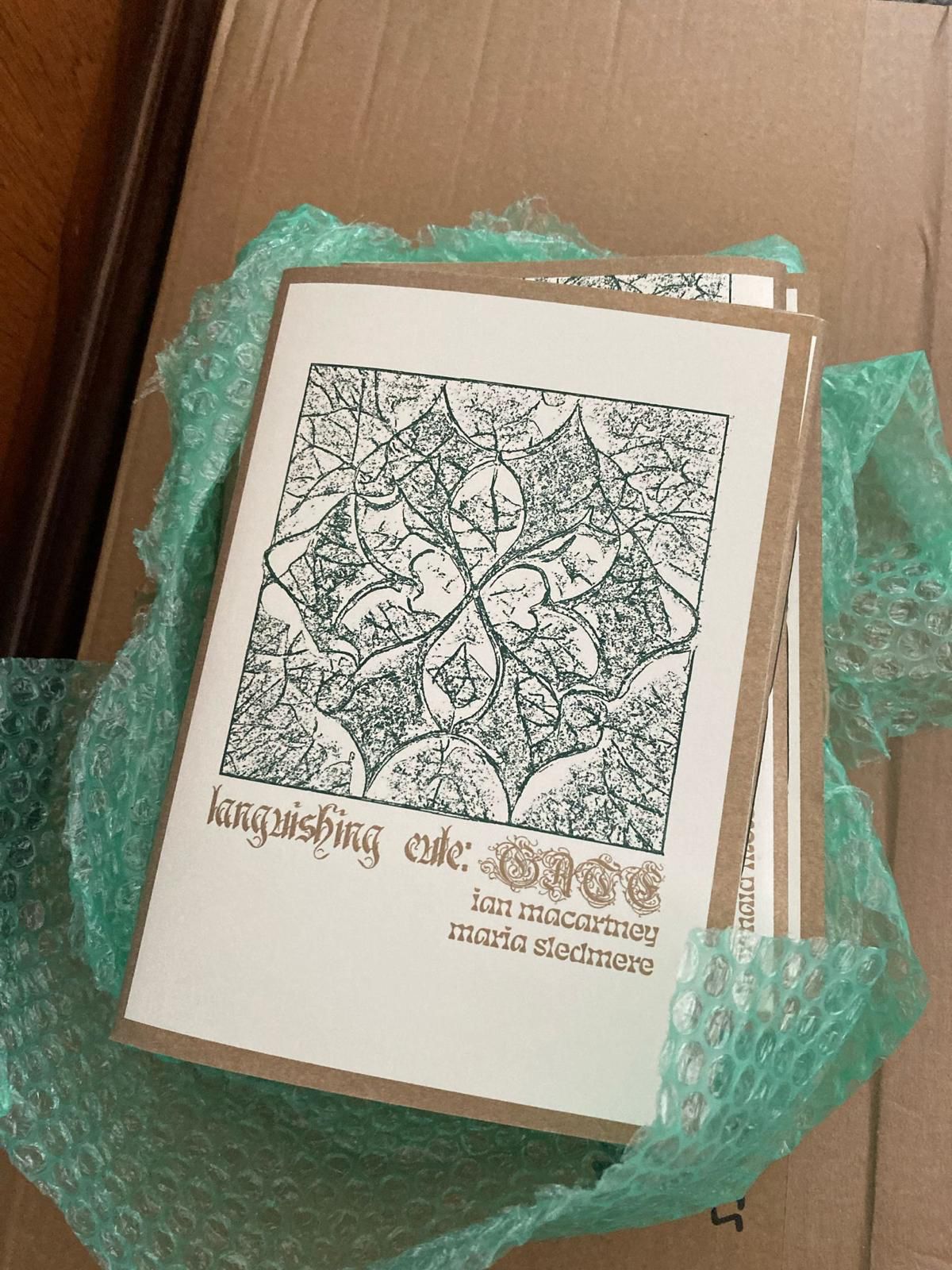
We’re also publishing, thanks to the exquisite printing of Earthbound Press, a separate riso pamphlet of b-sides titled The Gate. Look out for that at our launch events…
From the publisher
languishing, cutepresents a collection of jittery missives that propels the speculative Scottish canon of Morgan, Gray and Mitchison into a maximalist ‘high femme goth surrealism’ via hyperpop, Celtic futurism and digital culture. Here the poets tend towards e-pistolary contemplations of retro-adolescence, fizzy ecology and mercurial slippy gurlhood to complicate notions of Scottish identity, nationhood, ecology, nostalgia and more.
Nice things people have said:
languishing, cute is the opposite of a flyting — that traditional bare-knuckles fight between two poets. Rather, the two poets here offer their worlds to each other in the gift of friendship and they listen back: it’s not a duel, it’s a jewel. Where they meet is in a place of Anglophone avant-garde stimulants — locating codes include Francesca Lisette’s Teens, Edwin Morgan, Tim Atkins and Peter Manson — and the dancefloor has Bunny Is A Rider pumping out in up-melancholy and autotune. At times this is glitch-poetry, funny, para-kitsch and mesmeric. At other times there are the amplitudes of tenderness and self-effacement in a palette of citrus and greenest day-glo. What’s also fascinating is the pressing together of the virtual and its tics with its mineral and viscose underpin, all via the very human. It’s a leap from body/mind to capital/digital and back again, flickering, a visit to Silicon Brig-a-Doon you’ll want to be the first to Insta.
– Richard Price
[…] Messy as a teenage tumblr, flashy as a strobe light, this is two exceptionally generous poets bouncing off the walls of the backrooms with the energy of a thousand monster energies… here ~The Glitch~ is not a glitch but a stitch between windows, the glue between a b2b set, the rhythmic green hills of algorithmic infinity … and yet these re-mixes and e-mails traverse an internet of metal and cable, the business of poetry is conducted by staples through sheets of reconstituted tree::: there’s something old-school, decidedly analogue about all this. It feels like you could feel it. It feels like the push of a button, the caress of a bright cool screen. Actually no it feels warm and coarse, a cosy transmission rumbling, re-tuning itself like you’re flicking from station to radio station, flickering between noise & dialectical noise, patterns emerging in the static as the ether unknots itself, and the stuff of life comes spilling out […]
– Dan Power
Endless aureate refreshment from Maria Sledmere and Ian Macartney, languishing, cute is a collection with all its push notifications turned on that still finds headspace to pay attention on the DL to form and poetic inheritance. There’s Sledmere’s elliptical take on William Carlos Williams’ fridge raid (with Kylie Minogue R osé instead of plums), the odd sestina, and plentiful nods to that Scottish experimentalist Edwin Morgan range from embedded songs of the Loch Nes[s]presso Monster to Macartney’s predictive geographies in time-travelling poems indebted to Morgan’s Sonnets from Scotland.
With spins to further Scottish topographies from Maybole to Lerwick, Sledmere and Macartney are often found shuttling east and west ‘w/ eloquent glitches’ across Scotland’s central belt, heading increasingly into CAPITALS when Macartney’s voice announces us into Superedinburgh Vaporwaverley/Edenbruh/the London of Scotland.
The internet’s vertigo is never far away from poems presenting like listicles. Sadly for any wannabe monetised content, in languishing, cute these poets may be trading futures, but their hacked hypernature is funding nobody’s wellness retreat.
If you are in Nottingham, I’ll be reading at Dandelions Poetry at Broadway Cinema on 22nd April, 7pm. I’ll be joined by Charlie Baylis of Anthropocene Poetry. There will also be an open mic.
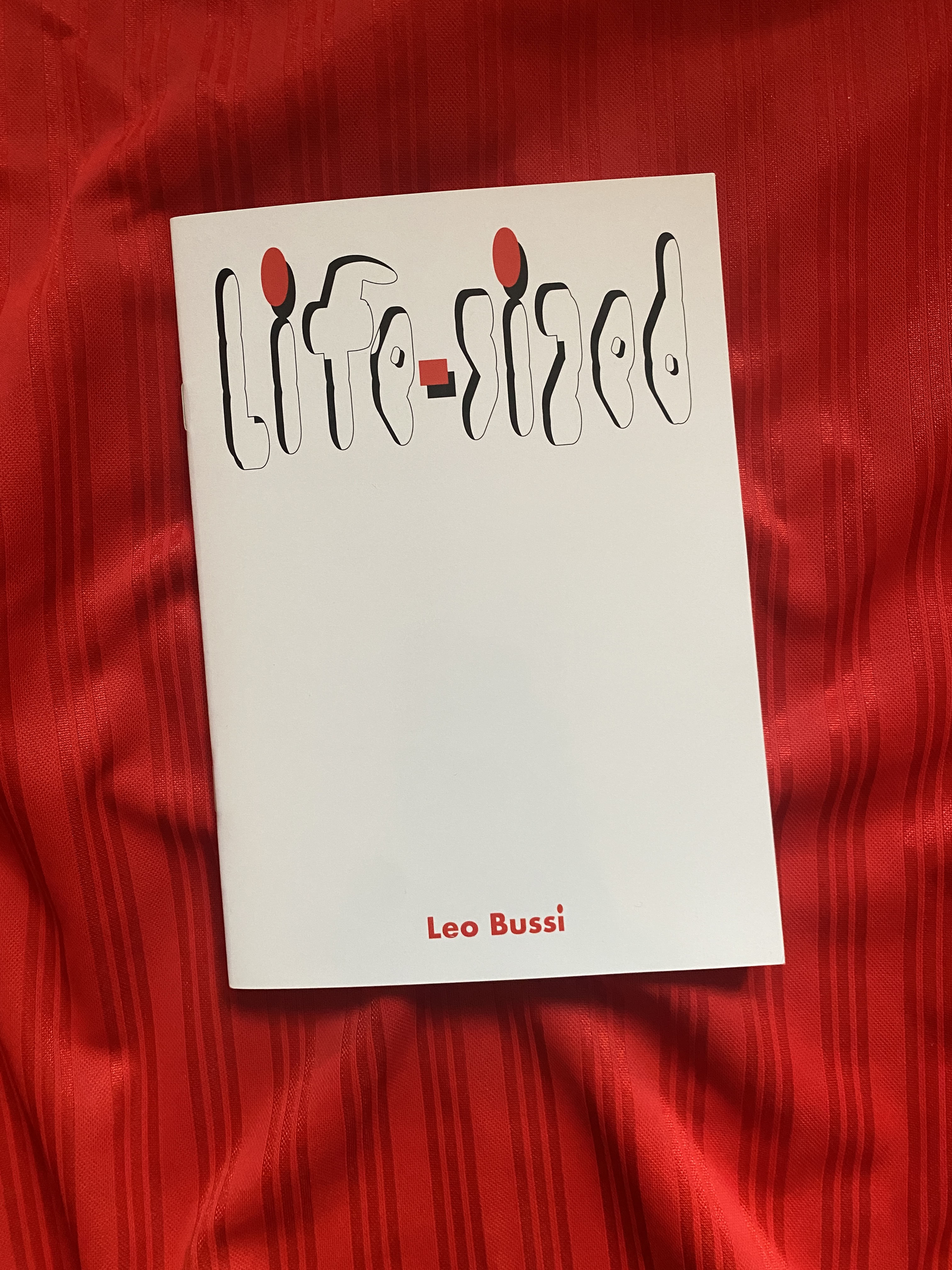
For a few months now I’ve been working as lead editor on Leo Bussi’s debut pamphlet, Life-Sized. I just wanted to say a quick word here about how awesome that’s been. I felt pretty jaded about running a press for a while because I was holistically exhausted and sick of the admin oblivion that is a non-profit tax return. This project has got me back in the game.
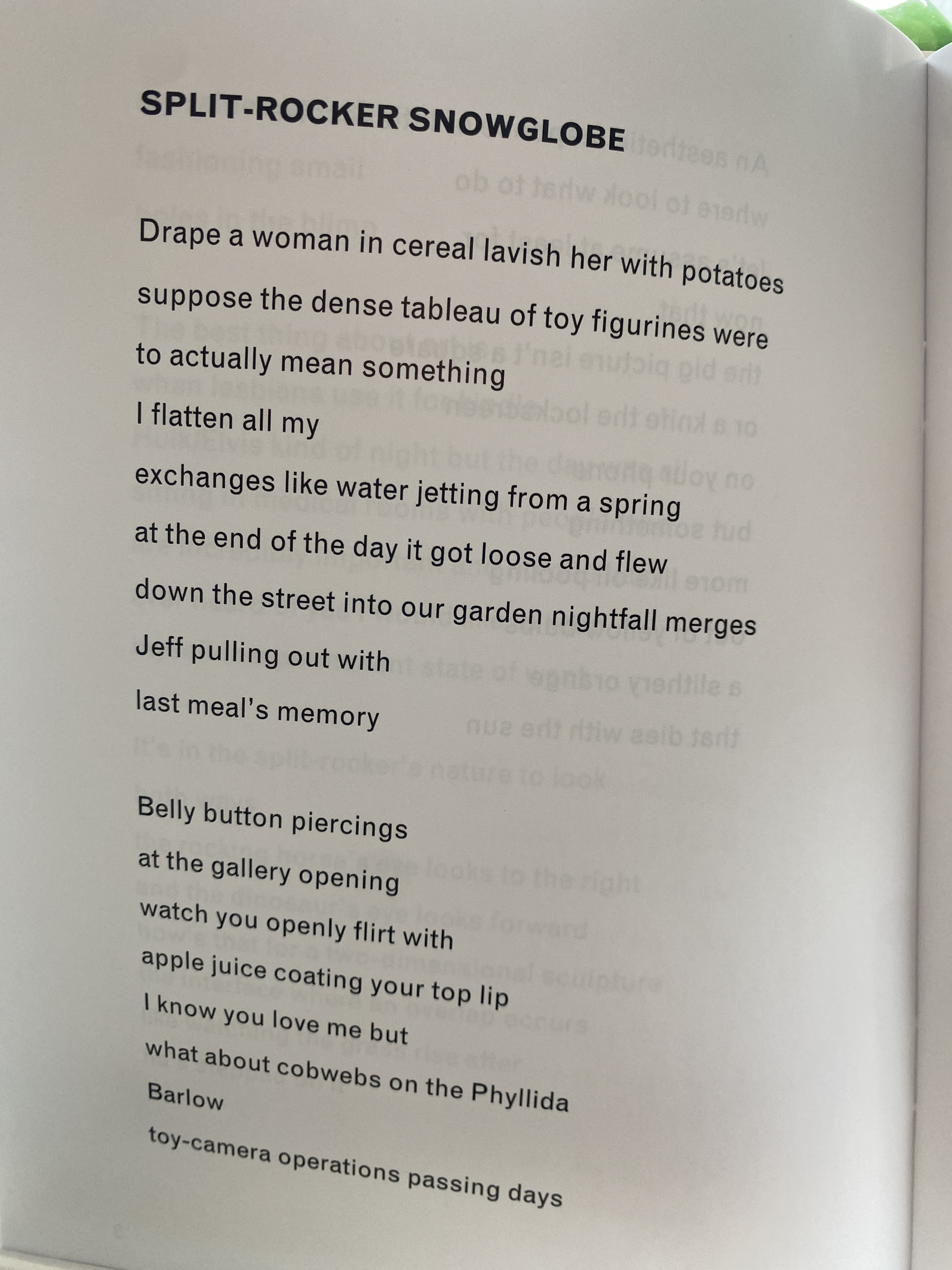
Leo’s work has charmed me ever since he read at the SPAM launch of Cocoa and Nothing (listen here) and we bonded over shared appreciation for a certain universally loathed, candy-named song. Editing Life-Sized has been energising because Leo is someone who kind of just comes with a fully formed poetic. And that’s informed by art and conversation and what Sue Tompkins calls ‘muscular sculpture’ and what Oli Hazzard calls ‘gorgeously goofy bathos’. He really has an ear for a line break which is sometimes comic timing and sometimes it’s object erotics and sometimes it’s the trompe l’oeil of the poem’s own jouissance. The poem feeling itself in cereal or nightfall or some kind of membrane.
AI-generated visual absurdism may have diluted the power of surrealism in culture but Leo’s poetry reaffirms the sharp gasp of the paranoiac-critical method. Here we have fused realities and toy scales – ‘Barbie version of Mount Rushmore’– played out in the synaesthetic poetics of a Jeff Koons expanded universe. If this is lyric then it’s also ‘Art-breath’ and everything might be desire but it’s also the agency of the brush and a line might be a gentle brush with erosion or it might be social realism i.e. ‘cucked and living in Britain’. My autocorrect tries to make cucked sucked and I want to tell my computer, you should be so lucky.
We are launching Leo’s book at Good Press on 20th March. It’s at 6:30pm, free and you can just show up.
 mariaology