Thrilled to announce I’ll be working with Beyond Form Creative Writing again this autumn to offer two new workshops. The first, Epistolary Experiments, begins on 28th September and is a monthly, four-part series designed to explore the arts of letter writing and correspondence across different forms. We’ll be thinking about how the work of address, posting, description and all its intimacy and triangulation can tell a story, evoke fantasy scenarios or perform an expansive, relational lyric. The second, Pop Matters: Our Songs, is a one-off workshop on 23rd November and offers a warm and upbeat ‘studio’ for musing on the relationship between creative practice and pop music. How do we write through and towards pop with all our devotion or ambient dwelling in its neon glow? Both workshops will involve a mix of reading other work, discussion and structured individual writing activities. There will never be any pressure to share work, although you will have access to the workshop threads on Experimental Creatives Collective, a closed forum space where further discussion and sharing can take place if anyone wishes.
For both workshops, there is both a full price and two concession rates.
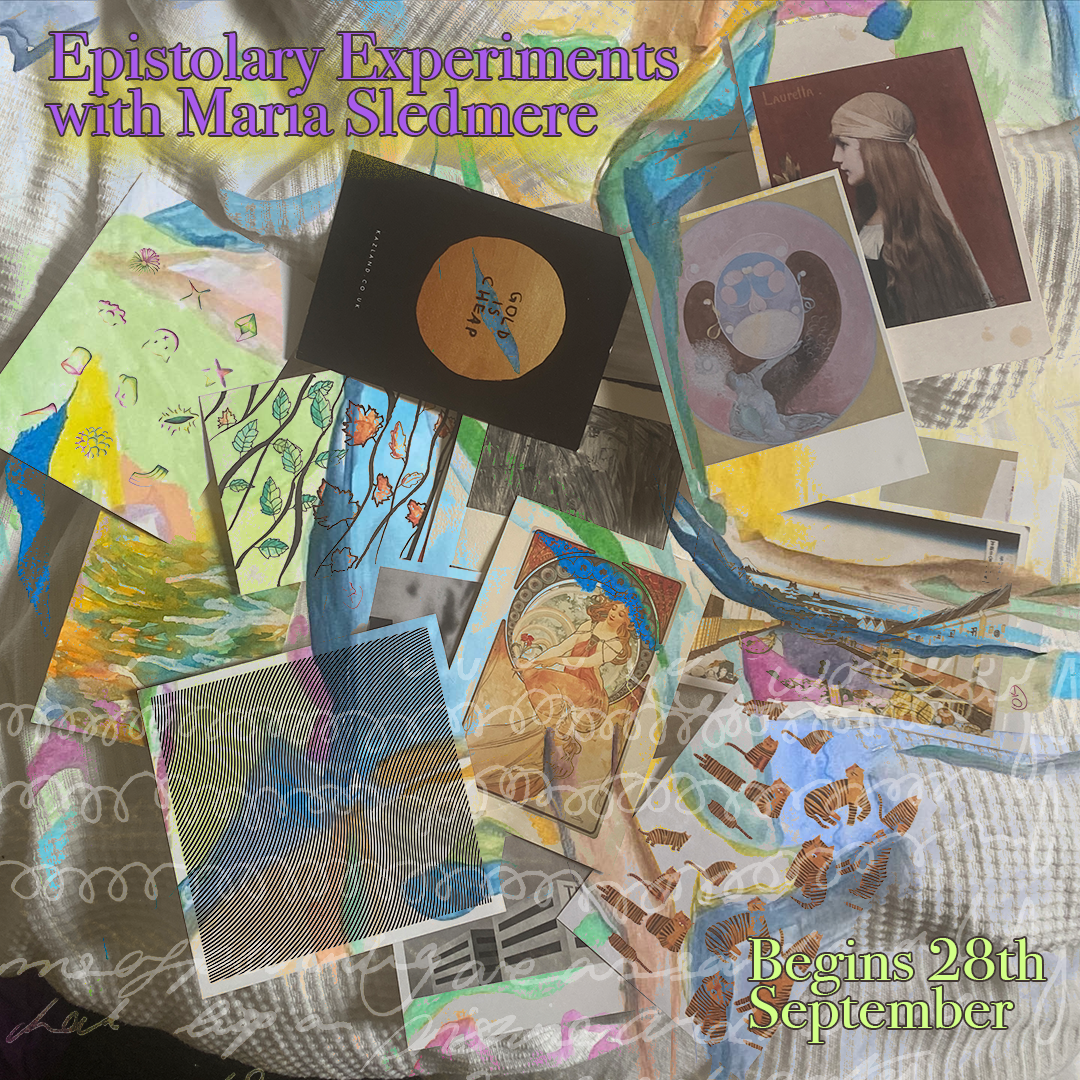
Epistolary Experiments
4 Sessions Starting Wednesday September 28th
6-8:00pm (GMT) via Zoom
‘I write you a letter to make eyes at a reader I don’t know from Adam’ (Kay Gabriel). From Samuel Richardson’s Pamela (1740) to Sean Bonney’s incendiary Letters Against the Firmament (2015), letter-writing or ‘the epistolary’ has inflected all kinds of writing, including novels, poetry and manifestos. Taking cue from Kay Gabriel’s ‘The Purloined Lyric’, we’ll explore the possibilities of letters, address and communication in all kinds of writing, practice and performance. While the literary letter has an established tradition, we’ll look at contemporary artists/authors who shake up the form of correspondence and in turn reframe desire, play, identity, sex, intimacy, domesticity and the political.
In this four-part, monthly series, we’ll look at several key areas: the love letter, the political letter, the fantasy letter and the postcard. A letter can triangulate writer, addressee and reader in endlessly generative ways, not to mention the origami of folds between art, life and writing, and this series is designed for creatives of all kinds to think about the epistolary genre in their own practice. Whether you want to incorporate the letter form directly into your work as source material/form, or simply use it as an extra tool in your research, reflection and development process, this series offers a generative starting point. Workshops will combine reading and reflection with individual writing activities, with some opportunities for collaboration including optional pairing of participants as ‘pen-pals’ for the duration of the course.
Open to all skill levels and writers and creatives of all mediums. You can sign up for all or just some of the weeks!
♡
Session 1 September 28th: The Love Letter
An iconic motif in the history of film and literature, the love letter conveys acts of noticing, clandestine reflections, confessions, embarrassment and desire. The love letter might be a plot device, a poetic ode, a pop song, a frank or coded material expression. The love letter tells a story, obscures a truth, embodies connection; it might concern romantic, platonic or comradely love. Sometimes a love letter goes beyond the intended beloved and forges all sorts of new energies and worlds. We’ll write into all these intimacies and frictions.
Key writers include John Keats, Jane Campion, Kay Gabriel, Jo Barchi, Diana Hamilton, Frank Ocean
Session 2 October 26th: The Political Letter
By reading unsent letters, letters to everyone, letters to no one, we’ll consider how the art of writing letters is a radically social form. Playing with the art of address and description, this workshop explores how the letter form can explode and disseminate ideas of presence, identity, desire and political (im)possibility.
Key writers include Bernadette Mayer, Fred Moten and Sean Bonney
Session 3 November 30th: The Fantasy Letter
Sometimes we write to someone who might never read our letters. We write to fictional characters, other writers or artists — some of them lost to time. These epistles might take the form of fan letters, speculative letters, epistolary letters or fantasy missives — defying the limits of time, space, the living and dead. In this workshop we’ll engage with such letters to consider voice, the intimate arts of reading, communication between forms, the body and queer temporalities.
Key writers include Dodie Bellamy, Vahni (Anthony Ezekiel) Capildeo, Jack Spicer
Session 4 December 14th: The Postcard
‘A giving which gives only its gift, but in the giving holds itself back and withdraws, such a giving we call sending’ (Derrida, The Post Card). What does it mean to send, or be sent? This final workshop takes the pithy form of the postcard as a figure for the literary possibilities of posting. What temporality does a postcard hold? What happens in the relationship between word and image, expression and constraint, public and private? Could we write postcards to the past or future, to the more-than-human? Can thinking postcard help us rethink other kinds of ‘posting’ and (un)delivery in our daily and writerly lives?
Key writers include: Postcards from the Anthropocene project, Jacques Derrida, Kiraṇ Kumār
Pop Matters: Our Songs
Wednesday November 23rd
6-8:00pm (GMT) via Zoom
Building on the success of the 2020 Pop Matters series, this workshop offers a warm and upbeat ‘studio’ for musing on the relationship between creative practice and pop music. We’ll focus mostly on pop music and love/devotion, making space for writing which borrows from the form of pop music or writes to specific pop artists. We’ll consider how pop can offer the emotional and structural inspiration for other kinds of creative output, the role of pop in everyday life/life-writing and the mythologies we give to pop icons in writing. Designed for anyone who wants to flirt with a bit of pop in their practice, this workshop will feature music, free association, reading and stimulating activities for writing.
Key writers include: Kevin Killian, Dana Ward, Anne Boyer, Ian Macartney

 mariaology