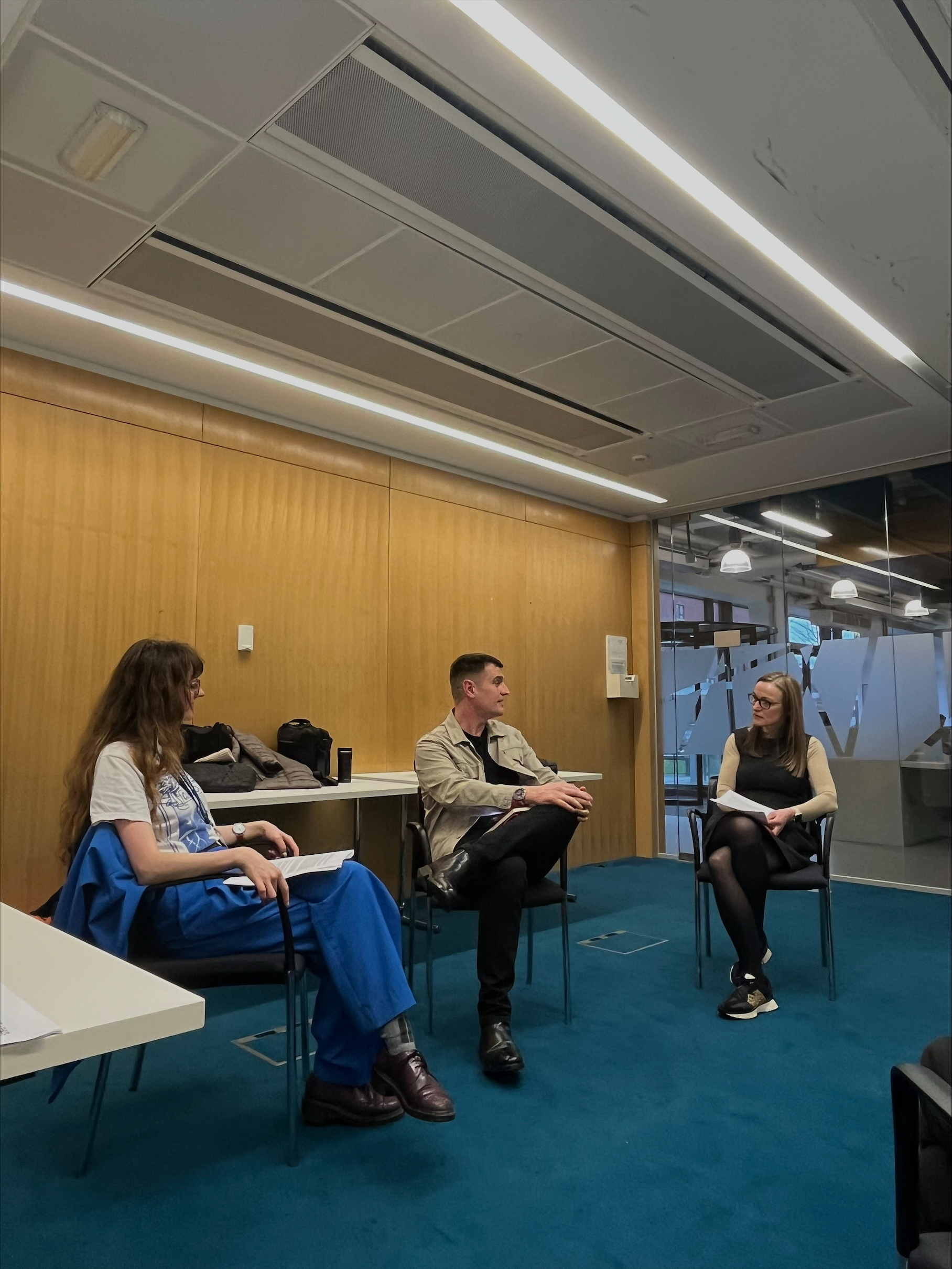
What a fucking privilege to sit down with a writer whose work not only touches a nerve but leaves a whole room of folk feeling inspired, invigorated and just the right amount of raging about the world to go and do something good about it. Graeme is an eloquent, generous speaker who came to StrathWrites last week to talk to us about his memoir, The Cloud Factory, along with his debut novel The Young Team (2020) which has made waves for its frank engagement with Scottish gang culture, masculinity and the vitality of Scots language. Graeme read from the end of The Cloud Factory, a work which feels like memoir dialled up to the communal document of what it feels like to be both inside and outside of something, to memorialise it and to work right through it, to know what was beautiful and also painful beyond words, camaraderie and shattering, refusing to paper over the cracks in reality, to note their presence and texture, to send up lost pals and those who never made it, to speak measuredly about how class and gender affect everything, to meditate on addiction, self-medication, faith, to find a turning point, to know what the past does, ‘stored as a memory in yir very cells’. He’s an author that gets it — the inside violence as much as the outside — and it’s clear from listening to him and watching a room full of folk listening to him that he can negotiate what goes unsaid with clarity and determination. After the reading we all just talked for ages, people sharing their stories and their experience of working in schools and what it means to teach and mentor and edit and pull each other through the muck of it all. What I loved most was everyone just speaking in their strongest tongue, telling stories.
~
StrathWrites is a series of writing events and workshops supported by the Strathclyde Jubilee Engagement Fund and the Strath Book Club. I’m lucky enough to work with the wonderful Jenny Carey from the Institute of Education — she’s swiftly become a radiant presence in my life and we’ve had loads of fun collaborating on these events.
READ: Extract from The Cloud Factory by Graeme Armstrong, in Granta
For anyone who missed Thursday’s event with Graeme, in lieu of a recording here’s a transcript of the workshop handout:
‘In place ae a realistic dialect portrait, authors create mutations where narrative is transacted in a ‘higher’ form. The clarity ae thought n expression afforded tae oor native guide default tae a more palatable Standard English. Meanwhile, the low, wild demotic dialect is reserved fur characters, who become linguistic puppets dangled on strings ae supposed authenticity. Characters ir reduced tae caricatures by this effect, their true dialect offered as dialogue canapés tae the unfamiliar reader, satiated by the apparent otherness ae the partial linguistic exhibit. They provide the local reader nae such nutrition. Oor language becomes a motif n isnae truly represented or respected by it. Nae working class Scot thinks in RP. Kin yi imagine? The willin suspension ae disbelief fur us is broken. An elevated n alien Standard English narrative voice betrays the remainin realism they have so carefully n respectfully crafted.’
— Graeme Armstrong, ‘Standard English is oor Second Language’, Literature Alliance Scotland
‘My culture and my language have the right to exist, and no one has the authority to dismiss that.’
— James Kelman’s Booker Prize Acceptance Speech 1994
Prescriptive grammar, in other words, becomes the sound made flesh of prescriptive pronunciation. The tawdry little syllogism goes something like this:
1. In speaking of reality, there is a standard correct mode of pronunciation.
2. In writing of reality, there is a standard correct mode of pronunciation.
3. In reality, correct spelling and correct syntax are synonymous with correct pronunciation.
Putting it another way, if a piece of writing can’t be read aloud in a “correct” Received Pronunciation voice, then there must be something wrong with it.
— Tom Leonard, ‘Glasgow Stir-Fry: Chopped language pieces on “the language question” in answer to a request’, Poetry Ireland Review
Drug-inspired delusion or Christmas epiphany, A cannae say fur sure but everyhin changed fae that night on. A never used drugs again n the violence wis finished tae. Suhin stirred in that wee flat that feels fundamental tae ma life noo. Maybe it wis always kinda there n just a ringin phone, never answered. The mare A sat n scrutinised it days later, A felt stupid n that kinda exposed way that speakin aboot faith sometimes makes yi feel, like if yi told any yir pals they would rip the pish oot yi n aw laugh. That feelin started tae pass. A dunno the ins n oots ae aw this either. The required leap that faith demands is complicated tae the best ae us, but ask yirself this, who really made the clouds? N when they clear, ask yirself, who put aw they fuckin stars up there? No everybody hus faith n that’s sound. A don’t minister tae anycunt, but A know the difference it made tae me wis life or death. That’s no nuhin.
Gangs huv dominated ma life. A’ve spent the last decade recoverin fae them n tryin tae find the words fur it aw in ma writing. That’s twenty year ae gangs in total. Their effects on yi ir far-reachin n complicated. Substances n drink ir used by many as self-medication. The aggression n hypervigilance that years ae gangs create don’t just disappear. They’re stull somewhere below, stored as a memory in yir very cells or expressed as violent tendencies.
— Graeme Armstrong, The Cloud Factory
WORKSHOP ACTIVITIES
Word bank warmup
Share what you consider to be an unusual or personal word – perhaps one you associate with place/location or a dialect word. Share a definition with the room.
Then pick someone else’s word and use that as a prompt for some free-writing.
Discussion: collocation e.g. ‘pishy pubs’. What effect do these have on our sense of familiarity with the world of the prose and the associations we have between words?
Voice
Writing dialogue: write a conversation between two people who come from a place you know really well. It might be your hometown or your current neighbourhood or a place that’s connected to your family somehow, or just a place you’ve spent a lot of time. Think about the textures of familiarity that are revealed in the language: experiment with dialect, code-switching and loanwords.
Now write about the relationship between these two people using the same dialect that they speak in. Whether your narrator is third person omniscient or first person, experiment with writing in dialect so that there isn’t a stark difference between how the characters speak to each other and how the narrative ‘speaks’.
Memory triggers
Think of a photograph or significant object that holds memory for you. Describe it in detail and use it as a springboard for writing a poem or story. Be as personal as you like.
Turning points
Write about a turning point in your life where you realised something, or had to make a decision to live differently.
This event took place on 21st March 2024 at the University of Strathclyde.

 mariaology