A long time ago, far out in the constellations of mythology, Rapunzel let down her hair. And what lovely hair it was, a waterfall of gold, spilling from the window of her tower. Answering the call of her keeper or lover, she unravelled her braids to form a rope. Rapunzel’s hair, then, provided the connecting threshold, the thread that stitched together her turreted psyche and the world outside. It was also her downfall, allowing her to have illicitly a lover. Her keeper, Dame Gothel, became jealous and cut her hair, and left her to live a withered existence out in the desert. The tale takes us from the lush beauty of a ‘splendid garden’ to the arid desert, where eventually Rapunzel and her lover reunite and find happiness. It’s a peculiar tale of desire, entrapment, revenge, femininity; a tale which sets the scene for wider cultural mythologising of long hair. It’s a mythology that we’re still fascinated with, as the popularity of the Disney adaptation of Rapunzal’s tale, Tangled (2010), attests.
History and myth are glutted with references to the power of lengthy tresses. Take Samson, the Israelite leader who lost the source of his strength when his lover Delilah betrayed him and cut off his long hair. Or the Sif, the wife of Thor, whose wheat-coloured locks were cut off and stolen in her sleep by the malevolent god Loki. After Sif’s husband entered a threatening rage about the hair theft, Loki ordered dwarves to weave Sif a new mane of hair out of threads of gold, more long and beautiful than before. There’s also, of course, Medusa; the monstrous Greek guardian whose hair famously consisted of venomous snakes, and whose eyes turned their onlookers to stone. In his essay, ‘Medusa’s Head’ (1922), Freud suggests that her snaky mane is linked to the castration complex, the (male) fear of having one’s genitals effectively guillotined. Freud’s typically eyebrow-raising essay links Medusa’s head to the female genitals, and the supposed threat of castration a boy experiences if he catches sight of these genitals. Well, apparently, Medusa’s snakes also alleviate the terror of castration, since they provide supplementary figures for the penis, thus filling in the implied absence of castration. And of course, Freud throws in a cheeky sexual pun, as Medusa’s head makes her ‘spectator stiff with terror’, and thus not only turns him to stone but also arouses him: ‘[f]or becoming stiff means an erection. Thus in the original situation it offers consolation to the spectator: he is still in possession of a penis, and the stiffening reassures him of the fact’. Yes, quite.

Well, it’s undeniable that literature has tended to represent a woman’s long hair with desire, sexuality and beauty. Take this passage from Book IV of Ovid’s Metamorphoses:
Medusa was astonishingly fair;
She was desired and contended for–
So many jealous suitors hoped to win her.
Her form was graced by many splendors, yet
There was no other beauty she possessed
That could surpass the splendor of her hair–
Yet while her hair made her an object of desire, a thing to be ‘contended for’, the ‘splendor’ of her snake hair also symbolises her multiplicity. As the snakes are full of a life of their own, Medusa cannot be pinned down, her personality is multiple, endless. Her hair is its own being, extending in legend and through history. It is slippery, but also a symbol of her power. Indeed, Hélène Cixous reclaimed Freud’s psychoanalytic pinning of Medusa to advance her feminist call-to-arms for women to rethink their sexuality in relation to language. In ‘The Laugh of the Medusa’ (1975) Cixous critiques the way Freud’s castration complex reinforces the mythologising of Woman as hysterical, as the Unknowable, ’dark continent’. As weak, passive, mysterious. Through writing (extending the lines of multiplicity that we find in Medusa’s hair), women may reclaim themselves, reach out and produce their desires and being through writing. Just as Cixous herself reclaims the mythical figure of Medusa from Freud’s cigar-stained fingers: ‘she’s not deadly’, Cixous argues, ‘she’s beautiful and she’s laughing’.
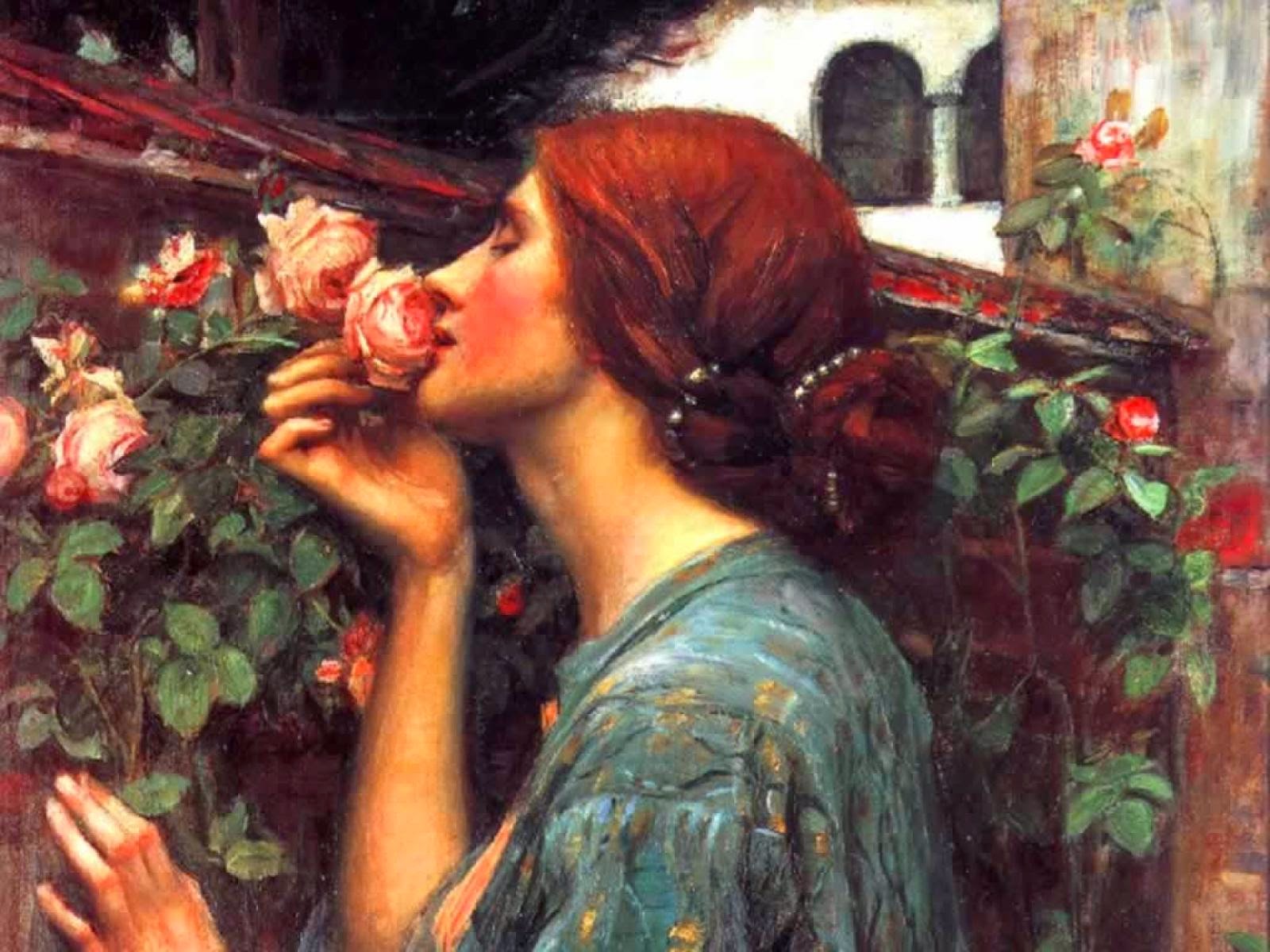
There is something joyful and exuberant about long hair. Think of the connotations: a young girl skipping through a field of wheat, streaming behind her a cherry red ribbon. An Austen heroine waiting to be the belle of the ball, or the flame of The Little Mermaid’s rippling tresses. It is a distinctly youthful trait, too; a symbol of childish innocence. In Victorian society, only children tended to let their hair down in public; if a girl wished to be seen as a woman or ‘lady’, she must pin up her locks, dress them in ornaments and braids. Letting one’s hair loose as a woman was seen as a sign of wantonness. Thus, the artistic portrayal of woman with their tresses flowing free represented a kind of back-to-nature aesthetic, a fetishising of the body, the long locks relishing a kind of originary femininity and sensuality. Perhaps also a wildness, a breaking forth from repressive societal values – the kind of constructed femininity that kept women as the domestic ‘angels of the house’. Think of the young Cathy in Emily Brontë’s Wuthering Heights (1847), her hair streaming behind her as she gallantly trails the ‘savage’ Heathcliff over the hillsides, or the iconography of the ‘fallen woman’ as depicted in Dante Gabriel Rossetti’s Pre-Raphaelite paintings. Women who did not look in the mirror and reflect back the pale perfection of the chaste Victorian angel, but positively glowed with their own matter – their glorious hair – their sensuality. There is something in that: the glorious feeling of standing on a cliff edge, letting the wind whip your hair across your face and fill it with billowing energy. Just don’t try it when you’re trying to eat ice cream.

Today, like everything else long hair has been sucked into the commercial imperative. Perhaps that is why long hair has been associated with anti-capitalist and consumerist movements: the lengthy tresses of 1960s hippies, Marx with his wild white beard and mane, the fluffy mop of Che Guevara. Long hair (especially the unkempt dreads of the hippies) was never really a friend of the drone-like demands of the job market. A short sharp haircut symbolises ‘cool’, edginess, the new freedoms enabled by consumption (think of the bobbed Flappers of the 1920s). Advertising impels us to buy products, perfect your femininity, express yourself through a new style; a new cut, spray, or shampoo. ‘The latest hair trends’, the V05 website proclaims, ‘help you express yourself’. Every day is a decision about how one will adorn oneself, about one’s performance; hair becomes a web of possible signifiers, waiting to be decoded by an image-consuming public, or at least by that stranger across the street. Femininity is a performance, but the secrets of self lie in the hair. There is Kim Kardashian, that postmodern queen of the feminine, a patchwork of skin and plastic flesh, of shiny dye and hair extensions. Websites will spend considerable time and space unpicking the details of Kim’s hairstyles, as she shifts chameleon-like from blonde to black to ombre. It seems that still we read a women through the strands of her hair, as if they were lines of text.

In Greek mythology, the long-haired Sirens were alluring femme fatales who seduced sailors with their bewitching singing, leading them to perish and shipwreck on their islands. The beauty of these long-haired beings is thus inherently linked to danger, a threat to the freedom and power of masculinity. We might make a connection to the emasculating anxiety of becoming trapped in feminised domestic space. We might also make a connection to the contemporary use of the word siren in relation to (often long-haired) actresses: she’s a real screen siren, we say. Again, these sirens are beguiling, but often perilous in luring their spectators into the isolated islands of their cinematic fantasies.
Yet in addition to these chains of mythology, hair at its most basic component is protein: an element of our body which symbolises nurturance and life. Like our hair, we are always changing, growing. If we look after our bodies with sleep, good food and exercise, it shows in the glow of our hair. A quick flick through a photo album will reveal a history of hairstyles, which reflect not only on the (dodgy or not) cultural trends of the period, but also on ourselves. Who we are and were.

My own hair history is a fairly interesting one. I’ve always loved long hair, ever since (perhaps even before) I watched a rented VHS copy of Splash (1984) and decided I wanted to be a mermaid. Refusing my mother’s futile attempts to brush my hair, I went to school with a witchy mane which was only sometimes contained in double, Heidi-like braids. There’s a picture of me at my seventh birthday party, with it all crimped as I grin at the camera, wearing 90s-style Baby-Spice white leggings. It would’ve looked almost cute, if I didn’t have a full-fringe which took over half of my skull. Safe to say I’m not such a fan of primary school photos…

At least I earned the comparisons I (still) get to Hermione from Harry Potter (and not just through the geekery department). Kids at school would ask me if I ever bothered to straighten my hair (or at least brush it, one girl sighed) – this was back when everyone had to wear their hair poker-straight and smooth as if it had been recently ironed, Bridget Jones style. All that static flattened out; everyone a clone. You could almost smell the whiff of burnt heat spray as the other girls glided past. I wanted GHD straighteners for so long, that by the time I got them (a joint present for me and my brother, who was then going through his wee 12-year-old emo phase), I quite liked my hair a bit wavy or curly. I still have and use that same pair of trusty straighteners, incidentally.
Hair was always a contentious issue in my schooldays. The P.E. teacher would warn us every week that if we didn’t have it tied up in class, we’d be forced to wear rubber bands to pull it back. I’d always imagine the excruciating sensation of pulling a rubber band out a ponytail (along with half of my hair), every nerve searing with dread. By the time I was thirteen my hair was pretty long and for Halloween I bought some of that wonderful Stargazer semi-permanent dye and made a half-successful job of my hair. I think I got that sort of ethereal/faerie/cyborg look, as I dyed the top half pink and the bottom half blue, and my bad dyeing skills meant I actually got quite a cool ombre effect as the shades blended into each other. I wasn’t so good at clearing up the spattered mess of the bathroom, which resembled a mediocre Jackson Pollock painting by the time I was finished.

Oh, and with said blue dye I also did my brother’s hair once. My friend and I bought him some cheap permanent blonde stuff from Semi-Chem, thinking that because his hair was so naturally dark it would need a bleached out base. I didn’t think the blonde would do much at all, maybe only lighten the brown a bit. Somehow, however, it worked a treat and he had the most, um, skunk-like streaks of yellow in his hair. Diligently, we applied the blue dye, forbidding him to look in the mirror until it was finished. With everything all rinsed out, I suppose he looked more like Sonic the Hedgehog than the Billie Joe Armstrong look he was probably going for. It also didn’t help much that I also let my friend cut his hair in the Debenham’s family toilets (while I sipped warm wine mixed with whisky from a plastic sports bottle – classay!), leaving chunks of it over the floor like it was the detritus of some old, innocent self. After a few week’s of swimming lessons, the chlorine made the blue bleed out into a measly green, and he’ll probably never forgive me for that.
The best hair I ever had was platinum blonde. I loved it so much. I guess it was my failed scene-kid phase, when I wanted hair that was long and spiky and backcombed like a rat’s nest, a white canvas to set off my black liner and neon eyeshadow. The bleach process took over three hours for the hairdresser to do, and probably cost all my birthday money and a month or so’s worth of EMA, but it was worth it. I was born a bonnie wee blonde, but cursed with the family trait of having this fade. Having bright blonde hair makes you literally dazzle. Anita Loos was the first to say that ‘gentleman prefer blondes’, and it’s become an adage that blondes have more fun. I don’t know about all that, but you do feel like you’ve become some diamond in a sea of dull, radiating a new light. It fades though. The roots cut in like black leeches and the strands dry out like straw. You get bored. I let the blonde grow out and kept the tips as a kind of proto-ombre (I swear I got there before Alexa Chung et al), which remained as a kind of limp homage to my teen years pretty much until about a year ago, when I went the whole way with the brunette thing.


And now I just wished I was ginger, or at least half ginger. That’s my plan now: gradually get more ginger. There’s something special about ginger hair; the way people try to hide it with lovely euphemisms – strawberry blonde – the way it’s linked to a fresh freckled face, or strange stereotypes (ginger people don’t have souls, I’ve been told). Its Celtic connotations. I want the amber and russet tones of Pre-Raphaelite tresses, that look gorgeous in autumn. It’s a sort of long term life plan, but probably achievable, although it’s one of the hardest colours to get right. You could end up with some cat-vomit orange, or a lustreless red, if you’re not precise with your dye. Yeah, I’ll do it gradually. It took me a while to get my hair as long and strong as it is now, so in spite of that saying ‘it’s hair: it’ll grow back’, I’m not risking my mane anytime soon.


Sure, I love the idea of hair makeovers. Get several inches lopped off and highlights put in and maybe an undercut. It looks cool on loads of people. But I’m definitely one of those strange souls who finds their hair a total comfort blanket, a scarf in the winter, something to chew on idly when I’m staring at a computer screen. I like being able to hide my face in awkward situations, or conceal the fact that I’ve made no effort with my makeup. It becomes a kind of signature, and people remember you by your hair. It would be hard to lose that, like shedding a self.
However, I’m not denying that long hair, rich with sensuous mythology though it is, isn’t a proper pain in the arse. The brushing, painful detangling, the half-hour plus hair-washing, the problem of it getting stuck in the door when you’re trying to clean the microwave. How to wear it for work; nobody wants a spaghetti strand of hair in their £18 steak. You do come up with a good routine though and it becomes manageable. I promise, it’s worth it.
Desire, jealousy, strength – all things long hair represents in myth. Sure, everyone has bad hair days, but maybe a bad hair day with long hair is more a ‘I just came out of the ocean’ look rather than ‘I just woke up’. Long live the mermaids.

Long hair-care tips:
- Wash as little as possible. I wash about once a week with a teaspoon of shampoo and a heap of conditioner.
- Good diet! Eat all your greens: kale, spinach, celery, avocado and broccoli are best.
- Coconut oil: heat some up and slather your hair in it and leave overnight for a nourishing hot oil treatment.
- Buy a tangle-teezer and make your life 50 x easier.
- Try to sleep with it in a braid.
- Wash it in the coldest water you can stand, and only start to blow dry it when it’s about 80% dry, so it’s getting less heat damage.
- Soft scrunchies are better than harsh bands!
- Give yourself or get someone else to give you regular almond oil scalp massages. A splash of peppermint oil mixed in also stimulates growth.
- Regular trims will not make it grow longer (myth myth myth!) but obviously keep your ends in good shape.
- Try using colour-depositing shampoos and conditioners as a less damaging colour upkeep as opposed to layering up permanent dye. Henna can also be good, although it doesn’t ever wash out, so be careful and do a strand test.




 mariaology
