The birds in the garden have been keeping me up again. Sleep slides in and out of the dark hour, for which I’ve been hoarding the lights in my room for a sunrise. I’m not very good at putting on records; they always jump at the wrong bit, glitching backwards. When you wake up because the moonlight is too bright. It is a question of paying attention. It is a question of living quiet. I wish I could sleep like you.
Spent a few days waiting on trains late into the night or the afternoon. My fingers making a conspiracy of amethyst, mottled with cold. There’s a little glass case you can stand in, twirling your body to get the light to switch on again. I’ve got my comforting songs pressed into my headphones. Funny things happen in my chest when I hear them. Sometimes it’s a release, other times it’s like you can see all the filaments of your blood and sinew twist and sprawl like delicate vines. It feels hot and temporary. I flicker through bad thoughts about what might happen to the people I love. I flicker through good thoughts about what we can do with the summer. It seems so distant.
Sometimes I fall literally into bed; it’s like someone is dropping me.
There are moments I pull very close. There are places where everyone is here at once. There are places where it’s just us and it’s finally warm and my mouth tastes of dark fruit cider and other people’s cigarettes I didn’t want in the first place. The curtains are always closed.
I keep thinking about how there are takeaway shops in the southside named after glistering techno bands and wondering what came before. In my head it is always the music, but then maybe that is something Leonard Cohen said, or didn’t. No, what was it, we are ugly / but we have the music. These shops look like dollhouse shops with all the tools and objects miniatured, but maybe this is just an effect of where I’m standing from across the street, short-sighted. I went out dressed in gingham shorts and other inappropriate quantities of yellow. To have music you sort of have to walk a bit more; you have to let rhythm and melody drop memory with muscle. I once said, leaving a party, I have to make tracks and he thought I meant laying down records. But in a way it is all just recording. When do we click off? Skip between beats.
There are signs of spring. I say this as it starts to snow. I mean a few days ago I could see buds on the trees, little yellow flowers. What happens now? Do they retreat inwards? I picture them shivering within precious membranes, cocoons, algorithms of promise interrupted. It’s okay, I’ll be buying less of these indulgent Lindt eggs from the Tesco round the corner. I’ll thin out eventually. Easter will come too early this year. Winter keeps us in its arms forever, shivering because like those buds we are children. Some people burst through. I admire the impulse. It’s like what, dancing naked in the snow. I used to listen to Sonic Youth when I was angry, whacking objects off dressers, now I close my eyes and try to visualise the colour blue. I get about as close as turquoise before everything melts to bliss. That would be the ideal effect. There’s something very beautiful and suggestive about the word lagoon. Is there a pill for this?
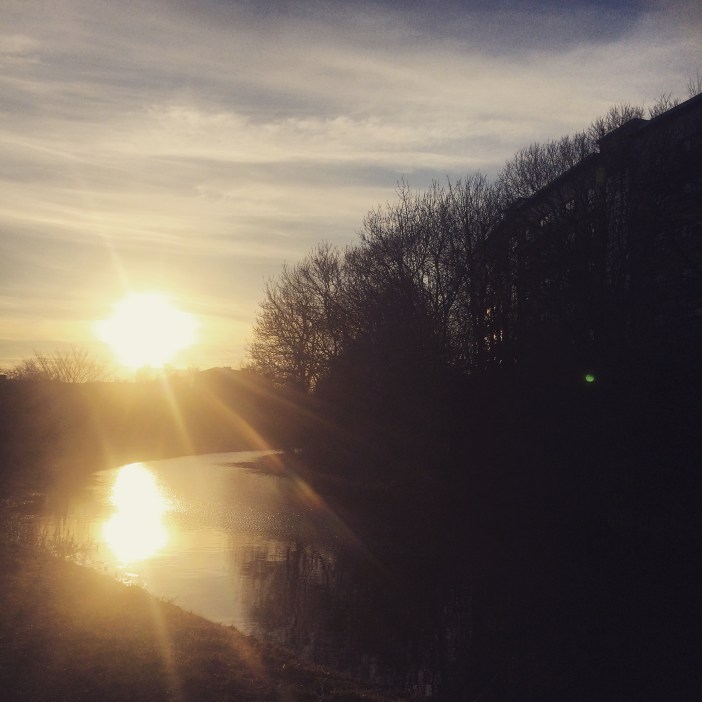
Recently I’ve been rediscovering canals. You see it’s actually been sunny. You have to walk along the motorway, cross several spaghetti roads to get over to the Phoenix Flowers—these sort of peculiar, half-lovely windmill structures. Then an underpass and up some steps. I follow a band of miscreant hipsters. A sign saying Urban Oasis. The canal looks good when the sun hits. I mean it looks sharp and glassy and properly blue. The trees glow ochre in the sun; the way they have faded all through winter seems refreshing now instead of exhausting. In a few months this should all be green. There’s still a fragility. Very little litter. You can see the stadium and the industrial buildings, warehouses and garages and houses. Everything over there gleams rust in the sun. I listen for whistles or song but the air is only as close as my headphones. I’m listening to The Kinks Are the Village Green Preservation Society, remembering odd passages from Cider with Rosie and feeling regret for nights I could’ve made longer with more wholesome spirits. Waking up to bright clusters of strawberry jam on bread like blood on the sheets.
Nothing floats by on the canal, though there are boats tied at Applecross and then a few bottles bobbing their dark viridian messages. I write letters to friends in England, emails to friends in America.
Somewhere down the line, where does all this become ASCII?
I write an inordinate quantity of poetry about bruises and flowers and passing time. The year has stepped up its bicycle gear and I wish my bike was in order so I could fly down the Clyde like Brendan and May in Ruby/Sapphire. Most mornings are filled with flash fiction and occasional bouts of panic. I finish draft ten of an important application.
Daffodils on the kitchen table bloom overnight, just like that. They are marvellously, gorgeously yellow. I feel no shame in showering adjectives.
I dream a lot about the sea. Except we don’t reach it. Mostly it is a question of negotiating cliffs to find safe accommodation. I buy family-sized bags of crisps just for the taste of salt, then feel awful afterwards. This is probably normal.
I am drawn to a piece of teal-coloured scaffolding mesh that resembles a streak of kelp on the street.
It feels good to make coffees and twirl around tables. It feels good to be serving, to eke out a few hours on other people’s time. Sometimes I look forward to a long, long waitress’s summer. Sunlight, sparkling lager and indefinite afterparties. Reams of time to commit to writing in lieu of sleep. We hover at table six and salvage lost noughties culture, folding paper napkins to crisp blue lines. If everything was this chiasmic, easily given to compost.
Today’s Oblique Strategy pops up on my Twitter timeline: Make something implied more definite. Last year I got Tinder but ended up using it mostly to talk about Brian Eno to at least two strangers. I feel like I understand lust less; it is like clustering the silent hours with extra ambience. This is not necessarily a bad thing. The snow outside my window right now is pretty pathetic. People are shaving the skin off clouds. It is really happening; the gaps are appearing. Sometime early nineties, year of the Rooster, hole in the ozone layer.
Being a sucker for charm, longing for the twilight of virtual swamplands where it is possible to cry again. An effect of atmospheric toxins. This is a slow-burner, just slip it on and trust me. You can see through the nacreous membranes, someone else’s confected scrolls of sugar, confession, snow.
~
Hookworms – Ullswater
Robert Rental, Thomas Leer – Day Breaks, Night Heals
Beth Orton, Four Tet – Carmella (Four Tet remix)
Kiasmos – Blurred (Bonobo remix)
Beach House – Lemon Glow
Agony – Beach Fossils
The Orielles – Old Stuff, New Glass
Japanese Breakfast – Soft Sounds from Another Planet
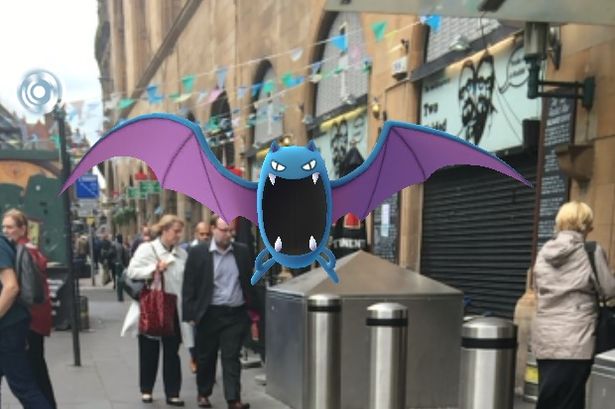
I scroll down my Facebook timeline, and there is a photograph of a pavement – on a real street which I recognise – and on that pavement is a Pidgey. You know, the wee brownish flying thing from first generation Pokémon? I scroll down a bit more and folk have been out and about all over the place: there’s a Weedle on the gingham tablecloth in a cafe, a wee purple-grey Nidoran on a hay bale, a Magikarp bouncing around by the Kelvin. This is, if you haven’t guessed already, people sharing their spoils from Pokémon Go, an augmented reality game which allows you to catch Pokémon in the wild, a.k.a real life. There was a glorious month in the summer when you could go for a walk and see clusters of people milling around with their phones in the air, as if trying to channel some ethereal spirit that was wafting in the atmosphere. They were out catching Pokémon. All of a sudden, people were going for walks again, leaving the house and the cosy glow of the television to catch invisible beasties who lived in trees and parks, museums and street corners.
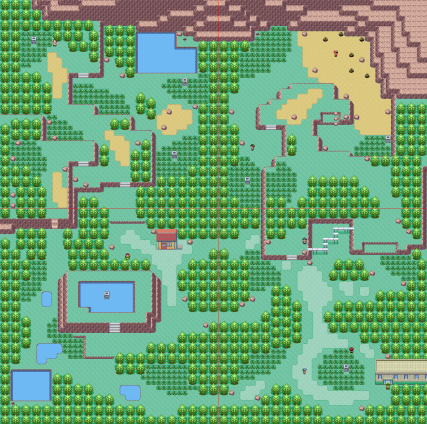
Safari Zone Map from Pokémon Ruby/Sapphire. Image Source: PsyPoke
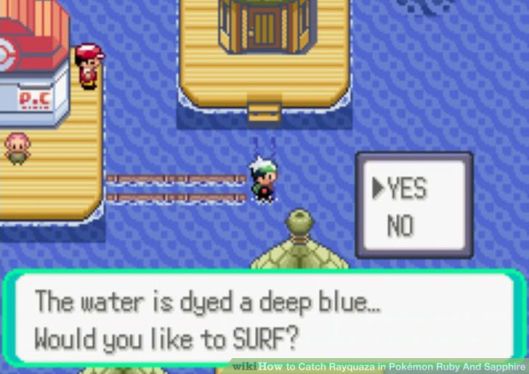
As a kid, I was an avid Pokémon fan. I missed the boat for Red and Blue but had Yellow, Ruby, Sapphire, Leaf Green for my Game Boy Colour and Advance and played them all to death. What I loved more than the battles was the wandering part. So much of your time is taken up pushing your way through long grass, cycling along seaside promenades, bobbing along the ocean, taking shortcuts through forests, crossing through dungeons, traversing the plains of mountains and deserts. You’re constantly interrupted by Pokémon encounters; so much so that often you double back in confusion, any instrumental pathway you’re trying to take disrupted by the screen switch to a battle. The towns often had such picturesque names as ‘Petalburg City’, ‘Sootopolis City’, ‘Lilycove City’ and ‘Mossdeep City’. Then there’s Meteor Falls, the Sunken Ship and Sky Pillar – these are just from Ruby/Sapphire alone. Yes, the game has a final purpose: you’re supposed to beat the gym leaders of every town and follow some convoluted let’s beat Team Rocket narrative, but often its trajectory is beautifully non-linear. You can explore, catch Pokémon in your own time, find side quests to achieve, people who need help. Acquire potions, level up your Pokémon, learn intriguing stories from local mythology.
Screen Cap from Ruby/Sapphire. Image Source: WikiHow
There is an obsessiveness to Pokémon, a desire to always repeat. As much as possible, you find yourself returning to previous towns and locations, either to seek out more Pokémon known to appear in the area or simply to explore, to see what you’ve missed. Invariably, you do nothing new, and manage to enjoy that process of wandering again. You fight the same Pokémon, hoping they will flee but secretly enjoying taking them down in one shot with your level 40 team, where once you’d have to fight tooth and nail with a goddamn Zubat. To some extent, Pokémon is a rhizomatic game: once you get to a certain stage, the world is yours to explore and you can map out your own routes and lines of flight as you see fit, flying and sailing and seeking locations of your choosing. However, you are still governed with the impulse of narrative, which spurs you onto particular places: sometimes you can’t move on till you’ve beaten the gym leader of that town, for example. You can regress, but not progress. There’s that sort of macho narrative of levelling up which you’re impelled to follow. It’s only when you’ve completed the game that you can reap the rewards of complete exploring.
Pokémon Go changes that. By transferring Pokémon to real life, you are as free to explore its terrain as you are to wander the streets of your local town or city, or indeed the plains of the countryside. Real life is transformed by augmented reality, the imposition of Pokémon on material space. Creatures that only the player, holding up her phone, can see. This is already getting very Black Mirror, but wait. It’s a competitive game, yes, but there aren’t the drastic consequences of social exclusion and alienation experienced by many of Black Mirror’s tech addicts. There is a lovely playfulness to Pokémon Go which somehow has generally avoided becoming cutthroat competition. For a while, everyone was playing it. It was a form of camaraderie (folk would go out in packs to hunt for Pokémon, or indeed organise mass hunting expeditions via Facebook). More time was being spent on the Pokémon Go app than on Snapchat, Twitter and Whatsapp. I’d go into the kitchen at work and the chefs would gleefully show off their Pokédex; which was glorious, seeing all those familiar creatures again in this new and surprising context. And since chefs have hardly a moment’s time when they’re not in the same place, working 14 hour shifts at a time, I can only imagine the extent to which people in other walks of life played it.
Pokémon Go is a strange way of making people notice their surroundings, particularly in the sense of urban space. Sure, most of the time their faces are glued to the maps on their phone screens, but in placing themselves in the world, they are forced to confront physical structures, obstacles, windows, private property and so on. It becomes even more of a game when you have to work out how to attain Pokémon in elusive locations. I’ve heard stories about folk knocking on your door asking if they could come in because they’ve noticed you’ve got a rare Pokémon in your house. It sounds pretty sinister, but it shows the level of commitment the game inspires.
Think of it this way: why is it so addictive? Like Tinder, it’s a form of locative media which uses your GPS to determine who or what will appear in your surroundings. Pokémon Go also uses your phone clock, as different types of Pokémon appear at different times of day. I’m reminded here of one of my favourite games, Animal Crossing,where you could go fishing and bug-catching but what was out there was determined by the ‘real time’ of your Game Boy’s internal clock. It followed the real time of a 24 hour day, of the seasons and so on, so that in December there’d be snow and falling leaves in autumn. It was very beautiful and the real time aspect has an addictive quality. I think it’s because the game becomes less a form of escapism and more a parallel to reality, to everyday life. You know it’s reached that status when The Mirror runs a how-to guide, eh?
What’s so cool about Pokémon Go is how it adds meaning to real space. A school, town hall, park or pub becomes a Pokémon Gym and everyone wants to visit. I swear business at my work improved for a month as we quickly realised we were a Pokémon Gym and groups of sullen young adults would gather silently at bar tables, trying to battle other trainers at the gym and hoping to win Pokécoins. A guy I work with would heavily protest when he saw someone playing the game because he was currently gym champion and got surly at the prospect of newcomers taking his title. If I was late bringing someone a coffee, nervous they’d be grumpy with me, often they were so distracted by the game that they’d not even noticed the time. In a sense then, Pokémon Go transforms both time and space. Everything is flattened into a map, where flashing nodes indicating Pokémon are the symbols of desire, the objects of pursuit.
In a compelling, complex and challenging article on Facebook as a ‘desire-network’, Maria-Daniella Dick and Robbie McLaughlin argue that ‘Facebook effects a mutation in desire and thus in capitalism’, and in tandem with this, a ‘historical shift inn the relationship between psychoanalysis and capitalism’ (Dick and McLaughlin 2013). With Facebook, ‘desire remains impossible to satiate, but it is now without object’ (Dick and McLaughlin 2013). They suggest that Facebook is situated within the Lacanian Imaginary order (which constitutes the intrinsic narcissism through which the human subject constructs fantasy images of both herself and her object of desire). According to Lacan, desire (unlike need) is always unfulfilled; we are always moving towards a lack, the anxiety prompted by something lost (as in the child’s original sense of wholeness before discovering the fragmentation of her parts, the split between her body and world and mother, in the mirror). The Imaginary is that which we create to attempt to fill that fundamental gap, the fantasies of the ‘ideal ego’ which compensate for an originary loss. Facebook is basically the ultimate web of the Imaginary: all our time is spent scrawling through pictures and statuses and shared media which all in various ways represent fragments of the ideal selves we project online. Yet our browsing is ultimately without end, it is ceaselessly rhizomatic, decentralised; we end up on one place, a restaurant page or old friend’s profile, without really knowing how we got there. Our passage through the network is governed by algorithms which attempt to map our desires; algorithms which are self-sustained by users’ input data, the patterns of usage recorded with every click. While this may seem revolutionary, a democratic decentering of the system, Dick and McLaughlin are highly sceptical of Facebook’s subversive potential at the scale of the political.
While the likes of Facebook were integral in the organising of such glocalised (global/local) revolutionary events as the Arab Spring or the Occupy Movement, ultimately ‘[s]ocial networking completely embodies and facilitates these phenomena in which the masses are now able to organise efficiently but without being unified by a radical ideological alternative’ (Dick and McLaughlin 2013). The fragmentary pathways of Facebook map out the lines of insidious liberal democracy, and as engrained as they are in corporate culture (the corporation itself becoming the medium for mass communication) offer little opportunity for imagining visionary alternatives to liberal capitalism. Crucially, Facebook (with all its user-directed interfaces based on algorithms of taste and so on) perpetuates the myth of the liberal individual, who curates her profile, her tastes, conducts a life of many choices. As Dick and McLaughlin (2013) put it: ‘[t]he so-called 99% are already conditioned by a liberal democracy in which they have the self-identical sovereignty of an individualistic ideology that places the subject at the centre of the world’. To really offer a vision for an alternative future, we have to actually come up with a plan. Recognise that we are always-already networked individuals, whose subjectivities are hardly unique and instead constituted through structures of discourse and power, and use this in a positive way, to undermine the liberal justifications for free-market capitalism.
What does all this have to do with Pokémon Go? The thing is, Pokémon Go seems like innocent child’s play, but it’s bound up in the politics of space. It’s fundamentally structured by GPS software and urban space, and let’s face it, urban space is always ideological. Whether it’s homeless spikes, shiny new glass-fronted apartments built where Brutalist high-rises used to be, gated communities, the psychotic disarray of London’s property market, the genuine promotion of American Psycho-style yuppie-targeting ads or simply the denigration of social housing as ‘slum housing’, space and architecture is always somehow political. In a recent talk given at the University of Glasgow titled ‘Remembering the Future: The Politics of Space and Architecture’, Darran Anderson argued that the current failure of the Left is a failure to put forward a vision of the future that is compelling and actually positive; if we don’t act soon then someone else will determine the future for us. One way Anderson proposes we can intervene in the social order is through architecture, by building sustainable forms of urban space, housing and energy production that take into account the fact that we are living in the Anthropocene. We need to accept the imminence of ecological disasters, which are indeed already happening. We need to rethink our fantasy imagery of the city; it needs to become a network of playful imagination, of empowerment, rather than just passive defeat, or the kind of share-lite politics, browsing, blasé escapism and distraction offered by Facebook.
What is interesting about Pokémon Go is that it restores to some extent the object of desire, which Facebook, in its endless networks of people, places, photos and check-ins, displaces. ‘With Facebook’, Dick and McLaughlin (2013) argue, ‘people no longer live the present as present; it exists only insofar as it is exists to be recorded and later uploaded to Facebook’. This temporal displacement shifts with Pokemon Go, which insists on the present as present. Pokémon only appear for a limited amount of time so the imperative is to catch them in the game space of the now. The impulse of shopping or clubbing to buy buy buy or drink drink drink is gleefully interrupted by the appearance of Pokémon, who are quickly snapped up and snapped, shared online. The allure of ‘cool’ or the aura of dreamlike consumption attached to consumption-based social places is disrupted by the childlike logic of the game. And there’s nothing the companies can really do about it, since technically Pokémon isn’t intruding on reality, it’s only intruding on maps of reality. Now I’m thinking of that Jorge Luis Borges story, ‘On Exactitude in Science’ (1946), and getting very confused about reality itself. In the story, Borges imagines an empire where cartography has become so exact that its map of the empire must match in size and detail the empire itself—after which, what’s the difference between the map and the original? Do you need the map anymore, or can you use real space to map out real (map?) space?
There is almost something a tad Situationist about Pokémon Go. It offers no restrictions on movement, the way the Game Boy games do, according to a linear narrative. If you want that elusive Vulpix or Meowth, perhaps you will have to explore territories previously uncharted in your running app or Instagram places map. You might end up in the strange end of town. And what will you find when you get there? Traversing space this way leads to opportunities of surprise and discovery. The fact that so many people are posting photos of their Pokémon Go encounters online adds a new palimpsest of meaning to our understanding of place. The appearance of Pokémon disrupts the order of cities; it adds new points of desire to the map. Sure, most gyms are in tourist hotspots, but that doesn’t mean you don’t have to explore the more unseemly areas of town to catch ‘em all. In wandering out your comfort zone, you’re enacting a sort of De Certeauian ‘tactic’, resisting the signage and flows of capital which generally direct your movement in urban space (i.e. according to the circuit-like lure of the shops, the home or workplace). Ironically, you’re doing this at the inspiration of a global corporation (the folks who own the Pokémon Go app), but in this case, it doesn’t necessarily mean your actions and movements aren’t subversive. Nevertheless, the transgression of space according to augmented reality is unfortunately still bound by societal racism, highlighting the fact that we experience space differently according to who we are—despite its best intentions and possibilities, a game like Pokémon Go can hardly overthrow the prejudices of the Repressive State Apparatus…
Since Pokémon Go is based mostly on algorithms of mapped information, there is an element of chance which escapes the systems of data (could we call this glitch a Lacanian intrusion of the Real?). Pokémon crop up in controversial places. Since ghost Pokémon are attracted to graveyards and places of mourning (think: the original Lavender Town), they have been appearing in places like the Holocaust Memorial or Ground Zero. The incongruity of the playful critters in these places of silence and solemnity is startling and forces us to rethink our expectations of memorialising space. In a sense then, for better and worse, Pokémon Go has a reterritorialising impulse. Sure, you can report inappropriate places and instigate a process for removing them from the Pokémon Go map, but that initial appearance, based on some kind of algorithmic randomness, has already violated the implicit expectations of such places in terms of silent respect and mourning. There is in a sense an overflow of the gaming impulse, where the augmented reality becomes more distracting than reality itself (even when you are in such a compelling and startling location as the Holocaust Memorial…).
Houses that crumble…Screen cap from Omer Fast’s 2015 adaptation of Remainder, starring Tom Sturridge. Source: Belfast Film Festival
Perhaps this is the danger then, of supplanting a fictional reality (the map) for the territory itself. I’m thinking of the protagonist in Tom McCarthy’s novel Remainder (2005), whose response to trauma is to assemble a detailed map of a very specific retrieved memory, based in a house where there was a very specific synaesthetic symphony of liver-frying, cats on roofs, piano playing and motorbike clanging. Eventually this map is transferred to the ‘real’ as the protagonist recreates mimetically the details of this spatial memory. Yet pursuit of the real is addictive; the protagonist soon begins recreating more extreme and harrowing memories he’s encountered: traffic accidents, bank robberies. What intrudes, eventually, is the remainder: the real itself which spills out of the recreated event. As McKenzie Wark writes in the preface to McCarthy’s novel, ‘[t]he simulation is never perfect, always in excess of the thing itself. It always leaves a remainder. The most troubling remainder is himself [the protagonist]. He is a leftover God, a God as debris of creation’ (Wark 2015: xi).
In a way, Pokémon Go represents a God-like desire to reconfigure reality, to impose the Imaginary space of the simulated game upon the ‘game’ of ordinary existence. Is this a postmodern statement of irony, a pastiche of 1990s nostalgia in the age of the smartphone? Yes, and no. There’s something kind of modernist and sincere about it too, a sense of genuine interest in creating the Big Project, a utopian potential for gaming to bring people together. While Pokémon Go is partly about earning currency (Pokécoins) to buy more materials which help level up Pokémon or revive them during battle, its general impulse is towards exploration. Conquering, yes, to an extent; but mostly exploration. What happens when you’ve captured every Pidgey in your neighbourhood? You travel farther, maybe even beyond your hometown or city. Of course there comes a point where most of us get bored and stop playing, but there was a moment when the game genuinely seemed to interrupt reality in a way that felt genuinely liberating. The fact that so many people deemed it silly, a waste of time and completely illogical only highlights the ways in which the game resists the general instrumentalism of capitalism (i.e. every minute should be spent doing something useful, like finding ways of accumulating money and furthering one’s career). The time wasting aspect, the fact that so many people love its paean to repetition (you can walk the same route every day and still get different Pokémon appearing), is a queer sort of logic; it goes against capitalism’s futurity, the linear progression of temporality, in favour of a kind of maddening impulse of looping, overlapping desire. We accumulate the same Pokémon several times and this is part of the internal logic of the game, compelling us to traverse the various spaces again and again. It represents at once the immateriality of twenty-first capitalism (as based on flows of ‘invisible’ capital and immaterial goods, symbols of status) and the potential for subverting the logic of accumulation to one that is both bizarre and based on the ethics of play rather than success.
Sure, a great deal of the game might be about levelling up and being the best, but you can also play it with general disregard to those impulses. Collecting, in a sense, transforms the use-value of goods by placing them in a new circuit of information, taking them from the marketplace to the geeky world of the collector, whose interest in based on details and aesthetics, often more than financial worth. Just look at what happens when someone tries to make money off becoming a hire-out Pokémon Go trainer: they are threatened with being banned from the game, since it violates their code of ethics/terms of service. Play, rather than capital, is at the heart of the game’s map of trajectories. It brings people together – even adults – in a space of play. I’m not saying it’s changed the world by any means, and indeed it has its slightly absurd but very real dangers, as people blithely ignore the potential perils of the real landscape in pursuit of the desired (simulated) object, like Icarus flying too close to the sun…However, there’s something genuinely refreshing about how Pokémon Go forces us to reconfigure our sense of reality, space and the routing of our desires and movement. While world-views are shrinking and narrowing in post-Brexit times, Pokémon Go reminds us of the value of expanding our horizons and getting up to just go and wander, maybe aimlessly.
There will always be moral panics over deaths from selfie-taking, planking and cavorting in dangerous places, but will there be anything quite like Pokémon Go?
Bibliography
(other references are hyperlinked in the text)
Anderson, Darran, 2016. ‘Remembering the Future: The Politics of Space and Architecture’, Lilybank House Seminar Room, University of Glasgow, 15th November 2016.
De Certeau, Michel, 2011. The Practice of Everyday Life (Berkeley: University of California Press).
Dick, Maria-Daniella, and Robbie McLaughlin, 2013. ‘The Desire Network’, Theory Beyond the Codes, [Available at: http://www.ctheory.net/articles.aspx?id=727] Accessed 21/11/16.
Wark, McKenzie, 2015. ‘Preface’, in Remainder by Tom McCarthy, (Richmond: Alma Books), pp. vii-xii.



 mariaology