
I wanna show up for poetry every day for the rest of my life. There’s this word for when food continues to cook itself — carry-over — like tortiglioni warm and slippery in the colander needing to be eaten. I wish poetry could do that. A. says it does, doesn’t it? When you remember a line sometime down the line and it occurs to you: a new meaning. Or when the poem you wrote marinades in the background all to be felt with alternative pressure. I guess to write then is to throw out your salt or chuck a glass of water behind you as you leave the door of the document. Poem to set out for the day each day.
When I say I want to show up for poetry it’s not just that I want to hear or write or feel it live. Is it that I want to pay it attention? Who or what is poetry and where do I go to do this?
Right now, I’m going to fiction.

Recently I attended a joint book launch at Waterstones, Glasgow with Elle Nash and Kirsty Logan. Nash said the thing about fiction, her philosophy, is that she wants it to bring the reader to their knees. Logan said she wanted fiction to be like telling the reader a story. Both are forms of surrendering and/or attention. I don’t remember being held in the cosy space of storytelling at school because my brain was off on its own adventures. I categorically could not pay attention. Or maybe I practised another form of attention. I had it for free, and didn’t need to pay anyone anything. Something I was scolded for. Maria, pay attention. Was I failing to pay some kind of respect to the storyteller? Part of me wanted that form of listening attention so badly, to be wrapped up in the words of another and so in the folds of the room, but I just couldn’t surrender like that. I would look around the class and be hyper aware of a hundred things at once. The pins and needles in my feet; the subtle vocal inflections of the reader; the question of whether or not this teacher had sex and surely they had because they said they had kids but could I imagine them having sex and then when I tried I could not stop imagining them having sex and it was awful; what would there be for dinner tonight and would I have to cook it; does anyone in this room have a cute dog; when will I be old enough to smoke; which of these characters should I care about; why does my nose itch; when will I get my first period; why does my friend think everyone’s a lesbian; is everyone a lesbian; what does the word bedraggled mean; I think I know what lethargy means; what is the word for….; when can we go outside; I hate going outside; wonder why the publisher gave the book that cover; wonder why there are dots in the ceiling tiles; whose body odour is that etc etc etc. I’ve already forgot what this paragraph was supposed to do or say. At some point in my school years I would just nod off.
I have never been someone who could digest a book, slowly and thoughtfully, and then be able to recount the significant actions and characters and narrative highlights back in a considered, ordered and clarified way. I come at it sideways and can’t talk about it without finding a new angle each time. I need to talk to people about books who can work with the zig zag.
I need writing to ‘strike’ like a match or lightning. I need to read to fall off the edge of reading.
Piece of feedback from a student: you know you teach better off the book.
Been thinking a lot about what that means and what the book is and how to cultivate a kindness towards an open style of teaching.
Been thinking about the way Emma Stone drives that aubergine Dodge muscle in the new Yorgos Lanthimos movie, Kind of Kindness (2024).
Sometimes I can’t pay attention to my own teaching. It happens on auto-pilot and I’m saying things and all of a sudden it’s the breathless bell supplement of the passing hour and people are packing their bags, and bizarrely I’m starving and it’s over. What does it mean to trust the other self that takes over? To walk into every classroom unsure of what will happen?
Sometimes, crash. Often, swerve.
I would describe my reading style as lackadaisical, dyspeptic, errant, passionate, half-awake. Why would I expect my students also to listen with 100% unadulterated attention, when this is how I go about my own learning?

At her recent Good Press event for the launch of Lessons of Decal, Sophie Seita spoke of asking her audiences to ‘absorb [her] words like a piece of music, where the words come in and out of consciousness’. To be given permission for that form of drift and daydream to be okay is a huge relief. If I’m at some event where it feels cool to whip out your phone and notebook, I usually enjoy it a lot more. It’s relaxing to pay attention by not paying all your attention. Allowing my attention to go stereo is sometimes the best way to listen (this was one of the things I loved about the poet Callie Gardner, the way they would often whip out a notebook during a reading, and by extension granting a kind of permission for others to do the same). Seita spoke on what a non-extractive form of attention might be, and might it be that more ambient, absorbing, blurring and responsive mode. I sometimes let the sentences snake around me, other times they cut little jewels, hardening and cleaving and polishing the soft matter of my thoughts. Sometimes I mishear, overhear. In lockdown readings and lectures, I’d participate heartily in the flowing ticker-tape of the Zoom chat and its various overspills onto group chats and discords. I liked the sense of multiplying conversations happening simultaneously, emoji splurging.
⬫꙳⋄﮳✧﮲⋆꙳⬫꙳⋄﮳✧﮲⋄⋆꙳﮳✦﮳⋄⋆꙳⬫꙳⋄﮳✧﮲⋄⋆꙳﮳✦﮳⋄⋆꙳⬫꙳⋄﮳✧﮲⋄⋆꙳﮳✦﮳⋄⋆꙳ ⟡﮳﮲✧﮲⬫꙳⋄﮳⋆꙳⬫꙳✦﮳⋄⋄✧⬫꙳⋄﮳✦﮳⋄⋆꙳⬫꙳⋄﮳✧﮲⋆꙳﮳⋄⋆꙳✧⬫꙳⋄﮳✦﮳⋄⋆꙳⬫꙳⋄﮳✧﮲⋄⋆꙳﮳✦﮳⋄⋆꙳⬫꙳⋄﮳✧﮲⋄⋆꙳﮳✦﮳⋄⋆꙳ ⟡﮳﮲✧﮲⬫꙳⋄﮳⋆꙳⬫꙳✦﮳⋄⋆꙳﮳⋄✧⬫꙳⋄﮳✦﮳⋄⋆꙳⬫꙳⋄﮳✧﮲⋆꙳﮳⋄⋆꙳✧⬫꙳⋄﮳✦﮳⋄⋆꙳⬫꙳⋄﮳✧﮲⋄⋆꙳﮳✦﮳⋄⋆꙳ ﮲
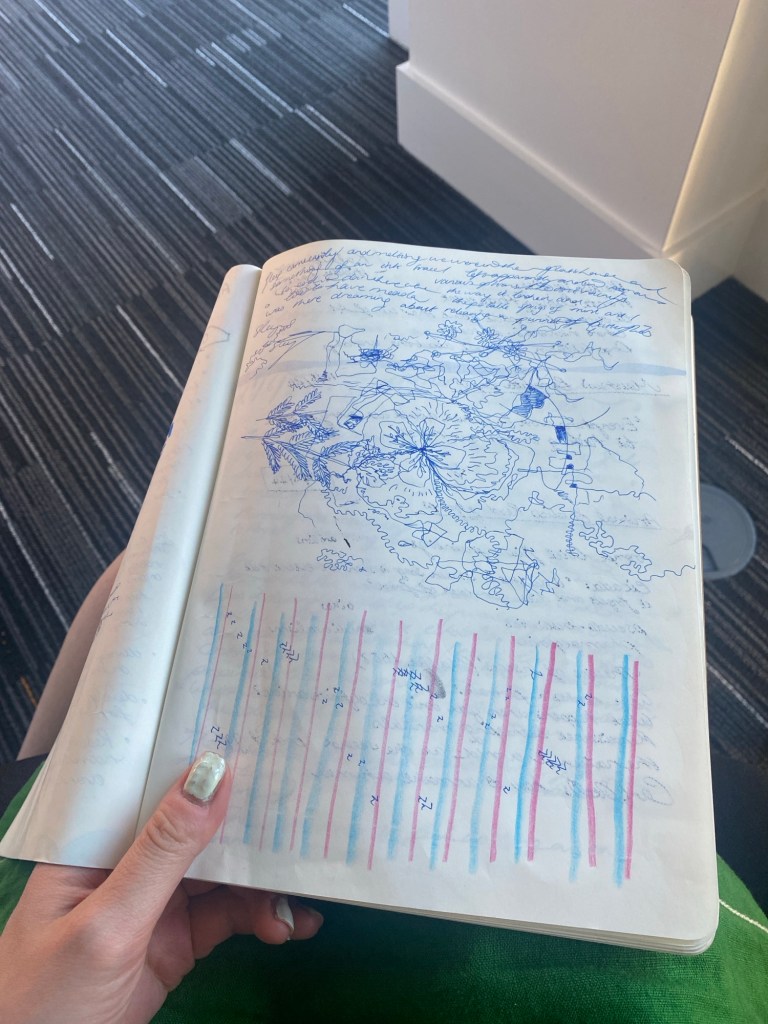
I went recently to Inside Voices, a free night of ambient music and poetry held at King Tuts and hosted by anoraq. I love these nights because I always fill up my notebook. There were readings from Medha Singh and Ian Macartney, a performance by Dronehopper. While listening, I pondered especially what the percussive parts of language were. Little coughs, plosives, hovers of breath while the performer altered their pace of attention.
I want a manifesto for ambient attention. The closest I have found so far, aside from the classic 1978 Brian Eno piece, is a university project: ‘A Manifesto for Ambient Literature’ (2017) co-written by the Ambient Literature team. Here’s a snippet:

I take this to mean affirmation of porosity between texts, but nonetheless one that holds true to the material reality of a text’s construction.
There’s an iPhone that crops up in some kind of poem and whatever it’s doing there, I start to see it running the whole text, a little monstrously. The poetic subject becoming a mediating interface. When I asked the jetpack AI to give me more emoji string, it granted me a handful more stars.
I like books for being (in)complete worlds perforated with holes (words and the gaps between them). A night (sky), variably rich.
My lover sees me drop the book and flop sideways three times before taking it off me and shutting the light. I try to read and the whir of sentences stirring up is somehow the kind of stimulus to send me to sleep.
When I wake early, as I often do, to the dawn screeching of gulls, I keep the light off and try to read by the dark. It’s every sixth or seventh word I miss. The full stops slide away, smudge into dimness, and I read sentences continually — sloshing into one another.
Sometimes I think I read off the book. Like, the reading comes not when my eyeballs are actually skimming the lines on the page but in some kind of preliminary or afterglow moment.
What about the content?
I once had to do a medical questionnaire that asked me if I ever struggled to understand the motivations and emotional behaviours of fictional characters. This was a fascinating question. I let it cook for a few days before answering on the numbered scale.
Hovering with my ballpoint, I kept thinking of that Virginia Woolf quote from ‘Mr Bennett and Mrs Brown’ (1924): ‘On or about December 1910 human character changed’.
Maybe I didn’t know why characters did things, even as I sat in rooms and offices and Zooms with students, discussing with great sincerity and intent the mechanics and motivations of fictional bone collectors, world-savers, serial killers, suffering girlfriends etc. Maybe I could only attend, momentarily, their tendencies; and so fathom a pattern or path from there.
What does it mean to give your full attention, to pay attention or to offer it?
I’ve started to think paying attention means there might be such a thing as ‘attention debt’. Is that the same as ‘attention deficit’? If I were to somehow skip the NHS diagnostic waiting lists to find myself looking at a special time-release pill on a silver platter, would that pill buy me attention? And would I somehow have to give it back, eventually, foreclosed or with massive accruals of cognitive interest? I start to think about the speed of my heartbeat in time to attention.
When I press my ear to your chest, and it’s your heartbeat I hear: am I witnessing the cost of attention?
Paying attention = being a cognitive agent of capitalism?
Does the heart hold the indelible mark of other attentions?
I would save all my heartbeats for you in a heartbeat. I hold them back from work. I save them in service of love and its ghosts.
Sometimes I want to be sharp; other times it’s better to blur.
Why do we say ‘pay attention’ and not ‘give attention’ or ‘do attention’? There’s a pretty useful article on this over at Grammarphobia:
English acquired the verb “pay” in the early 1200s by way of Anglo-Norman and Old French (it was paiier or paier in Old French), according to the OED.
The Old French verb meant, among other things, “to be reconciled to someone,” Oxford says, reflecting its classical Latin ancestor pacare (to appease or pacify), derived from pax (peace).
As the Chambers Dictionary of Etymology explains, “The meaning in Latin of pacify or satisfy developed through Medieval Latin into that of pay a creditor, and so to pay, generally, in the Romance languages.”
Some of the earliest meanings of “pay” in English are obsolete today—including to pacify, or to be pleasing or satisfactory to someone.
But senses relating to handing over money—or whatever is figuratively owed to someone—are just as old, and of course they’re still with us.
If I say pay attention, I’m not exactly doing so in the service of pacifying or pleasing. Much more likely that you’d take the phrase the way you’d take ‘pay your debt’ or ‘pay your letting agent’.
I don’t want attention to be an extractable value, but it is. We know that most of presenteeism at work is about being able to perform your paying attention for the sake of appearances. It isn’t really about productivity.
What if I let go of that presenteeism in other areas of life which demand attention? What if we got much more into improvising what makes for good listening? What if I wanted to watch television as a way of processing a complex emotional conundrum while also laughing my ass off at another life?
Would I write more? Would I understand human character?
Would I ~frolic in the generative plenitude of non-instrumental value?
✦
In 2017/2018, I saw Iain Morrison perform some of his Moving Gallery Notes at Market Gallery, back when it was in Dennistoun. The video I’ve linked above begins something like ‘right now, the time is 97%’. I feel my attention brimming like a healthy battery. Morrison’s poetic works comprise notes made while at various gallery events and artist talks. He describes the project as ‘a sequence that samples a chain of events, encounters, conversations, meetings, empty spaces and all the other things that make up the life of an arts organisation making its way through changing contemporary contexts’. Listening to the work is less about being presented with ‘content’ and more about being provided a poetic architecture in which to indulge great reverie. The content itself is also fascinating. Morrison’s gallery notes encompass everything from embodied experience to the yield of eavesdropping. The initial ‘splurge’ or ‘stream’ of notes goes handwritten onto the page, from the context of an event, and eventually gets whittled into lineated poetry. I found this description from Morrison’s blog, Permanent Positions, particularly useful:
The reason ‘notes’ is in the title of this and my earlier series, is because my first step for each poem is to choose an event at the gallery and write notes during it. When I’m making the notes I mostly write continuously, allowing whatever I’m thinking about – whether it’s things people are saying, or things occurring by association in my head – to stream onto the page, at the speed I can write at. My objective while doing this is to not worry about the appropriateness or relevance of what I write down. I try to get material down on paper, and there’s a hope that I can use my embodied presence – a thinking body in the space – to make myself into a recorder, one that acknowledges its subjectiveness, of the event. So this stage of writing can be a splurge. It usually is. I will edit these notes at the next part of the process.
This seems to me an ambient method of composition. It is open to digression, refuses to ignore the body and sees the self as both subject and ‘recorder’. Not so much Spicer’s radio here as the ZOOM H1n versatile pocket recorder.
Moving Gallery Notes is of course also a work of ekphrasis.
For my birthday, K. gave me a copy of Danielle Dutton’s Prairie, Dresses, Art, Other (2024). Halfway into this delicious compilation of fiction and nonfiction is an essay on ekphrasis which discusses, among other things, Rindy Sam’s kissing of a Cy Twombly canvas in 2007 and Eley Williams’ short story ‘Smote, or When I Find I Cannot Kiss You in Front of a Print by Bridget Riley’ (2015). The idea of ekphrasis is presented as a kiss, a mark left more or left indelibly from one work to the next. Soon I will write a poem called ‘kissing cy twombly’ because aside from the brilliant parenthesis of the act itself, sullying a white canvas and paying one ceremonial euro to the artist for the privilege, it sounds like a CSS song or something. So I will commence the writing of the poem from the idea that I am speaking to Lovefoxxx or sprinkling tongue-glitter on crayola-smeared Moleskine.
I write this painting my nails Essie (un)guilty pleasures and trying not to leave such a mark on my MacBook keys. What shade of green is this? It’s too late. Everyone who has seen my laptop knows the key letters are tapped out beyond repair. Skin friction has caused the letters to smudge and blur into pools of acidic white light.

Milton writes of ‘th’ Arch Angel’, about to speak, in Paradise Lost: ‘Attention held them mute’. Meanwhile, ‘Tears, such as Angels weep, burst forth’.
Have I cried on my laptop sufficient to melt its keys? Do I write from speech or silence?
The OED reminds me that one can ‘attract, call, draw, arrest, fix‘ attention.
Thou art to wink.
What if we wept for attention. Made its call. Applied the right fixative.
Now we say something like ‘oh that therapy session totally ate‘.
✦
What I like about blogs is that they are deliberately undercooked. You basically serve them up to the world before you’ve had time to stew, finesse and perfect the product. This one I wrote this weekend while procrastinating emails, on a rickety bus and then rushed with sips of coffee before heading out to a festival. It’s pretty al dente okay sorry you’re gonna have to chew on it. I like that I can look at a blog post and think ‘that’s a fucking mess’ and then immediately post it.
I do think I am capable of being floored by good fiction. When I read Nash’s latest novel, Deliver Me (2024), I was sick with flu but the flu was on a kind of continuum with the book. I kept texting everyone: ‘no one writes sex and the body like Elle Nash!’. I read it feverishly, dreamed in it and let certain scenes linger in my psyche long after I’d folded the last page. I read it with a curiosity I don’t think I’ve had since the way I used to read the internet. By which I mean: I devoured its voices.
Similar thing happened when I devoured Thomas Mann’s The Magic Mountain (1924) in January. I was listening to the audiobook version and continually would have to stop what I was doing (walking to work, cleaning, washing my hair) to make copious notes. All such fiction makes me weak at the knees. And you know, it isn’t the characters or the plot that do this to me, but the language. Its essaying of life, presence, intimacy, repetition. The way narrative is a temporal prosody conducting attention.
I liked hearing about Nash and Logan’s manifestos for fiction, what they hoped to give readers, because it made me realise my own liminal, elusive bar for contact. I think about the text as a space, not just for the conveyance of meaning but explicitly for bearing its im/possibility and by extension, its potential for ellipsis, disappearance. That’s where the fun begins.
Maybe what I wanna do is s(w)erve attention. Keep showing up.








 mariaology