The Many Moons of Jupiter

I was just five years old when my Dad first took me to see the stars. In the museum downtown they have this observatory room with a great glass ceiling displaying the night sky. A kind of visibility you can’t get in real life; you can’t help staring and staring for hours and hours, just staring at that bright jewellery case of stars. The blackness in the background, that velvet sheet they use, seems deeper alongside the purplish blueish hues which streak behind the twinkling chips of silver. I would sit on the floor of the observatory and stare up at those stars until my neck hurt. There was a makeshift telescope too, which showed up tiny coloured planets. You could check everything you saw against The Book of Celestial Details which was lying open on the glass table. It gave me an immense satisfaction: checking up on those stars, learning the constellations.

It was always Dad that took me to the observatory. Saturday afternoons I was his responsibility, and the easiest thing – the thing I begged for – was to visit the museum. We would go out to lunch afterwards, me leading the way down the familiar streets with the bustling weekend crowd, people weaving in and out of each other like threads from a harlequin fabric, trailing smiles and shopping bags. We always went to the same cafe, where they sold chocolate milkshakes and beans on toast for a fiver.

Dad is a landscape gardener. He digs up piles of mud and lays down square rolls of soft grass and puts in fancy plants that people order from catalogues. He does things with precision: cutting up his food carefully, watching everything I do with his observant eye, following this kind of persistent rhythm. He hated if I got food around my mouth, if I made a mess of the salt shakers or the scraps of food I left on my plate. In the cafe he talked to me about school and how I was getting on and what I liked and if my friends ever got into trouble. One thing we never talked about was Mum. Dad didn’t know how to talk about Mum.

My favourite planet is Jupiter. The biggest planet in our solar system, made of flaming greys and yellows and oranges, patterned with swirling lines which sweep around its diameter. After the moon and Venus, Jupiter’s the brightest planet in the night sky. Of course, I’ve never seen it in real life, only the simulated museum version – the version that flashes up onscreen and floats around in orbit. I always dream of that beautiful hologram, but all those pixels get mixed in with the Saturday city buzz and the taste of milkshakes. I don’t know what I’d do if I stumbled upon it one day, walking in some clear crisp countryside and seeing it up in the real night sky. I think it’d be pretty scary, not very real at all. I always wonder about that giant spot, the storm that’s raged for centuries on its surface. I’ve zoomed in right close to that Giant Red Spot like I was looking into the eye of a god. It’s like my way of praying, staring into that spot, feeling very small as I read about its greatness.

In the cafe, Dad asks me about the future.

“What do you want to do when you grow up?” he says. He asks me this just about every week, like he’s forgotten how I answered before. I have a list of things which I reel off for him: astronaut, astronomer, artist, builder.

“Artist? Builder?” he sounds confused. He doesn’t understand what I mean by that. I mean, I want to draw planets, to make planets come to life out of pencil and paper. I tell him I want to build things which will last like the planets, that will exist on the earth as the earth exists in the solar system. I can’t put it quite into words; it’s a feeling I have. Eternity. The rings, faint and reddish pale, that surround some of the planets – it’s sort of like that – the feeling drifts out to you, faint and pale. I wonder what it’s like to glide along one of those rings, feeling the chaos of gravity, shafts of light shooting right through you. Like playing Mario Kart, whizzing down a rainbow highway and picking up gold stars.

The problem is, I don’t think I’ll ever be an astronaut or an astronomer; I’m no good at maths.

Sometimes, I don’t think I’ll ever grow up at all, because Mum and Dad won’t let me.

“He doesn’t like toys anymore!” Mum shrieks at Dad when he buys me a train set for my birthday, or a Gamecube for Christmas. “He’s too old, for God’s sake!” She stares at me with her eyes on fire, wanting me to say something, to agree with her. Sometimes she throws plates or tips the dinner all over the floor, or literally shoves my father out the door. They fight over everything.

What’s confusing is that I can’t tell sometimes whether they’re making up or being mean; whether they hate each other or love each other. There is a small red wine stain on the carpet by the sofa, and I stare at it when they are arguing in the living room in front of me; I stare at it like it’s the Giant Red Spot of Jupiter. I want to dig my nails into the carpet and peel it off like a scab. They hurl swear words at each other, and Dad always shrinks into silence. It’s Mum who creates disorder, swirling her self around the room, her voice getting louder and louder. I sometimes have nightmares about this: the way she goes from shouting to crying, her red face blurring into something indistinct and terrible. I close my eyes and think of comets, shooting endlessly over the night sky.

She says I’m getting too old for museums.

“Help him with his homework instead,” she nags to Dad as we leave on Saturday mornings to get the bus into town. Her plea is lost to our backs as we step out of the house. Sometimes, late at night, I hear her come into my room and tuck me in. She stays there for a while, hanging over me and breathing softly – breathing warm tufts of fire. She touches my face and I pretend to be asleep as she slowly starts to cry, still stroking my cheek. All I want to do is shout: Mum, stop! but I can’t. I lie there, still as a shop floor dummy.

She listens to me sleeping, but she doesn’t listen to me talk about the things I like. She doesn’t listen to me when I talk about the sun and the solar system, the many moons of Jupiter. She just switches off, shutting you out with this kind of supernatural force.

How amazing it would be, to escape among the stars! I watch the science channels and see the space ships and the shuttles hurtle away from earth. They always interview the astronauts after they’ve landed: How do you cope with not seeing your family for so long? Don’t you get lonely? What can you eat out there? but they never ask about the things want to know:

Were you good at maths at school?
Do you need to do algebra to be an astronaut?
What is the square root of 395,691,324?
What do Saturn’s rings and Jupiter’s Red Eye look like from Space?

I always turn off the tv when I see their smug faces, when they take off the space helmets like they think they’re in a movie. Plain old human faces are as boring as my parents’ arguing.

Nowadays, they fight about anything at all. I don’t understand it; they’re like kids – and even Dad shouts now. From the top of the stairs I watch them through the gaps in the banister, wishing I could go down there and make them stop, make them shut up as fast as a hurricane tears up a city.

“Don’t forget we love you son,” Dad always says afterwards, “no matter how Daddy and Mummy feel about each other.”

But he never answers when I ask if they are getting a Divorce. It’s like I’ve whispered a secret I’m supposed to keep quiet, the one special code word that holds us back from chaos.

Now that I’m older, we don’t go to museums anymore; we get lunch in the pub. Dad loves fish and chips and Fosters lager. He also loves the slots.

Saturday afternoons he stands in front of the puggies while I watch the bartenders pouring pints and count how many times they spill things. Sometimes I go over and watch him play: I like to see the flashing lights, the colourful fruit symbols glow as the slots fall into place. Simple, persistent, like the bubbles in a glass of lemonade. Dad buys the drinks and tells me to go sit down. It’s a weird thing, watching him at the slot machine; like he’s in control of everything, like he knows when the slots will align the way he wants them to. Often, he pounds on the plastic shell of the machine, curses. We walk home in the purple dusk, past the city shutting up, and he tells me about anything – a song on the radio, the size of his shoes, the hat his mother used to wear when he was a kid – anything but how much money he’s lost.

The other day, I found Jupiter in a textbook at school. I guess I haven’t really been thinking about planets and stars and space for awhile, and now it stood out from the glossy pages like a face smiling from the darkness. A familiar face.

This girl sitting next to me, Layla, leant over my shoulder.

“What’s that you’re looking at?” she asked in that bright, tinkly voice of hers.

“Jupiter,” I said. I ran my hand over the smooth page where the clouds patterned themselves across the surface, like the wisps and eddies of smoke leftover from a fire. In my head, I rehearsed the names of all the elements that drift on through those clouds: carbon, vapour, neon, sulphur. 

“Is that your favourite planet?” Layla whispered, a lock of her hair spilling over my cheeks. I nodded.

“It’s the biggest planet there is. It’s so big it could swallow up all the other planets.”

“And one day you’ll live there like a king?” she smiled. She was teasing me.

“Nobody could ever live there, it’s too cold.” I closed the textbook.

After a while, I turned to look at Layla, thinking she would be facing the front again, watching the teacher scribbling sums on the board. But she was still looking at me. In her eyes I saw the glass darkness of another kind of space, where stars come forward like shoals of beautiful silver fish rising to the surface of the ocean. I glanced back at my paper and wrote down a perfect equation.

It was winter and after class she cornered me in the snowy playground and for fun I kissed her, just like that. Her lips were cold and wet with snowflakes and everything felt very still around us, like we were caught in a hullabaloo. It was all just luck really – that was the exciting part. I told her it’s a beautiful world and she laughed, like I had just said something funny and random from a movie. Like we’d made up the world ourselves and now we were powerful.

When I got home, all Dad said was: she’s left us. He looked around the room with this blank expression on his face, like the air itself was different, like something in the particles around him had changed. I poured a glass of milk and thought about it for awhile, but then I remembered the stars and the cool night sky that was only a few hours away, waiting with equations and gorgeous auroras. And yeah, I guess I felt okay.

(This short story was written for the GUCW Summer Short Story Competition 2015, under the theme of ‘Chaos’, and is republished from http://gucreativewriting.wordpress.com).
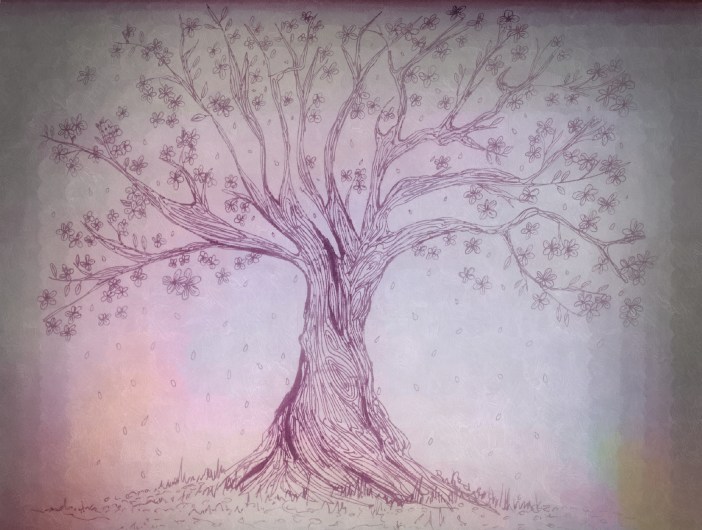
Apple Blossom

Apple Blossom

April, the sweetest candy of a pink-tinged sky blessing the late afternoon. Rebecca has sat in the garden for hours, watching the birds nibble from the feeder and splash around by the pond. This is her Grandpa’s garden, though he no longer enjoys it. They have him cooped upstairs on a dialysis machine, in a bedroom that smells of sweat and death. Rebecca is not allowed up there: the air, her mother says, is not fit for a young and blooming girl.

She misses her Grandpa. She remembers him mowing the lawn on Sunday afternoons, stooping with his bad back. She remembers him commending the shapes of his moon-faced daffodils. She remembers him singing Frank Sinatra in velvet baritone while pruning the roses.

The roses are now out of control. They cluster all over the flowerbeds along the path, dangling out with their swollen, sumptuous heads. They have grown so tall that they bend over, crippled with the excess weight, the stems stretching to breaking point. Grandpa would be so disappointed if he witnessed the state of his roses.

Sometimes, Rebecca liked to peel off a petal or two. It was hard to resist; once she took the first few, the others came off so easily and they just slid softly into her fingers. Vivid trails of pink and red petals are now strewn along the gravel path, where Rebecca has walked like a bridesmaid.

At the back of the garden is the apple orchard. In winter the trees are gnarled and bare silhouettes, and not a soul would dare enter the darkness between them. Now that spring has arrived they boast their pretty bows of white, flaky blossom. Every year, Grandpa used to send glossy photographs of the apple blossoms to Rebecca and her parents, who lived far away down in London and rarely made it up to visit. The sight of those lovely trees was always a dream to the young girl who yearned for the country.

“When can we go and see them for real?” Rebecca would sigh.

“Oh, sometime in summer. Maybe Christmas.” They were so often dismissive like this. They had waited too long to see him and now he was dying. Even Rebecca knew it.

She was growing quite bored now, in the garden with no-one to play with. She knew there would be supper soon: hot buttered crumpets with a dark smudge of Marmite melting inside them. Real Earl Grey (loose leaf) because that was the only tea Grandpa had in the cupboard. Rebecca thought it smelt a bit fusty, but you could read the tea leaves at the bottom of the cup afterwards. She thought she saw a bird in hers that morning.

Yes, she was quite bored. The hula hoop which she had brought up from London lay abandoned on the lawn. She had tossed away her tennis racket somewhere into a dense clump of shrubs, because it was no fun to play by yourself, hitting a ball against the shed wall. A bag of marbles had burst open on the patio, the little glass balls having long rolled away, to settle amongst their brethren of grass and gravel. Rebecca had no toys left and besides, she was so tired of them all.

Even the insects had bored her, with their slimy indifference to her existence, their urgent desire to escape her clasping girlish fingers. She couldn’t give a toss about snails and slugs, or even butterflies anymore.

It was in this moment of tedium that she spotted the boy through the hedge. She couldn’t believe she had never seen him before. It was a difficult thing not to be spotted, not to make a peep, but Rebecca crawled expertly into a gap and tried not to breathe as she watched him. He was lying on his front, kicking his long legs back and forth. From this angle, he looked about fourteen. His hair was sort of ginger but also sun-bleached, as if he had spent a long time outside in a streak of good weather that Rebecca must have missed. He looked like something the sun had offered as a blessing. She could see his freckles, the concentrated curl of his lips. He was drawing in a big sketchbook which was flipped open, so that sometimes the breeze rippled the pages. Rebecca felt her heart hum and flutter in the cage of her chest, like some swarm of insects had trapped itself deep within her. He was so beautiful.

She wanted to crawl right out of the hedge into the next-door garden, step into the other world where he existed. She wanted to talk to him, ask for his name. See what it was that he was drawing. She felt like the secrets of the world would unlock themselves once she had learned his name. The sapling of herself would unfurl and a bounty of happiness would overflow from her body like the golden leaves in autumn.

“Rebecca!” she froze. It was her mother calling. She had been searching all over the garden for her daughter and now here she was, discovered in the hawthorne with white blossoms caught in her hair and a strange smile on her lips. She saw there were tears in her mother’s eyes, clinging and spilling like rain from the knots of tree trunks. How could there be tears at a moment so pure, so lovely?

“It’s Gramps,” she gushed, “he’s, he’s gone!” And so her mother pulled her out of the hedge and clutched her in her arms, held her so tight Rebecca thought she would burst. It didn’t make sense: he’s gone, he’s gone. As her mother sobbed into her hair, she watched the apple blossoms being blown away by the gathering night wind. Next-door, the boy stretched out his long limbs, packed up his things and disappeared.

(This little story emerged out of a longer short story project combined with prompts from Glasgow Uni Creative Writing Society’s Flash Fiction February challenge (‘renewal’ & ‘orchard’)). 

Road Trip

highalnds

Picture the scene. You pass sea after sea of pines, their tall green points misted with a fine web of vapour, a greyness that stretches over, concealing the tips and the distance, and you are not sure whether it is fog or woodsmoke, the wisps of early morning or perhaps the smoulders of a landfill. Probably you’re somewhere deep in the moorlands, glens and peat bogs of the Highlands; or maybe not that far yet, maybe just the Trossachs. If you open the car window a tad, you can almost smell the midges, their damp, thirsty breath in the air. This is air so clean that its purity counts as a flavour, claimed by many who have flogged the native whisky or bottled water. You would leave the window open, indulge yourself, but there is a sharp cold breeze that tickles the fine hairs on your neck, waters your eyes. It is always windy here; or else deathly still, like a valley out of time. Mountains rise up around you, growing closer and grander as the car turns another corner. They seem monstrous, towering over your small car, and you feel like William Wordsworth (the boy version, out of The Prelude) plodding along in his stolen boat, gazing fearfully up at the mountain peak beyond the lake, the peak that gazes back like an animal: ‘a huge Cliff / As if with voluntary power instinct / Upreared its head’. You can’t help but stare at the streams which splash down from each hillside like silver belts, which glimmer in the pale light which makes it through the misted sky. They catch your eye, pull you in myriad directions. You know that rain is imminent; its scent is as clear as the water that runs on the burn alongside you.

There is always birdsong, even in the evening. You can hear the cacophony of many different species as the car rumbles on in the silent space between two tracks passing on the stereo. You and your friend spent a whole day curating the playlist for this trip. Curating. She said that word, jokingly; but even so, it makes you feel special. This isn’t just any trip. It isn’t like you get out like this all the time, free from the bustle and smoke of the city, the people lingering outside pubs, the strangers drifting through in street-lamp darkness.

You spent a childhood in the back of your mother’s car; the smell of her cigarettes always blowing straight back into your face, rolling down the window to snatch breathfuls of that sharp, fresh air – an escape. You scrambled alongside rivers which rolled on over gleaming boulders; you scrabbled together heaps of stones and logs and built dams, pools and waterways. You fell over, bruised your knees, skelfed your fingers on the pine branches. You watched the water for hours, while your mother smoked and your big brother showed off, scaling rock after rock, cliff after clifftop. You ate cheese and pickle sandwiches made soggy by the damp that seeps in everywhere, through the aluminium and glass, the plastic glovebox and the silver foil. Midges clung to your neck; constantly you felt their hot, sticky itch. Sometimes the car smelt of engine oil. The food made your cheeks flush afterwards, as you washed your lunch down with bottles of flat lemonade that had lingered on the backseat for days.

There was an innocence to those holidays which literally makes you ache to think of. You would do anything to be that small again, crouched by a river, dipping your toes into the freezing water while your brother splashed you from afar, shouting declarations of war. His always taunting words, his grand arrogance. The way your mother scrunched up the sandwich foil into tiny, crumpled balls, collected them in her purse. The day you found them all, still there, when you were digging for lunch money.

Fog coming in thick and deep from a distance. You saw it roll over the mountains like God’s own shroud. It was comforting, feeling the moisture prick in the air, seeing the landscape slowly disappear. When you retreated back into the car, packed up the camping gear, fought with your brother over the radio. He always wanted the sport – Five Live – and you wanted the songs, the music. The stereo pumped, crackling and loud, audible even through the walls of the car, drifting in and out of signal, static…

Her sadness, leaning against the bonnet, sipping from a flask of coffee, staring out into the distance. The tears that you couldn’t see – not from behind – but you always knew they were there.

And why are you going? Why set forth again into the world of fog, of deep enveloping glens and silver rivers? The soft moss and the heather, the greenness that haunts your sleep. Was there some mystery you thought you could solve? She said it would be cathartic, your friend, her name irrelevant. Anyway, it’s Eilidh. When you met her, you didn’t understand the silent letters.

The playlist comes from an iPod, the classic one with the spinning wheel and the white casing. You were going to sell it, after you lost your job and faced the end of things, but something pulled you back. Gone were the Nike trainers instead, and now you are here in the car with your best Sports Directs. What sounds pass through your head? There are many conversations you always wanted to have with Eilidh. You wanted to ask about her purple hair, the bright lilac colour of heather. What did it mean? You wanted to ask whether she was still seeing that guy she met at uni, the one who studied law and played cello for an orchestra; who spoke French in a way that defied the limits of his Edinburgh accent. But you had known her five years, and still you could not speak.

The songs were lovely, dark and deep. Miles were consumed by the roar and pulse of the engine, roadsides slipping away as easily as signs fading into hill fog. You were long gone from the city, its tall grey buildings a mere memory, the pillow of mist you sank into at night. Remember the times you shaved an inch from your life? The bus turning the corner, sharp; the tiny sliver of razor on the white bathroom china. The dark colours flowering out in water, as you watched your ex-girlfriend wash her paintbrushes in the sink. Shades of crimson, violet, blue and scarlet. You were slipping through all these images, the shock and the bruising; the little jolt to your heart as the car passed over a pothole. You were driving, then she was. It’s difficult to remember.

There’s a lot of Mogwai on this playlist. When you first hear ‘Heard About You Last Night’ it’s a bit like waking up for the first time, the blinking beat and slow entry of bass bringing into colour a brave new world of beauty and fear. So many people, you suppose, have died out on those mountains. Battles fought and lost and won. Rain that fell for so long, it seemed the whole landscape might be swallowed up in shadowy puddles. Then there’s the anxiety of ‘Hungry Face’, those infuriating repetitions which build up to the twinkling innocence of the xylophone against those quietly thundering drums. It gets in your head; you can’t help but think of ghost ships disappearing over the Clyde, a set of yellow eyes opening and closing, suspended in the dark, clouded air like the smile of a Cheshire cat. The sound of soft, steady bleeping. Eilidh says something funny about the sheep. They have an absurd look about them out here, she says, but then so do pretty much all sheep. They glance up at you, but instantly their expression fades into blasé. They have only two emotions: indifference and fear, the fear coming out when they jolt their necks back and scarper.

Soon you fall into the melancholy of ‘Cody’, so slow and serene you might as well be stoned, sinking away from your thoughts like being pulled out into a vast, shimmering ocean. The bass echoes slow through the car, its thick walls. You press your face against the glass, leaving steam marks which fog up the world outside, the tall green mountains now coated with your breath. Reality blurs with the material of sleep. And would you stop me? If I tried to stop you? You imagine this is what heroin feels like, plunging into a slow, majestic ecstasy, the kind that drags eons of time through your veins; and from all those hours draws out this kind of awesome mournfulness even as your whole body tingles with euphoria. You could sleep forever in blissful, evil dreams. When I drive alone at nights, I see the streetlights as fairgrounds / And I tried a hundred times to see the road signs as Day-Glo. So slow, the car turning corners. An elegy to a lost raver, stumbling through the darkness of some urban labyrinth, the upturned bins, old condoms and leaking glowsticks spilling out the wasted remainders of another good night, another goodbye to childhood. Would you care at all? Eilidh rests her hand on your leg.

“Stop crying,” she says. It’s a statement, not an instruction. You are still staring out the window.

Your mother used to listen to The Waterboys, maybe even Primal Scream in her more rebellious phase. She liked to dance around the living room doing the dusting to ‘Fisherman’s Blues’, all the dust motes swirling up in a maelstrom of childish untidiness and neglected housekeeping. Her voice would crack and she would laugh at herself, breathless, collapsing onto the sofa. Make me a cup of tea, eh boys?

You were at a house party once, at uni – not that long ago really – and this girl was playing a song that stirred something familiar in your memory. You knew that voice, its growl, the twists of electric guitars.

“What is this?” you asked, the joint smouldering between your fingers.

“Oh, it’s The Waterboys actually.” You resented her showiness, of course, but this was interesting. “I know, so lame right? I like it though. They put Yeats to music. You know the poet, W. B. Yeats? ‘The Lake Isle of Innisfree’. It’s a lovely poem.” She was drinking port, of all things – you remember that too.

You inherited, perhaps, a gloomier tradition of the nation’s music. There would be no Proclaimers on this playlist.

Arab Strap, the disco beats, spat poetry and everyday apathy.  The sort of post-hardcore or drum-soaked indie that felt like having the rotten parts of your brain stripped out as you lay on a boat, slowly being drenched in dreich Scottish rain. You were always a fan of Frightened Rabbit, ever since you saw them at a festival once, danced yourself into a frenzied ceilidh of mud and tangled feet, even as the songs sung of sadness and bleakness and heartbreak. The endless drone, the refrain: it takes more than fucking someone to keep yourself warm. Teenage campouts in Loch Lomond, worried you would all die of the cold, of the rain and the midges. Drunk out your minds, desperate and scared of the river which burst its banks sometimes even in summer. The expectations of nothing but the prospect of falling into the same abyss as everyone else. Fag butts drifting by the edge of the river, the scorched remainders of a bonfire. Listening to it again now, well, you can’t help but think of how this seems to be coming true somehow. The same abyss. Even as the drums collapse over the screaming words, there’s a waterfall out there somewhere, maybe the one you floated in once, upside down on weird pills with the cold so deep in your bones that you didn’t feel the punches of your best friend who hated you because you kissed — no. That was another time. You are driving forward now, you are at the wheel.

Maybe there is something that you know that I don’t. 

“We should stop soon, you look like you need a rest.” The world outside is almost darkness; it is twilight spinning webs of navy and sapphire gold around the edges of trees and mountains. Trees with their shimmering leaves. Clusters of stars emerge from the velvet blackness. You wouldn’t stop for anything.

Next: There Will Be Fireworks, ‘From ’84’. The simplicity, the sorrow which isn’t yours; for how could you feel so much nostalgia for a year, a thought, that came before your time? The not-belonging is what makes you feel lonelier, the minor chord, the rustle of Eilidh in her woollen tights turning the page of a cheap magazine. Just a kid, in his room / No-one hears him howling at the moon. But you have lost touch with friends too, you have felt the strange pain that comes from seeing people you love change, grow apart. You cannot hit the high notes; you cannot sing along. So we’ll put it down to fate or bad luck. The plain, bare strumming pattern haunts you, even after the song finishes and something new comes on. You’re thinking of another lyric – sad song in a minor key – and wondering how you ever heard of this band in the first place. Why is it you love them so? Whether they’re actually any good, or just another expression of bleak Scottish winters, the lack of sunlight, the endless, down-pouring rain…but isn’t that beautiful too?

Eilidh has, perhaps, more interesting taste. The next song is hers: Cocteau Twins of course. She mutters on about how their best album was Milk and Kisses, though everyone thinks it’s Heaven or Las Vegas. Elizabeth Fraser’s dreamy soprano takes you straight through the night and into the morning; you could both listen for hours and hours, not realising that the songs were changing or repeating, just drifting into the dissonant guitars and distorted lyrics, the hypnotic drum machine loops, better than sex. You would like to float, suspended in a disco somewhere, each song playing out the pattern of a strange, intense kiss. You suppose these are all the 1990s discos your mother would’ve went to (if she hadn’t had you). What does it matter now? The sky before you bursts through in pastel smudges, which break up the dark silhouettes of the Trossachs mountains. In the distance, through the windscreen, sparkles of sunlight play upon a pale blue pool, the first loch you have seen since yesterday. There is something about the shape of the peaks, the space of the valley. You have been here before. 

The Twilight Sad come on the car stereo. There’s no mistaking the intensity of that voice, the thick accent and its distinctive rolls and howls. Each song with its own atmosphere, a haunted quality reminiscent of The Cure.

“Let’s stop here.”

The loch is so close now. You can feel something inside you, a tension breaking, the rapid increase of the beat from the heart that burns in your chest. Eilidh is humming along, though her voice crackles and breaks as easily as the gravel on the road below your tyres. When you climb out the car, cold air sucks your breath away as you slam the door. Suddenly, the signal floods back to your phone. Three missed calls from your brother, and you know what that means. Another night, another row of bottles slowly emptying, slowly being broken in a dive bar of old men, the black hole at the bottom of every street in every Scottish city. Once he was an eagle, soaring down those hillsides, ready to leap out and scale the lake with legs made strong by football, with arms that could reach out for anything they wanted. He couldn’t save her, any more than you could, weak and pathetic, wrapped up in all that suppressed panic. Hidden in your room, even when it happened. It rolls through you, the realisation. This loch, like a terrible mirror. This beautiful loch, the very one you all picnicked by, the year your brother finished high school, the year of your first kiss, the year she —

‘There’s a Girl in the Corner’ on the stereo, and Eilidh is speaking, but her words are muffled through the window, the pounding drums and resounding lyrics. She’s not coming back / And she’s not coming back again. Standing here, the cold wind at your neck, another summer nearly ending and here you are – you finally feel it.

(all embedded lyrics attributed to respective artists).

Tropical

IMG_012301

Tropical

You used to worry about the palms: there was something wrong,
you said,
if the palms weren’t sighing.

You relished the soft peel of the wind through those palms,
the ones by the hotel garden.
We’ve been here every year
since Dad died.

The white beach sand is a mouthful of moonlight.
We sit up late drinking crushed fruit
and you say strange things, as you always do—
have you ever eaten a mango in the bath?
You would live your life like that,
all the time you said, eating mangoes in the bath.

All that pulp and mess, all that flesh.
Dad died in the spring, when blossoms
of soft pink cherry gathered on my lawn.
The baby lolled around in it like April snow
and we watched her giggle, ribbon
flying out from her hair. He would’ve loved that,
seeing her there.

The cancer took the green out his eyes,
ate the skin of his face.
Even when they pumped him full of fat and creamy vitamins,
the bones kept poking, pointing.
His face was a mask of something;
I couldn’t let the baby near it.

I imagine you prefer it here
to back home. You like the ooze
of the days, the way the maids make the beds;
the emerald green of the parakeet,
early mornings where the tide sparkles. Still,
you saw signs in everything.

Dad used to come visit during monsoon season.
He wrote reams of prose,
lapping up slushfuls of rain. He wrote
in the small hours, when he wasn’t working.

We lost the notes.
We’ve only the stuff on his business trips,
lost code on his laptop.
We haven’t a sense
of what to him was sharp or clear, what it was
that brought him over.
Just the whispering palms, the sleepy tense—
one day I’ll take the baby here.

Things Enchanted

Source: https://www.flickr.com/photos/mshipp/

The wedding was held on the first of October, that first fresh fling of a spring day with cherry blossoms lining the avenue and the smell of sunlight in the air. Marianne had chosen this day because on the calendar it had glowed up like a promise, the hope of something clean and new that wasn’t tarred with the silliness of April Fools or the bloat of British summertime. It was luck, really, that brought the good weather to New Zealand on that uncertain spring morning. It was also luck that bagged them the venue. She and Ethan had spent weeks debating where to get married, pouring over glossy brochures featuring medieval castles, luxurious hotels with honeymoon suites, country houses and converted churches which allowed you to toss your bouquet extravagantly from the bell tower. Arguing about the cost of fancy desserts and appropriate champagne. It was all very expensive and a little vulgar for Marianne’s liking. She was raised to believe that the most enchanting things in life were free. She had insisted for years and years that if she ever got married she would do it smack bang in the middle of Oxford Street for all it mattered. The best part of a wedding, Marianne had thought as a child, was the cake. I will find the best cake in the world, she would boast to her mother, because everyone likes cake, and not everyone likes a wedding. You can always, as Marie Antoinette put it, let them eat cake.

Growing up, Marianne found it to be true that not everyone likes a wedding. Or, at least, a wedding doesn’t do well for everyone. At the age of twenty-six, Marianne had dragged herself through enough of her friends’ weddings to know that the occasion prompted flourishing happiness for some, and hours of breakdown for others. Only last year, she had been drinking with her old roommate Bill at a colleague’s wedding and over the slurry candlelight he confessed to her his deep desire to kill himself.

“I just can’t stop thinking about it,” he had said quietly, refilling his wine glass, wiping the sweat from his eyes.

“William, William I had no idea.” And as the confetti swirled about the crowd, queer as a summer snowdrift, Marianne felt like she’d been chained to something dark and profound. Some sense of the underworld that she needed to get rid of. Bill had left soon after, taking a cab back to the hotel, and Marianne had gorged herself on the cheeseboard to cheer herself up, because it seemed there was nothing else she could do but stuff away her dreams with sticky lumps of brie. In the midst of all the magic, there was still all this sadness that seemed to coat the world in fear. When the bride passed her, Marianne smiled brightly, but later on she called Ethan in tears.

“Don’t worry,” he’d said, “he’ll be alright. Weddings bring out the best and the worst in people—”And yes, Bill was still alive, but he and Marianne had not spoken since. In all the chaos of organising her own wedding, she had forgotten.

Eventually, she and Ethan found their perfect venue in New Zealand, of all places. It was a rare corner of the world, special in its simple charm of rolling hills and friendly faces. Yet Marianne had a great deal of trouble convincing Ethan’s family to fly out there, even for just one weekend. Ethan’s mother suffered from bouts of depression and an event like a wedding, he said, could prove difficult – if not debilitating – to her state of mind, which had been fragile since his childhood. What’s more, Ethan’s father (they were divorced) seemed to drag himself through life with the sole intention of avoiding tricky situations such as these. He was a plumber who worked hard and spent most of his spare money down the pub, with people he’d known since high school. A cosy existence, free of the kind of complications that Marianne’s parents liked to pick over for a living. Marianne’s parents were academics, the kind of academics who relished a wedding, if only for the excuse to drink nice wine. She and Ethan were very worried about the whole occasion, about their parents coming together for only the second time, about the cost and the question of religion and whether it was weird to give people Love Heart sweets as favours.

“Shouldn’t we try for something more…intellectual?” It was him that said it first, not her.

On the last day of September, they landed crisp and safe on New Zealand ground, ready for rehearsal. To their surprise, they found the priest getting baked under a cabbage tree.

“My god, look at you two!” he exclaimed in his thick Kiwi accent, scrambling to his feet to greet them with a dazed look on his face. “Why I’ve never married such a beautiful couple!” He kissed them both on the cheek with enthusiasm.

“When do the family arrive?” he asked, walking them towards the church.

“Tonight,” Ethan glanced at his fiancé, expecting the nervous expression to show on her lips. She was, however, remarkably composed.

They were being married in a church made of trees. A brand new church, constructed in imitation of a similar design which went viral on the Internet a few years ago. The venue had appeared quite randomly in Marianne’s inbox, with all the sparkle of a super-charged Groupon offer, and she was quite enchanted by its strange beauty, its sense of the ephemeral. She did not want her marriage to be stone-cold and static, confined to a church, but to evolve and shift with the seasons, like this lovely temple.

Ethan and Marianne were just the seventh couple to get married under its bowers.

Silently, they stepped inside the iron framework and stood under the greenery, marvelling at the dappled light playing along the carpet of grass.

“Amazing,” Ethan whispered.

“It’s better than I ever dreamed of.” Marianne turned to him and gave him a long, satisfied kiss. They felt like they could stay here forever, dreamy and alone in this virescent version of heaven. The priest ushered them through their vows before leaving to meet his next clients. They delayed going to the airport to meet their parents, preferring to sit on one of the pew benches, scuffing their bare feet in the soft soil and laughing as they shared their secrets.

“All I want,” Marianne said to her fiancé as they sat later in the back of a cab, “is a few days of harmony. D’you think we can manage it?”

“All I want,” Ethan replied, “is our parents to get on okay. God knows I’m dreading the next few hours.”

“Don’t,” Marianne kissed him quiet. “It will be fine. They love us.”

To their surprise, it was fine. Fine as dinner and mumbled wisps of conversation could ever be. At the end of the meal, Ethan’s father stood up to deliver a drunken speech, exposing an embarrassing array of Ethan’s ex-girlfriends and childhood habits, enough for Marianne’s parents to speculate on for months to come. Ethan’s mother complained about the food and how warm it was for this time of year, her jet lag and sore head, then retired early to her room. Marianne worried, but Ethan knew better.

After dinner, they drank coffee in the restaurant lounge and all talked quite civilly about married life. Brian, Ethan’s father, had consumed a little too much wine and was already slurring off with jokes about how marriage was always a ‘two-way street’ with ‘no exits except death’. He wouldn’t stop, no matter how much Ethan tried to hush him. He teased the young couple about their choice of venue, speculating on all sorts of disaster scenarios which could disrupt the ceremony: lightning storms, forest fires, a rain shower. Marianne’s parents remained very quiet through all of dinner; so quiet, in fact, that Marianne worried there was something on their mind that they were choosing not to share.

Under the cool spring moon, they walked Marianne back to the hotel, leaving Ethan and Brian to have a last-minute tête-à-tête, which Ethan clearly didn’t appreciate. In the hotel garden, Marianne nuzzled herself into her father’s arms like she used to do as a child, feeling small and safe. It was different from how she felt with Ethan.

“Are you going to be okay?” Her father asked her. She thought about the day she first met Ethan, walking up the campus steps to her morning lecture, the sun breaking through a rain shower and the look on his face, concentrated and expectant. He wore his hair very short then – even shorter than it now was – clipped and cool in his blazer, a third-year law student.

“I think so,” she whispered back. The crickets purred around them.

“Just remember, everything is your own decision,” he said cryptically, ruffling her hair gently as he turned to enter the building.

“Goodnight love,” her mother echoed.

She and Ethan spent the night achingly in separate rooms, sleepless and fearful and eager. Marianne took out a pad of paper from the desk drawer and under the header with the hotel logo she wrote a list of all the reasons she was getting married: Love, dreams, sex, money, future, Sunday mornings, love. She laughed at how easily the cliches buoyed up in her mind. Brian’s words had awakened some tiny, irritable worm inside of her, a worm that wriggled with uneasiness. Yet she waited for it to rest and eventually fell asleep, letting the magic of the words she had written take shape in her dreams.

In the morning the sun bathed the grass in golden light and it was just as the first day of spring should look like, so different from October back home, where the streets were bronzed with glossy rain and fallen leaves. Ethan waited among the bright green bowers until Marianne appeared half an hour later, shrouded by the vines and only gradually entering his vision as she stepped through the knitted trees.

“How long?” he mouthed at her. She gave him a funny look as she slowly glided down the aisle, trailing her lacy dress. The church could only seat fifty guests, but there were very few people there. None of Ethan’s friends could afford the New Zealand flight, and Marianne hadn’t wanted to invite so many of her own that the bride’s side would outweigh the groom’s.

“What?” she asked him as they got closer.

“Why have we waited so long for this?”

She stood opposite him over the simple altar and as the priest approached Ethan added:

“I would’ve married you at uni, I would have married you so long ago.” He couldn’t help but grin then, and it was the kind of grin that unravelled the tight poise of his face and showed the fine lines around his eyes, the sparkling hazel eyes that she knew as mirrors of her own soul. She loved him, then, for that fragile smile alone.

“Don’t kid with me,” she murmured. She then looked up to face who they would be soon; who they would be after the magic words and the kiss that sealed them. She stood tall in her crystal heels and white gown, her light hair tumbling long down her shoulders, secured by the flower garland that her little niece had assembled for her that morning from the field of daisies. It was funny, she didn’t feel quite grownup; it was like being a child again, playing dress-up, playing at something that all of a sudden she knew nothing of. The priest stood over them in his robe, casting a shadow into the space around the altar. Marianne imagined that in winter the ground beneath their feet would be scattered with old seedpods and stray leaves fallen from the trees. Were they evergreen? She could not tell; she was no scholar of nature. How different the place would look, all wiry and skeletal. It was a chance vision, the fleeting kind gifted to the mind from a wisp of wind, cold and coming northwards. A fantasy of life at another time, caught in the secret culverts of the land around them.

She smiled as he slipped the ring on her finger, looking into the clouded space of his eyes and enjoying the blind joy that enveloped her.

After the ceremony, they led the guests down the aisle and out of the sparkling world of green onto the garden plains with the ornate shrubbery and the guesthouse lodge in the distance. Marianne’s mother, in her yellow hat, approached her and dutifully kissed her daughter on each cheek.

“It’s been a pleasure,” she said warmly, simply. Her father came and clasped each of her hands in his.

“You look wonderful love,” he told her. “I’m sure you’ll be very happy.” But she felt the clamminess of his fingers in hers, and slipped away. It was as she had felt at her friend’s wedding, that sudden moment talking to William, his face cloaked in cigarette smoke. There was something strange about the way her parents were so keen to share in her joy; it didn’t seem real.

What she would remember most about that day was not the party afterwards, with the sunlight dancing in her hair and the lilting joy of the violins and the woman that sung for them from a makeshift podium. It was not the fairy lights strung across the trees at night, or the sad sighs of the children told they had to go to bed. Not the crumbling wedding cake and the sugared strawberries eaten secretly in the grove by the river, or the sweet laughter of Ethan’s parents as they sat together sharing a bottle of wine and loudly reminiscing. Not the restless, whisky kisses pressed between the sheets in the cool summer evening, with the starriness of midnight pouring through the window. What she remembered most, now, was the feeling of her father’s fingers: cold and foreboding as she pulled away from him and out of her old world altogether.

Yet in the haze of those joyful days, it seemed obscene that in a few more hours they would be returning to a bleak, British winter, leaving behind the Kiwis and their colourful summer.

And love was all, love was all. That was what they said, what everyone kept saying, not knowing what it meant. The daydream of that day, its harmony draining slowly away in the time that was passing, the prickling chaos of day after day in each other’s company. Years flaking from them; precious layers of what they had always wanted to be, sloughing off and collecting in piles on the bedroom floor. There was then the new house, the miscarriage, the man in the white coat who talked to them as if they were children. The strangeness that grew between them. When they had argued, falling back into bed with tired passion, her father’s words flashed back to Marianne: everything is your own decision. And yet.

Here she was at her desk with the wads of paper blocking her view of the window, with the mirror glass behind her and that silver strand in her hair exposed for all to see. They had waited too long; too long they had waited to let happiness wash over them like a morning shroud of marijuana dreams. Marianne sat at her desk because it was the only place she knew where she was. Her head was full of the smell of hospital chemicals and the sound of dogs barking down the lane, old women nattering at bus stops. Blood being sucked through a plastic tube, the soft groan and the closing of his eyes, the shadow self that came over him in those moments. Pale and loitering. Loosely, the memories unravelled from her grasp, so that sleeplessly she would lie awake seeing her mother-in-law’s tormented face, the frown she pulled when she heard the news, the devastation in her eyes. There were too many pieces, too many pieces to pick up, replace.

Marianne lit a cigarette and stared at the ceiling.

In June she boarded the flight to New Zealand – the one she had booked only a week ago – the one her mother had paid for because Marianne was bogged down with the debts he’d kept secret.

Up in the air, suddenly the world no longer appeared in cut glass fragments of what she had lost. The blue sky was open and wide, the land below long and solid. When she landed, this time there was no priest to greet her, no summer insects singing in the grass.

She stepped off the road and made her way into the gardens without stopping, because there was no longer an attendant at the gate asking for an entry fee, a charity donation.

The land was starved. Ten years had passed, and here was the place where his parents had sat looking healthy for once, here the river where the children played, there the place with the daisy ring and the standing stones, the spot where they took their first dance under the virgin moon. The grass was now dry and yellowed underfoot, the breath of winter bitter on her cheeks, like ice kisses left by a dead lover. The irony was not lost on her. As she paced around, traces of litter – plastic rings, bottle tops and molten cardboard – lingered on from summer picnics. There were charred places where bonfires had burned, and Marianne imagined the fatty air filled with ash instead of confetti snow.

From the sky, the rain fell cold and slow. It seemed there was no money to be made from love, not here, not anymore.

The trees which had once flourished together protectively were now gnarled and thin and lonesome-looking, like trees from a fairy story.

How long had they waited for this? The last gasp of a feeling: not everyone likes a wedding. A ghost doesn’t like a wedding; a ghost resents its solidity, she thought, its promise of new absolution. Or was it the dreamy quality? Marianne had forgotten. They had waited too long, and it had cost them.

She sat under the skeleton trees, on the same bench where ten years ago she had dug her toes into the soft earth, sighing. And with the violins sounding sweetly in her ear, she took her shoes off; but the earth was too hard at her touch, encrusted in hoar frost and the dust of other memories, other dreams floating free.

Mortal Thing

Gentle capillary
So small as the daisy, pulled
into petals from the precious lens
of a leaf.

Unfurl the tangles like twine;
only soft
as an organ,
and underneath
the quick pulse
of some other body, the beautiful body:
that lies over there and empty,
still empty in the yellow light
of this warm morning.

(Written from GU CW’s last week’s prompt ‘capillary’)

On Words, Romanticism, Ramblings and Meanderings

I am coming to the end of the Glasgow Uni Creative Writing Society’s ‘Flash Fiction February’ Challenge. The aim is to write one piece of flash fiction a day, following prompts that are posted on the blog. The best thing I have probably achieved since I wrote my 10,000 word ‘The Quest’ story (complete with self-made Photoshop image and realistic fire effects) aged eleven is successfully averaging at least 700 words a day for a whole month (some days writing 700, other days moving upwards of 1300…). The reward is not just having a little portfolio of stories to go back and edit in the summer, but the habit of discipline that’s been earned. I have learned that I need the motivation of ‘completing something’, and that sharing one’s work and discussing it with others helps to feel better about writing. There is also the satisfaction of word count. If I averaged at least 700 a day, then that’s at least 19,600 for all of February. If I doubled my word count and did that for two months, I’d have a respectable 80,000 word novel. It’s an encouraging fact. Even if the content is sometimes pretty crap, I have something to work with! I just have to keep up the daily habit. It’s a bit like crack, only not so addictive, and cheaper. And, well, you have to work for its effects.

One of my fascinations is with the daily routines of successful writers. Not necessarily just literary authors, but philosophers, artists, journalists – even mathematicians. Anyone who gives up a significant chunk of their day to solitary writing, creating or just working. There is a fabulous blog called ‘Daily Routines’ which is the ultimate procrastination: putting off work by reading about how others work. It’s refreshing to see that not everyone needs a wee dram or French cocktail to get the imagination flowing, though it seems to be a recurring theme. As well as the time of day and the choice of stimulant, I’m a little bit obsessed with peoples’ medium: the effects of the pen, pencil or keyboard; how one’s writing implement impacts upon their style, speed and even argument.

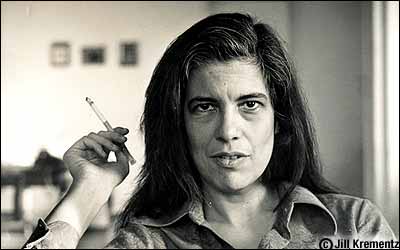
Susan Sontag. Source: nymag.com

For instance, Susan Sontag on her writing routine:

I write with a felt-tip pen, or sometimes a pencil, on yellow or white legal pads, that fetish of American writers. I like the slowness of writing by hand. Then I type it up and scrawl all over that. And keep on retyping it, each time making corrections both by hand and directly on the typewriter, until I don’t see how to make it any better. Up to five years ago, that was it. Since then there is a computer in my life. After the second or third draft it goes into the computer, so I don’t retype the whole manuscript anymore, but continue to revise by hand on a succession of hard-copy drafts from the computer.

[…]

I write in spurts. I write when I have to because the pressure builds up and I feel enough confidence that something has matured in my head and I can write it down. But once something is really under way, I don’t want to do anything else. I don’t go out, much of the time I forget to eat, I sleep very little. It’s a very undisciplined way of working and makes me not very prolific. But I’m too interested in many other things.

One day I want to write a big essay looking at how writing style changes according to how you get the words on the page (I even bought a beautiful typewriter to test that out). I love the idea that Sontag uses layers and layers in her writing and editing: the process of writing on top of writing, of scrawling and scoring out like the palimpsest diary Cathy in Wuthering Heights creates on the margins of a bible. Like Heidegger with his under-erasure being.

I also find it fascinating how people can study and write with music playing around them. I used to be a lover of total silence: a pure space in which I find the need to fill up the void with words. Now I can sometimes do with a bit of ambient sound: coffee shop clattering, birdsong, falling rain and so on. It makes a difference whether you are in the actual space (writing in a real garden or a coffee shop, for instance) or in the hyperreal zone of generated sounds (there are excellent Youtube sources of ambient sound, from whale-song to fire crackling in a grate). One will distract me to write about immediate details, the other soothes you into a weird creative ‘roll’ where you can pour out your words or nonsense like code streaming out in hyperspace. OK, I’m being self-indulgent.

And indeed, there is a self-indulgent aestheticisim to all of this: the endless procrastination involved in selecting the correct font for a piece, the need to rearrange one’s desk or shuffle books or change your pen or whatever it is. Yet there is something more important here that relates to publishing itself and the way literature often gets sucked into a commercial vacuum (think of the likes of the Brownings’ letters or Shakespeare’s sonnets which get beautifully repackaged in time for Valentine’s Day) . The original text is beautified by the paratext, and what is left is perhaps more of a consumer object than a discourse of words and sentences. There is an emphasis on white space, the chic luxury of thick paper and the gaps between printed letters. James Fenton said that, ‘what happened to poetry in the twentieth century was that it began to be written for the page’. But what is this page? Is it the sublime landscape of print paper stretching out its possibilities of unblemished whiteness? Or perhaps the virtual page: the ever-changing Internet archive that risks the dreaded 404, this page is missing; that risks alteration and collaboration and manipulation – and is this not a good thing? It is poetry changing, in transition; undergoing the morphological process of the human into cyborg. An automated computer voice reading aloud, staggering over the dashes and tildas and sharps, the onomatopoeia and enjambment like a child having a crack at reading Derrida. Il n’ya pas hors text: there is nothing outside the text/there is no outside-text (he writes in Of Grammatology).  When somebody reads aloud I imagine the words before me, drawing out of the page like butterflies coming to life; I can’t help it, it’s the way I learned to play with poetry. The world I like is the enclosed, shy space between the black ink and the reader’s eyes, the moving lips so silent.

The Mariner's ship and the Albatross. Source: thestage.co.uk
The Mariner’s ship and the Albatross. Source: thestage.co.uk

Like the ‘fluttering stranger’ that Coleridge observes as a child at school in ‘Frost at Midnight’, words in poetry become strange: there is an uneasiness to them that we cannot quite place. Verbs, adjectives and nouns are not what our teachers told us. You cannot fix them to a blackboard, and anyway chalk crumbles. While butterflies might be pinned down and classified by their colours, words are dependent on each other for meaning. So signification sifts in swirls of dreamy reading, and the mind makes connections. The imagination stirs and sometimes forgets them. Footnotes adorn the margins and confuse us, as they perhaps do in Coleridge’s ‘The Rime of the Ancient Mariner’, where we are driven into warmer but often more perplexing territory, as Coleridge’s gloss is less an academic explanation, and more a multiplicity of voices. At once, he joins in the action, ‘Like vessel, like crew!’ – yes, ‘her skin was white as leprosy’ – and we too catch this virus, moving between microbes of words that open and mutate through the strangest imagery. We shift between and through things with Coleridge’s metonymy, as in the gloss: ‘[a]nd its ribs are seen as bars on the face of the setting sun’. What are we to make of this being, ‘a Death’: an embodied spirit whose translucency both stirs and disturbs and amuses us, all at once? Aesthetics and meaning all blur into one.

Mount Snowdon. Photo by by Scott Wylie. https://www.flickr.com/photos/scotbot

With Romanticism what we often get is the journey, the progression through space, selves and substance, and through visual experiences: the sublime, picturesque and the beautiful. Not to mention the ugliness of Frankenstein’s monster, mirrored in Mary Shelley’s own monstrously patchworked collation of tropes and terrors and texts (imagine being raised on Milton but growing up like Rousseau  – being both Satan and a noble savage – now that is Otherness embodied, surely?). We follow Wordsworth up Snowdon and along the Alps in his glorious Prelude, with the seamless switch between interior musings and the expansive, golden panoramic shot that reveals the gaping ice and mountains, the tracks the subject’s wandering thinness:

The unfettered clouds and region of the heavens,
Tumult and peace, the darkness and the light,
Were all like workings of one mind, the features
Of the same face, blossoms upon one tree,
Characters of the great Apocalypse,
The types and symbols of eternity,
Of first, and last, and midst, and without end.

(Wordsworth, Book VI of The Thirteen-book Prelude, lines 566-572).

Where nature itself merges into one terrifying being, where opposites uncannily forgo their differences to become ‘features | of the same face’ and still the sweet ‘blossoms upon one tree’, we are in a sublime landscape, and then in the pastoral garden. The subject stamps himself upon the mountains, as the mountains are stamped upon him; we recall, with the help of the OED, the varied meanings of the term ‘character’: as both noun (a literary figure of self/person; a sign or symbol used in writing, print, computing; a code; the properties of a substance) and verb (‘to distinguish by particular marks, signs, or features’). Wordsworth’s figure is the self encoded in the text, the lonesome Romantic imprinted in his white sublime of Snowdon, going deep into the very properties of the rock itself. All is viscous, melting subject into object. All is, as Timothy Morton so aptly puts it, a mesh: where there can be nothing ‘out there’, as we are all a set of strangenesses, part of an existence that is always coexistence; and yet we are not simply part of a holistic collective, but connected in our differences, in our mutations that separate, stick and undo us. There are those clouds which seem ‘unfettered’ and yet even they cannot rise above the poet’s vision, the tacky link of aesthetic projection that takes nature from unified cliché  to a space of wilderness in which things move between abstraction and reification, and humans move with them in the ambiguous space between – like those viruses that multiply and mutate, ‘first, and last, and midst, and without end’.

This dangerous, homogenised idea of ‘landscape’ can be undone by thinking of it textually: as a palimpsest too of sorts, where human language adds layers to our understanding, alters our relationship with nonhuman things of the living and non-living. In writing and reading ‘nature poetry’, we are reconfiguring our place in the mesh; just as a drop of colour upon a single Paint pixel shifts the impression of the whole picture.

While Romanticism takes us on these messy forays into psyches and space, in the twentieth century we have, as Fenton has suggested, the poem as object: the poem as visual play on the page. The attempt to make the poem an object, to get to the very basics of objects. Think of Ezra Pound’s Imagism: ‘The apparition of these faces in a crowd; | Petals on a wet, black bough’ (‘In a Station of the Metro’). Think of William Carlos Williams’s notorious modernist poem, ‘The Red Wheelbarrow’, in which Williams’s poetics bring the object into stark and colourful being, like an object being rendered on some kind of graphic design program. Assonance coats our visual impressions so that we can almost taste what we see, the wheelbarrow ‘glazed with rain’. On the page, the poem too is a spilling of rain, of long lines dripping into single words, of basic objects hardening, forming. The ‘red wheel | barrow’; the ‘white | chickens’.

The Yellow Book. Source: http://www.johncoulthart.com/feuilleton/tag/fin-de-siecle/

There is also the lovely aestheticism of the fin de siècle: the beautiful margins and separation of art and text in the The Yellow Book, and of course Husymans’s jewel-encrusted tortoise, which eventually dies from the weight of its ridiculous embellishments. Does a text too collapse under the weight of its stylistic ornamentation? The fashion for minimalism perhaps gives way to this assumption, and yet what about the explosive textuality of Finnegans Wake, Gravity’s Rainbow; anything by Henry James, or for that matter, Angela Carter? Art for art’s sake is not a dip into vacuity, but is necessarily a political statement, a textual position, after all. An attempt to escape the shading blinds of ideology. You might write a dissertation on the politics of purple prose; you might float buoyantly along the clear river of Wikipedia readings.

And now I have lost my place in the forest and cannot find the light again. Birds tweet shrilly and their song is like stars tinkling and various shades of darkness hang in blue drapes from the bowers of pine trees. If I look around I see the jewel of every dew drop glisten and I know that it is twilight. I am looking for something particular: that silent speck of a presence; that which evades me every time I turn over each new leaf. Only I know that I cannot see, cannot see the gathering of these particles; the light is fading and soon the day will close its drapes.

These are just words after all, and who would cling to them?

Some further words:

Derrida, Jacques, 1967. Of Grammatology.

Edgar, Simon, ‘Landscape as Story’, Available at: http://www.lucentgroup.co.uk/the-landscape-as-story.html

Morton, Timothy, 2010. The Ecological Thought.

Huysmans, J. K. 1884. À rebours.

Flash Fiction February

So just thought I’d explain why I’ve not posted a single thing here in a few weeks – I’ve been working hard with uni projects but also the Creative Writing society that I’m part of runs an event in February where you work towards writing a daily flash fiction piece. So all my energy has been taken up with writing a new piece daily, and so far I’ve managed to meet the target. If you want to check out any of mine or the other members’ work it’s at http://gucreativewriting.wordpress.com – just keep scrolling down as there’s quite a few to look at!

Will be back to the blogging here in March hopefully!

x

Cumbrae: A Fragment

Source: openroadscotland.com

I have this memory of being nestled in the cleft of a rock on the isle of Cumbrae, my bike propped up beside me as I sit watching the sea and eating fizzy laces (they were cola-flavoured, or maybe strawberry). I’m on the rugged side of the island, where yellow eyes and strange animal faces are painted onto cliff walls and sometimes if you stare hard enough at the ocean you can see seals. On the other side of the island, you have the little town of Millport, with all the white and pastel-coloured houses looking out onto the harbour. Everything is still, soft, crisp – the texture of sorbet – so that the only sounds you can hear are the steady lap of the waves sloshing against rocks, and the occasional cry of a wandering cormorant. The island to me is like the shyest of kisses: the kind that taste of rain and raise your spirits. Yes, I’m eleven years old and I feel invincible.

You see, I’m on a bike ride, travelling twelve miles right round the island. I’m wearing jeans with the bottoms rolled up and spattered with black oil from the chain; I’m gripping the handlebars so tight I can feel the blood burn and tingle in the tips of my fingers. I’m pedalling even faster than my sporty brother and my father and I know I’m going somewhere because the landscape changes the faster I go. Life rushes by like a montage peeling back luscious scenery. I pass other families on their bikes but they don’t see me; I’m caught on the drift of the wind that they’re battling and I’m going faster than they could imagine. The sun is on my back and I’m flushed and my hair tangles around me, caught in the straps of my rucksack. I want to get there first; I want to be the first one to reach the secret beach.

You can stand there in your bare feet and I remember the cockle-shell rocks, greenish with sea leeches and weeds. Nearer the sea the sand is velvety thick and oozes up between your toes. My child’s eye spots the starfish and sea anemones, and I wish I had a jar to take some home. I’m teasing my brother about something and he throws a stone into the ocean, watching it bounce five times over the waves. Sullenly I watch it. Then in my head I tell everyone I’m a mermaid and paddle in the shallows, looking out for the shoals of fish that swim by in miniature shimmers. We’d wander back up to the rocks and pick our seat; and that’s where I’m sitting, now, in this moment, looking out to the mainland without worrying about a thing. I’m just admiring the craggy shapes of the distant cliffs and the way the cloud looks like billows of cigarette smoke coating the landscape.

The worries would come later, in the dreamy space that opens before sleep. I’m trying to get at the dregs of this memory. The exact details of colour and light, the way that the April air felt and the shapes of circling time. You go right round the island and come back to the start. You paint the strokes of the green hilltops and the silver belt of the road. It’s nearing summer so the day drifts endlessly through night; it doesn’t get dark properly here, not really. Not until the depths of winter. A shower of rain that’s a spray of glitter. Maybe there’s a lighthouse shooting beams of white across the bay. Ships passing ghostlike in the night and you wouldn’t even know. I remember the cold blasts of wind you get on the ferry, with the horn of other boats and the marvelled awe of other children looking out towards the harbour. I call up all these things and wish for more.

Source: openroadscotland.com

Maybe all that remains of this memory are the sea-smoothed shards collected in a jar that sits on the sill of some window in my mind. You can remove the lid and pick the best colours, turn them over separately in your palm, but you can’t make them real again. Time has softened the sharpness of their edges, added layers of distortion to their rays of shifting colour. Hold one up to the light and you will see the bubbles that mark each year that’s passed, arranged in no order other than chaos.

Somewhere, there is the shimmering bleep of slot machines from the cheap casino room of a ferry. A man asking for tickets and a car stuck on the gangway. The taste of peanut butter sarnies gritted with sand, the crispness of silver foil in my hand. If I close my eyes, dizzy and thirsty, I am back there, my body nauseous with the pull of the sea, the boat rocking to and fro with the turn of the words that mutter on my tongue. My hair whips over my face and it smells of salt and seaweed and I can feel the island growing ever so closer to me as the ocean moves towards the setting sun. It’s not that I’m eleven again – nothing is the same twice over – but it’s the feeling of a memory that you can hold up to the light, watch it distorted, watch it glimmering bright.

Mushrooms at Dusk

mushroom

She found the quality of light at this time of year awfully confusing. Dull grey in the morning, silver streams of mist that lick the sky like butter from your fingers. The twilight haze of three o’clock, where the amber lamps come out like fireflies and shadows gather ominously across the sky. Maybe a wisp of some foreign wind, darkling in the fade towards four, where she’d be sitting at her window, wondering. It was the time of year to tend to the garden, pile up the heaps of leaves, clusters of rotting pinecones and acorns that clotted in the soil. The earth was hardening for winter, and soon the frost would come, eating into the grass like a glittering poison. She’d see it as she dressed in 7am sunlight, the whitish mist making crystals at her window. Everything still and beautiful.

It was a luxury, to be home now. She waited for the seasons to change, right at the hinge between autumn and winter, before she made her journey. Asleep on the train, dreaming of being small again, so small in the bubble of childish memory. She could smell the peanut crunch of M&Ms, the sparkling particles of someone’s perfume. Soon, soon she’d be home. The place grew tighter every year, as she grew fatter on the milk of new years and their offerings of plastic joys and flattened dreams. She stood in the kitchen, watching the steam swirl out of her first cup of tea. No new mugs, of course. Later, she would press her face to the window and her breath would fog a dewy canvas, and with one finger she’d draw pentagrams, like she always used to. There’d be the rubbery squeak of skin on glass.

No-one was at home now, just her in the wide archives of the house. In the dusty shelves that made her sneeze, and the picture postcards, she imagined a thousand phantoms. They were pretty phantoms, ornamented with the smiles of children and the pinkish sheen of memory. They did not speak to her, but she was somewhat comforted by their silence. What counted was the presence, the ghosted sigh of a skin-prick or coldness. She would wait till her parents got home and read books, in that nook between the banister and the cabinet on the landing. Imagining herself as Jo in Little Women, taking great bites out of Braeburn apples, lines of prose flying before her eyes. She did not fit there as well as she did as a child. The wood cut into her arm as she read the strange poems covered in gold-frosted dust. Somebody had been spraying glitter in the study, making Christmas decorations. That was a long time ago.

***

Morning came like a murmuring of starlings, and slipped away again just as quickly. Her body was heavy, her limbs tree-trunks of aching muscle. She felt she had been away again, and the new hours were another return. She worked them over in her mind, pondering the way their shapes formed with her hunger and sleepiness. Moulding, slowly. At the window she stood and yawned. Some machine was whirring away, making her coffee. The smell dissipated through the room with its warm opulence, stirring her brain to life. Yes. She peered closely into the garden, staring at strange dark shapes which clumped in the fronds of long grass. Most peculiar. Later she would investigate. She ate her breakfast of burnt toast with the radio humming in the background, speaking of a war somewhere, and then advertisements for hair salons and special restaurants. Onto her toast she spooned pools of blackberry jam that looked like crushed rubies, and the soury sweetness bit at her tongue between her teeth. She chewed loudly and grinning, the wine-coloured juice staining her lips. Afterwards, she left everything on the table: the crumbs peppering the wood like a pixie’s debris.

It was almost enough just to be here, out of the shouting sirens, the madness of the city. Home, she supposed. She sat at her laptop, fingers clicking ruthlessly at the keys. She was writing a message to someone, a sad story about why she would no longer remember them. She would keep it saved, locked deep in her computer’s hard-drive, and then one day send it. When she had the person’s address. When the time was right; which it wasn’t just yet.

Everything stretched out like the languid yawn of a giant, just a long morning and the gape of afternoon, uncertain evening. The sheerness of time was narcotic, rendering tiny signals that pulsated in her brain. She was at once sleepy and electrified. She rushed up the stairs to check something in her room, but her phone was dead and all that was there were her clothes strewn across the carpet. She messed around looking for things to read. She highlighted her favourite words in the dictionary. It was a big dictionary, and a whole hour shed away like the flake of skin that layers the top of a scar. She remembered only a handful of this vocabulary: sapphire, salience, stardust, Saprotrophic. She was cleaning the window with lemon vinegar, making sweeping lanes in the film of dirt. A thin moon peered out of the weary sky like a wink. Saprotrophic…she had forgotten something. Ah…the mysterious clumps in the garden! Of course, they were mushrooms, only mushrooms…

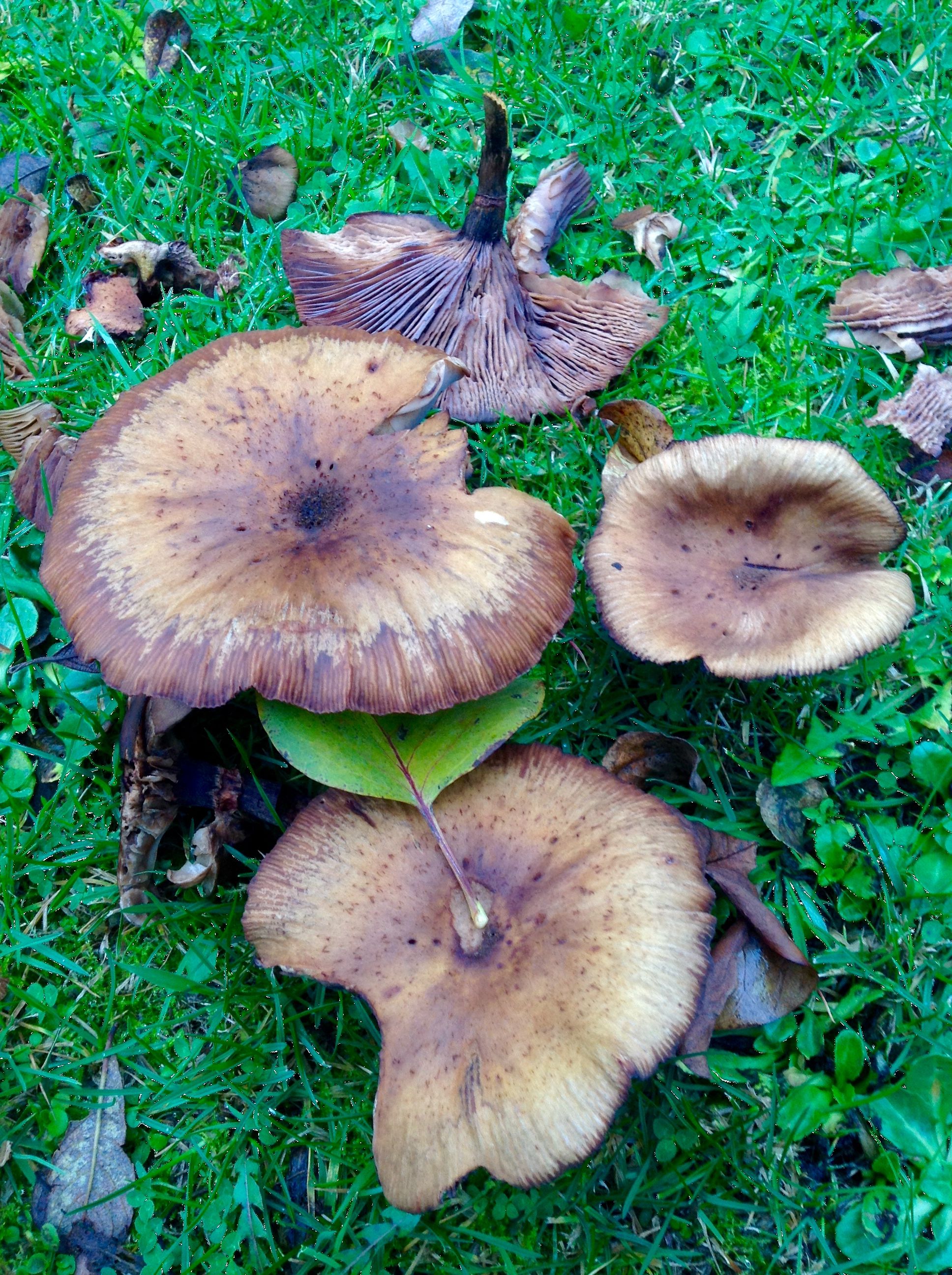
She pulled on her mother’s wellies and trod out into the garden, up the concrete steps. The air was very still; mournful, even. It smelled of wood-smoke, and somewhere she could hear the crackling snaps of burning tinder. Plumes of it rose against the blueish dusk in dark arabesques. She sighed contentedly. The clumps were even more abundant than she’d thought; the whole garden was teeming with their shadowy figures. She knelt down to inspect some. She thought of the honey fungus they’d found out in a forest once, clinging prettily to a rotting stump. In the sunset glistenings that glazed the silhouetted trees, she had thought she could almost see fairies, fluttering above the mushrooms. They were lovely mushrooms, with their smooth peachy caps. Her friend had said they were edible; but you could not be sure with wild ones, so they left them alone, like a living relic, noting their path. The toadstools she saw now in the garden were a putrid brownish colour, etched with black lines and little white spots. They were ugly in a kind of otherworldly way. Ethereal, even.

Her knees were going numb from bending so she stood up and did a lap of the garden to get her circulation back. She was recalling things. The party where a boy brought out a sandwich bag of suspicious-looking vegetables, frying them on somebody’s pan. She’d stood in the doorway of the kitchen, her mind full of cheap red wine, watching the way the little things unfurled in the buttery oil, their spindly stalks stretched out like tentacles, their heads jiggling like jellyfish. As they started to sizzle and wilt, they let out a curious, bitter smell. The boy had shared them among his friends and then they had disappeared for most of the night. Later, one of them was hanging upside down in a tree at the village park, and he was reciting streams of Byron’s poetry. Sometimes, she still heard his voice, even now, reverberating through the dark.

The cold was coming out of its slumber and creeping into her bones. She stood still, wrapping her cardigan tight around her. She crouched down again and dug her nails into the earth. A weird feeling gripped her, a feeling tinged with homesickness. She pulled nothing out of the ground, no trace of seed or root. She stood up again. The quietness made her feel smaller than ever, but her mind was huge and overbearing, stretching itself across the matter of the garden. It all glared in her vision like the close-up shots of a dream. She wished some sound would break the silence. A bird-cry, even. But the little creatures were so quick with their wings that they made no noise as they flew between branches. She was trembling now, remembering everything.

The fungus at her feet now looked like the severed heads of something. She had to breathe.

If only a car would start in the drive, or a plane fly overhead…something, something!

They say that magic makes you happier. And she thought there was a thing she could do, before going inside again to the womblike comforts of heat and sleep. She brushed through the grass with her wellied feet, and stood in the centre of one of the fairy rings. It was a near perfect circle. She stared first at the mushroomy clumps at her feet, then up at the sky. It bore the dramatic flashes of an expressionist painting: great bolts of violet wounded the blue, and rivulets of yellow broke away from the horizon, approaching amber and spiralling, spiralling. Then she found again the moon. Brighter now, it was a sharp crescent, the fold of an eyelid. She waited, waited. Her body was cold and her skin prickled like coral on a sea-washed rock.

The clouds began to gather, slowly at first then fast like an army.

You could smell it in the air, the sourish dampness that held as a breath.

She closed her eyes and the rain came. She felt the initial sprinkles that bounced off her skin, the cries of birds as they darted into the hawthorns for shelter. Drizzles of silver slashing the landscape. A downpour of water and chilly air. She stuck her tongue out for the cold shock and the sharp taste. The crescendo sound of it showering louder, coming down thick and heavy from the west in globules fat as teardrops. She opened her eyes and her hair streamed down her face like seaweed, clinging to the marble of her skin. She felt it surge within her, the waterfall sounds of this injured nature. A grumble of thunder. Something stirring in her chest, a rush in her pulse. Almost like someone was watching her, a million things flashing around her. Her laughter was lost in the cavernous sound of the rainstorm, another echo pirouetting through the chambers of memory. And as she stood there, the fungus and mushrooms soaked up their nectar, before crumpling to a wasted doom. The rain had poured through and through her, and she felt hollow and purged as a mermaid tossed from the sea to a tomb. And she was the still point in the tempest around her, her body soft and sad with its sickness. This was it; home was just this, wild and true, the beatific glow of a hullabaloo.