Nostalgia for the Future: Lana Del Rey’s ‘Love’ and the Cultural Politics of Celestial Hauntology and Queer Temporality

Nostalgia for the Future: Lana Del Rey’s ‘Love’ and the Cultural Politics of Celestial Hauntology and Queer Temporality

[this essay arose out of Tumblr & IRL discussions with Scott Coubrough & Douglas Pattison; all images taken as screen-caps from the ‘Love’ video unless stated otherwise]

look at you kids with their vintage music
coming through satellites while cruising
 you’re part of the past
but now you’re the future

Lana Del Rey finally dropped a new song. Critics are calling it ‘uplifting’, ‘radiofriendly’, ‘an ode to allowing yourself to feel’. They aren’t wrong: on the surface, ‘Love’ does what it says on the tin. It’s a pop song dripping with sentiment, evoking that sense of yearning, the fragile desire of a typical Lana ballad, the kind of retro-culture sadcore found most prominently on Born to Die (e.g. ’Videogames’ and ‘Summertime Sadness’). However, as with all of Lana’s material, there’s more going on beneath the surface. This isn’t just a saccharine ballad about love. In fact, this is probably the most poignant address to millennial angst I’ve experienced in pop music so far.

In the video for ‘Love’, clad in a white dress, dark hair studded with sixties-style daisies, Lana’s figure fades into view out of blackness. The mood is monochrome, but the song and its video deal in more than one mood, one temporality. As Scott Coubrough puts it, ‘it totally depicts the experience of the cultural anachrony of now’ (citation: Tumblr chat). The black-and-white vintage Hollywood vibe is lingered over with sensuous closeups of smouldering cigarettes, dust swirling on a rain-streaked window, a handsome man pulling shapes from his vintage guitar. In the first half of the video, Lana’s performance is spliced around footage of kids living in a pastel-hazed Instagram version of the sixties, skateboarding and drifting in couples around graffitied streets. While most of these teenagers carry sixties iconography—huge plastic shades, cropped haircuts, Ginsberg-glasses—there are the odd anachronisms, the kind of hoodie-clad ambience of a Blink 182 video romanticised in slow-motion. Smartphones make an appearance only as cameras. It’s not a selfie that’s taken, but an old-fashioned snapshot of a friend. Why invoke this vintage idea of relationships, of summer afternoons wasted innocently without the distracting paraphernalia of everyday technology? Who are these kids, who have time to lean seductively over trucks, to laugh arm in arm in glorious LA sunlight?

This is all a deliberate exercise in nostalgia. The warm haze of an Insta-filter showers these moments in the warm glow of preservation, the stylised memorabilia we accumulate daily with our social media feeds. There’s a sense of the future anterior to everything that happens: such visual flickers of perfection, snapped as photos, remind us that youth is always about imminence: knowing that this won’t last forever, that soon it will slip away. We are always finding ways to preserve, to prolong it. Youth. Even as we’re living, we’re thinking of ways to capture the moment.

So far so ordinary. Nostalgia for lost youth and lost love isn’t exactly a new theme in pop music, from Van Morrison’s ‘Brown Eyed Girl’ to Del Rey’s own back-catalogue, notably her offering on The Great Gatsby soundtrack, ‘Young and Beautiful’: “will you still love me when I’m no longer young and beautiful?” What’s different about ‘Love’ is its relentless insistence on the temporal deferrals within presence. “To be young and in love” she sings over and over, a collective rallying cry to her fans that urges its utopian possibility through the infinitive, rather than present tense. There’s no actual sense that these kids are all in love, but Lana explores what that love really means. She references the confusion of modern dating, mired as it is in the conventions of various apps and different types of hookup (“signals crossing can get confusing”). She repeats the word “crazy” like she’s trying to conjure it into being from the word’s invocation of chaos. But other than that, ‘Love’ doesn’t explicitly explore what it means to be in a conventional relationship; there’s none of the vivid imagery of masochism and defeat, none of the apostrophised Brutish and Beautiful Men you might find scattered around previous albums. Instead, love figures on this song as a kind of energy, the channels of desire that seem to pull us out of our current reality and into nostalgic futures.

The problem is, this desire isn’t a simple longing for a lost object, the loved one who slipped from our grasp; it’s a kind of depression, the Freudian melancholia that lacks an identifiable source, that eats away at our sleep. Beneath the sugary imagery of couples sharing walks and drives together, there’s that restless unease. The dark pulse of Born to Die-era strings. The heart of the song is a sense of self-reflective stasis. The camera pulls outwards to reveal the teenagers in the ballroom, watching Lana perform with reverent awe in their faces. Already, the singer is reflecting on the cultural presence of her music as it spreads into the future through the track’s own duration. This is a song which never seems to build to obvious climax, which rejects that teleological impulse towards the goal of release and decline, the cycles of reproduction which compel us to consume more and more as we start again each time. Instead, ‘Love’ wallows in the shallows of its strange, haunted swing, mesmerising us with cinematic production, with delicately repeated refrains that twirl like spun sugar. Onstage, Lana is bathed in white light, this ethereal beacon from the past or future, existing in the timeless space of an auditorium. It’s like the set for a Beckett play, that dark space of absence and aporetic timelessness where anything might happen. Beckett, only with sex, beauty and audience adoration. We’re encouraged by a playful, irresistible wink to fall for this surreal and breathless dream.

Screen Shot 2017-04-02 at 13.05.41.png

The kids slowly sink into Lana’s music, lolling their heads in time, blinking in meditative motion as they stare at her swaying onstage. When we see the starlight reflected back through Lana’s eyes, the kids begin seeing the same celestial beauty. A huge moon rises above them, the walls of reality shattering as the ceiling becomes a super-imposed night sky. The truck starts spinning in space, a truly lost object, like the kind of anachronistic cultural products scattered across Back to the Future, divorced from their temporal ‘home’ and washed up elsewhere, the debris of a lost present. In space, the truck’s radio says ‘No Service’. We’ve entered Beth Orton’s ‘Galaxy of Emptiness’, the starry space where we’re detached from the everyday. “Back to work or the coffee shop”; these banal facts of daily life are usually excluded from the typical Lana song, which is more likely to feature gangsters and bad boys and probably a branded soft drink or declaration of deeply personal romantic sadness. This song feels more universal, generational, though nonetheless affective. The ordinariness of work and coffee (made more poignant by the obvious fact that many millennials combine the two as baristas, again reinforcing this idea of a dull labour cycle) infiltrating a LDR song? Woah. Her previous work explores the saturated hyper-dreams of consumer capitalism, with presidents dripping in gold chains, Lana herself resplendent in expensive pastel Jackie O suits, or riding across sunset highways against the vintage billboards advertising various American Dreams. The haunting quality of ‘Love’ is that it sort of rises above the glitz and glamour. Smartphones aren’t product placements but rather become anachronistic, incongruous relics, twirling out of time. The youth depicted in ‘Love’ are caught in a static reality, never growing old. By floating into space, they are cast adrift from capitalism’s materialised temporality.

You get ready you get all dressed up / To go nowhere in particular”. With this line, I’m reminded of an endearing extras video from the Skins series, called ‘Cassie’s dark dates’. Cassie, the ethereal and bittersweet anorexic character, announces to her flatmates that she’s going on a date, slicks on lipstick and smiles nervously in the mirror. She sits in the park smoking in her mustard socks, hair blown back wispy in the wind, watching a red balloon caught in her tree, fragile as her own wee heart. She wanders the city alone till it gets dark, then finds an old man lying on the ground. Thinking he’s dead, she tries to talk to him, then lies down beside him after he says he’s ‘listening to the pavement’. The pair wander home and she helps him make beans and toast; they share a cigarette and some laughter. It’s a lovely depiction of two lost souls from different generations finding temporary peace in their lives. He falls asleep on her knees while she reads an old book. It’s wistfully delightful; watching it now reminds me that those teenagers we watched grow up grotesque and vivid onscreen are somewhere, someone else now. The girl I was ten years ago (literally, wow) is equally lost. Part of her thought she would return to Mars. But she didn’t (or did she?) and instead she faded through the years, through the ether.
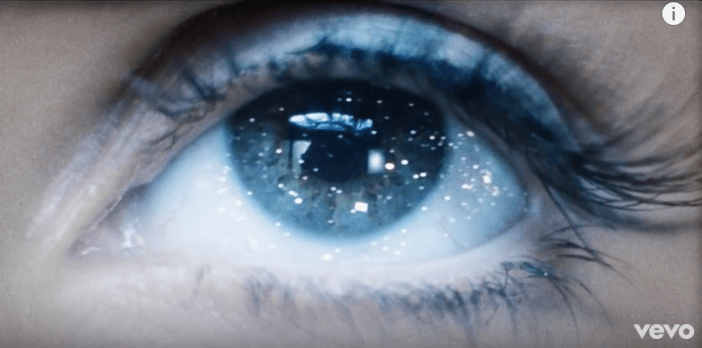
Screen Shot 2017-04-02 at 13.04.35.png

Reality is a Stage Set/Baby the World’s Ending

 J. G. Ballard famously said that ‘one of the things I took from my wartime experiences was that reality was a stage set’, whereby ‘the comfortable day-to-day life […] could be dismantled overnight’. I’m reminded of the closing scenes of Ashes to Ashes, where Daniel Mays’ devil-like character starts smashing up the office ‘stage set’ and revealing that this reality is really just a kind of limbo, suspended in starry space—all the characters, we suddenly realise, are already dead. This is a series that, as with Life on Mars, is constructed on the premise of a sort of techno-hauntology, where the characters find themselves cast back in time but connected to the present through various forms of twentieth-century media. Signals start crackling with uncanny resonance, spirits and voices carried across the ether.

In ‘Love’, the film’s stage set is revealed as suspended somehow in the rather grandiose setting of space. Seeing the truck spinning, I couldn’t help but be reminded of Gene Hunt’s Quattro, this retro object that acquires nostalgic significance for the contemporary viewer. Why is it hurtling, in Lana’s video, towards the smouldering sun? The faces of the young folk in the car are seen glowing amber as the sun approaches, but they look happy rather than frightened. Somehow the video ends with the cool kids frolicking in this strange environment which could be anywhere, any planet. There are several moons in the sky. There’s a diner in the middle of nowhere. It feels a bit like Mars, all red canyons and desert sands. But there’s the blue water. These sublime landscapes evoke a sense of both fear and wonder as all the characters, including Lana, stare up at the sky. Are they scared of what lies beyond? For a generation whose futures are likely to be less well-off than their parents, whose hopes and dreams are clouded with rent-markets, dead-end jobs, cycles of unemployment and crippling student debt, the world of phantasmagoria evoked by the planets and stars seems a welcome retreat.

Like Clay in Bret Easton Ellis’ Less than Zero, they spend endless time just floating. While Clay drives about on the LA freeways, these characters drive about in their trucks, then frolic in the wastelands of space. What Gen X and millennials have in common is that sense of suspension and boredom. Where millennials differ, perhaps, is in their urge towards something greater, a less jaded sense of existence. When pushed to the edge, where else to go but down into that abyss? Simon Reynolds explains this sense of suspended progress in the twenty-first century, where the problems Ellis’ characters faced in the eighties are even more accelerated within culture and social life:

our belief in progress itself has been shaken badly recently – by the resurgence of faith-based fundamentalisms, by global warming and toxic catastrophe in the Gulf of Mexico, by evidence that social and racial divisions are deteriorating rather than improving, by the financial crisis. In a destabilised world, ideas of durable tradition and folk memory start to appeal as a counterweight and a drag in the face of capitalism’s reckless and wrecking radicalism

(Reynolds 2011: 404).

It’s this drag that Lana’s languid beat creates. She assures us: “It doesn’t matter if I’m not enough / For the future or the things to come”. This is a bold statement in the goal-orientated universe we live in; a time when everything has to be justified, ticked in boxes, underlined with attaching transferable skills. ‘Love’ allows us to dwell on just being, on the non-instrumental connections we make with other humans. Like many LDR videos, ‘Love’ offers a form of escapism from reality, but unlike those other videos this is an escape we all live everyday. The anonymous teenagers/young adults featured in the video could be any of us; they are scaled down, their insignificance is made vivid by the appearance of huge celestial bodies. We literally transcend the Earth. So why not make it spiritual? After all, our planet is itself on the edge. We are living in the time of the Anthropocene. Isn’t it about time our pop-cultural heroine consulted the oracle and told us how best to look westwards?
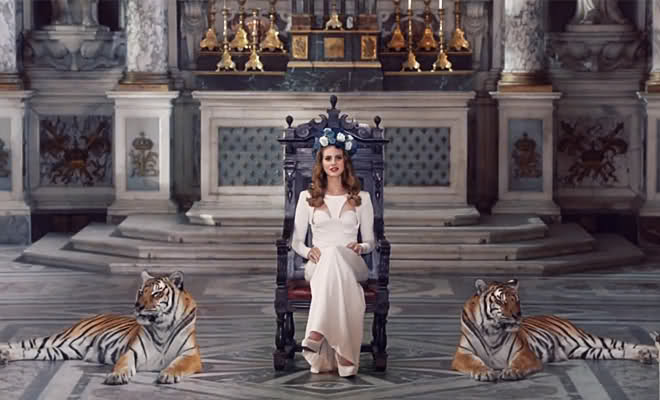
1531eyu.jpg
From the ‘Born to Die’ video. Source: MetroLyrics
1396259-lana-del-rey-delrey-viral-617-409.jpg
From the ‘Born to Die’ video. Source: Billboard.

“Baby don’t worry”: Lost in the Chora

Take previous LDR videos. ‘Born to Die’: the American flag, the imperial palace, the denim shorts and red baseball sneakers, tattoos and stretched ears, tigers and headlights, a lost highway, vampy red nails, the virginal white dress, sex, silence, a crown of summer flowers. A glut of signifiers. Money, power, glory. Oh wait, that’s another Lana song. The point is, we’re used to this sort of postmodern meta-play of signifiers when we’re watching a Lana video or listening to a Lana song. Like Ariel Pink, she works with readymade styles, retro-fitted fashions, vintage imagery and iconography. While Pink tends to work with a lo-fi, rough-edged, VHS aesthetic, the juicily plastic styles of the eighties, Lana favours the melancholy Hollywood dreams of the sixties. Those dark lashes, irresistible grin, hair so perfect you could frame it. ‘Love’ is a cinematic video; its very cover art suggests an old-school Hollywood film more than a new single. It’s got grandeur, it rises to what might be called ‘an intergalactic space opera’, although that sounds more like something Muse would get up to. We’re watching shooting stars stream silvery blue over a pyramid. What is a shooting star? A wish? And aren’t wishes necessarily orientated towards the future?

In opposition to an easy play of signifiers, ‘Love’ favours the expansive space of the sensuous and strange. Space itself, understood as whatever that mass of stars and matter that exists beyond our planet, is a bit like Plato’s chora. Or at least, the way it functions in Lana’s video (hell, I’m no astrophysicist). The chora is a kind of ‘mobile receptacle of mixing, of contradiction and movement’ (Kristeva 1977: 57); it is a womblike space which drive flows of renewal and infinite multiplicity within and beyond the subject. Think of a space in perpetual motion, no stasis allowed in its play of atoms. There is always a shimmering, a flickering between being, self, other. The language we use to describe this deconstructive flickering is, as Timothy Morton reminds us, ‘highly accurate’ at ‘a quantum scale’ (2015: 71). ‘When a verb is intransitive,’ he continues, ‘like flicker is, does the fact that it has no direct object mean that it represents a state of being or does it mean that it represents a state of doing—and if so, doing what to what?’ (Morton 2015: 72-73). What if ‘love’, as it appears in Lana’s new single, is an intransitive verb. To be in love is different from saying, ‘I love you’, ‘I love chocolate’ or ‘I love sunsets on the hottest days of June’. You’re not attaching the state to an object. There’s a sense of transition, passage, deferral between expression and feeling, the manifestation of a signifier. The space we inhabit in Lana’s song is a kind of chora, always undergoing some kind of self-rupture.

‘The chora, as rupture and articulations (rhythm), precedes evidence, verisimilitude, spatiality, and temporality’ (Kristeva 2001: 2170). Phantasmagoria are necessarily virtual images, superimposed on reality; the flicker of a hologram, a light display, a shower of fireworks, a neon sign flashing in the darkness. The blur of street-lamps in rain, the light of your phone glowing through a pink gauze of candy-floss, shimmers of fairy lights in a stranger’s window. There’s a sense of being seduced by the other side, by the beyond of the looking glass; nearly getting through but not quite. The allure of the surface, its invitation of depth that mistakes perception for layers of mirrors. The cameras filming ‘Love’ rupture time and space as they burst between different scenes, different worlds. Staring up at the stars is an old-fashioned Romantic image, but it seems less like the humans are projecting themselves onto the landscape, declaring their love as Keats did to the stars: ‘Bright star, would I were steadfast as thou art—’. Rather, this is more an experience of the sublime: the camera’s focus is more on the characters’ eyes, which become reflective screens to the visual dramas unfolding. The world impresses itself upon us, we become but reflective surfaces in the endless refraction of this mysterious universe, its scintillations of colour and light, of divided time.

We view the subject in language as decentering the transcendental ego, cutting through it, and opening it up to a dialectic in which its syntactic and categorical understanding is merely the liminary moment of the process, which is itself always acted upon by the relation to the other dominated by the death drive and its productive reiteration of the “signifier”

(Kristeva 2001: 2175).

With the word ‘liminary’, I can’t help but think of luminary. Is light necessarily a transitive state between presence and darkness? Can one have presence in darkness? A luminary is someone who shines light, who inspires or influences others; but of course it is also a light-giving body, the sun and moon and stars. Lana, clad in white and seeming to emanate light from the stage, is easily the video’s luminary. I also can’t help but think of Walter Benjamin’s Angel of History, ‘turning away from the future to face the ruined landscape of the past’ (Love 2007: 5); she’s caught between past and future, deliberately shadowing the future with her turn to a retro-fitted past.

Liminary, on the other hand, is that which is placed at the beginning of the book; it is the instating moment of ‘the process’. ‘Love’ is the start of something new, even as it is grounded in retro culture. The mise-en-abyme of its central ballroom performance instates a rupture in discourse, the sensuous invitation to revel in its temporal infinitude, the possibility of abyss offered by sudden expansions of space-time, the spreading out into the galaxy. How do we relate to one another in this reconfigured universe, this endless opening of the book that leaves us stranded in the interval between what exists and future artistic possibility? The faces we encounter in the video are always Other, always slipping from our grasp as the camera gives us insufficient time to retain them. What is the signifier so constantly reiterated in ‘Love’? Why, love of course! And here, love is inseparable from death.

Screen Shot 2017-04-02 at 13.06.11.png

No Future: Rejecting Reproductive Futurity

The video’s inertia and the song’s refusal of the little death of musical climax enacts a kind of non-consumerist pleasure. Take a standard pop, rock or indie song. There’s the buildup, the verse/chorus repetitions, the climax (with its attendantly indulgent, masturbatory solo) and the middle eight, a swift denouement. It’s all over before you know it and there you are, gorged and glutted but ultimately empty as you were to begin with. It’s the standard model for masculine sexual desire, which is pretty much always ego-centred. You keep going back for more but the high lasts only as long as the song. ‘Love’ strains towards something more intangible, elastic; both evanescent and eternal, a sensuousness moving between bodies, minds, times—never entirely confined.

I think a clue to the video’s strange temporal dynamics is, perhaps, its conspicuous lack of non-heterosexual couples. If it’s a paean to love, it’s a very straight one. Why have her characters plunge into the fiery planet? Is this a heteronormative apocalypse?
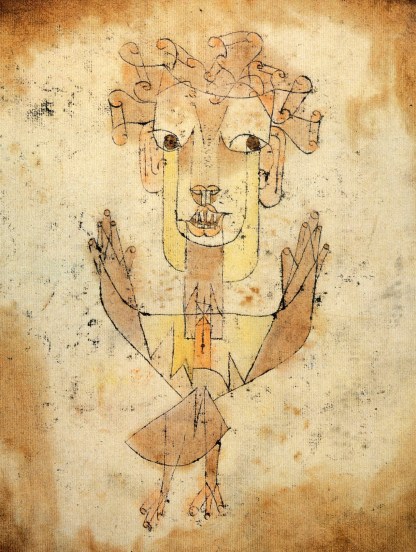
tumblr_m8bnxbqzp81qevm0qo1_1280_0.jpg
Paul Klee’s ‘Angeles Novus’–the painting Benjamin used to explain the Angel of History. Source.

There is a sense that this video is ghosted by a queer temporality. This opens up questions about identity, sexuality but also a more epochal sense of where we are now in terms of our experience of being and time.

According to Walter Benjamin (1940), one of the hallmarks of the modern era is a constant movement through “homogenous, empty time,” as opposed to the hauntings and co-occurrences of premodern civilisations and religious times. Attention to queer temporality explodes the idea of such homogenous and empty time, indicating the public face of white, heterosexual Western normativity as its vanguard.

(Cho 2015: 49)

Another striking thing about ‘Love’ is its white-washing. There are a few mixed-race characters but overwhelmingly these kids are the white youth. Maybe not quite Made in Chelsea-level, but nevertheless the video is pretty white. Now, while there’s been some controversy about Lana’s performative stylisation of racial tropes (and that’s a whole other essay on the topic of cultural appropriation), I don’t think white-washing is an inherent problem with Lana herself; she’s worked with people of colour in previous videos and in her touring band. So this instance of whiteness seems potentially deliberate. It’s part of a more general invoking of this hegemonic bloc, the young folk who we expect to have a wild youth and then grow up and settle into settled, middle-class heteronormative, reproductive lives. But what happens instead? They end up in this performative limbo, this space of the sublime, which is by definition ‘limitless’: ‘the mind in the presence of the sublime, attempting to imagine what it cannot, has pain in the failure but pleasure in contemplating the immensity of the attempt’ (Kant, A Critique of Pure Reason). Lana offers us this impulse to strain beyond what the world, in all its narrow clarity, offers. She urges us to relish in the shadows, even as she emanates light and knowledge.
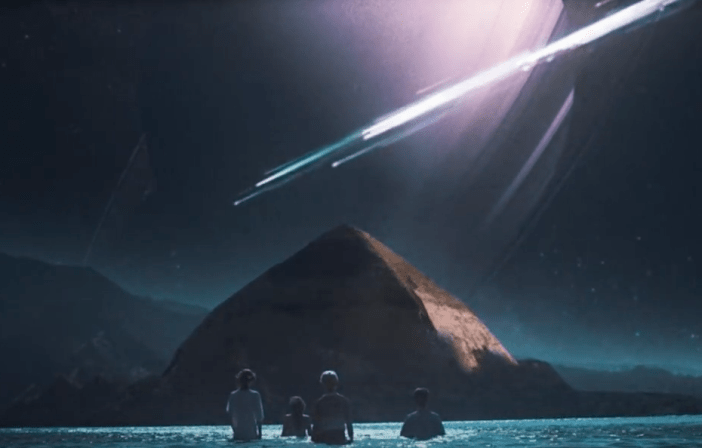
Screen Shot 2017-04-02 at 13.06.20.png

What are these shadows? Where are the queer and non-white hiding? As Lee Edelman (1998) points out, culture and society translate desire into temporality, into narrative; specifically, into the heteronormative teleological narrative of reproductive futurity. Fall in love so you can settle for a single partner, bind your desire in a capitalist social contract based on ideas of possession and commitment (marriage) and then help perpetuate the social order by having children and raising them to share your heteronormative ideologies. ‘Love’ unravels this teleological narrative of love. Those who fall out of the heterosexual camp are considered negative, ghostly, associated with the death drive since they do not reproduce. Lana, with her asynchronous depiction of sixties youth in the age of the smartphone, invokes a kind of time out of joint. As I’ve already said, these kids are trapped in stasis. The chora allows a sensuous, non-object related pleasure that goes beyond the consumer ethic or the typical romantic ethic of attachment. As they enter the waters of Mars (let’s just assume it’s Mars), they spread out from their initial couplings and form a collective of shared wonder. We’ve seen them plunge towards the fiery planet, the possible apocalypse that explodes instead into celestial beauty.

For Edelman, the project of queer theory is to embrace this association with the death drive:

Queer theory, then, should be viewed as a site at which a culturally repudiated irony, phobically displaced by the dominant culture onto the figure of the queer, is uncannily returned by those who propose to embrace such a figural identity within the figuralisation of identity itself.

(Edelman 1998: 27)

As discursive space, queer theory allows for ironically retaliating with an embrace of this phobic backwards queer. So imagery associating homosexuality with ghosts, vampires, absent figures and so on is vividly figured as an assertion of refusal, refusal to capitulate to reproductive futurity. In ‘Love’, the time of adolescence is transformed as these early models for future capitalism become ghosts, faces lit up in celestial white as they form a sort of playful colony on another planet. Their anonymous identities are held in stasis, prompting the audience to conjure for ourselves a narrative for their existence, their future.

By its very exclusion, the queer figure haunts Lana’s video. She reminds us that in Hollywood culture, rarely does a queer character get to share screen pleasure; but ultimately, the couples that do get together in ‘Love’ aren’t doing the old R’nB style dry hump in the back of a fancy car, but rather more innocently share in each other’s being. The moment of collectivity towards the video’s end when everyone looks up at the sky, just as before they looked at Lana, Angel of History, initiates a different kind of shared love. Friendship, perhaps, is just as important as romance. It’s all about a shared openness to the wonders around us. Maybe this is a sort of jouissance, that joy and bliss that cannot be pinned down simply to signifying object relations, ‘the sense of a violent passage beyond the circumscriptions inherent in meaning’ (Edelman 1998: 27). An experience of rupturing pleasure that can poke a hole in our normative sense of reality. However, as with most of Lana’s output, jouissance is inherently tied to the death drive, since by unravelling our symbolic reality, it also peels apart ‘the solidity of every object’, including the subject—making us painfully aware of our finitude, the void that stares back at us through the torn gauze of everyday signification (Edelman 1998: 27).

tumblr_mai7l9cLwG1qewhoso1_500.gif
Source: Rooster Magazine.

The Loop of Depression

Often referred to as ‘Hollywood sadcore’, Lana’s music is always inflected with a tragic undertone, a flirting with death (notoriously, she claimed in a Guardian interview that, ‘I wish I was dead already’), an atmosphere of darkness and depression. Depression works often by a loop logic. As Timothy Morton points out, the problem with depression is that it restricts temporality ‘to a diameter of ten minutes’: five in the past and five in the future. This narrowing translates into a kind of loop where one’s inability to think long-term forgoes the possibility of interrupting and re-directing the cycle of negative thought. The beats on ‘Love’ are tensely held; the song rarely develops beyond its repetitive ah-ah-ahs and it’s refrain of young and in love; while on the surface it seems affirmative, really it operates by a loop logic which betrays its cultural claustrophobia, its haunting. As my friend Scott points out, ‘Love’ also has a sound effect ‘that sounds like a metal bolt being locked’ which ‘reinforces how trapped we are in this loop’. And what exactly is this depressive ontology in which we are caught? How does Lana make it so seductive, even as she deconstructs its sources in heteronormative futurity and the existential despair of our millennial generation?

Depressive ontology is dangerously seductive because, as the zombie twin of a certain philosophical wisdom, it is half true. As the depressive withdraws from the vacant confections of the lifeworld, he unwittingly finds himself in concordance with the human condition so painstakingly diagrammed by a philosopher like Spinoza: he sees himself as a serial consumer of empty simulations, a junky hooked on every kind of deadening high, a meat puppet of the passions.

(Mark Fisher 2013: 61)

Being depressed highlights how much of a serial, looped existence we live on a daily basis, regardless of our mental health. It’s just capitalism. Only, unlike their ‘healthier’ or ‘more adjusted’ comrades, the depressed are unable to pursue this consumption of ‘empty simulations’ with any exuberance, feigned or otherwise. What’s the point in washing our hair when we’ll only have to do it again, when we’re not even sure what this body is or who it belongs to or what the fuck it’s doing in the world. When you don’t give a fuck about looking like that girl in the Loreal advert? Sylvia Plath’s protagonist Esther Greenwood, falling into clinical depression, says:

I hadn’t washed my hair for three weeks, either.

I hadn’t slept for seven nights.

The reason I hadn’t washed my clothes or my hair was because it seemed so silly.

I saw the days of the year stretching ahead like a series of bright, white boxes, and separating one box from another was sleep, like a black shade. Only for me, the long perspective of shades that set off one box from the next had suddenly snapped up, and I could see day after day after day glaring ahead of me like a white, broad, infinitely desolate avenue.

It seemed silly to wash one day when I would only have to wash again the next.

It made me tired just to think of it.

I wanted to do everything once and for all and be through with it.

(Plath, The Bell Jar)

The way Plath’s sentences spill out like lines of a poem, of code or fragmentary diary entries, indicate this sense of a loop: Esther can’t think beyond the next five minutes, and when she tries, she sees the infinitude of a ‘desolate avenue’. This is the future of the depressive, an endless repetition of mundanity that has no release from its shade. Esther has lost a sense of purpose or instrumentality: she cannot buy into the ideologies of femininity or self-care that justify the washing of one’s hair. She is, in body and mind, utterly exhausted.

What’s the point in having any faith in television, love, novels—the everyday detritus, landscapes and people of life itself—when everything reveals its inner hollowness, its lack of presence. The depressed see the emptiness in everything, the way everything concatenates, leads back round to the false positive of consumer logic. Maybe it’s a bit like seeing the world through Derrida’s eyes, but without Derrida’s flourishing ability to express it. Being depressed is actually—aside from the myriad debilitating physical and serious mental side effects—about having a very incisive and mostly, sadly, accurate view of the world. The problem is that there are ways of thinking through this loop and creating an alternative, positive subjectivity from the surrounding ruins; but when you’re stuck five minutes into the future and five into the past, this is pretty difficult to achieve.

So in a sense, ‘Love’ fetishises not death per se, but a depressive ontology which overshadows its surface celebration of exuberant love and celestial futurity, the astrological symbolism of possibilities to-come—future predictions. As with Esther Greenwood’s white boxes and black shade, Lana works with a monochrome logic of feedback loops (the audience viewing the artwork which we as audience are presently viewing), the symbiotic, repeated exchange between black and white, presence and absence, past and future. We are gifted with her “vintage music”, with the siren song of the past spreading into the celestial bounds of tomorrow. The sixties were a decade of utopian promise, representing the hope of future freedoms being realised in the present through protest, communes, youth culture—putting new ways of living into practice. In ‘Love’, the stylised invocation of the sixties represents the lost futures which our generation has been outcast from by the structural logic of late capitalism, its favouring of those who came before us, its refusal to invest in the infrastructure of youth and its possibility. The sixties can only appear here in the cinematic vintage of nostalgia.

The sound that comes “through satellites while cruising” could refer to the satellites of the present, the ones that structure the global interconnectedness of the internet, of broadcast television, the possibility of a rhizomatic exchange of divergent (and, hopefully, ideologically and temporally subversive) dreams that goes beyond the one-way projection of Hollywood’s cinematic vision of heteronormative LOVE. The word ‘cruising’ evokes the sense of pointless drifting, the sensuous and pleasurable experience of sailing around without definition of purpose that we find in the chora; in the way the characters float without gravity in space, surrounded by the suspended debris of identity, with smartphones and skateboards. It also, however, connotes the act of wandering around in search of a (casual) sexual partner, a practice often associated with gay culture. Once again, the spectre of the non-heterosexual returns to haunt this vision of sensuous, anti-teleological pleasure. Casual hook-ups rupture the reproductive marriage logic of possession; they instate a consumer attitude of recycled desires. Yet Lana’s video, unlike many contemporary music videos, doesn’t portray a vacuous array of club meet-ups leading to casual sex. It moves towards something sensuous, visionary and strangely warm and beautiful. There’s genuine affect, as Lana smiles and sings her way through this weird journey. She celebrates a kind of jouissance which seems to exist outside of reproductive futurity, outside of capitalism, outside of the Earth as we know it. Is this where we Millennials are headed? Will only the choice, privileged few get to share in this utopia, as is apparent in the video? Whose vintage dream is this, anyway?

Further Reading

Cho, Alexander, 2015. ‘Queer Reverb: Tumblr, Affect, Time’, Networked Affect, ed. by Ken Hillis, Susanna Paasonen and Michael Petit, (London: MIT Press), pp. 43-59.

Fisher, Mark, 2013. Ghosts of My Life: Writings on Depression, Hauntology and Lost Futures (Alresford: Zero Books).

Freud, Sigmund, 1914-1916. ‘Mourning and Melancholia’, On the History of the Psycho-Analytic Movement: Papers on Metapsychology and Other Works, Vol. 14, trans. by James Strachey, (London: Hogarth Press), pp. 243-258.

Heather Love, 2007. Feeling Backward: Loss and the Politics of Queer History (London: Harvard University Press).

Morton, Timothy, 2015. ‘Sparkle Time Time Sparkle’, in Sophie Sleigh-Johnson, Chtonic Index (Southend: Focal Point Gallery), pp. 66-79.

Reynolds, Simon, 2011. Retromania: Pop Culture’s Addiction to Its Own Past (London: Faber and Faber).
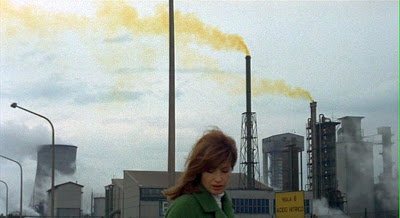
The Bog Girl’s Dark Ecology

red-desert-43
Red Desert ~ Source

My body was braille

for the creeping influences:

Seamus Heaney, ‘The Bog Queen’ (1975)

In Michelangelo Antonioni’s 1964 film Red Desert, loosely inspired by Rachel Carson’s groundbreaking ecological text, Silent Spring (1962), one of the characters complains that he was at a restaurant and the ‘eel tasted of petroleum’. This is a film landscaped by oil rigs, the persistent murmur of a dull grey dying sea, industrial structures whirring with eerie electricity. While there is a distinct sense of disconnection between characters, between humans and their environment, one connection that persists is between excess, waste and the body. While nowadays fish change genders due to oestrogen from the Pill being excreted and pumped from sewage into rivers, in Antonioni’s film, haunted by the apocalyptic backdrop of the Cold War, the characters worry about their food getting cloaked in some essence of what gets dumped and yet is also extracted from the sea. A perverse cycle of waste, energy, wasted energy.

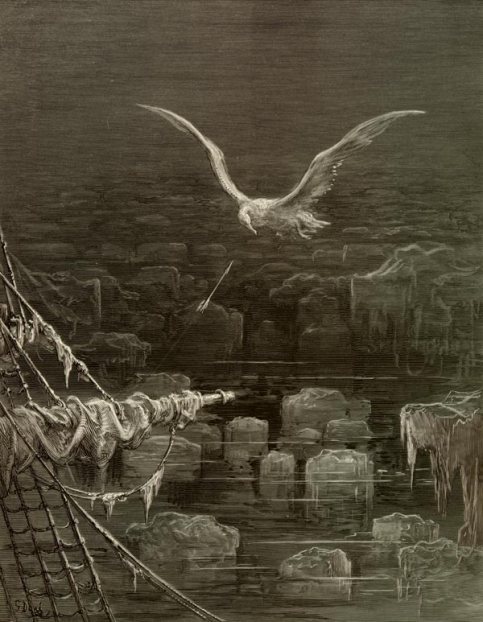
plate08.jpg
The mariner shoots the albatross, plate by Gustave Doré


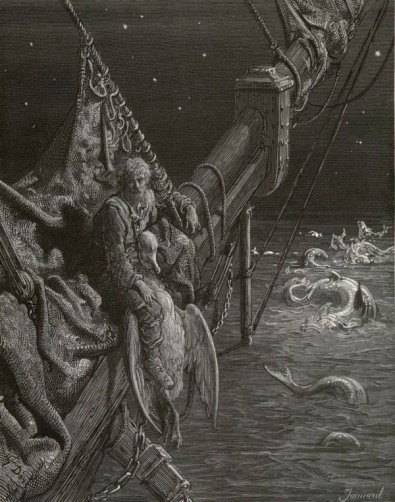
This early expression of ecological disaster as embedded in a fear of contamination, of sliminess mixing with toxic sliminess, has its roots even further back, in Samuel Taylor Coleridge’s poem The Rime of the Ancient Mariner (1798). After shooting the albatross and overcoming a terrible, supernatural (super as in extra nature, nature made unnatural by being its full strong self) storm, the mariner finds himself suspended in the aftermath, ‘as idle as a painted ship / Upon a painted ocean’ (Coleridge 2015). This sense of time frozen, of the environment refusing to yield to human command, is uncanny, a reminder that the land isn’t just something we can divide and conquer. The image of idleness and a ‘painted ocean’ recalls the experience of a crashed computer screen, hung or ‘frozen’ as the mariner is in the sheets of ice ‘green as emerald’ (Coleridge 2015). Think of a typical glitch, that which overlaps colour, blends unrelated materials together in a random, patchwork image. The ice is the colour of grass, yet still we are in the ocean. This is an environment without location, an ‘anywhere’ of strange displacement. This is the place of the ecological glitch.

tumblr_npqtors3nr1r6a43wo1_500
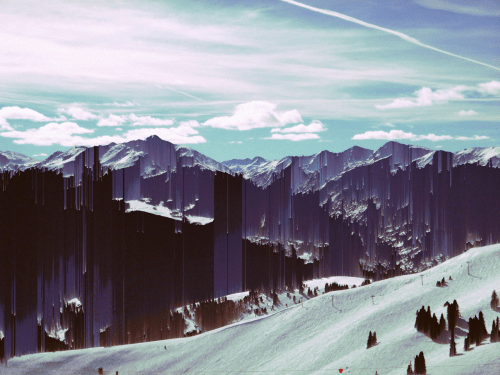
glitched landscape ~ Source

Rosa Menkman describes a glitch as ‘a (actual and/or simulated) break from an expected or conventional flow of information or meaning within (digital) communication systems that results in a perceived accident (2011: 9). While we are dealing in poems like Coleridge’s with a ‘natural’ system as opposed to a digital one, the strange effect of ‘accident’ persists. ‘Nature’ is never as it seems, never ‘natural’ but always unexpected, strange. Systems follow patterns which glitch; the patterns themselves, like evolution, proceed often by a logic of chance, randomness. The weather in The Ancient Mariner is not just climate, a conventional flow of data to be charted and forecasted; but it is positively weird. Weird in the etymological sense identified by Timothy Morton as ‘a turn or twist or loop, a turn of events’, the ‘flickers [of] a dark pathway between causality and the aesthetic dimension, between doing and appearing’ (2016: 5). We question whether the crime of shooting the albatross instigates this ecological horror, which culminates in the monstrous appearance of ‘a million million slimy things’ which the mariner sees surrounding the ship. Like Antonioni’s petroleum eels, these slimy things are stuck with the human character, they have by proximity or digestion become enmeshed, to borrow another term from Morton, the idea that ‘nothing exists by itself, and so nothing is fully “itself”’ (2010: 15). The mariner realises his own surprising mortality, just as the slimy things ‘liv’d on – so did I’. His attempt to lump the slimy things as one gelatinous mass of gross matter leaves him realising that he can’t distance himself from the ugly parts of nature, because he himself is part of the mass, that mesh of beings.

windeby_5
Source

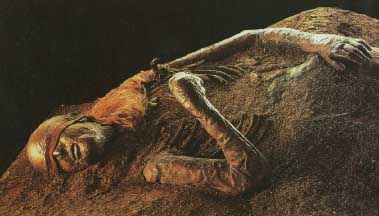
We might now describe Coleridge’s flirtation with the supernatural as a kind of magical realism, and the trend of using such weird elements to render ecological themes continues in a short story written by Karen Russell and published in the New Yorker in 2016. ‘The Bog Girl’ tells the story of a fifteen-year-old boy, Cillian, who works as a turf-cutter in the peatlands of some ambiguous ‘green island off the coast of northern Europe’, inflected with hints of Heaney’s hardy Irish pastoralism. Cillian falls in love with a young girl pulled from the bog; she is ‘whole and intact, cocooned in peat, curled like a sleeping child’ with ‘lustrous hair’ dyed ‘wild red-orange’ by the ‘bog acids’ (Russell 2016a). Crucially, there is a noose round her neck. She is young in appearance but probably 2000 years old; her flame-haired  and gaunt appearance recalls Celtic/Pictish origins as well as a ragged Pre-Raphaelitism, which hints at Cillian’s weird fetishisation of her beauty. The story that unfolds can be read as a love story, a tale of caution against projecting your ideal fantasies onto ‘the mask of another person’s face’ (Russell 2016b); but here I will read it as a tale of ecological horror that warns of the dangers of industry and celebrates the sensuous mysteries of the peatlands as something that deserves preserving.

Our current era, the Anthropocene, is one of distorted scale, where constantly we deposit chemicals into the atmosphere and earth whose afterlife beyond our own we can barely even gauge as mortal humans. Russell’s story explores this (im)possible meeting of temporalities through an encounter with strangeness which allows us to mull upon our relationship with the earth, to realise our absolute enmeshment with the environment. No matter the narratives we construct through history and science, all human theory is at best the ‘most speculative fiction’; while improvements in science (‘radiocarbon dating, DNA testing’) allow us to trace the ‘material fragments’ as ‘clues’ about our ancestors’ experience, ‘their inner lives remain true blanks’ (Russell 2016b). At one point, Cillian decides it’s time he met the Bog Girl’s family, so he takes a ferry from the island to a museum. He scans the museum’s labels, which attempt to give context to the ‘pickled bodies from the Iron Age’, but is unsatisfied by these attempts to ‘surmise’ details about the ancestors’ lives based on material detail alone (Russell 2016:a). Their bodies are ‘fetally scrolled’ (Russell 2016a), suggesting that screeds more of history are inscribed on their skin like ink upon scrolls, a literal blending of flesh and text. The inadequacy of the museum labels allows Cillian to continue his fantasy that the Bog Girl appeared for him alone, that she ‘was an alien from a planet that nobody alive could visit—the planet Earth, in the first century A.D.’ (Russell 2016a); none of the other ancestors stir the same emotion as the Bog Girl. Love becomes a token, a talisman of magical power: ‘He told no one his theory but polished it inside his mind like an amulet: it was his love that was protecting her’ (Russell 2016a).

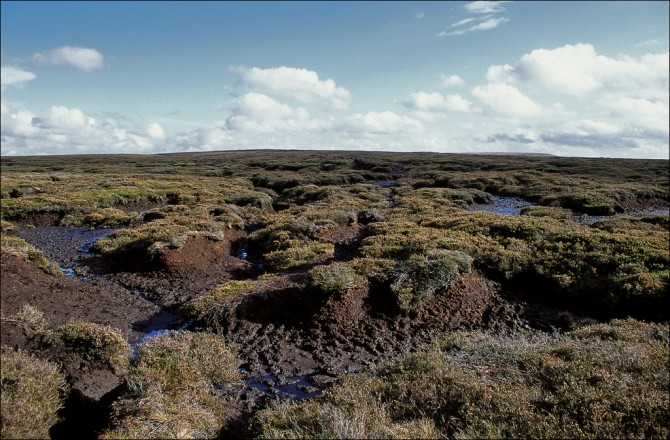
Russell’s narrative sustains this fantasy, resisting the natural outcome which would be the Bog Girl’s rapid decomposition upon exposure to air. This commitment to a magical realist effect allows her to explore problems of intimacy and otherness, which relate deeply to ecological issues. Take the bog itself. Russell describes it as a primitive hole, the ‘watery mires where the earth yawns open’, a place where time is suspended by a ‘spell of chemical protection’ which prevents the decomposition of matter: ‘Growth is impossible, and death cannot complete her lean work’ (2016a). Her rendering of the bog is crucial to the story for its associations with the suspended temporality embodied in the Bog Girl. We are told that much of the peat is cut away to turf, a key energy source still used by the islanders, and ‘nobody gives much thought to the fuel’s mortuary origins’ (Russell 2016a). Death, a haunting presence seemingly without telos, lingers in the earth, in the home; the Bog Girl weirdly embodies our paradoxical relationship to natural fuel sources: we consume them to produce energy, but our consuming instigates the loop of destruction—de-energising the earth—pumping poisons and coagulating into new forms of deadly matter. The peat bogs are a kind of charnel ground, already containing the detritus of bodies and time in a ‘disturbing intimacy […] that exists beyond being and non-being’ (Morton 2009: 76). The bogs are both ‘shit’ and ‘fuel’ (Russell 2016a), embodying the waste we must expel to maintain presence and order; but also refusing this separation, stickily gluing us through interdependence (the islanders need it for fuel) just like those slimy things reminding the mariner of mortality.

Moreover, the introduction to the bog includes the narrator’s address to the reader, the only such address in the story. The narrator remarks of the island, ‘it’s unlikely that you’ve ever visited. It’s not really on the circuit’. This seemingly throwaway comment interpellates  (in Althusser’s sense of the word as a ‘hailing’ of subjectivity within ideology) the reader as a global consumer, whose ‘circuit’ references a sort of capitalist freeway (the places we drift through for pleasure) as much as it slyly hints at the cycles of life/death which are interrupted in the text. From the start, we are made to feel as outsiders in this community, which is self-consciously established as a wasteland of sorts, off the circuit, the beaten track; a charnel ground for exploring the mystical possibilities of strangeness and ecological intimacy.

What’s more, her association with primitivism and death links the Bog Girl to the past in a way that is queer, that disrupts the reproductive logic of heteronormative capitalism, a disruption that Cillian welcomes. Cillian ‘imagined, with a strange joy, the narrow life’ he and the Bog Girl ‘would lead. No children, no sex, no messy nights vomiting outside bars, no unintended pregnancies […] no promises’ (Russell 2016a). Note again that word, ‘strange’. The Bog Girl’s body is bounded; she will never consume nor produce waste, will never reproduce to bring more consumers upon the earth; with her, Cillian shrugs off the lusty masculinity of the ‘mouth-breathers’ (Russell 2016a) who help dig up the Bog Girl, he deviates from the established gender norms. Indeed, Cillian’s docility, his placid detachment from the rugged rural manliness of those who surround him (personified most perfectly in his uncle, who refers to the Bog Girl as a ‘cougar’ and has ‘a thousand beers’ laid out for himself at dinner) renders Cillian a queer figure, ‘so kind, so intelligent, so unusual, so sensitive—such an outlier in the Eddowis family that his aunts had paid him the modern compliment of assuming that he was gay’ (Russell 2016a).

Yet while the Bog Girl embodies a queer backwardness, more specifically she offers an openness of temporality, a strange oscillation between past and future rather than an obsessional projection towards the future. Derrida (1994) explains the promise as bound up in the logic of messianism, the guarantee of the future to-come of some saving force that would sweep up history. Remember the religious breathlessness which narrates Cillian’s discovery of the Bog Girl: ‘The bog had confessed her’ (Russell 2016a), as if she were a message passed on from a Neolithic age. Yet Cillian is oblivious to the fact that his love is itself the promise of an (unspeakable) secret, a promise of a present without future, a seamless overlapping of present and a past that can never again be as time demands its rupture, the Event of her eventual, unexpected awakening. The silence between them, the Bog Girl’s inability to speak, indicates his sense that love can be their pre-linguistic communication, an avowal without trace; but this originary language is impossible:

Invented for the genealogy of what has not happened and the event of which will have been absent, leaving only negative traces of itself in what makes history, such a pre-originary language does not exist. It is not even a preface, a foreword, a lost language of origin. It can only be a language of arrival or rather of the future (une langue d’arrivée ou plutôt d’avenir), a promised sentence, a language of the other, again, but entirely other than the language of the other as language of master or coloniser [and now I emphasise], although the two of them can sometimes announce between them, keeping them in secret or holding them in reserve, so many troubling resemblances.

(Derrida 1998: 61)

This ‘language of the other’ breaks down the classically patriarchal imposition of telos and closure upon the Bog Girl: she will be his forever faithful silent Angel in the House; that is, until she starts speaking. Cillian’s aphasia, ‘a stutter that had been corrected at the state’s expense’ (Russell 2016a), hints at his own problematised presence in the text, since commonly we associate speech with presence. He lacks the authoritative Word, is himself described as a queerish glitch in (human) nature, a ‘thin, strange boy’, ‘once a bug-eyed toddler’, whose grownup, ‘celery-green eyes’ (Russell 2016a) bely an inherent connection to both land and water—there’s a suggestion of his slightness, his precarious and translucent appearance in the world. The mutuality of recognised love he comprehends with the Bog Girl is this ‘secret’ which excludes his mother and friends, which makes others jealous; and yet it is also a source of troubling disruption, the threat that emerges in the master/servant dynamic symbolised by the noose round the Bog Girl’s neck, which Cillian tightens as his ‘fantasy life’ grows deeper (Russell 2016a). And what is ‘the language of arrival’? It is the Bog Girl’s coming-to-life, her messianic resurrection into present existence.

The irony of the story is that Cillian and indeed all the human characters in the story failed to predict this resurrection. The Bog Girl is adored or feared precisely because she skims with death; the body-conscious girls at Cillian’s school are ‘jealous of how little she ate’, the vice-principal sees her as shedding ‘an exciting new perspective on our modern life’ through her contrasting connection to the past (at this moment, the Bog Girl ‘had slumped into his aloe planter’), the fear among Cillian’s mother and aunts is that she will drag him away from the safety net of respectable surveillance: ‘“I’m afraid,”’ Gillian, the mother, confesses, ‘“if I put her out of the house, he’ll leave with her”’ (Russell 2016a). There is no suggestion of the Bog Girl’s autonomy here; rather, she is seen as embodying a terrifying strangeness that might contaminate ‘innocent’ Cillian. But then she wakes up. Her ‘radish-red’ lashes are vegetable (in the sense of passivity and organic matter) companions to Cillian’s ‘celery-green eyes’ (Russell 2016a); she too is an earthling, bound to the bog in an inexplicably deep, mournful way. Her awakening is erotic, marked by ‘a blush of primal satisfaction’; it is only at this point that their relationship emerges fully into what Donna Haraway calls that of companion species, whose interdependence is based on mutuality, in ‘forbidden conversation’ (Haraway 2008: 16). Haraway says of her relationship to her canine friend:

I’m sure our genomes are more alike than they should be. Some molecular record of our touch in the codes of living will surely leave traces in the world, no matter that we are each reproductively silenced females, one by age and choice, one by surgery without consultation. […] We have had forbidden conversation; we have had oral intercourse; we are bound in telling story on story with nothing but the facts. We are training each other in acts of communication we barely understand. We are, constitutively, companion species. We make each other up, in the flesh. Significantly other to each other, in specific difference, we signify in the flesh a nasty developmental infection called love. This love is a historical aberration and a naturalcultural legacy

(Haraway 2008: 16).

It is only when the Bog Girl awakens that the relationship becomes properly ‘in the flesh’; she has learned the communion of erotic love, is ‘tugging at his boxers’, but at this point Cillian is tipped into the abyss of signifying rupture: ‘something truly terrifying had happened: she loved him back’ (Russell 2016a). The nasty developmental infection called love’ rips apart his perfect communion of static silence. The Bog Girl’s language ‘was no longer spoken anywhere on earth’, it is a primitive cry from the depths of the peatlands, which Cillian cannot answer because he is indifferent to the Other as anything more than his own anthropocentric projection: ‘The past, with its monstrous depth and span, reached toward him, demanding an understanding that he simply could not give’ (Russell 2016a). We might think of the title from Jonathan Bate’s crucial ecological polemic, The Song of the Earth (2000), or a strange, aberrant passage from Virginia Woolf’s Mrs Dalloway (1925), where a vagrant woman whose ‘rude’ mouth is a ‘rusty pump’ (signifying, perhaps, the decay of industry, its material crudeness) singing a song of ‘love which has lasted a million years’ (Woolf 2004: 70-71). The idea of song suggests an ambient music that stretches onwards without climax and fall, echoing past and future in its rasping cry. The eerie, anthropomorphic crackles, growls, roars and howls that come from the ice in The Ancient Mariner. What would the earth sound like, speaking back? Surely it would be our own cry, endlessly deferred; the echolalia of life forms caught in this experience together, entangled in the rendering of a dark and dying world.

296287094_7aa36bf57c_b.jpg
Source

In many ways, the Bog Girl is animal, Other; she is not quite human. Better then to think of her as someone who embodies the terrifying intimacy of all life-forms, which brush up against one another, bearing their various sensations and temporalities. While the mariner comes to admire those gross ‘slimy things’, noting their ‘rich attire’ and blessing them with a whiff of Romantic kitsch as ‘happy living things!’ (Coleridge 2015), Cillian finds himself caught between the Bog Girl’s world and his own, ‘struggling to pay attention to his droning contemporaries in the cramped classroom’ (Russell 2016a). Referring to his classmates as ‘contemporaries’ reinforces their association with the present; juxtaposing with Cillian’s mournful retracing of steps, back ‘to the lip of the bog’ (Russell 2016a), the word ‘lip’ suggesting both spatial liminality and the erotic possibility of the temporal and primordial lacuna that lies within. We can think of the Bog Girl as what Morton (2010: 41) calls the ‘strange stranger’, a word for all life-forms which encapsulates the way that even those closest to us are inherently weird, because they remind us that we are not wholly ourselves, that we too are composites of life-forms, viral code, enmeshments of DNA.

Although the Bog Girl always seems close—we get vivid details of her ‘rhinestone barettes’, her ‘face which was void of all judgement’ (Russell 2016a))—indeed she becomes a vital component of Cillian’s life, ultimately he is forced to realise her absolute strangeness. Unlike the mariner he is unable to overcome that gap of Otherness and make peace with the uncanny experience of the ecological mesh. He goes down, enticed by the ‘lip’ of the bog, listening for the ‘primitive eloquence’ of ‘the air-galloping insects continu[ing] to speak the million syllables of [the Bog Girl’s] name’ (Russell 2016a). At the end, the narrative becomes ambient, with a distortion of inside/outside, self/other:

“Ma! Ma! Ma!” That night, Cillian came roaring out of the dark, pistoning his knees as he ran for the light, for his home at the edge of the boglands. “Who was that?”

(Russell 2016a)

My immediate assumption here is that Cillian is calling “Ma!” for his mother, a riff on the Irish references of the piece which are probably a nod to Seamus Heaney’s Bog Poems (1975). However, it’s not clear; elsewhere she is usually referred to with the Americanism, “Mom”. Cillian himself has adopted a primitive roar, which rips through the resonant chorus of insects as if refusing their incantations of the Bog Girl’s presence. The call for the mother seems vaguely directed, a generalised cry for help rising from pure terror as he runs for the light. ‘“Who was that?”’, embedded in the same line, seems to come from Cillian, but equally it could come from his mother back home, or even the boglands themselves, watching this skinny boy run off from the darkness. A mutual sharing of strangeness. This is an affective, fleshly and sensuous experience of horror that the written texts, the museum labels, cannot document. There is always a possible slippage, which Russell literalises in the Bog Girls’ figure. Nature has betrayed its accident, the glitched intrusion of the prehistoric past upon a modern present. While Red Desert more overtly projects the ecological breakdown of the external world through the increasingly disordered mind of its female protagonist, ‘The Bog Girl’ leaves us with an unsettling vision of lingering presence: the insects singing the elegy of her name, a name which tremors, sends nightmares to Cillian, which resonates with the bog, itself a microcosm of a wasting, gurgling, plundered world. Is this a haunted logic for future coexistence? We’ll have to take the plunge to find out…it’s going to be dark, sticky and maybe dangerous…

mariner_watersnakes.jpg
I looked upon the rotting sea, and drew my eyes away ~ Gustave Doré.

Bibliography

Bennington, Geoffrey, 2004. Other Analyses: Reading Philosophy (Bennington Books).

Coleridge, Samuel Taylor, 2015. The Rime of the Ancient Mariner. Available at: <http://www.bartleby.com/101/549.html> [Accessed 1/3/17].

Derrida, Jacques, 1994. Spectres of Marx: The State of the Debt, the Work of Mourning, & the New International, trans. by Peggy Kamuf, (London: Routledge).

Derrida, Jacques, 1996. Le monolinguisme de l’autre ou le prothèse d’origine (Paris: Galilée). [The translations I use from this text are Geoffrey Bennington, cited in Bennington, 2004.

Haraway, Donna J., 2008. When Species Meet (Minneapolis: University of Minnesota Press).

Menkman, Rosa, 2011. The Glitch Moment(um) (Amsterdam: Institute of Network Cultures).

Morton, Timothy, 2010. The Ecological Thought (London: Harvard University Press).

Morton, Timothy, 2013. ‘Thinking the Charnel Ground (The Charnel Ground Thinking): Auto-Commentary and Death in Esoteric Buddhism’, Glossator, Vol. 7, pp. 73-94.

Morton, Timothy, 2016. Dark Ecology: For a Logic of Future Coexistence (New York: Columbia University Press).

Red Desert, 1963. Directed by Michelangelo Antonioni [Film] (Milan: Rizzoli).

Russell, Karen, 2016a. ‘The Bog Girl, The New Yorker. Available at: <http://www.newyorker.com/magazine/2016/06/20/bog-girl-by-karen-russell> [Accessed 1/3/17].

Russell, Karen, 2016b. ‘This Week in Fiction: Karen Russell on Balancing Humour and Horror’, Interview by Willing Davidson in The New Yorker. Available at: <http://www.newyorker.com/books/page-turner/fiction-this-week-karen-russell-2016-06-20> [Accessed 1/3/17].

Woolf, Virginia, 2004. Mrs Dalloway (London: Vintage).

A Voicemail for Some Scots Poet

IMG_3775.JPG

A Voicemail for Some Scots Poet
(scrawled in bed on the morning of Burns Night)

Your thatched roof I hid under with a jar
of rhubarb & custards, birthday gift for a friend
of the old-fashioned sort. Hiding my anxiety
with the pishing rain and roses for eyes,
I tried not to cry with the waiting.

Alloway was never the place for me,
though tourists once snapped my photo
sitting at the bus stop in my pinafore; maybe because
the bus never came as before and I seemed to them
an exhibit of the idle, plaited poet, crouched
and concrete with schoolbag and notebook.

I tried then to draw out my longing
but the salt water was sore and washed
each sketch away. At fourteen I took blackouts in the park
with the help of old Glens and Bell’s whisky.

Now they keep putting pictures of your face
under the hair of Che Guevara but my wi-fi
is shite as I look farther for the secrets
of some revolutionary conspiracy
known only to Twitter.

You were the smell of burnt haggis
in primary school kitchens, the passion
of incompetent, childish longing;
every January blackened for lack of snow
or a coffee topped with Irish cream
and dreams of home.

I’m trying to make you more of a meme
but the birds sing merrily of some Scots
that got tangled in my mouth, made a scandal
of the girls slinging glittery hooks
against the Ayrshire weather, dreich and pitiful
in the stench of manure and nicotine.

You made poetry from head-lice and folktales
while I’m starting out on madness and palm trees
and the single best beat to snatch, ecstatic
from a still calm sea. Dylan loved you
and god knows I share your fetish for roses,
though mine are long-glitched out of semantics
or flourishing poesy. The inevitable middle name;
the rose is a dead rose, a broken cable.

Every time they sing Auld Lang Syne
the spell snaps tight like the cutting of tartan
on a slut’s dress as she readies herself legendarily
for bewitching auld Ayr’s errant men. I love her
with the crimson candled extravagance
of the urban occultist, dull and lonely. She’s got legs
enough to kick them in the Doon when she’s finished,
chortling like a slot machine.

A match, perhaps, for the farmers of the toon
who tossed my friend in a hedge when he tried to join them at school
in talk of fags and cattle and the internet equivalent
of cutty sarks. It’s a fell swoon for the rest of us,
with ardent cries for freedom
from the trendy alt-truths of southern politicians
and the armies of bagpipes swarming the park
to practice for every month of fucking summer.

That hot breath steaming the January air,
some promise for Scots blood running cold in the veins
of my milky Englishness. I’d swap it all
to be back there, sugar-tongued and sweeter
in teenage confusion, rain spilling off
the thatched roof, every drop fused
with a purer kind of truth     like the shape of your words (Romantic).

Can you call me dear Rabbie,
if you’re able? I’m waiting, but the rose
is a dead rose, a broken cable.

Haunting the Capitalist Plaza: Making Sense of Vapourwave

16d
Lindsheaven Virtual Plaza – Daily Night Euphoria. Source.

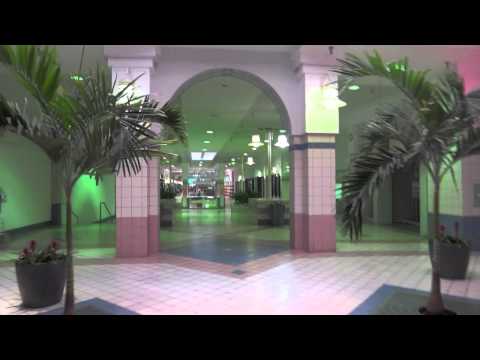
The resonance is a tinny vintage, anachronistic; tinselled with eighties synths and a vocal sample that never quite begins. That baggy voice, normally soft as milk, becomes jagged, inhuman. Creepily crystallised. Your aunty’s favourite easy-listening is stripped of all coherence and synthesis; the tacky detritus of Steve Wright’s Sunday Lovesongs repackaged for an ersatz world of sulphurous sunsets and crumbling metropolises imploding like the plastic dust of an Arizonan dead mall. Back to the dark desert highway, purple-skied and dripped in molten neon. This isn’t what you’d enjoy on a leisurely car trip to the drive through…Or is it?

Listen to : : :

death’s dynamic shroud.wmv // I’m at the point in the level where the road narrows, curves, swirls upside down. Death is imminent. You can see the gloved fingers slipping a compact disc into the slot of a monster, borrowed straight from the architectures of Digimon. I’m thinking: Elizabeth Fraser’s sweetly haunting soprano (imagine being ghosted by the purest aural distillation of beauty); the chilled techno-ambience resurrected from the nineties. There’s heartbreak ahead. If you jump too far—and you will, won’t you—the space around you will glitch. There you’ll be, suspended in the space twinkles. An empty swimming pool. Climb into the cracks. Why is everything so gleaming, so white? I’m obsessed with getting back to matter. The music restores the filth, the glitch. There’s a vast acceleration of beautiful colour. The soprano grows warped, the orb-like contortions are glowing off kilter, off rhythm. The seven lumps of Galaxy chocolate I’ve just eaten melt sticky bits of sugar in my mouth, refuse to dissolve. They’ll coat my teeth like that.

Vapourwave coats your teeth. God knows how or why you should define it. It’s like cheap candy, utterly sugary but filled with mysterious ingredients, mystic chemicals from another dimension. One minute I’m being instructed about the start of a sequence (it’s the eerie echoes of a sci-fi style video game)- – – loading loading loading  – –  – and then trap style beats come bouncing slowly in, delayed as if strained through some outpouring of weird gravity. There’s a purity to some of it, which feels more like an original composition; the ambient atmosphere of something along the lines of Aphex Twin’s Selected Ambient Works…There’s a sense of distortion, disorientation. Hyperreal landscapes lit in luminous pinks and purples. What’s that gleam, is it rain? Tokyo on a postcard, dipped in cross-processing chemicals, in violet acid. Then you’ve got a vague array of p a r a d i s e lighting up the screen. Palms and sand and cerulean sea.

ddeb386ad43001484a6221559eec0d94
Source

As soon as you get attached to a sample, you’re away. Rarely does the beat resolve. You’re like, totally always stuck on the pre-beat. To the point that human expression becomes a technological fault, a beep, a burp. Sometimes it sounds like waves are being pulsed through your brain, blurred in a malfunction of some tacky machinery cooked up for a pulp movie of the nineties. Do scanners really look like that? Coated in rhinestones, bathed in pink. Some of it’s dreamier. Arpeggios of bell-scented keyboards (what do bells smell like? Not musty old church bells, but the sonorous chimes of noughties computers). Arpeggios climbing and climbing, dissolving, rising. A pop melody shining through. I’m in a rainforest of futurist skyscrapers, cloud-surrounded, everything drenched in pastel-hued pixels. It’s so serene. 

Vapourwave. What a joke, an internet meme. Didn’t it die a couple of years ago?

I’m so confused. What is this monstrosity that’s eked itself into my life like a viral code luxuriating in my brain? At once disdainfully ironic, crass, tacky as hell; but also painfully sincere, nostalgic, full of a misplaced longing. The metamodern paradox of postmodern irony and modernist authenticity cooking up an endless loop of misplaced longing. I find myself thirsty for shopping malls from the seventies, for grotesque cups of Diet Pepsi, for the glossy pop of the eighties and the apocalyptic reveries of the nineties. I’m drifting through a city stripped of its glitz and left with patches of bright matte colour, refusing to reflect the glass through which dreams have appeared and got lost. I remember polishing a CD with the back of my sleeve, watching the lines of rainbows beam. Slotting it into a computer that hummed and whirred at my touch. I remember when technology felt somehow homely. 

a0279566532_10.jpg
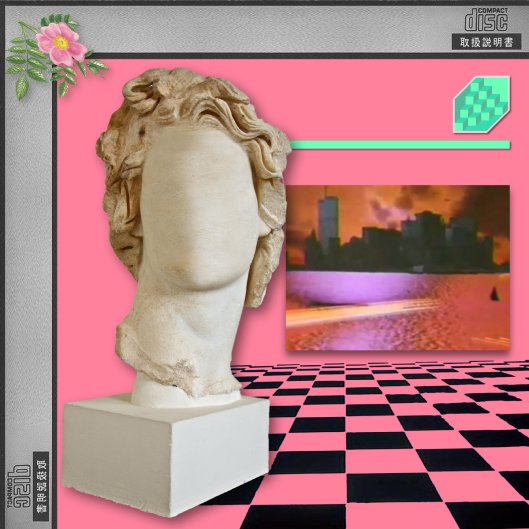
Macintosh Plus – Floral Shoppe. Source.

That comforting little Windows XP flourish, how friendly it was compared to the blasé boom of Apple’s triumphant C chord. Glitch, glitch, glitch. I pick the pixels out with my fingertips. The eerie keyed chords of MACINTOSH PLUS’ 地理 fill me with a sinister sense of urgency. It’s an entropic catastrophe of dissonance.

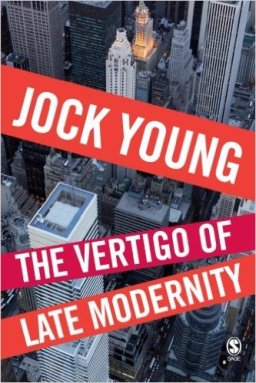
At the heart of vapourwave is a tension between the sweet and disturbing, between satisfyingly vacuous muzak and dissonant, deliberate glitching. This is related to its deterritorialising impulse, by which I mean (borrowing from Deleuze and Guattari lingo), the way it extracts and recontextualises some element of a thing, then placing it elsewhere in a different environment. Vapourwave is a sort of bulimic, abject, rhizomatic discourse. It gorges on the symbols of late capitalism (the glossy muzak and soft rock of the eighties, international brands like Nike or Microsoft, the aesthetics of corporate advertising and so on) and then expels them in a gross reinterpretation that seems to purge them of their original, seamless facade. It might be useful here to mention that sociologist/criminologist Jock Young (2007) once described late modernity as a ‘bulimic society’, where we are all (internationally) included in the dreamlike semiotics of the rich through the opulence and availability of global branding, advertising and popular culture, but increasingly we are structurally excluded from the means which would allow us to achieve such dizzying heights ourselves. This social anomie is jarringly rendered in vapourwave’s shameless embrace of corporate culture; at once poking fun at it but also monumentalising it in an ambiguous way. It’s by no means a didactic movement, but as Grafton Tanner tends to argue in his excellent book Babbling Corpse: Vapourwave and the Commodification of Ghosts (2016), it’s symptomatic of its times. The very poetics of vapourwave reflect the uneasy experience of being unable to escape the system, the uncanny effects of our perpetual cultural nostalgia—the celebration and denigration of late capitalist modernity and all its forms of post (post (post) post).

51jlr4xfsml-_sx331_bo1204203200_
Source.

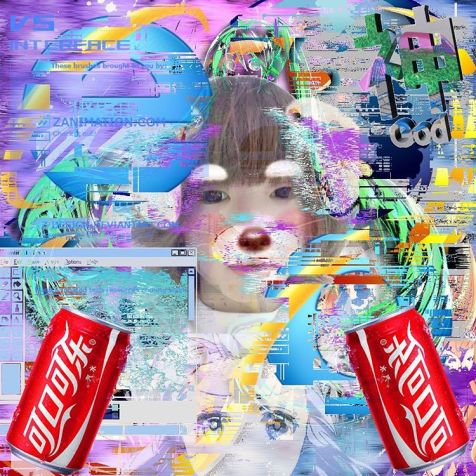
Outside of their usual contexts, corporate and commercial visuals (the vapourwave a e s t h e t i c) seem absurd, funny, strange, alienating. It hollows out the imagined ‘core’ of the brand and replaces it with a sort of free-floating lack of functionality, a disembodied eeriness. Chuck a logo in with a pastel-hued painting of palms and corny dolphins lifted from a SNES game and there you have it. Old Apple logos might be hovering over a pixellated ocean, waiting to plunge inexorably. Not only the aesthetics, but also the music itself, creates this sense of fragmented capitalism. Tanner talks briefly about the relevance of Derrida’s idea of hauntology to understanding the politics of vapourwave and this seems to me very astute. It’s the idea that the future is irrevocably haunted by the past; that culture and politics are also spooked with spectres from the past—from communism (Derrida’s book is called Spectres of Marx) to old technologies. It’s the idea that things are always-already obsolete, that there’s a sense of being itself as displaced and never quite fully present. It’s an ontology of difference, deferral, doubling, of objects which become ‘a little mad, weird, unsettled, “out of joint”’ (Derrida 1994). Derrida’s gloss on Marx’s analysis of the commodity-table gives us a sense on the ghostliness of consumer objects:

For example — and here is where the table comes on stage — the wood remains wooden when it is made into a table: it is then “an ordinary, sensuous thing [ein ordindäres, sinnliches Ding]”. It is quite different when it becomes a commodity, when the curtain goes up on the market and the table plays actor and character at the same time, when the commodity-table, says Marx, comes on stage (auftritt), begins to walk around and to put itself forward as a market value. Coup de theatre: the ordinary, sensuous thing is transfigured (verwandelt sich), it becomes someone, it assumes a figure. This woody and headstrong denseness is metamorphosed into a supernatural thing, a sensuous non-sensuous thing, sensuous but non-sensuous, sensuously supersensible (verwandelt er sich in ein sinnlich übersinnliches Ding). The ghostly schema now appears indispensable. The commodity is a “thing” without phenomenon, a thing in flight that surpasses the senses (it is invisible, intangible, inaudible, and odourless); but this transcendence is not altogether spiritual, it retains that bodiless body which we have recognised as making the difference between spectre and spirit. What surpasses the senses still passes before us in the silhouette of the sensuous body that it nevertheless lacks or that remains inaccessible to us.

(Derrida 1994)

Vapourwave, of course, exploits this ‘ghostly schema’ of consumer objects. ‘Woody and headstrong denseness’, the sheer materiality of the thing is ordinarily supplanted by its mystical, transcendent value as a commodified good or brand. When we think of Nike trainers, rarely do we care for their actual material structure; usually it is the symbolic resonance of the brand that captures us. In Vapourwave, materiality comes back, vicious and strange. Fredric Jameson laments the way that postmodernism presents us with a meaningless concatenation of cultural nostalgia, often without context—BuzzFeed’s noughties nostalgia lists perhaps being a case in point. Vapourwave takes this ‘out of context’ randomness and runs with it. Art objects, textures, corporate iconography and screen-saturated colours combine in a collage of irony and contrasts. The mishmash quality of the vapourwave aesthetic lends it to easy manipulation and re-creation. This is the DIY ethic of the movement, its impulse towards constant theft, the cut and paste fun of sampling, the wilful shredding of distortion which creates a contemporary rendering of William Burroughs’ literary cut-up method or the random-making ‘recipes’ of Dada poetry, as described by Tristan Tzara.

13422823_261081637591822_2099392307_n
Vapourwave Collage (note the hashtags on the link). Source.

Now, the effects of this mixed-bag of internet treats aren’t just weird and humorous, but weird also in an unsettling way. The samples become points of focus in a manner that strips away the normal cultural values of the original song; the easy soft-rock of the eighties becomes haunted with lo-fi feedback and interruption, compression and echoes. It sounds like it’s being heard through a cave or the underwater atrium of an abandoned mall, after the apocalypse. One of vapourwave’s most prominent releases to this day remains Macintosh Plus’ Floral Shoppe (2011) and on this record the production warps its soul music with a surrealist synth-driven dreamscape, in which R&B beats become slow and trippy and human voices are dehumanised into drawls and robotic calls. Often a sample starts but never resolves its line, constantly stumbling over itself. Tempos are spliced and no song follows conventional structure, but instead runs on repetitions, overlaps, interruptions; completely jarring changes in rhythm and key with no transition. Funk and soul from the eighties are no longer smooth and satisfying radio filler, but are turned inside out, their inherent weirdness exposed. Some of the highlights include ‘It’s Your Move’ by Diana Ross and ‘You Need a Hero’ by Pages. The effect of listening to this album is sort of like pushing a shopping cart round a supermarket and gazing around in wonder at the saturated pastels, the pointless products, the detritus of cluttered consumer madness. Glitches, twinkles, the beats of unsteady feet. Random tannoy announcements like a call from some parallel universe, the underground, the flickers of the internet ether.

Tanner’s Babbling Corpse usefully makes a connection between the dehumanisation of human voices in vapourwave music and contemporary philosophical movements such as speculative realism and object-orientated ontology. Both movements share the fundamental rejection of correlationism (the dominant, anthropocentric idea in Western philosophy that views reality only in relation to and projection from the human perspective). Instead, they turn to the world experience of the nonhuman, the sentient and foreign perspective of matter and objects. They expose the contrived nature of our distinction between self and world, showing how we are world, entangled in a way that is inextricable and disturbing (Timothy Morton, for instance, points to the crustaceans that live in our eyelashes or the bacteria in our gut as examples of how we are the environment, rather than self-complete and separate beings). Vapourwave in some way manages to evoke this weird world of objects, at a level only barely accessible to humans. Its use of glitches and looped samples disrupts the ordering of people and things. As Tanner puts it,

Glitches interrupt our expectations while deceiving and annoying us. They undermine our notion of what the machine is supposed to do for us, not without us. In this way, our electronic machines take on lives of their own and appear capable of functioning perfectly well without humans – a complete transcendence into other-worldly sentience.

 (2016: 11)

We might consider this in relation to Martin Heidegger’s (2008) idea that we only notice a tool as a thing when it stops working. A broken hammer suddenly becomes a strange entity in its own right, rather than just one chain link in the process of a means to an end. Chuck Persons Eccojams Vol. 1, for starters. The very name: Eccojams. It implies the jams are a product of this Other: the ecco, ecology, echo…The title derives from an old Sega Megadrive game called Ecco the Dolphin, an action adventure game which featured dreamy music and a very minimalist gameplay narrative. You made Ecco sing to attract and interact with other objects and cetaceans; you could evoke echolocation in order to unfold a map of your oceanic surroundings; you could call to special crystals (glyphs) which in various ways controlled Ecco’s access to different levels. There is a beautiful otherworldliness to this game, and not just because Ecco ends up at the City of Atlantis. It’s created its own mythology, and the emphasis on song (like The Legend of Zelda’s ocarina melodies, which initiate effects in the game) opens up the possibilities for a nonhuman conscious or logic. Music, perhaps more than language, has effects on nonhuman consciousness. At a certain pitch, it can shatter a glass, or cause buildings to rumble with bass. It opens up its own logic of cause and effect.

maxresdefault.jpg
Source.

Hauntology, in a sense, is about being stuck on the loop of the end of history.  Technology constantly dislocates our awareness of time and space, so that linearity is replaced with instancy, repetition and reiteration, the constant recycling of former styles and events. Repetition is uncanny partly because, as Freud argues in ‘The Uncanny’, it’s the structure of the unconscious. When we notice repetition, we notice how our whole psyches are built on the compulsion to repeat even that which is most traumatic to us. It also violates our sense of identity and experience as singular and unique (an idea that liberal democracy and consumer capitalism likes to perpetuate). Identical twins are uncanny for this reason, as is deja vu. We feel that the normal order of time and space has been distorted (this is of course made explicit in films like Donnie Darko, which deal with parallel universe theorems). Repetition is also uncanny because it suggests that things we thought were unique to a moment, imbued with their apparent transience, are actually lingering and potentially eternal. It’s unsettling to have the buried constantly disinterred and broken out into the open present. Tom McCarthy’s Remainder (2005) is a novel which explores the logic of repetition in relation to a trauma narrative in which the protagonist becomes obsessed with re-enacting events to the point of absurdity and violent conclusion. It’s that overlap of the real, where dreamlike remembrance meets actual performed repetition, that is the orgasmic satisfaction of the psyche.

Listening to vapourwave enacts this perfectly. We might start to recognise the songs from which these samples were drawn, but our recognition is distorted along with the samples themselves. The past floats uncannily into the future. Eccojams Vol. 1 drops its tinkling beats on a loop and the vocals from eighties ballads are stripped of their velvet and become mournful, minor, distorted. Inhuman, odd. There’s a sense in which our contemporary experience of reality in the face of apocalypse and pathological nostalgia is both dark and sweet. Morton’s branch of object-orientated ontology, dark ecology, perfectly captures this experience (in fact, in Dark Ecology (2016) he describes the process of dealing with this ‘grief’ as sharing the structure of a ‘dark ecological chocolate’). Vapourwave is at times incredibly saccharine, mapping itself through the cheerfully smooth loops of Muzak; but it is also jarring, dissonant, deeply unsettling. It takes dirty club techno, the complex tempos of intelligent dance music, and puts them through the cheap production of the GarageBand blender. Vocals echo like a broken tannoy machine. Vapourwave, as both visual and musical aesthetic, fundamentally opens an aural space in which past, present and future become a haunting echo chamber of one another. No longer is this the mere surface play of postmodern collage, but instead it’s the material manifestation of a specific cultural hauntology. As Tanner puts it, hauntology ‘is unlike Jameson’s pastiche in that it complicates the past (specifically, the past’s image of the future) in order to call attention to capitalism’s destructive nature as a subjugating force that only fools others into thinking it came to eradicate “history”’ (2016: 35-36). Capitalism is hollowed out, its signature brands become lost echoes in a vaguely recognisable, a hypnotically attractive yet alarming vision of our near-present future; blended with the figures of mall culture, the colours of early aughts internet webspaces and the abyssal possibilities of a Tumblr scroll.

I’m interested in how vapourwave re-enacts a different form of consciousness and how this might be ecological, even though the movement’s only obvious engagement with Nature as Such is through the proliferation of palms and potted plants that drift incongruously as consumer goods through some of its artwork. To get at its ecological sweetness, it’s like cracking open a crystal to see its lattice parameters (what a beautiful phrase), the places where the material cleaves (its lines of weakness), its cubic structure. The interplay between structure and embedded weakness is what motivates vapourwave; it contains its own failure, the undeveloped samples, the way a tiny snatch of a song is unfolded into a tranquil sequence of soporific, nonsensical sound. This is not music with a coherent logic. You look for lines and trends and vague traces of structure, but a song will become something more fluid and fragmented. Vapourwave’s material metaphors cannot be coherent; it’s at once free-floating, vaporous, seeping, gelatinous, oozing, splitting, cracking, choking, pulsing, dissolving. Hard matter, soft matter, chemical, vapour, waves and glitches and tiny explosions.

Sometimes, the structure is completely frustrating. On Person’s Eccojams Vol. 1, for example, the slowed-down, reverb-heavy sample from Gerry Rafferty’s ‘Baker Street’ repeats endlessly and never resolves itself into the next line: ‘another year and then we’ll be happy / just one more year and then we’ll be happy’. The twinkle signifies the glimpse of a transition and there’s a blip of the ‘b’ which should resolve into ‘but you’re crying, you’re crying now’ and yet here never does. Instead the song becomes an endless loop of implied futurity, the future conditional, ‘we’ll be happy’ that doesn’t get to complete itself but instead hangs. We’re taken out of time and left in this limbo. Here, the repetition isn’t soothing, it’s unsettling—mesmerising in a disturbing way. We question our longing for the song to resolve and before we have a chance it’s skipped to the next track. So we go back, search out the original version. Is it satisfying? Listening to Raferty’s original now feels weird in a way it didn’t before. It’s like this lost artefact from the past, spliced across the future ether rendered by Person’s eerie and hypnagogic album. While ‘Baker Street’ implies a specific place, now it’s thoroughly displaced, an effect of the internet’s rhizomatic possibilities.

As Morton puts it, ‘in order to have environmental awareness, one must be aware of space as more than just a vacuum. One must start taking note of, taking care of, one’s world’ (2002: 54). Ambient poetics disturb our assumed distinction between inside/outside, self/other; they show how we are entangled in a shared space of coexistence (Morton 2002: 54). Ambient music, in its sensuousness, its borrowing from the world—for example, by using samples of music concrète and field recordings from both nature and urban spaces—embeds us inside an environment in a way that is at once comforting and disturbing. It literally surrounds our senses. Brian Eno famously sets out a manifesto for ambient music by describing ambience as ‘an atmosphere, or a surrounding influence, a tint’, and ‘whereas conventional background music [i.e. Muzak] is produced by stripping away all sense of doubt and uncertainty […] from the music, Ambient Music retains these qualities. […] Ambient Music is intended to induce calm and a space to think’. As Morton puts it, ambient music as figured by Eno deconstructs the ‘opposition between foreground and background, or more precisely, between figure and ground’. In this sense, ‘ambience could be shown to resist the reification of space in capitalism’, ‘at once fill[ing] and overspill[ing] the ideological frame intended for it by the social structure in which it emerged’ (Morton 2001).

hqdefault-2
Abandoned mall / / Source.

Think of it this way: could you get away with playing vapourwave in a mall or a supermarket or diner? Sure, it would ‘fill’ the space in one sense, but also exceed it, rendering all our cultural and material associations with this space uncanny and distorted. It would become a sci-fi space, a space displaced into the future. We would be inhabiting a doubled world, a doubled temporality. I tried playing Floral Shoppe in the restaurant where I work once (obviously when there were no customers) and the effect was actually very comforting. I felt like I wasn’t trapped in the familiar twenty-something existential limbo and instead inhabiting a plane of dreamlike contemplation, like the Rainbow Road level on MarioKart: Double Dash. I close my eyes and the scratched wooden floor spills out into a highway of colour; the tables I’m bumping against are bright yellow stars and fragments of unknown matter. I’m back in the supermarket, trolleys wheeling away from me and products falling off the shelf. I open my eyes and there’s the mirror and a reflection of someone that might be me, wearing a uniform, the chairs and tables flashing around me like holograms. I’m not exactly sure where that association sprung from (it’s been a long time since I’ve turned on the old GameCube), but I guess that’s the free associative impact of the music itself.

Double_Dash_Rainbow_Road.png
Rainbow Road / / Source.

Like Jean-Jacques Rousseau’s Reveries of the Solitary Walker (1782), vapourwave is about an experience of travel and movement without necessarily describing that movement itself. Crucially, the emphasis is on slowing down, on dwelling in a moment; a moment which is looped, repeated, pondered over, exhausted, reflected on. ‘I undertook to subject my life to a severe examination that would order it for the rest of my days in such a way as I wished to find it at the time of my death’ (Rousseau 2011: 24). Vapourwave subjects the e v e r y t h i n g of capitalist late modernity to such self-reflexive inner scrutiny. This scrutiny enacts a slowing down of perception, a sense of looking around and absorbing one’s place in the environment. Through an uncanny distortion, doubling back and becoming the environment. Vapourwave allows us to adopt both a blasé and a highly perceptive attitude to the ad-saturated world in which we exist; the metropolis of the internet becoming some great labyrinth in which we linger at every turn, mesmerised by the neon palms swaying in time to the untimely music, to cans of diet coke and the universal resonance of that bold tick logo. Everything surrounds and coagulates, connects.

This aesthetic dwelling is crucial for ecology because it forces a recognition of the world which we are and in which we live, a recognition that notices patterns of interconnectedness and coexistence. For Gregory Bateson (2016), aesthetics means ‘responsiveness to the pattern which connects. The pattern which connects is a meta-pattern’; both cities and their parts form part of this pattern, of the patterned aesthetic of vapourwave. The metropolis, the mall, the fountain plaza, the computer screen, the window of a building, the burnished, pixellated sunset. All are the environs of sound and vision, the movement between figure and ground, the deconstruction of synecdoche. The part and the whole are constantly supplementing each other (the song, the sample; the symbolism, the surface aesthetic). It’s a bewildering, shape-shifting experience. It forces us to take notice of our world. There’s something about vapourwave which always suggests to me a sort of endless highway, where the vehicles move as if through some viscous substance that drags the experience of time and space. Our perception becomes blurred and starry, with blips of unconsciousness and moments of epiphanic reverie. Things around us fade or glow. The radio rumbles in the darkest cavity of our chest. Am I even breathing? I don’t feel human. Is this freedom?

homepage_large-be7a4fbb
Source.

Alongside this dwelling is a certain playfulness of a way unique to vapourwave. James Ferraro’s Far Side Virtual (2011) might be the classic here. It blends together the inane and cornily flourishing samples from Muzak with automated audio speech stolen from corporate contexts and sound effects from everyday tech life—the message-send swoop, a mouse click, laptop crashing sounds and start-up tunes. The result is something that might reflect Jean-Francois Lyotard’s famous definition of postmodernism as ‘eclecticism’, the ‘degree zero of contemporary general culture [where] one listens to reggae, watches Westerns, eats MacDonald’s for lunch and local cuisine for dinner, wears Paris perfume in Tokyo and retro clothing in Hong Kong; knowledge is a matter for TV games’ (2004: 76). This eclecticism is made playfully manifest in Ferraro’s lively, atmospheric and at times downright trippy record, where twinkles of commercially-drenched, techy synths give way to stuttering keyboards, ringtone effects and twirls of familiar message noises which become maddeningly synced with finger clicks and conversations between robotic voices. A CONUNDRUM article argues that ‘since vapourwave functions namely as commentary, it loops, pitch-shifts and “screws” the utopia of the virtual plaza, creating a harsh, grating sound in away that brings each muzak sample’s faults to the forefront of the track’. This is certainly true of Ferraro, but I’d also suggest that vapourwave is more than mere commentary; Ferraro especially revels in the silliness of corporate culture (check out ‘Pixarnia and the Future of Norman Rockwell’, with its drink slurping sound effects and jingly, kids tv-worthy melody), at the same time as revealing its peculiar utopian unreality, a world of shimmering sound and holograms. There’s a self-consciously affective and pleasurable aspect to the music. Sometimes it sounds like the demonstration music on an art channel, to the point where I’m expecting some beautiful, sellotaped creation to materialise with every musical flourish.

On the other hand, there’s the total weirdness of ‘Palm Trees, Wi-Fi and Dream Sushi’, which takes us through a scintillatingly bizarre encounter with a ‘touchscreen waiter’ who explains the ordering process at a sushi restaurant—apparently in Times Square, with Gordon Ramsay as chef—to the backdrop of exuberant synths and glitchy effects which sound like a Windows 95 laptop gone haywire, or merely said customer making her selections from the menu software. The result is to render a future where restaurants and coffeehouses are devoid of human interaction, becoming impersonal encounters with creepily enthusiastic machine waiters (creepy not just because they’d put me out of a job). The contrast between this manic happiness, this constant focus on choice, with the maddening music is to create a deep sense of unease, to reveal the artifice of such utopian tech constructions. Do we really have a choice? Is life being boiled down to a series of computer menus? Is the future bound to the unsettling intonations of such robotic encounters? I can’t help but escape into the absurdity of the music and try to forget this hauntological disaster is always-already constantly happening…

The comparatively meditative ‘Bags’ weaves its entrancing ambience from an early Windows startup theme, dipping into sonorous caverns of sparkling synths and lifting for air bubbles and irregular, incongruous finger clicks. I am reminded here of a beautiful essay by Steven Connor on the magic of objects, specifically here bags: ‘because they are in essence such fleshly or bodily things, bags enact as nothing else does our sense of the relation between inside and outside. We are creatures who find it easy and pleasurable to imagine living on the inside of another body’. There’s an amniotic vibe to Ferarro’s ‘Bags’; the swaying, dreamy pace that makes us feel as though we are inside those palms, or encased within a glossy plastic number, bouncing away against some glamorous knee. Just as humans have a sort of supplementary, life-giving association with bags, we also have this relationship with the plazas of capitalism and the affective world they render. Ferarro has said that he conceived of Far Side Virtual as a series of ringtones, a musical form which inherently suggests consumer transience, tackiness, kitsch, the whims of passing fashions (not least because the polyphonic presets change with each phone upgrade). He’s also said that he loves the idea of the album being ‘performed b a Philharmonic Orchestra […] Imagining an orchestra given X-Box controllers instead of mallets, iPhones instead of violins, ring tones instead of Tubular bells, Starbucks cups instead of cymbals. All streamed online, viewable on a megascreen in Times Square’. That’s what’s special about vapourwave: its commitment to the endurance of art and the a e s t h e t i c alongside an ambiguous relationship with the ephemerality of corporate kitsch. The artistic rearrangement of these samples, alongside their visual presentation and marketing as alt music through sites like Bandcamp, completely reterritorialises their original framework of meaning.

There’s a sense in which this music—with its self-conscious materiality, the recognisably tacky mattering of its samples, its embrace of the ambient disruption of foreground and background—is inherently committed to some kind of hauntological ecological project, the kind advocated by Tim Morton’s dark ecological poetics. As Ferarro himself says of his album, it’s a ‘rubbery plastic symphony for global warming, dedicated to the Great Pacific Garbage Patch’. Vapourwave recycles culture, proliferates both beauty and trash, endlessly parodies itself and its references. It renders explicitly what Marc Augé calls the ‘non-places’ of supermodernity: the anonymous malls, airports, offices and stations where cultures blend and collide and become foreign places of blank existence, of non-place, of disembodied temporality and physical and social experience. Places emptied out of cultural specificity. Places where one might eat Japanese sushi in a New York airport restaurant, concocted by a holographic rendition of a grumpy English chef and served by a robot developed and programmed by a Chinese tech company. Vapourwave is melancholy and strangely displaced. The frequent use of anonymity by many of its prominent artists (Xavier, for example, is responsible for more than just Macintosh Plus), alongside the Eastern characters for song titles, creates again a dehumanised, uncanny and culturally displaced understanding of identity. It weaves an almost Orientalist mystery through its art, so that we can’t quite geographically place the origins and players of this musical movement. It’s all about dissemination, reappropriation, the instancy of recycled production; but it’s also about slowing down to notice the flaws inherent in our everyday, consumer lives. The heavily sampled, rhizomatic nature of vapourwave forces you to become a more active consumer of both music and other forms of material pleasure, from picking your morning coffee to choosing your desktop screensaver. Perhaps it’s this recognition that gives vapourwave the vague trace of disruptive impulse; the way it strips away the uneasy pleasures and pink mist of the late capitalist plaza and replaces it with a mystique that haunts us back from the future. Objects and humans withdraw from our grasp and we are left with the surface detritus of crushed coke cans, defunct MacBooks, coffee cups and robot voices stuck on repeat, cleaning the floor of the mall to a vicious gleam that threatens to bounce back like a screen and remind us that we haven’t left the room at all – we’re still on the internet, chasing our dreams.

tumblr_mysm59oylp1t5u0gko1_250
#existentialwave / / Source.

Bibliography

Augé, Marc, 2009. Non-places: Introduction to an Anthropology of Supermodernity (London: Verso).

Bateson, Gregory, 2016. Mind and Nature: A Necessary Unity. Available at: http://www.oikos.org/mind&nature.htm. [Accessed 22.1.17].

Derrida, Jacques, 1994. Spectres of Marx. Extracts available at: https://www.marxists.org/reference/subject/philosophy/works/fr/derrida2.htm [Accessed 22.1.17].

Eno, Brian, 1978. ’Music for Airports liner notes’. Available at: http://music.hyperreal.org/artists/brian_eno/MFA-txt.html [Accessed 22.1.17].

Freud, Sigmund, 2003. The Uncanny, trans. by David McLintock, (London: Penguin).

Heidegger, Martin, 2008. Being and Time, trans. by John Macquarrie and Edward Robinson, (New York: Harper Perennial).

Jameson, Fredric, 1991. Postmodernism: Or, the Cultural Logic of Late Capitalism (Durham: Duke University Press).

Lyotard, Jean-Francois, 2004. Postmodern Condition: A Report on Knowledge, trans. by Geoff Bennington and Brian Massumi, (Manchester: Manchester University Press).

Morton, Timothy, 2001. ‘“Twinkle, Twinkle, Little Star” as an Ambient Poem; a Study of a Dialectical Image; with Some Remarks on Coleridge and Wordsworth’, https://www.rc.umd.edu/praxis/ecology/morton/morton.html

Morton, Timothy, 2002. ‘Why Ambient Poetics? Outline for a Depthless Ecology’, The Wordsworth Circle, Vol. 33, No. 1, pp. 52-56.

Morton, Timothy, 2016. Dark Ecology: For a Logic of Future Coexistence (New York: Columbia University Press).

Rousseau, Jean-Jacques 2011. Reveries of the Solitary Walker, trans. by Russell Goulbourne, (Oxford: Oxford World’s Classics).

Tanner, Grafton, 2016. Babbling Corpse: Vapourwave and the Commodification of Ghosts (Winchester: Zero Books).

Young, Jock, 2007. The Vertigo of Late Modernity (London: SAGE).

Moira Buchanan Exhibition: All Washed Up

img_0118

Last Thursday I had the pleasure of a day trip to Irvine to check about Moira Buchanan’s exhibition ‘All Washed Up’ down at the Harbour Arts Centre. Now I must say, although I was brought up in South Ayrshire I haven’t actually been down to Irvine since I was a kid – the days when we used to go swimming at the Magnum, or on school trips to the Big Idea (which is now sadly closed).

It was a bright and breezy wintery day and as soon as I stepped off the train that lovely clean briny smell filled my lungs and it was a bit like coming home. Irvine’s a fair pleasant town, once a port. You can walk along the harbour where ships still rest and along the front there are little gift shops and cafes with tinsel in the windows and the smell of coffee wafting out onto the street. I unzipped my jacket to feel the sun on my skin. It was midday and hardly anyone was around, but when I got to the Harbour Arts Centre there was a nice wee bustle about the place.

img_0119

img_0120
Took a photo of the hair left behind by a ginger mermaid.

The focus for Moira Buchanan’s exhibition is, as the title suggests, things which are washed up onshore. There is a pleasing openness to the exhibition. It’s light and airy, the pieces nicely balance a white sparseness with the intricate details of natural forms splayed upon the (handmade) page. Actually, it’s quite difficult to differentiate the natural from the unnatural here. Buchanan uses materials found along the beach to make her art, from plastic to twine and string, to seaweed and driftwood. Instead of simply presenting such materials as found objects, Buchanan’s reworking of their unique structures emphasises the beautiful details and aesthetic value of that which we might consider waste – environmental, human or otherwise. She uses an understated, organic palette and a combination of wispy, delicate lines and bold ink blurs to suggest perhaps the swirls of the tide and the sense of being washed out. 

The exhibition has a pleasing, nostalgic feel to it; a favouring of simplicity and the fragile loveliness of form, the childlike excitement in finding beauty amongst tiny, insignificant things. Dotted around the exhibition are little poetry chapbooks made from handmade parchment. Each poem feels like a miniature gift, a token gleaned from the coast and the sea and someone else’s memory. I think in today’s world, where global warming feels like something vast, incomprehensible, beyond our understanding, it’s so important to focus on the little things. The material details that remind us that we are part of this environment, that the ocean gives back what we put into it. There’s a feeling of salvage to the pieces, whose composition seems to perfectly balance the artful openness to chance at the same time as reflecting a careful attention to arrangement and applied form and texture. Everything seems precious.

The more monochromatic tones of the video exhibit suggest something starker, more emotionally arresting. The poems on display recount strange dreams, the changing weather and shape of the coastline, the turbulence of time and human perception. Between the poems are black-and-white closeups of items washed up on the shore. There’s a sense of borders overlapping, of the lush fronds of the clear water coming up to drag back the wisps of shadows and words and memories. I think of black ink pouring on a page, printing through layers of paper like the epidermis of skin. Sinking, achieving a kind of sticky permanence. I think of oil spills coating the northwards ocean. Each poem afloat on the water, the black background of oil, achieving purity in white ink as if blanched that way by the sun and the waves, as seashells are bleached by the tide. Moonlight pouring on still waters at night.

Responding to an ad on Creative Scotland, I sent in a poem I wrote called ‘Fort of the Yew Tree’. It’s kind of channelling a few of the mythical elements of a novel I wrote which is set in South Ayrshire (titled, with some irony, West Coast Forever). ‘Fort of the Yew Tree’ is said to be the Celtic derivation of the name ‘Dunure’, which is a fishing village on Scotland’s south west coast.

I feel very privileged that one of my poems is on that video. This thing that I wrote, a strange and baroque wee baby, has floated out to sea and there it is, somehow washed up in Irvine, travelled through the channels of WiFi and email and typed back out onto some distant slideshow, time cycling in loops and repeating, each image and word again returning like a message in a bottle tossed out to the waves. I wonder who will find it.

Anyway, you can check out my poem along with many others in the video below, made by Moira Buchanan and existing as part of her exhibition. ‘Fort of the Yew Tree’ starts at 2:35 and it spans four slides.

You can find out more about Moira Buchanan’s work on her website.

Being a Student Again: The First Semester

img_0106

It’s not all about realising you can get 10% off at Topshop again (although my ID photo is so bad this year I’m no sure I can brandish it in public). I didn’t know what to expect, going back to uni after a year out. It all happened so fast. Working for over a year as a full time waitress, doing 35-55 hour weeks, I didn’t really give myself the headspace to prepare myself for what uni entails. Despite knowing for several months that I had secured my place, a Masters in MLitt Modernities at Glasgow Uni just seemed something far in the distance, the uncertain plane which I would embark upon after an endless summer.

No matter how it feels at the time, summer is never endless. August was a strange old month, and horrible, tragic things kept happening around me. Amidst all that, it didn’t seem real, making my way through the infernal labyrinth of MyCampus; applying for scholarships, spending inordinate time staring at screens again, making lists of things to be done. I found myself in a room up high in the Boyd Orr building, listening to the inimitable and infectiously enthusiastic Rob Maslen give a speech about the strange history of these hallowed walls; being introduced to the university as if it were the first time all over again.

It is weird going back to the same university after a year out, especially if you’ve not gone far. I walked up the hill listening to Tigermilk feeling blissfully like a total Glasgow cliché and it was like nothing had changed at all; it was my first seminar of the semester and I felt bright and hopeful. Glasgow gifted us with a particularly gorgeous autumn, trees bronzing languidly into darkening violet as twilight fell and I was still sitting by the fountain, making notes on poetry. I tried to take walks in Kelvingrove as often as possible. Quite quickly, however, the daylight ran out. Nights drew in. Still stuck in waitressing mode, such thing as a sleeping pattern proving an elusive remnant lost somewhere back in 2015, I found myself going to sleep at 5am every night, often staying in the library till everyone on the floor had left and the lights kept going out automatically. There I was, alone in the dark in front of a dull-glowing screen (though one must note the upgrade in PCs at Glasgow Uni Library, which are much preferable). It’s easy to spiral into that maddening routine, trying to do all the reading, make notes on everything. I’ve never been a meticulous note-taker, not by a long shot, but I like to handwrite things and have a tangible record of ideas and theorists and possible avenues for further study.

I would walk home at 2am, stumbling tired-eyed through Kelvinside, hoping for a glimpse of the river, some tangible reminder of nature. How long had it been since I’d seen the sea? During reading week, I allowed myself a cheeky day trip to Arran, which felt so unreal it was almost magic. The days passed and ideas started to percolate in my head. The power of procrastination unleashed itself again. I did more creative writing in the past three months than probably I’ve done all year. I guess the more you read, the more you want to write. I sat on level 11 and watched the sunset over Park Circus, making airy, vague notes about queer temporality and thing theory on a 60p sketchpad. I went to seminars and was reminded of how nice it is to listen to people share a subject, to listen to experts talk with passion about something they must have covered a thousand times before and yet still they can find fresh things to say about it. To actually talk to said experts about such interesting topics (instead of merely serving them glasses of wine and plates of fish, as the Oran Mor waitress will often do for GU academics). Although a bit scary at first (not least because I had a screenwriter and published author in one of my seminars!), it was nice to actually have proper formal discussions about books again. Often we veered slightly off-topic, with Trump becoming the proverbial wall against which we hit our heads in frustration, but everything felt prescient, useful. I went to visiting speaker seminars with the likes of Stephen Ross, Graeme Macdonald and Darren Anderson, who talked about all manner of interesting topics: Beckett’s invention of the teenager, petroculture and the politics of space and architecture. Having been at Glasgow Uni four and a half years now, I was still struggling to find half the rooms and buildings I needed to get to.

I went to a couple of nights at The Poetry Club in Finnieston and actually read poems aloud to real humans. Got a few wee things published here and there. Went to a ceilidh. Realised that I want to do lots and lots of creative writing and really try and learn from people. Started writing music reviews for RaveChild which has been really rewarding, not least because it’s encouraged me to broaden my musical horizons and go to more gigs. Started tweeting again. I managed to go to a few Creative Writing Society workshops, wrote a collaborative sonnet and played around with tarot cards. Went to Creative Conversations at the Chapel and saw very smart and fascinating people talk about writing: Amy Liptrot, Liz Lochhead, Mallachy Tallack, for example. Developed many creative crushes on various academics.

15027973_10210791097083922_3119560477331738915_n
Necronaut: Tom McCarthy looking fit in flip flops. Image Source: Fitzcarraldo

My stress levels tend to rise in tandem with the library’s rising busyness and so I stopped going altogether about a month ago. I’ve more or less forgotten what sunlight is, except for the wee slant that comes through the window of the building in Professors’ Square where every Thursday we had our Modern Everyday seminar. I sit in bed everyday and try and write and write. I spent the first four weeks of this semester trying to read a section from The Derrida Wordbook everyday, until my brain started to melt a bit too much and I was thinking in riddles. One day I was so tired I woke up at 10.46 for an 11am seminar but somehow still made it on time, looking like something the cat had dragged in. I tried to get my head round Blanchot, and even went to a reading group where we poured over The Space of Literature and maybe I came out with some sense of the link between writing and death. I wrote reflective journals for my core course seminars and every time came back to Tom McCarty references. The man and his ideas are just so seductive.

Coming to the end of my first semester as a postgrad student, I’m not sure how I feel. I didn’t wash my hair for nearly four weeks. On the one hand, my brain feels heavier, I’m exhausted, probably much less fit; I’ve lost contact with a few friends. On the other, I’ve got ideas all the time, I’m meeting new people, I can understand a little bit of Heidegger. I’m extremely lucky to be able to study at all, especially on such a well-run, exciting course like Modernities.

img_0105
Cutlery: an everlasting source of inspiration

Things I miss about waitressing:

  1. Being on my feet all day. Coming home feeling like an honest hard day’s work has been done, that I really earned that massive block of chocolate.
  2. Gossip. Constant streams of salacious stories.
  3. The visceral fuck-strewn quality of hospitality patter.
  4. Unlimited access to coffee at the point of need.
  5. Making strangers happy through simple acts of kindness.
  6. Being with friends all day and plotting grand schemes.
  7. Minor dramas.
  8. Telling ghost stories to tourists.
  9. Having a reason to put makeup on in the morning/having a reason to get up in the morning before 10.
  10. Spontaneous drinking.
  11. That amazing post-coffee rush feeling when you know your break is due and you’ve got a good book on you.
  12. Finishing a shift and leaving it at the door for a Netflix binge.
  13. Meeting new people more or less constantly.
  14. Having actual muscles from plate carrying.
  15. Playing the game of concocting life stories for strangers.
  16. Teamwork! (which is sorely missed on an English Lit degree…)
  17. Solving completely unsolvable problems, like trying to find and polish 50 champagne flutes in five minutes, or sourcing pathologically evasive salt shakers, or convincing the kitchen not to slaughter you because your table’s arrived 45 minutes late, just in time to clash with every other function in the building.
  18. Unexpectedly deep conversations about love, life, literature, music, family, mental illness, travel, astrophysics, the ethics of illustration, Tumblr, queer theory, feminism, television, childhood memories and sleep deprivation all while polishing cutlery.
  19. The thrill of days off.

Going part-time, I still get some of these fun things, and less of the bad things. Maybe that’s a nice balance. The Christmas period is always a test for our sanity and endurance. Still, hopefully the feeling of handing in my essays will get me through the rest of the season, and if not god knows I have enough books to read to escape into! Maybe I should tidy my room first.

London Thunder

IMG_2758.JPG

We arrive at the bus station. It’s four in the morning and god knows why people are still here. Where I’m from, people are in their beds at this hour; the old folk know the truth of properly impenetrable slumber, even mothers draw brief glimpses of sleepy solace amidst the screams of their babies. Chimneys may shudder, walls may fall, but people will sleep. No, the folk where I’m from don’t haunt train stations, unless they’re homeless and know the secret places where you can hide from the rain. Benches scratched with ink and tip-ex, territorial markings. Nowhere to buy spray cans. Nothing interesting to hang around for. Here, I look around and all the same places flash in the ugly strip lights: a Starbucks, a sandwich bar, a Marks & Spencers. Nothing open, except some stand selling donuts, which smell fucking lovely even though I hate donuts. It’s that hot promise of oozy sugar, mouth-melting jam and fluffy fatty dough. Chewy. I can taste it, just as the guitars kick in, clean as the stars which god knows in this city you can’t see.

It’s cold. It’s the beginning of August and I’m homesick like the kid stuck at space camp.

It’s dark as hell in my head, that little sleep on the plane still safe, hovering over my thoughts like a shroud. It’s not all that dark outside; traffic passes, the neon from bars still aglow. Signs reflect back in headlights. I blink, rub my eyes. I have this sense of something vast and black. I want to close my eyes, imagine this spreading, seeping oil spill, disseminating its viscosity out over every surface, every gloss or gleam of grease, the echoes of footsteps melting, the pavements dissolving to nothing. I dream of an oil that is precisely that: nothing. It is matter as nothing, it is fat and black and coats everything, inevitably, inexorably. The chorus builds. I can hear something pulsing, a faint chime that cuts through all the sirens; when you pay attention, the littlest things cut through. You just have to pay attention, I’m telling you.

No water, no sound. I’m following someone else’s footsteps. People are everywhere, bumping and jostling, bags clattering on the vinyl floor, the cold stone steps, the deplorable concrete. Wouldn’t the oil flood over all of this, covering even the star speckled whiteness of gum? There is a lull, there is a slow progression of chords. There is a sense that…no. The sleep will not come back. I fall into it; I’m on the bus now, it’s slow thumping rhythm echoing the song. People get on and off; it goes and stops. I don’t know this place, or that. The high-rises are imprints, no longer there. Innumerable blurrings of nameless shops, bars, boutiques. You wouldn’t recognise them. It is all glass, sharp-cut and brilliant. In it, I see the bus. I don’t see my face. I never see my face…

And yet there is a crushing. The smoothness compresses back upon itself, like someone scrunching an aluminium can. I dream of a Diet Coke, fresh from some fridge-freezer, the snap of its top, crack, clack; the way the fizz bubbles fast in your throat. Mmmm, aspartame. I am in a room that is someone else’s. So sweet, so lonely. When they are gone to the bathroom, I get up to look out the window, a foreign sheet wrapped round my shoulders. I see more of the glass buildings, endlessly reflecting. I cannot see the window, nor my face. I’m waiting to return. It’s like vertigo, all the glass and all the lights. I miss the darkness. Sometimes when I’m in a room like this, lying on the crooked bed with my head far away, I think I hear the meteor showers. They come back again, silvers and silvers of them, lilting and sprinkling like the softest, most intangible fireworks. I have this memory of November 5th, ten years ago maybe, spinning round and round on a roundabout in a park in the middle of nowhere, the sky shattering above me but even then I’m so indifferent, just whirling, singing something very random, the scattering mess of everything swirling in my head. And I could fly off to the soft dark ground and let the darkness fall over me and god I wouldn’t mind, wouldn’t mind one bit, just the last gasp of a drowned sailor and that promise of a ————————-

The Subversive Spatiality of Pokémon Go

pokemon-hope-street
Zubat on Hope Street. Image Source: Glasgow Live

I scroll down my Facebook timeline, and there is a photograph of a pavement – on a real street which I recognise – and on that pavement is a Pidgey. You know, the wee brownish flying thing from first generation Pokémon? I scroll down a bit more and folk have been out and about all over the place: there’s a Weedle on the gingham tablecloth in a cafe, a wee purple-grey Nidoran on a hay bale, a Magikarp bouncing around by the Kelvin. This is, if you haven’t guessed already, people sharing their spoils from Pokémon Go, an augmented reality game which allows you to catch Pokémon in the wild, a.k.a real life. There was a glorious month in the summer when you could go for a walk and see clusters of people milling around with their phones in the air, as if trying to channel some ethereal spirit that was wafting in the atmosphere. They were out catching Pokémon. All of a sudden, people were going for walks again, leaving the house and the cosy glow of the television to catch invisible beasties who lived in trees and parks, museums and street corners.

safari
Safari Zone Map from Pokémon Ruby/Sapphire. Image Source: PsyPoke

As a kid, I was an avid Pokémon fan. I missed the boat for Red and Blue but had Yellow, Ruby, Sapphire, Leaf Green for my Game Boy Colour and Advance and played them all to death. What I loved more than the battles was the wandering part. So much of your time is taken up pushing your way through long grass, cycling along seaside promenades, bobbing along the ocean, taking shortcuts through forests, crossing through dungeons, traversing the plains of mountains and deserts. You’re constantly interrupted by Pokémon encounters; so much so that often you double back in confusion, any instrumental pathway you’re trying to take disrupted by the screen switch to a battle. The towns often had such picturesque names as ‘Petalburg City’, ‘Sootopolis City’, ‘Lilycove City’ and ‘Mossdeep City’. Then there’s Meteor Falls, the Sunken Ship and Sky Pillar – these are just from Ruby/Sapphire alone. Yes, the game has a final purpose: you’re supposed to beat the gym leaders of every town and follow some convoluted let’s beat Team Rocket narrative, but often its trajectory is beautifully non-linear. You can explore, catch Pokémon in your own time, find side quests to achieve, people who need help. Acquire potions, level up your Pokémon, learn intriguing stories from local mythology.

aid2204909-728px-catch-rayquaza-in-pokemon-ruby-and-sapphire-step-3
Screen Cap from Ruby/Sapphire. Image Source: WikiHow

There is an obsessiveness to Pokémon, a desire to always repeat. As much as possible, you find yourself returning to previous towns and locations, either to seek out more Pokémon known to appear in the area or simply to explore, to see what you’ve missed. Invariably, you do nothing new, and manage to enjoy that process of wandering again. You fight the same Pokémon, hoping they will flee but secretly enjoying taking them down in one shot with your level 40 team, where once you’d have to fight tooth and nail with a goddamn Zubat. To some extent, Pokémon is a rhizomatic game: once you get to a certain stage, the world is yours to explore and you can map out your own routes and lines of flight as you see fit, flying and sailing and seeking locations of your choosing. However, you are still governed with the impulse of narrative, which spurs you onto particular places: sometimes you can’t move on till you’ve beaten the gym leader of that town, for example. You can regress, but not progress. There’s that sort of macho narrative of levelling up which you’re impelled to follow. It’s only when you’ve completed the game that you can reap the rewards of complete exploring.

Pokémon Go changes that. By transferring Pokémon to real life, you are as free to explore its terrain as you are to wander the streets of your local town or city, or indeed the plains of the countryside. Real life is transformed by augmented reality, the imposition of Pokémon on material space. Creatures that only the player, holding up her phone, can see. This is already getting very Black Mirror, but wait. It’s a competitive game, yes, but there aren’t the drastic consequences of social exclusion and alienation experienced by many of Black Mirror’s tech addicts. There is a lovely playfulness to Pokémon Go which somehow has generally avoided becoming cutthroat competition. For a while, everyone was playing it. It was a form of camaraderie (folk would go out in packs to hunt for Pokémon, or indeed organise mass hunting expeditions via Facebook). More time was being spent on the Pokémon Go app than on Snapchat, Twitter and Whatsapp. I’d go into the kitchen at work and the chefs would gleefully show off their Pokédex; which was glorious, seeing all those familiar creatures again in this new and surprising context. And since chefs have hardly a moment’s time when they’re not in the same place, working 14 hour shifts at a time, I can only imagine the extent to which people in other walks of life played it.

Pokémon Go is a strange way of making people notice their surroundings, particularly in the sense of urban space. Sure, most of the time their faces are glued to the maps on their phone screens, but in placing themselves in the world, they are forced to confront physical structures, obstacles, windows, private property and so on. It becomes even more of a game when you have to work out how to attain Pokémon in  elusive locations. I’ve heard stories about folk knocking on your door asking if they could come in because they’ve noticed you’ve got a rare Pokémon in your house. It sounds pretty sinister, but it shows the level of commitment the game inspires.

125345.jpg
Animal Crossing Town Map. Image Source: Neoseeker Forums

Think of it this way: why is it so addictive? Like Tinder, it’s a form of locative media which uses your GPS to determine who or what will appear in your surroundings. Pokémon Go also uses your phone clock, as different types of Pokémon appear at different times of day. I’m reminded here of one of my favourite games, Animal Crossing, where you could go fishing and bug-catching but what was out there was determined by the ‘real time’ of your Game Boy’s internal clock. It followed the real time of a 24 hour day, of the seasons and so on, so that in December there’d be snow and falling leaves in autumn. It was very beautiful and the real time aspect has an addictive quality. I think it’s because the game becomes less a form of escapism and more a parallel to reality, to everyday life. You know it’s reached that status when The Mirror runs a how-to guide, eh?

What’s so cool about Pokémon Go is how it adds meaning to real space. A school, town hall, park or pub becomes a Pokémon Gym and everyone wants to visit. I swear business at my work improved for a month as we quickly realised we were a Pokémon Gym and groups of sullen young adults would gather silently at bar tables, trying to battle other trainers at the gym and hoping to win Pokécoins. A guy I work with would heavily protest when he saw someone playing the game because he was currently gym champion and got surly at the prospect of newcomers taking his title. If I was late bringing someone a coffee, nervous they’d be grumpy with me, often they were so distracted by the game that they’d not even noticed the time. In a sense then, Pokémon Go transforms both time and space. Everything is flattened into a map, where flashing nodes indicating Pokémon are the symbols of desire, the objects of pursuit.

In a compelling, complex and challenging article on Facebook as a ‘desire-network’, Maria-Daniella Dick and Robbie McLaughlin argue that ‘Facebook effects a mutation in desire and thus in capitalism’, and in tandem with this, a ‘historical shift inn the relationship between psychoanalysis and capitalism’ (Dick and McLaughlin 2013). With Facebook, ‘desire remains impossible to satiate, but it is now without object’ (Dick and McLaughlin 2013). They suggest that Facebook is situated within the Lacanian Imaginary order (which constitutes the intrinsic narcissism through which the human subject constructs fantasy images of both herself and her object of desire). According to Lacan, desire (unlike need) is always unfulfilled; we are always moving towards a lack, the anxiety prompted by something lost (as in the child’s original sense of wholeness before discovering the fragmentation of her parts, the split between her body and world and mother, in the mirror). The Imaginary is that which we create to attempt to fill that fundamental gap, the fantasies of the ‘ideal ego’ which compensate for an originary loss. Facebook is basically the ultimate web of the Imaginary: all our time is spent scrawling through pictures and statuses and shared media which all in various ways represent fragments of the ideal selves we project online. Yet our browsing is ultimately without end, it is ceaselessly rhizomatic, decentralised; we end up on one place, a restaurant page or old friend’s profile, without really knowing how we got there. Our passage through the network is governed by algorithms which attempt to map our desires; algorithms which are self-sustained by users’ input data, the patterns of usage recorded with every click. While this may seem revolutionary, a democratic decentering of the system, Dick and McLaughlin are highly sceptical of Facebook’s subversive potential at the scale of the political.
While the likes of Facebook were integral in the organising of such glocalised (global/local) revolutionary events as the Arab Spring or the Occupy Movement, ultimately ‘[s]ocial networking completely embodies and facilitates these phenomena in which the masses are now able to organise efficiently but without being unified by a radical ideological alternative’ (Dick and McLaughlin 2013). The fragmentary pathways of Facebook map out the lines of insidious liberal democracy, and as engrained as they are in corporate culture (the corporation itself becoming the medium for mass communication) offer little opportunity for imagining visionary alternatives to liberal capitalism. Crucially, Facebook (with all its user-directed interfaces based on algorithms of taste and so on) perpetuates the myth of the liberal individual, who curates her profile, her tastes, conducts a life of many choices. As Dick and McLaughlin (2013) put it: ‘[t]he so-called 99% are already conditioned by a liberal democracy in which they have the self-identical sovereignty of an individualistic ideology that places the subject at the centre of the world’. To really offer a vision for an alternative future, we have to actually come up with a plan. Recognise that we are always-already networked individuals, whose subjectivities are hardly unique and instead constituted through structures of discourse and power, and use this in a positive way, to undermine the liberal justifications for free-market capitalism.

thumbnail.jpeg
Pokémon in Edinburgh. Image Source: Google

What does all this have to do with Pokémon Go? The thing is, Pokémon Go seems like innocent child’s play, but it’s bound up in the politics of space. It’s fundamentally structured by GPS software and urban space, and let’s face it, urban space is always ideological. Whether it’s homeless spikes, shiny new glass-fronted apartments built where Brutalist high-rises used to be, gated communities, the psychotic disarray of London’s property market, the genuine promotion of American Psycho-style yuppie-targeting ads or simply the denigration of social housing as ‘slum housing’, space and architecture is always somehow political. In a recent talk given at the University of Glasgow titled ‘Remembering the Future: The Politics of Space and Architecture’, Darran Anderson argued that the current failure of the Left is a failure to put forward a vision of the future that is compelling and actually positive; if we don’t act soon then someone else will determine the future for us. One way Anderson proposes we can intervene in the social order is through architecture, by building sustainable forms of urban space, housing and energy production that take into account the fact that we are living in the Anthropocene. We need to accept the imminence of ecological disasters, which are indeed already happening. We need to rethink our fantasy imagery of the city; it needs to become a network of playful imagination, of empowerment, rather than just passive defeat, or the kind of share-lite politics, browsing, blasé escapism and distraction offered by Facebook.

What is interesting about Pokémon Go is that it restores to some extent the object of desire, which Facebook, in its endless networks of people, places, photos and check-ins, displaces. ‘With Facebook’, Dick and McLaughlin (2013) argue, ‘people no longer live the present as present; it exists only insofar as it is exists to be recorded and later uploaded to Facebook’. This temporal displacement shifts with Pokemon Go, which insists on the present as present. Pokémon only appear for a limited amount of time so the imperative is to catch them in the game space of the now. The impulse of shopping or clubbing to buy buy buy or drink drink drink is gleefully interrupted by the appearance of Pokémon, who are quickly snapped up and snapped, shared online. The allure of ‘cool’ or the aura of dreamlike consumption attached to consumption-based social places is disrupted by the childlike logic of the game. And there’s nothing the companies can really do about it, since technically Pokémon isn’t intruding on reality, it’s only intruding on maps of reality. Now I’m thinking of that Jorge Luis Borges story, ‘On Exactitude in Science’ (1946), and getting very confused about reality itself. In the story, Borges imagines an empire where cartography has become so exact that its map of the empire must match in size and detail the empire itself—after which, what’s the difference between the map and the original? Do you need the map anymore, or can you use real space to map out real (map?) space?

There is almost something a tad Situationist about Pokémon Go. It offers no restrictions on movement, the way the Game Boy games do, according to a linear narrative. If you want that elusive Vulpix or Meowth, perhaps you will have to explore territories previously uncharted in your running app or Instagram places map. You might end up in the strange end of town. And what will you find when you get there? Traversing space this way leads to opportunities of surprise and discovery. The fact that so many people are posting photos of their Pokémon Go encounters online adds a new palimpsest of meaning to our understanding of place. The appearance of Pokémon disrupts the order of cities; it adds new points of desire to the map.  Sure, most gyms are in tourist hotspots, but that doesn’t mean you don’t have to explore the more unseemly areas of town to catch ‘em all. In wandering out your comfort zone, you’re enacting a sort of De Certeauian ‘tactic’, resisting the signage and flows of capital which generally direct your movement in urban space (i.e. according to the circuit-like lure of the shops, the home or workplace). Ironically, you’re doing this at the inspiration of a global corporation (the folks who own the Pokémon Go app), but in this case, it doesn’t necessarily mean your actions and movements aren’t subversive. Nevertheless, the transgression of space according to augmented reality is unfortunately still bound by societal racism, highlighting the fact that we experience space differently according to who we are—despite its best intentions and possibilities, a game like Pokémon Go can hardly overthrow the prejudices of the Repressive State Apparatus…

Since Pokémon Go is based mostly on algorithms of mapped information, there is an element of chance which escapes the systems of data (could we call this glitch a Lacanian intrusion of the Real?). Pokémon crop up in controversial places. Since ghost Pokémon are attracted to graveyards and places of mourning (think: the original Lavender Town), they have been appearing in places like the Holocaust Memorial or Ground Zero. The incongruity of the playful critters in these places of silence and solemnity is startling and forces us to rethink our expectations of memorialising space. In a sense then, for better and worse, Pokémon Go has a reterritorialising impulse. Sure, you can report inappropriate places and instigate a process for removing them from the Pokémon Go map, but that initial appearance, based on some kind of algorithmic randomness, has already violated the implicit expectations of such places in terms of silent respect and mourning. There is in a sense an overflow of the gaming impulse, where the augmented reality becomes more distracting than reality itself (even when you are in such a compelling and startling location as the Holocaust Memorial…).

remainder_-_h_2015-690x388
Houses that crumble…Screen cap from Omer Fast’s 2015 adaptation of Remainder, starring Tom Sturridge. Source: Belfast Film Festival

Perhaps this is the danger then, of supplanting a fictional reality (the map) for the territory itself. I’m thinking of the protagonist in Tom McCarthy’s novel Remainder (2005), whose response to trauma is to assemble a detailed map of a very specific retrieved memory, based in a house where there was a very specific synaesthetic symphony of liver-frying, cats on roofs, piano playing and motorbike clanging. Eventually this map is transferred to the ‘real’ as the protagonist recreates mimetically the details of this spatial memory. Yet pursuit of the real is addictive; the protagonist soon begins recreating more extreme and harrowing memories he’s encountered: traffic accidents, bank robberies. What intrudes, eventually, is the remainder: the real itself which spills out of the recreated event. As McKenzie Wark writes in the preface to McCarthy’s novel, ‘[t]he simulation is never perfect, always in excess of the thing itself. It always leaves a remainder. The most troubling remainder is himself [the protagonist]. He is a leftover God, a God as debris of creation’ (Wark 2015: xi).

In a way, Pokémon Go represents a God-like desire to reconfigure reality, to impose the Imaginary space of the simulated game upon the ‘game’ of ordinary existence. Is this a postmodern statement of irony, a pastiche of 1990s nostalgia in the age of the smartphone? Yes, and no. There’s something kind of modernist and sincere about it too, a sense of genuine interest in creating the Big Project, a utopian potential for gaming to bring people together. While Pokémon Go is partly about earning currency (Pokécoins) to buy more materials which help level up Pokémon or revive them during battle, its general impulse is towards exploration. Conquering, yes, to an extent; but mostly exploration. What happens when you’ve captured every Pidgey in your neighbourhood? You travel farther, maybe even beyond your hometown or city. Of course there comes a point where most of us get bored and stop playing, but there was a moment when the game genuinely seemed to interrupt reality in a way that felt genuinely liberating. The fact that so many people deemed it silly, a waste of time and completely illogical only highlights the ways in which the game resists the general instrumentalism of capitalism (i.e. every minute should be spent doing something useful, like finding ways of accumulating money and furthering one’s career). The time wasting aspect, the fact that so many people love its paean to repetition (you can walk the same route every day and still get different Pokémon appearing), is a queer sort of logic; it goes against capitalism’s futurity, the linear progression of temporality, in favour of a kind of maddening impulse of looping, overlapping desire. We accumulate the same Pokémon several times and this is part of the internal logic of the game, compelling us to traverse the various spaces again and again. It represents at once the immateriality of twenty-first capitalism (as based on flows of ‘invisible’ capital and immaterial goods, symbols of status) and the potential for subverting the logic of accumulation to one that is both bizarre and based on the ethics of play rather than success.

Sure, a great deal of the game might be about levelling up and being the best, but you can also play it with general disregard to those impulses. Collecting, in a sense, transforms the use-value of goods by placing them in a new circuit of information, taking them from the marketplace to the geeky world of the collector, whose interest in based on details and aesthetics, often more than financial worth. Just look at what happens when someone tries to make money off becoming a hire-out Pokémon Go trainer: they are threatened with being banned from the game, since it violates their code of ethics/terms of service. Play, rather than capital, is at the heart of the game’s map of trajectories. It brings people together – even adults – in a space of play. I’m not saying it’s changed the world by any means, and indeed it has its slightly absurd but very real dangers, as people blithely ignore the potential perils of the real landscape in pursuit of the desired (simulated) object, like Icarus flying too close to the sun…However, there’s something genuinely refreshing about how Pokémon Go forces us to reconfigure our sense of reality, space and the routing of our desires and movement. While world-views are shrinking and narrowing in post-Brexit times, Pokémon Go reminds us of the value of expanding our horizons and getting up to just go and wander, maybe aimlessly.

There will always be moral panics over deaths from selfie-taking, planking and cavorting in dangerous places, but will there be anything quite like Pokémon Go?

Bibliography
(other references are hyperlinked in the text)

Anderson, Darran, 2016. ‘Remembering the Future: The Politics of Space and Architecture’, Lilybank House Seminar Room, University of Glasgow, 15th November 2016.

De Certeau, Michel, 2011. The Practice of Everyday Life (Berkeley: University of California Press).

Dick, Maria-Daniella, and Robbie McLaughlin, 2013. ‘The Desire Network’, Theory Beyond the Codes, [Available at: http://www.ctheory.net/articles.aspx?id=727] Accessed 21/11/16.

Wark, McKenzie, 2015. ‘Preface’, in Remainder by Tom McCarthy, (Richmond: Alma Books), pp. vii-xii.

Dark Ecology and Haunted Technology in Stranger Things

Dark Ecology and Haunted Technology in Stranger Things

stranger-things-title-pic.jpg

(warning: this essay lacks coherence; think of it more as a wandering, a haunting of deranged, half-baked ideas)

***

In our time, the soul has been progressively more materialised. That the soul should now be thought to be, no longer purely immaterial, but constituted from a range of different forms of exotic or tenuous matter is a proof of the necessity of physics for any metaphysics

(Steven Connor, ‘Her Light Materials’).

In her book Phantasmagoria, Marina Warner explores the way in which, from the seventeenth century onwards, we have increasingly relied upon various forms of matter in order to discursively figure the soul: visual apparatuses, natural elements, shadows, reflections, wax and technology are just some of the material modes by which the soul is embodied in the ‘modern’ era. This emphasis on things and substances as they bear forth not only selfhood but also the spiritual manifestation of self is crucial to an ecological understanding of humanity’s vision of itself in a post-industrial age where such substances, through our own actions, have contaminated the earth: the Anthropocene means that our physical activities as humans are literally embedded, embodied and sedimented into the Earth’s geology, ecosystems, climate. In a sense, the human soul, its debris of thingness – whether vaporous or material – is already encrusted within what we can now only tenuously call the environment. For doesn’t an environment presuppose a foreground and background, a subject who inhabits the object(ive) world? What happens when we are the object world? How do we confront the sudden otherness of ourselves, the realisation that we are the earth, and not in some hippie-dippie holism (let’s all hold hands with the animals) but in a frighteningly confrontational reality of material coexistence?

What is striking about Netflix’s Stranger Things is exactly its emphasis on strange things. The suffix draws attention to what we mean by things: who or what are we comparing the stranger things to? Ourselves? The creatures we coexist with, the ones we have already charted, taxonomised, ordered and made familiar through Enlightenment science, zoology and philosophy? How many horror films have we seen where that which is monstrous is not other to us but somehow represents the other within us? As Virginia Woolf said of Henry James’ ghosts: ‘They have their origin within us. They are present whenever the significant overflows our powers of expressing it; whenever the ordinary appears ringed with the strange’ (1921). When what we take as given, as natural or normal–is revealed as inherently disturbed–the boundaries of meaning violently ruptured or haunted, there incurs a fundamental split in what we take to be reality itself. We are forced to question our place in the ‘world’ not just as a human but as a physical subject tout court.

Screen Shot 2016-10-08 at 02.29.52.png
Screencap: Netflix

The horror genre is notorious for its representation of creatures who challenge our definition of the natural. Timothy Morton says of John Carpenter’s film The Thing: ‘the supposedly horrific alien is none other than the reproductive, simulative process of nature itself’; the Thing is always shifting its guises, ‘destined never to be itself’ (182). This is the dark allure of the popular horror trope of the viral: that which is always shifting, transforming, responding ‘automatically’ (as in Darwinian) to the conditions of its environment. Think of zombie movies, then also the likes of 28 Days Later, I Am Legend and so on—all are obsessed with the idea of infection, the notion that apocalypse will come because the purity of the human soul and body will be corrupted by some alien force.

However, what terrifies about the virus is the realisation that it is inherent in ‘nature’; as Morton argues, what is ‘monstrous’ about evolution, about the growth of plants and other lifeforms, is that DNA itself is viral: [a]ll organisms are monsters insofar as they are chimeras, made from pieces of other creatures’ (2010: 66). Like Victor Frankenstein’s Creature in Mary Shelley’s novel, all lifeforms are hybridised, made from scraps of other beings; though here the product not of Frankenstein’s experiments in vitalism but of evolution’s functional contamination. As with Derrida’s revelation that language, meaning and being have no presence, but only Différance, Darwin’s theory of evolution, as Morton shows, is similarly predicated on slipperiness, fuzziness, contamination. At the core of existence is not essence, but différance, with all its implications of instability, aporia and fragile, mutually infected binaries. Mutation, in a strong sense, is inherent to ‘nature’ – and by no means are humans excluded from this ‘nature’. Not only do we enmesh with the object world in a corporeal sense (our bodies are not bounded but always escape, fragment – the dust of our skin and hair inhabits the atmosphere) but also in the discursive sense, in the way that Warner has traced: in the literary and aesthetic figuring of the soul as a material thing.

Episode Four of Stranger Things is appropriately named ‘The Body’. Looking down at the corpse of her missing child (Will), Joyce (played by that chimera of the Gothic heroine, Winona Ryder) screams, ‘I don’t know what you think that thing in there is, but that is not my son’. What she feels is not grief, but something ‘different’: she is rubbing up against the fragile boundaries of the symbolic order, feeling the metaphysical structures of the world quiver uncannily around her. Later in the episode, we see her other son, Jonathan, weeping in his room to Joy Division’s ‘Atmosphere’. The lyrics enact an uncanny duality of dialogue: the imperative to ‘walk in silence’ is retracted immediately with ‘don’t walk away, in silence’: the whole song, with its slow, shimmering synths and shuddering drums enacts a play between presence and absence, the corporeal and incorporeal: ‘Naked to see / Walking on air / Hunting by the rivers’. Like The Cure’s ‘A Forest’, there is a maddening sense of pursuit, the lost object dissolving into silence while the mournful subject can only wander through the song in his melancholia, pursuing ‘through the streets’ but only to abandon ‘every corner […] too soon’. There is no closure, only this ‘atmosphere’ of absence sprinkled with the ghostly possibilities of presence elusive.

With Will’s ersatz body we confront the indeterminate state between life and death, the physical remains which should suggest closure and yet speak of something silent, unsayable. What is this strange body cast up before her? Surely not the son, who she is sure is not dead yet, who she has heard calling for her through the telephone…Later, when Hopper, the police chief, takes a knife to the chest of the corpse, he sees it to be synthetic, stuffed like a pillow. Matter contained in matter; this time, not human matter, but simple object matter. We are suddenly pointed to a deeper conspiracy (the Department of Energy and the MK Ultra experiments), but at the same time the suspense of Hopper’s puncturing is playing upon our abject reaction to the corpse as that which contains within it both life and death. What disgusts us in the carving of cadavers is the fact that it is even possible; the tear of the body representing the tear of all we have taken for granted in our usual embodied lives as similar beings, wrapped up in what we thought was the same fabric of reality.

What is uncanny about a human corpse? It reminds us of the presence of death within everyday existence, it shows us, in visceral, stinking, mattering manner, ‘what I permanently thrust aside in order to live’ – it is ‘death infecting life’ (Kristeva 1982: 3). Stranger Things is obsessed with appearance and reality, with the hidden networks of existence which haunt the outward façade of daily life in small-town Indiana. As the title suggests, part of this interplay of appearance and reality is the necessary strangeness of things: not just the gory, pulp-horror monsters that haunt our nightmares but the strangeness of all we take for granted as normal—the family home, the general ‘good’ of the government’s intentions and the rule of the law; the clear boundary between life and death, presence and absence, self and other. We might think of Jeffrey Beaumont in Blue Velvet (1986), bending down in the lush green grass of a suburban garden to lift that grotesque, insect-swarmed severed ear from the ground: the sudden onrush of magnified sound that signals our entrance into the underworld, the seedy, violent and parallel reality which exists aside our everyday lives. This essay will attempt an exploration of sorts into Stranger Thing’s heart of darkness: its uncanny depiction of the interrelations between bodies, technologies and nature, the living and the dead.

My central focus will concern how ethereal, inter-worldly transmission is figured through technology and also how its representation of abjection and the viscous, sticky enmeshment of the Upside-Down contributes to a renewed understanding of what constitutes such taken-for-granted things as nature, environment, world. I will argue that the show’s obsession with death as an ontological condition and its depiction of both communication and rupture is not just a parable of Cold War paranoia over the presence of the (Communist) Other within, but also challenges the ethics and poetics of how we approach the non-human Other in the context of late capitalism, i.e. ecological crisis and technological modernity.

One of the most terrifying aspects of the Monster/Creature/Demogorgon is its lack of a face; the fact that it cannot return the gaze of its onlookers, who can only look into the void of its flesh and see substance, reminding them that they too are substance—that the boundary between the human and monstrous is decidedly fragile. The Dementors in Harry Potter are similarly frightening because they lack eyes: where the eyes should be, the sockets are covered over with scabby, corpse-like skin. In Neil Gaiman’s children’s novella, Coraline, in the parallel, looking-glass world that Coraline finds ‘through the door’, her Other Mother and Other Father seem physically identical to their originals, except that their eyes have been replaced with black buttons. Freud famously outlined his theory of the uncanny through a close reading of E. T. A. Hoffman’s ‘The Sandman’ (1816), a dark Germanic fable about a creature who visits children and tears out their eyes. Freud very cleverly links the fear of blindness back to castration anxiety, but for my purposes, the uncanniness of losing one’s sight is partly due to perception itself. If our eyes are associated with discerning the real world of impressions around us, how can we without them tell if we are living in reality?

Moreover, when we encounter creatures without eyes, what are we to make of their consciousness? If eyes are ‘windows to the soul’ as the saying goes, can there be a soul without eyes? Coexistence can happen on an intelligible level if the animal can return our gaze: Derrida, in ‘The Animal That Therefore I Am (More to Follow)’, has written about his experience of being looked at and looking back at the animal, namely, his cat staring in confusion at his naked body; and we have all had a moment of silent exchange with a stranger’s pet, eyes meeting by chance perhaps but lingering…and in that lingering is the suggestion of an understanding between species, the troubling of notions of inside/outside, human/nonhuman.

Yet how do we interact with a creature who cannot return the gaze? A thing without facial features is ontologically unstable somehow, unable to establish presence through meaningful expression: ‘the phantasm is the sign of that visible incorporeality. The image I see returns as both the spectral figure of myself as other, and yet also it figures in its return the immanence of my disappearance’ (Dick and Wolfreys 2015: 139). Could we relate this ‘visible incorporeality’ to the Creature of Stranger Things? It is certainly figured as corporeal, as Nancy and Jonathan embark on a hunting mission to slay it like any old dragon or wildebeest, but then again, it is not of our world – it comes from the other place, the Upside-Down. Seeing the Creature, the characters are faced with its impossibility, which in turn incurs an ontological rupture whereby they themselves witness the flashing vanishing of matter. Barb’s sudden disappearance, for instance: the play of sensory impressions that distorts all sense of space and time in the woods.

Significantly, the Creature is not the only ‘monster’ that haunts Stranger Things. Throughout the show, El is in a sense a ‘monstrous’ figure. Her origins are unknown. Stripped of hair, with a boyish figure, she maintains an androgynous appearance; the boys’ attempts to prettify her with a wig and makeup enact a bizarre transformation which only serves to heighten her strangeness, as she appears more doll-like, the sudden deliberation of her actions running uncannily counter to her appearance, which would be that of an automaton if she were a living doll (or indeed, the escaped hospital patient possibility suggested by her bald scalp and hospital gown). Her fate, like Safie in Frankenstein (who provides a parallel figure of exile for the Creature, welcomed with hospitality while he is crudely expelled from the De Lacey home) seems inextricably tied up with that of the Creature: in the final episode, its vanishing at the command of her telekinesis simultaneously enacts her own vanishing from the concrete world of the boys and the classroom. It might’ve been interesting to make the Creature a more sympathetic life form, rather than a screaming reaction of base violence which actively preys on humans, just to give some extra ambiguity to the order of things; but even so, it’s still possible to have some sympathy for the Demogorgon (and not just because it seems the live manifestation of a beloved strategy game)—after all, it represents ‘nature’ in all its savage instincts, linking back to what I was saying earlier about monstrosity and evolution.

netflix
Screen cap: Netflix

In order to defeat the Creature, to seek out Will in the Upside-Down, El has to recreate the sensory deprivation experiments which were conducted upon her in the Department of Energy lab. Floating in the water, she appears Christ-like, as if her soul must endure the rituals of crucifixion in order to bring back Will from the Upside-Down (symbolic immersion?). Like Nancy, she is deathly thin, her physical presence pale against the strong personalities of the male characters. Her corporeal existence is almost shimmering: she is slow at first, learning words and meanings, piecing things together. Not only does this emphasise the shock of her telekinetic powers, but also it sediments the show’s strange interplay between the ethereal and material.

7.jpg
Spilt blood…Screen cap: Netflix

Stranger Thing’s preoccupation with eating is one manifestation of this. It’s all very Freudian. Jonathan makes eggs for his mother and tries to get her to eat. Arguments occur round the family dinner table. In the Upside-Down, Nancy sees the Creature feeding on a deer and realises its attraction to spilt blood. The cadaverous El is always ravenous and is frequently seen eating. In fact, at one point she blithely steals frozen waffles from a supermarket and devours them in the woods. Food is a prominent symbol in fairytales. Food, of course, is closely related to abjection. Fundamentally, the digestion and excretion of food reminds us that we are part of an enmeshment of material things; unfortunately, we cannot transcend the flesh prison which sustains our beautiful souls…Kristeva’s description of the abject reaction of food disgust is worth quoting in full, as her sentences gather a certain pace that mimics the physical spasms of reaction, the desire to expel the self in the experience of disgust from the food object which reminds us that we too are bodies, layered and soft and mortal:

Food loathing is perhaps the most elementary and most archaic form of abjection. When the eyes see or the lips touch that skin on the surface of milk—harmless, thin as a sheet of cigarette paper, pitiful as a nail paring—I experience a gagging sensation and, still farther down, spasms in the stomach, the belly; and all the organs shrivel up the body, provoke tears and bile, increase heartbeat, cause forehead and hands to perspire. Along with sight-clouding dizziness, nausea makes me balk at that milk cream, separates me from the mother and father who proffer it. “I” want none of that element, sign of their desire; “I” do not want to listen, “I” do not assimilate it, “I” expel it. But since the food is not an “other” for “me,” who am only in their desire, I expel myself. I spit myself out, I abject myself within the same motion through which “I” claim to establish myself. That detail, perhaps an insignificant one, but one that they ferret out, emphasise, evaluate, that trifle turns me inside out, guts sprawling; it is thus that they see that “I” am in the process of becoming an other at the expense of my own death. During that course in which “I” become, I give birth to myself amid the violence of sobs, of vomit.

(Kristeva 1982: 2-3)

The inside-out unsheathing of the body and its skin (the skin of flesh, the flesh of food) mirrors the Upside-Down Alice in Wonderland reversal and parallel convergence of realities. There is always a reversal, another possible surface. The mutation. Nothing is stable but always in movement. The spasms here mirror the shrieking of the self in the grip of grief: in Twin Peaks, Laura Palmer’s mother shrieking in hysteria; in Stranger Things, Joyce Byers rattling with terror as she storms around her own home, trying to find her lost son. The psychosexual implications of Kristeva’s passage are also relevant to Stranger Things because, let’s face it, there is something womblike and vaginal about the viscous, flora-infested environment of the Upside-Down, its gross and mollusc-like mucus and glistening ectoplasm. It’s perhaps no coincidence that Nancy loses her virginity the same night that her best friend Barb is sucked into that orifice-like portal of the monstrous feminine, the gooey nether-zone where she will find herself woven into the lining, her body penetrated by the infestations of disgusting slug and snake-like creatures. Like Cinderella, Barb pricks her finger (though on a crunched beer can, not a spindle) and is doomed to some sort of eternal sleep.

Netflix.jpg
Screen cap: Netflix

At one point in the show, one of the lab workers enters the portal in the Department of Energy and despite clinging to a rope, is irrevocably drawn into the depths, never to see the light of day again as the mouth of the portal closes. There’s the whole vagina dentata (religious myth of the toothed vagina) psychoanalytic strand here which would be interesting to pursue, especially as the implications of castration anxiety connect back to the Creature’s missing eyes/face. As in Twin Peaks, the portal to the other world (Black Lodge) will only open under certain conditions. With Kristeva’s passage on the skin of milk, we can think about how the entrance to the Upside-Down is itself an instance of abjection: the expelling of bodies and matter between worlds. The inside is clearly toxic as the lab workers don protective suits to enter; there is even a suggestion of the post-nuclear landscape in the way that an ash-like matter floats in the atmosphere, again fitting in with the monstrous nature/alien space theme.

Netflix.jpg
Screen cap: Netflix

As Nancy tumbles out from the forest portal (housed inside a tree), sticky with all the weird stuff that comes off the world’s ‘lining’, she is quivering with terror in a manner reminiscent of Kristeva in the rejection of the milk. Freud theorised that young boys were scared of their mothers due to the fear she would castrate them, and maybe there’s a reading that the whole show is some phantasmagoric, dreamlike manifestation of the terror of the overbearing ‘hysteric’ mother (Joyce). The winding strands of plant-like matter, snake-like and strange, are reminiscent too of Medusa’s head. Freud has a whole essay, ‘Medusa’s Head’ (1922), on the possibility/implications of Medusa’s head taking ‘the place of a representation of female genitals, or rather if it isolates their horrifying effects from their pleasure-giving ones is familiar in other connections as an apotropaic act’—namely, the commitment of evil. Interesting how Stranger Things teases with the gendering here: the male-dominated U.S. Government vs. monstrous feminine nature – which is more evil? Science or the (super)natural? I think the Alien films are probably the most obvious Stranger Things intertext here, but the very fact that the show wears its myriad influences on its sleeve creates a web-like structure of inference that opens itself up to multiple readings that cut across the cultural timelines of the twentieth and twenty-first centuries, spreading out monstrously, contaminating discourses both pop cultural and scientific.

The show plays constantly with this weirdly distorted womb/plant/viscous/genitals imagery and I can’t help but think perhaps it represents some kind of monstrous mother nature, the vengeance of the earth against the interfering experiments with time-space enacted by the US Government and its Department of Energy… Hyperobjects like global warming, plutonium and oil slicks are defined partly by their viscosity: ‘the more you know about a hyperobject, the more entangled with it you realise you already are’ (Morton 2010a). The more we as viewers learn about the strange world of the Upside-Down, the more we see it in our own reality. Monstrous, oozing nature. Ourselves in the mirror: the strange stranger – the notion that the closer we get to other life forms, the weirder they become (Morton 2010b: 17). The constant recurrence of floods and hurricanes and melting ice caps, irrevocably now understood as the consequences of global warming: they acquire an almost anthropomorphised monstrosity.

At the end of the series, Will, restored to apparent ‘reality’ (signified by that most traditional of temporal markers, perhaps the most important date in the calendar, Christmas Day), coughs up a slug-like creature and once again glimpses the Upside-Down again, flashing through the palimpsest surface of the normal world, reminding us of the imprint of the ecological uncanny, the presence of the strange, nonhuman other, within ourselves. I am struck with a line from Coleridge’s poem, ‘The Rime of the Ancyent Marinere’ (1798), where, after facing the nightmare wrath of the storms following his shooting of the albatross (the fatal crime against ‘nature’), the mariner glimpses the gross multitudes of sea-snakes in the ocean below his boat, shimmering among the floating corpses of his fellow sailors, lost to the storm: ‘And they all dead did lie! / And a million million slimy things / Liv’d on – and so did I’. The mushy consonance of the l sounds here recreates the oozing viscosity of all those wriggling bodies, but there is a sense in which the mariner seems to revel in the sheer multitude of these ‘million million slimy things’, as the repetition suggests—their individuality as types of species is beyond his grasp and he can only face them as a kind of hyperobject, the sharp realisation following the caesura (-) indicating the revelation of coexistence, which is both wondrous and terrifying.

Indeed, there’s something about El’s telekinetic powers too, the way they can elasticate reality, bending objects and shattering matter, but at the expense of something inside her, the price of the blood that oozes from her nose each time, signifying her depleted energy. She is no robot, but material and mortal too: the recurrence of the blood and its spilling viscosity insists on this. El’s ‘magic’ enacts a disruption of foreground and background; we cannot just perceive it as magic, for we have witnessed its basis in a kind of scientific experiment within the labs. It comes out of the world, disrupts the subject. Stranger Things is rife with pathetic fallacy – storms and power blackouts – and this isn’t just a contribution to the horror mood but also an underlining of the show’s ecological context and monstrosity: the collapse of weather as mere background, stage-setting, into the narrative itself (the significance of electricity in the show is still to be traced) signals the impossibility of the world as such. ‘We have no world,’ as Morton so aptly puts it, ‘because the objects that functioned as invisible scenery have dissolved’ (2013: 104). What happens when you think through the world as the world, rather than from an anthropocentric viewpoint? Peter Watts has written a short story titled ‘The Things’ which reverses the perspective of Carpenter’s movie, this time telling the story from the virus’ point of view (note the plural things and think back to the mutational plurality/chains of the virus)—once again, disruption of subject/object ordering. What is an alien consciousness? What is nature’s consciousness? The only way we can find out is by recognising nature’s strangeness, and that strangeness is inherently within us too. In Stranger Things, the dissolution of objects is part of the show’s exploration of the uncanny (walls and doors shift, ooze, open and close) in relation to the monstrous (and this is rooted in other themes beyond the scope of my essay; for example, the nuclear family and adolescent sexuality), but also the monstrosity of nature enacting its gross and terrible vengeance against man’s interference: El, little pixie child of the forest as she becomes, is able to manipulate objects, thus denying their status as mere staging and indeed staging them as vitalist forces in themselves (so far, so Object Orientated Ontology?).

On the subject of ‘energy’ and electricity it isn’t just El’s psychic energy and the deceptive title of the ‘Department of Energy’ that resonates in Stranger Things. ‘Energy’ also points us to the vitalist elements of Stranger Things; namely, its interest in the networked relations between humans and technology, the way that communication and transmission rupture not only the fleshly interaction of humans but also the metaphysical boundaries between life and death. For starters, there’s the song played against the opening title: New Order’s ‘Elegia’. What first struck me about this track was the dissonant synths, the way they creep up on you in mesmerising waltz-time, the guitars, piano and synths enveloping one another in counterpoint melodies. NME tells me that the song was written as a tribute to Ian Curtis and it’s almost impossible to listen to the 18-minute track, whose elegiac status is inscribed in the very title, and not think of absence, death, the plunge into void, the journey through its swirling, miasma-like movements which render eerie and maybe even ‘inhuman’ our experience of temporality. Before this contextual note, however, I was weirdly reminded of ‘Lavender Town Syndrome’: the 1990s internet myth surrounding the music from Pokemon Red and Green. The MIDI track from this particular town is indeed extremely jarring, run on two channels so that the sound travels literally through one ear and out of the other and thus fusing in the brain to create a certain sonic effect. There were rumours that this effect caused suicides and seizures until the MIDI track was ‘tamed’ for the American version.

While the story was more or less sheer internet rumour, it’s still provocative and raises questions about the ghostliness (or, as Warner might put it, phantasmagoria) provoked by the phantasmic structures of media technology. Aphex Twin, for example, embedding a spectrograph image inside an audio file, the implications of such a shape upon sound: screeching, searing static. The sound of a ghost trapped in a glitch world? If the glitch is an accident, then what is a ghost? An accident of time and space, trapped in the in-between, reminding us of the fragility of time-space itself? Of being itself? Sound, after all, is temporal; a MIDI track is self-containing in its temporality. You can loop it, but it has a form and a shape, a beginning and ending. Does the ghost have a beginning and ending? When I listen to the original Lavender Town track, I can definitely feel a kind of fuzziness or vibration in my brain, as if the frequencies of my thought were suddenly being played upon, synapses twisted and twanged as if in electro-convulsive therapy; or like the sensory experiments upon the brain portrayed in Anthony Burgess’ A Clockwork Orange and indeed in Stranger Things, inspired by the psychedelic investigations of the 1960s and 70s, name-checked in the show as ‘MK Ultra’ – incidentally, also the title of one of Muse’s most politically paranoid songs. An early configuration of this could be the Romantic Aeolian harp, which represented the mutual ‘play’ of sound, expression, music, poetry and impressions between the world and the artistic mind (see Shelley’s ‘A Defence of Poetry’). What these aural effects again reinforce is the dissolving of subject/object, as sounds from the so-called ‘environment’ feed into our brains, penetrate the boundaries of the self and flesh and in doing so enact a kind of digital Heideggarian poeisis, wherein the arrangement of sound itself (like words on the page of a poem), causes something to actually happen, to come into being. What is this being? The experience of terror, a sudden rupture of consciousness as the soundwaves pulse through the brain? Sensation, in its flux, placing us under erasure, as we fall away from consciousness? Where are we now, reaching back for the material symbols of the soul that would save us from the sea of dissonant, consuming music? Stranger Things evokes a rich sonic atmosphere, full of grotesque, squelchy, pulsing, oozing, insect-esque sound effects which trickle the presence of monstrous nature, of the metaphysical strangeness of the Upside-Down and its plant-like materials, straight into our brain.

Screen Shot 2016-10-08 at 02.44.51.png
Jonathan’s photography. Screen cap: Netflix

Attached to the auditory is the technological unfolding of the visual. Throughout the series, photography plays a significant role in the identification of the beast/creature. Following the scopophilic power of the male gaze (and of course another Blue Velvet reference is inevitable here, Jeffrey peeking through the closet at the acts of domestic sexual violence), Jonathan sneaks into the woods to take photos of Steve’s party, snapping pictures of Nancy for whom he harbours a secret desire/teenage love. Yet what remains in the photos isn’t just the form of his beloved, but the strange shape of the beast, captured indelibly in the developed ink:

Photography is a mode of tekhnē – a making appear (technology “makes” something “appear” out of parts, raw materials; it is thus the truth of the physical world; we make, we cause to appear things, commodities, but what does photography make appear? Images made of shadows, light and dark – in this it causes to appear an event no longer there, no longer with us; it gives us to see what we cannot otherwise see.

(Dick and Wolfreys 260)

There is a sense in which photography is, like the New Order track, inherently elegiac—or at the very least, represents the flicker between presence and absence, since the material presence of the photograph is haunted by the absence of what it represents, the not-there, the once-happened. As in the play of light and dark, positive and negative space, the photograph captures the liminal position between presence and absence, matter and ethereality. It is thus, as Barthes shows in Camera Lucida ( 1980), a medium closely associated with death. The shape of the beast is barely distinguishable in the photograph, especially with the added layer of another camera, and the computer screen through which we stream the Netflix content of Stranger Things itself. The temporality of the photograph is thus strangely ephemeral, despite its suggestion of a ‘snapshot’, a reification or fixing of the moment. There is a ghostliness to the photo: ‘it bears witness where there is no witness’ (Dick and Wolfreys 2015: 261); it reduplicates the sense of presence as reading the image bears another kind of birth, the control of the eye/I at the focal point in another space of time which is always overtaken by the image and its embodiment of another time–the displacing and shifting incurring is a kind of haunting.

sheryl-lee-twin-peaks.jpg
Laura Palmer’s homecoming photo from Twin Peaks

Think of Twin Peaks, another series whose entire plot hinges on absence, namely, the death of its main character, Laura Palmer, which occurs before the show’s diegetic action even begins. Laura’s absence is primarily signified by the presence of her prom queen portrait photograph, which occupies not only the mantelpiece of the Palmer home but also the end credits of every episode. Played over with the melancholy Angelo Badalamenti score, the picture serves to remind us of the presence of Laura as narrative phantasm, the way that the absent/dead Cathy and Heathcliff haunt Nelly’s recollected narrative in Wuthering Heights. 

Ghosts, then, are not just the creaky ghouls of Gothic castles, but instead are inextricably linked to the replicating capacities of technology and indeed narrative itself as a medium of recalling some thing or person or event, thereby disruptively evoking the past in the present, disturbing presence itself. As Derrida puts it:

Contrary to what we might believe, the experience of ghosts is not tied to a bygone historical period, like the landscape of Scottish manors, etc., but … is accentuated, accelerated by modern technologies like film, television, the telephone. These technologies inhabit, as it were, a phantom structure…When the very first perception of an image is linked to a structure of reproduction, then we are dealing with the realm of phantoms.

(Derrida 1989: 61)

In addition to photography, electricity and telephone communication are prominent mediums through which the ghostly is figured in Stranger Things. Joyce starts to hear Will calling to her through electricity—through the lamps and electric lights strung up in her home. She answers the telephone and hears his voice through the ambient rasping, and we can hear glimpses of that gooey, squelching monster sound. She literally rips the telephone out the wall trying to get back to him, causing another spatial rupture in the material world which started with the ephemeral, the sound of the phone call. Her makeshift séance codex constructed out of letter posters and the flashing bulbs of fairy lights renders literally the evocation of the dead through writing, the Derridean play of presence and absence which dissolves subjectivity in the space between speech and writing. Here Will can only communicate by flashing the lights, so that his presence is available only through the transmission of a kind of Morse code. At the end of episode two, as Joyce tries to navigate the suddenly terrifying environment of her home, seeking the source of the noise and of Will’s possible voice, the soundtrack, heard by us and by Joyce through the walls, is the Clash’s ‘Should I Stay or Should I Go’ – a song which ironically renders the subject’s lingering on the threshold between going and staying, presence and absence. Joyce’s discovery of the song playing on the stereo as if by magic is uncanny because the familiar song becomes wrenched from its normal experience and is here recontextualised as extremely disturbing and perhaps even tragic, the flicker and stutter of its playback following the jilted rhythms of a voice, a soul, a subject, trying to pierce through some unseen border, to transmit signals to his mother.

2.jpg
Phantasmagoria…Screen cap: Netflix

At one point, Joyce gets so far as to catch a glimpse of her son through the wall which becomes a glass screen, but soon he vanishes, the wall returns to being a wall that is now smashed and the daylight is beaming through, reminder of the permeability of all borders, the fragile boundaries of the home. When the estranged husband, father of Will, comes to visit, he makes attempts to patch up the physical confines of the home, but this patriarchal intrusion of order and reparation of stability does little to stabilise the spirits of the house: the invasive Creature, which howls in the wall, and Will, who calls through the lights.

What we get is a sense of Joyce’s claustrophobic mania, her absolute loneliness as she desperately tries to seek out signs of her son’s presence. Jonathan makes attempts to help her, to make her breakfast and be strong for her, but he too prefers to retire to his room and listen to his new wave melancholia, eyes transfixed on the constant whorl of the tape spools. As Joyce fashions a codex for communication, I think back to the idea of writing itself as a kind of call. In writing, the self dissolves, is irrevocably split (so far, so Lacan), but the same is true of speech:

[…] we come to apprehend a ghostly structure at work, which informs the condition of being human, and with that all forms, instances, possibilities of communication between the self and the other, the host and the guest or ghost, the living and the dead. Even if no one has said anything to me, when I begin to write, or when I start talking – to give a lecture, or in a seminar – what I call “my” words, arrive as a response to some unheard, but nonetheless persistent call […]

(Dick and Wolfreys 2015: 28).

There is, then, an uncanny disruption of subjectivity within the voice itself, a spacing of difference and deferral. Whose words am I speaking? In the experience of hearing Will’s voice, we undergo the creepy realisation of his presence penetrating the possibilities of time/space (how can you speak from the realm of the dead?) at the same time of the technological reproduction of his voice adding another layer of ‘removal’, of phantasmagoric embodiment to Will’s ‘self’ or indeed ‘soul’.

I would argue that the show’s real obsession is not with Cold War governmental conspiracy, but with transmission and networks. I wrote my undergraduate dissertation on how Tom McCarthy’s novel C (2010) approaches the discourse networks of twenty-first century internet and wireless technology by representing the wireless networks of the early twentieth century’s radio communication, in doing so carving out a media archaeological approach to literature and theory that renders the always-already status of subjectivity and human communication as a form of transmission, indelibly connected to texts and technics. McCarthy’s protagonist, Serge, tunes into the radio frequently, but even as he listens to a gramophone, the unravelling distortions of his dead sister’s voice tune into his brain through a psychoanalytic panoply of incest, desire and technological anamnesis:

The cylinders and discs are still there. When he plays them now, her voice attaches itself, leech-like, to the ones recorded in them – tacitly, as though laid down in the wax and shellac underneath these voices, on a lower stratum: it flashes invisibly within these crackles, slithers through the hisses of their silence.

(McCarthy 2010: 78)

Here the material paraphernalia of the gramophone has the effect of a medium in the telekinetic sense of communing with the dead; only Serge never speaks back, he only listens. The leech-like imagery conjured here, with the slithery plurality of voices, the intrusion of external sounds (‘these crackles’) recalls the slimy imagery of Coleridge’s water-snakes and indeed the Upside-Down: these are parts of ‘the world’ of matter that cannot be elided, that flicker in the strange temporal space which technologically carves out (in its ‘archaeological’ and reproductive function) between life and death. Sophie, the dead sister, returns as material detritus, reminding us again of our enmeshment (here physical embedding) within the material world. As the ‘wax and shellac’ score ‘these voices’, Warner’s figuring of the phantasmagoria of the soul appears again: the soul is here literally materialised, but only as recollected fragments. This is an ecological point in the sense that it underscores our dependence on the matter of technics as an entry point into being, since memory is crucial for our sense of selfhood, its recollection the temporal play that brings a sense of presence—of duration and continuity, though predicated on movement and the spacing of image and sound, the material, sensory forms taken by memory. There is something in this inherently connecting the child and the technological machine. Perhaps it is because children are closely associated with futurity, and their death (living on only in memory fragments) uncannily disrupts our sense of the linear ‘order’ of things. Perhaps also because of the history of the technical media itself:

As the literary critic Laurence Rickels points out, the technical media first create these children – “create” in the sense of constituting them as modern subjects by inscribing them across their wax- and nitrate-plated surfaces, framing them within their boxed walls – then, once the children are dead, provide the mausoleums they inhabit. “Every point of contact between a body and its media extension,” he goes on to argue, “marks the site of some secret burial.

(McCarthy, Tom 2012)

Will’s friends try to reach out to him by playing with the Ham radio at school, eventually getting through to him from the Upside-Down and in the process exploding the equipment. Is this burst of flames the violent rupture of the Real, another signal that the boundaries of the symbolic and indeed metaphysical order are being ruptured? The revenge of physics against a narrative of possible mysticism? When El encounters the spooky Russian man upon one of her sensory deprivation trips, he is muttering random words which sound like a radio transmission. El herself is a transmitter. She is the explosive node in the network which opened up the gateway between the ‘real world’ and the Upside-Down. In a kind of re-imagining of Donnie Darko, the boys question their science teacher on the multiple worlds theorem, and I have tried to read up on the physics and relativity theory but my poor wee humanities brain can’t quite hold it all together. Still, the idea of multiple worlds implies being as becoming. There cannot be stable presence, singular origin of selfhood, when multiple possibilities can coexist…I think of the protagonist of Charlotte Perkins Gilman’s The Yellow Wallpaper (1892) tearing at the grotesque yellow wallpaper as if seeking for the opening, the wound in the fabric of reality, which would let out that terrible voice, the face that she sees in the multiplicities of arabesques, which perhaps are not that unlike the floral arabesques of the green, ivy-like winds of the Upside-Down’s ‘lining’, hungry as fly-eating succulents in the greenhouse of Hell…

There are times when the absent/spirit/representational world ruptures into reality. This is the terror of Lavender Town Syndrome. Pokémon Go literally makes a game out of it, by placing Pokémon to be caught within the cartographies of ‘real’ space. We are obsessed with this slippage of the real and the illusory as palimpsests, where sometimes elements of each world slip through to the next. Slender Man, which grew out of an internet myth, the placing of a ghostly trace figure within digitally-manipulated photographs, flowered as if by evolutionary monstrosity into an elaborate urban legend. Breaking the fourth wall, two 12-year-old girls from Wisconsin have been charged with first-degree attempted homicide for trying to stab their friend to death, citing the demands of Slender Man as the cause of their actions. The blur between fiction and fact stares us straight in the face of this real-world ‘tragedy’. Was Slender Man ‘real’ if the girls truly believed in him and acted on accord of his illusory voice? What are the ethical implications of this infiltration of myth narrative within our phenomenological experience of the world? Often, we see the characters seeing the Creature more than we see the Creature (for example, when Barb is attacked at the poolside), and could this relational depiction of terror be a way of drawing us in further to a shared ontological understanding of the pervasiveness of the monstrous, rather than merely a cheap horror movie trick aimed at suspense? Isn’t suspense itself a disruptive force, holding hostage the linear ideology of progress in favour of the rhythm of the ‘shock’ which loops back into the past and halts the present?

img_1864
Facing the limits of space-time…Ashes to Ashes. Image source: jimcofer.com

In his book Haunted Media, Jeffrey Sconce eloquently explores how television came to be figured as uncanny, as the interconnecting medium between multiple worlds. The medium itself seemed to embody a hauntological structure, with the appearance of television ‘ghosts’, whereby wispy doubles of the actual figures onscreen cast a spectral aura around their ‘real’ counterparts: ‘not so much as shadows, but as disembodied echoes seemingly from another plane or dimension’ (Sconce 124). The combination of sound and image thus proliferates the ghostly possibilities of reproduction. The BBC series’ Life on Mars and its sequel, Ashes to Ashes take this to its logical extreme by exploring television as a medium for transmission across time and space. The central characters wake up in a parallel reality where they have a similar job only they have gone back in time by several decades, forced to work on police cases which will have ramifications for the future and indeed cases whose origins are the source-code for events already experienced in the characters’ present-moment temporalities. A whole other essay is required for analysing the complex play between technology, ontological instability, nostalgia and memory here (as well as comparative police culture!); but I can briefly say that, as in McCarthy’s novel, the exploration of past technologies is often used as a way of commenting on the present.

Moreover, the figuring of technology’s ‘ether’ connects to the metaphysics of the series itself, as we gradually discover more of the mechanics of time and space within Life on Mars and even more so on Ashes to Ashes. At the start of each episode of Life on Mars comes the refrain: ‘My name is Sam Tyler. I had an accident and woke up in 1973. Am I mad, in a coma, or back in time? Whatever’s happened, it’s like I’ve landed on a different planet.’ If the past seems like a ‘different planet’, then we are always-already inherently split: are our former selves and the lives we lead and have led fundamentally alien, as soon as they have happened? We gradually discover that the world inhabited by the ‘past’ characters (as opposed to the twenty-first century present) is a limbo of sorts, and this is revealed as characters start to glimpse aporetic fragments of starry ‘space’ towards the end of Ashes to Ashes. Like Joyce piercing through some dimension in her ripping holes in the wall, these characters uncover the stage-setting of the world around them. Space is figured as space in the physical sense (galaxies of matter) but also in the textual sense of rupture, pause, gaps in representation. No system is bounded or closed. There is a sense of the lost future, that which was snatched away from the dead, though lies still in its imminence. An elegiac sense of the stars, as often we perceive the dead as stars (which are themselves dead suns, and once again that idea of the flickering of light/shadow, presence/absence…). But also, the star spaces as portal/threshold, reminding us of the tangible and perhaps even elastic physical and ethereal spaces. What is it that calls us to open the door, to step forth? Upon what authority? Is it the voice within the self, irrevocably spilt as uncannily other? How does El vanish through the blackboard, along with the Creature? We are drawn to the liminal as we are drawn to the abject, precisely because there is a recognition of the enmeshment of things (Morton’s dark ecology) and the gaps in the web fascinate our sense of being as living species in relation to all other categories of being: the nonhuman, the (super)natural, the living and dead. In Life on Mars and indeed many other literary or dramatic representations of uncanny technology and its transmissions, these metaphysical hauntings are linked to the structural effects of television itself:

The introduction of electronic vision brought with it intriguing new ambiguities of space, time, and substance: the paradox of visible, seemingly material worlds trapped in a box in the living room and yet conjured out of nothing more than electricity and air. […] Unnervingly immediate and decidedly more tangible, the “electronic elsewhere” generated by television was thus more palpable and yet every bit as phantasmic the occult empires of previous media.’

 (Jeffrey Sconce 2000: 126)

What is the effect of watching television in the perpetual present enabled by the internet? The browse-all, constantly-refreshed interface of Netflix? There is an added layer of immediacy which renders the nostalgic 1980s setting of shows like Ashes to Ashes (which isn’t on Netflix by the way, last time I checked) and Stranger Things even stranger, like we are reaching through a portal upon our return to their ontologically-distorted worlds. The representation of now-disused technologies as uncanny, their transmissions disturbing and problematic, prompts reflection on our contemporary digital condition. Elizabeth Bridges sums this up perfectly:

Stranger Things gets the fact that silence feels uncanny in 2016, that a lack of noise and flashing screens makes people anxious now, that it feels…. off, eerily desolate. The jolt of a ringing phone amidst a sea of silence seems jarring for us in a way that it would not have felt in 1983. Oddly normal moments in this series make us jump out of our skin.

(Bridges 2016)

Our present condition, the always-on, archiving-on-the-fly status of digital and portable media, renders the world of constantly disrupted communication even more strange. There is another level of disconnection, a rupture in the present, the shock of a telephone ringing. When was the last time your house phone went off when you were at home alone? The human voice recorded seems strangely anachronistic now, a product of lost time; I can’t recall the last time I made a voicemail message, or even listened to one. There’s something about the recorded voice, floating out there in the ether…the sound of the answer machine, the creepy litany, please hang up and try again, in crisply forgotten Queen’s English…

There looms, within abjection, one of those violent, dark revolts of being, directed against a threat that seems to emanate from an exorbitant outside or inside, ejected beyond the scope of the possible, the tolerable, the thinkable. It lies there, quite close, but it cannot be assimilated.

 (Kristeva 1982: 1)

Perhaps it is not the conspiracy theories or the paranoid Cold War plots or the violence that frighten us. Perhaps it is the mediums of transmission themselves, carrying wave upon wave of voices, disembodied, from different times and dimensions, bearing the abject realities which render the folds in the fabric of our being, the slippages between past/future, self/other, subject/object and life and death itself…Perhaps all technological recordings mark a death of sorts, a vital split between the transmitting subject and the transmitted object. That is the technological uncanny, and its violation of foreground and background is what draws us back into the enmeshment of a dark ecological awareness, the sense of the importance of things—the understanding that we too, as humans, are things

Bibliography

Barthes, Roland, 1980. Camera Lucida (Hill and Wang).

Bridges, Elizabeth, 2016. ‘The Perils of Childhood – Stranger Things, Season 1’ <http://uncannyvalley.us/2016/07/stranger-things-season-1/&gt; [Accessed 11.10.16].

Coleridge, Samuel Taylor, 1798. The Rime of the Ancyent Marinere, in Seven Parts. <http://www.rc.umd.edu/sites/default/RCOldSite/www/rchs/reader/rime4.html> [Accessed 11.10.16].

Connor, Stephen, 2006. ‘Her Light Materials’ <http://stevenconnor.com/phantasmagoria.html&gt; [Accessed 11.10.16].

Creed, Barbara, 1993. The Monstrous-Feminine: Film, Feminism, Psychoanalysis (London: Routledge).

Derrida, Jacques, 1982. ‘Différance’ in Margins of Philosophy, trans. by Alan Bass (Chicago: University of Chicago Press), pp. 3-27.

Derrida, Jacques, 1989. The Ghost Dance: An Interview with Jacques Derrida by Mark Lewis and Andreas Payne, trans. by Jean-Luc Svoboda (Public, 2).

Derrida, Jacques, 2002. ‘The Animal That Therefore I Am (More to Follow), trans. by David Wills, in Critical Inquiry, Vol. 28, No. 2, pp. 369-418.

Dick, Maria-Daniella and Julian Wolfreys, 2015. The Derrida Wordbook (Edinburgh: Edinburgh University Press).

Kristeva, Julia, 1982. Powers of Horror: An Essay on Abjection, trans. by Leon S. Roudiez (New York: Columbia University Press).

McCarthy, Tom, 2010. C (London: Vintage).

McCarthy, Tom,  2012b. Transmission and the Individual Remix: How Literature Works, [Kindle edition; accessed: 23.8.14] (London: Vintage Digital).

Morton, Timothy, 2007. Ecology Without Nature: Rethinking Environmental Aesthetics

Morton, Timothy, 2010a. ‘Hyperobjects are Viscous’, Ecology Without Nature <http://ecologywithoutnature.blogspot.co.uk/2010/10/hyperobjects-are-viscous.html&gt; [Accessed 11.10.16].

Morton, Timothy, 2010b. The Ecological Thought (Cambridge: Harvard University Press).

Morton, Timothy, 2013. Hyperobjects: Philosophy and Ecology After the End of the World (Posthumanities) (University of Minnesota Press).

Sconce, Jeffrey, 2000. Haunted Media: Electronic presence from Telegraphy to Television (London: Duke University Press).

Shelley, Mary, 2009 [1818 edition]. Frankenstein (Oxford: Oxford World Classics).

Warner, Marina, 2006. Phantasmagoria: Spirit Visions, Metaphors and Media into the Twenty-First Century (Oxford: Oxford University Press).

Watts, Peter, ‘The Things’, Clarkesworld Magazine <http://clarkesworldmagazine.com/watts_01_10/> [Accessed 11.10.16].

Woolf, Virginia, 1921. ‘Henry James’ Ghost Stories’, The Times Literary Supplement, No. 1040, 22nd December, pp. 849-50.

S21.jpg
Screen cap: Netflix

Sunflowers

img_1599

The glow of the oil lamp
melts through the misting dust
that coats the light in the kitchen,
all airy, greyish, mossy and ochre
as the painted walls

(…In the evenings and mornings there are the same
slants of sun or moon, geometries of the cosmic
playing games upon the carpet).

Two weeks ago, the gloom was cut
with a bunch of sunflowers, hacked clean with a knife;
their extravagant heads all smiles and brightness.

They lifted the mood when you entered the room,
skin acquiring that olivine hue
from the plants and the shadows;
reflection of the radio, whose channels
remain static, always, in lieu
of music, or a television crackling,
or a body that would clutch
you so tight in its sadness
as to suck away your own.

Crumbs from the dead hours
grow a fur of mould; the pages curl
on a stack of magazines,
whose gloss lacks immunity to dust,
which scuttles and settles
between the pages, closely closing
leaf after leaf, an army of tiny hermit creatures—
Frankenstein splices of insect shells, fragments of lashes,
fibre and skin.

To sweep it would be merely
to cast a new dance of twirling particles.

It is exhausting, keeping things clean;
exhausting
to warm the stove, to watch the hours
unfurling
through the clock on the wall.

The sunflowers fade now; it is properly autumn,
bronze and darkening green.
Their time has been
and I collect the topaz petals, shrivelled slightly
as they catch on the carpet, the stacks of magazines.

September spreads its beautiful disease through the streets
as the leaves begin to fall, oozing soft fire,
the sweep sap of decay.

In the window, the sunflowers have lost their vigour.
They drop; their heads slump down,
defeated, as if shy at their deaths.
Their filaments wither, every yellow floret
sinks, crisp; a victim of gravity.

Every entrance to the room augments their sorrow.
We have forgotten the day we bought them,
or even where they were from.
There is just the slant of light, the green and ochre
smell of cooking, the smoke across the road,
and the knowing that probably
I will throw those flowers away tomorrow.

— 23/9/16

img_1601