Loving the Other: The Cinematic Magic of Paddington

Source: www.walesonline.co.ukSource: http://www.walesonline.co.uk

It was the morning after the busy Black Friday weekend at work, and, predictably, I slept in. The rain was pouring down thick and fast and Glasgow was a gloomy vat of grey. There was a need for something warm and enchanting in this mist that overshadowed Christmas.

Every year, my Mum, brother and I try to find something to visit – it’s become a kind of tradition. An acoustic gig, a play or a film, usually. In past year’s, we’ve seen the likes of Pearl and the Puppets, Great Expectations; a long time ago, it would be Maybole Bazaar or the Carrick Christmas Show. Sometimes it’s true that the older you get, the better things are. There was a year when I was supposed to go see Frightened Rabbit at The Arches with some friends, but a heavy snowdrift cancelled out all the trains and so I had to content myself with a night at home studying Higher Sociology…

Anyway, this year I found myself on the train to Edinburgh on Sunday morning. Since the weather was a gloomy storm of wind and rain, we decided to go to the cinema. I always like the thrill of going to a cinema I haven’t been before – even if it’s got the same pick and mix, popcorn machine and seats, there’s still something exciting about navigating the screen doors and the dark staircases. We went to the VUE cinema. Mum was keen on going to see Paddington. I was pretty sceptical; I mean, I’m not too keen on animated films, and I agreed with my brother that it might end up being a bit…childish. Probably like going to see Frozen, although I wouldn’t dare to be so controversial as to comment on that film, and anyway I haven’t seen it. Certainly, when we sat down to watch the adverts, there were a lot of commercials for toys and cereal and films that come with a ‘U’ certificate. A baby behind us intermittently crying. We exchanged Sibling Glances. What was this going to be?

I suppose in my mind I’ve always lumped Paddington in with Winnie the Pooh, The Wind and the Willows, Watership Down and Beatrix Potter: fuzzy, anthropomorphic children’s tales which hold prime place in the history of children’s literature. Yet all these tales tend to have a hidden dark side: like all traditional fairytales, their simple stories of adventure are interwoven with commentaries on the likes of family, love, violence and perhaps even racism. So I wasn’t sure what to expect from Paddington, but as I waited for the adverts to roll out, I was imagining that perhaps this would be more than just a plain old children’s film. Maybe it would reach the stature of one of the only children’s films I like, the (I think) highly symbolic Bug’s Life. 

Paddington begins in the midst of ‘darkest Peru’, recounting a colonial tale whereby an English explorer named Montgomery Clyde makes friends with two bears and tells them upon his return to England that they will always be welcome in London if they ever visit Britain. The whole film holds a self-conscious ironic mockery of British colonialism, like some postmodern update of Conrad. Imperial knowledge is held by the ‘Geographical Society’ who cruelly banish Clyde for his benevolent approach to the ‘natives’.

Soon after, we witness fantastical elements of the bears’ lives as they live alongside their nephew in the wilds of darkest Peru. These lives are remarkably sophisticated, featuring an intriguing marmalade-making machine and a radio crackling with the sharp tones of BBC R.P. informing distant listeners about life back home on the streets of London. There are also some very nice hats. The simple harmony of the forest is disrupted one day by a violent earthquake, which leaves the female bear Lucy effectively a widow as the other bear Pastuzo disappears. Lucy sends her poor bereft nephew away to London to seek adventure and fortune by sneaking him onto a ship, and retires peacefully to a retirement home for bears.

After this, the film follows a somewhat bizarre but delightfully heartwarming immigrant narrative. The young bear finds himself alienated in a strange city, acquires himself a ‘British’ name (Paddington, after the train station he arrives at), and then a suitably quirky and very English family to adopt him. The Browns (with Downton Abbey’s Hugh Bonneville as the dad and Made in Dagenham’s Sally Hawkins as the mum) embody that kind of slightly dysfunctional, messy and a bit bizarre middle-class family that holds mythological status at the heart of our culture. Yes, there is the threat of stereotype, but the film carries off these qualities generally well as they mould perfectly into warm, fairytale figures that chime in various ways with cultural caricatures without becoming too flat or prescriptive. The stern, paranoid father and the liberal, empathetic mother; the boy obsessed with building things; the girl choked on embarrassment and fear of seeming ‘weird’ to her friends. The Scottish and slightly alcoholic housekeeper, Mrs Bird, who can predict things with her knees and saves the day towards the end of the film by distracting a security guard with copious shots of whisky.

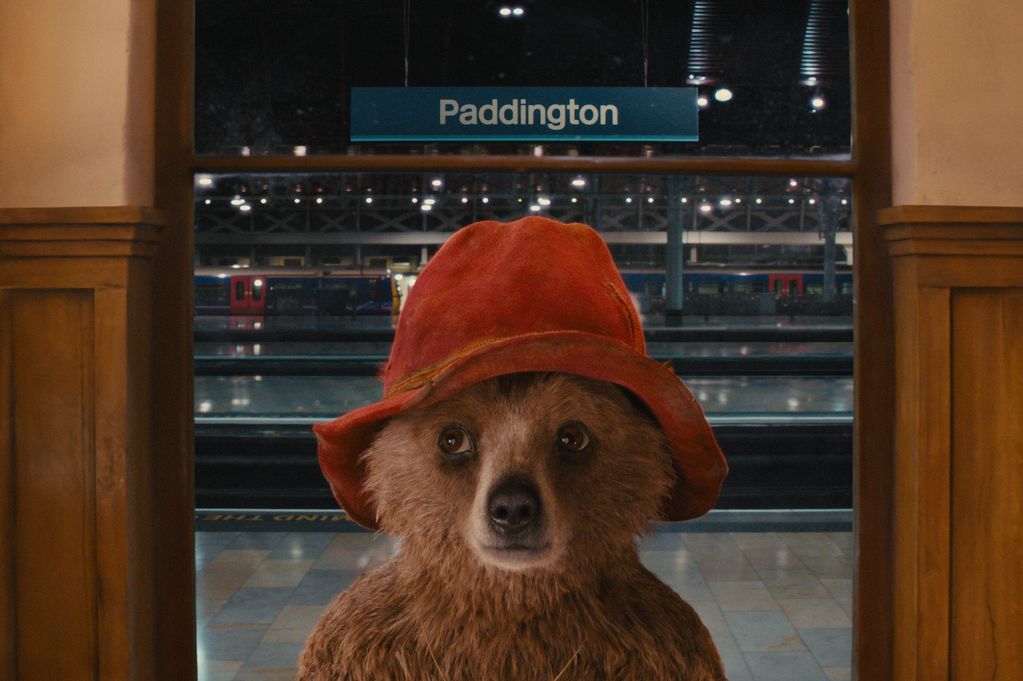
We might compare this play on well-loved family archetypes it to the likes of TV comedies My Family or Outnumbered, which features semi-improvised scripts depicting the chaos of modern family life. The overly-inquisitive little sister Karen, the perpetually-stressed mum, the wearied father, the embodied chaos of Ben, the youngest brother, the sulky teenager. What makes Paddington shine above any TV drama is the simple humour of its script and the cinematic magic of its costumes: Nicole Kidman’s sharp heels and trench as she stars as the villainous taxidermist who seeks to capture and stuff our beloved bear for the Museum of Natural History, Sally Hawkin’s outfits (all marvellous colour-clashing, woolly hats and embroidered cardigans), and that iconic blue duffle coat and red hat that Paddington wears himself. Let’s hope sales of said duffle coat go up in the aftermath of this film because I’m more than happy to see it everyday, especially in that lovely cobalt colour that Paddington sports so well:

Source: www.cityam.com
Source: http://www.cityam.com

Then there’s the magic of the house itself, which features a giant spiral staircase and walls painted with a Japanese cherry blossom tree, the blossoms of which bloom or fade beautifully according to the emotional tone of the story.

As Paddington adjusts himself to (human) family life, the audience goes through scenes of low-level cognitive estrangement, as Paddington explores everyday human life and tries to make sense of it, with amusing consequences: flooding the bathroom, using a toothbrush as an ear-cleaning cotton-bud, mastering how to use the escalators at the tube station. As I said at the beginning, I’m not generally a great fan of animated films, but Paddington carries off its loveable animal protagonist flawlessly, down to the details of individual water droplets shaking off each strand of his fur. Originally, Colin Firth was set to play the voiceover for Paddington, but he stepped down after worrying that his voice didn’t sound quite ‘open’ enough for the young bear. Instead, Ben Whishaw got the part and the sweet dulcet tones that so charmed us in his portrayal of Romantic poet John Keats in Jane Campion’s Bright Star are here perfect for the innocent wide-eyed charisma of Paddington. It’s a remarkably technical process; Whishaw had to wear a kind of helmet so that the animated Paddington bear could match the facial expressions and head movements of his kindred (human) spirit.
Source: www.networkrailmediacentre.co.uk
Source: http://www.networkrailmediacentre.co.uk

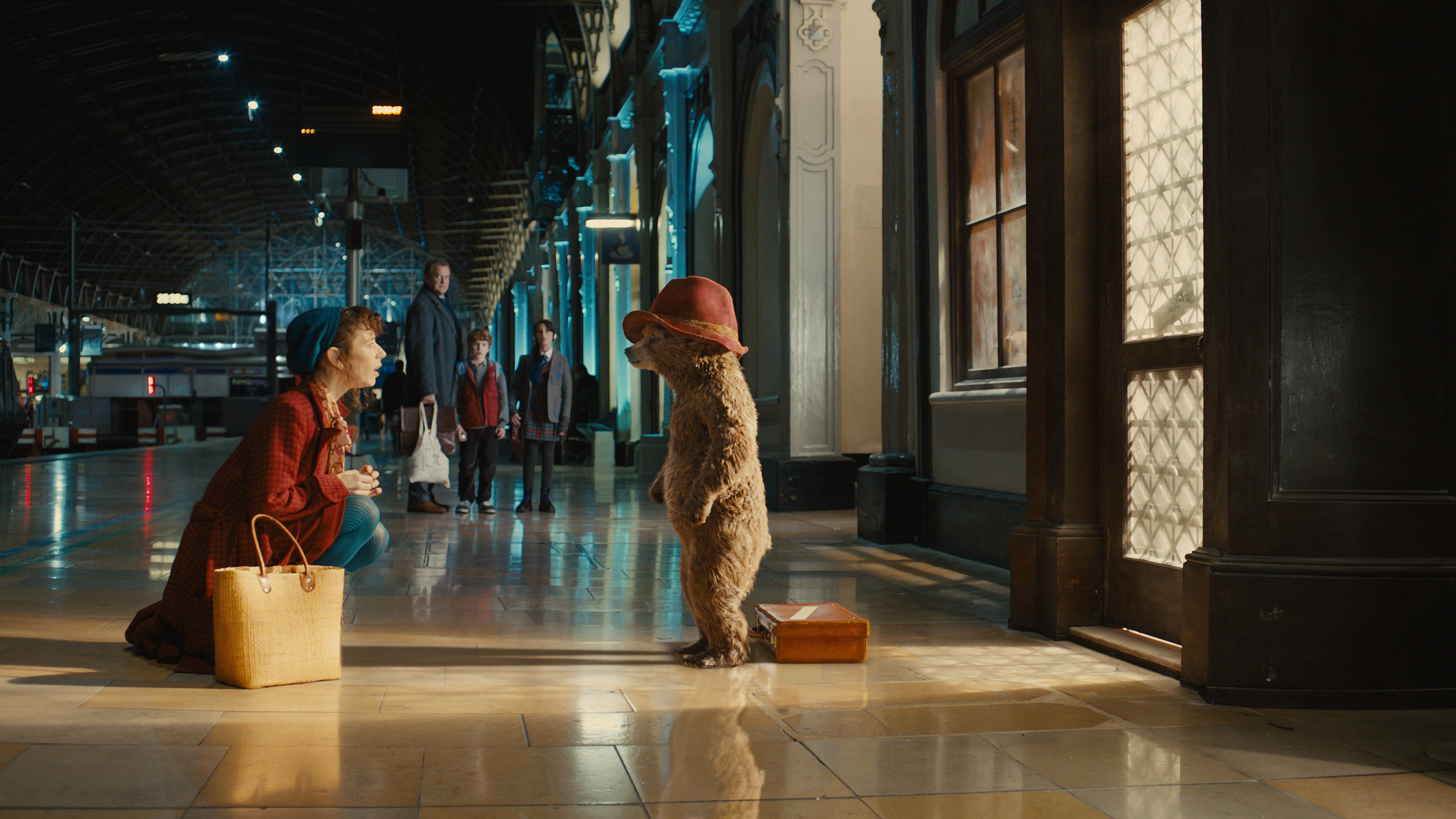
London is a dream in this film. From the grand corridors of the museum to the polished floors of Paddington Station (I imagine a much-needed plug for Network Rail…) and the snowy streets, it provides a romantic backdrop to Paddington’s adventures that makes us fall in love with the old city all over again. Sometimes I get very sick of London, especially the way it always flickers through media as this glassy corporate giant full of rich people with perfect lives (I’m thinking of the sweeping shots that open The Apprentice or basically every shot in Made in Chelsea that isn’t an awkward closeup of someone’s glakit face). The London of Paddington is a city of nostalgia, drenched in snow and old antique shops and red telephone boxes and a Dickensian wallet thief. Peter Capaldi playing an archetypal nosy old neighbour with a cockney accent and Doctor Who scarf. The family portrayed at the heart of the film are at once old-fashioned (the boring, distant father that perhaps echoes the banker father of Mary Poppins?) but deal with relatively modern issues: the presence of technology, the moodiness of teenagers. It’s this blend of the nostalgic and contemporary that really adds magic back to London itself, that spins a fairytale of visual beauty and enough narrative suspense to keep you hooked to the end (there is the encroaching threat of Kidman’s cold cyborg of a villain coming to kill and stuff our beloved protagonist).

Aside from the lovely visuals and fairytale storyline of good vs. evil, there’s the narrative of the Other which I already touched upon. Paddington experiences both alienation and welcome, and simultaneously the audience goes through the motions of heartbreak and compassion. Initially, he finds himself spurned by Mr Brown for his clumsy inability to fit into the household without making a mess of everything. In the cold rain he wanders the streets, and finds shelter with one of the Queen’s Guards who kindly offers him an emergency sandwich that he has stuffed under his enormous hat. Paddington is of course perfect for Christmas time: there is the message of family love, compassion and understanding, but also that simple narrative of sharing food that means so much in the shared gluttony of the festive season. There’s a reason we buy a tin of Roses or Heroes or Quality Street and it’s not just because it offers choice, but also because it’s a shared pleasure. Much like the film itself (I recommend everyone sees it on the big screen where the glorious visuals can really come to life).

You can look to the likes of Derrida or Donna Harraway to academically unpick the importance of understanding animality and other species for recognising the animal in us. By the end of the film, we realise that species shouldn’t divide us or cause fear or hatred or hierarchy. It’s wrong to treat another being as an instrumental object: something to be prized and displayed and stuffed. Go to Peter Singer for some philosophy too; I recommend ‘All Animals Are Equal’ (1974). It’s wrong to treat the Other with anything less than the respect you’d give to your own ‘species’. If bears and humans can become family, then can’t we all as humans get along in the turbulent times of the terrorism and threat and anti-immigration rhetoric of the 21st century?

What draws the immigrant narrative out from this Every(bear’s)man’s tale of immigration is the interspersed classic calypso songs which a band play throughout the action. Michael Bond’s children’s books were written, as Tim Masters (BBC 2014) points out, around the time when a new immigrant community were settling in Notting Hill – the place where Paddington himself finds a home. The songs are all positive and cheery, telling a story of endurance in the face of hardship and rippling with a fresh, hopeful spirit. The kind we need for 2015. By invoking the positive narrative of the Caribbean settlers in the mid-twentieth century (who came to help rebuild post-war Britain), the film implicitly critiques our contemporary societal stance on immigration. All the fear-mongering rhetoric that gets whipped up by the likes of UKIP is exploded in this heart-warming tale of love and discovery and acceptance of difference. It’s a classic tale of the journey of the Outsider that could be applied to anyone who has had the experience of settling into a new community as some kind of racial/ethnic/sexual/physical Other. And perhaps this, more than anything else, is the enduring magic of Paddington. So I’m glad I went to see it.

(On a side note, the only thing I was sceptical about was the heroic pigeons who essentially save Paddington at the film’s climax – not to put to fine a point on spoilers – I can’t see pigeons ever acting so benevolently. But then maybe that’s a terrible species bias that I should work on myself).

Bibliography:

Masters, Tim, 2014. BBC News Online. http://www.bbc.co.uk/news/entertainment-arts-30196290

Pauli, Michelle, 2014. Interview with Michael Bond. http://www.theguardian.com/books/2014/nov/28/michael-bond-author-paddington-bear-interview-books-television-film

Technology and Hardware: Some Sentimental Reflections

stock-photo-retro-ghetto-blaster-cassette-tape-recorder-on-table-in-front-mint-green-background-159525176

It’s funny how I still remember getting my first Game Boy. It was the original one, 8-bit in a lovely yellow colour, feeling heavy and smooth in your hand. My mum had bought it off my older cousin for about £10, and I remember feeling so surprised that she’d got me it for Christmas. I had a few games which were these wonderful plastic cartridges that you slotted into the back of your Game Boy, and you could hear the satisfying click when they were inserted properly. There was the sweet little noise it made as you switched it on, the Nintendo logo fizzling onto the screen, the red ‘on’ light glowing in the corner. The shimmering pixels and the chip tunes of game music.

I guess every generation grows up with some form of technological hardware that seems always exciting and new. Whether it’s a radio, gramophone or mobile phone, people born in the twentieth century have grown up with some newfangled machine that somehow adds to their daily life and experience of the world. I feel like my generation is an interesting one in this regard: we grew up with hardware but increasingly this hardware has shrunk like something from Alice in Wonderland, shrinking until it becomes something ethereal, intangible: a piece of code; a web of communication; a world available not only at your fingertips but at the swift movement of your iris. At primary school, we fiddled about trying to hand in homework on corrupted floppy disks. Now we have smartphones, iPods, Google Glass – and that funny thing, the Internet.

Recently I actually went into a shop and bought an album. That’s a statement that would seem pretty meaningless even five, six years ago. Who cares? Now, however, it’s an event. Why would I bother leaving the house when I could get the new music I wanted in an instant on iTunes? After all, that’s what I’ve often done before. I’m not sure why I decided to buy it in ‘hard copy’. It was the new Conor Oberst album, Upside Down Mountain. Being a longstanding fan of Oberst and his band Bright Eyes, I wanted to make buying his album seem more like an ‘event’, to get that kind of excitement I used to get as a teenager, spending endless Saturday afternoons browsing music shops and picking out intriguing album covers; or as a kid, when my dad would take my brother and I into HMV and let us each pick one album. I remember eleven-year-old me picking up The White Stripes’ Get Behind Me Satan and my dad looking at the cover and frowning, ‘that looks a bit too gothic Maria’; he bought it for me anyway.

So I happily purchased Upside Down Mountain from Fopp in Edinburgh and took it home on the train with a smile. It felt good to hold something physical in my hand; yet also strange that it was made not from the hard plastic casing I was used to but a kind of recyclable card. Times are changing. It didn’t have the same retro feel of a CD, something that would look nice all stacked up with the title showing, but it was still better than the paltry avatar of album art you get on a computer. Funny thing, I don’t own a CD player, so of course I had to put it into my computer anyway, to eventually burn onto my iPod. What I first noticed was the soft whirring sound as I inserted it into the disc drive. I’d forgotten all about that whirr; owning a MacBook, there’s very little computer noise at all and working with it normally feels like a more silent, smooth and hi-tech experience than it did with my old laptop that used to hiss and bleep and burn a hole in my lap. There was something lovingly nostalgic about that whirr. It got me thinking: how deep is our relationship to hardware?

As a kid, I had a sorbet yellow tape player with soft grey buttons and a handle that let you carry it about the house. One day I found my dad’s old collection of tapes: boxes of tapes that he’d copied, some original purchases with the artwork intact. The first ones I stole (with permission) were The Police and Manic Street Preachers. I used to listen to the radio with my beloved tape player; at night I’d sit in a den I’d made out of muslin and cushions in the corner of my bedroom, and I’d tape-record my favourite songs off of the radio, snippets from live lounges and interviews which later played back to me, mingled with a softly rasping static. I suppose these were my own (poor) attempts at making mixtapes, the songs cutting off midway through, fragments of old material appearing where I’d failed to tape over properly. I miss listening to music like this: a mix of rewinding and pausing, stopping and starting. I had audiobooks too: childhood stories filling my room, about pots and pans that came to life, and the bizarre sequel to Charlie and the Chocolate Factory. The excitement of silent sound space that came with the voice saying ‘End of Side One’ enacted a kind of participation in the story, as you had to manually extract the tape and flip it over before playing it again.

I feel lucky that someone has actually made me a mixtape before, and this was just before such an act became ‘hipster’ or mere ironic nostalgia.

My home town Maybole is pretty small and doesn’t boast much, but it did used to have a little video shop that my mum, my brother and I used to visit every Saturday night. We’d browse the aisles and argue about what film to pick, and it was always an excitement, knowing it was on loan only for one day and so we had to watch it. Afterwards we’d pop into Safeways across the road and buy snacks. Film watching was more of an event back then, a shared thing. Now, apart from a rare trip to the cinema, I only really watch films when I’m too exhausted to read after a shift at work, and even then it tends to be just me in front of a laptop sleepily watching whatever’s half-decent on BBC iPlayer. While now watching a film is easier to do in parts, before, you’d have to rewind and watch the funny people moving backwards, frustratedly searching out the point where you last left off. The ease in which we can slide between scenes on a DVD player or computer has probably added to our general sense of impatience; it’s too easy, perhaps, to skip over or lose concentration, knowing how easy it is to freeze and repeat.

Moving then from serial to random access memory, I entered my teens. When I was at secondary school, I was really into music and CDs – as much as I had once been into video games – and bought as many as I could with my birthday money. I had a cool silver-blue CD player from Argos that you could put three discs at once in, and it would shuffle songs from all of them at once (before it broke). I also miss the physical act of burning CDs onto a computer, one by one; back when they took ages to copy and almost without fail ended up crashing the family desktop. It was more of a reward when you finally built up a database of your physical music, and could sit and spend hours rearranging playlists whilst chatting to friends on MSN. Already, though, technology had given me the power of multi-tasking; it was just the slow internet connection and processing speed that tended to interrupt the flow (but I almost miss the bleeping symphony of a dialup connection).

I guess this article could be classed as another act of nostalgia, but I wrote it sort of to come to terms with where we are now. The Web has pretty much exploded, infested with advertising and weird material; an intricately layered network which is no longer just the facility through which I access Neopets but an intrinsic part of my daily life. Without it I couldn’t access course resources for uni, I’d struggle to contact my friends, I’d be limiting greatly the availability of information on hand to me. My laptop screen is now a perfect kind of mirror, an elaborate backlit LED technology which provides a window into the tunnel world of networks and code that make up our online lives. There is no longer that tangible, silvery translucence of the old LCD monitor displays which spread rainbow shimmers when you pressed your finger against them. The hardware of my childhood and adolescence – of tapes and CDs and Game Boys – has passed into the realm of the soft-world, the almost flawless efficiency of my MacBook Pro, through which everything is easily at hand. And you know what, I almost regret it.

Inception: Dreams and (Dis)illusion

source: http://oeaf.blogspot.co.uk/2012_05_01_archive.html

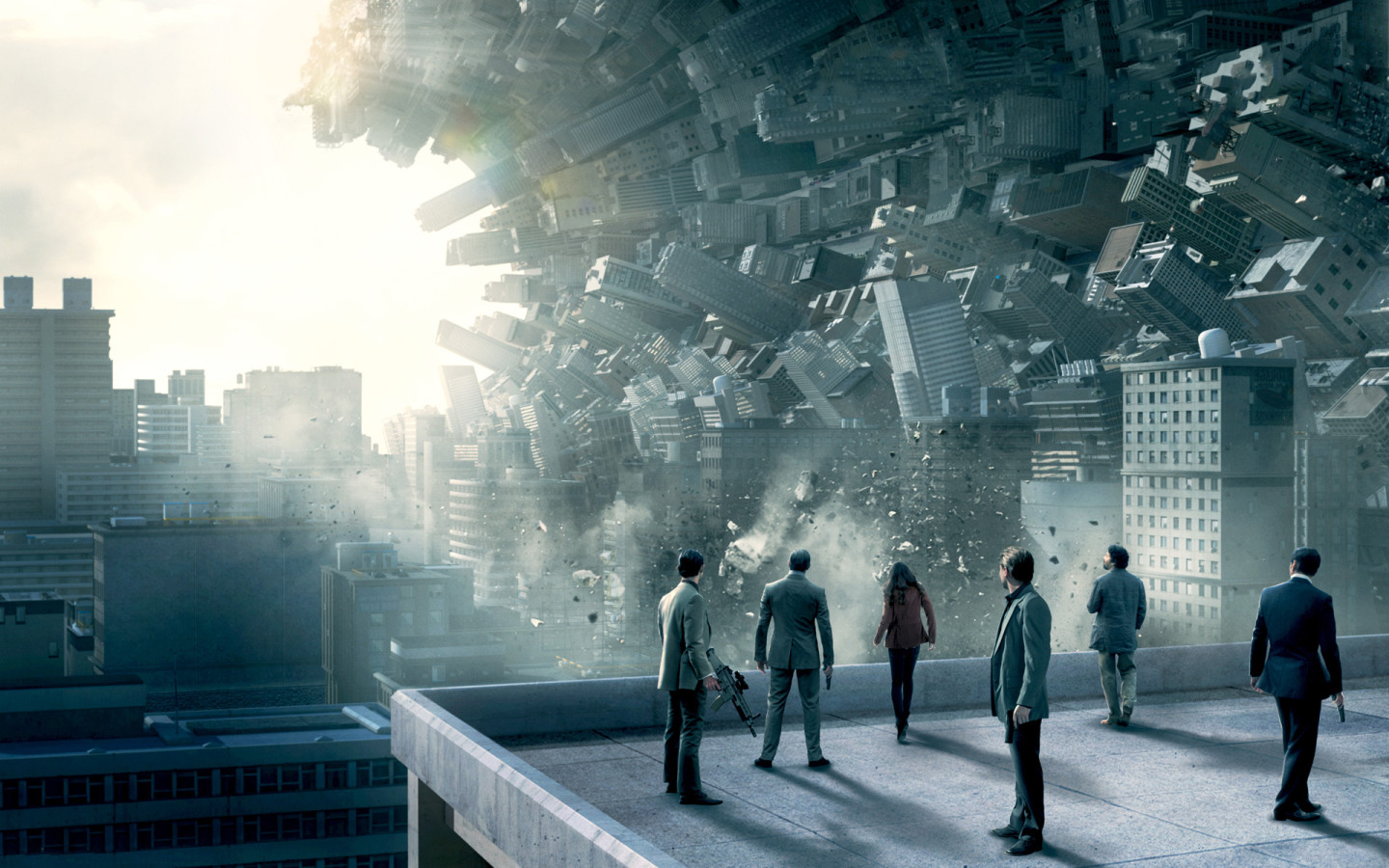
Inception is a film that begs itself to be watched twice. Following what appears to be a complex dual narrative of both emotional turmoil and psycho-political manipulation, Christopher Nolan’s blockbuster success turns on an exploration of the implications of the very personal act of dreaming being appropriated externally as a powerful means of mind-control. Yet whilst the film indulges in Hollywood-acknowledged action scenes – from a gravity-defying fight sequence in a surreal hotel corridor to a car tipping off a motorway bridge – it also diverges from the traditional narrative style of mainstream movies. With the seemingly complicated premise of dream-stealing intertwined with the intimate personal journey of the main character Cobb (played by DiCaprio), the film’s exposition is unravelled in an on-going fashion and so we are plunged straight into the action. The main storyline centres on a deal that Cobb strikes with Saito, a powerful global businessman who proposes that in order to use his influence to let Cobb return to the USA (Saito can eliminate false extradition charges held against Cobb), Cobb must perform the task of inception – a task that takes him and his colleagues deep within three dream-layers in order to manipulate another man’s mind. What is interesting about the film is not necessarily its deceptively confusing plot but the way it is told – the story itself – and the techniques the film employs by meshing the genres of sci-fi, psychological thriller, film noir and heist in order to raise questions about narrative seduction, dreams and the power of the unconscious.

While many heist films unveil their major technical premise at once, as a character explicates the details of the mission to his/her colleagues, Inception works in a fashion that Kristen Thompson calls ‘continous exposition’. In this sense, the aim of Cobb’s team of dream-thieves, as well as the physical laws that govern the practice of dream architecture and inception (the implanting of an idea into another’s mind so that they imagine it to be of their own creation), are revealed gradually throughout the film and during scenes of both explanation and action. The character Ariadne takes her name from the Greek heroine Ariadne, who falls in love with Athenian hero Theseus and helps guide him with a ball of string though the Cretan Labyrinth in order to assist him in locating and slaying the Minotaur. Similarly, Inception’s Ariadne plays a key role in not only helping Cobb to disentangle the repressed emotions regarding his dead wife which continue to haunt him and disrupt his dream work, but also as a pupil of the dream-workers she learns and responds to the workings of the dream-world, thus illuminating the film audience with the features, possibilities and ontology of dreaming through her character.

This gradual unravelling of exposition plays a fundamental role in the seductive quality of Inception’s narrative. Talking about the task of exposition, Nolan explains:

“Exposition is such a massive demand […] It’s something you have to just try and imbue in the relationships of the characters. You never want to find yourself in a scene where characters are passively receiving information in some way, because you don’t want the audience passively receiving information. You want them engaged with that dramatization.”

It is this engagement with understanding, this active involvement in working out the enigma, the puzzle, which makes the film so gripping. Rather than spoon-feeding the audience a fully-blown detailed account of the principles of mind-control, Nolan reveals slowly the inner workings of the machine of dreaming. Information seeps out of the action as characters exchange advice and teachings, and as things do or do not go to plan we are often left to extract our own conclusions about how the laws of dreaming work. This mode of exposition is thus fundamentally tied to the events of the film itself, rather than an intrinsic system of depth which can be quickly absorbed and applied to the film as a whole; the labyrinthine revealing of secrets and mysterious truths refracts from storylines and action across to the revelation of Cobb’s unconscious traumas, so that the audience find themselves caught in a play of possibility and information that moves as swiftly as the characters as they set out on their complicated mission.

I suggest this fast-moving, yet richly-layered form of narrative is highly seductive in its ability to lure viewers in to the depths of the film in a way that relies on the vivid exchange of surfaces, visuals and meaning. Seduction, as Baudrillard (2001) identifies, is fundamentally an ability ‘to deny things their truth and turn it into a game, the pure play of appearances’. One way in which a narrative can seduce, then, is by denying its audience fixed answers, a technique which enables the endless ‘play’ of possible meanings. This draws us in so that we play an active role in the ‘game’ of interpretation, a technique of seduction which seems very appropriate given the often vague and mysterious nature of dreams themselves.

In Inception, there are a lot of deliberate ambiguities, and things that are revealed to be not quite what they initially seemed to be. For example, the question of what is a dream and what is reality. This is a problem that we learn Cobb suffers with, and it is one that is well documented in literary and film history. Whether from overuse of psychadelic drugs, or some form of mental pathology, there have for decades been characters portrayed as losing their grip on the thin line that separates reality and fantasy, dream-world and actual experience. Examples that spring to mind are A Beautiful Mind and Black Swan, which both offer provoking depictions of schizophrenia. Psychosis is also a difficulty that Cobb’s deceased wife, Mal, has fought with. Mal and Cobb spent a great deal of time in ‘Limbo’, a world of endless pure subconscious creation that is formed in an on-going fashion by those that occupy it. It seems by definition to be an abyss of the mind, a place to be trapped in ceaseless possibility – lost in one’s own creative, expansive subconsciousness. You enter Limbo when your physical body is heavily sedated, and either you are killed in a dream or at a complex dream level (in the film, level 3) when you fall asleep. It’s a strange and vicious concept that has a dark allure to it – the suggestion that perhaps when people enter comas their minds are elsewhere, trapped, unable to get back to reality.

When Mal and Cobb finally make it out of Limbo, Mal soon loses the ability to distinguish this real world from the world they fashioned in their dreams. Eventually we learn that this is because Cobb only managed to get himself and Mal out of Limbo by planting through inception in Mal’s mind the idea that the world (at that point, Limbo) was not real – persuading them to commit suicide in order to be kicked out back to reality. Yet the idea that the world was not real grew like a parasite and tormented Mal until she could not accept even reality as reality. She thought she was still dreaming: that her children were just projections of her consciousness, that the physical environment was just a fabrication of memory and imagination. To remedy this perpetual state of insecurity, she decides to kill herself by jumping from their high-floor apartment into the abyss below.

I think this form of suicide poses interesting questions about the nature of consiousness and our self-awareness within the world. To what extent do we really know that this environment that seems so solid and familiar is in fact real and actual? We know what it feels like when we are dreaming: time is sped up, often fragmented (an issue dealt with in Inception, where there is a mathematical formula that encompasses the disjunction between time spent asleep and time in reality, where one can dream for 50 years but be asleep for merely three hours), we wake up when we die or when there is some sort of ‘kick’, which might be something like loud music or physical pain – a jolt that wakes us up. Yet although it seems easy to distinguish dreams and reality, how do we know that there is just one ‘reality’, or that our notion of reality is just an elaborately designed, prolonged dream? It’s a problem that was posed a long time ago by René Descartes, who suggested a form of radical scepticism about the nature of reality. Descartes proposed that all our conscious experience could merely be a dream-state, manipulated by an all-powerful and omniscient ‘Evil Demon’, who could control everything we do and everything around us. This is the famous ‘brain in a vat’ philosophical problem that has been explored in films like The Matrix, and becomes evermore salient as virtual reality and technology advances to provide evermore realistic and vividly detailed artificial environments. What it comes down to is the fact that we really cannot know (or can we?) the metaphysical nature of the world: our knowledge leads merely to a non-passé, or an abyss (like the one Mal plunges into), an endless recursion to the possibility of multiple imagined or experienced realities.

And who are we to judge that the world in the film is reality? What if Mal, in leaping from the metropolis to the dark void below, really did escape to a higher level of consciousness, a real world? The film cuts rapidly in and out of the different dream levels inhabited by the characters in their mission to conduct inception on Fischer, a businessman (to persuade him to break up his father’s monopolying empire – maybe someone should try and do this to a young Murdoch). This technique not only disorientates the audience and imbues the film with a surreal quality but it also highlights how our perception is fleeting, rapid, built up of impressions. Reality, then, is very subjective, and the distinction between psychological reality, the durational experience of time and physical reality with linear clock time. Nolan seems to want to emphasise this ambiguity of experience and reality with the ending, which closes on the image of the only anchor an individual possesses to reality – the totem: a small token whose unique, personalised weight, balance and appearance enables its owner to discover whether they are in their own waking/dreaming reality or another person’s dream – if they are in another’s dream the totem will feel strange. Cobb’s totem is a kind of spinning top, which is set to topple over if he is awake and to continue spinning if dreaming. At the ending, Nolan shows Cobb’s totem both spinning but also provocatively starting to topple. This means we do not know if the film closes with a conventional happy ending, with Cobb finally reunited with his children (mission accomplished) or whether he is simply dreaming about the event.

In the hope of drawing some line between dreams and reality, it is useful to consider the concept of the ‘kick’ featured in Inception. It’s interesting when real-life stimuli enter our dream-world: for example, in the film Cobb is thrown into a bath of water and in his dream water floods in through the windows. The ‘kick’ designed to withdraw the characters from the triple layers of dreams they are in is a piece of music, which resonates throughout each level like an uncanny scent or breath of memory – not just the physical stimuli of sound. I have had many dreams where I am drowning and can’t breathe – the pain physically sears up in my chest, but when I wake up I realise I’m somehow suffocating myself with my pillow! Not only is there some psychoanalytic value in studying what makes us wake up from dreams (hello, Freud), but the concept of the ‘kick’ raises intriguing questions about where mind and body collide, and how much of consciousness is interwoven with all those nerves and neurons to our physical form. Certainly this very phenomenon refutes the now very-dated but religiously popular form of Cartesian ‘dualism’ which proposed the mind and body were distinct forms of matter, so that when the body dies the soul remains and can go to heaven or hell. If mind and body are different materials, then how can they interact so intimately?

On the question of psychoanalysis, the film borrows heavily from Freudian ideas about the interplay between and the role and nature of dreams and the unconscious. The characters in Inception spend a great deal of their time lucidly fabricating dream-worlds and occupying the dream-worlds of others, as well as switching between dreams and reality, that it is no wonder that many of them suffer a mild psychosis whereby the distinction begins to break down. Freud himself deemed psychosis a ‘disturbance in the relation between the ego and the external world’.

In The Interpretation of Dreams, Freud posited that our dreams contained symbols transmitted from the underworld of our unconscious, symbols that represented repressed desires and wishes (usually sexual) that are too uncomfortable or psychologically painful (due to the effects of oppressive socialisation) for us to admit consciously. He says: ‘the interpretation of dreams is the royal road to a knowledge of the unconscious activities of the mind’. So a dream where you steal your dad’s hat could have awkward Oedipal consequnces, as Freud thought that hats were often representations of genetalia. The possibility that you have sexual feelings for a parent is painful to acknowledge consciously due to society’s incest taboo, so instead this desire reveals itself only in dreams.

The consequences of psychoanalysis seem quite profound in unsettling our conventional idea of reality. If so much of our perception of reality seems to be subconscious, this makes it difficult to assume that there is a clear, objective definition of a singular reality, since everyone is driven by multiple interlocking wishes. The central emotional plot of Inception is a psychoanalytic one, as well as a conventional Hollywood drama of a distraught father who misses his dead wife and would risk the life of himself and his team for a chance to see his children again. Dr. Stephen Diamond makes the interesting point that Cobb’s unresolved guilt and anxiety regarding his involvement in manipulating Mal’s psychological state and (somewhat inadvertedly) causing her suicide is projected symbolically in the form of Mal herself, as Cobb’s ‘negative anima’. Mal haunts many of the dreams Cobb creates and makes it difficult for him to do his job properly, as her shadow-like and disruptive figure keeps reappearing in times of crisis. Ariadne, ever the guiding light, at one point takes up the role of psychoanalyst and tells Cobb that the only way Mal is going to go away is if he lets her go – if he resolves his inner conflicts with his memory of Mal.

The ultimate goal of being reunited with his children flickers through the film in the recurring appearance of the boy and girl playing together on the grass with a beam of sunlight. Subtle differences in their appearance occur between the different shots, which suggests perhaps an alteration in Cobb’s memory of them, or the real process of aging they are experiencing – again, a blurring of reality, memory and dreams. In the end, when Cobb finally returns to his children but the camera finishes by focusing on the totem, we are left with the uncanny possiblity that the children may not be real, instead merely (as Mal feared) ghostly projections of Cobb’s unconscious. However, the warmth and joy we gain from seeing this satisfying ending feels real. Does it matter what really happens? I think Nolan employs the ambiguity here to self-reflexively acknowledge the strange status of film as often a vividly realisitc visual projection of reality, portraying visually and auditorily objective reality and also rendering the subjective inner life of individuals. Film can seem all too real, but it is often fictional, and like a dream it is a temporally-compressed representation of reality. When the credits roll and we are suddenly thrust back into our everyday environment, we realise that we have been intensely caught up in this other-world, its visual universe has been painted upon our eyes for the brief time that we have been watching. It has become part of our reality. We probably won’t forget it; we might even dream about it.

Baudrillard, J. (2010) Seduction, trans. by Brian Singer, (Montreal: CTheory Books), Available online: <http://free.art.pl/fotografie/baudrillard/seduction/BAUDRILLARD-SEDUCTION.html> [Accessed 25.01.13].

Descartes, R. (1641) Meditations on First Philosophy.

Diamond, S. (2010) http://www.psychologytoday.com/blog/evil-deeds/201008/inception-art-dream-and-reality

Freud, S. (1899) The Interpretation of Dreams.

Freud, S. (1924) Neurosis and Psychosis.

http://www.davidbordwell.net/blog/2010/08/12/revisiting-inception/

source: http://vegzetmernokei.blogspot.co.uk/2012_10_01_archive.html

My Difficulty(ies) with Sex and the City 2

Image
Image source: fanpop.com

I really don’t know what convinced me to watch Sex and the City 2. I suppose it was a case of finding something that wouldn’t require much brain power; some easy viewing for after exams. Little did I know the film would prompt some serious feminist and post-colonial rage.

Sex and the City 2 is, like the show that ran from 1998-2004, a romantic comedy. It follows Carrie, Samantha, Charlotte and Miranda as they travel abroad to a holiday in Dubai. Like the show, the film engages with the issues of being a woman in a ‘post feminist’ age, but also involves itself in questions of cultural difference and orientalism. Sex and the City 2 was released in 2010, in the midst of the turbulent relations between the West and East defined by the on-going war in Afghanistan.

Firstly, the question of feminism. Sex and the City 2 is a salient example of a ‘post feminist’ film. According to Angela McRobbie, in her work ‘Post Feminism and Popular Culture’, popular culture of the 1990s reflects a turn away from the gains made in the second wave feminist movement, through an exhibition of what McRobbie calls ‘post feminism’. Post feminism, for McRobbie, entails the notion that contemporary culture relies on the achievements of second wave feminism. Indeed, it takes these achievements – equal rights, liberated sexuality, economic independence etc – for granted, takes them as socially ‘obvious’ and in existence without need for critical reflection. The widespread assumption that women are sexually, economically and socially ‘liberated’ allows popular culture to represent female characters who embody an autonomous, self-reliant and empowered lifestyle: this includes having high-flying career women, sexually-liberated women; women with choice, education, power. It doesn’t take much effort to see that Sex and the City is a prime example of this: there’s Samantha the PR businesswomen, Carrie the writer, Miranda the lawyer.

Nevertheless, the empowered women portrayed in popular culture do not fit the aims of feminism, even though on the surface they appear strong and ‘free’. These women are presented as self-made, fully in control of their own destinies, fully unshackled from the chains of patriarchy and power and also the feminist movement itself. Their achievements are represented as examples of personal triumphs rather than identified as part of wider shifts in female employment and gender roles enabled by the feminist movement and its transformation of the systems of power and social mores which formerly would have constrained them. Since these women are depicted as independent and disengaged from feminism, their representation contributes nothing to the political ambitions of feminism, and also undermines the need for any contemporary feminist movement. Indeed, many popular renderings of the modern, empowered women (the post feminist female subject) in fact not only detract from the political weight of feminism but they also associate this new freedom with certain practices which actually restore traditional gender roles – the gendered behaviours that feminism set out to radically change.

In Sex and the City, both the show and the films, female liberation and empowerment is predominantly expressed through sex and consumption. Yet it is debatable as to whether these practices actually enable the women to free themselves from conventional gender norms or whether they in fact throw the characters back into the cycle of cultural constraints that rigidly define ‘women’ and ‘feminine behaviour’. Samantha, for example, is frequently depicted as the most sexually voracious of the four women. She enjoys the kind of sexuality – one night stands and the like – that men have been enjoying for centuries; she offers no apologies for her behaviour; it is, at least from the two films I have seen, seemingly morally accepted. Moreover, as a successful businesswoman, Samantha enjoys an economic independence which allows her to splurge on clothes, holidays and anti-aging products. It isn’t difficult to see where post feminism fits in here: while Samantha does have an assertive sexuality and personality, her empowerment is presented chiefly through consumption. Rather than making any significant political statement about female power or positioning, the show and films seem to reaffirm the status quo by confirming consumption as not only the vital source of contemporary identity but also the glittering route to status and power; yet a route that leads continually to traditional female objectification, with the body becoming a cultural mannequin, dressed up with the latest dresses, shoes and anti-aging potions to create the perfect sexualised subject. Of course, there is an inherent ambiguity about whether the woman is in control of herself, as she travels down this route of credit cards and department stores, or whether she is pressured by the powers of female-directed advertising and capitalism.

In any case, Sex and the City may appear feminist but it certainly contributes very little to the political movement of feminism. The girls may spout their girl power in a karaoke session singing second-wave feminism’s theme song ‘I Am Woman’, but their empowerment is arguably a superficial concealment of how they are trapped by the mind-numbing machines of advertising and the fashion and beauty industry which continue to pressurise and mould women’s sense of self, perpetuating gendered regimes and practices. Samantha, the only unmarried character, uses her economic power in ways that confirm her adherence to standards of femininity that are perpetuated by the beauty industry in order to exploit and extend female insecurities. She enhances her libido in the wake of menopause through guzzling handfuls of pills, to ‘trick [her] body into thinking it’s younger’, to which Miranda adds: ‘I’ve tricked my body into thinking it’s thinner – Spanx!’. While feminism as a movement attempted to open up new kinds of beauty, which included those who were not young, white and skinny, the characters are depicted as mindlessly striving towards and approving the stereotype, rather than in any sense shattering it. As Hadley Freeman of The Guardian astutely describes this scene: ‘it’s like being lobotomised with a pink teaspoon’.

Well this is all fair enough: perhaps you could argue that she is making the conscious choice to do so. Other characters have different means of empowering themselves, after all. There’s Miranda, the lawyer, and Carrie, the fashion-crazed newspaper columnist. Yet all these women are privileged: rich, often from affluent backgrounds or have wealthy husbands. They are friends for one thing because they have a shared class position. Their empowerment through shiny New York careers and the shopping is more of a class privilege than a political statement about girl power, and in this sense I would argue that the show is highly problematic in its potential to be cast as ‘feminist’.

While the issue of feminism and Sex and the City is ambiguous, I would argue the sequel film leaves little ambiguity about the issue of racism; or, more specifically, orientalism. The film follows the four girl’s holiday escapades in Abu Dhabi, the second biggest city of the United Arab Emirates. Hadley Freeman contrasts the ‘smart, funny, warm and wise’ TV show with the ‘pink-fringed, cliché-ridden, materialistic, misogynistic, borderline racist’ film; while the show ‘had genuine emotional truth’, the films are all about the ‘sex and shopping’.  I’ve never watched the shows, so cannot make a judgement other than my impression of the films. And my judgement is that their vision of women, homosexuality and ‘the East’ is distinctively narrow, shallow and hollow.

With Carrie, Samantha, Miranda and Charlotte sent off to Abu Dhabi, the film immerses itself in a world of blatant, unapologetic orientalism. Edward Said in his book Orientalism described orientalism as a concept which encompasses the binary distinction often made between West/East. This distinction comes with other stereotyped and hierarchical binary pairings such as civilised/uncivilised, us/them. Charting the history of colonisation, Said suggests that Europeans have for many years set up Eastern countries as ‘oriental’, as exotic Others by which they may define themselves against. For Europeans, whatever the Orientals were defined as, they (the occidents) were not. This allowed the West to position themselves as an inherently superior ‘race’, which in turn provided the justification for colonisation by using the ‘white man’s burden’ of civilising the ‘uncivilised’ world to legitimise their imperial domination of Eastern countries. As with most stereotyping and binary oppositioning (think man/woman), this process involved enormous cultural and social simplifications and generalisations which shaped prejudices against the ‘orient’ commonly held in the West. You only have to take a glimpse at today’s papers, with the generalisations about Islam and terrorism, to see how Orientalism still operates. Indeed, the USA in particular has frequently justified its occupation and invasion of Iraq and Afghanistan in terms of tackling the women’s rights records of these countries; but it is possible that this constitutes an imposition of Western norms on different cultures, and moreover, the USA’s record for women’s rights is itself questionable, as it is one of the few countries that has refused to ratify CEDAW, the UN’s Convention to Eliminate All Forms of Discrimination Against Women. This is just one contemporary example of how the West stereotypes Eastern cultures in opposition to its own cultural model, and reflects a complex entanglement of neo-imperialism, orientalism and feminist issues.

Back to Sex and the City 2. The representation of the Middle East is highly stereotypical, and makes a great effort to exoticise Middle Eastern men and women into characters which perpetuate traditional oriental images of the East found in films like Arabian Nights. The men are presented with a glamorous strangeness: with the mundane, clichéd dialogue and the glittering, stereotypical oriental music that accompanies their appearance. Upon arrival, the American women are treated like queens, each getting their own taxi and personal man-servant who stays up all hours to service their every petty whim. This sets up a kind of neo-colonial relationship where the ‘respectable’ Eastern characters are represented as intrinsically deferential to their Western ‘superiors’.

Additionally, the cultural status of sex is clear-cut into a binary issue, with Western liberation contrasted with a complete repression in the East – Samantha’s kissing on the beach is met with armed response and a permanent criminal record. Rather than acknowledging the nuances that characterise how sex is accepted and perceived in different contexts, the film forces the issue once again into stereotypical binaries.

Perhaps most significantly, the film also cashes in on stereotypes of the mysterious veiled Muslim women. Carrie and co ruminate over the sartorial restrictions of wearing a veil, and watch in awe as one eats her chips underneath the burqa. The Muslim woman is thus shown as an object of curiosity, and we viewers are forced to voyeuristically observe her eating chips as if she is some strange, voiceless creature. By minimising the actual interaction between the American women and the Middle Eastern women, the film negates any possibility for exploring the unique subjectivity of Muslim women and their experience of wearing a burqa as well as their religious beliefs. Instead, they remain Oriental objects of Western curiosity. Rather than respected for having their own minds, they remain quite obviously in this film, to borrow Chandra Mohanty’s phrase, under western eyes.

And indeed the moment that really struck me was when the Muslim women were given a voice. After helping the four girls escape a mob of angry Arab men (who Samantha has offended by spilling condoms all over the floor and announcing loudly that ‘yes, [she] does have sex!’, so yes – another stereotype about all Arabian men as women-haters) a group of Muslim women shed their niqabs to reveal they are wearing the latest New York runway collection. Delighted, the four American women laugh and praise their fashionable style. This is so obviously patronising that even after a film peppered with references to magic carpets and other Middle Eastern myths I was shocked. Being the primary scene where the main characters actually interact with Muslim women, it states, quite clearly, that Western and Eastern integration can only occur through consumption. Moreover, Muslim women can only be liberated from the ‘shackles’ of their own culture and religion (defined in the film by the recurrent veil image) by conforming to Western stereotypes of beauty and fashion. It’s a sickening simplification of the complexities of female identity within different cultural contexts, and seems to send out the message that globalisation (or rather, Westernisation) can only be a good thing because it is spreading a ‘liberated’ (or rather, shackled to consumerism) Western femininity to the poor, silenced Muslim women, who live in a culture that remains ‘backwards’. In doing so, it leaves out other more critical consequences of globalisation that could be explored, such as migrant labour in the Gulf, which is only skimmed over in Carrie’s conversation with her Indian servant Gaurav – who she benevolently bestows her money upon, as if this single lavish expenditure makes up for the capitalist restructuring which has necessitated Guarav’s move abroad away from his wife in the first place. Another example is in the nightclub where ironically the girls play karaoke and sing ‘I Am Woman’ while at the same time they are probably in the company of trafficked sex workers. Charlotte asks why the club’s belly dancers are allowed to show lots of flesh while every other woman in the East seems to cover up, and Miranda provides the pathetic response that there is a ‘nightclub loophole’. Many of the single women in Emirati nightclubs are indeed trafficked sex workers, but the film completely glosses over the possibility of critically engaging with this.

Finally, the wedding opens with another obvious stereotype that should’ve prepared me for the cliché trail that characterises the rest of the film. The wedding of two gay characters involves many stereotypes attached to homosexuality – infidelity, flamboyance, the pomp of a completely OTT ceremony, complete with boy choir and Liza Minnelli performing ‘Single Ladies’. It’s utterly cringeworthy and I had to temporarily mute the film so that my flatmate didn’t have to wonder what the hell I was watching. A fitting beginning to a film rife with caricature, condescension and cartoonish representation.

I can’t, however, completely make my mind up how I feel about the representation of women in this film. While there are many simplifications and the fact that the women conform to gender stereotypes through shopping, there are some moments where the difficulties of trying to ‘have/do it all’ are reflected. It is possible to look upon Samantha with pity, as a character who isn’t liberated but sucked too far in to the rigid, gendered standards of the beauty industry, and perhaps the patriarchal expectations of the area she works in – PR – which is based so much on appearance. Another example is the scene where Charlotte cries in the cupboard, hiding from her screeching children in a moment of genuine motherly breakdown. Nevertheless, these remain very limited representations, in that Charlotte’s troubles are the troubles of a privileged housewife. She’s crying because she worries about her husband having an affair with the nanny (an idea bizarrely stemming from the fact that the nanny doesn’t wear a bra) and because her daughter messed up her designer jeans. Not because she doesn’t know where her children’s next meal is going to come from, or because she’s overworked with three jobs to make ends meet.

So while the film touches on feminist issues, its dealing with class and ethnic difference is shockingly narrow. I couldn’t even enjoy it as a slice of indulgent consumerist fantasising, because the racial, sexual and cultural stereotypes, and the flat script and conventional female behaviour ascribed to many of the characters were so obvious and unsettling. It almost makes you feel guilty to watch. Of course, it all ends happily, with Charlotte’s nanny turning out to be a lesbian and thus in no danger of seducing Charlotte’s husband, and with Samantha finally consummating her passion for the Danish guy she got arrested for kissing in Abu Dhabi. Well, of course, the film suggests, everything happens correct and best in the West. Yet I’m not sure that all’s well that end’s well: the film prompts more questions about the implication of its depictions of women, homosexuals and the Middle East than it answers.

Bibliography:

McRobbie, A. (2004) ‘Post Feminism and Popular Culture’ in Feminist Media Studies, vol. 4, no. 3 , pp. 255–264.

Said, E. (1977) Orientalism. 

Sex and the City 2: Orientalist Boogaloo

http://www.guardian.co.uk/film/2010/may/23/sex-and-the-city-film-terrible

http://feministing.com/2010/06/03/sex-and-the-citys-women-of-color-problem/

Image

Explorations in Nostalgia: Midnight in Paris

file000675462020

Why is there a certain nostalgic quality to rain? Rain can be beautiful to imagine: the quietly rushing sound it stirs as it starts to fall, the peaceful pattering it makes on roofs and windowpanes, the tingle of droplets on your skin, the way it clings in watery beads to your lashes, the sweet earthy scent it trails as it vanishes from the vapory air. Thinking of rain conjures images of afternoons hiding indoors with a good book, of splashing in puddles as a child, of running makeup, of the high romance of kissing outside in a storm, and the satisfaction of coming home, changing into dry clothes and getting warm.

Most people living in Glasgow would be less lyrical about the drizzle that bursts ever too frequently upon the city. Rain can be a pain. Rain can mean struggling with a broken umbrella, feeling cold droplets drip down your back; it can mean delayed tennis matches, ruined picnics and cancelled plans. Yet rain is also one vein through which we are transported smoothly to some heart of our past; often our recollection of events and people is framed by weather, and rain can add a cinematic backdrop to memory that reflects the misted quality of nostalgia. It has a certain sense of deja vu, of transient confusion. I remember being here before, and it was raining. Like this…or was it somewhere else?

Yet rain is perhaps, like memory, never as lovely as we imagine or remember it to be. It is part of our wistful fantasies.

Woody Allen’s film Midnight in Paris opens with a beautiful montage of Paris in the rain, accompanied by accordion music. The shots slip effortlessly between postcard highlights of the city and panoramas of people in the street with umbrellas. It sets the scene for the film’s at times poignant but mostly witty and lighthearted exploration of nostalgia.

I first went to see Midnight in Paris at the kooky little Grosvenor Cinema on Ashton Lane in Glasgow’s West End. An appropriate venue, seeing as it is modeled on an old-fashioned picture-house, with red carpeting, plush seats, vintage interior design, glamour and the availability of wine.

Midnight in Paris is a pastiche of genres, styles, characters and references. Not only does it include an array of (slightly caricatured) figures from the 1920s creative scene in Paris, but it also welds together flashes of political satire with Hollywood rom-com and magical realism.

The film’s protagonist Gil is a Hollywood script-writer discontented with his sell-out job and longing to produce something creative in his writing. Perhaps there is a certain irony here: a search for authenticity staged within a film that is playfully anything but ‘original’. A trip to Paris with his fiancé and her parents, Gil hopes, will provide the spark of enchantment. The first conversation of the film sets up the juxtaposition between the romantic Gil and his pragmatic wife, who appropriately later has an affair with the ‘pedantic’ ‘pseudo-intellectual’ Paul:

 Gil: Can you picture how drop dead gorgeous this city is in the rain? Imagine this town in the ’20s. Paris in the ’20s, in the rain. The artists and writers!

Inez: Why does every city have to be in the rain? What’s wonderful about getting wet?

Already we get the sense that Gil wanders a little too much into his imagination, particularly his imagination of the past – of Paris in the 1920s. Gil’s first actual delve into the past occurs one evening when after the stroke of midnight a strange black cab stops to pick him up, full of revelers drinking wine and champagne. Through this mysterious portal, he is transported back in time to Paris in the 1920s. The film handles the visuals sparklingly well, with stunning 20s costumes, cocktails and the lovely decor of the bars and clubs. It’s all quite magical and dazzling, and we experience the wonder Gil must feel as he is teleported into his favourite fantasy. It certainly got me excited for Baz Luhrmann’s soon-to-be-released The Great Gatsby.

Except unlike us, the audience, Gil becomes a participant in his fantasy, not merely a spectator. Among his adventures, Gil encounters a plethora of characters from the 1920s literary and arts scene, including Hemingway, Dali, the Fitzgeralds, Picasso and Gertrude Stein. There is definitely an element of caricature here, which reflects the play of irony and pastiche characteristic of the post-modern: the film reminds us that these characters are just representations of real figures, who themselves were in a sense self-styled personas, who we knew predominantly through their art. From Dali’s raving about rhinoceroses, to Hemingway’s speeches about war and truth and sincerity, Allen plays with exaggeration to enrich the sense of fantasy and nostalgia. There is a scene where Zelda Fitzgerald is trying to commit suicide because she thinks her husband does not love her and Gil, trying to stop her jumping, tells her that he ‘knows’ that F. Scott Fitzgerald really does love her. Why? she asks. How can Gil possibly know? He’s read all the books and biographies about and by Scott, of course. I think the film here raises an interesting question about subjectivity and literature: what is the real version of events? What is the truth behind the writing? It seems that there isn’t one: instead there are all the fragmented perspectives of those involved, and those who write the books. Right now I’m reading Zelda’s novel Save Me the Waltz, which critics say is Zelda’s version of the semi-autobiographical events of Scott’s Tender is the Night, both depicting the breakdown of minds and marriages, but from the different perspectives of wife and husband. Gil’s attempts to claim that he can know better than the woman involved only underline the absurdity of any narrative which claims ultimate objectivity.

Gil’s encounters with the resurrected ghosts of the 1920s stage a playful juxtaposition of past and present. His quotative use of ‘like’ and his mundane discussions about his relationship to Inez contrast heavily with the stylish and hyper-surreal world he finds himself in. For example, his conversation with Adriana (Allen’s fictional amalgamated embodiment of Picasso’s lovers) about his engagement to Inez highlights the time and culture gap, but also the disparity between reality and fantasy. He realises that there is in fact very little he and Inez have in common, which perhaps suggests that his engagement itself was built on a fantasy. Gil admits that they have a ‘little bit of a disconnect with the big things’ but at least they agree on the little things:

Gil: I will say that we both like Indian food, not all Indian food, but the pita bread, we both like pita bread, I guess it’s called naan.

The likelihood of the super-stylish flapper Adriana knowing what pita bread is, let alone having eaten it, is pretty slim. In addition to this, Gil’s comic response to Hemingway’s question as to whether he’d ever been hunting – “only for bargains” – presents the playful irony of the film’s exploration of past and present, and the discrepancy between the dramatic, larger-than-life lives led by the characters of a by-gone age and the inane realities of the present.

Another funny encounter between past and present occurs when Gil gets into a cab driven by T.S. Eliot and exclaims:

Gil: Thomas Stearns Eliot? T.S. Eliot? T.S. Eliot? Prufrock is like my mantra.

The comedy here is that this reflects how many of us would behave – awkwardly unrestrained – if we were thrust into a world where we could meet our long-dead heroes. There is the hilarious sense that Gil is behaving as a teenage girl would if they encountered Justin Beiber. And yet he is not meeting the teeny-bopper Beiber, but one of the twentieth century’s finest poets (with all the linguistic prestige that entails). The film collapses the language of the present incongruously with the literary visage of the past.

Gil’s general obsession with the literature of the 20s is reflected in his view that Eliot’s poem ‘The Love Song of J. Alfred Prufrock’ is his ‘mantra’. This itself is an interesting mise-en-abyme of intertextuality, as Prufrock itself is a thoroughly intertextual poem, referring for example to Dante. It is also a difficult poem, an internal monologue that follows a complex and fragmented pattern of thoughts which seem to have no definite direction and nor indeed association. Yet its line, ‘Let us go then, you and I’ creates an evocation that resonates throughout Midnight in Paris. It is a speech act, an announcement: let us go. The film itself is built on such a contract of ‘let us go’, asking the audience to suspend their disbelief with regards to the unexplained time travel and enjoy the magic, follow the journey and watch as it restores reality only to thrust us back into fantasy.

Let us go’ seems to suggest an address to time itself – come with me, time, follow my fantasy – but also of linking arms or minds with someone and going someplace else. Time travel can be a solitary or a joint affair. Gil travels back in time to the fin de siecle with Picasso’s lover Adriana, because this Golden Age is Adriana’s fantasy. Here he realises that there is no Golden Age, the Golden Age myth is just a nostalgic longing to escape one’s present: ‘that’s what the present is. It’s a little unsatisfying because life is unsatisfying.’ We tend to travel when we are unsatisfied with where we are right now.

The spellbinding world that Gil occupies by night is by far the best part of the film, and Allen frustrates audiences by delaying these ventures with the mundanity of the film’s present narrative. Gil has to follow his spoilt-brat fiancé around shopping for furniture, have dinner with her ultra-conservative parents and trail around with Inez’s ‘pedantic’ lecturer friend Paul. There are slightly tedious scenes about lost earrings, relationship breakdowns and dinner-table conversations which leave us irritated with the twenty-first century rom-com drama, and desperate, like Gil, for the exciting narrative in the past. These temporal fluxes from past to present serve to delay and prolong the audience’s desire to go back into the past, and so highlight the unsatisfactory nature of the present in comparison with rose-tinted history.

Despite the occasional bore of the present, there are some gems slipped in by Allen amongst the rom-com rubble. These include the parodic representation of Inez’s conservative snobbery and naivety – ‘Inez: You always take the side of the help. That’s why Daddy says you’re a communist’. Also, Gil’s mocking of the Tea Party movement, calling them ‘crypto-fascist airhead zombies’. The film is not entirely an adventure into the past but also an aping of the absurdities of the present – from politics to romantic relationships.

And so back to memory. In the film there is the repeated question of ‘is nostalgia denial?’ Denial of the present, denial of reality, denial of the irretrievability of the past. Nostalgia can relate to more fantastic recollections of a past, a past that was only accessible in the first place through mediation such as literature, film and art – the very instruments of romanticism and fantasy. This is definitely the kind of nostalgia Gil suffers or experiences, but there is another kind of nostalgia that is more personal. This kind of nostalgia was famously articulated by Marcel Proust in his book In Search of Lost Time, in a scene where the narrator experiences an involuntary trigger of memory caused by a tea-soaked cake:

An exquisite pleasure had invaded my senses, something isolated, detached, with no suggestion of its origin. And at once the vicissitudes of life had become indifferent to me, its disasters innocuous, its brevity illusory—this new sensation having on me the effect which love has of filling me with a precious essence; or rather this essence was not in me it was me. I had ceased now to feel mediocre, contingent, mortal. Whence could it have come to me, this all-powerful joy? I sensed that it was connected with the taste of the tea and the cake, but that it infinitely transcended those savors, could not, indeed, be of the same nature.” (Marcel Proust, “The Cookie” from In Search of Lost Time).

This kind of nostalgia is one most of us can identify with: the slightly uncanny sparking of a past personal memory from some kind of sensory trigger. That is how perfume gains its emotional quality, through the way its scent weaves swirls of associations between our past loves, lives and histories, and stirs these up again for us from one whiff in the present. Each time I put on my Body Shop Japanese Cherry Blossom, I fondly and wistfully remember (and long for) my holiday in Rome. As Proust describes it, the unintended evocation of a past memory makes us feel as if we transcend time and morality, collapses our identity ‘this essence was not in me it was me’ and produces an ‘all-powerful joy’. Food is nostalgic because it combines different senses: taste, smell, touch, sight. From your granny’s best soup to those warm chewy cookies they used to make at school, our gustatory pleasures are a minefield of nostalgic resonances.

The point here is that nostalgia is not just an affliction, a slightly unhealthy yearning to escape the present and return to a past that has been forever forlorn in the timeline of history. Nostalgia can be pleasurable, even if the pleasure is a little bittersweet – that feeling of longing and sadness for the person you once were or once loved when you hear the opening bars of an old song. Gil’s nostalgia perhaps goes too far: his novel is set in a nostalgia shop, and he spends his real life dreaming of forgotten times. His fiance accuses him of having a ‘brain tumour’ when he begins talking about the past as if it were real. This is an interesting image, as it suggests something psychologically corrupting about the past: it seeps into the present inevitably and transforms the way we experience the here and now. It is a kind of everyday madness.

Yet Midnight in Paris leaves us with a vision of nostalgia that encapsulates its positive effects. Gil’s decision to break up with his ill-suited fiance, and the final scene where he walks into the rainy Parisian night culminates in a strange blurring of his reality and fantasy. He has finally made grown-up, significant choices, but he has also walked into the sweet allure of a romance that reverberates with his early fantasies of Paris in the rain. It is an elusive, probably unrealistic ending, but this is the magic of the movie. Woody Allen gives us the happy, fulfilled ending we’ve been hoping for – it’s not quite the kissing in the rain at the end of Breakfast at Tiffany’s but the rain still provides an amorous atmosphere – and this ending, quite nostalgically, recalls all the dreams Gil has at the beginning of the film, and all the familiar romance films of bygone times that end similarly. So this is nostalgia: the little dab of illusion to soften the edges of reality.

Further reading:

Nostalgia: Sweet Remembrance. Available at: http://www.psychologytoday.com/articles/200605/nostalgia-sweet-remembrance

Proust, M. 1913-1927. In Search of Lost Time. 

file0001794106155