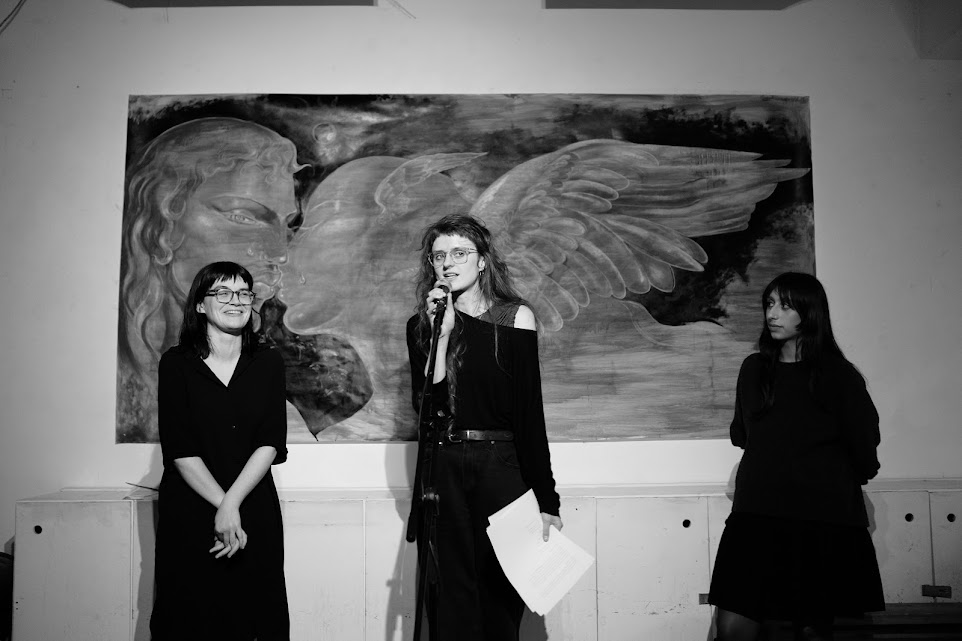
We started Away from Keyboard almost a year ago to the day. Despite hosting readings for a decade, SPAM had never previously run a regular night and we’d been talking about it for years since things started reopening after god knows how many lockdowns we had in Glasgow. After a hefty era spent solely ‘at keyboard’ it was time to get poets in a room again. What I like about a bimonthly series is it’s flexible enough to work around poets who might be in town anyway, there’s time for curation and building a kind of ‘snowball sampling’ effect of poets to invite via who shows up and who recommends who. The lineups are usually about five or six readers reading for 10-15 minutes each, which catches the sweet spot between a big, rapid-fire performance showcase and more sustained readings. While sometimes they can be really fun and a great way to get exposed to a wide range of writing, I’ve always struggled with big group readings because any potential associations, threads and lineages between the poets get lost in overdrive. I tune out. When you’ve got just five minutes on-stage, poets tend to read a particular kind of snappy and ‘polished’ poem and there isn’t room for the kind of variation and trajectory that comes from building a proper ‘set’. 10-15 minutes also leaves room to try out new work too.
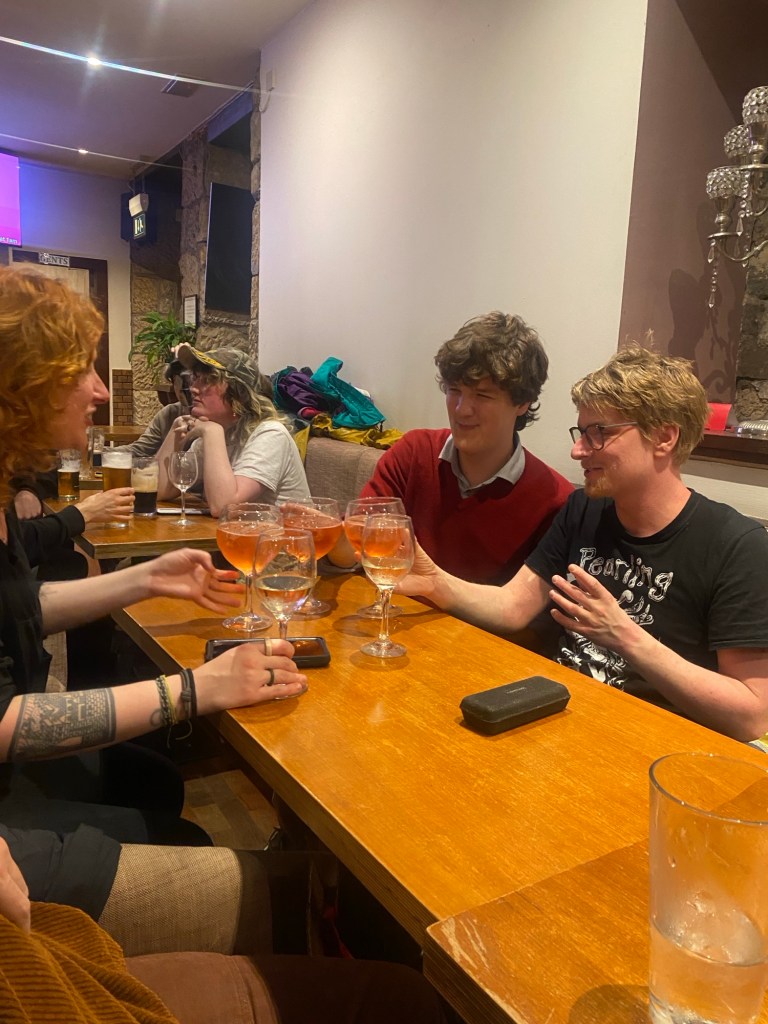
Our ninth AFK took place last Thursday at our old haunt, the Peckham Pelican. Huge gratitude to them especially Stu who helped us lock in the date. Let me just say how hard it is to book venues for poetry. Can someone make a big database of suitable venues please? The big problem in Glasgow is finding a space that is affordable, accessible and relatively stable. Everyone remotely in the Glasgow orbital will know about the decimation of our arts spaces in recent months (CCA and Listen Gallery have just closed). In London, the big problem seems to be finding a venue that won’t require a whopping minimum bar spend way out the league of our skint poetry community. Alas alas. Still, every bar we’ve worked with we’ve worked with because of a poet working at that bar. Keep it in the family. I love the Pelican and its happy hour negronis (‘Peli-gronis’), the friendly bar staff, big space, wonky bookshelf. I love how in London there is almost always transport home after dark, whereas in Glasgow you have to negotiate ride-shares on Ubers (an option newly available to me now I caved and finally moved south) or try and line up two buses, one of which is guaranteed to not show up, leaving you stranded in a vortex of raging seagulls and vape shops (‘town’), or in the industrial hinterlands of Tradeston. Online, I’ve seen recent movement in campaigning for better transport in Glasgow and I hope something comes of it. The amount of times I have walked 1.5 hours home after midnight…
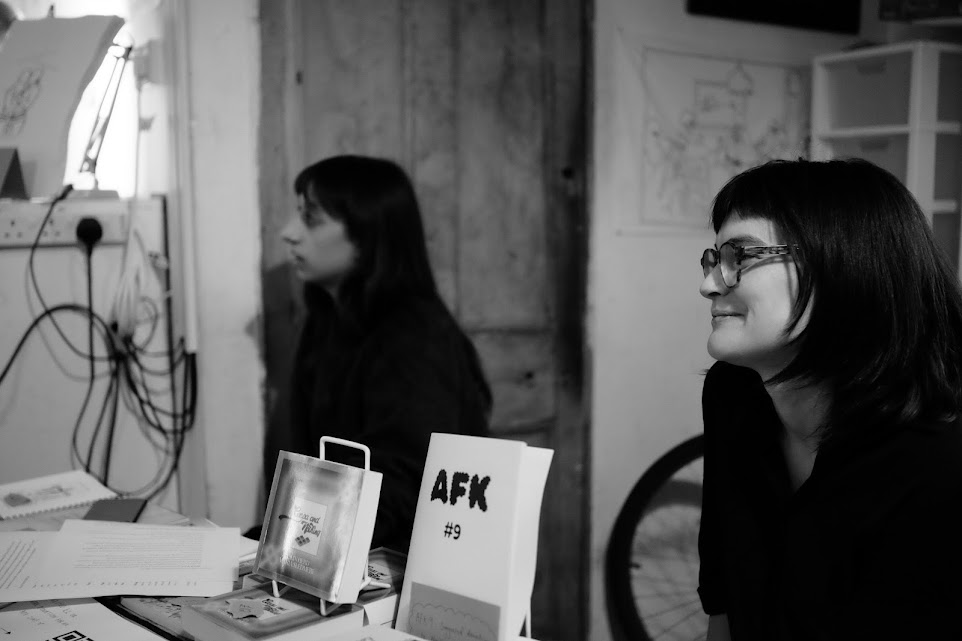
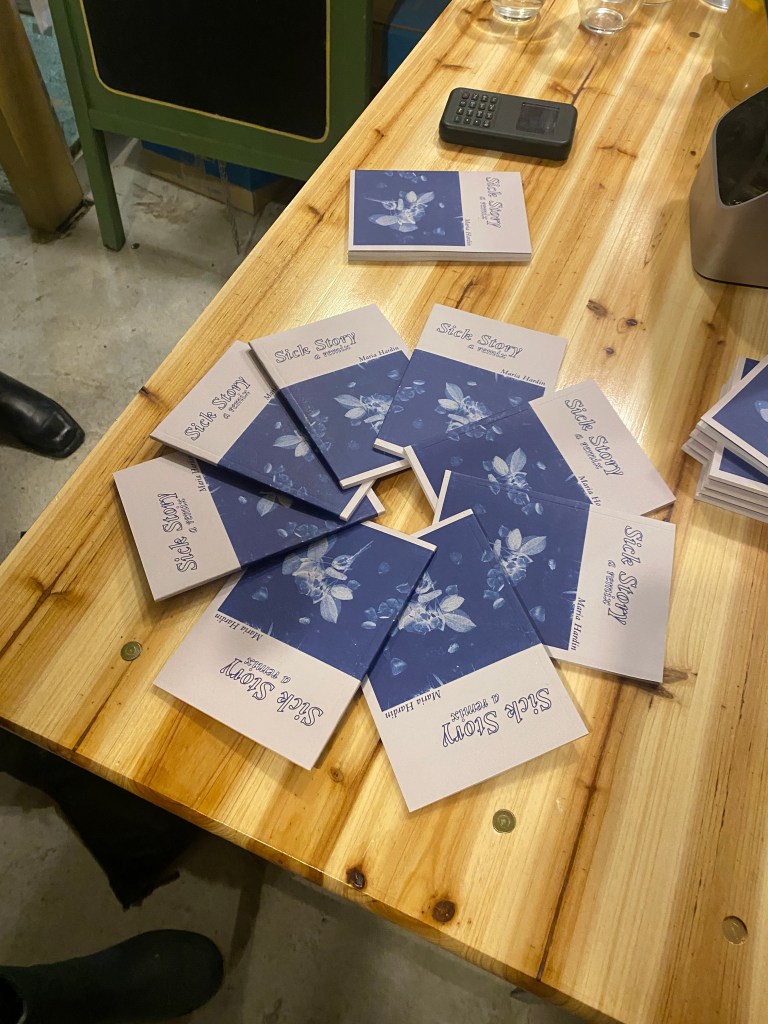
Before the reading, Maya, Mau, Kirsty and I got food at Peckham Market. Eating before a poetry reading is something I only learned how to do a few years ago and it makes a difference. No more blinding headaches! No more yearning to leave early! No more one drink too many! I recommend it. We had our book table set up in a jiffy cuz we’re getting really pro at that now. We had so many books it spilled out onto a bench and the nearby countertop. We thought there wasn’t much SPAM stock left but a surprise abundance of Thirteen Morisettes and Cocoa and Nothings showed up, plus some bonus books to sell from the readers. The AFK#9 zines sold out so quickly I didn’t even get a copy to take home! One of the things I enjoy about book-tabling is talking to people who come by to peruse. If you are a poet never be shy about introducing yourself at these things…we live in Glasgow and it helps to keep us in the wider loop 🙂
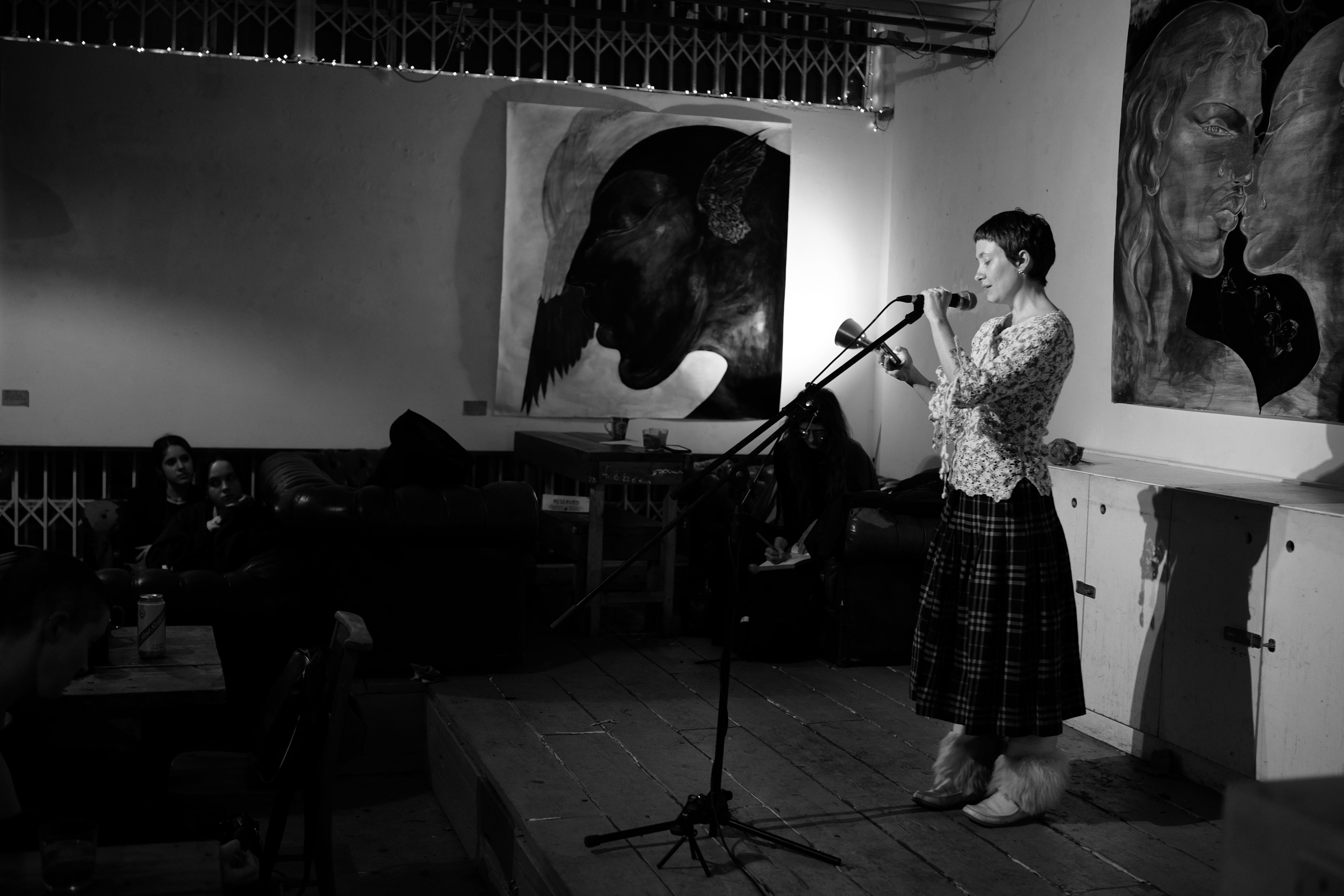
First up was Phoebe Eccles, who surely won outfit of the evening with her yeti boots, kilt and crocheted bell-sleeve combo, topped off with an enviably chic pixie cut. Eccles’ poetry did some Lynchian fish-catching, delivered timely political barbs, ran its hands through Milton’s silky hair and popped out some tulpa spoilers from Twin Peaks: The Return. I wrote down ‘The independent life of meat’ and a dream poem in which a child in a cave headbutts stalactites (or was it stalagmites?). Eccles’ work is playful and sharp, with a discursive feel to it that is able to weave in urgent recent events to the pulse of cultural analysis. The poetry had a similar to texture to some of David Lynch’s CGI creations in The Return: sort of glistening and disturbing, meat-like, surely not quite of this world but only because they are also so…tulpa? Virtual-material?
Next was Dora Maludi, who began with ‘Fear of dog’: a stunning, swerving poem about ownership, being on the leash, love, thread, fear, birth. I wrote down ‘failure as an embroidered emblem’, ‘it is not normal to lick weaponry’, ‘the anatomy was spectral and well-meaning’, ‘woof like you mean it’. It’s a good ethic to howl like you mean it. What does that look like in a poem? It’s almost like Maludi took the skeins of that howl – the shimmering microscopic particle matter – as a skyward formation swooping upwards and elsewhere in her reading. She also read from a ‘dental memoir’ which among other things describes menstruating all over the Ed Atkins retrospective at the Tate. I wrote down ‘microplastic and dandy’. I think microplastics came up in a couple of readings. Talking of skeins, I told everyone about how last time I was at the dentist the radio was playing ‘Geese’ and how much that upset me because I love Geese and this means a lot to me because for a long time friends described me as ‘gooseblind’ because I couldn’t recognise a goose from a lineup of idk ducks, and now that I knew what geese looked like and in fact loved the band Geese, I couldn’t have these neurological connections ruined by the everyday pain of a scale and polish. My dumb segue comment did not have room to explain that context so there it is.
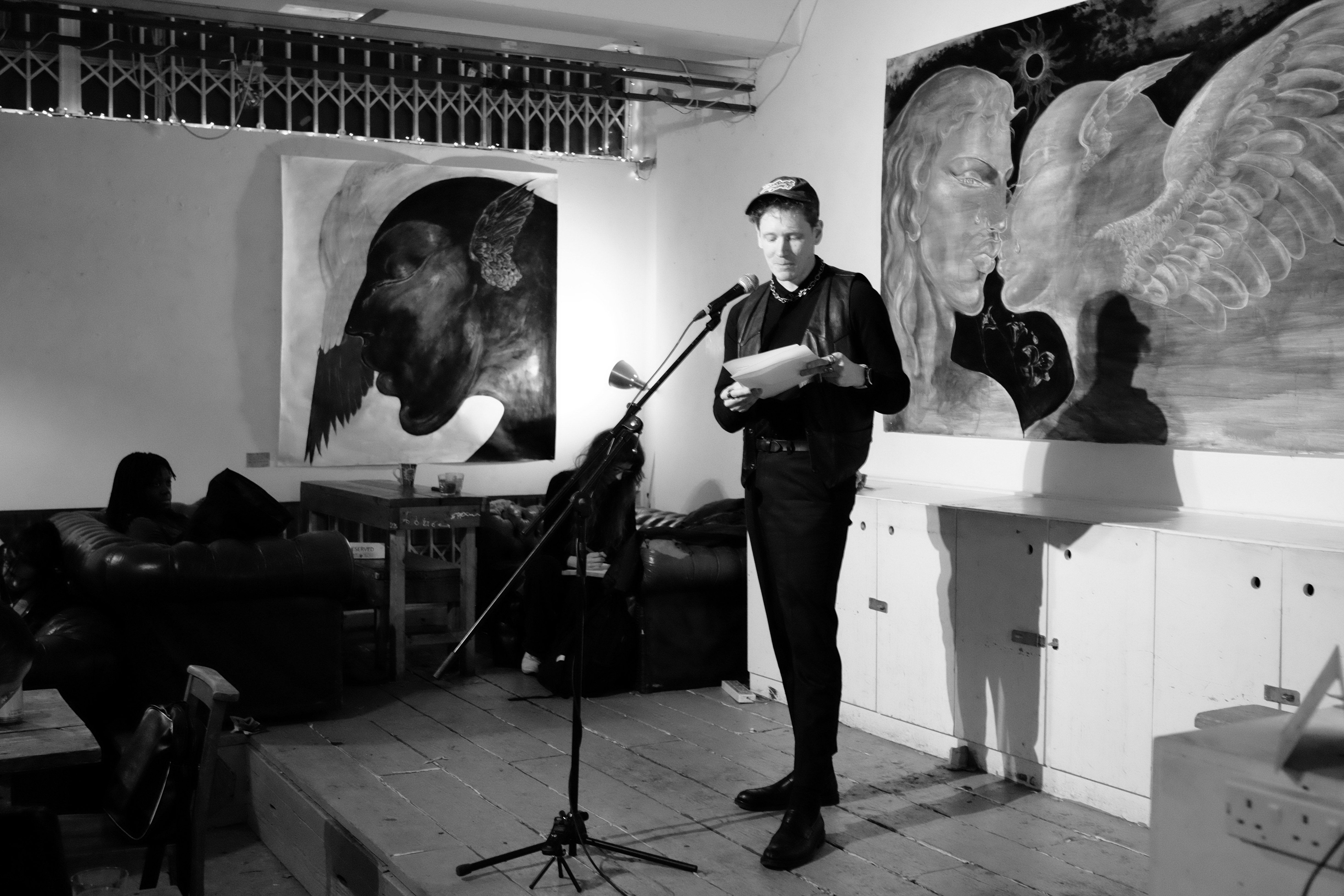
JD Howse followed, dressed all in black to match the SPAM editrixes, delivering a ghost story followed by a suite of new sonnets written, I found out later, in the span of a week. The ghost story took me somewhere, a kind of crumbling maybe seaside place — the geographical admixture of Robyn Skyrme and Ann Quin. A hotel crumbles over a promenade, there’s a fire pit, twigs. I wrote: ‘the sky pulled around us like bedsheets’ and imagined this wholeheartedly, being swaddled or suffocated in a shapeshifting quilt of cloud. ‘Cinders in the wind…smouldering as my body dissipates with yours’. The sonnets featured foxes, O’Hara being read in the rose garden (instigating personal flashback to reading Stephen Rodefer in the Berkeley Rose Garden — more poetry must be read in rose gardens), ‘morning attempts to ontologise what remains’, ‘orange tulips, almost neon, brought ot my door’. The images are vividly memorable, the twisting arguments of the sonnet form deployed to bathos and humour amongst sincerity, ‘I fell in love with you because / I thought it would be funny’. Ah how slant-assonance makes a mockery of love’s ass!
After the break, Poppy Cockburn took to the stage. We’d had a chat about our love for a little lace or gauze on an otherwise plain shirt and how to source the garment of your dreams via pursuit and digital fluking. Cockburn is masterful at grabbing the dynamics of poem-as-poem and holding it to the light like a prism scattering wit. She understands how to tap into polydimensional performance resonance which maybe comes from her prowess as both poet and PR strategist. Sometimes you laugh and sometimes you feel like here’s a side to existence thrown into relief, something you didn’t know you needed to see. At the start of the reading, poor Poppy had to compete with Joni Mitchell who was still playing over the bar’s PA. Good-naturedly she hummed along until the staff turned down Joni. She read from her debut collection, Naked Oyster, which was put out by If A Leaf Falls last year. On the cover, a smudged Grecian-cum-vaporwave head looks plaintively down as it floats above textural shrinkwrap. This ‘look’ is a good capture of affect and I started to think maybe they need to replace the heads of the angels in Crystal Palace Park. Cockburn’s pithy works are reminiscent of Chelsey Minnis, Bunny Rodgers, Maria Hardin and Nadia de Vries, but she has this distinctively English streak of deadpan that sets it apart. Her performance explored humility, haplessness in love, sirens, wash cycles, driving, secrecy, words as ‘silks on a slow cycle’, bad men, lost feelings. I wrote down ‘POETRY IS HUMILIATING AND THERE IS NO GETTING AWAY FROM IT’ (all-caps possibly mine), ‘music journalists are full of shimmer’ and ‘I don’t have an opinion / I’m just an ambient orb’ which felt like a gurlesque take on the ‘geometrical turn’ I’m seeing everywhere after years of formless oozing. Pretty sure shape-loving Ian Macartney had an orb-themed house party once. You’ll have to ask him about it.
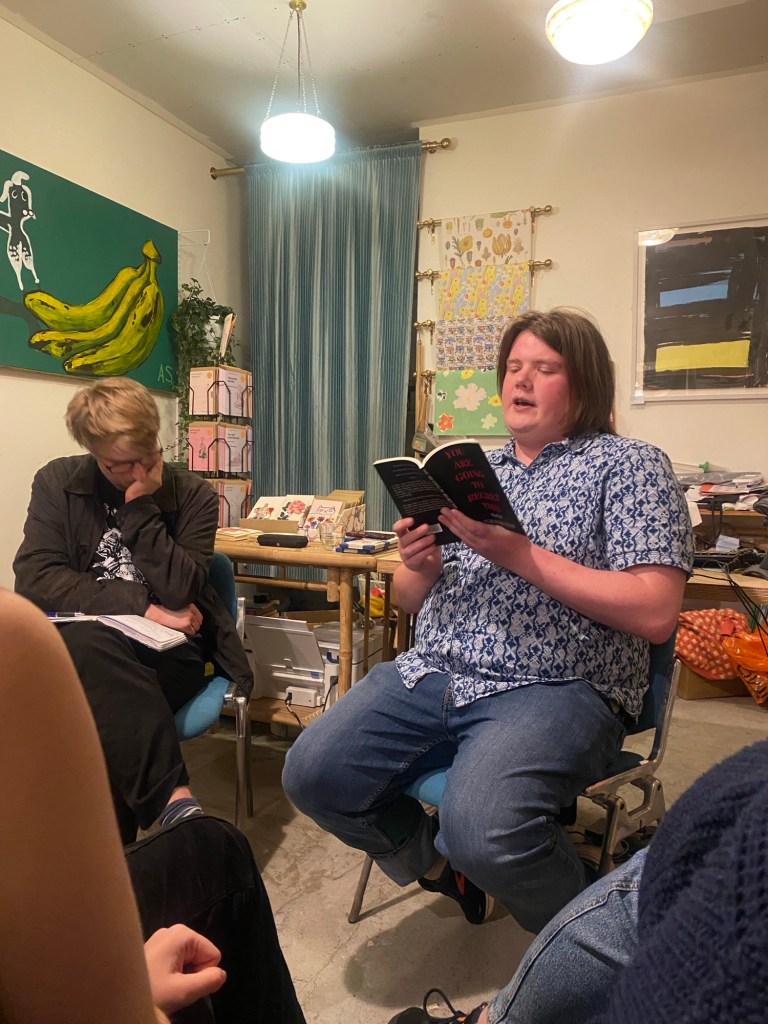
Our penultimate reader was Irish writer Francis Jones, who read from their Veer2 pamphlet Storm Drain. The opening repetitions reminded me of poetic markov chaining. A throwback to Howse’s twigs, we had ‘I scrub myself with cream with bits of bark in it’, how face-scrubbing makes you late for work. A spiderweb ‘like a pube in my teeth / but my own body’. Amidst this becoming-animal body horror there was an ‘unbelievable hibiscus’ and ‘major airways act[ing] furious’, ‘a grotesque stateliness’. Jones’ mentioning of the grotesque cascaded the next day into a conversation with two other poets, Katy Lewis Hood and Jared Stanley, about who or what the current grotesque poets are. I was thinking about that Dean Kissick article ‘The Vulgar Image’ which my south side reading group (affectionately titled Communal Nude) read in playful dialogue with Robert Glück’s inimitable Margery Kempe, thinking about iconography and desire and morphology, slop and narrative, collage and seam/i/less/ness. Hit me up if you have suggestions as to who are the new grotesque poets. Interestingly, grotesque comes from the Italian grottesca from opera or pittura grottesca meaning work resembling that found in a grotto. We had this conversation about the grotesque in Peltz Gallery while looking at Melanie Smith’s Tixinda, a Snail’s Purple and meditating on the gorgeousness and grossness of purple, its excess, as it is extracted from the sea snail Plicopurpura pansa. It was warm and kind of grotto-like in the gallery. Katy told me they discovered recently that the snail’s gel people are putting in beauty products is not extracted from sexually exciting the snail but in fact putting them into a state of panic. I started thinking about our cultural fetish for glass skin and the ecopoethic implications of putting the substance of another species’ panic attack on your face everyday. The last thing I wrote down during Jones’ reading was ‘love transports in moisture’.
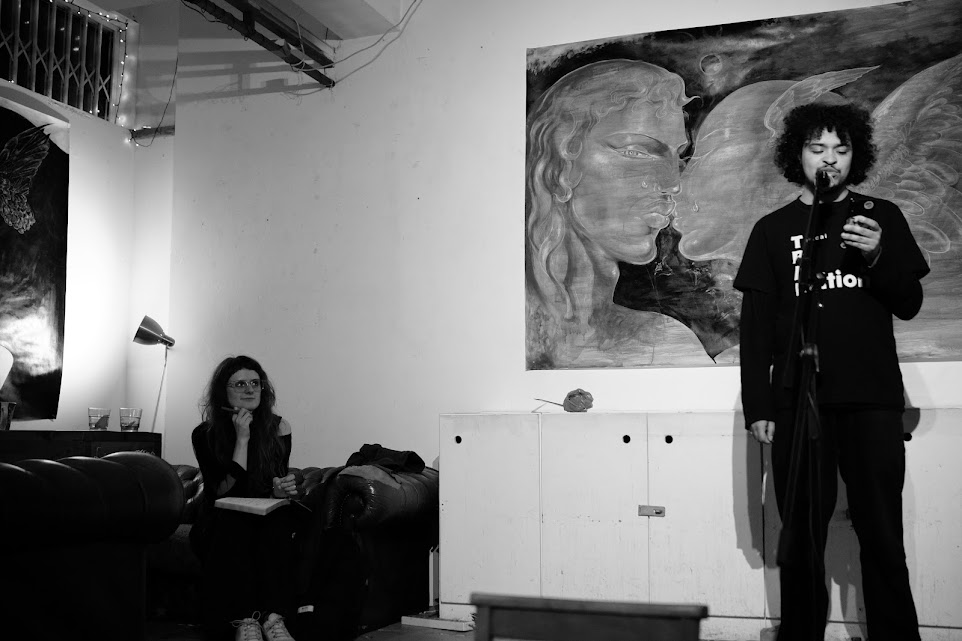
Talking of corporeal serums, William Aghoghobe topped off the night with wax and ‘the extreme extent of human secretions’ revealed in an autobiographical piece about his experience working in a university library. Aghoghobe is a very atmospheric writer and a kind of sculptor of images that sometimes coagulate and sometimes melt into motion. He read about doppelgangers, spores, frames within frames, dirt, the Walthamstow Marshes and marshy doubling of object pronouns, ‘I am only as much as my garments’. What does it mean to be a figure, like actually? All this talk of materiality made it very hard to resist pulling out the stuffing in the beat-up ‘green room’ sofas and somehow become-sofa myself but I did resist by writing down words instead. We had tales from the level 7 annex, tales from fire alarms, ‘mountains of keys’, plastics, being ‘a spectacle worker’ and dealing with an unfortunate ‘ghost-shitter’. Aghoghobe reads with bags of charm and a surrealism befitting the grotesquerie of the modern everyday.
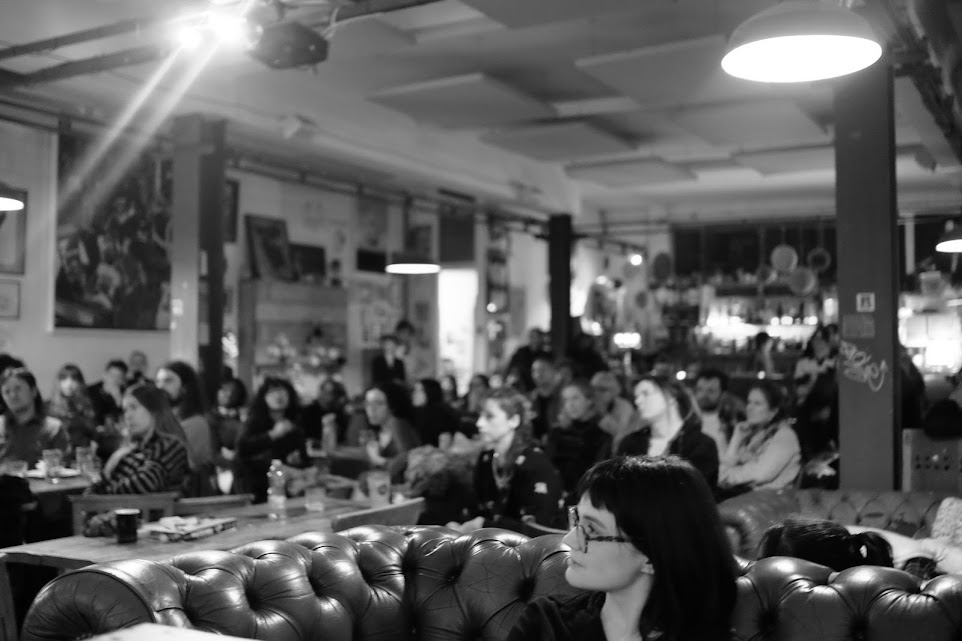
And so concludes my roundup of AFK#9! Our next reading will take place in Glasgow on the 9th March, with lineup soon to be announced. Thanks to everyone who came down to the Pelican! Other dates for your diary are:
20th March – Kirsty Dunlop’s book launch for Centrefolding at Mount Florida Books (in conversation with Ian Macartney)
27th March – Kirsty Dunlop’s book launch for Centrefolding at Argonaut Books (in conversation with me + performance from Kevin Leomo)
30th April – Launch of Iphgenia Baal’s new SPAM book at Peckham Pelican (details tbc)
27th May – SPAM 10-year anniversary party at The Old Queens Head on Essex Road, London (details tbc)
Also stay tuned for news of SPAM’s Glasgow anniversary party!
~
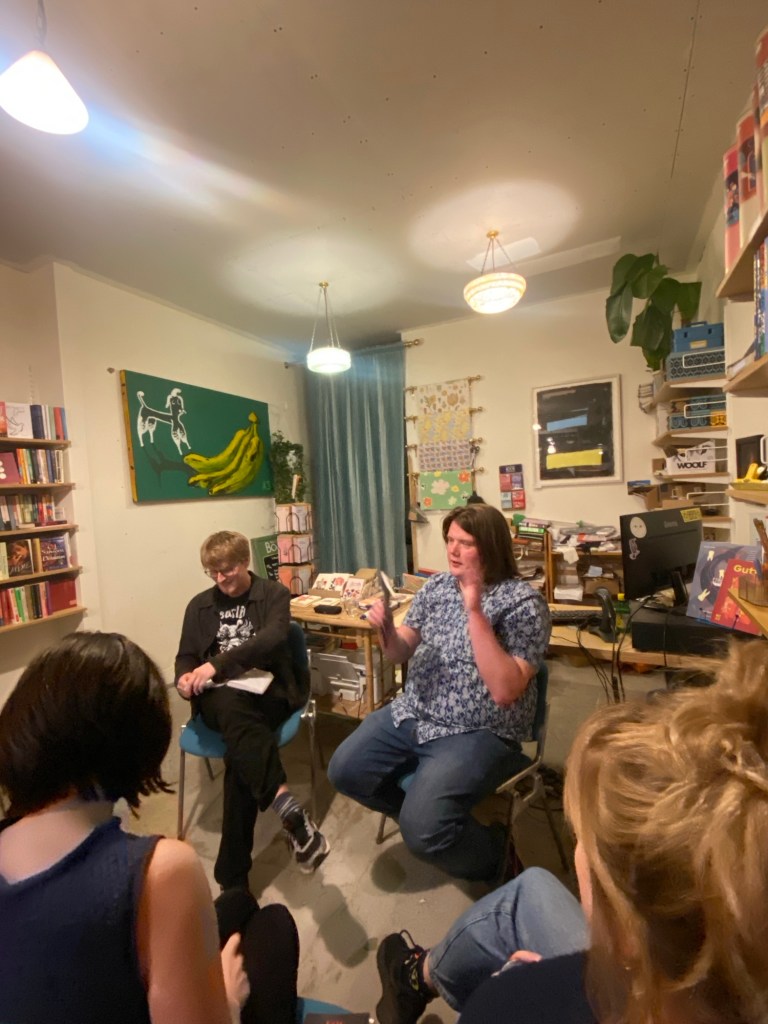
All photographs are by Mau Baiocco.


 mariaology