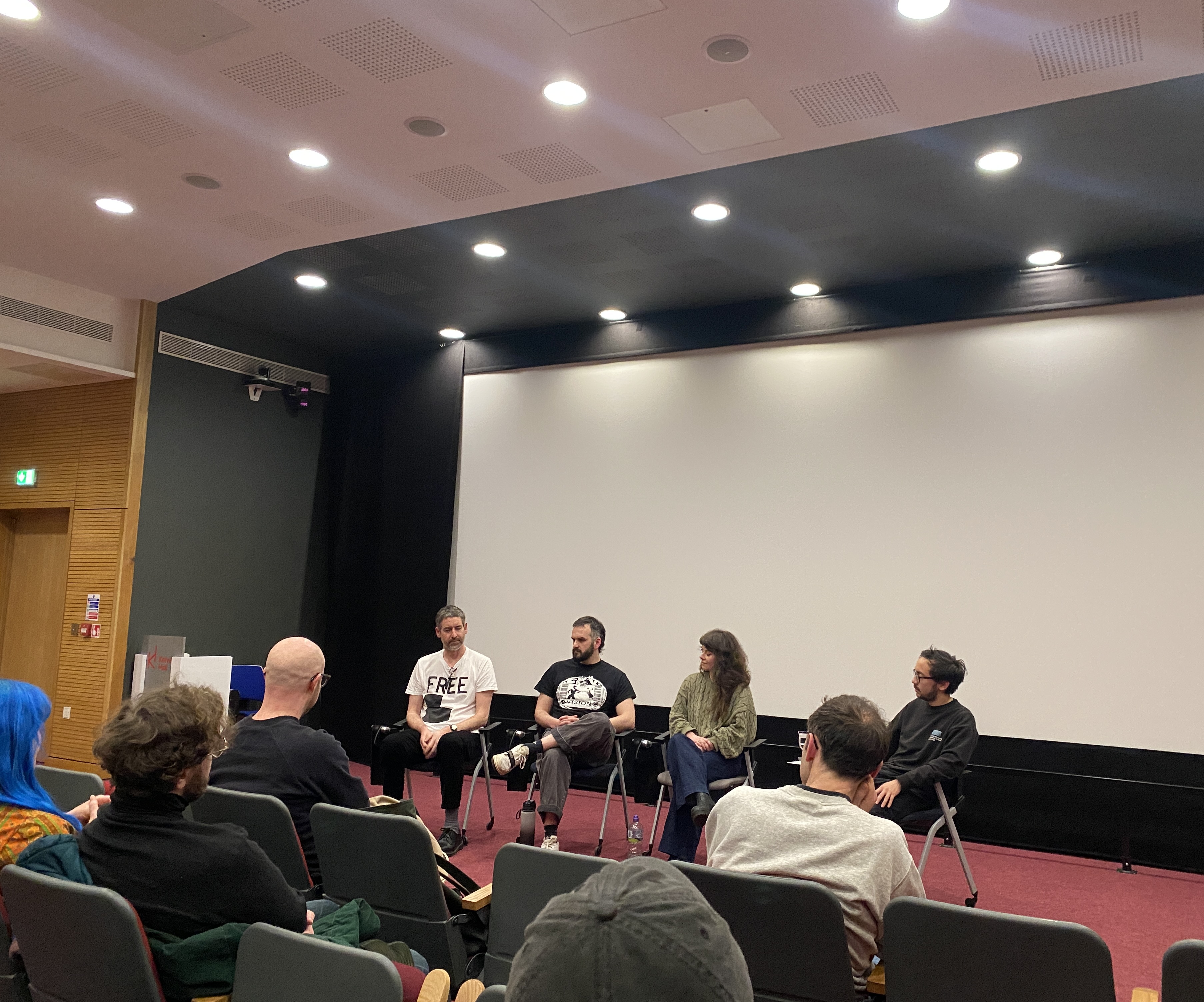
Bringing in the Chaos: I Dream of Wires event with Thinking Culture 19/2/25

(From left, Scott Myles, Lewis Cook, Suzi Cook, Kevin Leomo)

Last night I went to the Thinking Culture event: ‘I Dream of Wires – Film Screening and Panel Discussion’. It’s this film about modular synthesisers and the people who build, use and ultimately love them. Some people collect dozens of these instruments and get scared to record. The studio assemblages are like hyperobjects. It goes from being a musical thing to a techy thing, or this sublime encounter with wires. Some of the talking heads did say they were more like engineers, or more into hardware or just playing around. I found the film inspiring and charming. It was so great to hear from unabashed enthusiasts, some of whom comically shit-talked the digital in a way that was deeply satisfying. Anyone from Trent Reznor to Gary Newman, Legowelt, Doepfer and Modcan. You start seeing the tech itself as this circuitboard for attuning people globally who love something niche in a powerful way. That attunement is also to possibility. The circuitboard after all is an instrument. I loved watching guys hot wire stuff, or whatever it’s called, kind of moving around intricate cables, sparks, connections. It’s one of my favourite things, to let people go off on something they adore in this totally nerdy way. For the love of technicality. The way that the modular synths are more than vintage revivals. 

Afterwards, there was a panel chaired by Kevin Leomo with artist Scott Myles and musicians Suzi Cook and Lewis Cook of the band Free Love, who now run Glasgow Library of Synthesized Sound (GLOSS), the UK’s first electronic musical instrument library. Myles has this exhibition, Head in a Bell, finishing up at GoMA right now, containing the Instrument for the People of Glasgow, a social sculpture made up of donations he blagged from Eurorack synthesiser manufacturers across the world. One of the things that struck me again and again in the film and the discussion was this notion of the social, especially in terms of the civic — that which relates to the duties or activities of folks living in a particular locale. Obviously much of this is urban, but I’m curious about the rural life of the synth (remote cabin studios notwithstanding). 

One thread of the discussion I latched onto was around what is creativity and why does this question matter in the age of AI. Pretty soon, Lewis said, we’re going to have software that can simulate very well a track that sounds like it was recorded on tape in say, 1984. So why bother to make the track. What is the ‘worth’ in that labour, everyone ponders. Lewis, and I’m paraphrasing here, said he likes to come at instruments more as a wilful amateur than from a position of mastery. He talked about ‘approaching an instrument with a kind of naivety’. It would kind of get in the way if he knew everything an instrument does with that technical oversight. I was thinking about the relationship between creativity, play and amateurism (or what we might call newly coming to the thing, being a dabbler, a devotee etc) in terms of the vernacular possibilities of the modular synth. This is all very raw and speculative thinking, as a blog befits. Towards the end of I Dream of Wires, we have a lovely slowed-down shot of children interacting with a modular synthesiser which is placed outside. The effect is almost pastoral: sunlight on young faces, their curiosity blatant, the different colours of their little outfits standing brightly against the cool palette of the tech. The idea being: what would it be like to come at this as children? As well as: what will the musicians of tomorrow do with this tech?

This idea of the vernacular is one I nab from poetry. In Nilling (2012), Lisa Robertson writes:

a vernacular loosely gathers whatever singular words and cadences move a given situation, a given meeting, as it is being lived by its speakers. Characterised […] by wit, excess, plasticity, admixture, surge, caesura, the wildness of a newly turned metaphor, polylinguality and inappropriateness, the vernacular is the name for the native complexity of each beginner as she quickens.

What does it mean to ‘meet’ the technology of the past in the present? We could swap ‘singular words and cadences’ for samples, patches, presets and think about how improvisation turns a kind of ‘wildness’ into the surprise of new genres. Confronting the interface of a modular synthesiser is intimidating but also freeing because it is a machine that gives. And it will make a sound if you physically interact with it. And you keep building on that. In the film, social connection was mentioned again and again. Whether in shots of happy clubbers dancing away, the hands-on interactions of the Superbooth trade fair or in the social hub of Schneidersladen, a legendary synth store in Berlin, the film circles back to the idea that while there is a collector’s market for this stuff, it’s not always locked away. Even the hoarders like to come out and play sometimes, swap tricks or demonstrate. I like Robertson’s phrase ‘the native complexity of each beginner as she quickens’ as a description for what it means to come at an instrument, face on, learning through doing. Quickening. 

The opening question for the panel was ‘When did you first get into electronic music?’ and the answers were a delightful mix of classical training, chance and play. I remember being fourteen trying to play Enter Shikari songs on my friend’s microKORG and this particular instrument being legendary in her self-mythology, like something that landed out of the sky. I remember raucous chiptune gigs, energy drinks, GBX anthems, nineties industrial and the explosive synths of happy hardcore with their Koonsian sheen and total west coast of Scotland Id. I remember how all of this was mediated through hardware: specifically, the Sony Ericsson phone, crackling home computer speakers or the way things sounded IRL massive so much to ring in our ears for days. 

When we think about the transitional moment we are living through, with the accelerated capacities and tentacular reach of artificial intelligence, we should consider what we as human beings want from our creativity. This was a resounding proposition from the panel. The importance of social connection, spontaneity: how just being here at this event was also making me think and write again. The kinds of energy, power, connection you get from being in the room. Scott talked beautifully about how the modular synth was a way of ‘shaping electricity’; that could also form the plasticity of a certain musical vernacular. I thought about whether presets could serve as chronotopes hailing us back and forth in deterritorialised place and time. Again, remaking the vernacular. How creativity doesn’t always need efficiency. Lewis said something interesting about convergence of divergent thought. How you work with the practical and the abstract, sometimes needing a bit of one to go into the other. Efficiency can get in the way of meaning and feeling. You have auto-generated the perfect 2010s Eurobeat song. Now what? Slowing down the process can also quicken the senses. It’s how we get excited. Figuring it out. Connecting. 

Lewis mentioned that some of the guys on the film had a ‘model railway’ vibe about them, the way they collected and connected synths and narrated that practice. It made me think about how that model railway art of making these insular sonic worlds allows for imagination and mind-wandering play, but you then have to actually connect it to the social to get the extra utopian jolt. This can sometimes be intimate and personal: the ‘ecstatic companionship’ (Scott) of listening to drone music. It could also be energising and collective. The music could stay boutique in the studio or it could be this charge, this conduit to reaching others. I like to think about everyone listening to drone in their bedrooms as tuning into some field of collective frequencies, the oceanic feeling of being apart, together. 

Lewis said that one of the goals of GLOSS was to think through how to make a ‘luxury instrument’ available in a wider context, especially in such a divided city as Glasgow. When asked what piece of advice might you give to people interested in making their own electronic music, this is what the panel said (again, paraphrasing):

Suzi: celebrate your changing self and don’t be afraid of warping and letting that shape your practice

Lewis: don’t take yourself too seriously

Scott: always be doing, making sound and music, do it and don’t always try to understand it; keep making stuff and also redoing the thing; don’t be intimidated

Someone, I think Suzi, said ‘part of the balance is bringing in the chaos’. So I will go about my day with that Robertsonian wildness and celebrate indeterminacy, chance encounters, happy accidents.

~

This event was hosted by Thinking Culture. There will be a related gig at QMU in April.

Terrified

It’s terrifying to write about love as someone who’s grown up with extreme behaviors in relationships that would always send me on an emotional rush. The lyrics explain the anxiety of a relationship having no end point and thinking, ‘Oh my god, this might work out.’ I wanted to capture that feeling that I’m finally safe.

Jazmin Bean on ‘Terrified

Nursing their bleeding stars at the outskirts of asylum, Jazmin Bean plays nurse. Their bicycle is mint green and their hair is turquoise and they carry a box of medicine. When cleaning tables in my service job, I’d lip sync for real at the songs I’d play in my head to escape the music that was actually playing. When you fall in love it’s like bundling your stars into a bicycle and laying them all beside one another to clean them up, clean off the blood. Take them on a boat on the lake. Administer the painkiller to let them float back off to space. I listened to this song, Spotify tells me, more than any other in 2024.

The second song is ‘How to Rent a Room’ by Silver Jews. So when I’m listening reflectively to the Top Songs of 2024 in the linear unfold of a diary, the transition goes from three-minute perfect slice of zoomer britpop – Bean’s ‘I’m terrified / Sun in my eyes / I’m terrified / terrified’  – to Berman’s ‘I don’t really wanna die / I only wanna die in your eyes’  and the assonance of eyes/die/terrified collapses into the string section of mortal swoon. In ‘Terrified’, Bean sings about their first healthy relationship following a history of abuse and struggle in love. I’ve been following their work ever since Audrey Lindemann wrote about ‘Jazmin Bean’s Instagram’ for SPAM Cuts back in 2020. I kept thinking about that phrase ‘Imprisoned by Flesh’ as the locatedness of a room where men grasp at bedsheets and the elven blonde remains hugging their knees and grimacing. Lindemann described Bean’s aesthetic as ‘stradd[ling] a Butler-ian understanding of performativity and a Zoomer drive for authenticity’. The editorial implication of this piece is that we are reading Bean’s Instagram not just as art but also a kind of visual poetry. All of the gurlesque extremity channels into the emotional circuitboard through which I listen to ‘Terrified’. The transformation from this post-internet monsterkin to alt-pop star is pretty cool. The songs are bigger and more free. There’s space for the feeling to breathe.

Can we call this zoomer britpop? Atwood Magazine commented on the song’s ‘eruption of ’90s-era Britpop warmth’. I’ve been reassessing Britpop (capitalised here for History) with the Americans via the recent series of Bandsplain, where Yasi Salek and pals take on bands like the Happy Mondays, Blur and Oasis (and try valiantly to pronounce the various dialects associated with these bands). Britpop for me is the music that played as I nodded off in the back of my dad’s car, looking out the window or reading a book, looking for something else to do. Britpop, in its purest form, to me represents an emotional prototype for projecting personal excess and intensity. The actual lyrics should be fairly general and simple, with one striking detail. Your ‘wonderwall’ or ‘champagne supernova’, kind of like the novum of the song whose weirdness transforms all the ordinary detail like putting violet dye in an otherwise neutral lake. It also comes along with simple chord structures, homophony, melodic hooks, a compelling chorus or build towards it. EXUBERANCE (that is either swaggering or just a little unsure of itself). I am not trying to give a history of britpop I am just trying to get at how it currently resonates for me as a genre or perhaps more like a mode of music.

Another contemporary example of post-internet-leaning britpop for me was Grimes’ 2020 midi-acoustic elegy, ‘Delete Forever’ [‘I got super triggered when Lil’ Peep died’]. A song about addiction and dying that feels raw in comparison to the maximalism of Miss Anthropocene. I only just realised the line at the end of the chorus is ‘More lines on the mirror than a sonnet’. Sonnet = little song. Britpop anthems are sort of like little songs put through the maximalist ringer, or vice versa. When I walk through dawn listening to ‘Terrified’, what is it I’m feeling? Some proximity to that tunnel feeling of coming out the other side, coming into the light

and finding it utterly
fucking scary.

I had some news in 2023 which changed the way I felt about life. I found out that by a 50/50 draw, I hadn’t inherited a harmful gene mutation which greatly increases your risk of cancer. This gene variant is responsible for breast and ovarian cancer is multiple family members, some living and some not. I’m still learning how to write all about this and I find it easier to do so through song. What rips you to shreds but melody in some of these moments? But the ripping when cast to melody is more like a ribbon. And I tie it around my wrist and I get on with it. Is the ribbon pink? I don’t know / it is more like a mirror or mobius trip. When Bean writes about ‘Terrified’ as capturing ‘the anxiety of a relationship having no end point and thinking, “Oh my god, this might work out”‘ she hits the real heart nerve. I feel like this about my whole life. For various reasons, I didn’t think I’d live past fifteen, then I didn’t think I’d live past thirty. By ‘live’ I mean literally and figuratively. It was hard to imagine pushing past those milestones into further life, existence, going on. Then I was given this gift in the form of a medical letter. It trickled into everything. It was real in the moment but long-term really just a symbol or sign (I will get sick like everyone else, my stars will still bleed). At the start of 2024 I walked around listening to this perfect three-minute song because it was a homeopathic dose of the new scared-hope I was administering myself. A tiny infinity. I let a few of those stars back up. They’ll return for me.

Records I listened to in 2024

Okay music this year was weird for me. I liked things where the lyrics were meltwater into guitars and my ~spotify wrapped was all obsessively listened same songs split geode feelings. Exclusively masculine guitar bands with the exception of Brat (top 5). I too am the virus. Maybe because it rained nonstop all year in Glasgow, even with my heart split with California it made so much sense to listen to The Natural Bridge on loop and felt that bridge would cross the ocean. It was the bridge in the song and the bridge of the ocean. I kept thinking about high-singing shoegaze sirens and lay in the mud during a Mogwai gig. Songs about blues and magic mountains and lucifer and love and sympathy and blood and fluoresce and dallas and golden days and dreams and strawberries and tiredness and june and miracles. Seriously I know 2024 was music gossip and humming cancellations and virality blown up to chromatic ontology but (here I want a line break) I just wanted to be stoned at the claire rousay gig forever. And that was my music.

<cue sparkly tambourine>

“Come talk to me about it outside”

Thought about taking a searing breath onstage and how long til it heals?

[Shane Lavers’ shriek]

“Then there was this weird music video that popped up in my complaining featuring jelly sparkle heels and the message was about destroy your cloud with new CD-R storage capacities! and there was this song from the early 2000s and in the music video you could walk around with big yeti slippers

and this really horny barbie song set in a swimming pool which honestly just sounded like goats but was visually orgiastic & gauche 

guess I blame the pseudoephedrine!”

Winter – shoegaze, e-girl
Spring – folk, emo, concrète
Summer – jam bands, indie rock, hyperpop
Autumn – alt, slowcore

Jazmin Bean — Traumatic Livelihood

Kim Gordon — The Collective

DIIV — Frog in Boiling Water 

Waxahatchee — Tigers Blood

Julia Holter — Something in the Room She Moves

The Lemon Twigs — A Dream Is All We Know

Bladee — Pyskos 

Four Tet — Three +

Grace Cummings — Ramona 

Vampire Weekend — Only God Was Above Us

Pearling — Lovelocket

claire rousay — sentiment 

Billie Eilish — HIT ME HARD AND SOFT 

Charli xcx — Brat 

Dr. Dog — Dr. Dog 

Clairo — Charm 

Bella White — Five for Silver 

Chanel Beads – Your Day Will Come 

Loukeman — Baby You’re a Star 

Phish — Evolve

Kelly Lee Owens — Dreamstate

SOPHIE — SOPHIE

LI YILEI — NONAGE 

claire rousay — The Bloody Lady

Asher White — Home Constellation Study 

Porridge Radio — Clouds in the Sky They Will Always Be There For Me 

Horse Jumper of Love — Disaster Trick

Papa M — Ballads of Harry Houdini 

The Cure — Songs of a Lost World

Magdalena Bay — Imaginal Disk

070 Shake — Petrichor

Horse Jumper of Love — Disaster Trick

201520162017, 2018201920202022, 2023

hmu if there’s stuff you think I missed……………………………………

xoxo

A Given Thing

and love doesn’t need to destroy you any more (Weyes Blood, ‘A Given Thing‘)

Our love – ‘For there to be a gift, there must be no reciprocity’ (Derrida, Given Time). To keep loving is the gift, smoke emitted from wormholes, arterial flow of words in their fuck supplement. Had I experienced the kind of crush economy that results in debt and ruinous loves that smudged off years of existence, I would be that smoke. When I realise so much what that love was, given to me, not even to have been noticed, that is the gift. Derrida states of the gift: it is ‘Not impossible but the impossible […] It announces itself, gives itself to be thought as the impossible’. When you are still in love with the love (afterglow) you remain in that trembling verb, having the state, quality, identity, nature, role etc of one in love, given the fact of your waking each day in dream to get worser and worser. I declare this a gift: love bleeds out of me. We were conducting lightning not making love.

sometimes we confuse the dream for one another
we’re just screaming to be closer to infinity
to love everlasting (Weyes Blood, ‘A Given Thing’)

The gift starts and never ends in time: ‘Not only does it make simultaneous what is irreconcilable—gift and exchange—but it occurs only within and according to the form of a preexisting gift: the gift of time itself. […] We are situated within time, we receive time’ (Marcel Hénaff).

That we end is only that our gift is impossible.

Our love is chronic, cupidity, personified time. Our kisses encourage temporal knowledges.

Recall the wormhole scene in Donnie Darko, which is not a wormhole so much as a ‘Liquid Spear Waltz’, theatrical cut of television, the family and the liquid come out of our chests and bellies. I love myself loving this movie. Would it not take you through to the place of conception into the wardrobe of the thought you’d never been here at all, not once, they hadn’t borne you into things, and the smoke that passes over you is not god, but an airplane. Can determinism accept the gift? If I was destined to give it until I am given time in return. Time is all you take from me. You’re spending too much time. I’m all out of time. That is not death but jet lag. Nausea and healing.

‘She can no longer take her time. She has none left, and yet she gives it’ (Derrida, Given Time).

Kiss / episteme / chronos.

Our love is impossible.

We’re all out of time. An earth signature.

We are no longer making it. When the water comes of chorus, the same thing again.

It was that we could never be solid in the first place. Before. We were liquid people poured into the vessel our love would otherwise vapourise, like a couplet. The gift is when you forget. I don’t know why I gave you this in the first place. Love’s amnesia forgets what you were before each other. Loving many people is our ruin. We’re not being love we’re forgetting to live. Literally it lives, this giving to forget we gave each other, and you and yours and our love forgotten is a hole on the other side of the world. It never was a heart-shaped wound in the sky. It was love. It would have been the same if never we made it.

Love satiates itself in the giving over of the word, more language, semantic ever-after: it is perfect when I forget that I love you.

The time leftover of perfect echoes.

The tiny glass statuette of a boy you are polishing.

Chamber music.

 ❥

Reading

Derrida, Jacques, Given Time: 1. Counterfeit Money, trans. by Peggy Kamuf (Chicago: The University of Chicago Press).

Hénaff, Marcel, 2019. ‘Derrida: The Gift, The Impossible, and the Exclusion of Reciprocity’, The Philosophers’ Gift: Reexamining Reciprocity (New York: Fordham), pp. 11-29.

Weyes Blood, 2022. And in the Darkness, Hearts Aglow (Sub Pop)

Thirteen Morisettes

One of the exciting things about running a small press publisher is discovering new forms of poetry at the same time as totally falling in love with them. Like finding a long, lustrous hair at the end of the pencil and falling in love with it so much to spiralise your day around its protein. Like hearing a song on the radio first thing in the morning brain. What I mean to say is, poets are shedding all the time and sometimes you really want to be there, hospitably, in the moment of language leaving itself beautifully there.

Growing, shedding.

On 31st January, SPAM are releasing Thirteen Morisettes, a transatlantic communion between Courtney Bush and Jack Underwood, a 60-page book of lyrics and epistles which centre around the poets’ love of Alanis Morisette. Our eponymous chanteuse haunts the lyrical plazas of Woolwich Market, university corridors and Starbucks. It’s great to have a collaboration which feels like a true collaboration: the interweaving of voices, in-jokes, playful telepathy.

The Morisette itself is a new form developed by Jack and Courtney. The authors define it as:

The primary constraint of the Morisette is that its lines are formed out of the deliberate mis-transcribing of Alanis Morisette lyrics. The Morisette is (usually) comprised of two mis-transcribed verses, followed by a mis-transcribed chorus to end the poem.

The epistolary, then, is not just a mode of transmission but of listening. At the light speed of however many G’s we wish to bestow upon the airwaves, Jack and Courtney have made an ambience of their poetic communiqué and like the desire for better worlds we sublimate in the village of our most familiar coffee chains, typing away into elsewhere, they form a sort of pop-chorus-corridor across the Atlantic. I fucking love it. I hope you will too.

The book is available to preorder for £8 now.

SPAM TOUR:

Courtney and Jack will be reading on the following dates:

6th February – Instagram Live (@spamzine)

13th February – Glasgow (venue tbc)

15th February – Peckham Pelican, London (along with Eve Esfandiari-Denney, Karólína Rós Ólafsdóttir, Jack Young

16th February – Bookhaus, Bristol (Courtney only – along with Jack Young, me and Karólína Rós Ólafsdóttir)

TEXTURE TEXTURE: An interview 4/11/23

‘…Then it’s ‘Fairy Tale’ (not of New York). We’re going to do a song for each archetype of text e.g. poem, prayer, screenplay, fairy tale etc…’

I’m sitting here opposite EILEEN CAKE (whose work we love) and outside Kimchi Cult dead hungry, in conversation with the new disco-drone outfit (one half Ian Macartney one half Santiago Taberna), TEXTURE TEXTURE. If you have two libras in a band together does their balance balance each other out? What would that look like? Balance balance is like dance dance is like boom boom is like vroom vroom is like horror horror is like well well is like never never is like dark dark is like bah bah is like la la is like ____ ____ is like Xiu Xiu is like EXTRA EXTRA. Read all about it! It is astrological excess equivalent to semantic satiation of the stars and their generalised synthesisers. Red velvet epizeuxis.

When I think of EILEEN CAKE I think of Eileen Myles eating a cake. And someone narrating the whole process like Come on Eileen!!!!! What kind of cake would Eileen Myles enjoy? In researching this topic I found an interview Kristin Grogan did with Myles in a cafe in Oxford, remarking on the excellence of its pear crumble cake. No guarantee that’s what Myles ordered or what’s on offer at EILEEN CAKE, here in Partick. The main thing is it’s not EILEEN’S CAKES, it’s EILEEN CAKE. The cake of Eileen. The name Eileen denotes, says thebump.com, an ‘old world charmer’, its derivatives meaning ‘little bird’, ‘strength’ and ‘desired’. Oh yeah baby. It also ‘derives from the french word “Aveline,” meaning “hazelnut”’. Okay there’s the segue. Ian Macartney has a pretty scary nut allergy. That’s why we’re at outside waiting for our bibimbap and not eating EILEEN CAKE (though certainly I would like to try it). We’ve just been to a poetry reading.

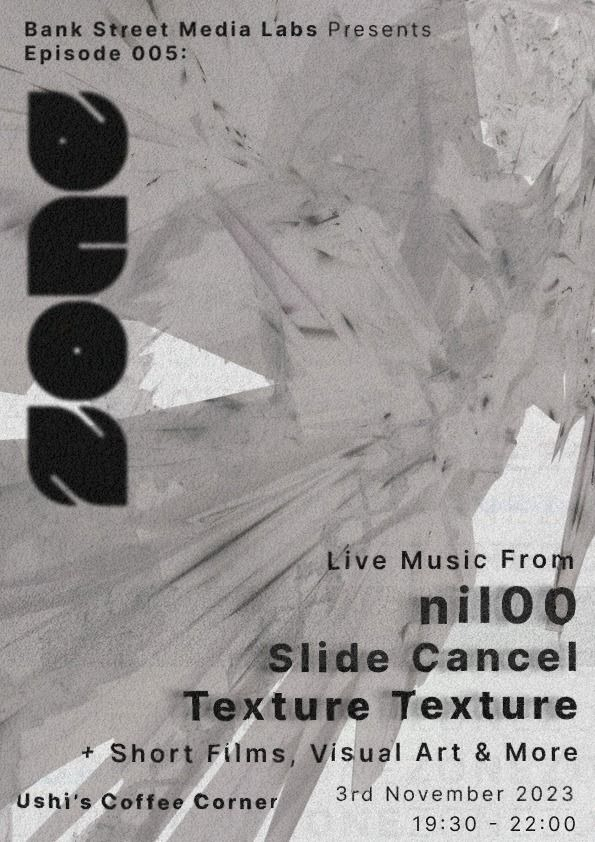
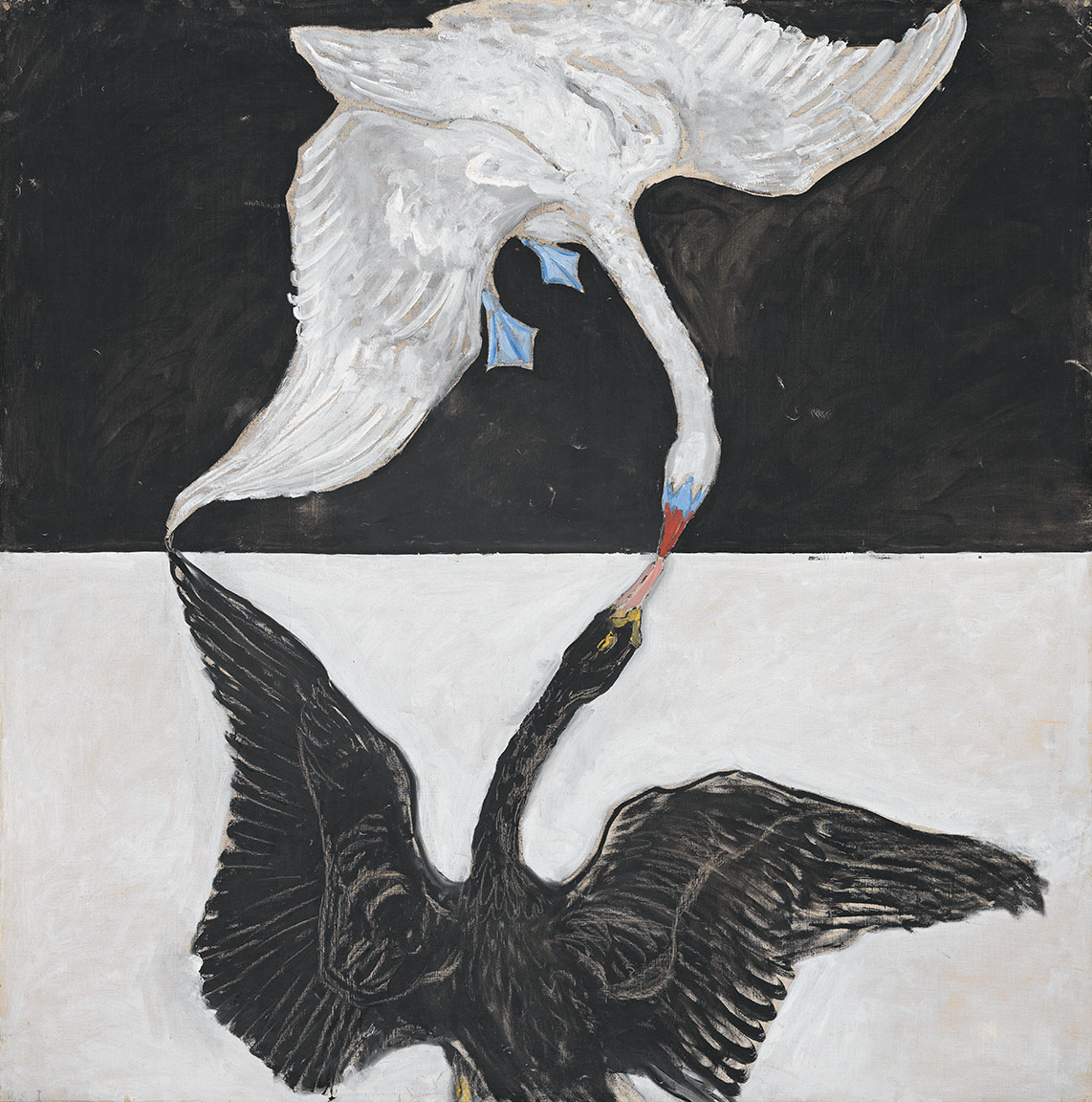
Every time I say ‘texture texture’ I sound like I am coaxing some cyborgian bambi out of the quantum realm for long enough to try a little pumpkin seed, some disco biscuits. Sometimes it sounds like a question, a comfort, compulsive loop. Last night TEXTURE TEXTURE played at the Bank Street Media Lab’s Episode 005: ZONE night at Ushi’s Coffee Corner. Don’t let cosiness fool you into thinking this isn’t a swag wee music venue home to many feline demons and the best soft drink selection this side of Eden. Anyway it really is snug and there are bare stone walls, an LED indigo glow and coils of wiring fit for a sculptural impression of e-waste baroque, say, five years from now in the trend cycle. The boys are knelt on the floor, one in white and one in black. When the white-outfiteer stands up, a little shaky, nearly knocking his head, the black-outfiteer tenderly holds his head to protect it. Bass hums. This reminds me of the Hilma af Klint painting The Swan, No. 1 (1915).

By which I mean the neck of the guitar is the neck of the black swan and the adam’s apple of clicky duplicity, swerve swerve. A transcript from the Guggenheim concerning this painting reads: ‘In alchemy, the swan represents the union of opposites necessary for the creation of what is known as the philosopher’s stone, a substance believed to be capable of turning base metals into gold. Here, af Klint’s black-and-white palette underscores the dualities of light and dark, male and female, life and death’. 

People in the audience keep telling each other to coorie in which is fucking adorable, finally we are in a crowd of intentional nesting and care. Santiago is wearing waterproof trousers, perhaps as a gesture to the storm that is sweeping the country (though not Glasgow, which got a bonnie blue day in its favour). If Ian is summer bummer, Santi is winter rain and the mix of solarity and rush rush is the sznal dialectic of fuck us all back to the early 2000s (before the weather was really bad?!).

They play a set that opens with a sort of beckoning call to the muse, Ian’s elastic shouting — I WANT YOU — refrained over triumphant feedback. Santi holds his guitar upside down and twangs a lotta noise out it, so far so Thurston. This I WANT YOU is the same premise of seductive intonation as is inherent in the name TEXTURE TEXTURE, which is to say here are two trochees smushed together like ‘The XX’ except no that’s a spondee, right, ‘XX’. Which is to say, kisses, and tweets made out into cigarettes like that Dana Ward poem where cigarettes are made into tweets and when I keep saying it, kisses and tweets and cigarettes and kisses and tweets I wonder about oral fixation and its relationship to noise like the aerated acne of being teenage or trying too hard all the time. My favourite song by Third Eye Blind is called ‘I Want You’. I like it because it’s super horny and super gothic and ugh fat clicky beginning it feels like the end of the world of caring for someone in your marrow. 

A TEXTURE TEXTURE highlight was one song from the end, perhaps ‘Fairy Tale’, a track which sounded like the Animal Crossing village song massaged through ovulation dreams of MACINTOSH PLUS to result in plaintive mall fables of yesteryear, which is to say 2006, with all its streaming puberty and cider. This is beautiful because it sounds like bagpipe midi cross melodics of having a thought. What else do I catch, something about watching waves. Something about time travel. This must be the place! etc. Earlier this morning, Ian left me a voice note saying ‘Just had a second recollection, I guess a proustian moment, of being extorted for peaches on Animal Crossing by my cousins’. Ian’s cousins were not available for comment. But god, the peaches! I wonder what brought this on. 

Everything gets darker at the end with ‘For a Stranger’. The livestream voiceover says: ‘the audience look like they’re scared, scared to dance!’. The vibe is kind of industrial nananananananaa syncopated bop-it shifting, but there’s a James Murphy in Ian yet as he riles up the dance dance and a soft drum underneath. I voxpop Ian’s flatmate who says he has heard the tappy tap of the electric drumkit for days but the rest of the set was pretty secret. 

Ian makes a point of pretending he is famous enough to not know the difference between Glasgow and Edinburgh. He does this by saying “THANK YOU EDINBURGH”. This, I argue, is not about ‘getting wide with the audience’ but evidence of a general veering towards ‘post-edinburgh’ which I have spoken of before (at length, in The Dram). It does remind me a little of when Desmond Dekker played a tiny field in Dumfries & Galloway and took to the stage with “HELLO GLASGOW”. This was in my childhood and I remember being very cold and desperate for my sleeping bag oblivion, listening to bass beats thrum through the grass. When someone in the audience goes ‘WOW’ with sarcasm and I repeat ‘WOW’ I am only repeating the mono-syllabic duplicity that is being awake, alive and scared to dance. Oh wow. Lovely. I’m feeling delicate.

Following TEXTURE TEXTURE were a bunch of trippy short films and two beaut sets from Slide Cancel and nil00. The former was super hypnotic, precise and really really cool internet music for melting your face off in the smoothest way possible ++++ and the latter was utterly enchanting crush ballads for the lovers. Special shoutout to this song, ‘Beautiful Fish (Just Remember You’re Beautiful, And Two Hours Comes Pretty Easily, I Wanna Spend It W You’: a perfect shimmery thought-loop of harmony and piscean energy I could get down with. Nooo it’s not lofi bubblegum pixel trap it’s lyric etherea, sorta a la Happy Spendy, a nu candy ballad which sings from inside the moon’s teardrop many aeolian harps ago, O angel you should’ve come to my little meadow of deconstructed cuddlecore. The fact there were audio problems to begin with (how many wires in the world does it take to connect our heaven) only added to the tenderness and play of the set. I was thinking about the fish song later drunk on the bus home thinking about fish and a thing my friend Frannie once said which is ‘I wonder where the fish go to sleep’ and I wonder where they do indeed. 

𓆟 

(beautiful fish)

Well anyway, the interview. Ian (Irn Bru) was wearing a stylish grandpa jumper testament to the heydays of west end thrifting, and Santi (Still Water) was wearing an ochre-beige coloured rain coat, so fall. The boys did not take turns answering in ecstatic monosyllables, so much as relish the dialectic of one’s reticence and the other’s intent. Sometimes, one would echo the other, recreating the semantic satiation which is the band’s lifeblood. More, more. Text, text. No, never. That’s all I’ll say of whose answers these are.

What is the poetic unit of TEXTURE TEXTURE?

TEXT.

What inspired you to start this band?

NOISE.

What was your first encounter with noise?

BABY. 

How did that feel? 

BAD. 

Would you define bad as a value judgement, or something else?

ELSE.

How do you think your work was received last night?

BOUNCY.

And what did you think of the visual accompaniment? 

GREAT. 

Is ‘great’ an ethic to you?

SERIOUS.

What’s the biggest mystery of your life?

GOD.

If you had to marry a sound, what would it be?

CLANG.

If you had to kill a sound, what would it be?

BUBBLEGUM. 

If you had to fuck a sound, what would it be?

COWBELLS.

So true, same. Did anyone ever tell you that you shouldn’t start a band, it’s a risky business?

YES.

Did you agree with them?

NO. 

Describe your production process.

INTUITIVE.

How did you two meet?

SPAM. 

Do you think it was a meeting of minds, souls or bodies?

SOULS.

What’s your biggest influence?

PEARLING.

If you could play any ocean in the world, what ocean would it be?

ANTARCTIC. 

Why?

ANTARCTIC.

Are you a communist?

YES.

What’s next for your performance?

MORE.

Tell me about your outfit choices.

OPPOSITES.

Have you ever fallen out?

NO. 

If TEXTURE TEXTURE were edible, what would it be?

SHRAPNEL.

What would you say is the big idea of TEXTURE TEXTURE?

DANCE.

What’s the spice level of TEXTURE TEXTURE?

PICANTE.

What’s the sun sign of TEXTURE TEXTURE?

SCORPIO. 

If you could send a cassette demo to one living politician, who would it be?

SALMOND.

What are you looking forward to about the future?

HOPE.

(HOPEDARKEVERLASTINGISADANGEROUSTHING)

>> You can watch the whole stream here

Upcoming Sleep Curricula

My research currently centres on sleep as a nexus for thinking about energy transition, low carbon pleasure and chronodiversity (the way our circadian rhythms differ).

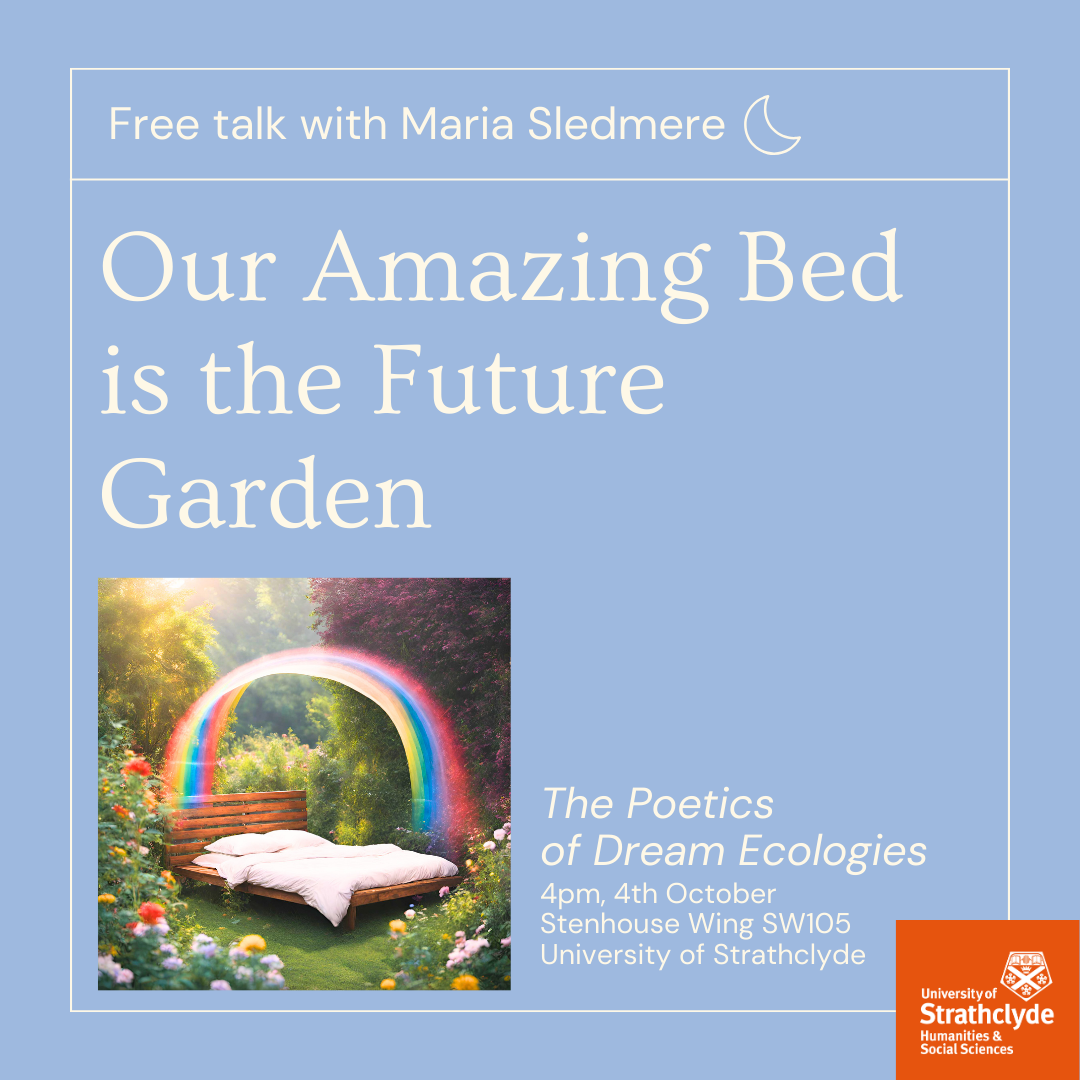
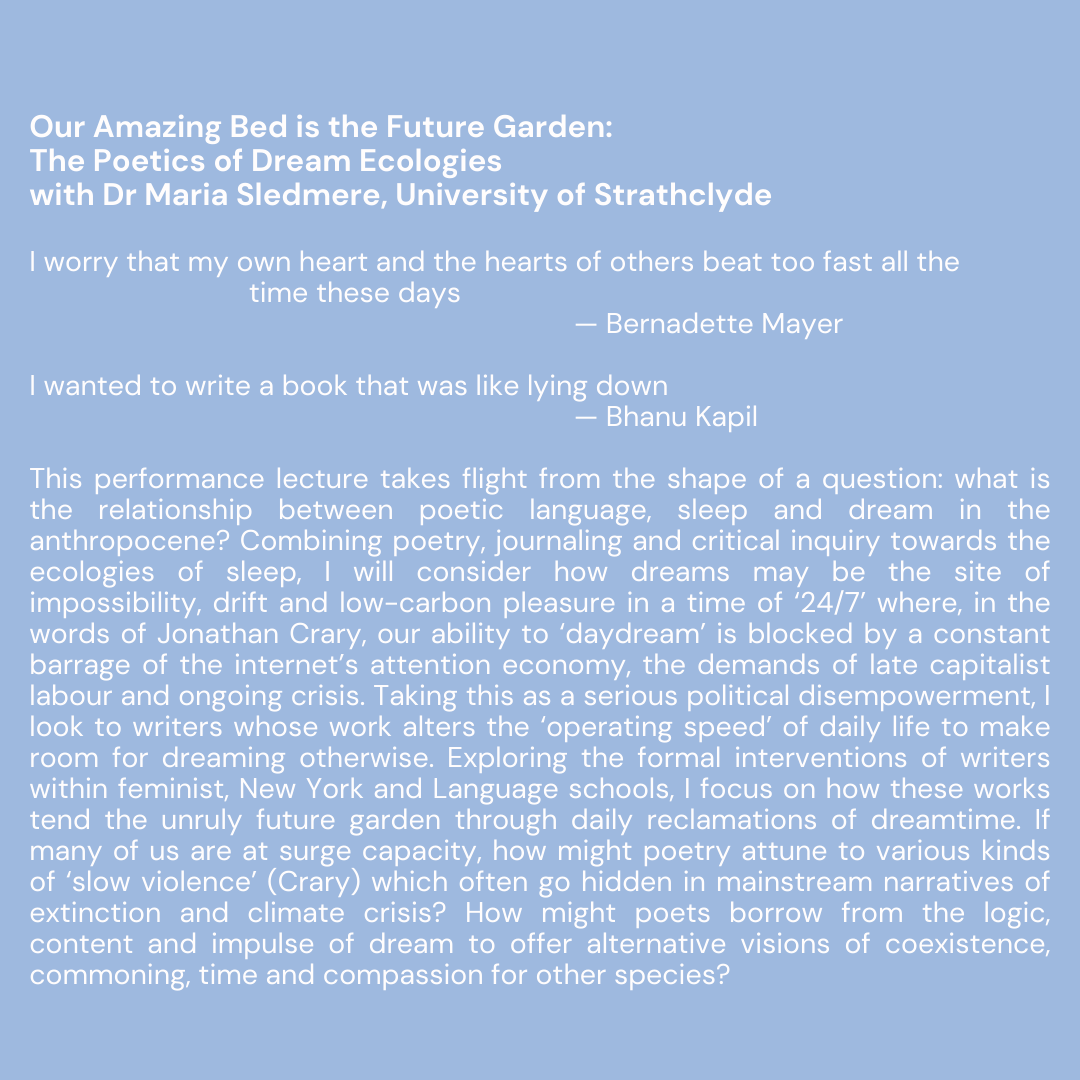
Tomorrow I’m giving a talk titled Our Amazing Bed Is the Future Garden: The Poetics of Dream Ecologies. It emerges from a chapter in my DFA thesis which will form part of a book forthcoming with NoUP Press next year. If you would like a Zoom link please drop me an email at maria.sledmere[at]strath.ac.uk.

This autumn I’ve got three upcoming workshops, two of them with the brilliant experimental composer Kevin Leomo.

Civil Twilight: Carving Dreamtime – workshop with Kevin Leomo and Maria Sledmere
14th October at 5:30pm, Civic House, Glasgow

Get your brain sticky in the pumpkin meat of the circadian and join Kevin Leomo and Maria Sledmere in carving dreamtime as an expression of creativity and low carbon pleasure. As the nights draw in and the clocks go back, we’ll be thinking about how darkness affects mood and slumber. Civil twilight is the brightest of the three twilight phases, where stars and planets might be seen in the sky as the sun dips just below the horizon. By attending to the ‘nocturne’ as a form in poetry and music, we’ll dwell in the possibilities of liminal experience for cultivating ecological imaginaries.
Please bring: Preferred writing materials, If you have one, a reusable coffee cup, headphones and phone.
Tickets are offered on a slide scale: £15 / £10 / £5.
Part of Civic Harvest at Civic House – an Autumn themed day of family friendly activities, workshops and market stalls with lunch from Parveen’s and seasonal cocktails at Civic House Bar!
Tickets

😴

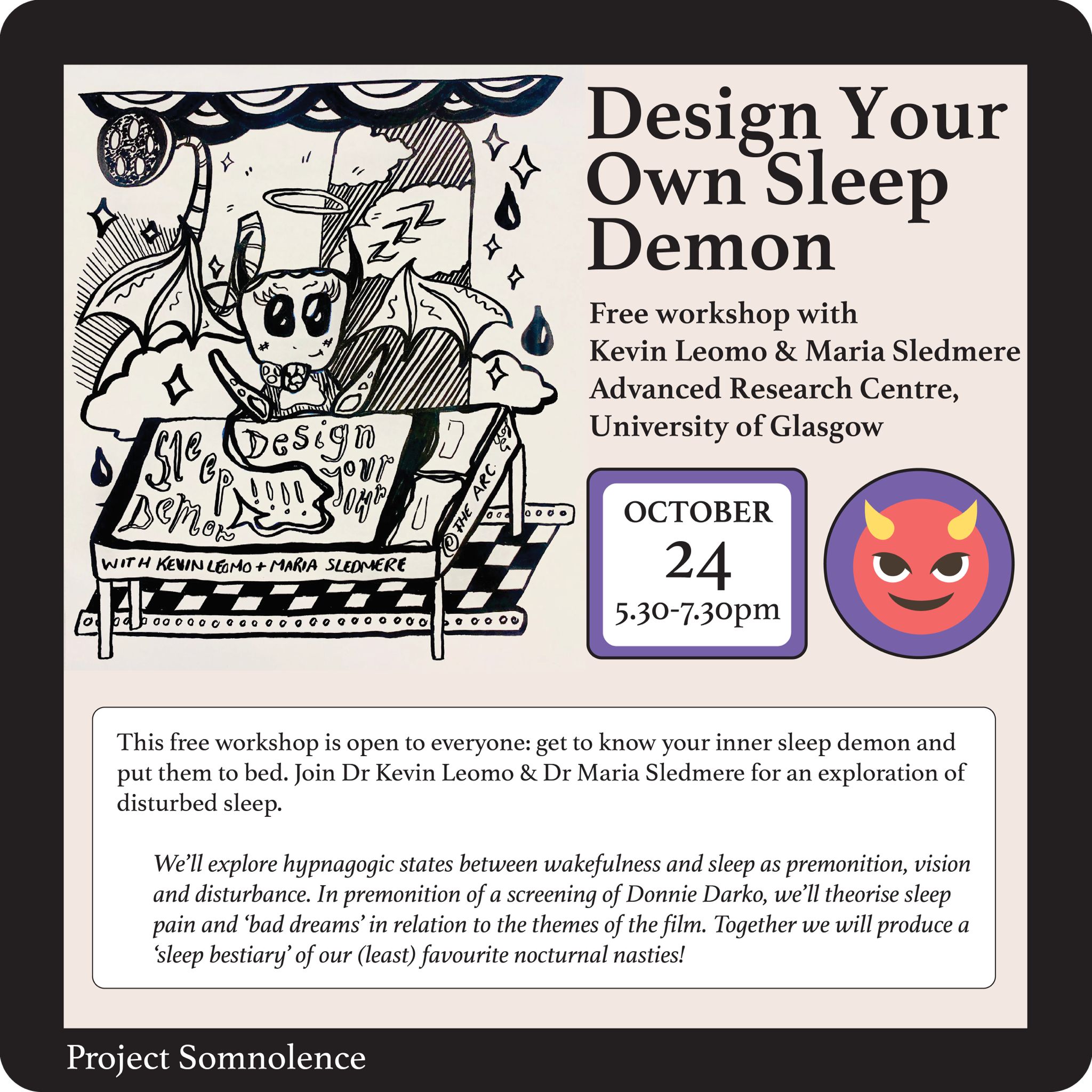
Design your own sleep demon – workshop with Kevin Leomo and Maria Sledmere
24th October at 5:30pm, Advanced Research Centre, University of Glasgow
While sleep is a source of rest and recovery, many of us wrestle with disturbed sleep. If you’ve ever had nightmares or found yourself sleepwalking, you’ve encountered oneirodynia. The word comes from the Greek oneiros, meaning ‘dream’ and odyne, meaning pain. Sleep disturbance may be caused by a number of factors: from stress to stimulants, environment, illness and temperature. The eponymous protagonist of Donnie Darko is often found sleepwalking or experiencing some kind of nocturnal anguish. In this workshop, which serves as a primer for the film’s upcoming CinemARC debut, we’ll explore hypnagogic states between wakefulness and sleep as premonition, vision and disturbance. Together we will produce a ‘sleep bestiary’ of our (least) favourite nocturnal nasties, and present our findings before the screening on Friday.

Tickets

😴

The Poetry of Somnolence – weekend double workshop with Maria Sledmere and Beyond Form Creative Writing
11th and 12th November at 1-4pm (GMT), Zoom

This 2 part series of afternoon workshops prioritise the relationship between writing and sleep. Exploring cross-genre writing, visual and sonic art, we will look at how daily writing practice can recentre our circadian rhythms. From hypnagogic poetics to dream writing, nocturnal missives, dawn songs and notes on twilight, we’ll consider experimental approaches to writing somnolence. All creatives welcome.

Workshop format will combine reading, writing, listening, optional discussion and two nap breaks.

Tickets

Kevin and I have also been working on this somnolent playlist for your melatonin delectation: