I remained on the alert to seize those vagrant moments which seemed to me in quest, as a lost soul is in quest of a body, of a consciousness to register and feel them
— Jean Genet.
I’m in a Caffe Nero in Central Manchester, and they’re playing Joni Mitchell’s ‘A Case of You’, a song I love dearly but haven’t heard in a while. People nearby are talking Italian, Portuguese, French; the coffee smells of a job I left behind. I kept dozing on the train heading south, the way you only doze as a teenager, as if falling asleep was its own laconic rebellion. As if your cares were minor enough to warrant a worldly suspension. There is something bittersweet I can’t name, for fact of the secret and something new coursing through me. I forget to spell, to brush my hair. I check in, and then out. I walk until my feet are sore. Along the canal the water glitters, a quintet of goslings tap at the grass. These shoes don’t fit yet. I’m collecting images for later, holding off the impulse to open my phone. Everything good is a little green light, an almost constancy.
There are bits of wax pastel under my nails I can’t scrape out, the blues and greens. Late at night I sketch mountains, undulating lines that mean something unnameable of time and place. This is where we are when we can’t hold it clearly. I need a selection of scenes. As if you could peel the line from the form. I do this over and over when I struggle to write. It all looks kitsch.
Transferable lines betray their futures.
As though you had to draw to think the drawing hand, the soul behind it. I could drink so much more of this thing that we are. Little symbol of something merlot. We talk of luminous substances, cinema.
*
I buy a badass topless postcard of Sappho. I do the splits at a poetry reading.
An elderly man from Cumbria relays a potted history of the railways between Preston and Carlisle. He tips his hat to me upon leaving the carriage; I go back to Clarice, reeling.
Suited lads order Carling till everything stops and we slump back into the city.
Fade out.
*
We do doubles and discuss our thievery; we’re not counting exactly, the hours just melt into amber, slosh after slosh and the sting of it. He says lovely hurt things, plus the syntax of limbs and rhythms. Weeks before, I snap glow-sticks onstage, follow the blue dot flash on the map. April feels sweet and easy. The blossoms are gone from the trees already. We are vaguely north. I want to hand you something precious that can’t be replaced.
We smash his plates at six in the morning, as though the heart were a sacred amphora.
Every few days I flip open Derrida’s Glas at random. I am caught on this gl, this glimmer and glyph. The only good thing we learned on that course was the runes, I see more of the runes in the church in Govan. I want to wrap my hands round a genuine sunstone, we discuss evolution at dusk and somebody is always interrupting us. The weather is clear and mild, like a symbol. Elsewhere I write the phrase, life is just stars refusing to die, and I don’t know why.
*
“We talked of the sun and moon, of what makes an earnest Instagram.”
*
I called it good air and used more cobalt to imply the sky. A man on my train resembled Mark Fisher and later I dreamt I asked him a question. Plexiglass demands a certain click. I scrolled on my iPod to find the playlist with all the rainbows, there was this chat of garage shanty and April showers. I tell your dad about the legendary felling of the lilac tree. Sometimes we think in firewood and catch sparks in the kitchen. If you want me I’ll be in the bar…
*
Cixous: ‘It is as if I were a fish and I wondered: “How can I be too much for the sea? How can I drown the sea?”’.
What is it we said of the question itself. ‘We never die enough’, she writes. Currently obsessed with excess, against lack. I die into the writing and it gets so I can’t even write! But that’s beautiful too, because the not-writing is the veer of the pen that leaks on my bed and the sleep that made it happen. I walked so far it was all I could do. Something turned over with pale deliberation; we had to elide the sea from each scene. And the gulls fell away like punctuation.
The fish drowns the sea with interminable shimmer! ABSOLUTE selenium. It is a vodka taste of pearlescent tendrils, it is everywhere you want to go of the road. We trundle into London at minimal expense. The air is mega.
*
Out in the dark, I lost the necklace with the ‘M’ on it, the one I’ve had since I was a child. I bore the loss quietly, which seemed to befit initial extinction. Later, I’d buy a watch with a face of pearl to replace it. I saw there was a value in time again.
*
Sincerely I wished to be a reader of science-fiction, but that was an effect of the store with all the metallic covers, the pop music. And of Messenger, ever. Some things you can’t parse from a future, but certain emotions grant you investment. There is finally something to want of tomorrow.
The day is all pinstriped and sunny, I can’t see through it.
* Scientists are finding shrimps that are laced with cocaine. We’re geared up for anything, they scream in journals. I eat my way through loops, wake shiny without comedowns. Something translucent twangs of the skin.
* I taste a nearly virtual plain, with lavender milk.
* In her poem ‘April 23rd’, Bernadette Mayer writes of a ‘cardinal’. I keep thinking of that song with the butterfly and the dogwood, the shades drawn down. It just appears, almost without comments excepting the greyness. Cixous notes, ‘The things that happen are too beautiful to be written’. This is all true and maybe why mostly the lines elude, or weigh too rich on the page these days. I am grateful for small indefinite phrases that come, and the pretty ones that even sometimes land. You can cry if you find the right canopy.
*
He wore green velvet.
*
There is all this tender intuition. The expressions of vanishing in Permanent Green Light. The protagonist who lies in a sleeping bag on this soft suburban lawn, a piñata hanging in the tree above him. Prior serenities of sleeping on trampolines through summery twilight. Blinded we’d swipe at the sky to beat the last of the leaves into tinder. Explosion is what happens to the sun all the time. It’s kind of delicious to think of that, like romance as solarity and the space between us. Measured days and days, held breath.
…What changed?
*
Dream of Sibylle Baier’s colour-green sweater. It’s made of angora and makes me sleep into the sleep of itself, as though sleep were exactly what you drew about your shoulders. And you did.
They were playing Bright Eyes in Nice ‘n’ Sleazy’s, a good omen if ever I know one. First with your hands, then with your mouth…
* Alone on the stairwell, dropping slips of snowy paper. Enjambed cacophony of the neighbours smoking, and a blue light that isn’t mine, the massive tv I pass each night in familiar windows. I love to be alone in hotel rooms, the soft mood of the light. The endless sense of mirror and sleep. When you played, you wanted to see to touch. I tried to remember the beautiful email, to make it better. Little confused thing, said so simple, sorting papers.
Sometime in April a letter I wrote.
Last edit was seven hours ago and boy can you feel it, a critical hit.
*
What I drew had no obvious form. I’d stopped bothering to look for permanence. There’s a new kind of ring to the rain, the smell of green leaves and the river’s illegibility. Most extravagant violet marks, a watched ellipsis. Here.
~
Sibylle Baier — Colour Green
Yohuna — The Moon Hangs in the Sky Like Nothing Hangs in the Sky
Pinegrove — Skylight
Hand Habits — what’s the use
Twain — Solar Pilgrim
Frankie Cosmos — On the Lips
The Bellybuttons — Mannequins, Gr.
Aldous Harding — Fixture Picture
Thee Oh Sees — Island Raiders
Youth Lagoon — 17
Buck Meek — Halo Light
Cate le Bon — Home to You
Joni Mitchell — Little Green
Weyes Blood — Something to Believe
The Cure — Plainsong
Galaxie 500 — Hearing Voices
Four Tet — Teenage Birdsong
Robert Sotelo — Orangerie
King Gizzard & The Lizard Wizard — Planet B
PUP — Full Blown Meltdown
Better Oblivion Community Centre — Exception to the Rule
On the 11th of June, 1993, I was born with an extra digit, an eleventh finger. I am told it was a finger, so goes my parents’ mythology, but probably there is some anatomical word which better explains the strange appendage attached to my left pinkie. Resembling a kind of lollipop, a glass candy, my eleventh finger was a long thin vessel of muscle or blood (what I cannot know or ask of that fact) attached to a kind of crimson orb, like a cherry. It wasn’t really a finger at all, but the unfinished potential of what might’ve been one, a mutation. This was accompanied by a strawberry-shaped birthmark on my inner left wrist which, my dad assured me, would fade as I grew older. The cherry finger was lopped off on the day of my birth, and the blood splattered the doctor’s coat, bright red upon starch white. Soon after, I nearly died. A lightning storm raged through the morning. I was placed in an incubator, I had some kind of viral infection. They furnished me with the supplementary khora, until I grew blonde and better. So the story goes, and already I have probably messed up the order.
But I want to say something of the number eleven. Eleven feels like a residue, an extra. The loss of this finger, which I do not write with and yet slyly it makes itself present as absence, constitutes a kind of originary erasure. Years pass in which I forget this secret was mine at all. Eleven, perhaps, is a statement of entropy, a chaos spilling over our familiar limits and even regressing or falling in loops. However we parcel our intake/outtake, our sense of personal energy. I test out images of eleven, of extra. In Tom McCarthy’s novel Remainder, the protagonist wants to claim his free coffee, the remainder, so badly that he buys ten cappuccinos just to get the loyalty card stamped, just to claim the free one, the eleventh beyond the card. A strange caffeination that remains incomplete, to come. Then there’s Eleven from Stranger Things as a kind of genetic extra; the number identifies her as a test subject. The number becomes name. That phrase, turn it up to eleven, when really the system stops at ten. Why is it we make wishes on 11:11, when did I start doing that? The wish constituted itself as extra. Over time, I find myself ‘catching’ this time more and more, glancing at the clock of my laptop when it just happens to be 11:11. And the wishes pile up at the forefront of thought, they take a while to resume as memory. When I am sad, I visit the Kelvingrove fountain. There is water and clarity, the hum of other people’s wishes. Sometimes this is better than poetry, it’s simply potential.
I knew someone who named themselves after the sky in Super Mario (with Ayrshire inflection) long before either of us had even heard of Cory Arcangel. We were born on the exact same day, same year, and we called ourselves twins. It took eleven years of our lives to find each other. Speaking to this person, I felt always this chiasmus of consciousnesses, a sense of keeping up, or ongoingness.[1] They were super beautiful with luminous curls and sports jackets. Their nights were spent up with consoles and synthesisers, and we messaged each other until our windows crashed, or our parents needed to use the phone. I will not quash the romance of the dialup connection, for it was real, the frisson of interruption. The sense of a moving into, the attunement that performed itself in the temporal interlude of a radio whistle, blow of white noise that had its sonic continuum, warping and twisting as though all these howls in the wires were coming to life, and we would sing through the modem our deepest thoughts. You would teach me a riff. We were each messaging the others at once. There would come a point where everything was just text in the end, the fragile reminder of each bodily fragility.
You wrote in cyan-coloured Comic Sans, before this was ironical.
Half of my brain wants a masculine state; the other half a quiet, feminine comedown. What is it to speak or sleep gender. I’d sip cider in the wee hours after the party, but nothing fragmentary said then was as good as it was on the computer. It was like coming to life, discovering what had not yet been told of a love or a taste. I suddenly felt affectionate towards everything, and the aesthetics of a particular website, the trajectory of a song, could startle me into tears. Everything grew fizzy and sugary; it was all too much. What we were supposed to say to each other. I was learning to apply eyeliner, clip bras and shed weight like a grownup. The environment was a diagram we drew at school, a set of names we recited while dipping for critters in rockpools, freezing our brains on polluted beaches. A joke that was told to the air before we could return to our games.
***
I never learned the word for what happened at my birth, what grew on me, this residue fruit. After a while, it broke away, the fact of it which was a specialness. I was losing that specialness the more I learned language. There was a solvent process of being okay with a long red line that meant mine or anybody else’s ‘I’. (/) A length of energy, a vessel snipped close to the richness. We invent names for ourselves on the internet.
Something constant was the minor chord shard in my heart, when I knew there was a thing awry. I could not put my finger on it, much as I could not remember what I wanted to do with my life, or what passion that had driven me to write as a child. For I had filled documents and jotters with my rambles before. What happened, if you can forgive me for inserting a narrative turn here, was a loss of story. Post-puberty, it seemed there could be no climax in my life. Events I had expected to effect a shock into existence had not occurred so; a long hard drag had occurred instead, slow enough to trick you into passive submission. Resistance became a case of daily withdrawal, decay. It seemed there was nothing to write into, now I understood the mysteries of sex, reproduction, death. I had written these epic fates about unwanted births, woman impregnated against their will in labs buried deep in violet mountains. I had a horror of the body inside the body, which was the same as the body inside the planet or the planet inside you. What grows, regardless.
There was a fragile voice I was waiting to hear on the radio. I had not yet worked out the temporal trick that was poetry, the way it could stop you on the blot of a page, by fact of its shape. What grew charged or tangled. I became interested in the way the body was just a body, something to be seen, something to offer up to bodies beyond you. I wanted to know its limits, its multiplicities, as much as its points of attunement. Like plugging in headphones to the library PC just so I can hear the electrical charge of each scroll as a sonic intensity. There was a time of mark-making, rigging lighters, taking steaming baths. Staring at other people’s ceilings. I practiced lying on concrete, feeling the dark cold of summer’s inversion travel up from my spine. I listened to music so loud that stars began splintering inside my ears, and so I would have tinnitus forever more. I burned my tongue on a minor chord.
And so the same sound would scream back, muted lagoon trapped in my ear a decade later, the splitting sextillion stars of that music. The melody itself was irrelevant. I was drawn to songs where you could fall between verse and chorus, and the space of that slack guitar was far more important, the way a man’s voice could break on a word. For some reason, then, it was always men.
What does it mean to be taught how to feel by the opposite sex? Things tilted and sweetened the weaker I grew. We held hands in west coast impressions of sunset. The word for weather was like whether to say I’m going offline. The fort-da pull of your endless sign-ins. r u okay?
Jean-Luc Nancy: ‘A corpus is not a discourse, and it is not a narrative. A corpus is what is needed [qu’il faudrait] here, then. Here—there is something like a promise that this has to deal with the body, that is going to deal with it—there, almost without waiting […] there is a sort of promise tacitly to hush’.
Thus the body is clearer in machinic absence. Thus this vast proliferation of forgettable text was the logic we gorged on, empty calorific haribo words. There was no vegetarian alternative, we were eating each other. I mean the sway of exchange, this sense to be dealt with. A hunger, sugar rush. I message you later. The pressure of reply, now we’re always online; transmission as love’s endless labour. Isn’t it exquisite just to hush, to disappear mid-conversation and relish the ellipsis for a future hour. In these small ways I was building a tentative next, but its openness was yet clouded by thought itself. I couldn’t think beyond three minutes, and that was depression.
***
I learned the deformity of my birth was a sign of witchcraft. I bought a bright pink book on the subject when I was very young, and tried to astral travel. I wanted to see things from above, but instead I found myself suffocated by their closeness. Children can smell sorrow, the weight of it dripping from adult expression; the way dogs pick up the mood of the house and embody it through quivering and whimpering. I burned incense and imagined an orb of lilac light spreading over my body, which became the mountain I buried my heroines in as a child writer, an amateur at fantasy. I slept with crystals under my pillow (I still do).
The wrongness of the world was everywhere. The way people spoke to each other. I could not connect. I leapt into situations where voices were just echoes back into the water they came from, where sentences shored up nothing more than the vice of their speaker. I began a long affair with silence. I stopped writing, and later I stopped speaking. For weeks at a time, I would lose my voice. It broke on the shore. I smoked little menthols in wind tunnels, listening to reality talk shit back to me. I was broken inside before I began; that was the feeling. Long walks could not smoulder it off, and the only calm I achieved was from the absolute lack of understanding I experienced in math. Not knowing was a clarity, one I still crave in the space of writing. The absolute sentence as a violence that closes all others.
Later, much later, I would discover this glitch was a crisis far beyond me, a crisis of climate, a crisis of world itself: so huge my child’s mind could hardly have discovered it. And yet, having said that, I was already halfway there. Halfway towards ecocide. As a child, I swore to my mother I would leave the planet on my fifteenth birthday. She almost believed me. Mars beckoned, with its fiery red swirls and its secret knowledge of an evil beyond. I liked the way the name felt ‘full’ in my mouth. When nothing happened, I drank myself into amnesia; I stopped eating. It was a birthday gift to myself, the hope that I might still disappear.
Hungover, I know there will be a point where I go and that is to die. The blank is like a name you forget at the point of recall. It is so much worse than that, as if we’d forgotten our own name and the name of our mothers and the E____ itself. And what it means to see the back of the tapestry and a trypophobic horror where every unloosened stitch, a tiny blank, is the signal of multiple (un)ending worlds. Consider the strawberry seen from inside, with its millioning glowing yellow seeds of light. My wrists replaced originary marks with marks.
There was so much to learn about what was happening. I needed to know what would be okay. It was just this whole impossibility of thinking the future. The word ‘career’ was hilarious. It made me think of falling through time, Scrabble letters tossed into void at light speed. That was the language I wanted, letters at light speed.
***
Silver foil, the metallic smell on your fingers from playing guitar. The way I could play through brass and acquire an instrumental breath, vibrations that slid out of tune because I had damaged my ears too much to listen.
As promised, the strawberry birthmark faded. It was like somebody had slowly quietened the white noise, so slowly that I could not be sure if what I heard was truth or hallucination. The distinction mattered less over time.
Dream where I can’t sleep, so I wake up to watch Super Mario Cloudson YouTube, so I relive the level without level.
Sometimes I feel twinges of pain in the bump where my finger was. This phantom sensation is strange because I have no working memory of the limb itself, if it can be called a limb. The-cherry-nothing-more-than-a-supplement. Wikipedia tells me that the pain of phantom limbs can be aggravated by ‘stress, anxiety and weather changes’. The supplementary limb, then, its existence as a constant play between presence and absence (I had the limb, and yet no memory of its function; the limb was extra and yet in having it removed I felt less than a ‘normal’ person, I am less than I was and in sameness still more), acts as a site of super-attunement. When the temperature gets weird, the tingles start over. The pain is a drift of cirrus.
If you press very hard on the bump on my hand, I feel a sort of convex nerve pain, akin to the ache of pins and needles, concentrated in this single location. I wonder if this is what happens to a cherry when you slice it in half, when you make of the round fruit a sudden circumference. Something fell out, a long long time ago. The tiniest stone.
The world is wrong. There are only signals. Nothing has even really reached us yet. So why leave?
Wikipedia tells me one explanation for phantom limb pain is ‘the result of “junk” inputs from the peripheral nervous system’. There is an overhaul of arousal just to live now; somehow the waste of this activity is concentrated in this mark of removal. Can it be called a wound if it is not a gap or a hollow, but something in addition to the skin, a geologic feature: a kind of tiny crater, a half-sphere, a mound? I imagine a tangle of thread-like nerves coiled up inside. Nobody has noticed this bump of their own volition. To mention it to someone, I was born with an eleventh finger, is of course to commit an act of confession, a gesture of intimacy.
Like here, you can nearly have my birth back. A gift to the Earth in you.
Derrida: ‘The wound can have (should only have) just one proper name. I recognise that I love — you — by this: you leave in me a wound I do not want to replace’.
I died when I was born, literally; I was born wrong. But in being born this way, I had to love the world as a child of enchantment. I had to trick myself into existing. It would be an obscenity to look back at those pictures, tiny baby with this slight extremity, this tuning fork of flesh, so easily severed. Who knew anything of a redheaded future, a salad of spent conditionals and love. And I want you to be free.
***
So what do we do with this extra? Knowing too much of the world and what the self cannot say of the world in itself. Autoplay is paused for the meantime, by which I mean the time in which we are mean. I remember discovering cruelty in the playground, where a boy would go round and hit us with strong red branches he pulled from a shrub that grew with some abundance around our school. And realising the marks made on the back of our calves were really just marks of a pain this boy had felt; a pain inflicted upon him from elsewhere, so that cruelty was something you transferred, a kind of heraldic ink you wore for your life, for your family. I would not explain these marks to my mother, or to myself, for years. My early experience of inflicting cruelty: throwing Chao against the wall, only to nurse them back into serenity later. Teasing the dog, watching a friend knock his head off a wall, deliberately fucking things up. Then the delirious pleasure: to throw one’s avatar off into starry void, a final sacrificial act. In Sonic Adventure 2 Battle, a game to which I dedicated many hours of pre-adolescent life, the villain Dr Robotnik has programmed his space colony, ARK,[2] to collide with Earth if the chaos emeralds are used. Such annihilation intends vengeance on ‘the government’ for condemning the doctor’s research and killing his daughter, Maria. Her request to Shadow, Sonic the Hedgehog’s Jungian double, is to help mankind. When Shadow plummets back to Earth, following the ultimate battle, ‘the Finalhazard’, he is happy, because he has fulfilled his promise to Maria.
Admittedly, this cosmological battle of heroes is little more than parenthesis here. I want to say something of my entrance into this discourse of annihilation. Shadow was a supplement: Sonic’s ‘double’, but also his genetic extra, his genetic remainder; both hero and villain, his narrative volition was ultimately self-sacrifice to save the world, and yet he was created to conquer the world. He embodies the eerie promise of a kind of living apocalypse, an ‘end’ to the world that does not end. I remember the final book of Garth Nix’s Old Kingdom series, whose blurb used the word cataclysm, or cataclysmic, to describe the events that closed the trilogy. That word lived on in me as a wound, cataclysm: something sharp that had already cut me. It was a word I could not unthink. What actually happened in the book was terrible, was a battle, it involved the loss of life; and yet there was redemption. I knew then that cataclysm was not necessarily apocalypse, because one world of fantasy could open into the new, like a modified species. There were chain reactions.
But all this is just average Earth. Learning to like the light, to paint a thought with the similar blue, knowing it only exists in dreams, and the way she holds a note.
***
These days, everything mostly feels like transing times. I listen to a Jason Molina recording and realise that he is gone, he is missing from the world, and yet the warmth of his fingers, these arpeggios; the sound of sirens passing through the windows of his Chicago apartment. These are present but I discover them only after absence. I have to realise this over and over, to register the shock of this or that loss. I close one tab, only to open another window onto extinction: this fact of a text we can’t share, because the text is ourselves, and we have shared unto each other enough of the missing space. And someone else I once loved dies. Data is what’s given, it clots into so much hurt. We just are confusion, the two of us and the planet and what’s opening up.
Everything swells; a cherry-red globe recurs in memory. I drift on a lifelong melancholia that isn’t quite mine. I want to be able to parse this bodily symbology as a something beyond me, of course; I want to look outwards at the felt inequality. So many wounds between us. The word continent crunched sour in my mouth. These histories we can’t unpeel or remain in singular. I want to be able to understand the matheme, but there is a wilderness still. The breath won’t catch up. Scared I’ll fall off the edge of my mind.
What we make difficult for ourselves, these fractures in fact or family. Always a guilt that sticks. It is as though we were speaking underwater, our altered tongues; what we could only bring together as lyric.
I had all these dreams of traffic, and the traffic could only move in the night. I was at the edge of a slip road, but I could not merge. Are we closer, now that you know this?
whatever in the world behind closed eyes the doors whispered. let her be. let her be her. let us be as if we were not forever entwined in that, as if we were not able to unthread the conclusions, deliver ourselves of the plot. at that level she intercedes for you. she cries mercy at the feet of her father. she knows where he is at the far corners of the universe. he has removed himself. he has gone off to sit and brood beyond the pale of light. if not that then this. but we had opened it. the knife that cuts both ways. always. in the centre of it the rose. pure. the flaming heart, an artifact. believe me. this is not a special dispensation. this is a matter of life and death.
(Beverly Dahlen, A Reading)
And why did they give me the middling name of the Rose? There was a world tucked in and still to unfurl, and the rose was a planet with cloud tucked into its darkest heart. Let her be here. That time I set my hair on fire and everything of the world smelt singed for weeks. It happened at the funeral. She was at the mercy of a childhood memory, curled at the window as they came in the night to tip the car. And she remembers the way the oil ran down the road as rainbows. The sound of her parents on the phone and a knife that cut the silence of Sunday. It was a thick gelatine; the boiled fruitmeat of calorific lyric. The cut in the world behind closed doors, closed eyes, the lids we can’t keep on our possible futures. So we swim through; no, it gets stuck in our teeth. How can it be a matter of both?
Crank the anthropocene up to eleven. I wish we had been sweeter to each other. Like listening to the bees without meaning to. We’ll never know why we are born the way we are born, or whether that matters. And I’m pushing sleep for the pleasure of that stretch of the break: when you say the break of the sky and is it a pink cloud I see, or just blue. The 8-bit troposphere catching nightly. Facebook is blue because Mark Zuckerberg is colourblind. There is the overlay, the twice-lived light of the screen and the sky beyond, which is also contained in a window. At no point do I choose to go outside, as it were; for this is the happening of a necessary containment. I need to be able to switch between tabs, my brain still reeling. There is always extra, the bit we missed and have to pursue.
If I saw you again, and we were the same as we were.
Excoriations of time are like Facebook disavowal; don’t click, don’t react. They rub off on our skin as however many times we surrendered our diaries, only to take them again in our arms, cradling tiny diacritics. The first broadband was the rupture of a secret, something breaking out widescreen and hurting.
Narcissism: this essay. A name comes out the sky(e), its extra e for the isle, for extinction. The Earth is active now, this state of evil, eleven, never even.
We should be kinder to each other, said the tree to the thing that would grind it to pulp. When Justine eats the meatloaf and it turns to ash in her mouth. And you know that all this extraness, extremeness of death is from the other planet that is our planet. Just is. I put a bar through Mars, I pierced its fat red eye with the proto-knowledge of Earth’s erasure. That was my great stupid rebellion. It felt like a dreamwork of futile justice.
The fact is only an identity, a pristine midnight. Land lines of countryside glimpsed in the feed, I know the moon only this way until I leave the library. So sigh, milk silver of gaze. Instinctive descent occurs in dark mode, and we play it over, scrolling and scrolling. The hours between. For all I remember of that night, there is only the simple avocado emoji, and a thank you. You’ve been more than a friend to me.
***
What do we call for?
It’s like the first time I saw Jane Campion’s Bright Star and thought of something shimmering in the woods, that would not come as powder or song but simply as itself. And yet even that was split. Cancer moon/Pisces rising. I could sense it, and the morning hurt, and the continuum of pain whose fidelity remained still into the half planet smudged on the edge of my hand. The Earth is a cherry that lost its innocent self. You would interrupt our greeting in honour of the end of the album. That was the tempo we stretched for ourselves, syncopating sleep with the lights adorning our names with time’s ongoingness; eleven hours at the end of the wish again, after we stayed up past the chorus of dawn. And the world was shimmering in the woods. Our cut had barely interrupted the story.
And ongoingness is, as Tim Morton puts it, the temporality of melancholy in the anthropocene, this sense that ‘nothing is determined yet’. This sense that we are not looking towards apocalypse but rather trying to be here, knowing this ‘here’ is not ours or fixed but is a viscous spreading of multiple subjectivities, bodies and times. Ongoingness is to look for pleasure as well as pain, to not look towards loss as imminent or behind us, but rather to appreciate the uncanniness of reality. So this person’s consciousness became for a while another half of my own, their thoughts would echo and remain in me, beyond pathology, warping from something raw and ‘live’ to a gentler articulation of being here, being-with. The enviro-mind, formerly-known-as…
Incidentally, the Ark was a youth club I’d frequent as a teenager, beside the sea. The site of many formative drinking experience, it was surrounded by dunes of lawn and behind those dunes I’d learn my first versions of drowning.
Plato wants to emit. Seed, artificially, technically. That devil of a Socrates holds the syringe. To sow the entire earth, to send the same fertile card to everyone.
— Derrida, The Post Card
He goes around sliding things under doors. When I answer the buzzer he coughs through the speaker. Is there something for me? Impossible to tell. He clutches bundles of luminous, anonymous catalogues. But there is mostly paper, less of noise, in my dream. All the colourful paper is folded into neat little butterflies and cast about a room somewhere, a trillion paper butterflies made animate by a ceiling fan. They swirl up and hover and tremble, they display the fact of display. If Damien Hirst were kinder to hyperobjects. The butterflies are destined to live for only a day, but their larvae live on and on, reproducing in squirming punctuation. The home screen was full of these icons, butterfly icons, but the state that I am in…well, I saw them as colours in kaleidoscopic array, you could say formless because they were almost utterly without origin. I tried to click through the butterflies to open a window. The word broadcast has its origins in agriculture. I see him at the edge of things, broadcasting his literature; dreaming of that broadcast whose discourse would finally slip into ‘Stone in Focus’, fully looped for 1:17:10 duration. The butterfly paper of things we were supposed to purchase. Palimpsests of unspent ‘truth’, a kind of solvent tonic for wounded text. What folds is the secret of objects, their identity prior to products. The butterflies fly, land, twist, secrete. They become tiny wedges. I want to gather up quantities of plastic and watch it melt between my fingers, the putty of a capitalist extinction. I kinda wanna call him. One day the fan will stop running and that will be the end of the day. The paper is better than plastic, by a mite.
That is what I write to you. A little shard of a page. I can pinpoint its scene of writing, the place where the walls are real moss and everything is green and utopian blue. The signs are over-scrawled in washable ink: fill up the kettle after finishing. A world slides out of focus when I write to you. No one cares. The point of a sentence is itself the long-tail; maybe I had not converted the file right, maybe I had not stretched this line as far as it wanted. But it broke apart regardless:
. . . . . .. . . . .
. . . . .. . . . . .. .. . . . .
. . . . . . .. . . . . .
. . . . . ….. .
. . .. .
I see last year’s city in a flowing grid of water. The artificial channel of departure. I am trying to remember the blue of the plane, the blue of a single window. It seems this journey annihilates the next. The weather is unavailable to me. I was up so late, crunching chocolate eggs between my teeth and reading Dodie Bellamy. Everything said was fibrous, electric, painfully or even exquisitely wired. I was in San Francisco, I was in a flooded New York; I was in my hometown, even more underwater. The prose came in streams but it was hardly mine. I leaned in to suck the smoke from your face. What everyone needed was chamomile, a breath of the air by the river.
At the end of the world, the butterflies drown. We mourn them very quietly, last of our senses stimulated. The muscularity we made of our work is immaterial now. I’m trying to swear myself into a rhythm of perfect sleep. What comprises a wake up call, the fuck fuck fuck of it. Alarms are sent from afar to hold me in the punch of 400 words, Plato’s postcard. I wake to her dreams in WhatsApp messages; I split samples of songs I don’t like into ringtones. Something slips into something and the dark looks different. I walk home and catch variant scents of spring, mixed up with the fumes from the late-night buses. I rub blossoms and leaves between my fingers, trying to intensify the feeling. I am incredibly nostalgic for Chloé perfume, when I hug her goodbye. Magnolia, freesia, honey and cedarwood hidden beneath. Often those moments are so sweet I have to stand there in the street and text myself about it. I have these texts on my phone:
05:12: It’s just sunset, stupid
01:01: My legs are full of equinox
23:42: What if we wrote a line for every hour slept
02:34: Orchid.mpeg remembering futures
In Lars Von Trier’s Melancholia, the only safe place is the cave. But the cave is more like a teepee, it has no walls; it opens out onto the cinematic event which is this massive planet colliding with Earth. So there are no walls, not even ones made of moss, woven with pollen. It is not exactly a place ‘to go’. The cave at the end of the world is a triangulation of lines, a diagram. It points to the sky. The inside of the cave is the outside; it is a geometric skin; it is infinitely double. I think of the cherry red skin of my hotmail; at what point in my life did I choose that? The interior kitsch of human flesh, rendered plastic. Sometime in the month I write: I want everything to be tender but I had no idea it could be this bad. When the hail comes, when they salt the road, when the snow comes, I think it is ending but I wake up as before with the equal ache. Sunlight (?) Statistics lisping the roof of my mouth, as though writing itself would produce an allergy. I lay down my stuff, just as he is walking in, and my tongue in my mouth and the blood in my veins and the thought—indistinct sense of where the year will head. But I am looking instead for the tail. Already curling back into itself, the significant events of January chase me with flickering imagery, they are a personal narcissism. If I could boil them down, attain a clarity; shoot them, syringing…
I roll up my sleeves for airborne beams of vitamins.
She tells me how gorgeous the ghost was. The coast was. I keep thinking about the chestnut taste and the kisses of light, the packet I put back on the shelf. The world was wrong; the supermarket made me soft enough to go, checking the mirrors in financial departure. Incredible sponges, dying at the bottom of oceans. Someone holds the syringe but not for me. Someone holds out for loose change. I lose specialness daily in order to live. I dream I have a daughter who stands by a fireplace while I clip a starfish pin in her hair. She can’t say the word. I perform the tiniest sweep, distracting her gaze. She doesn’t want to go outside, she will scream and clutch the radiator if I tell her. The word is literally unnameable, I wake up with it gone from my lips. But the word exists! There was surely a species. It is only a technicality now. Secretly I write the word down, days later when it returns to me, burning. To write it here would be to violate that, to cheapen its life with a summoning. I realise the daughter is only the version of self that I didn’t fuck up. She exists elsewhere. I swear to her:
Anne of Julia Kristeva’s psychoanalysis:
“I dreamt that a little girl came out of my body, the spitting image of my mother, while I have often told you that when I close my eyes I can’t bring her face to mind, as if she had died before I was born and carried me along into that death. And now here I am giving birth and it is she who lives again…”
(Kristeva, Black Sun)
The daughter as a twice-lived avatar of futurity, the mask of what comes before as pushing through generative time; mothering and lusting and screaming for our place in their state of absolute melancholy. Be with me and share this pain. In the anthropocene, we accumulate a sense of primitive, foetal lostness (how many times have I curled, cried, questioned); the world is our fragile, amniotic sac. We float, we are starved of good air; we trap the heat. We can’t trust the way we damage it, extract from its boundaries the richest juices; the way we carry it; the way we absorb and are absorbed by it; the way we circulate in the midst of our mutual toxins. But the Earth is nothing so essential to us as mother, and no blood-ridden cloud of cotton could stop the daughter, screaming all through my sleep.
The longest comedown, the longest night. Where mist is mostly the way of him holding a note, and it is not instant, it is not like the drug or the river that drowned him. It is the name with so many consonants. It could shatter a language with time. My dreams are thick and long but my sleep is short. I like how many times Sophie Robinson mentions her inbox in Rabbit. I check my own and the number surpasses 50,000. Spending the morning in turmoil, wanting to write back to the sunset I missed. Endless proliferation just is. It is something like, hold simultaneity in blockchain. Mathematics achieves a weightlessness. I’m sorry I’m sorry. Pieces of skylight I can hold in my head, granular blue. I’d let myself into the rain again. I need a very tall building, a stairwell to make the blood rush back to my extremities. You tell me not to.
Remembering the summer where all I could do was measure the slenderness of other people’s legs, in a numb, inexorable kind of way. This felt relative to my sense of extinction. It was something about, what do we put in our bodies and where or why do we want to go. I was suffused with the sense of the need elsewhere. How do we blend into a world, make of our souls these chalk pastel auras. If you could terraform Mars with memory only. The drift was the weight of an email, it was rainbow and stretched as far as my childhood. I saw her by the river, holding a piece of glass to the light. She hitched up her skirt and waded in. The voices subside in the rush of the current. The image fades, because she is anyway there, chastising my choice. I wonder how ever we lived without each other.
Heartburn and techno. Reasons I want to fold this away, why I walk along rivers regardless. The latent burn was only as far as the beat could measure. After the movie, I felt a depression so immense it was like I lost touch with each muscle. The doorbell. Friendships fraying like so many neglected threads. Coal emissions are rising like shares or something. I ran and ran in the dream of the land I remembered. I could smell wild garlic along the river. My brother was already home for the match. I ran and ran to get back to the gym with the moths in the showers, stuck to curtains. 91%, 69%, 43%, 1%. Even my phone is dying. Little white eggs in your palms are lyrics. What if the lilac tree were more than or less than life itself? Lilacs symbolise the beginnings of love. Being earnest, accelerationist, plugged into the HEX account of refresh, streaming language. What colour is it that flickers in time? I have been ignoring innumerable messages. I want to dwell in the missing hour, the split that occurs when the clocks go forward. It’s just like the extra cappuccino, the final stamp on a loyalty card. It always resets.
She is no longer there. It was so simple, letting the blood of the thought away. Dark liquids filled my days: cola and Guinness and the black, oozing matter you see in the water in Tarkovsky’s Stalker. Dreams of petroleum slick I saw in the sky. Oily dream of the Essay of the Book of the Essay. Literature seems almost impossible now. I needle myself into the heads of writers. I want them to pierce the myriad empty pores of me, tiny molten residue eggs. This imagination, waning. White cracking liquid black on the page. I was taking pleasure in texture and loops, cutting my tongue on a shout. I don’t know how to write! Mostly I would lie in bed reading D.rida and peeling the skin around my fingers, leaving tiny strips of red underneath. The cherry-rose flavour of Rescue Remedy. I needed something heavy; like an extra river, proplus, nicotine gum.
Transducer: A device that converts one form of energy into another.
I wanted to be online forever and I wanted that status to annihilate the fact, I wanted to erase onlineness from the web and I wanted the result to be world, oblique exchange of realities, and people uploading their papers forever, and a sweetness, whatever it means just to speak. I wanted the spider to eat the fly. I wanted to read behind the lines until I became signal, and my signal was a force behind the language I wanted to speak, and it was prior to me. I went to the Tower and forgot they were having a party. The white wine tasted like sugary air. There was a video I watched, ‘Pyramid Song’ performed in Egypt. What doesn’t care to be sent. The egg won’t open its hatch. The complete terroir of relief in southerly regions where I cram all my life into multiple time zones, the sibylline remainder of day. Mysterious she beckons with fat grapes squashed in the O of her mouth, all rotten fruit I could smell from the train going south. She designed a very careless outrage and I realised there wasn’t a single shout inside me. She twists out the stalks like dead capillaries. I confront the thought of something terrible happening. So many times and I could not shriek. Later, tiny black seeds spill into my palm. I can only cherish them.
Facebook is the broadcast of Earth. I try to straighten the mirror, as though the spatial urge were innate and not just void. It was not the same book that I had ordered, the Book of the Essay. I had already set forth on the impossible project. I struggled to review. I had not even written the fact of it yet. There is value and heat to this project, even in its moments of stretch and collapse. I would put writing through the machine that makes water effervesce, missing the ease of waitressing. When ‘Beyondless’ came on, I felt infinite again on Great Western Road. Short-sighted, I missed the faces of every stranger. I wrote this sestina called ‘Lucozade Blues’, but I had not the stomach for any orange energy. Would you like ice with that?
The cave is a kind of triangle. Facebook is the vending machine, dispensing the glitches and beats of our life. It is as one, invisible crowd of desire. I want to say swarm. I want to say seed, but the burst spent seeds that lie in the dust of the archive. And she does calisthenics just to stream them live, and she lays her beautiful eggs. I am obsessed with the rhythms I can’t keep, lunar cycles for mindless complexion. Someone comes along to clear us west, they have had enough of our westerly airs. Sometimes I long to smash the windows of my local Tesco after midnight, just to boost M&Ms off the shelf, scatter them along the coated floor and crunch their acid colours one by one with my shoes. I want a whole lifetime to tread in my shoes. The pause when you stop in the walk to tie your laces, and you look so lovely with your leg in the air; a kind of ballet occurs in suspended time. Everything about this sentence is soft, it has to be. Plié. It subjects me to a slenderness, elsewhere a song. Bend and taut. Fear of the dark or the light, lilac wiiine. Somebody else is always between us; somebody else is the cavalier world, riding its way through galloping matter to get back to the point at which this becomes anti. And later I stroke your hair in the stable, and later we find him, and later your dream hair is all I can smell and scrunch when I come up for air or salt in the morning. And you are smaller than I ever remembered. We do things we shouldn’t exactly do. As if all this could be written in cafés!
I felt sick all semester with radial thoughts, and when I woke it was spring and the circle made of my mood a halo, it would be the same mood to return forever. Sunshine, caffeine, approximation. A loop the butterfly pages can fly through, and we chase them, baby-fisted, throughout the night. I want to be this clumsy and look at you straight in the eye and smile. Faster, the butterfly pieces of colour and light. Faster the streams of warmth and the morning gulls and something that comes on astrological. Supermoon channel. It is only you that makes me angry. Spring arrives solely in Getty images. I could just download all this weather, I want its data to supplement; I listen to ‘Eudaemonia ’ on repeat and remember the future we were yet to inject, starbright direct to our arteries. I’m sending a sort of word to Socrates, I’ve got this whole card—
As I was a permanent client of stars, awaiting that moment before contract to fold back, edge of the page that was prior to birth. The sky is that page where everything saucy happens. If I feel ‘switched on’ it’s in fear of the light, scraping cutlery together to start fires with little intention of correct extinguishing. This is just an indulgent way of saying ‘fuck you’ to the spinney where I dropped a whole packet of sour cherry sweets that day after school with the song in my head. ‘Fuck you’ to the trees, like they own me forever. As I was defined by the willow I cried by, circa 2009. You only say ‘fuck you’, truly, to these sorts of vicarious parents, dragging their entrails along the water. They come in plurals; they have to eat each other just to exist. Something Eileen Myles says of a person, they can’t fully flourish till the mother tree falls. What was the one I saw by the golf course, Maybole, spear of the monument? Granite is war is radiation.
Someone replaced their tongue with a leaf of mint. They spoke in sprigs.
Things written in lieu of a nature poem:
A letter to washing machines all over the world
The lyrics to ‘Florida Kilos’
A list of snoring faces
Imitations of archived Twitter
Requiem for a useless wedding
Things I once wanted from the Argos catalogue
An inventory of much-despised artificial flavours
Amnesia’s archive of MySpace bulletins
Plagiarised ‘Daffodils’
Impressions of Shoreditch
An amateur walkthrough to ‘Star Light Zone: Act 3’
Homage to retro screensavers
Flyers for drugs
Hieroglyphs of ring-collecting sound effects
Many novelisable addictions
Screeds of abrasive html
Reasons why X should get paid more
Moderate to good assortment of sexual confessions
___The night in the casino felt like gold was butter, gold bars of the house we were chipping apart from the ingot. We hadn’t spoken in a very long time, so it seemed, galaxies of the year had passed already. In a land where I only reserve soft lyrics, hoard Milky Ways, know nothing of your suffering in that time except what you showed.
Taxidermic language, wrapping up the undead for the accidental. Reels of my body, scented magnolia layers beneath. ‘As for love’, Clarice says, ‘they weren’t in love, of course’. This is ‘The Message’.
Off the train the air was clear, smelled manicured. Click of the tape deck. He scorns me at the checkout, 2:am, buying my lightbulb. I could not live through the night without light. Haggard in Tesco blue he called me a moth and bared his teeth; I smiled and stepped into temperate February. Just flick the switch before you leave, that’s all. I’ll be a while, it’s no use waiting. My 1:09 Transpennine got stuck at Bellshill for hours and hours. I drank with a woman who did not know my name, as I lacked hers; we laughed at the pensioner commentaries, ordered drinks. We learned so much about trains in that time. I arrived back in the grey and longed for LED, Cornish horizons, the shape of his jaw like the edge of a country I might not visit.
It seemed impossible that I would ever fall asleep again. Veers of the wrist[?]
My sick heart is a small blue swollen ball.
In the novel I read there were always these nocturnal women, pacing around in foreign cities. They stayed in hotel rooms but could not last the night, they would slip softly into Parisian spring and trail the streets. It was often Paris, which rose in the back of my mind like something unfinished. It needed rendering. All I remembered was the razoring cold, the leers of buildings, needing to piss for hours and hours. The taste of cow’s milk, morning ache. Sometimes fancying the accordion song, impossible to exorcise.
[ The wreck contained mustard and scarlet, teal and rose. We wriggled a little. Missed a bit. ]
John Hall: ‘Can’t you see why I couldn’t be doing anything else?’
Tracing such palimpsests of light, we ask of the week a question. Will you stay this mild forever? Little interlude, it’s okay to feel nice for a while. That’s what he said, this is nice. The daffodils are out. Kneading the dough of a belly, I over-sleep each day until the hollows of my eyes smooth into cream. Life is a cheeky rose. Perhaps no one is in love as James on his album. Picture him at the window, clipping the extraneous stems from various houseplants, watching the syrup drip onto the leaves. Think of this synthwise. Maybe that is a loneliness, so absolute in your feeling. Imagine him paring his Joycean fingernails, the man at the window whose name was Blake with a kytten for history. There was nothing so bright as that. You could not say, hailing it, kytten, kytten! It was extra literary. It was sooo much of everything before even alive, hey.
__The kytten was made of milk. It was bound to leak out someday.
We’ve not had a chance at everything yet. We’ve burned it all! At dawn we drank algorithms and the well-bronzed man still kissing away on the fire escape. As if all of this happened, expensive drams and learning the words for variable clouds. We enter the storage facility. Your da, your da, your da sells—That bit where Don Draper gets all misty-eyed over Hershey’s. At the end I’m crumbling a little white cookie, Karen is wailing the way she feels, the inward razoring, and it’s all I can do to remember the bees.
[…]
Dyeing my hair with fresh cherries, yayo yayo, yeah they say it’s excess to do this again. She runs the punnet under a cold tap, rubs them clean with her fingers then scrunches them, crushes them luxuriously over my scalp till it all runs down and I’m shining again. There’s a baby at the back of my eye that screams and screams, maybe I pretend I don’t know her. The cherry girl in the bar was trapped in a basket. Lana says nobody dies in Miami! I remember the harsh sunsets of your Playstation 2, smashing ourselves into several pixelated seas. Rank best to worst our beliefs, this night that got away again. We looked up the cheats and looked into the future, pressed x’s and triangles together. I mixed up my consoles, remembering it. A hook, a hook.
It took me six months to write and then I scrunched that mess back into a planet!
Notes from my diary:
Today I’m heading south to learn about trees I could easily sit in a spoons and weep.
Goddamn stars what am I supposed to owe you! Held sequins in palm to insufflate, insitu. There was so much oil in my salad it looked unethical. Walking through the park at night, say this is balmy, so warm for the season but I don’t want to say unseasonable, and so feel like the narrator of another bored and beautiful New York novel. Don’t like the tonic in gin. Pay without debit; display songs in nested form. There are so many themes up my sleeve! Leave your key at front desk, darling I’m trying to reach it; white lines on the road wherever the silkworms—
Lately I’ve been haunted by a couple of lines by James Schuyler: ‘In the sky a gray thought / ponders on three kinds of green’ (‘A Gray Thought’). I can’t work out what kinds of green he means. Funny how the trees of London still have their leaves, mostly, and how the city keeps its own climate. Sunk in a basin. Schuyler names the source of the greens: the ‘tattered heart-shapes / on a Persian shrub’, ‘pale Paris green’ of lichens, ‘growing on another time scale’, and finally ‘another green, a dark thick green / to face the winter, laid in layers on / the spruce and balsam’. A grey thought to match the greyer sky. The sky has been grey in my life for weeks, it came from Glasgow and it came from England; I saw it break slightly over the midlands, a sort of bellini sunset tinged with pain. I just wanted it to fizz and spill over. I saw my own skin bloom a sort of insomnia grey, a vaguely lunar sheen. Schuyler’s greens describe a luxury of transition, pulling back the beaded curtains of winter and finding your fingers snagged on pearls of ice.
There is a presence here, and a space for mortality that starts to unfold like the slow crescendo of a pedal, held on the upright piano of childhood, whose acoustics promise the full afternoons of a nestlike bedroom. Which is to say, everything here. Protection. Which is to say, where every dust molecule seems to glow with us, which makes us multiple. A commodious boredom that opens such worlds as otherness is made of, ageing. Annie Ernaux in The Years (2008):
During that summer of 1980, her youth seems to her an endless light-filled space whose every corner she occupies. She embraces it whole with the eyes of the present and discerns nothing specific. That this world is now behind her is a shock. This year, for the first time, she seized the terrible meaning of the phrase I have only one life.
There is this life we are supposed to be living, we are still working out the formula for. And yet the life goes on around us, propels through us. It happens all the while we exist, forgetting. It is something about a living room and the satisfying crunch of aluminium and the echo chamber of people in their twenties still playing Never Have I Ever. And the shriek and the smoke and the lights outside, reflective laughter.
The many types of grey we can hardly imagine, which exist in friction with the gild of youth. He shows me the birthday painting hung by his bedside. It is blue and green, with miasmatic tangles of black and gold, like somebody tried to draw islands in the sky with lariat shapes. I look for a roar as I walk, as though something in my ears could make the ground tremble. The air is heavy, a new thick cold that is tricky to breathe in. It requires the clever opening of lungs. I stow cigarettes from Shanghai in my purse. My Nan says she gets lost in the city centre. She gets lost in the town. She looks around and suddenly nothing is familiar. She has lived here for years and years and yet. It is the day-to-night transition of a video game, it is the virtuality of reality, inwardly filtered. She sucks industrial-strength Trebor mints and something of that scent emits many anonymous thoughts in negative. How many worlds in one life do we count behind us?
From P. Syme’s Werner’s Nomenclature of Colours (1821)
There is something decidedly Scottish about singing the greys. A jarring or blur of opacity. We self-deprecate, make transparent the anxiety. There is the grey of concrete, breezeblock, pregnant skies delivering their stillborn rain. Grey of granite and flint, grey of mist over shore; grey of sea and urban personality. We splash green and blue against the grey, call it rural. Call it a thought. Call out of context. Lustreless hour of ash and in winter, my father lighting the fire. In London they caramelise peanuts in the crowded streets, and paint their buildings with the shiniest glass. It is all within a movie. My brother walks around, eyeing the landmarks and shopfronts fondly, saying ‘London is so…quaint’. He means London is so London. I stray from the word hyperreal because I know this pertains to what is glitz and commercial only. It does not include the entirety of suburb and district; it is not a commuter’s observation. Deliciously, it is sort of a tourist’s browsing gaze. Everything dematerialises: I get around by flipping my card, contactless, over the ticket gates. There is so much to see we forget to eat. It is not so dissimilar to hours spent out in the country, cruising the greens of scenery, looking for something and nothing in particular. Losing ourselves, or looking for that delectable point of loss. As Timothy Morton puts it, in Ecology Without Nature (2007), we ‘consume the wilderness’. I am anxious about this consuming, I want it to be deep and true, I want the dark green forest inside me. I want the hills. I’m scared of this endless infrastructure.
Some prefer a world in process. The greys reveal and conceal. The forest itself pertains to disturbance, it is another form of remaking. Here and there the fog.
In ‘A Vermont Diary’, it’s early November and Schuyler takes a walk past waterfalls, creek flats, ‘a rank harvest of sere thistles’. He notes the continuing green of the ferns in the woods, the apple trees still bearing their fruit despite winter. Our craving for forest, perhaps, is a primal craving for protection of youth, fertility, sameness. But I look for it still, life, splashed on the side of buildings. It has to exist here. I look up, and up; I j-walk through endlessly aggressive traffic. What is it to say, as T. S. Eliot’s speaker in The Waste Land (1922) does, ‘Winter kept us warm’?
Like so many others, in varying degrees, I walk through the streets in search of warmth.
Lisa Robertson, in Occasional Work and Seven Walks from the Office for Soft Architecture (2003), writes of the inflections of the corporeal city:
Architectural skin, with its varieties of ornament, was specifically inflected with the role of representing ways of daily living, gestural difference and plenitude. Superficies, whether woven, pigmented, glazed, plastered or carved, received and are formed from contingent gesture. Skins express gorgeous corporal transience. Ornament is the decoration of mortality.
So with every gorgeous idiosyncrasy, the flourish of plaster, stone or paint, we detect an age. A supplement to the yes-here fact of living. I dwell awhile in Tavistock Square and do not know what I am supposed to do. So Virginia Woolf whirled around, internally writing her novels here. There was a great blossoming of virtual narrative, and so where are those sentences now — might I look for them as auratic streams in the air, or have they regenerated as cells in leaves. There are so many sycamores to kick on the grass. There was a bomb. A monument. Thought comes over, softly, softly. I take pictures of the residue yellows, which seem to embody a sort of fortuity, sprawl of triangular pattern, for what I cannot predict. Men come in trucks to sweep these leaves, and nobody questions why. The park is a luminous geometry.
I worry the grey into a kind of glass. The cloud is all mousseline. If we could make of the weather an appropriate luxury, the one that is wanted, the one that serves. In The Toy Catalogue (1988), Sandra Petrignani remembers the pleasure of marbles, ‘holding lots of them between your hands and listening to the music they made cracking against each other’. She also says, ‘If God exists, he is round like a marble’. The kind of perfection that begs to be spherical. I think of that line from Sylvia Plath’s poem ‘Daddy’ (1960): ‘Marble-heavy, a bag full of God’. So this could be the marble of a headstone but it is more likely the childhood bag full of marbles, clacking quite serenely against one another in the weight of a skirt pocket. Here I am, smoothing my memories to a sheen. I have a cousin who takes photographs of forests refracted through crystal balls. I suppose they capture a momentary world contained, the miniaturising of Earth, that human desire to clasp in your hand what is utterly beautiful and resists the ease of three-dimensional thought. How else could I recreate these trees, this breeze, the iridescent play of the August light?
I like the crystal ball effect for its implications of magicking scene. One of my favourite Schuyler poems is ‘The Crystal Lithium’ (1972), which implies faceting, narcosis, dreams. The poem begins with ‘The smell of snow’, it empties the air, its long lines make every description so good and clear you want to gulp it; but you can’t because it is scenery just happening, it is the drapery of event which occurs for its own pleasure, always slipping just out of human grasp. The pleasure is just laying out the noticing, ‘The sky empties itself to a colour, there, where yesterday’s puddle / Offers its hospitality to people-trash and nature-trash in tans and silvers’. And Schuyler has time for the miniatures, glimpses, fleeting dramas. My cousin’s crystal ball photographs are perhaps a symptom of our longing for other modes of vision. They are, in a sense, versions of miniature:
“Miniature thinking” moves the daydreaming of the imagination beyond the binary division that discriminates large from small. These two opposing realms become interconnected in a spatial dialectic that merges the mammoth with the tiny, collapsing the sharp division between these two spheres.
(Sheenagh Pietrobruno, ‘Technology and its miniature: the photograph’)
Miniaturising involves moving between spheres. How do we do this, when a sphere is by necessity self-contained, perhaps impenetrable? I think of what happens when I smash thumbs into my eyes and see all those sparkling phosphenes, and when opened again there is a temporary tunnelling of sight — making a visionary dome. Or walking through the park at night and the way the darkness is a slow unfurling, an adjustment. For a short while I am in a paperweight lined with velvet dark, where only bike lights and stars permit my vision, in pools that blur in silver and red. The feeling is not Christmassy, as such colours imply. It is more like Mary of Silence, dipping her warm-blooded finger into a lake of mercury. I look into the night, I try to get a hold on things. On you. The vastness of the forest, of the park, betrays a greater sensation that blurs the sense between zones. I cannot see faces, cannot discern. So there is an opening, so there is an inward softening. What is this signal of my chest always hurting? What might be shutting down, what is activated? I follow the trail of his smoke and try not to speak; when my phone rings it is always on silent.
Enter the zone through the sky… Twin Peaks: The Return (2017)
It becomes increasingly clear that I am looking for some sort of portal. The month continues, it can hardly contain. I think of the towns and cities that remain inside us when we speak, even the ones we leave behind. Whispering for what would take us elsewhere.
Write things like, ‘walked home with joy, chest ache, etc’.
They start selling Christmas trees in the street at last, and I love the sharp sweet scent of the needles.
There is a sense of wanting a totality of gratitude, wanting the world’s sphere which would bounce back images from glossier sides, and so fold this humble subject within such glass as could screen a century. Where I fall asleep mid-sentence, the handwriting of my diary slurs into a line, bleeds in small pools at the bottom of the page. These pools resemble the furry black bodies of spiders, whose legs have been severed. A word that could not crawl across the white. I try to write spellbooks, write endlessly of rain. Who has clipped the legs of my spiders? I am not sure if the spells I want should perform a banishing or a summoning. The flight of this month. The icy winds of other cities.
The uncertain ice of my bedroom: ‘tshirts and dresses / spiders in corners of our windows / making fun of our fear of the dark’ (Katie Dey, ‘fear pts 1 & 2’). Feeling scorned by our own arachnid thoughts, which do not fit the gendered ease of a garmented quotidian, the one we are all supposed to perform. I shrug off the dusk and try out the dark, I love the nocturnal for its solitude: its absolute lack of demand, its closed response.
In the afternoon, sorting through the month’s debris. A whole array of orange tickets, scored with ticks. The worry is that he’ll say something. The dust mites crawl up the stairs as I speak between realms. This library silence which no-one sweeps. There is the cinema eventually, present to itself. I see her in the revolving glass doors and she is a splicing of me. Facebook keeps insisting on memories. People ask, ‘What are you doing for Christmas?’ Wildfires sweep across California and I want to say, Dude where are you? and for once know exactly who I am talking to. I want to work.
On the train I wanted a Tennents, I wanted fresh air and a paradox cigarette. They kept announcing atrocities on the line.
She talks in loops and loses her interest. She gives up on her pills, which gather dust in the cupboard among effervescent Vitamin C tablets and seven ripe tomatoes, still on the vine.
Every station unfurls with the logic of litany, and is said again and again. Somewhere like Coventry, Warrington. This is the slow train, the cheap train. It is not the sleep train.
In Garnethill, there is a very specific tree in blossom; utterly indifferent to the fading season. It has all these little white flowers like tokens. I remember last December, walking around here, everything adorned with ice. Fractal simplicity of reflective beauty. Draw these silver intimations around who I was. An Instagram story, a deliberate, temporary placement. Lisa Robertson on the skin of an architectural ornament: well isn’t the rime a skin as well; well isn’t it pretty, porcelain, glitter? Name yourself into the lovely, lonesome days. Cordiality matters. I did not slip and fall as I walked. One day the flowers will fall like paper, and then it will snow.
It will snow in sequins, symbols.
Our generation are beautiful and flaky. Avatars in miniature, never quite stable. Prone to fall.
Maybe there isn’t a spell to prevent that, and so I learn to love suspense. And the seasons, even as they glitch unseasonable in the screen or the skin of each other. Winter written at the brink of my fingers, just enough cold to almost touch. You cannot weave with frost, it performs its own Coleridgean ministry. Anna takes my hands and says they are cold. She is warm with her internal, Scandinavian thermos. Through winter, my skin will stay sad like the amethysts, begging for February. Every compression makes coy the flesh of a bruise; the moon retreats.
I mix a little portion of ice with the mist of my drink. It is okay to clink and collect this feeling, glass as glass, the sheen of your eyes which struggle with light. A more marmoreal thinking, a headache clearing; missing the closed loop of waitressing. Blow into nowhere a set of new bubbles, read more…, expect to lose and refrain. Smile at what’s left of my youth at the station. This too is okay. Suddenly I see nothing specific; it is all clarity for the sake of itself, and it means nothing but time.
Paint my eyes a deep viridian, wish for the murmur of Douglas firs, call a friend.
~
Katie Dey – fear pts 1 &2 (fear of the dark / fear of the light)
Oneohtrix Point Never ft. Alex G – Babylon
Grouper – Clearing
Yves Tumor, James K – Licking an Orchid
Daughters – Less Sex
Devi McCallion and Katie Dey – No One’s in Control
This month of intense transition, brisk walks after dark in a state of delirium. This PhD is all over me. My screen is so white and it glares all day. The moon is so white it’s almost offensive and so is the carton of milk which sits by the homeless man at Charing Cross. He rolls cigarettes and watches the traffic. I rarely see him smoke, but he is often rolling, and watching. Rolling and watching, as if the two were entwined and utterly necessary. I am watching too as I walk, but I walk fast and make of all features a blur. I run out of routes. I take the park at night to see the stars spread out on a sky of blue velvet. Nothing is nameable this way. It grows colder.
My feet look for a path but often find the grass instead.
Days pass, immersing myself in the journals of Gilbert White for a sense of the seasons, and how they manifest in the Earth. All the dead leaves of centuries swept. Then also Derek Jarman’s garden, so lovingly noted in Modern Nature.
To have such connection to the land, documenting its events. White:
Baker’s hill is harrowed-down after these great rains: it was no easy matter to subdue the clods at all. Some of the olde elders round the garden are almost leafless. Wallnuts are this Year innumerable. The white-apples are fit to make pies. Grapes, peaches, nectares very backward.
This is in August. Arboreal fruits and other riches. I ate a lot of apples in August, because there are always apples at conferences, nestled on paper-linings. In air-conditioned rooms, you crisply attend to knowledge. Something tart and sweet that activates the acid of many collective stomachs.
Mostly White’s journal compends the minutiae of fruits and vegetables grafted and grown and harvested in the garden. Little discoveries named in both English and Latin. The beauty of regularity and daily rhythm. But there are glitches: talk of ‘vast rain’ in the night, eerie events that just happen and remain unexplained —
A great light seen, & a vast explosion from y S: about a quarter past nine in the evening: the Cause unknown. It shook peoples houses very much. It seems to be meterous.
(White)
I write this on a Sunday morning, just as the bin men are creating a cataclysm of the garden. On Wednesday morning, the cleaners come early and the sound of the mop hitting the wall wakes me up from insomnia’s half-formed slumber. I dwell in these rhythms of other people’s labour, and consider my own, fingers on keys.
I have been thinking about data and how we access climate change as both event and ontological condition. What kinds of data do I attend to on a daily basis? I do not check the fluctuating air quality of my city, although Google allows you to do this. I rarely check the weather, at least beyond a cursory search as to whether to prepare with waterproofs or not. Checking the weather reminds me of the days of the week and all I have to do, and how the days are just units and thus the struggle of cramming things into them. I stay up very late because I am anxious about the days ahead, the things I am supposed to do in them. I remember a period of my life where I’d stay up all night all the time with friends, and when they’d lament the loss of their imminent day I’d say, no but this is great, it’s like cheating time! I did not realise they would sleep through the day, while I would ride wild on a sleep-deprived high, seeing the world as through frosted glass. The wee hours came, then the sun, and they would roll cigarette after cigarette in televisual flickers.
Summertime draws to a close, and dusk acquires a drama of light that demands photography. I skirt around Park Circus, following the curve of the streets, the incline. Ruffles of deeper darkness. How many memories are concentrated at the top of Kelvingrove Park, with the lights spread in ribbons of gold and red and glimmering distance. Collect my intensities, try not to think too hard. The air in my lungs reacts and is hot and sweet. The clocks go back and what a pleasure it is to flip straight to 1:01 again. Where does the hour go that is lost? It shaves a little light off my evening, for which I lament. Last year I was working until 3am when the clocks went back, and I was scared I’d have to work the extra hour unpaid. This is something we never talk about, the impact on those who pull night shifts. Luckily, there was a system. But customers did not understand. It got to 2am and we were kicking them out and they demanded we stay open till 3. The way it was on their phones, which automatically reset in electric synchrony. We were open till 3am that night; just on retro time, the time of before.
So tired I fall asleep with the light on, my face in some book. The luxury of curling into yourself and disappearing until all the dreams come.
The moon this week was consistently incredible. As in, cloaked in a halo of rainbow; magnetic, amphetamine rush of staring at it. Walk walk walk with the moon above, so below. The white pools of light that fall on the street. It gave me this charge or energy. I couldn’t sleep because I was full of the moon. Some lunar reaction inside me. I wanted to be more alone.
A friend describes my poem, ‘A Beautiful Video’, as ‘an autumn harvest of internet trash’, which I like a lot.
Adulthood means getting your bike fixed, over and over. Testing the brakes. It means learning to say no to things. It means being responsible for this and that. The ontological condition of email, with its beautiful intermittence — the sway of send and arrival. Kindest of wishes. I have been trying to start a letter all week but there are so many things I want to say to you. It’s been so long and I have no idea how you’re living.
It hurts to write ‘now’, like the lostness is already always.
On Hallowe’en, I’ll see Grouper play in Mackintosh Church.
The month began with me listening to Leonard Cohen, and ended in electronic abyss.
Spooky as the air is, filling the wood.
In my diary I seem to write a lot, ‘I feel sick at the thought’.
This is the month I leave my job of five and a half years. I have a lot of separation anxiety and maybe one day I’ll be back. Strange to have such emotional dependence on a place and its people. To measure yourself against the pace of its shifts, the demands of others. To love and love and love unconditionally. I miss everyone already; I did the very moment I set foot in the door for my last shift. We played a game of flexibility and were lovely to everyone, got good tips. A table of Texan tourists, the last people I served, told me: ‘you’re so pretty…you’re like as pretty as this glass of rosé wine’. The wine in question was our house, Angel’s Tears, so I said, ‘and I’m as sad as the tears of the angel’, to which they laughed uneasily. They meant it earnestly and I checked on the menu and a large glass was £7, so I am happy that my apparent attraction matches my second-favourite number. It was a cheap thing to say but I kinda liked it.
There have been these twangs in my chest, like someone pulling the strings of a harp too hard. I have not been sleeping too well.
Maybe I don’t miss the lush excesses of summer’s end, but I miss the extra light.
The way it feels to cycle downhill in freefall, giving yourself to the traffic, choking on the fumes of the cars around you. Red light upon red. Watching a film about homicidal ants. Messy situations and Skype conversations. Virtual reality and the value of objects. The enchanted beings appear on Byres Road, glitter-eyed at the crossing. Have written a sonnet a day for a week.
When I write in my diary it always begins so tired, so tired, or a variation of. I feel like I’ve done everything and nothing, and there’s so much still to do, to write into.
I watched The Garden until five in the morning and my eyes burned red all through the day. Something extravagantly eccentric about the manner of epic. Rub salt.
Erase yourself for rain and call it extinction. People have a lot of things to say on the matter.
So I sit here polishing pairs of shoes. At least I have something to walk with.
Begin again ordering rounds of Guinness. Almost asleep in the taxi, river-cross, the motorway morning orbits a thought. The mattering treacle of darkness. The air so cold it is almost sticky. When you see the abyss but take it anyway. This is such a soft short story to write in the library.
I lost my keys in the litter and leaves. I lost something in the hills, along time ago. Finding the words to say it.
~
Pinegrove – Rings
Angel Olsen – California
Red House Painters – Grace Cathedral Park
Sharon Van Etten – I Wish I Knew
Half Waif – Every Animal
Big Thief – Capacity
Karen Dalton – It Hurts Me Too
Haley Heynderickx, Max Garcia Conover – Slow Talkin’
Fleet Foxes – Icicle Tusk
Kiran Leonard – Working People
Leonard Cohen – The Partisan
The Innocence Mission – Lakes of Canada
Cocteau Twins – Summer-Blink
Arthur Russell – Losing My Taste For The Night Life
Sun Kil Moon, Jesu – You Are Me and I Am You
Oneohtrix Point Never – Love In The Time Of Lexapro
Telling a story is not like weaving a tapestry to cover up the world, it is rather a way of guiding the attention of listeners or readers into it.
— Tim Ingold, ‘The Temporality of the Landscape’
It seems I am happiest now when out in the country. Brought coachwards through Maryhill, Bearsden and north to the Trossachs, warmly we arrive where the air is clear and there are plenty of lichens to prove it. Something relaxes within my chest, the familiar twangs are settled.
On the road, we talk of stories and allusions. There is a cipher in the heart of Scotland and a myth that says more than etcetera. I jokingly call it Rob Roy of the Anthropocene and something makes sense.
October tells a story of all that has happened in summer. The leaves fall like words but never ask for discernment. One of us asks, What is the intention of the wind? It is easy to grasp what the people and the pollen and the tractors are doing. But what of the wind, most aleatoric of weatherly elements?
We arrive here to think through a specific term: Tim Ingold’s notion of ‘taskscape’. This notion brings temporality to an otherwise static conception of landscape: it factors in the performance of all entities involved in a landscape’s conjuring and perpetuation. Birds singing, workmen whistling, the whir of traffic, groan of thunder, sigh of trees. I stir up a whole anthropomorphic cauldron; its ingredients activating each other, bubbling and working. Ingold would prefer a more symphonic metaphor. Everything is performing some task or another, enmeshed in a complex, living system — what Ingold calls an ‘ensemble’ of ‘mutual interlocking’. The ‘taskscape is to labour what the landscape is to land’. To dwell in the taskscape is to enact a form of noticing that is multisensory, a way of attuning that picks up the subtleties of crackle and static within the picture, and in doing so reminds us of (multi-species) sociality, time and life: ‘the landscape is the congealed form of the taskscape […] the landscape seems to be what we see around us, whereas the landscape is what we hear’. Our guide for today’s trip, Dr David Borthwick of the University of Glasgow, presents us with paper ‘frames’ to remind us of this difference between landscape and taskscape, active and passive.
We shoot pictures of frames within frames, we flatten. I try to capture with my phone the green and the gold and the red and the light, but I cannot capture the fullness of surround sound, of medial sense, that makes a taskscape. And even with field recording, where would the motion of the water be? With video, how could the heat of the sun be felt? The smell of carbon coming off the road, and mingling with the forest’s brackish aroma? The burr and clunk of a passing lorry, laden with logs, which was more of a ribcage rumble than anything heard? Is writing able to capture some of that sensory dynamism?
Archaeology, for Ingold, is the study of ‘the temporality of the landscape’. The beat of its rhythms and actants, their play and tasks. Sometimes a taskscape eludes measurable time. The ease of synchrony. It could be time split into multiplicity. The time of the myriad ants trailing over pine needles in infinite fractals, the time of composting, the endurable time of the woman who works in the wool mill, the waitress who serves us coffee. Labour as glitch and repetition. The gift shop has summoned Christmas early with excessive trinkets, each one a throwback to a prior nation, the act of (re)imagining, Scotland the Brave contained on a keyring.
When we linger too long in one moment, Dave warns us we are burning daylight.
But we linger awhile by a grave. ‘Because I could not stop for Death – / He kindly stopped for me –’. Maybe we are mesmerised in churchyards because a slumbering looms beneath us, compelling. What is the work and the sound of death? Is it perhaps Emily Dickinson’s famous ellipsis, the almost-just-so of each fat dash? Is this the punctuated work of dwelling?
The grave belongs to one Robert Kirk, ‘The Fairy Minister’ best known for his book The Secret Commonwealth: a book about fairy folklore, witchcraft, ghosts and second sight. People have placed silver coins on the symbols adorning his grave. There is a currency to this kind of mourning, that blurs into well-wishing. Maybe it is more of a summoning. We learn that Kirk’s fairies were human-sized, tricksy and prone to following us, often as doppelganger creatures with their own mortality. Kirk had set out this alternative ontology, not entirely incompatible with his Christianity. These fairies live off of light, their flesh is comprised of air congealed. Idly I browse Wikipedia for further anatomy: ‘somewhat of the nature of a condensed cloud, and best seen in twilight’, their bodies are made ‘pliable through the subtlety of Spirits that agitate them’. The internet weaves stories around the things I am seeing. I click off my phone and instead breathe information in through my lungs, closing my eyes when the light is too bright and catching soft rainbows inside my lashes. These speckles of rainbow are my fleeting sprites, made of air and light and shining.
We ascend Doon Hill through burnished woods to find a shrine. There is a tree in the middle of a clearing where people have tied bright rags or ‘clooties’, along with loom bands, glitter, ribbons and a stray satsuma. Lichenous twigs are piled as offering, pennies and sweeties and conkers collect. We talk about whether these human trinkets make us feel closer to the tree, question our role as observers, the slide between intimacy and distance. The key word here is ‘kitsch’: these are mass-produced items, cheap commodities, remnants of sentiment and transient tourism. I am reminded again of the objects on sale in the Aberfoyle gift shop. Looking upon this kitschy monument, are we compelled or disgusted? Are such human-made objects utterly incongruous with the rustic landscape, or does their presence remind us of how land exists in time, is formed in continuums, assemblages, ensembles of affect and process and change. Dave tells us the last time he visited the tree, it was surrounded by mass quantities of plastic — presumably toys, wrappers of sweets, litter made sacred by fact of arboreal proximity. A sign down the hill says biodegradable clooties can be purchased in town. A problem was identified and the ecosystem of the land and the shrine shifts in tandem. There is perhaps a new aesthetic. Nothing is static, not even a monument. Lichen and moss spawn on a grave, a fly lays eggs inside a lost silk bow.
We admit the brightly coloured things, pastel and garish among the autumn hues, kind of gross us out. But we can’t stop looking. In Ecology Without Nature (2007), Timothy Morton says kitsch
exerts a fascinating, idiotic pull. It is often synesthetic, and it has no power except for the love we invest in it. Kitsch is the nearest thing in modern culture to the shamanic ritual object. Kitsch is immersive. It is a labour of love: you have to “get into it”. It poses the problem of how the subject relates to the object in a striking manner.
The more we look at the tree, the more we feel the pull of millioning time zones: the midges at night that might glow around it, the people who came and went, who took and stayed and left. It is only after we’ve been staring and puzzling the shrine for a while that Dave tells us the story behind it: ‘What if I told you…’. It’s important that this story exists in the conditional; for it too is a part of the taskscape, a melody played among the rest. The shrine began after the Dunblane school shooting, when a local primary school teacher brought her pupils up the hill to this tree, where she encouraged them to lay something of themselves in its roots. There was the hope of some kind of catharsis: a gesture towards memorialisation, to make a hurt world wholesome again. Dave suggests the term, ‘a secular spiritual’. The tree becomes a collage of innocence, of selves in time. When the pressure of being a ‘subject’ is too much, we call to the ‘object’. We want of the tree a longevity denied to others. There is some kind of empathy between species. Does the tree speak back? Here I am in this realm of kitsch and already yearning for a sort of panpsychism, a promise of communion, of relief and immersion.
Dave offers an answer, ‘To bear witness to landscape is to undertake an act of remembrance’.
The shrine began as a response to a deeply human calamity, but I wonder how this would function in the case of ecological destruction. Do people visit flood-sites, ruined forests, the ravaged remains of wildfires, with a similar sense of necessary ‘return’: the elegiac act of imparting one’s sorrow, sympathy and regret? Tying a ribbon to a tree, perhaps with the string of a message — is this part of ‘a new culture of eco-confessionalism’, which Stefan Skrimshire summons in his recent article ‘Confessing Anthropocene’ (2018)? Riffing on Jacques Derrida’s thoughts on witnessing and confession, Skrimshire suggests that: ‘the essence of the ethics of confession is that I never confess for my “self” in that modernist sense, but I always confess the other in me’; when we confess, we realise ‘the other’s desire for forgiveness operating in me’. My urge to lay down a flower, a toadstool, or some other jewel of the wood, is an act of remembrance and witnessing that also admits how such other species speak through me. I recognise the impossibility of asking for forgiveness for ecological crimes that exceed my limited comprehension; I gesture towards the small worlds of these things and how their hurt, their life and precarity, resonates inside me.
Perhaps what we need, in addition to confessions, are spells. I think of Robert Macfarlane and Jackie Morris’ recent book of acrostic spell-poems for children, The Lost Words: A Spell-Book (2017), which seeks to encourage children to recognise biodiversity, to perform little charms that ask us to notice the beauty of species before they disappear. While Macfarlane and Morris’ work gestures more towards the flora and fauna of the past and present, we might also think of enchantment as an attunement to the kinds of deep time inaccessible within ordinary human comprehension. Cautiously, Ginn et al. (2018) advocate Jane Bennett’s mode of ‘enchantment’ as ‘an uncanny and unsettling reminder of vast forces beyond one’s control. We might try to channel these forces in more or less enchanted ways, but success [in terms of progressive politics] will remain elusive’. Enchantment means noticing material vibrancy, the activeness and collaborative potential of everything in and around us, even while aware of the limits. It means thinking with, and wondering.
So we are still, so we listen. A little chill creeps in. I am grateful for shelter within these trees, the steps of their roots built into the hill. The wool in my fleece, which makes me look slightly sheep, but keeps me warm.
‘Enchantment is not a choice (although receptivity to enchanting experience can be cultivated); it is usually something that arises unbidden’ (Ginn et al.). I suppose we are doing our own work of enchantment, listening to Dave’s tales as we break fresh ground on the Highlands, trying not to think of ourselves as mere tourists — trying properly to see and hear and temporarily dwell.
Another fairy shrine…
Is folklore a form of environmental seduction? I listen to the trees, the way the wind speaks through them. I note all my instances of anthropomorphism. Okay, so Rob Roy was blatantly used to sell Scotland to American tourists, and, as a ‘thoroughly mythical character’ in Walter Scott’s fictional depictions, ‘the embodiment in life of all that the Romantic writer seeks in art’ (Leslie Fiedler). I wonder who our heroes are in the anthropocene, and whether they are human, and how we might queer them. If Roy is ‘the very spirit of risk and of the wilderness which he inhabits’ (Fiedler), then who might embody the spirit of global risk society (a la Ulrich Beck), who renders a wilderness once rich now spent and depleted by the actions of anthropos?
I miss when I was little and the woods were full of magical creatures, where now I often just see Buckfast bottles, fire pits, broken glass and other evidence of human activity. Of course the latter was there all along, it is a question of noticing. Does enchantment really have a summoning, interventionist function, stirring political desire, or is it more about consolation?
Maybe the anthropocene demands a kind of imaginary vigilantism? Letting rainbow smoke off into the taskscape, performing poetic intervention. Explode the light of all that action, demand appreciative feedback loops of refraction. This is nature hyperreal and this is it inside me and in you; this is it just as it is, this is why it matters. This is ‘the matter / of all of us mattering’ (Elizabeth-Jane Burnett).
The sound of a distant wood saw does its work. We fold back and descend to Aberfoyle.
Somebody spots this bird or that. Their branchly flitters an interruption, a quaver in the staves of the day, one talk flowing after another. As if to say, we are not gone yet; we are here and we still make sense.
The sun squints into my eyes, makes rainbows. The air is crisp and I crave orange juice, a supply of this light I could bottle, smell of mornings and woodsmoke.
We cruise along Duke’s Pass and make it to Loch Katrine. When I drink Tennents in Glasgow, sipping my yellow tin, I am drinking the water of this loch. Whenever it might taste bittersweet, or clear or cold or good, a remnant of that originary gold is present. To advertise your freshwater source is perhaps itself an act of ecological kitsch, a gesture of synecdoche that craves its place-name, its blue security. But I love it as I love the gold of these mornings. Drinking the landscape to drunk immersion.
There is of course also the light on the water, its scintillations just there, rippling, like someone spilled mercury. Silver and gold, but nothing of Christmas yet. There is a rhythm, just as Wordsworth and Nico both said, there was a pleasure there or then. To push such beauty into past tense. Miranda tells me about wild swimming and I’m already relishing a sort of burn and shudder within my extremities, the plunge of cold which is doing its work, shocking my body.
Noticed things:
Murmuring burns Clumps of moss, soft & bottle-green hills in miniature
Pale teal lichen Intimations of meadowsweet The wires black-taped to rocks (origin & purpose indeterminate) A fine specimen of birchwood polypore clamped to its tree Tiny waterfalls A fluffy pig sleeping in the sun
What is the intention of the wind?
Wanting to preserve my tired light feeling, I decide against coffee. Calm as I am, sleep-deprived and attuned to things as though they were already wisps of memory. To make of a landscape only medial presence, and thus richer than if it were grand and static. We can’t look at the gorgeous sweep of the hills for too long, but we stare at the mushroom and the grave and the tree and the pig.
These harvested fields of depleted green, this sense of the real-time seasons.
Dave tells us the legend of Sir Walter Scott visiting the Wordsworths, and being so disgruntled by their continual serving of porridge that he jumped out the window and ran for the pub. I think of Jazzer in the Archers and this archetype of the Scotsman with his fondness for pints, company and hearty dinners. I think of these men as a weird continuum, the overlapping currents of cultural narrative.
Like porridge, the Trossachs are truly nourishing — as in, all your carbs and protein at once. I come back softened yet inclined to wildness. Home to Glasgow, I want to go back and walk and walk. Is this what David Lynch meant by The Return with the new Twin Peaks; as in, this odyssey towards belonging, the wind in the douglas firs, the cherry pie taste of a former present, always already slid into retro?
Rob Roy was also known as Big Red. Before he was co-opted as a folk hero, tartan-filtered & highly masculine, Rob Roy was a shapeshifter, a problematic noble savage. I remember a childhood trip to visit his grave, wandering the moors with my mother and father, unable to find it. Now I can just see it on the internet, but as jpeg the image is spectral, flat and distant, overgrown with ferns and pixels. By necessity, compressed. But in fact it wasn’t his grave we were looking for, but his cave, somewhere along the banks of Loch Lomond.Memory acts in slippage of language. I have invented the moors for my own ecological ambience, adding the wind and the mist, a childhood hunger for the warmth of a car and a packet of crisps. How do we carry our own taskscapes, or is it more that they haunt us, making their overlays of locality, literary story and myth? I don’t think we ever found that cave, and thus how could I confirm that it even exists?
Imaginary outlaws of ecological rupture. Where might we forge a folklore for the anthropocene, in its always unfolding, its gesture towards archival pasts and residue futures?
Ingold: ‘For the landscape is a plenum, there are no holes in it that remain to be filled in, so that every infill is in reality a reworking’.
A porous landscape is the illusion I want, pouring in dreams of milk and honey, preserving Romantic patches of mystery. Is this why people wedge pennies in trees? What are they trying to keep out or in; whose time are they buying?
I used to always be unnerved by the viewpoint symbol on a map: half a sun, half a symbol for buffering. As though the landscape’s vista were beaming out from the person, or beaming back into. Subject and object, difference and deferral. Was each line one of sunlight or current or spirit? What is it really that we’re supposed to be seeing?
So I get home and I take out my phone and skip through the roll of images. So I scroll through my notes. I close my eyes and there are imprints of sound and sense, the warmth and chill, the wind ripping raw my ungloved fingers, the flash of my hair flaring fire in light. There is so much to parse in place-names, these histories in miniature I can hardly manage. Dan Hicks (2016) revisits Ingold’s concept of the task-scape and concludes that archaeology is actually ‘the study of the temporality of the landscape revisited’.
Back in Glasgow, I hold the word ‘Aberfoyle’ in my mouth like a toffee. I’m trying to make it last a long time, hoping it won’t melt.
In Gathering (2018), Alec Finlay writes: ‘sometimes people say and repeat place-names simply because they like to hear them’. I am so ignorant of the complexities occurring within the Trossachs, within this taskscape or that. The delicate filigree of history, literature, tourism and labour. But I hope by merely feeling pleasure, learning the names and lay of the land, listening for its shimmers, I am doing something of the work of dwelling, appreciating, gesturing towards a sense of care, mixing myself with the wind and all of its unknown intentions.
We could make a list of all the places we’ve been, the things we’ve noticed:
‘may these place-names be, once again, useful in the world; may we be inspired by them to remediate the landscapes they describe’ (Finlay).
I fold out a map and think of the future, dotting at random. There is so much I don’t understand. Space is a palimpsest of half-remembered places; sometimes you can’t traverse it clearly. Maybe there are holes, or pores, or fissures. So anyway, you tell a story.
The air is full of spells, and names, and fairies.
~
The trees of Twin Peaks
Bibliography
Burnett, Elizabeth-Jane, 2017. Swims (London: Penned in the Margins).
Fiedler, L., 1997. Love and Death in the American Novel (Illinois: Dalkey Archive Press).
Separation is something that passes through your body. It happens on scales that feel biological, because at once so intimate and distant, clear and mysterious. The vertigo sensation when you see a diagram of the heart, or someone’s face fading in the moving window of a train. When I learn the words for things I can’t articulate. When someone says Brexit or mentions faraway disasters, or power lines being laid deep under the sea. Scientific processes that I can’t reach. Separation, transmission, event repeating. A curiosity towards ominous energies. I’m not just talking about the endless, five o’clock stories, beamed through radio waves. Brexit is as Brexit does. Most analogue hour. How many of us woke up that Friday morning, after the fact, with stomach aches? The undigest of all our country, rent broad and familiar on all the news.
~
As history seems to be compressing, rapidly, in a chaotic present which seeks to smooth with legislative violence the rich diversity of our past, stories of migration and change become vital.
With vague direction, I walk over the motorway bridge twice to get back to Glasgow city centre. The trees in Kinning Park are singed with vermillion; it’s early October. I ascend the footbridge, just slightly hungover. The sight of the traffic fills me motion again, after a night of luxurious slosh and dark of stasis. Screen light and honeydew shoegaze. Cars are barely there, but they go places. They leave a carbon trail behind. Watching from the sun-drenched bridge, I carry my stories and see them swept up in lines I can’t manage. Later, I try to write. I am looking for a flow, a sense of circuitry. The sentences whir.
Then I step into the exhibition. There is the clarity of photography, more like a series of windows. Windows I see inside windows. The glass steams up in certain types of feeling, translated as light.
~
The themes of the recent Lightwaves exhibition at Street Level Photoworks, featuring the work of Mat Hay, Josée Pedneault, Bertrand Carrière, and Melanie Letoré, are moving histories: those of heritage, migration and the storytelling inherent within. I have a special familiarity with Letoré’s work and practice, having served as her hospitality comrade back in 2016 and since then having worked with her on a personal project: a weekly Google doc record of our lives and thoughts, sprawled in text, image (art & photographs), questions, lists, poetry, fiction and essays. The name of our project remains tendentiously secret, a bright hard candy. Keeping a ledger with someone who I tend only to encounter IRL on chance occasion (gliding bikewise down the motorway, drinking OJ in basement bars) feels a bit like an odyssey. An orbit of thought. Each week we find out more about each other’s pasts, our present fears and desires, our personalities. It’s a bit like trading journals at weekly sleepovers, except there’s the sense that each post on our shared document is less a private thought and more like something that needed airing, that needed figuring out in the shared forms of writing and visual expression. Writing as performative output, the act alone a delectation. I love the sense of sisterhood that comes with this kind of sharing, like when I was wee and my cousin and I would read each other’s palms and tarot, tell our futures.
I proposed the project to Melanie after many months of following her blog, Rectangledays, whose premise is the daily post of a fresh photograph. The blog goes back several years and serves as a sort of photo diary, a luminous archive of many little windows into moments in time. Some I recognise from the days we worked together at the restaurant: pictures of a decimated wedding cake, a lonesome chair in a stairwell, a bunch of crutches propped against the fence, another colleague’s bloodied toe, wadded with cotton. I love these photos as a testament to the physicality of hospitality, the importance of objects and tools (knives often feature) to our work, the endurance required: poor Shelby with the bloodied toe, acquired on a wild night out, would’ve hobbled along serving tables with her injury, no complaints, shift after shift.
It’s a total treat to see Melanie’s work in an exhibition context. Stories that maybe she’s written about in our ledger come to life in the distillation of pictures in a bright clean room. Privacy rents a very public space. The other photographers in the exhibition have their work blown up, pressed across the white, whereas Melanie’s are much smaller, identical in size, sitting parallel on a wall. The pictures are thick, giving the impression of little books, the three-dimensional aspect implying that the story is more complicated than the image allows. The image contains itself, and then the negative space of all these stories, quietly sporing. Much of her work is about shining a light on the intricacies of identity: Melanie’s grandparents migrated from North America to Europe in the 1950s, and she herself has moved from childhood Switzerland and found a home in Glasgow, as an adult. Her work feels like a dialogue with the everyday world around her, and maybe the people back home, the family who live their own lives many miles away. Photography as postcards without text on the back. Or maybe photography captioned with invisible ink, ink that only some people can see; others parsing their own specificity from the image. That’s the beauty of Melanie’s work: it’s tender and personal, but there’s a humanist impulse in there somewhere too, rent with a complexity that asks us to think about where people come from, how they live, where they touch the lives of others. Feelings, adventures, intimacies, routines, leisure and food.
A certain nourishment. I feel privileged to have access to some of the thoughts behind these images. Reading Melanie’s writing, I find myself adrift on all these planes of migration. The title of her exhibition, No You Without, comes from Rebecca Solnit’s A Field Guide to Getting Lost. When told of the Wintu in north-central California, who use the cardinal directions rather than the words left and right to capture their bodies, Solnit writes, ‘I was enraptured by this description of a language and behind it a cultural imagination in which the self only exists in reference to the rest of the world, no you without mountains, without sun, without sky’. With this perspective, we realise our own contingency in the context of a relatively stable world. Recently, I’ve been wondering about where the ‘you’ is situated in my own poetry, who exactly it is I’m addressing. Who is the ‘you’ in a photograph, what kinds of hailing occur when we look at a portrait, or perhaps a landscape. Where are we situated and within whose vision. There’s a piece in No You Without where a woman, I think in fact Melanie herself, has awkwardly levitated her body by propping it between two counters or surfaces. I’m struck with the fact of the body suspended so precisely this way, making a new morphology of her being. Like when you are a child and find ingenious ways to get across a room without touching the lava-strewn floor, or like lying upside down for too long and seeing how precarious your sense of space is. When you are forced to appreciate gravity, pressure, connections. The objects that make us by dint of negation.
In Melanie’s images, I seek fresh orientations. These are subjects which reflect process rather than point; they are a document in the quest for self in a sea of myriad reflections, a very real sea which threatens with its sweep. I see red ribs of meat, black curls through black curtains, a strand of hair overlooking an island, the pinching of elbow flesh, a rainbow, the gnarled remainders of landscape’s heap, two boys rolling around on the beach. Each image demands its own sense of scene, of identity in place. I have a sense of capturing, that one slight second that splits and releases: the clouds come in, the flesh smooths back, the rainbow ceases to be.
While the images do not document explicit ‘narrative’ as such, it’s clear there’s an intimacy threading between them. I wonder if we are encouraged to pick up the images and study them, the way you might lift family photos off the mantelpiece, stealing a look at the back for captions. In the exhibition notes, it’s suggested that the migration of Melanie’s grandparents to Europe, and all their associated trauma, comprises ‘another layer to her search for identity’. What we lose or leave behind. What we carry with us. A memory of blue, of sky, of something that represents the not-knowing, but nevertheless the feeling. That which comes, regardless of narrative or language. I planted a thought. Photography bears the visual seeds.
I’m reminded of a passage in Sophie Collins’ book small white monkeys, one that Melanie and I have discussed often:
Patterns of shame can of course be inherited, be broken, halted, but mostly they are carried on through, like mottos, or emotional heraldry.
Maybe we carry something of what our parents and grandparents taught us, or experienced. The learned behaviours, observational ticks of outburst or repression. Frequencies and cycles of confession or pain, the arguments which pixelate our childhood memories with varying degrees of trauma. A traumatic tartan, stitched to the furniture of our daily lives; a ravelled print of practices and patterns of thought and feeling.
We find ourselves reenacting the affects of others, those we are close to. Mostly, we don’t mean to. There are just these things we remember, ticking away in our brain and blood.
Such memory persists like a stick of brighton rock with the motto carried through, except you can break off the stick at any point, you can shatter the neat black letters. The rock of the shards tastes sweet and mint, is cleansing.
But it sticks to your teeth. Shame sticks also.
You can cut yourself on your own quick memory.
When I learn the words for things I can’t articulate. Surely ‘emotional heraldry’ captures this miasma of maybe incalculable feelings I might attribute to family experience? A coat of arms to bear, whose pattern is fading before me, or intensifying within me. Heraldry, inheritance. Jewishness on my mother’s side, ethnicity unrecognised, religious cycles and traumatic pasts; a kind of implicit migrancy that is only tangible in visiting. Stories my nan tells about ancestors whose names are like keys to dust-filled chests, mildewed letters, somewhere deep and distant. But then livable: a trip to Amsterdam, family graves and suddenly the pulses of history might glow in my veins. That heat is a shame. Peeling yourself from the easy determinism of ‘family’ and then finding family wherever you read. Recently I was struck hard by this essay by Daisy Lafarge on maternal approaches to poetics, or looking to whatever texts provide a sort of mothering supplement, rich with emotional truths. The wrestle with essentialism, with forms of belonging. I am someone’s daughter when I read a poem or look at a photograph. Sometimes I am otherwise lost. I am that altogether vulnerable.
I guess I’m an immigrant too of sorts. Moving from England to Scotland at a very young age, being acutely aware of my Englishness and thus playground shame because of the markers of accent, and yet proud at the difference, to be different. Melanie’s photos teach me to sympathise with other kinds of present, and presence. They are fleeting and insouciant, playful in one sense, but otherwise make me want to stockpile and archive with a kind of serious fever. I want to know everything about the people in these images, scour their diaries and ask them their names. But I also want to leave them alone, up on the shelf where their lives can be quiet and still, and yet somehow heard, in the seeing. Maybe an image is a kind of speech; it allows us to separate, and to parse our connections. To halt in the flow of feeling, to carry a place or a person; to illumine.
~
Lightwavesis on until 25th November at Street Level Photoworks, Glasgow.
Honeycrisp
The woke press gold upon the roar
which is easy to peel, like stickers off apples
a clarity of variety
Dwells in the shroud and often appears
on perfect nights, the right condition
for service, meekly ordering
scores of dishes
sweet to the eye then returned
Who would suppose her lachrymose smile
meant the plume was rising over
Against that cloud, your palm aglow
on the boulevard raging head of flame
I could only stop for coffee with you
refusing the questioning wallet of thought
that you might draw the sour tree
Some time in your sleep, its droop
upon us, our bodies as fronds in banana-
coloured dawn, peeling freckles
like stickers in the apple-bright daylight.
The word odyssey, like journey, is of course a literal and figurative force. We might have many journeys in our lives, real or imagined, actual or wished for, but how many attain the status of odyssey? What memories, eras and changes must pass for a thread of narrative to thicken as odyssey? Joyce, in Ulysses, showed us we can have an odyssey of everyday life. If you scale things close enough, the simple act of going out to buy a bar of soap is rich with the complexities and diversions and conflictions of odyssey. Wandering the city streets, akin to being lost at sea. Perhaps odyssey itself is more about a sustained act of noticing, looking backwards while intently in the present. Dwelling in memory’s rich oscillations; when we are aware of our lives having epic proportions, imbuing our actions with this freight of consequence. Maybe the more aware we are of our fragile world, or our fragile existence on this world — how proximate we are to a world without us! — even the simple life, so-called, seems massive, significant, difficult.
But I am not here to talk about the Anthropocene, which we are already passing through, wearing within our skin. Finding the label as though a sticker on an apple, formerly known as, familiar variety almost forgotten through ubiquity — well pressed on various surfaces, deferred. It was a Thursday, the day after Storm Ali wreaked havoc on Glasgow, tearing down trees and scattering leaves, stealing what green of summer was left of leaf and letting it blow forth upon roads of concrete — you might say free, if leaves have an internal stammer for separation, a need for self-definition. I’m not sure the beautiful, connected things do. A foliate thought unfinished. I guess I needed to be free as well, there was a lot of text, swimming around me all morning I couldn’t quite fathom. A thicket of text. Dwell upon ellipsis and offline symbols. So I slathered oil on my creaking bike chain, cycled along the Clyde and found myself at South Block studios for a new exhibition, An Orkney Odyssey, by the CAIM Collective.An Orkney Odyssey features the multi-disciplinary works of Ingrid Budge (photographer), Alastair Jackson (haiku), Moira Buchanan (handmade booklets) and John Cavanagh (sound installation). I recently returned from my first trip to Orkney and was eager to immerse myself in something of those islands again.
South Block studios is a white room, part café, a place smelling pleasantly of coffee. The rest stop between things, east of town. I’ve been here before with a friend, when we were discussing the early days of a new publication. It feels clean, airy, a place of potential. The exhibition consists mostly of Budge’s photographs, presented along the wall with Jackson’s poetic snippets beneath. I say snippets, because one gets the sense that all these impressions and snapshots are fragments of a broader story, a grander drama. My own time on the Orkney islands was limited to the mainland, but as the ferry curved round past Hoy, I sensed that to really experience life here, you have to think in archipelagos, rather than discriminate, bounded islands. A multiplicity of coastlines connected, reflected, glimpsed across these strips of tide. I experience each piece as both separate and connected: they resemble a sort of Instagram post, the supplementary clue to a world elsewhere, a stop beyond. The possible scroll, the anticipatory mirage of other places, beckoning like hyperlinks.
Looking at these images, I’m reminded of one of my favourite quotes from Susan Sontag’s On Photography: ‘to take a photograph is to participate in another person’s mortality, vulnerability, mutability. Precisely by slicing out this moment and freezing it, all photographs testify to time’s relentless melt’. Many of these photographs capture landscapes from a skewed perspective, a step away from anthropo-familiarity. We may be unsure where to place our gaze, looking for a horizon or coastline. Sometimes there is a blur, a smudge of cloud and beam of light; a looming mass of weather. An almost unnatural colouring. We are forced to think in terms of diurnal shifts, glitches in time, moments of elemental transition. They are nothing like the picturesque of the brightly saturated tourism brochure, the pamphlets I flicked through idly as I waited for the ferry to Stromness. These images are ghostly, strange, a little ‘off colour’. They challenge my own memories of the unique, misty and windswept atmospheres of Orkney. Budge experimented with different cameras — digital film, iPhone, pinhole — and various chemical processes to capture a sensuous, personal perspective on her native island. She exploited the apparitional potentials of lumen printing, in which objects are positioned on light-sensitive paper and exposed for hours, never quite fully developed. Rather than ‘capturing’ or stilling, rendering her subjects, Budge allows them to unfold in their own way, symbiotically in tune with their luminous environment: stealing its shadows, imprinting a smudge, a glow of time in process. It is almost as though, in taking those photos, she performs a material empathy with climatic change on the island: the shifts in light, all external markings of geologic time and the time of seasons. I am allowed to read into this, because the images abstract from subject, they ask us to find psychic states amid landscape, they do not fetishise the specifics of locality. They do not simply state: here is a field of sheep as we, as humans, see it. They challenge us to rethink perspective, authority, subject and photographic temporality.
Jackson’s poems, which each accompany one of Budge’s images, really draw out this elemental drama of perspective, time and abstraction. Instances of familiar infrastructure become the tuning posts or sounding board for the dead, ‘Ghosts of past talking’ through telegraph poles. Attuned to the nuance of island soundscapes and landscapes, Jackson deftly parses the aesthetic reactions of one object to another, using anthropomorphism in the strategic way suggested by Jane Bennett in her book Vibrant Matter: ‘We need to cultivate,’ she argues, ‘a bit of anthropomorphism – the idea that human agency has some echoes in nonhuman nature – to counter the narcissism of humans in charge of the world’. Anthropomorphism can draw out the multiplicities of sensory experience, crossing the phenomenological ‘worlds’ or ‘zones’ of various enmeshed beings and species.
The haiku might be an appropriate form for ‘capturing’ the Anthropocene because it flickers into being like a sound-bite, it contains a certain authorial anonymity, less of the singular lyric ‘I’ than the lyric I’s environed chorus. Not to mention its traditional association with ‘nature’ as such. Presented like a sort of Instagram caption beneath these images, each haiku seems a transmission from elsewhere, sparking into presence. There are several kinds of aesthetic overlay, a synaesthetic experience of scenes: ‘Glissades and rolls of eighth notes / On a summer breeze’. The smooth legato of wind stuttering up into quavers, could this be birds or the stammering tide where it sloshes in breakwater, interrupts all smoothness of lunar rhythm? I’m reminded of Kathy Hinde’s 2008 work Bird Sequencer, where she worked with Ivan Franco to scan videos of birds resting on telegraph lines into music, after noticing how much the positioning of the birds on the lines resembled a musical score. Each bird would trigger a note or audio sample from a music box and prepared piano, in the manner of a modern step-sequencer: Hinde was literalising a form of nonhuman aesthetic attunement, surrendering compositional control to the whims of the birds themselves, their arts of arrangement. That Jackson’s poetic vision parses the elemental landscape through musical metaphors says something of our ecological inclinations towards attunement. As Timothy Morton puts it:
Since a thing can’t be known directly or totally, one can only attune to it, with greater or lesser degrees of intimacy. Nor is this attunement a “merely” aesthetic approach to a basically blank extensional substance. Since appearance can’t be peeled decisively from the reality of a thing, attunement is a living, dynamic relation with another being.
Since music is our strongest metaphoric apparatus for noticing strategies of ‘attunement’, its poetic invocation allows us to access those processes of intimacy, coexistence and agency at an aesthetic level. The aesthetic level where, as Morton puts it, causality happens: an operatic voice shatters a wine glass, a match smoulders and eats up a piece of paper, the BPA in plastic seeps into the water, alters its chemical makeup, affects the food chain.
This is a fairly minimalist exhibition, despite its multisensory components. It opens space. I can take almost whatever time I want in front of the plainly mounted images and text, the white card a sort of beach I can linger on, skirting the image. These are dark and striking scenes, mostly of nonhuman subjects. I get to share in ‘time’s relentless melt’ as it happens at the pliant, archipelagic scales of an island, stripped away from the carnivalesque rhythms of urban leisure, or capitalist imperative.
Crucial to all this, of course, is Cavanagh’s sound piece. Keen to avoid the bland oceanic ambience of New Age relaxation CDs, Cavanagh makes things weirder. This is the sea but not quite the sea, nature more than nature. Composing or rendering ecological soundscapes requires more imagination these days, a keen ear towards plurality: as every ocean is inflected with both danger and precarity, a poetics of toxicity thanks to our dumping of marine plastics, there has to be an affective current underneath, a mixing of human and nonhuman rhythms, forces, pleasures and tragedies. A force of both presence and loss. Place is no longer one thing, but stamped with the stains of elsewhere. ‘Here’, as Morton puts it, ‘is shot through with there’. Living in a time of hyperobjects means that we can’t think of, say, the seas around Orkney without thinking about the pollution that comes from mainland cities, the energy generated in these waters subject to political decision-making further south, the marine populations around these coastlines affected by agricultural, infrastructural and consumption processes going on elsewhere.
Upon entering the exhibition, I’m handed this beautiful piece of hardware
It would be easy to respond to this collision of times, spaces and places with a sort of abrasive, dystopian mix of disorder. Cavanagh, however, responds to the sonic challenge with degrees of beauty, humour and playfulness. His soundscapes swirl around the spoken words of Jackson’s poems, anchoring us vaguely to a sense of present as we pass round the room, viewing the images and poems. Sure, I can hear the waves, the howl of the wind, but these are mixed with a certain distortion akin to kitsch, electronic warp and reverie that glistens with past times, feels retro. This operative aesthetic is achieved with the piece’s main component, an EMS VCS3 synthesiser from 1973: a model familiar to fans of Pink Floyd, Brian Eno and Tangerine Dream. Cavanagh’s music literally ‘translates’ Jackson’s poems and Budge’s images, themselves translations of Orkney scenery, by plugging the syllabic layout of Jackson’s haiku and the locational map data accorded to Budge’s photographs into a patchbay which generates from number sequences a variety of different rhythms, instruments and delay effects. Cavanagh’s ‘authentic’ or ‘raw’ field recordings from Orkney’s landscapes are thus programmed around the audiovisual, semantic stimuli of Budge’s and Jackson’s work. The act of remixing nature in this way exposes nature’s very artifice, a cultural construction dependent upon our aesthetic representations. I think of a very beautiful line quoted in a recent Quietus review of Hiro Kone’s new album, ‘“Nature sounds without nature sounds”’. As a challenge to passive eco-nostalgia, there is an active pleasure in this exposure, in realising the multiplicity and material vibrancy of a term we once took for background and static, mere sonic wallpaper for mindfulness meditations.
Faced with something as ineffable as the Anthropocene, we often respond, ironically, with lyric excess. The Anthropocene, it gets in edgeways, it knows we are porous. Whose odyssey is this anyway? Exhibitions like this are important because collaboration and innovation are vital means of tapping into the processes by which we, as human observers, might access nonhuman processes, glimpse the scales of time and place in a world where our significance dwindles into material trace. The fossils of future capital, always already fossils. What might a sonic fossil look like, sound like, a ghost trace of retroactive reverie, a broken sonogram, an elegiac bleep of machine or sea? An Orkney Odyssey, for all its portent towards the epic, is actually a rather humble exhibition. It offers the human perspective of memory and affect, holding wonder for these geographies and scenes, but there’s nothing too showy or sublime about it. And the micro focus is important too. Moira Buchanan’s handmade booklets draw us back to the beautiful details of wildlife around us, the simple pleasures in the act of binding and stitching the evidence of our everyday ecologies. She names in her booklets various species and places, prints poems and photos, mingles materials. There’s a real material enchantment here. Rather cutely, I wrote of these booklets before in a post on Buchanan’s 2016 exhibition, All Washed Up:
I think in today’s world, where global warming feels like something vast, incomprehensible, beyond our understanding, it’s so important to focus on the little things. The material details that remind us that we are part of this environment, that the ocean gives back what we put into it. There’s a feeling of salvage to the pieces, whose composition seems to perfectly balance the artful openness to chance at the same time as reflecting a careful attention to arrangement and applied form and texture.
I was still grappling with the Anthropocene with a sort of innocence then. I mean, I was still calling it global warming. The booklets in South Block catch the light of a late September afternoon, luminous in the window. Taking pictures of them, I can’t get the angle or the light right. I can’t quite translate, my iPhone proximate to its physical extinction, stubbornly refusing photographic clarity. During my trip to Munich this year, I was given a five-leaf clover picked from a lovely Bavarian meadow. I pressed it between the pages of Lisa Robertson’s The Weather. That, I suppose, was an act of salvage also. Symbolic recycling. A little token of some unspoken odyssey.
Unsure of the rest of the night, what to do, awaiting replies, I cycle through rush hour, heading south with only vague destination. Peddling hard, I cross the water as though crossing the sea. Later I will fall asleep with electronic sounds rasping my headphones, mixing with the wind outside which batters the window, until sleep becomes its own causality…
***
Exhibition Details:
Venue: South Block, 60-64 Osborne Street, Glasgow, G1 5QH
Exhibition Continues: 14th September – 5th October 2018 (Mon Fri 9-5).
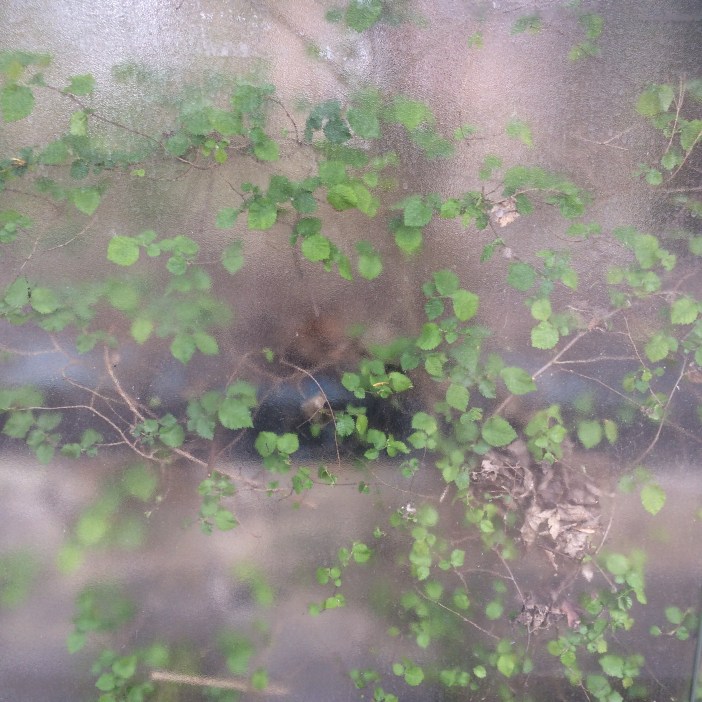
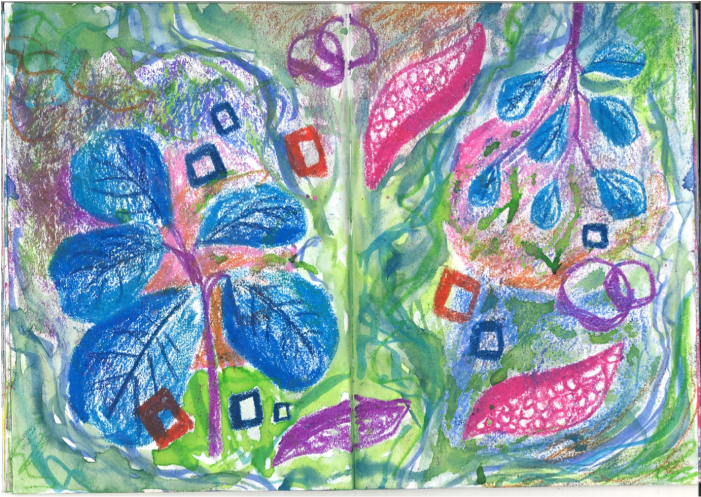


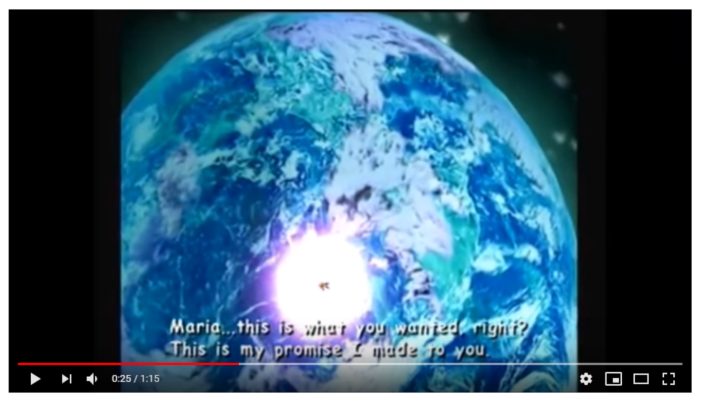

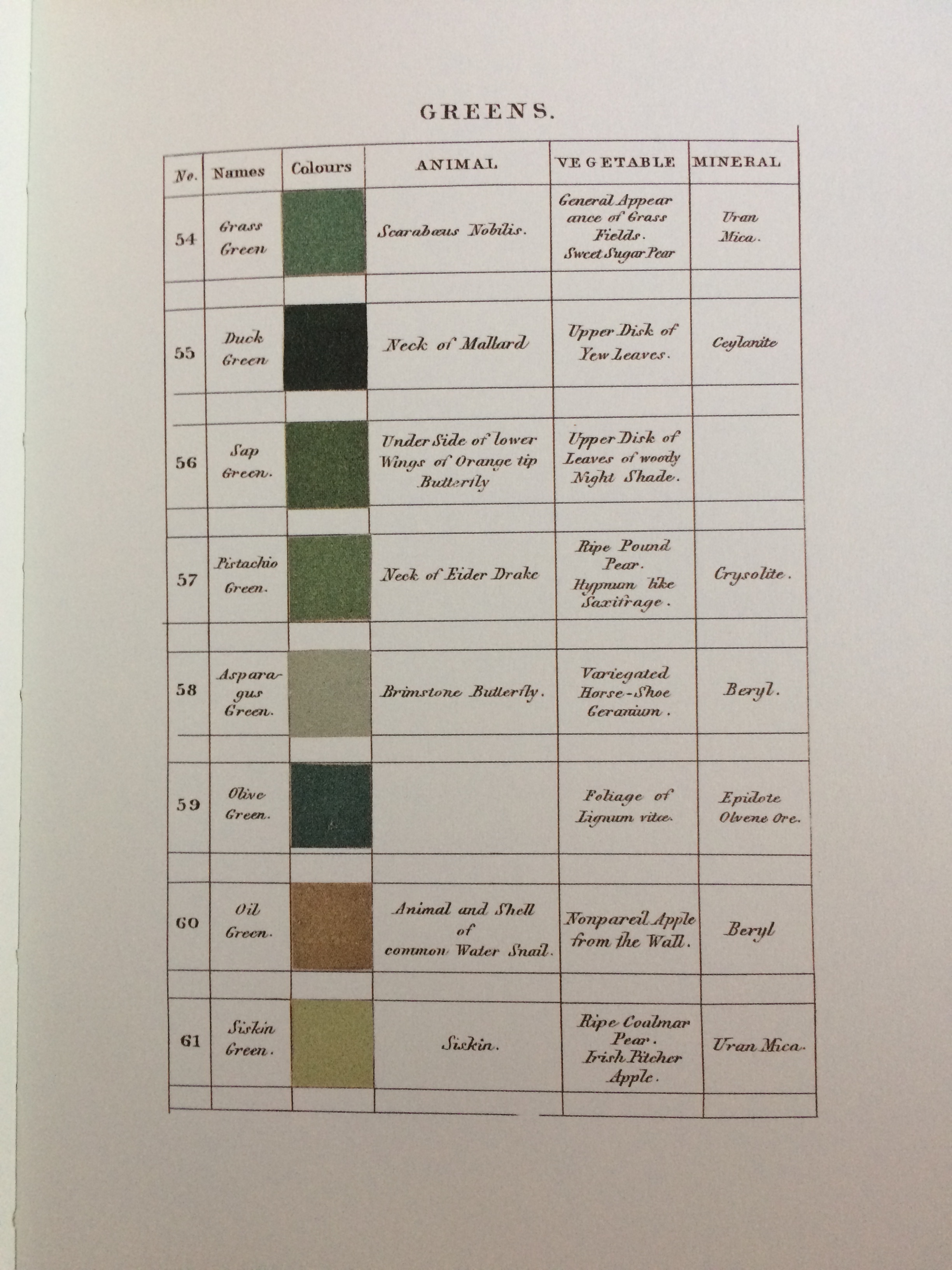
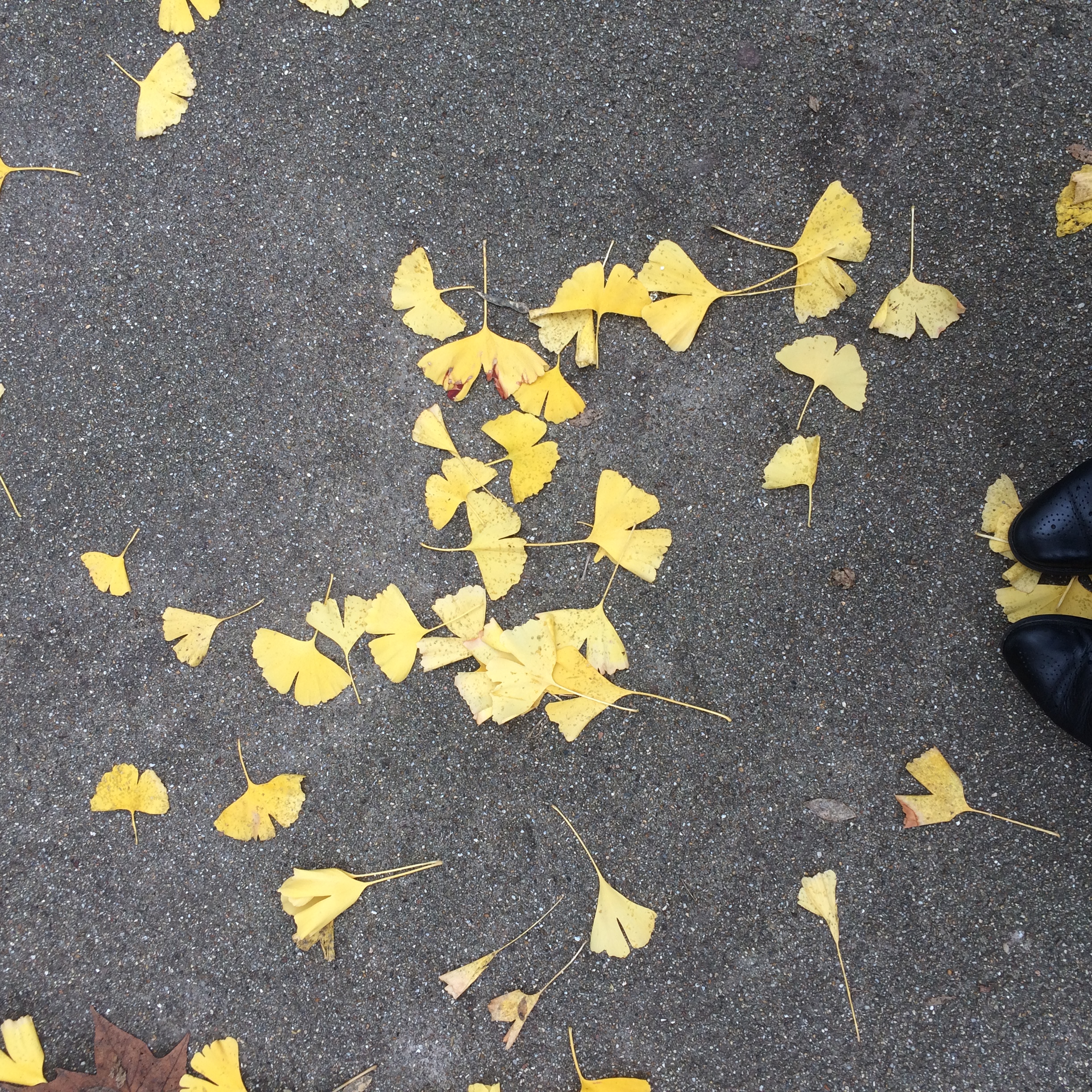
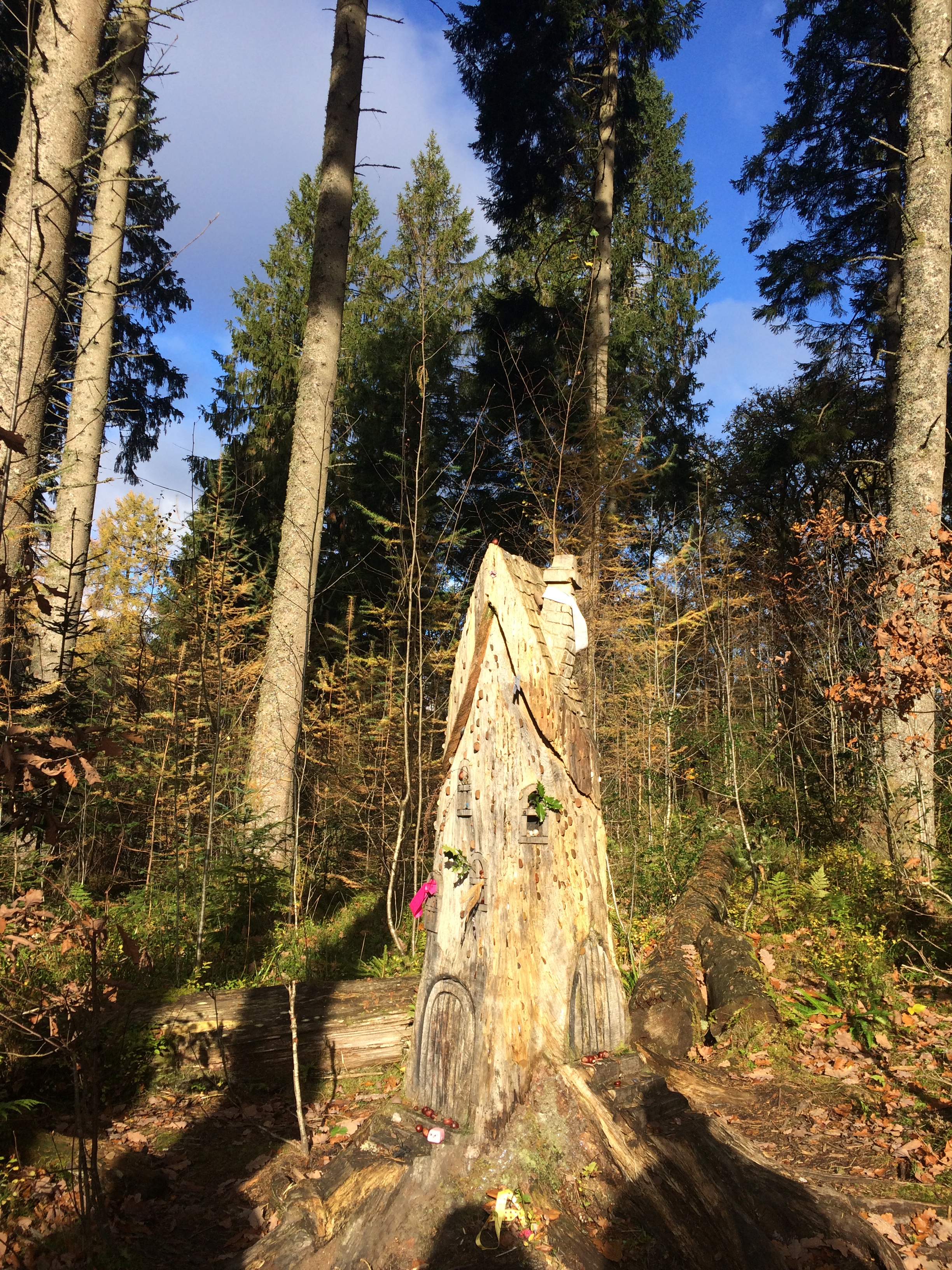
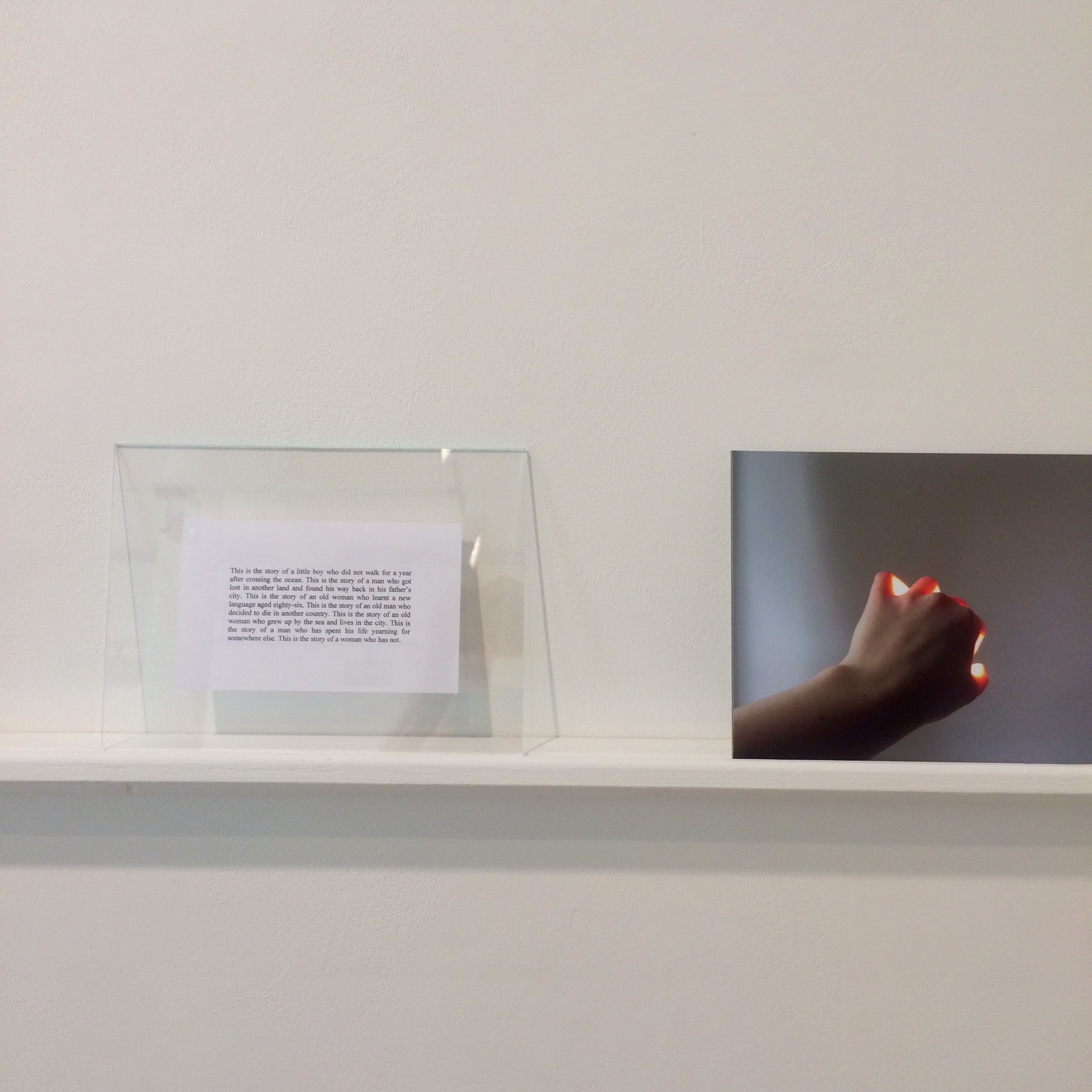
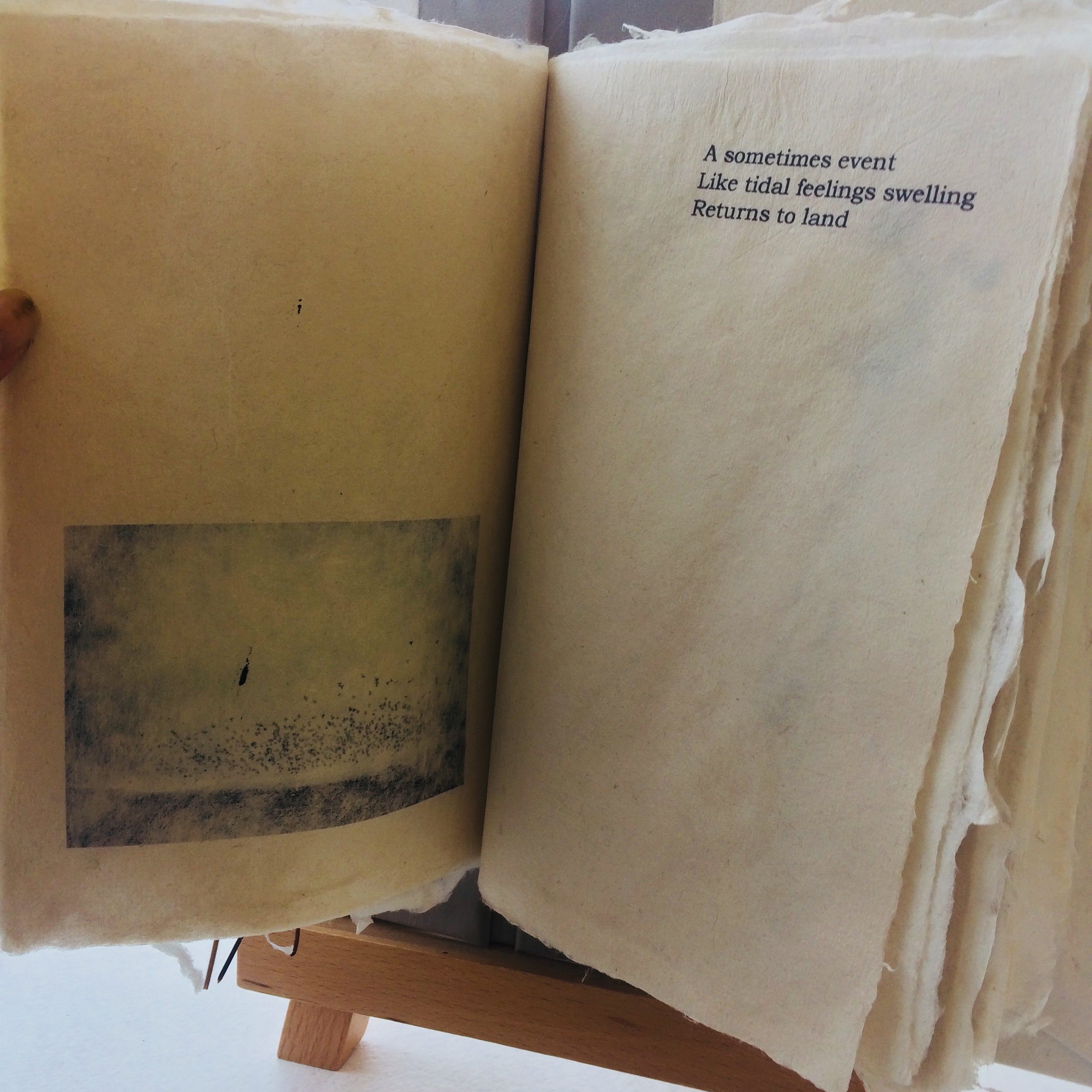
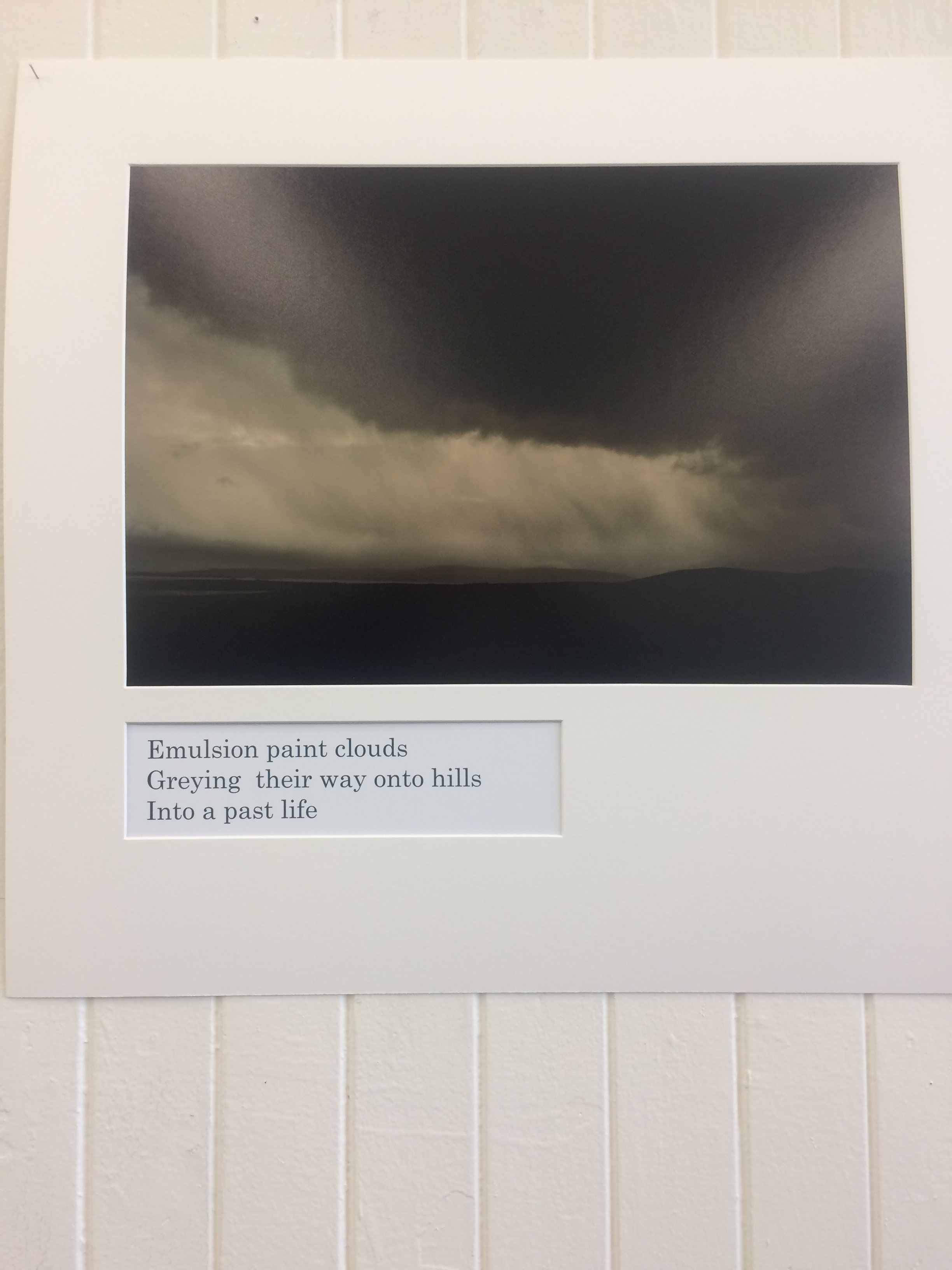
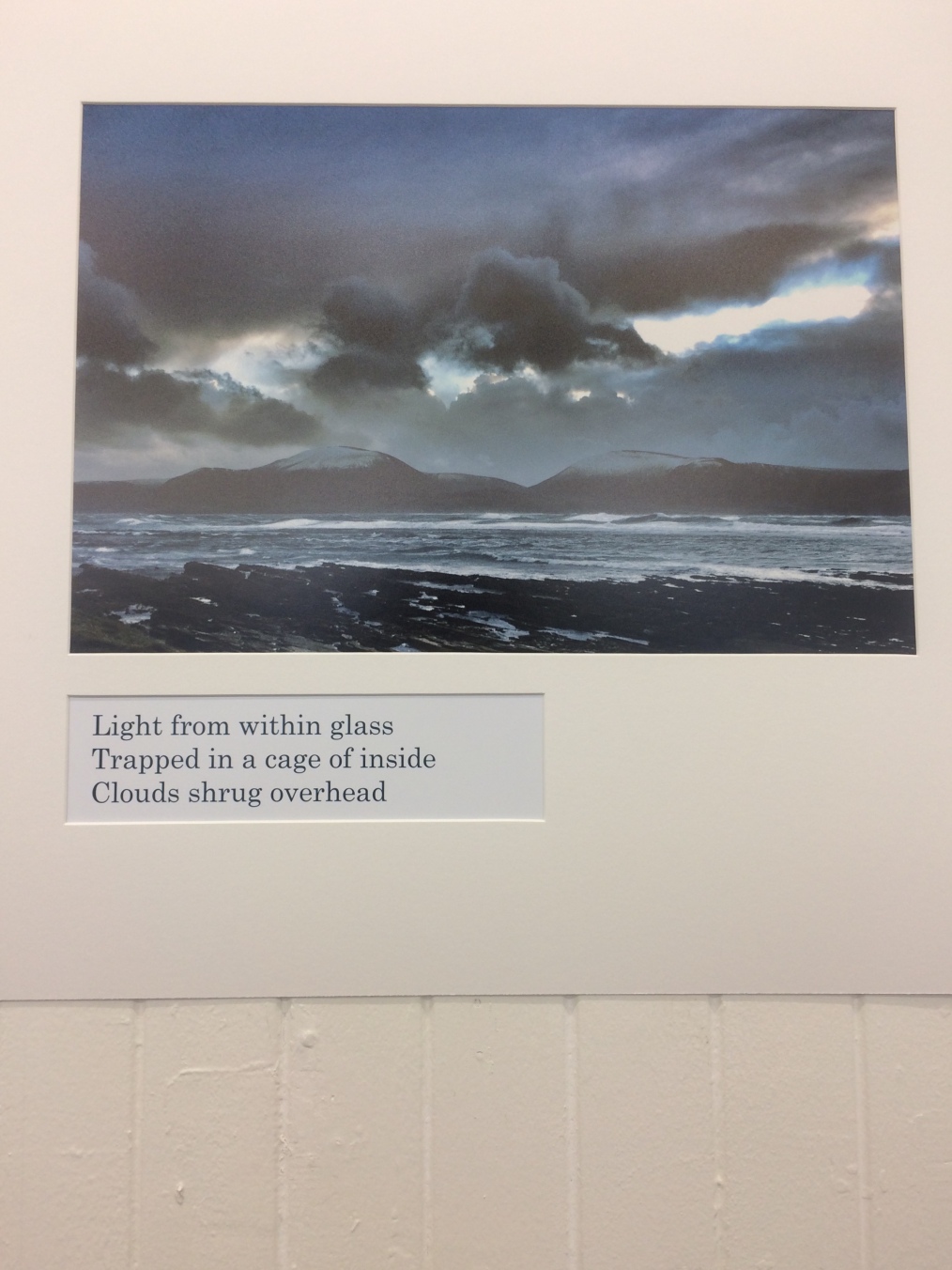
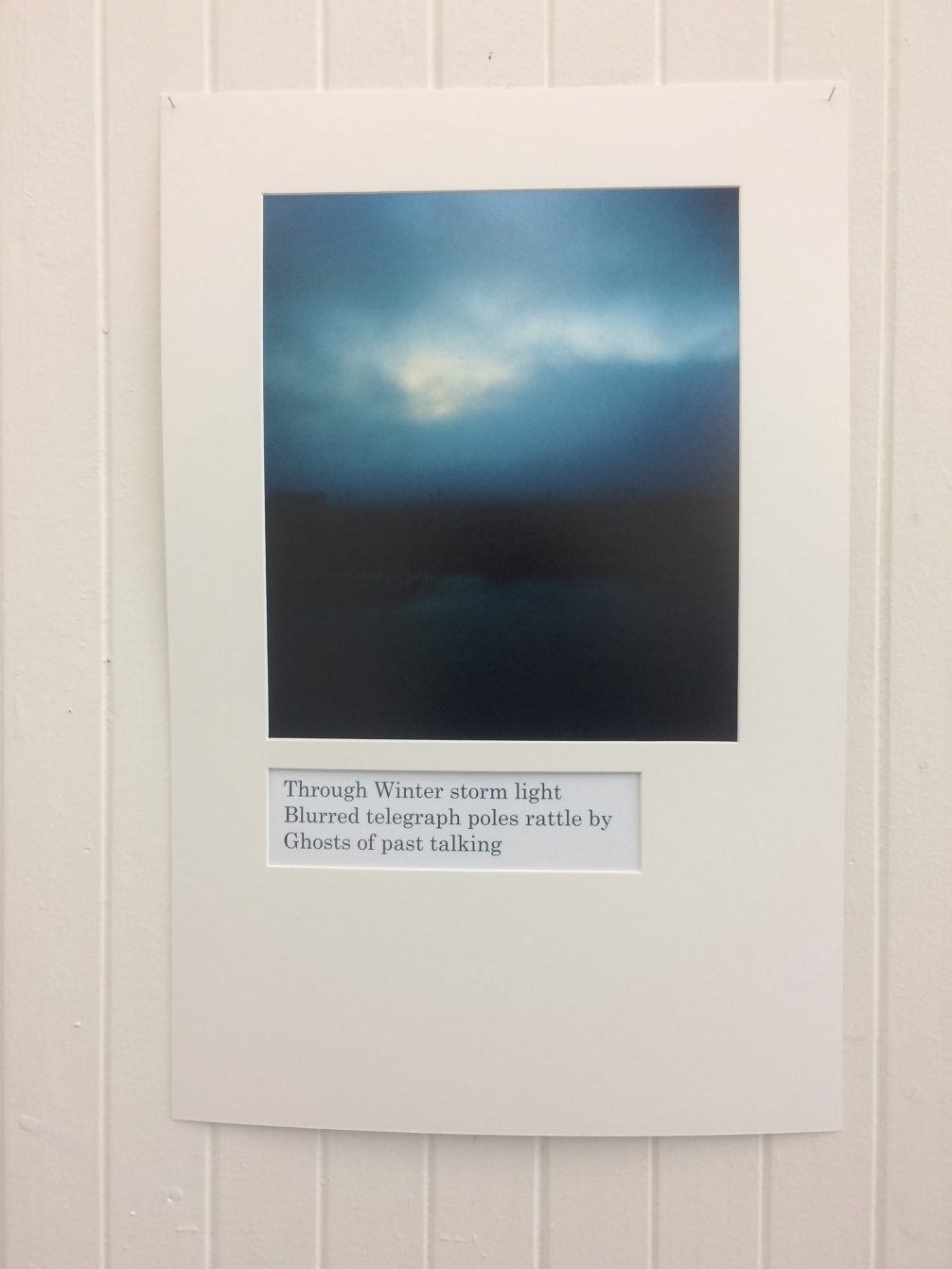
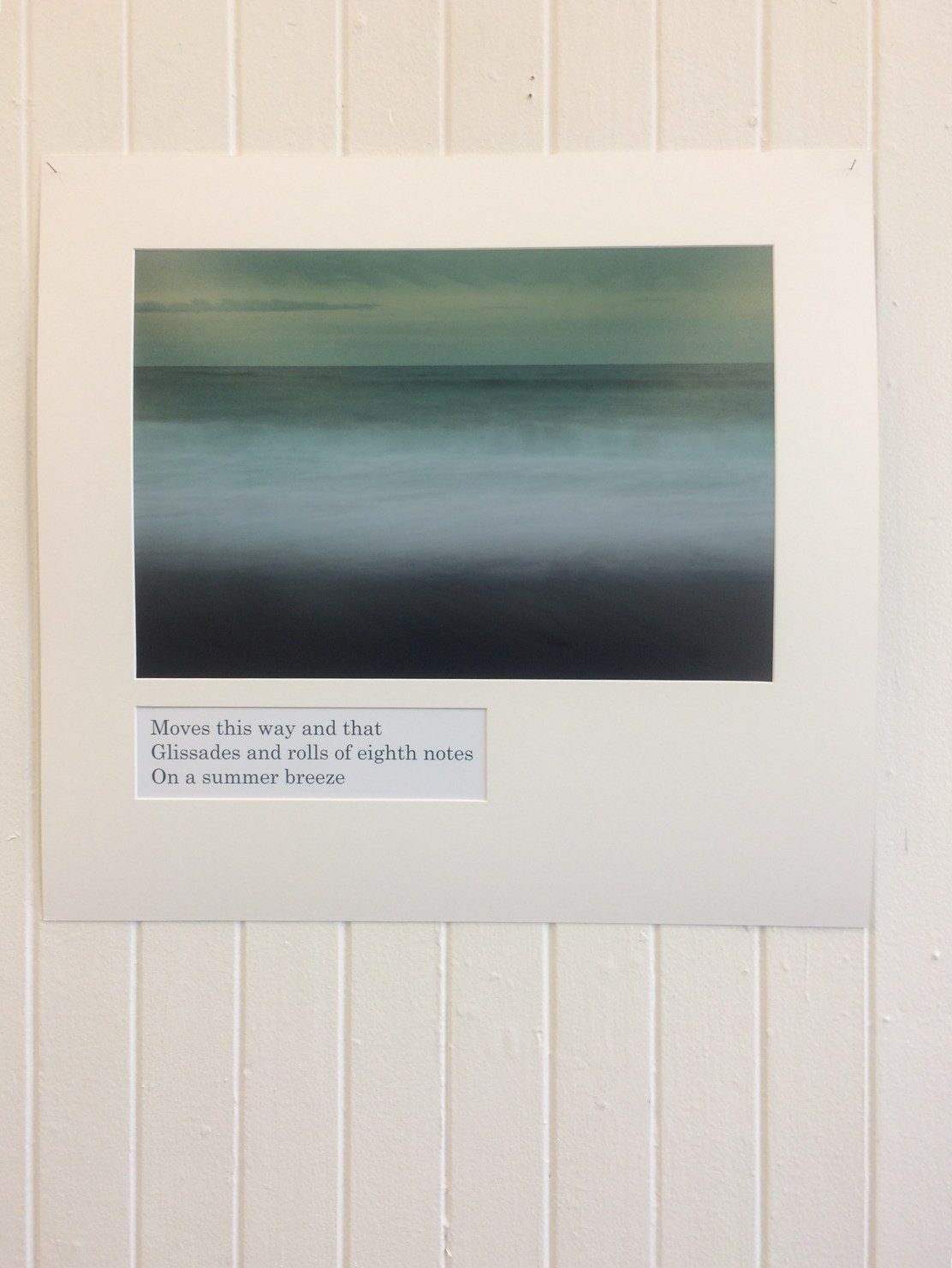
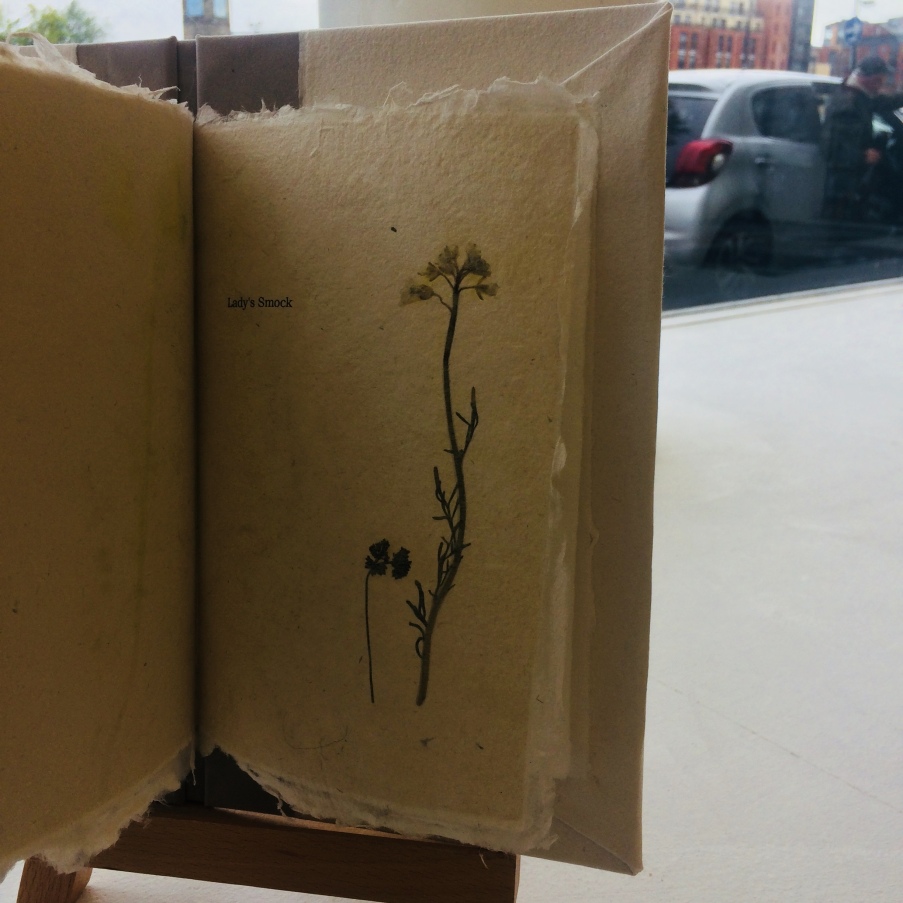
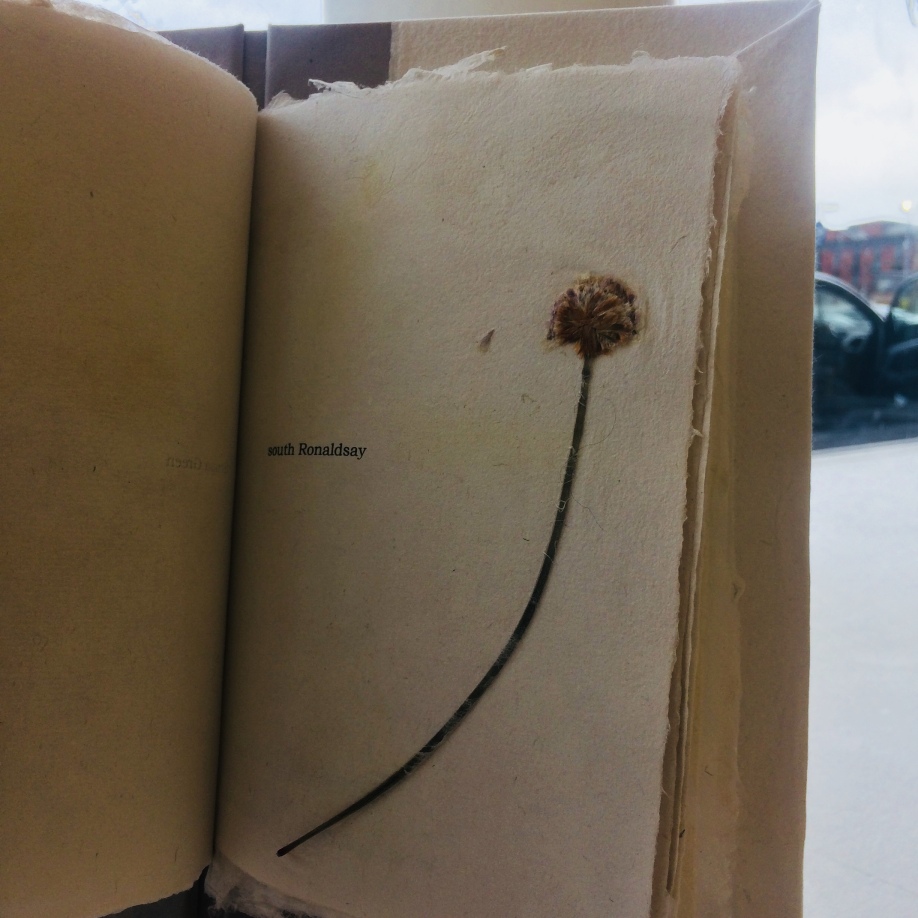
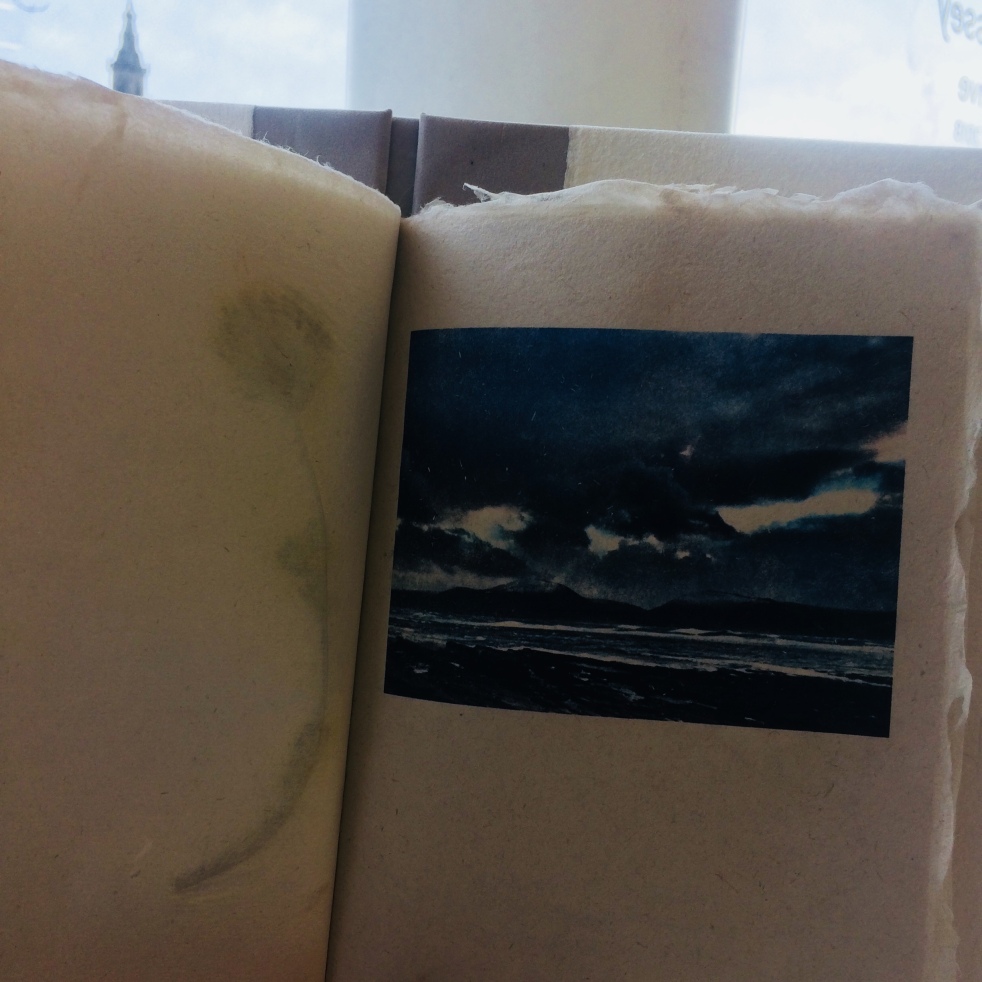
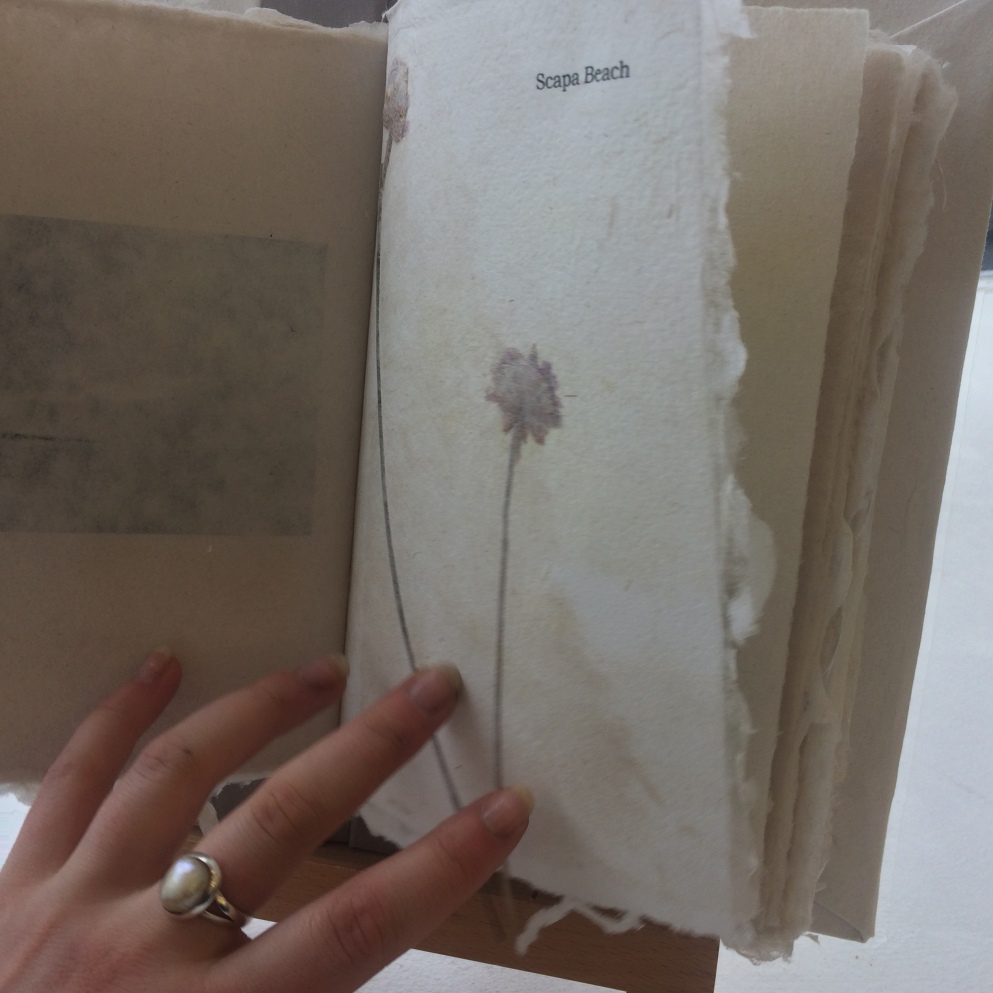
 mariaology