American Psycho: Sex, Violence, Technology and Society

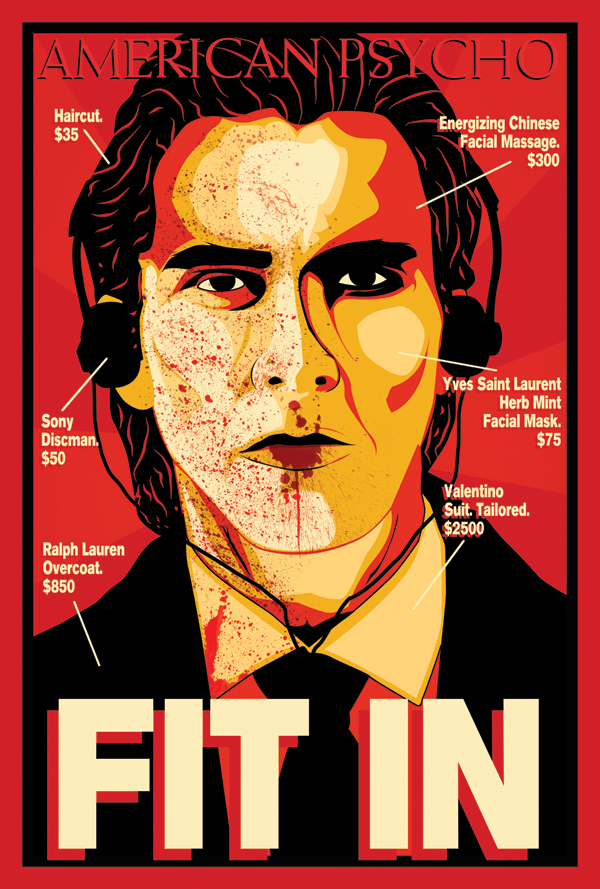
Image source: http://images6.fanpop.com/image/photos/33100000/Fit-In-american-psycho-33196259-600-889.png

I have just read a book that has all at once captivated, disgusted and intrigued me; a book that has left me strangely both emotionally drained and intellectually stimulated. Bret Easton Ellis’ American Psycho plunges the reader into a world of late 1980s ‘yuppie-ism’: the world of Wall Street, hyper-consumption, misogyny, racism, inane pop culture, television, sex…and violence. Written from the first person perspective of its protagonist (although somehow I find the term protagonist with its heroic connotations inadequate), Patrick Bateman, the novel has an unusual cyclical structure that plays out as a repetitive narrative of visits to classy restaurants, mundane descriptions of the latest consumer goods, chapters that read like music reviews and then the most controversial element: the horrifically graphic scenes of sexual violence and psychopathic slaughtering that got the book banned by its initially intended publishers.

Yet I don’t believe that Ellis includes these gruesome chapters just as a twisted indulgence, a pornography of violence. As I will discuss, they play a part in Ellis’ searing, often satirical portrayal of the Reagan era in America: a critique of neo-liberal values, consumerism and technology that is arguably more pertinent today than it was twenty years ago. The heartlessness, depravity and monotony of this culture and the novel itself is summed up in the opening line: ‘abandon all hope ye who enter here’, which is ‘scrawled in blood red lettering’ on the side of a building. This quote is an intertextual reference to Dante, who in his Divine Comedy suggested that this was the written passage that appeared in the entrance to Hell. When you pick up American Psycho and read the first lines, which immerse the reader immediately in the divided cityscape of 1980s New York – a world of graffiti, advertisements and pop culture – you cross over a threshold, you cross over into a tightly-confined mind that experiences its own corruption in a fictional universe that is all too like our own. What is interesting about the novel is on the one hand its hypothetical exploration of the thoughts of a psychopath, but also its trenchant critique of a society obsessed with surfaces, purchases and the perpetual presence of the flickering flow of television; a society plummeting towards absurdity and the eradication of all meaning – at all levels from the individual mind to the collective conscience.

Despite being the novel’s narrator, Bateman reveals little about himself other than his routines, his clothes and his opinionated taste in music. He indulges in lengthy passages detailing his workouts, his use of face masks, his appearance, eating habits, sexual interests; but the novel provides little in the way of solid character description. The narrative is therefore intensely claustrophobic, as we are restricted to Bateman’s narrow, white, narcissistic upper-class view. Moreover we know nothing of the Bateman behind the suit and Ray-Bans; we don’t know about his childhood, his relationship with his parents is only briefly suggested in a single flash of a chapter, and although it is the source of so much expendable income, we never find out what he actually does at work, other than order his secretary to make him dinner reservations. This latter point is especially interesting within the context of contemporary culture, where people are becoming ever-more critical of what these high-flying guys in banking and finance actually do; as bonuses and salaries remain sky-high in spite of the recession, there is increasing concern with regards tothe elaborate and obscure games that these ‘yuppies’ spend their time with – playing with money, justifying their existence. Ellis clearly does not seek to redeem the Wall Street yuppie, but instead caricatures his position and the career in general – which for me culminates most humorously in a chapter where Bateman and his coworkers engage in a highly-charged comparison of the stylishness of their respective business cards, that reads like a competition between prehistoric men flexing their muscles or showing off their hunting skills.

This leads into the question of masculinity and self in the novel. In a world where the most socially-esteemed jobs require what might be considered traditionally ‘emasculated’ behaviour – Bateman, it seems, is a proto-metrosexual – how do men assert their masculine identities, especially with the increasing challenge of the rising status of women? Bateman’s gendered self is ambiguous: on the one hand he is obsessed with his physical appearance – going for regular manicures, massages, constantly working out and asking if his hair looks good – and on the other asserting patriarchal dominance by literally killing, and in some cases torturing, those that either threaten his position (e.g. his colleague Paul Owen who has the superior business card) or those that he is different from and wishes to demonstrate are beneath him: women (especially models and prostitutes), beggars and homosexuals. This creates a bizarre, twisted sense of capitalism gone mad, of the ‘dog-eat-dog’ ideology of everyman for himself, of free market competition gone out of control. The individual, in his quest for success, seeks a greedy taste of the ‘Swordfish meatloaf with kiwi mustard’; that is, the excess and the addictiveness of the American Dream.

The novel thus remains engaged with material inequality, even though its focus is on one end of the scale – the high-flying lifestyle of yuppie clubs and restaurants. Throughout the book, Bateman and his friends taunt the plethora of beggars that haunt the streets of New York, holding out bills of money only to snatch them away in front of their starving eyes. At one point, Bateman even shoots a busker, just because he can; because he has the urge to kill and feels the man’s life is worthless. Yet there is an ironic discrepancy between Bateman’s behaviour and the outward image he projects of someone in tune with social problems. Early in the novel, Bateman delivers a speech that reads like the words of a politician: ‘we have to end apartheid for one. And slow down the nuclear arms race, stop terrorism and world hunger…strengthen laws to crack down on crime and illegal drugs’. All this from a man who personally terrorises the poor and vulnerable, regularly takes cocaine and is quite happy to waste money on often-uneaten restaurant food whilst trampling all over street beggars. Perhaps, therefore, Ellis meant to parody the hypocrisy of governments that proclaim their acknowledgement of socioeconomic problems but do nothing or little to actually tackle them. The irony of Bateman’s ‘identity’, then, is the way in which his words do not distinguish him but blur him further into convention, as he constructs his self by appropriating the words and values of others – particularly his hero Donald Trump (which says a lot about yuppie conscience). Indeed, this is humorously parodied in the fact that all food and tastes are judged not by individual experience but by reviews characters have read in glossy magazines.

So in spite of Bateman’s carefully constructed external self as a socially-conscious businessman, his identity remains a space of vacuum. Everything around him – his friends, his values, his lifestyle – is utterly superficial, and it turns out that he is too:

‘…there is an idea of a Patrick Bateman, some kind of abstraction, but there is no real me, only an entity, something illusory, and though I can hide my cold gaze and you can shake my hand and feel flesh gripping yours and maybe you can even sense our lifestyles are probably comparable: I simply am not there […] My self is fabricated, an aberration. I am a non-contingent human being. My personality is sketchy and unformed, my heartlessness goes deep and is persistent.’

When it was first published in 1991, American Psycho was accused, among many things, of being a poorly-written, immoral book, but I believe these early critiques were based on strong misreadings. The above passage, with its incisive insight into the thoughts of someone staring into the abyss of his own personality, its chillingly controlled and intoxicating prose, shatters any accusation that Bret Easton Ellis is a bad writer. It opens up the concern of many ‘Generation X’ writers: the paradox of identity in the late twentieth century. In a world where identities become more important, as each person seeks to distinguish themselves within the ocean of material things, selfhood in fact seems to dissolve, fragment, disintegrate under the weight of excessive choice and infinite expectations. Bateman reflects that ‘there is no real me’ in spite of the solid flesh, the personality moulded out of a particular consumer lifestyle, the ‘illusory’ mask of self presented in the fashionable clothes, the haircut, the voguish business card. American Psycho challenges many conventions of the novel, and one is character development: Bateman may become more reflective as the narrative ‘progresses’ but he does not undergo transformation or redemption. He remains all surface, with no core sense of morality and self beneath the veneer of his existential acts – he ‘simply [is] not there’.

This reminded me of Oscar Wilde’s The Picture of Dorian Gray, written a hundred years before American Psycho at the fin-de-siècle of the nineteenth-century. Like the ‘yuppies’ of Wall Street, Dorian and his friend Henry Wotton not only challenge traditional masculinity, as appearance-obsessed ‘dandies’ (the late Victorian metrosexual), but they are also excessively idle and spend their privileged lives like Bateman and his colleagues, indulging in sensual pleasures, conspicuous consumption and attending the finest venues of society. Narcissism and art are thematically central, just as narcissism and pop culture are to American Psycho. The fable-like plot of Dorian Gray turns on a Faustian bargain Dorian makes with the devil, whereby he barters his soul in exchange for eternal youth, so that his portrait grows old and twisted while he remains all surface, forever flawless and smooth. Dorian’s narcissism and pursuit of pleasure leads him into a spiral of moral corruption, visits to opium dens, murder and sexual depravities which, while completely removed from the Ellis’ gore, were nonetheless shocking at the time.

Each novel has lengthy passages cataloguing the material objects that consume the lives of its protagonist, emphasising the vacuity of their identities beneath the sheen of their flawless appearance. Yet Wilde, unlike Ellis, gives his novel closure: he provides some moral consequence to this hedonistic lifestyle, rather than as Ellis does allowing the reigning continuity of surface he gives some ethical depth. While American Psycho’s plot is an endless repetition of music reviews, restaurant, concert and club visits and violence, from which emerges no character development or moral conclusion, Dorian Gray traces the deterioration of a character whose initial purity is corrupted by a range of identifiable sources including art (notably, a ‘poisonous book’ thought to be J. K. Husyman’s A Rebours) and the influence of those around him. Dorian Gray ends with final punishment as Dorian tries to destroy the painting but in doing so reverses the mysterious spell, so that he acquires all the ugliness of his sins and the picture is restored to its original purity. Perhaps this structural difference can be attributed to the distinctive literary contexts of each book: while Wilde was writing in and to some extent subverting Victorian realism, Ellis is embedded within a more postmodern tradition that is sceptical about there being a moral centre to which texts can turn to, and is instead interested in showing how the boundaries of morality and self are not only fluid but at times seemingly invisible.

Indeed, what is particularly intriguing about Bateman’s monologue is the statement: ‘my self is fabricated, an aberration’ (my emphasis). Bateman spends his entire time striving to fabricate a self that fits in with the expected and respected norm embodied by the clone-like yuppies (indeed, because of their similar clothes and haircut they often mistake each others’ identities and this largely goes unquestioned in the narrative) and yet Bateman himself is an ‘aberration’ of this mundane normality. He’s an anomaly, defined by his psychopathic serial killer tendencies. Yet by linking the two – conformity and deviance – the text suggests that perhaps Bateman’s psychopathy is a product of society; it is not just a personal pathology but deeply embedded within the frustrating, depthless culture in which he finds himself skidding along with no hope of even drowning in. There is no way of drowning in a postmodern, or what Baudrillard calls a ‘hyper-real’ world where everything is interchangeable and signs refer to nothing but an endless stream of more signs – a choking bombardment of advertisements, appearances and vacuous conversation. Murder, rape and drugs provide some alternate reality, something real and solid and potent, that produce actual effects and allow Bateman to distinguish himself in some dark, significant way, even just as an ‘aberration’. It’s a chilling thought.

Although the novel never punishes its serial killer – Bateman is never caught, even though he drags a body-bag through the street, is helicopter-searched by police and leaves rotten body parts stewing in his apartment – the absence of a moral framework actually adds to the richness of the text. In his essay ‘From Work to Text’ Roland Barthes argues that the ‘writerly’ text offers up a plurality of readings rather than containing a single concrete meaning. It is in a sense an ‘event’, a surface (particularly relevant to American Psycho!) which engages the reader in a ‘practical collaboration’. This is achieved by the proliferate meanings offered up by the text: the intertextual references (abundant in Ellis’ novel, from Dante to Satre to Whitney Houston) and the elaborate web of signification spun in the writing, which encourages the reader to weave a fabric of meaning from the complexity of clues scattered throughout the prose. The pleasure of the text is our freedom to skip over passages, and to pay more attention to others. To endlessly reread and gain new insight, to create new meaning from. I find myself skim-reading the endless monologues about the latest technology, and often skipping entirely the really graphic parts; but this is not necessarily a bad thing, it merely prompts me to reflect on my role as reader in playing a role in constructing meaning in the text. It isn’t just there, but I actively make it depending on what I want to get from it.

Ellis also engages the reader in the ‘free play’ of meaning by leaving significant gaps in his text; the most notable of these gaps is the question of the unreliable narrator. Wayne C. Booth defines the narrator as ‘reliable when he speaks for or acts in accordance with the norms of the work (which is to say, the implied author’s norms, unreliable when he does not’. The subtle but at times overt irony that plays out in American Psycho, from Bateman’s extreme sexual and violent conquests and the ease in which he gets away with them to the literary language itself, is essential to raising questions about Bateman’s reliability. The tone he uses to describe the monotony of having to make reservations and his matter-of-fact description of his gym is the same tone used in his description of the scenes of grotesque and sadistic torture, necrophilia and cannibalism. Not only does this suggest that Bateman has been desensitized to pornography and violence but it also blends the normal and the abnormal together into a disturbingly hyperreal narrative of contemporary life. A life where rape and murder deserve no more expressive prose than a trip to ‘return some video tapes’. The prosaic language used to describe these scenes evacuates all possibility of the erotic or suspense that characterises porn or horror and instead foregrounds the acts themselves as real, painful and distorted occurrences – which in turn leave us with a sickening sense of our own voyeurism, raising wider questions about society’s enjoyment of such explicit forms of cultural entertainment. This notion of voyeurism is also highlighted by the repeated occurrence of such scenes (often signified by the foreboding chapter heading ‘Girls’ which I came to dread), creating a circular narrative which emphasises the text’s sense of claustrophobia and entrapment and recreating the inescapability of the distastefully explicit within modern culture.

Moreover, in relation to unreliable narration, the absurdity of Bateman’s rampant and seemingly meaningless killing sprees raises the question of whether what Bateman does is actually occurring, or whether it is an extended fantasy he projects as a way of indulging in his feeling of vacuity and ‘heartlessness’ within a featureless life of mind-numbing consumption. Is he merely fabricating his own alter-existence that plays out just like the pornographic films he rents from the video-store? The text provides little evidence to confirm or deny Bateman’s reliability, and this is what is so seductive about American Psycho: the fact that we as readers are left to judge the veracity of Bateman’s narration, which in turn leaves us within a complex moral vacuum. Unlike other books about serial killers, American Psycho doesn’t contain a detailed narrative explaining the root causes of Bateman’s pathology – abuse in childhood, a defined psychiatric condition etc. Bateman pops valium, Halcion and various other ‘pop’ drugs but he is not on medication for paranoid schizophrenia, multiple personality disorder or the like; the blame for his condition is thus found within a complexity of societal factors rather than an easy psychological diagnosis. The exact cause is left for the reader to decide: we have to map out Bateman’s life – his pleasures, his friends, his behaviour – in order to make judgements about the myriad origins of his psychopathy.

Another area of contemporary society which Ellis explores critically in American Psycho is technology; specifically, television and the telephone. The telephone was invented to improve communication, but in the novel it is the site of communication breakdown. For example, when Bateman and his coworkers make a conference call to decide their evening plans, the conversation breaks down into meaningless and often disconnected statements. There is nothing efficient about this communication. Moreover, the telephone presents an uncanny means of correspondence, since it removes the face and replaces it with the voice. This makes the person at the end of the line both familiar and unfamiliar, which raises interesting questions in terms of the fluidity and fragmentation of self depicted in American Psycho. At what could be argued is the novel’s most intense point, whereby Bateman has been on a killing spree, is chased by police and is now hiding in his office, he makes a call to his lawyer and leaves a message detailing all the murders he is committed. Yet when he meets his lawyer the next day, the lawyer not only refuses to believe the answer-phone message but he actually thinks Bateman is someone else – he thinks that the message was a joke played by someone else at Bateman’s expense. Telephone technology has not increased the potential for meaningful and intimate human interaction but merely created further distance, and in doing so distorted what is real and disconnected the ‘I’ that is speaking.

In terms of television, the book is rich with critical analysis. The debate about TV images and their influence on human behaviour goes all the way back to Plato. In The Republic, Plato puts forward the analogy of a cave in which prisoners have been chained since childhood so that all they can do is stare at the shadows on the wall which create shapes and sound; this is the only reality they know of, yet it is a reality constituted merely by the shadows of things, not the things themselves. If one prisoner escapes and sees REALITY itself, it will seem less real than the shadows. Like the prisoners of the cave, most people in contemporary society are in a sense ‘chained’ to the all-pervasive presence of television, which has become the source of much of our knowledge: the ‘shadow’ images of television are used to shape our morality, ideals, values etc – our whole perception of the world. Television, moreover, provides a perpetual ‘flow’ of time, squashing the past and present together in an ‘extended present’, which gives a rhythm and routine to our daily lives. Bateman’s life is partially constructed around his watching of the morning The Patty Winters Show, Late Night With David Letterman and endlessly re-watched video tapes such as the thriller Body Double in which a girl is murdered by a handheld drill.

When television images are extreme ones of hardcore pornography or violence, questions are raised about how far they can be blamed for real life violent behaviour. Perhaps Bateman can so easily murder without remorse because his acts of violence seem less real than the highly stylised images he consumes on a daily basis. This is a real life concern: the murder of James Bulger by two young boys in 1993 was blamed by some on the film Child’s Play 3, leading to calls for a ban on the film. Anthony Burgess’ novel also explores this link between video images and violence in A Clockwork Orange, where classical Pavlovian conditioning is used to re-calibrate the protagonists’ perception of violence: Alex is strapped to a chair, injected with a nausea-inducing drug and forced to watch violent films so that he learns to associate cruelty with sickness. Yet eventually, this ‘Ludovico technique’ is reversed and once again he is back to the same old daydreams of bloodlust; it is only through a process of experience and growing up that Alex comes to leave his days of brutality behind. Thus rather than allowing for a simple causal effect between images and action, Burgess overall complicates the relationship between television and violence.

A more recent play by Martin McDonagh, The Pillowman, is also a useful text for grappling with the link between art and violence. The play’s storyteller, Katurian, claims that ‘the only duty of a storyteller is to tell a story’, yet his stories become implicated in criminality as they have influenced others to commit crimes that copy the sinister plots of his fables (which involve swallowing apple-men containing razor blades and child crucifixion). It’s an infinitely dark and at times sorrowful play, but also it’s very funny: it raises a myriad of questions about authorial responsibility but rather than answering them The Pillowman blasts all moral closure with nihilistic conclusions, green pigs and its at times absurd, circular dialogue. It is a very clever, layered, metafictional commentary on the relationship between art, suffering and violence and I highly recommend it.

So to what extent is Bateman’s behaviour the product of the films he watches, or the TV shows which range in topics from ‘Toddler Murderers’ to ‘a man who set his daughter on fire while she was giving birth’? Again, the text offers no straightforward answers, and indeed it is possible that the orgiastic violence he indulges in isn’t real at all but merely fantasies extended from the flickering images he sees on television. This is an intriguing idea, especially going back to Plato’s notion that the man who leaves the cave will find reality less real than the shadows; the text leaves the question of what is ‘real’ in the novel, and even – what are the implications for the violence of American Psycho itself? It may be classified as fiction, but feminist group NOW attacked the novel upon publication as ‘a how-to novel on the torture and dismemberment of women’. Will some readers read Ellis’ text naively? Can it be blamed for furthering society’s desensitizing towards violence through its graphic scenes?

I think what redeems American Psycho in this respect is its self-conscious irony. Yes, it is horrifically graphic, but it does so for a purpose: to deconstruct and expose the way in which slasher movies, porn and the like have become part of popular culture, and to restore a shocking element to these forms of entertainment which have become so stylised and normalised. Additionally, like The Pillowman, Ellis’ book is also inherently funny. There are random standout lines such as the comment ‘”I bet Bono has a small dick,”’’ when Bateman and his friends go to a U2 concert, and also the narrative contains many running jokes, such as Bateman’s compulsive need to ‘return some video tapes’, and several repeated miscommunications such as when Bateman says he works in ‘murders and executions’ but this is interpreted as ‘mergers and acquisitions’, thus blending together ironically Bateman’s mundane day-job with his vicious night-job. There are also surprising parts of the book which seem human, such as when Bateman visits his mother in her care-home and all he can do is look at himself vainly in the mirror that he’s ‘insisted’ on having there and think about are the expensive things she’s wearing (bought by him). When Bateman asks his mother what she wants, her reply: ‘“I don’t know. I just want to have a nice Christmas”’ is tearfully poignant in that it summarises the inability of consumption to fill the gap in their relationship, to fulfill the mother’s spiritual need to enjoy Christmas, a traditionally family-orientated event. The maternal relationship is hinted as strained and distant as all mother and son can say to one another is ‘“you look unhappy”’ and talk ‘“uselessly”’ of a recent party. This breakdown in communication is actually full of pathos and presents a refreshing break in the text, but one that opens up another possible, yet unexplored, avenue of explanation for Bateman’s insanity.

In sum, the text offers no answers. Bateman’s violence we must explain ourselves by piecing together the various sources in the text – from television to consumerism to a societal crisis of masculinity. Ellis doesn’t pretend to moralise, and his book ends with the ambiguous reference to Sartre’s play No Exit, as Bateman stares at a red-lettered sign on the door of a bar saying ‘this is not an exit’. The text thus begins and ends with a textual allusion to hell, but hell itself is not contained within the novel – the end is not an exit from the tortuously mundane, unequal and cruel world Bateman exists in – it is firmly our own world, from which there is no exit. This is an unsettling and nihilistic vision, but one in which unfortunately resonates as violence, consumption, immoral bankers, social inequality, identity crises and televisual domination are all swarming features of life in the twenty-first century; perhaps even more so than back in the late 1980s where the novel is set. The musical backdrop may have changed, but largely, the culture has not. And this relevance factor is why I recommend American Psycho.


Bibliography

Barthes, R. ‘From Work to Text’.

Burgess, A. A Clockwork Orange.

Dante, A. Divine Comedy.

Ellis, B. E. American Psycho.

McDonagh, M. The Pillowman.

Plato, The Republic.

Satre, J. P. No Exit.

Wilde, O. The Picture of Dorian Gray.

http://www.nytimes.com/1990/12/06/books/now-chapter-seeks-boycott-of-psycho-novel.html

http://theater.nytimes.com/2005/05/06/theater/newsandfeatures/06note.html?position=&_r=0&adxnnl=1&pagewanted=print&adxnnlx=1370079884-9qmE05+JL/NXsusA29JsyA


Wordsworth’s The Prelude and the Death(?) of the Author

Wordsworth’s The Prelude is a pretty formidable poem, not least due to its length. I initially encountered it in my first year of studies as an English Literature undergraduate, within a course entitled ‘Writing & Self’. There was no obligation to tackle the entire poem – we just had to look at a few extracts and try to get to grips with Wordsworth’s philosophy on the relationship between nature, memory and selfhood. Selfhood. That elusive concept; you think you know it, but no – the post-structuralists, modernists and Samuel Beckett have something radically different to say about it. Not going to lie though, I really enjoyed it in the end. The really long poetry? Not so much…

At the time, I was disinterested in the seemingly repetitive obsession with the natural world, what seemed like bland blank verse, and the endless length. However, after studying more recently Milton’s marathon-of-a-poem Paradise Lost, with all its mythical references beyond my grasp, Wordsworth’s doesn’t seem so scary. In fact, I felt the urge to go back to it and think about how my perception may have changed. What interests me about it now, with (hopefully) a little more intellectual maturity, is not only the poem’s emotive value but also the way it sheds an interesting light on some theories I’ve been looking at recently.

Roland Barthes, in a famous essay called ‘The Death of the Author’, argued against the Romantic conception of author as god-like genius held by writers such as Wordsworth:

[…] a text does not consist of a line of words, releasing a single “theological” meaning (the “message” of the Author-God), but is a space of many dimensions, in which are wedded and contested various kinds of writing, no one of which is original: the text is a tissue of citations, resulting from the thousand sources of culture.

The idea that no writing is original, but instead a ‘tissue of citations’ borrowing meaning from the myriad of texts and other references (written or oral) floating in the social world of language has profound consequences for the way we approach literature. The notion that literary texts do not contain a single, ‘intended’ meaning released by the authorial author was posited by the New Critics of the early twentieth-century, Wimsatt and Beardsley. In ‘The Intentional Fallacy’, Wimsatt and Beardsley argued that good criticism shouldn’t try to decipher an author’s intended meaning but instead look at how the poem succeeds in creating meaning through its form, claiming simply that ‘judging a poem is like judging a pudding or a machine. One demands that it work.’ Their definition of what ‘works’ in poetry was that style contributed to substance; in other words, the poem’s metre, rhyme and metaphor evoked the feelings and understandings appropriate to the poem’s meaning – a meaning that should be deciphered, then, not in reference to the author’s intentions but in reference solely to the text on the page. The New Critics, however, differ from Barthes in that they believe a text contains a complete, unified meaning that can be ‘unlocked’ by studying the text, whereas Barthes is saying the text is inherently plural, due to the unstable and intertextual nature of language and literature.

Going back to Wordsworth’s The Prelude, an epic poem defined by its status as the autobiographical unfolding of a poet’s personal and artistic growth (a quest for self-expression famously rewritten by Elizabeth Barrett Browning in Aurora Leigh from a female perspective), seems problematic within the context of twentieth-century New Criticism. How are we to approach a poem that is concerned primarily with the poet’s mind and experience?   A poem that Wordsworth has literally put himself into? The poet himself described The Prelude as ‘a poem on the growth of my own mind’. Is it possible, then, to ignore his presence, and relegate the autobiographical context of the poem to a shadowy distance?

I think the two positions can be reconciled. Wordsworth’s poem may delve into personal experience, but he is by no means the only poet in the world that does so – let alone the only poet interested in the relationship between art and nature. Criticism is used to finding inventive ways of looking at a poem that may or may not involve the poet’s self and life. We could, in the following of Harold Bloom’s ‘Anxiety of Influence’, consider how his use of blank verse constitutes an Oedipal struggle with his predecessor Milton. We could examine the more political elements of the poem, and how they relate to the cultural and social context of the time, or even the complex philosophical ideas Wordsworth espouses.

I myself am interested in the poet’s voice: the way he narrates fragments of experience to build up to the whole of his self, his artistic vision. I am also interested in the fluctuating effects of self-estrangement and unification, and the evocation of memory that permeates the text. Here is one of my favourite extracts of The Prelude:

One summer evening (led by her) I found

A little boat tied to a willow tree

Within a rocky cove, its usual home.

Straight I unloosed her chain, and stepping in

Pushed from the shore. It was an act of stealth

And troubled pleasure, nor without the voice

Of mountain-echoes did my boat move on;

Leaving behind her still, on either side,

Small circles glittering idly in the moon,

Until they melted all into one track

Of sparkling light. But now, like one who rows,

Proud of his skill, to reach a chosen point

With an unswerving line, I fixed my view

Upon the summit of a craggy ridge,

The horizon’s utmost boundary; far above

Was nothing but the stars and the grey sky.

She was an elfin pinnace; lustily

I dipped my oars into the silent lake,

And, as I rose upon the stroke, my boat

Went heaving through the water like a swan;

When, from behind that craggy steep till then

The horizon’s bound, a huge peak, black and huge,

As if with voluntary power instinct,

Upreared its head. I struck and struck again,

And growing still in stature the grim shape

Towered up between me and the stars, and still,

For so it seemed, with purpose of its own

And measured motion like a living thing,

Strode after me. With trembling oars I turned,

And through the silent water stole my way

Back to the covert of the willow tree;

There in her mooring-place I left my bark, –

And through the meadows homeward went, in grave

And serious mood; but after I had seen

That spectacle, for many days, my brain

Worked with a dim and undetermined sense

Of unknown modes of being; o’er my thoughts

There hung a darkness, call it solitude

Or blank desertion. No familiar shapes

Remained, no pleasant images of trees,

Of sea or sky, no colours of green fields;

But huge and mighty forms, that do not live

Like living men, moved slowly through the mind

By day, and were a trouble to my dreams.


A New Critical reading here could look at many poetic elements and examine how they contribute to an overall meaning. Indeed, I think the New Critical approach always has great value in unlocking the text – not in the sense of unlocking some kind of hidden meaning – but in unlocking the nuanced structures and framework of techniques that produce particular effects. Yet this kind of close reading can also go hand-in-hand with considerations of writerly subjectivity and creation, especially for an overtly autobiographical work like The Prelude. Although Wordsworth termed poetry ‘the spontaneous overflow of powerful feelings’, he also noted that it was ‘emotion recollected in tranquillity’; in other words, poetry comes from the self, from a kind of organic inspiration caused by worldly experience, but it is only upon reflection and considered reconstruction that good poetry is created.

Of course, whether poetry comes from the self or not is irrelevant to New Critics, and for Barthes, this notion is flawed since all language is social: ‘it is language that speaks, not the author’, he claims in Image, Music, Text. It is, however, worthwhile to perhaps consider the ‘ghostly’ presence of the author in the text. Barthes himself admits in The Pleasure of the Text that the reader’s idea of the author plays a fundamental role in his/her reading of the text: ‘in a way, I need the author, I desire his presence’. This intimacy between reader and author is enacted as a kind of strangely corporeal, erotic relationship – where the reader desires the author’s body, in a kind of strip-tease effect as the text is unravelled before the reader’s eyes; but also by the reader, as the text is ‘played’ – as it offers up its ambiguities and gaps for the reader to fill in with his/her own meaning. The presence of the author is the promise of meaning. When I read Wordsworth’s poem, and look for meaning, I am not just thinking of the words on the page – inevitably I have some hazy conception of the writer who writes them, the man wandering the Lake District with words whirling round his brain like blossom caught in the wind. Without my sense of the author, I feel as I open the cover of a book, the text seems hollow; I need to conjure his/her presence to enter the threshold of fiction, and of meaning.

This of course applies to certain texts more than others. If I have no real knowledge of the author, I am able to approach a text with a ‘pure’ mind, but even then, I unconsciously scan for clues as to the possible links the text has to other writers and traditions. The text, then, seems always to be situated in some intangible web of meaning, and only sometimes is the author present, a spider or spectre creeping elusively around my reading of the text.

So, back to the ghostly presence of Wordsworth in this extract. Who is he – who and when and where is the speaking ‘I’ – is it Wordsworth, the physical hand, gnarled with old age (and those trips to the Alps) writing the poem, Wordsworth the young boy (returned to in memory or literally re-living his younger self?), Wordsworth the imagined author, behind a desk in Dove Cottage, conjured by the reader’s imagination…Or perhaps all of these, an uncanny amalgamation of identities? Wordsworth himself never lived to see the poem published; indeed, he was revising it again and again until his final years. So we can’t even be sure which temporal Wordsworth was writing these lines. Which words came at which age? When reading, I feel the fragmented sense of time come together in the quiet and consistent flow of the iambic lines. It seems like the author’s true identity, his ‘true’ intentions or involvement in the poem, slip away under the seduction of the poetry and language.

Milan Kundera in Art of the Novel mentions a distinction between poets with and without history. Wordsworth might here be difficult to classify because he wrote both intimate, lyrical poems and also ones which dealt with the politics and history of the time, such as the Industrial Revolution. In the above extract – a mere snippet of the whole poem, which does at points get historical – I’d like to consider Wordsworth a poet without history; the ‘I’ of the speaker merged with both the poet and the young boy who steals the boat. Memory has transformed the experience into a sublime perspective on the transcendent greatness of the world, the ‘familiar shapes’ evolved into ‘huge and mighty forms, which ‘do not live / like living men’. In other words, forms that will not breathe and change and die like humans, but remain in a powerful position of natural supremacy – an existence that to Wordsworth as a developing poet and young man was almost formidable, ‘a trouble to [his] dreams’. Kundera points out that ‘pure lyric poetry lives in feelings’ which ‘are all given to us at once’, but intensify in the mind of a poet. I feel that Wordsworth’s moving account of the transition of the landscape reflects this, particularly as the weighty blank verse and enjambment create that sense of moving, progressive and natural feeling.

Yet it is also a strange feeling, the sensation and memory of terror that recalls in the eye/the ‘I’ of the poet’s mind. The emotions experienced as a boy are part of the bank of material that builds up to produce poetic inspiration. And yet memory is not a film-tape, recording past events with absolute accuracy. It is malleable, subject to revision, always related to the present moment in which it is recalled. Wordsworth called these ‘spots of time’: moments where some flash of previous existence will burst into consciousness – a thought, a memory, a feeling, a scene from a novel, a line of verse, a melody from a song. This strange release of the past into the fiery now of the present can not always be explained, but they are essential, in Wordsworth’s philosophy, for the development of self. As Locke argued, the self is a continual being only through the continuation of consciousness, and it is through these ‘spots of time’ – gaps in the fabric of our present that catch some thread of our past – that our identity continues to be woven together into a coherent selfhood.

And so, in slight relation to selfhood, the idea of genius, or a poet without history. Barthes has destroyed genius, in his destruction of authorship. We can accept the theoretical ‘truth’ or weight of this, but still acknowledge, at least psychologically, some kind of notion of genius. Genius doesn’t have to mean brilliance, but as Kundera’s book suggests, it conveys something special and unique about creative writing, in that it is inevitably in some way produced by feeling – and this feeling is inextricably related to one’s personal experiences, even if the writer is not aware or rejects this in their writing. Personal experiences are unique, and even though language is not, it is our individual way of assembling language in direct relation to feeling and consciousness that makes writing something special, perhaps magical; that makes writers not merely what Italo Calvino in ‘Cybernetics and Ghosts’ calls ‘literary machines’, churning out elaborate patterns of words from the dictionary.

Moreover, and this may link with Barthes’ writings on readerly pleasure, genius can lie in the reader too. A genius that transcends language, the feeling of what Barthes calls ‘jouissance’ or bliss, that occurs when a text ‘imposes a state of loss’ upon the reader. For if the reader is involved in producing meaning from this lost, he/she too has some kind of genius. When faced with the lines: ‘For so it seemed, with purpose of its own / And measured motion like a living thing, / Strode after me’ we are struck with the sudden, lightning bolt connection between past and present. ‘Seemed’ highlights the idea of visual recollection, of memory recalled in the present. The uncanny anthropomorphism of the ‘huge peak, black and huge’ recalls a childhood terror, but also the adult’s terror of the unknown. Wordsworth, the writing poet, cannot recall exactly what made the peak so terrible. It is merely ‘huge’, ‘huge’ – a monstrous presence burgeoning repeatedly in his memory and thought. This strange severance between feeling and meaning is a kind of bliss, and a kind of fear. The loss is what is left out in the mind; just as Wordsworth’s recollection is a distortion of childhood fright and adult ‘trouble’, the reader’s perception of that looming black peak is the facing of an abyss: ‘there hung a darkness’. An abyss of possibility. What is the nature of the child’s fear, why can Wordsworth recall it – what is it in his present moment that brings back that memory? The only way to find out is to trail the poem’s entirety, searching endlessly for clues that connect the ‘stars’ of the poet’s psychology, of the poem’s constellation of meaning. Yet there will always be these chasms, where it seems that meaning is lost – where, as the black peak separates the ‘I’ from the ‘stars’, the reader faces an aporia, a non-road separating the word on the page with its meaning, its interpretation. The author’s intentions are lost, and the dictionary fails us.

I have tried to compare Wordsworth’s experience of nature with the experience of reading, as an activity profoundly connected with both loss and creation, with darkness and strangeness but also the ‘sparkling light’ that seems to seduce us into the bewitching land of literature.

‘To give an Author to a text,’ Barthes argues, ‘is to impose upon that text a stop clause, to furnish it with a final signification, to close the writing’. I don’t think this is entirely true. I think that if you allow the author’s presence, at least at some ghostly level – and this has been discussed somewhere in Derrida’s writing in a much more sophisticated way than I have here – you can open the writing. For the author creates more problems, as a character not quite inside or outside the text. The uniting of the reading and writing self; navigating the text and giving it meaning; facing up to the strange array of images and sounds that lead a meandering path through the poem – that is poetic genius.


Works Cited:

Barthes, R. (1967) ‘The Death of the Author’, translated by Richard Howard, Available at: http://www.tbook.constantvzw.org/wp-content/death_authorbarthes.pdf [Accessed 11.3.13].

Barthes, R. (1980) The Pleasure of the Text.

Kundera, M. (2003) The Art of the Novel. New York: HarperCollins.

Wimsatt and Beardsley – ‘The Intentional Fallacy’. Available at: http://letras.cabaladada.org/letras/intentional_fallacy.pdf

Wordsworth, W. The Prelude. – began in 1798 and published in 1850, the year of Wordsworth’s death.


‘Be Right Back’… Charlie Brooker’s Black Mirror, Simulacra and the Uncanny

Source: blogs.independent.co.uk

Freud published his essay on the ‘uncanny’ in 1919, almost a hundred years before Brooker’s captivating TV series was created. The essay and its related concept’s influence on film, literature and psychoanalysis has been hugely important. But what exactly is ‘the uncanny’? It is a term inherently bound up with the ‘disturbance of the familiar’, with upsetting conventional definitions and perceptions of reality and truth, of feeling and thought. The creation of uncertainty, unease; the dissonant feeling of being simultaneously repelled and attracted to something. Freud defined the uncanny as a paradoxical sense of unfamiliarity growing out of the familiar; the term in German is ‘Das unheimliche’ – which literally translates to ‘the opposite of what is familiar’.

Black Mirror. Even the title is uncanny. How can a mirror be black, when the necessary function of a mirror is to reflect light, reflect a clear image? Black connotes darkness, murkiness, obscurity – hardly the silvery coating of a looking-glass, reflecting the airy features of a Victorian drawing room, or beaming back the blue sky and clouds from the gleaming ceiling of a city office block.

And yet: paradox. The mirror is subverted, turned away from reality into the black chasm we have created in our ultra-mediated lives. Brooker’s series presents a startlingly chilly vision of a near-future society, one where mirrors no longer reflect back on reality, but on representations of reality. The paradox of the real in Brooker’s dystopian vision is that feeling what is real depends more and more on images of the real, rather than experience itself. The most catastrophic events of the show – I’m thinking the bizarre terror of Episode 1, Series 1 where a Prime Minister is led into having intercourse with a farmyard animal, live on TV to the gawping nation – are caused by an overflow of media messages and images, which impact reality in a hyper-real way. In this world, where real events are simulated first in the media, and then permeate reality, reality itself has become its own obscurity; a mise-en-abyme or hall-of-mirrors effect where we are constantly recording, representing and replaying ourselves in the abyss of cyberspace and media technology. A disturbance of the familiar, certainly: a disturbance of the real.

Over thirty years ago, the French philosopher Jean Baudrillard made a similar point in his text Simulacra and Simulation. Baudrillard argued that reality was being dissolved into a simulacrum. In past ages, signs had a fixed referent to something real. Yet with the explosion of mass-produced goods, the commodity was born. This relates to Marx’s idea of the ‘commodity fetish’: as goods become mass-marketed, no longer are they bought for their ‘use-value’: when a material item, even something as mundane as a bottle of water, becomes a commodity, it ‘changes into a thing that transcends sensuousness’. Value becomes linked to the product itself, rather than the cost of its production. Sign-value replaces use-value. The value of a bottle of water is linked not to its use-function as a quencher of thirst but because of the shape of the bottle, the style of the branding, the allure of the image portrayed in advertising campaigns. In contemporary society, Baudrillard argues, this has escalated to the point whereby signs and reality have become blurred, replacing a relatively simple distinction between signs and signifieds (the advertisement and the real product, for example) with a ‘simulacrum’: ‘the truth that conceals that there is none’. In the entirety of our experience, meaning and reality have become usurped by a hyper-reality of symbols and signs, which point not to a real object, but to more signs – they conceal the relevance of reality to everyday experience. We are then truly living in an unreal world.

Brooker addresses this idea in the opening episode to Series 2, ‘Be Right Back’. It asks: what happens when the effect of reproduction is enacted upon humans? When the human body and individual personality itself is subjected to fetishism; when the self is fragmented into the myriad traces of text it has trailed in its online life? Jacques Derrida defined the trace as ‘the sign of the presence of an absence’: the uncanny occupation of a liminal position between the real and the imaginary, between the sign and the signified – a rift tearing up the easy system of metaphysics, of our knowledge of what exists, and how.

In Brooker’s fiction (fictional, or half-fictional? Genre itself eludes simple definition – the series lingers between dystopia, horror, realism…hyper-realism), it is possible for a woman to order a cyborg replica of her dead husband. At first, she interacts with an online version rather than a corporeal one. Through instant messenger and phone conversations, she literally contacts her dead husband. And yet it is not really her dead husband, or is it? An assemblage of all the data her social-media-obsessed husband left in traces online, his presence is itself a trace: an uncanny ghost voice constructed from dead voices.

This is the uncanny resonance of the title: ‘be right back’. It hauntingly resonates with the much-used phrase familiar to all users of instant messengers, the signal that one’s physical presence will briefly be absent, although they are not fully ‘gone’ – they haven’t logged offline. ‘Be right back’, you say, when you are going to make a cup of coffee, when you change your status; a signal that your face is no longer behind the screen. ‘Be right back’ is that queer sense of presence/absence that seems to rupture ordinary human interaction, where the interlocutors know each other as corporeal figures and not avatars. The avatar is always present, but it is the mark of an absence: the mark of the speaker’s physical absence. When we talk online, there is always a strangeness, a distance, a whiff of the hyper-real; as if we are playing a game, talking to someone who is quite but not quite the person they are.

Source: m.espn.go.com

When the protagonist takes the next step in ordering the robotic facsimile of her beloved deceased, the strangeness is taken to a whole new level. We have the signs of the commodity fetish: delivered in a box, complete with instruction manual and shiny robotic skin. The human body made perfect, made into product. This of course is not itself an innovation: countless sci-fi books and TV series and films have portrayed the human robot, the automaton. What is particularly intriguing is the reproduction of the dead husband’s personality from text. Not handwriting, not speech, but the representation of voice through text.

At times, the robot’s speech is stunted. He tries his best to say the things that ‘Ash’, the former husband, would say. Yet the robot cannot completely replicate the human. ‘Ash’, as the name suggests, is dust, a powdery scattering of human traces, shimmering in the protagonist’s memory, in the character’s online presence, elusive and ethereal. Perpetually present, but not fully there. The mechanical creation cannot assume the body of the deceased; it can only simulate the fragments of his words. The movement of his face, his eyes, or his synthetic limbs will never wholly replicate what once was there. Ash cannot be resurrected, Ash is ash.

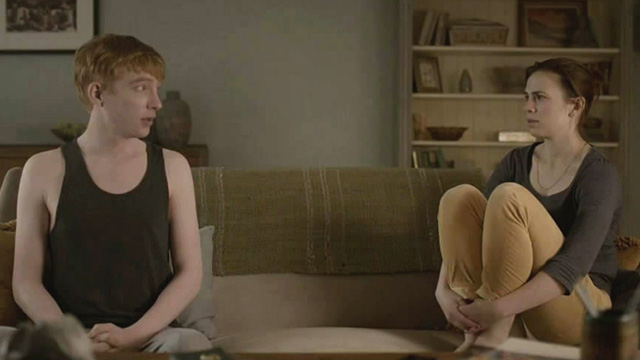
The robot’s automatism is primarily recalled when there is a gap between the woman’s memory of her husband and the robot’s personality. The protagonist is painfully reminded of the fact that it is not a real, living thing – not the warm body she once loved, still loves – but a mechanical product. Watching the woman interact with her robotic husband, touching his flawless synthetic skin, listening to the replicated voice of the deceased – at one point even having sex with him – was a disturbing experience. I felt unsettled; certainly I was experiencing the uncanny. The most carnal of human experiences – actual physical contact – simulated by a robot, with another human, completely explodes all notions of the natural by opening up so many strange possibilities.

Yet, as the show reminds us, technology cannot fully replicate reality. It may attempt to deflect our attention from truth – from the truth of death – with its simulations, but there are always points of rupture, where the fabric of the virtual is torn. At one point, the protagonist experiences distress and asks the robot to leave the room when his words don’t match up to her memory: “Ash would have argued” she says.

This uncertainty about the human and the machine haunts throughout Brooker’s award-winning series. How much of our lives has become merely the voices we leave on answer-phones, in text-messages and Facebook statuses? As communication becomes increasingly mediated, do our personalities become more constructed, more performative? With the advantage of anonymity, or the avatar concealment of the face allowed by the internet, people have time to carefully construct their responses, to portray a certain self-image, to play with the unfamiliar. ‘Be Right Back’ highlights the inadequacy of technology to embody – literally – the highly complex, fractured and fluid nature of the human self. Living more and more online, Black Mirror suggests in general, we creep closer and closer to the edge that demarcates our fundamental perceptions – our notions of truth, reality, existence, humanity itself. Brooker says of his show:

Each episode has a different cast, a different setting, even a different reality. But they’re all about the way we live now – and the way we might be living in 10 minutes’ time if we’re clumsy.’

It is this notion of ‘difference’ that creates the uncanny effect. What is the difference between things? The series poses more questions, perhaps, than it answers. Another uncanny effect. Brooker provides multiple possible realities, and thus renders the future with an inherent sense of what Derrida would call ‘undecidability’. It is not like a conventional dystopia, presenting a single, glaring vision warning of the future; instead, it troubles our expectations, it presents numerous ideas of what the next decade, or tomorrow, may hold. The show holds up a mirror to our society, one that is black – foreboding, sinister – and, fundamentally, refracted into different possible outcomes. Yet it is also a void, in the sense that Black Mirror itself is a fiction, where we may lose our sense of the real – collapsing the ever-familiar world of technology portrayed onscreen with our present everyday lives. It is in this threshold between today and tomorrow, between reality and fiction, that Black Mirror lies. And it is in this threshold that we lose our subjectivity, in the overwhelming threat of our own behaviour and the ghostly online world that could collapse our sense of existence.

Works Cited/further reading:

Baudrillard, J. (2006) Simulacra and Simulation, translated by Sheila Faria Glaser, University of Michigan Press.

Bennett, A. and N. Royle (2004) ‘The Uncanny’ in An Introduction to Literature, Criticism and Theory (Harlow: Pearson Education), pp. 34-42.

Black Mirror – Be Right Back [Season 2, Episode 1] by Charlie Brooker.

Felluga, Dino. ‘Modules on Marx: On Fetishism.’ Introductory Guide to Critical Theory. Purdue University. Available at: http://www.purdue.edu/guidetotheory/marxism/modules/marxfetishism.html. Accessed 30/4/13.

The Guardian. (2011). Charlie Brooker: the dark side of our gadget addiction. Available: http://www.guardian.co.uk/technology/2011/dec/01/charlie-brooker-dark-side-gadget-addiction-black-mirror. Last accessed 30/04/13.

Reynolds, J. (2010) ‘Jacques Derrida’. Available at: http://www.iep.utm.edu/derrida/#SH3d. Last accessed 30/04/13.

Why Don’t We Just Cull Humans?

DSC_2614Why Don’t We Just Cull Humans?

Picture the wild deer: all elegant neck, soft fur, tawny eyes staring back at you like butter wouldn’t melt. The stag too: a rare glimpse of those striking antlers flashing through forest leaves or the wire mesh of a fence, gazing gallantly over the hillside – a little like a proud lord, a patriarch admiring his land. There is something quite British about the graceful deer; something evocative of country outings, of heritage and sprawling estates, of heads rather unceremoniously stuck on pub walls.

Today, there are more deer in the UK than in any time since the last Ice Age[1]. It seems poetry is the wrong way to go about this; deer have become a real issue.

On the radio this morning I heard reports proclaiming new figures representing an excess in numbers of British deer. Deer, it is argued, in their proliferation, are posing a serious threat to British biodiversity. The overspill of deer will lead to more traffic accidents, more damage to crops and a drain on natural resources. With estimates of the current deer population positing 1.5 million, new research has suggested it will be necessary to kill off 50% to 60% of the animals to fully address the problem[2].

The above arguments may seem persuasive reasons for tackling ‘The Deer Problem’, but I would like to step back and question these fundamental justifications given for widespread slaughtering. I want to question the idea that the – let’s face it, unintentional – disruption of food-chains by deer warrants their culling.

My objection to culling derives not from an inherent concern with the ethics of killing animals – the morality of the practice of culling is another difficult issue – but from the premises given to defend culling by appeals to the negative consequences of an excessive deer population.

The problem I have with culling can be understood by considering a convincing argument offered by Australian philosopher and rights activist Peter Singer. Singer declares, somewhat radically, that ‘all animals are equal’[3]. Yet this statement is not as controversial as it appears. By ‘equal’, he means not that we should treat all animals the same – Singer is not justifying giving rabbits the right to vote or freedom of speech to chickens – but that we should give equal interest to all creatures, regardless of species. Singer points out that any claim asserting the superiority of human beings over other animals is arbitrary, speciesist.

Speciesist? Why?

Consider the reason we typically give for justifying the accordance of moral supremacy to humans:

1) Humans are rational creatures, or at least significantly more rational than other animals, and this makes our lives intrinsically more valuable.

Singer’s problem with this is that not all humans are rational. What about a child with Downs Syndrome, or a person in a coma? What makes them more superior to say a highly-intelligent primate if they lack rationality? Consequently, Singer states, any attempt to argue for human rights over animals is going to run into the problem of speciesism, since there can be no universal claim for the rationality of all humans. Speciesism is just like racism or sexism, in that it appeals to untenable claims about the essentially superior ‘nature’ of a particular race or sex which gloss over the reality that not every person within a race, sex or species shares these characteristics. If the sexist argues that men should be paid more because all men are more intelligent than women, his argument is rendered invalid by the stark fact that this is a sweeping, fallacious generalisation. Likewise, the speciesist cannot justify exploiting animals for human need by claiming humans are intrinsically superior because all humans are more rational than animals.

Therefore, for example, an argument justifying animal vivisection to support the more-valuable lives of humans (by exploring cures for cancer) will have to concede that this argument also, logically, licenses vivisection on non-rational humans. And I think most people would agree this seems a little distasteful.

Singer’s argument is compelling: the only relevant consideration that unites all humans, then, is sentience – the experience of pain and pleasure. An experience inherent to the lives of most animals and all humans.

Back to deer then.

The justification for culls is primarily their threat to the food-chain: too many deer means too much consumption of natural resources, too much disruption to the natural environment which other animals are dependent on. Deer, munching and treading and stomping all over our country’s flora and fauna, are threatening other wildlife. All very well.

But what about us? Aren’t we a threat to wildlife? What about our fossil fuel omissions, waste disposal, annihilation of forestry for paper, our excessive industry, infrastructure? Our pollution of lakes and rivers? Surely all this amounts to much more destruction than an overabundance of deer trampling on the landscape and eating too many acorns?

Well, it may be argued that we are humans; we are entitled to do these things because they fuel our rational progress towards more enriching lives. What gives us the right to think the world is ours to destroy, but not that of the deer? I would argue that our threat to the food-chain is significantly greater than that of our deer population, and yet I hear of no ecological experts advocating human culling.

Let’s be clear: I am not advocating human culling. But think about it: are we morally justified in killing deer because too many of them destroy the environment, when we wouldn’t do the same to humans, whose excessive population is also consuming too much of Mother Nature’s milk, and tainting it with acid rain in the process? If there is no relevant moral distinction between humans and animals, I find arguments which devalue animal life in favour of maintaining human interest deeply problematic. And after all, this isn’t just about preserving nature for nature’s sake, this is about preserving nature for people – for farmers, ramblers and future generations.

I acknowledge that there may be other reasons why culling might be justified – I am no environmental expert. Reducing deer numbers may work in the favour of their species, as too many deer means many will starve due to lack of resources. It is obvious how this can be turned around to humans: again, most people would object to human-culling because there isn’t enough bread to go round. Therefore, if there is no plausible moral distinction between humans and animals, then culling is difficult to morally justify, even if it produces certain good consequences.

It’s a thorny issue, and one that people often don’t consider; culling doesn’t seem to raise the same controversy as animal testing, hunting or meat-eating, because it is seen as a largely benevolent, if a little unpleasant, way of improving conditions for people and wildlife. I believe, however, that we should be concerned – at the very least, philosophically – with the flawed argument that lies at the heart of culling practices.