Phantom Architecture

the stillness of the painting has a kind of speech to it
the sustaining restless grammar of poetry
is that how good poets defy things with their heart
the sun on the tongue is a kind of living
the poem seems to fill up with this
a panic, just in the peripheral vision
a mode that can maintain the day
something of Schuyler in the act of saying
how it allows the people to enter the self
we are not complete
when I’m writing, I’m the right size
I’m not bigger or smaller than anything
kindle’s like etch a sketch
one of the issues of elegy is not being able to let go
the Orphic is endless
we’re all here because we’ve been taken captive by our reading practice
a text of dubious origin which is a great analogy for poetry
trick us into thinking these are finished propositions
the only authority is the sound itself
foregrounding the process of echoing
the lyric utterance as operating system in the present moment
humour my error
invent my own invisible poem behind the invisible poem
beginnings are always about nothingness
meaninglessness makes meaning
a horizon or atmosphere that I can continue to write into
I am always beginning…
I literally don’t know how to write a poem
phantom architecture of a poem
the complexity of getting from one line to another
a properly honest relation to our temporality 
the poem that doesn’t know it’s good is usually good 
you can’t find anything if you’re not lost
making nothing as a suspension of labour
marking the duration of a symptom
speculative topos for tracing affinities
there is no better time than the present when we have lost everything
a generative uprooting of one’s identity or biography to do the work
incantation to wrestle the poem from its enclosure 
to project in divine sublimity
hoping poetry might come back 

*

All of these lines are quotations of things said by panellists and contributors at the Peter Gizzi Colloquium at St Andrews University on 18th October 2024: Anne Boyer, Luke Roberts, Oli Hazzard, Honor Hamlet, Colin Herd, Jacob Bard-Rosenberg, Rosa Campbell, David Herd, Caspar Bryant, Daisy Lafarge, Anthony Caleshu, Peter Gizzi.

Tonight I am

Thinking about this song over and over as I prepare something to say about Peter Gizzi’s Sky Burial (2020) at a colloquium on Friday.

Lyric refrain: the gig that was meant to happen and didn’t. The poem that was meant to be and wasn’t. The soul that was to be given. Ellipsis of what’s left. Diminuendo. Poem thank you kindly.

Midsummer Song (Hypercritique)

In 2018, I started a Doctorate of Fine Arts in Creative Writing at the University of Glasgow. I also started a new diary. In October, the month it all started, I wrote about duplicate footsteps and permanent landfills. I wrote of lacking the energy to dance, being lost in the forest, looking for safety among swirling leaves. Can’t remember if the forest was real or metaphorical. I wrote seemingly in lieu of being able to actually venture beyond the confines of my working life. Over three years and three months, I went through multiple iterations of research focus. I looked at foam, clouds, technicity, glitter, quotidian measures, fire and cinders. I fell asleep on coaches circling lochan sunsets. I produced a list of figures for how we might conceptualise this project. It was a sort of Escherian dollshouse, a self-deconstruction of building this place to think. I thought about Bhanu Kapil dropping her book in the river. I thought about doing a writer’s residency within the confines of a square-shaped digital platform. I wrote of ‘An angel tossing her gunpowder sequins’ and ethical eating, ‘how so often you are so paralysed between two choices that you just don’t eat at all’. I wondered what kind of home this work would make for me. This was a material question: thanks to the Scottish Graduate School of Arts & Humanities, it was a funded period. It paid me through Covid-19.

These were my original research questions:

  • How can creative and critical writing interrogate and depict the apparent tensions between the Anthropocene’s deep-time and the quotidian context of our ecological orientations?
  • What hybrid critical-creative forms might open up possibilities for a future ecological art, one which builds productive ways of ‘tuning in’ to a non-anthropocentric experience, with reflexive attention to the artistic and technological media involved in this process?
  • How might ‘the everyday’ provide a temporal and formal mode through which to develop a critical, interdisciplinary Anthropocene aesthetics, negotiating ecological questions of affect, sensory relations, ethics and responsibility at scales both macro and micro, human and nonhuman?

It is up to the reader to decide how far the end result fulfilled or strayed from these lines of enquiry.

Six years on, having graduated from being a baby scholar-poet, I am really thrilled this project has found a dream home with No University Press, a new imprint from Tenement Press. The ‘no’ of refusal feels appropriate to this project, which very much concerns the affordances and limits of an academic and institutional mode when thinking through (im)possible questions of ecological thought and living on. Working with Benjamin Pickford and Dominic Jaeckle, editors at Tenement, I was able to bring the project’s creative detours and modalities to life in its final book form: Midsummer Song (Hypercritique). This is definitely the most ambitious work of my life. It’s 469 pages of critique, poetics, meadow work, illustration and elegy. I see the whole book as a big song, a study, an architectural attempt at making an ecological home in lyric.

Somewhere between an academic monograph and performative dreamwork, poetry and poetics, conceptualism and the commonplace.

You can order the book direct from Tenement here or from Asterism here.

You can read a full description of the book and access endorsements, sample poems and other materials here.

I will be touring the book at some upcoming dates in Glasgow, Edinburgh, Manchester and London:

09.11.24                      Peter Barlow’s Cigarette /
                                        with Maria Sledmere,
                                        Harriet Tarlo & Lucy Wilkinson
                                        The Carlton Club, Whalley Range
                                        Manchester
                                        See here.

05.11.24                      Midsummer Song / Readings & Discussion
                                        Maria Sledmere,
                                        David Farrier
                                        & Colin Herd
                                        Fruitmarket Gallery, Edinburgh
                                        See here.

26.10.24                      Midsummer Song / Readings & Discussion
                                        Maria Sledmere,
                                        Chris McCabe
                                        Small Publishers Fair
                                        Conway Hall, London
                                        See here.

22.10.24                     Midsummer Song / Readings & Discussion
                                        Maria Sledmere,
                                        Carl Lavery
                                        & Colin Herd
                                        Advanced Research Centre,
                                        University of Glasgow / (Online via Zoom)
                                        See here.

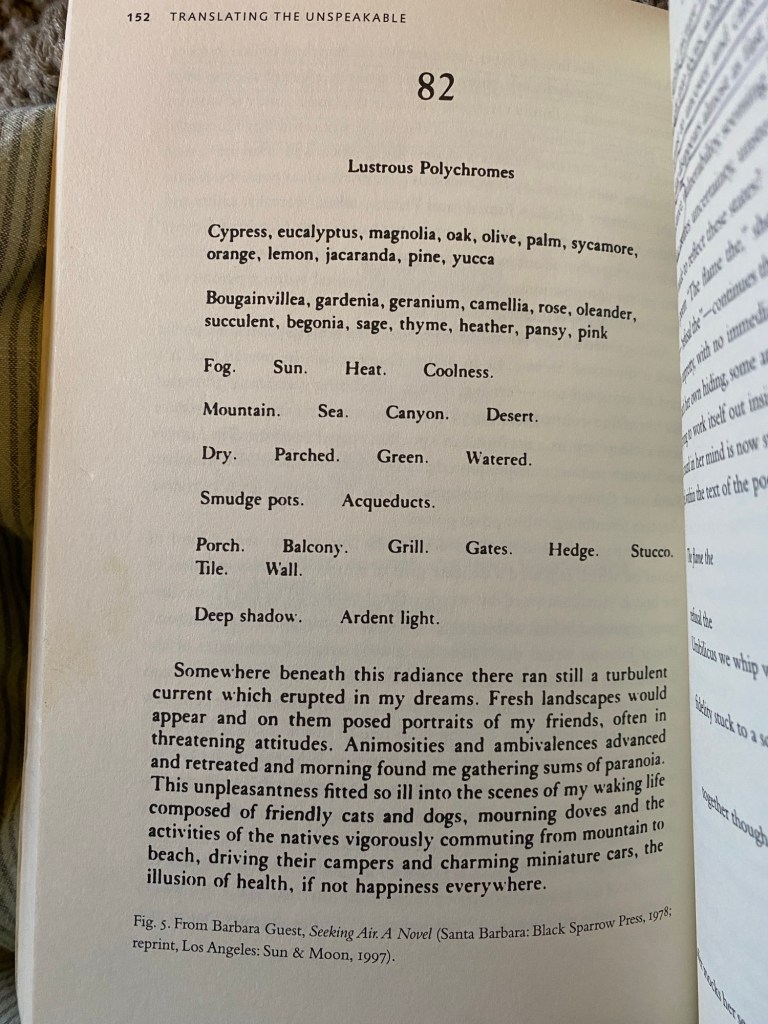
Lustrous Polychromes

Rereading Kathleen Fraser’s Translating the Unspeakable: Poetry and the Innovative Necessity (2000) in preparation for some teaching this year. Stumbled into Barbara Guest’s dreamscapes. How much does emotion colour your dreams? Sometimes such residue feels the longest hours beyond. How often a day’s blue tint, whose dream was responsible? I live in Sunday celadon. I love you. Ardent light.

New issue: Gilded Dirt iv x BERMUDA ▲ SADCORE

From my editor’s introduction:

Our title, BERMUDA ▲ SADCORE, embodies the vibe theory of oceanic feeling. The word sad, in its Germanic origin, connotes ‘weighty, dense’, eventually replaced in Middle English with the sense of ‘steadfast, firm’ — later ‘sorrowful’. The ocean is at once weighty, dense and everchanging, temperamental. We love the doleful, consonant insistence of the ‘d’ in ‘sad’ and ‘bermuda’. In recent years, the ocean has been toxified by microplastics, literally set on fire, forced to house massive, heat-generating data centres and scraped for rare earth minerals. If anyone has the right to be sad, it’s the ocean. And the ocean, historically feminised as sailors did with their boats, might herself be the Anthropocenic siren in the night everafter. Our original home and eventual disaster. Stop me if this sounds like an emo lyric.

What would it mean to be sad forever? Or to be steadfast in sadness, like the great eighteenth-century poet Charlotte Smith: who would wander the cliffs of Beachy Head and later write her Elegiac Sonnets from a debtor’s prison. To be sad forever is to forever be facing the sea. The vibrant imaginaries of the poems, essays and fiction contained herein will transport you to bodies of water whose sumptuous power to surprise, query and upend our bodies of knowledge is remarkable. The only way in is through surrender. In the movie Triangle of Sadness (2022), the rich are punished for their attempts to control, own and influence everything. With virtuosic abjection, we are witness to them literally vomiting the poisoned fruit of the ocean. 

The issue features the following contributors:

Adam Fraser
Al Anderson
Al Crow
Alex Grafen
Ali Graham
Amy Grandvoinet
Andrew Hykel Mears
Carolyn Hashimoto
Dan Power
Daniel Ridley
Fynn Kǒster
Grace Marshall
Iain Morrison
India Bucknall
James Andrews
J.R. Carpenter
John McCutcheon
Kim Crowder
Lauren Kalita
Lizzy Yarwood
Matt Pollock
Mattea Gernentz
Matthew Kinlin
Rahul Santhanam
Rose du Charme
Ruby Eleftheriotis
Sam Francis
Victoria Brooks
1846975493

You can read the whole thing for free here or download a pdf here.

Thanks as ever to Douglas Pattison for co-editing, curating and designing the cover art.

Pink Witch x Witches of Scotland

Earlier this year I published some poems in the anthology Pink Witch. Some of the other anthologised poets will be reading and in conversation with Zoe Venditozzi, co-founder of the Witches of Scotland campaign on 26th September. Event starts at 7:30pm and is at the Sauchiehall Waterstones in Glasgow.

Get your tickets here.

More info:

‘An evening of poetry, feminism and witchcraft with the poets of Pink Witch chat with Zoe Venditozzi, co-founder of the Witches of Scotland.

A chance aside by Zoe Venditozzi of the Witches of Scotland campaign inspired the poems of Pink Witch, which question identity, vilification and the names historically used to constrain women. Now for the first time, the poets chat with Zoe and discuss the inspiration behind these dark, insightful and frequently humorous pieces. Witches of Scotland is a campaign for a legal pardon, an apology and a national monument for the thousands of people executed for witchcraft in Scotland. The campaign was set up by Zoe Venditozzi and Claire Mitchell KC. Their podcast has over 70 episodes. Pink Witch is topical, intimate and eclectic, in turns sombre and funny, lighthearted and reflective, by some of Scotland’s best women poets.’

Berlin Dates

Cool news. Will be in Berlin weekend of 12-15th September doing two readings. It would be lovely to see some of you there!

Friday 13th September, 7pm
POETRY: Reading & Discussion with Maria Sledmere & Ian Macartney
7pm, FIXOTEK, Lohmühlenstraße 65, Berlin, Germany 12435

Thanks to Hopscotch for hosting!

No tickets just show up.

&

Sunday 15th September 2024
1-3pm, ChertLüdde Potsdamer Straße, Berlin

Reading with Ian Macartney, Max Parnell and Ari Níelsson from 1-3 PM, followed by an open mic at 4pm. This performance event is part of Ali Eyal & David Horvitz’s exhibition, A new garden from old wounds, whose title is taken from a poem of mine, ‘Deciduous‘ which was recently published by berlin lit.

No tickets just show up.

More about the exhibition:

In their duo exhibition, A new garden from old wounds, artists Ali Eyal and David Horvitz explore geographical and conceptual distances, delve into the intricate boundaries of memories and emotions, and investigate how fragmentary elements can come together to form a new enduring presence. The exhibition brings together new and existing works that interconnect with each other as separate fragments of a single unit.

Opening Reception: 12 September 2024, 6 – 9 pm

11 September – 12 October 2024
ChertLüdde Potsdamer