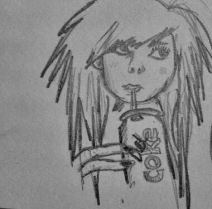
Falling through Glass


3746713882_eb3e039a09
self-portrait//circa 2008

[An essay on anorexia, femininity, adolescent pain & writing the body]

I distinctly remember the first time I watched someone apply liquid liner to their eyes. We stood in the Debenhams toilets before a sheet of unavoidable mirror. She emptied her rucksack of trinkets and tools, drew out a plastic wand with a fine-tip brush and skimmed the gooey ink skilfully over her lids, making curlicues of shimmering turquoise. Her irises were a kind of violent hazel, whose flecks of green seemed to swim against the paler blue. She was very tall and for a while, very thin. She had a nickname, a boyfriend and sometimes she shoplifted; in my head, she was the essence of teenage success. Only later, in the maelstrom of a drunken night out down the beach, do I discover she’s heavily bulimic.

A year or so passes since this first incident, watching my friend slick her eyes with electric blue. I have since learned to ink my own eyes, draw long Egyptian lines that imitate that slender almond shape I long for. My makeup is cheap and smudges. I have grown thinner and people are finally starting to notice.

My mother goes quiet when we do the shopping. She tells me to move out the aisle and I ask what’s wrong. People are staringshe says. I turn around and there they are by the stacks of cereal, mother and daughter, gesturing at my legs and whispering: stick insect, skeleton. A feel a flush of hot pride, akin to the day in primary school when I got everyone to sign my arms with permanent marker—this sudden etching of possession. I am glad I lack this conspiratorial relationship with my own mother, reserving comments on others for the page instead, for my skin. My pain and frustration are communicated bodily: I slink into the shadows, sleeping early, avoiding meals. When people stare, they imbue me with a visibility I desire to erase. I should like better to float around them intangibly, diaphanous, a veil of a name they can’t catch. Instead it rests on everyone’s tongue, thick and severe: anorexic.

It took a week for all the names to fade from my arms; it takes much longer to erase a single label.

In the television series Girls, Lena Dunham’s character reveals that she got tattoos as a teenager because she was putting on weight very quickly and wanted to feel in control of her own body, making fairytale scripture of her skin. In Roald Dahl’s short story, ‘Skin’, an old man gets a famous artist to tattoo the image of a gorgeous woman on his back, the rich pigment of ink like a lustrous ‘impasto’. Years later, art dealers discover his fleshly opus and proceed to barter, literally, on the price of his skin. The story reveals the synecdochical relations between the body, the pen and the value of art. Everything is a piece of something else, skin after skin after skin. In Skins, Cassie Ainsworth gazes into the camera: I hate my thighs. With black marker, she scrawls her name onto her palm; she’s got a smile that lights up, she’s in love. Everyone around her rolls cigarettes, swaps paper skins like scraps of poetry. It feels dirty, the chiaroscuro mood of sunshine and sorrow. Her whole narrative purpose is the spilling of secrets, of human hurt turned to vapour, smoke. Wow, lovely.

For a while, my name mattered less than my skin. There were levels of weight to lose, dress sizes which signified different planes of existence. Over and over, I would listen to ‘4 st. 7lbs’ by the Manic Street Preachers, Richey Edwards’ lyrics spat over a stomach-churning angst of guitar: ‘Self-worth scatters self-esteem’s a bore / I’ve long since moved to a higher plateau’. That summer, ten years ago now, I would walk for hours, the sun on my skin. All the fields stretched out before me like fresh pages of impossibility; my life was a mirage on the flickering sea. I thought of liquid turquoise ink, the friend in the mirror. I started to forget the details of her face, so she blurred into the impressionist portraits I wrote about in school.

Midsummer’s eve; I laid down in one of those fields. With bone-raw fingers, I counted the notches of my spine. Even in free-fall you never feel quite free.

I was obsessed with Richey’s ghost. He disappeared decades ago and they never found evidence of his body. I wanted to evaporate like that, leave my abstracted car somewhere along the motorway; step into the silence of anonymity. Richey wrote screeds of furious notes: ‘I feel like cutting the feet off a ballerina’. There it was: the dark evaporation of resentment and envy. Around this time, Bloc Party released A Weekend in the Citya record that uses Edwards’ lyric to express the racial frustration of being made Other by a racist society. I was acutely aware that the figure of a ballerina, the doll-like white girl, was a divisive source of symbolic desire. We inscribe such societal alignments on the female body, and shamefully I was more than ready to fall into place, to shed the necessary weight. But what I wanted was less the bloody violence of a crippled ballerina, and more the success of erasure.

In Zelda Fitzgerald’s only novel, Save Me the Waltz,the protagonist Alabama trains to be a ballerina late in her twenties, too late to ascend to any real career success. Here was ballet, the pre-adolescent world of waif-thin bodies and she was a mother, a woman—someone who once gave birth, who was strong in flesh. She reaches this frenzied state of beautiful prudence, honing her body to the point where every movement and thought is guided by the waltzing beat, the perfect arabesque: ‘David will bring me some chocolate ice cream and I will throw it up; it smells like a soda fountain, thrown-up, she thought’. I could attest to that. Ben and Jerry’s, swirls of it marbling the toilet bowl, clots of sweetness still clear in your throat. Fitzgerald’s sentences stream towards endless flourish. Alabama makes herself sick with the work, her desire is lustily bulimic. She gets blood poisoning, finds herself hospitalised with tubes in her body, drip-fed and cleansed by the system. I thought of how I wanted to photosynthesise, survive on nothing but air and light. Like a dancer, I was honing my new ascetic life.

Sometimes at night, the old ticker would slow to such a crawl and I thought it would stop in my sleep, sink like a stone. A girl I met on the internet sent me a red-beaded bracelet in the post and in class I’d twirl each plastic, pro-ana ruby, imagining the twist of my own bright sinew as later I’d stretch and click my bones.

I was small, I was sick. I used to write before bed, write a whole sermon’s worth of weight-loss imperatives; often I’d fall asleep mid-sentence and awake to a pool of dark ink, flowering its stain across my sheets. Nausea, of one sort or another, was more or less constant. Waves would dash against my brain, black spots clotting my vision. I moved from one plane or scale to another, reaching for another diuretic. I tried to keep within the lines, keep everything in shape.

Often, however, I thought about water, about things spilling; I drank so much and yet found myself endlessly thirsty. Esther Greenwood in Sylvia Plath’s The Bell Jar, trying to drown, being spat back out by the sea: I am I am I am.

 I’m fine I’m fine I’m fine. The familiar litany.

Something buoyed up, started showing on the surface. People could read the wrongness in the colour of my skin, all that mottled and purpling blood like a contrast dye my body had been dipped in. Against my pallid aquatic hue, I used to envy the warm and luxurious glow of other people’s skin. I sat on a friend’s lap and he freaked out at the jut of my bones. Someone lifted me and we ran down the road laughing and they were like, My god you’re so light. The sycamores were out in full bloom and I realised with a pang it would nearly be autumn. Vaguely I knew soon I would fall like all those leaves.

Anorexia is an austerity of the self. To fast is to practice a refusal, to resist the ideological urge to consume. To swap wasteful packs of pads and tampons for flakeaway skin and hypoglycaemic dreams. Unlike with capitalism, with anorexia you know where everything goes.

The anorexic is constantly calculating. Her day is a series of trades and exchanges: X amount of exercise for X amount of food; how much dinner should I spread around the plate in lieu of eating? It was never enough; nothing ever quite added up. My space-time melted into a continuous present in which I constantly longed for sleep. The past and future had no bearing on me; my increasingly androgynous body wasn’t defined by the usual feminine cycles—life was just existing. This is one of the trickiest things to fix in recovery.

Dark ecologist Timothy Morton says of longing: it’s ‘like depression that melted […] the boundary between sadness and longing is undecidable. Dark and sweet, like good chocolate’. Longing is spiritual and physical; it’s a certain surrender to the beyond, even as it opens strange cavities in the daily. The anorexic’s default existential condition is longing: a condition that is paradoxically indulgent. Longing to be thin, longing for self, dying for both. The world blurs before her eyes, objects take on that auratic sheen of desire. Later, putting myself through meal plans that involved slabs of Green & Black’s, full-fat milk and actual carbs, the dark sweet ooze of depression’s embrace gradually replaced my disordered eating. I wondered if melancholia was something you could prise off, like a skin; I saw its mise-en-abyme in every mirror, a curious, cruel infinitude.

In Aliens and Anorexia, Chris Kraus asks: ‘shouldn’t it be possible to leave the body? Is it wrong to even try?’. What do you do when food is abstracted entirely from appetite? What happens when life becomes a question of pouring yourself, gloop by gloop, into other forms? What is lost in the process?

I started a diary. I wrote with a rich black Indian ink I bought from an art supplies store. The woman at the counter ID’d me, saying she’d recently had teenagers come in to buy the stuff for home tattooing, then tried to blame her later when they all got blood poisoning. Different kinds of ink polluted our blood; I felt an odd solidarity with those kids, remembering the words others had scored on my skin for years. Tattooing yourself, perhaps, was a way of taking those names back. In any case, there was a sense that the ink was like oil, a reserve of energy I was drawing from the deep.

Recovery was trying to breathe underwater; resisting the urge of the quickening tide, striving for an island I couldn’t yet see.

(…What I miss most, maybe, is the driftwood intricacy, the beauty of the sternum in its gaunt, tripart sculpturing. Thinned to the bone, the body becomes elegiac somehow, an artefact of ebbing beauty…)

I think about beef and milk and I think about the bodies of cows and the way the light drips gold on their fields sometimes and how I’d like to curl up in some mossy grove and forget that all of this is happening. Sometimes I worry that my body is capable of making milk, making babies; its design is set up for this nourishing. Hélène Cixous insists women write ‘in white ink’ but I don’t want to be that plump and ripe, that giving. I want scarification, darkness, markings. I want Julia Kristeva’s black sun, an abyss that negates the smudge of identity.

I try to find loveliness in femininity, but my hands are full with hair barrettes, pencils, laxatives, lipstick—just so much material.

As Isabelle Meuret puts it, ‘starving in a world of plenty is a daring challenge’. Anorexia has the highest mortality rate of any mental illness. Recently, I logged onto my Facebook to find an old friend, a girl I’d known vaguely through an online recovery community, had died in hospital. Her heart just gave up in the night. People left consolatory messages on her wall; she was being written already into another existence. Another girl I used to know posts regular photos from her inpatient treatment. She’s very pretty but paper-thin, almost transparent in the flash of a camera. Tubes up her nose like she’s woven into the fabric of the institution, a flower with its sepals fading, drip-fed through stems that aren’t her own. She’s supposed to be at university. I think of Zelda Fitzgerald, of broken ballerinas. A third girl from the recovery forum covers herself in tattoos, challenging you to unlock the myriad stories of symbol. Someone I know in real life gets an orca tattoo in memory of her sea-loving grandfather; she says it helped to externalise the pain. My own body is a pool of inky potential; I cannot fathom its beginning and ending. I wish I could distil my experience into stamps of narrative, the way the tattoo-lovers did. I am always drawing on my face, only to wash the traces away. I must strive for something more permanent.

Recovery, Marya Hornbacher writes in her memoir Wasted,

comes in bits and pieces, and you stitch them together wherever they fit, and when you are done you hold yourself up and there are holes and you are a rag doll, invented, imperfect.
And yet you are all that you have, so you must be enough. There is no other way.

Every meal, every morsel that passes the lips, we tell ourselves: You are okay. You deserve this. Must everything be so earned? Still there is this girl underneath: the one that screams for her meagre dreams, her beautiful form; her starlight and skeletons, her sticks of celery. I try to bury her behind sheet after sheet of glass, lose her in shopfronts, the windows of cars and bathrooms; I daily crush out the bloat of her starched hyperbole, keeping the lines plain and simple. Watching others around me, I try to work out other ways of feeling full, of being free. There is an entry from 2009, scratched in a hand I barely recognise in the final page of a diary: ‘Maybe we are only the sum total of all our reflections’. I wonder what kind of sixteen-year-old wrote this, whether she is happy now and if that matters at all.
Seven Songs from the Vault (1)

IMG_1691.jpg

~ Seven Songs from the Vault (Version 1) ~ 

  1. Suzanne Vega – ‘Marlene on the Wall’, Suzanne Vega (1985)

Partly to blame for my writerly obsession with long, m-beginning girls names (Meredith, Meredana, Marianne), this song was one of the first tracks that brought me to music – brought me to music in the sense of listening to it and discovering something new about the world through it. It’s a story of a dangerous and probably ill-advised love affair, told through an impression of symbols; the singer urges the listener to ‘observe the blood, the rose tattoo and the fingerprints on me from you’. The line between desire and violence blurs here and there’s something about Vega’s cool, whispering voice: an intimacy that is at once conversational but also steadfastly aloof, refusing the self-aestheticising of vibrato and instead fixing itself on the delivery of its sharply observational lyrics. In an age where big, operatic voices dominate the popular music scene (think Adele), Vega’s vocal style seems comparatively and indeed curiously fresh. When she returns, angrily, to the chorus, there’s a real, mesmerising venom to her delivery.

The song was on an acoustic compilation CD I’d nicked from my Mum’s car and I used to play it over and over again, my nine-year-old mind trying to make sense of the song’s darkness; its ‘danger zone’, the urgent guitar strums and insistence on silence – ‘don’t talk about it later’. By successfully striking the experience of ambiguity in desire, twisting pop’s conventional picture of love to one more sinister, Vega draws you in and in again to her characters. Who’s Marlene? What does she mean by the wall? Who are the soldiers, and the ‘things I cannot see’? I still have no idea.

2) Bloc Party – ‘I Still Remember’, A Weekend in the City (2007)

Like a Roald Dahl novel, rife with endearing surrealism, you sink into this story of young love with a queasy mix of confusion and warm familiarity. The guitar riff that kicks in with all its clarity is a comfort, even now, listening back almost ten (!) years later, and the song lilts between the energy and languidness of longing. The relief that comes when Kele Okereke breathily sings that first line, ‘I / I still remember / how you looked that afternoon / it was only you.’ It’s a love that touches on the unspokenness of queer desire, the possibility of falling for your best friend: ‘we left our trousers by the canal / and our fingers, they almost touched’. It’s almost Blakean in its very pure, stripped-back articulation of innocence: ‘you said “it’s just like a full moon” / blood beats faster in our veins’. It’s draped in childhood nostalgia: ‘and on that teachers’ training day / we wrote our names on every train’. With all these images, you can’t help but remember such experiences from your own youth, those simple days and strange feelings.

When the song builds up with the thrashing drums and the insistent refrain, ‘I still remember’, all the campouts and nights out and beach drinking and endless hanging out come flooding back. Okereke’s love exists now only as a metonymic collection of details, sentimental objects and memories: the playgrounds and rooftops, park benches, school ties. There’s a terrible bittersweetness to the song, its sense of regret, of unrealised, forlorn desire: ‘You should have asked me for it / I would have been brave’. Sure, the album came out in January 2007, but in a way it’s a song for autumn: the aftermath of summer holidays, the return to school, the always problematic sense of fresh beginnings, of leaving a certain era behind. The golden haze of nostalgia, and all its futile longing. The dissolution of that final shining chord.

In my head, it’s inextricably tied up not just with my own adolescence but with that even earlier exposure to frustrated love. I think of the ending to Phillip Pullman’s His Dark Materials trilogy, with Mary’s endless stories, the ‘quantum leap’ that is love’s realisation, her talk of negative capability and the unravelling of Proustian memory, decades deep from a piece of marzipan; then Lyra and Will, after so many adventures across several universes, admitting they love each other, their first kiss like the taste of the ‘little red fruit’ and then the devastating revelation that they love each other and yet can literally never exist in the same world and live. I remember vividly sitting on my bedroom floor on a Sunday night, picking flakes of paint from the floorboards, anxiously devouring the last of book of the fantasy trilogy that had consumed both my summer and winter and feeling this weird immenseness of sadness and relief all at once. I think it’s the expression that counts; the only overcoming of such feelings. That’s why Bloc Party’s song’s so good. It’s cathartic.

3) Belle & Sebastian – ‘Dress Up in You’, The Life Pursuit (2006)

For me, The Life Pursuit is one of Belle & Sebastian’s most obviously ‘chamber pop’ albums, it’s lush and glossy and upbeat, featuring vocal contributions from both male and female members of the band. Its production is shiny and the mood (for once?) is cheerful.

Probably not surprising that the song I picked is one of the album’s most melancholy, however. We can all relate to ‘Dress Up in You’, in a way. It’s a song about jealousy, about our problematic relationship with the friend that always dazzled,  the one with a ‘beautiful face’, that was always destined for great things, while you were stuck back home, ‘knitting jumpers’ and ‘working after hours’. There’s a bitterness to the song’s tone but at the same time the relaxing cadence of the piano riff and the upliftingly sweet horn solo keep the sadness in check: ultimately, the song’s message is one of admiration. The ‘singer in the band’ paints a vision of her friend, the one who ‘got lucky’, who forgot about her, as a beautiful idol: ‘if I could have a second skin I’d probably dress up in you.

We’ve all wanted to be someone else at some point. It’s probably part of the human condition that we’re mostly doomed to be dissatisfied with our own skin, to long for where the grass is greener, where there are airplanes and style and ‘the essence’. What I love about this song is its contradictions: the bitter lyrics and the sweet music, the sense of absolute friendship (deals signed in blood, understandings, love, the sense of missing someone so much they give you stomach pain) and jealousy/resentment, the contrast between stardom and failure. It carries them off perfectly and there’s a satisfying relief in the way the song closes with the rallentando leading into ‘they are hypocrites, forget them / so fuck them too’ and then all those carefree la la la la las, harmonised lovingly with the accompanying brass.

It’s a song that reminds me of sitting up till 5am on friends’ sofas, passing round the laptop and its weighty iTunes library, drinking the dregs from a bottle of gin and feeling a bit miserable for ourselves but also kind of paradoxically content with the feeling of discontent.

Notably, it’s also the song that plays over the credits to Stuart Murdoch’s film, God Help the Girl, and I like that the film’s ending is pretty open, just like the outcome of the song—does the friend become an actress? Is she a success or a failure? 

4) Frightened Rabbit – ‘Poke’, The Midnight Organ Fight (2008)

2009 and 2010. Two winters so cold the roads and rivers froze over; so cold we wore coats in our classrooms, the heating system of our leaky-roofed Victorian school building packing in in tandem with the collapse in temperatures. These years all a blur of computer screens and studies, of long walks round town and into the hills with friends. I had tickets to see Frightened Rabbit at the Barrowlands in December; I was in school, reading Sylvia Plath for my English dissertation, when from the windows of the computer suite I saw the first flakes of snow, falling from the sky like a promise. They came thick and fast and soon everything was draped in white. Something inside me soared, even with the sad knowledge that the trains were cancelled. I couldn’t go to the gig.

At parties, we would mockingly sing the words to each other: ‘poke at my iris / why can’t I cry about this’. Sometimes we’d mishear the lyrics. We wanted a reaction from each other, perhaps, a way of making sense of that weird desire to be poked in the eye, to be stilted from our drunken reveries. Or maybe it meant something deeper, weirder. Maybe that was our own ‘brand new language’, a semiotics of stupid expressions and warbling voices, the way we’d brush up against each other’s hands as if we wanted to hold them.

‘Poke’. It’s an elegy of sorts; an elegy for the disintegration of a relationship, the frustration of striving for closure, caught between an animalistic need for freedom and that enduring residue of whatever was there before: ‘Why won’t our love keel over as it chokes on a bone? / And we can mourn its passing / And then bury it in snow’. It’s that wintery, rural Scottish numbness, the refusal or even inability to admit feeling – ‘Why can’t I cry about this?’. There’s the tender, Burns-like romanticism of this love – ‘it’s got lots to do with magnets and the pull of the moon’ – kicked viscerally in the teeth with all that suppressed violence that we bury in the darkest dullness of our relationships: ‘Or should we kick its cunt in / and watch as it dies from bleeding?’. Scott Hutchison’s poetic, sometimes growling croon is softened in this song, even as he refuses to hold back on the emotion, it unravels perfectly in the expression of paradox that governs the end of a relationship: ‘But I hate when I feel like this / And I never hated you’. The sudden severance of that connection that was almost familial, blood-strong in its longing. The interludes where Hutchison sings his Ooooohs with that perfect, withdrawn sorrow are like the movements of the sea over the steady rivulets of the guitar picking. I always wanted to be able to play this song on guitar. It sounded so simple and sad and pure.

5) Wild Nothing – ‘Paradise’, Nocturne (2012)

I used to do double shifts most Saturdays and Sundays and it was a grim affair without the aid of some good music to brighten the restaurant where I found myself pacing endlessly, lifting plates, taking orders, polishing glasses, picking litter and leaves off the floor, scraping candle wax off tables, dusting the gantry, moving zombie-like between tables with the same forced fresh, maybe fragile smile.

My friend Douglas would bring stacks of CDs in and leave them for me on the bar top while he was away working in his section. In the midst of sensory deprivation, I would pore over those CDs like they were exquisite treasures (which, fuck it, they were). For one, it was lovely to find someone else who shared my passion for the actual tangibility of the compact disc. The sleeve and the notes and the design printed on the disc itself. I liked the sheen of plastic, which felt solid in my hands. It was 2013 and Douglas had a music taste that ranged from the up-and-coming heroes of alt-pop (Grimes, Lana Del Rey) to the more left-field and experimental/electronic; looking over those CDs reminded me of the world I had missed while immersing myself in nothing but literary theory podcasts and James Joyce audiobooks for two years solid. Now there was Bjork, Angel Olsen, Poliça, Wild Nothing.

I asked to take a few home to borrow, mostly based on my attraction to the album artwork and the titles of songs. I’ve always been drawn to song titles and artwork, probably because I am literary-minded but also because I love it when artists actually pay attention to building up a particular aesthetic that’s appropriate to, or even spins a whole new meaning on, their music. I love thinking about how the title of a song changes everything. It’s weird because I find it really hard to title my own work, but I guess that’s a common problem…

Anyway, one of those lucky albums was Wild Nothing’s Nocturne, which is a blissful array of buttery, colourful dream pop songs which mould together as perfect as the lunar cycle. The standout track for me is ‘Paradise’, a five-and-a-half-minute ambient starry-eyed disco epic which, if the album is meant to sort of capture ‘a sleepless state of mind’ (hence the album’s title, Nocturne), is that moment when the endorphins kick in and you reach that precise state of euphoria that occurs when you have not slept for say 40 hours solid. Maybe you’re travelling, airborne to distant lands. Maybe you’ve been boozing through the night and morning. Maybe you’ve just been on your feet all day and are reaching the 11th hour of your shift…

For me, this is sort of The Cure drenched in pastel tones; the meticulous crafting of those dark synths and celestial reverb; Joy Division staring into the refracted galaxies of a crystal ball that would predict a brighter future. Jack Tatum’s voice here acquires a much stronger, more sonorous quality than on most other Wild Nothing tracks, and there are definitely Ian Curtis comparisons to be made here. The mood perfectly balances its bouncy drums, uplifting synths and twinkly 80s guitar riffs with a controlled and almost majestic lyrical delivery which is rather melancholy in theme, the refrain ‘love is paradise’ framing most of the song, as if striving to reach some sublime point where paradise would be reached. If you check out the extended version online, with Michelle Williams doing spoken word in an interlude section, there is a definite sort of Allen Ginsberg/Beat generation vibe to the lines, moving to a sort of transcendent rapture: ‘The past was folded up and in the twinkle of an eye / and everything had been changed / And made beautiful and good’.

The song overall feels like a spiritual and spatial journey; it fades and builds and comes to fade again. It never indulges in elaborate solos but instead maintains its vibrant rhythm that moves between liveliness and a kind of soporific haze of drums and sparkling guitar and synths. Listening to it at work, for those five-and-a-half-minutes I felt weightless, bodiless, up in the air; free from the cutlery and crockery and bells tolling endlessly from the kitchen…

6) Bright Eyes – ‘Lua’, I’m Wide Awake, It’s Morning (2005)

A song that you carry with you somehow, that’s so engrained in your brain as to never leave you, each chord and lyric sedimented with years of memory. It’s a fragile song, sparse as a deciduous tree in winter. It’s a song about wandering, the dislocated sense of not exactly inhabiting the world, but somehow just drifting through. It’s a paean to solitude: ‘when everything is lonely I can be my own best friend / I get a coffee and a paper have my own conversations / with the sidewalk and the pigeons and my window reflection’. It explores the thinness of reality, the sheen of ‘polish’ that in the morning ‘looks like shit’, the false love sold in the evening, which by the morning ‘won’t exist’. It’s a candid admission of human frailty, the mercurial nature of our emotions. It’s a specifically metropolitan song: you have a sense of Conor Oberst’s warbling voice as he wanders the streets, lost protagonist in his solipsistic sadness. Yet the song spreads outwards, as a commentary on the human (or at least a generational) condition, a not-quite nihilistic exhaustion with the world – ‘we might die from medication but we sure killed all the pain’. We flit from one thing to another, our desires will oscillate as sure as the moon’s phases. Everything seems ‘so simple as the moonlight’ but no amount of incantation will render solid this refrain.

Thematically, the song is about addiction, depression, the everyday vacillations of sensation contained in a morning and evening. The random party at ‘some actor’s west side loft’ and the flask shared on the train, the person addressed who looks ‘skinny like a model’ and keeps escaping to the bathroom, ‘always say you’ll be right back’. In body, the people in the song waste away as easily as the time that contains them, surviving off coffee and moonlight and imaginary conversations.

Oberst, lyrically, is a genius at paradoxes and parallels and expresses them in a way that offers them as explanations or gestures of understanding which never quite satisfy but at least leave us pondering: ‘But what was normal in the evening by the morning seems insane’. The opening line, ‘I know that it is freezing but I think we have to walk’ so clearly establishes the tone of the song, the jar of realisation – we’re both forced upon this journey, nobody’s going to give us a ride – that it could be a line from a Wallace Stevens poem. It’s a cold song, whose play of end rhymes only half hit home – ‘walk/loft’ ‘off/gone’ – leaving us always  longing for something more. No closure can be reached: the song can only end with the circular repetition of ‘so simple in the moonlight’, a childlike rehearsal of the beauty which cannot kill the complications of adult life, the self-destructive habits which inhabit the song’s lyrics.

In third year of high school, I used to listen to this every lunchtime, lying in the playground by the P.E block, feeling so light and empty, the world dissolving around me in a dull cacophony of kicked footballs, shrieking games and called-out names. It was a mysterious adult world, the one contained in that song, but I almost felt I was already there, dissolving what was left of matter.

[There’s a lovely version Oberst recorded with Gillian Welch for the album Dark Was the Night (2009) which gives it a flavour of melancholy Americana, a greater sense of dislocation, fusing the urban setting and Oberst’s minimalist delivery with Welch’s distinctly lilting, country voice and all its resonance of the prairie].

7) Muse – ‘Citizen Erased’, Origin of Symmetry (2001)

It seems insane to think that this album was released fifteen years ago, but maybe the timing was appropriate. There’s something uncanny about it: the paranoid, political and often surreal lyrics, howling soprano, bloated distortion of electric guitars, as if the music were forcing us to release the visceral eeriness and indeed grotesque weirdness of a reality that tried to cloak itself in the fairytales of gameshow tv and the financial greed offered by a fresh new century…

‘Citizen Erased’ is visceral, beautiful; at once tender and full of fury. It renders the experience of someone living in a fucked-up political state, the striving for freedom and confusion over what it means to be human, to be a person, at all. The thrashing drums give way to a thickly buzzing bass and the yearning swirls of screeching electric guitar solos. The song builds slowly and softly but the choruses are huge and operatic, with Bellamy’s distinctive wail crying out: ‘For one moment / I wish you would hold your stage / with no feelings at all / open minded / I’m sure I used to be, so free’.

The experience of this song is one of purification. You are exposed to music that is violent, lashing, angry, but like any good narrative, there is a turning point, a calming of the waves. The music becomes almost ambient. The key changes and Bellamy’s voice returns to its melodic, delicate expression, accompanied by ripples of piano and the fuzzy, spacey twanging of distorted guitars: ‘Wash me away / clean your body of me / erase all the memories / that will only bring us pain’. I’ve always felt purged somehow after listening to ‘Citizen Erased’. I think it chews you up a bit then leaves you, disembodied, drifting along the final tributaries of its current, back to a place of imaginary origin, more peaceful and pure than the harsh world it renders…