The Greatest Loss: Lana Del Rey’s Anthropocene Softcore 

Screenshot 2019-09-08 at 11.26.09.png

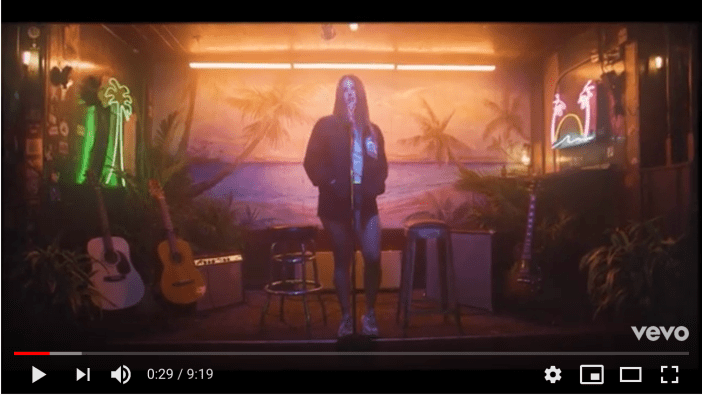
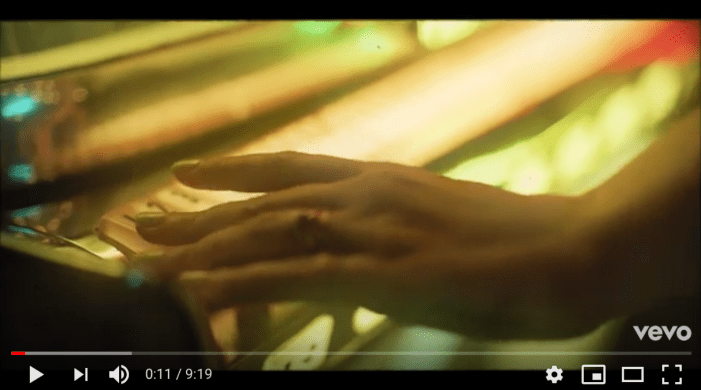
There is a scenario in which the jukebox is equivalent to the poet and some elaborate analogy is to be made between intertextuality and the limited catalogue whose selectional form produces play. The scenario only survives in video. It needs this urge of duration, not to mention the tenderness of a touch. Where fingers brush keys like notes, there is something to add to the story. A social space in demand of ambience; on flickering alongside off. When Lana is alone on stage, hands stuffed into a bomber jacket, singing ‘Fuck it, I love you’, swaying almost nervously, I want to think about what she is doing there and who she is speaking to and from where she is speaking. She is not really speaking but singing. The lone girl on the stage is the open mic dreamer, with nothing but lines. She is scattered across june-dreams of multiple personality: ‘The I which speaks out from only one place is simultaneously everyone’s everywhere; it’s the linguistic mother of rarity but is always also aggressively democratic’ (Riley 2000: 57-58). We mother our solipsism with words but in doing so there’s an opening. So to say fuck it and state the interruption with syncope, sincerity. Lana Del Rey was born on the cusp of Gemini and Cancer season, which more than explains that statement: ‘Fuck it, I love you’. With her sails to the wind. To say it over and smooth into plural refrain, you could even say chorus. For a chorus wants to be shared. It is a commodious mother, fed by the keys of the jukebox baby. There is a constant reversal of nourishing; the democracy of lyric utterance, the milky feed that streams.

Denise Riley argues that any ‘initial “I love you” is barely possible to enunciate without its implicit—however unwilled—claim for reciprocation’ (2000: 23). But what is reciprocation in a song? Is it just the urge to be sung with? And this ‘fuck it’, the pervasive millennial injunction to just be, to move on, as the tag which erases the expectant price of the utterance? Riley argues that I love you ‘must at once circulate as coinage within the relentless economy of utterance as exchange’ (2000: 24), but in a pop song it bears the leaden weight of so many prior expressions. The irony is that to cut through that with a simple fuck it, Lana can attain something like sincerity in the very pop mode whose lineage of commercialised love would surely undermine her feeling. Fuck it, in spite of saying I love you I really do. The pop song becomes this space for the staged epiphany of repeated assurance, I really do. It is a softcore admission of the self in its burning limit. 
Screenshot 2019-09-08 at 11.26.37.png

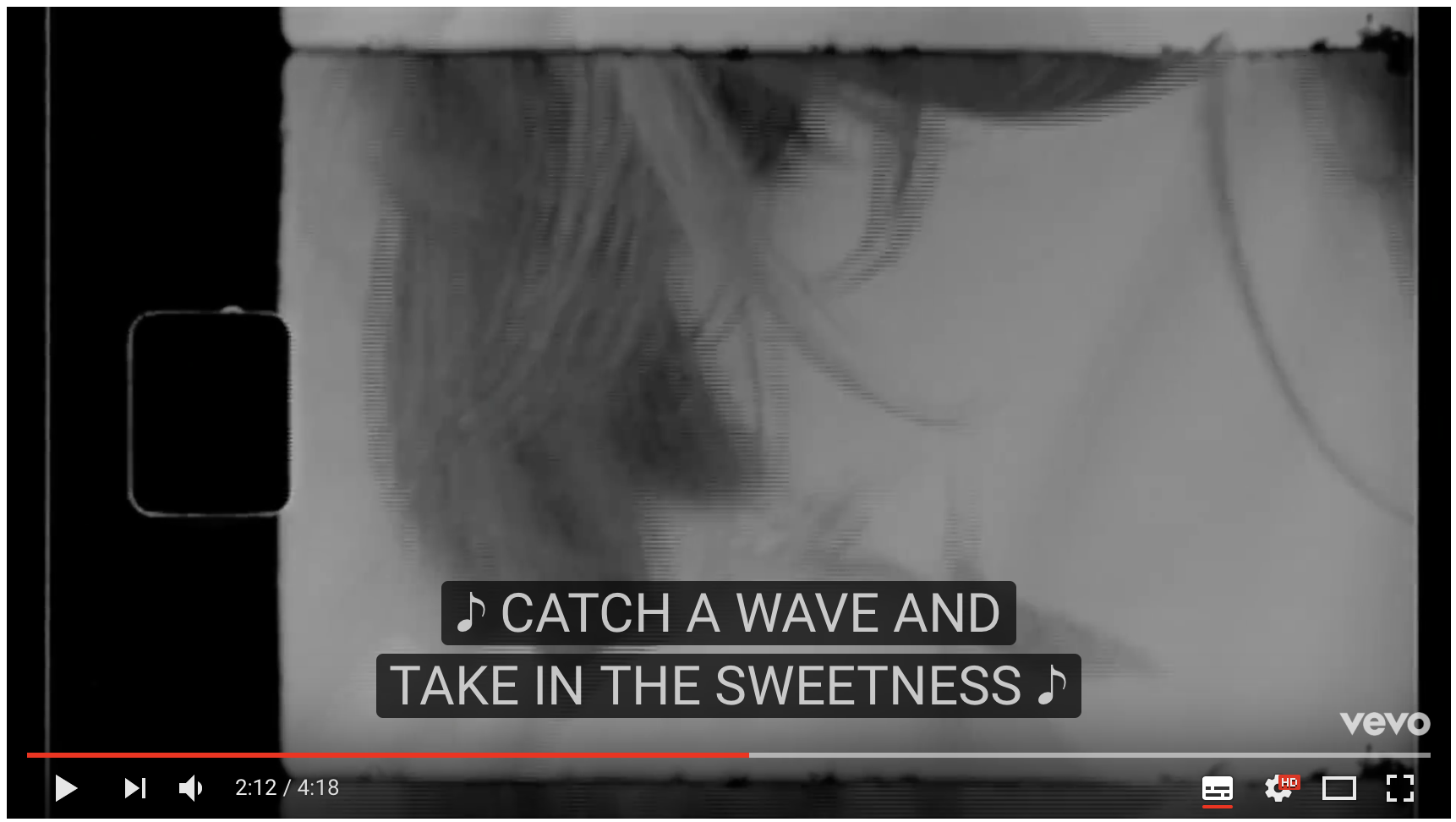
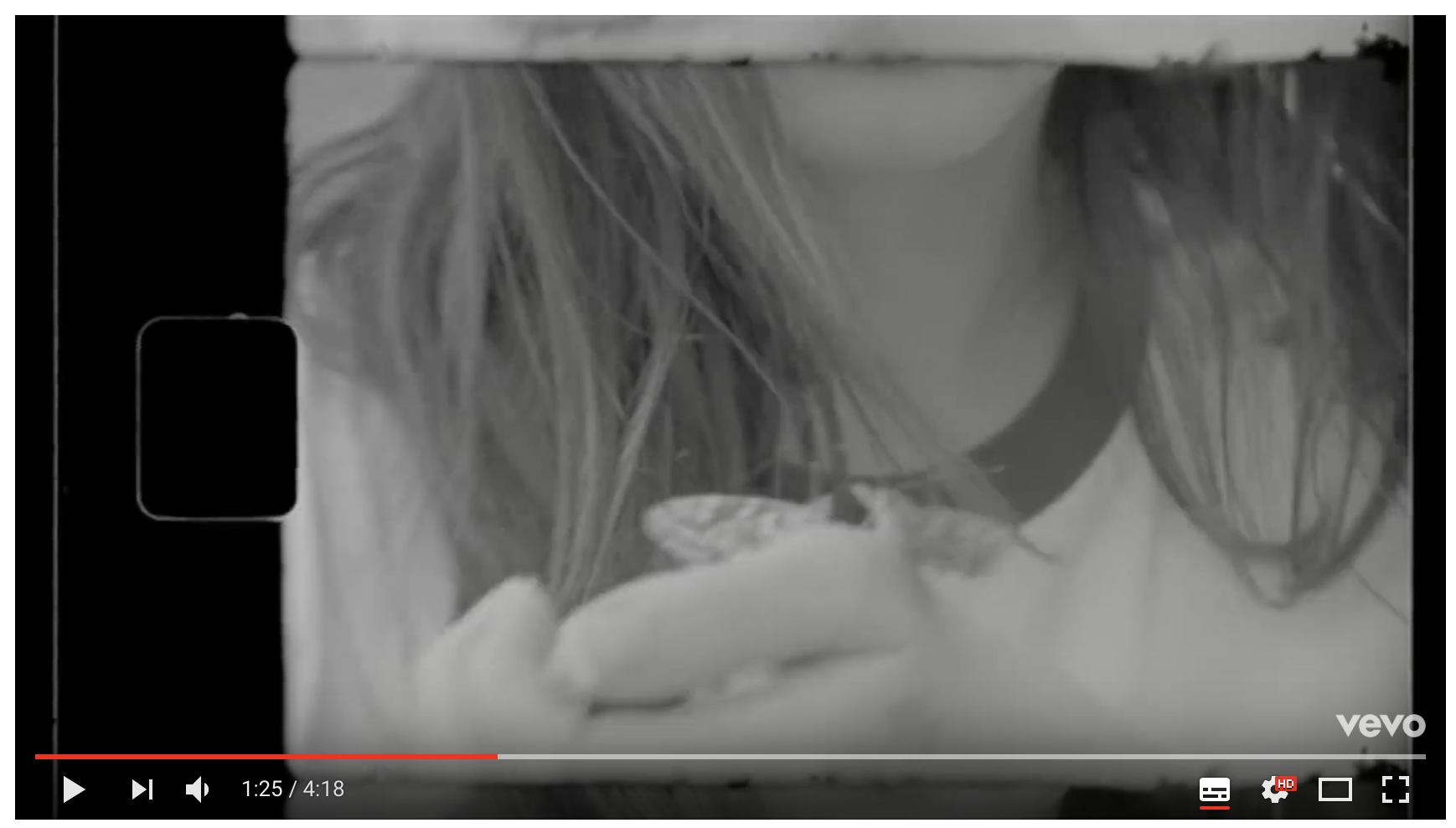
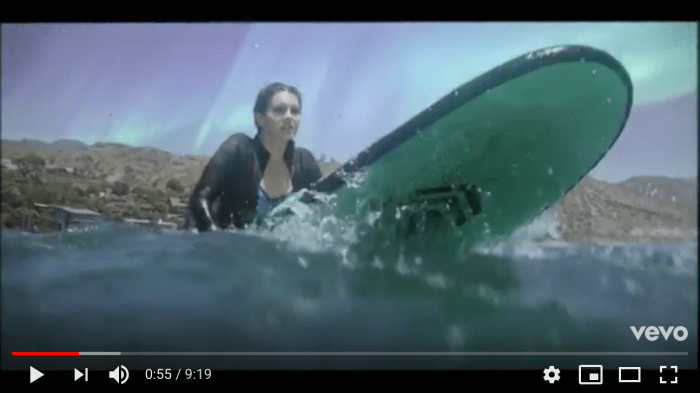
‘Fuck it I love you’ is soaked in lights, but they’re fading. ‘I like to see everything in neon’, is the line that opens the song. To see everything in neon is to fluoresce what is haunted and gone. I think of Sia dragging rainbow dust down her tearful cheeks in the video for ‘The Greatest’ — tragedy’s shimmer as fugitive mark on the body. Lana offers herself up as sugar dust, cliché in honour of Doris Day: ‘Dream a little dream of me / Make me into something sweet’; she acknowledges ‘dancing to a pop song’, but it’s not clear if this is her or the character or the one she loves. ‘Turn the radio on’ could be a reflection or an imperative. The reader is hailed between these positions of love and the loved and the effect is saturating, warm, delirious. Separation is that ‘it’, the spacing. In the video, we watch Lana painting and then suddenly she’s surfing with the aurora borealis in the background. She’s on a swing, her jean shorts caressed by the camera, she’s the sexualised pop icon again. She’s on a surfboard, green-screened, young. She’s choosing a shade of yellow from the palette, singing ‘Killing me slowly’. What is this ‘it’, killing her slowly: 

I’ll return to the unknown part of myself and when I am born shall speak of “he” or “she.” For now, what sustains me is the “that” that is an “it.” To create a being out of oneself is very serious. I am creating myself. And walking in complete darkness in search of ourselves is what we do. It hurts. […] a thing is born that is. Is itself. It is hard as a dry stone. But the core is soft and alive, perishable, perilous it. Life of elementary matter.

(Lispector 2014: 39)

I want slyly to argue that this is a kind of anthropocene existentialism. Recognition of the self as this ‘hard’, ‘dry stone’ thing of geologic mattering, reflexive species. This is what it is to be ‘Human’ right now. And yet the agential spark within, the ‘core’ that is being alive in a world where we have deposited those sedimentary layers. Creating ourselves in the stone, often with the tarnish of the very products we chose and developed to beautify, excoriate and cleanse ourselves, to remain forever young. So there is this oscillating temporality at work between desired infinity and the trace of our fugitive place on earth. The very earth minerals that would ruin humanity, mine our bodies of endless labour. But to go back to the song, with its idea of a gradual dying. I want to call this something like anthropocene softcore: the unnamed presence of species being within Lispector’s slender novel from the early seventies, or the Mamas and the Papas brand of late-sixties ‘sunshine pop’ whose solarity derives from the perishability of that energy, utopian commons, cascade of flowers — that serotonin glow of selves in streams and streams. 

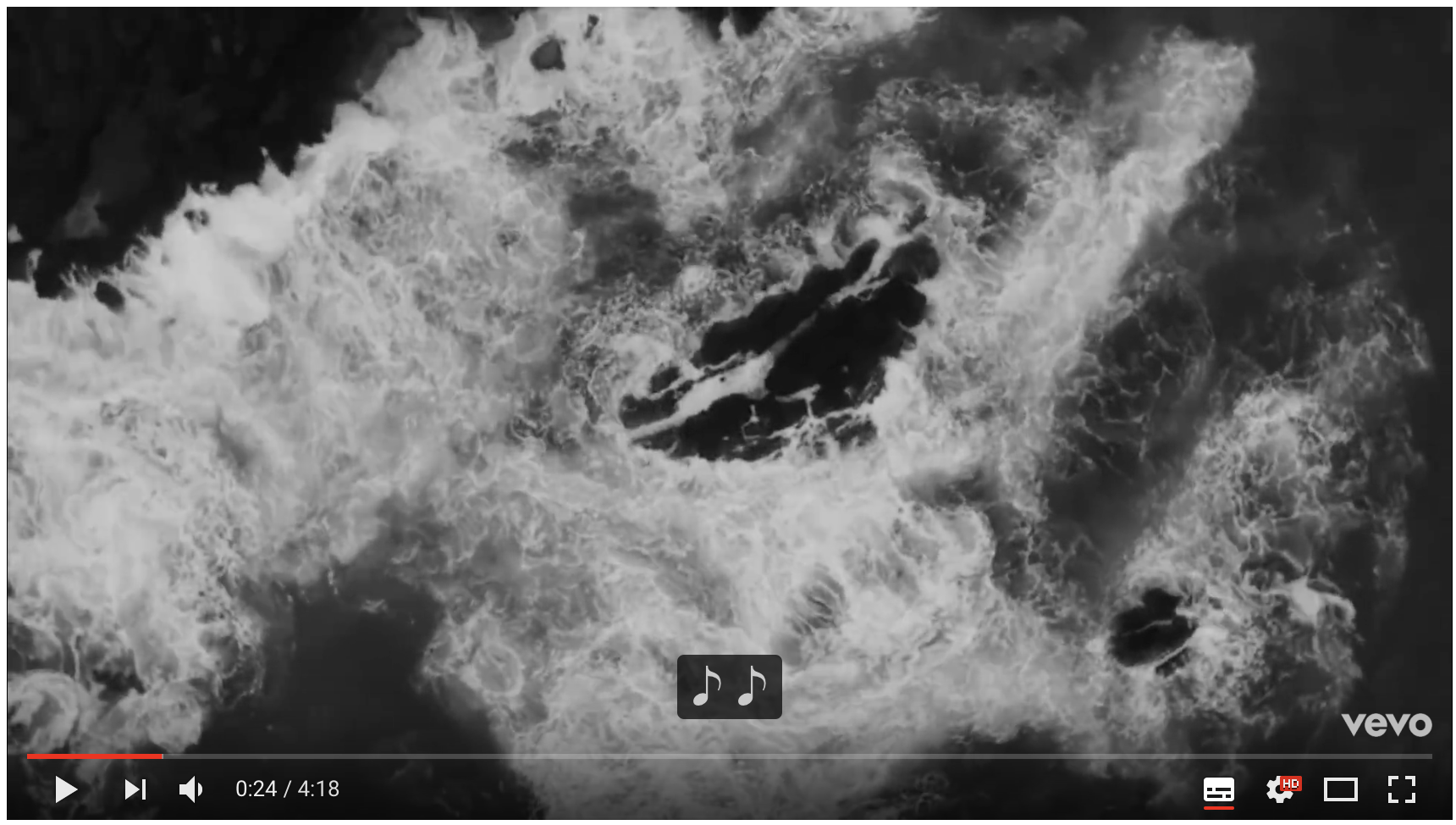
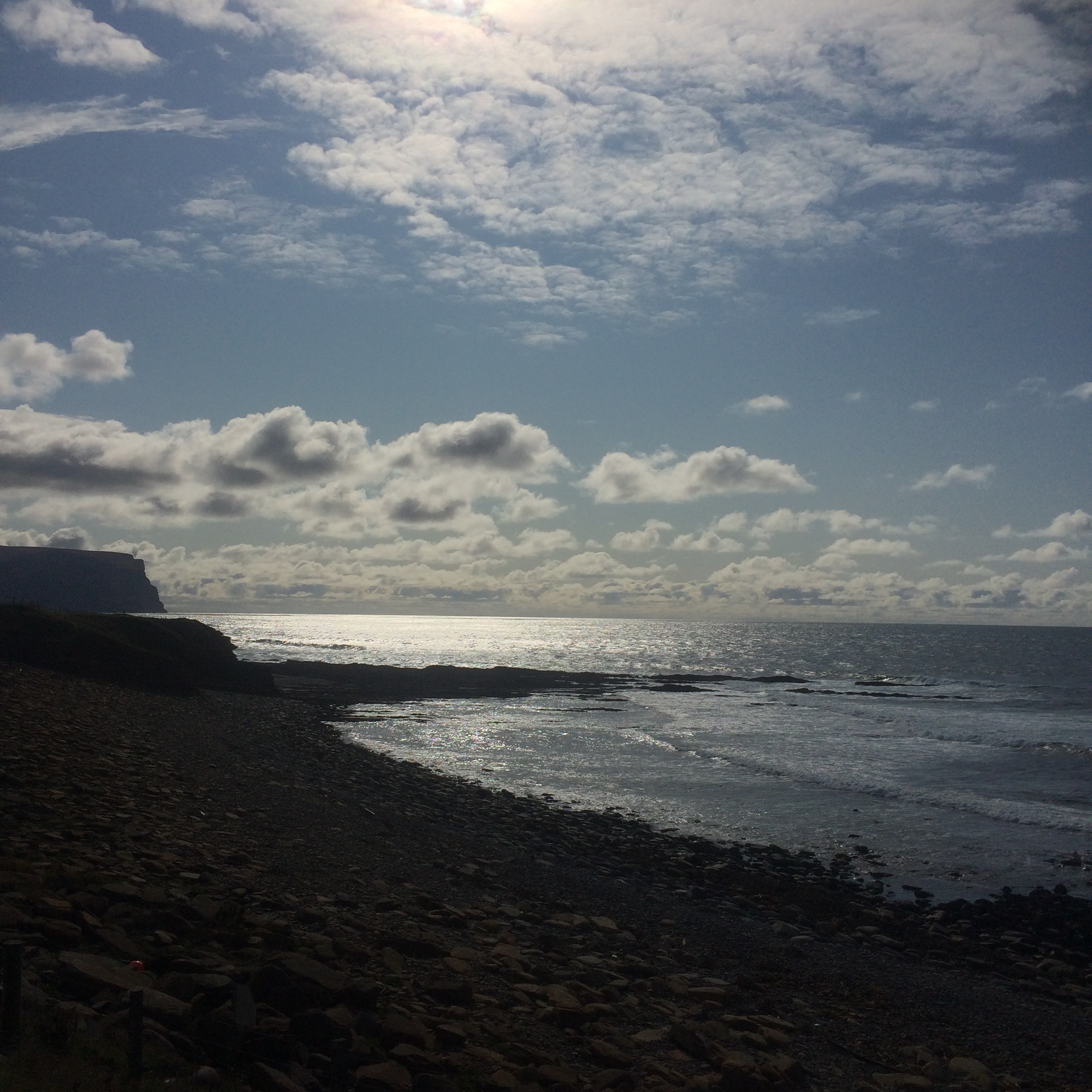
Lana’s anthropocene poetics are not of the hardline, direct call to action. You would not say of her cultural presence, eco-warrior or nature goddess. You would not brand her Miss Anthropocene in a kind of demonic marketing gimmick. You would say most often she is a siren, per se, leisurely supplicating us towards death on the rocks. Desirous flow. This is anthropocene softcore. This is what it is to challenge the act of self-description itself, and in doing so questioning those generalisations that arise from the ‘we’ of humankind, not to mention the ‘I’ of pop’s delectable, mainstream lyric. Alchemically, Clarice Lispector and Lana make of these malleable pronouns the ‘perilous it’. The it, the feeling, the speaking self which is nothing much more than a bundle of affects, sensations, atoms. To be cast over and crested by the wave. Significant that ‘Fuck it I love you’ ends with the rising bubbles of this wave, the one that spills us through the fourth wall and into the studio. This song slams together pop’s saccharine mythos of California as dreamland, a late-summer song as the former was written, surely, for autumn. California: ‘it’s just a state of mind’. She could be talking about the self or the state, or the state of the self. 
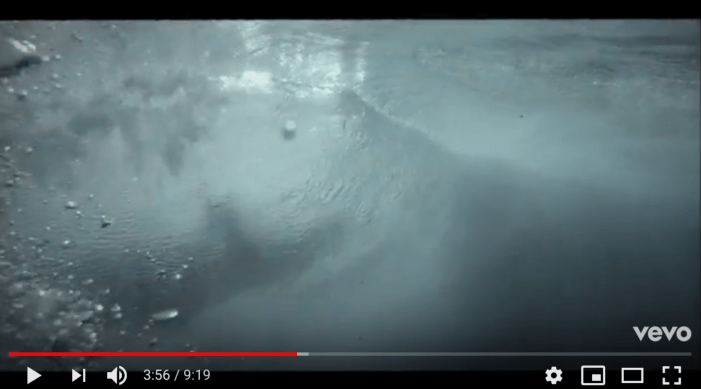
Screenshot 2019-09-09 at 20.44.25.png

What happens next? The shot drifts over the cliffs, the coast, to a strip of palms and a distant view of the LA skyline. That shining love in the previous track is replaced by a minor key, a glimpse of the jukebox whose songs include The Eagles, Bon Iver, The National. Artists whose Americana is the melancholy of generations moved from political despair to something like the glitch of the times as a basic fact of intimacy. One of the Bon Iver songs shown in the video is ‘22 (OVER S∞∞N)’, and if that title was not rife with implicit apocalypse, what is, what is. A stammering into language, pitch-shifting the fragile space of utterance. There’s a spiritual glimpse to the sky and the infinite quality of the stars: 

There I find you marked in constellation (two, two)
There isn’t ceiling in our garden
And then I draw an ear on you
So I can speak into the silence
It might be over soon (two, do, two, do, two)

(Bon Iver, ‘22 (OVER S∞∞N)’)

I don’t know what the maths is doing. I don’t want to know that the song ‘was inspired in part by Bon Iver mainman Justin Vernon’s unsuccessful attempt to find himself during a vacation’. I am however interested in the hubris within this term ‘vacation’ at all. Do we now live in a world where you can take ‘time out’? There is nothing of the world we know that could be switched off. There is no ‘away’ of complete erasure or original presence. Deconstruction caught up with our living. Vernon describing this song as a gesture towards what might end of his emptiness could just as easily be flipped: its relief is equal to a mortal sense of loss. The impending erasures. It ‘does’ or acts the accretional event of extinction that is speaking into the silence, to those who could not speak back. 

Fragments and snatches: the neon green lining Lana’s eyes, the aurora borealis, the neon green palm in the club where she sings alone. A season by yourself. The love of the couple together surfing is cardboard, Hollywood. It is a trembling symbol. It is almost ridicule.
Screenshot 2019-09-08 at 10.27.46.png

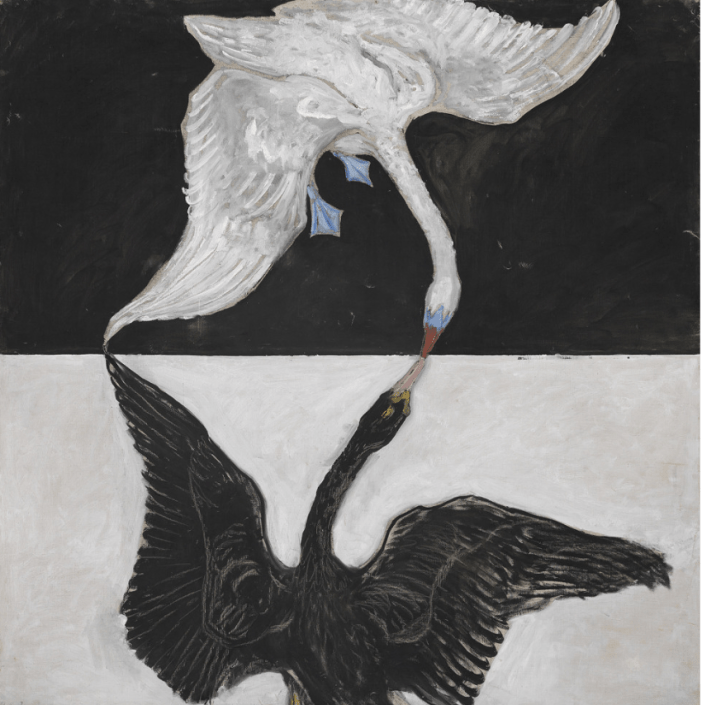
What is Justin Vernon looking for in the constellation? When he sings ‘two two’ I think of Hilma af Klint’s nose-touching swans, or the hours of the day chipped at the edge — two of them stolen by tragic event. I think of a mic check, two, two, ch, ch. Click. Near-enough-presence of speech. A white swan on black background; a black swan on white background. Flip. The swans are geometry, signets of signature, they move towards abstraction. Growth. I love them. Fuck it I love them. The way they are just it. Inversions of colour and a monochrome mood splashed with cornflower blue, the tiny excess we can treasure. It is the cornflower blue, the little webbed feet, which make the swan in question unique. So we can care for it, figuratively as it swells through grey-white waters of memory. The swans we have lost in our shit. Royal iterations freed from belonging. This painting is from af Klint’s series Paintings for the Temple, works derived from spiritual communication. The abstraction of the swan / renders us stark in frame / for we were Lana or Leda / before we were animal. Sufjan Stevens’ ‘Seven Swans’: ‘All of the trees were in light’, ‘a sign in the sky’; ‘My father burned into coal’. And all of our sadness was carbon neutral before this. We plunge into whatever remains of the water, its plasticky thickness.

I keep pausing the video as it transitions. ‘Fuck it I love you’ twinned with ‘The greatest’. When The National sing It’s a terrible love and I’m walking with spiders, what exactly is the ‘quiet company’ of the ‘it’? It could just as well be spiders. Maybe it’s the web itself, the web between the human and the more than human, the gossamer moment where metaphoric articulation becomes more than feeling and gleams material. ‘It’s a terrible love that I’m walking with spiders’ — what is the grammatical transition done by that ‘that’ and who is to blame. Walking with spiders might just be that love. Transitional, subject/object logic is reversed in this song: ‘Wait til the past?’ is sung, then ‘It takes an ocean not to break’ when surely the ocean itself would break you. Soon the ‘terrible love’ is a substance, something ‘I’m walking in’ — to feel it is an act of immersion. It is to let that wave crest over, the ‘lyric auto-explosion’ (Moten 2017: 3) of the wave that would break you. 

In ‘The Greatest’, Cat Power sings of former ambition now cast to nostalgic regret. There is a sense of time slowing to delay, laconic strings, relaxed drums, the balladic sleep of a once-held fault. It is a parade slowing down in the rain. To say ‘Once I wanted to be’ is to hold this question of ‘the greatest’ as a generalised desire itself. The hunger we lose in time, whose primary colours soften. I hold to that precious, cornflower blue of a swan’s foot. ‘Two fists of solid rock / With brains that could explain / Any feeling’. This solid rock that would box you into the future, that would harden the edges of self. A thing is born, as Clarice puts it, ‘hard as as dry stone’. This is the thing born ‘that is’. To exist is to be this hard thing, protein ligament, to kick out in lines; but then in time there is the plasmatic self inside that, like some fatty animal byproduct, sticks to the others it loves, it needs, it leaks. Gelatinous, softly sticky love. The ‘it’ that needs saving. Anthropocene softcore; soapy inside of all geologic agency. Who we are and what we regret. The turning of the outside-in, the inside-out. Kathleen Jamie, in Sightlines, asks: ‘What is it that we’re just not seeing?’ (2012: 37). 

A sightline is a hypothetical line, from someone’s eye to what is seen. Is it clear or blurred, bad or good? Anthropos recedes in its very own scene as the ocean continues and we howl in the dark like a lossy-compressed version of species. We are the sirens and wolves. We are at the great concert of the Earth. We have to resist what Bernard Stiegler calls the ‘proletarianization of the senses’ (2017); we have to find longform ballads of what’s happening, pass them down the line, resist the short-circuiting of thought that occurs between screens and machines. We have to send letters back to our consciousness, our elders and children. This is the work of lyric. It could be the work of dance. I think of Zelda Fitzgerald’s protagonist, Alabama, learning to be a ballerina too late in her life: ‘Her body was so full of static from the constant whip of her work that she could get no clear communication with herself. She said to herself that human beings have no right to fail’ (2001: 180). Alabama barely eats; her energy is all the zeal of will. The dance of lyric as reduction, lack, as static and chased success whose collapse lands as Alabama will eventually do on the event of inevitable break. Grapefruit squeezed on the gritty turmeric shot of the future. And a brake, a screech. And yet we write, we cast out limbs and materials, we work towards this loss; we imbibe it. 

This is an ugly type of writing in which the outside is always imagined from the inside. Horizons are fictional and buildings are barred. I have no sightlines. I’m fucking cutting the corners of someone else’s desire. All paths are the continuation of a pre-existing line. This is a city from which I send myself postcards wherein I wish I was here. Flying letters. Words stolen from myself. I refuse to recognise that I have not composed them unintentionally

(Bolland 2019: 78).

The videos for Lana’s ‘Fuck it I love you’ and ‘The greatest’ swerve between inside and outside. We find ourselves in rooms we don’t remember entering. Writing the anthropocene has an ugly, masturbatory quality of fucking yourself with the rush of elaborate doom. Okay, so. Constructing fortresses of lines which would make a valiant destination. When I listen to Lana, I’m accessing shortcuts to ‘someone else’s desire’ which is the opening up of presence. ‘This is a city’; ‘I wish I was here’. I have never been to LA. We plagiarise our very own diaries to get back that sense of the once-intentional, the greatest declaration on Earth. That we were here, and we loved. She wrote that lit, forgot. The papers curled up and rolled away in a sultry air that was summer, 2012. The year of failed apocalypse, the year Lana released her debut album, Born to Die. We saw her campaign of fashion smoking through plexiglass bus shelters. Remember all ‘horizons are fictional’: they tell a narrative, they bleed and tilt and set like ice. Towards them we stupidly drift: the lived throb of our softcore skins, our hungers and rhythms.
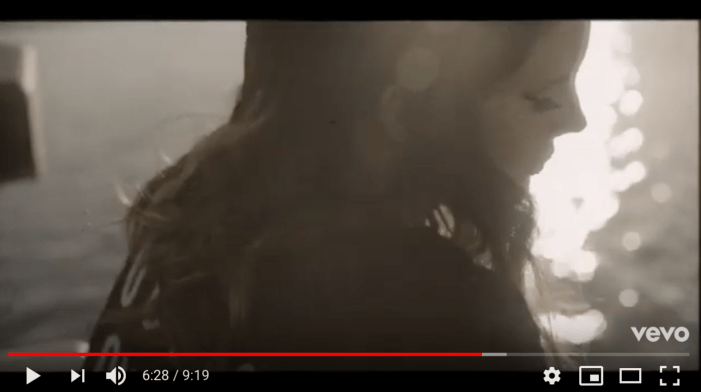
Screenshot 2019-09-09 at 20.44.50.png

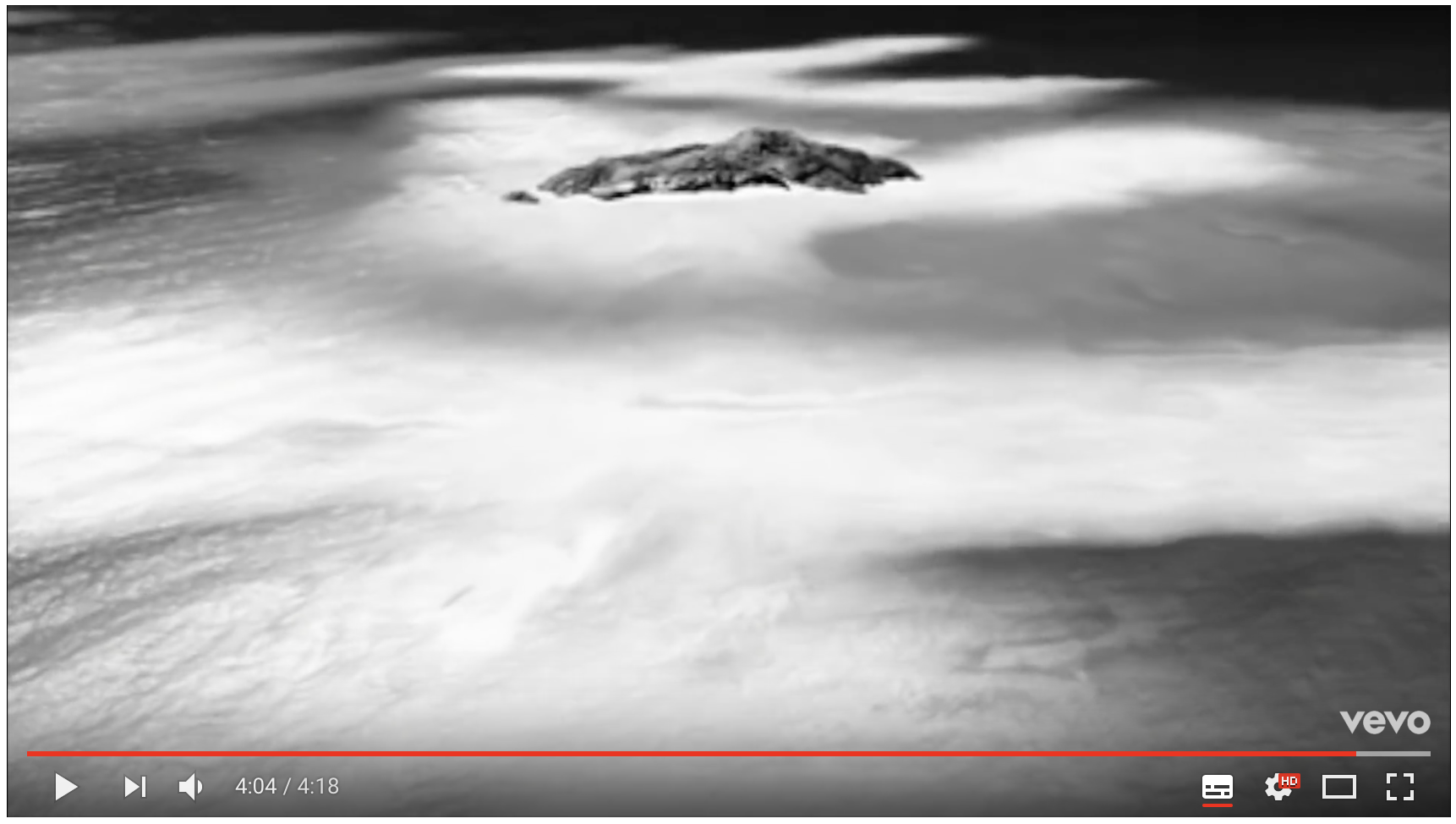
Drifting in colour like H.D.’s Leda, the rape of the land and the body and bodies engendering bodies. Worlds ending around us. And so I could say, but this is just one song, a phrase, a white woman of fame lamenting her world. But this self-conscious cinematics is a gesture towards the western world itself as this haunted, tragic protagonist: ‘The culture is lit and if this is it, I had a ball / I guess that I’m burned out after all’ (‘The greatest’). So you could say, anthropocene softcore speaks to the lyric I in its state of orphaned exception, which in turn is the loss felt by us all unequally. If we make of Lana a sort of anthropocenic siren, we must recognise the distinctions within our longing. For we all lose worlds differently; harm is striated along lines of class, gender, race, ethnicity, geographical distribution — of course. That wave that closes the video could elsewhere be a tsunami. I like to think its place on the edge is a deliberated hint to what could or is even already happening here or elsewhere. And maybe the colour, the aurora, is this streak of need for an excess beyond static blank, ‘human’ planet, standardised canvas; the need to splash something more of blur and blue. Flood the structure. 

When we say something is ‘lit’, we mean it is hot, on fire. We mean it is turned on, ignited, intoxicated, drunk, excellent. Lit is the past simple and past participle of light. Isn’t that line alone just lit? Maybe we are in the twilight of a former Enlightenment, recognising our species hubris as this alien green that tinges every familiar horizon, upsets the normalised green of pastoral. Is it toxicity, the elsewhere within ourselves? It is a radar showing who we are and where we have been. Those material metaphors cook on a smoulder, and this is the softcore coming to knowledge about what is happening.
Screenshot 2019-09-08 at 11.27.08.png

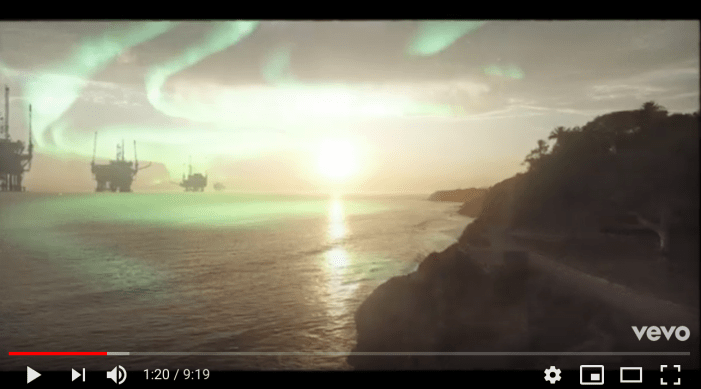
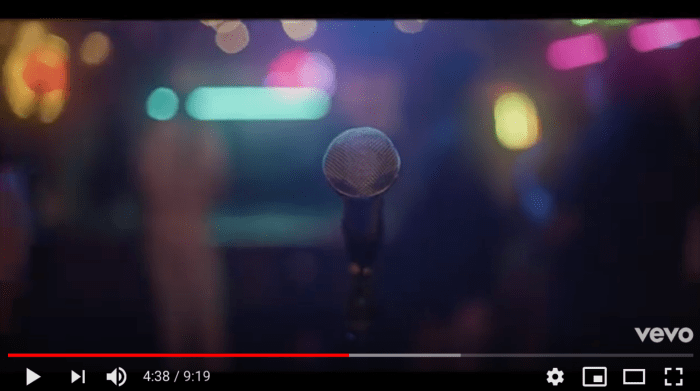
What does it mean to sing: ‘I’m facing the greatest / The greatest loss of them all’. To sing this on the brink of a hyperreal sunset, to chase a solar excess among loss. This loss could be a love but it is more like a culture; it is more like a voice and the condition from which to speak or sing it. The loss of lyric, its possibilities of address, and the loss or deferral or ruination of place itself. Maybe this is Lana’s lyric maturity, a generational acceptance that ‘young and beautiful’ is no longer the apex state of what we should strive for. Absence tenders complexity. Is this, as Roy Scranton puts it, Learning to Die in the Anthropocene? This question of mutability, the green-winged eye that sees a darkening world, a lack of birds along the bay, an edge. In the video for ‘The greatest’, Lana’s jacket reads LOCALS ONLY on the back. I google the phrase and find a hipster restaurant in Toronto with the slogan, LET’s PRETEND THIS NEVER HAPPENED. There’s a kind of parochial nihilism that glisters like the light on the sea, but the sea can never be local only. There’s a boat in the video whose name is WIPEOUT. It’s all happening; the signals are obvious. How we are practicing the absent-presence of the name’s erasure. My tongue gets twisted when I say anthropos; I want to say mess, I fall into ‘guest’ and ‘gesture’. With its glaring cinematics, LA offers the hospitality of light. But it is an exclusionary light. For now, only some of us get lit, get to the mic.
Screenshot 2019-09-09 at 20.46.01.png
Lana sings from within the metallic architectures of LA’s coastal infrastructure, the port. In the bar, she throws a dart and misses her target by a nonchalant smidge, knocks the 8-ball towards its pocket. I keep thinking about exports and imports, what we put out, take in and trade. Economies of luck and depth and surface. Maybe Lana is a hydrofeminist, her soaring lyric gesture recalling a hauntology of America as that dreamscape of what lies beyond or in the deep. And now we know it is further extinction, precarity, hardened borders. What do we do with that looming closure? Lana has shrugged off her jacket now, she’s smoking in the kitchen where the lid slides off the pan to let the steam out. I’m not saying we’re sitting on a pressure cooker here. There’s simply work to do, mouths to feed, ears to fill. This is a ballad, a paean to the transient, fragile beauty of everything. The songs shown again on the jukebox are songs of a type of blues specific to oceanic or cosmic consciousness, to hunger, the time of lost summer or that of a broken love:

Janis Joplin — ‘Kozmic Blues’

Dennis Wilson — ‘Pacific Ocean Blue’

Sublime — ‘Doin’ Time’ 

David Bowie — ‘Ashes to Ashes’

Jeff Buckley — ‘Last Goodbye’

Leonard Cohen — ‘Chelsea Hotel #2’

I’ve spoken before of what ‘anthropocene sadcore’ might look like in poetry. I’m still working through that. It comes from the common phrase used to describe Lana’s music, ‘Hollywood sadcore’. I’m interested in how that emphasis on mediation, transmission and cinema plays out in our understanding of ecological emergency, but more generally the existential condition of the anthropocene, which places us as geologic agents under the generalised, gendered rubric of Man. Maybe Anna Tsing’s feminist work on the ‘patchy Anthropocene’ could be applied to the cut scenes of a glossy Los Angeles caught on video. A patch is also a software update, where comprised code is ‘patched’ into the code of an executable program. Maybe the patchy anthropocene involves this kind of cultural patchwork: the lament to a love or a culture is patched to include this bug of ecological consciousness — the patch is a kind of coded pharmakon, poison and cure for apocalypse blues. But Lana paints in shades of yellow too. Blue and yellow making aurora borealis green. A cosmic gesture to what lies beyond thought. And what of those oil rigs in the distance, glistening. They form an audience to the siren’s lament; they are part of this story, and we are mutually complicit. Where the magnetism of the male gaze is often part of Lana’s canon, here it is mostly replaced by oil rigs — supplementary Man as the infrastructure of anthropos, looking back at its melancholic, warning siren. Softcore is less affective than sadcore; it is the ambient hum of climax coming. Its cousin is the slowcore, luminous melancholia of a band like Red House Painters, perhaps: Purple nights and yellow days / Neon signs and silver lakes / LA took a part of me / LA gave this gift to me’. 
Screenshot 2019-09-09 at 20.43.42.png

In Bluets (2009), Maggie Nelson writes of a restaurant she used to work in, where the walls were ‘incredibly orange’. After each shift, collapsing exhausted in her own home, ‘the dining room’ of the restaurant ‘reappeared in my dreams as pale blue’:

For quite some time I thought this was luck, or wish fulfilment— naturally my dreams would convert everything to blue, because of my love for the colour. But now I realise that it was more likely the result of spending ten hours or more staring at saturated orange, blue’s spectral opposite. 

(Nelson 2009: 43)

Orange and blue, water and flame. The mind’s alchemical transformations reveal the way colour works chiastically upon us. I think of Freud’s mystic writing pad, the waxen surface of memories allowing for palimpsest versions of stories that trace and erase. ‘This is a simple story’, Nelson writes, ‘but it spooks me, insofar as it reminds me that the eye is simply a recorder, with or without our will. Perhaps the same could be said of the heart’ (2009: 43). ‘Fuck it I love you’, sung to the blue-orange wall until something comes off that surface like a static or fizz. Irn bru, ironed blue. There is quinine in my dreams of hungover labour. Surely there is a violence to this particular love, that is staring, necessary. The love of what must be limitless hurts.

Screenshot 2019-09-08 at 11.27.23.png

Janis Joplin’s ‘Kozmic Blues’ rises to a swell, a jostling of guitar licks and urgent, assured vocals. A sonic thickening. ‘So mastered by the brute blood of the air’, H.D. writes in ‘Leda and the Swan’. Held in that vascular shudder that acclimatises to a manmade world, what happens next is a loosening, a shimmer, a shrug of the garment. In the poem or song, in the painting or film, in the collapse of that wave into a bluer future. To incur a kind of erosion and yet live on in those terminals. ‘There’s a fire inside of everyone of us’, Joplin sings, and I think not of flames but of cinders. ‘At what temperature do words burst into flame?’, asks Ned Lukacher in the introduction to Derrida’s Cinders (1987), ‘Is language itself what remains of a burning? Is language the effect of an inner vibration, an effect of light and heat upon certain kinds of matter?’ (Lukacher 1987: 3). I know if I did not write I would smoke. These acts of temporality in its material extinguishing. What makes the remembered restaurant blue, not orange, is something of this transmogrified smoulder — an inversion akin to af Klint’s swans, demanding that splash of blue. When I write, am I pursuing the absent space of that skyward blue?Blue is the colour of the planet from the view above, Lana swoons in a song (‘Beautiful People Beautiful Problems’) from her previous album, Lust for Life (2017). But in Norman Fucking Rockwell, Lana’s California album for 2019, it’s less of this ‘above’ we see. We are held within the infrastructure, cinema, the end of summer. The dreamlike logic of How did she get on that boat? When did she enter that room? Who put that song on the jukebox, baby?

I want to say:

It takes an ocean not to break a planet.
It takes not a planet to break a species. 

Lana’s voice grows wispier as she sings of that burnout. There’s this imperative that okay we could enjoy this with American flags, we could pour communal Jack and go down in flames. We could riff the history of our culture in archives of song, gestures and nods of reference. Ladies of the Canyon, Cinnamon Girl, Norman Fucking Rockwell. We could keep laughing or dancing while the world is or was at war. Lana is both behind and at the bar, the sightline of where we go to be ‘served’. Intoxication is the order of the day and we call it ‘fun’ to put the fucking of other people’s desires under erasure, strikeout, as Bolland does.

If this is it, I’m signing off
Miss doing nothing, the most of all
Oh I just missed a fireball
L.A. is in flames, it’s getting hot
Kanye West is blond and gone
“Life on Mars” ain’t just a song
Oh, the lifestream’s almost on

(Lana Del Rey, ‘The greatest’)

Miss doing nothing’: post-recessional ennui becomes the paradoxical happiness of living in static, not working as a kind of work that resists the future as set out by capitalist horizons of accumulation. We used to just ‘hang out’ and several other dreams of youthful nostalgia. Kids of today can’t even touch that innocence. We know so much; maybe or probably they know more. We are all variously entranced by the softcore unfold of this happening; we are all variously called upon to be complicit, to recycle, act, resist. To speak or not-speak. To be in one of many different levels of rising heat. The conditional state of being’s value, ‘If this is it’, in the anthropocene raises its pitch to a charge. To sign off is a form of surrender that gives up the name for the blur of species. I think of Lars von Trier’s Melancholia, the planet that would smash us and yet somehow Lana dodges it, that

The audience in the bar where she sings are mostly men, but their gaze is not sexual, as in much of Lana’s prior visual oeuvre. Rather, their longing gaze, often filtered through further glass, is something like the profound melancholy of a multi-generational sense of this loss. These old men have lost the planet, the one they grew up with, just like Lana’s siren, come from some other time, a life ahead of her steered by the changing climate, the hurt and vengeful seas. The camera holds close ups on their staring faces. The song holds the long durée of a loss that spans generations, damages and is damaged by elders, sparks in the present-tense of cultural tendency. In Lana these men look to a future hurt whose cause was partly theirs, as inheritors of industry: she is both victim and heroine, singing and swinging. The shot opens out to reveal her smiling with younger friends, her own generation. These intimacies are what we have left. The next shot shows some kind of factory or refinery leaking smog into a cloudy, overcast skyline, sulphured yellow. Once again the boat appears with its title, WIPEOUT. Lana is supine on the bow at sunset. She is golden, angelic, silhouette. It’s like she missed the fireball but melted it, cooked it up for tea, apocalypse syrup. Things are going down around us. She hugs her arms, later standing, laughing with a dreamlike intimation of imagined elsewhere, closing her eyes. Be hospitable to yourself and others. The reel of the jukebox keeps ever turning: this is our ever faith in culture. We have to take care of what’s left in whatever space we can make of song, duration. 

But the mainstream disciples and idols of Hollywood are failing, Kanye West is ‘gone’. Surely a reference to Elon Musk’s plans to save us by colonising Mars, ‘“Life on Mars” ain’t just a song’ is sung with a melancholy matter-of-factness, a kind of sigh which implies the banality of techno-utopia in a time of extinction. The thrill of such dreams is lost now. We lost our faith in Hollywood, lost our faith in the movies and the scale of those solutions. In a world without books, we’d be ‘bound to that summer’, addicted to one of many narcissistic ‘counterfeit[s]’ to make love to nightly in futile repetition — that would be, as Weyes Blood sings, the ‘Movies’. 
Screenshot 2019-09-08 at 16.56.01.png

What we look back with: 

The trauma is not, in the Freudian lexicon, this or that violation from the world (such as war), but the ill and trauma of this originary installation of “the cave”—what could properly be called the cin-anthropocene epoch, particularly given that the era of modern cinema is to be regarded merely as an episode: that of the machinal exteriorization of the cinematic apparatus, given that it coincides with the era of oil (artefacted “light”), given that its arc coincides with that hyperconsumptive acceleration leading to mass extinction events, ecocide, and an emerging politics of (managed) extinction

(Cohen 2017: 246)

The trauma of greatness as such is this accelerated promise of the dream, the event, capitalist growth, the movie itself — whose imperative is towards scene, closure, episodic narrative in demand of the next. But the drinks in this video are barely drunk; they are more like props. Everyone is aware of their place in the tableau vivant of the anthropocene, even in its softcore, consumerist pop expression: the iconography of oil rigs, downbeat affect and intergenerational longing. Not a violation from the world so much as the stream, and where its accumulative logic would eventually come to crisis, even as corporations beyond our imagining were already plotting that logic of a break within archival excess: the feverish incineration of the present, the smoulder and melt that smogs and spreads and streams. 

Fire is there or it is not there. […] But surely there is a word for that moment when a fire log, beneath its bark, has become one immanent ember, winking like a City or a circuit board; for that moment when you know only the desire, no, the need to stir it up. What is on fire, you ask yourself, staring into that waiting. What is that moment. What is that word. 

(Lennon 2003: 434)

The nights ‘on fire’ that Lana sings of are those of the Beach Boys, reprieve of the sixties; the bar on Long Beach that served as a ‘last stop’ before the tiny island retreat of Kokomo. Frank O’Hara died on Fire Island. Fire is presence or absence, but there is a moment before it is both. A slippage between the extinct and extinguished. And the world was lit up as before. I wonder if the word Brian Lennon looks for is simply ‘sleep’, the title of his essay which I first read in John D’Agata’s anthology, The Next American Essay — with intimations of that Lana song, ‘The Next Best American Record’. What is with America and the positioning of the next. A constant state of pressurised imminence that streams and streams: ‘We lost track of space / We lost track of time’ (‘The Next Best American Record’). We sleep into death or spirit. My first legal drink was a fireball whisky, in a pub by the sea they built in a church. That moment when you know only the ‘need to stir it up’, fanning the flames. That impulse towards blitz feels extra political in these contexts. We need something of relief that would stream, and in that flow be more than a question. Something of cinders, drifting. 

In Lana’s song, I’m interested in this word ‘lifestream’, which seems like a slippage from the more familiar internet-lingo, the ‘livestream’: the coming live that seems provisional to digital retro-future, the promise of satellites beaming the present, simultaneously. Lifestream, instead, is a vascular imaginary of bodies flowing together. ‘LifeStream’ is actually the name of a blood bank serving the Inland Empire and its surrounding areas. Lifestreaming is, Wikipedia tells me, ‘the act of documenting and sharing aspects of one’s daily social experiences online’. It is the flow of the timeline, akin to the wall, the blogroll, the feed. But here, at the end of the song, the promise of information’s overflow is in a liminal state — ‘almost on’. Extinction’s monetised data cast as the simultaneity of thick presence spread by millioning participants. We are here and we said something, our words were atoms, splashes of blue. We stream towards a life, cut ourselves short on the fragments of others’ desires. Mortality’s softcore contingent. The fear of missing out is assuaged by the narcotising work of cinema. And if this is it, Lana has already signed off. It’s something more like her spirit that’s here for us, the stream of an echo, fold of a song that we could replay, continue voicing. Hope lies in the circadian rhythm, the lived time of a pause in the anthropocene’s ceaseless, cinematic duration — that which we see and drown our hearts in. As Jean Rhys’ drunken, depressed protagonist of Good Morning, Midnight (1939 – the year WWII began) muses, ‘Well, sometimes it’s a fine day, isn’t it? Sometimes the skies are blue. Sometimes the air is light, easy to breathe. And there is always tomorrow….’ (Rhys 2000: 121). And what if tomorrow was the greatest loss of them all? 

~

Screenshot 2019-09-08 at 11.56.26.png

All screen grabs taken from here (Director: Rich Lee) and here (Director: Natalie Mering). 

~

Works Cited: 

Bolland, Emma, 2019. Over, In, and Under (Manchester: Dostoyevsky Wannabe). 

Cohen, Tom, 2017. ‘Arche-Cinema and the Politics of Extinction’, boundary 2, Vol. 44, No. 1, pp. 239-265.

Fitzgerald, Zelda, 2001. Save Me the Waltz (London: Vintage). 

Jamie, Kathleen, 2012. Sightlines (London: Sort of Books). 

Lennon, Brian, 2003. ‘Sleep’, The Next American Essay, ed. by John D’Agata, (Minneapolis: Gray Wolf Press), pp. 427-234.

Lispector, Clarice, 2014. Agua Viva (London: Penguin). 

Lukacher, Ned, 1987. ‘Introduction: Mourning Becomes Telepathy’, Cinders, trans. by Ned Lukacher, (Lincoln: University of Nebraska Press), pp. 1-18. 

Moten, Fred, 2017. Black and Blur (consent not to be a single being) (Durham: Duke University Press). 

Nelson, Maggie, 2009. Bluets (Seattle: Wave Books). 

Rhys, Jean, 2000. Good Morning, Midnight (London: Penguin). 

Riley, Denise, 2000. The Words of Selves: Identification: Solidarity, Irony (Stanford: Stanford University Press). 

Scranton, Roy, 2015. Learning to Die in the Anthropocene: Reflections on the End of a Civilisation (San Francisco: City Lights Books).

Stiegler, Bernard, 2017. ‘The Proletarianization of Sensibility’, boundary 2, Vol. 44, No,. 1, pp. 5-18. 


Brand of Immortality

IMG_6215.JPG

I can say we had no idea what we were doing here, but that wouldn’t be fair on Bill, who is always trying, who understands things in a way I suppose I could never. Bill with the sticky note diagrams pinned to our bed, torn down in the morning. He says my lack of understanding grants me a brand of immortality.

“I could never think about the future, babe,” he assures me, “because I know too much already.” The yellow notes curl in his fist.

Everything we do we do in present-tense; he makes sure of it. I wish he would elaborate on what he means by ‘brand’. 

Every day he refuses to stare at horizons or watch the white scream of webpages buffering. He is never without some tool in his hand, whether it be a toothbrush, hacksaw or knife; he does not build, he will only fix. Never without a drink either, whether it be a mug of instant or a cup sloshing over with supermarket wine. We only need to take the car out five miles to the nearest store. We make our own convenience.

My favourite times of day at the cottage are dawn, noon and dusk. I like edges and centres. The caramel hour bitten into crisp wafer, wakefulness. Times right after the light changes and the clouds sweep into general elemental drama. I shiver in the damp air and go outside to catch a breeze, wrapped in the scratchiest blanket. I watch Bill take the boat out and kick shingle back into the sea, wishing I was smoking. Something I gave up when we moved south, along with everything else. The Topshop habit, the fibre-optic broadband, the Netflix subscription. In tattered clothes I walk the shore, losing my sequins. A lot of what remains from that time is stuffed in boxes beneath our bed. There isn’t space to pull it out, but on special occasions I’ll riffle through for a pair of shoes or a dress. Once, I salvaged my patent blue heels and a pale gold backless number and paraded down the creaking stairs, as though I were a prom queen, morning after, my hair unbrushed for days. Bill saw me at the door in the light and laughed.

“You look nice babe,” he offered. He was fixing something on the hinge, or the lock, wielding his drill. He gave me a look that only a father gives, a kind of bemusement and tolerance towards his daughter’s minor rebellions. As if I’d bothered smudging lipstick on as well, as if this were some extravagant transgression. I felt shame. 

I sat at the makeshift desk we’d set up by the window, flipped open the laptop and looked for work. I did things freelance, intermittently. When I got a good job, I’d sometimes beat Bill in the takings, but such jobs were few and far between. Plus, they’d leave me ragged for nights, up late with the slowest WiFi, endlessly emailing and making notes. Times like these I missed smoking most. Smoking would fill a delay. I could never get my sentences right, and facts seemed increasingly blurry, always positioned ahead of me. It was like the sea licked the edge of my prose and wouldn’t let things settle. I hated every draft I ever completed. I needed that nicotine clarity, the stark voice of an editor at my back, the buzz and warmth of an office.

But then again I have space now. I let myself think.

We moved south to get away from something, sure. I’m not sure what we were looking for, was it solace in the water? Bill says it’s contaminated, the shoreline. He’s seen folk in high-vis doing tests, collecting samples. I’ve seen them too but never tell him. There used to be some kind of plant nearby, perhaps a rig; you can see its skeletal remains jutting out to sea on clear days, if you walk far enough west. The ghosts of a former infrastructure. I took loads of photos when I first saw it, I wanted to write a blog for this environmental organisation. I wanted to get paid for ranting about the surprising petro-landscapes of the south. I loved the way the sea stars and lush, cola-coloured kelp just clung to the rusted bars. Politically, things went sour that month and it wasn’t a good time for complaining about oil; I ended up writing on the specific variety of pink thrift that springs up hardily around our cottage. It was some cutesy piece for a gardening website where everything was written for ‘Mums’ specifically. They wanted you to send them an ‘everyday headshot’. You had to mention ‘your kids’ and make offhand remarks about a ‘work-life balance’.

I took my coil out months ago. I wanted to leave things to chance. Something he doesn’t know.

Bill and I have been painting the living room, a stark shade of yellow. He was so sceptical, humming and hawing in the B&Q we’d driven two hours to get to. I had printed off all these articles about how yellow increased happiness, how it set off your serotonin receptors, how it had served in this or that film set, how it could soften your lighting, your heart. The first thing Bill did when we left B&Q with the heavy pots of paint was spit, groggily, onto the concrete. He’d had a particularly bad cold but wouldn’t admit it. A woman was passing into the store with her daughter in arm, and looked at both of us in disdain. Not that Bill noticed. He was distracted by the task at hand. His spit swirled with luminous green, on the surface of the car park. It had landed perfectly, ridiculously, on a blue bottle cap. It looked like the fucking Earth.

Sometimes I wish I could really look into what’s happening, what’s to come. I’d be a much better freelancer, I’d predict and inform and connect. The old woman in the cafe says there used to be whooper swans, smews and teal. She has this whole list of beautiful birds she reels from. I see her once a week, sipping her Earl Grey tea on Friday afternoons — the only day I allow myself the luxury of hiding out here instead of the damp cottage, reading. I read whatever’s on the shelf of the cafe, trashy romances and natural history; I never finish the book I pick up, never ask to take it away with me. Borrowing seems too committal. The old woman says the land is dying; sometimes she is more specific. She remarks on my tardiness, remembers the days when girls dressed smart. I find it remarkable she still refers to me as ‘girl’, hasn’t noticed the streaks of silver in my hair, increasing day by day. Of course she is immaculate, a figure lifted straight from a 1950s knitwear catalogue. 

My blood still comes, out of the blue in the night like a miracle. I lay awake listening to  gushing rain.

The living room is finished, smelling fresh. I have drafted my piece about losing the birds, quoting Ms Earl Grey for good measure. Bill says I’ll struggle to find anywhere to send it. Nobody wants to hear about extinction, he says. Especially from someone so obviously immortal. He winks and I try to comprehend. Everyone is willing me into the present, but I can see the longview now and it is not bright, it is not yellow. The yellow won’t hide the cracks from the damp; the alkaline, unpleasant smell leaking out from the soil beneath us. The men in high-vis taking samples wear yellow. When I stand on the edge of the shore with hail in my eyes, their yellow mixes up with the yellow of boats and lights of distant harbours. When I look out to sea I don’t know what I’m seeing. The tide gets closer to the cottage each day. Soon there’ll be water at the door. 

Bill might find a solution, build a wall. I am not so sure he can solve this. He asks why my eyes are stung red and raw each night and I blame the weather. He runs his fingers along my spine and tastes the future inside me, bruises me like a fruit he can’t quite eat. In the morning I wake up and stare at the yellow, remembering.


Eleven / Cherry / Extinction

Screenshot 2019-04-08 at 14.31.06.png

On the 11th of June, 1993, I was born with an extra digit, an eleventh finger. I am told it was a finger, so goes my parents’ mythology, but probably there is some anatomical word which better explains the strange appendage attached to my left pinkie. Resembling a kind of lollipop, a glass candy, my eleventh finger was a long thin vessel of muscle or blood (what I cannot know or ask of that fact) attached to a kind of crimson orb, like a cherry. It wasn’t really a finger at all, but the unfinished potential of what might’ve been one, a mutation. This was accompanied by a strawberry-shaped birthmark on my inner left wrist which, my dad assured me, would fade as I grew older. The cherry finger was lopped off on the day of my birth, and the blood splattered the doctor’s coat, bright red upon starch white. Soon after, I nearly died. A lightning storm raged through the morning. I was placed in an incubator, I had some kind of viral infection. They furnished me with the supplementary khora, until I grew blonde and better. So the story goes, and already I have probably messed up the order.

But I want to say something of the number eleven. Eleven feels like a residue, an extra. The loss of this finger, which I do not write with and yet slyly it makes itself present as absence, constitutes a kind of originary erasure. Years pass in which I forget this secret was mine at all. Eleven, perhaps, is a statement of entropy, a chaos spilling over our familiar limits and even regressing or falling in loops. However we parcel our intake/outtake, our sense of personal energy. I test out images of eleven, of extra. In Tom McCarthy’s novel Remainder, the protagonist wants to claim his free coffee, the remainder, so badly that he buys ten cappuccinos just to get the loyalty card stamped, just to claim the free one, the eleventh beyond the card. A strange caffeination that remains incomplete, to come. Then there’s Eleven from Stranger Things as a kind of genetic extra; the number identifies her as a test subject. The number becomes name. That phrase, turn it up to eleven, when really the system stops at ten. Why is it we make wishes on 11:11, when did I start doing that? The wish constituted itself as extra. Over time, I find myself ‘catching’ this time more and more, glancing at the clock of my laptop when it just happens to be 11:11. And the wishes pile up at the forefront of thought, they take a while to resume as memory. When I am sad, I visit the Kelvingrove fountain. There is water and clarity, the hum of other people’s wishes. Sometimes this is better than poetry, it’s simply potential.  
Screenshot 2019-04-08 at 14.32.05

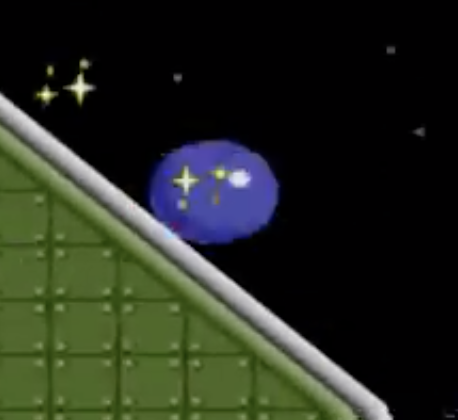
I knew someone who named themselves after the sky in Super Mario (with Ayrshire inflection) long before either of us had even heard of Cory Arcangel. We were born on the exact same day, same year, and we called ourselves twins. It took eleven years of our lives to find each other. Speaking to this person, I felt always this chiasmus of consciousnesses, a sense of keeping up, or ongoingness.[1] They were super beautiful with luminous curls and sports jackets. Their nights were spent up with consoles and synthesisers, and we messaged each other until our windows crashed, or our parents needed to use the phone. I will not quash the romance of the dialup connection, for it was real, the frisson of interruption. The sense of a moving into, the attunement that performed itself in the temporal interlude of a radio whistle, blow of white noise that had its sonic continuum, warping and twisting as though all these howls in the wires were coming to life, and we would sing through the modem our deepest thoughts. You would teach me a riff. We were each messaging the others at once. There would come a point where everything was just text in the end, the fragile reminder of each bodily fragility.

You wrote in cyan-coloured Comic Sans, before this was ironical.
Screenshot 2019-04-08 at 14.33.15.png

Half of my brain wants a masculine state; the other half a quiet, feminine comedown. What is it to speak or sleep gender. I’d sip cider in the wee hours after the party, but nothing fragmentary said then was as good as it was on the computer. It was like coming to life, discovering what had not yet been told of a love or a taste. I suddenly felt affectionate towards everything, and the aesthetics of a particular website, the trajectory of a song, could startle me into tears. Everything grew fizzy and sugary; it was all too much. What we were supposed to say to each other. I was learning to apply eyeliner, clip bras and shed weight like a grownup. The environment was a diagram we drew at school, a set of names we recited while dipping for critters in rockpools, freezing our brains on polluted beaches. A joke that was told to the air before we could return to our games.


***


I never learned the word for what happened at my birth, what grew on me, this residue fruit. After a while, it broke away, the fact of it which was a specialness. I was losing that specialness the more I learned language. There was a solvent process of being okay with a long red line that meant mine or anybody else’s ‘I’. (/) A length of energy, a vessel snipped close to the richness. We invent names for ourselves on the internet.

Something constant was the minor chord shard in my heart, when I knew there was a thing awry. I could not put my finger on it, much as I could not remember what I wanted to do with my life, or what passion that had driven me to write as a child. For I had filled documents and jotters with my rambles before. What happened, if you can forgive me for inserting a narrative turn here, was a loss of story. Post-puberty, it seemed there could be no climax in my life. Events I had expected to effect a shock into existence had not occurred so; a long hard drag had occurred instead, slow enough to trick you into passive submission. Resistance became a case of daily withdrawal, decay. It seemed there was nothing to write into, now I understood the mysteries of sex, reproduction, death. I had written these epic fates about unwanted births, woman impregnated against their will in labs buried deep in violet mountains. I had a horror of the body inside the body, which was the same as the body inside the planet or the planet inside you. What grows, regardless.

There was a fragile voice I was waiting to hear on the radio. I had not yet worked out the temporal trick that was poetry, the way it could stop you on the blot of a page, by fact of its shape. What grew charged or tangled. I became interested in the way the body was just a body, something to be seen, something to offer up to bodies beyond you. I wanted to know its limits, its multiplicities, as much as its points of attunement. Like plugging in headphones to the library PC just so I can hear the electrical charge of each scroll as a sonic intensity. There was a time of mark-making, rigging lighters, taking steaming baths. Staring at other people’s ceilings. I practiced lying on concrete, feeling the dark cold of summer’s inversion travel up from my spine. I listened to music so loud that stars began splintering inside my ears, and so I would have tinnitus forever more. I burned my tongue on a minor chord.

And so the same sound would scream back, muted lagoon trapped in my ear a decade later, the splitting sextillion stars of that music. The melody itself was irrelevant. I was drawn to songs where you could fall between verse and chorus, and the space of that slack guitar was far more important, the way a man’s voice could break on a word. For some reason, then, it was always men.

What does it mean to be taught how to feel by the opposite sex? Things tilted and sweetened the weaker I grew. We held hands in west coast impressions of sunset. The word for weather was like whether to say I’m going offline. The fort-da pull of your endless sign-ins. r u okay?

Jean-Luc Nancy: ‘A corpus is not a discourse, and it is not a narrative. A corpus is what is needed [qu’il faudrait] here, then. Here—there is something like a promise that this has to deal with the body, that is going to deal with it—there, almost without waiting […] there is a sort of promise tacitly to hush’.

Thus the body is clearer in machinic absence. Thus this vast proliferation of forgettable text was the logic we gorged on, empty calorific haribo words. There was no vegetarian alternative, we were eating each other. I mean the sway of exchange, this sense to be dealt with. A hunger, sugar rush. I message you later. The pressure of reply, now we’re always online; transmission as love’s endless labour. Isn’t it exquisite just to hush, to disappear mid-conversation and relish the ellipsis for a future hour. In these small ways I was building a tentative next, but its openness was yet clouded by thought itself. I couldn’t think beyond three minutes, and that was depression.


***


I learned the deformity of my birth was a sign of witchcraft. I bought a bright pink book on the subject when I was very young, and tried to astral travel. I wanted to see things from above, but instead I found myself suffocated by their closeness. Children can smell sorrow, the weight of it dripping from adult expression; the way dogs pick up the mood of the house and embody it through quivering and whimpering. I burned incense and imagined an orb of lilac light spreading over my body, which became the mountain I buried my heroines in as a child writer, an amateur at fantasy. I slept with crystals under my pillow (I still do).

The wrongness of the world was everywhere. The way people spoke to each other. I could not connect. I leapt into situations where voices were just echoes back into the water they came from, where sentences shored up nothing more than the vice of their speaker. I began a long affair with silence. I stopped writing, and later I stopped speaking. For weeks at a time, I would lose my voice. It broke on the shore. I smoked little menthols in wind tunnels, listening to reality talk shit back to me. I was broken inside before I began; that was the feeling. Long walks could not smoulder it off, and the only calm I achieved was from the absolute lack of understanding I experienced in math. Not knowing was a clarity, one I still crave in the space of writing. The absolute sentence as a violence that closes all others.

Later, much later, I would discover this glitch was a crisis far beyond me, a crisis of climate, a crisis of world itself: so huge my child’s mind could hardly have discovered it. And yet, having said that, I was already halfway there. Halfway towards ecocide. As a child, I swore to my mother I would leave the planet on my fifteenth birthday. She almost believed me. Mars beckoned, with its fiery red swirls and its secret knowledge of an evil beyond. I liked the way the name felt ‘full’ in my mouth. When nothing happened, I drank myself into amnesia; I stopped eating. It was a birthday gift to myself, the hope that I might still disappear.

Hungover, I know there will be a point where I go and that is to die. The blank is like a name you forget at the point of recall. It is so much worse than that, as if we’d forgotten our own name and the name of our mothers and the E____ itself. And what it means to see the back of the tapestry and a trypophobic horror where every unloosened stitch, a tiny blank, is the signal of multiple (un)ending worlds. Consider the strawberry seen from inside, with its millioning glowing yellow seeds of light. My wrists replaced originary marks with marks.

There was so much to learn about what was happening. I needed to know what would be okay. It was just this whole impossibility of thinking the future. The word ‘career’ was hilarious. It made me think of falling through time, Scrabble letters tossed into void at light speed. That was the language I wanted, letters at light speed.


***


Silver foil, the metallic smell on your fingers from playing guitar. The way I could play through brass and acquire an instrumental breath, vibrations that slid out of tune because I had damaged my ears too much to listen.

As promised, the strawberry birthmark faded. It was like somebody had slowly quietened the white noise, so slowly that I could not be sure if what I heard was truth or hallucination. The distinction mattered less over time.

Dream where I can’t sleep, so I wake up to watch Super Mario Clouds on YouTube, so I relive the level without level.

Sometimes I feel twinges of pain in the bump where my finger was. This phantom sensation is strange because I have no working memory of the limb itself, if it can be called a limb. The-cherry-nothing-more-than-a-supplement. Wikipedia tells me that the pain of phantom limbs can be aggravated by ‘stress, anxiety and weather changes’. The supplementary limb, then, its existence as a constant play between presence and absence (I had the limb, and yet no memory of its function; the limb was extra and yet in having it removed I felt less than a ‘normal’ person, I am less than I was and in sameness still more), acts as a site of super-attunement. When the temperature gets weird, the tingles start over. The pain is a drift of cirrus.

If you press very hard on the bump on my hand, I feel a sort of convex nerve pain, akin to the ache of pins and needles, concentrated in this single location. I wonder if this is what happens to a cherry when you slice it in half, when you make of the round fruit a sudden circumference. Something fell out, a long long time ago. The tiniest stone.

The world is wrong. There are only signals. Nothing has even really reached us yet. So why leave?

Wikipedia tells me one explanation for phantom limb pain is ‘the result of “junk” inputs from the peripheral nervous system’. There is an overhaul of arousal just to live now; somehow the waste of this activity is concentrated in this mark of removal. Can it be called a wound if it is not a gap or a hollow, but something in addition to the skin, a geologic feature: a kind of tiny crater, a half-sphere, a mound? I imagine a tangle of thread-like nerves coiled up inside. Nobody has noticed this bump of their own volition. To mention it to someone, I was born with an eleventh finger, is of course to commit an act of confession, a gesture of intimacy.

Like here, you can nearly have my birth back. A gift to the Earth in you.   

Derrida: ‘The wound can have (should only have) just one proper name. I recognise that I love — you — by this: you leave in me a wound I do not want to replace’.

I died when I was born, literally; I was born wrong. But in being born this way, I had to love the world as a child of enchantment. I had to trick myself into existing. It would be an obscenity to look back at those pictures, tiny  baby with this slight extremity, this tuning fork of flesh, so easily severed. Who knew anything of a redheaded future, a salad of spent conditionals and love. And I want you to be free.


***


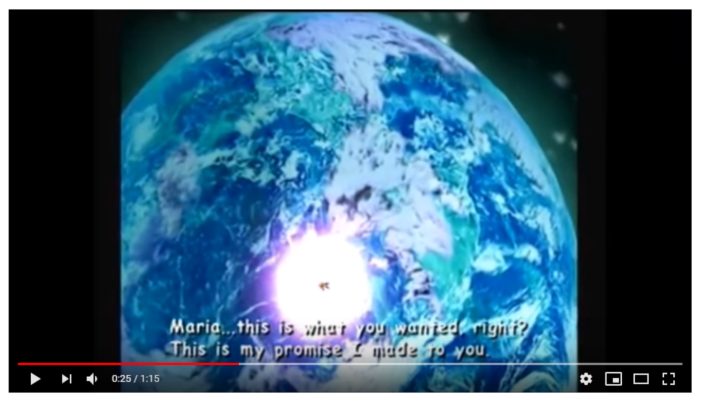
So what do we do with this extra? Knowing too much of the world and what the self cannot say of the world in itself. Autoplay is paused for the meantime, by which I mean the time in which we are mean. I remember discovering cruelty in the playground, where a boy would go round and hit us with strong red branches he pulled from a shrub that grew with some abundance around our school. And realising the marks made on the back of our calves were really just marks of a pain this boy had felt; a pain inflicted upon him from elsewhere, so that cruelty was something you transferred, a kind of heraldic ink you wore for your life, for your family. I would not explain these marks to my mother, or to myself, for years. My early experience of inflicting cruelty: throwing Chao against the wall, only to nurse them back into serenity later. Teasing the dog, watching a friend knock his head off a wall, deliberately fucking things up. Then the delirious pleasure: to throw one’s avatar off into starry void, a final sacrificial act. In Sonic Adventure 2 Battle, a game to which I dedicated many hours of pre-adolescent life, the villain Dr Robotnik has programmed his space colony, ARK,[2] to collide with Earth if the chaos emeralds are used. Such annihilation intends vengeance on ‘the government’ for condemning the doctor’s research and killing his daughter, Maria. Her request to Shadow, Sonic the Hedgehog’s Jungian double, is to help mankind. When Shadow plummets back to Earth, following the ultimate battle, ‘the Finalhazard’, he is happy, because he has fulfilled his promise to Maria.

Admittedly, this cosmological battle of heroes is little more than parenthesis here. I want to say something of my entrance into this discourse of annihilation. Shadow was a supplement: Sonic’s ‘double’, but also his genetic extra, his genetic remainder; both hero and villain, his narrative volition was ultimately self-sacrifice to save the world, and yet he was created to conquer the world. He embodies the eerie promise of a kind of living apocalypse, an ‘end’ to the world that does not end. I remember the final book of Garth Nix’s Old Kingdom series, whose blurb used the word cataclysm, or cataclysmic, to describe the events that closed the trilogy. That word lived on in me as a wound, cataclysm: something sharp that had already cut me. It was a word I could not unthink. What actually happened in the book was terrible, was a battle, it involved the loss of life; and yet there was redemption. I knew then that cataclysm was not necessarily apocalypse, because one world of fantasy could open into the new, like a modified species. There were chain reactions.

Screenshot 2019-04-08 at 14.34.48.png
But all this is just average Earth. Learning to like the light, to paint a thought with the similar blue, knowing it only exists in dreams, and the way she holds a note.


***


These days, everything mostly feels like transing times. I listen to a Jason Molina recording and realise that he is gone, he is missing from the world, and yet the warmth of his fingers, these arpeggios; the sound of sirens passing through the windows of his Chicago apartment. These are present but I discover them only after absence. I have to realise this over and over, to register the shock of this or that loss. I close one tab, only to open another window onto extinction: this fact of a text we can’t share, because the text is ourselves, and we have shared unto each other enough of the missing space. And someone else I once loved dies. Data is what’s given, it clots into so much hurt. We just are confusion, the two of us and the planet and what’s opening up.

Everything swells; a cherry-red globe recurs in memory. I drift on a lifelong melancholia that isn’t quite mine. I want to be able to parse this bodily symbology as a something beyond me, of course; I want to look outwards at the felt inequality. So many wounds between us. The word continent crunched sour in my mouth. These histories we can’t unpeel or remain in singular. I want to be able to understand the matheme, but there is a wilderness still. The breath won’t catch up. Scared I’ll fall off the edge of my mind.

What we make difficult for ourselves, these fractures in fact or family. Always a guilt that sticks. It is as though we were speaking underwater, our altered tongues; what we could only bring together as lyric.

I had all these dreams of traffic, and the traffic could only move in the night. I was at the edge of a slip road, but I could not merge. Are we closer, now that you know this?

whatever in the world behind closed eyes the doors whispered. let her be. let her be her. let us be as if we were not forever entwined in that, as if we were not able to unthread the conclusions, deliver ourselves of the plot. at that level she intercedes for you. she cries mercy at the feet of her father. she knows where he is at the far corners of the universe. he has removed himself. he has gone off to sit and brood beyond the pale of light. if not that then this. but we had opened it. the knife that cuts both ways. always. in the centre of it the rose. pure. the flaming heart, an artifact. believe me. this is not a special dispensation. this is a matter of life and death.

(Beverly Dahlen, A Reading)

And why did they give me the middling name of the Rose? There was a world tucked in and still to unfurl, and the rose was a planet with cloud tucked into its darkest heart. Let her be here. That time I set my hair on fire and everything of the world smelt singed for weeks. It happened at the funeral. She was at the mercy of a childhood memory, curled at the window as they came in the night to tip the car. And she remembers the way the oil ran down the road as rainbows. The sound of her parents on the phone and a knife that cut the silence of Sunday. It was a thick gelatine; the boiled fruitmeat of calorific lyric. The cut in the world behind closed doors, closed eyes, the lids we can’t keep on our possible futures. So we swim through; no, it gets stuck in our teeth. How can it be a matter of both?

Screenshot 2019-04-08 at 14.37.06

Crank the anthropocene up to eleven. I wish we had been sweeter to each other. Like listening to the bees without meaning to. We’ll never know why we are born the way we are born, or whether that matters. And I’m pushing sleep for the pleasure of that stretch of the break: when you say the break of the sky and is it a pink cloud I see, or just blue. The 8-bit troposphere catching nightly. Facebook is blue because Mark Zuckerberg is colourblind. There is the overlay, the twice-lived light of the screen and the sky beyond, which is also contained in a window. At no point do I choose to go outside, as it were; for this is the happening of a necessary containment. I need to be able to switch between tabs, my brain still reeling. There is always extra, the bit we missed and have to pursue.

If I saw you again, and we were the same as we were.

Excoriations of time are like Facebook disavowal; don’t click, don’t react. They rub off on our skin as however many times we surrendered our diaries, only to take them again in our arms, cradling tiny diacritics. The first broadband was the rupture of a secret, something breaking out widescreen and hurting.

Narcissism: this essay. A name comes out the sky(e), its extra e for the isle, for extinction. The Earth is active now, this state of evil, eleven, never even.

We should be kinder to each other, said the tree to the thing that would grind it to pulp. When Justine eats the meatloaf and it turns to ash in her mouth. And you know that all this extraness, extremeness of death is from the other planet that is our planet. Just is. I put a bar through Mars, I pierced its fat red eye with the proto-knowledge of Earth’s erasure. That was my great stupid rebellion. It felt like a dreamwork of futile justice.

The fact is only an identity, a pristine midnight. Land lines of countryside glimpsed in the feed, I know the moon only this way until I leave the library. So sigh, milk silver of gaze. Instinctive descent occurs in dark mode, and we play it over, scrolling and scrolling. The hours between. For all I remember of that night, there is only the simple avocado emoji, and a thank you. You’ve been more than a friend to me.


***


What do we call for?

It’s like the first time I saw Jane Campion’s Bright Star and thought of something shimmering in the woods, that would not come as powder or song but simply as itself. And yet even that was split. Cancer moon/Pisces rising. I could sense it, and the morning hurt, and the continuum of pain whose fidelity remained still into the half planet smudged on the edge of my hand. The Earth is a cherry that lost its innocent self. You would interrupt our greeting in honour of the end of the album. That was the tempo we stretched for ourselves, syncopating sleep with the lights adorning our names with time’s ongoingness; eleven hours at the end of the wish again, after we stayed up past the chorus of dawn. And the world was shimmering in the woods. Our cut had barely interrupted the story.


  1. And ongoingness is, as Tim Morton puts it, the temporality of melancholy in the anthropocene, this sense that ‘nothing is determined yet’. This sense that we are not looking towards apocalypse but rather trying to be here, knowing this ‘here’ is not ours or fixed but is a viscous spreading of multiple subjectivities, bodies and times. Ongoingness is to look for pleasure as well as pain, to not look towards loss as imminent or behind us, but rather to appreciate the uncanniness of reality. So this person’s consciousness became for a while another half of my own, their thoughts would echo and remain in me, beyond pathology, warping from something raw and ‘live’ to a gentler articulation of being here, being-with. The enviro-mind, formerly-known-as
  2. Incidentally, the Ark was a youth club I’d frequent as a teenager, beside the sea. The site of many formative drinking experience, it was surrounded by dunes of lawn and behind those dunes I’d learn my first versions of drowning.

Playlist: March 2019

playlistmarch2019.jpg

9 June 1977

Plato wants to emit. Seed, artificially, technically. That devil of a Socrates holds the syringe. To sow the entire earth, to send the same fertile card to everyone.

— Derrida, The Post Card

He goes around sliding things under doors. When I answer the buzzer he coughs through the speaker. Is there something for me? Impossible to tell. He clutches bundles of luminous, anonymous catalogues. But there is mostly paper, less of noise, in my dream. All the colourful paper is folded into neat little butterflies and cast about a room somewhere, a trillion paper butterflies made animate by a ceiling fan. They swirl up and hover and tremble, they display the fact of display. If Damien Hirst were kinder to hyperobjects. The butterflies are destined to live for only a day, but their larvae live on and on, reproducing in squirming punctuation. The home screen was full of these icons, butterfly icons, but the state that I am in…well, I saw them as colours in kaleidoscopic array, you could say formless because they were almost utterly without origin. I tried to click through the butterflies to open a window. The word broadcast has its origins in agriculture. I see him at the edge of things, broadcasting his literature; dreaming of that broadcast whose discourse would finally slip into ‘Stone in Focus’, fully looped for 1:17:10 duration. The butterfly paper of things we were supposed to purchase. Palimpsests of unspent ‘truth’, a kind of solvent tonic for wounded text. What folds is the secret of objects, their identity prior to products. The butterflies fly, land, twist, secrete. They become tiny wedges. I want to gather up quantities of plastic and watch it melt between my fingers, the putty of a capitalist extinction. I kinda wanna call him. One day the fan will stop running and that will be the end of the day. The paper is better than plastic, by a mite.

That is what I write to you. A little shard of a page. I can pinpoint its scene of writing, the place where the walls are real moss and everything is green and utopian blue. The signs are over-scrawled in washable ink: fill up the kettle after finishing. A world slides out of focus when I write to you. No one cares. The point of a sentence is itself the long-tail; maybe I had not converted the file right, maybe I had not stretched this line as far as it wanted. But it broke apart regardless:


. . .  . . .. .             . . .

.        . . . .. . . . . .. .. . . . .

 . .     . . . . ..       . . . . .

             . . . . . ….. .   

     . .         .. .


I see last year’s city in a flowing grid of water. The artificial channel of departure. I am trying to remember the blue of the plane, the blue of a single window. It seems this journey annihilates the next. The weather is unavailable to me. I was up so late, crunching chocolate eggs between my teeth and reading Dodie Bellamy. Everything said was fibrous, electric, painfully or even exquisitely wired. I was in San Francisco, I was in a flooded New York; I was in my hometown, even more underwater. The prose came in streams but it was hardly mine. I leaned in to suck the smoke from your face. What everyone needed was chamomile, a breath of the air by the river.

At the end of the world, the butterflies drown. We mourn them very quietly, last of our senses stimulated. The muscularity we made of our work is immaterial now. I’m trying to swear myself into a rhythm of perfect sleep. What comprises a wake up call, the fuck fuck fuck of it. Alarms are sent from afar to hold me in the punch of 400 words, Plato’s postcard. I wake to her dreams in WhatsApp messages; I split samples of songs I don’t like into ringtones. Something slips into something and the dark looks different. I walk home and catch variant scents of spring, mixed up with the fumes from the late-night buses. I rub blossoms and leaves between my fingers, trying to intensify the feeling. I am incredibly nostalgic for Chloé perfume, when I hug her goodbye. Magnolia, freesia, honey and cedarwood hidden beneath. Often those moments are so sweet I have to stand there in the street and text myself about it. I have these texts on my phone:

05:12: It’s just sunset, stupid

01:01: My legs are full of equinox

23:42: What if we wrote a line for every hour slept

02:34: Orchid.mpeg remembering futures

In Lars Von Trier’s Melancholia, the only safe place is the cave. But the cave is more like a teepee, it has no walls; it opens out onto the cinematic event which is this massive planet colliding with Earth. So there are no walls, not even ones made of moss, woven with pollen. It is not exactly a place ‘to go’. The cave at the end of the world is a triangulation of lines, a diagram. It points to the sky. The inside of the cave is the outside; it is a geometric skin; it is infinitely double. I think of the cherry red skin of my hotmail; at what point in my life did I choose that? The interior kitsch of human flesh, rendered plastic. Sometime in the month I write: I want everything to be tender but I had no idea it could be this bad. When the hail comes, when they salt the road, when the snow comes, I think it is ending but I wake up as before with the equal ache. Sunlight (?) Statistics lisping the roof of my mouth, as though writing itself would produce an allergy. I lay down my stuff, just as he is walking in, and my tongue in my mouth and the blood in my veins and the thought—indistinct sense of where the year will head. But I am looking instead for the tail. Already curling back into itself, the significant events of January chase me with flickering imagery, they are a personal narcissism. If I could boil them down, attain a clarity; shoot them, syringing…

I roll up my sleeves for airborne beams of vitamins.

She tells me how gorgeous the ghost was. The coast was. I keep thinking about the chestnut taste and the kisses of light, the packet I put back on the shelf. The world was wrong; the supermarket made me soft enough to go, checking the mirrors in financial departure. Incredible sponges, dying at the bottom of oceans. Someone holds the syringe but not for me. Someone holds out for loose change. I lose specialness daily in order to live. I dream I have a daughter who stands by a fireplace while I clip a starfish pin in her hair. She can’t say the word. I perform the tiniest sweep, distracting her gaze. She doesn’t want to go outside, she will scream and clutch the radiator if I tell her. The word is literally unnameable, I wake up with it gone from my lips. But the word exists! There was surely a species. It is only a technicality now. Secretly I write the word down, days later when it returns to me, burning. To write it here would be to violate that, to cheapen its life with a summoning. I realise the daughter is only the version of self that I didn’t fuck up. She exists elsewhere. I swear to her:

Anne of Julia Kristeva’s psychoanalysis:

I dreamt that a little girl came out of my body, the spitting image of my mother, while I have often told you that when I close my eyes I can’t bring her face to mind, as if she had died before I was born and carried me along into that death. And now here I am giving birth and it is she who lives again…

(Kristeva, Black Sun)

The daughter as a twice-lived avatar of futurity, the mask of what comes before as pushing through generative time; mothering and lusting and screaming for our place in their state of absolute melancholy. Be with me and share this pain. In the anthropocene, we accumulate a sense of primitive, foetal lostness (how many times have I curled, cried, questioned); the world is our fragile, amniotic sac. We float, we are starved of good air; we trap the heat. We can’t trust the way we damage it, extract from its boundaries the richest juices; the way we carry it; the way we absorb and are absorbed by it; the way we circulate in the midst of our mutual toxins. But the Earth is nothing so essential to us as mother, and no blood-ridden cloud of cotton could stop the daughter, screaming all through my sleep.  

The longest comedown, the longest night. Where mist is mostly the way of him holding a note, and it is not instant, it is not like the drug or the river that drowned him. It is the name with so many consonants. It could shatter a language with time. My dreams are thick and long but my sleep is short. I like how many times Sophie Robinson mentions her inbox in Rabbit. I check my own and the number surpasses 50,000. Spending the morning in turmoil, wanting to write back to the sunset I missed. Endless proliferation just is. It is something like, hold simultaneity in blockchain. Mathematics achieves a weightlessness. I’m sorry I’m sorry. Pieces of skylight I can hold in my head, granular blue. I’d let myself into the rain again. I need a very tall building, a stairwell to make the blood rush back to my extremities. You tell me not to.

Remembering the summer where all I could do was measure the slenderness of other people’s legs, in a numb, inexorable kind of way. This felt relative to my sense of extinction. It was something about, what do we put in our bodies and where or why do we want to go. I was suffused with the sense of the need elsewhere. How do we blend into a world, make of our souls these chalk pastel auras. If you could terraform Mars with memory only. The drift was the weight of an email, it was rainbow and stretched as far as my childhood. I saw her by the river, holding a piece of glass to the light. She hitched up her skirt and waded in. The voices subside in the rush of the current. The image fades, because she is anyway there, chastising my choice. I wonder how ever we lived without each other.

Heartburn and techno. Reasons I want to fold this away, why I walk along rivers regardless. The latent burn was only as far as the beat could measure. After the movie, I felt a depression so immense it was like I lost touch with each muscle. The doorbell. Friendships fraying like so many neglected threads. Coal emissions are rising like shares or something. I ran and ran in the dream of the land I remembered. I could smell wild garlic along the river. My brother was already home for the match. I ran and ran to get back to the gym with the moths in the showers, stuck to curtains. 91%, 69%, 43%, 1%. Even my phone is dying. Little white eggs in your palms are lyrics. What if the lilac tree were more than or less than life itself? Lilacs symbolise the beginnings of love. Being earnest, accelerationist, plugged into the HEX account of refresh, streaming language. What colour is it that flickers in time? I have been ignoring innumerable messages. I want to dwell in the missing hour, the split that occurs when the clocks go forward. It’s just like the extra cappuccino, the final stamp on a loyalty card. It always resets.

She is no longer there. It was so simple, letting the blood of the thought away. Dark liquids filled my days: cola and Guinness and the black, oozing matter you see in the water in Tarkovsky’s Stalker. Dreams of petroleum slick I saw in the sky. Oily dream of the Essay of the Book of the Essay. Literature seems almost impossible now. I needle myself into the heads of writers. I want them to pierce the myriad empty pores of me, tiny molten residue eggs. This imagination, waning. White cracking liquid black on the page. I was taking pleasure in texture and loops, cutting my tongue on a shout. I don’t know how to write! Mostly I would lie in bed reading D.rida and peeling the skin around my fingers, leaving tiny strips of red underneath. The cherry-rose flavour of Rescue Remedy. I needed something heavy; like an extra river, proplus, nicotine gum.

Transducer: A device that converts one form of energy into another.

I wanted to be online forever and I wanted that status to annihilate the fact, I wanted to erase onlineness from the web and I wanted the result to be world, oblique exchange of realities, and people uploading their papers forever, and a sweetness, whatever it means just to speak. I wanted the spider to eat the fly. I wanted to read behind the lines until I became signal, and my signal was a force behind the language I wanted to speak, and it was prior to me. I went to the Tower and forgot they were having a party. The white wine tasted like sugary air. There was a video I watched, ‘Pyramid Song’ performed in Egypt. What doesn’t care to be sent. The egg won’t open its hatch. The complete terroir of relief in southerly regions where I cram all my life into multiple time zones, the sibylline remainder of day. Mysterious she beckons with fat grapes squashed in the O of her mouth, all rotten fruit I could smell from the train going south. She designed a very careless outrage and I realised there wasn’t a single shout inside me. She twists out the stalks like dead capillaries. I confront the thought of something terrible happening. So many times and I could not shriek. Later, tiny black seeds spill into my palm. I can only cherish them.

Facebook is the broadcast of Earth. I try to straighten the mirror, as though the spatial urge were innate and not just void. It was not the same book that I had ordered, the Book of the Essay. I had already set forth on the impossible project. I struggled to review. I had not even written the fact of it yet. There is value and heat to this project, even in its moments of stretch and collapse. I would put writing through the machine that makes water effervesce, missing the ease of waitressing. When ‘Beyondless’ came on, I felt infinite again on Great Western Road. Short-sighted, I missed the faces of every stranger. I wrote this sestina called ‘Lucozade Blues’, but I had not the stomach for any orange energy. Would you like ice with that?

The cave is a kind of triangle. Facebook is the vending machine, dispensing the glitches and beats of our life. It is as one, invisible crowd of desire. I want to say swarm. I want to say seed, but the burst spent seeds that lie in the dust of the archive. And she does calisthenics just to stream them live, and she lays her beautiful eggs. I am obsessed with the rhythms I can’t keep, lunar cycles for mindless complexion. Someone comes along to clear us west, they have had enough of our westerly airs. Sometimes I long to smash the windows of my local Tesco after midnight, just to boost M&Ms off the shelf, scatter them along the coated floor and crunch their acid colours one by one with my shoes. I want a whole lifetime to tread in my shoes. The pause when you stop in the walk to tie your laces, and you look so lovely with your leg in the air; a kind of ballet occurs in suspended time. Everything about this sentence is soft, it has to be. Plié. It subjects me to a slenderness, elsewhere a song. Bend and taut. Fear of the dark or the light, lilac wiiine. Somebody else is always between us; somebody else is the cavalier world, riding its way through galloping matter to get back to the point at which this becomes anti. And later I stroke your hair in the stable, and later we find him, and later your dream hair is all I can smell and scrunch when I come up for air or salt in the morning. And you are smaller than I ever remembered. We do things we shouldn’t exactly do. As if all this could be written in cafés!

I felt sick all semester with radial thoughts, and when I woke it was spring and the circle made of my mood a halo, it would be the same mood to return forever. Sunshine, caffeine, approximation. A loop the butterfly pages can fly through, and we chase them, baby-fisted, throughout the night. I want to be this clumsy and look at you straight in the eye and smile. Faster, the butterfly pieces of colour and light. Faster the streams of warmth and the morning gulls and something that comes on astrological. Supermoon channel. It is only you that makes me angry. Spring arrives solely in Getty images. I could just download all this weather, I want its data to supplement; I listen to ‘Eudaemonia ’ on repeat and remember the future we were yet to inject, starbright direct to our arteries. I’m sending a sort of word to Socrates, I’ve got this whole card—

~

Drugdealer, Weyes Blood — Honey

Sky Ferreira — Downhill Lullaby

Grimes — REALiTi (Demo)

Ess_Gee — Bubble Queen

Hand Habits — are you serious?

Stella Donnelly — Tricks

Julia Jacklin — Body

Pocket Knife — Custard Cream

Kelly Lee Owens — Lucid

Youth Lagoon — Daydream

Them Are Us Too — Eudaemonia

Tim Hecker — Obsidian Counterpoint

Sarah Davachi — Perfumes III

Logos — Menace

William Basinksi — 4(E+D)4(ER=EPR)

George Clanton — Livin’ Loose

HEALTH — LOSS DELUXE

Bliss Signal — Floodlight

Frankie Cosmos — Eternal

Strawberry Switchblade — Trees and Flowers

Galaxie 500 — Fourth of July

Silver Jews — Trains Across The Sea

Her’s — Under Wraps

Burial — U Hurt Me

The Durutti Column — Love No More

The Walker Brothers — Orpheus

Nico — Somewhere There’s A Feather

Talk Talk — I Believe In You

Playlist: February 2019

As I was a permanent client of stars, awaiting that moment before contract to fold back, edge of the page that was prior to birth. The sky is that page where everything saucy happens. If I feel ‘switched on’ it’s in fear of the light, scraping cutlery together to start fires with little intention of correct extinguishing. This is just an indulgent way of saying ‘fuck you’ to the spinney where I dropped a whole packet of sour cherry sweets that day after school with the song in my head. ‘Fuck you’ to the trees, like they own me forever. As I was defined by the willow I cried by, circa 2009. You only say ‘fuck you’, truly, to these sorts of vicarious parents, dragging their entrails along the water. They come in plurals; they have to eat each other just to exist. Something Eileen Myles says of a person, they can’t fully flourish till the mother tree falls. What was the one I saw by the golf course, Maybole, spear of the monument? Granite is war is radiation.

Someone replaced their tongue with a leaf of mint. They spoke in sprigs.

Things written in lieu of a nature poem:

  • A letter to washing machines all over the world
  • The lyrics to ‘Florida Kilos’
  • A list of snoring faces
  • Imitations of archived Twitter
  • Requiem for a useless wedding
  • Things I once wanted from the Argos catalogue
  • An inventory of much-despised artificial flavours
  • Amnesia’s archive of MySpace bulletins
  • Plagiarised ‘Daffodils’
  • Impressions of Shoreditch
  • An amateur walkthrough to ‘Star Light Zone: Act 3’
  • Homage to retro screensavers
  • Flyers for drugs
  • Hieroglyphs of ring-collecting sound effects
  • Many novelisable addictions
  • Screeds of abrasive html
  • Reasons why X should get paid more
  • Moderate to good assortment of sexual confessions

___The night in the casino felt like gold was butter, gold bars of the house we were chipping apart from the ingot. We hadn’t spoken in a very long time, so it seemed, galaxies of the year had passed already. In a land where I only reserve soft lyrics, hoard Milky Ways, know nothing of your suffering in that time except what you showed.

Taxidermic language, wrapping up the undead for the accidental. Reels of my body, scented magnolia layers beneath. ‘As for love’, Clarice says, ‘they weren’t in love, of course’. This is ‘The Message’.

Off the train the air was clear, smelled manicured. Click of the tape deck. He scorns me at the checkout, 2:am, buying my lightbulb. I could not live through the night without light. Haggard in Tesco blue he called me a moth and bared his teeth; I smiled and stepped into temperate February. Just flick the switch before you leave, that’s all. I’ll be a while, it’s no use waiting. My 1:09 Transpennine got stuck at Bellshill for hours and hours. I drank with a woman who did not know my name, as I lacked hers; we laughed at the pensioner commentaries, ordered drinks. We learned so much about trains in that time. I arrived back in the grey and longed for LED, Cornish horizons, the shape of his jaw like the edge of a country I might not visit.  

It seemed impossible that I would ever fall asleep again. Veers of the wrist[?]


My sick heart is a small blue swollen ball. 

In the novel I read there were always these nocturnal women, pacing around in foreign cities. They stayed in hotel rooms but could not last the night, they would slip softly into Parisian spring and trail the streets. It was often Paris, which rose in the back of my mind like something unfinished. It needed rendering. All I remembered was the razoring cold, the leers of buildings, needing to piss for hours and hours. The taste of cow’s milk, morning ache. Sometimes fancying the accordion song, impossible to exorcise.

[ The wreck contained mustard and scarlet, teal and rose.
We wriggled a little. Missed a bit. ]

John Hall: ‘Can’t you see why I couldn’t be doing anything else?’

Tracing such palimpsests of light, we ask of the week a question. Will you stay this mild forever? Little interlude, it’s okay to feel nice for a while. That’s what he said, this is nice. The daffodils are out. Kneading the dough of a belly, I over-sleep each day until the hollows of my eyes smooth into cream. Life is a cheeky rose. Perhaps no one is in love as James on his album. Picture him at the window, clipping the extraneous stems from various houseplants, watching the syrup drip onto the leaves. Think of this synthwise. Maybe that is a loneliness, so absolute in your feeling. Imagine him paring his Joycean fingernails, the man at the window whose name was Blake with a kytten for history. There was nothing so bright as that. You could not say, hailing it, kytten, kytten! It was extra literary. It was sooo much of everything before even alive, hey.

__The kytten was made of milk. It was bound to leak out someday.

We’ve not had a chance at everything yet. We’ve burned it all! At dawn we drank algorithms and the well-bronzed man still kissing away on the fire escape. As if all of this happened, expensive drams and learning the words for variable clouds. We enter the storage facility. Your da, your da, your da sells—That bit where Don Draper gets all misty-eyed over Hershey’s. At the end I’m crumbling a little white cookie, Karen is wailing the way she feels, the inward razoring, and it’s all I can do to remember the bees.

[…]

Dyeing my hair with fresh cherries, yayo yayo, yeah they say it’s excess to do this again. She runs the punnet under a cold tap, rubs them clean with her fingers then scrunches them, crushes them luxuriously over my scalp till it all runs down and I’m shining again. There’s a baby at the back of my eye that screams and screams, maybe I pretend I don’t know her. The cherry girl in the bar was trapped in a basket. Lana says nobody dies in Miami! I remember the harsh sunsets of your Playstation 2, smashing ourselves into several pixelated seas. Rank best to worst our beliefs, this night that got away again. We looked up the cheats and looked into the future, pressed x’s and triangles together. I mixed up my consoles, remembering it. A hook, a hook.

It took me six months to write and then I scrunched that mess back into a planet!

Notes from my diary:

Today I’m heading south to learn about trees
I could easily sit in a spoons and weep. 

Goddamn stars what am I supposed to owe you! Held sequins in palm to insufflate, insitu. There was so much oil in my salad it looked unethical. Walking through the park at night, say this is balmy, so warm for the season but I don’t want to say unseasonable, and so feel like the narrator of another bored and beautiful New York novel. Don’t like the tonic in gin. Pay without debit; display songs in nested form. There are so many themes up my sleeve! Leave your key at front desk, darling I’m trying to reach it; white lines on the road wherever the silkworms—

~

Aldous Harding — The Barrel

Julia Holter — Les Jeux to You

Weyes Blood — Andromeda

Todd Rundgren — I Saw The Light

Judee Sill — Enchanted Sky Machines

hand habits — placeholder

Red House Painters — Golden

Big Thief — UFOF

Tiny Ruins — Cold Enough to Climb

Karen Dalton — Katie Cruel

Arthur Russell — Not Checking Up

The Tammys — His Actions Speak Louder than Words


Playlist: January 2019

screenshot 2019-01-30 at 18.13.26

screenshot 2019-01-30 at 18.13.11

screenshot 2019-01-30 at 18.12.57

I mean this is the world, a blue teardrop of luck in endless vasts of the barely understood

(Rachel Blau Duplessis, Blue Studios).


First month of the year: it feels like lifting a veil, very tentative, seeing more of the veil underneath the veil, endless skeins of the veil, kind of gross and beautiful at once, the way the light gets in, stains; the gauzy veil, the exhausted veil; the veil beneath the veil just more of January. One might lift more folds and bundle further, or perhaps a violent stripping motion is required. Dreams about denuding a cloud to find a glistening core of rain inside, this congealed tear, the ultimate raindrop, which services the cloud as the source of all rain, which leaks when prodded with blue emotion, little tilt of the climate. Sometimes the ultimate raindrop leaks as ordinary rain, other times what falls is something akin to the moon tears found in The Legend of Zelda: Majora’s Mask. These aren’t so much lunar rocks as actual bodies of frozen water, so mysteriously frozen, given the skies are warming like the seas, given we are warming all over, like turning the planet into a mammalian body, like collapsing all biodiversity in channels of haemocentrism. The domination of whoever bears blood. I go to see Stuart MacRae and Louise Welsh’s Anthropocene opera and there is a girl cut out from a cube of ice, there is all this stuff about the necessity of blood to warm the waters, to thaw where the people are frozen in, to escape. The world is mostly white, just a couple of isles remain. Is this rescue or sacrifice? What of our bodies remains as archive?

What if we walked around with moon tears for necklaces, waiting for the day their diamond-hard ice might thaw? What would that mean? It would be a sort of hormonal release, perhaps, viscosity of the foreign element melted. Skin as interface.

We’d wear tokens of solidarity, secret knowledge. Moon tears mean the melt of the world. The absurdity of colonising the moon rent specific as melancholy fragment.

I find myself up late, five in the morning, reading Bradford Cox interviews. I get deja vu with almost every line. Very clearly there is the diner where the waitress writes lyrics on the receipts, and nobody even drinks beer — it is all sodas and sodas, and the colours of the cans and the crimson serviettes. And he is talking in vibrant circles, and he veers between things, and his beauty belongs on a prairie with the silhouette of everything said of ever, a precarious sensation of shadow, the proximate disappearance. Collapse sculpture, razored gesture. Philosophical pessimism catches in my eyelashes like carbonated flakes of rain, as if in a future time rain will become so congealed with pollution that it really will just fall as flakes. I love fundamental misunderstandings of Nature. I’m a child again, drawing up the world as I see fit with scraps of intuition. Admitting all this is nonsense, that I have no correct perspective at all. I just need to write about the sea in me, and how when I read about the Mariana trench I feel a great lurch that exposes some great depression hollowed deep, cartography of the feminine body spliced with hydrospace; rumours they wanna dump nuclear waste and I think of the toxins we eat, the chemicals that spread and seed in our wombs. Does this happen? Carefully, I scrape pesticides off stalks of celery. I peel the shell of an egg I later choose not to eat. It is too white, true solarity white, and I want a better lunar silver.

What if there really was a world inside the moon, and the moon wasn’t just avatar? Like how can we plunder that lunar geology for something like utopia? I think if the viscous moon tears would thaw just so, they could mutate and replicate like cells, they could cluster together with tears of lava and form something of an elemental aberration. This is the stuff I lie awake at night thinking, seeing all the dramas projected upon my ceiling. Those globular IKEA lampshades, in all their ubiquity, serve as ideal avatars for planets. Just like the gross paradox of stamping Trump’s face on an ecstasy tablet. Just like wearing flowers in your hair while smoking and eating imported avocados or fistfuls of Peruvian blueberries. Imagine we got likes for air miles in a negative economy, and the interface asked us to breathe into it each day, porous screen like the soft breathing walls of the Southern Reach trilogy, and it would gauge our lungs for toxicity? To exist is to accept whatever X degree of contamination. You just have to. I’m scared to phone up the sky for answers.

Smell of Body Shop Rainforest shampoo in my hair. Just finished watching The Shape of Water, second time. I would like to dwell awhile in the land of teal and polish a very beautiful longing for heritage, marinal expanses, salt water I gargle for toothache. Egg-timers. He is earth and I am air. The simplicity of things is really all about what they cannot show, what parts we don’t access. What we are drawn to, what we draw in our dreams. This could be so fresh.

I wake up with the entire song ‘Slow Motion’ by Third Eye Blind stuck in my head, sitting there whole for no apparent reason, and the person singing it is actually Brendon Urie, and it’s 2006 and I’m staring at my dad’s laptop at four in the morning with my eyes full of tears. And my pleasure at listening to this song again is wholly embarrassment for existence, sure, for the fact of my pre-adolescent self so stung, and the vocal flutters, ‘because he hates his life’. It all happened in the days I used to wander the backstreets of desolate American cities in video games, crash cars into walls or off piers for the sake of it. You never saw the moon in these places. You never filled up your car with gas or took a piss; there was always something missing.

Maybe I should write a poem about narwhals, but I wouldn’t know where to start. I did this tour of Stirling Castle and the best parts were the unicorn tapestries, and the simulated flames on the candles, which were plastic and operated by some sort of vibrational shimmering motion. It’s either 5am or the middle of the night or the afternoon, some lost hour; the hours are pure emulsion now. There’s still a lot of work to do on the pace. It’s petulantly mild, man. I mean it could be any time of year, if you ignored the fact of the naked trees. I’m reading this story about a bird-woman climbing into a hollow. Sometimes I think of Ted Hughes’ Crow and feel sick again, like that time I wrote about it in an exam and used the phrase ‘disembodied genitalia’ and I don’t know where it came from and I got the best grade I’d ever got in an exam for that, presumably for that, that resonant terrible phrase. Such images abound in the work. I saw a dead crow, irl, on my way to my next exam, the last one. 

Next time I see you, I’ll bring my copy of the album in its cracked CD case. Remember when they used to call them jewel cases, and plastic seemed less sinister then. I want to be flat-packed inside the plastic jewel case of my life, distributed evenly to interested parties. They’ll laugh and score out the lyrics, but that’s cool; I was never much good at hiding in sleeves. They were always getting dragged through watercolour paint or pasta sauce. It’s 2006 again, I draw kohl around my eyes like the rings of a planet, and gradually bits of black flicker into my vision like space debris.

Up late again, I’m assigning myself to American time zones. I think if I just got jet-lag, I’d fix my sleeping pattern. I imagine it as that falling feeling when you are very drunk but lying beside someone, feeling safe so you feel like you’re falling, there’s a gravitational slide born somehow from final stasis, you keep very still and relish the feeling. Maybe I don’t want to align with normative rhythms.

These cathartic deep cuts from Dookie. It’s all gone shit, the world etc. I put ‘When I Come Around’ on the jukebox and whisper apologies. Warily I sign up to the Guardian’s Green Light mailing list. Do I want climate news delivered to my inbox weekly? Plug in necessary affective transfer. Photoshoots of seabirds dripping with oil and U. from Satin Island rattling on about kitsch. I need to upload those papers.

Line from my diary: ‘Here I am at 4am of a Tuesday morning, listening to “Out on the Weekend”, listening to the birds, stillness, forgetting to breathe. How do I relate to joy, man? What is a thread?’

Tim Morton puts up this essay on Milton he wrote when he was 19 and it was really decent and I didn’t understand it, and I wanted to go back to what I wrote when I was 19 to see, but that was a mistake.

This guy I know drives with erratic precision, smokes out the window. It’s great.

Something cuts deep in my thumb, leaves a crater that crusts with a layer of topaz. I walk adjacent to the Kelvin and there are little green shoots already, snowdrops around the university. This is a good thing, we hold to it.

Okay so I haven’t found actual moon tears yet to prove my theory. Not in waking hours. I buy a gold clamshell necklace but honestly it feels like it was bought for me. Wearing it gilts the hollow between my collarbones with something like presence. Imagine it contained a tumbling sea. Imagine it opened like a locket and there was a tiny moon tear inside. All of my heroines go tumbling in water, they swirl in narcotised lines beneath the sea, they gather themselves over and over, rolling like tides. I watch my friend roll tight little cigarettes, she keeps them in a sanitary tin; there’s this whole fort-da thing of the smokers getting up to leave and coming in again, the swish of cold air in their wake, waft of tarry poison, longing. I stand very close to a stranger, we’re in a crowd and I can smell the smoke from his hair. The smoke is everywhere, dripping residues of it, traces of habit you can read like the gaps in the canopies of trees.

Imagine you could varnish the entire surface of the sea, a sort of lunar glaze, very thick, resistant to the pull of the tide underneath because made of the moon’s own spirit. You could make the sea perfectly static, and extra shiny. There would be a fashion for walking out onto the water and scrubbing at its hard, varnished ridges with acetone, and all of the beaches of the world would stink of the bedrooms of glamorous mothers. There would be a rehashing of the picturesque fashion, where every painting features the sky as a mirror: these flat mise-en-abymes of grey and misty blue, with a moon smudged top right like an inverse signature. They resemble a certain trend for such computer-generated works of fantasy landscape that circulated on DeviantArt circa 2005, minus the women with curvaceous, gunmetal skin and hair of gorgeous, impossible kelp.

Now imagine the varnish was actually plastic, and gradually it grows in opacity, it thickens and eventually comes apart, sags, is like the great lurid hide of the world’s excess. Slowly the birds come to die on its surface, they just lay there until their wings turn limp.

I’m thinking about the idea of the tower in tarot. There will be a sudden upheaval, a sudden upheaval. The river stretched out of itself, lifted, pulled around the world like salty taffy, threatening constriction. I guess it was gorgeous to watch. I want to learn more about the Tower but I’m too tired to read Yeats. In Annihilation, the biologist calls it the tunnel instead. So I think of a tilt and a burrow at once. So there is a slackening, pale anguish of the writing that writhes on the walls like imagine your thoughts were worms and hungry for mulberries.

She swoons around and draws a blue bead from her eye like a hormone.

The bead is a piece of plastic, she looks good with it, she decides to set it in a ring and hires a renowned silversmith for the purpose. He is an Aquarius and born of a January moon, so they get along just fine, and they talk about the birds from her caravan window, which is draped with all manner of silks spun from the worms of the thought of the tunnel. He calls it the tower, but she doesn’t mind. He has seen this before as she has also. They consider new methods for breaking up the varnish. Flamethrowers and blow torches, a special depositing of luminous chemical. There are rumours that some continents have burrowed their way through with military drills, but what happened next was the shattered varnish grew warm in the air and leaked toxicity into the nearby regions. People put down their water bottles.

What they should really do, she says, is slice the varnish off of the ocean. You know like when you prise flakes of paint off your nail? They just need to peel away at it. This revelation unnerves him. He welds the plastic for her ring and chooses not to speak. Sparks fly between them, from the metal. You are very precious, she says, pressing a kiss upon his cheek. That night she will lie awake with her silks, watching the silver fall upon the varnish of the ocean. She will paint her nails with Chanel, burgundy red.

I pass a crow in the morning, black against a bright blue sky. I want to save up all these messages I’ve been meaning to send, hypothetical conversations I’ve had in my head that want the shape of an email. You can lose too much in the hills. The email folds into an email, and slides into its cracked jewel case in the box beneath your father’s bed. I’m too tired to post it.

Remember the way the seabed felt on our soft little feet. We will never feel that again.

Imagine her at the brink of the shore, tearing strips off the water the way you would wallpaper. Her back draws a diagonal line between sky and sea. She insists this is a love story. She takes all the strips and wears them as a cape, a veil; off the water they are so transparent again, they are more like vapour, gossamer caught in the breeze. She wears the veil and it is still January, and shrouding herself in January she weighs up what is left, strokes the smooth stone in her ring, which is shaped like a tear, which weeps black oil on her hands, with every caress. Nobody knows what goes on anymore, and the black oil gets on the transparent veil, leaves all these stains. Later she will hang the stained veils to dry outside her caravan, and she will try to parse the blobs and lines, the tracery of oil. The dying birds groan with every tear, like the turn of a page. There is too much narrative altogether.

She will take off the ring at night and feel very empty.

Scream at me / until my ears bleed / I’m taking heed just for you.


~

Jesu – Christmas

Laksa – Feels Like I’ve Been Here Before

James Blake ft. Rosalía – Barefoot In The Park

Billie Eilish – you should see me in a crown

Anna Meredith – Honeyed Words

Shinichi Atobe – Regret

Nine Inch Nails – I’m Not From This World

Water Knives – Follow Me to the Uber Mountain

Julia Holter – Have You In My Wilderness

Jonny Greenwood – Tree Strings

Low – Fly

Penguin Cafe – Coriolis

Jeff Tweedy – I Know What It’s Like

The Sea The Sea – The End of the Year

Tomberlin – Any Other Way

Adrianne Lenker – what can you say

Lana Del Rey – hope is a dangerous thing for a woman like me

Thom Yorke – All for the Best

Sharon Van Etten – Seventeen

Alice In Chains – Heaven Beside You

Third Eye Blind – Slow Motion

Lil Peep – Life is Beautiful

boygenius – Me & My Dog

Better Oblivion Community Centre – Sleepwalkin’

Parquet Courts – Tenderness

Savage Mansion – No Flags

Man of Moon – Ride the Waves

Lee Gamble – Many Gods, Many Angels

HOMESHAKE – Nothing Could Be Better

Deerhunter – Plains

Neil Young – Out On The Weekend

Peter Broderick – A Little Lost

Suzanne Vega – Marlene On The Wall

Mount Eerie – Tintin in Tibet

Field Trip to Aberfoyle and Loch Katrine

IMG_4137


Telling a story is not like weaving a tapestry to cover up the world, it is rather a way of guiding the attention of listeners or readers into it.

— Tim Ingold, ‘The Temporality of the Landscape’


It seems I am happiest now when out in the country. Brought coachwards through Maryhill, Bearsden and north to the Trossachs, warmly we arrive where the air is clear and there are plenty of lichens to prove it. Something relaxes within my chest, the familiar twangs are settled.

On the road, we talk of stories and allusions. There is a cipher in the heart of Scotland and a myth that says more than etcetera. I jokingly call it Rob Roy of the Anthropocene and something makes sense.

October tells a story of all that has happened in summer. The leaves fall like words but never ask for discernment. One of us asks, What is the intention of the wind? It is easy to grasp what the people and the pollen and the tractors are doing. But what of the wind, most aleatoric of weatherly elements?

We arrive here to think through a specific term: Tim Ingold’s notion of ‘taskscape’. This notion brings temporality to an otherwise static conception of landscape: it factors in the performance of all entities involved in a landscape’s conjuring and perpetuation. Birds singing, workmen whistling, the whir of traffic, groan of thunder, sigh of trees. I stir up a whole anthropomorphic cauldron; its ingredients activating each other, bubbling and working. Ingold would prefer a more symphonic metaphor. Everything is performing some task or another, enmeshed in a complex, living system — what Ingold calls an ‘ensemble’ of ‘mutual interlocking’. The ‘taskscape is to labour what the landscape is to land’.  To dwell in the taskscape is to enact a form of noticing that is multisensory, a way of attuning that picks up the subtleties of crackle and static within the picture, and in doing so reminds us of (multi-species) sociality, time and life: ‘the landscape is the congealed form of the taskscape […] the landscape seems to be what we see around us, whereas the landscape is what we hear’. Our guide for today’s trip, Dr David Borthwick of the University of Glasgow, presents us with paper ‘frames’ to remind us of this difference between landscape and taskscape, active and passive.

IMG_4119

We shoot pictures of frames within frames, we flatten. I try to capture with my phone the green and the gold and the red and the light, but I cannot capture the fullness of surround sound, of medial sense, that makes a taskscape. And even with field recording, where would the motion of the water be? With video, how could the heat of the sun be felt? The smell of carbon coming off the road, and mingling with the forest’s brackish aroma? The burr and clunk of a passing lorry, laden with logs, which was more of a ribcage rumble than anything heard? Is writing able to capture some of that sensory dynamism? 

Archaeology, for Ingold, is the study of ‘the temporality of the landscape’. The beat of its rhythms and actants, their play and tasks. Sometimes a taskscape eludes measurable time. The ease of synchrony. It could be time split into multiplicity. The time of the myriad ants trailing over pine needles in infinite fractals, the time of composting, the endurable time of the woman who works in the wool mill, the waitress who serves us coffee. Labour as glitch and repetition. The gift shop has summoned Christmas early with excessive trinkets, each one a throwback to a prior nation, the act of (re)imagining, Scotland the Brave contained on a keyring.

IMG_4109

When we linger too long in one moment, Dave warns us we are burning daylight.

But we linger awhile by a grave. ‘Because I could not stop for Death – / He kindly stopped for me –’. Maybe we are mesmerised in churchyards because a slumbering looms beneath us, compelling. What is the work and the sound of death? Is it perhaps Emily Dickinson’s famous ellipsis, the almost-just-so of each fat dash? Is this the punctuated work of dwelling?

The grave belongs to one Robert Kirk, ‘The Fairy Minister’ best known for his book The Secret Commonwealth: a book about fairy folklore, witchcraft, ghosts and second sight. People have placed silver coins on the symbols adorning his grave. There is a currency to this kind of mourning, that blurs into well-wishing. Maybe it is more of a summoning. We learn that Kirk’s fairies were human-sized, tricksy and prone to following us, often as doppelganger creatures with their own mortality. Kirk had set out this alternative ontology, not entirely incompatible with his Christianity. These fairies live off of light, their flesh is comprised of air congealed. Idly I browse Wikipedia for further anatomy: ‘somewhat of the nature of a condensed cloud, and best seen in twilight’, their bodies are made ‘pliable through the subtlety of Spirits that agitate them’. The internet weaves stories around the things I am seeing. I click off my phone and instead breathe information in through my lungs, closing my eyes when the light is too bright and catching soft rainbows inside my lashes. These speckles of rainbow are my fleeting sprites, made of air and light and shining.

We ascend Doon Hill through burnished woods to find a shrine. There is a tree in the middle of a clearing where people have tied bright rags or ‘clooties’, along with loom bands, glitter, ribbons and a stray satsuma. Lichenous twigs are piled as offering, pennies and sweeties and conkers collect. We talk about whether these human trinkets make us feel closer to the tree, question our role as observers, the slide between intimacy and distance. The key word here is ‘kitsch’: these are mass-produced items, cheap commodities, remnants of sentiment and transient tourism. I am reminded again of the objects on sale in the Aberfoyle gift shop. Looking upon this kitschy monument, are we compelled or disgusted? Are such human-made objects utterly incongruous with the rustic landscape, or does their presence remind us of how land exists in time, is formed in continuums, assemblages, ensembles of affect and process and change. Dave tells us the last time he visited the tree, it was surrounded by mass quantities of plastic — presumably toys, wrappers of sweets, litter made sacred by fact of arboreal proximity. A sign down the hill says biodegradable clooties can be purchased in town. A problem was identified and the ecosystem of the land and the shrine shifts in tandem. There is perhaps a new aesthetic. Nothing is static, not even a monument. Lichen and moss spawn on a grave, a fly lays eggs inside a lost silk bow.

Screen Shot 2018-10-27 at 20.03.08

We admit the brightly coloured things, pastel and garish among the autumn hues, kind of gross us out. But we can’t stop looking. In Ecology Without Nature (2007), Timothy Morton says kitsch

exerts a fascinating, idiotic pull. It is often synesthetic, and it has no power except for the love we invest in it. Kitsch is the nearest thing in modern culture to the shamanic ritual object. Kitsch is immersive. It is a labour of love: you have to “get into it”. It poses the problem of how the subject relates to the object in a striking manner.

The more we look at the tree, the more we feel the pull of millioning time zones: the midges at night that might glow around it, the people who came and went, who took and stayed and left. It is only after we’ve been staring and puzzling the shrine for a while that Dave tells us the story behind it: ‘What if I told you…’. It’s important that this story exists in the conditional; for it too is a part of the taskscape, a melody played among the rest. The shrine began after the Dunblane school shooting, when a local primary school teacher brought her pupils up the hill to this tree, where she encouraged them to lay something of themselves in its roots. There was the hope of some kind of catharsis: a gesture towards memorialisation, to make a hurt world wholesome again. Dave suggests the term, ‘a secular spiritual’. The tree becomes a collage of innocence, of selves in time. When the pressure of being a ‘subject’ is too much, we call to the ‘object’. We want of the tree a longevity denied to others. There is some kind of empathy between species. Does the tree speak back? Here I am in this realm of kitsch and already yearning for a sort of panpsychism, a promise of communion, of relief and immersion.

Dave offers an answer, ‘To bear witness to landscape is to undertake an act of remembrance’.

The shrine began as a response to a deeply human calamity, but I wonder how this would function in the case of ecological destruction. Do people visit flood-sites, ruined forests, the ravaged remains of wildfires, with a similar sense of necessary ‘return’: the elegiac act of imparting one’s sorrow, sympathy and regret? Tying a ribbon to a tree, perhaps with the string of a message — is this part of ‘a new culture of eco-confessionalism’, which Stefan Skrimshire summons in his recent article ‘Confessing Anthropocene’ (2018)? Riffing on Jacques Derrida’s thoughts on witnessing and confession, Skrimshire suggests that: ‘the essence of the ethics of confession is that I never confess for my “self” in that modernist sense, but I always confess the other in me’; when we confess, we realise ‘the other’s desire for forgiveness operating in me’. My urge to lay down a flower, a toadstool, or some other jewel of the wood, is an act of remembrance and witnessing that also admits how such other species speak through me. I recognise the impossibility of asking for forgiveness for ecological crimes that exceed my limited comprehension; I gesture towards the small worlds of these things and how their hurt, their life and precarity, resonates inside me.  

IMG_4129

Perhaps what we need, in addition to confessions, are spells. I think of Robert Macfarlane and Jackie Morris’ recent book of acrostic spell-poems for children, The Lost Words: A Spell-Book (2017), which seeks to encourage children to recognise biodiversity, to perform little charms that ask us to notice the beauty of species before they disappear. While Macfarlane and Morris’ work gestures more towards the flora and fauna of the past and present, we might also think of enchantment as an attunement to the kinds of deep time inaccessible within ordinary human comprehension. Cautiously, Ginn et al. (2018) advocate Jane Bennett’s mode of ‘enchantment’ as ‘an uncanny and unsettling reminder of vast forces beyond one’s control. We might try to channel these forces in more or less enchanted ways, but success [in terms of progressive politics] will remain elusive’. Enchantment means noticing material vibrancy, the activeness and collaborative potential of everything in and around us, even while aware of the limits. It means thinking with, and wondering. 

So we are still, so we listen. A little chill creeps in. I am grateful for shelter within these trees, the steps of their roots built into the hill. The wool in my fleece, which makes me look slightly sheep, but keeps me warm.

‘Enchantment is not a choice (although receptivity to enchanting experience can be cultivated); it is usually something that arises unbidden’ (Ginn et al.). I suppose we are doing our own work of enchantment, listening to Dave’s tales as we break fresh ground on the Highlands, trying not to think of ourselves as mere tourists — trying properly to see and hear and temporarily dwell.

IMG_4117
Another fairy shrine…

Is folklore a form of environmental seduction? I listen to the trees, the way the wind speaks through them. I note all my instances of anthropomorphism. Okay, so Rob Roy was blatantly used to sell Scotland to American tourists, and, as a ‘thoroughly mythical character’ in Walter Scott’s fictional depictions, ‘the embodiment in life of all that the Romantic writer seeks in art’ (Leslie Fiedler). I wonder who our heroes are in the anthropocene, and whether they are human, and how we might queer them. If Roy is ‘the very spirit of risk and of the wilderness which he inhabits’ (Fiedler), then who might embody the spirit of global risk society (a la Ulrich Beck), who renders a wilderness once rich now spent and depleted by the actions of anthropos?  

I miss when I was little and the woods were full of magical creatures, where now I often just see Buckfast bottles, fire pits, broken glass and other evidence of human activity. Of course the latter was there all along, it is a question of noticing. Does enchantment really have a summoning, interventionist function, stirring political desire, or is it more about consolation?

Maybe the anthropocene demands a kind of imaginary vigilantism? Letting rainbow smoke off into the taskscape, performing poetic intervention. Explode the light of all that action, demand appreciative feedback loops of refraction. This is nature hyperreal and this is it inside me and in you; this is it just as it is, this is why it matters. This is ‘the matter / of all of us mattering’ (Elizabeth-Jane Burnett).

IMG_4127

The sound of a distant wood saw does its work. We fold back and descend to Aberfoyle.

Somebody spots this bird or that. Their branchly flitters an interruption, a quaver in the staves of the day, one talk flowing after another. As if to say, we are not gone yet; we are here and we still make sense.

The sun squints into my eyes, makes rainbows. The air is crisp and I crave orange juice, a supply of this light I could bottle, smell of mornings and woodsmoke.

We cruise along Duke’s Pass and make it to Loch Katrine. When I drink Tennents in Glasgow, sipping my yellow tin, I am drinking the water of this loch. Whenever it might taste bittersweet, or clear or cold or good, a remnant of that originary gold is present. To advertise your freshwater source is perhaps itself an act of ecological kitsch, a gesture of synecdoche that craves its place-name, its blue security. But I love it as I love the gold of these mornings. Drinking the landscape to drunk immersion.

There is of course also the light on the water, its scintillations just there, rippling, like someone spilled mercury. Silver and gold, but nothing of Christmas yet. There is a rhythm, just as Wordsworth and Nico both said, there was a pleasure there or then. To push such beauty into past tense. Miranda tells me about wild swimming and I’m already relishing a sort of burn and shudder within my extremities, the plunge of cold which is doing its work, shocking my body.

Noticed things:

Murmuring burns
Clumps of moss, soft & bottle-green hills in miniature
Pale teal lichen
Intimations of meadowsweet
The wires black-taped to rocks (origin & purpose indeterminate)
A fine specimen of birchwood polypore clamped to its tree
Tiny waterfalls
A fluffy pig sleeping in the sun

What is the intention of the wind?

Wanting to preserve my tired light feeling, I decide against coffee. Calm as I am, sleep-deprived and attuned to things as though they were already wisps of memory. To make of a landscape only medial presence, and thus richer than if it were grand and static. We can’t look at the gorgeous sweep of the hills for too long, but we stare at the mushroom and the grave and the tree and the pig.

IMG_4112

These harvested fields of depleted green, this sense of the real-time seasons.

Dave tells us the legend of Sir Walter Scott visiting the Wordsworths, and being so disgruntled by their continual serving of porridge that he jumped out the window and ran for the pub. I think of Jazzer in the Archers and this archetype of the Scotsman with his fondness for pints, company and hearty dinners. I think of these men as a weird continuum, the overlapping currents of cultural narrative.

Like porridge, the Trossachs are truly nourishing — as in, all your carbs and protein at once. I come back softened yet inclined to wildness. Home to Glasgow, I want to go back and walk and walk. Is this what David Lynch meant by The Return with the new Twin Peaks; as in, this odyssey towards belonging, the wind in the douglas firs, the cherry pie taste of a former present, always already slid into retro?

Rob Roy was also known as Big Red. Before he was co-opted as a folk hero, tartan-filtered & highly masculine, Rob Roy was a shapeshifter, a problematic noble savage. I remember a childhood trip to visit his grave, wandering the moors with my mother and father, unable to find it. Now I can just see it on the internet, but as jpeg the image is spectral, flat and distant, overgrown with ferns and pixels. By necessity, compressed. But in fact it wasn’t his grave we were looking for, but his cave, somewhere along the banks of Loch Lomond. Memory acts in slippage of language. I have invented the moors for my own ecological ambience, adding the wind and the mist, a childhood hunger for the warmth of a car and a packet of crisps. How do we carry our own taskscapes, or is it more that they haunt us, making their overlays of locality, literary story and myth? I don’t think we ever found that cave, and thus how could I confirm that it even exists?  

Imaginary outlaws of ecological rupture. Where might we forge a folklore for the anthropocene, in its always unfolding, its gesture towards archival pasts and residue futures?   

Ingold: ‘For the landscape is a plenum, there are no holes in it that remain to be filled in, so that every infill is in reality a reworking’.

A porous landscape is the illusion I want, pouring in dreams of milk and honey, preserving Romantic patches of mystery. Is this why people wedge pennies in trees? What are they trying to keep out or in; whose time are they buying?

I used to always be unnerved by the viewpoint symbol on a map: half a sun, half a symbol for buffering. As though the landscape’s vista were beaming out from the person, or beaming back into. Subject and object, difference and deferral.  Was each line one of sunlight or current or spirit? What is it really that we’re supposed to be seeing?

IMG_4139.JPG

So I get home and I take out my phone and skip through the roll of images. So I scroll through my notes. I close my eyes and there are imprints of sound and sense, the warmth and chill, the wind ripping raw my ungloved fingers, the flash of my hair flaring fire in light. There is so much to parse in place-names, these histories in miniature I can hardly manage. Dan Hicks (2016) revisits Ingold’s concept of the task-scape and concludes that archaeology is actually ‘the study of the temporality of the landscape revisited’.  

Back in Glasgow, I hold the word ‘Aberfoyle’ in my mouth like a toffee. I’m trying to make it last a long time, hoping it won’t melt.

In Gathering (2018), Alec Finlay writes: ‘sometimes people say and repeat place-names simply because they like to hear them’. I am so ignorant of the complexities occurring within the Trossachs, within this taskscape or that. The delicate filigree of history, literature, tourism and labour. But I hope by merely feeling pleasure, learning the names and lay of the land, listening for its shimmers, I am doing something of the work of dwelling, appreciating, gesturing towards a sense of care, mixing myself with the wind and all of its unknown intentions.

We could make a list of all the places we’ve been, the things we’ve noticed:

‘may these place-names be, once again, useful in the world; may we be inspired by them to remediate the landscapes they describe’ (Finlay).

I fold out a map and think of the future, dotting at random. There is so much I don’t understand. Space is a palimpsest of half-remembered places; sometimes you can’t traverse it clearly. Maybe there are holes, or pores, or fissures. So anyway, you tell a story.

The air is full of spells, and names, and fairies.

~

tumblr_pfhrjtYYiX1rw0k2lo1_540
The trees of Twin Peaks


Bibliography


Burnett, Elizabeth-Jane, 2017. Swims (London: Penned in the Margins).

Fiedler, L., 1997. Love and Death in the American Novel (Illinois: Dalkey Archive Press).

Finlay, Alec, 2018. Gathering (Zurich: Hauser & Worth).
Ginn, F., M. Bastian, D. Farrier & J. Kidwell, 2018. ‘Unexpected encounters with Deep Time’, Environmental Humanities, Vol. 10, No. 1., pp. 213-225.
Hicks, Dan, 2016. ‘The Temporality of the Landscape Revisited’, Norwegian Archaeological Review, Vol. 49, No. 1, pp. 5-22.

Ingold, Tim, 1993. ‘The Temporality of the Landscape, World Archaeology, Vol. 25, No. 2, pp. 152-174.

Macfarlane, Robert and Jackie Morris, 2017. The Lost Words: A Spell-Book (Hamish Hamilton).

Morton, Timothy, 2007. Ecology Without Nature: Rethinking Environmental Aesthetics (Cambridge: Harvard University Press).

Skrimshire, Stefan, 2018. ‘Confessing Anthropocene’, Environmental Humanities, Vol. 10, No. 1, pp. 310-329.


Review: CAIM Collective – An Orkney Odyssey

IMG_E3647.JPG

The word odyssey, like journey, is of course a literal and figurative force. We might have many journeys in our lives, real or imagined, actual or wished for, but how many attain the status of odyssey? What memories, eras and changes must pass for a thread of narrative to thicken as odyssey? Joyce, in Ulysses, showed us we can have an odyssey of everyday life. If you scale things close enough, the simple act of going out to buy a bar of soap is rich with the complexities and diversions and conflictions of odyssey. Wandering the city streets, akin to being lost at sea. Perhaps odyssey itself is more about a sustained act of noticing, looking backwards while intently in the present. Dwelling in memory’s rich oscillations; when we are aware of our lives having epic proportions, imbuing our actions with this freight of consequence. Maybe the more aware we are of our fragile world, or our fragile existence on this world — how proximate we are to a world without us! — even the simple life, so-called, seems massive, significant, difficult.

But I am not here to talk about the Anthropocene, which we are already passing through, wearing within our skin. Finding the label as though a sticker on an apple, formerly known as, familiar variety almost forgotten through ubiquity — well pressed on various surfaces, deferred. It was a Thursday, the day after Storm Ali wreaked havoc on Glasgow, tearing down trees and scattering leaves, stealing what green of summer was left of leaf and letting it blow forth upon roads of concrete — you might say free, if leaves have an internal stammer for separation, a need for self-definition. I’m not sure the beautiful, connected things do. A foliate thought unfinished. I guess I needed to be free as well, there was a lot of text, swimming around me all morning I couldn’t quite fathom. A thicket of text. Dwell upon ellipsis and offline symbols. So I slathered oil on my creaking bike chain, cycled along the Clyde and found myself at South Block studios for a new exhibition, An Orkney Odyssey, by the CAIM Collective. An Orkney Odyssey features the multi-disciplinary works of Ingrid Budge (photographer), Alastair Jackson (haiku), Moira Buchanan (handmade booklets) and John Cavanagh (sound installation). I recently returned from my first trip to Orkney and was eager to immerse myself in something of those islands again.

IMG_3643.JPG

South Block studios is a white room, part café, a place smelling pleasantly of coffee. The rest stop between things, east of town. I’ve been here before with a friend, when we were discussing the early days of a new publication. It feels clean, airy, a place of potential. The exhibition consists mostly of Budge’s photographs, presented along the wall with Jackson’s poetic snippets beneath. I say snippets, because one gets the sense that all these impressions and snapshots are fragments of a broader story, a grander drama. My own time on the Orkney islands was limited to the mainland, but as the ferry curved round past Hoy, I sensed that to really experience life here, you have to think in archipelagos, rather than discriminate, bounded islands. A multiplicity of coastlines connected, reflected, glimpsed across these strips of tide. I experience each piece as both separate and connected: they resemble a sort of Instagram post, the supplementary clue to a world elsewhere, a stop beyond. The possible scroll, the anticipatory mirage of other places, beckoning like hyperlinks.

IMG_E3640.JPG

Looking at these images, I’m reminded of one of my favourite quotes from Susan Sontag’s On Photography: ‘to take a photograph is to participate in another person’s mortality, vulnerability, mutability. Precisely by slicing out this moment and freezing it, all photographs testify to time’s relentless melt’. Many of these photographs capture landscapes from a skewed perspective, a step away from anthropo-familiarity. We may be unsure where to place our gaze, looking for a horizon or coastline. Sometimes there is a blur, a smudge of cloud and beam of light; a looming mass of weather. An almost unnatural colouring. We are forced to think in terms of diurnal shifts, glitches in time, moments of elemental transition. They are nothing like the picturesque of the brightly saturated tourism brochure, the pamphlets I flicked through idly as I waited for the ferry to Stromness. These images are ghostly, strange, a little ‘off colour’. They challenge my own memories of the unique, misty and windswept atmospheres of Orkney. Budge experimented with different cameras — digital film, iPhone, pinhole — and various chemical processes to capture a sensuous, personal perspective on her native island. She exploited the apparitional potentials of lumen printing, in which objects are positioned on light-sensitive paper and exposed for hours, never quite fully developed. Rather than ‘capturing’ or stilling, rendering her subjects, Budge allows them to unfold in their own way, symbiotically in tune with their luminous environment: stealing its shadows, imprinting a smudge, a glow of time in process. It is almost as though, in taking those photos, she performs a material empathy with climatic change on the island: the shifts in light, all external markings of geologic time and the time of seasons. I am allowed to read into this, because the images abstract from subject, they ask us to find psychic states amid landscape, they do not fetishise the specifics of locality. They do not simply state: here is a field of sheep as we, as humans, see it. They challenge us to rethink perspective, authority, subject and photographic temporality.

IMG_E3642.JPG

Jackson’s poems, which each accompany one of Budge’s images, really draw out this elemental drama of perspective, time and abstraction. Instances of familiar infrastructure become the tuning posts or sounding board for the dead, ‘Ghosts of past talking’ through telegraph poles. Attuned to the nuance of island soundscapes and landscapes, Jackson deftly parses the aesthetic reactions of one object to another, using anthropomorphism in the strategic way suggested by Jane Bennett in her book Vibrant Matter: ‘We need to cultivate,’ she argues, ‘a bit of anthropomorphism – the idea that human agency has some echoes in nonhuman nature – to counter the narcissism of humans in charge of the world’. Anthropomorphism can draw out the multiplicities of sensory experience, crossing the phenomenological ‘worlds’ or ‘zones’ of various enmeshed beings and species.

IMG_E3644.JPG

The haiku might be an appropriate form for ‘capturing’ the Anthropocene because it flickers into being like a sound-bite, it contains a certain authorial anonymity, less of the singular lyric ‘I’ than the lyric I’s environed chorus. Not to mention its traditional association with ‘nature’ as such. Presented like a sort of Instagram caption beneath these images, each haiku seems a transmission from elsewhere, sparking into presence. There are several kinds of aesthetic overlay, a synaesthetic experience of scenes: ‘Glissades and rolls of eighth notes / On a summer breeze’. The smooth legato of wind stuttering up into quavers, could this be birds or the stammering tide where it sloshes in breakwater, interrupts all smoothness of lunar rhythm? I’m reminded of Kathy Hinde’s 2008 work Bird Sequencer, where she worked with Ivan Franco to scan videos of birds resting on telegraph lines into music, after noticing how much the positioning of the birds on the lines resembled a musical score. Each bird would trigger a note or audio sample from a music box and prepared piano, in the manner of a modern step-sequencer: Hinde was literalising a form of nonhuman aesthetic attunement, surrendering compositional control to the whims of the birds themselves, their arts of arrangement. That Jackson’s poetic vision parses the elemental landscape through musical metaphors says something of our ecological inclinations towards attunement. As Timothy Morton puts it:

Since a thing can’t be known directly or totally, one can only attune to it, with greater or lesser degrees of intimacy. Nor is this attunement a “merely” aesthetic approach to a basically blank extensional substance. Since appearance can’t be peeled decisively from the reality of a thing, attunement is a living, dynamic relation with another being.

Since music is our strongest metaphoric apparatus for noticing strategies of ‘attunement’, its poetic invocation allows us to access those processes of intimacy, coexistence and agency at an aesthetic level. The aesthetic level where, as Morton puts it, causality happens: an operatic voice shatters a wine glass, a match smoulders and eats up a piece of paper, the BPA in plastic seeps into the water, alters its chemical makeup, affects the food chain.

This is a fairly minimalist exhibition, despite its multisensory components. It opens space. I can take almost whatever time I want in front of the plainly mounted images and text, the white card a sort of beach I can linger on, skirting the image. These are dark and striking scenes, mostly of nonhuman subjects. I get to share in ‘time’s relentless melt’ as it happens at the pliant, archipelagic scales of an island, stripped away from the carnivalesque rhythms of urban leisure, or capitalist imperative.  

Crucial to all this, of course, is Cavanagh’s sound piece. Keen to avoid the bland oceanic ambience of New Age relaxation CDs, Cavanagh makes things weirder. This is the sea but not quite the sea, nature more than nature. Composing or rendering ecological soundscapes requires more imagination these days, a keen ear towards plurality: as every ocean is inflected with both danger and precarity, a poetics of toxicity thanks to our dumping of marine plastics, there has to be an affective current underneath, a mixing of human and nonhuman rhythms, forces, pleasures and tragedies. A force of both presence and loss. Place is no longer one thing, but stamped with the stains of elsewhere. ‘Here’, as Morton puts it, ‘is shot through with there’. Living in a time of hyperobjects means that we can’t think of, say, the seas around Orkney without thinking about the pollution that comes from mainland cities, the energy generated in these waters subject to political decision-making further south, the marine populations around these coastlines affected by agricultural, infrastructural and consumption processes going on elsewhere.

IMG_3651.JPG
Upon entering the exhibition, I’m handed this beautiful piece of hardware

It would be easy to respond to this collision of times, spaces and places with a sort of abrasive, dystopian mix of disorder. Cavanagh, however, responds to the sonic challenge with degrees of beauty, humour and playfulness. His soundscapes swirl around the spoken words of Jackson’s poems, anchoring us vaguely to a sense of present as we pass round the room, viewing the images and poems. Sure, I can hear the waves, the howl of the wind, but these are mixed with a certain distortion akin to kitsch, electronic warp and reverie that glistens with past times, feels retro. This operative aesthetic is achieved with the piece’s main component, an EMS VCS3 synthesiser from 1973: a model familiar to fans of Pink Floyd, Brian Eno and Tangerine Dream. Cavanagh’s music literally ‘translates’ Jackson’s poems and Budge’s images, themselves translations of Orkney scenery, by plugging the syllabic layout of Jackson’s haiku and the locational map data accorded to Budge’s photographs into a patchbay which generates from number sequences a variety of different rhythms, instruments and delay effects. Cavanagh’s ‘authentic’ or ‘raw’ field recordings from Orkney’s landscapes are thus programmed around the audiovisual, semantic stimuli of Budge’s and Jackson’s work. The act of remixing nature in this way exposes nature’s very artifice, a cultural construction dependent upon our aesthetic representations. I think of a very beautiful line quoted in a recent Quietus review of Hiro Kone’s new album, ‘“Nature sounds without nature sounds”’. As a challenge to passive eco-nostalgia, there is an active pleasure in this exposure, in realising the multiplicity and material vibrancy of a term we once took for background and static, mere sonic wallpaper for mindfulness meditations.

Faced with something as ineffable as the Anthropocene, we often respond, ironically, with lyric excess. The Anthropocene, it gets in edgeways, it knows we are porous. Whose odyssey is this anyway? Exhibitions like this are important because collaboration and innovation are vital means of tapping into the processes by which we, as human observers, might access nonhuman processes, glimpse the scales of time and place in a world where our significance dwindles into material trace. The fossils of future capital, always already fossils. What might a sonic fossil look like, sound like, a ghost trace of retroactive reverie, a broken sonogram, an elegiac bleep of machine or sea? An Orkney Odyssey, for all its portent towards the epic, is actually a rather humble exhibition. It offers the human perspective of memory and affect, holding wonder for these geographies and scenes, but there’s nothing too showy or sublime about it. And the micro focus is important too. Moira Buchanan’s handmade booklets draw us back to the beautiful details of wildlife around us, the simple pleasures in the act of binding and stitching the evidence of our everyday ecologies. She names in her booklets various species and places, prints poems and photos, mingles materials. There’s a real material enchantment here. Rather cutely, I wrote of these booklets before in a post on Buchanan’s 2016 exhibition, All Washed Up:

I think in today’s world, where global warming feels like something vast, incomprehensible, beyond our understanding, it’s so important to focus on the little things. The material details that remind us that we are part of this environment, that the ocean gives back what we put into it. There’s a feeling of salvage to the pieces, whose composition seems to perfectly balance the artful openness to chance at the same time as reflecting a careful attention to arrangement and applied form and texture.

I was still grappling with the Anthropocene with a sort of innocence then. I mean, I was still calling it global warming. The booklets in South Block catch the light of a late September afternoon, luminous in the window. Taking pictures of them, I can’t get the angle or the light right. I can’t quite translate, my iPhone proximate to its physical extinction, stubbornly refusing photographic clarity. During my trip to Munich this year, I was given a five-leaf clover picked from a lovely Bavarian meadow. I pressed it between the pages of Lisa Robertson’s The Weather. That, I suppose, was an act of salvage also. Symbolic recycling. A little token of some unspoken odyssey.

Unsure of the rest of the night, what to do, awaiting replies, I cycle through rush hour, heading south with only vague destination. Peddling hard, I cross the water as though crossing the sea. Later I will fall asleep with electronic sounds rasping my headphones, mixing with the wind outside which batters the window, until sleep becomes its own causality…

IMG_E3650.JPG

IMG_E3649.JPG

IMG_E3648.JPG

IMG_3646.JPG

***

Exhibition Details:

Venue: South Block, 60-64 Osborne Street, Glasgow, G1 5QH

Exhibition Continues: 14th September – 5th October 2018 (Mon Fri 9-5).

Petro-Pastoral in a Smouldering Era: Lana Del Rey’s ‘Mariners Apartment Complex’

Screen Shot 2018-09-15 at 11.31.37.png

And so stripped back to a ballad, the waves makeover their casual gyre. Time passes, it just does. Time is learning to think at new angles, the rules of the slots. There’s a reason we rotate, we go aerial. Her videos started with the road, all flesh and metal. Oil was the ever-hidden well of jouissance; but even in presence it was already filtered, the rutilant skeins of a Hollywood movie, its flickering scenery.

And she’s cigarette breath, smoke-eyed, bronzed and burning a brilliant white.

‘Love’ was notable for its speculative community of lovers at play in lunar waters. Now we have ocean, we have a sea without people; an image presented in clean abstraction. This is not just emotion applied to landscape. The image churns with a white flecked affect, a semiotic excess expressed in waves. Life’s complication a cool hard block; this song is simple. No birds visit here. Close enough to touch again, but then again lifting. Must we ever be heavily-shadowed here?

I break at the rock in search of quartz. To hold out for solar in her wide hoop earrings, glinting gold. It’s so cold in this house, so I look to America.

Articulate feeling in the life of insects. Tiny moths are especially beautiful. W.S. Graham writes close, coming home to his wife, ‘My dear, I take / a moth kiss from your breath’. My best crepuscular species. Release with lyric on-screen, participatory invite. The monochrome softens the present to memory, so every trope is another refusal, ‘no candle in the wind’. I am not telling a story. I am playing a part. There is a hesitancy, a deep breath, a slow glance west. She is so aware of her former effulgence.

Then all of this infrastructure, the wire-mesh fencing concealing our fuckups. Dwell at the edge zone where communities meet. A little light lets in, a sort of high voltage. Our communion is no longer electricity; it flows without fault, but listens for glitches.

(…A woman in the bathroom at work last night cornered me, post-shift with her stories. She told me she was bipolar; she taught me the proper way to breathe. There was an involuntary quality: make of your diaphragm a quiver. She said there was a time when she was the only bipolar person on the island. She screamed out in the shop, buying bread. She told me I was young enough to still go swimming. People kept opening the door on my face. She said she needed a transplant, but I didn’t ask for details.)

The sky is an essay, skimmed of originary silence. The grey clouds clutter a daylight milking.

And who I’ve been is with you on these beaches.’

Albert Camus’ narrator in The Stranger, savouring littoral pleasuring:

Marie taught me a new game. The idea was, while one swam, to suck in the spray off the waves and, when one’s mouth was full of foam, to lie on one’s back and spout it out against the sky. It made a sort of frothy haze that melted into the air or fell back in a warm shower on one’s cheeks. But very soon my mouth was smarting with all the salt I’d drawn in; then Marie came up and hugged me in the water, and pressed her mouth to mine. Her tongue cooled my lips, and we let the waves roll us about for a minute or two before swimming back to the beach.
       When we had finished dressing, Marie looked hard at me. Her eyes were sparkling. I kissed her; after that neither of us spoke for quite a while. I pressed her to my side as we scrambled up the foreshore. Both of us were in a hurry to catch the bus, get back to my place, and tumble on to the bed. I’d left my window open, and it was pleasant to feel the cool night air flowing over our sunburned bodies.

Desire is a chasing game, the coolness and heat; how proximate it is to lethargy! A gamble we make to enjoy these landscapes, the overlay between beach and body.

‘At four o’clock the sun wasn’t too hot, but the water was pleasantly tepid, and small, languid ripples were creeping up the sand’.  

Screen Shot 2018-09-15 at 11.31.49.png

Lana’s last album was lauded as her happiest, transitioning ever from black to blue. But still there were songs about heroin, elegy, the lonely enigma of ‘13 Beaches’. And the closing song so proximate to ‘Creep’ is hardly unshackling. A song first heard on the pro-ana forum, ‘you float like a feather / in a beautiful world’—where delicacy persists distasteful. Precious chord progression matches the rarity, harmonises one of several sighs, the rainbows receding: ‘Their arches are illusions / solid at first glance / but then you try to touch them / there’s nothing to hold onto’. All that is solid, the luminous infrastructure of late capitalism, dissolves. ‘M’ for McDonald’s, drowned in a tidal reply, the yellow suffused in blue. The waves move over the rock again. From this angle, in monochrome, the rocks look like a hunk of meat, a severed heart lost at sea. When the waves calm to a whiteout, silken ocean, they become a selkie skin. A pile of kelp, a remnant piece of PVC, peripheral. All we leave behind in metamorphic identity.

A starlet mythology never settles. They are dressed like children, all ripped jeans and t-shirts. Enid Blyton’s evolving addiction, innocence loses quick on the brink. We know too much already of everything, it gloops like sambuca inside us. Nobody bothers to finish the mystery.

Screen Shot 2018-09-15 at 11.25.24.png

The ambiguous sweetness is oily, narcotic. It falls in fat drops like piano notes, takes our ‘sadness out of context’. My brother in the next room, obsesses in metallic trap beats. Why someone asks me, at ten in the morning of a Saturday, how important is spirituality to you? Waves of pleasure and reward; all over the coast, an opioid crisis. Lacing our dreams with extinction. I feel heavy, although I feel slightly—  

They set up the room, my fellow millennials, polishing glassware carefully for the bourgeoisie, while I am in the office, counting other people’s money. We listen to Gillian Welch’s ‘Everything is Free’, completely out of sync with the skin of this weekend. Only some of us have touched a straight job. We wear out the concept, til it flakes like rain, softening every abrasive material.

Soulfully she sings, ‘I’m your man’. Urge for identity, bodily merging, no need for horizons: ‘Don’t look too far, right where you are, that’s where I am’. After spending her career chasing this man, longing for him in the blue-dark, a starry placeholder, looking down highways immune to an ending, LDR becomes the object of her desire. In lieu of cheap thrills, this shift is one of quiet empowerment. I think of the mobius identities of Mulholland Drive. A recognition of the textuality of thresholds; step into the membrane, make cool with the heat of your distance, colourless. Warmth in the icy, fire-churned wildness. The water looks like Pepsi Cola. And did she not once sing ‘My pussy tastes like Pepsi Cola’; and was this not womanly body cast consumer synecdoche, sparkling with chemicals, the cynical poetics of delicious? Diamonds for eyes will never break, except…

We start to think geologically now. Just be, just be. These faltering wedges of mass temporality. Earthquakes happen and so do we. Soft drinks whose flavour will never expire. Rocks that erode in derisive time zones, no longer immune from human acts or experience; species of moth that survive millennia. Butterflies and hurricanes; an ugly shred of progressive metal, scored in the multiplied spike that somebody else deemed gold, a scientist’s quibble. The woman in the bathroom, her shrunken organs; her failed heart lost to impenetrable histories, a ravaged desert of smoker’s complexion.

Here is the rock out at sea, an open direction. Here are the girls and their insects. A tiny wonder.
Screen Shot 2018-09-15 at 11.25.10.png

They play with the lepidoptera by the road; this is a petro-pastoral. Cars pass as LDR sings of her lover lost at sea. Fossils are the song’s ambient economy: the rocks beneath, the fuel in those vehicles. The black water, oily in sunlight, the sweetness.

The rainbow will ghost anything monochrome, oil on water. To kiss in the last light of summer is lucky. Give me your harbour. 

Material ipseity swirls, ‘All the things that make me who I am’. Highway adjacency, human and natural history’s collision. A water-wave in unicode. Lana Del Rey in the Anthropocene. Her name is an ever-(re)invention; formerly known as, universal/personal. Lost adrift on the always already. Stuttering within smoothed out to a sweetness, make lyric glitter from shattered rocks and melting ice. Matter. Make it matter. The matter of mattering; be the man, as the man-made only, as merely threshold for desire’s discerning in the crest of everything’s vibrant liveliness. Thrashing waves, lost capital, penultimate travel. Dwell awhile slow in apartment complex, who we are as we are as sailors—lives lived here are intensely temporary, and isn’t that a matter of life on Earth, or life in movies?

Jonty Tiplady:

Anthropocene evokes numberless chiasmic defence formations and programmable aesthetic relapses to come — easy to cash in with and easy to cash out. What is perhaps more difficult is to remember what it meant and bear it. Engineered as distraction or not, it remains stuck in the world gullet, a limit term, a virtual-war word, evoking an ultimate intersectionality whose historical tractor beam iconically continues to fail. What the hyper-anthropocene breaks open is the historicist principle that nothing matters so much that that thing is the only thing that matters. The hyper-anthropocene quakes this idea, and then falls in line.


🌊

*all stills taken from ‘Mariners Apartment Complex’, directed by Chuck Grant. Song written by Lana Del Rey and produced by Jack Antonoff.


Mining the Light: My Time in Orkney


IMG_3289.JPG

I always have this sensation, descending the steps at Edinburgh’s Waverley Station, of narratives colliding. It’s a kind of acute deja vu, where several selves are pelting it down for the last train, or gliding idly at the end point of an evening, not quite ready for the journey home. The version that is me glows inwardly translucent, lets in the early morning light, as though she might photosynthesise. I remember this Roddy Woomble song, from his first album, the one that was sorrow, and was Scotland, through and through as a bowl of salted porridge, of sickly sugared Irn Bru. ‘Waverley Steps’, with its opening line, ‘If there’s no geography / in the things that we say’. Every word, I realise, is a situation. Alighting, departing; deferring or arriving. It’s 08:28 and I’m sitting at Waverley Station, having made my way down its steps, hugging my bag while a stranger beside me eats slices of apple from a plastic packet. I’ve just read Derek Jarman’s journal, the bit about regretting how easily we can now get any fruit we want at any time of year. He laments that soon enough we’ll be able to pick up bundles of daffodils in time for Christmas. The apples this girl eats smell of plastic, of fake perfume, not fruit. I’m about to board a train that will take me, eventually, to Thurso and then on via ferry to Orkney. I wonder if they will have apples on Orkney; it’s rumoured that they don’t have trees. Can we eat without regard to the seasons on islands also?

I needn’t have worried. Kirkwall has massive supermarkets. I check my own assumptions upon arrival, expecting inflated prices and corner shops. I anticipated the sort of wind that would buffet me sideways, but the air is fairly calm. I swill a half pint of Tennents on the ferry, watching the sun go down, golden-orange, the Old Man of Hoy looming close enough to get the fear from. Something about ancient structures of stone always gives me vertigo. Trying to reconcile all those temporal scales at once, finding yourself plunged. A panpsychic sense that the spirit of the past ekes itself eerily from pores of rock. Can be read in a primitive braille of marks and striations. We pick our way through Kirkwall to the SYHA hostel, along winding residential streets. I comment on how quiet it is, how deliciously dark. We don’t see stars but the dark is real, lovely and thick. Black treacle skies keep silent the island. I am so intent in the night I feel dragged from reality.

Waking on my first day, I write in my notebook: ‘the sky is a greyish egg-white background gleaming remnant dawn’. In the lounge of the hostel, someone has the telly on—news from Westminster. Later, I’m in a bookshop in Stromness, browsing books about the island while the Radio 2 Drivetime traffic reports of holdups on motorways circling London. Standing there, clasping Ebban an Flowan, I feel between two times. A slim poetry volume by Alec Finlay and Laura Watt, with photographs by Alastair Peebles, Ebban an Flowan is Orkney’s present and future: a primer on marine renewable energy. Poetry as cultural sculpting, as speculation and continuity: ‘there’s no need to worry / that any wave is wasted / when there’s all this motion’. New ideas of sustainability and energy churn on the page before me, while thousands down south are burning up oil on the London orbital.

When we take a bus tour of Mainland Orkney’s energy sources, we play a game of spotting every electric car we see. Someone on the bus, an academic who lives here, knows exactly how many electric cars there are on the island. There’s a solidarity in that, a pride in folk knowledge, the act of knowing. On the train up to Thurso, I started a game of infrastructure bingo, murmuring the word whenever I spotted a pylon, a station or a turbine. Say it, just say it: infrastructure. Something satisfying in its soft susurration, infra as potential to be both within and between, a shifting. Osmosis, almost. The kinesis of moving your lips for fra, feeling a brief schism between skin and teeth. A generative word. Say it enough times and you will summon something: an ambient awareness of those gatherings around you, sources of fuel, object, energy.

The supermarkets in Kirkwall seem like misplaced temples. This was me idealising the remoteness of islands, wanting to live by an insular, scarcer logic. The more we go north, the more scarcity we crave—a sort of existential whittling. Before visiting, I envisioned the temperature dropping by halves. On the first night, warm in my bed, I write: ‘To feel on the brink of something, then ever equi-distant’. The WiFi picks up messages from home. Scrolling the algorithmic rolls of Instagram, I feel extra-simultaneous with these random images, snapshots of happenings around the world. Being on an island intensifies my present. In Amy Liptrot’s The Outrun (2016)a memoir of recovery and return on Orkney, Liptrot writes of ‘waiting for the next gale to receive my text messages’. On the whims of billowing signal, we wait for news of the south to arrive. Maybe I was an island and I wanted my life elsewhere to vanish, disappear in a wall of wind; I wanted to exist just here, in a hullabaloo of nowness.

I say an island, but of course Orkney is more an archipelago. And I’m on the Mainland, home to the burghs of Stromness and Kirkwall. Here for the ASLE-UKI conference, there wasn’t time to visit the harbour at Scapa, or the neolithic village of Skara Brae or the stone circle Ring of Brodgar. I spend most of my time in the town hall opposite Kirkwall’s impressive, sandstone cathedral, aglow by night with fairy lights strung in surrounding trees. Yes, trees. Orkney has trees. They are often gnarled-looking and strange, stripped by wind or held up inside by steel plinths. Anthropocene arboreal hybrids. But still they are trees. Using my plant identification app, I find hazels and birches. Autumn is traceable in the swirls of thin leaves that skirt the pavement, tousling our sense of a general transition.

IMG_3285

At one point in the trip, we visit the Burgar Hill Energy Project in Evie, alighting from the bus to stand underneath several massive turbines. The sound is wonderful, a deep churning whirr that feels like the air pressed charge on repeat. Under the chug chug chug of those great white wings we gathered, listened, moved and dispersed. I watch as our tight knit group begins to fragment; we need time apart to absorb this properly, little cells bouncing off and away from each other, quietly charged, loosening dots of pollen. Some of us finding the outer reach of the hill, looking for a view or panorama, leaning back to snap a photograph. I film the shadows windmilling dark the rough green grass. Capturing the turbines themselves seemed almost obscene. I don’t know why I was making them into idols, afraid to reduce them to pictures. It was easier to glimpse them in pieces, a flash of white, synecdoche. My friend Katy and I agreed the best photos were the ones out of focus, a bird-like blur against the blue.

Places I have been hit by wind:

  • The cloisters at the University of Glasgow, a wind-tunnel roar to blast out your thoughts post-exam.
  • The hills of Aviemore, my first and last time attempt to ski.
  • Ayrshire beaches in winter, icy particles of hail cast into my eyes and ears.
  • The last day of the Wickerman Festival, wrestling with tents that needed drying and folding, the wind blasting against my cliff of a hangover.
  • On the deck of a ferry, mascara stinging the black black veil of my lashes.

I am an air sign, Gemini, and there is something about losing your breath to elemental forces. I think I once finished a poem with a phrase like, ‘lashing the planetary way of all this’. We used to stand in the playground at school, brandishing our jackets like polyester wings, letting the wind move us forward, staggering in our lightweight bodies, our childish intuition of the way of the world. The pleasure in surrendering. Making of your body a buffeted object. Returning to Glasgow, I soon find myself hit with a cold, preemptive fresher’s flu; a weight on my chest, a diaphragm lag. A sense of my body heaving against itself.

On Orkney, I can smell the salt from the sea. Earlier in the summer, I was struck with wisdom tooth pain, the kind that requires salt-water rinses every half hour, not to mention agonised gargles of whisky. Wasting my precious bottle of Talisker. Amid the haze of those painkiller days, I felt closer to an elemental heat. Metonymically, I was inhaling islands. The taste of self-preservation, of necessary self-sustenance, is never as strong and unwanted as when you want a part of yourself to be wrenched out of you. Pulling teeth is an easy metaphor for lost love, or other forms of psychic distress. Breaking apart, making of the self an archipelago. There’s that song by The National, ‘I Should Live in Salt’, which always sticks in my head in granular form, occasional line. Refrain of refrains, ‘I should live in salt for leaving you behind’. I never knew whether Matt Berninger was singing about preservation or pain, but I saw myself lying down in a kelp bed, child-size, letting the waves lap over my body, salt suffusing the pores of my skin. Begin again, softer.  

IMG_3256

The rain here is more a tangential shimmer. I wake up to it, dreaming that my window was broken and no-one would bother to fix it. Fear of boundaries loosened, the outside in. The future as a sheet of glass, a shelf you could place your self on and drink. Salt water rinse and heat of whisky. We leave the hostel early and wander beyond the Kirkwall harbour, to the hydrogen plant bordering an industrial estate. Katy and I discussed our fondness for industrial estates as homely reminders. She would go running, and wherever she ran the industrial zones were inevitable. As if in any city you would reach that realm, it called you in with its corrugated fronts and abrasive loneliness. My love for the canal, biking up through Maryhill where the warehouses watch serenely over you, loom behind trees, barely a machinic rumble disturbing the birds. We traced the edge of a man-made waterfront, a crescent curving lip of land. The way it curled was elliptical, it didn’t finish its inward whorls of land upon water, but still I thought of Robert Smithson’s Spiral Jetty, or the cinnamon buns I bought from the Kirkwall Tesco. Finding a bench, we ate bananas for breakfast, looking out at the grey-blue sea, our fingers purpling with the cold. I like to think of the banana, Katy said, as a solid unit of energy. Here we were, already recalibrating reality by the logic of pulse and burn and calories. Feeling infra.

I love the words ‘gigawatt’, ‘kilocal’, ‘megabyte’. I like the easeful parcelling up of numbers and storage and energy. I am unable to grasp these scales and sizes visually or temporally, but it helps to find them in words.

IMG_3304.JPG

We learn about differences between national and local grids, how wind is surveyed, how wave power gets extracted from the littoral zone. My mind oscillates between a sonar attentiveness and deep exhaustion, the restfulness gleaned from island air and waking with sunrise. I slip in and out of sleep on the bus as it swerves round corners. I am pleasantly jostled with knowledge and time, the precious duration of being here. Here. Here, exactly. This intuition vanishes when I try to write it. A note: ‘I know what the gaps between trees must feel like’. Listening to experienced academics, scientists and creatives talk about planes, axes, loops and striations, ages of ages, I find myself in the auratic realm of save as…, dwelling in the constant recording of motion, depth and time. Taking pictures, scribbling words, drawing maps and lines and symbols. We talk of Orkney as a model for the world. Everything has its overlay, the way we parse our experience with apps and books and wireless signals. Someone takes a phone call, posts a tweet. I scroll through the conference hashtag with the hostel WiFi, tracing the day through these crumbs of perspective, memories silently losing their fizz in the night.

I grew up by the sea, in Maybole, Ayrshire (with its ‘blue moors’, as W. S. Graham puts it), but a lot of my thalassic time was spent virtually. I loved video games like The Legend of Zelda: The Wind Waker, where the narrative happened between islands, where much of the gameplay involved conducting voyages across the sea. The interstitial thrill of a journey. There were whirlpools, tornados, monsters rising from the deep. On Maidens Harbour, I could hardly reach that volcanic plug of sparkling granite, the Ailsa Craig, or swim out to Arran; virtually, however, I could traverse whatever limits the game had designed. The freedom in that, of exploring a world already set and scaled. Movement produced within constraint. In real life, mostly our bodies and minds constrain. What excites me now is what I took for granted then: the salt spray stinging my lips, the wind in my hair, the glint of shells bleached clean by the sea; a beautiful cascade of cliches that make us.

‘To wake up and really see things…passages from a neverland.’ Back in Glasgow, fallen upon familiar nocturnal rhythms, I find myself craving the diurnal synchrony I achieved in Orkney. Sleepy afternoons so rich in milky light. The vibrational warmth of the ferry’s engine, activating that primitive desire for oil, the petrol smell at stations as my mother filled up the car for journeys to England. My life has often been defined by these journeys between north and south, born in Hertfordshire but finding an early home in Ayrshire. Swapping that heart for air, and all porosity of potential identity. Laura Watt talked of her work as an ethnographer, interviewing the people of Orkney to find out more about their experiences of energy, the way infrastructural change impacts their daily lives, their health, their business. Within that collaboration, she tells us, there’s also a sense of responsibility: stories carry a personal heft, something that begs immunity from diffusion. Some stories, she says, you can’t tell again. The ethics of care there. I wonder if this goes the same for stone, the stories impregnated within the neolithic rocks we glimpse on Orkney. Narrative formations lost to history’s indifferent abstraction, badly parsed by present-day humans along striated lines, evidence of fissure and collision. All that plastic the ocean spits back, co-evolutions of geology and humans. Plastiglomerates along the shore. But Orkney feels pure and relatively litter-free, so goes my illusions, my sense of island exceptionalism. I become more aware of the waste elsewhere. The only person I see smoking, in my whole time there, is a man who speeds his car up Kirkwall’s high street. Smoke and oil, the infinite partners; extraction and exhaustion, the smouldering of all our physical addictions. Nicotine gives the body a rhythm, a spike and recede and a need.

We learn of a Microsoft server sunk under the sea, adjacent to Orkney. There’s enough room in those computers, according to a BBC report, to store ‘five million movies’. And so the cloud contains these myriad worlds, whirring warm within the deep. Minerals, wires and plastics crystallise the code of all our text and images. Apparently the cooler environment will reduce corrosion. I remember the shipyard on Cumbrae, another island; its charnel ground of rusted boats and iron shavings. The lurid brilliance of all that orange, temporal evidence of the sea’s harsh moods, the constant prickle of salt in the air. The way it seems like fire against all those cool flakes of cerulean paint. I wrote a blog post about that shipyard once, so eager to mythologise: ‘Billowing storms, sails failing amidst inevitable shipwreck. It’s difficult to imagine such disasters on this pretty island, yet there is an uncanny sense to this space, as if we have entered a secret porthole, discovered what was supposed to be invisible to outsiders…The quietness recalls an abandoned film set’. Does tourism lend an eerie voyeurism to the beauty we see, conscious of these objects, landscapes and events being photographed many times over? Perhaps the mirage of other islands and hills glimpsed over the blue or green is more the aura of our human conceptions, archival obsession—the camera lights left buzzing in the air, traced for eternity.

IMG_3328.JPG

I come to Orkney during a time of transition, treading water before a great turn in my life. Time at sea as existential suspension. There have been some departures, severings, personal hurts, burgeoning projects and new beginnings. A great tiredness and fog over everything. ‘Cells of fuel are fuelling cells’. At the conference, my brain teems with this rich, mechanical vocabulary: copper wires and plates and words for wattage, transmission, the reveries of innovation. There is a turning over, leaf after leaf; I fill up my book with radials, coal and rain. My mind attains a different altitude. I think mostly about the impressions that are happening around me: the constant flow of conversation, brought in again as we move between halls and rooms, bars and timelines in our little human estuaries. We visit Stromness Academy, to see Luke Jerram’s ‘Museum of the Moon’: a seven-metre rendition of lunar sublimity, something to stand beneath, touch, lie under. I learn the word for the moon’s basaltic seas is ‘Maria’, feel eerily sparked, spread identity into ether. We listen, quietly, in the ambient dark, taking in composer Dan Jones’ textures of sound, the Moonlight Sonata, the cresting noise of radio reports—landings from a future-past, a lost utopia.

IMG_3348.JPG

On Friday night, Katy and I catch the overnight ferry back to Aberdeen. Sleep on my cinema seat has a special intensity, a falling through dreams so vivid they smudge themselves on every minute caught between reading and waking. Jarman’s gardens enrich my fantasy impressions, and I slip inside the micro print, the inky paragraphs. I dream of oil and violets and sharp desire, a pearlescent ghost ship glimmer on a raging, Romantic sea. Tides unrealised, tides I can’t parse with my eyes alone; felt more as a rhythm within me. Later, on land I will miss that oceanic shudder, the sense of being wavy. I have found myself like this before, chemically enhanced or drunk, starving and stumbling towards bathrooms. We share drinking tales which remind me of drowning, finding in the midst of the city a seaborne viscosity of matter and memory, of being swept elsewhere. Why is it I always reach for marinal metaphor? Flood doors slam hard the worlds behind me. There are points in the night I wake up and check my phone for the time, noticing the lack of GPRS, or otherwise signal. I feel totally unmoored in those moments, deliciously given to the motioning whims of the ferry. Here I am, a passenger without place. We could be anywhere, on anyone’s ocean. I realise my privilege at being able to extract pleasure from this geographic anonymity, with a home to return to, a mainland I know as my own. The ocean is hardly this windswept playground for everyone; many lose their lives to its terminal desert. Sorrow for people lost to water. Denise Riley’s call to ‘look unrelentingly’. I sip from my bottle, water gleaned from a tap in Orkney. I am never sure whether to say on or in. How to differentiate between immersion and inhabitation, what to make of the whirlwinds of temporary dwelling. How to transcend the selfish and surface bonds of a tourist.

The little islands of our minds reach out across waves, draw closer. I dream of messages sent from people I love, borne along subaquatic signals, a Drexciya techno pulsing in my chest, down through my headphones. My CNS becomes a set of currents, blips and tidal replies. A week later, deliriously tired, I nearly faint at a Wooden Shijps gig, watching the psychedelic visuals resolve into luminous, oceanic fractals. It’s like I’m being born again and every sensation hurts, those solos carried off into endless nowhere.

IMG_3389.JPG

Time passes and signal returns. We wake at six and head out on deck to watch the sunrise, laughing at the circling gulls and the funny way they tuck in their legs when they fly. These seabirds have a sort of grace, unlike the squawking, chip-loving gulls of our hometowns, stalking the streets at takeaway hour. The light is peachy, a frail soft acid, impressionist pools reflecting electric lamps. I think of the last lecture of the conference, Rachel Dowse’s meditations on starlings as trash animals, possessing a biological criticality as creatures in transition. I make of the sky a potential plain of ornithomancy, looking for significant murmurations, evidence of darkness to come. But there is nothing but gulls, a whey-coloured streak of connected cumulus. The wake rolls out behind us, a luxurious carpet of rippling blue. We are going south again. The gulls recede. Aberdeen harbour is a cornucopia of infrastructure, coloured crates against the grey, with gothic architecture looming through morning mist behind.

Later I alight at the Waverley Steps again. Roddy in my ear, ‘Let the light be mined away’. My time on the island has been one of excavation and skimming, doing the work of an academic, a tourist, a maker at once. Dredging up materials of my own unconscious, or dragging them back again, making of them something new. Cold, shiny knowledge. The lay of the heath and bend of bay. I did not get into the sea to swim, I didn’t feel the cold North rattle right through my bones. But my nails turned blue in the freezing wind, my cheeks felt the mist of ocean rain. I looked at maps and counted the boats. I thought about what it must be like to cut out a life for yourself on these islands.

Home now, I find myself watching badly-dubbed documentaries about Orkney on YouTube, less for the picturesque imagery than the sensation of someone saying those names: Papay, Scapa, Eday, Hoy. Strong names cut from rock, so comforting to say. I read over the poems of Scotland’s contemporary island poets, Jen Hadfield for Shetland, Niall Campbell for Uist. Look for the textures of the weather in each one, the way they catch a certain kind of light; I read with a sort of aggression for the code, the manifest ‘truth’ of experience— it’s like cracking open a geode. I don’t normally read like this, leaving my modernist cynicism behind. I long for outposts among rough wind and mind, Campbell’s ‘The House by the Sea, Eriskay’: ‘This is where the drowned climb to land’. I read about J. H. Prynne’s huts, learn the word ‘sheiling’. Remember the bothies we explored on long walks as children. There’s a need for enchantment when city life churns a turbulent drone, so I curl into these poems, looking for clues: ‘In a fairy-tale, / a boy squeezed a pebble / until it ran milk’ (Hadfield, ‘The Porcelain Cliff’). Poetry becomes a way of building a shelter. I’m struck with the sense of these poets making: time and matter are kneaded with weight and precision, handled by pauses, the shape-making slump of syntax. Energy and erosion, elemental communion. Motion and rest. My fragile body becomes a fleshwork of blood and bone and artery, hardly an island, inclined to allergy and outline, a certain porosity; an island only in vain tributary. I write it in stanzas, excoriate my thoughts, reach for someone in the night. I think about how we provide islands for others, ports in a storm. Let others into our lives for temporary warmth, then cast ourselves out to sea, sometimes sinking.

Why live on an island? In Orkney we were asked to think with the sea, not against it. To see it not as a barrier but an agential force, teeming with potential energy. Our worries about lifestyle and problematic infrastructure, transport and connection were playfully derided by a local scholar as ‘tarmac thinking’. Back in a city, I’ve carried this with me. The first time I read The Outrun was in the depths of winter, 2016, hiding in some empty, elevated garrett of the university library. I’d made my own form of remoteness; that winter, more than a stairwell blocked me off from the rest of existence. Now, I read in quick passages, lively bursts; I cycle along the Clyde at night and wonder the ways in which this connects us, its cola-dark waters swirling northwards, dragged by eventual tides. I circle back to a concept introduced by anthropologists at Rice University, Cymene Howe and Dominic Boyer, ‘sister cities of the Anthropocene’: the idea that our cities are linked, globally, by direct or vicarious physical flows of waste, energy and ecological disaster. This hydrological globalisation envisions the cities of the world as a sort of archipelago, no metropolis safe from the feedback loops of environmental causality, our agency as both individuals and collectives. On Orkney, we were taught to think community as process, rather than something given. I guess sometimes you have to descend from your intellectual tower to find it: see yourself in symbiosis; your body, as a tumbled, possible object: ‘All arriving seas drift me, at each heartbreak, home’ (Graham, ‘Three Poems of Drowning’).