Walking to the supermarket today cost wild amounts of strength and energy, for which I am grateful to have spent now that I can eat nauseating Roquefort cheese in the hope of coaxing my numbed-out tastebuds to attention (so far semi-successful) with lathering of French mustard on wholewheat bagel. Semi permasick seemingly from something in the walls in me. MOULD. Watching the Easterheads peruse giant boxes with undersized, foil-wrapped eggs inside reminds me of a lecturer I had many years ago whose primary exam advice was to study always with such an egg by your side, because curved chocolate is ‘superior’. Trying to summon childhood memories of Easter and all I get is something hardboiled and glum, rainbow-painted free-rangers being rolled down the smashed-up concrete of Minnoch Crescent estate. What were you supposed to do next? Retrieve the egg. I forget. I roll over. I have to sleep on my side or something in my organs hurts; but I believe cats have healing powers and if a cat wants to sleep right on my chest, sure, I’ll sleep on my back and wake up better.
So I’ve been enjoying The Blindboy Podcast and recently the episode where he talks about the internet before it became, well, everything. The total bombardment. Blindboy has charming tales of what cultural scarcity was like before you could just shazam the shit out of any sonic phenomenon, google every micro-thought that comes into your head or find your brain rewired around the big-ass anxiety MMORPG that is Twitter. I’m geriatric millennial enough to remember this and especially tapes. I had a thing about tapes. I wrote about this already, way back in 2014, my thing for tapes. That was kind of before the indie tape revival (is it still going on?). Seriality in writing is irresistible to me. The backwards and forwardsness of it. Krapp’s spoolish jouissance. Bernadette Mayer’s tape recordings in Piece of Cake, Memory and Midwinter Day. The glossolalic Mr Tuttle in Don DeLillo’s The Body Artist.
Recently, editor, writer and absolute king [<3] in the poetry community, Aaron Kent, published a pocket-sized pamphlet called The Rise Of… (Broken Sleep Books, 2022). The back page features the familiar anatomy of tape reels encased in clear plastic. There’s a kind of Side One/Side Two vibe: a long essay-poem, ‘The Rise Of…’, which documents the process of coming to know what happened in the wake of a sexual assault; and a poem ‘Inkmist’ dedicated to ‘CRASAC group therapy; for saving me‘. This is a breathtaking work that doesn’t so much ‘confront’ its difficult subject as enter into a kind of ‘momentum’ capable of thawing the petrification of trauma. Of central concern to the speaker is the notion of hallucination, of letter-writing, of ‘difficulty’ itself. I opened it gently from the envelope as I once would a cassette from its casing, read the whole thing in one go and found myself at this point upside down on the sofa, blood rushed to my head, kind of too stunned to even cry. The fluidity and force of Kent’s words are such that all kinds of dormant synapses in my own brain began to take flight again. This is poetry which dials up exposure not exactly to ‘tell a story’ but to disclose the whole affect-storm of a writing that could approximate a traumatised consciousness — one that is at once deeply singular, embodied but also permeable within language itself. A writing that soaks up the residues of thinking’s trillions. It’s hypnagogic, syncopated, a rush; full of swerves, stops, broken clauses, syntactic mania. Forget punctuation. This is a book about the secret. About a wild undersong of constant, yet fluctuating pain. ‘I’m like a sponge i’m always shedding and if i don’t deal with it the pain won’t go away’. Anhedonia, itching, ‘something so simple and powerful’ about a scream. ‘There must be a word for losing melody’. In a blurb for the book, Day Mattar describes this not so much as ‘a stream of consciousness’ but ‘a flood’. There’s something mesmerising and unstoppable here. ‘I am the rapture!’ Buy this book.
When I was in London I also picked up Emily Berry’s new collection, Unexhausted Time (Faber, 2022), a book I’d hotly anticipated owing to Berry’s excellent previous titles Dear Boy (2013) and Stranger, Baby (2017) but also because the book cover perfectly matched the magenta of fred’s new iets frans tracksuit. I read this last weekend in a few turbulent, food coma type nights, marvelling at how my brain could just pick up a special Berry ellipsis, steal it for a dream and then awake to another suspension in the poem. This is a book full of ghosts and twisted souls, a kind of carefulness around utterance itself; spellbinding in the sense of a spine for holding together our weathering lives. A book bound by some kind of spell. You have the sense of a secret, and a holding back:
All statements purporting to be act are true. Nothing goes away… You carry it with you, if not on your back, or in your arms, then somewhere behind your eye… So be careful… See the ghost scratching at the door frame for the note that will free her. The past is parked next to me like a dirty van with messages fingered in the grime…
(Emily Berry, Unexhausted Time)
These lines summon us but also disintegrate on the page as dust. I imagine the automatic typing of a super-intelligence gleaned from our messages. It feels intimate, uncanny. Where is this person speaking from? I want to take their advice seriously. There’s a lowkey lockdown hauntology, the house turned inside out by a kind of social toxicity. Anything natural is also sort of monstrous: ‘It always seemed to me a kind of madness, / the gardens all in flower year after year’. It’s sort of obscene to me that the blossoms are all out and I feel about as disconnected from them as if they existed purely as pixels. Is this disintegration of the senses a prefiguration to ageing? How do you stay involved with the big delicious ‘madness’ of the sensory world? The hyper-pitch of birdsong made audible by the lockdown of spring 2020 was lush, but also spooky. As if to be always in the dawn song of 5am, alone with the birdly chimeras — too piercing to surely be real? I miss it. The feeling of being wholly alive in waves. Write something to the ghost?
It always comes back. And there are new messages…
(Berry)
The digital eeriness of felt presence. New messages. Poems in their seasonal palimpsests. I want that unexhausted time, a time we haven’t yet strung out, a time to be rechilded. A time for birds.
Dearest, Happy pink moon!!!!!!!!!!!!!!!!!!
Lastly, the new Ludd Gangarrived. Mark Francis Johnson:
Those birds of passage present as fists.
I think we fauns may learn more from those birds than
half-hours by the sea teach us.
In the summer the woodcutter wanted to fell my home
and I let him.
(from The Faun Book)
You go stumbling, burned your pineal gland, phone mum. I keep the doors open in my dreams in case a deer walks in. ‘With my eye’, says Jesse Darling in the same issue, ‘I wanted to go / there, to the end of that road. With my whole body I wanted to go / there’.
Let the cold, curved chocolate fit the lip of my tongue, from the fridge.
Want also to melt.
Earlier I wrote something of our weathering lives. It’s the most beautiful and encompassing thing you can say to someone, becoming the spooky sweet hail in flux with sunbursts and mugs full of snow, a rainbow.
Something like an offering, snowballs of silver foil. Blossoms and more blossoms.
Again, from Ludd Gang (the last poem), Gloria Dawson writing for Callie Gardner:
hey, you were my weather sometimes arriving at my door
The term psychogeography was coined by the French Marxist Guy Debord in 1955. Its specific impulse is to explore the relationship between place, affect and human behaviour. Back in the nineteenth century, Charles Baudelaire enjoyed wandering around Paris being a flâneur (a kind of urban rambler, who drifts somewhat aimlessly through metropolitan space, absorbing her impressions).
We might take urban space for granted as something that’s just there, the same way we do about nature. Space, however, is always ideological, entangled in contested debates about politics, identity, belonging. Different groups of people experience the same place completely distinctly. Each town and city has its demarcations, its specific districts, gang territories, religious and/or subcultural quarters. Architecture and town planning don’t just happen in a vacuum; they are influenced by the politics of the local councils and corporate bodies that fund them. The creation of homeless spikes, gated communities and the demolition of Brutalist towerblocks don’t just occur for aesthetic reasons, whatever politicians may claim. They are ideological responses to human conditions, defences of the privileged against the intrusion of the ‘unwanted’. Space is always a story of demarcation, of limiting the flows of people, of perpetuating a constant sense of self/other.
Psychogeography can be a kind of resistance to such demarcations. Aimless wandering is a direct transgression of the social ordering of space. It’s a form of trespassing (sometimes legal, sometimes not); entering into districts you might not normally feel comfortable in. In a way, it seems accessible to anyone, but obviously excludes people who can’t just throw on a scarf and leave the house for a wander. Not everyone has the power to walk. James Kelman’s How Late it Was, How Late (1994), the protagonist Sammy wakes up blind and spends most of the novel walking. He’s figuring out the streets from a sightless perspective. When bad stuff happens to him, when he’s got no money and the state and healthcare system hardly provide the direction, he just keeps walking: ‘Sammy kept walking’; ‘[t]here was nothing he could do. Nothing. Except walk. He had to walk’ (Kelman 1998: 216, 57). There’s an impulse there; a will to keep going even if keeping going means plunging through the impenetrable smog of uncertainty; that whole Beckettian ‘you must go on. I can’t go on. I’ll go on’ sense of abyssal recursion which isn’t quite static but rather endlessly churning.
The effectiveness of defying the sociogeographical norms of space through walking is obviously up for debate, but it’s still a worthy aesthetic experiment to try out and certainly one that works someway towards avoiding social and spatial claustrophobia.
I’ve written about psychogeography and places of memory before, so I won’t go into much detail here. However, I just wanted to write briefly about a wee experiment I tried out in preparation for a seminar on Situationism.
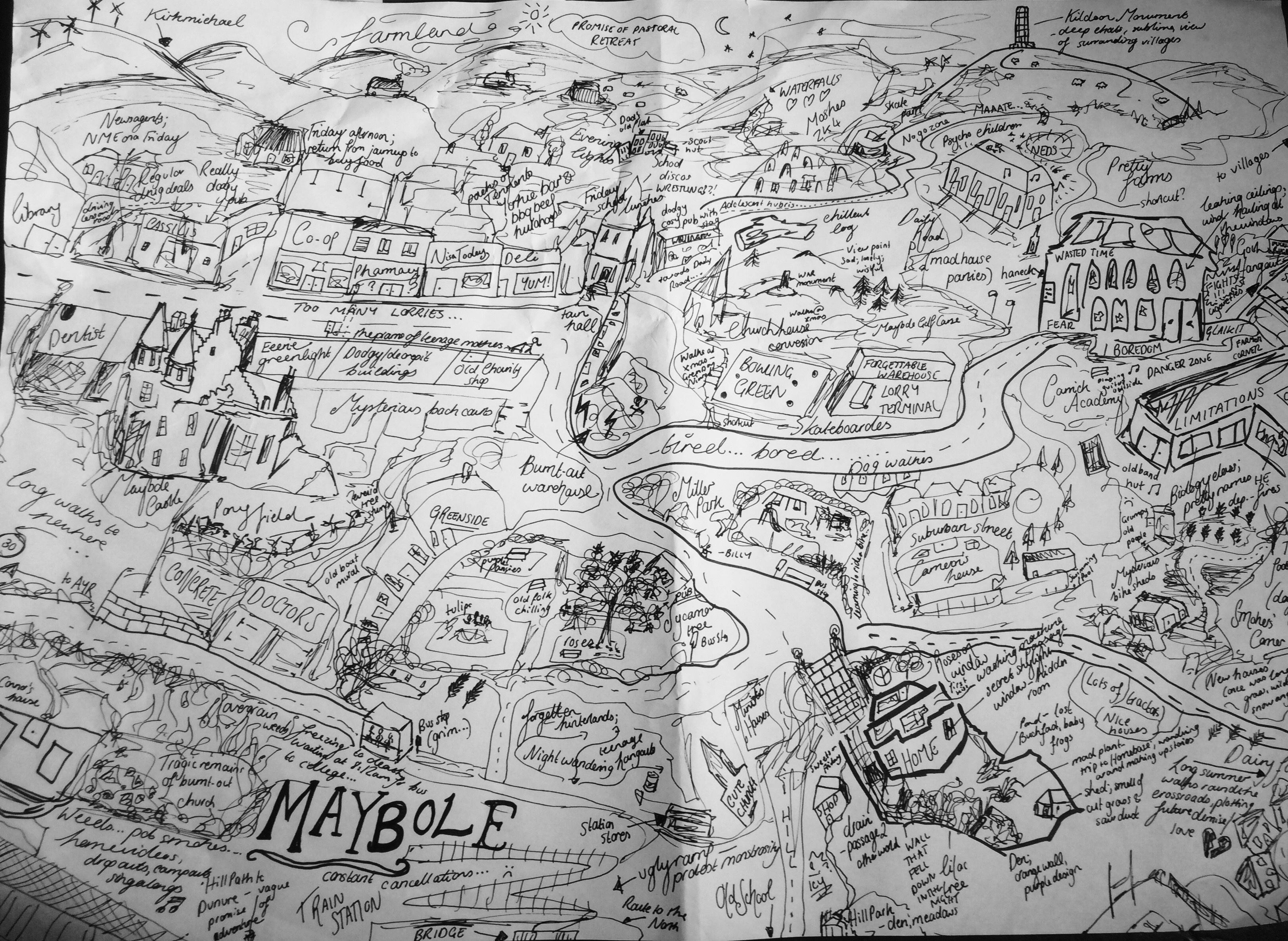
Usually, psychogeographic studies focus on the experience of exploring and traversing urban space, but I wanted to look at something a bit smaller; namely, my hometown of Maybole. At two in the morning, after a tiring shift, I sat down at my desk and tried to map out a subjective outline of the Ancient Capital of Carrick (ugh, such pretension eh?). I wanted something that would take into account that sort of dreamscape feel, like not just buildings but also the sense of surrounding landscape, of the in-between (Deleuze & Guattari intermezzo – the life of the Maybole nomad?); the town as connecting point, with little else to centre it, perhaps, other than its connections (oh and a little high street castle). I zoomed in on my old house and saw that the pampas grass in the front garden was trampled and skewed as usual and, somewhat weirdly, a mysterious object lying on the lawn turned out to be a blue light-sabre (of the plastic Star Wars variety). This foreign object suddenly made my whole homesick longing for the house a wee bit strange; like my feelings felt displaced, belonging to another time, another version of the house.
It took a while to get into the process of sketching out the town, but soon my mind started whirring and various memories and impressions started firing off, cutting across the whole 18+ years that I lived there, in the same house on Culzean Road. I spent a wee bit of time browsing the town on Google Maps, but the flatness, the sparsity of detail, lack of interesting gradients, wasn’t very inspiring. I like messy maps. It was easier just to work from a sort of organic expressiveness, not bothering about such technicalities as cartographic accuracy, scale or objective detail. Instead, I threw in everything I could think of: the weird stuff, the way certain streets and buildings still signify in my brain, even though the places in real life have most likely moved on.
Most of these impressions, by the way, are teenage ones. Don’t take them seriously, seriously. After all, the point of psychogeography is, in a sense, its resistance to the static quality of the map. Its performative constitution of many different possible drafts of maps and routes, impressions, emotions, memories – which shift over time and certainly, if anything, refuse to be stable.
17/11/16
Bibliography
Kelman, James, 1998. How Late it Was, How Late (London: Vintage).
‘Psychogeography’, Glossary of Art Terms, The TATE. Available at: http://www.tate.org.uk/learn/online-resources/glossary/p/psychogeography [Accessed 18.11.16].
‘Power floats like money, like language, like theory.’
(Baudrillard, Simulacra and Simulation)
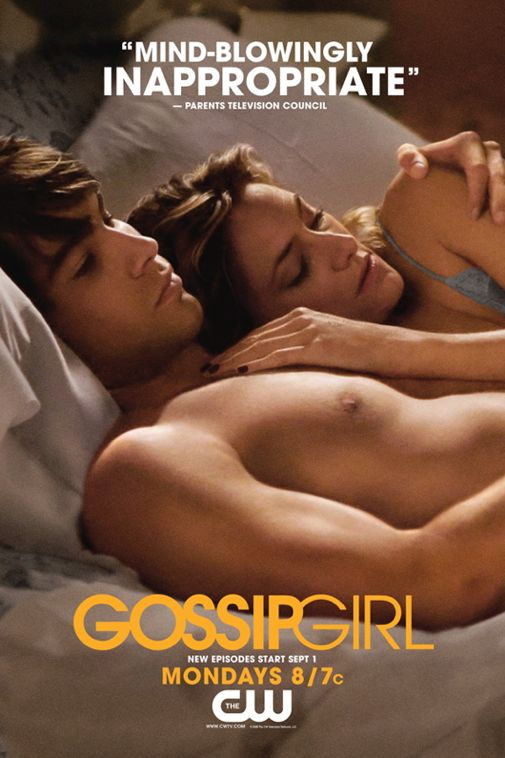
Something happened to me recently and I found myself drifting into the glossy paradise of the Upper East Side; more specifically, that alluring tab on Netflix entitled ‘Gossip Girl’. It’s been a while. I used to watch the show when I was about fifteen, in its heyday. I guess it just slipped away from me and I kind of passed by the whole finale hype back in 2012, but something brought me back to it a few weeks ago. Maybe it was the absence of real-life summer and the promise of a sun-drenched pavement in Manhattan, or maybe it was just Dan Humphrey with his dark mop of curls and deceptively earnest eyes. Maybe it was the cracking soundtrack. Either way, I was struck again by how entrancing the show is, even while it’s kind of terrible.
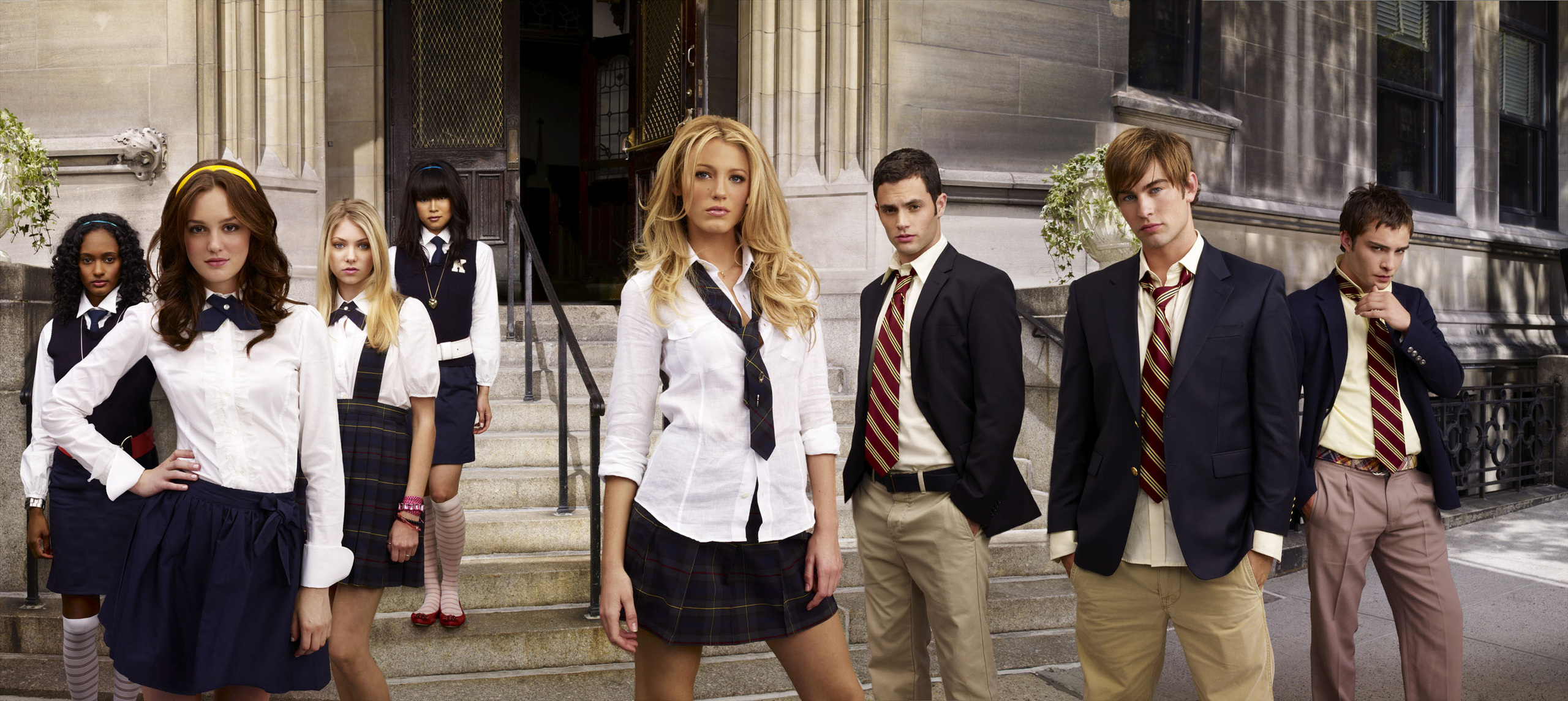
Gossip Girl is a show about power. It follows the privileged, glitzy lives of a group of Upper East Siders, from high school into the land of careers and more sophisticated scheming. There is a point round about the end of Season 2 which most critics concede to be the end of ‘good’ Gossip Girl; all subsequent seasons were just a bit daft. We’ve gone from credible high school bitching and scheming to absurdities on a Skins series 5 & 6 scale. How did we get from petty teen drama and pregnancy tests to Bart Bass falling from a roof and Chuck and Blair rushing themselves through a (gorgeously shot) emergency wedding? From Dan Humphrey as amateur school poet to successful penman of a Roman a clef exposing the ‘scandalous lives of Manhattan’s elite’, as Kristen Bell so enticingly describes it at the start of each episode. The link in all this chaos is power. Power and simulacra.
‘You’re nobody until you’re talked about’. That’s the mantra that seems to crop up again and again, haunting the minds of Gossip Girl’s characters like they’re stuck in some bizarre virtual reality where rumour precedes being, scandal precedes survival (see Sartre, ‘existence precedes essence’) – Mean Girls meets Black Mirror, if you will. What distinguishes Gossip Girl from other teen dramas (The O.C, 90210 and so on) is its centring around the concept of ‘Gossip Girl’. Like Foucault’s ‘panopticon’, Gossip Girl is a technology of power. The panopticon was a kind of prison design, created by Jeremy Bentham in the eighteenth century. It was intended to institute the force of surveillance not just on the individual but on society as a whole, so that in a prison each inmate is invisible to others, but visible to the guard station placed in the centre of the prison building. The point is that at any moment, the individual knows he or she is being watched, and will thus adjust their behaviour accordingly. A panoptic way of disciplining is one in which people are controlled through constant surveillance.
It seems pretty obvious that the outcome of Gossip Girl is constant surveillance. Every remotely meaningful action taken by the big-shot Upper East Siders (Serena, Blair, Chuck, Nate, their friends and family) is sent to the Gossip Girl server via anonymous reporters (anyone within or outside of the elite circle) and is then posted as a ‘blast’ which is then communicated straight to everyone’s phones. You know, if it wasn’t so familiar it would sound like something straight out a sci-fi novel. Throughout the show, Gossip Girl doesn’t just record and publish the intimate details of the characters’ lives (think dark secrets, slander and sex tapes) but indeed anticipates things that might happen. Sometimes, characters act a certain way because they are aware of the presence of Gossip Girl, of the probability that their actions will end up exposed through her blasts.
It doesn’t take much to link Gossip Girl to the Twitter generation. The Age of Snapchat, or WhatsApp, or whatever you want to call it. Created in 2007, the show suddenly tapped into a massive cultural shift among young people, whereby our entire lives become archived online, with or without our permission. Yet back in the mid-noughties, we were using Bebo and MySpace to spread gossip and create profiles of ourselves and others. These platforms were still relatively slow, especially as many of us still accessed them via a dialup connection, or by slyly hacking through content blockers at school while the teacher wasn’t looking. Gossip Girl anticipated the sort of instantaneous, life-shattering exchange of information that creates a panopticon effect on our lives. It’s a great plot device (the unravelling of a secret to everyone instigates some serious character crises) but now, in real life, it’s an uncomfortable truth that a nude selfie or a sneaky picture of say your neighbour doing cocaine can indeed be spread around with the ‘blast’ of a single Snapchat message, unravelling reputations in its wake. If, as Baudrillard argues, ‘power floats like money’ it does so because, like money, it is transferable, easily shifted, lost and dissolved. Instant, mass communication arguably makes power more diffused: in one minute it’s in Blair’s hands, then Serena’s and then HEY – Georgina Sparks steps in outta nowhere and suddenly it’s all gone wrong again. These days, you might say similar things about power and global politics.
Dan at his desk… Source: digitalspy.co.uk
But is it really diffused? Couldn’t you argue that although different people post in to Gossip Girl, ultimately it’s the Wizard of Oz, the soul behind the screen, that controls the gates – isn’t it that one person that has all the power? Just as Mark Zuckerberg ultimately frames all our communications via Facebook? In the end, we discover that (surprise surprise) Dan Humphrey, the main ‘author’ figure, is Gossip Girl. Dan Humphrey, the ‘impoverished’ outsider, exiled in his trendy Brooklyn loft, banished from full membership and relegated to the limbo world where messenger bags meet the glamour of Blair’s Marc Jacobs and Serena’s Prada. Dan started the Gossip Girl site as a way of literally writing himself into the closed world of the Upper East Siders, fashioning the role of ‘Lonely Boy’ within a fairy-tale, Fitzgerald-esque world of vicious scheming, stinking money and glittering mythology. In the end, Dan gets the girl: as the ‘5 Years Later’ epilogue of the final episode so indulgently shows, Dan marries Serena in a beautiful wedding (interestingly enough, his Brooklynite ex-rockstar father gets with – the actual – Lisa Loeb).
You could argue that there is something ‘queer’ about Gossip Girl. An almost Beckettian obsession with repetition and the endless possible combinations of relationships you can achieve within a group (OK, so maybe that’s more Made in Chelsea – or perhaps Sade?). In a way, Gossip Girl is obsessed with binaries: good girl vs. bad girl; Golden Boy vs. Bad Boy; virgin vs. whore and, perhaps most importantly, truth vs. falsity/appearance vs. reality. Yet these binaries are never sustained, and in fact the show repeatedly reveals the inherent insecurity of these binaries. The innocent Little J is really just the protective adolescent cocoon from which raccoon-eyed rebel Jenny emerges (more dramatically in real life, with Taylor Momsen becoming a risqué rock princess). There is a whole convoluted storyline about Ivy Dickens, who impersonates Charlie Rhodes (Lily Bass’s niece?) who herself is acting as someone else – ‘Lola’. Ivy, now her ‘authentic’ self, enters a relationship with Lily’s husband Rufus, but little does he know that Ivy is actually sleeping with William Bass (Lily’s ex and Serena’s father) who, it turns out, is only in a relationship with Ivy to get (in a roundabout way) back to his ‘true love’ Lily and the kids. The storylines get so elaborate and implausible (Blair meeting and marrying the Prince of Monoco; Bart returning from the dead) that you lose track of what’s real and what’s really happening; you become dissociated from the notion that any of this is really part of ‘our’ world. Even Penn Badgley, the actor who plays Dan Humphrey, admitted that the revelation that Dan was Gossip Girl ‘doesn’t make sense at all’, but that’s kind of okay because (in his words) ‘Gossip Girl doesn’t make sense!’ Sure, New York is always there, in those beautiful, sweeping shots of the city: embracing the characters in its warm glow, looking fantastic in summer, spring, autumn and winter; but the lives of the characters are as twisted, repetitive and as confusing as Samuel Beckett’s television play Quad.
[Imagine this as a symbolic representation of Gossip Girl’s plot. It’s the mesmerising that’s key, not the accurate rendering of reality.]
The queerness, then, (I’m using the term ‘queer’ tenuously, in a more generalised sense – the show can hardly be a banner for LGBT) is in Gossip Girl’s shameless disregard for certain old-school, heteronormative notions of ‘morality’, its distortion of conventional character arcs and its indulgence in various strange sexual affairs which often border on the incestuous (and then there’s that old problem of Serena and Dan and their parents being married for most of the show…). It’s in the fact that characters’ lives seem to follow more of a cyclical than linear path, as they repeat the mistakes of their parents, fall strangely in and out of love while maintaining they were in love the whole time they were also in hate. The whole Blair/Dan/Serena triangle.
Unlike some other shows which run for the length of Gossip Girl, Gossip Girl keeps more or less the same core cast throughout the six seasons, and in doing so transforms its characters into weirdly intangible signifiers rather than ‘real people’. So much of them is based on the need to manipulate the reportage of their lives that we can’t be sure how much we know of their ‘real’ selves. I would like to think that Baudrillard would approve of Gossip Girl much more than The Matrix, because in my opinion, the way Serena, Blair et al plan their lives around the panopticon of Gossip Girl fits pretty well with Baudrillard’s idea of the simulacra as the ‘map that precedes the territory’, the ‘reality’ dependent upon representation. Most of the characters’ actions are driven by and shaped around Gossip Girl: the virtual voice who ‘maps’ the lives of Manhattan’s elite.
There is a point in most TV shows where you are able to gage the protagonists’ motivations, but with several key players, Gossip Girl leaves us endlessly guessing, as some very weird choices leave you baffled about who or what is this person who you thought you knew from Season 1. Chuck, for example, is sometimes romantic softie, sometimes nonchalant alcoholic, sometimes downright psychopath. But that’s the fun of it, the not-knowing, the rollercoaster effect of plot after spiralling plot. A show about scheming; that could be another tagline.
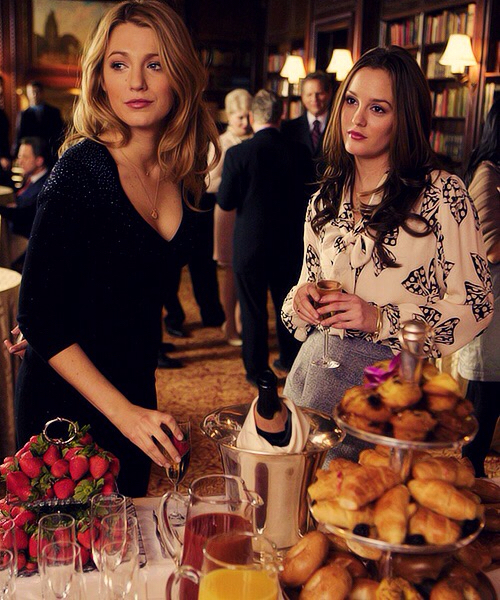
A love letter to New York; that could be another tagline. The city is so lovingly rendered throughout the show that even the actual New Yorkmayor got involved with the set of its 100th episode, and declared January 26th ‘Gossip Girl Day’. I wonder how I can start incorporating that into my life…perhaps I’ll start with one of those glorious pastry and fruit-filled brunches and then spend all day sipping scotch a la Chuck, kissing boys in classy bars a la Serena and ending up at some expensive party where everything around me is basically the flashbulb remnant of a photograph…or maybe I’ll just live tweet my actual everyday Glasgow observations – Spotted: Man with a Farmfoods Bag Disappears into the Bookies. It’s hardly Manhattan amidst golden, burnished fall, but it might just have to do.
***
In the final episode, Serena tries to defend Dan’s (pretty immoral) behaviour in acting as Gossip Girl by claiming that his salacious discourse amounts ultimately to a ‘love letter to all of us’. It’s true: all that reporting of all that scandal, all those razor-sharp character assassinations were a form of mythologising which we can recognise not just in celebrity culture, but now in our everyday online lives. Being mean doesn’t just keep ‘em keen, it creates drama, which is what makes any good slice of fiction. And what is life without fiction?
For all its raciness, Gossip Girl falls into a pretty comfortable conclusion. Two weddings, a (very cute) baby, a potential political career for Nate; it’s all very white, upper-class and generally heterosexually perfect. But that’s what Gossip Girl’s always been shamelessly about: sure, there’s Blair’s ever-present maid, Derota, but she functions more as a Shakespearean comedy sidekick than as a serious addition to the plot. Gossip Girl has never claimed, unlike say Lena Dunham’s Girls, to be ‘the voice of a generation’; it has always zoomed in on the narrow world of a handful of privileged characters. This is its flaw as well as its strength: there is, sadly, little racial/sexual/religious diversity, but when it does touch on such matters, it does so with its own quirky ease, meaning that it doesn’t trip over itself trying to take everything too seriously. There are nuggets of genuine, ‘emotionally truthful’ storylines in there, and real teen issues like losing your virginity, finding yourself stuck in family feuds and trying to make friends are handled sometimes with poignancy, sometimes with juicily gratuitous melodrama. Blair Waldorf’s bulimia is, in a way, a symbolic symptom of the culture she finds herself in: endlessly consuming, lusting for more information, gossip, power, but simultaneously being unable to contain it, needing to purify, purge, rewind the cycle. Dan longs to be part of the world, but at the same time it repels him; he is part of that societal wastage, the baggage once used then left behind – but he uses his limbo position to his advantage. In a way, the American Dream in all its distorted glory is right there, at the heart of Gossip Girl her(him)self.
What’s great about Gossip Girl, then, is its ability to take us on a whirlwind of artifice, of phony drama for phony characters, but through the falsity it reveals some hideous truths about contemporary society. The network of New York, as a series of public spaces, of upper and lower ‘sides’, is an inverse parallel to the non-hierarchical communications enabled by the Web, where power ‘floats’ more easily as hackers and smart kids from Brooklyn find themselves running the system. There is, in real life, an economy of gossip, whereby what’s been said about you determines your whole place in the world, perhaps even more so than money (sometimes). It runs in the workplace, the playground, the spidery webs of social networks. There’s a line in the final song which plays at the end of the last episode (‘Kill Me’ by The Pretty Reckless, the band headed by Taylor Momsen, aka Jenny Humphrey): ‘someone get me outta the sun’. I read this not just as a statement of Momsen’s goth/vampire credentials, but as an appropriate nudge to The Sun newspaper and by extension the world of gossip, the sunlit limelight which holds the (un?)lucky few up to fame and fortune and ruin.
There will always be an outsider wanting to get inside, Bell narrates provocatively as the last scene drifts over a street of smartly-dressed school kids, the next generation of Gossip Girl victims. It’s classic Gossip Girl: reminding us that even within the cherry sweet containment of its happy ending, there’s a bitter worm still at work. We’re now in an age where you can never live free of the media, of surveillance and all it entails. An unequal age where even the rich in their isles of bliss are never quite free of the rest of us, the outsiders, the mass exiles of our bulimic society – drawn to the alluring world of the beautiful and damned and then expelled because we can’t afford to be there, we don’t belong. And if that’s the end of Gossip Girl’s rollercoaster, then it’s not just a fairground of pure escapism, but also a biting satire on our actual IRL society.
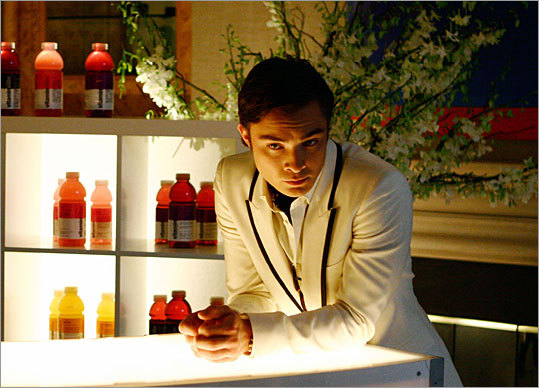
—A satire which, I might add, trickles right down to the shameless flaunting of product placement:


 mariaology