A second smaller heart: on writing The Indigo Hours

The first song I was ever obsessed with was Suzanne Vega’s ‘Marlene on the Wall’. It was on a compilation CD called Simply Acoustic that I’d found somewhere in the house. I’d listen to it over and over again on the CD player in my room. What I loved about this song was its narrative possibility. The protagonist triangulates her love affairs under the watchful eye of ‘Marlene’ looking down at her from the wall. My child’s mind made up all kinds of stories about this. Marlene could be an older sister, a mentor, maybe the lover of one of the men that passed through the life of her. Marlene seemed cold. She was not a jealous lover, she didn’t act out. Anything advised by Marlene is provisional, ‘what she might have told me’. I imagined her having very thick eyeliner.

For a long while, Marlene was a kind of angel to me. I saw her wherever I saw people on the wall. A Picasso print of a woman drinking coffee on a balcony. I haven’t been able to source this painting except to remember there was long dark wavy hair, the colours purple and yellow, coffee. I remember thinking it looked a little like my mother. It’s not something we kept when we had to clear her flat this summer. Maybe I took a picture, but I don’t want to look for it. Marlene showed up in my dreams. Marlene was there in my imaginary stories. I could never tell if she was the protagonist of a life or someone to whom things were done. She seemed to encapsulate a distant sexual maturity while also representing ‘the impossible’ and so, the untouchable.

*

I see 2018 as an apex year in my life. I remember dazzling summer nights, two kingfishers, kissing in the midst of cinders, hiding, my phone pinging constantly, no homework, sparkle emoji. This was the year I wrote the novella that Broken Sleep are publishing next week. I started writing The Indigo Hours partly in solidarity with a close friend who was writing a novella for her Masters degree. I was a year out from my MLitt and waiting to start a PhD. I don’t think we shared any work in progress; we just swapped manuscripts when we’d got to the end. I don’t remember writing this book. I don’t remember if I wrote it on my phone, a library computer, the Chromebook in the restaurant I worked at. Maybe it bounced between these locales. Maybe the bouncing was painful. It involved data loss. When I meditated today the AI-generated female voice said ‘find a point in your breath and this will be your anchor’. The point in my breath is a ‘flashing’ spot in my chest. It is an anxiety motor. It cannot be my heart because it is too centred. But of course it is my heart. Sometimes I think I have a second smaller heart lodged in my sternum, where I used to get an ache from purging. This heart is blue, a mottled and gold-streaked blue, and it is rare like the blue version of the rose, my middle name. Semi-precious.

I wanted to tell this story about two people kissing illicitly in a garden, surrounded by white poppies and mystery. I wanted to write about the indigo hour of midsummer dawn, when you are up all night with someone, the breath before a comedown, before it’s all over. I wanted to write about a relationship that felt like that and whose dramaturgy was always the dawn. I wanted to write about something that was ending over and over again, and the ending wasn’t the point. There was a life and people drifted in and out of it. I wanted to write about arousal and attention, sentiment and giving up.

The summer before The Indigo Hours took shape, I was writing a thesis about the curatorial novel, about object-oriented ontology. I was interested in what Ben Lerner says about fiction staging encounters with other art forms. For that to be embodied and taking place in a credible present. I was interested in the refrain of unseasonable warmth that haunts his novel 10:04, the way the narrator might have these hotspots of medial feeling owing to places in New York City where he received such and such a text. I was reading a lot of books that take place in the disintegration of some kind of love affair — Joanna Walsh’s Break.up and Lydia Davis’ The End of the Story (also loaned by the novella-writing friend). I don’t remember the plots of these books at all but I see them essentially as ‘novels that walk around, receiving and metabolising messages’.

Turning to write myself, I wanted to create a fictional world in the aperture of indigo, the special hours of Scottish nights in June and July where it never really gets dark — there remains this blueish glow to the sky. I knew these hours to be indigo because I didn’t really know what indigo looked like, only that it was some kind of shade of blue and everyone seemed to disagree about how light or dark it was. A morning and eveningness, a not quite. More like a mineral or texture.

How deep in the woods to go to get this indigo. How deep in love did we go, or in druggy reverie. It all felt so subjective, translucent. The love I was writing about was already belated, collaged and distributed unevenly through various places, fantasies and timelines. What could I say about it? This love that made an ‘I’ into both subject and object. That distorted the closure we had been raised on to believe was love’s destiny. It was an ambient intimacy, then. It was in medias res, ongoing. The midtone of indigo. In the process of editing the raggedy manuscript (what I referred to, in an email to the poet Callie Gardner, as ‘the trashy wee thing’) a couple years later, I discovered the phenomenon of indigo children. Since then I have learned more about what it means to be an indigo from the writer Laynie Browne. I relate this to a phenomenon of emotional & intellectual hyper-attentiveness my ex and I used to refer to as ‘shine’, also to a feeling of hyper-empathy and sensitivity not just to the mood of a room but to the mood of anything more-than-human. If you are capable of shine, if you are inclined to indigo, your presence might follow a gradient opacity. In Committed: On Meaning and Madwomen, Suzanne Scanlon has a chapter ‘Melting’ which talks about what it feels like to have ‘no glue’ and no security: ‘You could melt into another person, or melt into a place like this [a psychiatric hospital]’. This melting is akin to what Stephen King calls ‘the shining’ or what others call ‘sensitivity, insecurity, shyness. Fragility’ (Scanlon). I’m interested in how to put that kind of melting character on the page. What would her voice sound like?

A vessel, a leaky container…a watercolour palette smudging ceaselessly in stroke after stroke…Being an indigo is a lonely experience but one that lights up at the world. Pure indigo has a high melting point; when heated, it will eventually decompose or sublimate. For some people, reading indigo must surely be excruciating. For others, it is true. I think indigos come from elsewhere, they remember other times, their memories mutate and take form in their dreams, they bear an awful gift, they don’t belong to any fixed thing. What could be their future, is it possible. It doesn’t have to be something that makes you special. There is a kind of love that makes you indigo, opens you. For a lot of my life and even now, I walk around like an animal or an open wound. These are cheap metaphors. It is more that I walk around like the weather. No, I walk around like indigo. I freeze-dry experiences into crystals and exhale them on the page. I can’t say whether this produces realism; it’s very smudged.

Trying to put Marlene on the page was an act of transmutation. I read Timothy Morton on beauty’s perception as an act of ‘attunement’. I wondered if my attempt at fiction was really just an attempt at sensing beauty. But there is a lot of horrible stuff in this book. A lot takes place in the shadows. A lot of the scenes are decontextualised and in a sense ‘free-floating’. We don’t get heightened climaxes and denouements so much as vignettes melting into one another. In Reading Machines: Ambient Writing and the Poetics of Atmospheric Media, Alec Mapes-Frances talks about the ambient poetics of Lisa Robertson and Tan Lin as a ‘vaporisation of the lyric subject or self’. I saw Marlene as a soluble force more than as a coherent character, a stable subject. Marlene was a problem to be solved; she was able to be dissolved. I needed the temporal mode of fiction to play this out over time, place and encounter. Ambience refers to the surroundings of something, the environment, a kind of base existence (there is light, it is blue; there is this mood; the room is cool) tinted with some accompaniment, encompassing. Can we plot ambience the way we might plot time? This was something I was concerned with when writing the book.

My friend Stuart read an early version of the manuscript and said something about it being constructed around several pillars or towers. I think he was referring to place, as it stands in the story. The central (unnamed) city, Berlin and the prairie. I imagined these towers as constructed of fragile pixels. A little data moshed and crumbling. The movement through the story might be closer to a dérive or distracted wandering (I imagine readers skipping over, revisiting, forging microloops as I did in the writing). Insofar as I can remember writing the book (which I cannot) I was doing so in order to ‘read’ a relationship. This took place in a series of loops and compressions. Similar things said, the same mistakes, rotations of closeness and distance. My towers were constructed to make something semi-permanent of a very dissolving time. Aaron Kent’s cover for the book invites you to choose from various alcoves and passageways, or drift onwards into mise-en-abyme. All the while, in the company of clouds. I recently rewatched season 2 of Twin Peaks and the finale, in which Agent Cooper slips in and out of red curtains while seeking Annie, or answers, resonates. Disorientation. Passing through thresholds. Trying to save your love from evil. And what if it was not one love, but a concatenation of shadows?

Evil was also the ravages of shame and depression, the doubling of seeing the dark in yourself. Or, depression was a particularly sensitivity to evil. I get into these loops about it. There is so much evil in the world. For much of my life, I have not felt like a person. There are clouds drifting in that part of my soul that is supposed to feel warm and full. “I am okay” etc. I am like a child, lily-padding over the clouds. The same child that needed Marlene to guide me. I experienced love as something annihilating and so bright. The blue-heart anchoring pain in my chest. Hawk tells Cooper that if you go into the Black Lodge ‘with imperfect courage, it will utterly annihilate your soul’. What does it mean to give your narrator courage? I wanted her to have the courage of suffering and to see that in others. To suffer what would never work out. A constellation of burst blood vessels around the eyes. To have the strength to look in them, for that look to be a holding place, then a continental shelf, then nothing.

A foothold, even. For someone climbing the tower, trying to get to the kissable moment again and again. For the tower to be a text. I go to the tower, I spiral in stairwells, I see a prairie stretching farther and farther, I get so thirsty.

*

Are such towers architectures of refuge or incarceration? Here’s a passage from Hélène Cixous’ Hyperdream, a novel about grief, love, friendships, telephones and mother-daughter relationships (I will never not be obsessed with):

We don’t stop killing ourselves. We die one another here and there my beloved and I, it’s an obsession, it’s an exorcism, it’s a feint, what we are feigning I have no idea is it a sin a maneuver a vaccination the taming of a python the fixing-up of the cage, it’s an inclination, we don’t stop rubbing up against our towers touching our lips to them

Haunting the novel is this allusion to 9/11, but the towers as totems seem also to be something else, much more imaginary: ‘I saw it shimmer in my thoughts’, Cixous says of her ‘dearly beloved originary tower’. In an early document for The Indigo Hours I had this epigraph I haven’t since been able to locate from Morton, something about beauty being a homeopathic dose of death. I see my love go out the wrong door, I see a certain look, a turning back. Towers of collapsing sand. I see Marlene on the wall. Marlene from a tower. Marlene as the mother-tower, no, the sister. All my life I have said, who is she? She whose name means ‘star of the sea’. I rap at the door of Montaigne’s library tower. It survived a fire.

The homeopathic dose of beauty, like Cixous’ vaccination, prepares us for exquisite loss (and so soaring, to tower over). In a way, The Indigo Hours quite simply plots the disintegration of a what is now called a situationship. But really it is a book about everything happening in one plane, each shifting tense another groove of growing older. Growing into the old you were before. Essaying through this experience via encounters with art — everything from installations to Lana Del Rey (on whose early albums the narrator delivers protracted sermons — this being a book loosely about finding meaning in the spiritual emptiness of the 2010s). No, it is a book about things and time and pleasure.

Only recently did I look up the meaning of the song ‘Marlene on the Wall’. Apparently Marlene was the German actress, Marlene Dietrich, whose heavy gaze looks down from a poster. Maybe this is why my protagonist so frequently visits Berlin. Vega talks about writing the song for Dietrich after turning on the TV one night, her ‘beautiful face in close-up’. ‘Marlene on the Wall’ is a coming-of-age song, it’s also about power and violence, beauty and changing. There’s a butchershop but also a rose tattoo. I saw the song as an eternal love story with destruction as its anchor point. ‘Even if I am in love with you’ being the parenthesis through which to begin the working backwards of what Joanna Walsh calls the ‘fresh and terrible’. If I carried around that song I also carried the ghost-image of Marlene’s televised face in monochrome. How alien those brows, the beauty of another time. When I read fiction, when I edit fiction, when I approach a story, so often my question is ‘so what?’ I am looking not for answers, but for experience. Fingerprints.

Vega’s opening: ‘Even if I am in love with you / All this to say, what’s it to you?’ could be the central premise of The Indigo Hours. So for this book to be ambient is to be deeply interested in the ‘it’. Of love, of the being-in, of melting into the world, being washed continuously in its blood, its indigo, its chlorinated swimming pools. To look for explanation is one of many reasons for fiction. If Marlene peeled off the wall, I saw her growing along some trellis as a rare blue flower, a wallflower but livid and shedding, changing. I would write to water her, I would coax my clouds for a little rain.

Blurbing The Indigo HoursAmy Grandvoinet (brilliant critic of Surrealist & avant-garde psychogeographies) writes generously of ‘a languageful love pulsing constant’. A blue heart plucked and buried in the book, behind some cloudy curtain. This heart is sequined to the rhythm of life. If there is a cadence to the book it is love and love’s chaos sewn into patchwork. Marlene returns to Berlin to see her friend. She sees an old friend and cannot bear to reach him because there is this substance between them. She paraphrases T. S. Eliot’s ‘Burnt Norton’, she almost leaps the mirror fence. There are indigo seeds in these stories. I hope whoever reads it finds their own pulsing constant.

You can order the book from the publisher here. It is out on the 31st October.
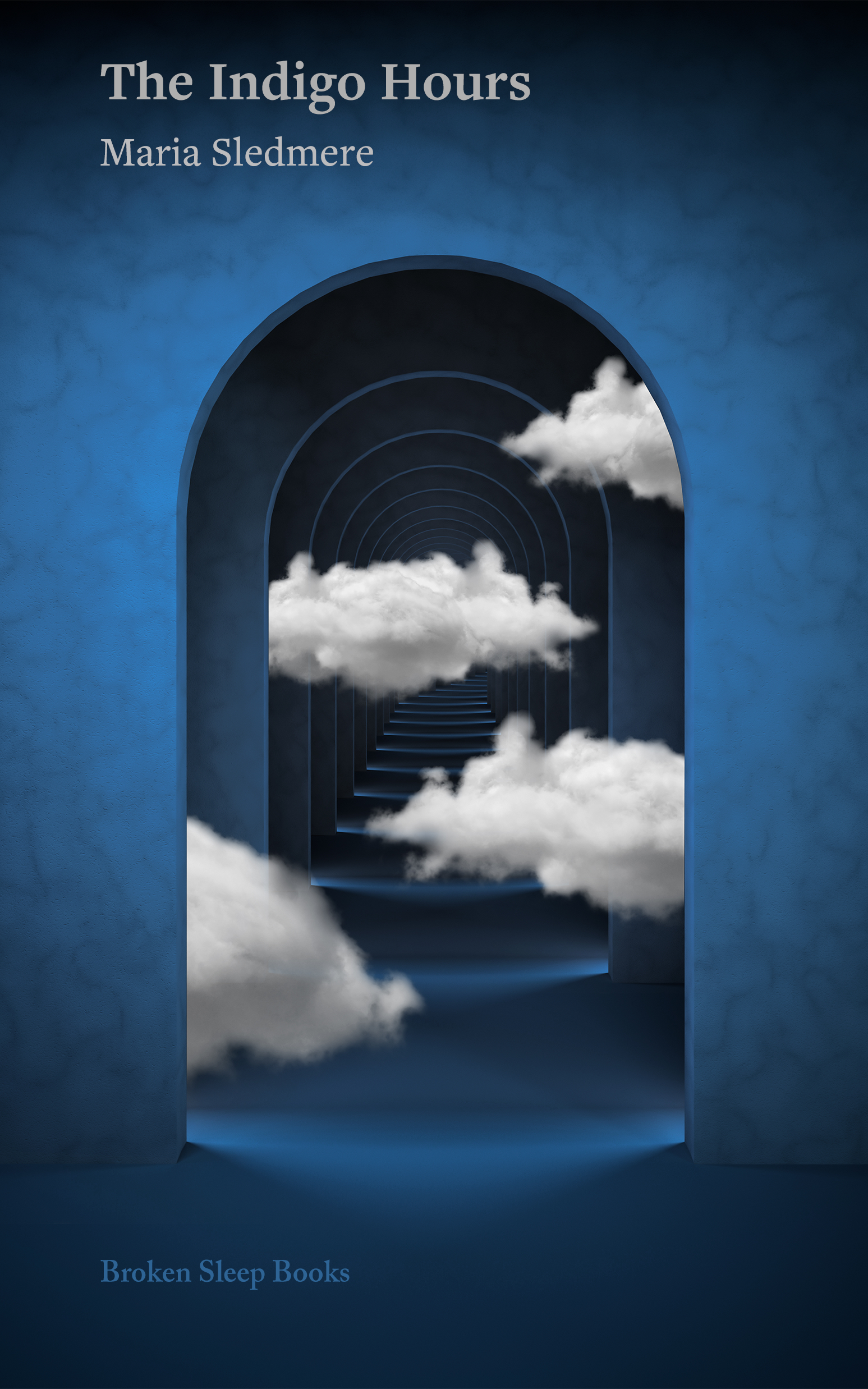
New book: The Indigo Hours

🦋🌫️🍋‍🟩The Indigo Hours…forthcoming with Broken Sleep Books

In 2018, I wrote a novella about erratic romance/Romance and the lyrical space-times of its (im)possibility. The fictional ~situationship at the heart of this work is stretched into, over and through various places — real and imagined — which the narrator digs into as pockets of presence and meaning. With its wandering, non-linear plot, I’d describe The Indigo Hours as ambient fiction. It’s a little eclipse of a book. It was ambiently written (leisurely, over one summer, as a dare) and may invite ambient reading. Which is to say, a textual experience more inclined to ‘going round’ a thing, attuning to its surrounds, getting lost, adjusting the frequency of (dis)interest. This is like dating a semi-transparent person. To adore the ghosts of both of you. How might love halo or envelope one’s personhood? How might love’s presence be felt ambiently in the objects and subjects of everyday life? The work tests love against memory, song, travel and friendship. I was interested in the phenomenon of blue — specifically indigo — as a desiring filter. Indigo as a singularity. Indigo as language of variable opacity. Denim wash (to go someplace). The supernatural inflection of indigo children (as a vocalised attempt at performing divergence of attention, durée and feeling). The book is full of aura, fleeting connections, music, art, intimacy and loss. It will be out on Hallowe’en, 31st October 2025. 

Some nice things people have said: 

The Indigo Hours’ lyrical prose, daubed from a free-associating palette of sensory psychedelia, becomes a portal into a ‘blossomy blossomy realm of the possible,’ where sadness is a sexuality, jealousies cause for celebration, and love a drunken texture. Painterly, tender, and spatially generous, this affecting novella rewards re-reading, like a magic eye that reveals a new image, and perhaps new self, with every glance.

— Poppy Cockburn

The Indigo Hours is watery fortification. Beneath li’l triads of asterisk constellations, Maria Sledmere tells a post-Romantic tale of moonlit precarity and passion among pools & thunderstorms & prairies & airports, where feeling wretched wandering midnight miles is a complex freedom, as exposure on cobalt-lit webcams, dozing/dosing to dub deep trap techno, bruises so Blühen. Yet under cosmic circumstances that augur heartbreak, Maria gifts us the deep assurance of ancient-blue auras and a languageful love pulsing constant. For insomniacs-or-otherwise against analgesia’s ‘“who cares”’, a most vital and tender-prone tonic.

— Amy Grandvoinet

Preorder now from the publisher.

x x x x x x x

SPAM Tour Diary: February 2024

SPAM Tour Diary: February 2024

I wanted to write this a week ago, in the throes of a northbound Avanti while grown men stood up shouting things like ‘plastic cunts!!!! all of em plastic cunts!!!!!’ (some cryptic reference to the footie) before departing at Carlisle, but another border had to be crossed and here I am, writing this from my sickbed. Week 6 of the academic semester finally got to me. But this is my diary of the first official SPAM Tour. Guys, I was so so excited for this tour. I even got up at 5am on a weekday to iron the custom design on a tour t-shirt (omg why did nobody tell me how hard it is to draw on tshirt fabric?). I love that poetry literally takes me places. I met some of the best people ever on tour. Tour tour tour.

What follows is my fond paracetamol-induced delirium ❤ 

We were a poetry carousel in celebration of three new pamphlets: Thirteen Morisettes, a transatlantic collab by Courtney Bush and Jack Underwood; in the country garden/the end of england, by Jack Young and Karólína Rós Ólafsdóttir’s All in Animal Time. Ever since the latter was submitted to SPAM I have been rolling it around in my head when something is asked of me and I want to say, sighing, yes yes all in animal time, it will be done. Who were the horses? Who were the horseback riders? This is getting a bit Yeatsian so I’ll give you the names: of course there were the two Jacks, Courtney and Karó, along with Marianne Tambini, Leo Bussi, Annie Muir, Eve Esfandiari-Denney and me. And everyone we met along the way.

It may have been my decision to go see All of Us Strangers on Valentine’s Day but the transition to a dreamstate of solace, if not soul-searching, was upon me. Walking home on Wednesday night I wrote: ‘When she looks at him taking his wet clothes off from the rain and knows that suddenly he is older and she is sort of his daughter. I feel so messed up and grateful that it is raining and when I get home I can cry and read my stupid poetry. How I have missed this ceaselessly crying. I was always too sensitive like melting into the folds of the world’. 

The next morning was all coffee and white noise, still a bit shook. I met Kirsty Dunlop, my glitchsistertrix, at Glasgow Central and we piled on the Avanti whose queue as ever was abundant. I had big plans to commit to ‘agile working’: I was going to research Detroit techno, ahead of a summer conference, get my MLitt marking done and generally clear the inbox but these earnest endeavours were DERAILED by the indubitable fact of half term madness. This is a concept still foreign to me, as someone raised in Scotland, the February half-term. Idk if that is a sufficient explanation for why there were about 300 twelve-year-old boys on our train. In the queue, the Avanti guy is like to me and Kirsty, ‘are you in the school trip’ and I clipped back, ‘nah, we’re far too old’ and he does this kind of sweet double take ‘aw not really’ to like, I guess encourage our confidence that we could make convincing schoolkids, probably with our backpacks etc. I take that as a flirt, though on hindsight maybe creepy. He’s a good guy though, I see him every time I get the London train and he’s having to put out fires with the insouciance of work-place survival tactics, every time. You can tell he’s reliable and it’s like being ID’d for cheap sauvignon blanc; you have to take compliments when they come.

On the train, from the get-go these schoolboys are kicking off. For the morning, Kirsty and I convince ourselves we are schoolboys too. We are practically hysterical. They are practically hysterical. The boys have discovered a famous boxer on the train called Anton. They are, let’s not beat around the bush here, obsessed with Anton. Every other word that comes out their mouths is Anton. ANTON. BIG ANTON. I daren’t google to see if he’s real or not. We are convinced he’s made up, a fiction. The hyperstition of their near arrival. ‘Let’s get Anton on snap’, ‘Come to the bathroom and we’ll go see Anton’, ‘Come get food and we’ll go see Anton’, ‘Let’s give Anton a present’, ‘I want to give Anton some milk’. K. and I dissected the extent to which such gestures were euphemisms. We answered some overdue Plaza emails because it was literally the first time in weeks we’d had a shred of time to do dedicated SPAM admin. We took pictures of ourselves being silly because how silly it is to be travelling poets. I’d left my anti-nausea pills in the big orange bag I couldn’t bear trying to get off the shelf in front of everyone, so I sat tight and gingerly sipped a ‘fiery kombucha’ and loosened my tie. I really do need anti-nausea pills for England. When we pulled into Euston the boys threw some of their milk sachets in our direction, landing by our boots, and I wondered if we’d been the hyperobject of ‘”Anton”‘ all along.

Before we get to London I should tell you about Tuesday. We had this great reading at Mount Florida Books, hosted by the glorious Katia: a bookseller and all-round babe whose generosity and humour ne’er fails to completely lift my mood. We agreed the secret to Glasgow was to talk freely about your life but don’t name anyone. We talked about when you can’t stop thinking about kissing. And sexy poetry. How did we get here or there? Most of us, as non-south-siders, were at the mercy of rush hour traffic. My bus didn’t show up. I missed the pre-match dinner at The Battlefield Rest and Courtney got stuck on a 90 bus which took her on some kind of motorway loop out of town. I love that she called it the freeway and briefly my brain merged the M8 with Los Angeles and an offbeat sunset, nine hours behind. The 90 bus is such a gamble at the best of times it is best taken when one has made peace with the possibility that you might end your journey on the moon, or Carlisle. We know that it’s always Carlisle, wherever you are. Perhaps Loch Lomond. On the bonnie bonnie bus to Loch Lomond…….okay, shut up Maz, get on with it. 

Happily all poets were fed and watered and though they arrived late for their own reading, this is in fact a local custom to be adhered to. Plus, if you are going to have a press run by two ADHD queens this is going to happen at some point. Time must reasonably adjust to our lossy measure. Have you ever tried to get several poets out of (or, for that matter, into) a room all at once? My fellow editors had brought wine with the security tag still on (‘Kirsty did you steal this wine?!’, ‘No, ofc not!!!’) and which I sort of shotted with the precision demanded of 7pm on a Tuesday. Kirsty and I introduced the evening and I did something weird which was when she said the word ‘earworm’ or something like ‘lines that curl in your ear’ I couldn’t help but go to touch her ear onstage, like it was a seashell. Ian captured this gesture as a blur of the hand and my big stupid grin. 

Our readers (Marianne, Leo, Annie) were by all accounts devastating, hilarious and super-luminous. Apparently it was Marianne’s first reading and you wouldn’t know it because she was so funny, deadpan and confident. I loved the M8/mate poem. She is a very fine reader of the absurdity of the world. Puns galore. Swerves. Leo also. Omg that Ben Lerner poem of theirs. Leo co-runs this amazing reading series in Glasgow that’s been going for over a year now: it’s called Waterwings and on Wednesday they have a pamphlet launch at Strangefield, French Street. Annie is a good friend of SPAM and MF and we are label mates on Broken Sleep Books (she read from her 2021 pamphlet New Year’s Eve along with some new stuff). She also runs Time For One Poem which is a poetry podcast I listened to a lot in the pandemic, and a workshop series at Glasgow Zine Library for beginners and experienced poets alike. I really admire Annie’s passion for breaking open the joy and difficulty of poetry and she really lights up a room when she reads.

This was the first time Jack and Courtney had actually met each other IRL. The story goes that Jack tweeted his first Morisette and only two people liked it (no way to prove this as Jack, like all respectable people, is no longer on Twitter). One of them was Courtney (the other purveyor of a like remains a trade secret). She slid into his DMs and thus the collab began, and the rest is post-internet poetry history. Both poets read from their new spamphlet as well as other books. they had such a joyous and sweet kind of poetry sibling rapport. You can watch their performance on youtube! Please like and subscribe to SPAM on youtube! If you do probably we will find more things to share there.

Afterwards, thanks to an enthusiastic Mount Florida resident and fellow writer Victoria, we wound up in a place whose sign promised ‘a friendly local bar’. We had tried to get into the Clockwork which was our usual post-poetry haunt, but they were not having it. Maybe they genuinely were closing for the night. I don’t know the ways of the south side. Anyway, it was too ‘well-lit’ for our tastes besides. Since it was the 13th February, the florist next to Mount Florida was still busy working at 9pm to put all the Valentine’s roses into sumptuous red bouquets. It was joyous to see our friendly poets all making friends with each other. Ian and I practised mewing and everyone seemed to have vitamin T and it took me an hour and a bit to get back to Haghill because the Cathcart Circle and the fact that trains are cancelled at Queen Street more frequently even than Matty Healy. I feel like somebody has made a similar joke in a poem before. I fell asleep at my desk next to a bowl of cornflakes reading about cybernetics. Yeah, idk who was doing the reading, me or the cornflakes. Theory eats itself. 

I woke up with the horrendous news that I had been on Twitter (‘X’) for fifteen years, that is half my life. ‘Happy X anniversary’ is giving this bitch will never get married and their anniversary might as well be with an extractive hyperdistracting platform in whose word limits dreams are made and unmade. 

Okay back to London. What the hell, we arrived and spring had sprung upon Euston with a vengeance. Which is to say it was seventeen bloody degrees and I was wearing my sleeping bag coat because Glasgow was cold and we had about thirty bags of books to carry between us. We stopped in Tavistock Square to rearrange our garments (essentially, stripping in public — I nearly pulled off my tights right in front of the Woolf statue). The purple crocuses were out and even some spring blossom on the trees. Lovely. I texted solidarity purple crocuses to someone who was doing a good and important thing back home. We got to the London Review Bookshop and spoke to the wonderful John who benevolently relieved us of some of our stock (including the work of the tour poets, plus Brilliant Vibrating Interface, Cocoa and Nothing, Visions & Feed). Down in the poetry basement and secret pamphlet cupboard, it was not long until I’d found away to pile the weight back onto my luggage in the form of Prynne’s Snooty Tipoffs, Ted Berrigan’s Get the Money! and Rachael Allen’s God Complex. Kirsty’s partner Sean also met us at the LRB (he’d gotten an earlier train but arrived later, such is the the Avanti’s negentropic spacetime elongation of the West Midlands) and saved us by carrying some of the bags. The suitcase, however, was doomed for. Kirsty has an unfortunate history with London-based suitcase drama and this poetry trip was no exception. We couldn’t get the damn handle to budge and at some point her and Sean had to perform a kind of suitcase surgery, whose outcome I can’t remember. I do remember wrestling with it on the floor of Euston while K. was in the loo and people looking at me like I was doing something not only suspicious but positively heinous. Yes my hair was in two plaits and I was wearing a tie but so what! Let the poets have their endless, impossible luggage. The tote bag theory of poetry tour.

We made our way to the Tate Modern and I can confirm that not once did I put us on the wrong tube. This is one thing I can show a concrete, material improvement on in the past five years: navigating London with confidence. After stowing our bags, we spent an hour and more wandering the Philip Guston exhibition. I’ve been wanting to see that for months. It was really breathtaking. We all choked up a bit at some of the late works, especially the painting of the tangled limbs in bed and the sense of mutual pain. I sat in front of The Ladder for a long time. Kirsty said sometimes in exhibitions you forget that it is actually the real painting in front of you, like it’s travelled all this way, and that’s quite overwhelming. Especially after a life of scrolling digital images. I thought about the sincerity of paint strokes and presence and colour and preservation. How lucky we all were. Worlds. Emotional corporeal pinks. What pink must’ve been like before the millennium. Our navigation of the Tate had a comic air of being in the funhouse, going between connected buildings. I took pictures of Sean and Kirsty on the escalator and charged on ahead because I was so excited for art. The coat check guy was kind of horrified that we found London hot because he said it was freezing to him and he only feels that way when he goes to Spain. Sometimes I forget how cold Scotland is in comparison. Once I was in London for one night only in March and it was genuine full-blown floral aromas while it snowed back home. 

When we finally got to the Peckham Pelican, Kirsty fell into a hole right outside and let out a cry. You have to watch out for those holes in the ground (they might lead to Carlisle). Sean charged his vape and I delighted in the phenomena of ‘happy hour’. We ate nachos and pizza with caramelised onions and goats cheese and I drank an Asahi very slowly because I kept getting up to say hi to people. Reunited with so many poets and hugging Jane so hard because it had been so long, and everything we’ve been through. Katy with their long wavy hair and pizza queries. Adam and I talking about Don DeLillo. Courtney got stuck on a bus again listening to this guy talk on the phone to his girlfriend Jodie about how to cook a pork chop for over an hour. We sold loads of books (thanks!!!) and the readings were so gorj and we recorded them so stay tuned for the URL Sonata podcast episode someday. I loved taking pictures of the poets and I love the pictures where you can see people’s faces reacting to the poets, so wholesome. It was a dream to be united with our queen Denise and also Nasim and many others.

Kirsty and I performed our weird Morisette intro poem that we penned on the train and semi-plagiarised from Alanis and Lana. It makes a lot more sense if you hear it being sung but fuck it, here it is (we read it a line each taking turns). See if you can guess which Alanis song it’s from.

WRITE THRU U (ME+YOU)


You mispronounced my POEM
You didn’t wait for all the INFORMATION
Before you turned me away
Wait a minute sleekit beastie
You kind of hurt my feeeeeeelings
You see me as tinned meat delight
And you’ve got a meal deal taste
I see tonight through you
I know tonight through you
I feel the SPAM bite through you
I talk tonight through you
You took me for a sonnet
You took me for a round of golf
You took a long hard look at my sass
And then played crazy golf for a flash
Your hacket face is like a fish
You pat me on the motherboard
You took me out to lyrically slay me
But didn’t hear a damn anapaest
I remix through you
I hyperlink through you
I glitchfully seduce you
I’m loooooading you
I’m buffering you slowly
Oh hello Mr. SPAM
You didn’t think I’d come back
You didn’t think I’d show up with my poetry
And these goddamn pamphlets on my back
Now that I’m (almost) a doctor
Now that I’m a zillionaire
Now that I’m the incoming integrity officer of the tortured poets society
You scan the credits for your literary influence
And wonder why it’s not there
I write through you
I’m typing right through you
I’m recording right through you
I’m poyuming right through you, you
You, it’s all for you
everything I do
I tell you all the time
heaven is a place on earth with you
tell me all things you wanna do
I heard that you liked the bad rhymes honey
is that true
IRL from Glasgow me and you
who knows what these poets will do
………..(FADE OUT)

People said they thought it was funny and very ‘written on the train’. 

That night, I stayed at my brother’s in Hackney and it took Jane and I an hour and forty-five minutes to get home because London. We met Jack at the station and he also missed his train because they cancelled a bunch of trains. I tried some of the beautiful Björk liqueur that Karó had brought us as a gift from Iceland and it tasted like licking the sweet vanilla minerals of the most exquisite waterfall. In Joe and Minnie’s flat, I ate leftover Valentine’s babka, slept like a log on the floor and felt pretty good in the morning. We woke early and went for breakfast for weird mushroom lattes and talked about work problems, and our awesome school friend who now does hardstyle gigs in New Zealand. Karó, Courtney and I got the train to Bristol from Paddington and I sat next to Courtney and talked about love, about how being with poets is like a drug because everyone talking about poetry getting higher and higher on the total collapse infinity of language. This sensation was augmented by how warm it was on the train. We talked about cats, about US poetry scenes and struggling with narrative and being in love and the difference between feeling and thought, the art of being charming and our favourite poets. I kept thinking about how beautiful Eve’s poems were and how great it is when you discover a new poet. 

When we got to Bristol, we headed straight to Bookhaus and met another Joe, this time Joe Vaughn of Strange Region who is super cool and lovely and hosted us in the bookshop that night. You can now buy a bunch of SPAM things in there! Courtney, Karó and I got lunch at an organic place round the corner (more kombucha, this time turmeric) and we talked about our craziest student/teaching experiences, learning runes for no particular reason, doing virtual workshops, making friends on the internet, making films, our collective love for Jack Underwood. We then got lost in a mall looking for Second Page Books, an excellent secondhand place, in which I found a copy of The Reality Street Book of Sonnets. I was pleased to find that Bristol did in fact fulfil all my Skins fantasies and more, as a place with bluetooth speaker jungle music, old tramlines, pervasive smell of weed, authentic mall goths, Cornish pasties and a vibe that seemed extremely conducive to thrifting. We walked around laughing about how bins in England always have to have some kind of rhyming poem on them to convince you to use them. After checking into our Travelodge, doors held open for us by earnest hockey-stick brandishing teen boys (more half-term trouble?), we fulfilled Courtney’s bubble tea craving then headed to Cargo Cantina where tacos were had along with orange wine and much funny conversing about the stuplimity of Valentine’s chocolates, dreams revolving around BeReal, the inimitable typing speed of Jo Lindsay Walton. It felt so classy and impossible to sit outside for dinner in February but I guess this is possible in Bristol! We collectively admired Courtney’s vintage coat and its interwoven display of amphora. We were just on time for our reading at Bookhaus. Alex Marsh of sold out Hot Orange Squash Sky was there and I was so excited that SPAM poets from multiple seasons were present in the same room, so far south from Glasgow. 

We were hosted by lovely Dan Eltringham, who co-runs the reading series Toppling State (from which this evening had been christened as Toppling SPAM, and some people had thought it was a sushi tasting event from the poster) and who wrote this amazing book Poetry & Commons which won the ASLE-uki environmental writing prize last year. I read first, a few poems from my new book Cinders and my second collection, Visions & Feed. My copies of Cinders were supposed to arrive yesterday but UPS did that thing where they pretend to have showed at your door but they don’t leave a note or anything, and you were there all along and didn’t hear the doorbell. Jack Young and I were in the eco-bubble of the reading and he did such a brilliant performance from in the country garden, a book that was so great to work on last autumn and a book that has taught me a lot about the violence of taxonomy and what might a garden mean to ongoing colonialisms and how do we cultivate something queer and flourishing instead. Karó read wonderfully too, and I thought about her girl and punctuation poems as innovative gems that have stuck with me more than I otherwise realised. It’s like metabolising the lyric by way of Lisa Robertson (at her most camp) through Rachael Allen’s ‘Girls of Situations’ through zoomscapes of play and animal joy. I also want to shout out all of Karó’s showstopping colourful outfits. Courtney, alone this time (Jack U couldn’t make the Bristol leg of the tour) performed totally irresistible Morisettes numbers alongside poems from her book I Love Information and even read some of Jack’s poems from A Year in the New Life. We debated the pronunciation of apricot. I prefer how Americans say it. I loved that she even near-sang some of the morisette poems to get at the sway of melody. The genius goddess of bad moons, Sam Walton, hosted a Q&A with all the poets and we talked about the importance of small press poetries and it was so nice to hear Jack, Karó and Courtney talk about the origin stories of their spamphlets. Thanks Sam, Dan and Joe for being great hosts! 

Afterwards we went to a delightful pub called The Orchard where a drunk hippie fell on me (feels like a Bristol right of passage) and we guzzled the best cider I have ever tasted. I was so tired from the fullness of poetry and travel that I was falling asleep right there in the pub mid-conversation, such is my habit, I would fall asleep and chime in a few beats later with some anachronistic question. For a long time this happened to me constantly, such as at gigs or in attendance of lectures, and I now realise it’s not narcolepsy just a symptom of intense sleep deprivation. I was sort of light-dreaming while talking to my friends in the pub. It’s like my brain wants to be in both worlds at once. We talked about heartbreak, dating musicians, dating poets, writing novels. Joe is writing one, Courtney has written one, Alex is also writing one. I want to write one. I have an idea now, we cracked it out over hotel breakfast the next morning. Perhaps more on that later. 

The next day we had to say bye to Courtney who was going back to London before the next leg of her Europe trip (Paris!) and none of us wanted to part </3. In an attempt to console ourselves Karó and I went to look at some art then we did some drawing and then met Sam and Dan and bought some supplies from Cass Art and got amazing noodle hotpots at Chilli Daddy that were bigger than our faces. Karó gifted me a big bag of Icelandic liquorice for the train home. I couldn’t believe that tour was over and we’d have to go back to our lonely heads. The train manager announced that people were having a good dance in coach H. Reader I almost joined them, but instead I read Courtney’s books twice because I was missing her and tour already and then I finished reading the Cixous novella I’d brought with me, which was all about time and grief. People seemed especially beautiful that day. Even the boy vomiting in the bowels of Queen Street Station was beautiful. Some women twice his age stopped, brandishing wine, told him that puking was a right of passage. It was Saturday night. They said they were having an overdue Galentines, which reminds me of gelatine which reminds me of the sacred caul in which spam is encased. SPAM forever! 

~

Buy Thirteen Morisettes
Direct from SPAM
US folks might want to order from Printed Matter
UK folks might want to order from Good Press, or head to MF Books or LRB Bookshop to pick up a copy.

Buy Season 7 and other SPAM publications
https://www.spamzine.co.uk/shop

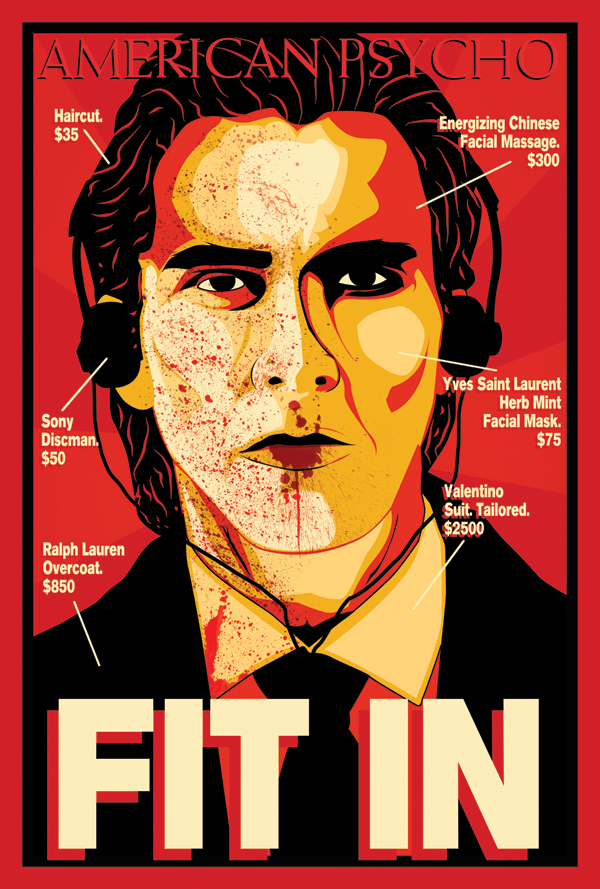
American Psycho: Sex, Violence, Technology and Society

Image source: http://images6.fanpop.com/image/photos/33100000/Fit-In-american-psycho-33196259-600-889.png

I have just read a book that has all at once captivated, disgusted and intrigued me; a book that has left me strangely both emotionally drained and intellectually stimulated. Bret Easton Ellis’ American Psycho plunges the reader into a world of late 1980s ‘yuppie-ism’: the world of Wall Street, hyper-consumption, misogyny, racism, inane pop culture, television, sex…and violence. Written from the first person perspective of its protagonist (although somehow I find the term protagonist with its heroic connotations inadequate), Patrick Bateman, the novel has an unusual cyclical structure that plays out as a repetitive narrative of visits to classy restaurants, mundane descriptions of the latest consumer goods, chapters that read like music reviews and then the most controversial element: the horrifically graphic scenes of sexual violence and psychopathic slaughtering that got the book banned by its initially intended publishers.

Yet I don’t believe that Ellis includes these gruesome chapters just as a twisted indulgence, a pornography of violence. As I will discuss, they play a part in Ellis’ searing, often satirical portrayal of the Reagan era in America: a critique of neo-liberal values, consumerism and technology that is arguably more pertinent today than it was twenty years ago. The heartlessness, depravity and monotony of this culture and the novel itself is summed up in the opening line: ‘abandon all hope ye who enter here’, which is ‘scrawled in blood red lettering’ on the side of a building. This quote is an intertextual reference to Dante, who in his Divine Comedy suggested that this was the written passage that appeared in the entrance to Hell. When you pick up American Psycho and read the first lines, which immerse the reader immediately in the divided cityscape of 1980s New York – a world of graffiti, advertisements and pop culture – you cross over a threshold, you cross over into a tightly-confined mind that experiences its own corruption in a fictional universe that is all too like our own. What is interesting about the novel is on the one hand its hypothetical exploration of the thoughts of a psychopath, but also its trenchant critique of a society obsessed with surfaces, purchases and the perpetual presence of the flickering flow of television; a society plummeting towards absurdity and the eradication of all meaning – at all levels from the individual mind to the collective conscience.

Despite being the novel’s narrator, Bateman reveals little about himself other than his routines, his clothes and his opinionated taste in music. He indulges in lengthy passages detailing his workouts, his use of face masks, his appearance, eating habits, sexual interests; but the novel provides little in the way of solid character description. The narrative is therefore intensely claustrophobic, as we are restricted to Bateman’s narrow, white, narcissistic upper-class view. Moreover we know nothing of the Bateman behind the suit and Ray-Bans; we don’t know about his childhood, his relationship with his parents is only briefly suggested in a single flash of a chapter, and although it is the source of so much expendable income, we never find out what he actually does at work, other than order his secretary to make him dinner reservations. This latter point is especially interesting within the context of contemporary culture, where people are becoming ever-more critical of what these high-flying guys in banking and finance actually do; as bonuses and salaries remain sky-high in spite of the recession, there is increasing concern with regards tothe elaborate and obscure games that these ‘yuppies’ spend their time with – playing with money, justifying their existence. Ellis clearly does not seek to redeem the Wall Street yuppie, but instead caricatures his position and the career in general – which for me culminates most humorously in a chapter where Bateman and his coworkers engage in a highly-charged comparison of the stylishness of their respective business cards, that reads like a competition between prehistoric men flexing their muscles or showing off their hunting skills.

This leads into the question of masculinity and self in the novel. In a world where the most socially-esteemed jobs require what might be considered traditionally ‘emasculated’ behaviour – Bateman, it seems, is a proto-metrosexual – how do men assert their masculine identities, especially with the increasing challenge of the rising status of women? Bateman’s gendered self is ambiguous: on the one hand he is obsessed with his physical appearance – going for regular manicures, massages, constantly working out and asking if his hair looks good – and on the other asserting patriarchal dominance by literally killing, and in some cases torturing, those that either threaten his position (e.g. his colleague Paul Owen who has the superior business card) or those that he is different from and wishes to demonstrate are beneath him: women (especially models and prostitutes), beggars and homosexuals. This creates a bizarre, twisted sense of capitalism gone mad, of the ‘dog-eat-dog’ ideology of everyman for himself, of free market competition gone out of control. The individual, in his quest for success, seeks a greedy taste of the ‘Swordfish meatloaf with kiwi mustard’; that is, the excess and the addictiveness of the American Dream.

The novel thus remains engaged with material inequality, even though its focus is on one end of the scale – the high-flying lifestyle of yuppie clubs and restaurants. Throughout the book, Bateman and his friends taunt the plethora of beggars that haunt the streets of New York, holding out bills of money only to snatch them away in front of their starving eyes. At one point, Bateman even shoots a busker, just because he can; because he has the urge to kill and feels the man’s life is worthless. Yet there is an ironic discrepancy between Bateman’s behaviour and the outward image he projects of someone in tune with social problems. Early in the novel, Bateman delivers a speech that reads like the words of a politician: ‘we have to end apartheid for one. And slow down the nuclear arms race, stop terrorism and world hunger…strengthen laws to crack down on crime and illegal drugs’. All this from a man who personally terrorises the poor and vulnerable, regularly takes cocaine and is quite happy to waste money on often-uneaten restaurant food whilst trampling all over street beggars. Perhaps, therefore, Ellis meant to parody the hypocrisy of governments that proclaim their acknowledgement of socioeconomic problems but do nothing or little to actually tackle them. The irony of Bateman’s ‘identity’, then, is the way in which his words do not distinguish him but blur him further into convention, as he constructs his self by appropriating the words and values of others – particularly his hero Donald Trump (which says a lot about yuppie conscience). Indeed, this is humorously parodied in the fact that all food and tastes are judged not by individual experience but by reviews characters have read in glossy magazines.

So in spite of Bateman’s carefully constructed external self as a socially-conscious businessman, his identity remains a space of vacuum. Everything around him – his friends, his values, his lifestyle – is utterly superficial, and it turns out that he is too:

‘…there is an idea of a Patrick Bateman, some kind of abstraction, but there is no real me, only an entity, something illusory, and though I can hide my cold gaze and you can shake my hand and feel flesh gripping yours and maybe you can even sense our lifestyles are probably comparable: I simply am not there […] My self is fabricated, an aberration. I am a non-contingent human being. My personality is sketchy and unformed, my heartlessness goes deep and is persistent.’

When it was first published in 1991, American Psycho was accused, among many things, of being a poorly-written, immoral book, but I believe these early critiques were based on strong misreadings. The above passage, with its incisive insight into the thoughts of someone staring into the abyss of his own personality, its chillingly controlled and intoxicating prose, shatters any accusation that Bret Easton Ellis is a bad writer. It opens up the concern of many ‘Generation X’ writers: the paradox of identity in the late twentieth century. In a world where identities become more important, as each person seeks to distinguish themselves within the ocean of material things, selfhood in fact seems to dissolve, fragment, disintegrate under the weight of excessive choice and infinite expectations. Bateman reflects that ‘there is no real me’ in spite of the solid flesh, the personality moulded out of a particular consumer lifestyle, the ‘illusory’ mask of self presented in the fashionable clothes, the haircut, the voguish business card. American Psycho challenges many conventions of the novel, and one is character development: Bateman may become more reflective as the narrative ‘progresses’ but he does not undergo transformation or redemption. He remains all surface, with no core sense of morality and self beneath the veneer of his existential acts – he ‘simply [is] not there’.

This reminded me of Oscar Wilde’s The Picture of Dorian Gray, written a hundred years before American Psycho at the fin-de-siècle of the nineteenth-century. Like the ‘yuppies’ of Wall Street, Dorian and his friend Henry Wotton not only challenge traditional masculinity, as appearance-obsessed ‘dandies’ (the late Victorian metrosexual), but they are also excessively idle and spend their privileged lives like Bateman and his colleagues, indulging in sensual pleasures, conspicuous consumption and attending the finest venues of society. Narcissism and art are thematically central, just as narcissism and pop culture are to American Psycho. The fable-like plot of Dorian Gray turns on a Faustian bargain Dorian makes with the devil, whereby he barters his soul in exchange for eternal youth, so that his portrait grows old and twisted while he remains all surface, forever flawless and smooth. Dorian’s narcissism and pursuit of pleasure leads him into a spiral of moral corruption, visits to opium dens, murder and sexual depravities which, while completely removed from the Ellis’ gore, were nonetheless shocking at the time.

Each novel has lengthy passages cataloguing the material objects that consume the lives of its protagonist, emphasising the vacuity of their identities beneath the sheen of their flawless appearance. Yet Wilde, unlike Ellis, gives his novel closure: he provides some moral consequence to this hedonistic lifestyle, rather than as Ellis does allowing the reigning continuity of surface he gives some ethical depth. While American Psycho’s plot is an endless repetition of music reviews, restaurant, concert and club visits and violence, from which emerges no character development or moral conclusion, Dorian Gray traces the deterioration of a character whose initial purity is corrupted by a range of identifiable sources including art (notably, a ‘poisonous book’ thought to be J. K. Husyman’s A Rebours) and the influence of those around him. Dorian Gray ends with final punishment as Dorian tries to destroy the painting but in doing so reverses the mysterious spell, so that he acquires all the ugliness of his sins and the picture is restored to its original purity. Perhaps this structural difference can be attributed to the distinctive literary contexts of each book: while Wilde was writing in and to some extent subverting Victorian realism, Ellis is embedded within a more postmodern tradition that is sceptical about there being a moral centre to which texts can turn to, and is instead interested in showing how the boundaries of morality and self are not only fluid but at times seemingly invisible.

Indeed, what is particularly intriguing about Bateman’s monologue is the statement: ‘my self is fabricated, an aberration’ (my emphasis). Bateman spends his entire time striving to fabricate a self that fits in with the expected and respected norm embodied by the clone-like yuppies (indeed, because of their similar clothes and haircut they often mistake each others’ identities and this largely goes unquestioned in the narrative) and yet Bateman himself is an ‘aberration’ of this mundane normality. He’s an anomaly, defined by his psychopathic serial killer tendencies. Yet by linking the two – conformity and deviance – the text suggests that perhaps Bateman’s psychopathy is a product of society; it is not just a personal pathology but deeply embedded within the frustrating, depthless culture in which he finds himself skidding along with no hope of even drowning in. There is no way of drowning in a postmodern, or what Baudrillard calls a ‘hyper-real’ world where everything is interchangeable and signs refer to nothing but an endless stream of more signs – a choking bombardment of advertisements, appearances and vacuous conversation. Murder, rape and drugs provide some alternate reality, something real and solid and potent, that produce actual effects and allow Bateman to distinguish himself in some dark, significant way, even just as an ‘aberration’. It’s a chilling thought.

Although the novel never punishes its serial killer – Bateman is never caught, even though he drags a body-bag through the street, is helicopter-searched by police and leaves rotten body parts stewing in his apartment – the absence of a moral framework actually adds to the richness of the text. In his essay ‘From Work to Text’ Roland Barthes argues that the ‘writerly’ text offers up a plurality of readings rather than containing a single concrete meaning. It is in a sense an ‘event’, a surface (particularly relevant to American Psycho!) which engages the reader in a ‘practical collaboration’. This is achieved by the proliferate meanings offered up by the text: the intertextual references (abundant in Ellis’ novel, from Dante to Satre to Whitney Houston) and the elaborate web of signification spun in the writing, which encourages the reader to weave a fabric of meaning from the complexity of clues scattered throughout the prose. The pleasure of the text is our freedom to skip over passages, and to pay more attention to others. To endlessly reread and gain new insight, to create new meaning from. I find myself skim-reading the endless monologues about the latest technology, and often skipping entirely the really graphic parts; but this is not necessarily a bad thing, it merely prompts me to reflect on my role as reader in playing a role in constructing meaning in the text. It isn’t just there, but I actively make it depending on what I want to get from it.

Ellis also engages the reader in the ‘free play’ of meaning by leaving significant gaps in his text; the most notable of these gaps is the question of the unreliable narrator. Wayne C. Booth defines the narrator as ‘reliable when he speaks for or acts in accordance with the norms of the work (which is to say, the implied author’s norms, unreliable when he does not’. The subtle but at times overt irony that plays out in American Psycho, from Bateman’s extreme sexual and violent conquests and the ease in which he gets away with them to the literary language itself, is essential to raising questions about Bateman’s reliability. The tone he uses to describe the monotony of having to make reservations and his matter-of-fact description of his gym is the same tone used in his description of the scenes of grotesque and sadistic torture, necrophilia and cannibalism. Not only does this suggest that Bateman has been desensitized to pornography and violence but it also blends the normal and the abnormal together into a disturbingly hyperreal narrative of contemporary life. A life where rape and murder deserve no more expressive prose than a trip to ‘return some video tapes’. The prosaic language used to describe these scenes evacuates all possibility of the erotic or suspense that characterises porn or horror and instead foregrounds the acts themselves as real, painful and distorted occurrences – which in turn leave us with a sickening sense of our own voyeurism, raising wider questions about society’s enjoyment of such explicit forms of cultural entertainment. This notion of voyeurism is also highlighted by the repeated occurrence of such scenes (often signified by the foreboding chapter heading ‘Girls’ which I came to dread), creating a circular narrative which emphasises the text’s sense of claustrophobia and entrapment and recreating the inescapability of the distastefully explicit within modern culture.

Moreover, in relation to unreliable narration, the absurdity of Bateman’s rampant and seemingly meaningless killing sprees raises the question of whether what Bateman does is actually occurring, or whether it is an extended fantasy he projects as a way of indulging in his feeling of vacuity and ‘heartlessness’ within a featureless life of mind-numbing consumption. Is he merely fabricating his own alter-existence that plays out just like the pornographic films he rents from the video-store? The text provides little evidence to confirm or deny Bateman’s reliability, and this is what is so seductive about American Psycho: the fact that we as readers are left to judge the veracity of Bateman’s narration, which in turn leaves us within a complex moral vacuum. Unlike other books about serial killers, American Psycho doesn’t contain a detailed narrative explaining the root causes of Bateman’s pathology – abuse in childhood, a defined psychiatric condition etc. Bateman pops valium, Halcion and various other ‘pop’ drugs but he is not on medication for paranoid schizophrenia, multiple personality disorder or the like; the blame for his condition is thus found within a complexity of societal factors rather than an easy psychological diagnosis. The exact cause is left for the reader to decide: we have to map out Bateman’s life – his pleasures, his friends, his behaviour – in order to make judgements about the myriad origins of his psychopathy.

Another area of contemporary society which Ellis explores critically in American Psycho is technology; specifically, television and the telephone. The telephone was invented to improve communication, but in the novel it is the site of communication breakdown. For example, when Bateman and his coworkers make a conference call to decide their evening plans, the conversation breaks down into meaningless and often disconnected statements. There is nothing efficient about this communication. Moreover, the telephone presents an uncanny means of correspondence, since it removes the face and replaces it with the voice. This makes the person at the end of the line both familiar and unfamiliar, which raises interesting questions in terms of the fluidity and fragmentation of self depicted in American Psycho. At what could be argued is the novel’s most intense point, whereby Bateman has been on a killing spree, is chased by police and is now hiding in his office, he makes a call to his lawyer and leaves a message detailing all the murders he is committed. Yet when he meets his lawyer the next day, the lawyer not only refuses to believe the answer-phone message but he actually thinks Bateman is someone else – he thinks that the message was a joke played by someone else at Bateman’s expense. Telephone technology has not increased the potential for meaningful and intimate human interaction but merely created further distance, and in doing so distorted what is real and disconnected the ‘I’ that is speaking.

In terms of television, the book is rich with critical analysis. The debate about TV images and their influence on human behaviour goes all the way back to Plato. In The Republic, Plato puts forward the analogy of a cave in which prisoners have been chained since childhood so that all they can do is stare at the shadows on the wall which create shapes and sound; this is the only reality they know of, yet it is a reality constituted merely by the shadows of things, not the things themselves. If one prisoner escapes and sees REALITY itself, it will seem less real than the shadows. Like the prisoners of the cave, most people in contemporary society are in a sense ‘chained’ to the all-pervasive presence of television, which has become the source of much of our knowledge: the ‘shadow’ images of television are used to shape our morality, ideals, values etc – our whole perception of the world. Television, moreover, provides a perpetual ‘flow’ of time, squashing the past and present together in an ‘extended present’, which gives a rhythm and routine to our daily lives. Bateman’s life is partially constructed around his watching of the morning The Patty Winters Show, Late Night With David Letterman and endlessly re-watched video tapes such as the thriller Body Double in which a girl is murdered by a handheld drill.

When television images are extreme ones of hardcore pornography or violence, questions are raised about how far they can be blamed for real life violent behaviour. Perhaps Bateman can so easily murder without remorse because his acts of violence seem less real than the highly stylised images he consumes on a daily basis. This is a real life concern: the murder of James Bulger by two young boys in 1993 was blamed by some on the film Child’s Play 3, leading to calls for a ban on the film. Anthony Burgess’ novel also explores this link between video images and violence in A Clockwork Orange, where classical Pavlovian conditioning is used to re-calibrate the protagonists’ perception of violence: Alex is strapped to a chair, injected with a nausea-inducing drug and forced to watch violent films so that he learns to associate cruelty with sickness. Yet eventually, this ‘Ludovico technique’ is reversed and once again he is back to the same old daydreams of bloodlust; it is only through a process of experience and growing up that Alex comes to leave his days of brutality behind. Thus rather than allowing for a simple causal effect between images and action, Burgess overall complicates the relationship between television and violence.

A more recent play by Martin McDonagh, The Pillowman, is also a useful text for grappling with the link between art and violence. The play’s storyteller, Katurian, claims that ‘the only duty of a storyteller is to tell a story’, yet his stories become implicated in criminality as they have influenced others to commit crimes that copy the sinister plots of his fables (which involve swallowing apple-men containing razor blades and child crucifixion). It’s an infinitely dark and at times sorrowful play, but also it’s very funny: it raises a myriad of questions about authorial responsibility but rather than answering them The Pillowman blasts all moral closure with nihilistic conclusions, green pigs and its at times absurd, circular dialogue. It is a very clever, layered, metafictional commentary on the relationship between art, suffering and violence and I highly recommend it.

So to what extent is Bateman’s behaviour the product of the films he watches, or the TV shows which range in topics from ‘Toddler Murderers’ to ‘a man who set his daughter on fire while she was giving birth’? Again, the text offers no straightforward answers, and indeed it is possible that the orgiastic violence he indulges in isn’t real at all but merely fantasies extended from the flickering images he sees on television. This is an intriguing idea, especially going back to Plato’s notion that the man who leaves the cave will find reality less real than the shadows; the text leaves the question of what is ‘real’ in the novel, and even – what are the implications for the violence of American Psycho itself? It may be classified as fiction, but feminist group NOW attacked the novel upon publication as ‘a how-to novel on the torture and dismemberment of women’. Will some readers read Ellis’ text naively? Can it be blamed for furthering society’s desensitizing towards violence through its graphic scenes?

I think what redeems American Psycho in this respect is its self-conscious irony. Yes, it is horrifically graphic, but it does so for a purpose: to deconstruct and expose the way in which slasher movies, porn and the like have become part of popular culture, and to restore a shocking element to these forms of entertainment which have become so stylised and normalised. Additionally, like The Pillowman, Ellis’ book is also inherently funny. There are random standout lines such as the comment ‘”I bet Bono has a small dick,”’’ when Bateman and his friends go to a U2 concert, and also the narrative contains many running jokes, such as Bateman’s compulsive need to ‘return some video tapes’, and several repeated miscommunications such as when Bateman says he works in ‘murders and executions’ but this is interpreted as ‘mergers and acquisitions’, thus blending together ironically Bateman’s mundane day-job with his vicious night-job. There are also surprising parts of the book which seem human, such as when Bateman visits his mother in her care-home and all he can do is look at himself vainly in the mirror that he’s ‘insisted’ on having there and think about are the expensive things she’s wearing (bought by him). When Bateman asks his mother what she wants, her reply: ‘“I don’t know. I just want to have a nice Christmas”’ is tearfully poignant in that it summarises the inability of consumption to fill the gap in their relationship, to fulfill the mother’s spiritual need to enjoy Christmas, a traditionally family-orientated event. The maternal relationship is hinted as strained and distant as all mother and son can say to one another is ‘“you look unhappy”’ and talk ‘“uselessly”’ of a recent party. This breakdown in communication is actually full of pathos and presents a refreshing break in the text, but one that opens up another possible, yet unexplored, avenue of explanation for Bateman’s insanity.

In sum, the text offers no answers. Bateman’s violence we must explain ourselves by piecing together the various sources in the text – from television to consumerism to a societal crisis of masculinity. Ellis doesn’t pretend to moralise, and his book ends with the ambiguous reference to Sartre’s play No Exit, as Bateman stares at a red-lettered sign on the door of a bar saying ‘this is not an exit’. The text thus begins and ends with a textual allusion to hell, but hell itself is not contained within the novel – the end is not an exit from the tortuously mundane, unequal and cruel world Bateman exists in – it is firmly our own world, from which there is no exit. This is an unsettling and nihilistic vision, but one in which unfortunately resonates as violence, consumption, immoral bankers, social inequality, identity crises and televisual domination are all swarming features of life in the twenty-first century; perhaps even more so than back in the late 1980s where the novel is set. The musical backdrop may have changed, but largely, the culture has not. And this relevance factor is why I recommend American Psycho.


Bibliography

Barthes, R. ‘From Work to Text’.

Burgess, A. A Clockwork Orange.

Dante, A. Divine Comedy.

Ellis, B. E. American Psycho.

McDonagh, M. The Pillowman.

Plato, The Republic.

Satre, J. P. No Exit.

Wilde, O. The Picture of Dorian Gray.

http://www.nytimes.com/1990/12/06/books/now-chapter-seeks-boycott-of-psycho-novel.html

http://theater.nytimes.com/2005/05/06/theater/newsandfeatures/06note.html?position=&_r=0&adxnnl=1&pagewanted=print&adxnnlx=1370079884-9qmE05+JL/NXsusA29JsyA