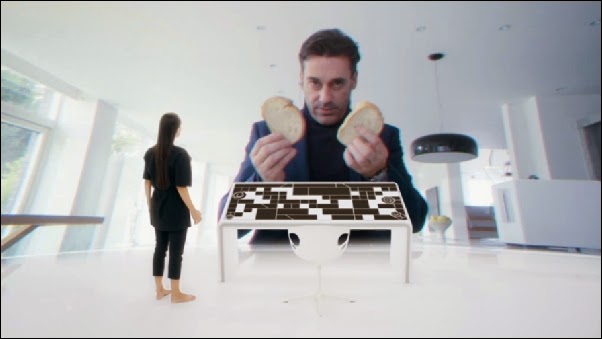
My experience of watching Black Mirror: White Christmas was a sharp departure from the usual mindless festive telly fare. Like a lingering nightmare, it will hover over the dreamy limbos of television’s ‘Christmas Special’ tradition for years to come. Black Mirror (while we can certainly argue that some episodes are better than others) has successfully created a lethal concoction of technological speculation, sharp drama and black humour that stands out amidst the genres of science fiction, reality tv or documentary which tend to be employed to convey the themes explored in Black Mirror’s fictional anthology series. Themes like the impact of technology on our everyday lives, relationships, desires, minds.
On Twitter, the show’s writer, king of cynicism Charlie Brooker, promised that his Christmas offering wouldn’t be anything darker than what writers at the BBC had in store for the residents of Albert Square, but having only read a handful of bemused Facebook statuses to account for said Eastenders episode, I don’t feel fit to judge between the two programmes. Black Mirror delves into the future that hangs over us like an Apple update that keeps stalling our computers. The future that is five minutes (or, if your MacBook is as slow as mine, five hours) away. Drew Grant of The New York Observer has aptly described Black Mirror’s episodes as ‘self-contained parables about the modern condition’. The parable is a good description of Brooker’s show because it highlights the importance of the moral conclusions and dilemmas which entangle every episode. In this one-off Christmas Special, Brooker weaves three tales together through a darkly layered story of love, loss, crime, voyeurism, punishment, seduction and of course technology. What comes out at the end is a Beckettian acceptance of the futility of time; a sense of the fragility of everything in the face of time’s endurance. Watching Brooker’s characters recount the bittersweet and painful tales of their lives, against the sinister backdrop of technology and the ironic happiness of Christmas, I was reminded of Beckett’s play Krapp’s Last Tape. The protagonist Krapp stares into and sometimes physically leans over a tape recorder, which plays back the tapes he has made himself, voices recalling distant and familiar memories. There is the same sense of alienation and poignancy, the same mechanical desire that intermingles in the softness of human despondency.
What drew attention to this particular episode was its casting of Jon Hamm as a lead character. Hamm has become something of an icon for his role as the womanising advertising director Don Draper in Matthew Weiner’s period series Mad Men, but in this feature-length Black Mirror episode he proves his talents lie beyond smoking, nipping bourbon, cheating and delivering great advertising speeches. Hamm isn’t known for playing sinister figures, but then Brooker is never so simple as to create any such ‘simple’ characters. In Black Mirror, the basic components of the technology presented (often already recognisable in our daily lives) are underpinned by an endless constellation of questions and implications. Everything is always layered, complex, ethically challenging – from the ontological questions about what is really real in our hyper-mediated modern lives, to how new technology plays out in more concrete areas like the justice system. This is not a one-dimensional view of the future, but a conversation woven with logical gaps, technical and ethical problems, which invites the audience’s participation. We create our own fates; Brooker doesn’t dictate the determinism of technological evolution, but reveals our own often regrettable involvement in our dystopian downfall.
The show begins in a remote cottage where a man named Joe (Rafe Spall) awakens to the sound of familiar Christmas music. He looks gloomily in the mirror and touches a photograph of a girl that’s stuck there. He walks into the kitchen to discover what appears to be his roommate, Matt (played by Hamm), whipping up Christmas dinner. The tale then unfolds as the two sit down, and the charismatic Matt persuades Joe to be a bit sociable for once and enjoy some conversation over lunch with him. It’s uncertain what the relationship between these two men really is. The story proceeds through a series of flashbacks, as Matt tells Joe all about his past. The story is meant to explain why he is here, since Matt is looking for Joe to tell him why he is here. This central setting for the story that frames the narrative from start to finish harks back to that old tradition of framing devices that is often used in what we might call ‘ghost’ stories of sorts. Journeys to the dark heart of human nature: think of Marlow, travelling up the Thames in Joseph Conrad’s Heart of Darkness as he recounts his tale of colonial horror along the Congo in Africa; think of the epistolary narrative of Mary Shelley’s Frankenstein; think of Wuthering Heights, where much of the story comes to the reader through the yarn woven by Nelly Dean the housekeeper as she sits knitting and talking to our primary narrator, Lockwood. In all these texts, characters are not so much human beings as they are shadows of discourse, and maybe you could say the same about the state of people in the digital age…
Such framing and meta-awareness of storytelling is of course prominent in cinema too, although often for different purposes beyond the sense of alienation and epistemological confusion evoked by such literary techniques. The likes of Martin McDonagh, in his stage dramas and screenplays, employs this technique or trope to reflect on – among other things – the problem of mediated reality in a so-called ‘postmodern’ era. In Black Mirror, Brooker goes beyond the televisual technologies which defined the era of high postmodernism to incorporate a future of duplicating, haptic and intensely interactive technologies. It is hard to shoehorn this programme into ‘science fiction’ or ‘crime fiction’ or merely ‘dark drama’. Everything is ambiguous, just like White Christmas’ central location. The audience doesn’t know what or where here is, other than a snow-coated cottage in the middle of nowhere. There’s a flickering fire and sense of impending disaster. Matt jokes that the cottage was only meant to include essentials, but weirdly that included a string of red tinsel. You can’t get away from Christmas, as Joe’s unfortunate avatar finds out in the episode’s end. In the three parts, we shift between the stories of Matt and Joe, as well as a broader story about the systemic use (and abuse) of technology, and the interwoven stories of the characters whose lives connect with our protagonists’.
You see, this is Black Mirror; things are never straightforward or linear. Matt used to be some kind of romance coach who provides dating advice to men by talking to them internally like an inner voice. Taken out of context, the person in question would look like they were talking to imaginary voices, like a caricatured schizophrenic. Implanted technology allows Matt to witness every action taken by the other man, Harry, through Harry’s own eyes. What kind of panopticon effect would this have on our consciousness, if we knew that everything we saw was being seen in directly the same manner by someone else? I’m immediately thinking of Google Glass here: technology that interacts with the optical function, that projects information between the eye, the world and the brain. Our own perception is shared through wireless communication, in ways that maybe we can no longer control. There are sinister consequences here, as Matt’s advice inadvertently leads the other man, Harry, to successfully seduce a rather unstable woman who is convinced that since they both hear voices they should pass to the ‘next stage’. The next stage being death; not just quitting her job, it turns out. She feeds him poison and he dies right there on screen, for Matt and his audience to see. It turns out that Matt helps shy and lonely men seduce women as a hobby, and in turn shares the footage of these encounters with other men, in what seems to be a sinister extension of contemporary internet ‘live-cam’ pornography. Only, the woman and man in question don’t know the extent to which their actions are being viewed and exploited. It doesn’t seem too far off from the hacking scandals that plagued the likes of Jennifer Lawrence’s iCloud only this summer. The story deals with these issues of consent and broadcast communication on the one hand, but also the ease with which Harry succeeds in seducing women with Matt’s tricks is a little chilling (not merely just unconvincing). In the context of a wider narrative on mediation, it makes us reflect on how much human attraction is based on pre-scripted ideas that are encoded in our brains from so much exposure to romantic discourse – from the old technics of writing and literature to computer games and cinema.
The poison scene weirdly reminded me of a corrupted version of Shakespeare’s Hamlet, where Hamlet’s father is killed by having poison fed into his ear. An untimely revenge; perhaps the consequences of inauthenticity. The ghost of Hamlet’s father reappears in the play, and even when he is not present, the spectre of his wish haunts Hamlet’s frustrated consciousness. White Christmas is also concerned with ghosts. We might even consider the title an ironic reference to Bing Crosby’s ‘White Christmas’: ‘I’m dreaming of a white Christmas / Just like the ones I used to know’. Well, these lyrics seem pretty sinister in the context of this episode, where what’s white is the symbolically smothering snow and the egg-shaped ‘cookie’ device that connects to an implant in people’s brains. An implant that duplicates the self into a ‘cookie’, a cookie which is externalised and given a simulated body. A body that might not be real, but is certainly sentient.
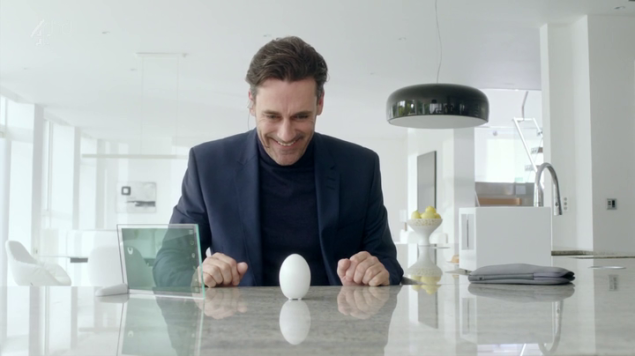
If we used to know Christmas as pure and white, all love and peace and Sainsbury’s-spouted Christmas truces and freedom from suffering, Black Mirror throws this day of spirited possibility into suspicion. The twist of the tale reveals a moral dilemma that haunts the use of such duplicating technology that takes us towards the realm of cloning; but, as in episode Be Right Back, keeps it close enough to the present state of technological reality to really disturb. Is it wrong to harm things that aren’t real, but still feel pain? Can we keep our simulated extra-selves as slaves to enhance our lives, even if it forces them into a lifetime of torture? What does it do to our personal identity to be physically conscious of doing harm to some simulated duplication of ourselves?
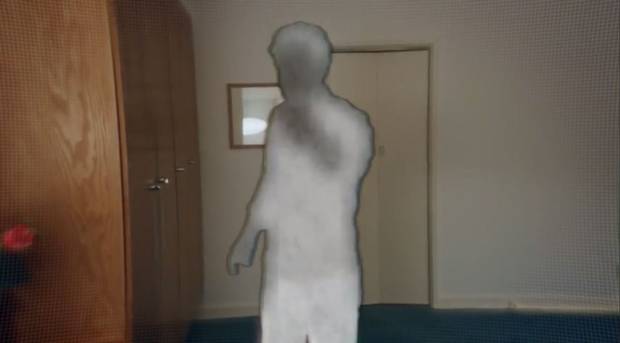
As with Hamlet, the theme of retribution runs rife through the episode. Partners punish one another through ‘blocking’: a way of cancelling out an entire person – as you may do on Twitter and Facebook – only in real life. The person in question becomes a pixellated greyish blur, like a glitch from a computer game that you can never quite get close to properly, even though they could still do you physical violence. Weirdly enough, the blocked figures in White Christmas reminded me of Pokemon Red and Blue’s ‘Missingno’, which appeared as an odd remainder of scrambled code that never quite got fixed in the games’ final cut. A Pokemon that appeared mysteriously without indexical recognition; an unknown creature. The name ‘Missingno’ also seems somehow relevant here, as it stands for ‘missing number’, as if the human in question was stripped of his/her name and personality, and left only as the grey matter of their brains, the bureaucratic residue of a ‘missing number’, 1984 style.

Only, unlike the geometric shape of Missingno (oddly resembling a missing puzzle piece), in Black Mirror you still see the human outline of the person you block. The fluid movement of their head and limbs. Their speech roars at you like a radio out of tune and communication will never ultimately travel as you want it to. Even in photographs, the blocked person dissolves from view. An absence cut permanently from your life; or at least until they unblock you. With great precision and a balance between steely analytic satire on contemporary social media and emotional humanity, Black Mirror explores the human consequences of such technologies: heartbreak, misunderstanding, new forms of enduring punishment. Matt is ultimately punished for his role in inadvertently causing Harry’s murder by being universally blocked, so that all humans are to him blobbed and distorted like a sea of Missingnos, and to everyone else, Matt becomes a red blur. We might think back to the days of MSN Messenger, where if we blocked someone from talking to us, on their Contact List we would forever appear as the red ‘Appear Offline’ icons. Always within reach but never fully present or within contact, we would linger elusively on their list of contacts but every message they tried to send would be lost in the ether. Technology, from the beginning, is a story of both absence and presence, communication and severance. It is all too easy to talk to someone across the globe, to love them truly even though they may be a stranger; it is equally all too easy to cut someone out of your life seemingly forever at the click of a button, given how much time we devote to living online.
I think it’s appropriate that such an episode is aired at Christmas time; the time when everyone finds themselves worshipping at the circuitboard altar of a new tablet or phone or smart-watch. It issues a kind of warning, at the same time as being dramatically gripping and comedically entertaining. We live in an age of Sony hacks, Gamergate, iCloud leaks, attempted murders committed by children under the influence of online Creepypasta mythologies, Twitter abuse storms and the rife availability of online child pornography, smartphone apps which track your every dietary intake and calorie burned, as if you were some cookie of yourself trained and disciplined by the ethereal whims of your own idealised higher being. Technology is clearly something we frequently use to abuse ourselves and one another as human beings; it brings out whatever darkness is already in our nature and provides the platform for exhibiting this darkness more effectively. If we lose ourselves to this ease of abuse, where will we be in five, ten, twenty years time? Maybe only Charlie Brooker knows.
If Back to the Future got some things right about 2015 (pollution, nostalgic 1980s cultural revival), and others pretty wrong (hover-boards and flying cars) it’s difficult to say how much Black Mirror gets right about our future. The most chilling aspect of all Brooker’s episodes is perhaps how much they touch on a prosthetic logic whereby we lose ourselves to the tools we employ to help us that is already in operation today. A prosthetic logic that only needs a few more steps in Santa’s workshop to become Brooker’s nightmare vision of reality. There is nothing wrong with the technology itself per se, the show suggests, but the way we lose our humanity by giving ourselves up fully to the wonders of its operation. Surely the best metaphor for this is Oona Chaplin’s character, who literally forges a double of herself (called a cookie) and enslaves this poor spirit animal to a life of making toast and adjusting the volume of ambient music, simply for the benefit of a more efficient and technically-enhanced lifestyle. If we surrender all morality and consciousness to the endless improvement of this so-called ‘lifestyle’, aren’t we forgetting the things that make life worth living? White Christmas ends with Matt drifting out into the ultimate alienation of universal blocking, and Joe in a hysterical condition in his prison cell whilst his cookie lives in an infinite torture of Wizzard’s ‘I Wish it Could be Christmas Every Day’ being played on repeat while he exists forever trapped in the isolated kitchen. This manic but also slightly funny conclusion reveals the show’s unique blend of human sympathy and nightmare desolation. No matter how many times he tries to smash the radio, the song keeps playing. It’s like that time Celebrity Big Brother decided to lock Basshunter in a room for six hours with his song ‘All I Ever Wanted’ playing on repeat really loudly. Sure, Brooker’s ending is a bleak reminder that Christmas isn’t always great for everyone; but it’s also a reminder that you should be careful what you wish for. After all, it’s easy enough to become slaves to the technology that enchants us, but not so easy to sever ourselves from this technology, once we’ve realised that it’s usurped our humanity, and maybe even our sanity.
Further reading on the episode:
http://www.theverge.com/2014/12/31/7471901/i-cant-stop-comparing-everything-to-black-mirror
Grant, Drew, The New York Observer Online. http://observer.com/2014/12/cookies-arent-grains-debunking-the-single-universe-theory-of-black-mirror/
See also my pal Kat’s article on the same episode: http://katinwords.wordpress.com/2015/03/31/black-mirror-white-christmas/

 mariaology