Perfume Junkie

(So I thought this article was kind of Christmas appropriate, given that in the familiar nativity story, the Three Wise Men bring Jesus the precious scents of myrrh and frankincense.)

***

‘Perfume is like a parenthesis, a moment of freedom, peace, love and sensuality in between the disturbances of modern living.’

(Sonia Rykiel)

‘To create a perfume you have to be the servant of the unconscious. Each idea evolves and transforms, but there should be a surprise with each note.’

(Serge Lutens)

Perfume is a strange part of our everyday lives that acts as a channel of sorts. The word perfume comes from the Latin per (through) and fumum (smoke). This conjures the image of an ethereal essence which, like smoke, carries through some kind of message. We might think of it as an unspoken means of communication, a way of emitting some essence of ourselves to those who happen to pass close enough to catch a glimpse of our secret aroma. One that releases itself only from certain spots on the body, places we have chosen to let the scent develop. I love the way that glossy magazines and figures of high fashion talk so indulgently about perfume. It’s like poetry: a complete decadence of revelry in words. It’s like reading a wine list and falling for a string of adjectives rather than the taste of the drink itself. Rich, smoky, full-bodied, bursting with dark fruits. The poetry of advertisement aims to seduce. So too does perfume: it is a seduction not only in a sexual sense but also a seduction of self. A seduction of memory.

I was probably about nine or ten years old when I made my first forays into the world of fragrance. Certainly, I was still at primary school. I used to sneak into my Mum’s bedroom while she was eating her breakfast downstairs and try on what she had. Her dressing table was never cluttered with pretty glass bottles (more like heaps of unusual jewellery and hair mousse), but she did have a couple of classic Body Shop numbers. There was of course the famous White Musk, which I started wearing often. I liked the soft but heady smell it had, not too overpowering as a floral but sweet enough to stir your senses with its blend of ylang ylang, jasmine, rose, musk and lily. Then a while later, she gave me a bottle of spray she didn’t want, this time the Body Shop’s Oceanus. Or was it Ocean Rain? – no, I am getting confused with an Echo & the Bunnymen song! It was actually quite a strong one, though it wore off fairly quickly. I suppose it was meant to smell sharp and fresh like the ocean, and actually it was quite a nice one to wear at school where P.E. and stuffy classrooms were never conducive to pleasant aromas.

We were of course, forbidden deodorant in P.E. This was at secondary school, where everyone was aware that they had, y’know, adult bodies now, bodies which tended to sweat after exercise (even the half-hearted exercise we attempted in class). The teacher would storm into the dressing rooms at even a hint of spray being used, demanding that the most suspicious looking pupils empty their bag in front of her to reveal the contraband goods. She must have hoarded a whole treasure trove of Charlie and So…? and all those other brands we clung to as adolescents. On such days I would hide my little bottle of Oceanus in a glasses case at the bottom of my bag and spray it liberally once the coast was clear. A sea tide of refreshment filled the room. The contents of that bottle seemed to last forever; in fact, I think I still have some left in my bedroom.

The first perfume that was gifted to me was a miniature bottle of Burberry Touch. It’s a pretty intimate scent, threading together notes which include jasmine, raspberry, pink peppercorn, vanilla and oak moss. It sounds sweeter than it actually is: this is a strong scent but also has an air of sophistication. It feels grown-up and even a bit masculine (perhaps that’s the base notes of Cedarwood and oak moss?). I was fourteen when I got it so it ran out fairly quickly, but I now have a big bottle of it on my dressing table.

I also, at quite a young age, acquired my mother’s bottle of Yves Saint Laurent’s ‘Paris’. Launched in 1983, this distinctive scent was meant to capture the spirit of Paris with its heady blend of Damascan rose and violet, which after hours of being on your skin transforms into English rose and whispers of mimosa, sandalwood and musk. There are other beautiful notes in there: orange blossom,  amber, jasmine, hawthorne, heliotrope. It’s so complex that I’m still working out whether I actually like it or not. I wore it all the time until I was about sixteen. It’s far too grown up a scent for someone to be wearing at that age, but somehow it matched my wearied spirit. It felt almost exotic, a smell from far away. Something about it matched the impressionistic notion of Paris I had; a Paris which shimmered with the seductions of beautiful art and mysterious, moody people. It was certainly a smell which took you out of the dreary realities of Maybole, if only for that first spritz in the morning. The pale gold bottle with its crystalline, faceted surface and satisfyingly chunky feel still has pride of place on my shelf back home. I’ll spray it every now and again – what’s left of it – when I feel the need for a bit of escapism or nostalgia.

Source: https://www.flickr.com/photos/jsgutierrez/8778507488

I like to think that when I’m using perfume I had years ago, I’m speaking to some secret old self, one that got lost in the ethereal tangles of time and change and forgetting. For Christmas two years ago, I asked for a bottle of Chloé perfume. Chloé was the first ‘proper’ fashion fragrance I bought for myself, when I was fifteen, in the Christmas sales of that freezing winter of 2009. To this day it’s definitely still one of my favourite scents. Along with Miss Dior Chérie (the orange one), which I also had as a teenager, it’s a romantic scent, sparkling with pretty florals and a dab of French sophistication. Both bottles are adorned with a ribbon to signify the femininity and lighthearted spirit they intend to convey. Chloé is quite a strange and unusual floral, with rose at its heart, honey at its base and the tartness of lychee as its top note. The blend is very smooth and does not induce headaches like some other more couture brands; it is at once instantly recognisable and also quietly luxurious on the wearer’s skin. When wearing it, you want to be riding a vintage bike through some sunshine street in Paris, where all the lamps light up for you, and your destination is a quiet picnic in the park, or a date with a good paperback under the canopies of a Montparnasse café. The bottle is quite short, almost stumpy in comparison to the tall thickness of Burberry Touch, but this makes it easy to cup in your hand to apply. It sits prettily on my dressing table, even with only a few dregs of scent left in the bottom, amid bottles of glitter nail polish and fragments of hair ribbon. If I had to pick a ‘signature’ perfume, it would be Chloé; a friend once texted me saying she was spraying it in a shop and instantly thought of me, which was sweet.

Source: https://www.flickr.com/photos/idhren/7171470710/in/photolist-aktUVr-8QgRJY-63ty7o-dp8nWE-8N2gQN-bVHEEq-bWrF59-bVHF4w-bVHEoJ-6u9PLc-ea9vW5

When I got my second bottle of Chloé, the scent instantly evoked that feeling of being fifteen again. It wasn’t an entirely bad experience, it was a taste of having that smallness, that protected enclave of a childhood world again. Or at least, the experience of being on the brink between the world of childhood and the uncertain future of adulthood. Perfume, I suppose, makes an industry of Proust’s ‘involuntary memory’: the idea that under certain conditions, one is transported back to a clear, distinct memory. Not wilfully, but through some item containing the ‘essence of the past’, whose sensory associations stir up the scene of some personal history. For Proust, eating a tea-soaked ‘madeleine’ cake recalled a childhood scene where he ate such a snack with his aunt. For me, spraying Chloé makes me think of warm radiators and school mornings in the cold pits of winter, or getting ready to perform in jazz band concerts, sweating under the hot lights. Leaning against the window of the 361 bus, reading Margaret Atwood. Floating through Ayr on the way to college, stopping always at Debenhams to spritz on their testers. I’d spray the little pieces of cardboard they provide you with and slip them in my bag, so that all my notebooks smelled of my favourite perfume. Sometimes my friends and I would spend an hour or so trying on all the perfumes, until we left smelling like we’d fallen through some vat in a Dior factory, causing everyone in our near vicinity to sneeze violently. I still enjoy doing that, although these days I set my sights on the counters at House of Fraser.

Strangely enough though, the older I get, the more I’ve switched to simpler scents. Part of this is a side effect of student stinginess, but I also like the freedom of buying several scents and being able to choose between them, to suit the weather or the seasons. I guess perfume is just something I tend to waste my wages on, the way that others waste them on Asos, cigarettes or vodka oranges. I have too many Body Shop Eau de Toilettes to count. There’s Chocomania, a very rich and some might say saccharine rendering of lush dark chocolate – perfect for those gloomy winter mornings when already you’re craving your bed and some hot cocoa. The distinctively tropical Coconut, which is, admittedly, more Bounty Bar than fresh jar of cold-pressed coconut oil. Then there’s the clean bright tartness of Satsuma or Strawberry, refreshing for summer. The milk chocolate and almondy sweetness of Brazil Nut. Honeymania, which does what it says on the tin and makes for a perfect late summer scent. I suppose, at less than £10 each, these perfumes make great little gifts or stocking fillers, which last a surprisingly long time. You could mix and match your scents (I like the sound of chocolate orange, brazil & coconut or honey & strawberry), and the small light bottles make them portable for your handbag. And with Body Shop (I swear I’m not a brand ambassador!) there’s always the positive that everything is ethically produced, usually from Fairtrade ingredients.

In a pricier range of perfume, I recently revisited one of my favourite childhood smells, Penhaligon’s ‘Bluebell’, which I got as a present for my 21st. When I was a very little kid, my dad brought back from a trip to London a velvety purple bag full of Penhaligon’s samples. They had enchanting names, like Elixir, Gardenia, Elisabethan Rose, Levantium (oh to have a perfume with the top notes of saffron and absinthe!). The one that stuck with me was ‘Bluebell’, which felt the most quaint and old fashioned of all the scents. The bottle, for one, is gorgeous, a little bit Art Nouveau, a little bit of simple prettiness. I could easily imagine myself, smelling it now, as a little girl running about in a field of bluebells. It’s not over-sweet or stuffy; it reminds me of the kinds of luxurious scents that would be spritzed around in early twentieth century department stores. I think of Cassandra and Rose in one of my favourite books, Dodie Smith’s beautiful coming-of-age novel, I Capture the Castle (1948), as they wander through the fairyland of such a store in London and marvel over the bluebell perfume. You see, there’s more than just chemicals and packaging to perfume; it always has some kind of rich cultural and personal history living in its notes.

bluebells in Culzean woods

***

Do you remember your first science classes? Most of those memories are probably enriched by the strange smells concocted from an uncertain mixture of suspicious substances. The rotten eggs of sulphur, the acridity of various nitrates. What stands out most for me was a lesson where for some reason we were experimenting with burning different types of foodstuff over our Bunsen burners, to measure reactions to starch or something. Somebody’s Pickled Onion Monster Munch made the entire classroom smell like a Chinese restaurant. The process of perfumery, while aiming for more delicate blends of scent, follows, of course, a similar (but infinitely more sophisticated) chemical process. A perfume will blend natural sources – flowers, fruits, wood, roots, gums and resins – with synthetic productions of those ingredients which don’t produce their own oils naturally, for example lily of the valley. An intriguing guide to the complex scientific process through which these raw ingredients turn into perfume can be found here. I especially like the sound of the enfleurage step, where ‘flowers are spread on glass sheets coated with grease’. Over time, the grease absorbs the scent of the flowers, like a leaf absorbing rain water, just as expression collects the precious oils of various fruits. Alcohol and water are used to distill and preserve the fragrance. That’s why you should be careful not to spray perfume on your eye, or an open wound – or an open fire, for that matter.

Source: https://www.flickr.com/photos/karen_roe/

Interestingly, like champagne or wine, a ‘fine’ perfume is left to ‘age’ to let the blends develop. Maybe this is why Chanel No. 5, for instance, is such an iconic symbol of ultimate luxury. Its yellow-gold colour always dazzles in department store Christmas displays, but it also reminds one of a pale whisky or dark champagne. Like alcohol, it is intense, maybe even difficult to stomach. Infinitely seductive… complex to create…

Perhaps, like aromatherapy, there is a system to the choice of various scents and flavours. A science to how different people are attracted to different things. While some like a fresh burst of citrus, others revel in the dark sweetness of the likes of Thierry Mugler’s Alien perfume (not a fan). We can all guess that lavender makes you sleepy, lemon is awakening…but maybe there’s more to it all than that. A curious interaction of emotion, memory, desire, sensation… Maybe, after all, it’s the cold December air that led me towards my latest perfume purchase, returning full circle to my first White Musk perfume, only this time with the Body Shop’s newest fragrance, ‘Red Musk’. With its fiery bottle which blends amber, red and black, this Eau de Parfum combines the smouldering notes of tobacco, pepper and cinnamon with a layer of spiced musk. With cinnamon, it’s a dark, shadowy twist on a festive fragrance. Moreover, it’s about time perfume embraced androgyny, as this scent does with its hints of tobacco. Gone are the feminine florals of summer. So while I might be accused of being a hoarder, stashing my perfumes like a witch hoards her bottles of potion, maybe I can justify buying this particular perfume because anything that makes you feel warm (in a flat with single glazing) has got to be good, right?

Mould

10155541664_fdbdb1532e_z

It was a moon-scape she saw, peering into the mug in her mother’s study. Yes, a moon-scape with little lumps of perilous blue and grey, seeping into one another. Or maybe it was another kind of space terrain: she imagined the ground of Pluto, with its eye-like holes and fissures. She gave it a shake, and watched the particles break up and drift away, flotsam on some unreal ocean. A polluted ocean; maybe the earth’s oceans in a hundred years’ time. They told her in school that the world was filling up with waste and one day everything would melt away, like those paintings of dissolving clocks she saw when her mother took her to the museum. You could already tell it was happening, her teacher had said, the way that it gets so warm these days. The mildness of winter. It wasn’t right.

Well, the moon wasn’t right either that night. No; she could not stop thinking about what she saw in that mug. Another world, was it? She wished she could go back and count the dots, knowing that if she did she could start to chart this new universe, and in knowing it better she could sleep. She could enter its landscapes, drift across it with the powers she had in her dreams. Her mother put a sachet of lavender under her pillow and she could smell it through the cotton, soft and sweet…but it was not enough distraction. She needed to know what she had seen. But her mother might hear her and send her back to bed. It had to be worth a try. Sucking in her breath, she tip-toed back into the study, closing the door quietly behind her and flicking on the light. It was an energy-saver bulb, that took ages to properly glow. So she stood in the dull orange light, watching the wall till it got brighter. Then she would pick up the mug and see. Then she would know again.

Finally it was bright enough and so she went to pick up the mug…but this time, oh how the smell caught her! It was sharp and evil like the stench of seaweed, only worse, like the most rotten thing in the world, slowly fermenting. Yes, she smelt it and was knocked backwards almost. But it was fascinating. She let her nostrils quiver and sniff deeper as she held the mug to her nose. The she looked into it again and saw how the dunes and lumps had mushroomed and the blue was turning greenish, or maybe that was just the duller light. Still, these were definite changes. And she was thinking of the clumps of toadstools she’d seen in the school playground, while they were out measuring soil quality and watching the teacher bending in the grass with a thermometer. They were big brown flat things, ugly and intriguing, and she knew that some of them were poisonous, and some of them if you poked them let out a puff of steam. She wished she could touch these mushrooms but the thought of putting her finger in the mug was repulsing. It was kind of like a horror movie, she thought, where they showed you somebody’s festering wound, only it never looked quite real. Still, you would not like to touch it, it was just sort of funny to look at. No, she would not touch it; instead she shook it again, and this time the dunes did not dissolve, but she could see little fissures rippling across them. Her stomach turned over as if emptying something, and she felt a surge in her gullet. She put the mug down and breathed in deeply, trying to rid herself of the awful smell that clung to her like a disease.

She wondered what it was that these microbes loved so much about her mother’s tea. She considered if they’d accept her into their colony. Like them, she was partial to a glass of milk, but maybe not tea, unless it was laden with sugar. She wondered how they’d order themselves, scattered about as they were like that. Bulbous, growing over each other. It would be a ruthless economy. She sat down on the comfy office chair and span around slowly. The queasiness was leaving. She liked how all the objects rushed around her, melting into long white and orange lines. She stifled a giggle; she must not wake her mother up. She whispered stories to the mug. Telling them about the boy she wrote a letter to once in class and the time she left her homework on a bus. Soon she would say goodbye to her mother. She knew that it could not be long before she was ready to join them. They would be like ants, or the tiny people in Gulliver’s Travels – Lilliputions – running all over her body. Only, they were so small you could not see them. You could just imagine them, growing and multiplying, all over her skin.

They made the moon rocky and bumpy, like that boy whose skin was cratered with pimples. She had seen on television once two fat ladies in white coats scrubbing away green things from the corners of a bathtub. She and her mother didn’t have a bathtub, but sometimes she saw things come out of the plughole in the shower. Great streams of wiry hair that poked out, or smeared themselves upon the porcelain. Once a huge spider. She heard its legs patter and she screamed, and her mother tried to lift it out with a gardening trowel. Sometimes there were little black seeds all over the bath, and the first time she thought maybe a plant had vomited up all its babies (in class that morning she had been drawing diagrams of sepals and stigmas and filaments and seed-pellets), but then her mother told her it was just exfoliating beads from some lotion she had. She tried the lotion and it made her skin burn, but it was not unpleasant; kind of like the scratch of dry sand. It left a pinkish blotch on her legs. She was wondering if the moon was like that: all pastures of dry sand. Were there lakes or ponds or waves? Trees, even? In the mug she could not see any trees, and the only waves were from when she rippled the sticky liquid with the swirl of her wrist. She thought maybe if she lived there she’d have to invent some more things, to keep her interested. There would be a gift shop, for one thing. You could buy t-shirts with maps of the land on them, with close-up details of the blue-green growths and the tea-stains that ringed the china walls. It was like a whole continent splayed out, with all the countries slotted together, their landmasses enveloping each other. A strange thing.

She would take the mug into school on Monday, for show-and-tell. It was the right thing to do. Everybody else would bring in their cinema tickets, their remote-controlled helicopters, Pokemon cards, a book they had read over the weekend. And they would talk about themselves, nattering away about this thing that had brought them  their childish joy. Then she would take to the stage, like the prime minister on the telly, clasping her precious mug, and she would tell them how she had found the moon. At first they would laugh, she recognised that, but then they would realise how clever she was. How amazing was her discovery. She giggled just thinking about it. But I must let it rest, she reflected. After all, she needed to let her colony expand, for the spores to pile up higher upon one another until they were spilling over the edges of the mug. She wanted her colony to be huge and impressive. I mustn’t let them escape. She took a postcard from the wall – it was a painting of a lemon and a teacup by Francis Cadell – and she placed it over the mug. The moon was safe, and its surface would continue to bubble and grow in their new warmth and darkness. So she tip-toed back to bed and lay awake, her mind floating around this wondrous space. Each star was a point of contact, a possibility.

And she spoke to the stars, even as she jumped between them, as you jump between chairs and tables and sofas when you play ‘The Floor is Lava’. Each one told her a story, and she basked in the glow of all those words weaving a tapestry around her. Soon she could slip into sleep, soon, soon, soon…she closed her eyes to a new darkness, felt the warmth of the space beneath the sheets. The smell of mould dissipated from her brain, and now there was only silence, the scent of lavender, wafting in delicate waves…

When tomorrow arrived, it was Monday, so she got dressed for school and went downstairs. To her horror, she saw the mug up-ended on the draining board. What on earth…? Mummy? Her mother came down to boil the kettle and make her porridge, but was startled to see her daughter crying so early in the morning. What is it, darling? She was already late for work, and starving. She threw her handbag on the table and brushed down her jacket. What is it? she repeated. The child was pointing at something next to the sink. Mummy! she wailed, you’ve killed the moon! 

14999083677_30927ae383_z

Punk, Politics and the Personal: In Praise of the Manic Street Preachers


tumblr_nd4vd77mIC1qj3j7go1_500

One of my earliest memories is being at my dad’s old flat and messing with the hi-fi player to get attention. It would’ve been around about 1998, the year the Manic Street Preachers released their album, This is My Truth, Tell Me Yours. Maybe my dad and my brother were watching rugby on T.V or something, and I’d read all the books I’d brought with me. Well anyway, I thought of a keen plan to wind them up. I turned on the hi-fi and skipped to my dad’s favourite song (at least, his favourite song that wasn’t anything by U2!) and let it play. Loudly. And then I put it on repeat. And then I stopped letting it play out; I just played the first bar or so then pressed repeat and played it again, as if it were on a loop, inducing hypnosis. Incidentally, those first few notes are inscribed into my memory. The song was ‘You Stole the Sun from My Heart’.

Since then, I’ve drifted through life with the Manics not far from my consciousness. When I was about fourteen, I discovered some of the darker tracks from The Holy Bible online and basically that was me sorted for emotional outlet. What better lyrics do you need as an existentially-frustrated teenager than: ‘self-worth scatters, self-esteem’s a bore’? However, it’s only this summer that I’ve come to properly listen to the album in full. By pure coincidence, it just so happens that this year marks the 20th anniversary of The Holy Bible’s release. I was one year old when it came out. Funny, how it still rasps with fresh energy, all these years later when a whole new generation are beginning to appreciate it. It has songs about capital punishment, anorexia, the Holocaust, prostitution, aching nostalgia, suicide and (metaphorical) political sex scandals. At times it can be painful to listen to, with its throbbing, angry bass-lines, and packed-in lyrics which scream razor-sharp poetry: ‘Your idols speak so much of the abyss / Yet your morals only run as deep as the surface’ (‘IfwhiteAmericatoldthetruthforonedayitsworldwouldfallapart’). James Dean Bradfield is a master at the smashing (in the literal sense of smashing), punkish guitar rhythms and sailing solos that almost make your brain hurt. At the same time as being able to throw out all those lines, a million a minute. It’s brilliant. I can only imagine how amazing it must’ve felt, back then, to go out and buy this brand new album and listen to it on a Walkman and feel, more than ever, electric and alive. And angry at everything.

The Holy Bible is now considered an early 1990s classic, to be filed alongside the (considerably cheerier) offerings of 90s Britpop; for example, Oasis’s Definitely Maybe (1994) and (What’s the Story) Morning Glory? (1995), and the holy bible of grunge, Nirvana’s Nevermind (1991). While the rest of British music was penning the likes of ‘Live Forever’, ‘Rock and Roll Star’ and ‘Park Life’ – drunk anthems for the boozy masses (and still we love them, if only in secret) – the Manics were deconstructing contemporary society (class, political injustice, historical trauma) and existential crisis through the spike-edged modes of punk, pessimism and fury.

ManicStreetPreachers_TheHolyBible

Moreover, as its title suggests, The Holy Bible is more than just an album: it’s also a text. A network of references and quotes, provocative enough to set you on a trail of philosophical and literary discovery. The voracious listener is able to devour even more information by following up the sources scattered over its songs, learning at the same time as participating in this performance of knowledge. Camus, Foucault, Plath and others haunt this album, through direct references but also aesthetics. There’s Plath’s visceral emphasis on the body and its various contortions and distortions, its ruptures and vulnerabilities: ‘a tiny animal curled into a quarter circle’ (‘Die in the Summertime’). The title of track ‘Archives of Pain’ pays homage a chapter in David Macey’s 1993 biography of French philosopher Michel Foucault (who wrote Discipline and Punish), and the song itself considers changing societal values with regards to punishment, although it is ambiguous as to whether the song advocates a return to capital punishment, or a refusal of the glorification of serial killers. Lyrics such as ‘prisons must bring their pain’ and ‘the centre of humanity is cruelty’ offer a bleak, Lord of the Flies rendering of humankind’s essential lust for destruction, its need for revenge. While Nicky Wire and Richey Edwards collaborated on its lyrics, Richey seems to claim it as a ‘pro-capital punishment song’  (see Harris 2004), while Nicky told music magazine Melody Maker: ‘everyone gets a self destructive urge to kill, but I don’t particularly like the glorification of it. The song isn’t a right-wing statement, it’s just against this fascination with people who kill’ (cited in Power 2010). The ethical ambiguity of this song adds to its disturbing quality, its fury that cannot quite be pinned down.

The album also crackles with various audio samples, a ghost chamber of voices which include a fragment from an interview with the mother of a victim of Peter Sutcliffe (the 1946 so-called ‘Yorkshire Ripper’):

I wonder who you think you are
You damn well think you’re God or something
God give life, God taketh it away, not you
I think you are the Devil itself

And when you hear it, you’re chilled to the bone, before being thrown into the savage world of ‘Archives of Pain’. There’s also a quote from the author J. G. Ballard talking about his controversial novel Crash (1973), which flashes in as a soundbite on ‘Mausoleum’: ‘I wanted to rub the human face in its own vomit, force it to look in the mirror’. Mausoleum is a song inspired by a visit to Auschwitz, to the barren landscapes where concentration camps once existed, but still linger. The chorus is simply:

No birds – no birds
The sky is swollen black
No birds – no birds
Holy mass of dead insect

It’s painful and bare, so that listening to it, you imagine a dark carcass of a sky, heavy with the traumatic void of its past. The ‘dead insect’ which serves not only as an image of the barren remainders of death, but also perhaps as a reference to those swarms of people who were so brutally dehumanised during World War Two. And Ballard’s quote captures everything about The Holy Bible: it’s visceral, it forces you to confront the shadows of your own self, and of humanity. It provokes an abject reaction, through its images of self-harm, dismemberment, corrupt sex and violence. At the same time, it ‘obliterates your meaning’ (‘Mausoleum’); it shatters all attempts to make sense of the traumatic events it references. The conventional linear progression of melody and song and perhaps even narrative in an album is broken up with intertexts and ghosts, and perhaps that’s why it still lives on today. Unlike, perhaps, an Oasis album, which is nostalgically evocative of more simpler, hopeful times, it doesn’t feel in the least bit dated. Its endless trail of references add shadow and depth to its meaning.

richey-edwards

But perhaps, listening to it now, you feel that it’s haunted most by Richey Edwards himself, the band’s fourth member who penned (Nicky Wire has claim to the other quarter) 75% of the lyrics. Following bouts of depression, self-harm and an eating disorder, Richie disappeared one morning in January 1995, just before he and James were due to visit the U.S. on a promotional tour. In February, his car was found abandoned at a service station near the Severn Bridge. Since then, almost twenty years on, still no evidence or trace of Edwards has been found. Even though he was pronounced officially ‘presumed dead’ a few years ago, the aporia of his disappearance remains. Of course, this allows fans to string mythological tales about his reappearances around the world. The lack of closure is perhaps what is most distressing: the not-knowing, the sense that at any time he could come back into his friend’s and family’s lives. Listening to The Holy Bible, Richey’s personal suffering is of course inscribed in every line, even though most of the lyrics reach a universal, almost transcendental pain at times: ‘I’ve long since moved to a higher plateau’ (‘4st. 7lbs’). And then you hear him when listening to the Manics’ later albums, which are still full of Richey’s presence/non-presence in the band: ‘You keep giving me your free air miles / What would I give just for one of your smiles’ (‘Nobody Loved You’), and ‘As holy as the soil that buries your skin / As holy as the love we’ll never give / As holy as the time that drifted away / I love you so will you please come home’ (‘As Holy as the Soil (That Buries Your Skin)’).  Richey’s bandmates even dug out his old notebooks, with permission from his family, to use as the lyrics for their 2009 album, Journal for Plague Lovers. Maybe the most painfully intimate Richey track is the final song on this album, ‘William’s Last Words’. Arranged by Wire, it features soft guitar strokes and his crooning, deep voice singing about voyeurism over lines of loss and death that almost sound a melancholy joy:

Isn’t it lovely, when the dawn brings the dew?
I’ll be watching over you
Isn’t it lovely, when the dawn brings the dew
I’ll be watching over you

It ends with the bittersweet lines: ‘I’d love to go to sleep and wake up happy, / Wake up happy’. It’s a stripped-back Manics; it’s simple but stays with you, innocent and chilling, like the blood-spattered Jenny Saville artwork that adorns Journal’s cover:

manic_street_preachers_journal_for_plague_lovers_1241170684_crop_550x550

In this album we also see again that familiar combination of theory and fiery politics, as the opening track references Noam Chomsky’s book, Rethinking Camelot: JFK, The Vietnam War, and US Political Culture (1993):

Riderless horses on Chomsky’s Camelot
Bruises on my hands from digging my nails out
A series of images, against you and me
Trespass your torment if you are what you want to be

The sense of our powerlessness to media and mediated disaster is captured here in just a few frenzied lines. ‘A series of images’: the sense of personal and political conflict flashes past us in handfuls of words, just like the way that war plays out through the flickering light of our television screens. Chomsky’s book documented a critique of Kennedy’s foreign policy in Vietnam, and these themes of military funerals, fallen soldiers, geo-political conflicts and human sacrifice in war are all invoked in a handful of words, powerfully delivered as ever by Bradfield. We might think also of ‘Kevin Carter’, the trumpet-tinged single from Everything Must Go (1996) which documents the story of ‘Bang Bang Club’ and Pulitzer Prize-winning photographer, Kevin Carter, who famously suffered from the haunting scenes of all the killings and suffering he had witnessed (and indeed photographed) and eventually committed suicide. The Manics, not just with their military-inspired outfits, are consistently attuned to themes of war and death.

The mysterious story of Richey and the Manics is of course seductive, and perhaps part of the enshrinement of pain that goes with their mythology, but they are also an incredibly uplifting band. They kick the listener into political engagement, which is refreshing in a time of political apathy (or the complete neglect of politics in most pop and rock music, with the exception, perhaps, of Muse’s Matt Bellamy and his crazy conspiracy theories). Songs like ‘The Masses Against the Classes’ and ‘Design for Life’ are songs about working-class experience and class politics in the post-Thatcher era. Of course, being from Blackwood, an ex-mining town in Wales, the Manics are all familiar with the catastrophic effects of deindustrialisation upon communities. Seeing the life and soul of a town being lain to waste after the rich won the class-wars of the miners’ strikes. Their eleventh studio album, Rewind the Film, closes with the song ’30-Year War’, which references the Battle of Orgreave, the Hillsborough disaster, coverups at the BBC (and oh how there are many – from Savile to Scottish Independence) and has the refrain, ‘the old-boy network won the war again’. It’s depressing, but realistic in our time of austerity. Has much has really changed from the Thatcherite legacies of the early 1990s, when the Manics came into being? Arguably, with the rise of UKIP and a weakening Labour party, the ‘working-class’ opposition to neoliberalism faces an even deeper well of apathy.

Source: walesoline.co.uk

On the subject of far right politics, funnily enough last year the far-right English Defence League (EDL)  tried to appropriate the Manics’ 1998 hit ‘If You Tolerate This Your Children Will Be Next’ for promoting a demonstration in Birmingham. The song features the pretty much crystal clear lyrics: ‘So if I can shoot rabbits / Then I can shoot fascists’. As well as a lesson in irony, it is probably a reflection on the EDL’s stupidity as much as anything else to choose a song inspired by an anti-fascist slogan used during the Spanish Civil War. The Manics have always been associated with political controversy, from Nicky Wire’s sharpish (‘remember, all men should castrate themselves’) quotes to the band’s iconography (famously, a 1994 performance on Top of the Pops featured Bradfield wearing a ‘terrorist style’ balaclava, albeit with his name scrawled across it playfully like a name sewn onto a school jumper), but in this case, the EDL’s appropriate was too ridiculous and they had to sue.

***

This autumn, the Manics announced that they were finally ready to do a Holy Bible anniversary tour. Although my dad and I jumped on Ticketmaster at 9am, we were unable to grab any tickets for the elusive Barrowlands date, which apparently sold out in two minutes.  I’m really gutted (especially as it would have been a welcome reward for finishing uni coursework), as I can’t really imagine a gig that would have quite the same emotional resonance. Nevertheless, the fact that they’re now touring the album means they’re playing it more in general across various forms of media, which is always a great thing. I must admit, it was very satisfying to see James, Nicky and Sean performing ‘Revol’ on Later…With Jools Holland. When Jools interviewed them about the song they were going to play from the Holy Bible, Nicky sort of giggles and says it’s about dictators engaged in metaphorical sex games, some clever idea of Richey’s. There’s an irony that he’s certainly aware of. How commercialised music’s become, how such a song just doesn’t have its place in today’s music world. It’s telling that the two songs chosen to broadcast on the evening show were the poppier (but no less the better!) offerings from their new album, Futurology (2014). The new album is bold, flamboyantly European and even features that rare delight of Nicky singing on the chorus of a leading single, ‘Futurology’. It’s bold – maybe even bombastic – but the boldness is put into relief by the acoustic introspection and self-deprecation that characterised their previous album, Rewind the Film. They just keep reinventing themselves, and that’s the best thing about the Manics: they don’t do paltry repetitions, or parodies of their former selves. Their lyrics stick with you and gather new meanings as each album throws your deepest assumptions into question.

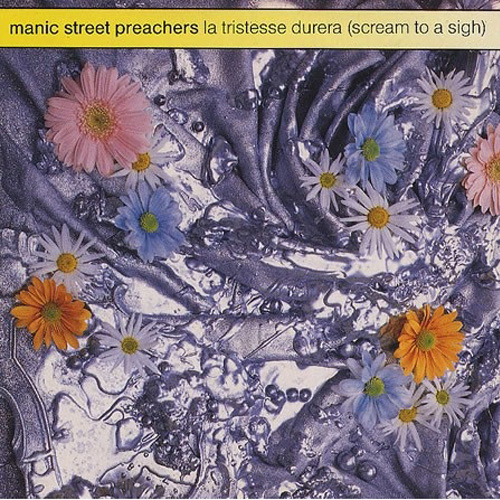
Artwork from 'La Tristesse Durera' (Gold Against the Soul)
Artwork from ‘La Tristesse Durera’ (Gold Against the Soul)

You could argue that the Manics have the paradoxical personality of a child: that strange urge to both disappear and gain all the attention in the world. To ‘walk in the snow and not leave a footprint’ (‘4st. 7lbs’) but also pen the extroverted Krautrock of ‘Europa Geht Durch Mich’, which throws itself into electronic music but also the increasingly frenzied political debates surrounding Europe in Britain right now. And like the child that I once was, trying to break my dad’s CD player by endlessly repeating one of their most successful songs, they go for attention. Their confidence isn’t the laddish arrogance of their Britpop bedfellows, but the endearing ambition and glam aesthetic of their early years and the strong direction that characterises most of their career (maybe Lifeblood was a slip-up, but I think it deserves more than straight dismissal…). It’s an oft-forgotten fact that the Manics’ single ‘The Masses Against the Classes’, was the first British chart No. 1 in the new millennium. It’s a single that begins with Chomsky: ‘The primary role of the government is to protect property from the majority and so it remains’ and ends with Camus: ‘A slave begins by demanding justice and ends by wanting to wear a crown’. Maybe this vicious cycle of capitalist desire and inequality will continue through the millennium, but by god let’s hope there’s still artists like the Manics around to do all they can to critique it. And if that’s not enough for you, then the fact that Nicky Wire went to the Brit Awards wearing an ‘I Love Hoovering’ t-shirt (and the man seriously does love housework) really should. What could be cooler than a Situationist statement which isn’t for once pure hipster irony?

tumblr_ncthj6WAd91rufro7o1_500
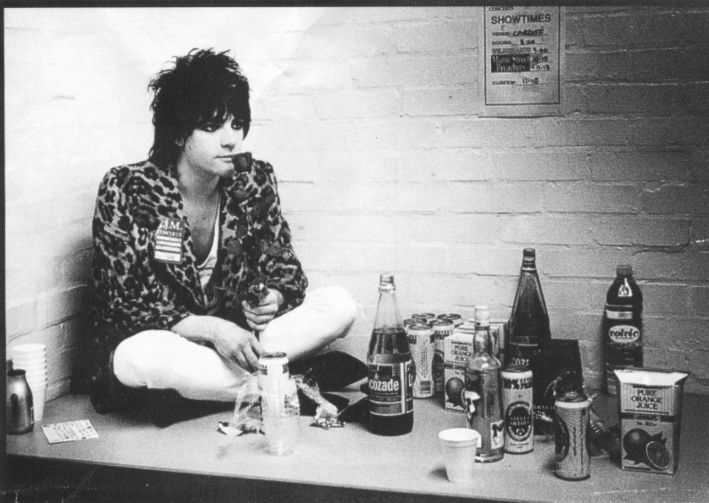
basically Nicky Wire is amazing & makes me want to wear leopard print again

***

Harris, John, 2004. ‘The commitments’ in The Guardian, Available at: http://www.theguardian.com/music/2004/nov/21/popandrock [Accessed 7.11.14].

NME, 2013. ‘Manic Street Preachers take legal action against the English Defence League’ , Available at: http://www.nme.com/news/manic-street-preachers/71397 [Accessed 7.11.14].

Power, Martin, 2010. Manic Street Preachers: Nailed to History (London: Omnibus Press).

Oranges for Bonfire Night

IMG_0027

(from a Creative Writing Society freewrite with the prompts ‘fireworks’ and ‘oranges’)

She remembers the days when she and her brother popped over to the neighbour’s house for Bonfire Night. She’d climb over the garden wall, wearing her wellies and her dad’s itchy jumper that came down to her knees and a hat her mother had pulled over her fringe. They’d play with the children next-door because they were good friends and the same age, more or less. Even though it was pitch dark in the November night, they’d dance around the garden, shrieking and playing tig or hide and seek while they waited for the fireworks to be set up. They were cheap fireworks, bought from the local store, which ordered them from some chemistry enthusiast in the city. This was, of course, before The Internet.

She can’t remember his name, the man next-door; the dad who told the kids off for laughing too loud and who’d sneak off for fags in the greenhouse while his wife did the washing up. She remembers the blur of his bearded face. His yell as he stepped back from the firework he’d just set up. She remembers the mum better; the mum used to bring out steaming mugs of soup and carrier bags loaded with oranges. She remembers standing in the cold bright air, peeling with the stubs of her fingernails the rind that came away like thick flakes of skin. Biting into the soft flesh as a flame-coloured Comet rippled above her. The sour sting of the juice squirting in her eye; the sweetness seeping over her tongue. Stickiness on her fingers. She’d toss most of it away, into the rhubarb patch. She wanted to save her appetite for the chocolate log and lollypops that awaited them inside.

There’d be the rockets, soaring and screeching in her ears like banshees, sizzling in her belly. The wheeeEEeeeee like electricity. She hated them, but they were a thrill. She’d look up to catch them but they’d be gone already. Then there were the pretty ones. She read their names off the cardboard box, discarded on the porch: Crosettes, Dragons’ Eggs, Ice Fountains and Blossoms. She watched them go off with the other children, trying to identify each one as if they were flowers in a biology textbook. Only, they were always too quick; their beauty dazzled her vision and then evaporated. There were the ones that overflowed like ocean spray, showering and spitting flickers of white and silver, like a jeweller soldering a giant diamond. Rainbows would spread out across the smooth sky, raining colours across the tall trees at the back of the garden. Her favourite was the Catherine Wheel. It took ages to set up, but it was magical. It spiralled like a wild thing from the pole of the washing-line, sparks flying around it with the craziness of broken machinery, or hypnosis. She adored the Catherine Wheels. They made her feel strange and unreal, as if she were looking into an abyss.

After all the fireworks were gone, the children were doled out sparklers, which they were only allowed to use with gloves. The sparklers let them write their names in the air, as if they were inscribing their thin identities into the vast constellations of the night sky, the atoms of the air around them. She misses how back then in the country you could always see the stars and the sky achieved a proper dark. In the city where she lives now the sky is always a murky brown, the colour of Coca Cola or dirty rivers.

She used to hate how eventually they’d have to go inside. She used to want to stay out in the garden forever, sucking in the lovely coldness of November night. She hated how the sparklers had to be chucked into water buckets, where they’d snuff out with a quick hiss. The adults would always check that they hadn’t burned their little fingers. She remembers the faint char marks that stained her gloves. Remainders. She found those gloves, only a few months ago, when she’d gone home to help clear the house. They were in that same yellow jacket she used to wear, and even just touching the plasticky fabric brought back glimmers of firework enchantments. But the gloves were full of holes, the stitches became undone in her hands. Everything was to be given away, sold or donated to charity, after her mother died and now that the house was to be sold as her father left for business in America.

He’d phone her from new places and his voice would crackle over the phone like a fading sparkler. She closes her eyes and still she smells the warm soup, the tickle of gunpowder.

And oranges. She remembers the oranges. She never liked oranges.

Halloween Confessions

IMG_3021

(appeared originally on Medium)

There was a time when Halloween was almost better than Christmas. That was when I lived in a place that had the potential to be haunted. Halloween, I feel, has a spirit that creeps up and metamorphoses with your home. The house that I grew up in is a semi-detached one, perched on top of a drive with Rennie Mackintosh-esque roses cryptically shining from the front bay windows. There’s a skylight window which has always been shrouded in mystery: we’ve never been able to identify what room it belongs to (we reckoned we’d have to knock a hole through the bathroom wall to get into this secret space, anyhow). The outer walls are rough pink sandstone, kind of old-fashioned, romantic, but we have a modern kitchen extension built by former owners.

With its big rooms, (defunt) fireplaces and (rather decrepit) chandelier, it was the perfect venue for spooky parties. We’d drape heaps of fake cobwebs along the banister, from the lampshades, the settee, the windows. In the cobweb there’d be the plastic figures of ersatz rats and spiders, waiting to catch unwittingly in someone’s hair. Half an hour before our guests arrived, we’d turn down all the electric lights and I’d be in charge of candles. We made holders out of peeled tin cans, pierced with holes to make patterns for the light. The lanterns were strewn all around the house and outside in the patio area, where people gathered around a fire we kept crackling in a rusty old tire rim.

I filled the hall with incense and creepy dubstep music playing quietly from an iPod dock hidden in the study, so that you could only hear it thudding quietly if you ventured upstairs to use the bathroom.

There was all sorts of strange food: white buttered toast cut into triangles and sprinkled with crushed salt & vinegar crisps to resemble witches’ hats, Yorkshire puddings filled with beans (cauldrons), suspicious-looking pots of pasta meant to resemble some gorish substance, and lovely pumpkin soup that my Mum’s friend brought in a giant pan. There would also be heaps of various sweets and chocolates piled on every surface, so that it wasn’t long before everyone was hyped up on sugar. Guests would drift in and out the different rooms, sometimes lingering surreptitiously at the bottom of the drive for cigarettes. We were all quite young then, less than fourteen. I suppose we talked and drank and maybe danced at some ill-defined point later on (there was a year when I remember we all had really sore necks the day after, so we must’ve been headbanging…probably to Enter Shikari…). All the teenagers would gather in the bigger room, which had the bay windows and the old computer. One year we even had a strobe. Friends would sift through my chaotic iTunes library, and wince as their favourite tunes were ruined by our rasping speakers.

Mum and I would make fruit punch beforehand, pouring in blood-red cherry lemonade and slices of orange. The real alcohol, however, was stowed away in sleeping bags under my bed. My friends would hide up there to drink before appearing back downstairs where all the adults congregated around the fire and food. One party ended somewhat disastrously. The ‘drink to the line’ approach to vodka-consumption has never really boded well for anyone. Said friend passed out in my bed for several hours and woke up only to vomit straight into my bin. Bless her for good aiming. One of my mum’s friend’s kids happened to be wandering about and saw her in my bed, asking everyone fearfully, ‘is she dead?!’ I was sitting, secretly sipping cider and having a perfectly civilised chat to my mum when her then-boyfriend dragged another friend downstairs — she had her thumb caught in a bottle of wine. There wasn’t much explaining to do there.

In addition to these house parties, there’d be the school discos, with all the necessary alcohol action plan they required. We’d dress up (fairy, witch, Twiggy were my various outfits) and meet at each others’ houses beforehand — usually mine as I lived closest to the townhall where the discos were. So maybe someone would bring a Smirnoff Ice or some WKD, but I never had much stomach for that kind of thing. Too sweet. I’d play that old teenage trick of sneaking the household spirits and refilling the bottle with water to hide the damage (I always justify my cheeky thefts to myself through the logic that my Mum never really drinks and if she was really bothered she’d pull me up about the wishy-washy gold of her depleted Southern Comfort more times than she actually did – sorry Mum! 😉 ). The problem is, when I think about how I used to drink it makes me sick! I used to mix together the vilest things: Malibu Coconut Rum, orange juice (with bits in), Coca Cola, Jameson’s Whisky — all in the same (plastic water) bottle. We’d take turns to shot the disgusting potion and then we’d stumble, giggling, down to the town hall, playing tinny music on our phones (Bloc Party, Drive-By Argument, Paramore). Ugh.

The disco itself was always an anticlimax, an embarrassing mix of teachers critiquing the DJ’s music taste (I distinctly remember a P.E. teacher calling up some sixth year for playing the Prodigy’s ‘Smack my Bitch Up’), couples awkwardly winchin and alcohol being sneakily passed around in the toilets. I’d usually leave a little bit early, glowing with sweat and smudged eyeliner, giving myself time to wash all that hairspray and glitter out of my hair before school the next day.

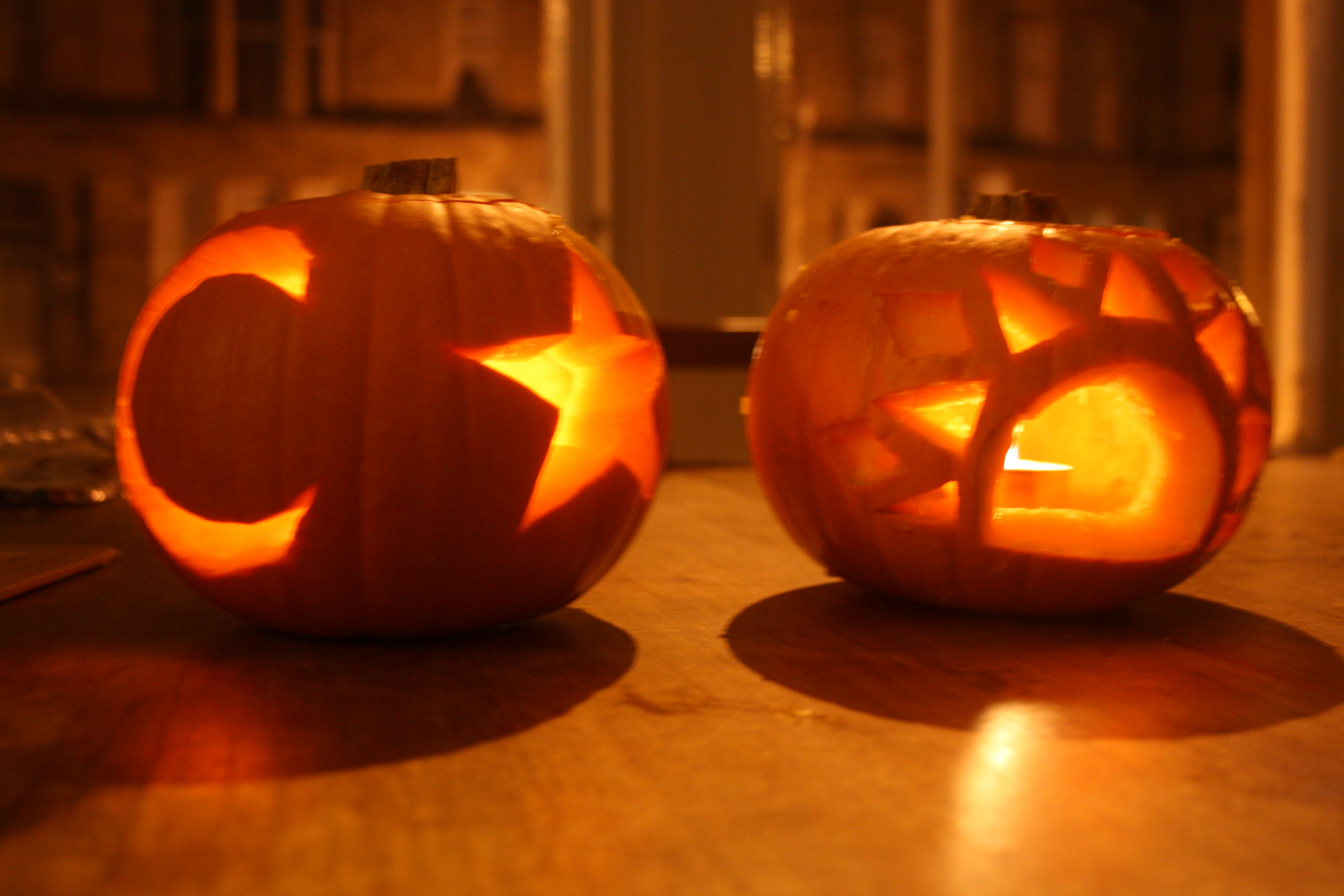
Well, they were good times, sort of. Back then, Halloween still had a kind of magic to it: you could go for walks in the dark around the town and you’d still see ghosts in that carrier bag caught in the spindly branches of a tree. I guess now I have too much freedom, and a walk doesn’t have that same sense of wide-eyed luxury. At uni, Halloween seems to be an excuse for a tacky outfit and a pub crawl. It’s always around deadlines, anyway. After uni, maybe I’ll get back into the spooky house parties and punch-drinking again; but for now, it’ll be pumpkin carving and a night in, reading in some cold dark annexe of the library.