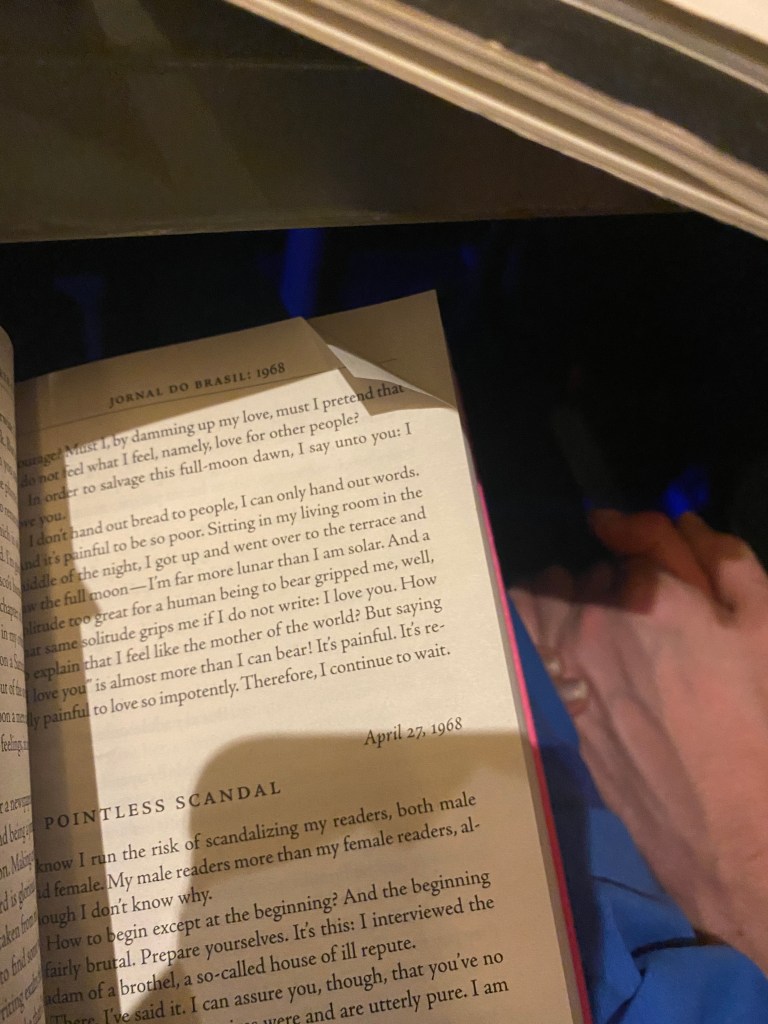
Clarice Lispector, Too Much of Life: The Complete Crônicas (Penguin, 2022)
Clarice Lispector, Too Much of Life: The Complete Crônicas (Penguin, 2022)

There is much I cannot tell you. I’m not going to be autobiographical. I want to be “bio.”
— Clarice Lispector, Água Viva, trans. by Stefan Tobler
Hidden gardens where a bioluminescent frisbee, in imitation of the mysterious diskettes that roam the deepest zones of ocean, drifts upon the late May breeze. It is unseasonably cold. We take pleasure in relishing the ‘unseasonably cold’, as to say something is unreasonable or unforgivably it. The thing. The heating is on all through the month of May. Rain-sodden trainers left to dry on radiators. A documentary about nudibranchs had revealed to us the secrets of experts. Experts in general. How you really have to hate the thing you study, in order to love it. The thing has to perpetually withhold from you what you want, not knowing what it is, but always in pursuit of it. So the nudibranch in question, this pinkish one, does what is told as a ‘dance’ for the diver, who has gone too deep in the song. The sea tells nothing after the bridge. It is barely a chorus.
I am a heart beating at fish time, deep in the abyssopelagic city along with the dumbo octopus, the cookiecutter shark, the shrimp. I will not say much about these animals and how they came to adapt to such aphotic lifestyles. I myself was once a chaser of light. We are circus anomalies, dependent on a phrase of unseasonable coldness. The freak quality of not-to-want oxygen or like, having been left here then stubbornly I will stay here. Make of my heart what you want — a jewel or rock, a piece of cold life, swallowed. Bare and beating. Something is getting dark around us. Darker yet.
And so never to leave the perpetual lockdown of the not capital city, and so to leave it for gorse and blue realms and the haar of what is by the sea, in a wavelet transformation. Having to go inland to escape it. And so to give up one’s limbs for the personal study of human impossibility, as if we had also been persons all along. I wear a delicious, impermeable bracelet of kelp. The order of adjectives tends towards certain qualities, for instance when I say a blonde soft hair it is wrong somehow, touching the thing in a wrong order, when everyone wants a soft blonde hair as delicacy. To be in this month and spearing the secret fish of the story, one after the other meandering down this channel. At the bottom of everything, when you see it. When you see the story.
Let us go deeper yet. I have these new glasses, you have these hands that will brush away masses of silt and sand. You have the order of words corrected. Living in a grammar of ceaseless helium. Lamentation of the soft urban fox you were once, once were. The frisbee glows quietly in the grass at night. At dinner, J. gives the lowdown on *********** and various fish glow quietly in their sadness and having been farmed to believe I too am in this story, eating. The very delicate scarce thing we would toss to the word of the mouth, the open wound of it, melted substance. Brushing a fork through soft blots of cream and saying is it so, deep sea, very scarcely. This instant, speared, you are the story also. Salt. Twice removed from the lavender thing twigged from the garden and drank in gin with soda, so the ice knows more than I do. So the ice clinks in the quiet night, which is never a night. So T. confesses the end of dark lunch. I read it.
The cold fresh lenses allow us to witness how the deer get sick, how the white deer especially are beautiful by any standard of “I love you” said between the innocent eyes of how we are also roes, taking our glasses off to see better the way faces exist when brushed together, clicked and twisted, kissed. And the gorse so yellow, sky so blue. Immediately, to have been tourist for mourning. The most disappointing best hot chocolate in the world has all the good sweet silt at the bottom. I finish it, feel sick as expected. Flush. I throw up my arms or something. Wash the cup, recycle it.
So the nudibranch’s name is derived from the Greek words ‘nudus’ and ‘brankhia’, meaning naked gills. They have no special skill in discerning between light and dark, often using chemical signals to locate what is needed: food and each other. They possess a pair of ‘oral tentacles’. Soft-bodied, dragon-like, losing their vestigial shell during a larval phase. The extreme vividity of their being works as advertisement. I am obsessed with them. The sap-sucking slugs, algae rich. They produce solar power from munching on corals, absorbing their chloroplasts to photosynthesise nutrients. Bright colours result from their diet. The month of May has a toothed structure that tongues the very campion and jewelled aurora that passes for what you want ‘pure total nature’ or sweet poisons, for which I take showers to exhume from this system.
The writing, at the bottom of everything, is colours. They come from what we eat.
Null cerise and sweet neutral grey, back into darkness again and gently.
Now it’s 10:29 of Sunday morning and last night’s song thrush and the afternoon skylark and none of this heard on a podcast exists — it is all true and continues. The frisbee flies sentences through the wan air and hark is it early to never want to leave, to always be entering the room spreading butter on toast and holding a glass up for persons, wild-cats, in a language the daylight speaks and speaks along, another dark lunch hidden from the universe only to be camembert nightmares of rosemary — whisky — do you remember this shadow man or his shadow step-daughter, do you remember the riot, do you remember the castle of gold, clearance and loneliness? This place is tricky to heat. Black tulips, white hyacinths. Coming up the stairs is the question.
A nudibranch bristles into coral and kelp bed. At the bottom of everything is the nudibranch. Do you see it? Do you see it?
I burn my tongue on the question. What will be coming
around the mountain of bleached consideration, haunted and lovely
through the haar and more blue to come
exists
as breath, underwater, this pause before each born
to scrub our hands with sea kelp soap from the isle of darkness and safety
trending in the United Kingdom
of the girl, with her voice of crunched glass
abolishing sky castles, sand castles
her salad days
her spectacular glands
her nudibranch heart
~
Arca – Brokeup
Nap Eyes, NNAMDÏ – Blood River
Burial – Space Cadet
Brian Eno – Little Fishes
A. G. Cook, Charli XCX – Xcxoplex
Katie Dey, Lonelyspeck – Darkness
Caroline Polachek – Breathless
Slayyyter – Troubled Paradise
SOPHIE – JUST LIKE WE NEVER SAID GOODBYE
Zoee – Host
Sharon Van Etten, Angel Olsen – Like I Used To
Judee Sill – Down Where the Valleys Are Low
Lana Del Rey – Blue Banisters
Bright Eyes – The Difference in the Shades
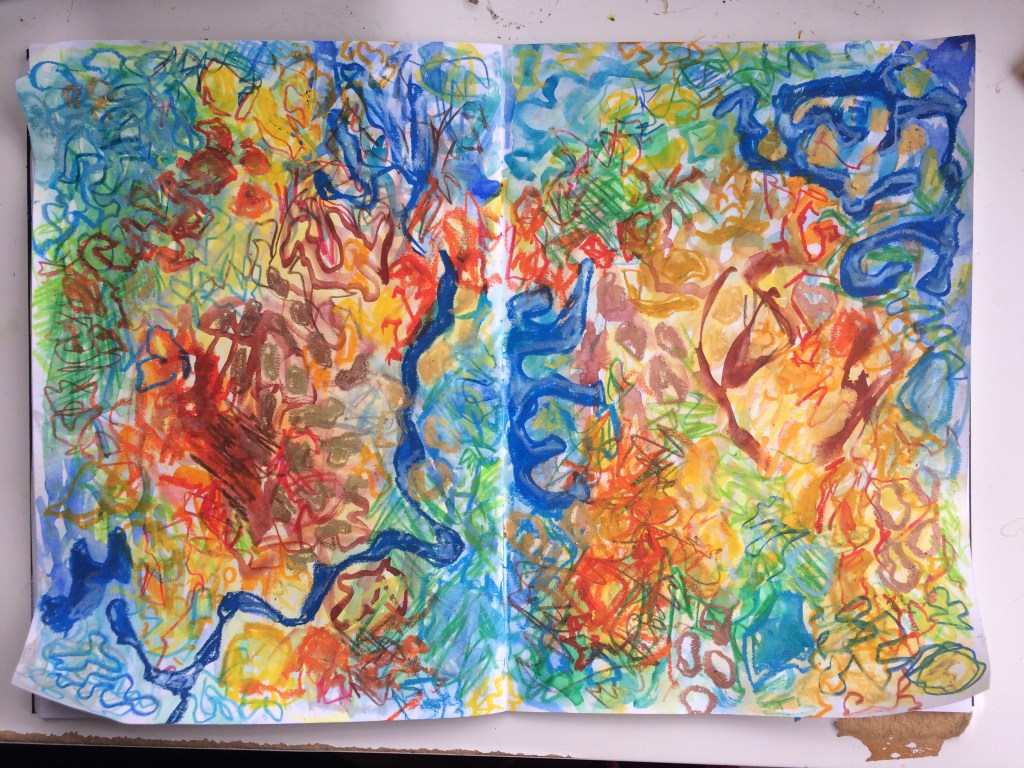
Patiency challenges the body’s borders, the fantasy of which converges with a policing function. This means reimagining the body as process without a centre, not a discrete biological or social fact, but an untotalisable set of relations, the body not as a static object, but as the ek-static convergence of processes always in excess of themselves.
(Rob Halpern, Weak Link).
Patiency: ‘to do with the body as a situation of suspended agency and disabused mastery. If this illusion of mastery is a privileged delusion, then patiency is its refusal’. Halpern gives the example of Ban, in Bhanu Kapil’s Ban en Banlieu (2015), who ‘lies down on the street in the opening scene of a riot’. So begins the novel and another historical opening. Patiency might be, I am heckled on the subway and so I lay down in the aisle. Or is that too much of a spectacle? It might be that I is not-I, just as ‘love is not love / When it’s a coathanger / A borrowed line or passenger’. We do patiency differently. So love that is love provides more than suspension or structure; it isn’t the person sitting beside you or even the vehicle. Limerence on a borrowed line. So things are thrown. I am lying down in the middle of lockdown, which feels like ‘response’ as such. In these casual Zoom calls, these meetings, it is like “Oh, well I spent that day lying on my floor, sorry.” I stop saying “just lying on my floor” since, over time, lying on the floor seems adequate. Almost, to a certain thought. We used to call these sad naps and could take them at work, for instance, with head resting on folded hands, or perhaps in the little vinyl benches round the corner of the bar, under the picture of Dylan and the roses, and the painting with the cut-away eyes, whose market value would astound us. When I say I lay down in the middle of a global pandemic, who am I kidding? Sometimes I turn off my webcam and lie down with my eyes closed, still keep talking.
I google ek-static and find a meaning for ecstasy, ekstasis: ek (out) and stasis (a stand, or a standoff of forces). So an experience of ekstasis comprises, as Alexander Riley puts it, ‘extraordinary situations in which one stands, temporarily, outside the normal interactional world in an existential frame of peculiar intensity and effervescence’. There was a night in lockdown I bumped into a friend and we walked along the river, bordered the parking lots of the broadcast buildings, looked at the false lights reflected in stout-dark water until I finally looked up and saw the huge harvest moon. This hour or so outside of the otherwise confinements of lockdown had felt ekstatic — for I was outside, on the edge of the river. I was talking again, for real and wheels were turning. Words, however everyday, had their electric shocks. But was this an extraordinary situation, this encounter? Context matters.
Types of lockdown ~ekstasis:
There’s a song that goes, ‘all that I have is a river’ and I remember it from more than a movie. An undergraduate, alone in my small room I was watching this video of a young Johnny Flynn and Laura Marling just sing this together and I thought it was an old song, oldest, the kind of thing you can only think when adolescence still is you. Almost ten years have passed since then. Ten long summers, more like winters…What a gift to forgo all but the river, to be young enough to possess nothing, cover it, or to let go for the water and what it carries. For you know everything is a new current is not even new, it was streaming before and now it is catching. And you let yourself into it or you don’t. You walk into, you walk by the river. You are carried, supine. Patiency.
I skirt the river in lockdown because it is a motion of passing when nothing else does except spirits and bodies, and the days are leaf, they are like easy to peel from the calendar, people are always saying O how the time passes, but into what? Time passes with you, otherwise I am waiting. The song that appeared in a search result. With you am I writing. ‘Dreaming is the best kind of waiting: it overcomes nothing, it does not try to separate itself from what it wants, from everything it wants. Dreaming just begins’ writes Sarah Wood, in 2007, which was a year I learned to starve myself among eons of bad indie. So I would dream hard instead; it was like whittling reality down to return to those childhood imaginaries whose nourishment was almost endless. To be almost endless, and good. It was the year before recession and so I had not learned the societal imperative towards ‘hope’. ‘If Hope can find oxygen, it will’, writes Lena Andersson at the end of her novel, Wilful Disregard (2013), ‘Starvation rations do not help […]. The supply of nourishment must be completely cut off’. You learn to breathe different air; you have to. Oh the rain really came today, I feel like saying / or send you a video. Told to have hope or having hope is different from living towards it. Soft falling hope was not that. In a 2019 discussion with Greta Thunberg, Alexandria Ocasio-Cortez says,
I learned that hope is not something that you have. Hope is something that you create, with your actions. Hope is something you have to manifest into the world, and once one person has hope, it can be contagious. Other people start acting in a way that has more hope.
I’ve had it with viral metaphors, in the sense that I live in the era of post-viral fatigue and my body is sick with the carriage, ‘but I can’t stop expanding with currents convulsive’ (Halpern, Weak Link). Lana sang ‘Hope is a dangerous thing for a woman like me to have’ and the question became less about hope and more about that ‘like me’, a little hinge. I identified with a neighbourly extravagance, hydrangeas, pale blue-lilac from a middling soil; I left the gate slightly open, I smoked in the rain. The danger was in hope without architecture, so a ghost came in. Hope requires a manifest scaffold, perhaps. Weather that rails against it. The trace effects of a fire, of dream languor, particle physics. It was in the sentences we erected, passed on, hammered in, lifted and lay still, remembered…‘my present tense contracting the way love contracts me to the future from whose point of view this will have not been terminal’ (Halpern). The person on the Zoom call, PST, said to say goodbye, If you’re in California, don’t leave your house, there’s smoke out there. Stay healthy. Hope needs to be more than just ‘in the pipeline’. Maybe we need to blow up the pipeline.
2007. I lived in the years of ambient war. Later, too young, I would attempt to read Cyclonopedia: Complicity with Anonymous Materials (2008) and dream about pools of oil filling the end of my bed, like a menstrual stain. At school, we wrote essays in which we had to pick a side: for or against? The Iraq War, vegetarianism, a bypass for our town, surveillance capitalism? I could only think of deserts, not arguments; I wondered what secret plant could stem blood flow from a wound. I rarely watched television. In super rural mornings, December, the air smelled of engine oil, woodsmoke, fertiliser. Shit and snow. Something to-come that never was passing. I felt sanguine, calm without compare, sipping vodka + cokes against gym blocks. Back then, clouds were irrelevant. Instead, I scrolled the internet for answers and images. ‘That hope is just another bloated moat / is worth the ringworm, is it really so cute’ writes Nikki Wallschlaeger in Crawlspace (2017). Thinking in Sianne Ngai’s terms, is this ‘so cute’ ‘a sensuous quality or appearance’, or ‘a feeling-based evaluation or speech act’ (Our Aesthetic Categories). It’s cute that you dreamt it. The ringworm I mean, another parasite. So you circle in medias res, nibble a little of that time, but I thought I could jump the moat into future. Future was just a quality, like cute. Is it really so cute? The tiny things and changes. billie eilish in her video for ‘my future’ looks pretty cute, but it’s more than that. The soft falling rain would fill up the moat, the river, the lake. The dream was a body of water again. Speech fell upon us, fluid, then telling the nude and lime-before-lilac sensation. Something that gets inside us; a tooth around your neck, and pain.

Dreaming just begins. Derrida is beginning his lecture on Joyce, ‘Ulysses Gramophone’, with the signature of a date. This feels arbitrary enough – a date in lieu of a site specific. I would send letters in lockdown for the sake of sending a date. It was an act of patiency, a claim against time that could turn it inside out, let somebody else pop the bubblewrap for you.
I was looking for postcards that would show Japanese lakes, or let’s call them inland seas. It had crossed my mind to follow the edges of lakes in Ulysses, to venture out on a grand lakeside tour between the lake of life which is the Mediterranean Sea and the Lacus Mortis referred to in the hospital scene, as it happens, and dominated by the symbol of the mother […]. You will no doubt know better than I that the whole pack of postcards perhaps hints at the hypothesis that the geography of Ulysses’ trips around the Mediterranean lake could have the structure of a postcard or a cartography of postal dispatches.
(Derrida, ‘Ulysses Gramophone’)
The difference between the lake and the sea, is it tidal? Say I wrote to you by a general lunar insurrection: I refuse to be governed by hormones alone. I am lapped, turned over, the hours are upon me in wavelets. For a long time, months, the word ‘hospital’ also conjured ‘field’, and ‘crisis’, and ‘overstretched’, ‘overburdened’. Many fled cities to avoid this. What would a postcard from the pandemic look like? This sounds like the afterthought of a conference happening years from now. Send a postcard to your future self! I would rather dwell awhile in the mystical, sub bass pastoral of a common place that is billie’s future. The transparent dew in the process of dropping, clearest blue. But it was also the artist’s imperative, mid-March, to say something. To who? A postcard can be read by anyone, if they get their fingers on the mail, if they would risk that trace or touch.
You could circle the drain, if not the lake, like in the video where Soccer Mommy is at Palm Springs Surf Club and conjures an existential state by the weather: ‘I wanna be calm like the soft / Summer rain on your back / Like the fall of your shoulders’. A desert gets cold at night; its ochres turned deep into cobalt. What happens in the turn of those lines is the fall of rain is a bodily gesture, the fall of your shoulders. Like sigh before sleep or hold me. Both kinds of soft between element and form are just memory’s fall, and a longing that is ambient and prolonged like those four hour looped videos where the song is slowed down and rain sounds are added. Its weird twist is dark ecological: I love and you as the other with your shoulders, their fall, I love I am rain old rain we are just that falling or were. There is a sense, if vague, of when it happened, of summer. Somewhere. I would send a postcard with those lines and make a cliché of the feeling. Clichés are like rain; they fall all around us and that too is cliché. In London I learned to long for the rain.
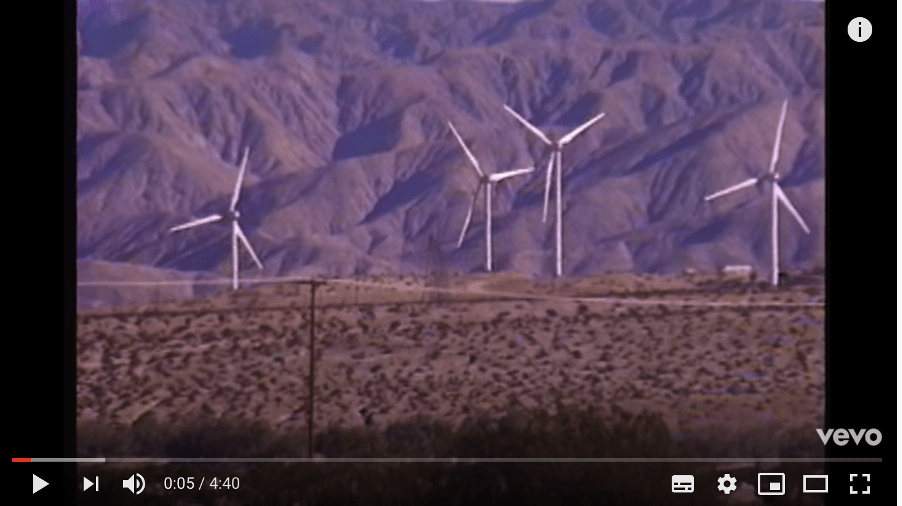

My trips around the Surf Club, is that a name for this desert, some place out and aching, are not knowing what I’m looking for, the lake of life or death. There was a body of unknowable time at the beginning of pandemic that felt like a lake, a dark one with monsters inside it. You were scared to touch. The virus was a hyperobject and it lived in the lake and became us. So I thought what it meant to carry the lake. Like if you could tie it to your Kanken and drag the lake on a walk every day, make it lose weight. Could you test the lake, dump chemicals in it, starve it, piss in it? Was this abuse? My poor lake, resting at the edge of the desert. The lake was too much: overstretched, overburdened. Eventually I would bathe in it, but that was July, just before a morning of rain and the fall of your shoulders / brush back hair. Aeolian breath above the lake.
A thought crossed Derrida’s mind ‘to follow the edges of lakes’ in a novel. A very long novel but only a day. Sometimes we say ‘it feels Mediterranean’ and is it a warm breeze off the sea, a quality of something vermillion splashed against turquoise? Like Dorothea Lasky (if I remember her essay on colour correctly, perhaps there is a colourblindness to memory) I always loved that combination. But it grew too much and mostly I stopped painting in those colours. Can there be too much blue in your life? We compare eye colour on Zoom and there is what, somethingsomething pixelation of the soul, which is almost good, is it. The inland sea of WhatsApp green, or the rising tides of Facebook blue. An irritant gets into the ocean. This is how a pearl is formed, and we worry it into August.
August: the commonplace between seasons. What was formerly meant by holiday. Halpern’s weak link is something about tendency, which is a quality of patiency, surely:
[——] = a common place we can’t sense, but upon which all we perceive depends
In the book, the double em-dash is more than that, because there is no gap in the line. I don’t know how to recreate that here. Rachel Blau DuPlessis often uses the commonplace of a line, this continuity, asking questions like
Did these years have to happen
the way they did?______________
______________. The poem, unwritten
is concealed by the poem,written.
(Surge: Drafts 96-114)
This is from a poem called ‘Draft 100: Gap’. I feel urged to fill in the blanks, but then suddenly don’t. Mind the gap? I am mindful of my tendency to make lines into rivers. This is a temporal effect: ‘The body of water a particular time of day resembles’, writes Lucy Ives in ‘Catalogue’, not answering the proposition except to parenthesise ‘candida’ in brackets (). Parasites again. You can’t starve them so much as you must cut off the oxygen altogether. They want sugar! Like rubbing words out of your poem is a kind of excision necessary to let the reader in: an exchange of space. But is a blank also a body of water? Let us lie down in the blanks, one or more acts of patiency. The edge of my body at the edge of the lake, which was almost erased, became two-dimensional. Was it the politicians who did this, or the semioticians? Surge, surge, surge…
Without touch, I could not plunge into the body of water for several months. Returning was two-sided, flickering. It was turning the river to a mobius strip. The river that led to the lake? No pictures were taken, but words were written…
The other’s body was divided: on one side, the body proper—skin, eyes—tender, warm; and on the other side, the voice—abrupt, reserved, subject to fits of remoteness, a voice which did not give what the body gave. Or further: on one side, the soft, warm, downy, adorable body, and on the other, the ringing, well-formed, worldly voice—always the voice.
(Barthes, A Lover’s Discourse)
In his telegraphic dashes, Barthes evokes the voice on the line, between lines, electric crackle. I am on the end of a telephone listening to what I thought was rain but was only white noise or the manifest difference of space between us. For once, not time; though still there was time between us, before which we could meet. The body could always give more, which is why Derrida would venture the IRL lakes to follow a postal cartography. Here where I received this text, sparkle emoji, a picture of sunset forgetting I’d sent… But what if the voice became a body in tender distance? A kind of tendering in itself? If it was all we had of those months, and could cradle ourselves to sleep in it…
We look back on the years that are happening and wonder if they ‘have’ to happen this way. There are divisions, revisions; something that gives and receives. A year is impossible. The depth of a lake without measure. I could not tie it to my horse and ride away. Salt and sweet. The difference between lake and inland sea depended on your idea of ‘freshness’, but in Cancer season I delved in the water. We called it a loch, though named it was ‘Lake’. Always the voice / settles cool on the water.
Down becomes a colour. Peach stuck, clouded. A snapshot from my enviro-diary in spring:

I realised there had to be exits from ‘lavender country’, even if I felt implicated in the earth forever. What had I otherwise written of the wild mountain thyme, the purple heather. I had.
What Andersson wrote of hope, ‘If Hope can find oxygen, it will’ recalls Angel Olsen’s song, ‘If It’s Alive, It Will’ and you can’t help thinking about the ‘it’. This thin word of the thing itself. Love? The song, the poem? ‘My friend you are unique but not always / Some stranger in the well has surely felt your pain […] And all the things you’ve once said / Your thoughts exist in someone else’s head’. So we are parasites of a mutual speech, second body, patiency. It’s going on elsewhere,, echo,, echo. I saw the police queuing for pizza. I saw mothers outside supermarkets, I saw masks trampled into the towpath. I saw your breath left a mark on the bathroom mirror. If anything is taught now it is that pain is not unique in its total uniqueness. It is also a misting — these noticing moments like the colour of your eyes on webcam, or when I saw a friend by the river or the cygnets when they were still small, and charcoal. Touch, know that we live. ‘A moment of affirmation; for a certain time, though a finite one, a deranged interval, something has been successful’ (Barthes, A Lover’s Discourse). The weak link ( — ) of ‘a common place we can’t sense, but upon which all we perceive depends’ (Halpern). The more we send, the more links accumulate. This is not some metaphor leading into Connell’s chain, or the blockchain, the chain of being or food chain, but something like when I recently went to visit my Nan for the first time in nearly two years I saw she was wearing the gold chain I remembered. It remains a ghost fact against my clavicle. Gilded, some arterial link between times, the artefact worn of all years, not mine.
And did that path or the other
(Blau DuPlessis, Surge: Drafts 96-114)
lead anywhere?_________________?
________________? The other
side of words_______________.
A path can be dangerous, like hope. So I see it not as a route so much as this mark of the common place, where you enter the poem. Echo. It is not so much I who is writing. Someone is pouring clementine fizz into the glassware someone else will inherit. An embrace is made possible because of this. If it’s alive, it will. The other side of words or the strangers in the well you threw a coin into. I was always wishing on fountains. Could I eavesdrop on what went on inside your sleep? It was trouble enough to listen to mine. Quiet plash. Your breath like the ocean beside me, etc.
Hope and not-hope. I am obsessed with this passage from Verity Spott’s forthcoming Hopelessness (2020). ‘I hope. You hope’, she writes:

‘I wondered if it was enough to extract a sentence and hope something would ramify from there, like crystal’, writes Brian Dillon in Suppose a Sentence (2020). That word ‘hope’ again! To put faith in the art of essaying, you manifest from the sentence, say. But isn’t extraction bad? Verity writes an incredible sentence. Love contracts, there is a terminus, there is no harbour, is it that thoughts overfall or flow before water. There are strange moments where you fall into iambic rhythm, ‘would shrink like necks passed out’ and find yourself taking perverse pleasure in the pulse of that action, complicit. I fell asleep at the desk, put a crick in my neck. If Verity’s sentence is a crystal it is so splintering hot that to hold it I had already thrown it towards you like catch and here we are passing those lines between each other like ouch! or whoosh! as it goes through the air then starts to stream — is it light or water that sprays off the sentence, falling or lifting we get it back up we get going again, so being itself is contingent, there is a feeling of tilting, just touching between something like what Adrienne Lenker sings in ‘Mary’ — a most verbose song with the lines the lines the lines like fractals, repeats, alliterative, the rhymes inside it — ‘The violent tenderness / The sweetest silence / The clay you find is fortified / We felt unfocused fade the line’, it’s a blur then, even if the object is hard, ‘my vested shot’ like bullets are thoughts, ‘get fucked’ (a reminder that we die or desire, no, we could be ejected by the speaker, why not), leave holds inside us and the ullulation maybe of lift/leak/blink/light/love/cryssalis/live/like/laugh/will, hear the undersong packed inside the block, LA LA LA LA CAN I HEAR YOU? to put this in the kiln of language and wait, tender, splintered political speech is the romantic filibuster of ‘on and on and on and on’ worn in a ring without rose, lust, health, being messed up by time and order, ‘and change not come it not does come to who those wait’ as if to be the subject doing object to the thing itself, no is that not right, I’m in the stream of it, ‘where else’, ‘that change’, well I feel gentle to read this to you aloud and think poetry is it never could smile like lift this up what’s underneath, ‘screaching night’ of fizzy things in vessels, ‘pouring thoughts I made them up, so what’, a fall of your shoulders, softly, who cares, ‘wry out’ did I twist that humour is lyric always sincere, I care (?) is it the very empowerment or dressage of the poem that makes it ‘shot’, tongue tangled, get shot, ‘hurt the air’, ‘get fucked’, I love you, whole world is metamorphosis. It’s for love or dream or death, ‘if you fall great down’ a white-hot crystal. Stammering light of I love you. So keep repeating the sentence forever it’s the estuary (ex)change in my head where the diamond melted; I go out like a river, a light, it’s so many; I lift crisp, iridescent leaf to find you in process…‘scarless along the rib, as if to say’ (Halpern). Small wet thing w/ almost wings. ‘Soon come’ is a charm I have held all summer, ‘Where goes? I guess’ / the flight, the train, the swim, the breath…
According to my diary, in 2020 I had nineteen dreams about breath. These are some:
but maybe this is a lesson in being able to let go and breathe deep and keep going, rather than hinge on another lag. Oh hinge is another app right, maybe I should get that.
I started to do long deep breaths.
I would come out in the breaks to breathe fresh air among the tumbling ivy. My aching head, my burned-out lungs. I eat too much!
A lavender girl with this expensive complexion and a close-shaved head was underwater for a very long time and when she bobbed to the surface, numb and curled in the foetal position, she moaned something about “I wanted to give up my breath”. And we realised this was the currency of all these submersions: losing your breath. There were many people doing it, just bobbing to die in the water.
I don’t have a shortness of breath or any particular fever beyond what you usually wake up to after too much sugar
Last night at four in the morning I finished A Breath of Life in a sort of tired rapture, still very awake, leaning back into my eyes and my soul a while, the sense that it might go on forever, whatever ‘it’ is, cross-referenced of course with Àgua Viva
Started to have trouble breathing, a sort of slanted weight on my chest. I guess sometimes I suffer from very minor sleep apnoea, like the Beach Fossils song
Disorientating to wake up from a dream with so many people, almost like I couldn’t breathe, my heart was racing, I had to pull off my jumper
I feel this pressure, like I won’t be able to breathe and I won’t. In the dream I was between two tribes and there were guns I suppose, other weapons. Loosely I was in love with someone on the wrong side and so my loyalties were confused and I knew my life was at stake, the others having pressed knives to my throat to warn me, given me a bracelet I knew contained a location tag. I want to be dazzled by leaves and tiny pieces of unmentionable silver.
She went away and I was sort of left in this state of zero energy, desperately trying to gather up selected marbles to give out to whoever was still left in the boarding house. And then I sort of dried up, paralysed, barely able to breathe.
A few people joked about moshing. I miss the rupture of something going shoulder to shoulder. I miss the general blaze of sweat. How is it to breathe in a basement.
I want to feel like the blanks between dreams, ekstatic spaces between sleep (fall asleep to yr voice again), are bodies of water. Àgua Viva: running water, fresh water; variously translated as stream of life. Another writer who wields the dash, flies on the line, which is also the spray, the beam of light, is of course Clarice Lispector:
Today I finished the canvas I told you about: curves that intersect in fine black lines, and you, with your habit of wanting to know why—I’m not interested in that, the cause is past matter—will ask me why the fine black lines? because of the same secret that now makes me write as if to you, writing something round and rolled up and warm, but sometimes cold as the fresh instants, the water of an ever-trembling stream. Can what I painted on this canvas be put into words? Just as the silent word can be suggested by a musical sound.
(Àgua Viva, trans. by Benjamin Moser)
Who is she talking to, writing to? The fine black lines of moth wings draw up a thought. It is a cashmere reality and I am tugged at the holes. In the subjunctive, only ‘as if’ writing to you; she can preserve the stream, the weave, the cold splash of secrets. This is only towards the act of communication itself. All works of ekphrasis, all spirals of daylight, all times I turned on the tap and for what? Could I wash myself back into a blank, or what luxury to preserve in the mud on my shins, the marks of ink up my arms, mascara’d tears around my eyes, the blood running down the inside of my thighs? In the water, it would all run into trembling lines, purple blur, it would circle the drain, would never stop————————————
~
MUNA – It’s Gonna Be Okay, Baby
Tim Heidecker feat. Weyes Blood – Fear of Death
Lens Mozer – All My Friends
Disq – I Know What It’s Like
Martha Ffion – Nights to Forget
FKA twigs – Water Me
The 1975 – Frail State of Mind
The Kundalini Genie – Can’t Get You Out My Mind
Bright Eyes – Just Once in the World
Lucinda Williams – Overtime
Joan Baez – North Country Blues
Elliott Smith – Pitseleh
Sia – Breathe Me
Bloc Party – Biko
John Prine – Bruised Orange (Chain of Sorrow)
Joanna Sternberg – Nothing Makes My Heart Sing
Big Thief – Mary
Angel Olsen – Waving, Smiling
Sarah Davachi – Play the Ghost
Tomberlin – Wasted
billie eilish – my future
Yo La Tengo – Nowhere Near
La Force – You Amaze Me
A.G. Cook – Crimson and Clover (cover)
DJ Shadow – Midnight in a Perfect World
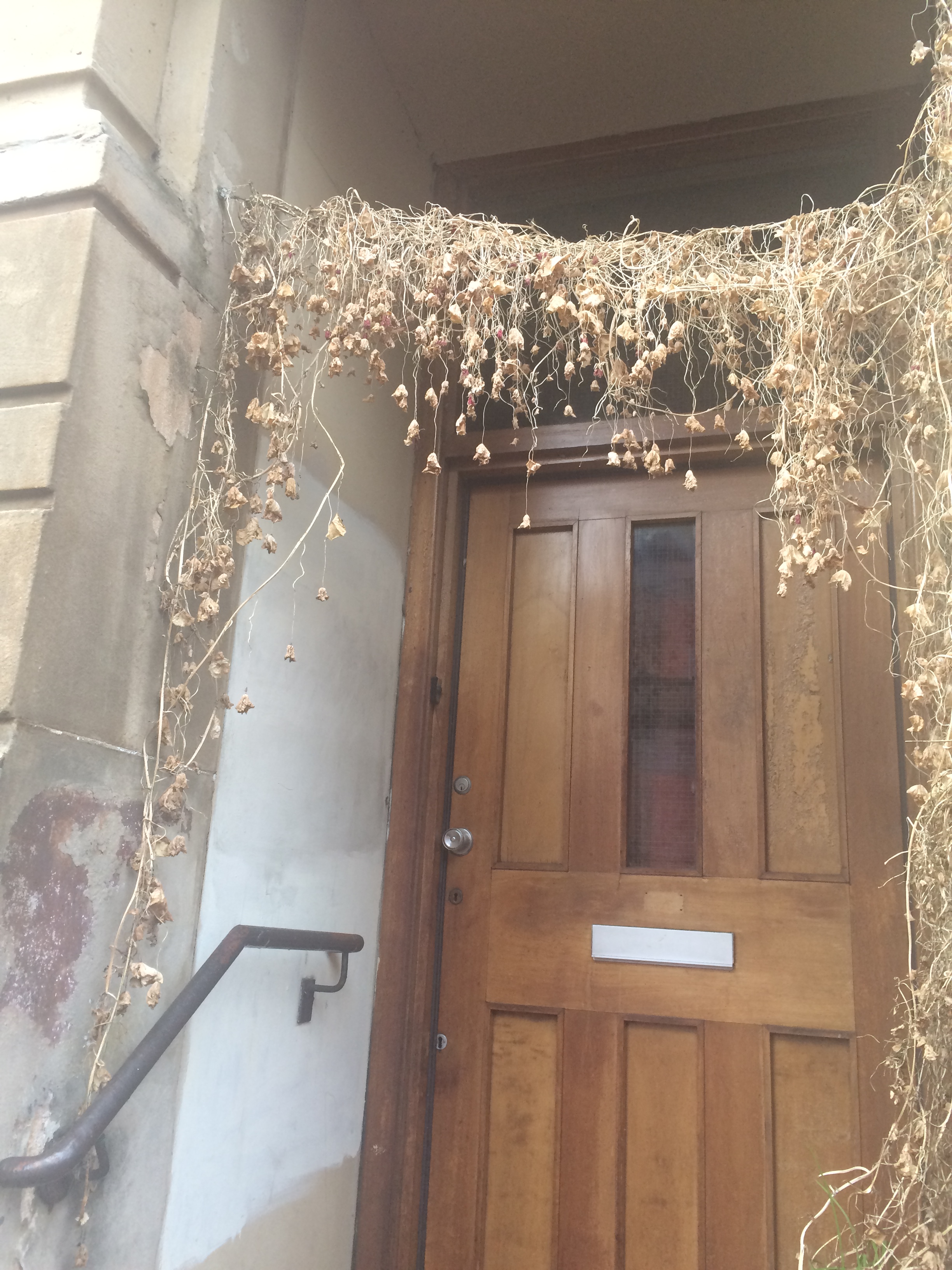
There is this Anne Carson poem, ‘God’s Work’, which ends with the line ‘Put away your sadness, it is a mantle of work’. By chance, I was reminded of the poem via some post on Instagram that came up an hour ago. I want to think about this ‘it’, like how it is the sadness and also the work, and the pronoun of living, the abstract embodied. ‘Mantle’ is something that covers, envelops or conceals, it is a portion of the Earth, a sleeveless cloak or cape. Is it also the bevelled edge of a door? One can be mantled with a blush, the mark of a covering shame. Is it a mantle of work to hide your sadness, or does the ‘it is’ refer to some other thing whose outcome is that we must put away our sadness? We must close a passage of time behind us? Notice I am switching to a plural pronoun, because I have entered the poem, sharing the position of both addressee and speaker. I am the the person with this feeling; I am the person addressing this feeling. To speak at all, I am doing the mantle of work. There have been these tectonic shifts in my life of late, the underlying move or loss that is a portion of everything. ‘Put away your sadness’ asks you to imagine a physical form for the affect, a classic poetic move: my sadness is a bird, my sadness is a stone, my sadness is a rose, a scrunchie, a sea. These are things you can put away, tie back; or you can hide with a cloud, or you can dive in. Typing in ‘my sadness is a’, Google suggests:
addiction
a smile
a father introduced
a souvenir
a smile
a text
a joyful dance
a science
It seems these things are all correct, at the present moment. For instance, I drink from this mug and I think about Prague, and how it looked in the rain of a flickering image. That is a souvenir, but it is somebody else’s rain. The internet offers ‘Healthy ways to deal with sadness’, ‘Why am I sad all the time?’ and the old adage, ‘It’s okay to feel sad’. I have been reading Heather Christle’s The Crying Book (2019) and Joan Didion’s The Year of Magical Thinking (2005). Didion insists, ‘The way I write is who I am, or have become, yet this is a case in which I wish I had instead of words and their rhythms a cutting room’ where one could ‘touch a key and collapse the sequence of time’. In one of my favourite Laura Marling songs, ‘The Captain and the Hourglass’, she sings ‘Behind every tree is a cutting machine and a kite fallen from grace / Inside every man is a heart of sand you can see it in his face’. I love the pessimistic, teenage fatalism of this album, Alas I Cannot Swim (2008), its jump cuts of warning and love and familiar pain. Is the man the whole of humankind, or men in general? What if instead of words we had the bark of a tree, its abrasive shavings; a shaven novel or heart of sand in which to bear our suffering? Dissolve is imminent. There would be the rings of your life, the brief achievements of flight, but then the fallen linen, the tired old string, the particles blown. Didion wants it all at once: a simultaneous display of the frames, the scenes of a life. You would then choose what to cut, reassemble or stow away. What doesn’t matter to be dispersed. In the cutting room, a mantle of work is required. And what of the work that is to write who you are, when what that seems is only pencil shavings, sawdust and woodsmoke?
I have not walked in the woods for so long, and the last time it was with you. But let that not be the last. I was cloaked in so many layers; I could not get rid of the cold. It was a damp and green, needling feeling. It was not so much inside as around me.
Heather Christle puts it really well, this question of the cutting room and the cry:
Maybe we cannot know about the real reason we are crying. Maybe we do not cry about, but rather near or around. Maybe all our explanations are stories constructed after the fact. Not just stories. I won’t say just.
It is a relief to write while crying. There is something comforting about the simultaneous flow, as though letting two substances at once run through you: one being language, the other chemical; each in a woven relation. Crying, then, is the anarrangement (ana being Greek for ‘up, in place or time, back, again, anew — OED), of a state of things that are happening in life, in the body, in the social, in various temporalities. There is the before and after of a break; there is the running on, running behind, the sense of feeling this from ‘above’ or ‘below’. Like when for ages I didn’t properly eat the world was a glassy thing I was seeing from underwater, poking the ripples, falling backwards. To cry is to indulge in both prolepsis and analepsis, to slip and collapse, to blur and feel into. A friend says, you have to work through and not around it. I try not to cry about, but recognise the ambience of sadness. I won’t know until later what is really happening, what narrative this can all be placed in, or slip from.
Somebody nearby is playing a flute really badly.
The chime of a text message. It’s okay to feel sad.
In the office, friends and I exchange tales of election night. One of us is trying to fix a puzzle, the other drinks for sorrow; there is a mutual sensation of violence which can only ‘end’ in blackout, keying a car, throwing a punch, posting a rant or falling through sleep’s amnesia. For a while, I could only listen to songs that came out before this happened, and before the Tories were a bad new government, which felt forever ago.
What if daylight itself became elective, and that was the bold democracy of what it was to enter a day. Do you choose the light, or does it summon you? I just make playlists.
The moon has been flagrant of late, or was it right before. I remember seeing rainbows around the moon for days at a time. I remember that seeming too much, like I’d overdosed on the dust of this planet, like there were molecules of colour in my nose I could not sneeze or shake out. Like there was a terrible high about to happen.
I have not seen the moon at all this week.
I write this raining.
A thought of the before and after which remains unfixed and semi-colonic. It is to say and not say of what was said.
There is a special release in crying by bodies of water. I believe in a clairvoyant sadness, one that predicts some upset to come. It is the body’s sincerity of knowing. So you cry by the sea, or lately, a river. All that I have. Cry your eyes out by the Clyde. When you arrived, I was reading about the horror of purple, that ‘which hurts both sides’, ‘the horror’ (Hannah Weiner, The Fast). I wear it around my sleepless eyes. It is a bruise colour, the muscular failure to move through the day; it is a pile of clothes, a burgeoning energy of the horror. So I turn to blue, which is a star, or a gas flame because someone is cooking.
That line in Joni Mitchell’s ‘A Case of You’, from Blue, a lifesaver every Christmas, which goes, ‘Just before our love got lost you said / I am as constant as a northern star’. And it’s that ‘I am’ that I like, the moving throughness of it, the insistence that this is and not was. Because there is something of forever which is getting lost, or a wound that is hidden and cannot be healed. That is forever opening up. For we were so close, a year ago. And of course Joni flips, deliciously, to the mundane. She asks ‘Constantly in the darkness / Where’s that at / If you want me I’ll be in the bar’. As though to look down in your soupy negroni, you would find that hot abyss from which love is turned, over and over. And maybe you’d shed a few tears in it. And you’d struggle to say the location.
I remember dressing as a wise man for a play at school, wearing a homemade crown and parading slowly towards a manger. Somebody was acting the part of the star, and we followed them.
Somehow in a notebook I wrote, ‘I am going to be fine. I am going to shine at it’. To be shiny in this being fine, I wrote that in a café and I remember my hands were trembling, my earrings were not real gold.
There is this dream from last night where I wear a blindfold made of a banana leaf, and you are helping me cross this road, this road that is river.
In Goodbye, First Love, there is a hat that floats away in the river where Camille is swimming. This happens at the end. It is either too late or too soon, and she is crushed. This is the wiki summary. From the film I remember the widening shot of the river that flows on but closes, and the sunlight, and crying as I watched this at six in the morning, after reading about it on somebody’s blog, the link now lost. It was almost spring and I had not cried since winter. Back when I would add things to my weekly list like, ‘more on lattices’, ‘a setlist’, ‘a more explicit weave’, ‘reply’ and ‘pack’.
Writing this now, am I attempting to ‘put’ this ‘away’?
When he tried to be practical, mentioned ‘In the long run…’ I could only think of that song by The Staves. It was a churlish note, curled at the edge and not mine or yours. That night, there was a cat called Olive, a taxi to Greenbank, sleeping in a friend’s sister’s bed, waking up face to face with Sophie Collins’ small white monkeys again. In the notebook I had written in a slurred hand, ‘I wish I would cry now but I feel afloat’. It was the elated tiredness, the denial. I had a freezing shower to cool my shame.
Climate breakdown is also a breakdown of the heart. We have to admit that. Something is always stinging, ‘I’ve been thinking’, a mug of hot water. I could not sleep, I was reading Clarice Lispector’s Agua Viva in fits and starts, which is perhaps how it demands to be read:
I swallow a mouthful of blood that fills me entirely. I hear cymbals and trumpets and tambourines that fill the air with noise and uproar drowning out the silence of the disc of the sun and its marvel. I want a cloak woven from threads of solar gold. The sun is the magical tension of the silence.
A spoon of blood, not sugar, not jam. It is the hot lump in your throat when you cry and the blood that is anyway. About to. Remember I bled for thirteen days, or was it more. It was because of hot liquid, a rush, a pill. How you nourish yourself or not. A friend says, when I cry on buses and trains I listen to specific kinds of music and pretend I’m in a movie. Is it detachment we want from that? Would there be cymbals and trumpets and tambourines in this movie? I want you to put me in it, the noise. I want to stand at the front of the gig, be buffeted. I want to be bashed around like a note that won’t break from the instrument. I want to find a post-it note stuck to my back, but what should it say? Over time, I garner respect for the sun. It is not that my nocturnal years are ‘over’, but I am wondering what it would mean to truly love and rejoice in the sun. The giver of life, not Byronic darkness. To lie in a colourless sea. What would this clarity that Clarice writes of look like, the woven cloak of ‘solar gold’, its ripples? Is it the mantle one could wear to cloak a sadness? But what if the sadness was the clarity itself? I say, I think you are brilliant. It is a mantra. It is a giving away. When the van swerved and nearly hit me, I felt the sunlight so incredibly brightly. The east coast, the sense that this was someone else’s morning. The silence remains still, and I look for it in that ‘magical tension’ of the said and unsaid, and I am doing what Didion does with her grief, the magical thinking that is arranging all these scenes at once for something to emerge as possible. That is trying to sort a timeline or feeling yourself ‘invisible’, between things, the living and dead, an incomprehensible love.
In Ariana Reines’ recent collection, A Sand Book (2019), the pages of the final section, ‘MOSAIC’, are black. She introduces the scene that prompted this section with italics,
The sun’s warmth kept filling me, and what had begun as a slightly above-average warmth kept growing. It was starting to fill my body, and just before I totally surrendered to it, I had the inkling this might be something like the “bliss” I had heard about in old books. I had to sit down.
What is relayed as a religious experience, a spiritual experience, is then a series of transmissions (‘MOSAIC’ is in reference to Moses). But it is also fundamentally a solar experience. I think of Laura Marling’s heart of sand, something grazed by a coming warmth, the lap of a sunlight like the sea. A hot liquid thing that is coming inside me, causing the bleed, the bliss, the generous massage of some hormone. It is embarrassing writing, it demands a hot bright mantle. To feel it, feel through it, you have to sit down. You might go to the bar, as Joni does. In fact, I write this lying in bed, as is often the way. There is nothing to set out for or plan, so much as the needling of this ‘inkling’.
I go to see Little Women, and focus on Jo’s ink-stained fingers.
I have not been ‘on holiday’ for so long but if I did I would make a solar panel of my opening chest and lay where the river and the light would take me. I think the black space on Ariana Reine’s pages is just as important as the whitely capitalised text, ‘EARTH IS SPECIAL […] THERE IS NO “BACK” TO GET TO’. We can’t get back to any bliss other than what is felt in the present. And there has to be so much energy. Put down your phone.
Dorothea Lasky says she tells her students ‘not to have a plan, but to collect things and poems and then put them together’, there is this ‘holy idea’ of ‘emergence’. I write mostly by assembling quotes I like, streaming things down (for to ‘jot’ implies a decisiveness, an almost violence) whenever they do or don’t make sense. Text myself so the thought is received as though in reply. I have all these poems from the month I don’t yet know how to assemble. They are as much of the rain as the rain. Someone comments on a fresh sense of ‘scarcity’.
‘I wish I had a river so long’. And there is no snow here. The lines feel hard and overly sweet.
Candy canes hang upon the tree.
On Christmas Day, we walk by the canal and stop by the locks. The trees seem anorexic, as in a Plath poem; as though they had chosen to strip this pure and gleam on the water. They too will see from below, but they know a different renewal.
I can’t say a certain five letter word.
I want to know what the seven words are in the Weyes Blood song.
‘I wish I could swim in an ocean / As cold as’ a line I can’t finish, listening to Grace Cummings as though it were autumn all over again. But people on the internet are still going wild swimming. The world is not everywhere cold. The caption reads, literally all I want for xmas.
Two photos on different accounts of a landscape blurred by the motional train.
It’s funny, I even wrote, ‘it’s like The Topeka School and the failure of language’.
To sob into the warm, soft fur of a cat.
The want of a cigarette.
Astonishing winter light.
I couldn’t finish the wine.
In The Fast, Hannah Weiner writes, ‘I didn’t know any golden light people, but I knew a couple of blues. I knew I had to be rescued (I thought of it that way) by a blue, or someone near it’. One of my closest friends and I both Instagram a snapshot of ‘River’ on Spotify at separate points across the festive period. It is this secret, not-so-secret gesture of the living-on, the warmth and possible. I think she is one of the golden light people, in loops, and I wonder what I am, if one of the blues. Who else is a blue? But I have always loved green eyes. And the Earth, which is a globe of something like green and blue, (de)pendant on/of the universe. Whose. And I have seen the garden in four seasons now, but just barely. The scene is still swinging and won’t stop to focus.
What Reines writes of how there is no ‘back’ of the Earth to get to. I think of the back of a tapestry: a ragged collation of stems, snipped-off threads, criss-crossing lines. A simultaneity, a mess, a work in progress. When I am trying to write about the anthropocene, about what is happening, about the earth, is it this ‘back’ I am trying to write. It is not to get back to, but a back that is happening, the other side. I have been trying and failing to learn crochet; I think those who succeed are beautiful and perfect, I won’t turn over their lovely creations. In her song ‘Other Side’, Grace Cummings sings ‘The fall of a raindrop / Returns blue to the daylight / Your mind must return / To behind your eyes’. One drop of blue can restore the day. I think of Bob Dylan’s ‘Tangled Up in Blue’, living on Montague Street, in one or more stories. The worried thread. It is like putting on makeup to stop yourself crying, but doing it anyway, later in rivers of mascara and other clichés. When you are watching a movie and the crying is about to happen and you feel it as a sparkle, because it is not about the movie for which you are crying, but something around or near the happening, the space of it, being there in the other imaginary. And then what is going on ‘behind your eyes’. Crying happens in a space. It is all the prettiness we do while we can, which is a mutual hurt, a hot slide of a tear that catches your neck and means something small and inexplicable.
The Bright Eyes song ‘Train Under Water’ begins, ‘You were born inside of a raindrop / I watched you falling to your death / And the sun, well she could not save you / She’d fallen down too, now the streets are wet’. I used to think that song was about miscarriage, now I know it could be about any kind of love and loss. Remember when Jeremy Corbyn said something offhand about getting the train to Orkney? I dream about the sub-thalassic train sometimes, northerly moving, passing by jellyfish and flashes of shapeless light. Where are you going, where have you been. The milky unborn thing that we bear yet. Feeling sick from relative motion. It is the glassy way we watch from behind falling water, all of our lives. What touch do we really share of each other?
The air is a key change.
At the reading, Gloria says something like, we have all been thinking of writing as a practice of moving through the days, a practice of living, of marking time. Here are the days I give you in words. In Utopia, her little red book, Bernadette Mayer writes, ‘Everything you or I or anybody says always seems 100% wrong sometimes, unless you keep forcing it to be closer to the truth’. There is a truth quality, say, to the way plants photosynthesise or a starling assembles her nest. The percentage quality in which I can or cannot get out of bed, and whether you are ‘Active Now’ or in fact just barely online. Again, it is a question of green.
Marianne Morris has this beautiful poem, the last in her collection Word / World (2018), that a friend and I once read aloud together on a patio in summer at the XR climate café, the first I’d attended. Everything seemed shimmer then. The poem, ‘Lion’s Gate’, is a prose poem of some intensity. It is about what it means to love and to hate, and what is worth keeping. I really want to quote the whole thing but I can’t, so I’ll make do:
We do not want to go back with more questions pertaining to life on this Earth. We must learn them before we leave, loving every possible second upon this beautiful Earth, because we will not come back. We will move on elsewhere. It is like a heart breaking feeling suddenly, I see it all so clearly and I want this moment to stay. This feeling of certainty that the only thing that matters in this life is that you enjoy your time here and keep thirsting and seeking and do not resist the lessons, rush towards them and learn them all, so that you can die to yourself, die into light.
~
Green Day – 2000 Light Years Away
Caribou – You and I
Market – Told
Angel Olsen – Lark
Fleetwood Mac – Dreams
Pinegrove – Skylight
Rob St. John – Your Phantom Limb
Laura Marling – Tap At My Window
Karen Dalton – God Bless the Child
Joni Mitchell – River
Grace Cumming – Other Side
wished bone – Pink Room
Nirvana – Something In The Way
Wilco – An Empty Corner
Belle and Sebastian – We Rule the School
Vashti Bunyan – Winter is Blue
Connie Converse – I Have Considered the Lilies
Bright Eyes – Train Under Water
Big Thief – Dandelion
The National – Guilty Party
Organ Tapes – Simple Halo
Björk – Sun In My Mouth
Eartheater, LEYA – Angel Path
Mitski – Last Words of a Shooting Star
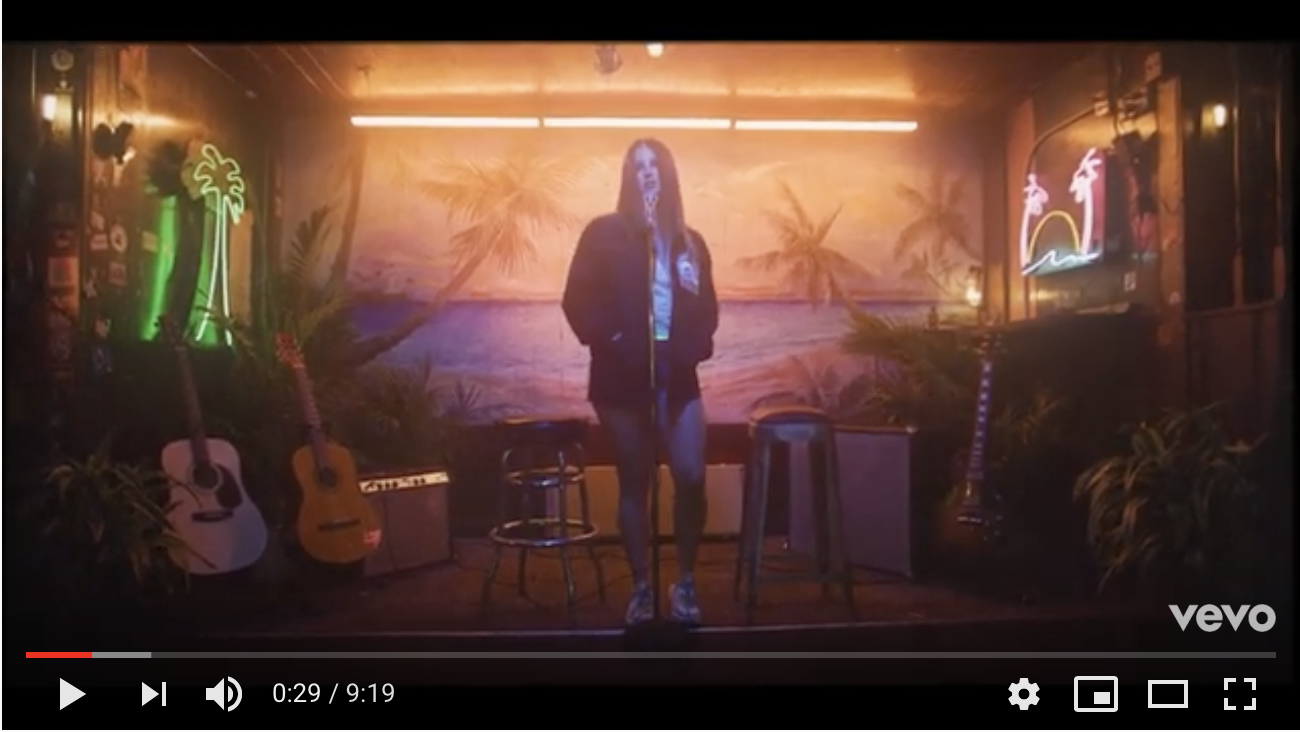
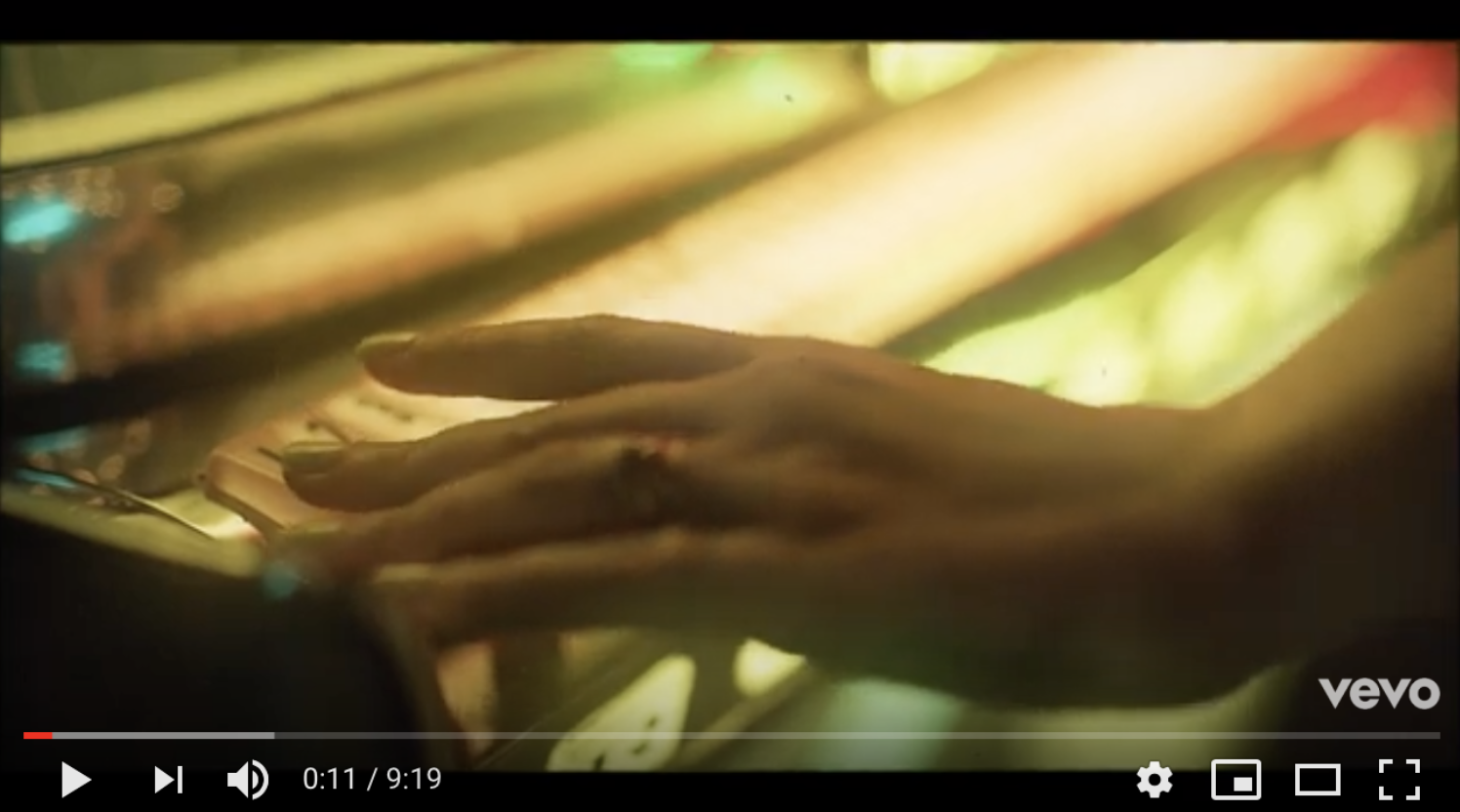
There is a scenario in which the jukebox is equivalent to the poet and some elaborate analogy is to be made between intertextuality and the limited catalogue whose selectional form produces play. The scenario only survives in video. It needs this urge of duration, not to mention the tenderness of a touch. Where fingers brush keys like notes, there is something to add to the story. A social space in demand of ambience; on flickering alongside off. When Lana is alone on stage, hands stuffed into a bomber jacket, singing ‘Fuck it, I love you’, swaying almost nervously, I want to think about what she is doing there and who she is speaking to and from where she is speaking. She is not really speaking but singing. The lone girl on the stage is the open mic dreamer, with nothing but lines. She is scattered across june-dreams of multiple personality: ‘The I which speaks out from only one place is simultaneously everyone’s everywhere; it’s the linguistic mother of rarity but is always also aggressively democratic’ (Riley 2000: 57-58). We mother our solipsism with words but in doing so there’s an opening. So to say fuck it and state the interruption with syncope, sincerity. Lana Del Rey was born on the cusp of Gemini and Cancer season, which more than explains that statement: ‘Fuck it, I love you’. With her sails to the wind. To say it over and smooth into plural refrain, you could even say chorus. For a chorus wants to be shared. It is a commodious mother, fed by the keys of the jukebox baby. There is a constant reversal of nourishing; the democracy of lyric utterance, the milky feed that streams.
Denise Riley argues that any ‘initial “I love you” is barely possible to enunciate without its implicit—however unwilled—claim for reciprocation’ (2000: 23). But what is reciprocation in a song? Is it just the urge to be sung with? And this ‘fuck it’, the pervasive millennial injunction to just be, to move on, as the tag which erases the expectant price of the utterance? Riley argues that I love you ‘must at once circulate as coinage within the relentless economy of utterance as exchange’ (2000: 24), but in a pop song it bears the leaden weight of so many prior expressions. The irony is that to cut through that with a simple fuck it, Lana can attain something like sincerity in the very pop mode whose lineage of commercialised love would surely undermine her feeling. Fuck it, in spite of saying I love you I really do. The pop song becomes this space for the staged epiphany of repeated assurance, I really do. It is a softcore admission of the self in its burning limit.
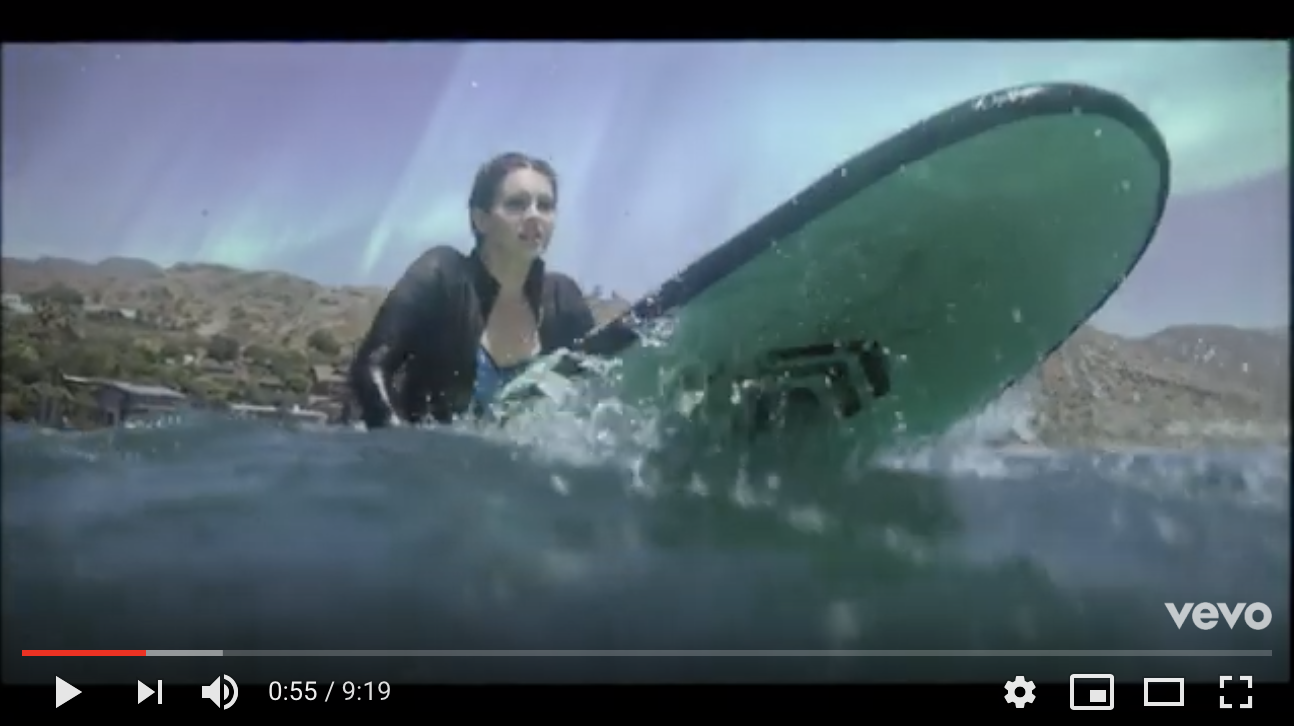
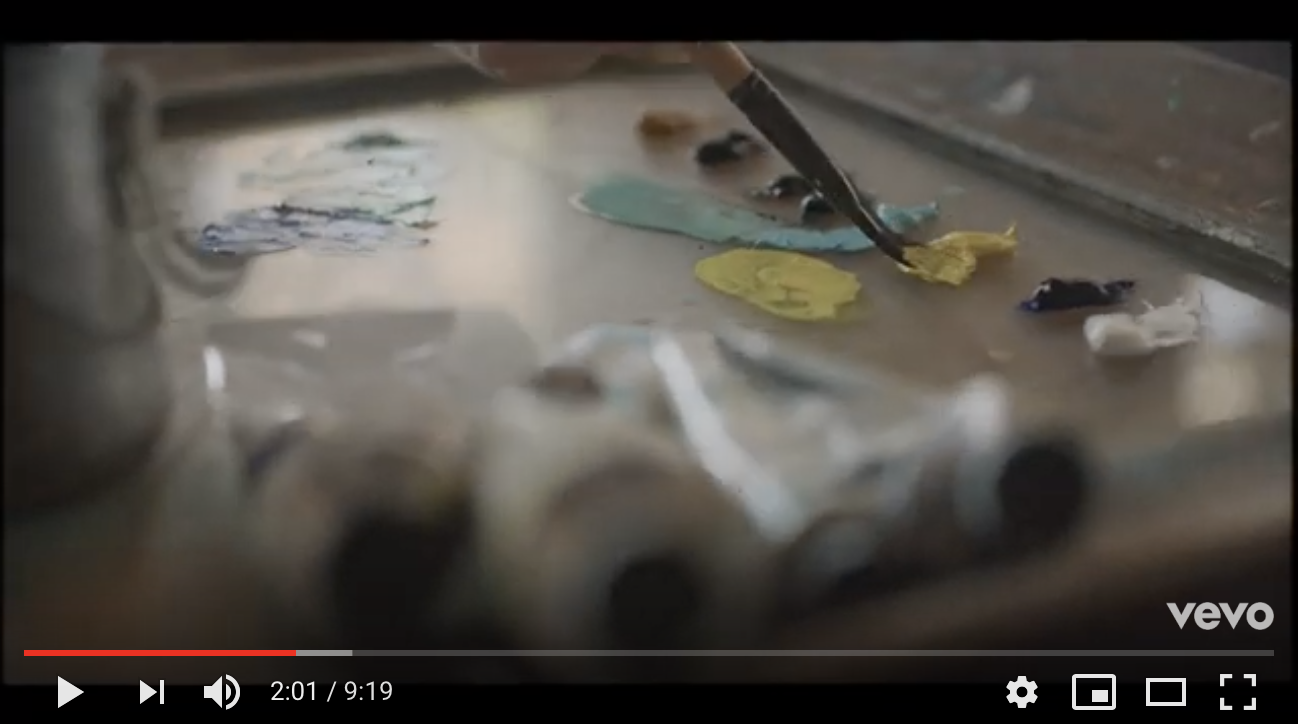
‘Fuck it I love you’ is soaked in lights, but they’re fading. ‘I like to see everything in neon’, is the line that opens the song. To see everything in neon is to fluoresce what is haunted and gone. I think of Sia dragging rainbow dust down her tearful cheeks in the video for ‘The Greatest’ — tragedy’s shimmer as fugitive mark on the body. Lana offers herself up as sugar dust, cliché in honour of Doris Day: ‘Dream a little dream of me / Make me into something sweet’; she acknowledges ‘dancing to a pop song’, but it’s not clear if this is her or the character or the one she loves. ‘Turn the radio on’ could be a reflection or an imperative. The reader is hailed between these positions of love and the loved and the effect is saturating, warm, delirious. Separation is that ‘it’, the spacing. In the video, we watch Lana painting and then suddenly she’s surfing with the aurora borealis in the background. She’s on a swing, her jean shorts caressed by the camera, she’s the sexualised pop icon again. She’s on a surfboard, green-screened, young. She’s choosing a shade of yellow from the palette, singing ‘Killing me slowly’. What is this ‘it’, killing her slowly:
I’ll return to the unknown part of myself and when I am born shall speak of “he” or “she.” For now, what sustains me is the “that” that is an “it.” To create a being out of oneself is very serious. I am creating myself. And walking in complete darkness in search of ourselves is what we do. It hurts. […] a thing is born that is. Is itself. It is hard as a dry stone. But the core is soft and alive, perishable, perilous it. Life of elementary matter.
(Lispector 2014: 39)
I want slyly to argue that this is a kind of anthropocene existentialism. Recognition of the self as this ‘hard’, ‘dry stone’ thing of geologic mattering, reflexive species. This is what it is to be ‘Human’ right now. And yet the agential spark within, the ‘core’ that is being alive in a world where we have deposited those sedimentary layers. Creating ourselves in the stone, often with the tarnish of the very products we chose and developed to beautify, excoriate and cleanse ourselves, to remain forever young. So there is this oscillating temporality at work between desired infinity and the trace of our fugitive place on earth. The very earth minerals that would ruin humanity, mine our bodies of endless labour. But to go back to the song, with its idea of a gradual dying. I want to call this something like anthropocene softcore: the unnamed presence of species being within Lispector’s slender novel from the early seventies, or the Mamas and the Papas brand of late-sixties ‘sunshine pop’ whose solarity derives from the perishability of that energy, utopian commons, cascade of flowers — that serotonin glow of selves in streams and streams.
Lana’s anthropocene poetics are not of the hardline, direct call to action. You would not say of her cultural presence, eco-warrior or nature goddess. You would not brand her Miss Anthropocene in a kind of demonic marketing gimmick. You would say most often she is a siren, per se, leisurely supplicating us towards death on the rocks. Desirous flow. This is anthropocene softcore. This is what it is to challenge the act of self-description itself, and in doing so questioning those generalisations that arise from the ‘we’ of humankind, not to mention the ‘I’ of pop’s delectable, mainstream lyric. Alchemically, Clarice Lispector and Lana make of these malleable pronouns the ‘perilous it’. The it, the feeling, the speaking self which is nothing much more than a bundle of affects, sensations, atoms. To be cast over and crested by the wave. Significant that ‘Fuck it I love you’ ends with the rising bubbles of this wave, the one that spills us through the fourth wall and into the studio. This song slams together pop’s saccharine mythos of California as dreamland, a late-summer song as the former was written, surely, for autumn. California: ‘it’s just a state of mind’. She could be talking about the self or the state, or the state of the self.
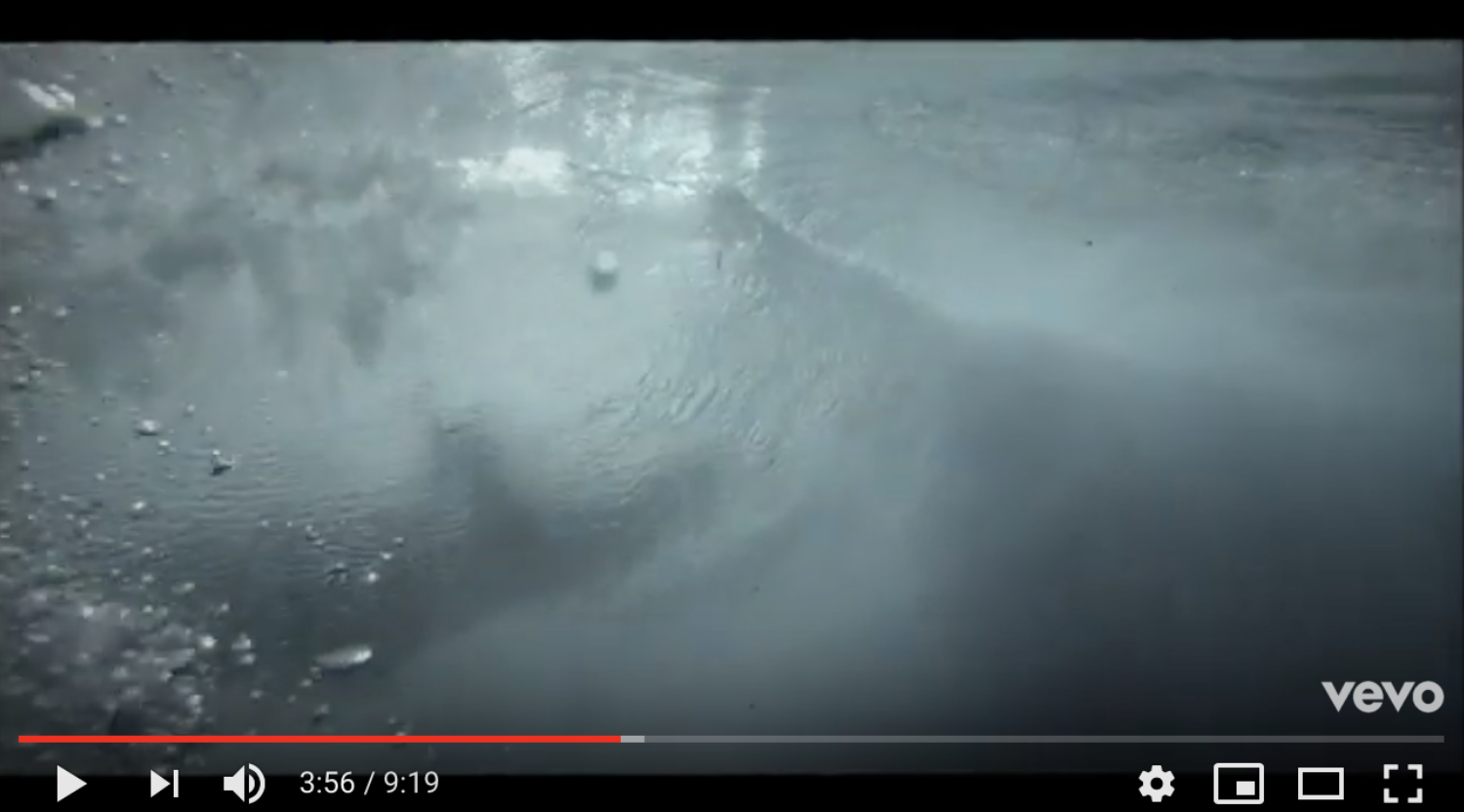
What happens next? The shot drifts over the cliffs, the coast, to a strip of palms and a distant view of the LA skyline. That shining love in the previous track is replaced by a minor key, a glimpse of the jukebox whose songs include The Eagles, Bon Iver, The National. Artists whose Americana is the melancholy of generations moved from political despair to something like the glitch of the times as a basic fact of intimacy. One of the Bon Iver songs shown in the video is ‘22 (OVER S∞∞N)’, and if that title was not rife with implicit apocalypse, what is, what is. A stammering into language, pitch-shifting the fragile space of utterance. There’s a spiritual glimpse to the sky and the infinite quality of the stars:
There I find you marked in constellation (two, two)
There isn’t ceiling in our garden
And then I draw an ear on you
So I can speak into the silence
It might be over soon (two, do, two, do, two)
(Bon Iver, ‘22 (OVER S∞∞N)’)
I don’t know what the maths is doing. I don’t want to know that the song ‘was inspired in part by Bon Iver mainman Justin Vernon’s unsuccessful attempt to find himself during a vacation’. I am however interested in the hubris within this term ‘vacation’ at all. Do we now live in a world where you can take ‘time out’? There is nothing of the world we know that could be switched off. There is no ‘away’ of complete erasure or original presence. Deconstruction caught up with our living. Vernon describing this song as a gesture towards what might end of his emptiness could just as easily be flipped: its relief is equal to a mortal sense of loss. The impending erasures. It ‘does’ or acts the accretional event of extinction that is speaking into the silence, to those who could not speak back.
Fragments and snatches: the neon green lining Lana’s eyes, the aurora borealis, the neon green palm in the club where she sings alone. A season by yourself. The love of the couple together surfing is cardboard, Hollywood. It is a trembling symbol. It is almost ridicule.
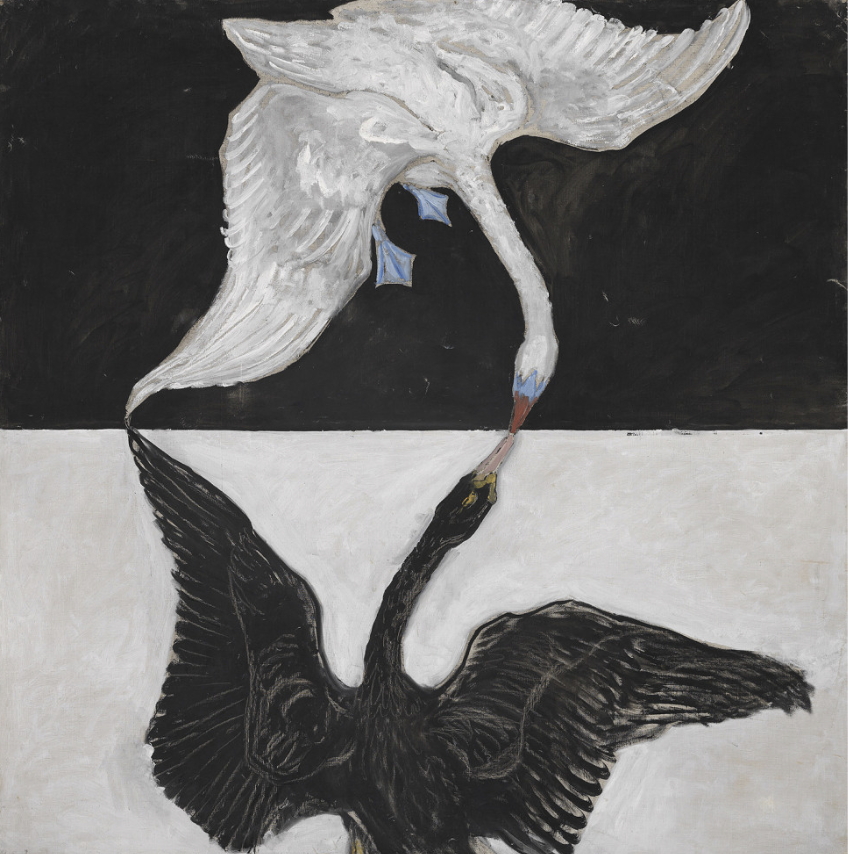
What is Justin Vernon looking for in the constellation? When he sings ‘two two’ I think of Hilma af Klint’s nose-touching swans, or the hours of the day chipped at the edge — two of them stolen by tragic event. I think of a mic check, two, two, ch, ch. Click. Near-enough-presence of speech. A white swan on black background; a black swan on white background. Flip. The swans are geometry, signets of signature, they move towards abstraction. Growth. I love them. Fuck it I love them. The way they are just it. Inversions of colour and a monochrome mood splashed with cornflower blue, the tiny excess we can treasure. It is the cornflower blue, the little webbed feet, which make the swan in question unique. So we can care for it, figuratively as it swells through grey-white waters of memory. The swans we have lost in our shit. Royal iterations freed from belonging. This painting is from af Klint’s series Paintings for the Temple, works derived from spiritual communication. The abstraction of the swan / renders us stark in frame / for we were Lana or Leda / before we were animal. Sufjan Stevens’ ‘Seven Swans’: ‘All of the trees were in light’, ‘a sign in the sky’; ‘My father burned into coal’. And all of our sadness was carbon neutral before this. We plunge into whatever remains of the water, its plasticky thickness.
I keep pausing the video as it transitions. ‘Fuck it I love you’ twinned with ‘The greatest’. When The National sing ‘It’s a terrible love and I’m walking with spiders’, what exactly is the ‘quiet company’ of the ‘it’? It could just as well be spiders. Maybe it’s the web itself, the web between the human and the more than human, the gossamer moment where metaphoric articulation becomes more than feeling and gleams material. ‘It’s a terrible love that I’m walking with spiders’ — what is the grammatical transition done by that ‘that’ and who is to blame. Walking with spiders might just be that love. Transitional, subject/object logic is reversed in this song: ‘Wait til the past?’ is sung, then ‘It takes an ocean not to break’ when surely the ocean itself would break you. Soon the ‘terrible love’ is a substance, something ‘I’m walking in’ — to feel it is an act of immersion. It is to let that wave crest over, the ‘lyric auto-explosion’ (Moten 2017: 3) of the wave that would break you.
In ‘The Greatest’, Cat Power sings of former ambition now cast to nostalgic regret. There is a sense of time slowing to delay, laconic strings, relaxed drums, the balladic sleep of a once-held fault. It is a parade slowing down in the rain. To say ‘Once I wanted to be’ is to hold this question of ‘the greatest’ as a generalised desire itself. The hunger we lose in time, whose primary colours soften. I hold to that precious, cornflower blue of a swan’s foot. ‘Two fists of solid rock / With brains that could explain / Any feeling’. This solid rock that would box you into the future, that would harden the edges of self. A thing is born, as Clarice puts it, ‘hard as as dry stone’. This is the thing born ‘that is’. To exist is to be this hard thing, protein ligament, to kick out in lines; but then in time there is the plasmatic self inside that, like some fatty animal byproduct, sticks to the others it loves, it needs, it leaks. Gelatinous, softly sticky love. The ‘it’ that needs saving. Anthropocene softcore; soapy inside of all geologic agency. Who we are and what we regret. The turning of the outside-in, the inside-out. Kathleen Jamie, in Sightlines, asks: ‘What is it that we’re just not seeing?’ (2012: 37).
A sightline is a hypothetical line, from someone’s eye to what is seen. Is it clear or blurred, bad or good? Anthropos recedes in its very own scene as the ocean continues and we howl in the dark like a lossy-compressed version of species. We are the sirens and wolves. We are at the great concert of the Earth. We have to resist what Bernard Stiegler calls the ‘proletarianization of the senses’ (2017); we have to find longform ballads of what’s happening, pass them down the line, resist the short-circuiting of thought that occurs between screens and machines. We have to send letters back to our consciousness, our elders and children. This is the work of lyric. It could be the work of dance. I think of Zelda Fitzgerald’s protagonist, Alabama, learning to be a ballerina too late in her life: ‘Her body was so full of static from the constant whip of her work that she could get no clear communication with herself. She said to herself that human beings have no right to fail’ (2001: 180). Alabama barely eats; her energy is all the zeal of will. The dance of lyric as reduction, lack, as static and chased success whose collapse lands as Alabama will eventually do on the event of inevitable break. Grapefruit squeezed on the gritty turmeric shot of the future. And a brake, a screech. And yet we write, we cast out limbs and materials, we work towards this loss; we imbibe it.
This is an ugly type of writing in which the outside is always imagined from the inside. Horizons are fictional and buildings are barred. I have no sightlines. I’m fucking cutting the corners of someone else’s desire. All paths are the continuation of a pre-existing line. This is a city from which I send myself postcards wherein I wish I was here. Flying letters. Words stolen from myself. I refuse to recognise that I have not composed them unintentionally
(Bolland 2019: 78).
The videos for Lana’s ‘Fuck it I love you’ and ‘The greatest’ swerve between inside and outside. We find ourselves in rooms we don’t remember entering. Writing the anthropocene has an ugly, masturbatory quality of fucking yourself with the rush of elaborate doom. Okay, so. Constructing fortresses of lines which would make a valiant destination. When I listen to Lana, I’m accessing shortcuts to ‘someone else’s desire’ which is the opening up of presence. ‘This is a city’; ‘I wish I was here’. I have never been to LA. We plagiarise our very own diaries to get back that sense of the once-intentional, the greatest declaration on Earth. That we were here, and we loved. She wrote that lit, forgot. The papers curled up and rolled away in a sultry air that was summer, 2012. The year of failed apocalypse, the year Lana released her debut album, Born to Die. We saw her campaign of fashion smoking through plexiglass bus shelters. Remember all ‘horizons are fictional’: they tell a narrative, they bleed and tilt and set like ice. Towards them we stupidly drift: the lived throb of our softcore skins, our hungers and rhythms.
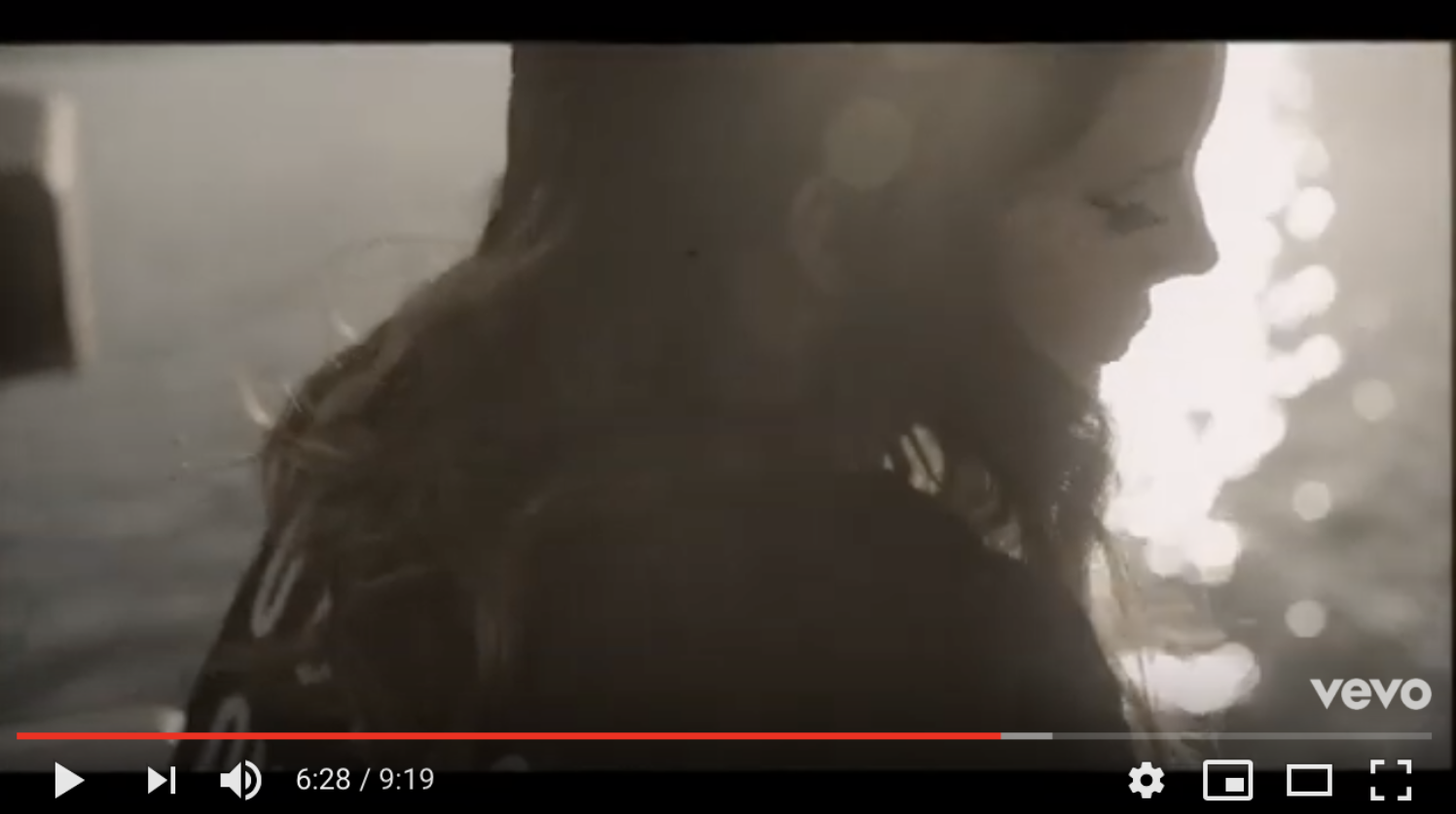
Drifting in colour like H.D.’s Leda, the rape of the land and the body and bodies engendering bodies. Worlds ending around us. And so I could say, but this is just one song, a phrase, a white woman of fame lamenting her world. But this self-conscious cinematics is a gesture towards the western world itself as this haunted, tragic protagonist: ‘The culture is lit and if this is it, I had a ball / I guess that I’m burned out after all’ (‘The greatest’). So you could say, anthropocene softcore speaks to the lyric I in its state of orphaned exception, which in turn is the loss felt by us all unequally. If we make of Lana a sort of anthropocenic siren, we must recognise the distinctions within our longing. For we all lose worlds differently; harm is striated along lines of class, gender, race, ethnicity, geographical distribution — of course. That wave that closes the video could elsewhere be a tsunami. I like to think its place on the edge is a deliberated hint to what could or is even already happening here or elsewhere. And maybe the colour, the aurora, is this streak of need for an excess beyond static blank, ‘human’ planet, standardised canvas; the need to splash something more of blur and blue. Flood the structure.
When we say something is ‘lit’, we mean it is hot, on fire. We mean it is turned on, ignited, intoxicated, drunk, excellent. Lit is the past simple and past participle of light. Isn’t that line alone just lit? Maybe we are in the twilight of a former Enlightenment, recognising our species hubris as this alien green that tinges every familiar horizon, upsets the normalised green of pastoral. Is it toxicity, the elsewhere within ourselves? It is a radar showing who we are and where we have been. Those material metaphors cook on a smoulder, and this is the softcore coming to knowledge about what is happening.
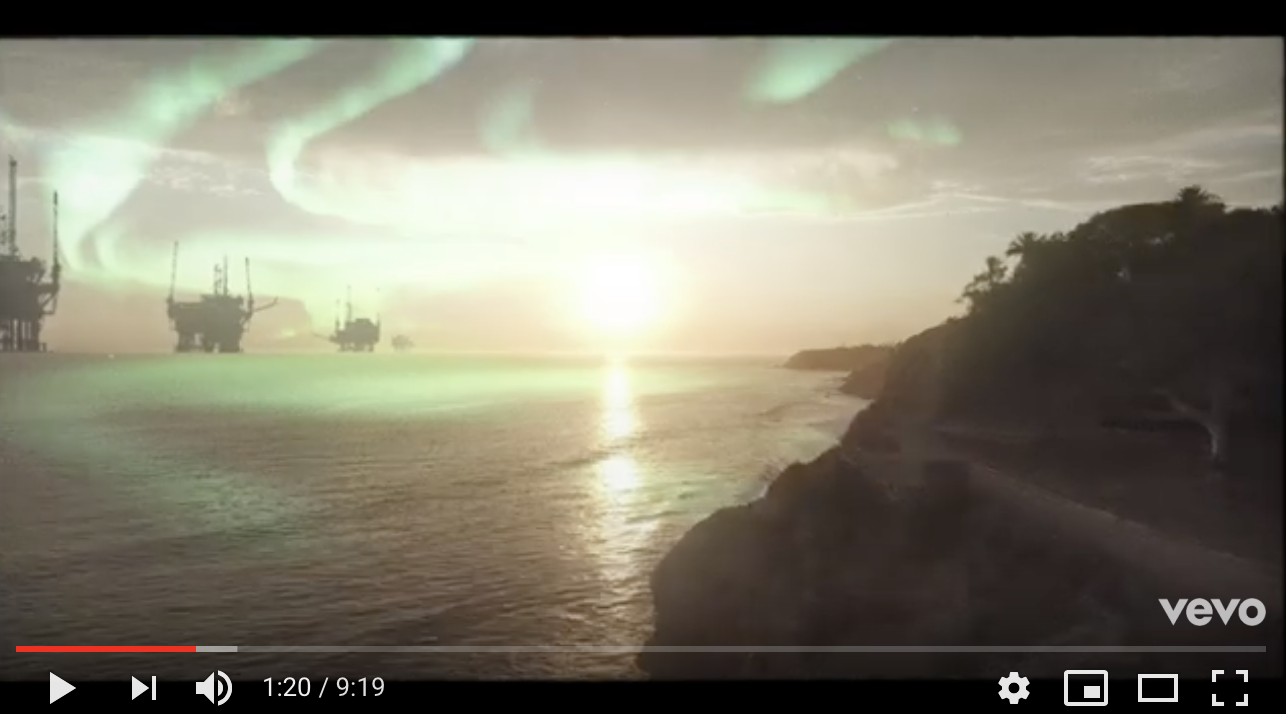
What does it mean to sing: ‘I’m facing the greatest / The greatest loss of them all’. To sing this on the brink of a hyperreal sunset, to chase a solar excess among loss. This loss could be a love but it is more like a culture; it is more like a voice and the condition from which to speak or sing it. The loss of lyric, its possibilities of address, and the loss or deferral or ruination of place itself. Maybe this is Lana’s lyric maturity, a generational acceptance that ‘young and beautiful’ is no longer the apex state of what we should strive for. Absence tenders complexity. Is this, as Roy Scranton puts it, Learning to Die in the Anthropocene? This question of mutability, the green-winged eye that sees a darkening world, a lack of birds along the bay, an edge. In the video for ‘The greatest’, Lana’s jacket reads LOCALS ONLY on the back. I google the phrase and find a hipster restaurant in Toronto with the slogan, LET’s PRETEND THIS NEVER HAPPENED. There’s a kind of parochial nihilism that glisters like the light on the sea, but the sea can never be local only. There’s a boat in the video whose name is WIPEOUT. It’s all happening; the signals are obvious. How we are practicing the absent-presence of the name’s erasure. My tongue gets twisted when I say anthropos; I want to say mess, I fall into ‘guest’ and ‘gesture’. With its glaring cinematics, LA offers the hospitality of light. But it is an exclusionary light. For now, only some of us get lit, get to the mic.
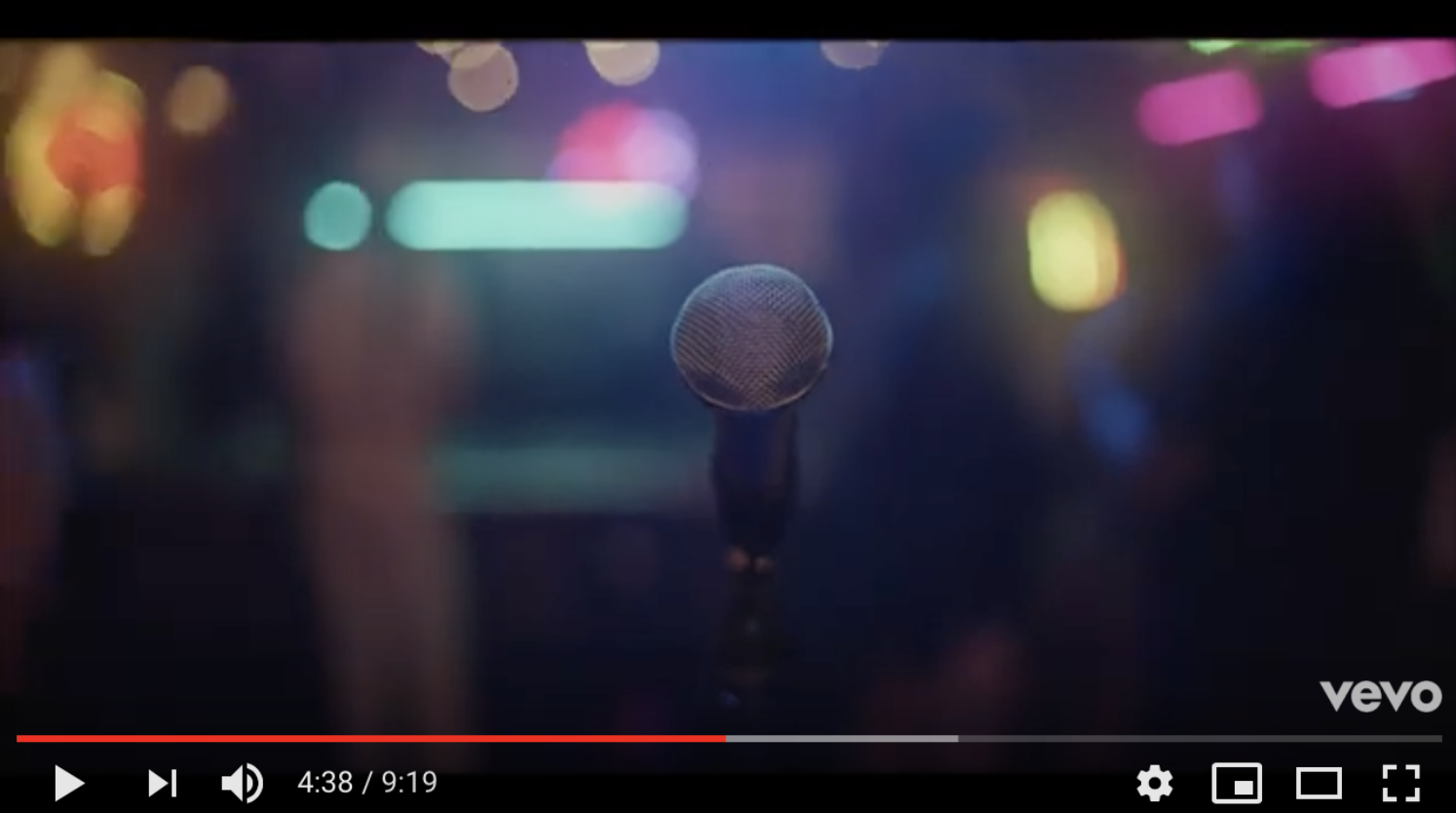
Lana sings from within the metallic architectures of LA’s coastal infrastructure, the port. In the bar, she throws a dart and misses her target by a nonchalant smidge, knocks the 8-ball towards its pocket. I keep thinking about exports and imports, what we put out, take in and trade. Economies of luck and depth and surface. Maybe Lana is a hydrofeminist, her soaring lyric gesture recalling a hauntology of America as that dreamscape of what lies beyond or in the deep. And now we know it is further extinction, precarity, hardened borders. What do we do with that looming closure? Lana has shrugged off her jacket now, she’s smoking in the kitchen where the lid slides off the pan to let the steam out. I’m not saying we’re sitting on a pressure cooker here. There’s simply work to do, mouths to feed, ears to fill. This is a ballad, a paean to the transient, fragile beauty of everything. The songs shown again on the jukebox are songs of a type of blues specific to oceanic or cosmic consciousness, to hunger, the time of lost summer or that of a broken love:
Janis Joplin — ‘Kozmic Blues’
Dennis Wilson — ‘Pacific Ocean Blue’
Sublime — ‘Doin’ Time’
David Bowie — ‘Ashes to Ashes’
Jeff Buckley — ‘Last Goodbye’
Leonard Cohen — ‘Chelsea Hotel #2’
I’ve spoken before of what ‘anthropocene sadcore’ might look like in poetry. I’m still working through that. It comes from the common phrase used to describe Lana’s music, ‘Hollywood sadcore’. I’m interested in how that emphasis on mediation, transmission and cinema plays out in our understanding of ecological emergency, but more generally the existential condition of the anthropocene, which places us as geologic agents under the generalised, gendered rubric of Man. Maybe Anna Tsing’s feminist work on the ‘patchy Anthropocene’ could be applied to the cut scenes of a glossy Los Angeles caught on video. A patch is also a software update, where comprised code is ‘patched’ into the code of an executable program. Maybe the patchy anthropocene involves this kind of cultural patchwork: the lament to a love or a culture is patched to include this bug of ecological consciousness — the patch is a kind of coded pharmakon, poison and cure for apocalypse blues. But Lana paints in shades of yellow too. Blue and yellow making aurora borealis green. A cosmic gesture to what lies beyond thought. And what of those oil rigs in the distance, glistening. They form an audience to the siren’s lament; they are part of this story, and we are mutually complicit. Where the magnetism of the male gaze is often part of Lana’s canon, here it is mostly replaced by oil rigs — supplementary Man as the infrastructure of anthropos, looking back at its melancholic, warning siren. Softcore is less affective than sadcore; it is the ambient hum of climax coming. Its cousin is the slowcore, luminous melancholia of a band like Red House Painters, perhaps: ‘Purple nights and yellow days / Neon signs and silver lakes / LA took a part of me / LA gave this gift to me’.
In Bluets (2009), Maggie Nelson writes of a restaurant she used to work in, where the walls were ‘incredibly orange’. After each shift, collapsing exhausted in her own home, ‘the dining room’ of the restaurant ‘reappeared in my dreams as pale blue’:
For quite some time I thought this was luck, or wish fulfilment— naturally my dreams would convert everything to blue, because of my love for the colour. But now I realise that it was more likely the result of spending ten hours or more staring at saturated orange, blue’s spectral opposite.
(Nelson 2009: 43)
Orange and blue, water and flame. The mind’s alchemical transformations reveal the way colour works chiastically upon us. I think of Freud’s mystic writing pad, the waxen surface of memories allowing for palimpsest versions of stories that trace and erase. ‘This is a simple story’, Nelson writes, ‘but it spooks me, insofar as it reminds me that the eye is simply a recorder, with or without our will. Perhaps the same could be said of the heart’ (2009: 43). ‘Fuck it I love you’, sung to the blue-orange wall until something comes off that surface like a static or fizz. Irn bru, ironed blue. There is quinine in my dreams of hungover labour. Surely there is a violence to this particular love, that is staring, necessary. The love of what must be limitless hurts.
Janis Joplin’s ‘Kozmic Blues’ rises to a swell, a jostling of guitar licks and urgent, assured vocals. A sonic thickening. ‘So mastered by the brute blood of the air’, H.D. writes in ‘Leda and the Swan’. Held in that vascular shudder that acclimatises to a manmade world, what happens next is a loosening, a shimmer, a shrug of the garment. In the poem or song, in the painting or film, in the collapse of that wave into a bluer future. To incur a kind of erosion and yet live on in those terminals. ‘There’s a fire inside of everyone of us’, Joplin sings, and I think not of flames but of cinders. ‘At what temperature do words burst into flame?’, asks Ned Lukacher in the introduction to Derrida’s Cinders (1987), ‘Is language itself what remains of a burning? Is language the effect of an inner vibration, an effect of light and heat upon certain kinds of matter?’ (Lukacher 1987: 3). I know if I did not write I would smoke. These acts of temporality in its material extinguishing. What makes the remembered restaurant blue, not orange, is something of this transmogrified smoulder — an inversion akin to af Klint’s swans, demanding that splash of blue. When I write, am I pursuing the absent space of that skyward blue? ‘Blue is the colour of the planet from the view above’, Lana swoons in a song (‘Beautiful People Beautiful Problems’) from her previous album, Lust for Life (2017). But in Norman Fucking Rockwell, Lana’s California album for 2019, it’s less of this ‘above’ we see. We are held within the infrastructure, cinema, the end of summer. The dreamlike logic of How did she get on that boat? When did she enter that room? Who put that song on the jukebox, baby?
I want to say:
It takes an ocean not to break a planet.
It takes not a planet to break a species.
Lana’s voice grows wispier as she sings of that burnout. There’s this imperative that okay we could enjoy this with American flags, we could pour communal Jack and go down in flames. We could riff the history of our culture in archives of song, gestures and nods of reference. Ladies of the Canyon, Cinnamon Girl, Norman Fucking Rockwell. We could keep laughing or dancing while the world is or was at war. Lana is both behind and at the bar, the sightline of where we go to be ‘served’. Intoxication is the order of the day and we call it ‘fun’ to put the fucking of other people’s desires under erasure, strikeout, as Bolland does.
If this is it, I’m signing off
Miss doing nothing, the most of all
Oh I just missed a fireball
L.A. is in flames, it’s getting hot
Kanye West is blond and gone
“Life on Mars” ain’t just a song
Oh, the lifestream’s almost on
(Lana Del Rey, ‘The greatest’)
‘Miss doing nothing’: post-recessional ennui becomes the paradoxical happiness of living in static, not working as a kind of work that resists the future as set out by capitalist horizons of accumulation. We used to just ‘hang out’ and several other dreams of youthful nostalgia. Kids of today can’t even touch that innocence. We know so much; maybe or probably they know more. We are all variously entranced by the softcore unfold of this happening; we are all variously called upon to be complicit, to recycle, act, resist. To speak or not-speak. To be in one of many different levels of rising heat. The conditional state of being’s value, ‘If this is it’, in the anthropocene raises its pitch to a charge. To sign off is a form of surrender that gives up the name for the blur of species. I think of Lars von Trier’s Melancholia, the planet that would smash us and yet somehow Lana dodges it, that.
The audience in the bar where she sings are mostly men, but their gaze is not sexual, as in much of Lana’s prior visual oeuvre. Rather, their longing gaze, often filtered through further glass, is something like the profound melancholy of a multi-generational sense of this loss. These old men have lost the planet, the one they grew up with, just like Lana’s siren, come from some other time, a life ahead of her steered by the changing climate, the hurt and vengeful seas. The camera holds close ups on their staring faces. The song holds the long durée of a loss that spans generations, damages and is damaged by elders, sparks in the present-tense of cultural tendency. In Lana these men look to a future hurt whose cause was partly theirs, as inheritors of industry: she is both victim and heroine, singing and swinging. The shot opens out to reveal her smiling with younger friends, her own generation. These intimacies are what we have left. The next shot shows some kind of factory or refinery leaking smog into a cloudy, overcast skyline, sulphured yellow. Once again the boat appears with its title, WIPEOUT. Lana is supine on the bow at sunset. She is golden, angelic, silhouette. It’s like she missed the fireball but melted it, cooked it up for tea, apocalypse syrup. Things are going down around us. She hugs her arms, later standing, laughing with a dreamlike intimation of imagined elsewhere, closing her eyes. Be hospitable to yourself and others. The reel of the jukebox keeps ever turning: this is our ever faith in culture. We have to take care of what’s left in whatever space we can make of song, duration.
But the mainstream disciples and idols of Hollywood are failing, Kanye West is ‘gone’. Surely a reference to Elon Musk’s plans to save us by colonising Mars, ‘“Life on Mars” ain’t just a song’ is sung with a melancholy matter-of-factness, a kind of sigh which implies the banality of techno-utopia in a time of extinction. The thrill of such dreams is lost now. We lost our faith in Hollywood, lost our faith in the movies and the scale of those solutions. In a world without books, we’d be ‘bound to that summer’, addicted to one of many narcissistic ‘counterfeit[s]’ to make love to nightly in futile repetition — that would be, as Weyes Blood sings, the ‘Movies’.
What we look back with:
The trauma is not, in the Freudian lexicon, this or that violation from the world (such as war), but the ill and trauma of this originary installation of “the cave”—what could properly be called the cin-anthropocene epoch, particularly given that the era of modern cinema is to be regarded merely as an episode: that of the machinal exteriorization of the cinematic apparatus, given that it coincides with the era of oil (artefacted “light”), given that its arc coincides with that hyperconsumptive acceleration leading to mass extinction events, ecocide, and an emerging politics of (managed) extinction.
(Cohen 2017: 246)
The trauma of greatness as such is this accelerated promise of the dream, the event, capitalist growth, the movie itself — whose imperative is towards scene, closure, episodic narrative in demand of the next. But the drinks in this video are barely drunk; they are more like props. Everyone is aware of their place in the tableau vivant of the anthropocene, even in its softcore, consumerist pop expression: the iconography of oil rigs, downbeat affect and intergenerational longing. Not a violation from the world so much as the stream, and where its accumulative logic would eventually come to crisis, even as corporations beyond our imagining were already plotting that logic of a break within archival excess: the feverish incineration of the present, the smoulder and melt that smogs and spreads and streams.
Fire is there or it is not there. […] But surely there is a word for that moment when a fire log, beneath its bark, has become one immanent ember, winking like a City or a circuit board; for that moment when you know only the desire, no, the need to stir it up. What is on fire, you ask yourself, staring into that waiting. What is that moment. What is that word.
(Lennon 2003: 434)
The nights ‘on fire’ that Lana sings of are those of the Beach Boys, reprieve of the sixties; the bar on Long Beach that served as a ‘last stop’ before the tiny island retreat of Kokomo. Frank O’Hara died on Fire Island. Fire is presence or absence, but there is a moment before it is both. A slippage between the extinct and extinguished. And the world was lit up as before. I wonder if the word Brian Lennon looks for is simply ‘sleep’, the title of his essay which I first read in John D’Agata’s anthology, The Next American Essay — with intimations of that Lana song, ‘The Next Best American Record’. What is with America and the positioning of the next. A constant state of pressurised imminence that streams and streams: ‘We lost track of space / We lost track of time’ (‘The Next Best American Record’). We sleep into death or spirit. My first legal drink was a fireball whisky, in a pub by the sea they built in a church. That moment when you know only the ‘need to stir it up’, fanning the flames. That impulse towards blitz feels extra political in these contexts. We need something of relief that would stream, and in that flow be more than a question. Something of cinders, drifting.
In Lana’s song, I’m interested in this word ‘lifestream’, which seems like a slippage from the more familiar internet-lingo, the ‘livestream’: the coming live that seems provisional to digital retro-future, the promise of satellites beaming the present, simultaneously. Lifestream, instead, is a vascular imaginary of bodies flowing together. ‘LifeStream’ is actually the name of a blood bank serving the Inland Empire and its surrounding areas. Lifestreaming is, Wikipedia tells me, ‘the act of documenting and sharing aspects of one’s daily social experiences online’. It is the flow of the timeline, akin to the wall, the blogroll, the feed. But here, at the end of the song, the promise of information’s overflow is in a liminal state — ‘almost on’. Extinction’s monetised data cast as the simultaneity of thick presence spread by millioning participants. We are here and we said something, our words were atoms, splashes of blue. We stream towards a life, cut ourselves short on the fragments of others’ desires. Mortality’s softcore contingent. The fear of missing out is assuaged by the narcotising work of cinema. And if this is it, Lana has already signed off. It’s something more like her spirit that’s here for us, the stream of an echo, fold of a song that we could replay, continue voicing. Hope lies in the circadian rhythm, the lived time of a pause in the anthropocene’s ceaseless, cinematic duration — that which we see and drown our hearts in. As Jean Rhys’ drunken, depressed protagonist of Good Morning, Midnight (1939 – the year WWII began) muses, ‘Well, sometimes it’s a fine day, isn’t it? Sometimes the skies are blue. Sometimes the air is light, easy to breathe. And there is always tomorrow….’ (Rhys 2000: 121). And what if tomorrow was the greatest loss of them all?
~
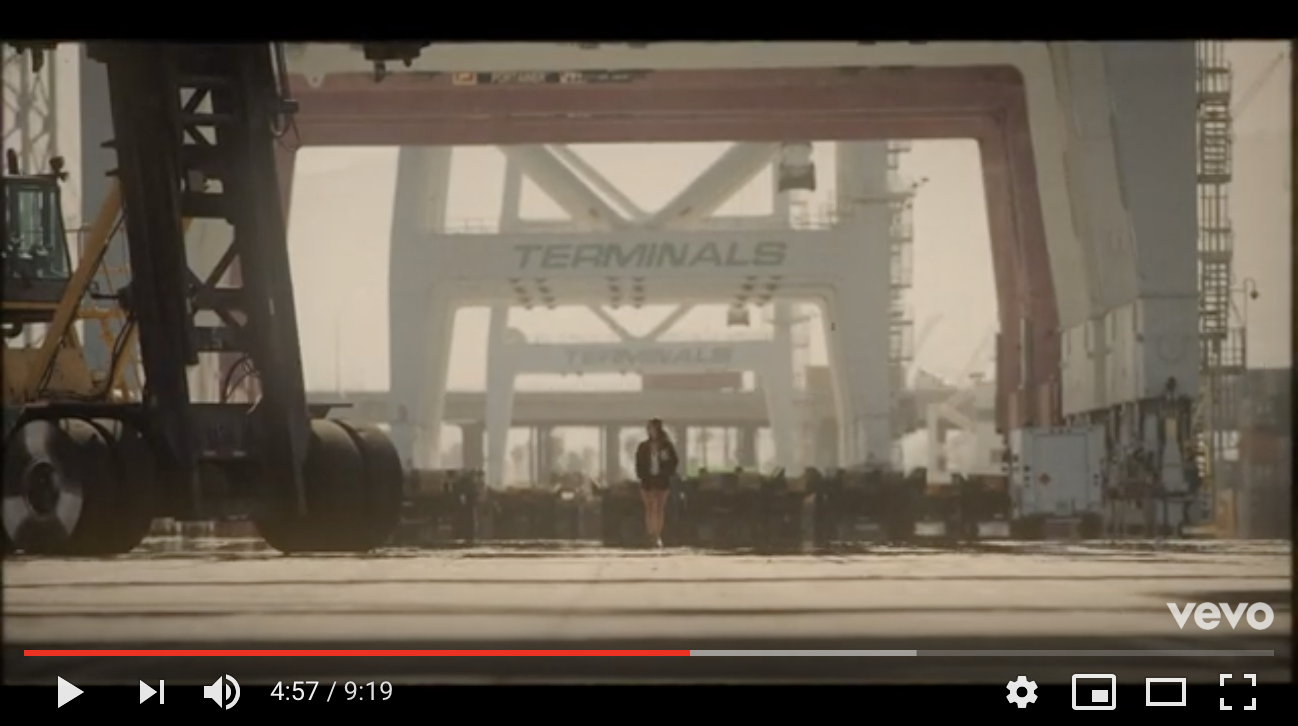
All screen grabs taken from here (Director: Rich Lee) and here (Director: Natalie Mering).
~
Works Cited:
Bolland, Emma, 2019. Over, In, and Under (Manchester: Dostoyevsky Wannabe).
Cohen, Tom, 2017. ‘Arche-Cinema and the Politics of Extinction’, boundary 2, Vol. 44, No. 1, pp. 239-265.
Fitzgerald, Zelda, 2001. Save Me the Waltz (London: Vintage).
Jamie, Kathleen, 2012. Sightlines (London: Sort of Books).
Lennon, Brian, 2003. ‘Sleep’, The Next American Essay, ed. by John D’Agata, (Minneapolis: Gray Wolf Press), pp. 427-234.
Lispector, Clarice, 2014. Agua Viva (London: Penguin).
Lukacher, Ned, 1987. ‘Introduction: Mourning Becomes Telepathy’, Cinders, trans. by Ned Lukacher, (Lincoln: University of Nebraska Press), pp. 1-18.
Moten, Fred, 2017. Black and Blur (consent not to be a single being) (Durham: Duke University Press).
Nelson, Maggie, 2009. Bluets (Seattle: Wave Books).
Rhys, Jean, 2000. Good Morning, Midnight (London: Penguin).
Riley, Denise, 2000. The Words of Selves: Identification: Solidarity, Irony (Stanford: Stanford University Press).
Scranton, Roy, 2015. Learning to Die in the Anthropocene: Reflections on the End of a Civilisation (San Francisco: City Lights Books).
Stiegler, Bernard, 2017. ‘The Proletarianization of Sensibility’, boundary 2, Vol. 44, No,. 1, pp. 5-18.
 mariaology