

Dorothy
I worked in the morning
A very fine morning
A fine cool pleasant breezy day
A fine day
We walked in the evening
In the morning we walked
Very cold
Putting linen by and mending
Came home
Very hot
Dried the linen in the morning
My head bad and I lay long
Rain in the night
In the morning I copied
All the morning I was busy copying
Gathered peas
Still very hot
Received a letter
Very warm
Still hotter
A very rainy day
A fine morning but cloudy
Dullish, damp and cloudy
A very cold morning
I was not well in the morning
A fine sharp morning
In the morning walked up to the rocks
In the morning worked in the garden
I walked to Ambleside with letters
A very fine warm day
Ironing till tea time
A very fine day with showers
Went often to spread the linen
Incessant rain from morning till night
Warm and mild
Baking bread apple pies
A coldish dull morning
Hung out the linen
Walked
Walked I know not where
Coleridge dined with us
A fine sunny and frosty morning
We sate in the house in the morning reading
Still a cloudy dull day, very dark
I have neglected
Poole dined with us
Rain all day
Rain all day
We rose early
Went a part of the way home
I have forgotten
A pleasant morning
Turned towards
A foggy morning, but a clear sunny day
A clear sunny morning
I lay down in the morning
A mild morning
Walked through the wood
Walked to the sea-side
A tolerably fine morning
A showery day
A mild morning
A sweet delightful morning
A very rainy morning
A dullish rainyish morning
A thorough wet day
Coleridge came
A sweet mild morning
A cold dry windy morning
Ironing
Walked to Rydale
William better
A fine October morning
All the morning mending white gown
We rose by candlelight
We put the new window in
Omitted
Made bread
We walked round the lake in the morning
A very fine beautiful sunshiny morning
A very fine day
Set forward
…
The green paths down the hillsides are channels for streams.
(Each line of this poem is sampled from the opening lines of Dorothy Wordsworth’s diary entries.)
Source text:
Wordsworth, Dorothy, 1971. Journals of Dorothy Wordsworth. 2nd ed., edited by Mary Moorman (Oxford: Oxford University Press).
Observations of Sky
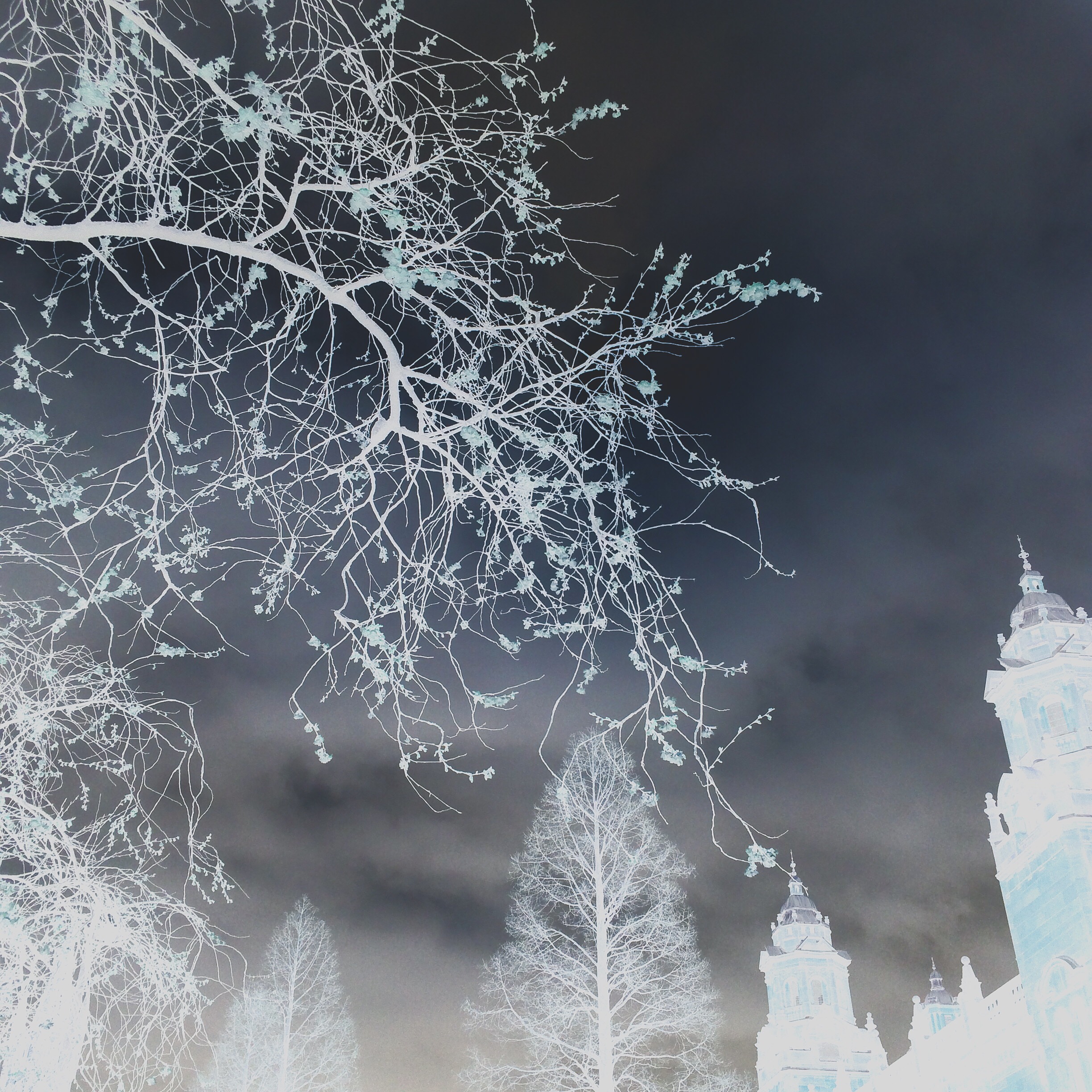
[Exercise in which I recorded the sky over nine days upon waking.]
10/3. The sky today is a grey recalling opals. Something of a swallowing grey, an inversion of light. An all-consuming, elderly grey. It feels smooth enough to resist osmosis and yet it manages to yearn its way into you, needling the soul. A grey that knows mortality, even as it gapes its ceaseless ugliness. A grey you’d pearl into a necklace, then hate it.
11/3. The sky today is the slightly off-white of old furs, you know the kind that’ve been festering in vintage shops a little too long. Demographic time-bomb. Once clean bleached, now a bit lossy on the gleam front. You couldn’t picture Kate Moss starrily circling a red carpet in this kind of white. It’s sorta depressing; an off-white mother’s day. Facelift.
12/3. The sky today is white again, but the kinda white with a glow behind it, promising future glimpsing blue. Maybe that’s an audiovisual effect of birdsong, deceiving me as to the premise of spring. The sky is a white that goes on forever. You have to lift yourself up mountains to see where it breaks into greys and golds, watercolour perimeter slowly blurred.
13/3. The sky today is spread with the aquarellist promise of blue. It is still early, before 10am and there is hope for sunlight later in the day. It is a true March morning, the kind I remember from beautiful hangover walks two years ago, savouring the fact of my company and an energy I’m sure I didn’t deserve. Spiralling & dashing like a girl again, not needing a drop of anything. The clouds are faint but everywhere, leaving the blue slightly mottled beneath and I think of canopy shyness–left faintness of yesterday’s rain which I missed anyway, being inside all day. Imprinted silhouette pretty. It is hopefully a blue for opening daffodils.
14/3. The sky today is grey again. This is the unmistakably fatty grey that speaks of climatic sickness. It is grey going backwards, clustering soot upon styrofoam. Some elements clicked together to make a nasty residue, spread like paté or peat across where clouds might be; but no gaps in between, no alterations of colour. It is all the same grey. It is all of a thickness, bubbling. I wonder who clutches the knife to prise it.
15/3. The sky today is grey again, but imbued with a stony blue within it. Tricky to explain, a certain weight. Completely opaque. Maybe algaeic. Can hardly imagine it ever breaking again, breaking to blue. I find myself longing for that Frightened Rabbit b-side, and the line, Well the city was born bright blue today. Clacking my feet upon fresh pavements; the westerly smell of warm tar, marijuana. Maybe I’ll wake up soon to that topsy-turvy, luminous feeling. It is like somebody took wax and ripped off the beams of sun, so all that’s left is the gluey residue, sweat-stained and delirious between earthly dimensions.
16/3. The sky today is a discharge grey, clotting so gross into its own thickness. It has not broken for days beyond sprinklings of rain. It is a turgid and bodily grey, waiting to burst. It is a hundred mixed-up medical metaphors. I listen to the pale road roar and the twinkles of sparrows. Mostly the sky is just grey though. I watch a video of people kissing inside cellophane.
17/3. The sky today is much more blue. I dream I bought cornflower underwear. Oh, this blue. Powdery and fragile, but blue nonetheless; you can see it made out against white patches of cloud that are not quite summer white, cotton white, but white of a sort. It is such a relief for this briefness of blue. Blue you might achieve something in, except I am so tired I succumb to rested eyes, closed lids, the watery exhaustion that leaks between lashes like a great whale expelling its plankton, mistaken plastic.
18/3. The sky today is heavy as a belly about to give. It presses down, sags with white. I hope somebody administers a drip to silently remove its snow. Through the back entrance, back to heaven. I cannot handle any more snow. Never mind silent spring, what of invisible spring. All the frost and snow crushed out the crocuses. Will I even see a single row of good daffodils this year? I fear I won’t. I am reading Dorothy’s journals for practice, or some sort of vernal supplement. Of course more skiffles start drifting, but it wasn’t supposed to snow after 1am and now it’s 11:11, the witching minute, and I can’t help but wish for a flourishing kinship. The sky will resolve its millioning creases into further whiteout loneliness, so I make do down here, terraforming my future.
 Why Don’t We Just Cull Humans?
Picture the wild deer: all elegant neck, soft fur, tawny eyes staring back at you like butter wouldn’t melt. The stag too: a rare glimpse of those striking antlers flashing through forest leaves or the wire mesh of a fence, gazing gallantly over the hillside – a little like a proud lord, a patriarch admiring his land. There is something quite British about the graceful deer; something evocative of country outings, of heritage and sprawling estates, of heads rather unceremoniously stuck on pub walls.
Today, there are more deer in the UK than in any time since the last Ice Age[1]. It seems poetry is the wrong way to go about this; deer have become a real issue.
On the radio this morning I heard reports proclaiming new figures representing an excess in numbers of British deer. Deer, it is argued, in their proliferation, are posing a serious threat to British biodiversity. The overspill of deer will lead to more traffic accidents, more damage to crops and a drain on natural resources. With estimates of the current deer population positing 1.5 million, new research has suggested it will be necessary to kill off 50% to 60% of the animals to fully address the problem[2].
The above arguments may seem persuasive reasons for tackling ‘The Deer Problem’, but I would like to step back and question these fundamental justifications given for widespread slaughtering. I want to question the idea that the – let’s face it, unintentional – disruption of food-chains by deer warrants their culling.
My objection to culling derives not from an inherent concern with the ethics of killing animals – the morality of the practice of culling is another difficult issue – but from the premises given to defend culling by appeals to the negative consequences of an excessive deer population.
The problem I have with culling can be understood by considering a convincing argument offered by Australian philosopher and rights activist Peter Singer. Singer declares, somewhat radically, that ‘all animals are equal’[3]. Yet this statement is not as controversial as it appears. By ‘equal’, he means not that we should treat all animals the same – Singer is not justifying giving rabbits the right to vote or freedom of speech to chickens – but that we should give equal interest to all creatures, regardless of species. Singer points out that any claim asserting the superiority of human beings over other animals is arbitrary, speciesist.
Speciesist? Why?
Consider the reason we typically give for justifying the accordance of moral supremacy to humans:
1) Humans are rational creatures, or at least significantly more rational than other animals, and this makes our lives intrinsically more valuable.
Singer’s problem with this is that not all humans are rational. What about a child with Downs Syndrome, or a person in a coma? What makes them more superior to say a highly-intelligent primate if they lack rationality? Consequently, Singer states, any attempt to argue for human rights over animals is going to run into the problem of speciesism, since there can be no universal claim for the rationality of all humans. Speciesism is just like racism or sexism, in that it appeals to untenable claims about the essentially superior ‘nature’ of a particular race or sex which gloss over the reality that not every person within a race, sex or species shares these characteristics. If the sexist argues that men should be paid more because all men are more intelligent than women, his argument is rendered invalid by the stark fact that this is a sweeping, fallacious generalisation. Likewise, the speciesist cannot justify exploiting animals for human need by claiming humans are intrinsically superior because all humans are more rational than animals.
Therefore, for example, an argument justifying animal vivisection to support the more-valuable lives of humans (by exploring cures for cancer) will have to concede that this argument also, logically, licenses vivisection on non-rational humans. And I think most people would agree this seems a little distasteful.
Singer’s argument is compelling: the only relevant consideration that unites all humans, then, is sentience – the experience of pain and pleasure. An experience inherent to the lives of most animals and all humans.
Back to deer then.
The justification for culls is primarily their threat to the food-chain: too many deer means too much consumption of natural resources, too much disruption to the natural environment which other animals are dependent on. Deer, munching and treading and stomping all over our country’s flora and fauna, are threatening other wildlife. All very well.
But what about us? Aren’t we a threat to wildlife? What about our fossil fuel omissions, waste disposal, annihilation of forestry for paper, our excessive industry, infrastructure? Our pollution of lakes and rivers? Surely all this amounts to much more destruction than an overabundance of deer trampling on the landscape and eating too many acorns?
Well, it may be argued that we are humans; we are entitled to do these things because they fuel our rational progress towards more enriching lives. What gives us the right to think the world is ours to destroy, but not that of the deer? I would argue that our threat to the food-chain is significantly greater than that of our deer population, and yet I hear of no ecological experts advocating human culling.
Let’s be clear: I am not advocating human culling. But think about it: are we morally justified in killing deer because too many of them destroy the environment, when we wouldn’t do the same to humans, whose excessive population is also consuming too much of Mother Nature’s milk, and tainting it with acid rain in the process? If there is no relevant moral distinction between humans and animals, I find arguments which devalue animal life in favour of maintaining human interest deeply problematic. And after all, this isn’t just about preserving nature for nature’s sake, this is about preserving nature for people – for farmers, ramblers and future generations.
I acknowledge that there may be other reasons why culling might be justified – I am no environmental expert. Reducing deer numbers may work in the favour of their species, as too many deer means many will starve due to lack of resources. It is obvious how this can be turned around to humans: again, most people would object to human-culling because there isn’t enough bread to go round. Therefore, if there is no plausible moral distinction between humans and animals, then culling is difficult to morally justify, even if it produces certain good consequences.
It’s a thorny issue, and one that people often don’t consider; culling doesn’t seem to raise the same controversy as animal testing, hunting or meat-eating, because it is seen as a largely benevolent, if a little unpleasant, way of improving conditions for people and wildlife. I believe, however, that we should be concerned – at the very least, philosophically – with the flawed argument that lies at the heart of culling practices.
 mariaology