On Words, Romanticism, Ramblings and Meanderings

I am coming to the end of the Glasgow Uni Creative Writing Society’s ‘Flash Fiction February’ Challenge. The aim is to write one piece of flash fiction a day, following prompts that are posted on the blog. The best thing I have probably achieved since I wrote my 10,000 word ‘The Quest’ story (complete with self-made Photoshop image and realistic fire effects) aged eleven is successfully averaging at least 700 words a day for a whole month (some days writing 700, other days moving upwards of 1300…). The reward is not just having a little portfolio of stories to go back and edit in the summer, but the habit of discipline that’s been earned. I have learned that I need the motivation of ‘completing something’, and that sharing one’s work and discussing it with others helps to feel better about writing. There is also the satisfaction of word count. If I averaged at least 700 a day, then that’s at least 19,600 for all of February. If I doubled my word count and did that for two months, I’d have a respectable 80,000 word novel. It’s an encouraging fact. Even if the content is sometimes pretty crap, I have something to work with! I just have to keep up the daily habit. It’s a bit like crack, only not so addictive, and cheaper. And, well, you have to work for its effects.

One of my fascinations is with the daily routines of successful writers. Not necessarily just literary authors, but philosophers, artists, journalists – even mathematicians. Anyone who gives up a significant chunk of their day to solitary writing, creating or just working. There is a fabulous blog called ‘Daily Routines’ which is the ultimate procrastination: putting off work by reading about how others work. It’s refreshing to see that not everyone needs a wee dram or French cocktail to get the imagination flowing, though it seems to be a recurring theme. As well as the time of day and the choice of stimulant, I’m a little bit obsessed with peoples’ medium: the effects of the pen, pencil or keyboard; how one’s writing implement impacts upon their style, speed and even argument.

Susan Sontag. Source: nymag.com

For instance, Susan Sontag on her writing routine:

I write with a felt-tip pen, or sometimes a pencil, on yellow or white legal pads, that fetish of American writers. I like the slowness of writing by hand. Then I type it up and scrawl all over that. And keep on retyping it, each time making corrections both by hand and directly on the typewriter, until I don’t see how to make it any better. Up to five years ago, that was it. Since then there is a computer in my life. After the second or third draft it goes into the computer, so I don’t retype the whole manuscript anymore, but continue to revise by hand on a succession of hard-copy drafts from the computer.

[…]

I write in spurts. I write when I have to because the pressure builds up and I feel enough confidence that something has matured in my head and I can write it down. But once something is really under way, I don’t want to do anything else. I don’t go out, much of the time I forget to eat, I sleep very little. It’s a very undisciplined way of working and makes me not very prolific. But I’m too interested in many other things.

One day I want to write a big essay looking at how writing style changes according to how you get the words on the page (I even bought a beautiful typewriter to test that out). I love the idea that Sontag uses layers and layers in her writing and editing: the process of writing on top of writing, of scrawling and scoring out like the palimpsest diary Cathy in Wuthering Heights creates on the margins of a bible. Like Heidegger with his under-erasure being.

I also find it fascinating how people can study and write with music playing around them. I used to be a lover of total silence: a pure space in which I find the need to fill up the void with words. Now I can sometimes do with a bit of ambient sound: coffee shop clattering, birdsong, falling rain and so on. It makes a difference whether you are in the actual space (writing in a real garden or a coffee shop, for instance) or in the hyperreal zone of generated sounds (there are excellent Youtube sources of ambient sound, from whale-song to fire crackling in a grate). One will distract me to write about immediate details, the other soothes you into a weird creative ‘roll’ where you can pour out your words or nonsense like code streaming out in hyperspace. OK, I’m being self-indulgent.

And indeed, there is a self-indulgent aestheticisim to all of this: the endless procrastination involved in selecting the correct font for a piece, the need to rearrange one’s desk or shuffle books or change your pen or whatever it is. Yet there is something more important here that relates to publishing itself and the way literature often gets sucked into a commercial vacuum (think of the likes of the Brownings’ letters or Shakespeare’s sonnets which get beautifully repackaged in time for Valentine’s Day) . The original text is beautified by the paratext, and what is left is perhaps more of a consumer object than a discourse of words and sentences. There is an emphasis on white space, the chic luxury of thick paper and the gaps between printed letters. James Fenton said that, ‘what happened to poetry in the twentieth century was that it began to be written for the page’. But what is this page? Is it the sublime landscape of print paper stretching out its possibilities of unblemished whiteness? Or perhaps the virtual page: the ever-changing Internet archive that risks the dreaded 404, this page is missing; that risks alteration and collaboration and manipulation – and is this not a good thing? It is poetry changing, in transition; undergoing the morphological process of the human into cyborg. An automated computer voice reading aloud, staggering over the dashes and tildas and sharps, the onomatopoeia and enjambment like a child having a crack at reading Derrida. Il n’ya pas hors text: there is nothing outside the text/there is no outside-text (he writes in Of Grammatology).  When somebody reads aloud I imagine the words before me, drawing out of the page like butterflies coming to life; I can’t help it, it’s the way I learned to play with poetry. The world I like is the enclosed, shy space between the black ink and the reader’s eyes, the moving lips so silent.

The Mariner's ship and the Albatross. Source: thestage.co.uk
The Mariner’s ship and the Albatross. Source: thestage.co.uk

Like the ‘fluttering stranger’ that Coleridge observes as a child at school in ‘Frost at Midnight’, words in poetry become strange: there is an uneasiness to them that we cannot quite place. Verbs, adjectives and nouns are not what our teachers told us. You cannot fix them to a blackboard, and anyway chalk crumbles. While butterflies might be pinned down and classified by their colours, words are dependent on each other for meaning. So signification sifts in swirls of dreamy reading, and the mind makes connections. The imagination stirs and sometimes forgets them. Footnotes adorn the margins and confuse us, as they perhaps do in Coleridge’s ‘The Rime of the Ancient Mariner’, where we are driven into warmer but often more perplexing territory, as Coleridge’s gloss is less an academic explanation, and more a multiplicity of voices. At once, he joins in the action, ‘Like vessel, like crew!’ – yes, ‘her skin was white as leprosy’ – and we too catch this virus, moving between microbes of words that open and mutate through the strangest imagery. We shift between and through things with Coleridge’s metonymy, as in the gloss: ‘[a]nd its ribs are seen as bars on the face of the setting sun’. What are we to make of this being, ‘a Death’: an embodied spirit whose translucency both stirs and disturbs and amuses us, all at once? Aesthetics and meaning all blur into one.

Mount Snowdon. Photo by by Scott Wylie. https://www.flickr.com/photos/scotbot

With Romanticism what we often get is the journey, the progression through space, selves and substance, and through visual experiences: the sublime, picturesque and the beautiful. Not to mention the ugliness of Frankenstein’s monster, mirrored in Mary Shelley’s own monstrously patchworked collation of tropes and terrors and texts (imagine being raised on Milton but growing up like Rousseau  – being both Satan and a noble savage – now that is Otherness embodied, surely?). We follow Wordsworth up Snowdon and along the Alps in his glorious Prelude, with the seamless switch between interior musings and the expansive, golden panoramic shot that reveals the gaping ice and mountains, the tracks the subject’s wandering thinness:

The unfettered clouds and region of the heavens,
Tumult and peace, the darkness and the light,
Were all like workings of one mind, the features
Of the same face, blossoms upon one tree,
Characters of the great Apocalypse,
The types and symbols of eternity,
Of first, and last, and midst, and without end.

(Wordsworth, Book VI of The Thirteen-book Prelude, lines 566-572).

Where nature itself merges into one terrifying being, where opposites uncannily forgo their differences to become ‘features | of the same face’ and still the sweet ‘blossoms upon one tree’, we are in a sublime landscape, and then in the pastoral garden. The subject stamps himself upon the mountains, as the mountains are stamped upon him; we recall, with the help of the OED, the varied meanings of the term ‘character’: as both noun (a literary figure of self/person; a sign or symbol used in writing, print, computing; a code; the properties of a substance) and verb (‘to distinguish by particular marks, signs, or features’). Wordsworth’s figure is the self encoded in the text, the lonesome Romantic imprinted in his white sublime of Snowdon, going deep into the very properties of the rock itself. All is viscous, melting subject into object. All is, as Timothy Morton so aptly puts it, a mesh: where there can be nothing ‘out there’, as we are all a set of strangenesses, part of an existence that is always coexistence; and yet we are not simply part of a holistic collective, but connected in our differences, in our mutations that separate, stick and undo us. There are those clouds which seem ‘unfettered’ and yet even they cannot rise above the poet’s vision, the tacky link of aesthetic projection that takes nature from unified cliché  to a space of wilderness in which things move between abstraction and reification, and humans move with them in the ambiguous space between – like those viruses that multiply and mutate, ‘first, and last, and midst, and without end’.

This dangerous, homogenised idea of ‘landscape’ can be undone by thinking of it textually: as a palimpsest too of sorts, where human language adds layers to our understanding, alters our relationship with nonhuman things of the living and non-living. In writing and reading ‘nature poetry’, we are reconfiguring our place in the mesh; just as a drop of colour upon a single Paint pixel shifts the impression of the whole picture.

While Romanticism takes us on these messy forays into psyches and space, in the twentieth century we have, as Fenton has suggested, the poem as object: the poem as visual play on the page. The attempt to make the poem an object, to get to the very basics of objects. Think of Ezra Pound’s Imagism: ‘The apparition of these faces in a crowd; | Petals on a wet, black bough’ (‘In a Station of the Metro’). Think of William Carlos Williams’s notorious modernist poem, ‘The Red Wheelbarrow’, in which Williams’s poetics bring the object into stark and colourful being, like an object being rendered on some kind of graphic design program. Assonance coats our visual impressions so that we can almost taste what we see, the wheelbarrow ‘glazed with rain’. On the page, the poem too is a spilling of rain, of long lines dripping into single words, of basic objects hardening, forming. The ‘red wheel | barrow’; the ‘white | chickens’.

The Yellow Book. Source: http://www.johncoulthart.com/feuilleton/tag/fin-de-siecle/

There is also the lovely aestheticism of the fin de siècle: the beautiful margins and separation of art and text in the The Yellow Book, and of course Husymans’s jewel-encrusted tortoise, which eventually dies from the weight of its ridiculous embellishments. Does a text too collapse under the weight of its stylistic ornamentation? The fashion for minimalism perhaps gives way to this assumption, and yet what about the explosive textuality of Finnegans Wake, Gravity’s Rainbow; anything by Henry James, or for that matter, Angela Carter? Art for art’s sake is not a dip into vacuity, but is necessarily a political statement, a textual position, after all. An attempt to escape the shading blinds of ideology. You might write a dissertation on the politics of purple prose; you might float buoyantly along the clear river of Wikipedia readings.

And now I have lost my place in the forest and cannot find the light again. Birds tweet shrilly and their song is like stars tinkling and various shades of darkness hang in blue drapes from the bowers of pine trees. If I look around I see the jewel of every dew drop glisten and I know that it is twilight. I am looking for something particular: that silent speck of a presence; that which evades me every time I turn over each new leaf. Only I know that I cannot see, cannot see the gathering of these particles; the light is fading and soon the day will close its drapes.

These are just words after all, and who would cling to them?

Some further words:

Derrida, Jacques, 1967. Of Grammatology.

Edgar, Simon, ‘Landscape as Story’, Available at: http://www.lucentgroup.co.uk/the-landscape-as-story.html

Morton, Timothy, 2010. The Ecological Thought.

Huysmans, J. K. 1884. À rebours.

Memories from MSN

014400a589401

Few things define the noughties more than MSN Messenger. The spinning pair of green and blue icons, surrounded by butterflies. The friendly window which popped up every time you logged onto the family computer after school, to ‘do some homework’. Forget Facebook, MSN was basically the main communication channel for my generation growing up, and I feel like its recent closure deserves some elegising. Yes, incase you hadn’t heard, MSN (rebranded since 2005 as Windows Live Messenger), is no longer with us. Microsoft forced its clients to give up the nostalgic platform and merge with Skype.

I remember getting my first email address, when the world of social media as we know it was still in its infancy. My cousin helped me set up my first hotmail account, and I was delighted to find that I could call it anything I wanted. I could express my (proto-manic-pixie) weirdness with some cool and random name I made up. I opted for ‘strawberry_bonfire’, an email address which incidentally I still often use (although not for LinkedIn or job applications…). It felt like a rite of passage, typing in my home address for some anonymous computer to process and setting up a password and making an email signature. People could now contact me. I was contactable. I’d have my own inbox. More importantly, I could set up a Neopets account! And an MSN account!

There was something unique about MSN’s interface which sets it apart from the likes of Facebook messenger, or Snapchat. I suppose the emphasis on conversation is key here. Each conversation opened out into a window of its own, although you could group your chats in ‘tabs’ for ease of moving between conversations. There was of course, the odd awkward moment when you accidentally sent someone a message reply that was intended for another person. Gossiping via MSN was a tricky business, which required organisation and attention.

Everything was a beautiful network of colours and messed-up symbols. It took a good five minutes to work out who was who when you looked at your contacts list, especially if your friends had recently updated their names. There was a whole sequence of tildas, dashes and asterisks to sift through before you could pinpoint your pal’s pseudonym or elaborately embellished screen name. I suppose that’s another reason why (not so) secretly I still prefer MySpace and MSN to Facebook…there’s that element of individuality that you don’t really get in the highly structured systems of more contemporary social media platforms. Sure, they’re probably more resistant to coding bugs because of their relative standardisation, but I miss the quirkiness of an amateur’s attempts at html on a MySpace theme, or a smear or rainbow lettering constituting someone’s MSN name. You came to know people not by their boring old real name and photograph (as on Facebook), but by some random avatar and distinctive font. That one friend you recognised when they popped up saying ‘hi’ by their enduring use of cyan-coloured Comic Sans or violet Monotype Corsiva as much as their name. There’s a nice sense of cosiness that comes with this, of online personalities being fabricated, selves being formed in the endless conversations that would eat into hours of an evening. Back then, we were too young to go to the pub, too remote in the country to find something ‘real’ and useful to do like join a sports club or an art class. Even if we did do extra stuff, MSN filled in the rest of our time, extended our social lives.

Then there was the personal message. This could range from ‘ugh doing maths homework’, to ‘Amy You Are My One <3’ and the ambiguous ‘=/’ which would result in a barrage of people asking ‘what’s up?’, only for the person to reply, ‘nothing’. Your personal message also revealed what you were listening to, if you had your iTunes hooked up. This of course stopped you listening to hideously embarrassing music (in theory) and listening to what you thought would impress other people. It was also a good indicator of people’s moods. God knows I wouldn’t start a conversation with someone if they were listening to Secondhand Serenade or Hawthorne Heights…

Then there was the ‘nudge’ function which was brought in later on. The bane of your existence if you were trying to coordinate MSN with homework or downloading or streaming YouTube videos (basically, my ancient computer would crash every time I received a nudge), the nudge would make your screen shake and force you to pay attention to the nudger’s conversation. Luckily you could only send a restricted number within a certain period of time. There was a time when MSN conversations were very precious, back in the pre-Broadband days when you dreaded that fateful phrase from your mother, ‘I’m going to unplug the internet because I need to use the phone’. You had waited so long for that bloody diallup connection to ring through and now you had to hastily sign off with a quick ‘g2g xxx’. To be fair, a lot of conversations basically went like this:

Person A: Hey x
Person B: Helloooooo

Person A: Howz u?
Person B: nb, u?
Person A: gd thanks
Person B: wubu2?
Person A: just hw and stuff, u?
Person B: yeh same

Person B: g2g, byeeeee xxx

Nevertheless, a lot of us had our first breakups, friend fallouts and heart-to-heart confessions over MSN. That, I guess, is where a lot of the nostalgia comes from. Staying up into the small hours on a Friday night having a moan about life to someone, or helping them through something they were going through. You could send them helpful web articles or songs to cheer them up (it might take 2 hours for the song to arrive though), or a funny picture (memes were growing popular). Emoticons back then weren’t the loathsome ‘emoji’ phenomenon they are now (god I sound like an old woman) – they were generally small and unobtrusive (unlike Apple updating your iPad and putting in an emoji keyboard without telling you…) and often served as a welcome substitute from =] or ‘lol’ being added to the end of every message. And then if you were going on holiday you could put the little tropical island or plane symbol in your personal message, and people would know that you were now an exotic thing talking to them from the imaginary world of some hotel abroad (with dodgy WiFi connections).

img25
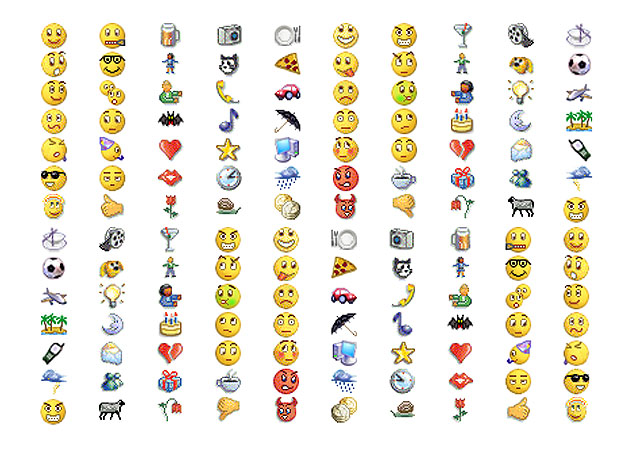
emoticons! all the emoticons!

MSN was in some ways an endlessly frustrating service, but in a way that’s what made it so good. The game of how to talk to someone you fancied without making yourself look like a stalker (wait at least ten minutes before talking to them after they’ve signed in), of working out whether your matter was urgent enough to disturb someone whose status was ‘Busy’. There was always that weirdo online at 4am who you sometimes wanted to speak to and ask what the hell was up with their sleeping pattern. Then there were the endless difficulties with connection that left you kicking the desk underneath your computer and wishing you had one of those newfangled Macbooks or something (I guess this is where the ease of the latest messaging services comes in). I kept a notepad next to my keyboard for a while and it was amazing the amount of doodling I could do in the time I spent waiting for MSN to load; sometimes it was as bad as waiting for a 3GB installation of the Sims!

Source: Urban Dictionary

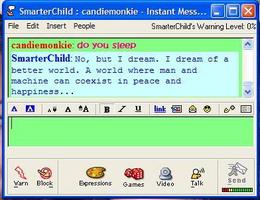
Yes, MSN was great for killing time. If you had friends round, chances were you’d end up on MSN, talking to (berating, more like) SmarterChild. SmarterChild was an instant messaging chatbot, a robot who replied to your message with a complex(ish) formula of responses. You’d send it (him?) lewd messages and he’d scold you for being inappropriate. You could ask him a question about your homework and he’d do his best to look up some (mostly irrelevant) answer. He’d do your times tables, and give you dictionary definitions. If you were in a bad moon, you could take it out on SmartChild. Talking to SmarterChild felt that you were outsmarting all those academic people who were worrying about the effects of inhuman interaction on us children. We were outsmarting the robots here.

There’s a lot of talk nowadays about the dangers of the Internet for young people. Schoolchildren are supposed to be educated about staying safe online, about not talking to strangers or giving out personal information. I don’t really remember getting much (if any) education on this at school, other than, ‘don’t give anyone your phone number’. Remember that familiar acronym which haunted every MSN conversation you had with a stranger: ASL? Standing for ‘Age, Sex, Location’, it was (is?), as Urban Dictionary puts it, ‘what stupid people say on chats to learn who you are and where you live so they can come to your house with a chainsaw and kill you.’ Most of the time I would reply ’99, Cat, the moon’, and then block them, but then that’s just me…I always felt MSN was totally safe. It was so easy to block people (the satisfaction of seeing their little icon turn red!) or appear offline so they couldn’t start a conversation with you. The fact that it was a separate console and not embedded within your browser felt more private somehow, and less like your every word was being tracked with cookies, or sucked into the black hole of some governmental data archive. Facebook exposes a lot more information about you than MSN ever did. All you’d get from the average person’s MSN profile was some kooky screen name, a jumble of symbols and song lyrics and maybe a blurry/’arty’ webcam shot of the side of their face.

One of the earliest academics to properly study the effects of online communication on people’s identities was Sherry Turkle. Her book Life on the Screen: Identity in the Age of the Internet (1995) looked at how people interact via MUDs (role playing games and forums on the the internet), through which they communicated in fictional worlds. I suppose the fantasy-scape of something like Dungeons and Dragons is an example here, but someone with more expertise in what is evolving into online cos-play would surely be able to list many more. Well in this book, Turkle basically argued that such online interactions, which involved the play of masks and multiple identities, were allowing people to develop a postmodern mode of knowledge – they came to see reality itself as a play of surface signifiers, a swirling universe of simulations. Think Baudrillard here, only, Baudrillard getting serious research application (not just armchair academia or The Matrix). Identity becomes a game, a game in which you have some control; as Turkle points out, “One player says, ‘You are what you pretend to be…you are what you play.’”. Simulations basically infect out reality, and allow us to enjoy it like a game, playing out the selves we have created online.

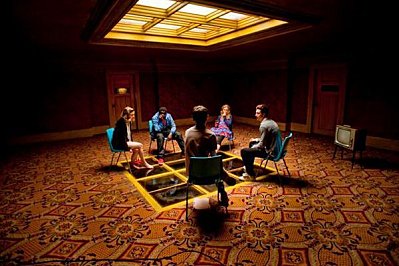
Scene from Chatroom

There are of course, many film and literary representations of the dangers of forging online identities: the thriller Chatroom (2010) stages chatrooms as anonymous hotel rooms, in which teenagers encourage each other to do increasingly disturbing actions in reality, culminating in the most psychopathic character trying to manipulate someone to commit suicide. Jeanette Winterson’s The Power.Book (2000), named after an old Mac computer, delves into the fantasy realm enabled by the Internet, with its chimerical portrayal of a dialogue between two selves (whose names and identities shift). For Winterson, the computer functions as a way of exploring the multiplicity of narratives, the instantaneity of their communication and transformation. Her chapters have names like ‘New Document’ and ‘Search’. Whether she creates a credible Internet Romance (could this be a genre? The Guardian (2000) reviewed it as ‘a virtuoso trip into virtual reality’ ) or a gimmicky spin on vaguely plausible computer jargon is up to the reader. Still, it does link in to Turkle’s ideas about how the Internet has fabricated a postmodern reality of play and possibility.

I’m not sure exactly how much scope MSN offered for that sort of thing. Often, we just used it to chat to our friends as we would in real life. We’d have ‘group convos’ which contained as much shouting (CAPITALS), annoying nudges and confusing dialogue as such a conversation would play out in real life. Sure, maybe we’d open up a bit more online, with the safety of the computer interface. We could tell our secrets to complete strangers, who wouldn’t know our real name and so couldn’t track us down later via Facebook to wreck our lives. We could just block them. So maybe there was a bit of identity ‘play’ there, but mostly it was just an extension of the interactions we had in the park, on the bus, in the playground. It wasn’t a simulated, enclosed environment in the same way a chatroom online is; it wasn’t a specific ‘zone’ – it was a console that you opened up, a kind of tool as opposed to a virtual reality. That’s how it felt to me anyway.

Throughout my teens, Piczo, MySpace and Bebo would come and go, fading into the recesses of an Internet shadow-world that secretly archives every scrap of your self that was once uploaded online. But MSN was faithful, erasing every conversation into the imaginary ether, so that only you could read over previous conversations (if you had ‘chat logs’ switched on; but they certainly weren’t searchable online in the same way your dreadful Piczo account was). MSN was the gateway for many friendships, a forum to vent frustration and a place to play chess with a stranger from America who added you because his cousin knew your friend or something. A place where you got a pleasant kick from signing on and seeing the ghost message of someone who’d tried to talk to you when you were offline. You felt that important. A place of horrific fonts: ‘яσ¢кιи ιи нєανєи, 2кαιι7’ and fondly irritating screennames (my own include ‘Whatsername’ (yes, a riff on Green Day’s American Idiot – I was a twelve-year-old-wannabe-goff) and Maria Magickk (I promise you, I knew people with worse ‘scene’ names than that; also, I thought the double k was a clever reference to the ‘kk’ which everyone substituted for ‘okay’ on MSN. Oh dear.). Now that MSN has been shut down for good in its final resting place and we all have to migrate to Skype (never!), I guess all that’s left for us Generation Y people is the WhatsApps and Snapchats and other gimmicky chat applications that smartphones have brought us. Conversation these days is less about talking and more about sending emoticons and stupid pictures (bah humbug!). For the rest of us, there’s always the excellent nostalgia trip that is the MSN Memories Twitter account: https://twitter.com/MSNmesenger (enjoy).

the dreaded Troubleshoot message

***

Kellaway, Kate, 2000. ‘She’s got the power’ in The Guardian. Available at: <http://www.theguardian.com/books/2000/aug/27/fiction.jeanettewinterson> [Accessed 3.11.14].

Nakata, Hideo, 2010. Chatroom [DVD].

Neopets(!) www.neopets.com [just cause you have to try it]

Turkle, Sherry, 1995. Life on the Screen: Identity in the Age of the Internet (New York: Simon & Schuster).

Winterson, Jeanette, 2000. The Power.Book (London: Vintage).

Technology and Hardware: Some Sentimental Reflections

stock-photo-retro-ghetto-blaster-cassette-tape-recorder-on-table-in-front-mint-green-background-159525176

It’s funny how I still remember getting my first Game Boy. It was the original one, 8-bit in a lovely yellow colour, feeling heavy and smooth in your hand. My mum had bought it off my older cousin for about £10, and I remember feeling so surprised that she’d got me it for Christmas. I had a few games which were these wonderful plastic cartridges that you slotted into the back of your Game Boy, and you could hear the satisfying click when they were inserted properly. There was the sweet little noise it made as you switched it on, the Nintendo logo fizzling onto the screen, the red ‘on’ light glowing in the corner. The shimmering pixels and the chip tunes of game music.

I guess every generation grows up with some form of technological hardware that seems always exciting and new. Whether it’s a radio, gramophone or mobile phone, people born in the twentieth century have grown up with some newfangled machine that somehow adds to their daily life and experience of the world. I feel like my generation is an interesting one in this regard: we grew up with hardware but increasingly this hardware has shrunk like something from Alice in Wonderland, shrinking until it becomes something ethereal, intangible: a piece of code; a web of communication; a world available not only at your fingertips but at the swift movement of your iris. At primary school, we fiddled about trying to hand in homework on corrupted floppy disks. Now we have smartphones, iPods, Google Glass – and that funny thing, the Internet.

Recently I actually went into a shop and bought an album. That’s a statement that would seem pretty meaningless even five, six years ago. Who cares? Now, however, it’s an event. Why would I bother leaving the house when I could get the new music I wanted in an instant on iTunes? After all, that’s what I’ve often done before. I’m not sure why I decided to buy it in ‘hard copy’. It was the new Conor Oberst album, Upside Down Mountain. Being a longstanding fan of Oberst and his band Bright Eyes, I wanted to make buying his album seem more like an ‘event’, to get that kind of excitement I used to get as a teenager, spending endless Saturday afternoons browsing music shops and picking out intriguing album covers; or as a kid, when my dad would take my brother and I into HMV and let us each pick one album. I remember eleven-year-old me picking up The White Stripes’ Get Behind Me Satan and my dad looking at the cover and frowning, ‘that looks a bit too gothic Maria’; he bought it for me anyway.

So I happily purchased Upside Down Mountain from Fopp in Edinburgh and took it home on the train with a smile. It felt good to hold something physical in my hand; yet also strange that it was made not from the hard plastic casing I was used to but a kind of recyclable card. Times are changing. It didn’t have the same retro feel of a CD, something that would look nice all stacked up with the title showing, but it was still better than the paltry avatar of album art you get on a computer. Funny thing, I don’t own a CD player, so of course I had to put it into my computer anyway, to eventually burn onto my iPod. What I first noticed was the soft whirring sound as I inserted it into the disc drive. I’d forgotten all about that whirr; owning a MacBook, there’s very little computer noise at all and working with it normally feels like a more silent, smooth and hi-tech experience than it did with my old laptop that used to hiss and bleep and burn a hole in my lap. There was something lovingly nostalgic about that whirr. It got me thinking: how deep is our relationship to hardware?

As a kid, I had a sorbet yellow tape player with soft grey buttons and a handle that let you carry it about the house. One day I found my dad’s old collection of tapes: boxes of tapes that he’d copied, some original purchases with the artwork intact. The first ones I stole (with permission) were The Police and Manic Street Preachers. I used to listen to the radio with my beloved tape player; at night I’d sit in a den I’d made out of muslin and cushions in the corner of my bedroom, and I’d tape-record my favourite songs off of the radio, snippets from live lounges and interviews which later played back to me, mingled with a softly rasping static. I suppose these were my own (poor) attempts at making mixtapes, the songs cutting off midway through, fragments of old material appearing where I’d failed to tape over properly. I miss listening to music like this: a mix of rewinding and pausing, stopping and starting. I had audiobooks too: childhood stories filling my room, about pots and pans that came to life, and the bizarre sequel to Charlie and the Chocolate Factory. The excitement of silent sound space that came with the voice saying ‘End of Side One’ enacted a kind of participation in the story, as you had to manually extract the tape and flip it over before playing it again.

I feel lucky that someone has actually made me a mixtape before, and this was just before such an act became ‘hipster’ or mere ironic nostalgia.

My home town Maybole is pretty small and doesn’t boast much, but it did used to have a little video shop that my mum, my brother and I used to visit every Saturday night. We’d browse the aisles and argue about what film to pick, and it was always an excitement, knowing it was on loan only for one day and so we had to watch it. Afterwards we’d pop into Safeways across the road and buy snacks. Film watching was more of an event back then, a shared thing. Now, apart from a rare trip to the cinema, I only really watch films when I’m too exhausted to read after a shift at work, and even then it tends to be just me in front of a laptop sleepily watching whatever’s half-decent on BBC iPlayer. While now watching a film is easier to do in parts, before, you’d have to rewind and watch the funny people moving backwards, frustratedly searching out the point where you last left off. The ease in which we can slide between scenes on a DVD player or computer has probably added to our general sense of impatience; it’s too easy, perhaps, to skip over or lose concentration, knowing how easy it is to freeze and repeat.

Moving then from serial to random access memory, I entered my teens. When I was at secondary school, I was really into music and CDs – as much as I had once been into video games – and bought as many as I could with my birthday money. I had a cool silver-blue CD player from Argos that you could put three discs at once in, and it would shuffle songs from all of them at once (before it broke). I also miss the physical act of burning CDs onto a computer, one by one; back when they took ages to copy and almost without fail ended up crashing the family desktop. It was more of a reward when you finally built up a database of your physical music, and could sit and spend hours rearranging playlists whilst chatting to friends on MSN. Already, though, technology had given me the power of multi-tasking; it was just the slow internet connection and processing speed that tended to interrupt the flow (but I almost miss the bleeping symphony of a dialup connection).

I guess this article could be classed as another act of nostalgia, but I wrote it sort of to come to terms with where we are now. The Web has pretty much exploded, infested with advertising and weird material; an intricately layered network which is no longer just the facility through which I access Neopets but an intrinsic part of my daily life. Without it I couldn’t access course resources for uni, I’d struggle to contact my friends, I’d be limiting greatly the availability of information on hand to me. My laptop screen is now a perfect kind of mirror, an elaborate backlit LED technology which provides a window into the tunnel world of networks and code that make up our online lives. There is no longer that tangible, silvery translucence of the old LCD monitor displays which spread rainbow shimmers when you pressed your finger against them. The hardware of my childhood and adolescence – of tapes and CDs and Game Boys – has passed into the realm of the soft-world, the almost flawless efficiency of my MacBook Pro, through which everything is easily at hand. And you know what, I almost regret it.