Let’s Go to the (Dead) Mall

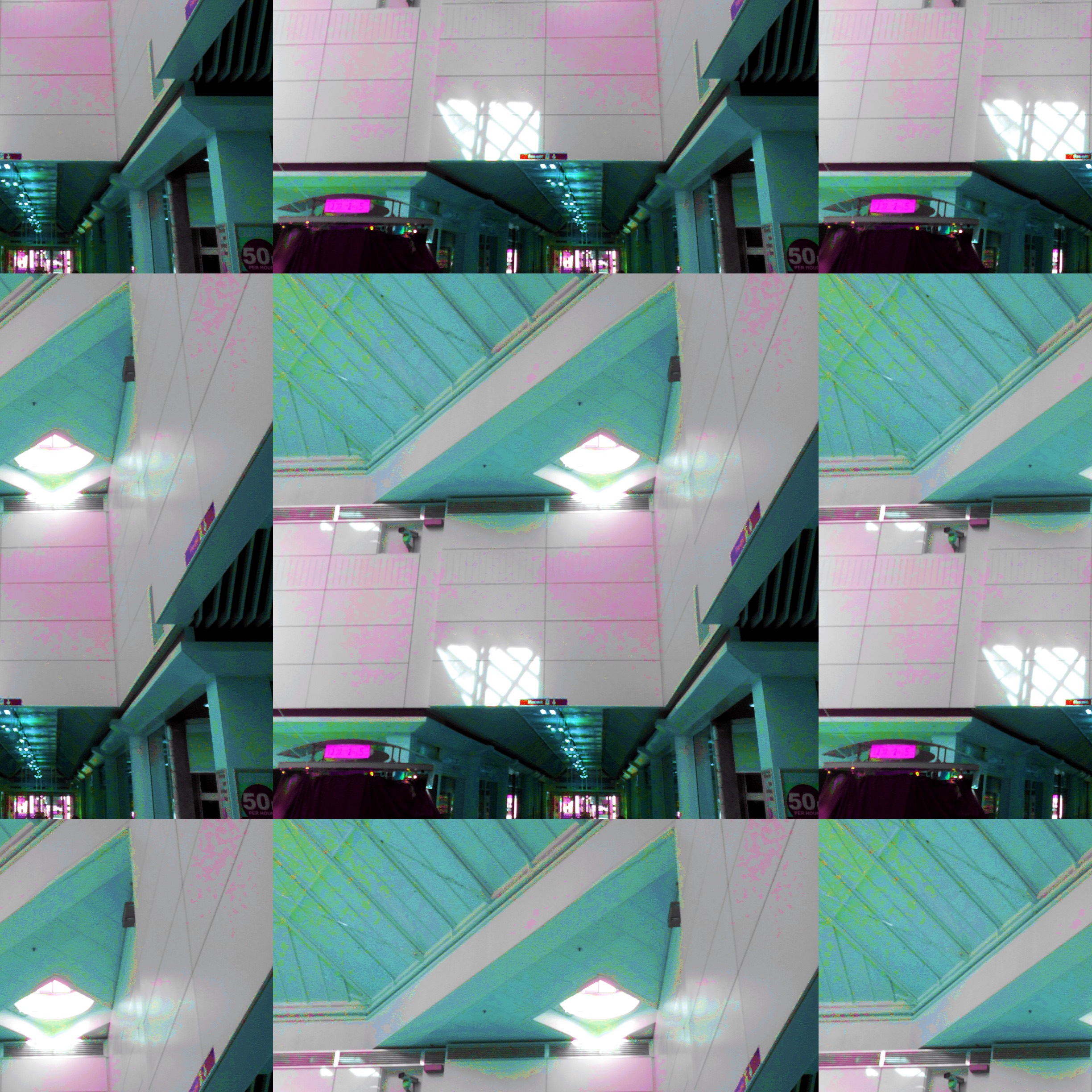
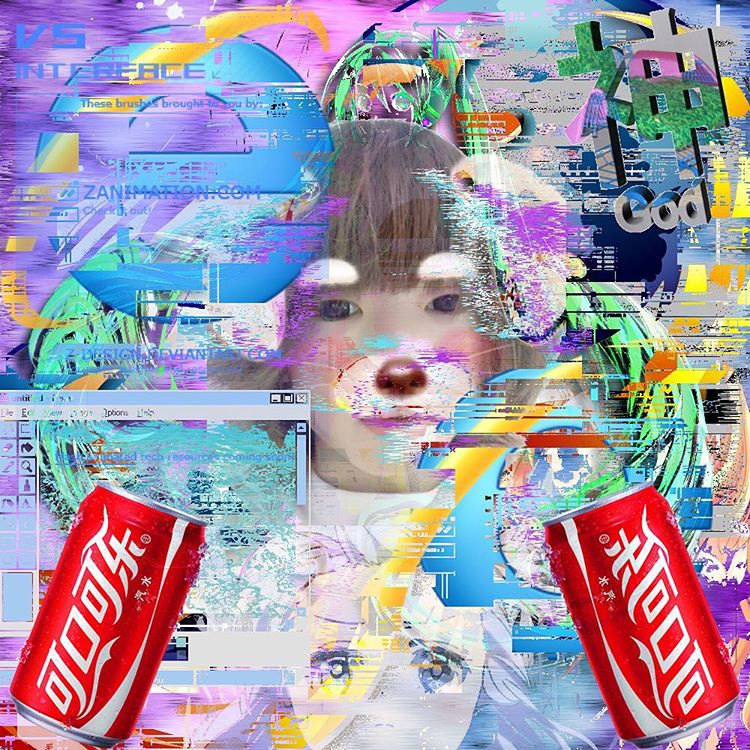
Adam Rybak (AI-generated vapourwave mall art)

Last week I taught a seminar and workshop at the University of Glasgow’s Summer School: Urban Arcadia: Mythologies of the Mall. We explored how malls represent liminal spaces of urbanism and suburbia, public and private, the civic and surveillance. We reflected on the decline of malls in recent years, on the deadmalls archive project, on malls as institutions, infrastructures and emblematic locales of capitalism. I once wrote a phenomenology of my local mall, a shopping centre in Ayr, the site of teenage loitering, toil and trouble. I asked the students to write manifestos or plans towards new malls: public sites built into or out of a failing mall building. The more I write mall, the more I fall into it. The idea of plenitude. One student said malls are so prevalent in post-apocalyptic fiction because that’s where the resources are pooled. It’s only natural that when capital eats itself we go back to its crumbling temples to eat. Malls are for raiding, free-running, skating, squatting, paying disrespect to statuesque disgrace of billionaires, wishing in fountains, abolishing, raving, growing plants in greenhouses. Malls with solar panels, malls with turbines, malls with open canteens, malls where you take what you like. I want malls to metabolise the brilliance of dreaming the billioning of a generous elsewhere that yes could be ours, not like in adverts but actually in our hands, sticky with bricks and mortar and molten pennies the fountains spat back as lithium rainbows in the battery acid of plurality, nothing pristine, our shattering. It’s so infinitely worthless, warm and deplorable. The lyric I is a mallwalker. All of them. Open doors.

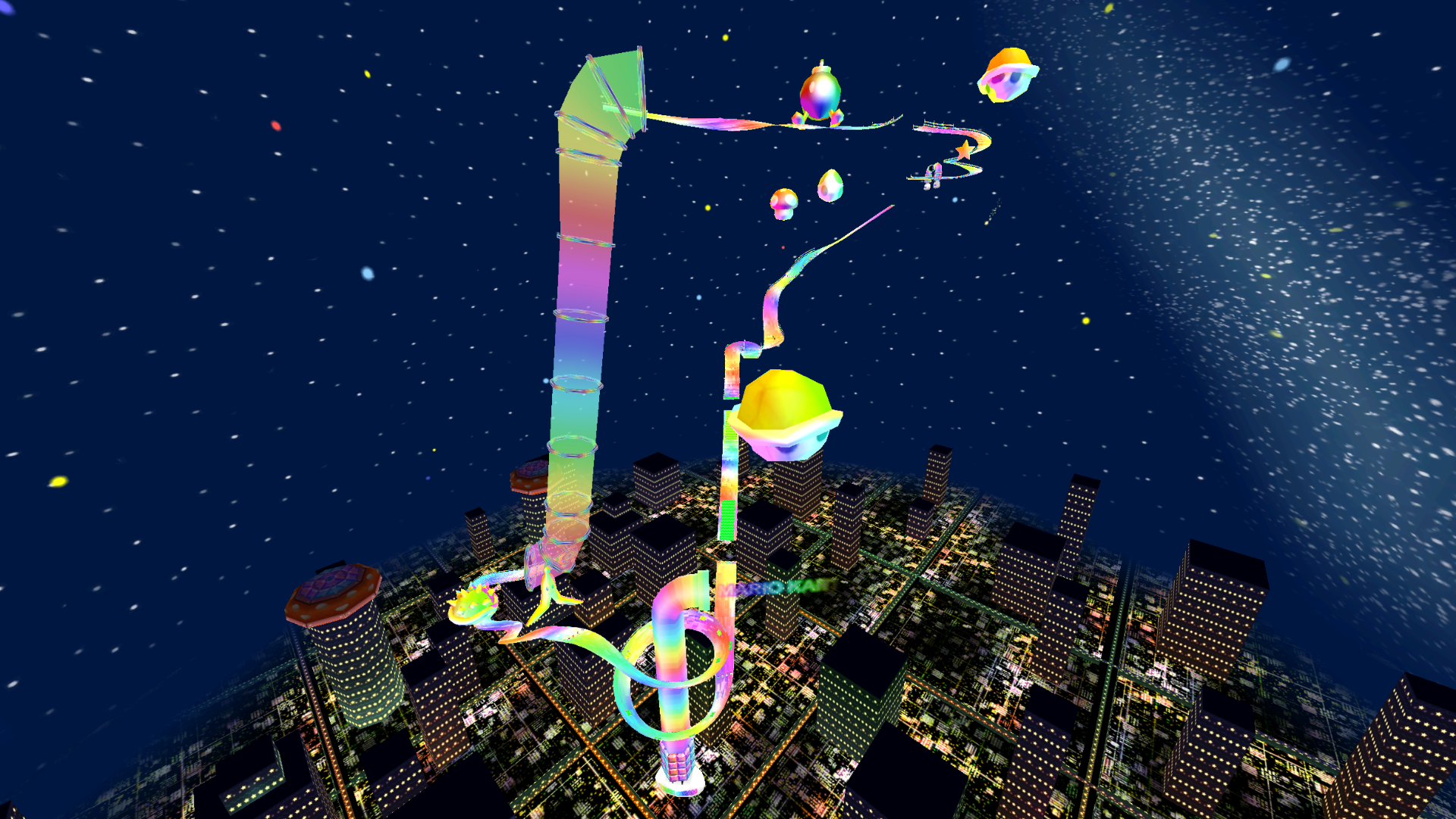
I’ve written about malls before in fiction and poetry. See ‘Mallwalkers’ and Rainbow Arcadia.  

Suggested exercise: 

Mall Regeneration

You have been tasked with reviving a so-called dead mall in your local town or city. The budget is limitless! In pairs, come up with a manifesto for how you would rebuild the mall or put it to new uses. You might want to share the different contexts of how retail works in your local area and think about a ‘solution’ that works for both of you. What values do you find important in urban architecture? How should public space be used in the twenty-first century and beyond? Is this mall just for human people or other creatures? What would the mall need to serve, withstand or endure?

You can write this as a list or mini essay. 

The Greatest Loss: Lana Del Rey’s Anthropocene Softcore 

Screenshot 2019-09-08 at 11.26.09.png

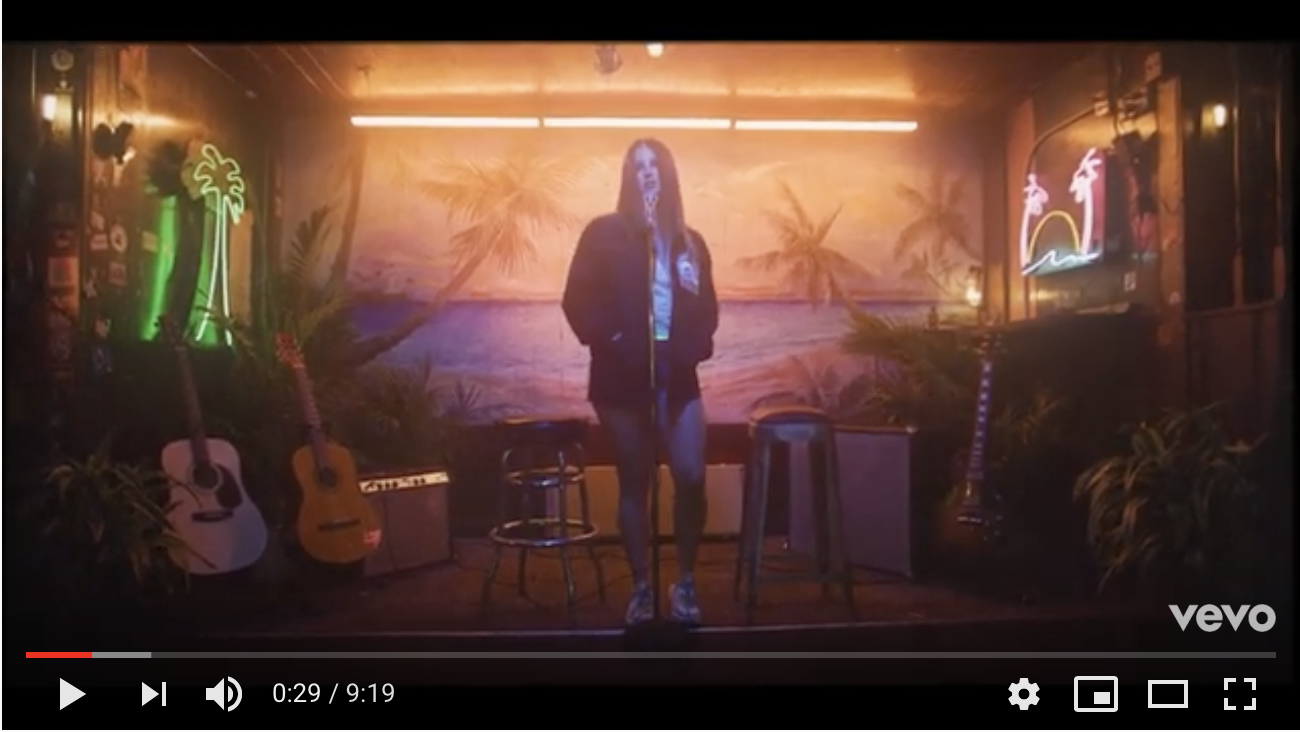
There is a scenario in which the jukebox is equivalent to the poet and some elaborate analogy is to be made between intertextuality and the limited catalogue whose selectional form produces play. The scenario only survives in video. It needs this urge of duration, not to mention the tenderness of a touch. Where fingers brush keys like notes, there is something to add to the story. A social space in demand of ambience; on flickering alongside off. When Lana is alone on stage, hands stuffed into a bomber jacket, singing ‘Fuck it, I love you’, swaying almost nervously, I want to think about what she is doing there and who she is speaking to and from where she is speaking. She is not really speaking but singing. The lone girl on the stage is the open mic dreamer, with nothing but lines. She is scattered across june-dreams of multiple personality: ‘The I which speaks out from only one place is simultaneously everyone’s everywhere; it’s the linguistic mother of rarity but is always also aggressively democratic’ (Riley 2000: 57-58). We mother our solipsism with words but in doing so there’s an opening. So to say fuck it and state the interruption with syncope, sincerity. Lana Del Rey was born on the cusp of Gemini and Cancer season, which more than explains that statement: ‘Fuck it, I love you’. With her sails to the wind. To say it over and smooth into plural refrain, you could even say chorus. For a chorus wants to be shared. It is a commodious mother, fed by the keys of the jukebox baby. There is a constant reversal of nourishing; the democracy of lyric utterance, the milky feed that streams.

Denise Riley argues that any ‘initial “I love you” is barely possible to enunciate without its implicit—however unwilled—claim for reciprocation’ (2000: 23). But what is reciprocation in a song? Is it just the urge to be sung with? And this ‘fuck it’, the pervasive millennial injunction to just be, to move on, as the tag which erases the expectant price of the utterance? Riley argues that I love you ‘must at once circulate as coinage within the relentless economy of utterance as exchange’ (2000: 24), but in a pop song it bears the leaden weight of so many prior expressions. The irony is that to cut through that with a simple fuck it, Lana can attain something like sincerity in the very pop mode whose lineage of commercialised love would surely undermine her feeling. Fuck it, in spite of saying I love you I really do. The pop song becomes this space for the staged epiphany of repeated assurance, I really do. It is a softcore admission of the self in its burning limit. 
Screenshot 2019-09-08 at 11.26.37.png

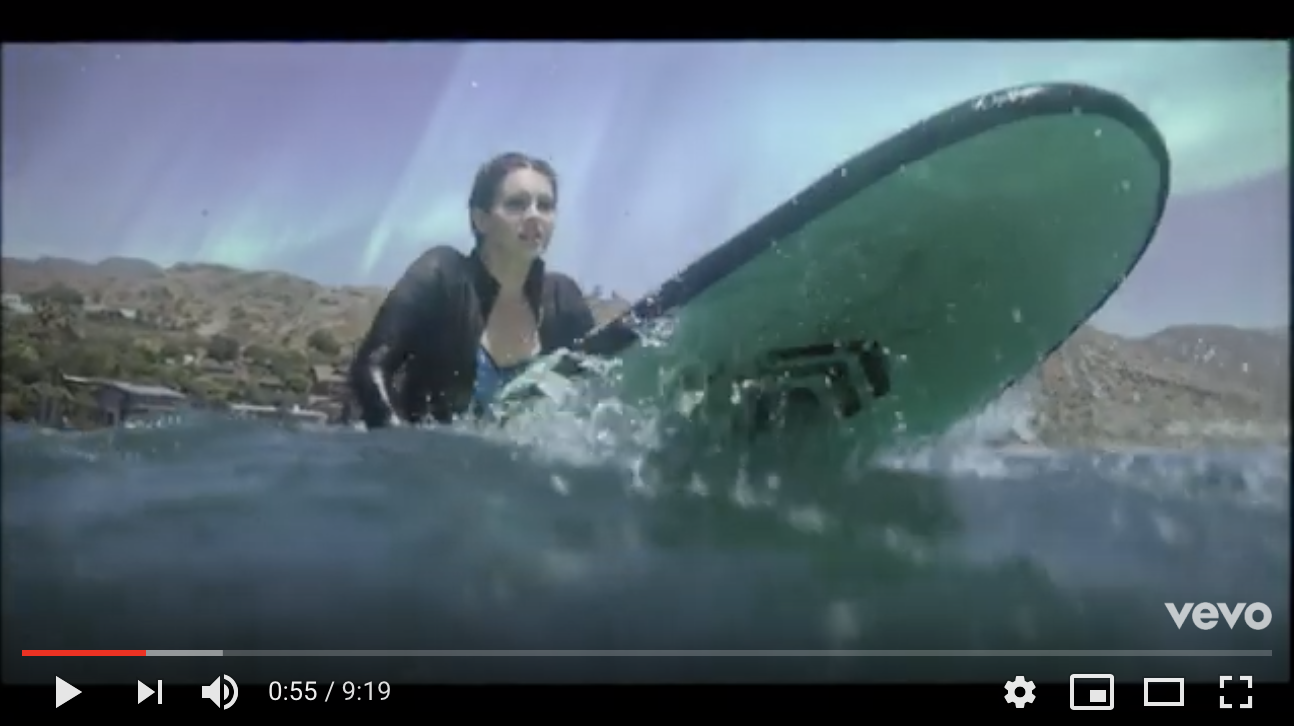
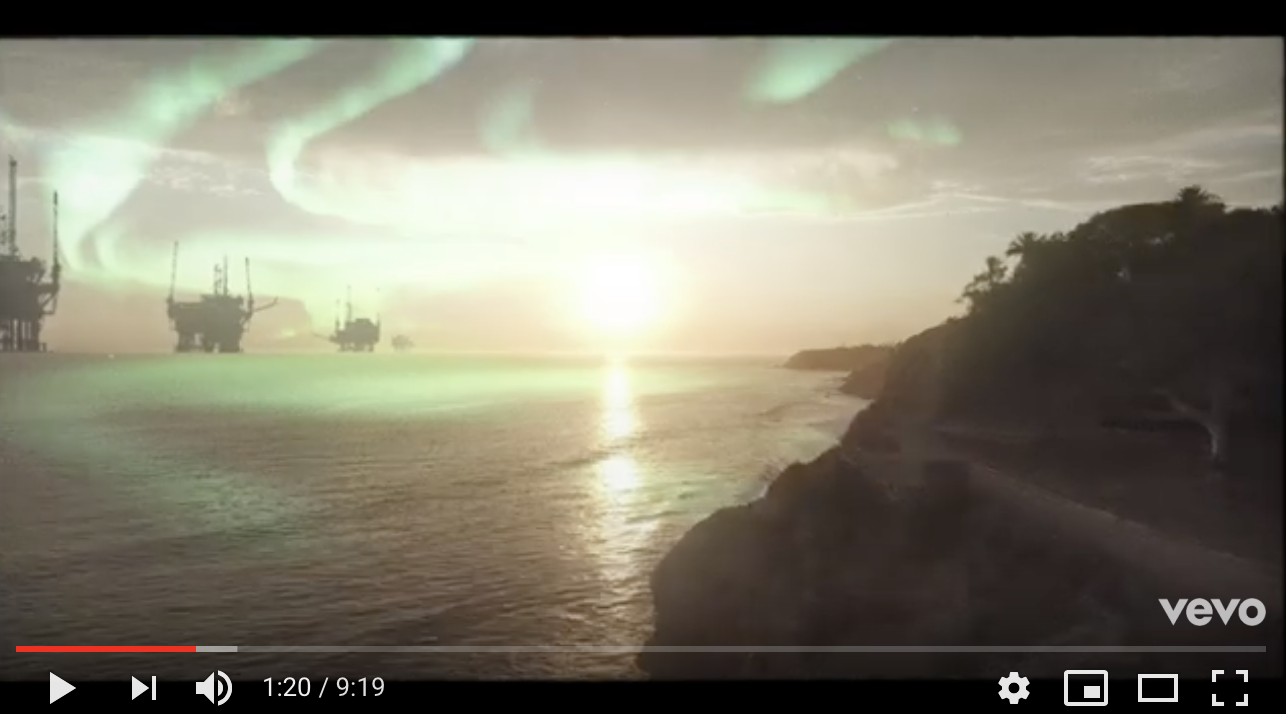
‘Fuck it I love you’ is soaked in lights, but they’re fading. ‘I like to see everything in neon’, is the line that opens the song. To see everything in neon is to fluoresce what is haunted and gone. I think of Sia dragging rainbow dust down her tearful cheeks in the video for ‘The Greatest’ — tragedy’s shimmer as fugitive mark on the body. Lana offers herself up as sugar dust, cliché in honour of Doris Day: ‘Dream a little dream of me / Make me into something sweet’; she acknowledges ‘dancing to a pop song’, but it’s not clear if this is her or the character or the one she loves. ‘Turn the radio on’ could be a reflection or an imperative. The reader is hailed between these positions of love and the loved and the effect is saturating, warm, delirious. Separation is that ‘it’, the spacing. In the video, we watch Lana painting and then suddenly she’s surfing with the aurora borealis in the background. She’s on a swing, her jean shorts caressed by the camera, she’s the sexualised pop icon again. She’s on a surfboard, green-screened, young. She’s choosing a shade of yellow from the palette, singing ‘Killing me slowly’. What is this ‘it’, killing her slowly: 

I’ll return to the unknown part of myself and when I am born shall speak of “he” or “she.” For now, what sustains me is the “that” that is an “it.” To create a being out of oneself is very serious. I am creating myself. And walking in complete darkness in search of ourselves is what we do. It hurts. […] a thing is born that is. Is itself. It is hard as a dry stone. But the core is soft and alive, perishable, perilous it. Life of elementary matter.

(Lispector 2014: 39)

I want slyly to argue that this is a kind of anthropocene existentialism. Recognition of the self as this ‘hard’, ‘dry stone’ thing of geologic mattering, reflexive species. This is what it is to be ‘Human’ right now. And yet the agential spark within, the ‘core’ that is being alive in a world where we have deposited those sedimentary layers. Creating ourselves in the stone, often with the tarnish of the very products we chose and developed to beautify, excoriate and cleanse ourselves, to remain forever young. So there is this oscillating temporality at work between desired infinity and the trace of our fugitive place on earth. The very earth minerals that would ruin humanity, mine our bodies of endless labour. But to go back to the song, with its idea of a gradual dying. I want to call this something like anthropocene softcore: the unnamed presence of species being within Lispector’s slender novel from the early seventies, or the Mamas and the Papas brand of late-sixties ‘sunshine pop’ whose solarity derives from the perishability of that energy, utopian commons, cascade of flowers — that serotonin glow of selves in streams and streams. 

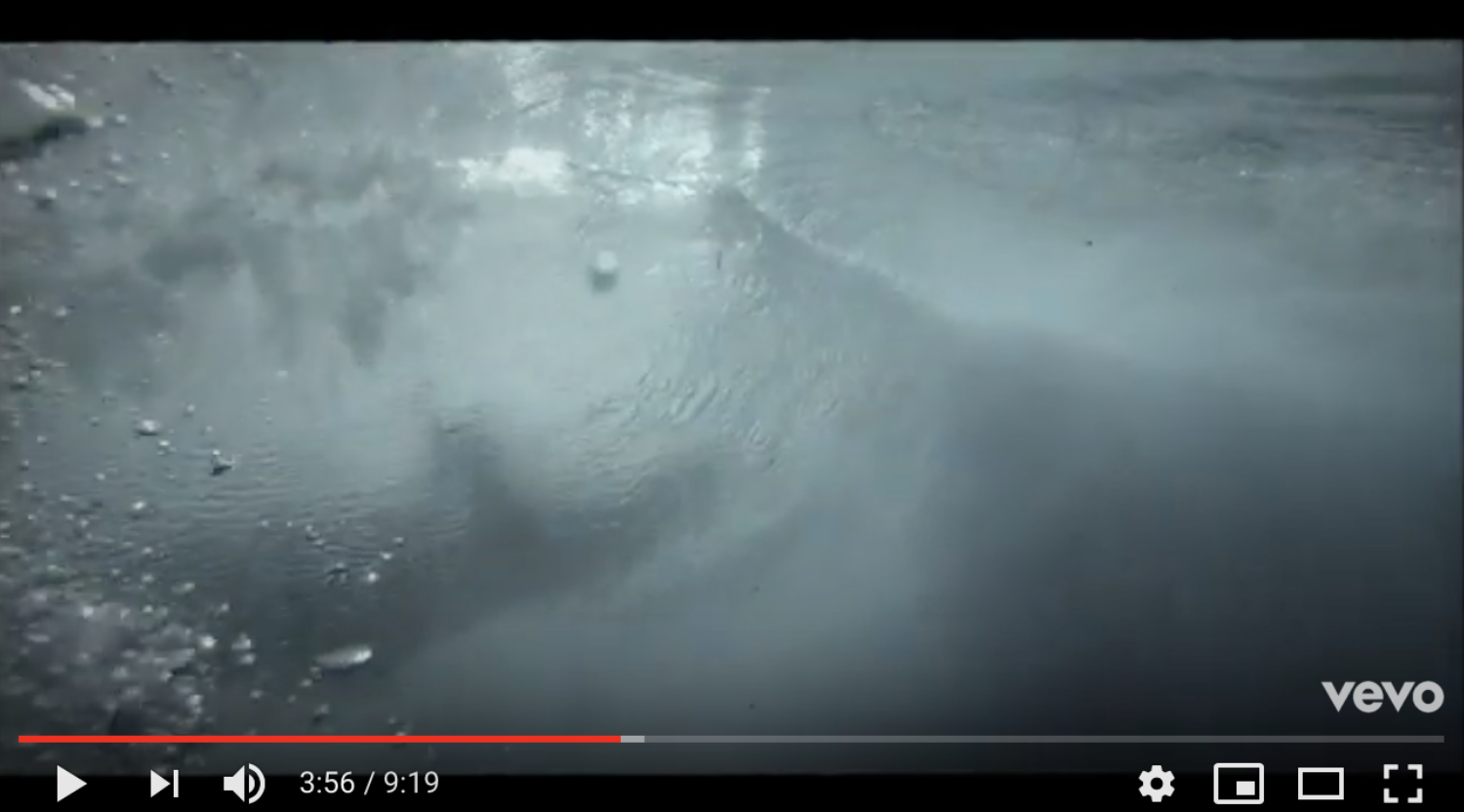
Lana’s anthropocene poetics are not of the hardline, direct call to action. You would not say of her cultural presence, eco-warrior or nature goddess. You would not brand her Miss Anthropocene in a kind of demonic marketing gimmick. You would say most often she is a siren, per se, leisurely supplicating us towards death on the rocks. Desirous flow. This is anthropocene softcore. This is what it is to challenge the act of self-description itself, and in doing so questioning those generalisations that arise from the ‘we’ of humankind, not to mention the ‘I’ of pop’s delectable, mainstream lyric. Alchemically, Clarice Lispector and Lana make of these malleable pronouns the ‘perilous it’. The it, the feeling, the speaking self which is nothing much more than a bundle of affects, sensations, atoms. To be cast over and crested by the wave. Significant that ‘Fuck it I love you’ ends with the rising bubbles of this wave, the one that spills us through the fourth wall and into the studio. This song slams together pop’s saccharine mythos of California as dreamland, a late-summer song as the former was written, surely, for autumn. California: ‘it’s just a state of mind’. She could be talking about the self or the state, or the state of the self. 
Screenshot 2019-09-09 at 20.44.25.png

What happens next? The shot drifts over the cliffs, the coast, to a strip of palms and a distant view of the LA skyline. That shining love in the previous track is replaced by a minor key, a glimpse of the jukebox whose songs include The Eagles, Bon Iver, The National. Artists whose Americana is the melancholy of generations moved from political despair to something like the glitch of the times as a basic fact of intimacy. One of the Bon Iver songs shown in the video is ‘22 (OVER S∞∞N)’, and if that title was not rife with implicit apocalypse, what is, what is. A stammering into language, pitch-shifting the fragile space of utterance. There’s a spiritual glimpse to the sky and the infinite quality of the stars: 

There I find you marked in constellation (two, two)
There isn’t ceiling in our garden
And then I draw an ear on you
So I can speak into the silence
It might be over soon (two, do, two, do, two)

(Bon Iver, ‘22 (OVER S∞∞N)’)

I don’t know what the maths is doing. I don’t want to know that the song ‘was inspired in part by Bon Iver mainman Justin Vernon’s unsuccessful attempt to find himself during a vacation’. I am however interested in the hubris within this term ‘vacation’ at all. Do we now live in a world where you can take ‘time out’? There is nothing of the world we know that could be switched off. There is no ‘away’ of complete erasure or original presence. Deconstruction caught up with our living. Vernon describing this song as a gesture towards what might end of his emptiness could just as easily be flipped: its relief is equal to a mortal sense of loss. The impending erasures. It ‘does’ or acts the accretional event of extinction that is speaking into the silence, to those who could not speak back. 

Fragments and snatches: the neon green lining Lana’s eyes, the aurora borealis, the neon green palm in the club where she sings alone. A season by yourself. The love of the couple together surfing is cardboard, Hollywood. It is a trembling symbol. It is almost ridicule.
Screenshot 2019-09-08 at 10.27.46.png

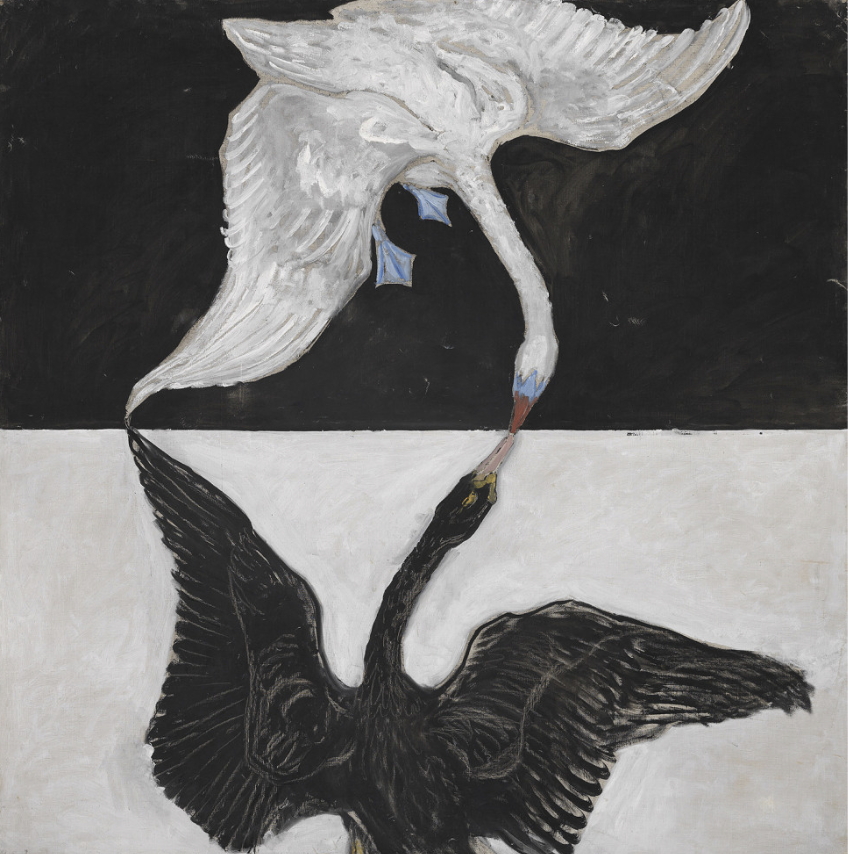
What is Justin Vernon looking for in the constellation? When he sings ‘two two’ I think of Hilma af Klint’s nose-touching swans, or the hours of the day chipped at the edge — two of them stolen by tragic event. I think of a mic check, two, two, ch, ch. Click. Near-enough-presence of speech. A white swan on black background; a black swan on white background. Flip. The swans are geometry, signets of signature, they move towards abstraction. Growth. I love them. Fuck it I love them. The way they are just it. Inversions of colour and a monochrome mood splashed with cornflower blue, the tiny excess we can treasure. It is the cornflower blue, the little webbed feet, which make the swan in question unique. So we can care for it, figuratively as it swells through grey-white waters of memory. The swans we have lost in our shit. Royal iterations freed from belonging. This painting is from af Klint’s series Paintings for the Temple, works derived from spiritual communication. The abstraction of the swan / renders us stark in frame / for we were Lana or Leda / before we were animal. Sufjan Stevens’ ‘Seven Swans’: ‘All of the trees were in light’, ‘a sign in the sky’; ‘My father burned into coal’. And all of our sadness was carbon neutral before this. We plunge into whatever remains of the water, its plasticky thickness.

I keep pausing the video as it transitions. ‘Fuck it I love you’ twinned with ‘The greatest’. When The National sing It’s a terrible love and I’m walking with spiders, what exactly is the ‘quiet company’ of the ‘it’? It could just as well be spiders. Maybe it’s the web itself, the web between the human and the more than human, the gossamer moment where metaphoric articulation becomes more than feeling and gleams material. ‘It’s a terrible love that I’m walking with spiders’ — what is the grammatical transition done by that ‘that’ and who is to blame. Walking with spiders might just be that love. Transitional, subject/object logic is reversed in this song: ‘Wait til the past?’ is sung, then ‘It takes an ocean not to break’ when surely the ocean itself would break you. Soon the ‘terrible love’ is a substance, something ‘I’m walking in’ — to feel it is an act of immersion. It is to let that wave crest over, the ‘lyric auto-explosion’ (Moten 2017: 3) of the wave that would break you. 

In ‘The Greatest’, Cat Power sings of former ambition now cast to nostalgic regret. There is a sense of time slowing to delay, laconic strings, relaxed drums, the balladic sleep of a once-held fault. It is a parade slowing down in the rain. To say ‘Once I wanted to be’ is to hold this question of ‘the greatest’ as a generalised desire itself. The hunger we lose in time, whose primary colours soften. I hold to that precious, cornflower blue of a swan’s foot. ‘Two fists of solid rock / With brains that could explain / Any feeling’. This solid rock that would box you into the future, that would harden the edges of self. A thing is born, as Clarice puts it, ‘hard as as dry stone’. This is the thing born ‘that is’. To exist is to be this hard thing, protein ligament, to kick out in lines; but then in time there is the plasmatic self inside that, like some fatty animal byproduct, sticks to the others it loves, it needs, it leaks. Gelatinous, softly sticky love. The ‘it’ that needs saving. Anthropocene softcore; soapy inside of all geologic agency. Who we are and what we regret. The turning of the outside-in, the inside-out. Kathleen Jamie, in Sightlines, asks: ‘What is it that we’re just not seeing?’ (2012: 37). 

A sightline is a hypothetical line, from someone’s eye to what is seen. Is it clear or blurred, bad or good? Anthropos recedes in its very own scene as the ocean continues and we howl in the dark like a lossy-compressed version of species. We are the sirens and wolves. We are at the great concert of the Earth. We have to resist what Bernard Stiegler calls the ‘proletarianization of the senses’ (2017); we have to find longform ballads of what’s happening, pass them down the line, resist the short-circuiting of thought that occurs between screens and machines. We have to send letters back to our consciousness, our elders and children. This is the work of lyric. It could be the work of dance. I think of Zelda Fitzgerald’s protagonist, Alabama, learning to be a ballerina too late in her life: ‘Her body was so full of static from the constant whip of her work that she could get no clear communication with herself. She said to herself that human beings have no right to fail’ (2001: 180). Alabama barely eats; her energy is all the zeal of will. The dance of lyric as reduction, lack, as static and chased success whose collapse lands as Alabama will eventually do on the event of inevitable break. Grapefruit squeezed on the gritty turmeric shot of the future. And a brake, a screech. And yet we write, we cast out limbs and materials, we work towards this loss; we imbibe it. 

This is an ugly type of writing in which the outside is always imagined from the inside. Horizons are fictional and buildings are barred. I have no sightlines. I’m fucking cutting the corners of someone else’s desire. All paths are the continuation of a pre-existing line. This is a city from which I send myself postcards wherein I wish I was here. Flying letters. Words stolen from myself. I refuse to recognise that I have not composed them unintentionally

(Bolland 2019: 78).

The videos for Lana’s ‘Fuck it I love you’ and ‘The greatest’ swerve between inside and outside. We find ourselves in rooms we don’t remember entering. Writing the anthropocene has an ugly, masturbatory quality of fucking yourself with the rush of elaborate doom. Okay, so. Constructing fortresses of lines which would make a valiant destination. When I listen to Lana, I’m accessing shortcuts to ‘someone else’s desire’ which is the opening up of presence. ‘This is a city’; ‘I wish I was here’. I have never been to LA. We plagiarise our very own diaries to get back that sense of the once-intentional, the greatest declaration on Earth. That we were here, and we loved. She wrote that lit, forgot. The papers curled up and rolled away in a sultry air that was summer, 2012. The year of failed apocalypse, the year Lana released her debut album, Born to Die. We saw her campaign of fashion smoking through plexiglass bus shelters. Remember all ‘horizons are fictional’: they tell a narrative, they bleed and tilt and set like ice. Towards them we stupidly drift: the lived throb of our softcore skins, our hungers and rhythms.
Screenshot 2019-09-09 at 20.44.50.png

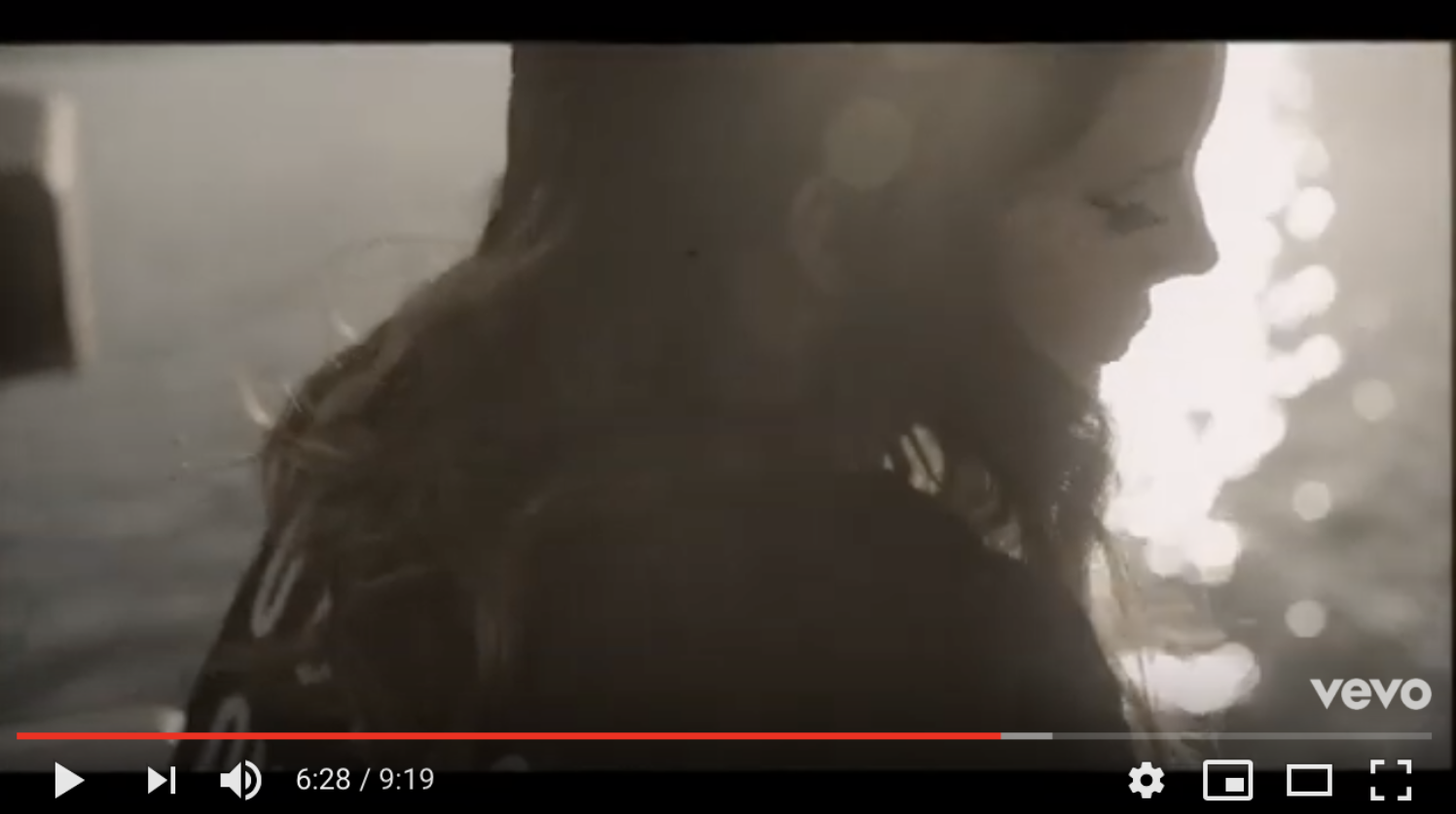
Drifting in colour like H.D.’s Leda, the rape of the land and the body and bodies engendering bodies. Worlds ending around us. And so I could say, but this is just one song, a phrase, a white woman of fame lamenting her world. But this self-conscious cinematics is a gesture towards the western world itself as this haunted, tragic protagonist: ‘The culture is lit and if this is it, I had a ball / I guess that I’m burned out after all’ (‘The greatest’). So you could say, anthropocene softcore speaks to the lyric I in its state of orphaned exception, which in turn is the loss felt by us all unequally. If we make of Lana a sort of anthropocenic siren, we must recognise the distinctions within our longing. For we all lose worlds differently; harm is striated along lines of class, gender, race, ethnicity, geographical distribution — of course. That wave that closes the video could elsewhere be a tsunami. I like to think its place on the edge is a deliberated hint to what could or is even already happening here or elsewhere. And maybe the colour, the aurora, is this streak of need for an excess beyond static blank, ‘human’ planet, standardised canvas; the need to splash something more of blur and blue. Flood the structure. 

When we say something is ‘lit’, we mean it is hot, on fire. We mean it is turned on, ignited, intoxicated, drunk, excellent. Lit is the past simple and past participle of light. Isn’t that line alone just lit? Maybe we are in the twilight of a former Enlightenment, recognising our species hubris as this alien green that tinges every familiar horizon, upsets the normalised green of pastoral. Is it toxicity, the elsewhere within ourselves? It is a radar showing who we are and where we have been. Those material metaphors cook on a smoulder, and this is the softcore coming to knowledge about what is happening.
Screenshot 2019-09-08 at 11.27.08.png

What does it mean to sing: ‘I’m facing the greatest / The greatest loss of them all’. To sing this on the brink of a hyperreal sunset, to chase a solar excess among loss. This loss could be a love but it is more like a culture; it is more like a voice and the condition from which to speak or sing it. The loss of lyric, its possibilities of address, and the loss or deferral or ruination of place itself. Maybe this is Lana’s lyric maturity, a generational acceptance that ‘young and beautiful’ is no longer the apex state of what we should strive for. Absence tenders complexity. Is this, as Roy Scranton puts it, Learning to Die in the Anthropocene? This question of mutability, the green-winged eye that sees a darkening world, a lack of birds along the bay, an edge. In the video for ‘The greatest’, Lana’s jacket reads LOCALS ONLY on the back. I google the phrase and find a hipster restaurant in Toronto with the slogan, LET’s PRETEND THIS NEVER HAPPENED. There’s a kind of parochial nihilism that glisters like the light on the sea, but the sea can never be local only. There’s a boat in the video whose name is WIPEOUT. It’s all happening; the signals are obvious. How we are practicing the absent-presence of the name’s erasure. My tongue gets twisted when I say anthropos; I want to say mess, I fall into ‘guest’ and ‘gesture’. With its glaring cinematics, LA offers the hospitality of light. But it is an exclusionary light. For now, only some of us get lit, get to the mic.
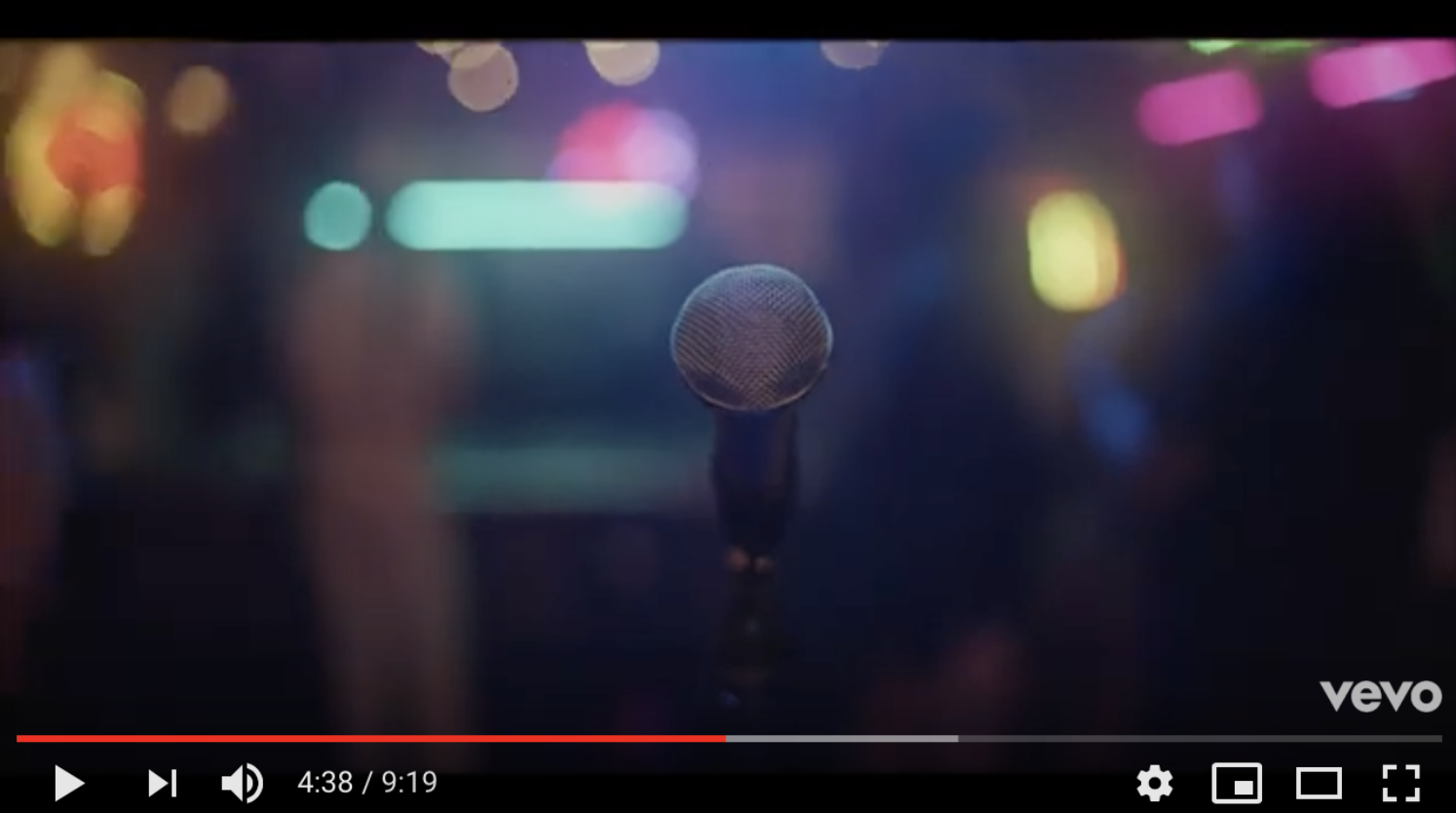
Screenshot 2019-09-09 at 20.46.01.png
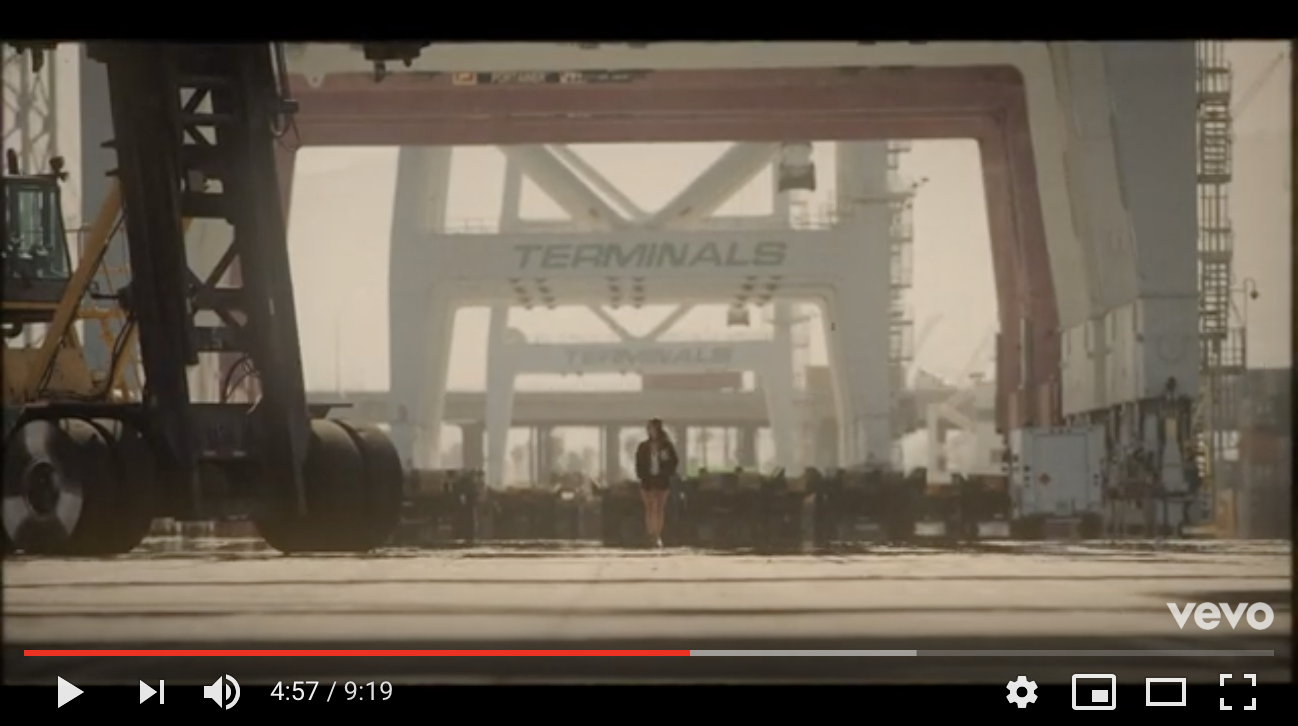
Lana sings from within the metallic architectures of LA’s coastal infrastructure, the port. In the bar, she throws a dart and misses her target by a nonchalant smidge, knocks the 8-ball towards its pocket. I keep thinking about exports and imports, what we put out, take in and trade. Economies of luck and depth and surface. Maybe Lana is a hydrofeminist, her soaring lyric gesture recalling a hauntology of America as that dreamscape of what lies beyond or in the deep. And now we know it is further extinction, precarity, hardened borders. What do we do with that looming closure? Lana has shrugged off her jacket now, she’s smoking in the kitchen where the lid slides off the pan to let the steam out. I’m not saying we’re sitting on a pressure cooker here. There’s simply work to do, mouths to feed, ears to fill. This is a ballad, a paean to the transient, fragile beauty of everything. The songs shown again on the jukebox are songs of a type of blues specific to oceanic or cosmic consciousness, to hunger, the time of lost summer or that of a broken love:

Janis Joplin — ‘Kozmic Blues’

Dennis Wilson — ‘Pacific Ocean Blue’

Sublime — ‘Doin’ Time’ 

David Bowie — ‘Ashes to Ashes’

Jeff Buckley — ‘Last Goodbye’

Leonard Cohen — ‘Chelsea Hotel #2’

I’ve spoken before of what ‘anthropocene sadcore’ might look like in poetry. I’m still working through that. It comes from the common phrase used to describe Lana’s music, ‘Hollywood sadcore’. I’m interested in how that emphasis on mediation, transmission and cinema plays out in our understanding of ecological emergency, but more generally the existential condition of the anthropocene, which places us as geologic agents under the generalised, gendered rubric of Man. Maybe Anna Tsing’s feminist work on the ‘patchy Anthropocene’ could be applied to the cut scenes of a glossy Los Angeles caught on video. A patch is also a software update, where comprised code is ‘patched’ into the code of an executable program. Maybe the patchy anthropocene involves this kind of cultural patchwork: the lament to a love or a culture is patched to include this bug of ecological consciousness — the patch is a kind of coded pharmakon, poison and cure for apocalypse blues. But Lana paints in shades of yellow too. Blue and yellow making aurora borealis green. A cosmic gesture to what lies beyond thought. And what of those oil rigs in the distance, glistening. They form an audience to the siren’s lament; they are part of this story, and we are mutually complicit. Where the magnetism of the male gaze is often part of Lana’s canon, here it is mostly replaced by oil rigs — supplementary Man as the infrastructure of anthropos, looking back at its melancholic, warning siren. Softcore is less affective than sadcore; it is the ambient hum of climax coming. Its cousin is the slowcore, luminous melancholia of a band like Red House Painters, perhaps: Purple nights and yellow days / Neon signs and silver lakes / LA took a part of me / LA gave this gift to me’. 
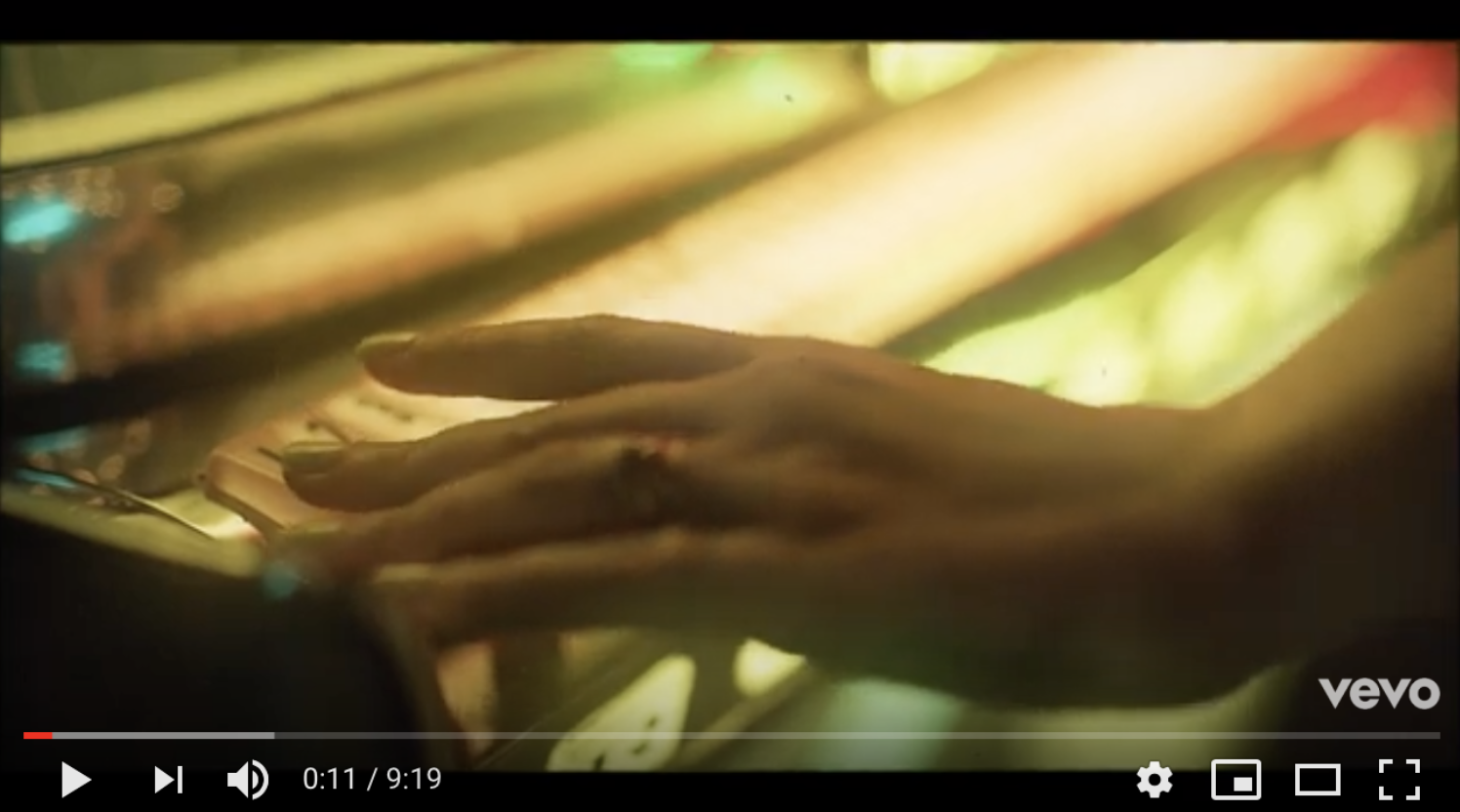
Screenshot 2019-09-09 at 20.43.42.png

In Bluets (2009), Maggie Nelson writes of a restaurant she used to work in, where the walls were ‘incredibly orange’. After each shift, collapsing exhausted in her own home, ‘the dining room’ of the restaurant ‘reappeared in my dreams as pale blue’:

For quite some time I thought this was luck, or wish fulfilment— naturally my dreams would convert everything to blue, because of my love for the colour. But now I realise that it was more likely the result of spending ten hours or more staring at saturated orange, blue’s spectral opposite. 

(Nelson 2009: 43)

Orange and blue, water and flame. The mind’s alchemical transformations reveal the way colour works chiastically upon us. I think of Freud’s mystic writing pad, the waxen surface of memories allowing for palimpsest versions of stories that trace and erase. ‘This is a simple story’, Nelson writes, ‘but it spooks me, insofar as it reminds me that the eye is simply a recorder, with or without our will. Perhaps the same could be said of the heart’ (2009: 43). ‘Fuck it I love you’, sung to the blue-orange wall until something comes off that surface like a static or fizz. Irn bru, ironed blue. There is quinine in my dreams of hungover labour. Surely there is a violence to this particular love, that is staring, necessary. The love of what must be limitless hurts.
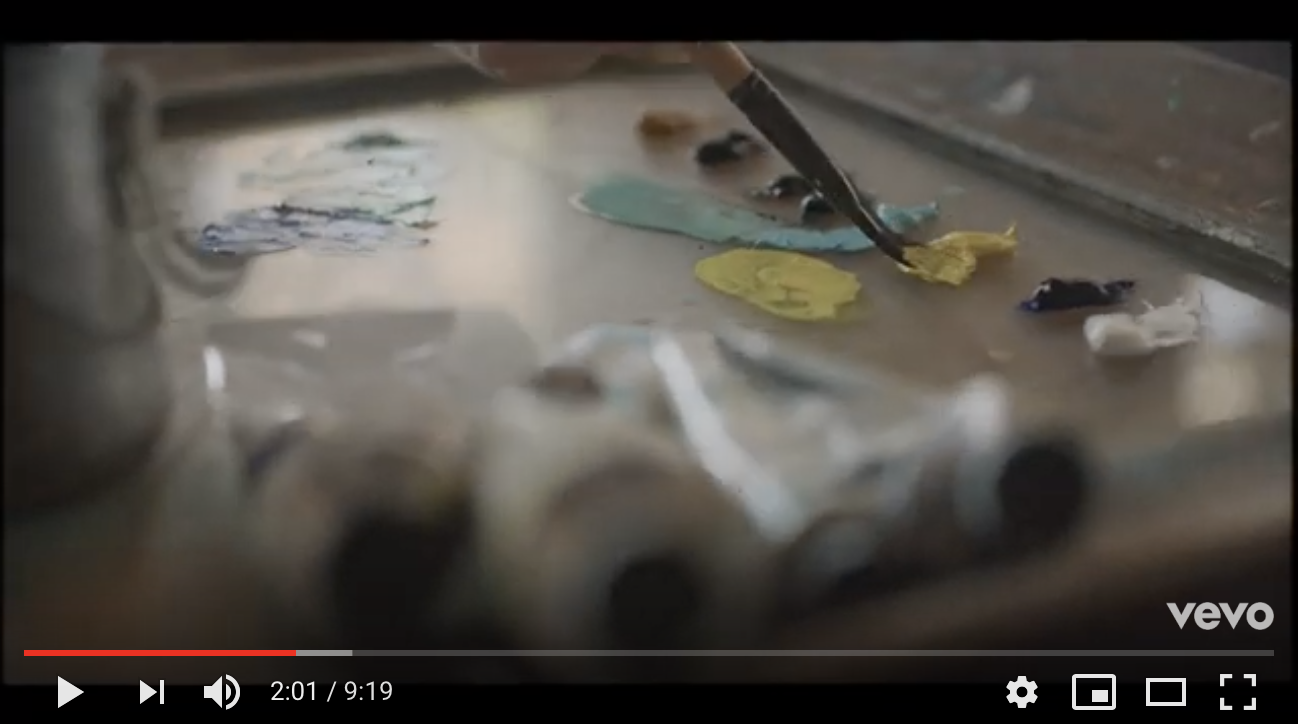
Screenshot 2019-09-08 at 11.27.23.png

Janis Joplin’s ‘Kozmic Blues’ rises to a swell, a jostling of guitar licks and urgent, assured vocals. A sonic thickening. ‘So mastered by the brute blood of the air’, H.D. writes in ‘Leda and the Swan’. Held in that vascular shudder that acclimatises to a manmade world, what happens next is a loosening, a shimmer, a shrug of the garment. In the poem or song, in the painting or film, in the collapse of that wave into a bluer future. To incur a kind of erosion and yet live on in those terminals. ‘There’s a fire inside of everyone of us’, Joplin sings, and I think not of flames but of cinders. ‘At what temperature do words burst into flame?’, asks Ned Lukacher in the introduction to Derrida’s Cinders (1987), ‘Is language itself what remains of a burning? Is language the effect of an inner vibration, an effect of light and heat upon certain kinds of matter?’ (Lukacher 1987: 3). I know if I did not write I would smoke. These acts of temporality in its material extinguishing. What makes the remembered restaurant blue, not orange, is something of this transmogrified smoulder — an inversion akin to af Klint’s swans, demanding that splash of blue. When I write, am I pursuing the absent space of that skyward blue?Blue is the colour of the planet from the view above, Lana swoons in a song (‘Beautiful People Beautiful Problems’) from her previous album, Lust for Life (2017). But in Norman Fucking Rockwell, Lana’s California album for 2019, it’s less of this ‘above’ we see. We are held within the infrastructure, cinema, the end of summer. The dreamlike logic of How did she get on that boat? When did she enter that room? Who put that song on the jukebox, baby?

I want to say:

It takes an ocean not to break a planet.
It takes not a planet to break a species. 

Lana’s voice grows wispier as she sings of that burnout. There’s this imperative that okay we could enjoy this with American flags, we could pour communal Jack and go down in flames. We could riff the history of our culture in archives of song, gestures and nods of reference. Ladies of the Canyon, Cinnamon Girl, Norman Fucking Rockwell. We could keep laughing or dancing while the world is or was at war. Lana is both behind and at the bar, the sightline of where we go to be ‘served’. Intoxication is the order of the day and we call it ‘fun’ to put the fucking of other people’s desires under erasure, strikeout, as Bolland does.

If this is it, I’m signing off
Miss doing nothing, the most of all
Oh I just missed a fireball
L.A. is in flames, it’s getting hot
Kanye West is blond and gone
“Life on Mars” ain’t just a song
Oh, the lifestream’s almost on

(Lana Del Rey, ‘The greatest’)

Miss doing nothing’: post-recessional ennui becomes the paradoxical happiness of living in static, not working as a kind of work that resists the future as set out by capitalist horizons of accumulation. We used to just ‘hang out’ and several other dreams of youthful nostalgia. Kids of today can’t even touch that innocence. We know so much; maybe or probably they know more. We are all variously entranced by the softcore unfold of this happening; we are all variously called upon to be complicit, to recycle, act, resist. To speak or not-speak. To be in one of many different levels of rising heat. The conditional state of being’s value, ‘If this is it’, in the anthropocene raises its pitch to a charge. To sign off is a form of surrender that gives up the name for the blur of species. I think of Lars von Trier’s Melancholia, the planet that would smash us and yet somehow Lana dodges it, that

The audience in the bar where she sings are mostly men, but their gaze is not sexual, as in much of Lana’s prior visual oeuvre. Rather, their longing gaze, often filtered through further glass, is something like the profound melancholy of a multi-generational sense of this loss. These old men have lost the planet, the one they grew up with, just like Lana’s siren, come from some other time, a life ahead of her steered by the changing climate, the hurt and vengeful seas. The camera holds close ups on their staring faces. The song holds the long durée of a loss that spans generations, damages and is damaged by elders, sparks in the present-tense of cultural tendency. In Lana these men look to a future hurt whose cause was partly theirs, as inheritors of industry: she is both victim and heroine, singing and swinging. The shot opens out to reveal her smiling with younger friends, her own generation. These intimacies are what we have left. The next shot shows some kind of factory or refinery leaking smog into a cloudy, overcast skyline, sulphured yellow. Once again the boat appears with its title, WIPEOUT. Lana is supine on the bow at sunset. She is golden, angelic, silhouette. It’s like she missed the fireball but melted it, cooked it up for tea, apocalypse syrup. Things are going down around us. She hugs her arms, later standing, laughing with a dreamlike intimation of imagined elsewhere, closing her eyes. Be hospitable to yourself and others. The reel of the jukebox keeps ever turning: this is our ever faith in culture. We have to take care of what’s left in whatever space we can make of song, duration. 

But the mainstream disciples and idols of Hollywood are failing, Kanye West is ‘gone’. Surely a reference to Elon Musk’s plans to save us by colonising Mars, ‘“Life on Mars” ain’t just a song’ is sung with a melancholy matter-of-factness, a kind of sigh which implies the banality of techno-utopia in a time of extinction. The thrill of such dreams is lost now. We lost our faith in Hollywood, lost our faith in the movies and the scale of those solutions. In a world without books, we’d be ‘bound to that summer’, addicted to one of many narcissistic ‘counterfeit[s]’ to make love to nightly in futile repetition — that would be, as Weyes Blood sings, the ‘Movies’. 
Screenshot 2019-09-08 at 16.56.01.png

What we look back with: 

The trauma is not, in the Freudian lexicon, this or that violation from the world (such as war), but the ill and trauma of this originary installation of “the cave”—what could properly be called the cin-anthropocene epoch, particularly given that the era of modern cinema is to be regarded merely as an episode: that of the machinal exteriorization of the cinematic apparatus, given that it coincides with the era of oil (artefacted “light”), given that its arc coincides with that hyperconsumptive acceleration leading to mass extinction events, ecocide, and an emerging politics of (managed) extinction

(Cohen 2017: 246)

The trauma of greatness as such is this accelerated promise of the dream, the event, capitalist growth, the movie itself — whose imperative is towards scene, closure, episodic narrative in demand of the next. But the drinks in this video are barely drunk; they are more like props. Everyone is aware of their place in the tableau vivant of the anthropocene, even in its softcore, consumerist pop expression: the iconography of oil rigs, downbeat affect and intergenerational longing. Not a violation from the world so much as the stream, and where its accumulative logic would eventually come to crisis, even as corporations beyond our imagining were already plotting that logic of a break within archival excess: the feverish incineration of the present, the smoulder and melt that smogs and spreads and streams. 

Fire is there or it is not there. […] But surely there is a word for that moment when a fire log, beneath its bark, has become one immanent ember, winking like a City or a circuit board; for that moment when you know only the desire, no, the need to stir it up. What is on fire, you ask yourself, staring into that waiting. What is that moment. What is that word. 

(Lennon 2003: 434)

The nights ‘on fire’ that Lana sings of are those of the Beach Boys, reprieve of the sixties; the bar on Long Beach that served as a ‘last stop’ before the tiny island retreat of Kokomo. Frank O’Hara died on Fire Island. Fire is presence or absence, but there is a moment before it is both. A slippage between the extinct and extinguished. And the world was lit up as before. I wonder if the word Brian Lennon looks for is simply ‘sleep’, the title of his essay which I first read in John D’Agata’s anthology, The Next American Essay — with intimations of that Lana song, ‘The Next Best American Record’. What is with America and the positioning of the next. A constant state of pressurised imminence that streams and streams: ‘We lost track of space / We lost track of time’ (‘The Next Best American Record’). We sleep into death or spirit. My first legal drink was a fireball whisky, in a pub by the sea they built in a church. That moment when you know only the ‘need to stir it up’, fanning the flames. That impulse towards blitz feels extra political in these contexts. We need something of relief that would stream, and in that flow be more than a question. Something of cinders, drifting. 

In Lana’s song, I’m interested in this word ‘lifestream’, which seems like a slippage from the more familiar internet-lingo, the ‘livestream’: the coming live that seems provisional to digital retro-future, the promise of satellites beaming the present, simultaneously. Lifestream, instead, is a vascular imaginary of bodies flowing together. ‘LifeStream’ is actually the name of a blood bank serving the Inland Empire and its surrounding areas. Lifestreaming is, Wikipedia tells me, ‘the act of documenting and sharing aspects of one’s daily social experiences online’. It is the flow of the timeline, akin to the wall, the blogroll, the feed. But here, at the end of the song, the promise of information’s overflow is in a liminal state — ‘almost on’. Extinction’s monetised data cast as the simultaneity of thick presence spread by millioning participants. We are here and we said something, our words were atoms, splashes of blue. We stream towards a life, cut ourselves short on the fragments of others’ desires. Mortality’s softcore contingent. The fear of missing out is assuaged by the narcotising work of cinema. And if this is it, Lana has already signed off. It’s something more like her spirit that’s here for us, the stream of an echo, fold of a song that we could replay, continue voicing. Hope lies in the circadian rhythm, the lived time of a pause in the anthropocene’s ceaseless, cinematic duration — that which we see and drown our hearts in. As Jean Rhys’ drunken, depressed protagonist of Good Morning, Midnight (1939 – the year WWII began) muses, ‘Well, sometimes it’s a fine day, isn’t it? Sometimes the skies are blue. Sometimes the air is light, easy to breathe. And there is always tomorrow….’ (Rhys 2000: 121). And what if tomorrow was the greatest loss of them all? 

~
Screenshot 2019-09-08 at 11.56.26.png

All screen grabs taken from here (Director: Rich Lee) and here (Director: Natalie Mering). 

~

Works Cited: 

Bolland, Emma, 2019. Over, In, and Under (Manchester: Dostoyevsky Wannabe). 

Cohen, Tom, 2017. ‘Arche-Cinema and the Politics of Extinction’, boundary 2, Vol. 44, No. 1, pp. 239-265.

Fitzgerald, Zelda, 2001. Save Me the Waltz (London: Vintage). 

Jamie, Kathleen, 2012. Sightlines (London: Sort of Books). 

Lennon, Brian, 2003. ‘Sleep’, The Next American Essay, ed. by John D’Agata, (Minneapolis: Gray Wolf Press), pp. 427-234.

Lispector, Clarice, 2014. Agua Viva (London: Penguin). 

Lukacher, Ned, 1987. ‘Introduction: Mourning Becomes Telepathy’, Cinders, trans. by Ned Lukacher, (Lincoln: University of Nebraska Press), pp. 1-18. 

Moten, Fred, 2017. Black and Blur (consent not to be a single being) (Durham: Duke University Press). 

Nelson, Maggie, 2009. Bluets (Seattle: Wave Books). 

Rhys, Jean, 2000. Good Morning, Midnight (London: Penguin). 

Riley, Denise, 2000. The Words of Selves: Identification: Solidarity, Irony (Stanford: Stanford University Press). 

Scranton, Roy, 2015. Learning to Die in the Anthropocene: Reflections on the End of a Civilisation (San Francisco: City Lights Books).

Stiegler, Bernard, 2017. ‘The Proletarianization of Sensibility’, boundary 2, Vol. 44, No,. 1, pp. 5-18. 

 

Falling through Glass


3746713882_eb3e039a09
self-portrait//circa 2008

[An essay on anorexia, femininity, adolescent pain & writing the body]

I distinctly remember the first time I watched someone apply liquid liner to their eyes. We stood in the Debenhams toilets before a sheet of unavoidable mirror. She emptied her rucksack of trinkets and tools, drew out a plastic wand with a fine-tip brush and skimmed the gooey ink skilfully over her lids, making curlicues of shimmering turquoise. Her irises were a kind of violent hazel, whose flecks of green seemed to swim against the paler blue. She was very tall and for a while, very thin. She had a nickname, a boyfriend and sometimes she shoplifted; in my head, she was the essence of teenage success. Only later, in the maelstrom of a drunken night out down the beach, do I discover she’s heavily bulimic.

A year or so passes since this first incident, watching my friend slick her eyes with electric blue. I have since learned to ink my own eyes, draw long Egyptian lines that imitate that slender almond shape I long for. My makeup is cheap and smudges. I have grown thinner and people are finally starting to notice.

My mother goes quiet when we do the shopping. She tells me to move out the aisle and I ask what’s wrong. People are staringshe says. I turn around and there they are by the stacks of cereal, mother and daughter, gesturing at my legs and whispering: stick insect, skeleton. A feel a flush of hot pride, akin to the day in primary school when I got everyone to sign my arms with permanent marker—this sudden etching of possession. I am glad I lack this conspiratorial relationship with my own mother, reserving comments on others for the page instead, for my skin. My pain and frustration are communicated bodily: I slink into the shadows, sleeping early, avoiding meals. When people stare, they imbue me with a visibility I desire to erase. I should like better to float around them intangibly, diaphanous, a veil of a name they can’t catch. Instead it rests on everyone’s tongue, thick and severe: anorexic.

It took a week for all the names to fade from my arms; it takes much longer to erase a single label.

In the television series Girls, Lena Dunham’s character reveals that she got tattoos as a teenager because she was putting on weight very quickly and wanted to feel in control of her own body, making fairytale scripture of her skin. In Roald Dahl’s short story, ‘Skin’, an old man gets a famous artist to tattoo the image of a gorgeous woman on his back, the rich pigment of ink like a lustrous ‘impasto’. Years later, art dealers discover his fleshly opus and proceed to barter, literally, on the price of his skin. The story reveals the synecdochical relations between the body, the pen and the value of art. Everything is a piece of something else, skin after skin after skin. In Skins, Cassie Ainsworth gazes into the camera: I hate my thighs. With black marker, she scrawls her name onto her palm; she’s got a smile that lights up, she’s in love. Everyone around her rolls cigarettes, swaps paper skins like scraps of poetry. It feels dirty, the chiaroscuro mood of sunshine and sorrow. Her whole narrative purpose is the spilling of secrets, of human hurt turned to vapour, smoke. Wow, lovely.

For a while, my name mattered less than my skin. There were levels of weight to lose, dress sizes which signified different planes of existence. Over and over, I would listen to ‘4 st. 7lbs’ by the Manic Street Preachers, Richey Edwards’ lyrics spat over a stomach-churning angst of guitar: ‘Self-worth scatters self-esteem’s a bore / I’ve long since moved to a higher plateau’. That summer, ten years ago now, I would walk for hours, the sun on my skin. All the fields stretched out before me like fresh pages of impossibility; my life was a mirage on the flickering sea. I thought of liquid turquoise ink, the friend in the mirror. I started to forget the details of her face, so she blurred into the impressionist portraits I wrote about in school.

Midsummer’s eve; I laid down in one of those fields. With bone-raw fingers, I counted the notches of my spine. Even in free-fall you never feel quite free.

I was obsessed with Richey’s ghost. He disappeared decades ago and they never found evidence of his body. I wanted to evaporate like that, leave my abstracted car somewhere along the motorway; step into the silence of anonymity. Richey wrote screeds of furious notes: ‘I feel like cutting the feet off a ballerina’. There it was: the dark evaporation of resentment and envy. Around this time, Bloc Party released A Weekend in the Citya record that uses Edwards’ lyric to express the racial frustration of being made Other by a racist society. I was acutely aware that the figure of a ballerina, the doll-like white girl, was a divisive source of symbolic desire. We inscribe such societal alignments on the female body, and shamefully I was more than ready to fall into place, to shed the necessary weight. But what I wanted was less the bloody violence of a crippled ballerina, and more the success of erasure.

In Zelda Fitzgerald’s only novel, Save Me the Waltz,the protagonist Alabama trains to be a ballerina late in her twenties, too late to ascend to any real career success. Here was ballet, the pre-adolescent world of waif-thin bodies and she was a mother, a woman—someone who once gave birth, who was strong in flesh. She reaches this frenzied state of beautiful prudence, honing her body to the point where every movement and thought is guided by the waltzing beat, the perfect arabesque: ‘David will bring me some chocolate ice cream and I will throw it up; it smells like a soda fountain, thrown-up, she thought’. I could attest to that. Ben and Jerry’s, swirls of it marbling the toilet bowl, clots of sweetness still clear in your throat. Fitzgerald’s sentences stream towards endless flourish. Alabama makes herself sick with the work, her desire is lustily bulimic. She gets blood poisoning, finds herself hospitalised with tubes in her body, drip-fed and cleansed by the system. I thought of how I wanted to photosynthesise, survive on nothing but air and light. Like a dancer, I was honing my new ascetic life.

Sometimes at night, the old ticker would slow to such a crawl and I thought it would stop in my sleep, sink like a stone. A girl I met on the internet sent me a red-beaded bracelet in the post and in class I’d twirl each plastic, pro-ana ruby, imagining the twist of my own bright sinew as later I’d stretch and click my bones.

I was small, I was sick. I used to write before bed, write a whole sermon’s worth of weight-loss imperatives; often I’d fall asleep mid-sentence and awake to a pool of dark ink, flowering its stain across my sheets. Nausea, of one sort or another, was more or less constant. Waves would dash against my brain, black spots clotting my vision. I moved from one plane or scale to another, reaching for another diuretic. I tried to keep within the lines, keep everything in shape.

Often, however, I thought about water, about things spilling; I drank so much and yet found myself endlessly thirsty. Esther Greenwood in Sylvia Plath’s The Bell Jar, trying to drown, being spat back out by the sea: I am I am I am.

 I’m fine I’m fine I’m fine. The familiar litany.

Something buoyed up, started showing on the surface. People could read the wrongness in the colour of my skin, all that mottled and purpling blood like a contrast dye my body had been dipped in. Against my pallid aquatic hue, I used to envy the warm and luxurious glow of other people’s skin. I sat on a friend’s lap and he freaked out at the jut of my bones. Someone lifted me and we ran down the road laughing and they were like, My god you’re so light. The sycamores were out in full bloom and I realised with a pang it would nearly be autumn. Vaguely I knew soon I would fall like all those leaves.

Anorexia is an austerity of the self. To fast is to practice a refusal, to resist the ideological urge to consume. To swap wasteful packs of pads and tampons for flakeaway skin and hypoglycaemic dreams. Unlike with capitalism, with anorexia you know where everything goes.

The anorexic is constantly calculating. Her day is a series of trades and exchanges: X amount of exercise for X amount of food; how much dinner should I spread around the plate in lieu of eating? It was never enough; nothing ever quite added up. My space-time melted into a continuous present in which I constantly longed for sleep. The past and future had no bearing on me; my increasingly androgynous body wasn’t defined by the usual feminine cycles—life was just existing. This is one of the trickiest things to fix in recovery.

Dark ecologist Timothy Morton says of longing: it’s ‘like depression that melted […] the boundary between sadness and longing is undecidable. Dark and sweet, like good chocolate’. Longing is spiritual and physical; it’s a certain surrender to the beyond, even as it opens strange cavities in the daily. The anorexic’s default existential condition is longing: a condition that is paradoxically indulgent. Longing to be thin, longing for self, dying for both. The world blurs before her eyes, objects take on that auratic sheen of desire. Later, putting myself through meal plans that involved slabs of Green & Black’s, full-fat milk and actual carbs, the dark sweet ooze of depression’s embrace gradually replaced my disordered eating. I wondered if melancholia was something you could prise off, like a skin; I saw its mise-en-abyme in every mirror, a curious, cruel infinitude.

In Aliens and Anorexia, Chris Kraus asks: ‘shouldn’t it be possible to leave the body? Is it wrong to even try?’. What do you do when food is abstracted entirely from appetite? What happens when life becomes a question of pouring yourself, gloop by gloop, into other forms? What is lost in the process?

I started a diary. I wrote with a rich black Indian ink I bought from an art supplies store. The woman at the counter ID’d me, saying she’d recently had teenagers come in to buy the stuff for home tattooing, then tried to blame her later when they all got blood poisoning. Different kinds of ink polluted our blood; I felt an odd solidarity with those kids, remembering the words others had scored on my skin for years. Tattooing yourself, perhaps, was a way of taking those names back. In any case, there was a sense that the ink was like oil, a reserve of energy I was drawing from the deep.

Recovery was trying to breathe underwater; resisting the urge of the quickening tide, striving for an island I couldn’t yet see.

(…What I miss most, maybe, is the driftwood intricacy, the beauty of the sternum in its gaunt, tripart sculpturing. Thinned to the bone, the body becomes elegiac somehow, an artefact of ebbing beauty…)

I think about beef and milk and I think about the bodies of cows and the way the light drips gold on their fields sometimes and how I’d like to curl up in some mossy grove and forget that all of this is happening. Sometimes I worry that my body is capable of making milk, making babies; its design is set up for this nourishing. Hélène Cixous insists women write ‘in white ink’ but I don’t want to be that plump and ripe, that giving. I want scarification, darkness, markings. I want Julia Kristeva’s black sun, an abyss that negates the smudge of identity.

I try to find loveliness in femininity, but my hands are full with hair barrettes, pencils, laxatives, lipstick—just so much material.

As Isabelle Meuret puts it, ‘starving in a world of plenty is a daring challenge’. Anorexia has the highest mortality rate of any mental illness. Recently, I logged onto my Facebook to find an old friend, a girl I’d known vaguely through an online recovery community, had died in hospital. Her heart just gave up in the night. People left consolatory messages on her wall; she was being written already into another existence. Another girl I used to know posts regular photos from her inpatient treatment. She’s very pretty but paper-thin, almost transparent in the flash of a camera. Tubes up her nose like she’s woven into the fabric of the institution, a flower with its sepals fading, drip-fed through stems that aren’t her own. She’s supposed to be at university. I think of Zelda Fitzgerald, of broken ballerinas. A third girl from the recovery forum covers herself in tattoos, challenging you to unlock the myriad stories of symbol. Someone I know in real life gets an orca tattoo in memory of her sea-loving grandfather; she says it helped to externalise the pain. My own body is a pool of inky potential; I cannot fathom its beginning and ending. I wish I could distil my experience into stamps of narrative, the way the tattoo-lovers did. I am always drawing on my face, only to wash the traces away. I must strive for something more permanent.

Recovery, Marya Hornbacher writes in her memoir Wasted,

comes in bits and pieces, and you stitch them together wherever they fit, and when you are done you hold yourself up and there are holes and you are a rag doll, invented, imperfect.
And yet you are all that you have, so you must be enough. There is no other way.

Every meal, every morsel that passes the lips, we tell ourselves: You are okay. You deserve this. Must everything be so earned? Still there is this girl underneath: the one that screams for her meagre dreams, her beautiful form; her starlight and skeletons, her sticks of celery. I try to bury her behind sheet after sheet of glass, lose her in shopfronts, the windows of cars and bathrooms; I daily crush out the bloat of her starched hyperbole, keeping the lines plain and simple. Watching others around me, I try to work out other ways of feeling full, of being free. There is an entry from 2009, scratched in a hand I barely recognise in the final page of a diary: ‘Maybe we are only the sum total of all our reflections’. I wonder what kind of sixteen-year-old wrote this, whether she is happy now and if that matters at all.

Lost Water: Towards a Phenomenology of the Kyle Centre

skylight.jpg

A crumpled local newspaper, ink bleeding in the rain, a tattoo of useless words on the Styrofoam takeaway. A case of stacked metaphors, every sentence weighted with the freight of muscle, plunge, pressing ahead. Snowflakes of unbreakable material make their way across bladderwrack pavements. Words like eateries and retail melt through the cracks and what’s left is the skeletal possibility of what could be, mulched in quicksand, the mall revamped with luscious funds and pumped to the brim with glass, tiles of parquet impression, leisure. The Kyle Centre mall, as understood in American English (O to cue Idlewild forever in the longing for that sensitive, Irvine drawl), once boasted a fountain where you tossed in your lucky pennies. There was a genuine, operating foodcourt. In the summer, tents would be erected upstairs for sale; a bouncy castle provided cheap joy for children and teenagers bored by another washout July. Many of us stole first kisses in the warm, polyester glow of those tents. We’d take caffeinated beverages and go browsing, the way you do now with the ease of a thumb and the screen, the virtual checkout. The semiology of colour in familiar high street stores, from Next to Topshop, functioned as landmarks in the crisscross abyss of ersatz environs, scaled to micro.

What comes next, next, next—a panoply of signage directs the flow of bodies. There were four entrances and exits, but only locals mastered the correct orientations. Kids drifted aimlessly up and down the escalators, shouting to friends who clustered on the floor below, sharing meal deals purloined from Superdrug, dropping fake grated cheese on the sallow floor. Medievals feeding their daily, carpeted fodder; a spin-cycle draining the pockets of millennials. All was amalgamation, consumerism in miniature. There was the looping belt of process that brought each person’s return on a Saturday afternoon. You might say bustling, even, if you were a journalist running out of words. You felt the bloat, the awkward accrual of bags, the jostle towards actual sunlight fizzled in the imminent night. Evening came quicker by the sea, shaded by islands and cloudy bars. Making impulse decisions, drawing back to the thing that comes without thinking.

To return ten years on is to witness the boom and bust cycle’s distilled effect. Scrunched out remnants of culture, expendable income bleached to regret. Towns throughout Britain, of course, lay waste to the whims of the market; but few as strong as this one. A smattering of bookies, charity shops, pawnbrokers and dingy discount stores spring up where cafés and clothes shops used to be. The supermarkets teem with the deranged ennui of the drifters. Old folks carry their bags to and fro, not gathering—not even picking the fruit of occasional Watt Brothers lipsticks. Their gums sink with cheap mints, the quality of the buskers slackens to fraught renditions of ‘All of Me’. As if the comprehensive self were still a myth to be chased. Pill poppers make the rounds quite openly, TKMaxx installs vein-resistant violet lighting in its bathrooms to stave off addicts. The establishment dwindles. Woolworths closed an age ago; they are slowly getting used to it.

As operational concept, the town brings out its humming despair. Gulls swoop in circles, waiting to descend on their carrion, the fag butts flicked into new oblivions. When dropped from a four-storey carpark, nutmeg stoned, you practise the art of temporal refusal—stepping literally into the upswept dust of the times. Trying out the bone-shattering acrobatics. Something glimpsed on telly. Creating a whirl of delusion which staves off the fear, if only for three hours with side effect headaches. You sit in the sticky dark of the Odeon, chewing peanuts, waiting for the arrival of those who won’t come. A shower runs on in the back of your mind; numeric paranoias flourish like dog daisies in June-green meadows. All of a sweetness, lingering aspartame. River Island being that literalised metaphor for outdoor fashion, something exotic in the lurid schemes. New tribes stranded on the traffic islands of their adolescent years, calling for help but only serving to prompt more crashes. The roadsides fill up with scrap metal, coke cans, broken dreams. Only the criminals pick litter and weeds. Somebody stops you on the street to ask about your pension, your PPI. In trackies you concoct some lie of an income. It feels better to exist beyond form, chewing a pack of mucilaginous candy, taming the jaw towards process. I run, I run, I run.

Practitioners of parkour and skaters clatter up the common walkways, alleys–backflipping normality. In that violent clack or fall of trainers, they emit fresh wavelengths on the general orbit. They are trying to avoid, like all of us, the inevitable, hullabaloo pull of the Kyle Centre, its middling void drawing us back to terrible origins. Returning after years, I found the mall to be almost utterly empty. The floor tiles coated with a fine layer of dust. I could almost hear the tinny echoes of Macintosh Plus resonate in the brain as I glided around, glancing into the charnel grounds of abandoned shop windows. Was this the mall of yesterday, snagged in its vividly bland, retro-futurity? Tacky goods, novelty toys and festive decorations were stacked up without sale, all in a jumble, asynchronic. There was an elegiac quality to the silence, the desolation, the click of my heels on the tiles. Usually, a curated selection of galling chart bangers would blast from some unseen stereo, but this has been replaced by a low-level, Lynchian electrical hum. There’s almost a sense that the whole setup could explode; something of J. G. Ballard’s comment that ‘reality itself’ feels like some kind of elaborate ‘stage set’, one that ‘could be dismantled at any moment’. Who would do the dismantling–and how violently? An irritated, private developer, snuffling the truffles of riches buried beneath crumbling plaster? When I touch shop signs, the tarnish comes apart in my fingers, along with all youthful glitz of faith. Consumerism comes here to evade its afterlife. I consider the rent rates of a gamble.

April 2017, a fresh visit. The only shop that appeared to be open—beyond a curious popup tent with a sunglass stand of neon hairbands—sold vapes in all sorts of flavours. Oddly appropriate that the vaporisation business flourished under recession. Ye olde Marx strikes again: ‘All that is solid melts into air’. The material basis of capital, of physical living–structures defined and hardened over years of labour relations–is eventually dissipated under the strain of its own regime. Our cloying desires rent free and exhaled as vapour, the flavours of youth recreated with chemical enhancements. Cookies and cream, strawberry sundae, cherry cola; all the treats once devoured in these hallowed walls provide now the scented mists of our caustic lungs. We choke on the smallness of the shrinking world, distracted by flickering images.

Quite satisfying, really, to find oneself wandering around in the new vacuity. Less sincerity than simple dwelling in abstraction, a reminder that such clear plexiglass canvases once held the false cheer of advertisements. Stalking the old trajectories, attempting to align memories of space, place, movement. By posing at the broken fruit machine, sticking post-its upon the locked bathroom doors, peering into grime-smeared windows, are we enacting a form of détournement, constructing a new milieu, hijacking a bland, capitalist reality? EAT ME/DISCOUNTS/SALES/NEW DEALS (Tony Blair’s Cheshire cat grin suspended in symptomatic darkness). The devouring logic of the overdraft reigns, gasps, struggles for land. We snap for Instagram, slathering everything with inevitable millennial humour, a soft irony tinged with longing. These washed-out, fluorine filters; do they augment the dreaminess or merely expose the inherently bland, detached, trifling logic of the fetish? For all love for material is only immaterial. What you trade on a wage, the price of petrol; a burnout dependence, the chalky velocity.

I once saw my friend play guitar here, his voice resonating with surprising boom in the faux-brick cavern. It was a Sunday, no-one around but other hoodies, pensioners, lovers on their way between worlds. More than ever, the c e n t r e becomes transit zone, the overlap of other non-places. Time exists perpetually at four o’clock, the imminent closing of the shops, the light spilling in so grey and serene from tiny windows. It could be any time, in dreichest summer or dimmest winter. With sloganeered t-shirts, devoid of irony (“I Love to Shop Til I Drop”), we depart from resistance and give ourselves freely to the tide of tabloid iconography. It sweeps us inside its beige dripping media, sickly vanilla, till we are left like baby in the corner, picking dirt from beneath our milky nails. Waiting. People stop buying us ice-creams, frappuccinos, smoothies. All sugar departs by the lore of the body’s exhaustion. The inner world of the subject meets its flux in the antique plasticity of a once blazing commercialism. The streets shriek with bird-shit, pollutant buses, football hooligans and irate teenagers. Always there is the sharp, iodine smell of the sea. Someone stuck their disposable fork in an apple, set rotten upon a statue, as if waiting to be struck by lightning, lottery, something. A bottle of vodka is thrown from the luminous heights of White City, the same old hood in its twilight sleep.

The new silver screen dream was deemed a ‘multiplex’, a grand unveiling with the rich promise of quick progress, an ambitious proposal; a snip off the cash boost economy, a successful investment. Two years on and the ghosts still roam the walls, the bleak clichés of everything must go. Go where? Capitalism, in the age of waste, strips us of former ideals for nowhere, elsewhere. We know all the junk floats back somehow; we’ve seen the debris, the bottles, the latex remains washed up on the shore. You can just about hear the dull roar of an old hairdryer, blasting away the years in what once was a trendy hair salon. Temporary beauty, a pencil full of noxious lead. Nobody leaves Yelp reviews for the dead. The eighties decor, the depression of spirit. We circle back round, take the westerly entrance out towards honey-drip sunsets. Nobody weeps for the high street store, nor sheds a penny for the sake of nostalgia. Soon all will be gone, sodium dissolved; as sure as your new emporium, the vapours coming in through the walls, coating each residue thing with virulent mists. For reminiscence, for seconds caught static in the gleam of the fountain, an imaginary power sweeps us northward, drawn to other versions of lost dreams, lost treats, the endless catacomb concrete.

Haunting the Capitalist Plaza: Making Sense of Vapourwave

16d
Lindsheaven Virtual Plaza – Daily Night Euphoria. Source.

The resonance is a tinny vintage, anachronistic; tinselled with eighties synths and a vocal sample that never quite begins. That baggy voice, normally soft as milk, becomes jagged, inhuman. Creepily crystallised. Your aunty’s favourite easy-listening is stripped of all coherence and synthesis; the tacky detritus of Steve Wright’s Sunday Lovesongs repackaged for an ersatz world of sulphurous sunsets and crumbling metropolises imploding like the plastic dust of an Arizonan dead mall. Back to the dark desert highway, purple-skied and dripped in molten neon. This isn’t what you’d enjoy on a leisurely car trip to the drive through…Or is it?

Listen to : : :

death’s dynamic shroud.wmv // I’m at the point in the level where the road narrows, curves, swirls upside down. Death is imminent. You can see the gloved fingers slipping a compact disc into the slot of a monster, borrowed straight from the architectures of Digimon. I’m thinking: Elizabeth Fraser’s sweetly haunting soprano (imagine being ghosted by the purest aural distillation of beauty); the chilled techno-ambience resurrected from the nineties. There’s heartbreak ahead. If you jump too far—and you will, won’t you—the space around you will glitch. There you’ll be, suspended in the space twinkles. An empty swimming pool. Climb into the cracks. Why is everything so gleaming, so white? I’m obsessed with getting back to matter. The music restores the filth, the glitch. There’s a vast acceleration of beautiful colour. The soprano grows warped, the orb-like contortions are glowing off kilter, off rhythm. The seven lumps of Galaxy chocolate I’ve just eaten melt sticky bits of sugar in my mouth, refuse to dissolve. They’ll coat my teeth like that.

Vapourwave coats your teeth. God knows how or why you should define it. It’s like cheap candy, utterly sugary but filled with mysterious ingredients, mystic chemicals from another dimension. One minute I’m being instructed about the start of a sequence (it’s the eerie echoes of a sci-fi style video game)- – – loading loading loading  – –  – and then trap style beats come bouncing slowly in, delayed as if strained through some outpouring of weird gravity. There’s a purity to some of it, which feels more like an original composition; the ambient atmosphere of something along the lines of Aphex Twin’s Selected Ambient Works…There’s a sense of distortion, disorientation. Hyperreal landscapes lit in luminous pinks and purples. What’s that gleam, is it rain? Tokyo on a postcard, dipped in cross-processing chemicals, in violet acid. Then you’ve got a vague array of p a r a d i s e lighting up the screen. Palms and sand and cerulean sea.

ddeb386ad43001484a6221559eec0d94
Source

As soon as you get attached to a sample, you’re away. Rarely does the beat resolve. You’re like, totally always stuck on the pre-beat. To the point that human expression becomes a technological fault, a beep, a burp. Sometimes it sounds like waves are being pulsed through your brain, blurred in a malfunction of some tacky machinery cooked up for a pulp movie of the nineties. Do scanners really look like that? Coated in rhinestones, bathed in pink. Some of it’s dreamier. Arpeggios of bell-scented keyboards (what do bells smell like? Not musty old church bells, but the sonorous chimes of noughties computers). Arpeggios climbing and climbing, dissolving, rising. A pop melody shining through. I’m in a rainforest of futurist skyscrapers, cloud-surrounded, everything drenched in pastel-hued pixels. It’s so serene. 

Vapourwave. What a joke, an internet meme. Didn’t it die a couple of years ago?

I’m so confused. What is this monstrosity that’s eked itself into my life like a viral code luxuriating in my brain? At once disdainfully ironic, crass, tacky as hell; but also painfully sincere, nostalgic, full of a misplaced longing. The metamodern paradox of postmodern irony and modernist authenticity cooking up an endless loop of misplaced longing. I find myself thirsty for shopping malls from the seventies, for grotesque cups of Diet Pepsi, for the glossy pop of the eighties and the apocalyptic reveries of the nineties. I’m drifting through a city stripped of its glitz and left with patches of bright matte colour, refusing to reflect the glass through which dreams have appeared and got lost. I remember polishing a CD with the back of my sleeve, watching the lines of rainbows beam. Slotting it into a computer that hummed and whirred at my touch. I remember when technology felt somehow homely. 

a0279566532_10.jpg
Macintosh Plus – Floral Shoppe. Source.

That comforting little Windows XP flourish, how friendly it was compared to the blasé boom of Apple’s triumphant C chord. Glitch, glitch, glitch. I pick the pixels out with my fingertips. The eerie keyed chords of MACINTOSH PLUS’ 地理 fill me with a sinister sense of urgency. It’s an entropic catastrophe of dissonance.

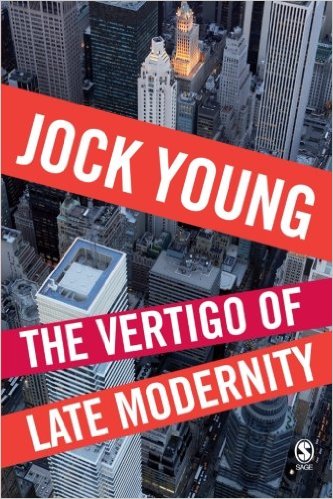
At the heart of vapourwave is a tension between the sweet and disturbing, between satisfyingly vacuous muzak and dissonant, deliberate glitching. This is related to its deterritorialising impulse, by which I mean (borrowing from Deleuze and Guattari lingo), the way it extracts and recontextualises some element of a thing, then placing it elsewhere in a different environment. Vapourwave is a sort of bulimic, abject, rhizomatic discourse. It gorges on the symbols of late capitalism (the glossy muzak and soft rock of the eighties, international brands like Nike or Microsoft, the aesthetics of corporate advertising and so on) and then expels them in a gross reinterpretation that seems to purge them of their original, seamless facade. It might be useful here to mention that sociologist/criminologist Jock Young (2007) once described late modernity as a ‘bulimic society’, where we are all (internationally) included in the dreamlike semiotics of the rich through the opulence and availability of global branding, advertising and popular culture, but increasingly we are structurally excluded from the means which would allow us to achieve such dizzying heights ourselves. This social anomie is jarringly rendered in vapourwave’s shameless embrace of corporate culture; at once poking fun at it but also monumentalising it in an ambiguous way. It’s by no means a didactic movement, but as Grafton Tanner tends to argue in his excellent book Babbling Corpse: Vapourwave and the Commodification of Ghosts (2016), it’s symptomatic of its times. The very poetics of vapourwave reflect the uneasy experience of being unable to escape the system, the uncanny effects of our perpetual cultural nostalgia—the celebration and denigration of late capitalist modernity and all its forms of post (post (post) post).

51jlr4xfsml-_sx331_bo1204203200_
Source.

Outside of their usual contexts, corporate and commercial visuals (the vapourwave a e s t h e t i c) seem absurd, funny, strange, alienating. It hollows out the imagined ‘core’ of the brand and replaces it with a sort of free-floating lack of functionality, a disembodied eeriness. Chuck a logo in with a pastel-hued painting of palms and corny dolphins lifted from a SNES game and there you have it. Old Apple logos might be hovering over a pixellated ocean, waiting to plunge inexorably. Not only the aesthetics, but also the music itself, creates this sense of fragmented capitalism. Tanner talks briefly about the relevance of Derrida’s idea of hauntology to understanding the politics of vapourwave and this seems to me very astute. It’s the idea that the future is irrevocably haunted by the past; that culture and politics are also spooked with spectres from the past—from communism (Derrida’s book is called Spectres of Marx) to old technologies. It’s the idea that things are always-already obsolete, that there’s a sense of being itself as displaced and never quite fully present. It’s an ontology of difference, deferral, doubling, of objects which become ‘a little mad, weird, unsettled, “out of joint”’ (Derrida 1994). Derrida’s gloss on Marx’s analysis of the commodity-table gives us a sense on the ghostliness of consumer objects:

For example — and here is where the table comes on stage — the wood remains wooden when it is made into a table: it is then “an ordinary, sensuous thing [ein ordindäres, sinnliches Ding]”. It is quite different when it becomes a commodity, when the curtain goes up on the market and the table plays actor and character at the same time, when the commodity-table, says Marx, comes on stage (auftritt), begins to walk around and to put itself forward as a market value. Coup de theatre: the ordinary, sensuous thing is transfigured (verwandelt sich), it becomes someone, it assumes a figure. This woody and headstrong denseness is metamorphosed into a supernatural thing, a sensuous non-sensuous thing, sensuous but non-sensuous, sensuously supersensible (verwandelt er sich in ein sinnlich übersinnliches Ding). The ghostly schema now appears indispensable. The commodity is a “thing” without phenomenon, a thing in flight that surpasses the senses (it is invisible, intangible, inaudible, and odourless); but this transcendence is not altogether spiritual, it retains that bodiless body which we have recognised as making the difference between spectre and spirit. What surpasses the senses still passes before us in the silhouette of the sensuous body that it nevertheless lacks or that remains inaccessible to us.

(Derrida 1994)

Vapourwave, of course, exploits this ‘ghostly schema’ of consumer objects. ‘Woody and headstrong denseness’, the sheer materiality of the thing is ordinarily supplanted by its mystical, transcendent value as a commodified good or brand. When we think of Nike trainers, rarely do we care for their actual material structure; usually it is the symbolic resonance of the brand that captures us. In Vapourwave, materiality comes back, vicious and strange. Fredric Jameson laments the way that postmodernism presents us with a meaningless concatenation of cultural nostalgia, often without context—BuzzFeed’s noughties nostalgia lists perhaps being a case in point. Vapourwave takes this ‘out of context’ randomness and runs with it. Art objects, textures, corporate iconography and screen-saturated colours combine in a collage of irony and contrasts. The mishmash quality of the vapourwave aesthetic lends it to easy manipulation and re-creation. This is the DIY ethic of the movement, its impulse towards constant theft, the cut and paste fun of sampling, the wilful shredding of distortion which creates a contemporary rendering of William Burroughs’ literary cut-up method or the random-making ‘recipes’ of Dada poetry, as described by Tristan Tzara.

13422823_261081637591822_2099392307_n
Vapourwave Collage (note the hashtags on the link). Source.

Now, the effects of this mixed-bag of internet treats aren’t just weird and humorous, but weird also in an unsettling way. The samples become points of focus in a manner that strips away the normal cultural values of the original song; the easy soft-rock of the eighties becomes haunted with lo-fi feedback and interruption, compression and echoes. It sounds like it’s being heard through a cave or the underwater atrium of an abandoned mall, after the apocalypse. One of vapourwave’s most prominent releases to this day remains Macintosh Plus’ Floral Shoppe (2011) and on this record the production warps its soul music with a surrealist synth-driven dreamscape, in which R&B beats become slow and trippy and human voices are dehumanised into drawls and robotic calls. Often a sample starts but never resolves its line, constantly stumbling over itself. Tempos are spliced and no song follows conventional structure, but instead runs on repetitions, overlaps, interruptions; completely jarring changes in rhythm and key with no transition. Funk and soul from the eighties are no longer smooth and satisfying radio filler, but are turned inside out, their inherent weirdness exposed. Some of the highlights include ‘It’s Your Move’ by Diana Ross and ‘You Need a Hero’ by Pages. The effect of listening to this album is sort of like pushing a shopping cart round a supermarket and gazing around in wonder at the saturated pastels, the pointless products, the detritus of cluttered consumer madness. Glitches, twinkles, the beats of unsteady feet. Random tannoy announcements like a call from some parallel universe, the underground, the flickers of the internet ether.

Tanner’s Babbling Corpse usefully makes a connection between the dehumanisation of human voices in vapourwave music and contemporary philosophical movements such as speculative realism and object-orientated ontology. Both movements share the fundamental rejection of correlationism (the dominant, anthropocentric idea in Western philosophy that views reality only in relation to and projection from the human perspective). Instead, they turn to the world experience of the nonhuman, the sentient and foreign perspective of matter and objects. They expose the contrived nature of our distinction between self and world, showing how we are world, entangled in a way that is inextricable and disturbing (Timothy Morton, for instance, points to the crustaceans that live in our eyelashes or the bacteria in our gut as examples of how we are the environment, rather than self-complete and separate beings). Vapourwave in some way manages to evoke this weird world of objects, at a level only barely accessible to humans. Its use of glitches and looped samples disrupts the ordering of people and things. As Tanner puts it,

Glitches interrupt our expectations while deceiving and annoying us. They undermine our notion of what the machine is supposed to do for us, not without us. In this way, our electronic machines take on lives of their own and appear capable of functioning perfectly well without humans – a complete transcendence into other-worldly sentience.

 (2016: 11)

We might consider this in relation to Martin Heidegger’s (2008) idea that we only notice a tool as a thing when it stops working. A broken hammer suddenly becomes a strange entity in its own right, rather than just one chain link in the process of a means to an end. Chuck Persons Eccojams Vol. 1, for starters. The very name: Eccojams. It implies the jams are a product of this Other: the ecco, ecology, echo…The title derives from an old Sega Megadrive game called Ecco the Dolphin, an action adventure game which featured dreamy music and a very minimalist gameplay narrative. You made Ecco sing to attract and interact with other objects and cetaceans; you could evoke echolocation in order to unfold a map of your oceanic surroundings; you could call to special crystals (glyphs) which in various ways controlled Ecco’s access to different levels. There is a beautiful otherworldliness to this game, and not just because Ecco ends up at the City of Atlantis. It’s created its own mythology, and the emphasis on song (like The Legend of Zelda’s ocarina melodies, which initiate effects in the game) opens up the possibilities for a nonhuman conscious or logic. Music, perhaps more than language, has effects on nonhuman consciousness. At a certain pitch, it can shatter a glass, or cause buildings to rumble with bass. It opens up its own logic of cause and effect.

maxresdefault.jpg
Source.

Hauntology, in a sense, is about being stuck on the loop of the end of history.  Technology constantly dislocates our awareness of time and space, so that linearity is replaced with instancy, repetition and reiteration, the constant recycling of former styles and events. Repetition is uncanny partly because, as Freud argues in ‘The Uncanny’, it’s the structure of the unconscious. When we notice repetition, we notice how our whole psyches are built on the compulsion to repeat even that which is most traumatic to us. It also violates our sense of identity and experience as singular and unique (an idea that liberal democracy and consumer capitalism likes to perpetuate). Identical twins are uncanny for this reason, as is deja vu. We feel that the normal order of time and space has been distorted (this is of course made explicit in films like Donnie Darko, which deal with parallel universe theorems). Repetition is also uncanny because it suggests that things we thought were unique to a moment, imbued with their apparent transience, are actually lingering and potentially eternal. It’s unsettling to have the buried constantly disinterred and broken out into the open present. Tom McCarthy’s Remainder (2005) is a novel which explores the logic of repetition in relation to a trauma narrative in which the protagonist becomes obsessed with re-enacting events to the point of absurdity and violent conclusion. It’s that overlap of the real, where dreamlike remembrance meets actual performed repetition, that is the orgasmic satisfaction of the psyche.

Listening to vapourwave enacts this perfectly. We might start to recognise the songs from which these samples were drawn, but our recognition is distorted along with the samples themselves. The past floats uncannily into the future. Eccojams Vol. 1 drops its tinkling beats on a loop and the vocals from eighties ballads are stripped of their velvet and become mournful, minor, distorted. Inhuman, odd. There’s a sense in which our contemporary experience of reality in the face of apocalypse and pathological nostalgia is both dark and sweet. Morton’s branch of object-orientated ontology, dark ecology, perfectly captures this experience (in fact, in Dark Ecology (2016) he describes the process of dealing with this ‘grief’ as sharing the structure of a ‘dark ecological chocolate’). Vapourwave is at times incredibly saccharine, mapping itself through the cheerfully smooth loops of Muzak; but it is also jarring, dissonant, deeply unsettling. It takes dirty club techno, the complex tempos of intelligent dance music, and puts them through the cheap production of the GarageBand blender. Vocals echo like a broken tannoy machine. Vapourwave, as both visual and musical aesthetic, fundamentally opens an aural space in which past, present and future become a haunting echo chamber of one another. No longer is this the mere surface play of postmodern collage, but instead it’s the material manifestation of a specific cultural hauntology. As Tanner puts it, hauntology ‘is unlike Jameson’s pastiche in that it complicates the past (specifically, the past’s image of the future) in order to call attention to capitalism’s destructive nature as a subjugating force that only fools others into thinking it came to eradicate “history”’ (2016: 35-36). Capitalism is hollowed out, its signature brands become lost echoes in a vaguely recognisable, a hypnotically attractive yet alarming vision of our near-present future; blended with the figures of mall culture, the colours of early aughts internet webspaces and the abyssal possibilities of a Tumblr scroll.

I’m interested in how vapourwave re-enacts a different form of consciousness and how this might be ecological, even though the movement’s only obvious engagement with Nature as Such is through the proliferation of palms and potted plants that drift incongruously as consumer goods through some of its artwork. To get at its ecological sweetness, it’s like cracking open a crystal to see its lattice parameters (what a beautiful phrase), the places where the material cleaves (its lines of weakness), its cubic structure. The interplay between structure and embedded weakness is what motivates vapourwave; it contains its own failure, the undeveloped samples, the way a tiny snatch of a song is unfolded into a tranquil sequence of soporific, nonsensical sound. This is not music with a coherent logic. You look for lines and trends and vague traces of structure, but a song will become something more fluid and fragmented. Vapourwave’s material metaphors cannot be coherent; it’s at once free-floating, vaporous, seeping, gelatinous, oozing, splitting, cracking, choking, pulsing, dissolving. Hard matter, soft matter, chemical, vapour, waves and glitches and tiny explosions.

Sometimes, the structure is completely frustrating. On Person’s Eccojams Vol. 1, for example, the slowed-down, reverb-heavy sample from Gerry Rafferty’s ‘Baker Street’ repeats endlessly and never resolves itself into the next line: ‘another year and then we’ll be happy / just one more year and then we’ll be happy’. The twinkle signifies the glimpse of a transition and there’s a blip of the ‘b’ which should resolve into ‘but you’re crying, you’re crying now’ and yet here never does. Instead the song becomes an endless loop of implied futurity, the future conditional, ‘we’ll be happy’ that doesn’t get to complete itself but instead hangs. We’re taken out of time and left in this limbo. Here, the repetition isn’t soothing, it’s unsettling—mesmerising in a disturbing way. We question our longing for the song to resolve and before we have a chance it’s skipped to the next track. So we go back, search out the original version. Is it satisfying? Listening to Raferty’s original now feels weird in a way it didn’t before. It’s like this lost artefact from the past, spliced across the future ether rendered by Person’s eerie and hypnagogic album. While ‘Baker Street’ implies a specific place, now it’s thoroughly displaced, an effect of the internet’s rhizomatic possibilities.

As Morton puts it, ‘in order to have environmental awareness, one must be aware of space as more than just a vacuum. One must start taking note of, taking care of, one’s world’ (2002: 54). Ambient poetics disturb our assumed distinction between inside/outside, self/other; they show how we are entangled in a shared space of coexistence (Morton 2002: 54). Ambient music, in its sensuousness, its borrowing from the world—for example, by using samples of music concrète and field recordings from both nature and urban spaces—embeds us inside an environment in a way that is at once comforting and disturbing. It literally surrounds our senses. Brian Eno famously sets out a manifesto for ambient music by describing ambience as ‘an atmosphere, or a surrounding influence, a tint’, and ‘whereas conventional background music [i.e. Muzak] is produced by stripping away all sense of doubt and uncertainty […] from the music, Ambient Music retains these qualities. […] Ambient Music is intended to induce calm and a space to think’. As Morton puts it, ambient music as figured by Eno deconstructs the ‘opposition between foreground and background, or more precisely, between figure and ground’. In this sense, ‘ambience could be shown to resist the reification of space in capitalism’, ‘at once fill[ing] and overspill[ing] the ideological frame intended for it by the social structure in which it emerged’ (Morton 2001).

hqdefault-2
Abandoned mall / / Source.

Think of it this way: could you get away with playing vapourwave in a mall or a supermarket or diner? Sure, it would ‘fill’ the space in one sense, but also exceed it, rendering all our cultural and material associations with this space uncanny and distorted. It would become a sci-fi space, a space displaced into the future. We would be inhabiting a doubled world, a doubled temporality. I tried playing Floral Shoppe in the restaurant where I work once (obviously when there were no customers) and the effect was actually very comforting. I felt like I wasn’t trapped in the familiar twenty-something existential limbo and instead inhabiting a plane of dreamlike contemplation, like the Rainbow Road level on MarioKart: Double Dash. I close my eyes and the scratched wooden floor spills out into a highway of colour; the tables I’m bumping against are bright yellow stars and fragments of unknown matter. I’m back in the supermarket, trolleys wheeling away from me and products falling off the shelf. I open my eyes and there’s the mirror and a reflection of someone that might be me, wearing a uniform, the chairs and tables flashing around me like holograms. I’m not exactly sure where that association sprung from (it’s been a long time since I’ve turned on the old GameCube), but I guess that’s the free associative impact of the music itself.

Double_Dash_Rainbow_Road.png
Rainbow Road / / Source.

Like Jean-Jacques Rousseau’s Reveries of the Solitary Walker (1782), vapourwave is about an experience of travel and movement without necessarily describing that movement itself. Crucially, the emphasis is on slowing down, on dwelling in a moment; a moment which is looped, repeated, pondered over, exhausted, reflected on. ‘I undertook to subject my life to a severe examination that would order it for the rest of my days in such a way as I wished to find it at the time of my death’ (Rousseau 2011: 24). Vapourwave subjects the e v e r y t h i n g of capitalist late modernity to such self-reflexive inner scrutiny. This scrutiny enacts a slowing down of perception, a sense of looking around and absorbing one’s place in the environment. Through an uncanny distortion, doubling back and becoming the environment. Vapourwave allows us to adopt both a blasé and a highly perceptive attitude to the ad-saturated world in which we exist; the metropolis of the internet becoming some great labyrinth in which we linger at every turn, mesmerised by the neon palms swaying in time to the untimely music, to cans of diet coke and the universal resonance of that bold tick logo. Everything surrounds and coagulates, connects.

This aesthetic dwelling is crucial for ecology because it forces a recognition of the world which we are and in which we live, a recognition that notices patterns of interconnectedness and coexistence. For Gregory Bateson (2016), aesthetics means ‘responsiveness to the pattern which connects. The pattern which connects is a meta-pattern’; both cities and their parts form part of this pattern, of the patterned aesthetic of vapourwave. The metropolis, the mall, the fountain plaza, the computer screen, the window of a building, the burnished, pixellated sunset. All are the environs of sound and vision, the movement between figure and ground, the deconstruction of synecdoche. The part and the whole are constantly supplementing each other (the song, the sample; the symbolism, the surface aesthetic). It’s a bewildering, shape-shifting experience. It forces us to take notice of our world. There’s something about vapourwave which always suggests to me a sort of endless highway, where the vehicles move as if through some viscous substance that drags the experience of time and space. Our perception becomes blurred and starry, with blips of unconsciousness and moments of epiphanic reverie. Things around us fade or glow. The radio rumbles in the darkest cavity of our chest. Am I even breathing? I don’t feel human. Is this freedom?

homepage_large-be7a4fbb
Source.

Alongside this dwelling is a certain playfulness of a way unique to vapourwave. James Ferraro’s Far Side Virtual (2011) might be the classic here. It blends together the inane and cornily flourishing samples from Muzak with automated audio speech stolen from corporate contexts and sound effects from everyday tech life—the message-send swoop, a mouse click, laptop crashing sounds and start-up tunes. The result is something that might reflect Jean-Francois Lyotard’s famous definition of postmodernism as ‘eclecticism’, the ‘degree zero of contemporary general culture [where] one listens to reggae, watches Westerns, eats MacDonald’s for lunch and local cuisine for dinner, wears Paris perfume in Tokyo and retro clothing in Hong Kong; knowledge is a matter for TV games’ (2004: 76). This eclecticism is made playfully manifest in Ferraro’s lively, atmospheric and at times downright trippy record, where twinkles of commercially-drenched, techy synths give way to stuttering keyboards, ringtone effects and twirls of familiar message noises which become maddeningly synced with finger clicks and conversations between robotic voices. A CONUNDRUM article argues that ‘since vapourwave functions namely as commentary, it loops, pitch-shifts and “screws” the utopia of the virtual plaza, creating a harsh, grating sound in away that brings each muzak sample’s faults to the forefront of the track’. This is certainly true of Ferraro, but I’d also suggest that vapourwave is more than mere commentary; Ferraro especially revels in the silliness of corporate culture (check out ‘Pixarnia and the Future of Norman Rockwell’, with its drink slurping sound effects and jingly, kids tv-worthy melody), at the same time as revealing its peculiar utopian unreality, a world of shimmering sound and holograms. There’s a self-consciously affective and pleasurable aspect to the music. Sometimes it sounds like the demonstration music on an art channel, to the point where I’m expecting some beautiful, sellotaped creation to materialise with every musical flourish.

On the other hand, there’s the total weirdness of ‘Palm Trees, Wi-Fi and Dream Sushi’, which takes us through a scintillatingly bizarre encounter with a ‘touchscreen waiter’ who explains the ordering process at a sushi restaurant—apparently in Times Square, with Gordon Ramsay as chef—to the backdrop of exuberant synths and glitchy effects which sound like a Windows 95 laptop gone haywire, or merely said customer making her selections from the menu software. The result is to render a future where restaurants and coffeehouses are devoid of human interaction, becoming impersonal encounters with creepily enthusiastic machine waiters (creepy not just because they’d put me out of a job). The contrast between this manic happiness, this constant focus on choice, with the maddening music is to create a deep sense of unease, to reveal the artifice of such utopian tech constructions. Do we really have a choice? Is life being boiled down to a series of computer menus? Is the future bound to the unsettling intonations of such robotic encounters? I can’t help but escape into the absurdity of the music and try to forget this hauntological disaster is always-already constantly happening…

The comparatively meditative ‘Bags’ weaves its entrancing ambience from an early Windows startup theme, dipping into sonorous caverns of sparkling synths and lifting for air bubbles and irregular, incongruous finger clicks. I am reminded here of a beautiful essay by Steven Connor on the magic of objects, specifically here bags: ‘because they are in essence such fleshly or bodily things, bags enact as nothing else does our sense of the relation between inside and outside. We are creatures who find it easy and pleasurable to imagine living on the inside of another body’. There’s an amniotic vibe to Ferarro’s ‘Bags’; the swaying, dreamy pace that makes us feel as though we are inside those palms, or encased within a glossy plastic number, bouncing away against some glamorous knee. Just as humans have a sort of supplementary, life-giving association with bags, we also have this relationship with the plazas of capitalism and the affective world they render. Ferarro has said that he conceived of Far Side Virtual as a series of ringtones, a musical form which inherently suggests consumer transience, tackiness, kitsch, the whims of passing fashions (not least because the polyphonic presets change with each phone upgrade). He’s also said that he loves the idea of the album being ‘performed b a Philharmonic Orchestra […] Imagining an orchestra given X-Box controllers instead of mallets, iPhones instead of violins, ring tones instead of Tubular bells, Starbucks cups instead of cymbals. All streamed online, viewable on a megascreen in Times Square’. That’s what’s special about vapourwave: its commitment to the endurance of art and the a e s t h e t i c alongside an ambiguous relationship with the ephemerality of corporate kitsch. The artistic rearrangement of these samples, alongside their visual presentation and marketing as alt music through sites like Bandcamp, completely reterritorialises their original framework of meaning.

There’s a sense in which this music—with its self-conscious materiality, the recognisably tacky mattering of its samples, its embrace of the ambient disruption of foreground and background—is inherently committed to some kind of hauntological ecological project, the kind advocated by Tim Morton’s dark ecological poetics. As Ferarro himself says of his album, it’s a ‘rubbery plastic symphony for global warming, dedicated to the Great Pacific Garbage Patch’. Vapourwave recycles culture, proliferates both beauty and trash, endlessly parodies itself and its references. It renders explicitly what Marc Augé calls the ‘non-places’ of supermodernity: the anonymous malls, airports, offices and stations where cultures blend and collide and become foreign places of blank existence, of non-place, of disembodied temporality and physical and social experience. Places emptied out of cultural specificity. Places where one might eat Japanese sushi in a New York airport restaurant, concocted by a holographic rendition of a grumpy English chef and served by a robot developed and programmed by a Chinese tech company. Vapourwave is melancholy and strangely displaced. The frequent use of anonymity by many of its prominent artists (Xavier, for example, is responsible for more than just Macintosh Plus), alongside the Eastern characters for song titles, creates again a dehumanised, uncanny and culturally displaced understanding of identity. It weaves an almost Orientalist mystery through its art, so that we can’t quite geographically place the origins and players of this musical movement. It’s all about dissemination, reappropriation, the instancy of recycled production; but it’s also about slowing down to notice the flaws inherent in our everyday, consumer lives. The heavily sampled, rhizomatic nature of vapourwave forces you to become a more active consumer of both music and other forms of material pleasure, from picking your morning coffee to choosing your desktop screensaver. Perhaps it’s this recognition that gives vapourwave the vague trace of disruptive impulse; the way it strips away the uneasy pleasures and pink mist of the late capitalist plaza and replaces it with a mystique that haunts us back from the future. Objects and humans withdraw from our grasp and we are left with the surface detritus of crushed coke cans, defunct MacBooks, coffee cups and robot voices stuck on repeat, cleaning the floor of the mall to a vicious gleam that threatens to bounce back like a screen and remind us that we haven’t left the room at all – we’re still on the internet, chasing our dreams.

tumblr_mysm59oylp1t5u0gko1_250
#existentialwave / / Source.

Bibliography

Augé, Marc, 2009. Non-places: Introduction to an Anthropology of Supermodernity (London: Verso).

Bateson, Gregory, 2016. Mind and Nature: A Necessary Unity. Available at: http://www.oikos.org/mind&nature.htm. [Accessed 22.1.17].

Derrida, Jacques, 1994. Spectres of Marx. Extracts available at: https://www.marxists.org/reference/subject/philosophy/works/fr/derrida2.htm [Accessed 22.1.17].

Eno, Brian, 1978. ’Music for Airports liner notes’. Available at: http://music.hyperreal.org/artists/brian_eno/MFA-txt.html [Accessed 22.1.17].

Freud, Sigmund, 2003. The Uncanny, trans. by David McLintock, (London: Penguin).

Heidegger, Martin, 2008. Being and Time, trans. by John Macquarrie and Edward Robinson, (New York: Harper Perennial).

Jameson, Fredric, 1991. Postmodernism: Or, the Cultural Logic of Late Capitalism (Durham: Duke University Press).

Lyotard, Jean-Francois, 2004. Postmodern Condition: A Report on Knowledge, trans. by Geoff Bennington and Brian Massumi, (Manchester: Manchester University Press).

Morton, Timothy, 2001. ‘“Twinkle, Twinkle, Little Star” as an Ambient Poem; a Study of a Dialectical Image; with Some Remarks on Coleridge and Wordsworth’, https://www.rc.umd.edu/praxis/ecology/morton/morton.html

Morton, Timothy, 2002. ‘Why Ambient Poetics? Outline for a Depthless Ecology’, The Wordsworth Circle, Vol. 33, No. 1, pp. 52-56.

Morton, Timothy, 2016. Dark Ecology: For a Logic of Future Coexistence (New York: Columbia University Press).

Rousseau, Jean-Jacques 2011. Reveries of the Solitary Walker, trans. by Russell Goulbourne, (Oxford: Oxford World’s Classics).

Tanner, Grafton, 2016. Babbling Corpse: Vapourwave and the Commodification of Ghosts (Winchester: Zero Books).

Young, Jock, 2007. The Vertigo of Late Modernity (London: SAGE).

Poldark’s Romanticism: Solitude, Sex Appeal and Scenery

(Warning: contains possible spoilers up until the end of episode four).


'Wander Above the Sea of Fog'
Source: BBC

the-wanderer_00372102
‘Wanderer Above the Sea of Fog’

Moving from plumes of cloud and sullen mist to the flaming spit of fire below, the opening sequence of Poldark sets us up for a journey through the sublime chasms of history down to the core of its hero’s heart. The scene is Cornwall in the 1780s. The story is a beautifully rendered television voyage through various Romantic archetypes, culminating in the protagonist himself, who stands alone facing the open, churning sea, in the manner of Caspar David Friedrich’s famous Romantic painting, ‘Wanderer above the Sea of Fog’. In the first episode, Captain Ross Poldark returns, miraculously alive, from the American War of Independence, bearing the mark of his experience in the distinctive dark scar upon his cheek. After the battle scene in which Poldark alone escapes with his life, a dreamy flashback presents our hero in smart uniform, ready to go abroad, acquiescing to the breathless urge of his lover Elizabeth: ‘Pray do not be reckless, I wish you to return’. Well, like Robinson Crusoe from his shipwreck and 28 years of island isolation, Poldark does return. Only, while Crusoe returns to ‘civilisation’ to find a hefty profit from his Brazilian plantations to fill his greasy palms, Poldark returns to find his finances in ruins and his dear Elizabeth now married to his insipid cousin. What follows is a tale of Poldark’s redemption; once the idle gambler at war only to ‘escape the gallows’, he evolves into a near prototypical Romantic hero, embodying the necessary sentiment, broody solitude and bad-boy glamour that brought Byron his fame and trouble.

But while Poldark represents an idealised benevolence cut with rugged beauty, he is not a dandyish poet in the manner of Byron or Wilde, but a man of war and experience. While Byron would go off gallivanting with his many women, writing hopes of radicalism back home, Poldark says little of his time overseas – a quietness that only emphasises the intrigue of his character. As the frequent close-ups of his scar insist, this man has done battle, a distinction that reinforces his difference to the other men of Cornwall’s stuffy society.

2671E96800000578-2985366-image-a-24_1425840006831

'Napoleon Crossing the Alps': note the comparison with Poldark - solitary man on horseback, though while Poldark traverses picturesque Britain, Napoleon ranges over the sublime mountains of the Alps
‘Napoleon Crossing the Alps’: note the comparison with Poldark – solitary man on horseback, though while Poldark traverses picturesque Britain, Napoleon ranges over the sublime mountains of the Alps

And indeed, Poldark puts his experience to virtuous use. He represents in some ways that much-loved ‘cult of sensibility’ that wormed its way into novels and poetry of the eighteenth-century: rescuing a wayward waif, providing work for starving labourers and delivering an impassioned courtroom speech in defence of an unfortunate young poacher (played – did anyone else notice – by metal-head Rich from Skins). Sensibility, as we might guess from the title of Henry Mackenzie’s popular novel The Man of Feeling (1771), was a kind of fashion for displaying emotion; a newly remodelled masculinity which was exhibited through tears and expression and other public manifestations of feeling. While Poldark is by no means the soppy hero of Mackenzie’s novel (the Editor’s Introduction to The Man of Feeling warns that the novel ‘proceeds in due course through so many tears that it is hardly to be called a dry book’), his compassion towards the struggling labourers contributes to our image of him as a benign venture capitalist, a hero of industry for our postmodern age of corrupt public figures and criminal bankers. The symbolism of a man attempting to re-open a mine threatened by closure and poor investment, to work alongside his miners in the sweaty heat of the pit and to share the profit, was perhaps not lost on Poldark’s viewers when it was first broadcast in the 1970s. While many period dramas fall into the trap of caricature when representing the ‘lower classes’, Poldark offsets this problem by honing in on individual experiences which highlight the precarious economic and social position of Cornwall’s labourers in the late eighteenth-century: the plight of the young poacher, and, importantly, the story of Demelza, who is adopted from the streets by Poldark as a house-maid and later becomes his wife.

This is a show that milks the viewer’s voyeurism. Any chance it gets to parade Aiden Turner’s sweaty golden torso, visible as he swims in the sea or hacking at the land, it takes it. However, such enticing demonstrations of abs and strength are not merely to keep Turner loyalists from the Being Human days happy. They also serve as an interesting parallel to scenes of Demelza alone in nature. Well, not quite alone. While Poldark ranges the cliffs on foot or on horseback – once again parading the dazzling iconography of Romantic solitude – Demelza wanders off at dawn with her little scruffy dog. While Poldark is a figure of Promethean strength and virility (here another connection between strength and suffering – Shelley’s Prometheus Unbound), Demelza’s ethereal looks, in tandem with her ‘exotic’ Cornish dialect, establish her as an almost mythological figure of Romantic fascination. There are many tender scenes where she lies languid in the long grass, playing with pretty cornflowers, or trailing over the rolling cliffs; but there are also scenes where she tills the land with all the power of Poldark himself. We are led into believing the credibility of their marriage because the show sets them up as equals. Demelza is, in a way, Wordsworth’s ‘Solitary Reaper’: the ‘lass’ with the regional accent, who ‘cuts and binds the grain, | And sings a melancholy strain’ which flows through the land with ‘more welcome notes’ than a ‘Nightingale’. When we first encounter her, begging in the street and being heckled, she is clearly a ‘peasant’, a mess of coarseness and dirt; but her time as Poldark’s domestic tames her appearance, though not her spirit. While Wordsworth’s female Reaper was just one of the rural characters to feature in the revolutionary Lyrical Ballads (1798), Demelza is not merely a figure of some traveller’s amusement or poetic interest. The camera does not gaze at her always from a distance, but switches to close-ups and pan shots of the scenes around her: the swaying grain, the face of her dog, some plain little flower or the ever-present sea. At times, then, we share her perception. Episode by episode, we are lured in with her sweet pure voice; significantly, the voice which settles Poldark’s love for her.

Richardson_pamela_1741

The master/servant romantic dyad is certainly not an original one, but a trope embedded in many prominent examples of canonical novels since the eighteenth-century. Hailed as one of the first ‘novels’ in the sense recognised today, Samuel Richardson’s Pamela (1970) tells through a series of its heroine’s diaries and letters the story of a virtuous servant girl resisting the sexual advances of her master, eventually redeeming his character through her writing and in turn being rewarded with an equal marriage based on love and respect. What made Richardson’s novel unique was that it placed value upon a ‘mere’ servant-girl’s right to self-respect, to protect her chastity and resist the common (and indeed legal) assumption that a servant-girl was her master’s property, to do with what he would. Also, the level of psychological detail afforded by Richardson’s epistolary form allowed the reader an incisive insight into the consciousness of Pamela’s character, a consciousness that gained integrity and resistance through letter-writing itself. While Richardson’s novel gives us an excess of detail, Poldark speaks often through silence. It is those moments in the gloomy interiors of Poldark’s home, with the fire flickering shadows over a rustic meal, or against the backdrop of the ocean, with only the gulls’ moaning, that things change between Poldark and Demelza. The show fleshes her out with a backstory and a problem father, a sense of longing for an unspeakable freedom – the kind of Romantic liberty we experience in her plain, almost Blakean singing.

When Poldark and Demelza do get married, almost on a whim, the show deals with the social consequences of this unlikely coupling. Like Pamela, who has to get used to calling her master by her name, Demelza struggles to address Poldark as ‘Ross’ instead of ‘master’ or ‘sir’. Moreover, the rebellious couple face an onslaught not only of gossip but the kind of exclusion that has very material consequences, not just in terms of how Poldark is treated by polite society but even in business, as investors withdraw from his start-up mining company. This is something Demelza worries about greatly, as does Pamela in her marriage to her master, Mr. B-, as she reflects:

The great Mr. B—— has done finely! he has married his poor servant wench! will some say. The ridicule and rude jests of his equals, and companions too, he must stand: And the disdain of his relations, and indignation of Lady Davers, his lofty sister! Dear good gentleman! he will have enough to do, to be sure! O how shall I merit all these things at his hand! I can only do the best I can; and pray to God to reward him; and resolve to love him with a pure heart, and serve him with a sincere obedience. I hope the dear gentleman will continue to love me for this; for, alas! I have nothing else to offer!

Richardson’s novel, I should add, was riffing off the tradition of conduct literature, expressing a kind of Puritan message of self-restraint and virtue. It loses pace in the second half, where Richardson has shunned the romantic convention of ending on a marriage and instead spends the rest of the book describing Pamela’s efforts to run a virtuous domestic set-up. It is with Charlotte Brontë’s Jane Eyre (1847) that the servant-girl heroine is imbued with a wilder, more defiant streak. While Pamela shows her strength not through any physical feat (indeed, her only two escape attempts constitute a foolish notion to drown herself in the garden pond, and a runaway plan which is aborted when she comically mistakes plain old cows for menacing bulls), Jane displays real physical endurance when she manages to flee Mr. Rochester after discovering about the sham marriage she was almost tricked into. I cannot help but quote that famous, impassioned speech that she makes to her would-be husband:

Do you think, because I am poor, obscure, plain, and little, I am soulless and heartless? You think wrong!–I have as much soul as you,–and full as much heart! . . . I am not talking to you now through the medium of custom, conventionalities, or even of mortal flesh:–it is my spirit that addresses your spirit: just as if both had passed through the grave, and we stood at God’s feet, equal,–as we are!

This transcendentalist ideal of love carried through spirit is profoundly Romantic, and one that comes to inhabit the space of Poldark through the mystic enchantments of Demelza’s singing. This taps into Romanticism’s trope of the folk ballad and the femme fatale, found particularly in Keats but also Coleridge’s ‘Christabel’, that warns of the strange seduction of the ‘wild’, exotic female:

I met a lady in the meads,
Full beautiful – a faery’s child,
Her hair was long, her foot was light,
And her eyes were wild.

Perhaps this description could be applied to Demelza too, as she dances at the village carnival and skips fairylike along the cliff top meadows. In Keats’ ‘La Bella Dame Sans Merci’ (1819), the speaker meets a curious, vampire-like woman, who seduces him then leaves him cold and alone in the ‘gloam’ of the lake’s bird-less landscape (and, of course, birds are a very importance presence in Romantic poetry). It is interesting that in the twentieth century, with the impact of Bram Stoker’s Dracula (1897), that the myth of the vampire, the lethal seducer, was transferred from the female to male (Turner himself played the tortured vampire Mitchell in Being Human). There are no vampires in Poldark. Demelza is more of the innocent fairy type, embodying the kind of alienated selfhood that Jane encounters as she perceives herself in the mirror: ‘the effect of a real spirit […] like one of the tiny phantoms, half fairy, half imp’. Estranged from what she thought she was – a mere governess – and hurled into the beautiful turmoil of a fairy story.

Art thou pale for weariness      Of climbing heaven and gazing on the earth, Wandering companionless       Among the stars that have a different birth, And ever changing, like a Joyless eye      That finds no object worth its constancy? (Percy Bysshe Shelley, 'To the Moon')
Art thou pale for weariness
Of climbing heaven and gazing on the earth,
Wandering companionless
Among the stars that have a different birth,
And ever changing, like a Joyless eye
That finds no object worth its constancy?
(Percy Bysshe Shelley, ‘To the Moon’)

It is in Demelza’s metamorphosis from fawn-like (as Elizabeth describes her) child to Poldark’s wife that the show reaps the reward for both parties. When Demelza finally works up the courage to try on a jewel-green dress she finds stuffed into a drawer, it is in this dress that she winds up in bed at last with her master. Yet even here she still looks shrunken, pixie-like in the dress too-big for her, representing the absurdity of the bourgeois identity that she is inadvertently stepping into, like Cinderella. Here, she remains, like ‘plain Jane’, elusive and fairy like, ephemeral in her selfhood. It is in her later endurances, her resistance to the jibes of polite society, that Demelza emerges as our true heroine.

In Brontë’s novel, stumbling alone and starving over the moors, Jane Eyre embodies both female vulnerability and endurance against hardship within the stifling social conditions of the era. Steadfastly she refuses to be Rochester’s mistress and live under a sham marriage. Eventually, like Pamela, she too is rewarded for her virtue, by in turn claiming her own (now, like Poldark, wounded) Byronic hero, whose redemption is signified in the purging of a dramatic fire. The hearth is enflamed from quiet warmth to primitive passion. At the end of episode 4 of Poldark, Ross confesses his love to Demelza in a scene of bedroom intimacy that well resembles that of Pamela and Jane Eyre:

‘You are not too ashamed o’ me?’ asks Demelza, sitting on the bed.

‘Why do you think I married you?’ her husband turns to her.

‘I don’t rightly know.’

‘To satisfy an appetite, to save myself from being alone […] I had few expectations. At best, you’d be a distraction – a bandage to ease a wound. But I was mistaken. You have redeemed me; I am your humble servant, and I love you’.

Like Rochester, and Mr. B-, Poldark is a man redeemed by humble love. Only time will tell (no spoilers) how this pans out. The novel is a form which tends to drive towards closure, the pursuit of some fulfillment of marriage, death or didactic morality; whereas television drama feeds us with cliffhangers, the always open promise of a sequel. This is of course a simplistic distinction, but even so, the point remains that with a book, you can physically see when you are getting to the end, where the pages are running out, and with television, there is a kind of abstracted spatiality and temporality that leaves you always hanging.

Scene from Pamela (source the-toast.net)

As if I were watching a serialised version of Byron’s biography, I intend for the rest of the series merely to sit back and enjoy the picturesque landscapes and the pretty hair, the romance and tragedy and beautiful costumes. All acts of consumption I suppose, which is fitting because Romanticism, as Timothy Morton argues in The Poetics of Spice, invented consumerism; consumerism in the sense of Marxian ‘commodity fetishism’ – consuming something for its representative, fantasy qualities more than for the use value of the thing itself. Wordsworth with his mountains, Coleridge with his opium; objects of desire which offer some form of imaginative potential to the self. But I won’t go into anymore detail; that’s another story, another romance.

Hyperreal Lives: Made in Chelsea and The Seductive Politics of Boredom

There’s a certain uneasy, shifting quality at the centre of Made in Chelsea that reminds one of the later work of Samuel Beckett.

Martha Gill

For a show in which a character actually says “Charles Dickens wrote Winnie the Pooh. No, Pride and Prejudice,” you might be shocked at any comparison raised between Made in Chelsea and the world of literature. And yet, there is a sense of unease that haunts the famous Channel 4 show which documents the financially-flushed lives of trendy twenty-somethings partying and gossiping themselves around London. A sense of unease that is usually reserved for the realm of the literary text, specifically the postmodern literary text, which evades fixed meaning and narrative closure. That leaves us in some sort of existential crisis. And so what is this Beckettian quality that haunts the flashy world of ‘yahs’, of immaculate blow-dries and fancy cars? Is it the sheer vacuity, the absurdity, the meaningless and endlessly repetitive plot lines? The bizarre seduction of its pointlessness and dragged-out pacing, the lingering shot on a face of shaky acting that aims to convey some kind of deep significance, but instead trails us into nowhere?

There is something strangely seductive about Made in Chelsea. I thought maybe I’d struggle to write this article, given that I have only watched a handful of episodes from a show that has run for seven seasons. My mother watches it, my brother watches it. They don’t watch much else on telly, so there must be something in it that lures them in. That lures us all in. Indeed, maybe there are people out there who genuinely anticipate new episodes, as if there really was some plot development to look forward to. There must be some reason why Channel 4 bother advertising narrative ‘tensions’ in their new episode teasers. Yet I find it difficult to establish the significance of any story arc in Made in Chelsea: each episode rolls over with an intrigue that evaporates like the champagne sucked so readily from its characters’ glasses.

But wait, you may say: Made in Chelsea is not meant to be television drama, it is reality, albeit ‘structured reality’. We are, supposedly, watching a show about ‘real’ lives; these are ‘real’ people acting out things that have ‘really’ happened to them. Reality does not readily provide us with such arcs of climax and resolution that fictional scripts tend to yield up; reality is all about interweaving story-lines, little tensions that burst and dissipate under hushed storms of gossip – the sheer joy of calling someone an idiot behind their back. I suppose this is what Made in Chelsea really is: grownup children bitching and dissecting one another against the backdrop of glittering cocktail glasses and an effortlessly hip soundtrack.

Because of course, this is no ordinary ‘reality tv show’. The cast of Made in Chelsea are rarely seen smoking, vomiting, shagging. The ordinary things folk tend to do on reality tv shows; you know, Big Brother and the like. The world of Chelsea is one of perfected physicality: sculpted bodies, stylish clothes, the cool gaze of another blasé conversation, another stilted standoff between two characters. For this show is all surface, all talk. Not much changes, except for the setting: from beautiful London gardens with the perpetual tinkle of glasses to throbbing club scenes and the stunning backdrops of Venice and Versoix, from gleaming storefronts to pheasant shoots and country-club chic. We are invited to revel in the gorgeousness of panoramic camera shots, the afternoon light as it flickers from the sun between leaves to the glint of a wine glass. Perhaps we could watch this show on mute, with the characters becoming a kind of tableau vivant, and we may sate ourselves on the images of their flawless skin, their achingly white teeth. These are characters whose personalities shift with the wind of each new season, who perform themselves as they please.

And of course, there is the British obsession with class, particularly the surface forms which class may take. We have always loved observing the lives of the super-poor and hyper-rich, and from Dickens to Evelyn Waugh readers have been drawn in by artistic representations of both the struggling underclass and the excesses of the wealthy. Watching or reading about the extremes of poverty or richness makes us feel better: it allows us to reaffirm our own position, as somehow ‘normal’. We’re never that bad; we’re comfortably in-between. In a sense then, Made in Chelsea shares with shows like the BBC’s documentary-style show The Scheme its status as a form of class porn. Watching the ‘feckless’ lives of those in poverty makes people feel better; superior, even. Careful editing enhances the drama, adds turbulence to the characters’ lives and cuts out the ordinary hard work that may go on behind the scenes. Watching Made in Chelsea, I suggest, deflects the structural issues underpinning the status of the super-rich onto a series of mundane story-lines that focus almost exclusively around love interests. There is very little in the show to tell us how so-and-so got his or her fortune. And if the university degree, modelling career or entrepreneurship features at all, it is usually as a mere prologue to some form of romantic or consumerist intrigue. We are told to sit back and enjoy this form of lifestyle porn, without bearing a thought for the opportunities these people received to get where they are now.

Also, there is a certain pleasure in indulging in one’s prejudices. The cast of Made in Chelsea embody a certain form of gap yah privilege that many of us enjoy mocking in this day and age where the class divide is wider than ever. While watching shows about the ‘underclasses’ often makes uncomfortable viewing, documenting the frequently distressing scenes of life on the breadline, watching Made in Chelsea involves both succumbing to the passive pleasures of spectacle and an exercise in mockery at the dandified lives of its characters. We may poke fun at the absurdity of some of their dialogue: the accent, the ‘totes’, the ‘yeah boi’, the gestures that seem to separate these people from the rest of the human race. As the notorious Mark Francis quips, ‘I once knew someone who owned a sleeping bag’. Yes, quite: a sleeping bag; those cave animals from the world beyond, with their horribly proletariat existence. Indeed, these beautiful beings, the Chelsea Set, are not like the rest of human kind. Not like the rest of us watching, half allured and half bemused.

Onscreen we watch these glimmering cyborgs, as they fashion their real lives right before our eyes.

And yet, the Chelsea Set are not untouchable beings. They splash themselves over pop culture: doing photo shoots, exclusive interviews, making innocuous appearances as guest-star DJs in clubs. We are asked to see them in the flesh, as if we too can reach out – if only briefly – to touch their precious stash, the solid gold of their lifestyles.  We may look them up on Wikipedia to find out more; these characters are hypertexts, whose ‘real’ lives are perhaps preceded in a Baudrillardian sense by the simulations they portray onscreen. They have built up their empires of personality which branch out from the TV series to magazines and online articles documenting details of their fabulously elaborate yet ultimately vacuous existence. As Jon Dovey puts it: ‘reality TV is the ultimate expression of the simulacrum in which the insistence upon realism is in direct proportion to the disappearance and irrelevance of any referential value’. Yes, the disappearance of any worthwhile meaning; that sounds familiar. Are these ‘real’ people, or mere masks – postmodern burlesques of the generation of ‘bright young things’ which once lit up the 1920s Jazz Age, but now dissipate into the no-place of mundane conversation? The sexiness of Made in Chelsea is perhaps undermined by the sheer obviousness of its facade.

Yet when we watch these individuals perform their ‘selves’, do we passively absorb their world as if it were merely a stage-set, or can we pierce this world, burst the bubble on their champagne-scented version of reality? If there is an almost erotic allure in the mere spectacle of the lives of the rich, then allowing ourselves to be sucked into the simulacrum of this show constitutes a new, if slightly sickly, opium for the masses (or at least, those who bother watching). So, perhaps, let us covet the aura of affluence, of shimmering lives and expensive spaces, while at the same time reminding ourselves of the poverty and inequality that must exist to support the glamorous boredom of the rich and famous. Or maybe we could turn off the telly, and go camping instead.

http://youtu.be/FAv57nK4aXw

Sources: 

John Dovey (2000). Freakshow 

Martha Gill, http://www.newstatesman.com/culture/2013/05/made-chelsea-totes-postmodern