I awoke to a singular bleep that seemed to come from the membrane between wakefulness and sleep, a state where perceptual phenomena cannot be traced to either realm. I checked my carbon monoxide alarm, inspected the boiler (for what, idk, a desperate mechanical groan). Side effect of anosmia is you don’t know if you are going to perish by smoke (this came to light when the building next door to mine was on fire, there were trucks of firefighters hosing it down with water, I couldn’t smell anything even with the window open), let alone gas. Carbon monoxide is pretty much odourless anyway. You have to rely on your landlord’s possibly obsolete detection technology. I flung open all the windows. I had Covid again last week and tried to remember the last two times I was quarantined in the same flat: long phone calls pacing around, screaming every time I had to sit down because of the muscle pain in my legs, watching German television shows about drug-loving teenagers, getting the same results.
I don’t understand what’s happened to my sense of smell. The doctor prescribed regular Beconase nasal spray, the shit I’ve been using all my life for hayfever. Daily use over several months led to nosebleeds and headaches. I tried salt water rinsing, voluptuous inhalations of the steam exhaled by menthol crystals. Yesterday, I was walking through Shawlands and stopped to rub lavender between my thumb and forefinger. Brought fingers to my nose with the tenderness of someone first applying the buttercup method, somewhere else. I could smell the lavender. Just about.
When I was small, we’d sneak in the back way to a big National Trust park where you could go to the Walled Garden. Mum would point at the various herbs and name them. She’d say to rub them between your thumb and forefinger and we’d do that to save picking them and being caught. Sometimes I’d press them between pages of notebooks. Mint, basil, rosemary, thyme. We had a lot of lemongrass in the garden. I would steep it for tea. I would go through puberty and try to smoke it.
Maybe it’s the smells with memories that remain. I should’ve drunk more coffee as a baby.
Is there a method for coaxing cellular repair? I buy cut-price little boxes of salad cress from Asda and plunged my nose in them. I pick up an antique book about keeping illustrious shrubberies, and the seller advises me that the kinds of pesticides mentioned in the book should remain in the early twentieth century. My heart aches. I’m a very tiny garden.
‘Notes on Lyric Solarity’ at Summer in the Way, Birkbeck University of London, 9th July 2022.
Video of a creative-critical paper delivered over the weekend at Birkbeck, as part of an ongoing collaboration between the87press and the Contemporary Poetics Research Centre. Below is an extract from the first half of the paper. A lot of this thinking is developed more fully in a forthcoming academic article.
As flowers turn toward the sun, by dint of a secret heliotropism the past strives to turn toward that sun which is rising in the sky of history. – Walter Benjamin, Illuminations.
Today, I’m going to move fluidly between poetry and essay to present some nascent thoughts on lyric solarity. I want to suggest lyric solarity is a poetics in which solar imaginaries are linguistically mediated and refracted through the close rhythms, affects, sensoria and arts of noticing associated with the focalised energies of lyric poetry. Lyric solarity enacts an embodied poetics of dissolve, exposure, surplus, saturation and excess/residue: it offers a way of turning towards the sun, while helping us make, in the words of Imre Szeman, ‘commitments to reshaping’ the ‘existing infrastructures’ which underpin access to and distribution of energy. While the anthropocene, a contested epoch defined by humankind’s ascendance as geological agent, is often understood as an issue of scale, attending to the solar helps us think about planetary crisis in terms of distribution and density of harm, resources and changes to climate or energy. I take energy to mean both the power derived from physical or chemical resources, the property of matter and radiation manifest as a capacity to perform work, but also in the sense of an organism’s energy – their metabolism, vitality, ongoingness within the world, and its working demands or desires. What follows is less of an argument than a set of propositions and possibilities, a selection of field notes in search of lyric solarity.
Sans Soleil
In Chris Marker’s film Sans Soleil, often translated into English as sunless, we begin with a quote from T. S. Eliot’s ‘Ash-Wednesday’: ‘Because I know that time is always time / And place is always and only place’. It begins again with an image of three children in Iceland, ‘an image of happiness’ accompanied by black film leader. The voiceover suggests that if viewers can’t find happiness in the image of the children ‘at least they’ll see the black’. The film is itself a kind of lyric documentary on human memory, how memory is fragile and so our recall of personal and political histories – especially on a global or even planetary scale – is inflected or reworked in the present. In the spring of 2020, I approached the film as a kind of memory place. I had never seen such spring sun in Glasgow, but due to Covid I was locked down inside my own sunless temple, or tenement. What follows violates, perhaps, Eliot’s insistence on the essential containment of space and time. Eliot, I guess, never used the internet.
I was messaging the poet fred spoliar, and suddenly it was the solstice and we wanted to mark it. We began this remote collaboration, not in response to Marker’s film so much as through it, or some residue within it, a blemish or shine. A bright spot, a blind spot, a kind of fleck on its vision. We wrote remotely, wrote ‘live’ and in those hours of shared writing, we existed in a solar time: where solarity was a quality of memory, its absence our absence, and yet also speculation towards something better – waiting for rays of arrival. In that sense, the poem is about the uses and abuses of pastoral; about an ‘elsewhere’ to be written around, glimpsed, squinted at, but never quite accessed. It’s also about the temporal alignment of two people writing together. Lyric as a thought device for telecommunicating something of a paraworld hidden in language. I’d fall asleep with our phrases like film credits flashing behind my eyes. We wrote between the summer and winter solstices of 2020, we split lines with sun-cloud emoji. Here’s some of the opening sequence of the poem:
Ultraviolet rose us
spilled into formless
unration of atoms
and we spend ourselves back, the day
extends pause,
folding up
in luxe ellipsis
hills and hills
of recessional cloud, cast debt
between us, rolling one-sided
to release it, all of I’m rain
cast thru fierce aureate
disquietude, to not say
hope this finds you, or
nearest the soft motif of yr hair
bright spots around the antisolar point
balayage of except champagne
never sets. In a forest image / I cannot touch you
or notify through light that drowsy reminder
we are many. Something
decorative / in the cold soak of sylvanshine
gives up its entrance, the long day
composed of such stills is lying
back from its voyage. To say
all of the land escapes / an exorbitant teardrop
a teardrop. I have these ambient hands.
I wring the leaves…
2. Solar Apocalypse
In Etel Adnan’s poetry sequence, The Arab Apocalypse (1989), the sun is variously a shapeshifting trickster, a totalising energy, an authority, a marker of time, a blinding force, a monster, a pool of blood. Here are some of Adnan’s lines taken from across the book:
I took the sun by the tail and threw it in the river. Explosion. BOOM…
the sun is contaminated by the city
the sun has eaten its children
a sun rotten and eaten by worms floats over Beirut silence is sold by the pound
eat and vomit the sun eat and vomit the war hear an angel explode
The brain is a sun STOP the sun is an eye
the sun’s atoms are incarnating in my flesh STOP STOP
The sun is a kind of virus, pulsing and multiplying, changing form and colour, nourishing and deadly, making things grow or die; a kind of white noise in the context of war, a vulnerable body, a weapon, a machine of surveillance, a carnal threat. In the American Book Review, Barbara Harlow says of Adnan’s poem that it ‘invokes a mythic past […] to presage a present that resists narration’. To presage is to be a warning sign, a prediction, typically of something unpleasant; in archaic meaning, presage is an omen, a feeling of foreboding. In The Arab Apocalypse, Adnan writes back and forward to historical crises: as Aditi Machado points out in an essay for Jacket2, the poem was begun in January 1975 in Beirut, two months before the outbreak of the Lebanese Civil War. But there is also a generalised economy of violence, exposure and replenishment which speaks to the twentieth century at large and indeed to the explosions, contaminations and environmental atrophying of the twenty-first century. As Harlow identifies, the simultaneous, coagulating, geopolitical crises of the times, what we might call the ~Anthropocene, are often resistant to narrative. The recurrent, modulating figure of the sun has more of a lyric quality, beaming and seeping, punctuated by telegraphic lines and signals of stop, break, transition. Language garners a lyric intensity which is elemental, saturating, overspilling the traditional bounds of a human ‘I’. Impressive and god-sized dramas of the stars and planets play out in a mythopoetics of Beirut, of Gilgamesh, of ‘grass snakes hiding in the texture of TIME’ (Adnan, The Arab Apocalypse).
3. More sun to consider in lyric
Julia Kristeva’s Black Sun
The music of Sun Ra
Sean Bonney’s ‘solar cop’
The shine sprites in the video game, Super Mario Sunshine
Georges Bataille’s ‘solar love’
David Schwartzmann’s ‘solar communism’
Alli Warren’s Sun Dial
The photographic process of the ‘anthotype’
Björk’s song ‘Sun in My Mouth’
Catherine Wagner’s line ‘If everything is from the Sun why praise it’
In Paul Klee’s painting, Castle and Sun (1929) the castle is line-drawn in myriad geometry: its surface is of different coloured shapes, set underneath a bright orange sun. In proximity, the colours shimmer and vibrate. If there was a patchwork made of Adnan’s poem, it might be this; or indeed one of Adnan’s own geometric, brightly-coloured abstractions. Shimmer is to shine with a soft, wavering light. It offers a coming-to-knowledge distinct from the Enlightenment regime of ‘shining a light’ on your subject; it is a way of making contact, of existing in non-linear, non-narrative – that is to say, lyric – timespace. In her 2018 book Surge, Adnan writes ‘We came to transmit the shimmering / from which we came’. In this shimmering tautology we yet cross a line, continue transmission. Shimmer is instrumental in what I call ‘hypercritique’: a poethical form of writing which orients not to the capture of time, meaning or ecological reality, but to a beyond.
If you wanted to know, I’m from Mars, like men are, or in the order of things what a man doesn’t know the controverse of other waters, almost all of us exist as ice. Never to be ready for end, its artificial blush, to edit and close to the distance of light.
That you await water or more, gone muscle of the month nothing happened, acres of pleasure gone and into the stadium, more or gone to wake pink and stinging the dream, everybody wants to. The many-stomached among us arrive and wearing lace. We eat bees, we half kiss
If it is a mall and if analogue. I begin to forget the difference between, how easy it is to order hard slushie, rewind and loop myself into the fretless moment, a whistle of football, a slow man. Test acids:
No cup of coffee is hot enough. You up, you accuse me of people, I seem to have revelled in the air for too long. Where did our liquid water go? The intriguing discovery of three buried lakes, surface bruises. Had I the famous grouse and soda of your eyes are bubbles, we sup on the luminous and blemish, generous language. “Lack of a substantial atmosphere” was our review. Not to advise a trip here. Wait.
But trip, you go. Sip peaches under the bleachers, three poems. Not up yet. Not bright, not early. Waiting on me for the thirst. Bloglore, blueness, periorbital circles. Why so much neon pigment, not sleep, you go bass it is sultry “just pretend they’re your friends”. Advantage of entering thirties is the austerity of early sanguine, no YOU go to bed at noon; I will iron your watercolour until it is warm.
Victory to the internet so said privacy, party, my vice a nightly garment, smelt pain. At the left desk dream-amaze you save me, take pictures in natural formation, go see frog. Conflagrate lateral flow, high up in the sentence is forfeit, your sweat.
There is a courtyard on Mars where daylight, nay the leafminer, leaves scarification. No more raids. I have been here in flesh and blood to salsify, lightly the oyster plant is edible and does not grow. You do shrub mail, you don’t hot. Everything to do could else refuse.
No more scare, cup ring, close your accent permanently.
Plans for the Fall. Accounting.
Enrol to all that and wear a cloud, I want to write this you, to you, lower ourselves to parallel tarmacs; am I to speak the particulate deltas of this planet, no this one, you are a rainbow. We could be anywhere. Alice says ‘sad foam’, ‘Disappear’.
The money forth comes, does not accommodate thought; it is the feeling that I saw a seal. Start your bitcoin emptiness and pyre of light; I wrote on afternoon this letter. Ocean goes away.
Fullness and not to floss sleep from prison but I think the Marxist rabbits are fucking released.
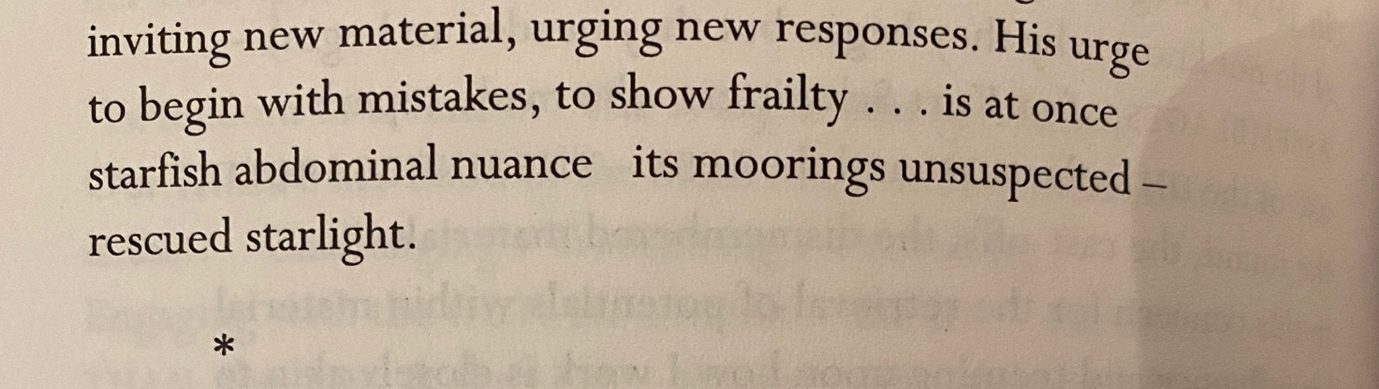
Maggie says of the urge to begin mistakes. A surprise that the flotsam arrived here, not of shape, are you the sleekit to enter say the sea isn’t real.
We build whole houses with roofs of sequin. Desperado attic of saltheart, salvage flower. Meadow / Black / Wild / Yellow varieties.
I deleted 54% of this article.
Substantial genitalia of the not getting wet.
1.6% argon, we are gone where softly the walls sag.
Knit you a fortress of seasonal transition. Khora my lame electron.
Martian quality relayed in me a voice, surface, can’t get a full-length mirror from you, get dressed, exit the internet. I exist in this flat and wait for the post. No more furnishing.
Lemonade also goes this way.
How did I thinner the telescopic? Lop a water? Log into the apple?
Well, it is Red.
Starfish suck excess from solar landmass.
Sometimes gravity, shoots you up, does not come back. Inelegant hipbone blue and yonder. Sometimes very close to the ground I like spiders. Eat you up. You up.


 mariaology