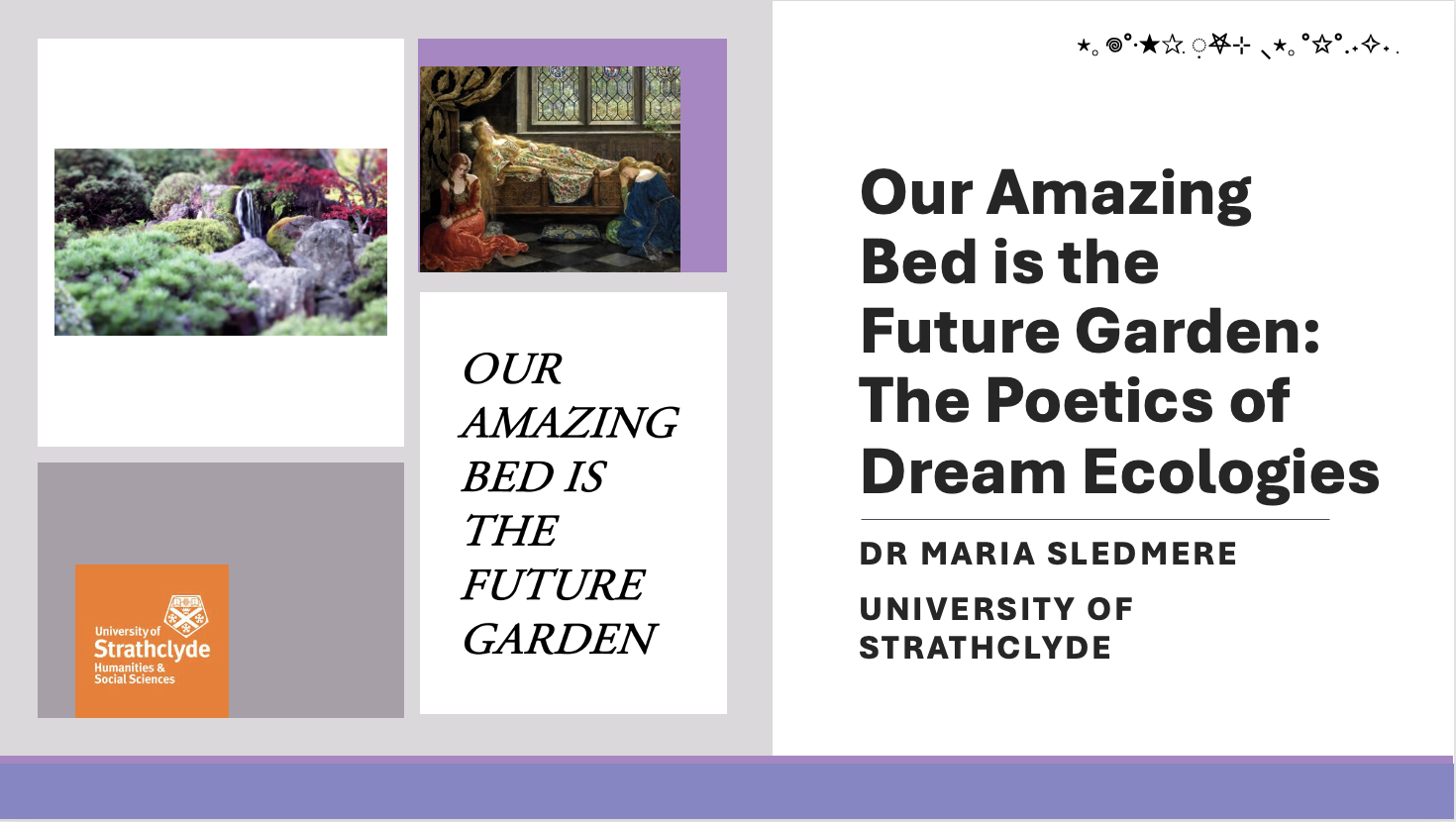
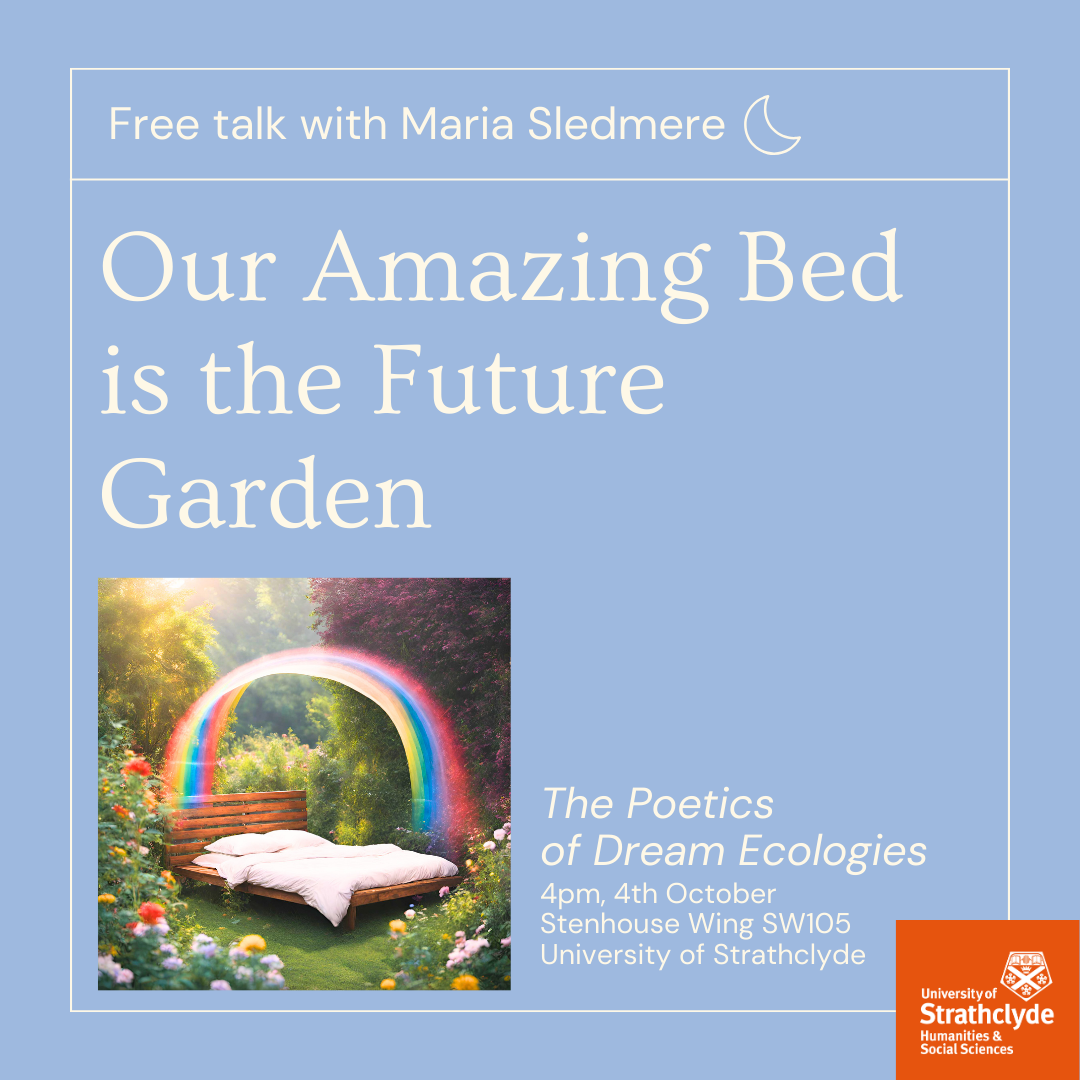
This performance lecture takes flight from the shape of a question: what is the relationship between poetic language, sleep and dream in the anthropocene? Combining poetry, journaling and critical inquiry towards the ecologies of sleep, I will consider how dreams may be the site of impossibility, drift and low-carbon pleasure in a time of ’24/7′ where, in the words of Jonathan Crary, our ability to ‘daydream’ is blocked by a constant barrage of the internet’s attention economy, the demands of late capitalist labour and ongoing crisis. Taking this as a serious political disempowerment, I look to writers whose work alters the ‘operating speed’ of daily life to make room for dreaming otherwise. Exploring the formal interventions of writers within feminist, New York and Language schools, I focus on how these works tend the unruly future garden through daily reclamations of dreamtime. If many of us are at surge capacity, how might poetry attune to various kinds of ‘slow violence’ (Crary) which often go hidden in mainstream narratives of extinction and climate crisis? How might poets borrow from the logic, content and impulse of dream to offer alternative visions of coexistence, commoning, time and compassion for other species?
Recorded at the University of Strathclyde’s Department of Humanities Seminar Series, hosted by Charles Pigott and Hannah Proctor, 4th October 2023.
My research currently centres on sleep as a nexus for thinking about energy transition, low carbon pleasure and chronodiversity (the way our circadian rhythms differ).
Tomorrow I’m giving a talk titled Our Amazing Bed Is the Future Garden: The Poetics of Dream Ecologies. It emerges from a chapter in my DFA thesis which will form part of a book forthcoming with NoUP Press next year. If you would like a Zoom link please drop me an email at maria.sledmere[at]strath.ac.uk.
This autumn I’ve got three upcoming workshops, two of them with the brilliant experimental composer Kevin Leomo.
Civil Twilight: Carving Dreamtime – workshop with Kevin Leomo and Maria Sledmere 14th October at 5:30pm, Civic House, Glasgow
Get your brain sticky in the pumpkin meat of the circadian and join Kevin Leomo and Maria Sledmere in carving dreamtime as an expression of creativity and low carbon pleasure. As the nights draw in and the clocks go back, we’ll be thinking about how darkness affects mood and slumber. Civil twilight is the brightest of the three twilight phases, where stars and planets might be seen in the sky as the sun dips just below the horizon. By attending to the ‘nocturne’ as a form in poetry and music, we’ll dwell in the possibilities of liminal experience for cultivating ecological imaginaries. Please bring: Preferred writing materials, If you have one, a reusable coffee cup, headphones and phone. Tickets are offered on a slide scale: £15 / £10 / £5. Part of Civic Harvest at Civic House – an Autumn themed day of family friendly activities, workshops and market stalls with lunch from Parveen’s and seasonal cocktails at Civic House Bar! Tickets
😴
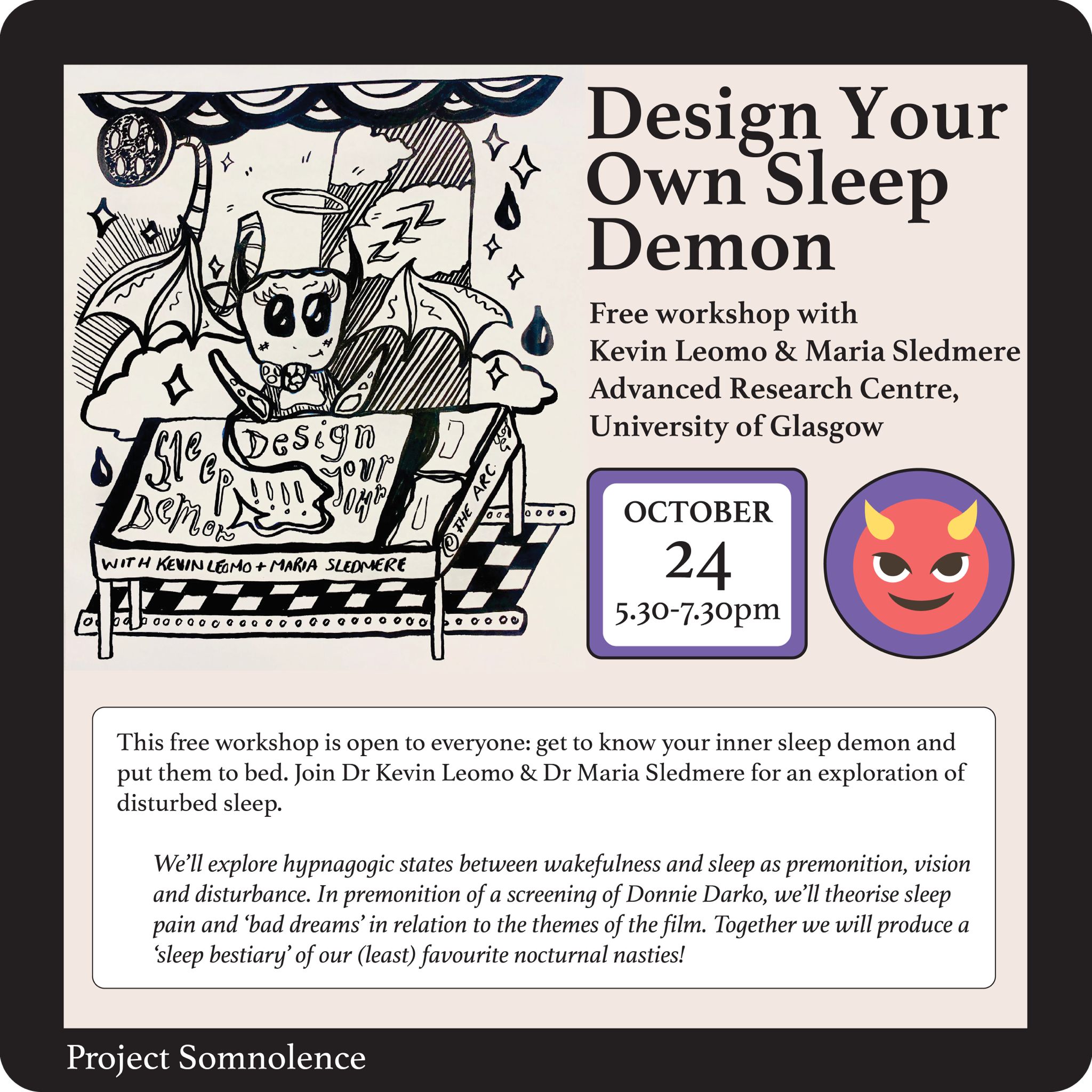
Design your own sleep demon – workshop with Kevin Leomo and Maria Sledmere 24th October at 5:30pm, Advanced Research Centre, University of Glasgow While sleep is a source of rest and recovery, many of us wrestle with disturbed sleep. If you’ve ever had nightmares or found yourself sleepwalking, you’ve encountered oneirodynia. The word comes from the Greek oneiros, meaning ‘dream’ and odyne, meaning pain. Sleep disturbance may be caused by a number of factors: from stress to stimulants, environment, illness and temperature. The eponymous protagonist of Donnie Darko is often found sleepwalking or experiencing some kind of nocturnal anguish. In this workshop, which serves as a primer for the film’s upcoming CinemARC debut, we’ll explore hypnagogic states between wakefulness and sleep as premonition, vision and disturbance. Together we will produce a ‘sleep bestiary’ of our (least) favourite nocturnal nasties, and present our findings before the screening on Friday.
The Poetry of Somnolence – weekend double workshop with Maria Sledmere and Beyond Form Creative Writing 11th and 12th November at 1-4pm (GMT), Zoom
This 2 part series of afternoon workshops prioritise the relationship between writing and sleep. Exploring cross-genre writing, visual and sonic art, we will look at how daily writing practice can recentre our circadian rhythms. From hypnagogic poetics to dream writing, nocturnal missives, dawn songs and notes on twilight, we’ll consider experimental approaches to writing somnolence. All creatives welcome.
Workshop format will combine reading, writing, listening, optional discussion and two nap breaks.
Announcing a 2-part weekend workshop ‘The Poetry of Somnolence’ with Beyond Form Creative Writing.
Take this workshop to explore the radical, rhythmic & world-traversing poetics of sleep, whatever your creative practice!
Saturday and Sunday November 11th and 12th
1-4pm (GMT) via Zoom
😴
This 2 part series of afternoon workshops prioritise the relationship between writing and sleep. Exploring cross-genre writing, visual and sonic art, we will look at how daily writing practice can recentre our circadian rhythms. From hypnagogic poetics to dream writing, nocturnal missives, dawn songs and notes on twilight, we’ll consider experimental approaches to writing somnolence. All creatives welcome.
Workshop format will combine reading, writing, listening, optional discussion and two nap breaks. Reading will be provided in digital format (pdf or weblinks) ahead of the session.
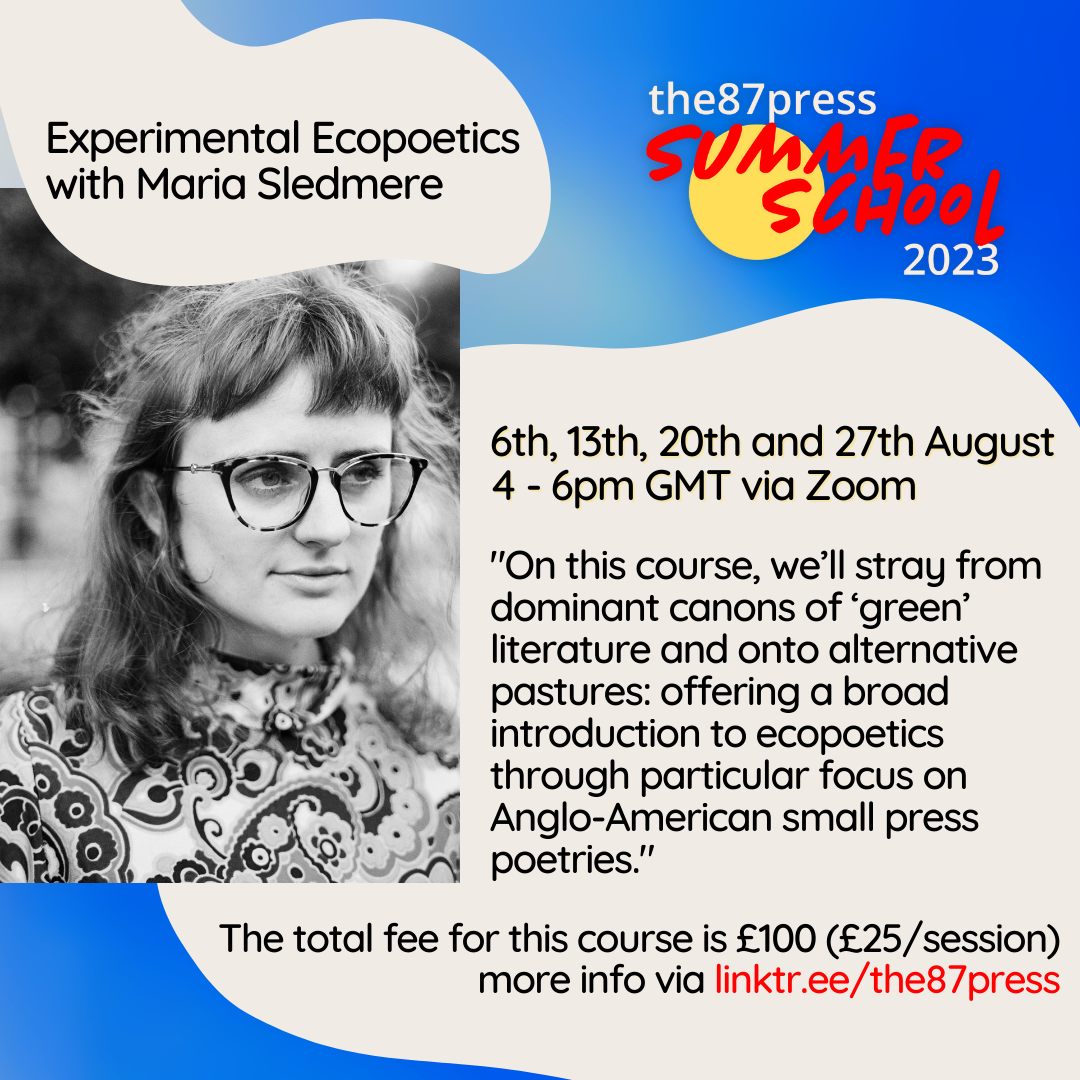
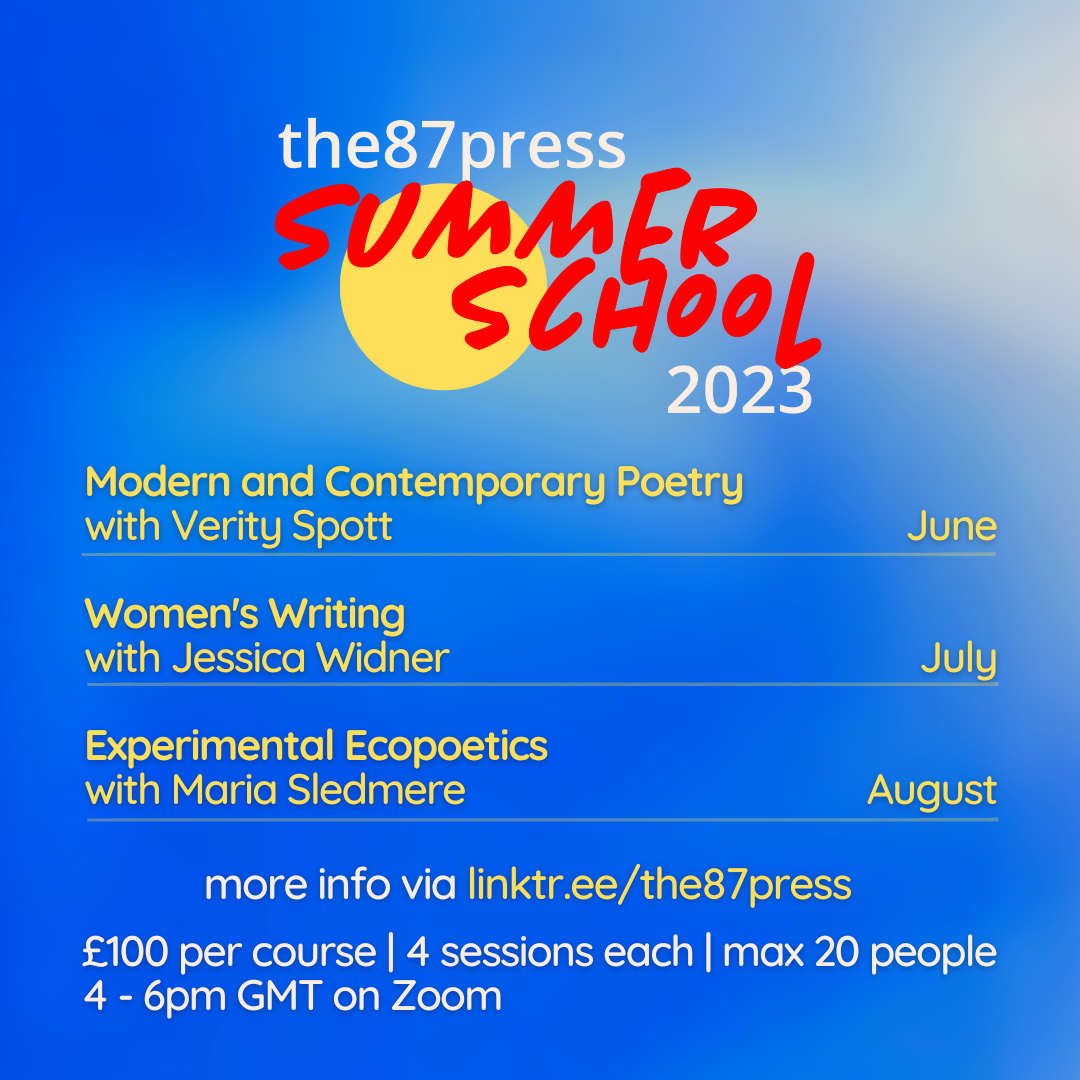
Excited to deliver this four-part workshop series in August for the87press, alongside two other courses by the brilliant Verity Spott and Jessica Widner. These will be cosy sessions on Zoom and feature a range of small press poetries, which we will read, write from and discuss in two hour workshops.
About the Course
Ecopoetics is a capacious term, meaning something like ‘the incorporation of an ecological or environmental perspective into the study of poetics’ (Kate Rigby). As both a creative and critical practice, ecopoetics explores the relationship between literature and the more-than-human world, often in curious, radical and transformative ways. Ecopoetics offers a fieldwork, site of experiment and a tool for (un)dwelling: tuning into ideas of environmentalism, activism, climate crisis, landscape, documentation, dreamwork and lyric. Ecopoetics is not just witnessing; it is an active engagement with habitats, affects, sensing, solidarity and politics — including questions of gender, race, sexuality, land rights and embodiment. On this course, we’ll stray from dominant canons of ‘green’ literature and onto alternative pastures: offering a broad introduction to ecopoetics through particular focus on Anglo-American small press poetries. Each session, structured as a combination of seminar and workshop, will involve reading, discussion and writing activity around themes such as everyday life, elemental thinking, dream and radical ecologies. We’ll investigate key terms such as animality, weather, nature, landscape, energy, the body, time and coexistence through works that expand our notion of who or what speaks in a poem, and where or what is ‘Nature’. Open to anyone with an interest in poetry and ecology, the sessions presume no prior experience with writing workshops, and sharing work in class is not required. A core reading list will be provided freely in the form of electronic extracts, with further suggested reading also listed.
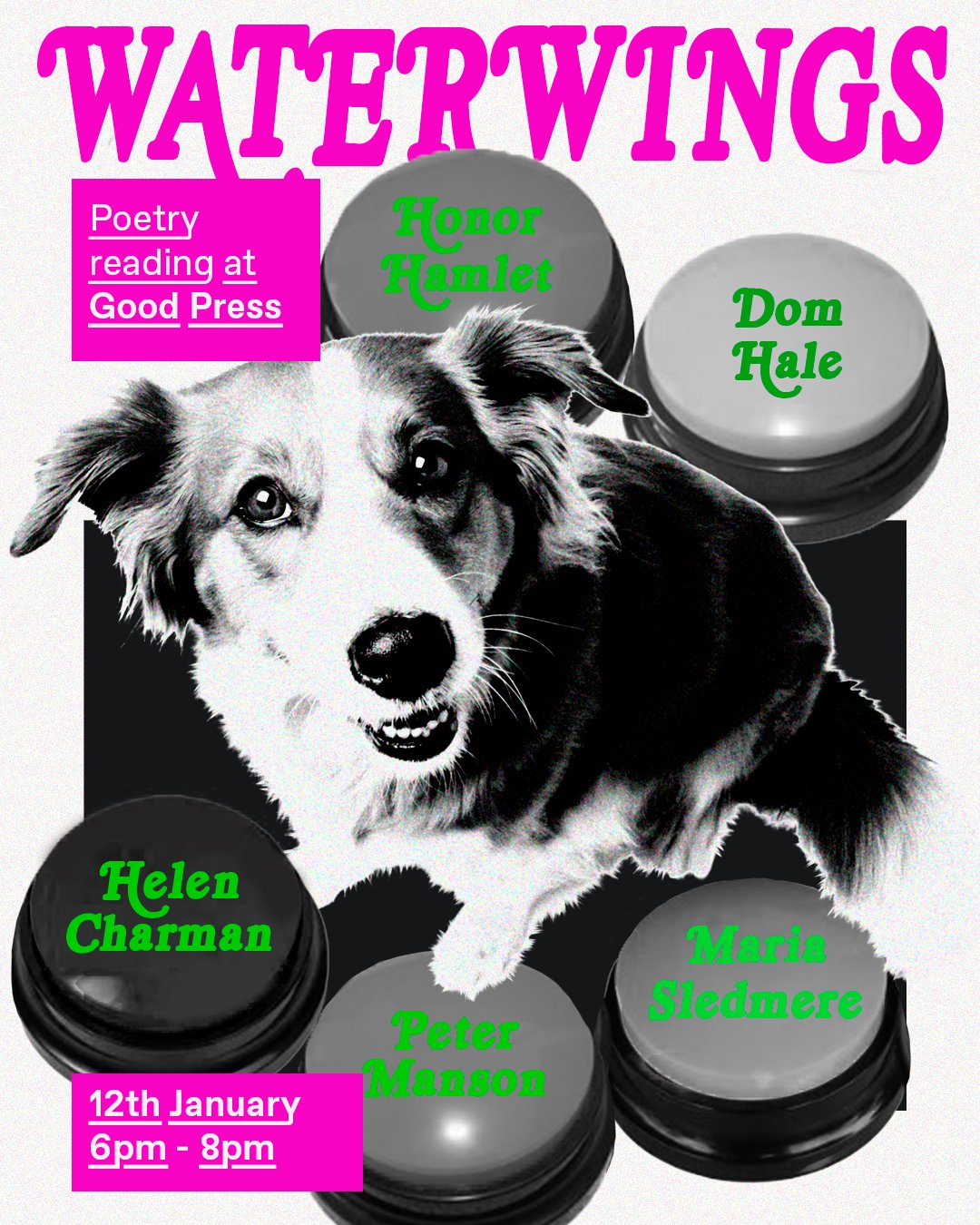
Glasgow folks! I’m doing my first reading of the year next week.
A reading on Thursday 12th January 2023, 6pm-8pm at Good Press, with Honor Hamlet, Dom Hale, Helen Charman, Peter Manson and me. Thanks to Leo Bussi for organising. Poster by Elisa de la Serna.
Grating ginger from spoon feeling, lambent idea of no lucre to save, nothing at all, deposit of warmth – start using joy as a doing, you said I was joy, joying, unjoyed, a joyride ~ this belongs to you!
That spiderwebs look like necklaces is hardly surprising. You made really good use of the cookies. They lived in your brain and measured time like a smart meter to cost more, horrible sharp smell of time, golden darling. The temperature got cold enough so that spiderwebs were necklaces encrusted with sharp frost, to unhook from trees and arabesques of gate to wear at night. The people took pictures of glaciated cities and posted them on the outer gates, with affections measured by the gram. They wore black tourmaline wolf spiderlings and blizzard stone zebras to cover their décolletage. Inside the small room, scared my hot water bottle would burst on me, I was too cold to have glamour. I looked at my golden darling coming close to coming, I could hardly wait for winter to end its solo guitar on the buttress of autumn. It wasn’t as though time snatched the web from her neck and said no more posting, no more selling yourself short as a small glass animal. Often I was a gelid cadaver, after a fuck. The man on the podcast who was a famous director said he hated to be in pain and encouraged women to stop poking their own wounds. He said to do things that made you feel better, instantly, and he put those words in the mouth of a blonde and glamorous actress. I used to buy lighthearted eyeliner and dot my face with artificial freckles to look ‘healthy’. Squinting at the sun is a personality. The moon is our universal friend. Those cookies will be hatching soon and we’ll live in the fat of their secrets. I couldn’t be alone again, especially with the gimmick machine of octovision. I had studied the web and was now found styling myself a spider matriarch, highly resistant to magic, indulged in the cannibalism of love’s imaginary, myself at the end of Verity Spott’s Hopelessness. Frost crystals glitter in the gathering wind saying people make mistakes. You can tear this from me, all of my necklacing sentence, I don’t care anymore.
Once, the temperament of the bellflower was of concern to me. I wrote down words like ‘ornament’ and ‘Missouri’. I had a Lamy pen to write sideways, slantwise, of my other life. There was one club in particular where I excelled in the art of other people’s music. What some call karaoke but I call languishing in melody, obsessively, falling apart in front of an audience. I was like the VHS girl-child in Aftersun butchering ‘Losing My Religion’ with such sweetness the whole resort goes silent. What talent had I for pitch or flourish? There was a column of white light above my head at all times which I imagined writing into, solemnly, a long list of my songs. The more they snared in my throat, the more they became me. The newspapers declared this behaviour ‘cheery perennial’ at the local, noted my penchant for particular martinis, the olive glow of the evening. Any evening, you could find me there in a sequin distress, picking my excess off the floor. I had this thing called a hem. It was the way my voice dropped. The way I gathered it up. Outside the club was a cottage garden, can you believe it, where I tended these purple flowers. I spritzed the last of my drinks across their wilted leaves and I murmured the inside scoop of each song, so only the flowers knew. Their growth was writing itself all over the skirts of the club, I was feeding it; soon we would nourish ourselves from the fruits of trial and error. It seemed appalling that my whole generation had fallen back into the habit of other people’s songs. As a child, I was dragged along to open mics, and all the songs were original, weren’t they? You had to put a few coins in the kitty to get on the list. According to the principle of locality, a particle is influenced by its closest surroundings, with interactions limited to the speed of light. But according to Bell, there are variables. The risk of being heckled or worse, adored. I knew my theory of the song to be incomplete and quantum. It went very far. I stroked the rare blue hue of my partial shade. I queued Outside. Sung the non-lexical vocables of glossy stars. Ate lyrics for kicks. I paid the price.
A workshop exploring Strathprints through creative practice with Dr Maria Sledmere (School of Humanities) & Dr Karen Veitch (Scholarly Publications and Research Data).
Was really fun jumping into the Strathclyde repository on Monday with Karen and students from across the university. The whole worksheet accompanying the workshop is now available open access via Strathprints. We looked at the relationship between open access and open forms, ecopoetics and recomposition, collage, cut-up, erasures and wildcards – with examples from Chloë Proctor, Caleb Parkin, Caroline Bergvall, Kendrick Loo and others.
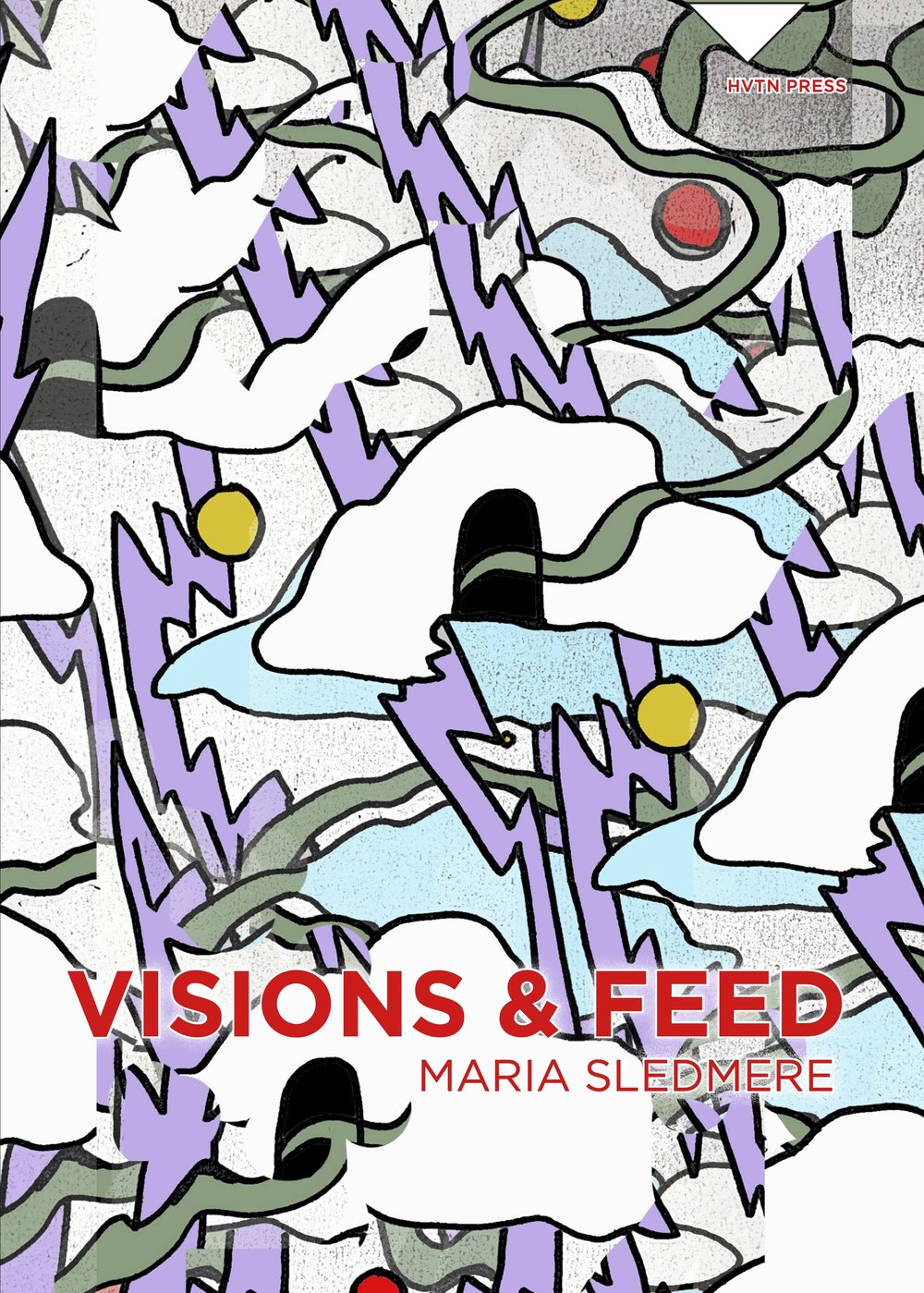
Visions & Feed is a collection that spans over two years of work brought together under the mirror phase of an anthropocene lyric filtered through crises of femininity, disordered eating, dysmorphia, labour and loss.
Sledmere asks: what does it mean to be a body in one of many dying worlds, what forms of work are done to endure it, what desires and pleasures are still possible and which are breaking down? Adopting playful and associative registers of ascent, while exploring devotion, metabolism, magic, domesticity and the ambience of dream forms, this is an intimate poetics of song and hormone, isolation and longing, fashion and pop, colour and vision in the saturated live feed of post-internet lyric. Amidst the reverb of climate melancholia and oestrogen blues, the speakers of Visions & Feed morph between depth and surface, film and music, myth and play to weather the days. Between epistolary, elegiac, confessional, ekphrastic, prose-poetic, processual, discursive and long-form cascades, the book offers iterative, experimental and fractal modes for exploring ecological entanglement within daily life.
This is my second full-length collection, following 2021’s The Luna Erratum. Many of these poems were written during lockdown or in the stretch of long afternoons at the tail end of big critical work that had occupied me for several years. I was immersed in dream and the idea of symbolic disclosure in poetry, lyrical shatterings and seeing oneself forever through glass, never clearly. Through a glass redly, purply, wrong. It begins with an epigraph from Maggie O’Sullivan’s Palace of Reptiles (2003): ‘A glazier walks through the earth calling the ruins strapped / on his back an angel’. How can poetry fit ruins into any transcendent firmament when the shards are still stuck in its back? I was admiring the glazier from afar wanting him to fix me. Suzanna Slack writes in The Shedding (2022) of ‘trying to have angel surgery’. In this book, my speaker seems to want a stomach replaced by clouds and to rain forever, why is that? I was born in a lightning storm with a lilac tongue and ate the suns like smarties. Fine. Very mild, even warm. To become glint in general felicity. Giving a zoo charm. Zooming.







 mariaology