On Words, Romanticism, Ramblings and Meanderings

I am coming to the end of the Glasgow Uni Creative Writing Society’s ‘Flash Fiction February’ Challenge. The aim is to write one piece of flash fiction a day, following prompts that are posted on the blog. The best thing I have probably achieved since I wrote my 10,000 word ‘The Quest’ story (complete with self-made Photoshop image and realistic fire effects) aged eleven is successfully averaging at least 700 words a day for a whole month (some days writing 700, other days moving upwards of 1300…). The reward is not just having a little portfolio of stories to go back and edit in the summer, but the habit of discipline that’s been earned. I have learned that I need the motivation of ‘completing something’, and that sharing one’s work and discussing it with others helps to feel better about writing. There is also the satisfaction of word count. If I averaged at least 700 a day, then that’s at least 19,600 for all of February. If I doubled my word count and did that for two months, I’d have a respectable 80,000 word novel. It’s an encouraging fact. Even if the content is sometimes pretty crap, I have something to work with! I just have to keep up the daily habit. It’s a bit like crack, only not so addictive, and cheaper. And, well, you have to work for its effects.

One of my fascinations is with the daily routines of successful writers. Not necessarily just literary authors, but philosophers, artists, journalists – even mathematicians. Anyone who gives up a significant chunk of their day to solitary writing, creating or just working. There is a fabulous blog called ‘Daily Routines’ which is the ultimate procrastination: putting off work by reading about how others work. It’s refreshing to see that not everyone needs a wee dram or French cocktail to get the imagination flowing, though it seems to be a recurring theme. As well as the time of day and the choice of stimulant, I’m a little bit obsessed with peoples’ medium: the effects of the pen, pencil or keyboard; how one’s writing implement impacts upon their style, speed and even argument.
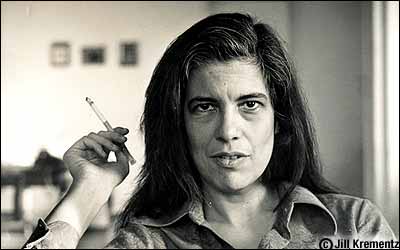
Susan Sontag. Source: nymag.com

For instance, Susan Sontag on her writing routine:

I write with a felt-tip pen, or sometimes a pencil, on yellow or white legal pads, that fetish of American writers. I like the slowness of writing by hand. Then I type it up and scrawl all over that. And keep on retyping it, each time making corrections both by hand and directly on the typewriter, until I don’t see how to make it any better. Up to five years ago, that was it. Since then there is a computer in my life. After the second or third draft it goes into the computer, so I don’t retype the whole manuscript anymore, but continue to revise by hand on a succession of hard-copy drafts from the computer.

[…]

I write in spurts. I write when I have to because the pressure builds up and I feel enough confidence that something has matured in my head and I can write it down. But once something is really under way, I don’t want to do anything else. I don’t go out, much of the time I forget to eat, I sleep very little. It’s a very undisciplined way of working and makes me not very prolific. But I’m too interested in many other things.

One day I want to write a big essay looking at how writing style changes according to how you get the words on the page (I even bought a beautiful typewriter to test that out). I love the idea that Sontag uses layers and layers in her writing and editing: the process of writing on top of writing, of scrawling and scoring out like the palimpsest diary Cathy in Wuthering Heights creates on the margins of a bible. Like Heidegger with his under-erasure being.

I also find it fascinating how people can study and write with music playing around them. I used to be a lover of total silence: a pure space in which I find the need to fill up the void with words. Now I can sometimes do with a bit of ambient sound: coffee shop clattering, birdsong, falling rain and so on. It makes a difference whether you are in the actual space (writing in a real garden or a coffee shop, for instance) or in the hyperreal zone of generated sounds (there are excellent Youtube sources of ambient sound, from whale-song to fire crackling in a grate). One will distract me to write about immediate details, the other soothes you into a weird creative ‘roll’ where you can pour out your words or nonsense like code streaming out in hyperspace. OK, I’m being self-indulgent.

And indeed, there is a self-indulgent aestheticisim to all of this: the endless procrastination involved in selecting the correct font for a piece, the need to rearrange one’s desk or shuffle books or change your pen or whatever it is. Yet there is something more important here that relates to publishing itself and the way literature often gets sucked into a commercial vacuum (think of the likes of the Brownings’ letters or Shakespeare’s sonnets which get beautifully repackaged in time for Valentine’s Day) . The original text is beautified by the paratext, and what is left is perhaps more of a consumer object than a discourse of words and sentences. There is an emphasis on white space, the chic luxury of thick paper and the gaps between printed letters. James Fenton said that, ‘what happened to poetry in the twentieth century was that it began to be written for the page’. But what is this page? Is it the sublime landscape of print paper stretching out its possibilities of unblemished whiteness? Or perhaps the virtual page: the ever-changing Internet archive that risks the dreaded 404, this page is missing; that risks alteration and collaboration and manipulation – and is this not a good thing? It is poetry changing, in transition; undergoing the morphological process of the human into cyborg. An automated computer voice reading aloud, staggering over the dashes and tildas and sharps, the onomatopoeia and enjambment like a child having a crack at reading Derrida. Il n’ya pas hors text: there is nothing outside the text/there is no outside-text (he writes in Of Grammatology).  When somebody reads aloud I imagine the words before me, drawing out of the page like butterflies coming to life; I can’t help it, it’s the way I learned to play with poetry. The world I like is the enclosed, shy space between the black ink and the reader’s eyes, the moving lips so silent.

The Mariner's ship and the Albatross. Source: thestage.co.uk
The Mariner’s ship and the Albatross. Source: thestage.co.uk

Like the ‘fluttering stranger’ that Coleridge observes as a child at school in ‘Frost at Midnight’, words in poetry become strange: there is an uneasiness to them that we cannot quite place. Verbs, adjectives and nouns are not what our teachers told us. You cannot fix them to a blackboard, and anyway chalk crumbles. While butterflies might be pinned down and classified by their colours, words are dependent on each other for meaning. So signification sifts in swirls of dreamy reading, and the mind makes connections. The imagination stirs and sometimes forgets them. Footnotes adorn the margins and confuse us, as they perhaps do in Coleridge’s ‘The Rime of the Ancient Mariner’, where we are driven into warmer but often more perplexing territory, as Coleridge’s gloss is less an academic explanation, and more a multiplicity of voices. At once, he joins in the action, ‘Like vessel, like crew!’ – yes, ‘her skin was white as leprosy’ – and we too catch this virus, moving between microbes of words that open and mutate through the strangest imagery. We shift between and through things with Coleridge’s metonymy, as in the gloss: ‘[a]nd its ribs are seen as bars on the face of the setting sun’. What are we to make of this being, ‘a Death’: an embodied spirit whose translucency both stirs and disturbs and amuses us, all at once? Aesthetics and meaning all blur into one.

Mount Snowdon. Photo by by Scott Wylie. https://www.flickr.com/photos/scotbot

With Romanticism what we often get is the journey, the progression through space, selves and substance, and through visual experiences: the sublime, picturesque and the beautiful. Not to mention the ugliness of Frankenstein’s monster, mirrored in Mary Shelley’s own monstrously patchworked collation of tropes and terrors and texts (imagine being raised on Milton but growing up like Rousseau  – being both Satan and a noble savage – now that is Otherness embodied, surely?). We follow Wordsworth up Snowdon and along the Alps in his glorious Prelude, with the seamless switch between interior musings and the expansive, golden panoramic shot that reveals the gaping ice and mountains, the tracks the subject’s wandering thinness:

The unfettered clouds and region of the heavens,
Tumult and peace, the darkness and the light,
Were all like workings of one mind, the features
Of the same face, blossoms upon one tree,
Characters of the great Apocalypse,
The types and symbols of eternity,
Of first, and last, and midst, and without end.

(Wordsworth, Book VI of The Thirteen-book Prelude, lines 566-572).

Where nature itself merges into one terrifying being, where opposites uncannily forgo their differences to become ‘features | of the same face’ and still the sweet ‘blossoms upon one tree’, we are in a sublime landscape, and then in the pastoral garden. The subject stamps himself upon the mountains, as the mountains are stamped upon him; we recall, with the help of the OED, the varied meanings of the term ‘character’: as both noun (a literary figure of self/person; a sign or symbol used in writing, print, computing; a code; the properties of a substance) and verb (‘to distinguish by particular marks, signs, or features’). Wordsworth’s figure is the self encoded in the text, the lonesome Romantic imprinted in his white sublime of Snowdon, going deep into the very properties of the rock itself. All is viscous, melting subject into object. All is, as Timothy Morton so aptly puts it, a mesh: where there can be nothing ‘out there’, as we are all a set of strangenesses, part of an existence that is always coexistence; and yet we are not simply part of a holistic collective, but connected in our differences, in our mutations that separate, stick and undo us. There are those clouds which seem ‘unfettered’ and yet even they cannot rise above the poet’s vision, the tacky link of aesthetic projection that takes nature from unified cliché  to a space of wilderness in which things move between abstraction and reification, and humans move with them in the ambiguous space between – like those viruses that multiply and mutate, ‘first, and last, and midst, and without end’.

This dangerous, homogenised idea of ‘landscape’ can be undone by thinking of it textually: as a palimpsest too of sorts, where human language adds layers to our understanding, alters our relationship with nonhuman things of the living and non-living. In writing and reading ‘nature poetry’, we are reconfiguring our place in the mesh; just as a drop of colour upon a single Paint pixel shifts the impression of the whole picture.

While Romanticism takes us on these messy forays into psyches and space, in the twentieth century we have, as Fenton has suggested, the poem as object: the poem as visual play on the page. The attempt to make the poem an object, to get to the very basics of objects. Think of Ezra Pound’s Imagism: ‘The apparition of these faces in a crowd; | Petals on a wet, black bough’ (‘In a Station of the Metro’). Think of William Carlos Williams’s notorious modernist poem, ‘The Red Wheelbarrow’, in which Williams’s poetics bring the object into stark and colourful being, like an object being rendered on some kind of graphic design program. Assonance coats our visual impressions so that we can almost taste what we see, the wheelbarrow ‘glazed with rain’. On the page, the poem too is a spilling of rain, of long lines dripping into single words, of basic objects hardening, forming. The ‘red wheel | barrow’; the ‘white | chickens’.

The Yellow Book. Source: http://www.johncoulthart.com/feuilleton/tag/fin-de-siecle/

There is also the lovely aestheticism of the fin de siècle: the beautiful margins and separation of art and text in the The Yellow Book, and of course Husymans’s jewel-encrusted tortoise, which eventually dies from the weight of its ridiculous embellishments. Does a text too collapse under the weight of its stylistic ornamentation? The fashion for minimalism perhaps gives way to this assumption, and yet what about the explosive textuality of Finnegans Wake, Gravity’s Rainbow; anything by Henry James, or for that matter, Angela Carter? Art for art’s sake is not a dip into vacuity, but is necessarily a political statement, a textual position, after all. An attempt to escape the shading blinds of ideology. You might write a dissertation on the politics of purple prose; you might float buoyantly along the clear river of Wikipedia readings.

And now I have lost my place in the forest and cannot find the light again. Birds tweet shrilly and their song is like stars tinkling and various shades of darkness hang in blue drapes from the bowers of pine trees. If I look around I see the jewel of every dew drop glisten and I know that it is twilight. I am looking for something particular: that silent speck of a presence; that which evades me every time I turn over each new leaf. Only I know that I cannot see, cannot see the gathering of these particles; the light is fading and soon the day will close its drapes.

These are just words after all, and who would cling to them?

Some further words:

Derrida, Jacques, 1967. Of Grammatology.

Edgar, Simon, ‘Landscape as Story’, Available at: http://www.lucentgroup.co.uk/the-landscape-as-story.html

Morton, Timothy, 2010. The Ecological Thought.

Huysmans, J. K. 1884. À rebours.
Flash Fiction February

So just thought I’d explain why I’ve not posted a single thing here in a few weeks – I’ve been working hard with uni projects but also the Creative Writing society that I’m part of runs an event in February where you work towards writing a daily flash fiction piece. So all my energy has been taken up with writing a new piece daily, and so far I’ve managed to meet the target. If you want to check out any of mine or the other members’ work it’s at http://gucreativewriting.wordpress.com – just keep scrolling down as there’s quite a few to look at!

Will be back to the blogging here in March hopefully!

x

Mushrooms at Dusk

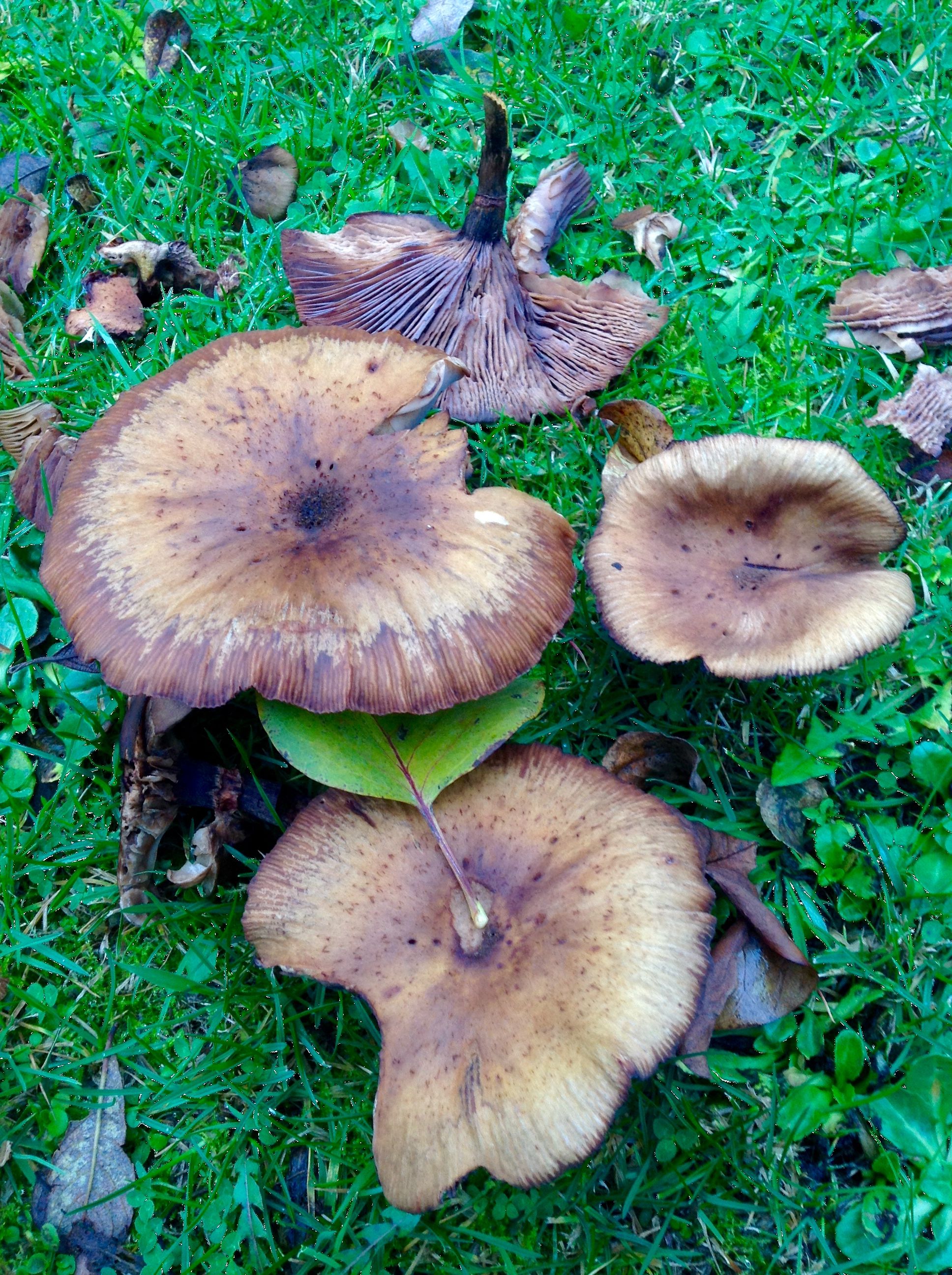
mushroom

She found the quality of light at this time of year awfully confusing. Dull grey in the morning, silver streams of mist that lick the sky like butter from your fingers. The twilight haze of three o’clock, where the amber lamps come out like fireflies and shadows gather ominously across the sky. Maybe a wisp of some foreign wind, darkling in the fade towards four, where she’d be sitting at her window, wondering. It was the time of year to tend to the garden, pile up the heaps of leaves, clusters of rotting pinecones and acorns that clotted in the soil. The earth was hardening for winter, and soon the frost would come, eating into the grass like a glittering poison. She’d see it as she dressed in 7am sunlight, the whitish mist making crystals at her window. Everything still and beautiful.

It was a luxury, to be home now. She waited for the seasons to change, right at the hinge between autumn and winter, before she made her journey. Asleep on the train, dreaming of being small again, so small in the bubble of childish memory. She could smell the peanut crunch of M&Ms, the sparkling particles of someone’s perfume. Soon, soon she’d be home. The place grew tighter every year, as she grew fatter on the milk of new years and their offerings of plastic joys and flattened dreams. She stood in the kitchen, watching the steam swirl out of her first cup of tea. No new mugs, of course. Later, she would press her face to the window and her breath would fog a dewy canvas, and with one finger she’d draw pentagrams, like she always used to. There’d be the rubbery squeak of skin on glass.

No-one was at home now, just her in the wide archives of the house. In the dusty shelves that made her sneeze, and the picture postcards, she imagined a thousand phantoms. They were pretty phantoms, ornamented with the smiles of children and the pinkish sheen of memory. They did not speak to her, but she was somewhat comforted by their silence. What counted was the presence, the ghosted sigh of a skin-prick or coldness. She would wait till her parents got home and read books, in that nook between the banister and the cabinet on the landing. Imagining herself as Jo in Little Women, taking great bites out of Braeburn apples, lines of prose flying before her eyes. She did not fit there as well as she did as a child. The wood cut into her arm as she read the strange poems covered in gold-frosted dust. Somebody had been spraying glitter in the study, making Christmas decorations. That was a long time ago.

***

Morning came like a murmuring of starlings, and slipped away again just as quickly. Her body was heavy, her limbs tree-trunks of aching muscle. She felt she had been away again, and the new hours were another return. She worked them over in her mind, pondering the way their shapes formed with her hunger and sleepiness. Moulding, slowly. At the window she stood and yawned. Some machine was whirring away, making her coffee. The smell dissipated through the room with its warm opulence, stirring her brain to life. Yes. She peered closely into the garden, staring at strange dark shapes which clumped in the fronds of long grass. Most peculiar. Later she would investigate. She ate her breakfast of burnt toast with the radio humming in the background, speaking of a war somewhere, and then advertisements for hair salons and special restaurants. Onto her toast she spooned pools of blackberry jam that looked like crushed rubies, and the soury sweetness bit at her tongue between her teeth. She chewed loudly and grinning, the wine-coloured juice staining her lips. Afterwards, she left everything on the table: the crumbs peppering the wood like a pixie’s debris.

It was almost enough just to be here, out of the shouting sirens, the madness of the city. Home, she supposed. She sat at her laptop, fingers clicking ruthlessly at the keys. She was writing a message to someone, a sad story about why she would no longer remember them. She would keep it saved, locked deep in her computer’s hard-drive, and then one day send it. When she had the person’s address. When the time was right; which it wasn’t just yet.

Everything stretched out like the languid yawn of a giant, just a long morning and the gape of afternoon, uncertain evening. The sheerness of time was narcotic, rendering tiny signals that pulsated in her brain. She was at once sleepy and electrified. She rushed up the stairs to check something in her room, but her phone was dead and all that was there were her clothes strewn across the carpet. She messed around looking for things to read. She highlighted her favourite words in the dictionary. It was a big dictionary, and a whole hour shed away like the flake of skin that layers the top of a scar. She remembered only a handful of this vocabulary: sapphire, salience, stardust, Saprotrophic. She was cleaning the window with lemon vinegar, making sweeping lanes in the film of dirt. A thin moon peered out of the weary sky like a wink. Saprotrophic…she had forgotten something. Ah…the mysterious clumps in the garden! Of course, they were mushrooms, only mushrooms…

She pulled on her mother’s wellies and trod out into the garden, up the concrete steps. The air was very still; mournful, even. It smelled of wood-smoke, and somewhere she could hear the crackling snaps of burning tinder. Plumes of it rose against the blueish dusk in dark arabesques. She sighed contentedly. The clumps were even more abundant than she’d thought; the whole garden was teeming with their shadowy figures. She knelt down to inspect some. She thought of the honey fungus they’d found out in a forest once, clinging prettily to a rotting stump. In the sunset glistenings that glazed the silhouetted trees, she had thought she could almost see fairies, fluttering above the mushrooms. They were lovely mushrooms, with their smooth peachy caps. Her friend had said they were edible; but you could not be sure with wild ones, so they left them alone, like a living relic, noting their path. The toadstools she saw now in the garden were a putrid brownish colour, etched with black lines and little white spots. They were ugly in a kind of otherworldly way. Ethereal, even.

Her knees were going numb from bending so she stood up and did a lap of the garden to get her circulation back. She was recalling things. The party where a boy brought out a sandwich bag of suspicious-looking vegetables, frying them on somebody’s pan. She’d stood in the doorway of the kitchen, her mind full of cheap red wine, watching the way the little things unfurled in the buttery oil, their spindly stalks stretched out like tentacles, their heads jiggling like jellyfish. As they started to sizzle and wilt, they let out a curious, bitter smell. The boy had shared them among his friends and then they had disappeared for most of the night. Later, one of them was hanging upside down in a tree at the village park, and he was reciting streams of Byron’s poetry. Sometimes, she still heard his voice, even now, reverberating through the dark.

The cold was coming out of its slumber and creeping into her bones. She stood still, wrapping her cardigan tight around her. She crouched down again and dug her nails into the earth. A weird feeling gripped her, a feeling tinged with homesickness. She pulled nothing out of the ground, no trace of seed or root. She stood up again. The quietness made her feel smaller than ever, but her mind was huge and overbearing, stretching itself across the matter of the garden. It all glared in her vision like the close-up shots of a dream. She wished some sound would break the silence. A bird-cry, even. But the little creatures were so quick with their wings that they made no noise as they flew between branches. She was trembling now, remembering everything.

The fungus at her feet now looked like the severed heads of something. She had to breathe.

If only a car would start in the drive, or a plane fly overhead…something, something!

They say that magic makes you happier. And she thought there was a thing she could do, before going inside again to the womblike comforts of heat and sleep. She brushed through the grass with her wellied feet, and stood in the centre of one of the fairy rings. It was a near perfect circle. She stared first at the mushroomy clumps at her feet, then up at the sky. It bore the dramatic flashes of an expressionist painting: great bolts of violet wounded the blue, and rivulets of yellow broke away from the horizon, approaching amber and spiralling, spiralling. Then she found again the moon. Brighter now, it was a sharp crescent, the fold of an eyelid. She waited, waited. Her body was cold and her skin prickled like coral on a sea-washed rock.

The clouds began to gather, slowly at first then fast like an army.

You could smell it in the air, the sourish dampness that held as a breath.

She closed her eyes and the rain came. She felt the initial sprinkles that bounced off her skin, the cries of birds as they darted into the hawthorns for shelter. Drizzles of silver slashing the landscape. A downpour of water and chilly air. She stuck her tongue out for the cold shock and the sharp taste. The crescendo sound of it showering louder, coming down thick and heavy from the west in globules fat as teardrops. She opened her eyes and her hair streamed down her face like seaweed, clinging to the marble of her skin. She felt it surge within her, the waterfall sounds of this injured nature. A grumble of thunder. Something stirring in her chest, a rush in her pulse. Almost like someone was watching her, a million things flashing around her. Her laughter was lost in the cavernous sound of the rainstorm, another echo pirouetting through the chambers of memory. And as she stood there, the fungus and mushrooms soaked up their nectar, before crumpling to a wasted doom. The rain had poured through and through her, and she felt hollow and purged as a mermaid tossed from the sea to a tomb. And she was the still point in the tempest around her, her body soft and sad with its sickness. This was it; home was just this, wild and true, the beatific glow of a hullabaloo.

Oranges for Bonfire Night

IMG_0027

(from a Creative Writing Society freewrite with the prompts ‘fireworks’ and ‘oranges’)

She remembers the days when she and her brother popped over to the neighbour’s house for Bonfire Night. She’d climb over the garden wall, wearing her wellies and her dad’s itchy jumper that came down to her knees and a hat her mother had pulled over her fringe. They’d play with the children next-door because they were good friends and the same age, more or less. Even though it was pitch dark in the November night, they’d dance around the garden, shrieking and playing tig or hide and seek while they waited for the fireworks to be set up. They were cheap fireworks, bought from the local store, which ordered them from some chemistry enthusiast in the city. This was, of course, before The Internet.

She can’t remember his name, the man next-door; the dad who told the kids off for laughing too loud and who’d sneak off for fags in the greenhouse while his wife did the washing up. She remembers the blur of his bearded face. His yell as he stepped back from the firework he’d just set up. She remembers the mum better; the mum used to bring out steaming mugs of soup and carrier bags loaded with oranges. She remembers standing in the cold bright air, peeling with the stubs of her fingernails the rind that came away like thick flakes of skin. Biting into the soft flesh as a flame-coloured Comet rippled above her. The sour sting of the juice squirting in her eye; the sweetness seeping over her tongue. Stickiness on her fingers. She’d toss most of it away, into the rhubarb patch. She wanted to save her appetite for the chocolate log and lollypops that awaited them inside.

There’d be the rockets, soaring and screeching in her ears like banshees, sizzling in her belly. The wheeeEEeeeee like electricity. She hated them, but they were a thrill. She’d look up to catch them but they’d be gone already. Then there were the pretty ones. She read their names off the cardboard box, discarded on the porch: Crosettes, Dragons’ Eggs, Ice Fountains and Blossoms. She watched them go off with the other children, trying to identify each one as if they were flowers in a biology textbook. Only, they were always too quick; their beauty dazzled her vision and then evaporated. There were the ones that overflowed like ocean spray, showering and spitting flickers of white and silver, like a jeweller soldering a giant diamond. Rainbows would spread out across the smooth sky, raining colours across the tall trees at the back of the garden. Her favourite was the Catherine Wheel. It took ages to set up, but it was magical. It spiralled like a wild thing from the pole of the washing-line, sparks flying around it with the craziness of broken machinery, or hypnosis. She adored the Catherine Wheels. They made her feel strange and unreal, as if she were looking into an abyss.

After all the fireworks were gone, the children were doled out sparklers, which they were only allowed to use with gloves. The sparklers let them write their names in the air, as if they were inscribing their thin identities into the vast constellations of the night sky, the atoms of the air around them. She misses how back then in the country you could always see the stars and the sky achieved a proper dark. In the city where she lives now the sky is always a murky brown, the colour of Coca Cola or dirty rivers.

She used to hate how eventually they’d have to go inside. She used to want to stay out in the garden forever, sucking in the lovely coldness of November night. She hated how the sparklers had to be chucked into water buckets, where they’d snuff out with a quick hiss. The adults would always check that they hadn’t burned their little fingers. She remembers the faint char marks that stained her gloves. Remainders. She found those gloves, only a few months ago, when she’d gone home to help clear the house. They were in that same yellow jacket she used to wear, and even just touching the plasticky fabric brought back glimmers of firework enchantments. But the gloves were full of holes, the stitches became undone in her hands. Everything was to be given away, sold or donated to charity, after her mother died and now that the house was to be sold as her father left for business in America.

He’d phone her from new places and his voice would crackle over the phone like a fading sparkler. She closes her eyes and still she smells the warm soup, the tickle of gunpowder.

And oranges. She remembers the oranges. She never liked oranges.