Seven Songs from the Vault (1)

IMG_1691.jpg

~ Seven Songs from the Vault (Version 1) ~ 

  1. Suzanne Vega – ‘Marlene on the Wall’, Suzanne Vega (1985)

Partly to blame for my writerly obsession with long, m-beginning girls names (Meredith, Meredana, Marianne), this song was one of the first tracks that brought me to music – brought me to music in the sense of listening to it and discovering something new about the world through it. It’s a story of a dangerous and probably ill-advised love affair, told through an impression of symbols; the singer urges the listener to ‘observe the blood, the rose tattoo and the fingerprints on me from you’. The line between desire and violence blurs here and there’s something about Vega’s cool, whispering voice: an intimacy that is at once conversational but also steadfastly aloof, refusing the self-aestheticising of vibrato and instead fixing itself on the delivery of its sharply observational lyrics. In an age where big, operatic voices dominate the popular music scene (think Adele), Vega’s vocal style seems comparatively and indeed curiously fresh. When she returns, angrily, to the chorus, there’s a real, mesmerising venom to her delivery.

The song was on an acoustic compilation CD I’d nicked from my Mum’s car and I used to play it over and over again, my nine-year-old mind trying to make sense of the song’s darkness; its ‘danger zone’, the urgent guitar strums and insistence on silence – ‘don’t talk about it later’. By successfully striking the experience of ambiguity in desire, twisting pop’s conventional picture of love to one more sinister, Vega draws you in and in again to her characters. Who’s Marlene? What does she mean by the wall? Who are the soldiers, and the ‘things I cannot see’? I still have no idea.

2) Bloc Party – ‘I Still Remember’, A Weekend in the City (2007)

Like a Roald Dahl novel, rife with endearing surrealism, you sink into this story of young love with a queasy mix of confusion and warm familiarity. The guitar riff that kicks in with all its clarity is a comfort, even now, listening back almost ten (!) years later, and the song lilts between the energy and languidness of longing. The relief that comes when Kele Okereke breathily sings that first line, ‘I / I still remember / how you looked that afternoon / it was only you.’ It’s a love that touches on the unspokenness of queer desire, the possibility of falling for your best friend: ‘we left our trousers by the canal / and our fingers, they almost touched’. It’s almost Blakean in its very pure, stripped-back articulation of innocence: ‘you said “it’s just like a full moon” / blood beats faster in our veins’. It’s draped in childhood nostalgia: ‘and on that teachers’ training day / we wrote our names on every train’. With all these images, you can’t help but remember such experiences from your own youth, those simple days and strange feelings.

When the song builds up with the thrashing drums and the insistent refrain, ‘I still remember’, all the campouts and nights out and beach drinking and endless hanging out come flooding back. Okereke’s love exists now only as a metonymic collection of details, sentimental objects and memories: the playgrounds and rooftops, park benches, school ties. There’s a terrible bittersweetness to the song, its sense of regret, of unrealised, forlorn desire: ‘You should have asked me for it / I would have been brave’. Sure, the album came out in January 2007, but in a way it’s a song for autumn: the aftermath of summer holidays, the return to school, the always problematic sense of fresh beginnings, of leaving a certain era behind. The golden haze of nostalgia, and all its futile longing. The dissolution of that final shining chord.

In my head, it’s inextricably tied up not just with my own adolescence but with that even earlier exposure to frustrated love. I think of the ending to Phillip Pullman’s His Dark Materials trilogy, with Mary’s endless stories, the ‘quantum leap’ that is love’s realisation, her talk of negative capability and the unravelling of Proustian memory, decades deep from a piece of marzipan; then Lyra and Will, after so many adventures across several universes, admitting they love each other, their first kiss like the taste of the ‘little red fruit’ and then the devastating revelation that they love each other and yet can literally never exist in the same world and live. I remember vividly sitting on my bedroom floor on a Sunday night, picking flakes of paint from the floorboards, anxiously devouring the last of book of the fantasy trilogy that had consumed both my summer and winter and feeling this weird immenseness of sadness and relief all at once. I think it’s the expression that counts; the only overcoming of such feelings. That’s why Bloc Party’s song’s so good. It’s cathartic.

3) Belle & Sebastian – ‘Dress Up in You’, The Life Pursuit (2006)

For me, The Life Pursuit is one of Belle & Sebastian’s most obviously ‘chamber pop’ albums, it’s lush and glossy and upbeat, featuring vocal contributions from both male and female members of the band. Its production is shiny and the mood (for once?) is cheerful.

Probably not surprising that the song I picked is one of the album’s most melancholy, however. We can all relate to ‘Dress Up in You’, in a way. It’s a song about jealousy, about our problematic relationship with the friend that always dazzled,  the one with a ‘beautiful face’, that was always destined for great things, while you were stuck back home, ‘knitting jumpers’ and ‘working after hours’. There’s a bitterness to the song’s tone but at the same time the relaxing cadence of the piano riff and the upliftingly sweet horn solo keep the sadness in check: ultimately, the song’s message is one of admiration. The ‘singer in the band’ paints a vision of her friend, the one who ‘got lucky’, who forgot about her, as a beautiful idol: ‘if I could have a second skin I’d probably dress up in you.

We’ve all wanted to be someone else at some point. It’s probably part of the human condition that we’re mostly doomed to be dissatisfied with our own skin, to long for where the grass is greener, where there are airplanes and style and ‘the essence’. What I love about this song is its contradictions: the bitter lyrics and the sweet music, the sense of absolute friendship (deals signed in blood, understandings, love, the sense of missing someone so much they give you stomach pain) and jealousy/resentment, the contrast between stardom and failure. It carries them off perfectly and there’s a satisfying relief in the way the song closes with the rallentando leading into ‘they are hypocrites, forget them / so fuck them too’ and then all those carefree la la la la las, harmonised lovingly with the accompanying brass.

It’s a song that reminds me of sitting up till 5am on friends’ sofas, passing round the laptop and its weighty iTunes library, drinking the dregs from a bottle of gin and feeling a bit miserable for ourselves but also kind of paradoxically content with the feeling of discontent.

Notably, it’s also the song that plays over the credits to Stuart Murdoch’s film, God Help the Girl, and I like that the film’s ending is pretty open, just like the outcome of the song—does the friend become an actress? Is she a success or a failure? 

4) Frightened Rabbit – ‘Poke’, The Midnight Organ Fight (2008)

2009 and 2010. Two winters so cold the roads and rivers froze over; so cold we wore coats in our classrooms, the heating system of our leaky-roofed Victorian school building packing in in tandem with the collapse in temperatures. These years all a blur of computer screens and studies, of long walks round town and into the hills with friends. I had tickets to see Frightened Rabbit at the Barrowlands in December; I was in school, reading Sylvia Plath for my English dissertation, when from the windows of the computer suite I saw the first flakes of snow, falling from the sky like a promise. They came thick and fast and soon everything was draped in white. Something inside me soared, even with the sad knowledge that the trains were cancelled. I couldn’t go to the gig.

At parties, we would mockingly sing the words to each other: ‘poke at my iris / why can’t I cry about this’. Sometimes we’d mishear the lyrics. We wanted a reaction from each other, perhaps, a way of making sense of that weird desire to be poked in the eye, to be stilted from our drunken reveries. Or maybe it meant something deeper, weirder. Maybe that was our own ‘brand new language’, a semiotics of stupid expressions and warbling voices, the way we’d brush up against each other’s hands as if we wanted to hold them.

‘Poke’. It’s an elegy of sorts; an elegy for the disintegration of a relationship, the frustration of striving for closure, caught between an animalistic need for freedom and that enduring residue of whatever was there before: ‘Why won’t our love keel over as it chokes on a bone? / And we can mourn its passing / And then bury it in snow’. It’s that wintery, rural Scottish numbness, the refusal or even inability to admit feeling – ‘Why can’t I cry about this?’. There’s the tender, Burns-like romanticism of this love – ‘it’s got lots to do with magnets and the pull of the moon’ – kicked viscerally in the teeth with all that suppressed violence that we bury in the darkest dullness of our relationships: ‘Or should we kick its cunt in / and watch as it dies from bleeding?’. Scott Hutchison’s poetic, sometimes growling croon is softened in this song, even as he refuses to hold back on the emotion, it unravels perfectly in the expression of paradox that governs the end of a relationship: ‘But I hate when I feel like this / And I never hated you’. The sudden severance of that connection that was almost familial, blood-strong in its longing. The interludes where Hutchison sings his Ooooohs with that perfect, withdrawn sorrow are like the movements of the sea over the steady rivulets of the guitar picking. I always wanted to be able to play this song on guitar. It sounded so simple and sad and pure.

5) Wild Nothing – ‘Paradise’, Nocturne (2012)

I used to do double shifts most Saturdays and Sundays and it was a grim affair without the aid of some good music to brighten the restaurant where I found myself pacing endlessly, lifting plates, taking orders, polishing glasses, picking litter and leaves off the floor, scraping candle wax off tables, dusting the gantry, moving zombie-like between tables with the same forced fresh, maybe fragile smile.

My friend Douglas would bring stacks of CDs in and leave them for me on the bar top while he was away working in his section. In the midst of sensory deprivation, I would pore over those CDs like they were exquisite treasures (which, fuck it, they were). For one, it was lovely to find someone else who shared my passion for the actual tangibility of the compact disc. The sleeve and the notes and the design printed on the disc itself. I liked the sheen of plastic, which felt solid in my hands. It was 2013 and Douglas had a music taste that ranged from the up-and-coming heroes of alt-pop (Grimes, Lana Del Rey) to the more left-field and experimental/electronic; looking over those CDs reminded me of the world I had missed while immersing myself in nothing but literary theory podcasts and James Joyce audiobooks for two years solid. Now there was Bjork, Angel Olsen, Poliça, Wild Nothing.

I asked to take a few home to borrow, mostly based on my attraction to the album artwork and the titles of songs. I’ve always been drawn to song titles and artwork, probably because I am literary-minded but also because I love it when artists actually pay attention to building up a particular aesthetic that’s appropriate to, or even spins a whole new meaning on, their music. I love thinking about how the title of a song changes everything. It’s weird because I find it really hard to title my own work, but I guess that’s a common problem…

Anyway, one of those lucky albums was Wild Nothing’s Nocturne, which is a blissful array of buttery, colourful dream pop songs which mould together as perfect as the lunar cycle. The standout track for me is ‘Paradise’, a five-and-a-half-minute ambient starry-eyed disco epic which, if the album is meant to sort of capture ‘a sleepless state of mind’ (hence the album’s title, Nocturne), is that moment when the endorphins kick in and you reach that precise state of euphoria that occurs when you have not slept for say 40 hours solid. Maybe you’re travelling, airborne to distant lands. Maybe you’ve been boozing through the night and morning. Maybe you’ve just been on your feet all day and are reaching the 11th hour of your shift…

For me, this is sort of The Cure drenched in pastel tones; the meticulous crafting of those dark synths and celestial reverb; Joy Division staring into the refracted galaxies of a crystal ball that would predict a brighter future. Jack Tatum’s voice here acquires a much stronger, more sonorous quality than on most other Wild Nothing tracks, and there are definitely Ian Curtis comparisons to be made here. The mood perfectly balances its bouncy drums, uplifting synths and twinkly 80s guitar riffs with a controlled and almost majestic lyrical delivery which is rather melancholy in theme, the refrain ‘love is paradise’ framing most of the song, as if striving to reach some sublime point where paradise would be reached. If you check out the extended version online, with Michelle Williams doing spoken word in an interlude section, there is a definite sort of Allen Ginsberg/Beat generation vibe to the lines, moving to a sort of transcendent rapture: ‘The past was folded up and in the twinkle of an eye / and everything had been changed / And made beautiful and good’.

The song overall feels like a spiritual and spatial journey; it fades and builds and comes to fade again. It never indulges in elaborate solos but instead maintains its vibrant rhythm that moves between liveliness and a kind of soporific haze of drums and sparkling guitar and synths. Listening to it at work, for those five-and-a-half-minutes I felt weightless, bodiless, up in the air; free from the cutlery and crockery and bells tolling endlessly from the kitchen…

6) Bright Eyes – ‘Lua’, I’m Wide Awake, It’s Morning (2005)

A song that you carry with you somehow, that’s so engrained in your brain as to never leave you, each chord and lyric sedimented with years of memory. It’s a fragile song, sparse as a deciduous tree in winter. It’s a song about wandering, the dislocated sense of not exactly inhabiting the world, but somehow just drifting through. It’s a paean to solitude: ‘when everything is lonely I can be my own best friend / I get a coffee and a paper have my own conversations / with the sidewalk and the pigeons and my window reflection’. It explores the thinness of reality, the sheen of ‘polish’ that in the morning ‘looks like shit’, the false love sold in the evening, which by the morning ‘won’t exist’. It’s a candid admission of human frailty, the mercurial nature of our emotions. It’s a specifically metropolitan song: you have a sense of Conor Oberst’s warbling voice as he wanders the streets, lost protagonist in his solipsistic sadness. Yet the song spreads outwards, as a commentary on the human (or at least a generational) condition, a not-quite nihilistic exhaustion with the world – ‘we might die from medication but we sure killed all the pain’. We flit from one thing to another, our desires will oscillate as sure as the moon’s phases. Everything seems ‘so simple as the moonlight’ but no amount of incantation will render solid this refrain.

Thematically, the song is about addiction, depression, the everyday vacillations of sensation contained in a morning and evening. The random party at ‘some actor’s west side loft’ and the flask shared on the train, the person addressed who looks ‘skinny like a model’ and keeps escaping to the bathroom, ‘always say you’ll be right back’. In body, the people in the song waste away as easily as the time that contains them, surviving off coffee and moonlight and imaginary conversations.

Oberst, lyrically, is a genius at paradoxes and parallels and expresses them in a way that offers them as explanations or gestures of understanding which never quite satisfy but at least leave us pondering: ‘But what was normal in the evening by the morning seems insane’. The opening line, ‘I know that it is freezing but I think we have to walk’ so clearly establishes the tone of the song, the jar of realisation – we’re both forced upon this journey, nobody’s going to give us a ride – that it could be a line from a Wallace Stevens poem. It’s a cold song, whose play of end rhymes only half hit home – ‘walk/loft’ ‘off/gone’ – leaving us always  longing for something more. No closure can be reached: the song can only end with the circular repetition of ‘so simple in the moonlight’, a childlike rehearsal of the beauty which cannot kill the complications of adult life, the self-destructive habits which inhabit the song’s lyrics.

In third year of high school, I used to listen to this every lunchtime, lying in the playground by the P.E block, feeling so light and empty, the world dissolving around me in a dull cacophony of kicked footballs, shrieking games and called-out names. It was a mysterious adult world, the one contained in that song, but I almost felt I was already there, dissolving what was left of matter.

[There’s a lovely version Oberst recorded with Gillian Welch for the album Dark Was the Night (2009) which gives it a flavour of melancholy Americana, a greater sense of dislocation, fusing the urban setting and Oberst’s minimalist delivery with Welch’s distinctly lilting, country voice and all its resonance of the prairie].

7) Muse – ‘Citizen Erased’, Origin of Symmetry (2001)

It seems insane to think that this album was released fifteen years ago, but maybe the timing was appropriate. There’s something uncanny about it: the paranoid, political and often surreal lyrics, howling soprano, bloated distortion of electric guitars, as if the music were forcing us to release the visceral eeriness and indeed grotesque weirdness of a reality that tried to cloak itself in the fairytales of gameshow tv and the financial greed offered by a fresh new century…

‘Citizen Erased’ is visceral, beautiful; at once tender and full of fury. It renders the experience of someone living in a fucked-up political state, the striving for freedom and confusion over what it means to be human, to be a person, at all. The thrashing drums give way to a thickly buzzing bass and the yearning swirls of screeching electric guitar solos. The song builds slowly and softly but the choruses are huge and operatic, with Bellamy’s distinctive wail crying out: ‘For one moment / I wish you would hold your stage / with no feelings at all / open minded / I’m sure I used to be, so free’.

The experience of this song is one of purification. You are exposed to music that is violent, lashing, angry, but like any good narrative, there is a turning point, a calming of the waves. The music becomes almost ambient. The key changes and Bellamy’s voice returns to its melodic, delicate expression, accompanied by ripples of piano and the fuzzy, spacey twanging of distorted guitars: ‘Wash me away / clean your body of me / erase all the memories / that will only bring us pain’. I’ve always felt purged somehow after listening to ‘Citizen Erased’. I think it chews you up a bit then leaves you, disembodied, drifting along the final tributaries of its current, back to a place of imaginary origin, more peaceful and pure than the harsh world it renders…

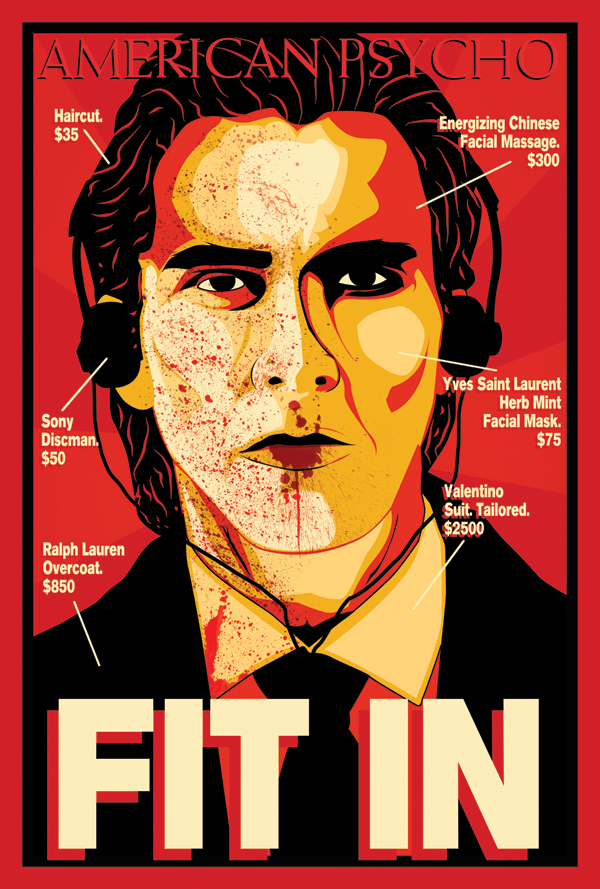
American Psycho: Sex, Violence, Technology and Society

Image source: http://images6.fanpop.com/image/photos/33100000/Fit-In-american-psycho-33196259-600-889.png

I have just read a book that has all at once captivated, disgusted and intrigued me; a book that has left me strangely both emotionally drained and intellectually stimulated. Bret Easton Ellis’ American Psycho plunges the reader into a world of late 1980s ‘yuppie-ism’: the world of Wall Street, hyper-consumption, misogyny, racism, inane pop culture, television, sex…and violence. Written from the first person perspective of its protagonist (although somehow I find the term protagonist with its heroic connotations inadequate), Patrick Bateman, the novel has an unusual cyclical structure that plays out as a repetitive narrative of visits to classy restaurants, mundane descriptions of the latest consumer goods, chapters that read like music reviews and then the most controversial element: the horrifically graphic scenes of sexual violence and psychopathic slaughtering that got the book banned by its initially intended publishers.

Yet I don’t believe that Ellis includes these gruesome chapters just as a twisted indulgence, a pornography of violence. As I will discuss, they play a part in Ellis’ searing, often satirical portrayal of the Reagan era in America: a critique of neo-liberal values, consumerism and technology that is arguably more pertinent today than it was twenty years ago. The heartlessness, depravity and monotony of this culture and the novel itself is summed up in the opening line: ‘abandon all hope ye who enter here’, which is ‘scrawled in blood red lettering’ on the side of a building. This quote is an intertextual reference to Dante, who in his Divine Comedy suggested that this was the written passage that appeared in the entrance to Hell. When you pick up American Psycho and read the first lines, which immerse the reader immediately in the divided cityscape of 1980s New York – a world of graffiti, advertisements and pop culture – you cross over a threshold, you cross over into a tightly-confined mind that experiences its own corruption in a fictional universe that is all too like our own. What is interesting about the novel is on the one hand its hypothetical exploration of the thoughts of a psychopath, but also its trenchant critique of a society obsessed with surfaces, purchases and the perpetual presence of the flickering flow of television; a society plummeting towards absurdity and the eradication of all meaning – at all levels from the individual mind to the collective conscience.

Despite being the novel’s narrator, Bateman reveals little about himself other than his routines, his clothes and his opinionated taste in music. He indulges in lengthy passages detailing his workouts, his use of face masks, his appearance, eating habits, sexual interests; but the novel provides little in the way of solid character description. The narrative is therefore intensely claustrophobic, as we are restricted to Bateman’s narrow, white, narcissistic upper-class view. Moreover we know nothing of the Bateman behind the suit and Ray-Bans; we don’t know about his childhood, his relationship with his parents is only briefly suggested in a single flash of a chapter, and although it is the source of so much expendable income, we never find out what he actually does at work, other than order his secretary to make him dinner reservations. This latter point is especially interesting within the context of contemporary culture, where people are becoming ever-more critical of what these high-flying guys in banking and finance actually do; as bonuses and salaries remain sky-high in spite of the recession, there is increasing concern with regards tothe elaborate and obscure games that these ‘yuppies’ spend their time with – playing with money, justifying their existence. Ellis clearly does not seek to redeem the Wall Street yuppie, but instead caricatures his position and the career in general – which for me culminates most humorously in a chapter where Bateman and his coworkers engage in a highly-charged comparison of the stylishness of their respective business cards, that reads like a competition between prehistoric men flexing their muscles or showing off their hunting skills.

This leads into the question of masculinity and self in the novel. In a world where the most socially-esteemed jobs require what might be considered traditionally ‘emasculated’ behaviour – Bateman, it seems, is a proto-metrosexual – how do men assert their masculine identities, especially with the increasing challenge of the rising status of women? Bateman’s gendered self is ambiguous: on the one hand he is obsessed with his physical appearance – going for regular manicures, massages, constantly working out and asking if his hair looks good – and on the other asserting patriarchal dominance by literally killing, and in some cases torturing, those that either threaten his position (e.g. his colleague Paul Owen who has the superior business card) or those that he is different from and wishes to demonstrate are beneath him: women (especially models and prostitutes), beggars and homosexuals. This creates a bizarre, twisted sense of capitalism gone mad, of the ‘dog-eat-dog’ ideology of everyman for himself, of free market competition gone out of control. The individual, in his quest for success, seeks a greedy taste of the ‘Swordfish meatloaf with kiwi mustard’; that is, the excess and the addictiveness of the American Dream.

The novel thus remains engaged with material inequality, even though its focus is on one end of the scale – the high-flying lifestyle of yuppie clubs and restaurants. Throughout the book, Bateman and his friends taunt the plethora of beggars that haunt the streets of New York, holding out bills of money only to snatch them away in front of their starving eyes. At one point, Bateman even shoots a busker, just because he can; because he has the urge to kill and feels the man’s life is worthless. Yet there is an ironic discrepancy between Bateman’s behaviour and the outward image he projects of someone in tune with social problems. Early in the novel, Bateman delivers a speech that reads like the words of a politician: ‘we have to end apartheid for one. And slow down the nuclear arms race, stop terrorism and world hunger…strengthen laws to crack down on crime and illegal drugs’. All this from a man who personally terrorises the poor and vulnerable, regularly takes cocaine and is quite happy to waste money on often-uneaten restaurant food whilst trampling all over street beggars. Perhaps, therefore, Ellis meant to parody the hypocrisy of governments that proclaim their acknowledgement of socioeconomic problems but do nothing or little to actually tackle them. The irony of Bateman’s ‘identity’, then, is the way in which his words do not distinguish him but blur him further into convention, as he constructs his self by appropriating the words and values of others – particularly his hero Donald Trump (which says a lot about yuppie conscience). Indeed, this is humorously parodied in the fact that all food and tastes are judged not by individual experience but by reviews characters have read in glossy magazines.

So in spite of Bateman’s carefully constructed external self as a socially-conscious businessman, his identity remains a space of vacuum. Everything around him – his friends, his values, his lifestyle – is utterly superficial, and it turns out that he is too:

‘…there is an idea of a Patrick Bateman, some kind of abstraction, but there is no real me, only an entity, something illusory, and though I can hide my cold gaze and you can shake my hand and feel flesh gripping yours and maybe you can even sense our lifestyles are probably comparable: I simply am not there […] My self is fabricated, an aberration. I am a non-contingent human being. My personality is sketchy and unformed, my heartlessness goes deep and is persistent.’

When it was first published in 1991, American Psycho was accused, among many things, of being a poorly-written, immoral book, but I believe these early critiques were based on strong misreadings. The above passage, with its incisive insight into the thoughts of someone staring into the abyss of his own personality, its chillingly controlled and intoxicating prose, shatters any accusation that Bret Easton Ellis is a bad writer. It opens up the concern of many ‘Generation X’ writers: the paradox of identity in the late twentieth century. In a world where identities become more important, as each person seeks to distinguish themselves within the ocean of material things, selfhood in fact seems to dissolve, fragment, disintegrate under the weight of excessive choice and infinite expectations. Bateman reflects that ‘there is no real me’ in spite of the solid flesh, the personality moulded out of a particular consumer lifestyle, the ‘illusory’ mask of self presented in the fashionable clothes, the haircut, the voguish business card. American Psycho challenges many conventions of the novel, and one is character development: Bateman may become more reflective as the narrative ‘progresses’ but he does not undergo transformation or redemption. He remains all surface, with no core sense of morality and self beneath the veneer of his existential acts – he ‘simply [is] not there’.

This reminded me of Oscar Wilde’s The Picture of Dorian Gray, written a hundred years before American Psycho at the fin-de-siècle of the nineteenth-century. Like the ‘yuppies’ of Wall Street, Dorian and his friend Henry Wotton not only challenge traditional masculinity, as appearance-obsessed ‘dandies’ (the late Victorian metrosexual), but they are also excessively idle and spend their privileged lives like Bateman and his colleagues, indulging in sensual pleasures, conspicuous consumption and attending the finest venues of society. Narcissism and art are thematically central, just as narcissism and pop culture are to American Psycho. The fable-like plot of Dorian Gray turns on a Faustian bargain Dorian makes with the devil, whereby he barters his soul in exchange for eternal youth, so that his portrait grows old and twisted while he remains all surface, forever flawless and smooth. Dorian’s narcissism and pursuit of pleasure leads him into a spiral of moral corruption, visits to opium dens, murder and sexual depravities which, while completely removed from the Ellis’ gore, were nonetheless shocking at the time.

Each novel has lengthy passages cataloguing the material objects that consume the lives of its protagonist, emphasising the vacuity of their identities beneath the sheen of their flawless appearance. Yet Wilde, unlike Ellis, gives his novel closure: he provides some moral consequence to this hedonistic lifestyle, rather than as Ellis does allowing the reigning continuity of surface he gives some ethical depth. While American Psycho’s plot is an endless repetition of music reviews, restaurant, concert and club visits and violence, from which emerges no character development or moral conclusion, Dorian Gray traces the deterioration of a character whose initial purity is corrupted by a range of identifiable sources including art (notably, a ‘poisonous book’ thought to be J. K. Husyman’s A Rebours) and the influence of those around him. Dorian Gray ends with final punishment as Dorian tries to destroy the painting but in doing so reverses the mysterious spell, so that he acquires all the ugliness of his sins and the picture is restored to its original purity. Perhaps this structural difference can be attributed to the distinctive literary contexts of each book: while Wilde was writing in and to some extent subverting Victorian realism, Ellis is embedded within a more postmodern tradition that is sceptical about there being a moral centre to which texts can turn to, and is instead interested in showing how the boundaries of morality and self are not only fluid but at times seemingly invisible.

Indeed, what is particularly intriguing about Bateman’s monologue is the statement: ‘my self is fabricated, an aberration’ (my emphasis). Bateman spends his entire time striving to fabricate a self that fits in with the expected and respected norm embodied by the clone-like yuppies (indeed, because of their similar clothes and haircut they often mistake each others’ identities and this largely goes unquestioned in the narrative) and yet Bateman himself is an ‘aberration’ of this mundane normality. He’s an anomaly, defined by his psychopathic serial killer tendencies. Yet by linking the two – conformity and deviance – the text suggests that perhaps Bateman’s psychopathy is a product of society; it is not just a personal pathology but deeply embedded within the frustrating, depthless culture in which he finds himself skidding along with no hope of even drowning in. There is no way of drowning in a postmodern, or what Baudrillard calls a ‘hyper-real’ world where everything is interchangeable and signs refer to nothing but an endless stream of more signs – a choking bombardment of advertisements, appearances and vacuous conversation. Murder, rape and drugs provide some alternate reality, something real and solid and potent, that produce actual effects and allow Bateman to distinguish himself in some dark, significant way, even just as an ‘aberration’. It’s a chilling thought.

Although the novel never punishes its serial killer – Bateman is never caught, even though he drags a body-bag through the street, is helicopter-searched by police and leaves rotten body parts stewing in his apartment – the absence of a moral framework actually adds to the richness of the text. In his essay ‘From Work to Text’ Roland Barthes argues that the ‘writerly’ text offers up a plurality of readings rather than containing a single concrete meaning. It is in a sense an ‘event’, a surface (particularly relevant to American Psycho!) which engages the reader in a ‘practical collaboration’. This is achieved by the proliferate meanings offered up by the text: the intertextual references (abundant in Ellis’ novel, from Dante to Satre to Whitney Houston) and the elaborate web of signification spun in the writing, which encourages the reader to weave a fabric of meaning from the complexity of clues scattered throughout the prose. The pleasure of the text is our freedom to skip over passages, and to pay more attention to others. To endlessly reread and gain new insight, to create new meaning from. I find myself skim-reading the endless monologues about the latest technology, and often skipping entirely the really graphic parts; but this is not necessarily a bad thing, it merely prompts me to reflect on my role as reader in playing a role in constructing meaning in the text. It isn’t just there, but I actively make it depending on what I want to get from it.

Ellis also engages the reader in the ‘free play’ of meaning by leaving significant gaps in his text; the most notable of these gaps is the question of the unreliable narrator. Wayne C. Booth defines the narrator as ‘reliable when he speaks for or acts in accordance with the norms of the work (which is to say, the implied author’s norms, unreliable when he does not’. The subtle but at times overt irony that plays out in American Psycho, from Bateman’s extreme sexual and violent conquests and the ease in which he gets away with them to the literary language itself, is essential to raising questions about Bateman’s reliability. The tone he uses to describe the monotony of having to make reservations and his matter-of-fact description of his gym is the same tone used in his description of the scenes of grotesque and sadistic torture, necrophilia and cannibalism. Not only does this suggest that Bateman has been desensitized to pornography and violence but it also blends the normal and the abnormal together into a disturbingly hyperreal narrative of contemporary life. A life where rape and murder deserve no more expressive prose than a trip to ‘return some video tapes’. The prosaic language used to describe these scenes evacuates all possibility of the erotic or suspense that characterises porn or horror and instead foregrounds the acts themselves as real, painful and distorted occurrences – which in turn leave us with a sickening sense of our own voyeurism, raising wider questions about society’s enjoyment of such explicit forms of cultural entertainment. This notion of voyeurism is also highlighted by the repeated occurrence of such scenes (often signified by the foreboding chapter heading ‘Girls’ which I came to dread), creating a circular narrative which emphasises the text’s sense of claustrophobia and entrapment and recreating the inescapability of the distastefully explicit within modern culture.

Moreover, in relation to unreliable narration, the absurdity of Bateman’s rampant and seemingly meaningless killing sprees raises the question of whether what Bateman does is actually occurring, or whether it is an extended fantasy he projects as a way of indulging in his feeling of vacuity and ‘heartlessness’ within a featureless life of mind-numbing consumption. Is he merely fabricating his own alter-existence that plays out just like the pornographic films he rents from the video-store? The text provides little evidence to confirm or deny Bateman’s reliability, and this is what is so seductive about American Psycho: the fact that we as readers are left to judge the veracity of Bateman’s narration, which in turn leaves us within a complex moral vacuum. Unlike other books about serial killers, American Psycho doesn’t contain a detailed narrative explaining the root causes of Bateman’s pathology – abuse in childhood, a defined psychiatric condition etc. Bateman pops valium, Halcion and various other ‘pop’ drugs but he is not on medication for paranoid schizophrenia, multiple personality disorder or the like; the blame for his condition is thus found within a complexity of societal factors rather than an easy psychological diagnosis. The exact cause is left for the reader to decide: we have to map out Bateman’s life – his pleasures, his friends, his behaviour – in order to make judgements about the myriad origins of his psychopathy.

Another area of contemporary society which Ellis explores critically in American Psycho is technology; specifically, television and the telephone. The telephone was invented to improve communication, but in the novel it is the site of communication breakdown. For example, when Bateman and his coworkers make a conference call to decide their evening plans, the conversation breaks down into meaningless and often disconnected statements. There is nothing efficient about this communication. Moreover, the telephone presents an uncanny means of correspondence, since it removes the face and replaces it with the voice. This makes the person at the end of the line both familiar and unfamiliar, which raises interesting questions in terms of the fluidity and fragmentation of self depicted in American Psycho. At what could be argued is the novel’s most intense point, whereby Bateman has been on a killing spree, is chased by police and is now hiding in his office, he makes a call to his lawyer and leaves a message detailing all the murders he is committed. Yet when he meets his lawyer the next day, the lawyer not only refuses to believe the answer-phone message but he actually thinks Bateman is someone else – he thinks that the message was a joke played by someone else at Bateman’s expense. Telephone technology has not increased the potential for meaningful and intimate human interaction but merely created further distance, and in doing so distorted what is real and disconnected the ‘I’ that is speaking.

In terms of television, the book is rich with critical analysis. The debate about TV images and their influence on human behaviour goes all the way back to Plato. In The Republic, Plato puts forward the analogy of a cave in which prisoners have been chained since childhood so that all they can do is stare at the shadows on the wall which create shapes and sound; this is the only reality they know of, yet it is a reality constituted merely by the shadows of things, not the things themselves. If one prisoner escapes and sees REALITY itself, it will seem less real than the shadows. Like the prisoners of the cave, most people in contemporary society are in a sense ‘chained’ to the all-pervasive presence of television, which has become the source of much of our knowledge: the ‘shadow’ images of television are used to shape our morality, ideals, values etc – our whole perception of the world. Television, moreover, provides a perpetual ‘flow’ of time, squashing the past and present together in an ‘extended present’, which gives a rhythm and routine to our daily lives. Bateman’s life is partially constructed around his watching of the morning The Patty Winters Show, Late Night With David Letterman and endlessly re-watched video tapes such as the thriller Body Double in which a girl is murdered by a handheld drill.

When television images are extreme ones of hardcore pornography or violence, questions are raised about how far they can be blamed for real life violent behaviour. Perhaps Bateman can so easily murder without remorse because his acts of violence seem less real than the highly stylised images he consumes on a daily basis. This is a real life concern: the murder of James Bulger by two young boys in 1993 was blamed by some on the film Child’s Play 3, leading to calls for a ban on the film. Anthony Burgess’ novel also explores this link between video images and violence in A Clockwork Orange, where classical Pavlovian conditioning is used to re-calibrate the protagonists’ perception of violence: Alex is strapped to a chair, injected with a nausea-inducing drug and forced to watch violent films so that he learns to associate cruelty with sickness. Yet eventually, this ‘Ludovico technique’ is reversed and once again he is back to the same old daydreams of bloodlust; it is only through a process of experience and growing up that Alex comes to leave his days of brutality behind. Thus rather than allowing for a simple causal effect between images and action, Burgess overall complicates the relationship between television and violence.

A more recent play by Martin McDonagh, The Pillowman, is also a useful text for grappling with the link between art and violence. The play’s storyteller, Katurian, claims that ‘the only duty of a storyteller is to tell a story’, yet his stories become implicated in criminality as they have influenced others to commit crimes that copy the sinister plots of his fables (which involve swallowing apple-men containing razor blades and child crucifixion). It’s an infinitely dark and at times sorrowful play, but also it’s very funny: it raises a myriad of questions about authorial responsibility but rather than answering them The Pillowman blasts all moral closure with nihilistic conclusions, green pigs and its at times absurd, circular dialogue. It is a very clever, layered, metafictional commentary on the relationship between art, suffering and violence and I highly recommend it.

So to what extent is Bateman’s behaviour the product of the films he watches, or the TV shows which range in topics from ‘Toddler Murderers’ to ‘a man who set his daughter on fire while she was giving birth’? Again, the text offers no straightforward answers, and indeed it is possible that the orgiastic violence he indulges in isn’t real at all but merely fantasies extended from the flickering images he sees on television. This is an intriguing idea, especially going back to Plato’s notion that the man who leaves the cave will find reality less real than the shadows; the text leaves the question of what is ‘real’ in the novel, and even – what are the implications for the violence of American Psycho itself? It may be classified as fiction, but feminist group NOW attacked the novel upon publication as ‘a how-to novel on the torture and dismemberment of women’. Will some readers read Ellis’ text naively? Can it be blamed for furthering society’s desensitizing towards violence through its graphic scenes?

I think what redeems American Psycho in this respect is its self-conscious irony. Yes, it is horrifically graphic, but it does so for a purpose: to deconstruct and expose the way in which slasher movies, porn and the like have become part of popular culture, and to restore a shocking element to these forms of entertainment which have become so stylised and normalised. Additionally, like The Pillowman, Ellis’ book is also inherently funny. There are random standout lines such as the comment ‘”I bet Bono has a small dick,”’’ when Bateman and his friends go to a U2 concert, and also the narrative contains many running jokes, such as Bateman’s compulsive need to ‘return some video tapes’, and several repeated miscommunications such as when Bateman says he works in ‘murders and executions’ but this is interpreted as ‘mergers and acquisitions’, thus blending together ironically Bateman’s mundane day-job with his vicious night-job. There are also surprising parts of the book which seem human, such as when Bateman visits his mother in her care-home and all he can do is look at himself vainly in the mirror that he’s ‘insisted’ on having there and think about are the expensive things she’s wearing (bought by him). When Bateman asks his mother what she wants, her reply: ‘“I don’t know. I just want to have a nice Christmas”’ is tearfully poignant in that it summarises the inability of consumption to fill the gap in their relationship, to fulfill the mother’s spiritual need to enjoy Christmas, a traditionally family-orientated event. The maternal relationship is hinted as strained and distant as all mother and son can say to one another is ‘“you look unhappy”’ and talk ‘“uselessly”’ of a recent party. This breakdown in communication is actually full of pathos and presents a refreshing break in the text, but one that opens up another possible, yet unexplored, avenue of explanation for Bateman’s insanity.

In sum, the text offers no answers. Bateman’s violence we must explain ourselves by piecing together the various sources in the text – from television to consumerism to a societal crisis of masculinity. Ellis doesn’t pretend to moralise, and his book ends with the ambiguous reference to Sartre’s play No Exit, as Bateman stares at a red-lettered sign on the door of a bar saying ‘this is not an exit’. The text thus begins and ends with a textual allusion to hell, but hell itself is not contained within the novel – the end is not an exit from the tortuously mundane, unequal and cruel world Bateman exists in – it is firmly our own world, from which there is no exit. This is an unsettling and nihilistic vision, but one in which unfortunately resonates as violence, consumption, immoral bankers, social inequality, identity crises and televisual domination are all swarming features of life in the twenty-first century; perhaps even more so than back in the late 1980s where the novel is set. The musical backdrop may have changed, but largely, the culture has not. And this relevance factor is why I recommend American Psycho.


Bibliography

Barthes, R. ‘From Work to Text’.

Burgess, A. A Clockwork Orange.

Dante, A. Divine Comedy.

Ellis, B. E. American Psycho.

McDonagh, M. The Pillowman.

Plato, The Republic.

Satre, J. P. No Exit.

Wilde, O. The Picture of Dorian Gray.

http://www.nytimes.com/1990/12/06/books/now-chapter-seeks-boycott-of-psycho-novel.html

http://theater.nytimes.com/2005/05/06/theater/newsandfeatures/06note.html?position=&_r=0&adxnnl=1&pagewanted=print&adxnnlx=1370079884-9qmE05+JL/NXsusA29JsyA