Playlist: July 2018

IMG_2559.JPG

This month first bloomed in the green-gold fairgrounds of sleepless nights, twinned in a week of pre-delirium. We stood in a packed sports bar and watched three screens simultaneously, everyone’s face a spectacle of something other that was going on beyond offsides and angles and penalties. Indulgent love of epi-bro culture. Finding that tiny jubilance inside you. Running round with the lights off, spouting catch phrases that kill and kill. I say the same name again and again, without meaning to. Am I winning.

Closing time and proximate whisky. What swills and feels wavy, later, at the top of the street. I hold ice in my gums for the numbing. 

Imagine a toothache so rich in pain it was like cradling some other entity within yourself.

So the paths seemed windier than usual and trailing my way into whatever would happen and the ascent and the lights that seemed stranger. Cradle your toothache into some kind of coda, a pause that leads to return. The portholes of naproxen, dihydrocodeine, paracetamol, ibuprofen. Appetite collapses and the mouth is a metallic pool of pain. Send one thing away to endure. Circle around, forget about yourself. Forget your body. Learn to make of my carpet a turquoise pool, our belligerent drift which quickens to pulse. I lay very still and bit my lip. Learn not to cry when people are kind, learn to accept gesture in itself. Walk in the back roads of Finnieston on some green afternoon, everything lush and wilted with rain.

So it warms again.

Salt rinses make me sad for the sea.

These train rides between cities and the way the light looks at eight of an evening in late July. The soft yellow gold of fields to be harvested, trails of meadow lines read as braille. We talk intermittently. I close my eyes to a faint remainder of presence. It is difficult to remember what’s happened, bundling into a part song of falling. Walk back along the Clyde, swallow a letdown that ricochets through all buried traits, read as you walk. Walk as you read. Chance encounters that mean things.

To be sent home early, to feel over-brimming with all this salty, incorrigible water. Cancer season comes to an end.

I say whatever weird thing pops into my head. This is the way we are now. It is light at six in the morning, we sit at the table among fag paraphernalia and sketch each other’s souls. So ever to read glitches between us in negative space. I walk home alone and the daylight tastes so beautiful and I am so dizzy from twice cheating the diurnal within the same week. When we message, we use only the choicest emojis. Wouldn’t you like a vial of mercury?

I told him I was seeing. I was seeing.

My head in my throat, forehead to forehead. Is it the sweat, the seemingly interminable beats? The club is like the cabin of a ship, sloshing with heat and bodies. I spill out in cold night. I write this looking at the rain outside, which is utterly vertical and soft, drooping the branches of trees I can’t name. The sky is a greyish egg white, clearer towards centre. It matches my mood quite perfectly. I fear it will melt.

The colours in the takeaway were ravishing, erratic. I could not take my eyes off the shreds of meat. The singular tomato.

The rain was welcome. It gushed bright cold to my skin as I peddled, the canal adjacent to my trail. Catching my breath on the hot chest feeling, which later would become a pang, a harp string pulled too taut. A minor chord that needed to settle. It takes awhile to settle into your own body, to learn its game. The rain was good, the rain was silver and dazzled the leaves. I cycled to Lock 31 and back again twice in a week. I wanted to compare each experience. The fact was a shift in my flesh, a chorus of moving blood and water.

My sweaty hair smelled of the sea. I like that the seagulls leave when it rains.

Maggie Nelson writes: ‘How many ways are there / to get saturated in another’s mind?’ & I wonder. She is writing about a canal too, but really she is writing about desire. Canals don’t flow though; canals are relatively static. Something of undercurrent draws them along?

The pale sweet scent of coconut oil and misplaced nostalgia.

The Forth & Clyde Canal is so unlike the Clyde, this great wide luminously masculine river. When the song came on and I thought of the boy who drowned. I like to look at the lights on the Clyde at night, feel quite dark in myself and proximate to history. Feel everything dimming. Feel muscular for merely being there.

But then once I saw the Clyde in the afternoon, it was buttermilk.

Maryhill becomes a sort of fairyland, the unseen space around the canal, the outcrops of houses blending into Anniesland. I stick to the line, the gravel, the pace. Trust in my breath. Clusters of teenage girls pass by on their mobiles.

Sometimes I hallucinate the phone ring of my childhood home.

Keep sleeping in and savouring escape. The trick is to get to bed before five. To keep yourself stable.

The weeks slip away like vulnerable sand flats.

I drink things that are orange and icy and strong. I try to recall that hullabaloo of pain. A wedge of it bright and red.

Drawing is a warm sweet vortex where I drag myself deep into greens and blues.

Layering long stints of techno over the same routes. It gets heavier. I walk into the headlights of cars without meaning to. They keep playing Darude’s ‘Sandstorm’ in Byres Road Tesco, the inchoate vertigo of a broken decade. Later I dream the stores were empty as they were in the snow days. Water everywhere, sloshing the hours and ankles, not a drop to drink. Remember when everything caught glitches, sounded through the tinniness of a Motorola phone, those metallic wee speakers, resounded twice over on the plexiglass of a bus stop?

Everyone’s cold suburbia closes. You just shut the skylight, ignore the rain.

When you are away I sort of half live in the other place, but then already between myself.

Is it the circles below my eyes, below ugly tungsten light? The intimate work of a visceral distraction? Too many bowls of soft cereal?

Craving the expanse of the sea, releasing my cuts, wanna lose all time + memory.

Salt rinse, salt rinse; salt and cloves.

Find a note on someone’s jotter at work: get cunt fae spar. It will take a while to parse this. Fae spar get cunt, cunt spar get fae. Ye olde spar will get yae. Forget the star. 

There is a fight and a fire and over and over I write things like, gratitude, gratitude. Plug sockets sparking. 

Resist the tinny in the fridge. Do magick. I think maybe I am tired and scared of the present. The piano sounded lovely. With my window open, I could hear someone warming the keys. Notes for a genuine summer, notes for a situation. Then breathe. Bryan Ferry is sound-checking from the bandstand, you can hear the distant, phasing groan. It is almost August. 


*


Death Grips – Black Paint

03 Greedo – Jealous

Cold Cave – You & Me & Infinity

Fred Thomas – Good Times Are Gone Again

The Twilight Sad – I/m Not Here [Missing Face]

Hand Habits – Book on How to Change

Pavement – Harness Your Hopes

Mush – Luxury Animals

Black Marble – A Great Design

Sun June – Discotecque

Emily Isherwood – Calibrate

Hana Vu – Crying on the Subway

Laurel Halo – Sunlight on the Faded

RF Shannon – Jaguar Palace

Amen Dunes – Lonely Richard

Lucretia Dalt – Edge

Ride – Chrome Waves

Oneohtrix Point Never – Monody

Gang Gang Dance – Lotus

Beach House – Black Car

Womensaid – Magick!

Wooden Shjips – Eclipse

Phoebe Bridges – The Gold (Manchester Orchestra cover)

Galaxie 500 – Tugboat

Judee Sill – Lopin’ Along Thru The Cosmos

Aphex Twin – aisatsana [102]
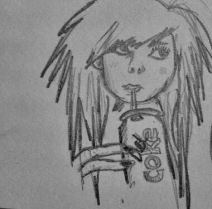
Falling through Glass


3746713882_eb3e039a09
self-portrait//circa 2008

[An essay on anorexia, femininity, adolescent pain & writing the body]

I distinctly remember the first time I watched someone apply liquid liner to their eyes. We stood in the Debenhams toilets before a sheet of unavoidable mirror. She emptied her rucksack of trinkets and tools, drew out a plastic wand with a fine-tip brush and skimmed the gooey ink skilfully over her lids, making curlicues of shimmering turquoise. Her irises were a kind of violent hazel, whose flecks of green seemed to swim against the paler blue. She was very tall and for a while, very thin. She had a nickname, a boyfriend and sometimes she shoplifted; in my head, she was the essence of teenage success. Only later, in the maelstrom of a drunken night out down the beach, do I discover she’s heavily bulimic.

A year or so passes since this first incident, watching my friend slick her eyes with electric blue. I have since learned to ink my own eyes, draw long Egyptian lines that imitate that slender almond shape I long for. My makeup is cheap and smudges. I have grown thinner and people are finally starting to notice.

My mother goes quiet when we do the shopping. She tells me to move out the aisle and I ask what’s wrong. People are staringshe says. I turn around and there they are by the stacks of cereal, mother and daughter, gesturing at my legs and whispering: stick insect, skeleton. A feel a flush of hot pride, akin to the day in primary school when I got everyone to sign my arms with permanent marker—this sudden etching of possession. I am glad I lack this conspiratorial relationship with my own mother, reserving comments on others for the page instead, for my skin. My pain and frustration are communicated bodily: I slink into the shadows, sleeping early, avoiding meals. When people stare, they imbue me with a visibility I desire to erase. I should like better to float around them intangibly, diaphanous, a veil of a name they can’t catch. Instead it rests on everyone’s tongue, thick and severe: anorexic.

It took a week for all the names to fade from my arms; it takes much longer to erase a single label.

In the television series Girls, Lena Dunham’s character reveals that she got tattoos as a teenager because she was putting on weight very quickly and wanted to feel in control of her own body, making fairytale scripture of her skin. In Roald Dahl’s short story, ‘Skin’, an old man gets a famous artist to tattoo the image of a gorgeous woman on his back, the rich pigment of ink like a lustrous ‘impasto’. Years later, art dealers discover his fleshly opus and proceed to barter, literally, on the price of his skin. The story reveals the synecdochical relations between the body, the pen and the value of art. Everything is a piece of something else, skin after skin after skin. In Skins, Cassie Ainsworth gazes into the camera: I hate my thighs. With black marker, she scrawls her name onto her palm; she’s got a smile that lights up, she’s in love. Everyone around her rolls cigarettes, swaps paper skins like scraps of poetry. It feels dirty, the chiaroscuro mood of sunshine and sorrow. Her whole narrative purpose is the spilling of secrets, of human hurt turned to vapour, smoke. Wow, lovely.

For a while, my name mattered less than my skin. There were levels of weight to lose, dress sizes which signified different planes of existence. Over and over, I would listen to ‘4 st. 7lbs’ by the Manic Street Preachers, Richey Edwards’ lyrics spat over a stomach-churning angst of guitar: ‘Self-worth scatters self-esteem’s a bore / I’ve long since moved to a higher plateau’. That summer, ten years ago now, I would walk for hours, the sun on my skin. All the fields stretched out before me like fresh pages of impossibility; my life was a mirage on the flickering sea. I thought of liquid turquoise ink, the friend in the mirror. I started to forget the details of her face, so she blurred into the impressionist portraits I wrote about in school.

Midsummer’s eve; I laid down in one of those fields. With bone-raw fingers, I counted the notches of my spine. Even in free-fall you never feel quite free.

I was obsessed with Richey’s ghost. He disappeared decades ago and they never found evidence of his body. I wanted to evaporate like that, leave my abstracted car somewhere along the motorway; step into the silence of anonymity. Richey wrote screeds of furious notes: ‘I feel like cutting the feet off a ballerina’. There it was: the dark evaporation of resentment and envy. Around this time, Bloc Party released A Weekend in the Citya record that uses Edwards’ lyric to express the racial frustration of being made Other by a racist society. I was acutely aware that the figure of a ballerina, the doll-like white girl, was a divisive source of symbolic desire. We inscribe such societal alignments on the female body, and shamefully I was more than ready to fall into place, to shed the necessary weight. But what I wanted was less the bloody violence of a crippled ballerina, and more the success of erasure.

In Zelda Fitzgerald’s only novel, Save Me the Waltz,the protagonist Alabama trains to be a ballerina late in her twenties, too late to ascend to any real career success. Here was ballet, the pre-adolescent world of waif-thin bodies and she was a mother, a woman—someone who once gave birth, who was strong in flesh. She reaches this frenzied state of beautiful prudence, honing her body to the point where every movement and thought is guided by the waltzing beat, the perfect arabesque: ‘David will bring me some chocolate ice cream and I will throw it up; it smells like a soda fountain, thrown-up, she thought’. I could attest to that. Ben and Jerry’s, swirls of it marbling the toilet bowl, clots of sweetness still clear in your throat. Fitzgerald’s sentences stream towards endless flourish. Alabama makes herself sick with the work, her desire is lustily bulimic. She gets blood poisoning, finds herself hospitalised with tubes in her body, drip-fed and cleansed by the system. I thought of how I wanted to photosynthesise, survive on nothing but air and light. Like a dancer, I was honing my new ascetic life.

Sometimes at night, the old ticker would slow to such a crawl and I thought it would stop in my sleep, sink like a stone. A girl I met on the internet sent me a red-beaded bracelet in the post and in class I’d twirl each plastic, pro-ana ruby, imagining the twist of my own bright sinew as later I’d stretch and click my bones.

I was small, I was sick. I used to write before bed, write a whole sermon’s worth of weight-loss imperatives; often I’d fall asleep mid-sentence and awake to a pool of dark ink, flowering its stain across my sheets. Nausea, of one sort or another, was more or less constant. Waves would dash against my brain, black spots clotting my vision. I moved from one plane or scale to another, reaching for another diuretic. I tried to keep within the lines, keep everything in shape.

Often, however, I thought about water, about things spilling; I drank so much and yet found myself endlessly thirsty. Esther Greenwood in Sylvia Plath’s The Bell Jar, trying to drown, being spat back out by the sea: I am I am I am.

 I’m fine I’m fine I’m fine. The familiar litany.

Something buoyed up, started showing on the surface. People could read the wrongness in the colour of my skin, all that mottled and purpling blood like a contrast dye my body had been dipped in. Against my pallid aquatic hue, I used to envy the warm and luxurious glow of other people’s skin. I sat on a friend’s lap and he freaked out at the jut of my bones. Someone lifted me and we ran down the road laughing and they were like, My god you’re so light. The sycamores were out in full bloom and I realised with a pang it would nearly be autumn. Vaguely I knew soon I would fall like all those leaves.

Anorexia is an austerity of the self. To fast is to practice a refusal, to resist the ideological urge to consume. To swap wasteful packs of pads and tampons for flakeaway skin and hypoglycaemic dreams. Unlike with capitalism, with anorexia you know where everything goes.

The anorexic is constantly calculating. Her day is a series of trades and exchanges: X amount of exercise for X amount of food; how much dinner should I spread around the plate in lieu of eating? It was never enough; nothing ever quite added up. My space-time melted into a continuous present in which I constantly longed for sleep. The past and future had no bearing on me; my increasingly androgynous body wasn’t defined by the usual feminine cycles—life was just existing. This is one of the trickiest things to fix in recovery.

Dark ecologist Timothy Morton says of longing: it’s ‘like depression that melted […] the boundary between sadness and longing is undecidable. Dark and sweet, like good chocolate’. Longing is spiritual and physical; it’s a certain surrender to the beyond, even as it opens strange cavities in the daily. The anorexic’s default existential condition is longing: a condition that is paradoxically indulgent. Longing to be thin, longing for self, dying for both. The world blurs before her eyes, objects take on that auratic sheen of desire. Later, putting myself through meal plans that involved slabs of Green & Black’s, full-fat milk and actual carbs, the dark sweet ooze of depression’s embrace gradually replaced my disordered eating. I wondered if melancholia was something you could prise off, like a skin; I saw its mise-en-abyme in every mirror, a curious, cruel infinitude.

In Aliens and Anorexia, Chris Kraus asks: ‘shouldn’t it be possible to leave the body? Is it wrong to even try?’. What do you do when food is abstracted entirely from appetite? What happens when life becomes a question of pouring yourself, gloop by gloop, into other forms? What is lost in the process?

I started a diary. I wrote with a rich black Indian ink I bought from an art supplies store. The woman at the counter ID’d me, saying she’d recently had teenagers come in to buy the stuff for home tattooing, then tried to blame her later when they all got blood poisoning. Different kinds of ink polluted our blood; I felt an odd solidarity with those kids, remembering the words others had scored on my skin for years. Tattooing yourself, perhaps, was a way of taking those names back. In any case, there was a sense that the ink was like oil, a reserve of energy I was drawing from the deep.

Recovery was trying to breathe underwater; resisting the urge of the quickening tide, striving for an island I couldn’t yet see.

(…What I miss most, maybe, is the driftwood intricacy, the beauty of the sternum in its gaunt, tripart sculpturing. Thinned to the bone, the body becomes elegiac somehow, an artefact of ebbing beauty…)

I think about beef and milk and I think about the bodies of cows and the way the light drips gold on their fields sometimes and how I’d like to curl up in some mossy grove and forget that all of this is happening. Sometimes I worry that my body is capable of making milk, making babies; its design is set up for this nourishing. Hélène Cixous insists women write ‘in white ink’ but I don’t want to be that plump and ripe, that giving. I want scarification, darkness, markings. I want Julia Kristeva’s black sun, an abyss that negates the smudge of identity.

I try to find loveliness in femininity, but my hands are full with hair barrettes, pencils, laxatives, lipstick—just so much material.

As Isabelle Meuret puts it, ‘starving in a world of plenty is a daring challenge’. Anorexia has the highest mortality rate of any mental illness. Recently, I logged onto my Facebook to find an old friend, a girl I’d known vaguely through an online recovery community, had died in hospital. Her heart just gave up in the night. People left consolatory messages on her wall; she was being written already into another existence. Another girl I used to know posts regular photos from her inpatient treatment. She’s very pretty but paper-thin, almost transparent in the flash of a camera. Tubes up her nose like she’s woven into the fabric of the institution, a flower with its sepals fading, drip-fed through stems that aren’t her own. She’s supposed to be at university. I think of Zelda Fitzgerald, of broken ballerinas. A third girl from the recovery forum covers herself in tattoos, challenging you to unlock the myriad stories of symbol. Someone I know in real life gets an orca tattoo in memory of her sea-loving grandfather; she says it helped to externalise the pain. My own body is a pool of inky potential; I cannot fathom its beginning and ending. I wish I could distil my experience into stamps of narrative, the way the tattoo-lovers did. I am always drawing on my face, only to wash the traces away. I must strive for something more permanent.

Recovery, Marya Hornbacher writes in her memoir Wasted,

comes in bits and pieces, and you stitch them together wherever they fit, and when you are done you hold yourself up and there are holes and you are a rag doll, invented, imperfect.
And yet you are all that you have, so you must be enough. There is no other way.

Every meal, every morsel that passes the lips, we tell ourselves: You are okay. You deserve this. Must everything be so earned? Still there is this girl underneath: the one that screams for her meagre dreams, her beautiful form; her starlight and skeletons, her sticks of celery. I try to bury her behind sheet after sheet of glass, lose her in shopfronts, the windows of cars and bathrooms; I daily crush out the bloat of her starched hyperbole, keeping the lines plain and simple. Watching others around me, I try to work out other ways of feeling full, of being free. There is an entry from 2009, scratched in a hand I barely recognise in the final page of a diary: ‘Maybe we are only the sum total of all our reflections’. I wonder what kind of sixteen-year-old wrote this, whether she is happy now and if that matters at all.

Warm-Up

The exercise involves lying full-bodied on the floor for another to draw around your form. The purpose of said exercise is to articulate a sense for the flow of immobility, immobility as flow and thus possibility. Many groups attempted similar activities to great aplomb and connection. Artists collapsed upon their models. Models rose to heights of personal ascendence. Poetry collections were published. Limbs grew lithe in artificial moonlight. The studio upgraded its entire rigging. We brought new humans to practice passivity. Every pairing was a pool of pleasure. Who knew the flesh untouched could be so malleable. To cultivate the necessary unrest, ambient ocean sounds may be played directly into the model’s ear. Arousal. Here we are, rhythm of intermittent tide, a pencilled warble. This man has muscles that articulate a paradoxical vulnerability. It’s in his tattoos, which only the artist sees. A he or a she or neither, in which case a very special effect is reached. Systems fall into perfect error. Undulations of hair leave their impress upon carpets, but admittedly parquet floors were instructed. Recommendations swept away in paper flakes. Controversies stirred at the death of a single participant. They had scratched, I am just looking for a way out. It never occurred to the artist that the model was in fact referring to their very own body. Doors were locked and provisions made. They ate tinned peaches and dripped the slippery juice across each other’s faces. Some of them miss the practice as it was before. No good to dwell in the past. No good at all. The snapshots were flushed when authorities arrived. Time will tell, how else? Little white lines. Social media profiles in the boom era broke down when the 404 parade came round, desperate and percussive. I make of you a blade of rain, they said. This isn’t the eighties, the skin replied. There were twenty-two poems explaining aesthetic paralysis. A great deal of laughter and stuck-together A2 paper, resonant scent of impermanent ink. When your felt-tip skims my shoulders I melt like infinite butter. His tattoos twist, I drink them.


(Response to the #FlashFictionFebruary challenge…

(04/02/18: ‘create’)

Playlist: September 2017

IMG_6411

  📀🍂💋

Late night listening to the sound of the planets :::soundtrack::: Adult Sadness Vol. 2. The sky is a dark green borrowed from a pen I once had that smelt quite rotten, not unlike the algae in the Queen’s Park pond you can’t touch because it’s poison bloom. A sign tells you. Underuse of racing ink. Toy cars with ferric metal. Lungs clotted orange. Weather for ducks. Earnest shrills in the steam//screwed repression. The feathers in my window shiver in the draught and there are many fibrous villi around my ribs that stir, muscle and sinew twitching.

Maryhill is lovely in autumn, all brick and scaffold, all concrete and leaves. Struggle of unfolding, furls come slowly their upward petals turned sunward for silk in lieu of caress. Lights glimmer vague at dusk but among rust and green there are delicious marbles of red, tiny gleams. Tin cans in windows. Glass reflects this wool coat, its pale blue shape containing my body. A scratch, diskette release. Let me know what you think of winter; it’s something I suspect we’ll disagree on. Church bells ring in distances, always three minutes out of sync. 1,2,3 (!) My alarm clock feels ornamental, like the inessential flourish of an amateur artist. Precious, the ephemeral perfection of certain ~simple~ things. Sufjan singing amethysts and flowers on the table and the gathering of leaves in dry cold fingers. A honey-tinged moment of regress. When she died we built a house out of sticks and acorns. They say they won’t break your bones. Most of us snap limbs climbing trees. Karmatic trauma of perilous branches, the wounded arborescence conveying refuscent regret.

I am sorry we both suffered. Tinge of tears: mostly the sting of decayed mascara, delayed asterism of accounts, of admin. A sort of mourning when you peel at the bark with your chipped fingernails, the roughness because you never learned to file. You liked black paint, the name ‘Lamp Black’. Technically I would stand at filing machines with a block of mahogany and a terror in my gut that I might shave off the first flesh of my knuckles if I was not careful, if my attention lapsed for a second—which of course it was liable to do. Cloud patterns, sand particles, root of palm. The tender, meaty abrasions. A leaf in the window. A fudge of trunk. A windmill pirouette in split sycamore seedling. A man at a gig with a fidget spinner, reenacting the gleeful vacuity of a faraway childhood. He likes the repetitive beat, has a fiend in each pupil. In a dream I did nothing for days and loved it.

They shoved yellow bricks on the topsoil, building a road. Composed monotony of Sunday morning, purplish as old Cadbury wrappers, melting to grey in the blinds, the unfinished business. The city got thinner; people lived off vegetable scraps, acidic drinks. The lovely vodka was tonic for the soul. Add cranberry and stir with three wishes. Lime dash, cheap taste of the bitter quarry. Trust me, this can all go away. Tartly. The beauty of how easy it can all go away. Close your eyes and reach for the dead, a charnel miasma of dark and brilliant matter. Check lunar spells, the pulpy, rhythmic etcetera. The smarted tongue of demethylated plasma. The visceral, cavernous depths of Nick Cave’s deranged baritone, the dripping blood that seeps between two tunings. My face without water. Apocalyptic nothing. Dawn skin, imitation foundation, polished silver. Wasn’t it some ride w/ flashing lights and a siren that shredded the nerves in your spine? Things recall home. A patience.

Find myself besotted by violins and even bagpipes for the first time in my life—something about the possible soaring. The violet sublime of imaginary mountains, 23 minutes from KO to summit. Duplicity. A very weird light on the river amorphous, the narrow rapture that glimpses distance. Glasgow is O so grey and so close(d), except for special streets where sky can be seen. Washed-out autumnals, palette of eyeshadow crushed upon absent downs. The baby fly drawn to the white screen light. Flicker of water. Cradling. Give it your interest, invest in gifts. Conduct flowcharts, erect monumental spreadsheets. Working for eloquent pennies and smiling at genuine occasions, deferring the plunge of a vast anxiety.

Chance encounters with beloved people. It’s getting chilly; I notice the wisps of gold on your fingers. Tiny clatter of teaspoon, agreement. Just the want of nourishing. Can I help you with…? Careless loungewear. Languidly envisioning bike rides and the sweet nicotine of his neck, maybe not present or else a taurine sunset burst harsh on canals. Walking hours just for circling. Euphoria of autumn, the crapulent auroras of thought. Remember me here and here alone. Deepen the nauseous voices with chlorine, the temporal wound of music which eked out several nights, no grace. Brain fog(?) / darling the chosen cottage was swamped in starlings. She wants it! In my milky cocoon I slip into sea. A truly invisible misery that flourishes with absence of sunlight. Yet these have been glorious days, phantasmic fall. Lagoons of jewelline, arboreal beauty. How far the pretty trees seem, so close to fading. These are the first weeks. A new leaf being this fragile contusion, gilded with flavanols.

September a full month, fat on Lindt-rich dusks, transitioning through ending. (Un)start a record. What we write being less than unwanted dreams of childhood bedrooms. A still-written diary, a remark of childish handwriting. Sometimes the sound of the lock recalls being young and waiting at a table with homework, the dog snoring. Absence wafts through floorboards; the city flats have hallways that smell of spices and home-cooked food. The luxury of illusions. Homegrown squash from the neighbour’s garden; a generous, ministerial grin. Star Trek boxsets. Subway blasting ersatz fumes of bread. Give us our (daily) bread, your most aesthetic cucumber shred. Flour turns to flower in the whirl of a trip, slappy hour calyx. Fetishistic love for cigarettes; loathed tobacco discount nausea. Too long among clouds of nitrate, butane. Stealing the stuff in bars when hungry, letting the soothing crunch give seconds of life. Keep walking, look focused. Be watery, light. Release apophenic reactions to overwhelming reverie. Let the glassy-eyed night remain hypothetical, lull your throat with cinnamon tea. Play for 2hrs+ and expect no refunds.

A coruscating, honest energy; a heartbreak falsetto. Be mine, be mine. It’s a love-heart candy or Spinning Coin song or a leaf trampled wax-red in the rain. The gleaming of  complexions fed on beta-carotene. Waiting for the top to stop, its twirl collapses the triplet realities. Trap pop and unripe nectarines, paring of skin. Wake me up when. The haunting/ed seventh circle. Shellac memories comb trellising mystery. The Lynchian roar of Mercury’s industry. Chewing dates for luck, mulling imminent (Pause) the solitary red-berried rowans at church. Each apparition of Sebaldian land: the Suffolk coast, the labyrinth; the breathlessness of melancholics. Krapp’s remembered lighthouse, Sarah Palmer’s ceiling fan. Again, the twirling. Things that keep me awake, the static turning geometric shapes. Cyclonic diagrams of elsewhere tornados. Gently, side to side, a new tossed pound from the mint. A fresh pack of gum going stale in the rucksack. Suspense! Many day trips or nights you hoped might go on. Graveyard hookups. Rain lashes, splashes, makes it deluge a cache of murmuring sound, of hypnotic water, a lariat looping nutritious conditionals. I listen in sleep, I fall asleep to rainymood and its ambient coolness unsettles the sheets, loses the cookies. Precipitation is a quality of the tongue, without moving a lively swill of ice, of breezy smiles. Full in the no-going, the onward falling. Tell me your everything. Swaying skeletal trees are absurd. If you were in a flat and on someone’s floor and the furniture spoke to you. Be mine, be mine. September’s coming soon / blinded by the moon. Things which trigger the shifting year. Seasons are an art form in letting go of an Earth; molecular moves manifest as scent, burnish, colour. Smoke gets in your eyes, the squint-making light. Rush of the somewhere tap, free cold water, accompanied nights.

Close out. Pluto a drone in the back of my mind, the x-rays made of millioning crystals, lattices cut on the frost of midnight. At what time, the secret ossified entry beckons. Baudrillard winks with a follow me, as if he knew the currency of emoji. Emotional seduction. I say it in loathing, stuck on the affluent salt of my copper-hued cravings. You are an apple pie with a crust of ashes, you are the zone of the saddest parties/pastries. Someone taught me Jupiter’s salad of flames, or gestured towards her salubrious eye. The sky retains that tip of fire, spilt ink of other-terrestrial planes. Sonorous longing, your favourite spooky IPA. We need a holiday and a coffee, a combined electricity of homeostasis. Human profusion: a pool of Buckfast, VHS reels, vacant pleasures. Layered bodies, microbials enmeshed. SmoOoo00oth. Hatched exactitudes coke residue lumps of OCD. All good people are slowly leaving. New ecosystems persist less algorithmic than ferns, but equal to measure of possible lushness, the spiral and point of rising life. These addictions enriched with chromatic schemes of arguments and gin, or whatever the superlative spice. A price on each arrogant lacquer, a month out of season, already stewing. Braeburns juice the pallid enamel, keep us up stung without sleep. Tell me I’m leaving.

*

Car Seat Headrest – Drunk Drivers/Killer Whales

The Pastels – If I Could Tell You

The Delgados – The Past That Suits You Best

Roddy Woomble – Every Line of a Long Moment

Savage Mansion – Do You Say Hello To Your Neighbours?

Spinning Coin – Albany

Angel Olsen – Special

Frightened Rabbit feat. Julien Baker – How It Gets In

Jane Weaver – Modern Kosmology

Four Tet – Lush

Gross Net – Citadel Ghosts

Slowdive – Trellisaze

LCD Soundsystem – black screen

Bob Dylan – Don’t Think Twice, It’s All Right

The Horrors – Gathering

Nick Cave & The Bad Seeds – Push The Sky Away

Screen Shot 2017-09-21 at 03.49.19

PSYCHOGEOGRAPHY: Mapping my Hometown

The term psychogeography was coined by the French Marxist Guy Debord in 1955. Its specific impulse is to explore the relationship between place, affect and human behaviour. Back in the nineteenth century, Charles Baudelaire enjoyed wandering around Paris being a flâneur (a kind of urban rambler, who drifts somewhat aimlessly through metropolitan space, absorbing her impressions).

We might take urban space for granted as something that’s just there, the same way we do about nature. Space, however, is always ideological, entangled in contested debates about politics, identity, belonging. Different groups of people experience the same place completely distinctly. Each town and city has its demarcations, its specific districts, gang territories, religious  and/or subcultural quarters. Architecture and town planning don’t just happen in a vacuum; they are influenced by the politics of the local councils and corporate bodies that fund them. The creation of homeless spikes, gated communities and the demolition of Brutalist towerblocks don’t just occur for aesthetic reasons, whatever politicians may claim. They are ideological responses to human conditions, defences of the privileged against the intrusion of the ‘unwanted’. Space is always a story of demarcation, of limiting the flows of people, of perpetuating a constant sense of self/other.

Psychogeography can be a kind of resistance to such demarcations. Aimless wandering is a direct transgression of the social ordering of space. It’s a form of trespassing (sometimes legal, sometimes not); entering into districts you might not normally feel comfortable in. In a way, it seems accessible to anyone, but obviously excludes people who can’t just throw on a scarf and leave the house for a wander. Not everyone has the power to walk. James Kelman’s How Late it Was, How Late (1994), the protagonist Sammy wakes up blind and spends most of the novel walking. He’s figuring out the streets from a sightless perspective. When bad stuff happens to him, when he’s got no money and the state and healthcare system hardly provide the direction, he just keeps walking: ‘Sammy kept walking’; ‘[t]here was nothing he could do. Nothing. Except walk. He had to walk’ (Kelman 1998: 216, 57). There’s an impulse there; a will to keep going even if keeping going means plunging through the impenetrable smog of uncertainty; that whole Beckettian ‘you must go on. I can’t go on. I’ll go on’ sense of abyssal recursion which isn’t quite static but rather endlessly churning.

The effectiveness of defying the sociogeographical norms of space through walking is obviously up for debate, but it’s still a worthy aesthetic experiment to try out and certainly one that works someway towards avoiding social and spatial claustrophobia.

I’ve written about psychogeography and places of memory before, so I won’t go into much detail here. However, I just wanted to write briefly about a wee experiment I tried out in preparation for a seminar on Situationism.

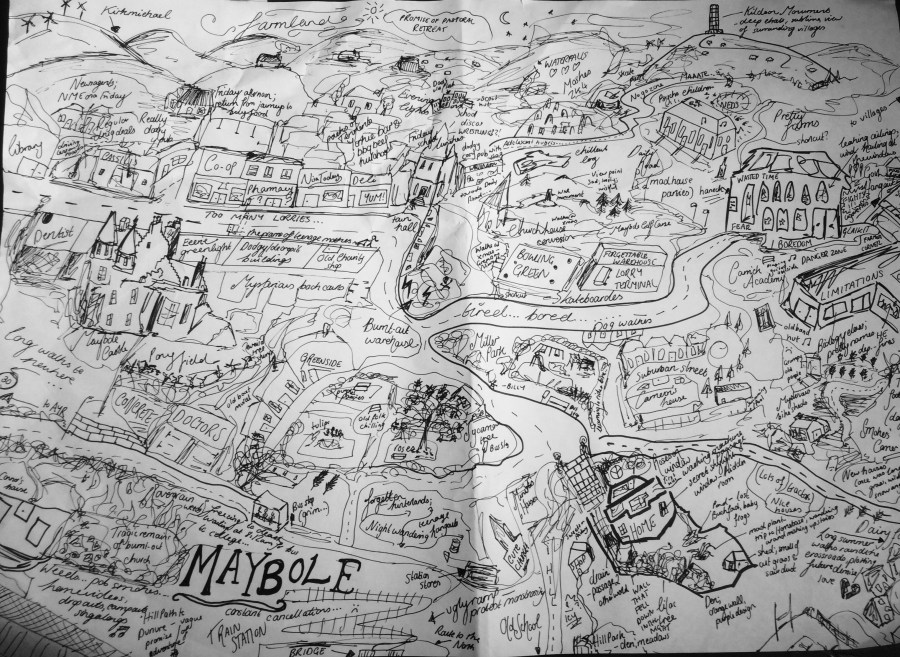
Usually, psychogeographic studies focus on the experience of exploring and traversing urban space, but I wanted to look at something a bit smaller; namely, my hometown of Maybole. At two in the morning, after a tiring shift, I sat down at my desk and tried to map out a subjective outline of the Ancient Capital of Carrick (ugh, such pretension eh?). I wanted something that would take into account that sort of dreamscape feel, like not just buildings but also the sense of surrounding landscape, of the in-between (Deleuze & Guattari intermezzo – the life of the Maybole nomad?); the town as connecting point, with little else to centre it, perhaps, other than its connections (oh and a little high street castle). I zoomed in on my old house and saw that the pampas grass in the front garden was trampled and skewed as usual and, somewhat weirdly, a mysterious object lying on the lawn turned out to be a blue light-sabre (of the plastic Star Wars variety). This foreign object suddenly made my whole homesick longing for the house a wee bit strange; like my feelings felt displaced, belonging to another time, another version of the house.

It took a while to get into the process of sketching out the town, but soon my mind started whirring and various memories and impressions started firing off, cutting across the whole 18+ years that I lived there, in the same house on Culzean Road. I spent a wee bit of time browsing the town on Google Maps, but the flatness, the sparsity of detail, lack of interesting gradients, wasn’t very inspiring. I like messy maps. It was easier just to work from a sort of organic expressiveness, not bothering about such technicalities as cartographic accuracy, scale or objective detail. Instead, I threw in everything I could think of: the weird stuff, the way certain streets and buildings still signify in my brain, even though the places in real life have most likely moved on.

Most of these impressions, by the way, are teenage ones. Don’t take them seriously, seriously. After all, the point of psychogeography is, in a sense, its resistance to the static quality of the map. Its performative constitution of many different possible drafts of maps and routes, impressions, emotions, memories – which shift over time and certainly, if anything, refuse to be stable.

fullsizerender
17/11/16

Bibliography

Kelman, James, 1998. How Late it Was, How Late (London: Vintage).

‘Psychogeography’, Glossary of Art Terms, The TATE. Available at: http://www.tate.org.uk/learn/online-resources/glossary/p/psychogeography [Accessed 18.11.16].


POVEMBER Week 1: HAIKU

img_2435

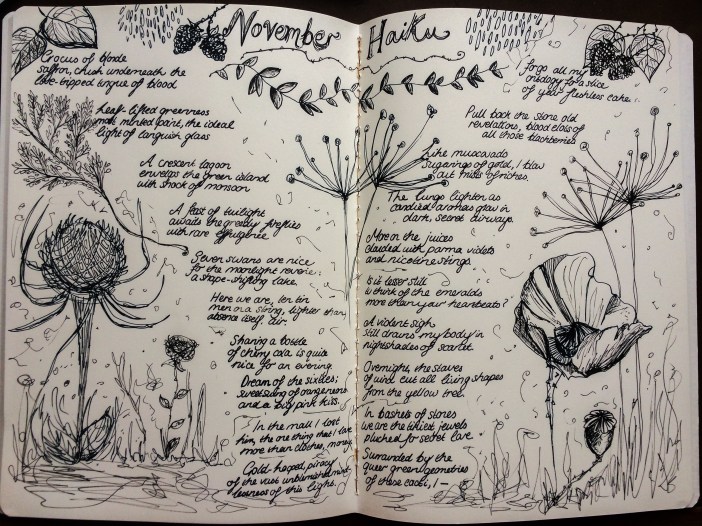
Every year the Glasgow University Creative Writing Society run a wee challenge called ‘POVEMBER’, the cleverly punned name really digging the whole poetic playfulness thing of course. Anyway, the basic point is to set guidelines or prompts to encourage you to up your poetry game during the month of November. Week 1 was Haiku, the Japanese form which is typically constructed as a 3 line poem with 5 / 7 / 5 syllables. Above I’ve written out a bunch of daily haiku which are all unedited and a bit messy and weird but were nevertheless fun to write. I like the idea of haiku having a cumulative effect and I’m not sure how well the above ones fit together but maybe they do something when thrown out on a page like that.

Anyway, it’s a fun process and super easy to have a crack at so encourage everyone to have a try!

You can check out more information on POVEMBER here. 

Apple Blossom

Apple Blossom

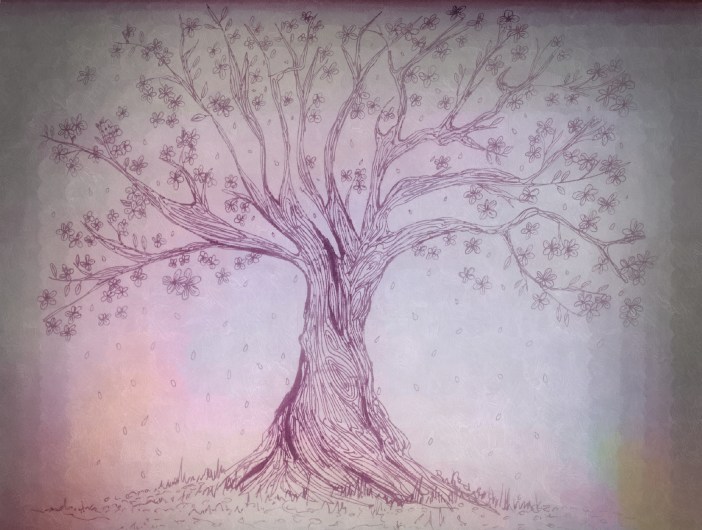
April, the sweetest candy of a pink-tinged sky blessing the late afternoon. Rebecca has sat in the garden for hours, watching the birds nibble from the feeder and splash around by the pond. This is her Grandpa’s garden, though he no longer enjoys it. They have him cooped upstairs on a dialysis machine, in a bedroom that smells of sweat and death. Rebecca is not allowed up there: the air, her mother says, is not fit for a young and blooming girl.

She misses her Grandpa. She remembers him mowing the lawn on Sunday afternoons, stooping with his bad back. She remembers him commending the shapes of his moon-faced daffodils. She remembers him singing Frank Sinatra in velvet baritone while pruning the roses.

The roses are now out of control. They cluster all over the flowerbeds along the path, dangling out with their swollen, sumptuous heads. They have grown so tall that they bend over, crippled with the excess weight, the stems stretching to breaking point. Grandpa would be so disappointed if he witnessed the state of his roses.

Sometimes, Rebecca liked to peel off a petal or two. It was hard to resist; once she took the first few, the others came off so easily and they just slid softly into her fingers. Vivid trails of pink and red petals are now strewn along the gravel path, where Rebecca has walked like a bridesmaid.

At the back of the garden is the apple orchard. In winter the trees are gnarled and bare silhouettes, and not a soul would dare enter the darkness between them. Now that spring has arrived they boast their pretty bows of white, flaky blossom. Every year, Grandpa used to send glossy photographs of the apple blossoms to Rebecca and her parents, who lived far away down in London and rarely made it up to visit. The sight of those lovely trees was always a dream to the young girl who yearned for the country.

“When can we go and see them for real?” Rebecca would sigh.

“Oh, sometime in summer. Maybe Christmas.” They were so often dismissive like this. They had waited too long to see him and now he was dying. Even Rebecca knew it.

She was growing quite bored now, in the garden with no-one to play with. She knew there would be supper soon: hot buttered crumpets with a dark smudge of Marmite melting inside them. Real Earl Grey (loose leaf) because that was the only tea Grandpa had in the cupboard. Rebecca thought it smelt a bit fusty, but you could read the tea leaves at the bottom of the cup afterwards. She thought she saw a bird in hers that morning.

Yes, she was quite bored. The hula hoop which she had brought up from London lay abandoned on the lawn. She had tossed away her tennis racket somewhere into a dense clump of shrubs, because it was no fun to play by yourself, hitting a ball against the shed wall. A bag of marbles had burst open on the patio, the little glass balls having long rolled away, to settle amongst their brethren of grass and gravel. Rebecca had no toys left and besides, she was so tired of them all.

Even the insects had bored her, with their slimy indifference to her existence, their urgent desire to escape her clasping girlish fingers. She couldn’t give a toss about snails and slugs, or even butterflies anymore.

It was in this moment of tedium that she spotted the boy through the hedge. She couldn’t believe she had never seen him before. It was a difficult thing not to be spotted, not to make a peep, but Rebecca crawled expertly into a gap and tried not to breathe as she watched him. He was lying on his front, kicking his long legs back and forth. From this angle, he looked about fourteen. His hair was sort of ginger but also sun-bleached, as if he had spent a long time outside in a streak of good weather that Rebecca must have missed. He looked like something the sun had offered as a blessing. She could see his freckles, the concentrated curl of his lips. He was drawing in a big sketchbook which was flipped open, so that sometimes the breeze rippled the pages. Rebecca felt her heart hum and flutter in the cage of her chest, like some swarm of insects had trapped itself deep within her. He was so beautiful.

She wanted to crawl right out of the hedge into the next-door garden, step into the other world where he existed. She wanted to talk to him, ask for his name. See what it was that he was drawing. She felt like the secrets of the world would unlock themselves once she had learned his name. The sapling of herself would unfurl and a bounty of happiness would overflow from her body like the golden leaves in autumn.

“Rebecca!” she froze. It was her mother calling. She had been searching all over the garden for her daughter and now here she was, discovered in the hawthorne with white blossoms caught in her hair and a strange smile on her lips. She saw there were tears in her mother’s eyes, clinging and spilling like rain from the knots of tree trunks. How could there be tears at a moment so pure, so lovely?

“It’s Gramps,” she gushed, “he’s, he’s gone!” And so her mother pulled her out of the hedge and clutched her in her arms, held her so tight Rebecca thought she would burst. It didn’t make sense: he’s gone, he’s gone. As her mother sobbed into her hair, she watched the apple blossoms being blown away by the gathering night wind. Next-door, the boy stretched out his long limbs, packed up his things and disappeared.

(This little story emerged out of a longer short story project combined with prompts from Glasgow Uni Creative Writing Society’s Flash Fiction February challenge (‘renewal’ & ‘orchard’)).