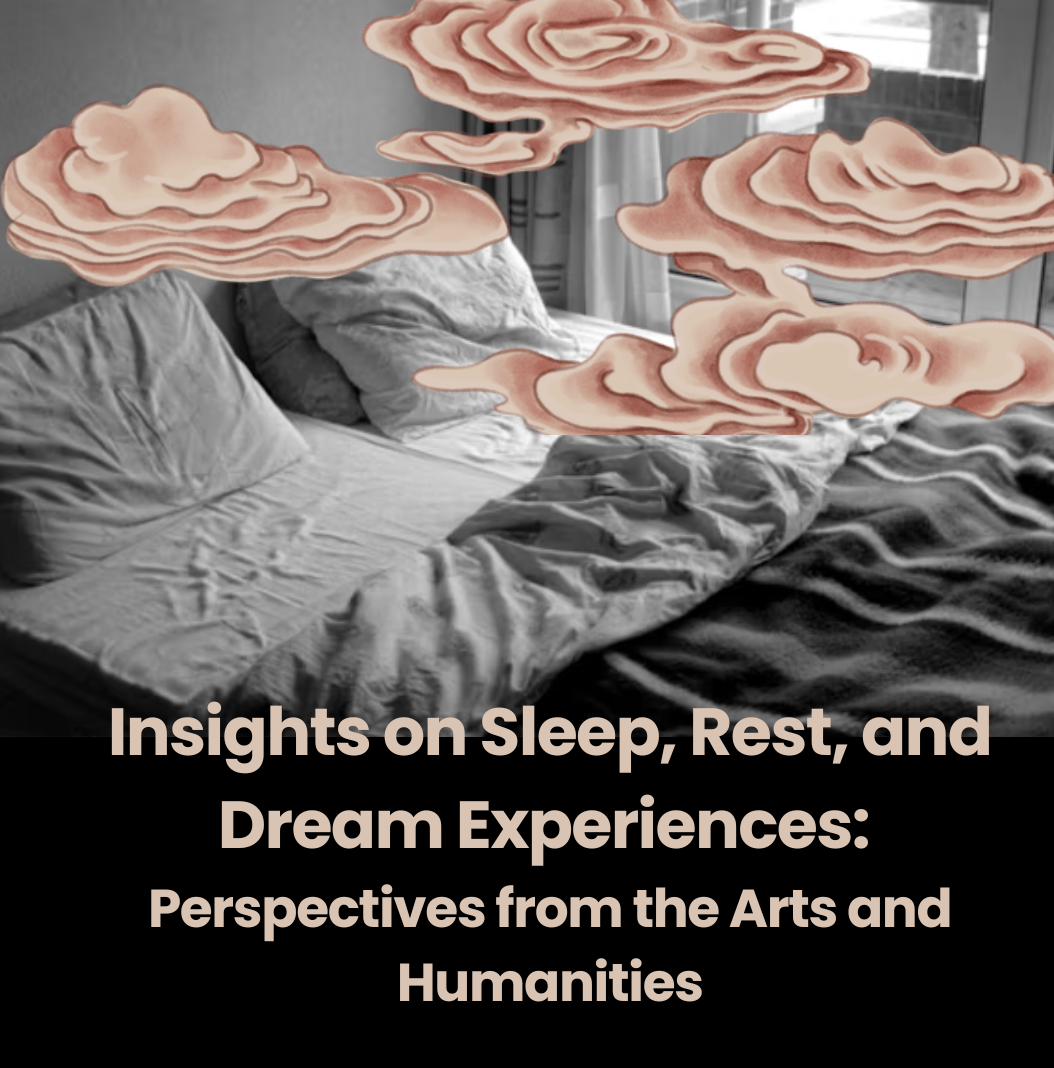
22nd of May 2025. 11-5.30.
Institute for Advanced Studies in the Humanities, 2 Hope Park Square Edinburgh EH8 9NW
Broadly, our societal response towards sleep and rest is one of downgrading and devaluation. In our current capitalist society, sleep and rest are conceptualised as a time of passivity and inaction, and thus, as a period in which we are not producing or accomplishing. We tend to be jealous of those who can go about their days with fewer hours of sleep than ours, or praise those who can maximise their schedules, crammed with an endless series of activities and tasks. However, lack of sleep and rest time can lead to poorer health, both physical and mental. A good night of sleep can be one of our most restorative activities, and despite this fact, it tends to be neglected. Similarly, sleep and resting states allow for the occurrence of experiences that, if carefully attended, can provide us with a tool for self-exploration, such as dreaming and daydreaming.
The workshop intends to explore how these and related issues to our relationship to sleep and rest can be approached from the methods and perspectives of different disciplines within the arts and humanities. To that end, the workshop will consist of short presentations, panel discussions, and collaborative sessions for active participation. The workshop will be hosted both in-person and online.
Speakers and facilitators:
Dr Adriana Alcaraz-Sánchez (Philosophy, University of Edinburgh)
Dr Marco Bernini (Literary Studies, Durham University)
Prof Felicity Callard (Geography, University of Glasgow)
Dr Robert Cowan (Philosophy, University of Glasgow)
Dr Oli Hazzard (English, University of St Andrews)
Dr Sophie Jones (English, University of Strathclyde)
Dr Kevin Leomo (Music, University of Glasgow)
Dr Elizabeth Reeder (Creative Writing, University of Glasgow)
Dr Maria Sledmere (English & Creative Writing, University of Strathclyde)
Preliminary schedule:
11-11.25: Introduction and reflective activities: In this initial session, participants will be encouraged to share and write down their thoughts about their relationship to sleep and rest.
11.30-13: “Topics on dreaming, sleep experiences and transitory states” (Dr. Alcaraz-Sánchez, Dr. Bernini and Dr. Cowan). Short talks followed by a Q&A.
· Dr Marco Bernini (Durham University): “Dreams and Heightened Narrowed Immersivity: Combining Saturation, Permeability, Presentationality and Presence”. Are dreams (narrative) worlds? What similarities and differences are in play between our waking consciousness of the perceptual world and dream consciousness as quasi-perception? This paper posits that dreams exhibit a unique experiential mode called ‘Heightened Narrowed Immersivity’ (HNI)—a state characterized by intense presentational immediacy and severely restricted informational context. Combining frameworks and concepts from narrative theory and cognitive science while looking at dream reports, literature, lyrics, and movies, the paper shows how dreams and their artistic mediations reveal unstable ontological environments—low saturation in time, causality, identity, and space—while maintaining a high degree of immersive presence.
· Dr Robert Cowan (University of Glasgow). “Exotic and Ordinary Dreaming”. In this talk I consider two kinds of ‘exotic’ dreams. First, those that occur during episodes of REM sleep behaviour disorder where subjects allegedly ‘act out’ their dreams. Second, lucid dreams wherein subjects are apparently aware that they are dreaming while dreaming. My question: what do these exotic cases tell us about the nature of ordinary dreaming? My answer: very little and certainly less than others have thought.
· Dr Adriana Alcaraz Sánchez (University of Glasgow). Hacking the sleeping mind: the exploitation of the dreamspace. In dream research, the term ‘dream engineering’ has been adopted to describe techniques that manipulate, record and affect our dreams. Within the research context, dream engineering has become a useful tool for exploring the nature of dreaming as well as its potential for enhancing our waking lives. Yet, a couple of examples taken from outside scientific research might make us worry about the extent dream engineering practices should be conducted, especially when those are applied widely to the general public. Here, I consider some of the ethical implications of those practices outside the research realm, some of which put into question the value we attribute to sleep and dreaming.
13-14: Lunch Break: Vegetarian and Vegan catering for all participants
14-15: Panel discussion: Working title “The need for rest” (Dr Reeder, Dr Jones, and Dr Callard and Dr Sledmere): Our panellists will give a flash/provocation followed by a chaired discussion with questions from the audience.
15-15.15: Short break: Tea and coffee for all participants
15.15-17.00: Creative session. In this facilitated session, we will explore the role of dreaming/liminal states for creative purposes.
· Poetry reading and discussion by Dr Sledmere and Dr Hazzard.
· Haiku writing and Deep Listening activities
17.00-17.30: Discussion back to the rest of the workshop/final thoughts
From 17.30: Wine reception at IASH (Open to all participants)
This event is organised by Adriana Alcaraz-Sánchez (Postdoctoral Fellow in Philosophy, IASH, University of Edinburgh), Maria Sledmere (Artist and Lecturer in English & Creative Writing, University of Strathclyde) and Kevin Leomo (Artist and Community and Engagement Manager, University of Glasgow).
The event is supported by the Susan Manning Workshop Fund from the Institute for Advanced Studies in the Humanities (IASH) and is jointly hosted by IASH and Project Somnolence [https://projectsomnolence.com/about]
Accessibility: This event will take place at IASH, 2 Hope Park Square, Edinburgh, EH8 9NW. Please see a map here: https://www.iash.ed.ac.uk/location
The Seminar Room is on the first floor, and unfortunately IASH does not have a lift. If you have mobility issues and would like to discuss access, please contact iash@ed.ac.uk as soon as possible. Next to the Seminar Room, there are a couple of rooms that can be freely used in between the sessions/break time. If you require a quieter space at any point during the duration of the workshop, do reach out to the lead organiser (contact below) or let any of the organisers know on the day of the event. There’s also access to a microwave/small kitchen space if you require it.
Note to online participants: All sessions will be streamed, and online participants will be able to ask questions. However, note that due to the engaging nature of some of the sessions (i.e. creative session), we will not be able to provide tailored support or feedback to online participants. The sessions (including the talks) will not be recorded.
Note to in-person participants: Unfortunately, we are unable to cover travel and/or accommodation expenses for participants. Catering (including lunch and refreshments) will be provided to all.
Contact: For any questions or enquiries regarding the event, please get in touch with the lead organiser Adriana at Adriana.alcaraz.sa@gmail.com
Cover picture: https://unsplash.com/es/fotos/una-cama-se-deshace-cerca-de-una-ventana-mbvHui7I5KQ [Digital alteration by Adriana Alcaraz Sánchez]
The event is supported by the Susan Manning Workshop Fund from the Institute for Advanced Studies in the Humanities (IASH) and is jointly hosted by IASH and Project Somnolence.


 mariaology