Hypercritique: A Sequence of Dreams for the Anthropocene

Pleased to announce a new journal article, ‘Hypercritique: A Sequence of Dreams for the Anthropocene’ is now published as part of Coils of the Serpent’s ISSUE 8 (2021): IM/POSSIBILITY: ON THE PRODUCTION, DISTRIBUTION, AND ARTICULATION OF THE POSSIBLE AND THE IMPOSSIBLE. With thanks to the editors.

You can read the full issue for free here.

What sort of coming belongs to a dream? Existing suspended, to come, now, is to place impossible faith in the possible: that passion for “something” which answers as closure, fulfilment, echo, return. The conditional tense, “to have given us to believe”, as though this were the very text we were each receiving. And I call you from dreams like the siren, and I am more of each line, the outwards spread which you circle to end, ellipsis, still typing, which you centre but do not settle. The anthropocene, this hypothetical epoch of the lived, the literal extinction, asks us (and could it) to see ourselves coming as pure expenditure, general economy, the discharge of species.1 And so I ate the lure and let me go.

The Greatest Loss: Lana Del Rey’s Anthropocene Softcore 

Screenshot 2019-09-08 at 11.26.09.png

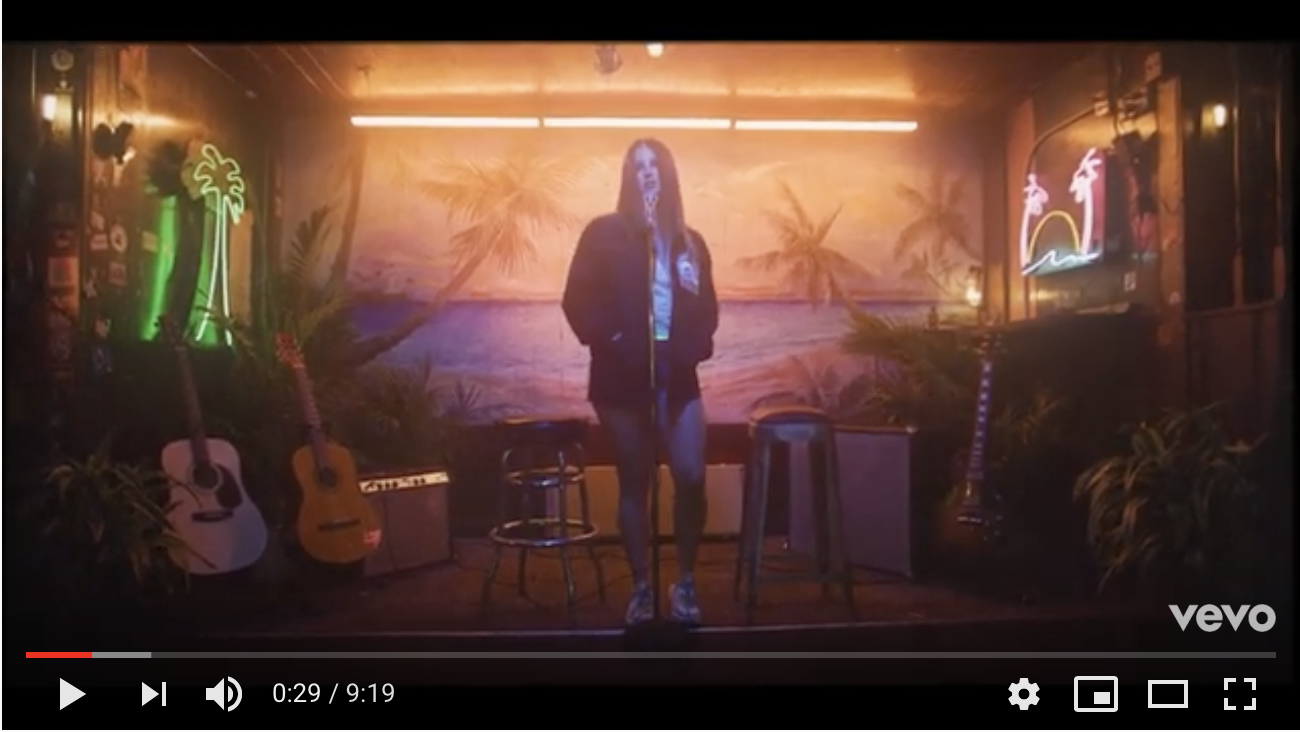
There is a scenario in which the jukebox is equivalent to the poet and some elaborate analogy is to be made between intertextuality and the limited catalogue whose selectional form produces play. The scenario only survives in video. It needs this urge of duration, not to mention the tenderness of a touch. Where fingers brush keys like notes, there is something to add to the story. A social space in demand of ambience; on flickering alongside off. When Lana is alone on stage, hands stuffed into a bomber jacket, singing ‘Fuck it, I love you’, swaying almost nervously, I want to think about what she is doing there and who she is speaking to and from where she is speaking. She is not really speaking but singing. The lone girl on the stage is the open mic dreamer, with nothing but lines. She is scattered across june-dreams of multiple personality: ‘The I which speaks out from only one place is simultaneously everyone’s everywhere; it’s the linguistic mother of rarity but is always also aggressively democratic’ (Riley 2000: 57-58). We mother our solipsism with words but in doing so there’s an opening. So to say fuck it and state the interruption with syncope, sincerity. Lana Del Rey was born on the cusp of Gemini and Cancer season, which more than explains that statement: ‘Fuck it, I love you’. With her sails to the wind. To say it over and smooth into plural refrain, you could even say chorus. For a chorus wants to be shared. It is a commodious mother, fed by the keys of the jukebox baby. There is a constant reversal of nourishing; the democracy of lyric utterance, the milky feed that streams.

Denise Riley argues that any ‘initial “I love you” is barely possible to enunciate without its implicit—however unwilled—claim for reciprocation’ (2000: 23). But what is reciprocation in a song? Is it just the urge to be sung with? And this ‘fuck it’, the pervasive millennial injunction to just be, to move on, as the tag which erases the expectant price of the utterance? Riley argues that I love you ‘must at once circulate as coinage within the relentless economy of utterance as exchange’ (2000: 24), but in a pop song it bears the leaden weight of so many prior expressions. The irony is that to cut through that with a simple fuck it, Lana can attain something like sincerity in the very pop mode whose lineage of commercialised love would surely undermine her feeling. Fuck it, in spite of saying I love you I really do. The pop song becomes this space for the staged epiphany of repeated assurance, I really do. It is a softcore admission of the self in its burning limit. 
Screenshot 2019-09-08 at 11.26.37.png

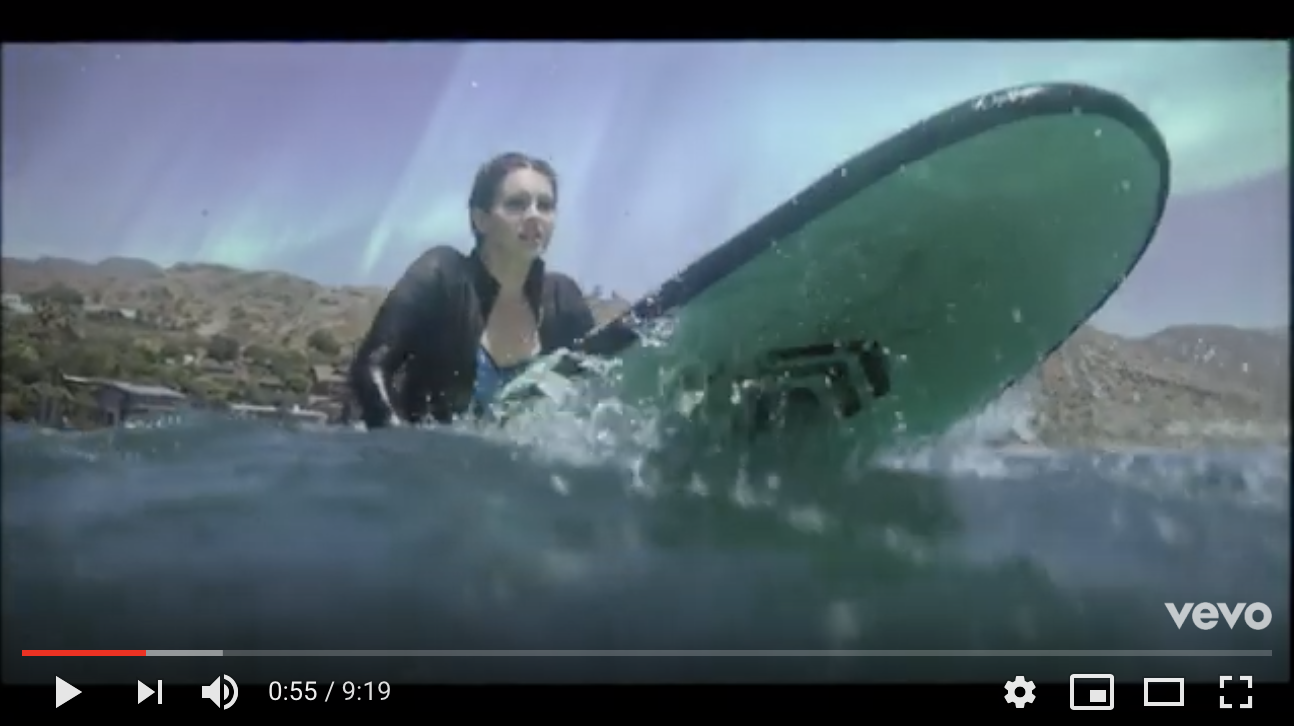
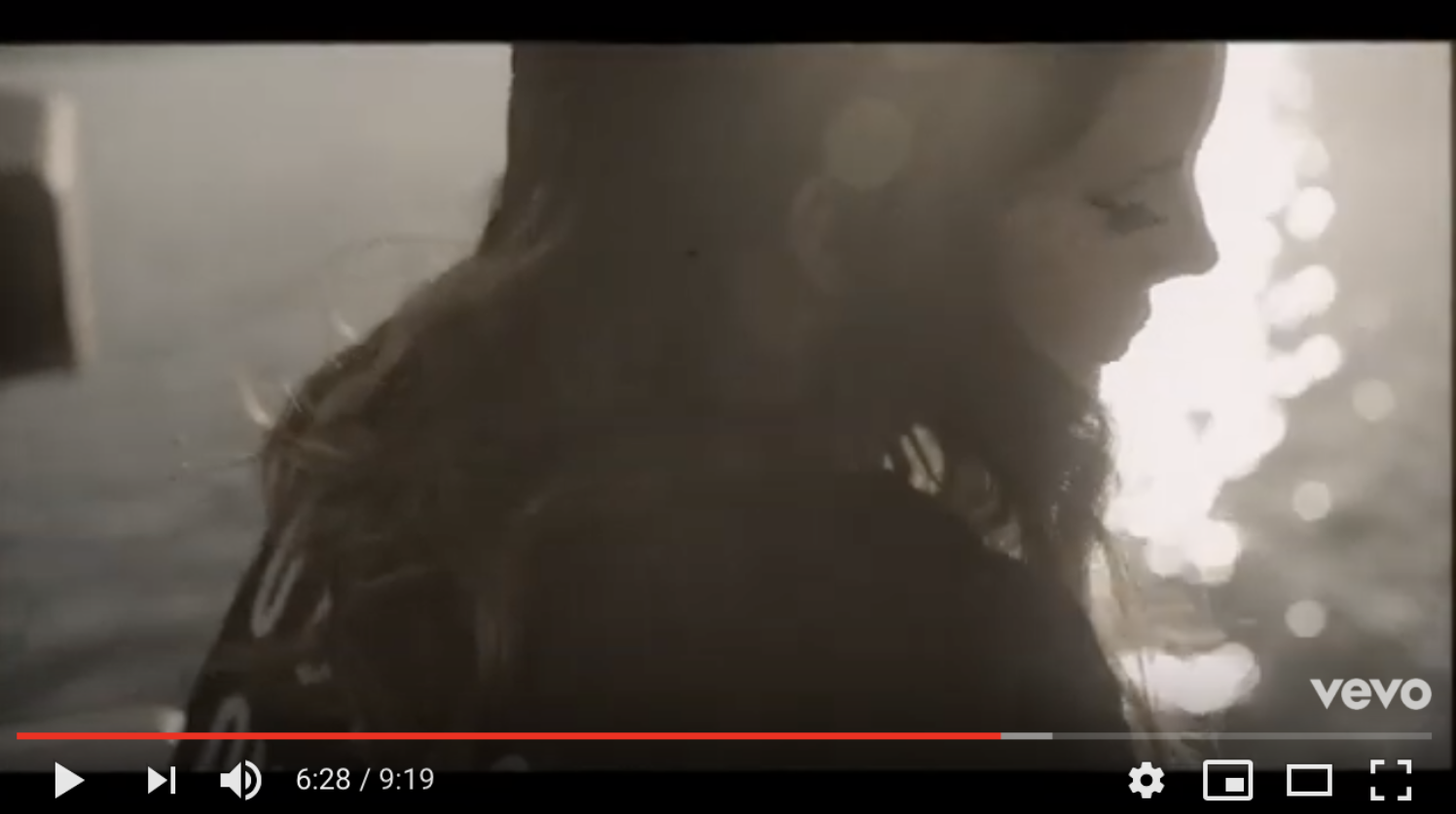
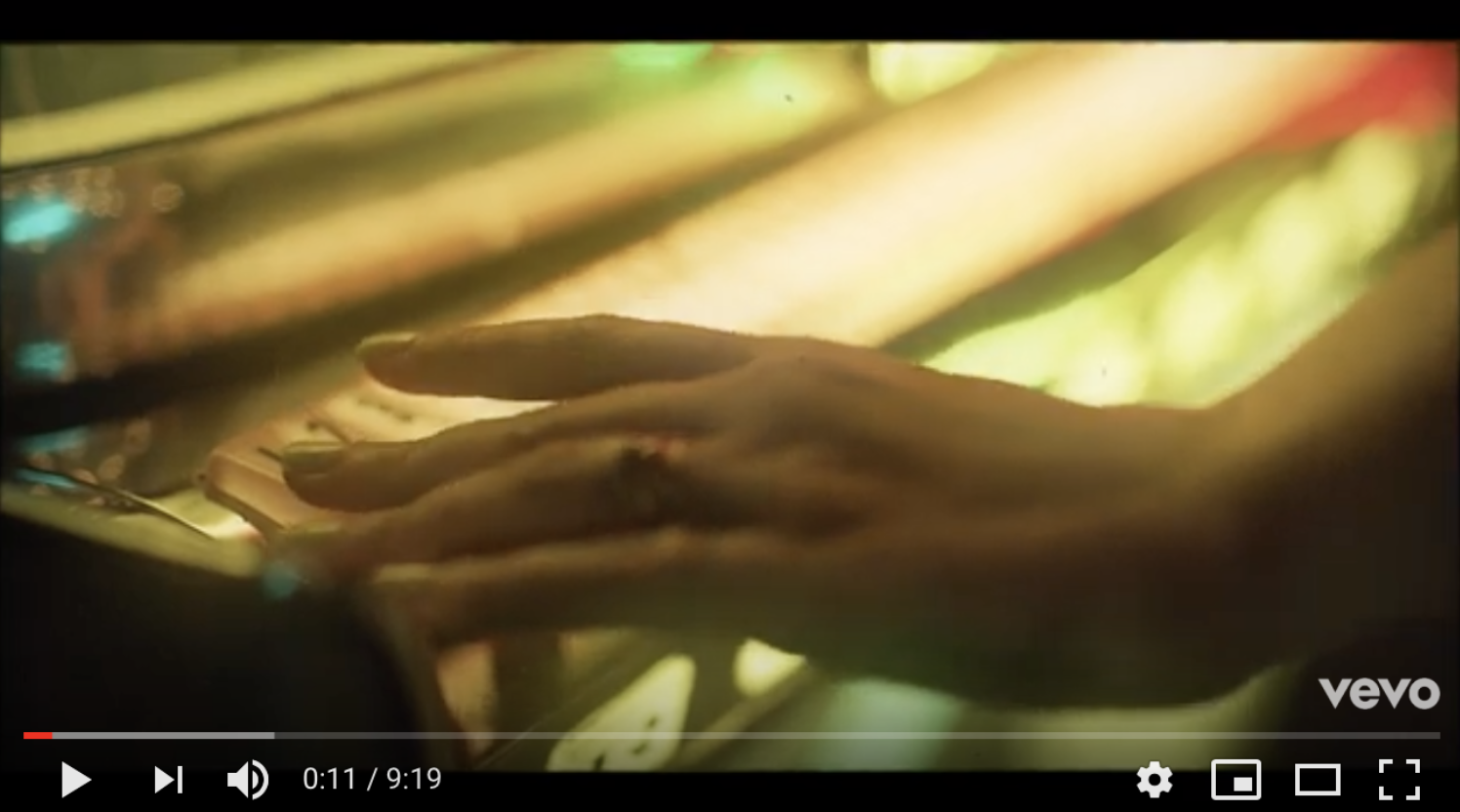
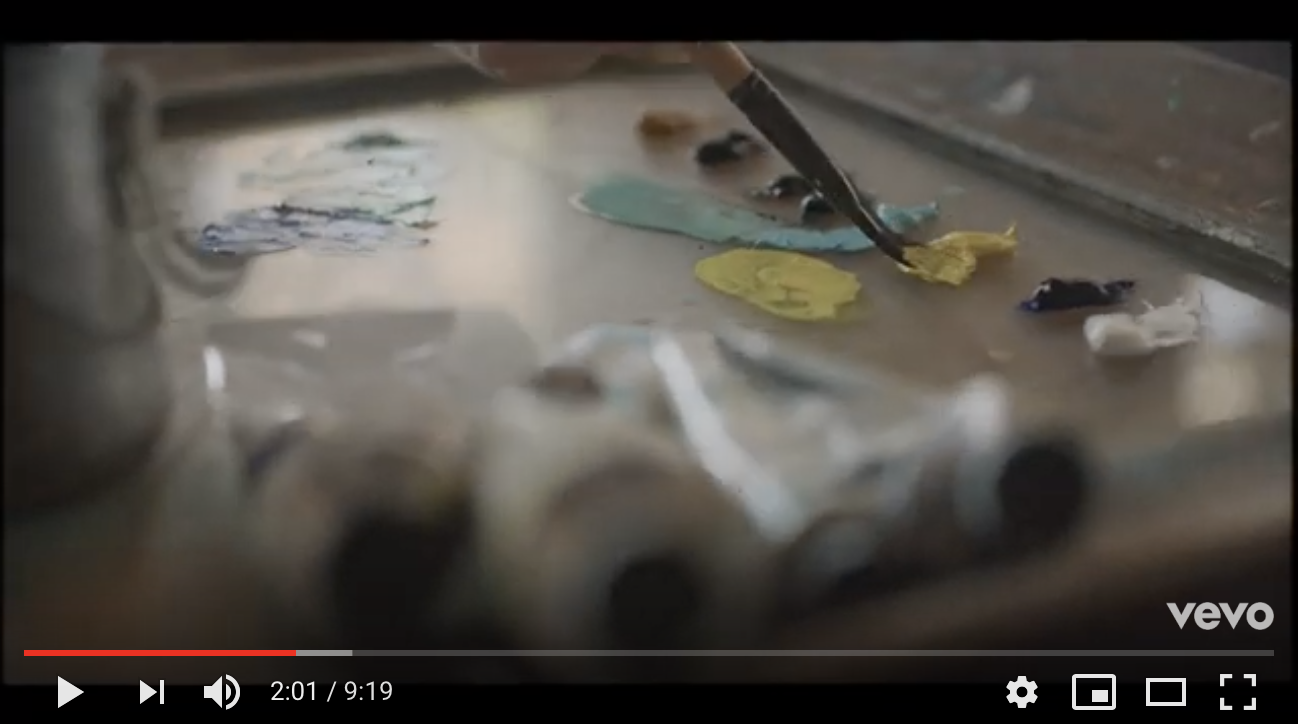
‘Fuck it I love you’ is soaked in lights, but they’re fading. ‘I like to see everything in neon’, is the line that opens the song. To see everything in neon is to fluoresce what is haunted and gone. I think of Sia dragging rainbow dust down her tearful cheeks in the video for ‘The Greatest’ — tragedy’s shimmer as fugitive mark on the body. Lana offers herself up as sugar dust, cliché in honour of Doris Day: ‘Dream a little dream of me / Make me into something sweet’; she acknowledges ‘dancing to a pop song’, but it’s not clear if this is her or the character or the one she loves. ‘Turn the radio on’ could be a reflection or an imperative. The reader is hailed between these positions of love and the loved and the effect is saturating, warm, delirious. Separation is that ‘it’, the spacing. In the video, we watch Lana painting and then suddenly she’s surfing with the aurora borealis in the background. She’s on a swing, her jean shorts caressed by the camera, she’s the sexualised pop icon again. She’s on a surfboard, green-screened, young. She’s choosing a shade of yellow from the palette, singing ‘Killing me slowly’. What is this ‘it’, killing her slowly: 

I’ll return to the unknown part of myself and when I am born shall speak of “he” or “she.” For now, what sustains me is the “that” that is an “it.” To create a being out of oneself is very serious. I am creating myself. And walking in complete darkness in search of ourselves is what we do. It hurts. […] a thing is born that is. Is itself. It is hard as a dry stone. But the core is soft and alive, perishable, perilous it. Life of elementary matter.

(Lispector 2014: 39)

I want slyly to argue that this is a kind of anthropocene existentialism. Recognition of the self as this ‘hard’, ‘dry stone’ thing of geologic mattering, reflexive species. This is what it is to be ‘Human’ right now. And yet the agential spark within, the ‘core’ that is being alive in a world where we have deposited those sedimentary layers. Creating ourselves in the stone, often with the tarnish of the very products we chose and developed to beautify, excoriate and cleanse ourselves, to remain forever young. So there is this oscillating temporality at work between desired infinity and the trace of our fugitive place on earth. The very earth minerals that would ruin humanity, mine our bodies of endless labour. But to go back to the song, with its idea of a gradual dying. I want to call this something like anthropocene softcore: the unnamed presence of species being within Lispector’s slender novel from the early seventies, or the Mamas and the Papas brand of late-sixties ‘sunshine pop’ whose solarity derives from the perishability of that energy, utopian commons, cascade of flowers — that serotonin glow of selves in streams and streams. 

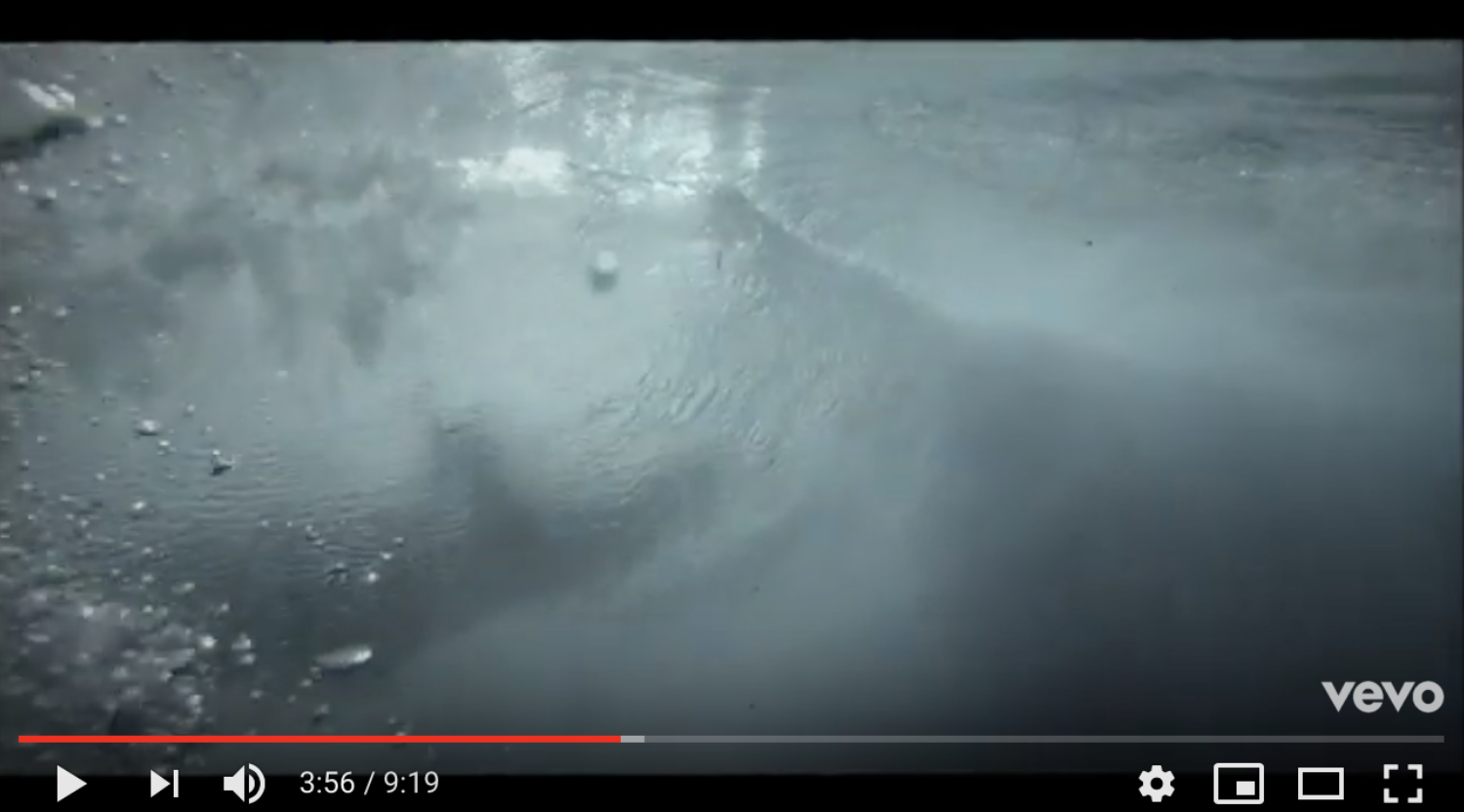
Lana’s anthropocene poetics are not of the hardline, direct call to action. You would not say of her cultural presence, eco-warrior or nature goddess. You would not brand her Miss Anthropocene in a kind of demonic marketing gimmick. You would say most often she is a siren, per se, leisurely supplicating us towards death on the rocks. Desirous flow. This is anthropocene softcore. This is what it is to challenge the act of self-description itself, and in doing so questioning those generalisations that arise from the ‘we’ of humankind, not to mention the ‘I’ of pop’s delectable, mainstream lyric. Alchemically, Clarice Lispector and Lana make of these malleable pronouns the ‘perilous it’. The it, the feeling, the speaking self which is nothing much more than a bundle of affects, sensations, atoms. To be cast over and crested by the wave. Significant that ‘Fuck it I love you’ ends with the rising bubbles of this wave, the one that spills us through the fourth wall and into the studio. This song slams together pop’s saccharine mythos of California as dreamland, a late-summer song as the former was written, surely, for autumn. California: ‘it’s just a state of mind’. She could be talking about the self or the state, or the state of the self. 
Screenshot 2019-09-09 at 20.44.25.png

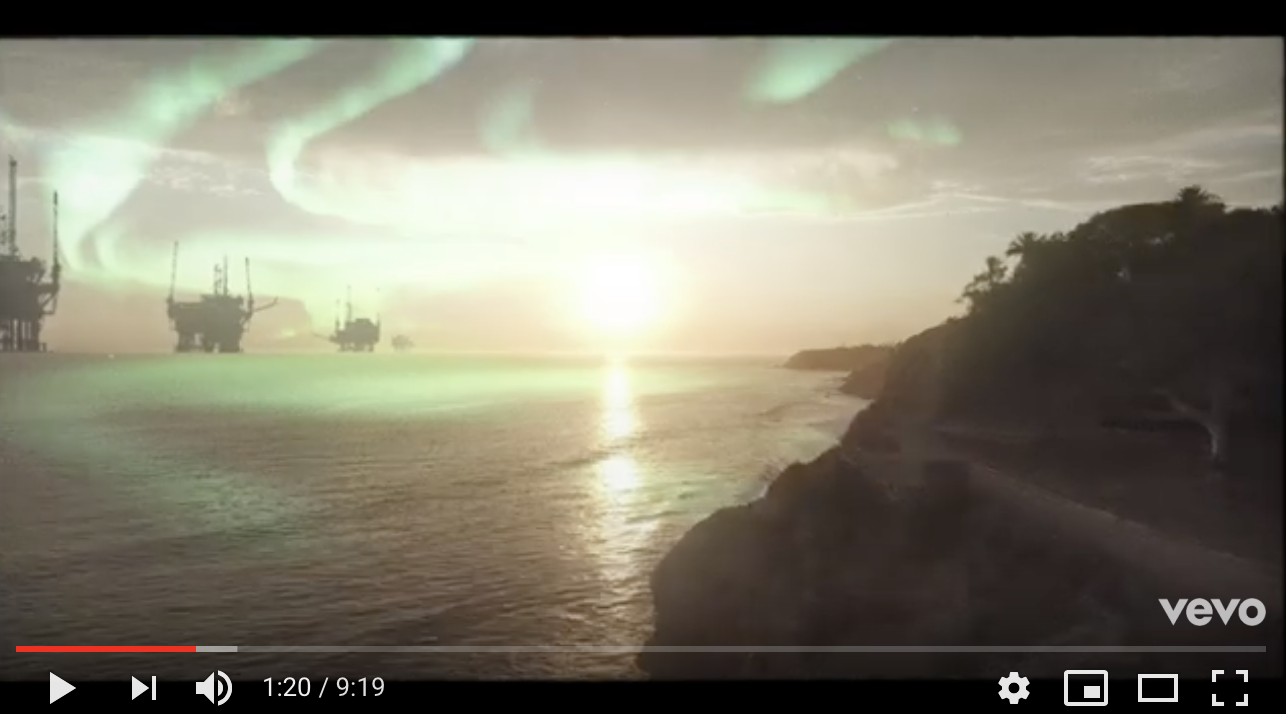
What happens next? The shot drifts over the cliffs, the coast, to a strip of palms and a distant view of the LA skyline. That shining love in the previous track is replaced by a minor key, a glimpse of the jukebox whose songs include The Eagles, Bon Iver, The National. Artists whose Americana is the melancholy of generations moved from political despair to something like the glitch of the times as a basic fact of intimacy. One of the Bon Iver songs shown in the video is ‘22 (OVER S∞∞N)’, and if that title was not rife with implicit apocalypse, what is, what is. A stammering into language, pitch-shifting the fragile space of utterance. There’s a spiritual glimpse to the sky and the infinite quality of the stars: 

There I find you marked in constellation (two, two)
There isn’t ceiling in our garden
And then I draw an ear on you
So I can speak into the silence
It might be over soon (two, do, two, do, two)

(Bon Iver, ‘22 (OVER S∞∞N)’)

I don’t know what the maths is doing. I don’t want to know that the song ‘was inspired in part by Bon Iver mainman Justin Vernon’s unsuccessful attempt to find himself during a vacation’. I am however interested in the hubris within this term ‘vacation’ at all. Do we now live in a world where you can take ‘time out’? There is nothing of the world we know that could be switched off. There is no ‘away’ of complete erasure or original presence. Deconstruction caught up with our living. Vernon describing this song as a gesture towards what might end of his emptiness could just as easily be flipped: its relief is equal to a mortal sense of loss. The impending erasures. It ‘does’ or acts the accretional event of extinction that is speaking into the silence, to those who could not speak back. 

Fragments and snatches: the neon green lining Lana’s eyes, the aurora borealis, the neon green palm in the club where she sings alone. A season by yourself. The love of the couple together surfing is cardboard, Hollywood. It is a trembling symbol. It is almost ridicule.
Screenshot 2019-09-08 at 10.27.46.png

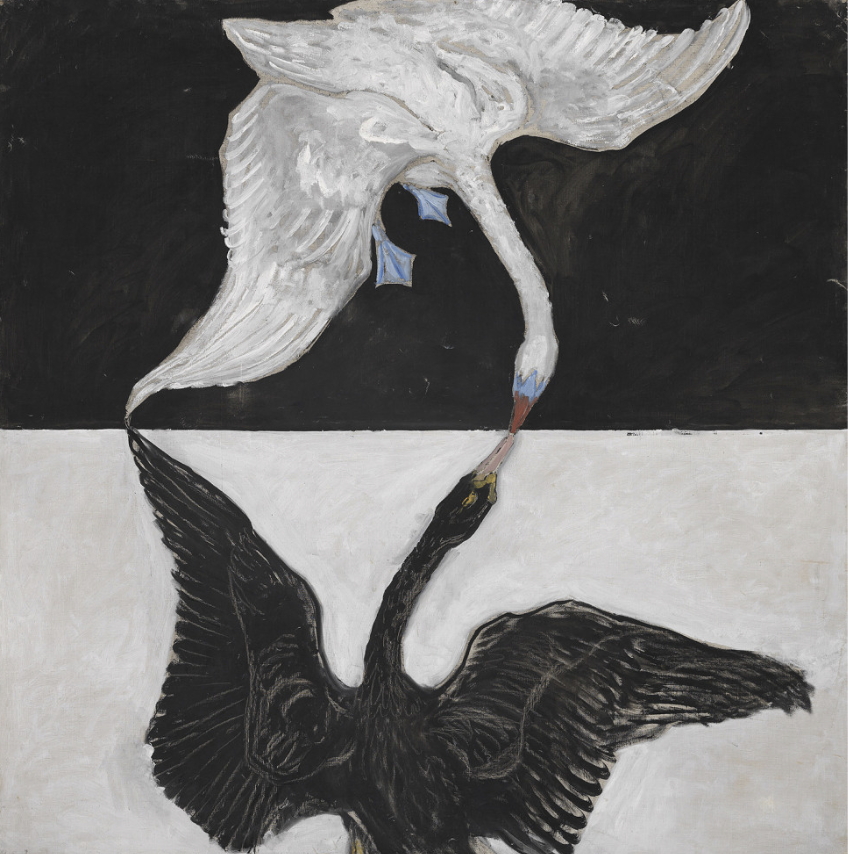
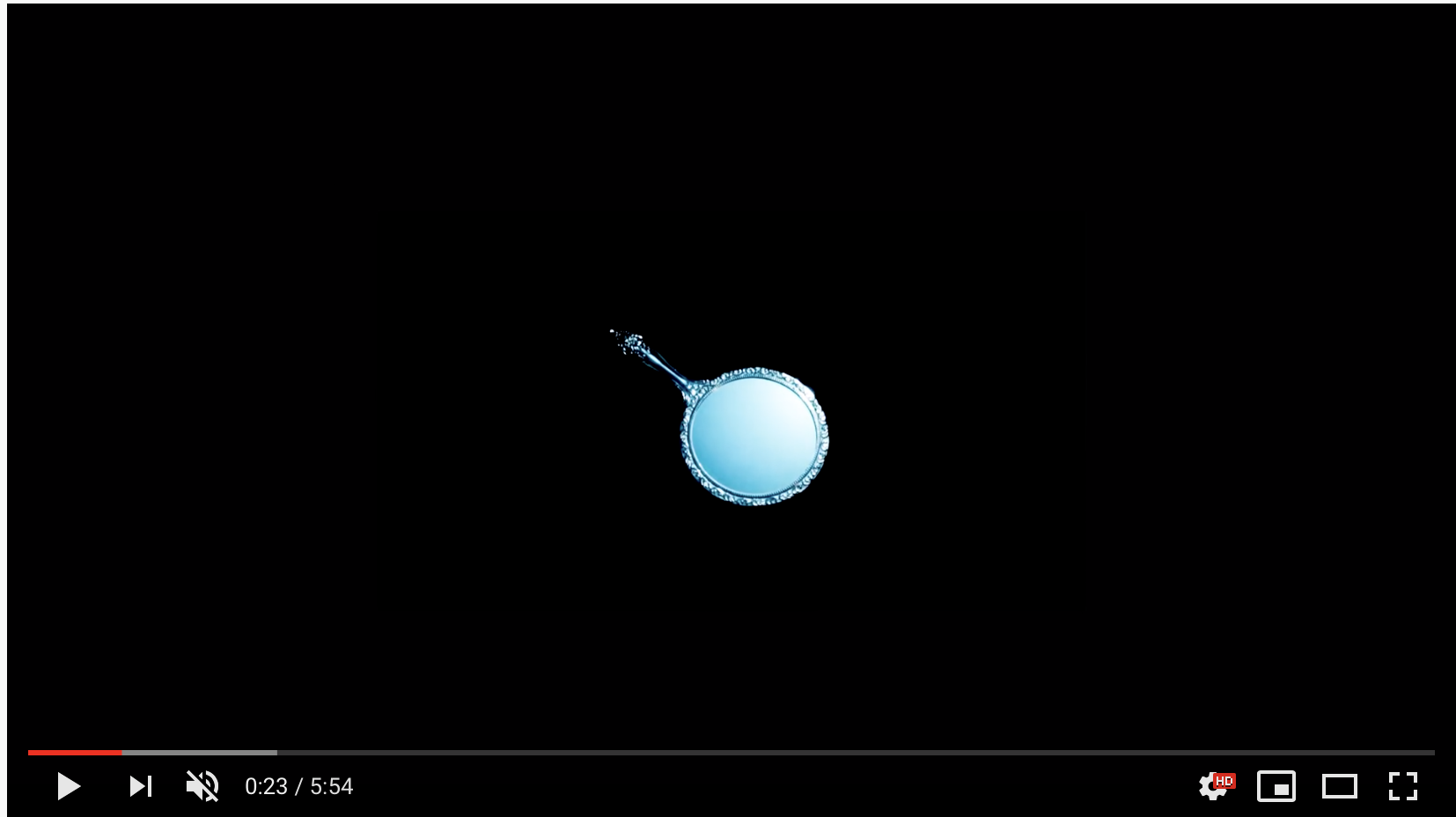
What is Justin Vernon looking for in the constellation? When he sings ‘two two’ I think of Hilma af Klint’s nose-touching swans, or the hours of the day chipped at the edge — two of them stolen by tragic event. I think of a mic check, two, two, ch, ch. Click. Near-enough-presence of speech. A white swan on black background; a black swan on white background. Flip. The swans are geometry, signets of signature, they move towards abstraction. Growth. I love them. Fuck it I love them. The way they are just it. Inversions of colour and a monochrome mood splashed with cornflower blue, the tiny excess we can treasure. It is the cornflower blue, the little webbed feet, which make the swan in question unique. So we can care for it, figuratively as it swells through grey-white waters of memory. The swans we have lost in our shit. Royal iterations freed from belonging. This painting is from af Klint’s series Paintings for the Temple, works derived from spiritual communication. The abstraction of the swan / renders us stark in frame / for we were Lana or Leda / before we were animal. Sufjan Stevens’ ‘Seven Swans’: ‘All of the trees were in light’, ‘a sign in the sky’; ‘My father burned into coal’. And all of our sadness was carbon neutral before this. We plunge into whatever remains of the water, its plasticky thickness.

I keep pausing the video as it transitions. ‘Fuck it I love you’ twinned with ‘The greatest’. When The National sing It’s a terrible love and I’m walking with spiders, what exactly is the ‘quiet company’ of the ‘it’? It could just as well be spiders. Maybe it’s the web itself, the web between the human and the more than human, the gossamer moment where metaphoric articulation becomes more than feeling and gleams material. ‘It’s a terrible love that I’m walking with spiders’ — what is the grammatical transition done by that ‘that’ and who is to blame. Walking with spiders might just be that love. Transitional, subject/object logic is reversed in this song: ‘Wait til the past?’ is sung, then ‘It takes an ocean not to break’ when surely the ocean itself would break you. Soon the ‘terrible love’ is a substance, something ‘I’m walking in’ — to feel it is an act of immersion. It is to let that wave crest over, the ‘lyric auto-explosion’ (Moten 2017: 3) of the wave that would break you. 

In ‘The Greatest’, Cat Power sings of former ambition now cast to nostalgic regret. There is a sense of time slowing to delay, laconic strings, relaxed drums, the balladic sleep of a once-held fault. It is a parade slowing down in the rain. To say ‘Once I wanted to be’ is to hold this question of ‘the greatest’ as a generalised desire itself. The hunger we lose in time, whose primary colours soften. I hold to that precious, cornflower blue of a swan’s foot. ‘Two fists of solid rock / With brains that could explain / Any feeling’. This solid rock that would box you into the future, that would harden the edges of self. A thing is born, as Clarice puts it, ‘hard as as dry stone’. This is the thing born ‘that is’. To exist is to be this hard thing, protein ligament, to kick out in lines; but then in time there is the plasmatic self inside that, like some fatty animal byproduct, sticks to the others it loves, it needs, it leaks. Gelatinous, softly sticky love. The ‘it’ that needs saving. Anthropocene softcore; soapy inside of all geologic agency. Who we are and what we regret. The turning of the outside-in, the inside-out. Kathleen Jamie, in Sightlines, asks: ‘What is it that we’re just not seeing?’ (2012: 37). 

A sightline is a hypothetical line, from someone’s eye to what is seen. Is it clear or blurred, bad or good? Anthropos recedes in its very own scene as the ocean continues and we howl in the dark like a lossy-compressed version of species. We are the sirens and wolves. We are at the great concert of the Earth. We have to resist what Bernard Stiegler calls the ‘proletarianization of the senses’ (2017); we have to find longform ballads of what’s happening, pass them down the line, resist the short-circuiting of thought that occurs between screens and machines. We have to send letters back to our consciousness, our elders and children. This is the work of lyric. It could be the work of dance. I think of Zelda Fitzgerald’s protagonist, Alabama, learning to be a ballerina too late in her life: ‘Her body was so full of static from the constant whip of her work that she could get no clear communication with herself. She said to herself that human beings have no right to fail’ (2001: 180). Alabama barely eats; her energy is all the zeal of will. The dance of lyric as reduction, lack, as static and chased success whose collapse lands as Alabama will eventually do on the event of inevitable break. Grapefruit squeezed on the gritty turmeric shot of the future. And a brake, a screech. And yet we write, we cast out limbs and materials, we work towards this loss; we imbibe it. 

This is an ugly type of writing in which the outside is always imagined from the inside. Horizons are fictional and buildings are barred. I have no sightlines. I’m fucking cutting the corners of someone else’s desire. All paths are the continuation of a pre-existing line. This is a city from which I send myself postcards wherein I wish I was here. Flying letters. Words stolen from myself. I refuse to recognise that I have not composed them unintentionally

(Bolland 2019: 78).

The videos for Lana’s ‘Fuck it I love you’ and ‘The greatest’ swerve between inside and outside. We find ourselves in rooms we don’t remember entering. Writing the anthropocene has an ugly, masturbatory quality of fucking yourself with the rush of elaborate doom. Okay, so. Constructing fortresses of lines which would make a valiant destination. When I listen to Lana, I’m accessing shortcuts to ‘someone else’s desire’ which is the opening up of presence. ‘This is a city’; ‘I wish I was here’. I have never been to LA. We plagiarise our very own diaries to get back that sense of the once-intentional, the greatest declaration on Earth. That we were here, and we loved. She wrote that lit, forgot. The papers curled up and rolled away in a sultry air that was summer, 2012. The year of failed apocalypse, the year Lana released her debut album, Born to Die. We saw her campaign of fashion smoking through plexiglass bus shelters. Remember all ‘horizons are fictional’: they tell a narrative, they bleed and tilt and set like ice. Towards them we stupidly drift: the lived throb of our softcore skins, our hungers and rhythms.
Screenshot 2019-09-09 at 20.44.50.png

Drifting in colour like H.D.’s Leda, the rape of the land and the body and bodies engendering bodies. Worlds ending around us. And so I could say, but this is just one song, a phrase, a white woman of fame lamenting her world. But this self-conscious cinematics is a gesture towards the western world itself as this haunted, tragic protagonist: ‘The culture is lit and if this is it, I had a ball / I guess that I’m burned out after all’ (‘The greatest’). So you could say, anthropocene softcore speaks to the lyric I in its state of orphaned exception, which in turn is the loss felt by us all unequally. If we make of Lana a sort of anthropocenic siren, we must recognise the distinctions within our longing. For we all lose worlds differently; harm is striated along lines of class, gender, race, ethnicity, geographical distribution — of course. That wave that closes the video could elsewhere be a tsunami. I like to think its place on the edge is a deliberated hint to what could or is even already happening here or elsewhere. And maybe the colour, the aurora, is this streak of need for an excess beyond static blank, ‘human’ planet, standardised canvas; the need to splash something more of blur and blue. Flood the structure. 

When we say something is ‘lit’, we mean it is hot, on fire. We mean it is turned on, ignited, intoxicated, drunk, excellent. Lit is the past simple and past participle of light. Isn’t that line alone just lit? Maybe we are in the twilight of a former Enlightenment, recognising our species hubris as this alien green that tinges every familiar horizon, upsets the normalised green of pastoral. Is it toxicity, the elsewhere within ourselves? It is a radar showing who we are and where we have been. Those material metaphors cook on a smoulder, and this is the softcore coming to knowledge about what is happening.
Screenshot 2019-09-08 at 11.27.08.png

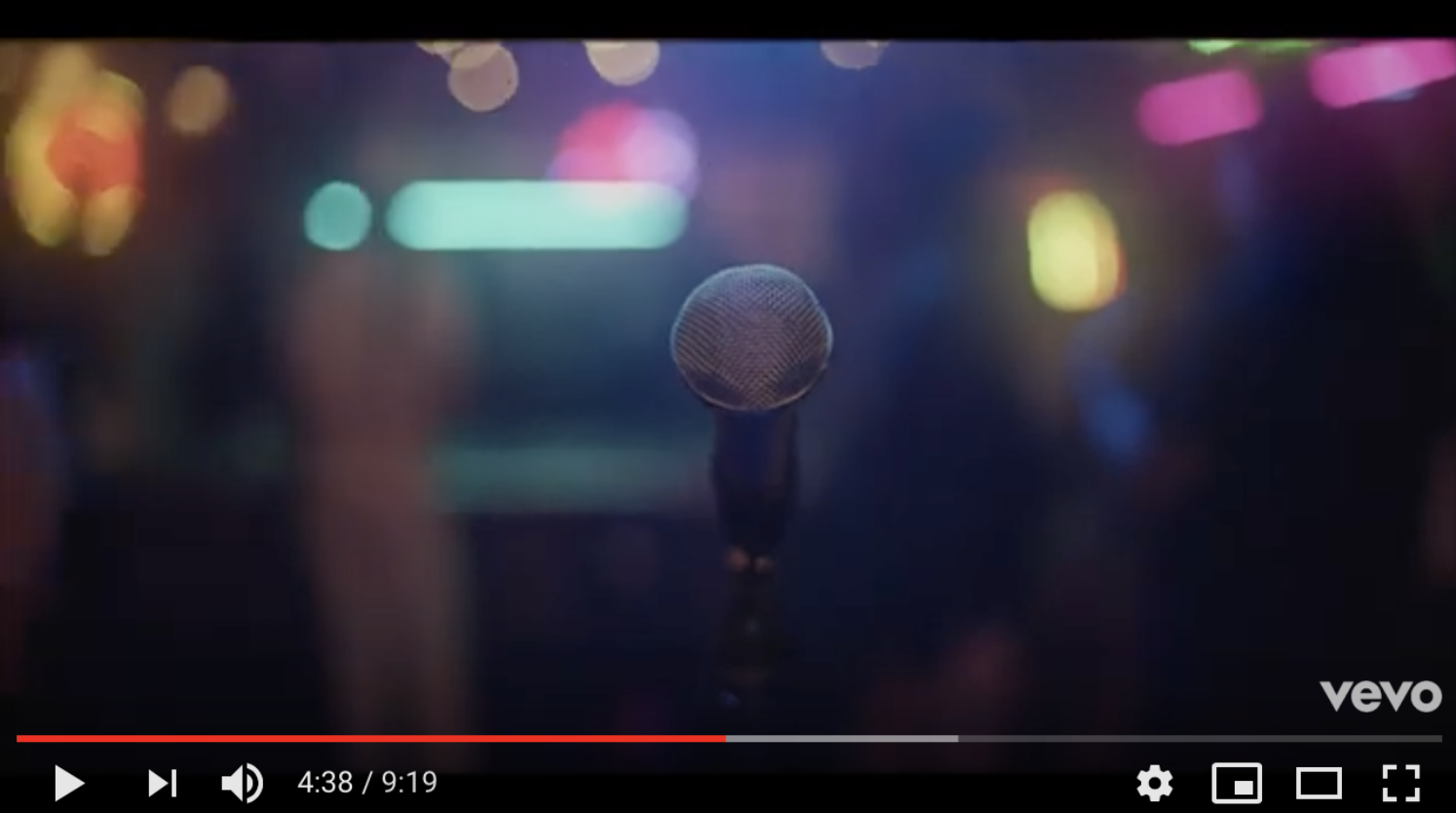
What does it mean to sing: ‘I’m facing the greatest / The greatest loss of them all’. To sing this on the brink of a hyperreal sunset, to chase a solar excess among loss. This loss could be a love but it is more like a culture; it is more like a voice and the condition from which to speak or sing it. The loss of lyric, its possibilities of address, and the loss or deferral or ruination of place itself. Maybe this is Lana’s lyric maturity, a generational acceptance that ‘young and beautiful’ is no longer the apex state of what we should strive for. Absence tenders complexity. Is this, as Roy Scranton puts it, Learning to Die in the Anthropocene? This question of mutability, the green-winged eye that sees a darkening world, a lack of birds along the bay, an edge. In the video for ‘The greatest’, Lana’s jacket reads LOCALS ONLY on the back. I google the phrase and find a hipster restaurant in Toronto with the slogan, LET’s PRETEND THIS NEVER HAPPENED. There’s a kind of parochial nihilism that glisters like the light on the sea, but the sea can never be local only. There’s a boat in the video whose name is WIPEOUT. It’s all happening; the signals are obvious. How we are practicing the absent-presence of the name’s erasure. My tongue gets twisted when I say anthropos; I want to say mess, I fall into ‘guest’ and ‘gesture’. With its glaring cinematics, LA offers the hospitality of light. But it is an exclusionary light. For now, only some of us get lit, get to the mic.
Screenshot 2019-09-09 at 20.46.01.png
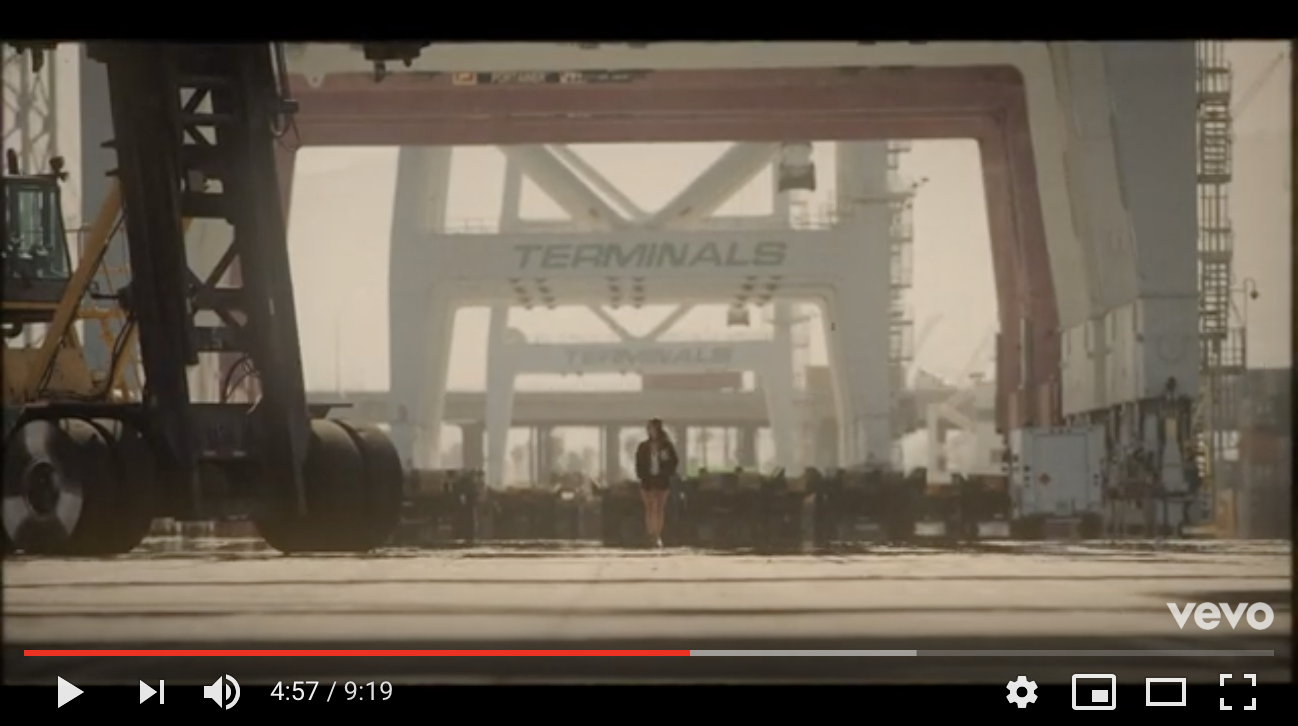
Lana sings from within the metallic architectures of LA’s coastal infrastructure, the port. In the bar, she throws a dart and misses her target by a nonchalant smidge, knocks the 8-ball towards its pocket. I keep thinking about exports and imports, what we put out, take in and trade. Economies of luck and depth and surface. Maybe Lana is a hydrofeminist, her soaring lyric gesture recalling a hauntology of America as that dreamscape of what lies beyond or in the deep. And now we know it is further extinction, precarity, hardened borders. What do we do with that looming closure? Lana has shrugged off her jacket now, she’s smoking in the kitchen where the lid slides off the pan to let the steam out. I’m not saying we’re sitting on a pressure cooker here. There’s simply work to do, mouths to feed, ears to fill. This is a ballad, a paean to the transient, fragile beauty of everything. The songs shown again on the jukebox are songs of a type of blues specific to oceanic or cosmic consciousness, to hunger, the time of lost summer or that of a broken love:

Janis Joplin — ‘Kozmic Blues’

Dennis Wilson — ‘Pacific Ocean Blue’

Sublime — ‘Doin’ Time’ 

David Bowie — ‘Ashes to Ashes’

Jeff Buckley — ‘Last Goodbye’

Leonard Cohen — ‘Chelsea Hotel #2’

I’ve spoken before of what ‘anthropocene sadcore’ might look like in poetry. I’m still working through that. It comes from the common phrase used to describe Lana’s music, ‘Hollywood sadcore’. I’m interested in how that emphasis on mediation, transmission and cinema plays out in our understanding of ecological emergency, but more generally the existential condition of the anthropocene, which places us as geologic agents under the generalised, gendered rubric of Man. Maybe Anna Tsing’s feminist work on the ‘patchy Anthropocene’ could be applied to the cut scenes of a glossy Los Angeles caught on video. A patch is also a software update, where comprised code is ‘patched’ into the code of an executable program. Maybe the patchy anthropocene involves this kind of cultural patchwork: the lament to a love or a culture is patched to include this bug of ecological consciousness — the patch is a kind of coded pharmakon, poison and cure for apocalypse blues. But Lana paints in shades of yellow too. Blue and yellow making aurora borealis green. A cosmic gesture to what lies beyond thought. And what of those oil rigs in the distance, glistening. They form an audience to the siren’s lament; they are part of this story, and we are mutually complicit. Where the magnetism of the male gaze is often part of Lana’s canon, here it is mostly replaced by oil rigs — supplementary Man as the infrastructure of anthropos, looking back at its melancholic, warning siren. Softcore is less affective than sadcore; it is the ambient hum of climax coming. Its cousin is the slowcore, luminous melancholia of a band like Red House Painters, perhaps: Purple nights and yellow days / Neon signs and silver lakes / LA took a part of me / LA gave this gift to me’. 
Screenshot 2019-09-09 at 20.43.42.png

In Bluets (2009), Maggie Nelson writes of a restaurant she used to work in, where the walls were ‘incredibly orange’. After each shift, collapsing exhausted in her own home, ‘the dining room’ of the restaurant ‘reappeared in my dreams as pale blue’:

For quite some time I thought this was luck, or wish fulfilment— naturally my dreams would convert everything to blue, because of my love for the colour. But now I realise that it was more likely the result of spending ten hours or more staring at saturated orange, blue’s spectral opposite. 

(Nelson 2009: 43)

Orange and blue, water and flame. The mind’s alchemical transformations reveal the way colour works chiastically upon us. I think of Freud’s mystic writing pad, the waxen surface of memories allowing for palimpsest versions of stories that trace and erase. ‘This is a simple story’, Nelson writes, ‘but it spooks me, insofar as it reminds me that the eye is simply a recorder, with or without our will. Perhaps the same could be said of the heart’ (2009: 43). ‘Fuck it I love you’, sung to the blue-orange wall until something comes off that surface like a static or fizz. Irn bru, ironed blue. There is quinine in my dreams of hungover labour. Surely there is a violence to this particular love, that is staring, necessary. The love of what must be limitless hurts.
Screenshot 2019-09-08 at 11.27.23.png

Janis Joplin’s ‘Kozmic Blues’ rises to a swell, a jostling of guitar licks and urgent, assured vocals. A sonic thickening. ‘So mastered by the brute blood of the air’, H.D. writes in ‘Leda and the Swan’. Held in that vascular shudder that acclimatises to a manmade world, what happens next is a loosening, a shimmer, a shrug of the garment. In the poem or song, in the painting or film, in the collapse of that wave into a bluer future. To incur a kind of erosion and yet live on in those terminals. ‘There’s a fire inside of everyone of us’, Joplin sings, and I think not of flames but of cinders. ‘At what temperature do words burst into flame?’, asks Ned Lukacher in the introduction to Derrida’s Cinders (1987), ‘Is language itself what remains of a burning? Is language the effect of an inner vibration, an effect of light and heat upon certain kinds of matter?’ (Lukacher 1987: 3). I know if I did not write I would smoke. These acts of temporality in its material extinguishing. What makes the remembered restaurant blue, not orange, is something of this transmogrified smoulder — an inversion akin to af Klint’s swans, demanding that splash of blue. When I write, am I pursuing the absent space of that skyward blue?Blue is the colour of the planet from the view above, Lana swoons in a song (‘Beautiful People Beautiful Problems’) from her previous album, Lust for Life (2017). But in Norman Fucking Rockwell, Lana’s California album for 2019, it’s less of this ‘above’ we see. We are held within the infrastructure, cinema, the end of summer. The dreamlike logic of How did she get on that boat? When did she enter that room? Who put that song on the jukebox, baby?

I want to say:

It takes an ocean not to break a planet.
It takes not a planet to break a species. 

Lana’s voice grows wispier as she sings of that burnout. There’s this imperative that okay we could enjoy this with American flags, we could pour communal Jack and go down in flames. We could riff the history of our culture in archives of song, gestures and nods of reference. Ladies of the Canyon, Cinnamon Girl, Norman Fucking Rockwell. We could keep laughing or dancing while the world is or was at war. Lana is both behind and at the bar, the sightline of where we go to be ‘served’. Intoxication is the order of the day and we call it ‘fun’ to put the fucking of other people’s desires under erasure, strikeout, as Bolland does.

If this is it, I’m signing off
Miss doing nothing, the most of all
Oh I just missed a fireball
L.A. is in flames, it’s getting hot
Kanye West is blond and gone
“Life on Mars” ain’t just a song
Oh, the lifestream’s almost on

(Lana Del Rey, ‘The greatest’)

Miss doing nothing’: post-recessional ennui becomes the paradoxical happiness of living in static, not working as a kind of work that resists the future as set out by capitalist horizons of accumulation. We used to just ‘hang out’ and several other dreams of youthful nostalgia. Kids of today can’t even touch that innocence. We know so much; maybe or probably they know more. We are all variously entranced by the softcore unfold of this happening; we are all variously called upon to be complicit, to recycle, act, resist. To speak or not-speak. To be in one of many different levels of rising heat. The conditional state of being’s value, ‘If this is it’, in the anthropocene raises its pitch to a charge. To sign off is a form of surrender that gives up the name for the blur of species. I think of Lars von Trier’s Melancholia, the planet that would smash us and yet somehow Lana dodges it, that

The audience in the bar where she sings are mostly men, but their gaze is not sexual, as in much of Lana’s prior visual oeuvre. Rather, their longing gaze, often filtered through further glass, is something like the profound melancholy of a multi-generational sense of this loss. These old men have lost the planet, the one they grew up with, just like Lana’s siren, come from some other time, a life ahead of her steered by the changing climate, the hurt and vengeful seas. The camera holds close ups on their staring faces. The song holds the long durée of a loss that spans generations, damages and is damaged by elders, sparks in the present-tense of cultural tendency. In Lana these men look to a future hurt whose cause was partly theirs, as inheritors of industry: she is both victim and heroine, singing and swinging. The shot opens out to reveal her smiling with younger friends, her own generation. These intimacies are what we have left. The next shot shows some kind of factory or refinery leaking smog into a cloudy, overcast skyline, sulphured yellow. Once again the boat appears with its title, WIPEOUT. Lana is supine on the bow at sunset. She is golden, angelic, silhouette. It’s like she missed the fireball but melted it, cooked it up for tea, apocalypse syrup. Things are going down around us. She hugs her arms, later standing, laughing with a dreamlike intimation of imagined elsewhere, closing her eyes. Be hospitable to yourself and others. The reel of the jukebox keeps ever turning: this is our ever faith in culture. We have to take care of what’s left in whatever space we can make of song, duration. 

But the mainstream disciples and idols of Hollywood are failing, Kanye West is ‘gone’. Surely a reference to Elon Musk’s plans to save us by colonising Mars, ‘“Life on Mars” ain’t just a song’ is sung with a melancholy matter-of-factness, a kind of sigh which implies the banality of techno-utopia in a time of extinction. The thrill of such dreams is lost now. We lost our faith in Hollywood, lost our faith in the movies and the scale of those solutions. In a world without books, we’d be ‘bound to that summer’, addicted to one of many narcissistic ‘counterfeit[s]’ to make love to nightly in futile repetition — that would be, as Weyes Blood sings, the ‘Movies’. 
Screenshot 2019-09-08 at 16.56.01.png

What we look back with: 

The trauma is not, in the Freudian lexicon, this or that violation from the world (such as war), but the ill and trauma of this originary installation of “the cave”—what could properly be called the cin-anthropocene epoch, particularly given that the era of modern cinema is to be regarded merely as an episode: that of the machinal exteriorization of the cinematic apparatus, given that it coincides with the era of oil (artefacted “light”), given that its arc coincides with that hyperconsumptive acceleration leading to mass extinction events, ecocide, and an emerging politics of (managed) extinction

(Cohen 2017: 246)

The trauma of greatness as such is this accelerated promise of the dream, the event, capitalist growth, the movie itself — whose imperative is towards scene, closure, episodic narrative in demand of the next. But the drinks in this video are barely drunk; they are more like props. Everyone is aware of their place in the tableau vivant of the anthropocene, even in its softcore, consumerist pop expression: the iconography of oil rigs, downbeat affect and intergenerational longing. Not a violation from the world so much as the stream, and where its accumulative logic would eventually come to crisis, even as corporations beyond our imagining were already plotting that logic of a break within archival excess: the feverish incineration of the present, the smoulder and melt that smogs and spreads and streams. 

Fire is there or it is not there. […] But surely there is a word for that moment when a fire log, beneath its bark, has become one immanent ember, winking like a City or a circuit board; for that moment when you know only the desire, no, the need to stir it up. What is on fire, you ask yourself, staring into that waiting. What is that moment. What is that word. 

(Lennon 2003: 434)

The nights ‘on fire’ that Lana sings of are those of the Beach Boys, reprieve of the sixties; the bar on Long Beach that served as a ‘last stop’ before the tiny island retreat of Kokomo. Frank O’Hara died on Fire Island. Fire is presence or absence, but there is a moment before it is both. A slippage between the extinct and extinguished. And the world was lit up as before. I wonder if the word Brian Lennon looks for is simply ‘sleep’, the title of his essay which I first read in John D’Agata’s anthology, The Next American Essay — with intimations of that Lana song, ‘The Next Best American Record’. What is with America and the positioning of the next. A constant state of pressurised imminence that streams and streams: ‘We lost track of space / We lost track of time’ (‘The Next Best American Record’). We sleep into death or spirit. My first legal drink was a fireball whisky, in a pub by the sea they built in a church. That moment when you know only the ‘need to stir it up’, fanning the flames. That impulse towards blitz feels extra political in these contexts. We need something of relief that would stream, and in that flow be more than a question. Something of cinders, drifting. 

In Lana’s song, I’m interested in this word ‘lifestream’, which seems like a slippage from the more familiar internet-lingo, the ‘livestream’: the coming live that seems provisional to digital retro-future, the promise of satellites beaming the present, simultaneously. Lifestream, instead, is a vascular imaginary of bodies flowing together. ‘LifeStream’ is actually the name of a blood bank serving the Inland Empire and its surrounding areas. Lifestreaming is, Wikipedia tells me, ‘the act of documenting and sharing aspects of one’s daily social experiences online’. It is the flow of the timeline, akin to the wall, the blogroll, the feed. But here, at the end of the song, the promise of information’s overflow is in a liminal state — ‘almost on’. Extinction’s monetised data cast as the simultaneity of thick presence spread by millioning participants. We are here and we said something, our words were atoms, splashes of blue. We stream towards a life, cut ourselves short on the fragments of others’ desires. Mortality’s softcore contingent. The fear of missing out is assuaged by the narcotising work of cinema. And if this is it, Lana has already signed off. It’s something more like her spirit that’s here for us, the stream of an echo, fold of a song that we could replay, continue voicing. Hope lies in the circadian rhythm, the lived time of a pause in the anthropocene’s ceaseless, cinematic duration — that which we see and drown our hearts in. As Jean Rhys’ drunken, depressed protagonist of Good Morning, Midnight (1939 – the year WWII began) muses, ‘Well, sometimes it’s a fine day, isn’t it? Sometimes the skies are blue. Sometimes the air is light, easy to breathe. And there is always tomorrow….’ (Rhys 2000: 121). And what if tomorrow was the greatest loss of them all? 

~
Screenshot 2019-09-08 at 11.56.26.png

All screen grabs taken from here (Director: Rich Lee) and here (Director: Natalie Mering). 

~

Works Cited: 

Bolland, Emma, 2019. Over, In, and Under (Manchester: Dostoyevsky Wannabe). 

Cohen, Tom, 2017. ‘Arche-Cinema and the Politics of Extinction’, boundary 2, Vol. 44, No. 1, pp. 239-265.

Fitzgerald, Zelda, 2001. Save Me the Waltz (London: Vintage). 

Jamie, Kathleen, 2012. Sightlines (London: Sort of Books). 

Lennon, Brian, 2003. ‘Sleep’, The Next American Essay, ed. by John D’Agata, (Minneapolis: Gray Wolf Press), pp. 427-234.

Lispector, Clarice, 2014. Agua Viva (London: Penguin). 

Lukacher, Ned, 1987. ‘Introduction: Mourning Becomes Telepathy’, Cinders, trans. by Ned Lukacher, (Lincoln: University of Nebraska Press), pp. 1-18. 

Moten, Fred, 2017. Black and Blur (consent not to be a single being) (Durham: Duke University Press). 

Nelson, Maggie, 2009. Bluets (Seattle: Wave Books). 

Rhys, Jean, 2000. Good Morning, Midnight (London: Penguin). 

Riley, Denise, 2000. The Words of Selves: Identification: Solidarity, Irony (Stanford: Stanford University Press). 

Scranton, Roy, 2015. Learning to Die in the Anthropocene: Reflections on the End of a Civilisation (San Francisco: City Lights Books).

Stiegler, Bernard, 2017. ‘The Proletarianization of Sensibility’, boundary 2, Vol. 44, No,. 1, pp. 5-18. 
 

Eleven / Cherry / Extinction

Screenshot 2019-04-08 at 14.31.06.png

On the 11th of June, 1993, I was born with an extra digit, an eleventh finger. I am told it was a finger, so goes my parents’ mythology, but probably there is some anatomical word which better explains the strange appendage attached to my left pinkie. Resembling a kind of lollipop, a glass candy, my eleventh finger was a long thin vessel of muscle or blood (what I cannot know or ask of that fact) attached to a kind of crimson orb, like a cherry. It wasn’t really a finger at all, but the unfinished potential of what might’ve been one, a mutation. This was accompanied by a strawberry-shaped birthmark on my inner left wrist which, my dad assured me, would fade as I grew older. The cherry finger was lopped off on the day of my birth, and the blood splattered the doctor’s coat, bright red upon starch white. Soon after, I nearly died. A lightning storm raged through the morning. I was placed in an incubator, I had some kind of viral infection. They furnished me with the supplementary khora, until I grew blonde and better. So the story goes, and already I have probably messed up the order.

But I want to say something of the number eleven. Eleven feels like a residue, an extra. The loss of this finger, which I do not write with and yet slyly it makes itself present as absence, constitutes a kind of originary erasure. Years pass in which I forget this secret was mine at all. Eleven, perhaps, is a statement of entropy, a chaos spilling over our familiar limits and even regressing or falling in loops. However we parcel our intake/outtake, our sense of personal energy. I test out images of eleven, of extra. In Tom McCarthy’s novel Remainder, the protagonist wants to claim his free coffee, the remainder, so badly that he buys ten cappuccinos just to get the loyalty card stamped, just to claim the free one, the eleventh beyond the card. A strange caffeination that remains incomplete, to come. Then there’s Eleven from Stranger Things as a kind of genetic extra; the number identifies her as a test subject. The number becomes name. That phrase, turn it up to eleven, when really the system stops at ten. Why is it we make wishes on 11:11, when did I start doing that? The wish constituted itself as extra. Over time, I find myself ‘catching’ this time more and more, glancing at the clock of my laptop when it just happens to be 11:11. And the wishes pile up at the forefront of thought, they take a while to resume as memory. When I am sad, I visit the Kelvingrove fountain. There is water and clarity, the hum of other people’s wishes. Sometimes this is better than poetry, it’s simply potential.  
Screenshot 2019-04-08 at 14.32.05

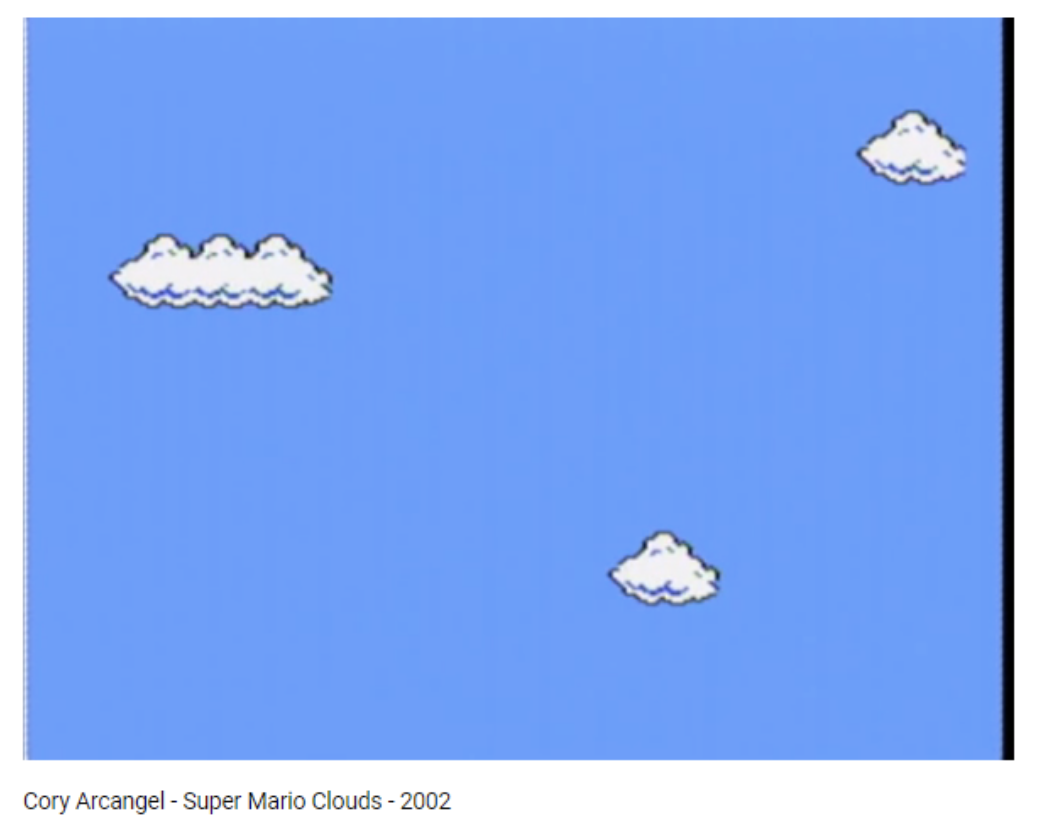
I knew someone who named themselves after the sky in Super Mario (with Ayrshire inflection) long before either of us had even heard of Cory Arcangel. We were born on the exact same day, same year, and we called ourselves twins. It took eleven years of our lives to find each other. Speaking to this person, I felt always this chiasmus of consciousnesses, a sense of keeping up, or ongoingness.[1] They were super beautiful with luminous curls and sports jackets. Their nights were spent up with consoles and synthesisers, and we messaged each other until our windows crashed, or our parents needed to use the phone. I will not quash the romance of the dialup connection, for it was real, the frisson of interruption. The sense of a moving into, the attunement that performed itself in the temporal interlude of a radio whistle, blow of white noise that had its sonic continuum, warping and twisting as though all these howls in the wires were coming to life, and we would sing through the modem our deepest thoughts. You would teach me a riff. We were each messaging the others at once. There would come a point where everything was just text in the end, the fragile reminder of each bodily fragility.

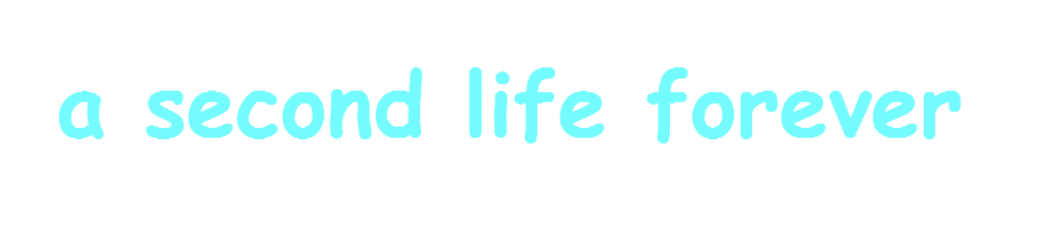
You wrote in cyan-coloured Comic Sans, before this was ironical.
Screenshot 2019-04-08 at 14.33.15.png

Half of my brain wants a masculine state; the other half a quiet, feminine comedown. What is it to speak or sleep gender. I’d sip cider in the wee hours after the party, but nothing fragmentary said then was as good as it was on the computer. It was like coming to life, discovering what had not yet been told of a love or a taste. I suddenly felt affectionate towards everything, and the aesthetics of a particular website, the trajectory of a song, could startle me into tears. Everything grew fizzy and sugary; it was all too much. What we were supposed to say to each other. I was learning to apply eyeliner, clip bras and shed weight like a grownup. The environment was a diagram we drew at school, a set of names we recited while dipping for critters in rockpools, freezing our brains on polluted beaches. A joke that was told to the air before we could return to our games.


***


I never learned the word for what happened at my birth, what grew on me, this residue fruit. After a while, it broke away, the fact of it which was a specialness. I was losing that specialness the more I learned language. There was a solvent process of being okay with a long red line that meant mine or anybody else’s ‘I’. (/) A length of energy, a vessel snipped close to the richness. We invent names for ourselves on the internet.

Something constant was the minor chord shard in my heart, when I knew there was a thing awry. I could not put my finger on it, much as I could not remember what I wanted to do with my life, or what passion that had driven me to write as a child. For I had filled documents and jotters with my rambles before. What happened, if you can forgive me for inserting a narrative turn here, was a loss of story. Post-puberty, it seemed there could be no climax in my life. Events I had expected to effect a shock into existence had not occurred so; a long hard drag had occurred instead, slow enough to trick you into passive submission. Resistance became a case of daily withdrawal, decay. It seemed there was nothing to write into, now I understood the mysteries of sex, reproduction, death. I had written these epic fates about unwanted births, woman impregnated against their will in labs buried deep in violet mountains. I had a horror of the body inside the body, which was the same as the body inside the planet or the planet inside you. What grows, regardless.

There was a fragile voice I was waiting to hear on the radio. I had not yet worked out the temporal trick that was poetry, the way it could stop you on the blot of a page, by fact of its shape. What grew charged or tangled. I became interested in the way the body was just a body, something to be seen, something to offer up to bodies beyond you. I wanted to know its limits, its multiplicities, as much as its points of attunement. Like plugging in headphones to the library PC just so I can hear the electrical charge of each scroll as a sonic intensity. There was a time of mark-making, rigging lighters, taking steaming baths. Staring at other people’s ceilings. I practiced lying on concrete, feeling the dark cold of summer’s inversion travel up from my spine. I listened to music so loud that stars began splintering inside my ears, and so I would have tinnitus forever more. I burned my tongue on a minor chord.

And so the same sound would scream back, muted lagoon trapped in my ear a decade later, the splitting sextillion stars of that music. The melody itself was irrelevant. I was drawn to songs where you could fall between verse and chorus, and the space of that slack guitar was far more important, the way a man’s voice could break on a word. For some reason, then, it was always men.

What does it mean to be taught how to feel by the opposite sex? Things tilted and sweetened the weaker I grew. We held hands in west coast impressions of sunset. The word for weather was like whether to say I’m going offline. The fort-da pull of your endless sign-ins. r u okay?

Jean-Luc Nancy: ‘A corpus is not a discourse, and it is not a narrative. A corpus is what is needed [qu’il faudrait] here, then. Here—there is something like a promise that this has to deal with the body, that is going to deal with it—there, almost without waiting […] there is a sort of promise tacitly to hush’.

Thus the body is clearer in machinic absence. Thus this vast proliferation of forgettable text was the logic we gorged on, empty calorific haribo words. There was no vegetarian alternative, we were eating each other. I mean the sway of exchange, this sense to be dealt with. A hunger, sugar rush. I message you later. The pressure of reply, now we’re always online; transmission as love’s endless labour. Isn’t it exquisite just to hush, to disappear mid-conversation and relish the ellipsis for a future hour. In these small ways I was building a tentative next, but its openness was yet clouded by thought itself. I couldn’t think beyond three minutes, and that was depression.


***


I learned the deformity of my birth was a sign of witchcraft. I bought a bright pink book on the subject when I was very young, and tried to astral travel. I wanted to see things from above, but instead I found myself suffocated by their closeness. Children can smell sorrow, the weight of it dripping from adult expression; the way dogs pick up the mood of the house and embody it through quivering and whimpering. I burned incense and imagined an orb of lilac light spreading over my body, which became the mountain I buried my heroines in as a child writer, an amateur at fantasy. I slept with crystals under my pillow (I still do).

The wrongness of the world was everywhere. The way people spoke to each other. I could not connect. I leapt into situations where voices were just echoes back into the water they came from, where sentences shored up nothing more than the vice of their speaker. I began a long affair with silence. I stopped writing, and later I stopped speaking. For weeks at a time, I would lose my voice. It broke on the shore. I smoked little menthols in wind tunnels, listening to reality talk shit back to me. I was broken inside before I began; that was the feeling. Long walks could not smoulder it off, and the only calm I achieved was from the absolute lack of understanding I experienced in math. Not knowing was a clarity, one I still crave in the space of writing. The absolute sentence as a violence that closes all others.

Later, much later, I would discover this glitch was a crisis far beyond me, a crisis of climate, a crisis of world itself: so huge my child’s mind could hardly have discovered it. And yet, having said that, I was already halfway there. Halfway towards ecocide. As a child, I swore to my mother I would leave the planet on my fifteenth birthday. She almost believed me. Mars beckoned, with its fiery red swirls and its secret knowledge of an evil beyond. I liked the way the name felt ‘full’ in my mouth. When nothing happened, I drank myself into amnesia; I stopped eating. It was a birthday gift to myself, the hope that I might still disappear.

Hungover, I know there will be a point where I go and that is to die. The blank is like a name you forget at the point of recall. It is so much worse than that, as if we’d forgotten our own name and the name of our mothers and the E____ itself. And what it means to see the back of the tapestry and a trypophobic horror where every unloosened stitch, a tiny blank, is the signal of multiple (un)ending worlds. Consider the strawberry seen from inside, with its millioning glowing yellow seeds of light. My wrists replaced originary marks with marks.

There was so much to learn about what was happening. I needed to know what would be okay. It was just this whole impossibility of thinking the future. The word ‘career’ was hilarious. It made me think of falling through time, Scrabble letters tossed into void at light speed. That was the language I wanted, letters at light speed.


***


Silver foil, the metallic smell on your fingers from playing guitar. The way I could play through brass and acquire an instrumental breath, vibrations that slid out of tune because I had damaged my ears too much to listen.

As promised, the strawberry birthmark faded. It was like somebody had slowly quietened the white noise, so slowly that I could not be sure if what I heard was truth or hallucination. The distinction mattered less over time.

Dream where I can’t sleep, so I wake up to watch Super Mario Clouds on YouTube, so I relive the level without level.

Sometimes I feel twinges of pain in the bump where my finger was. This phantom sensation is strange because I have no working memory of the limb itself, if it can be called a limb. The-cherry-nothing-more-than-a-supplement. Wikipedia tells me that the pain of phantom limbs can be aggravated by ‘stress, anxiety and weather changes’. The supplementary limb, then, its existence as a constant play between presence and absence (I had the limb, and yet no memory of its function; the limb was extra and yet in having it removed I felt less than a ‘normal’ person, I am less than I was and in sameness still more), acts as a site of super-attunement. When the temperature gets weird, the tingles start over. The pain is a drift of cirrus.

If you press very hard on the bump on my hand, I feel a sort of convex nerve pain, akin to the ache of pins and needles, concentrated in this single location. I wonder if this is what happens to a cherry when you slice it in half, when you make of the round fruit a sudden circumference. Something fell out, a long long time ago. The tiniest stone.

The world is wrong. There are only signals. Nothing has even really reached us yet. So why leave?

Wikipedia tells me one explanation for phantom limb pain is ‘the result of “junk” inputs from the peripheral nervous system’. There is an overhaul of arousal just to live now; somehow the waste of this activity is concentrated in this mark of removal. Can it be called a wound if it is not a gap or a hollow, but something in addition to the skin, a geologic feature: a kind of tiny crater, a half-sphere, a mound? I imagine a tangle of thread-like nerves coiled up inside. Nobody has noticed this bump of their own volition. To mention it to someone, I was born with an eleventh finger, is of course to commit an act of confession, a gesture of intimacy.

Like here, you can nearly have my birth back. A gift to the Earth in you.   

Derrida: ‘The wound can have (should only have) just one proper name. I recognise that I love — you — by this: you leave in me a wound I do not want to replace’.

I died when I was born, literally; I was born wrong. But in being born this way, I had to love the world as a child of enchantment. I had to trick myself into existing. It would be an obscenity to look back at those pictures, tiny  baby with this slight extremity, this tuning fork of flesh, so easily severed. Who knew anything of a redheaded future, a salad of spent conditionals and love. And I want you to be free.


***


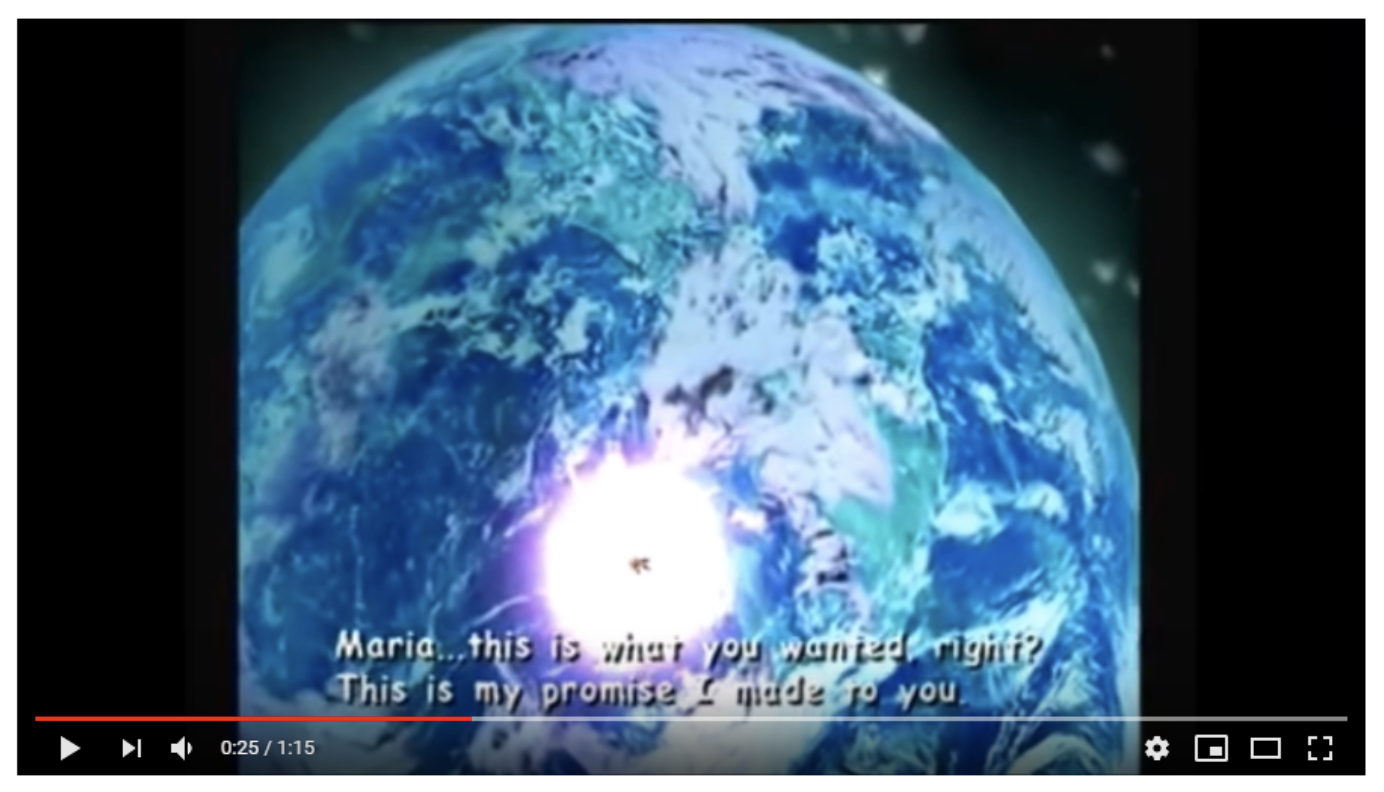
So what do we do with this extra? Knowing too much of the world and what the self cannot say of the world in itself. Autoplay is paused for the meantime, by which I mean the time in which we are mean. I remember discovering cruelty in the playground, where a boy would go round and hit us with strong red branches he pulled from a shrub that grew with some abundance around our school. And realising the marks made on the back of our calves were really just marks of a pain this boy had felt; a pain inflicted upon him from elsewhere, so that cruelty was something you transferred, a kind of heraldic ink you wore for your life, for your family. I would not explain these marks to my mother, or to myself, for years. My early experience of inflicting cruelty: throwing Chao against the wall, only to nurse them back into serenity later. Teasing the dog, watching a friend knock his head off a wall, deliberately fucking things up. Then the delirious pleasure: to throw one’s avatar off into starry void, a final sacrificial act. In Sonic Adventure 2 Battle, a game to which I dedicated many hours of pre-adolescent life, the villain Dr Robotnik has programmed his space colony, ARK,[2] to collide with Earth if the chaos emeralds are used. Such annihilation intends vengeance on ‘the government’ for condemning the doctor’s research and killing his daughter, Maria. Her request to Shadow, Sonic the Hedgehog’s Jungian double, is to help mankind. When Shadow plummets back to Earth, following the ultimate battle, ‘the Finalhazard’, he is happy, because he has fulfilled his promise to Maria.

Admittedly, this cosmological battle of heroes is little more than parenthesis here. I want to say something of my entrance into this discourse of annihilation. Shadow was a supplement: Sonic’s ‘double’, but also his genetic extra, his genetic remainder; both hero and villain, his narrative volition was ultimately self-sacrifice to save the world, and yet he was created to conquer the world. He embodies the eerie promise of a kind of living apocalypse, an ‘end’ to the world that does not end. I remember the final book of Garth Nix’s Old Kingdom series, whose blurb used the word cataclysm, or cataclysmic, to describe the events that closed the trilogy. That word lived on in me as a wound, cataclysm: something sharp that had already cut me. It was a word I could not unthink. What actually happened in the book was terrible, was a battle, it involved the loss of life; and yet there was redemption. I knew then that cataclysm was not necessarily apocalypse, because one world of fantasy could open into the new, like a modified species. There were chain reactions.

Screenshot 2019-04-08 at 14.34.48.png
But all this is just average Earth. Learning to like the light, to paint a thought with the similar blue, knowing it only exists in dreams, and the way she holds a note.


***


These days, everything mostly feels like transing times. I listen to a Jason Molina recording and realise that he is gone, he is missing from the world, and yet the warmth of his fingers, these arpeggios; the sound of sirens passing through the windows of his Chicago apartment. These are present but I discover them only after absence. I have to realise this over and over, to register the shock of this or that loss. I close one tab, only to open another window onto extinction: this fact of a text we can’t share, because the text is ourselves, and we have shared unto each other enough of the missing space. And someone else I once loved dies. Data is what’s given, it clots into so much hurt. We just are confusion, the two of us and the planet and what’s opening up.

Everything swells; a cherry-red globe recurs in memory. I drift on a lifelong melancholia that isn’t quite mine. I want to be able to parse this bodily symbology as a something beyond me, of course; I want to look outwards at the felt inequality. So many wounds between us. The word continent crunched sour in my mouth. These histories we can’t unpeel or remain in singular. I want to be able to understand the matheme, but there is a wilderness still. The breath won’t catch up. Scared I’ll fall off the edge of my mind.

What we make difficult for ourselves, these fractures in fact or family. Always a guilt that sticks. It is as though we were speaking underwater, our altered tongues; what we could only bring together as lyric.

I had all these dreams of traffic, and the traffic could only move in the night. I was at the edge of a slip road, but I could not merge. Are we closer, now that you know this?

whatever in the world behind closed eyes the doors whispered. let her be. let her be her. let us be as if we were not forever entwined in that, as if we were not able to unthread the conclusions, deliver ourselves of the plot. at that level she intercedes for you. she cries mercy at the feet of her father. she knows where he is at the far corners of the universe. he has removed himself. he has gone off to sit and brood beyond the pale of light. if not that then this. but we had opened it. the knife that cuts both ways. always. in the centre of it the rose. pure. the flaming heart, an artifact. believe me. this is not a special dispensation. this is a matter of life and death.

(Beverly Dahlen, A Reading)

And why did they give me the middling name of the Rose? There was a world tucked in and still to unfurl, and the rose was a planet with cloud tucked into its darkest heart. Let her be here. That time I set my hair on fire and everything of the world smelt singed for weeks. It happened at the funeral. She was at the mercy of a childhood memory, curled at the window as they came in the night to tip the car. And she remembers the way the oil ran down the road as rainbows. The sound of her parents on the phone and a knife that cut the silence of Sunday. It was a thick gelatine; the boiled fruitmeat of calorific lyric. The cut in the world behind closed doors, closed eyes, the lids we can’t keep on our possible futures. So we swim through; no, it gets stuck in our teeth. How can it be a matter of both?

Screenshot 2019-04-08 at 14.37.06

Crank the anthropocene up to eleven. I wish we had been sweeter to each other. Like listening to the bees without meaning to. We’ll never know why we are born the way we are born, or whether that matters. And I’m pushing sleep for the pleasure of that stretch of the break: when you say the break of the sky and is it a pink cloud I see, or just blue. The 8-bit troposphere catching nightly. Facebook is blue because Mark Zuckerberg is colourblind. There is the overlay, the twice-lived light of the screen and the sky beyond, which is also contained in a window. At no point do I choose to go outside, as it were; for this is the happening of a necessary containment. I need to be able to switch between tabs, my brain still reeling. There is always extra, the bit we missed and have to pursue.

If I saw you again, and we were the same as we were.

Excoriations of time are like Facebook disavowal; don’t click, don’t react. They rub off on our skin as however many times we surrendered our diaries, only to take them again in our arms, cradling tiny diacritics. The first broadband was the rupture of a secret, something breaking out widescreen and hurting.

Narcissism: this essay. A name comes out the sky(e), its extra e for the isle, for extinction. The Earth is active now, this state of evil, eleven, never even.

We should be kinder to each other, said the tree to the thing that would grind it to pulp. When Justine eats the meatloaf and it turns to ash in her mouth. And you know that all this extraness, extremeness of death is from the other planet that is our planet. Just is. I put a bar through Mars, I pierced its fat red eye with the proto-knowledge of Earth’s erasure. That was my great stupid rebellion. It felt like a dreamwork of futile justice.

The fact is only an identity, a pristine midnight. Land lines of countryside glimpsed in the feed, I know the moon only this way until I leave the library. So sigh, milk silver of gaze. Instinctive descent occurs in dark mode, and we play it over, scrolling and scrolling. The hours between. For all I remember of that night, there is only the simple avocado emoji, and a thank you. You’ve been more than a friend to me.


***


What do we call for?

It’s like the first time I saw Jane Campion’s Bright Star and thought of something shimmering in the woods, that would not come as powder or song but simply as itself. And yet even that was split. Cancer moon/Pisces rising. I could sense it, and the morning hurt, and the continuum of pain whose fidelity remained still into the half planet smudged on the edge of my hand. The Earth is a cherry that lost its innocent self. You would interrupt our greeting in honour of the end of the album. That was the tempo we stretched for ourselves, syncopating sleep with the lights adorning our names with time’s ongoingness; eleven hours at the end of the wish again, after we stayed up past the chorus of dawn. And the world was shimmering in the woods. Our cut had barely interrupted the story.


  1. And ongoingness is, as Tim Morton puts it, the temporality of melancholy in the anthropocene, this sense that ‘nothing is determined yet’. This sense that we are not looking towards apocalypse but rather trying to be here, knowing this ‘here’ is not ours or fixed but is a viscous spreading of multiple subjectivities, bodies and times. Ongoingness is to look for pleasure as well as pain, to not look towards loss as imminent or behind us, but rather to appreciate the uncanniness of reality. So this person’s consciousness became for a while another half of my own, their thoughts would echo and remain in me, beyond pathology, warping from something raw and ‘live’ to a gentler articulation of being here, being-with. The enviro-mind, formerly-known-as
  2. Incidentally, the Ark was a youth club I’d frequent as a teenager, beside the sea. The site of many formative drinking experience, it was surrounded by dunes of lawn and behind those dunes I’d learn my first versions of drowning.

Playlist: October 2018

IMG_4128.JPG
This month of intense transition, brisk walks after dark in a state of delirium. This PhD is all over me. My screen is so white and it glares all day. The moon is so white it’s almost offensive and so is the carton of milk which sits by the homeless man at Charing Cross. He rolls cigarettes and watches the traffic. I rarely see him smoke, but he is often rolling, and watching. Rolling and watching, as if the two were entwined and utterly necessary. I am watching too as I walk, but I walk fast and make of all features a blur. I run out of routes. I take the park at night to see the stars spread out on a sky of blue velvet. Nothing is nameable this way. It grows colder.

My feet look for a path but often find the grass instead.

Days pass, immersing myself in the journals of Gilbert White for a sense of the seasons, and how they manifest in the Earth. All the dead leaves of centuries swept. Then also Derek Jarman’s garden, so lovingly noted in Modern Nature.

To have such connection to the land, documenting its events. White:

Baker’s hill is harrowed-down after these great rains: it was no easy matter to subdue the clods at all. Some of the olde elders round the garden are almost leafless. Wallnuts are this Year innumerable. The white-apples are fit to make pies. Grapes, peaches, nectares very backward.

This is in August. Arboreal fruits and other riches. I ate a lot of apples in August, because there are always apples at conferences, nestled on paper-linings. In air-conditioned rooms, you crisply attend to knowledge. Something tart and sweet that activates the acid of many collective stomachs.

Mostly White’s journal compends the minutiae of fruits and vegetables grafted and grown and harvested in the garden. Little discoveries named in both English and Latin. The beauty of regularity and daily rhythm. But there are glitches: talk of ‘vast rain’ in the night, eerie events that just happen and remain unexplained —

A great light seen, & a vast explosion from y S: about a quarter past nine in the evening: the Cause unknown. It shook peoples houses very much. It seems to be meterous.

(White)

I write this on a Sunday morning, just as the bin men are creating a cataclysm of the garden. On Wednesday morning, the cleaners come early and the sound of the mop hitting the wall wakes me up from insomnia’s half-formed slumber. I dwell in these rhythms of other people’s labour, and consider my own, fingers on keys.

I have been thinking about data and how we access climate change as both event and ontological condition. What kinds of data do I attend to on a daily basis? I do not check the fluctuating air quality of my city, although Google allows you to do this. I rarely check the weather, at least beyond a cursory search as to whether to prepare with waterproofs or not. Checking the weather reminds me of the days of the week and all I have to do, and how the days are just units and thus the struggle of cramming things into them. I stay up very late because I am anxious about the days ahead, the things I am supposed to do in them. I remember a period of my life where I’d stay up all night all the time with friends, and when they’d lament the loss of their imminent day I’d say, no but this is great, it’s like cheating time! I did not realise they would sleep through the day, while I would ride wild on a sleep-deprived high, seeing the world as through frosted glass. The wee hours came, then the sun, and they would roll cigarette after cigarette in televisual flickers.

Summertime draws to a close, and dusk acquires a drama of light that demands photography. I skirt around Park Circus, following the curve of the streets, the incline. Ruffles of deeper darkness. How many memories are concentrated at the top of Kelvingrove Park, with the lights spread in ribbons of gold and red and glimmering distance. Collect my intensities, try not to think too hard. The air in my lungs reacts and is hot and sweet. The clocks go back and what a pleasure it is to flip straight to 1:01 again. Where does the hour go that is lost? It shaves a little light off my evening, for which I lament. Last year I was working until 3am when the clocks went back, and I was scared I’d have to work the extra hour unpaid. This is something we never talk about, the impact on those who pull night shifts. Luckily, there was a system. But customers did not understand. It got to 2am and we were kicking them out and they demanded we stay open till 3. The way it was on their phones, which automatically reset in electric synchrony. We were open till 3am that night; just on retro time, the time of before.

So tired I fall asleep with the light on, my face in some book. The luxury of curling into yourself and disappearing until all the dreams come.

The moon this week was consistently incredible. As in, cloaked in a halo of rainbow; magnetic, amphetamine rush of staring at it. Walk walk walk with the moon above, so below. The white pools of light that fall on the street. It gave me this charge or energy. I couldn’t sleep because I was full of the moon. Some lunar reaction inside me. I wanted to be more alone.

A friend describes my poem, ‘A Beautiful Video’, as ‘an autumn harvest of internet trash’, which I like a lot.

Adulthood means getting your bike fixed, over and over. Testing the brakes. It means learning to say no to things. It means being responsible for this and that. The ontological condition of email, with its beautiful intermittence — the sway of send and arrival. Kindest of wishes. I have been trying to start a letter all week but there are so many things I want to say to you. It’s been so long and I have no idea how you’re living. 

It hurts to write ‘now’, like the lostness is already always.

On Hallowe’en, I’ll see Grouper play in Mackintosh Church.

The month began with me listening to Leonard Cohen, and ended in electronic abyss.

Spooky as the air is, filling the wood.

In my diary I seem to write a lot, ‘I feel sick at the thought’.

This is the month I leave my job of five and a half years. I have a lot of separation anxiety and maybe one day I’ll be back. Strange to have such emotional dependence on a place and its people. To measure yourself against the pace of its shifts, the demands of others. To love and love and love unconditionally. I miss everyone already; I did the very moment I set foot in the door for my last shift. We played a game of flexibility and were lovely to everyone, got good tips. A table of Texan tourists, the last people I served, told me: ‘you’re so pretty…you’re like as pretty as this glass of rosé wine’. The wine in question was our house, Angel’s Tears, so I said, ‘and I’m as sad as the tears of the angel’, to which they laughed uneasily. They meant it earnestly and I checked on the menu and a large glass was £7, so I am happy that my apparent attraction matches my second-favourite number. It was a cheap thing to say but I kinda liked it. 

There have been these twangs in my chest, like someone pulling the strings of a harp too hard. I have not been sleeping too well.

Maybe I don’t miss the lush excesses of summer’s end, but I miss the extra light.

The way it feels to cycle downhill in freefall, giving yourself to the traffic, choking on the fumes of the cars around you. Red light upon red. Watching a film about homicidal ants. Messy situations and Skype conversations. Virtual reality and the value of objects. The enchanted beings appear on Byres Road, glitter-eyed at the crossing. Have written a sonnet a day for a week.

When I write in my diary it always begins so tired, so tired, or a variation of. I feel like I’ve done everything and nothing, and there’s so much still to do, to write into.

I watched The Garden until five in the morning and my eyes burned red all through the day. Something extravagantly eccentric about the manner of epic. Rub salt.

Erase yourself for rain and call it extinction. People have a lot of things to say on the matter.

So I sit here polishing pairs of shoes. At least I have something to walk with.

Begin again ordering rounds of Guinness. Almost asleep in the taxi, river-cross, the motorway morning orbits a thought. The mattering treacle of darkness. The air so cold it is almost sticky. When you see the abyss but take it anyway. This is such a soft short story to write in the library.

I lost my keys in the litter and leaves. I lost something in the hills, along time ago. Finding the words to say it.


~

Pinegrove – Rings

Angel Olsen – California

Red House Painters – Grace Cathedral Park

Sharon Van Etten – I Wish I Knew

Half Waif – Every Animal

Big Thief – Capacity

Karen Dalton – It Hurts Me Too

Haley Heynderickx, Max Garcia Conover – Slow Talkin’

Fleet Foxes – Icicle Tusk

Kiran Leonard – Working People

Leonard Cohen – The Partisan

The Innocence Mission – Lakes of Canada

Cocteau Twins – Summer-Blink

Arthur Russell – Losing My Taste For The Night Life

Sun Kil Moon, Jesu – You Are Me and I Am You

Oneohtrix Point Never – Love In The Time Of Lexapro

Lo Kindre – Torment Of One

Hiro Kone – Outside the Axiom

Low – Words

Mazzy Star – Mary Of Silence

Sibylle Baier – I Lost Something in the Hills

Nico – Afraid

~