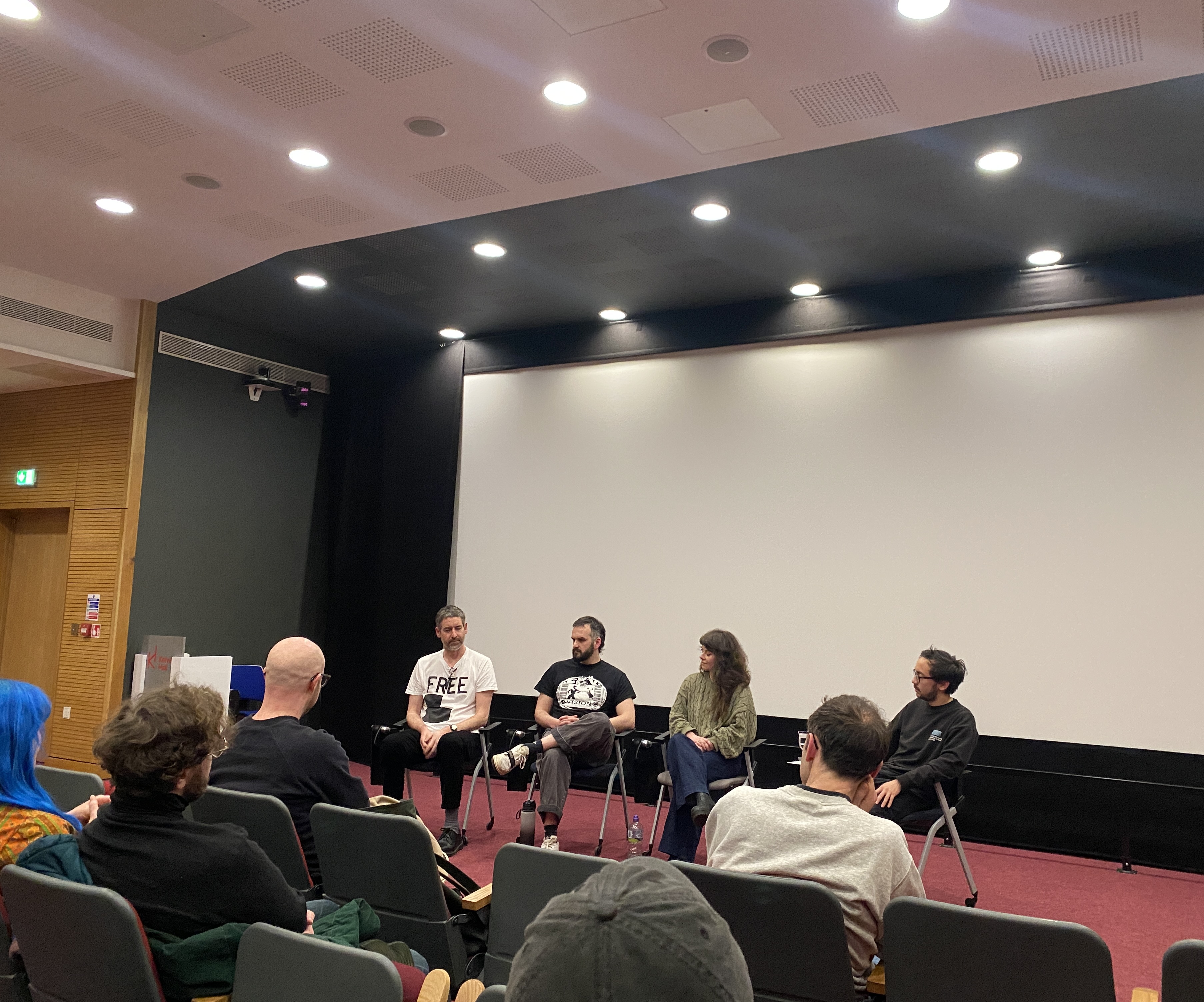
Bringing in the Chaos: I Dream of Wires event with Thinking Culture 19/2/25

(From left, Scott Myles, Lewis Cook, Suzi Cook, Kevin Leomo)

Last night I went to the Thinking Culture event: ‘I Dream of Wires – Film Screening and Panel Discussion’. It’s this film about modular synthesisers and the people who build, use and ultimately love them. Some people collect dozens of these instruments and get scared to record. The studio assemblages are like hyperobjects. It goes from being a musical thing to a techy thing, or this sublime encounter with wires. Some of the talking heads did say they were more like engineers, or more into hardware or just playing around. I found the film inspiring and charming. It was so great to hear from unabashed enthusiasts, some of whom comically shit-talked the digital in a way that was deeply satisfying. Anyone from Trent Reznor to Gary Newman, Legowelt, Doepfer and Modcan. You start seeing the tech itself as this circuitboard for attuning people globally who love something niche in a powerful way. That attunement is also to possibility. The circuitboard after all is an instrument. I loved watching guys hot wire stuff, or whatever it’s called, kind of moving around intricate cables, sparks, connections. It’s one of my favourite things, to let people go off on something they adore in this totally nerdy way. For the love of technicality. The way that the modular synths are more than vintage revivals. 

Afterwards, there was a panel chaired by Kevin Leomo with artist Scott Myles and musicians Suzi Cook and Lewis Cook of the band Free Love, who now run Glasgow Library of Synthesized Sound (GLOSS), the UK’s first electronic musical instrument library. Myles has this exhibition, Head in a Bell, finishing up at GoMA right now, containing the Instrument for the People of Glasgow, a social sculpture made up of donations he blagged from Eurorack synthesiser manufacturers across the world. One of the things that struck me again and again in the film and the discussion was this notion of the social, especially in terms of the civic — that which relates to the duties or activities of folks living in a particular locale. Obviously much of this is urban, but I’m curious about the rural life of the synth (remote cabin studios notwithstanding). 

One thread of the discussion I latched onto was around what is creativity and why does this question matter in the age of AI. Pretty soon, Lewis said, we’re going to have software that can simulate very well a track that sounds like it was recorded on tape in say, 1984. So why bother to make the track. What is the ‘worth’ in that labour, everyone ponders. Lewis, and I’m paraphrasing here, said he likes to come at instruments more as a wilful amateur than from a position of mastery. He talked about ‘approaching an instrument with a kind of naivety’. It would kind of get in the way if he knew everything an instrument does with that technical oversight. I was thinking about the relationship between creativity, play and amateurism (or what we might call newly coming to the thing, being a dabbler, a devotee etc) in terms of the vernacular possibilities of the modular synth. This is all very raw and speculative thinking, as a blog befits. Towards the end of I Dream of Wires, we have a lovely slowed-down shot of children interacting with a modular synthesiser which is placed outside. The effect is almost pastoral: sunlight on young faces, their curiosity blatant, the different colours of their little outfits standing brightly against the cool palette of the tech. The idea being: what would it be like to come at this as children? As well as: what will the musicians of tomorrow do with this tech?

This idea of the vernacular is one I nab from poetry. In Nilling (2012), Lisa Robertson writes:

a vernacular loosely gathers whatever singular words and cadences move a given situation, a given meeting, as it is being lived by its speakers. Characterised […] by wit, excess, plasticity, admixture, surge, caesura, the wildness of a newly turned metaphor, polylinguality and inappropriateness, the vernacular is the name for the native complexity of each beginner as she quickens.

What does it mean to ‘meet’ the technology of the past in the present? We could swap ‘singular words and cadences’ for samples, patches, presets and think about how improvisation turns a kind of ‘wildness’ into the surprise of new genres. Confronting the interface of a modular synthesiser is intimidating but also freeing because it is a machine that gives. And it will make a sound if you physically interact with it. And you keep building on that. In the film, social connection was mentioned again and again. Whether in shots of happy clubbers dancing away, the hands-on interactions of the Superbooth trade fair or in the social hub of Schneidersladen, a legendary synth store in Berlin, the film circles back to the idea that while there is a collector’s market for this stuff, it’s not always locked away. Even the hoarders like to come out and play sometimes, swap tricks or demonstrate. I like Robertson’s phrase ‘the native complexity of each beginner as she quickens’ as a description for what it means to come at an instrument, face on, learning through doing. Quickening. 

The opening question for the panel was ‘When did you first get into electronic music?’ and the answers were a delightful mix of classical training, chance and play. I remember being fourteen trying to play Enter Shikari songs on my friend’s microKORG and this particular instrument being legendary in her self-mythology, like something that landed out of the sky. I remember raucous chiptune gigs, energy drinks, GBX anthems, nineties industrial and the explosive synths of happy hardcore with their Koonsian sheen and total west coast of Scotland Id. I remember how all of this was mediated through hardware: specifically, the Sony Ericsson phone, crackling home computer speakers or the way things sounded IRL massive so much to ring in our ears for days. 

When we think about the transitional moment we are living through, with the accelerated capacities and tentacular reach of artificial intelligence, we should consider what we as human beings want from our creativity. This was a resounding proposition from the panel. The importance of social connection, spontaneity: how just being here at this event was also making me think and write again. The kinds of energy, power, connection you get from being in the room. Scott talked beautifully about how the modular synth was a way of ‘shaping electricity’; that could also form the plasticity of a certain musical vernacular. I thought about whether presets could serve as chronotopes hailing us back and forth in deterritorialised place and time. Again, remaking the vernacular. How creativity doesn’t always need efficiency. Lewis said something interesting about convergence of divergent thought. How you work with the practical and the abstract, sometimes needing a bit of one to go into the other. Efficiency can get in the way of meaning and feeling. You have auto-generated the perfect 2010s Eurobeat song. Now what? Slowing down the process can also quicken the senses. It’s how we get excited. Figuring it out. Connecting. 

Lewis mentioned that some of the guys on the film had a ‘model railway’ vibe about them, the way they collected and connected synths and narrated that practice. It made me think about how that model railway art of making these insular sonic worlds allows for imagination and mind-wandering play, but you then have to actually connect it to the social to get the extra utopian jolt. This can sometimes be intimate and personal: the ‘ecstatic companionship’ (Scott) of listening to drone music. It could also be energising and collective. The music could stay boutique in the studio or it could be this charge, this conduit to reaching others. I like to think about everyone listening to drone in their bedrooms as tuning into some field of collective frequencies, the oceanic feeling of being apart, together. 

Lewis said that one of the goals of GLOSS was to think through how to make a ‘luxury instrument’ available in a wider context, especially in such a divided city as Glasgow. When asked what piece of advice might you give to people interested in making their own electronic music, this is what the panel said (again, paraphrasing):

Suzi: celebrate your changing self and don’t be afraid of warping and letting that shape your practice

Lewis: don’t take yourself too seriously

Scott: always be doing, making sound and music, do it and don’t always try to understand it; keep making stuff and also redoing the thing; don’t be intimidated

Someone, I think Suzi, said ‘part of the balance is bringing in the chaos’. So I will go about my day with that Robertsonian wildness and celebrate indeterminacy, chance encounters, happy accidents.

~

This event was hosted by Thinking Culture. There will be a related gig at QMU in April.

Dancefloor Utopia: Free Love’s ‘Pushing Too Hard’ & ‘July’

I love alcohol, the gloaming
of the blood that makes time an arcade.

Somehow, lately, I have been unable to drink myself into drunkenness. Everything is a spritzer whose taste effervesces like the further most points of the sea at sunset, those glisters of peachy waters which seem almost to fizz beneath the pleasure of light. To think of that expanse as the body’s active limit, like the horizons of video games, whose traversal would teleport you back to some familiar, originary location. Flip away. Endpoints as triggers for reversal. To travel outwards, to raise yourself clean into movement. To make of the body its own hypothetical. It’s like I want only the blueprint potential, the colours and geometries. 

The waves move against me. I do not drink. 

Queue, Free Love (FKA Happy Meals) ‘Pushing Too Hard’. This ultra-dappled, smiley-faced italo-disco is a sort of vertigo. I mean I am spinning silver in its listening. Emptiness requires its own containment. To dance in parallels then pirouettes, to queue time upon time’s arabesque. To oooooze. The little eddies of the ocean still swallowing, the sun ravelling down like residue soda. Whatever direction you make into ceremony, pleasure. 

The bunching of muscle, where sun hits the boulevard. Where the boulevard bursts into its many discographies of water, inclined to times beyond and before, a gradient popularity of passengers and travellers, nomadic ravers. Where the boulevard is not a waypoint but the lengthy stretch of hypnosis itself, an astral plane into sunlit ethers.

The very word boulevard, a sort of ferric opulence unfolding a hazy, urban sprawl.

All of this wayward July, and the synths so warm on my skin, and every conversation a twirl of hyperbole. I wanted nothing of night again, as night was just the day’s refresh and erasure. All through the summer, the air so syrup and seething.

I book the overnight ferry, I dream of a world without timetables. The tide sloshes over me and it is sleepless, and it is heat.

This is rich-text. All of oddness. I’m just so much happier at four in the morning, in the priory of sunrise. Missing you.

Cherish the currency of friendship, however the slightest touch is a glorious misreading. Miss reading, I’m missing. Mist between the one and the two and same, faintness of incense that is. The body unshowered, the mist of heat. The endless messaging dew drops of moisture; your pearly brow is beautiful. It isn’t as though you could shift sentences for me. I’m just as weak.

Suzanne Roden of Free Love sings sometimes in French and slips between two languages, the language of the one and the other, the foreign tongue as love in transition. The lively nuance of melodic translation. To stretch meaning, to make of its pulse the possibly unmappable. We listen and maybe we don’t quite need to understand, we just need the potential of passage, its affective route per semantic reach. Glossing Derrida on love, Maria-Daniella Dick and Julian Wolfreys write thus:

Love calls on us to be responsible in coming to map the unmappable, to be open to the possibility of the impossible, and the possibility of this impossible experience is that, in short, which is between us, and which remains: to come. Love is always just this exemplary passage between tongues, in what is foreign, other in the language one calls one’s own.

There is a healthy cascade of reverie. There is browse and incline, click and encryption. The love that you seek. Every pop song is of course love’s expression, the fluid joy of a ~solid~ ego; and yet to map that point of dissolve in which this ego is the melt-point of ipseity’s porous limit, is that not the deferring impulse of disco? Strike through to jouissance. The repetitive beat, the multiple oscillating climaxing motion; the avoidance of pop’s inevitable, normative denouement; the queerish musing deliciously around fulfilment; the rhizomatic overflow of the senses!

Stay mercurial, baby. In cool arousal, in sluicing.

‘But I love you despite the boring terrorism / of particularity / fading like parity’ (Keston Sutherland).

Your forehead is hot. It is glass for the shattering. We are fashionable and hackneyed, practicing lunacy where the beats scream and are again crass in their lust and elation, their confinement to time and place and the pulse of this darkness.

When my irises bleed, is this a form of eschewing the present? As in, swallowing an elsewhere unseen to the other? We see our eyes outside, in the comedown glow of street lamp smoulders. We the parts of our bodies as an archipelago, every isle slowly swallowed by rising water. 

This tectonic pulse, this encompassing warmth.

You’re pushing too hard. And so language is physical, and so is literally thrust in, into, the armoury of love. I will not say weapon, I will not reduce a necessary plural to the singular tool, the implied signified of the phallus. The piercing. My eyes become pliant.

Make of the air her dulcet voice, over and over like rain’s refusal. Make of this moment a lightness, a smoothing. Trace little bumps and ripples and glitches; the motion is softcore, resplendent’s true sense.

Love is also the coveting of blindspots, those absent locations of self’s abyss which lie adjacent to the lieux de memoire recognised as the sites of love’s memory, of memory’s happening in love. Love as process of betweening, as immersion. A feel-good, a good feeling. The prolonging of ephemeral sensation in an act of imaginary narrative, its plights and highs and necessary zigzags. Act within capitalism, act without; act as pop’s dazzling detournement. So here by the convenience store we kissed, so here by the river; so at the window we shared cigarettes in a friend’s apartment, by the ersatz palms, so these screens between us, so the niche forums that served as our weird, oblique interface; so here where the road slumps into a junction, so here at the station where you had to go. A whole topography of abstract thought, remix it. Drink it. So memories of mountains, so sharing the lakes we made up in memory; that you swam in, the lakes I walked round as a child, the heather on hills where ashes were scattered. This interface, these blue messages. Blue irises. The shape of a letter impressed on a map. The silent valley, its conclusive basin of time; where life is swallowed. I memorialise a thought, the quality of light in August, its paler gold among green; whose green is mortal again, whose green is set to fade. Your pupils resolve all green of the iris to blindspots, they mop up the blue with the black of sleep. And to sleep as equals is to forget the self, to wake in a room between rooms, to find yourself caught as other again, your room unfamiliar, the room never yours even less so now. The very first utterance of morning might break the spell. How the sky looks different through your open, solar window!

And I’m not the one to help you / Although I’d like to tryyyyy.

Clatter and wave, video game imperative to action and motion. Soundtrack the heat. Make reverie of weather. The production is so acid house. The production inclines toward dance. Externalise the internal. Naturalise the natural. A certain elasticity of underlying beat, as if bass were the hum of the blood that produces affect. As if it were all that reducible. As if in that energy. Make our mammalian restraint ethereal. 

The Quietus says of Free Love’s music, ‘Their vision is a utopian one, influenced by rave culture, Eastern religions, politics and magic’. To unhinge love from its possessive sense, love becomes an ambient tone in the spread of the days between days which we count in love, if love is a sense as any other, an orientation between things, between selves, the one and the same. If love is something… that something within us must export to numbers. How many days has it been, I’ve been thinking all week… Here are our figures. Crunch on a sort of krautrock lingering, the impersonality at the heart of euphoria’s insistent heat. Free Love have used drones before, meditative, balearic beats. It’s a process of seeking the nuanced frequency, the cleaner hum of Being, what might spread into an open future, something bright to seize. Design your consciousness for different realms, just feel the synaesthesia of speculative situation. The future’s flirtatious, maybe it speaks French. It’s a bright pink, cherry-red electric French.

In his spectacular tome, More Brilliant than the Sun: Adventures in Sonic Fiction (1998), Kodwo Eshun talks of how the subaquatic techno-duo Drexciya ‘fictionalise frequencies into sound pictures of unreal environments […]. They fictionalise the psychoacoustic volume of a giant submersible’. ‘Pushing Too Hard’ implies a current out of sync with its destination, an unbalancing in the passage between entities. A kinetic effort. Disco’s warm flicker invites that spiralling back to aporia; not a giving up in the sense of seduction’s failure, so much as surrender to the unknown and its cheeky, distinctive flourishes of acid, italo, proto-house all drenched in funk. I don’t pretend to understand French; my language is literally standard grade, processed only to that limit.

But I pick up some terms Suzanne sings:

L’avenir: future, future, future, promise. To come up. Insistent, proximity, imminent. A cool bitten ecstasy, a love to-come. Love in the conditional, although I’d like to tryyyyy. Those airy harmonies cascade around chiasmic, sunshine flourishes. Love’s duration at 4:18.

Plastique: plastic. What seems elastic, mutable, but is in some sense unerasable—a material that ultimately remains. Residuals. Shards, bits. When ‘Pushing Too Hard’ collapses into its A-side twin, ‘July’, the beats are fatter, darker, hotter—brooding with a sense of summer’s latency as always already. The plastic feeling is inside me, it’s a melting, it’s a coming-into-skin. Sonic duplicity. It’s the Anthropocenic hauntology of organs, it’s a PVC drag of natural sensation. It necessitates dancing, but the percussive chimes in the track’s white-heat centre drag my mind from the present’s solidity. Those chimes are airy, they are elsewhere, enchanted; they are so far removed from the close close city. To be fast and slow, hard and soft, selfish and strong, reflected and present, past and future…Being as syncopation, being as plastic, rent to split. Our lapidary imaginaries, our synthesised clicks of pleasure; a pool of sound, an immersion…I’ve come to relax, to realise.

Visage: face. A word whose very sound is that of sunlight hitting clean the bounce of a mirror, a slide into silver. The waspish vibration of the lips, inclined to glass on the brink of shatter. I think of all those mirror tricks in every ABBA video. The face, the face, the face again. The face we effect. Maria Dick and Julian Wolfreys again: ‘Seeing the face in its absolute and irrecusable singularity, I am given to apprehend a doubleness from the first gaze’. Disco is doubleness inherently split to multiplicity, it is the vying for one attention amidst the millioning of other skins (skins becoming a metonymy of figures, faces), it is the shakeaway of self into other, the imitation, the performance of gesture’s contextual plurality. The face, in Emmanuel Lévinas’ sense, is the announcement of subjectivity: the instating of the subject as a sort of ‘hostage’, as Dick and Wolfreys gloss. It demands a response, stealing the attentions of the self, instating by necessity a certain ethics of wholly Otherness: the human face, as Lévinas puts it, ‘orders and ordains us’. I catch your face on the dancefloor, there is a temporary pact between us. What implicitly slides in the raising of one arm, the twist of hips, copying this dance, a Xeroxing event whose zero-sum origin remains irreducible, whose condition is always undecidable, plural. So far so obvious the ontology of rave culture. Every action now as response. A semi-autonomous severing. Technology can be, as Eshun puts it, a ‘bifurcation in time’. The techno throbbing through the pale membranes of my human sense is a channel for split subjectivity, an experience of falling between worlds.

On the dancefloor, when he asks me what to do, I whisper in his ear, in some half-remembered echo from The Bell Jar: ‘pretend that you are drowning’. And that paranoid panic, that scramble for air in the thrust of the limbs, it seems to work. I see the moisture mist up his glasses. Face after face, we glimpse the phenomenology of substitution, we trade our own affect for the possible electricity of the next. His smile, her hair, our collective sweat. The absurdity of all these moves; the warping of all muscle memory inclined to a known rhythm, then ever the melodic trajectory of an unknown palette. We expose our infinite vulnerability, we abstract ourselves to the dancefloor’s disorderly hospitality, where the reciprocal push-pull of crowd and DJ is a mutual reading and so mutual dissolve, a ‘free love’ whose freedom is conditional on the exchange of gesture, face and motion, of bass, beat and melody. Of sonic and visionary qualities. Of closeness, a close reading. 

I imagine my skin looks metallic, right now, as you see it.

Eshun again:

Groove is when overlapping patterns of rhythm interlock, when beats syncromesh until they generate an automotion effect, an inexorable, effortless sensation which pushes you from behind until you’re funky like a train. To get into the Groove is to lock into the polyrhythmotor, to be adapted by a fictionalised rhythm engine which draws you on its own momentum.

Is fiction here the condition for identity’s erasure? We hustle ourselves out of ordinary language, slip into the chug and pulse of the train. Okay so all these bodies in motion. To export yourself to the techne of musical condition. Fold in the overlap, a baroque philosophy of subjectivity’s production. Enter heterotopia with both hope and scepticism. Put away your wallet. Fold yourself. There’s Deleuze’s notion of the fold as a doubling: one thought rolled and pressed into another, the scratch of tobacco in cigarette papers, the promise of chemical stimulation imbibed in the skin, the curlicues of words upon screen and page, the unlocking potential of semiotics in motion. A rolling into, an overlay’s careful pleat of impression and meaning. The duplicity of temporalities in photographic exposure. This tongue curled on a foreign one, the blendable play between French and English, a play between verse and chorus. A recursively mutual translation of inside/outside, the self and other, here and there, near and distant; a translation whose very process belies the instability and futility of such ontological divisions. We relate to ourselves as production, we produce ourselves. But don’t look at me / I’m just as weak. The face that desires, amid over-stimulation, the reserve of hiddenness, the retreat. Subjectivity as a question of mastery, self-relation, processing affect, thought and memory in the world’s abundance, intensified in the sonic duration of a pop song, or in the ever-churning lieux de memoire of a dancefloor, where memory is always in oscillation, caught between bodies and beats. And the magic in that, and the heat. 

‘It’s like creating temporal communities’ — Lewis Cook.

Every melody’s upswing, a new euphoria: ‘Synchronicity’. Left my ego on the ground. Make of identity its fractal components in disco extension, plugin auroras of thought, the perspectives shifting. Suzanne’s voice spliced between echo and harmony, echoed by Free Love’s other half, Lewis, echoed by her own, echoed by the satisfactions of division’s fall back into rhythm, the tightness of synchronicity. Turn me upside down / I don’t know what’s left in front of me. Resonate, resonate. Duplicity kaleidoscopes originary identity as an always receding, elusive location, infinite addiction. Broken glass, symmetry, the one and the same split shard-ways, a cool euphony of a synthetic present cast ever between past and future; the neuromuscular necessity of this beat, this bodily response; hyperstition; this brainwave as process corrosion, as shimmer and sweet, as almost coincidence.


*

(Video shared via YouTube/Gorilla vs Bear)