Playlist: October 2017

IMG_7632.JPG

(disclaimer: my god i’m feeling autumn morbid)

Time is a stopped drumbeat tonight; it is the remnant of old Halloween feeling. Singular childhood memories: salt-crisp toasts in the shape of witch hats, chocolate spiders, fireworks; a plastic bag snagged on a tree, resembling the gossamer trace of someone’s soul. Pumpkin seeds sprinkled paprika, oven-roasted. Surrender to central heating. I close my eyes to desolate parking lots where the wind buffers round and round in the thick-whorled conch of my ears, which have not heard enough in their time; filled with white noise and melodies honeying the sore parts to moan or depart. We talked about feeling passionate or just not at all and long communications across channels across waters and distances of spacetime unfathomable to the little things beating in our chest that were tender of fibre and sinew, blood and bone. Heart attack, absence. A craving for airports, places of arrival and departure. Erase all communion. At the very least, some ferry terminal where the rain lashes my face and it’s like being born again and over and over–the way a shell is each time the tide unfurls some granules of sand in ribboning form, sweeping layers of time back over the nacreous skin. A white shape looming chltulu from darkness, from blue. Suddenly nostalgic for everything; days where less pressed upon the brain, where a deep abyss still made its outward ripples around me. The wake of a ferry, see the whitening arabesques of that line. Days sloshed out with delicious, ice-deprived, inexpensive whisky. The blurriness of alcohol a delay, an appeal. Repeat. Too many nights lost in flats without sense of an ending, every corridor a wind tunnel. Cycling home the abstraction. Best to present this as fact or fiction?

Bursts of prose, aches and pains behind the ears, deep in the muscle and bones. Getting harder to cling to routine. The nights draw in malevolently, extravagant in their darkness. Things to look forward to seem less and less. Sometime you come home; you come home and there’s a version of home I swim through, salt stung and sober but nonetheless longing for home. Less lost tracing same old routes, longing for the everywhere nowhere of hill mist and sea fog, rivers you step in forever for each time is another, another. Moss between cracks in the patio driveway. Keep mesmerising beats still close to sleep. Fabricate reality.

Spent inordinate quantities of time this month listening to Elliott Smith. Sad pale lullabies from a lonely Los Angeles. I pace these streets, pretending they’re boulevards. The only palms here are ugly, reedy, hardy. Stop wearing liner because regardless the irises stream. The wet leaves gather and stick and are swept into gutters. Gelid, compact. Packed into bags. I don’t know where they go, where the end is.

We put the radiators on for the first time since spring.

Autumn requires more indulgence in pleasure. Thickening of the flesh. I buy spice and wait for sweet potatoes to warm on the stove, thinking of how music creates space and it’s space that I need—so much space and space. Space is space is space. Where strings elasticate the littler twinges of pain, I’m counting the falling beats of a piano far from my room, far steadier than the twitches of dreamcatcher feathers above my bed. Tidal sighs. Voice grows frailer with audience, chance Saturdays off work recounting old lines in the sea pace of rain that steadies the brain in concrete roads. The opening chords, like coming home. Dusk slowly loses its dramatic autumnal sense of transition. Winter steals ruthlessly, magpie glitches of silver light. My hair dulls against the cognac gold of the leaves, their magical lambent light. My skin gathers sapphires, latticed and laced with violet blue, violent hues. Bumping my legs on things in my room because it is all too small, dollhouse small & ever shrinking; the arrangement of objects and clutter and books that spill over and spaghetti tangles of words I can’t follow because sleep might steal me. Words, words. Lurid in sentence through sentence. Sleep is a sort of ache you have to embrace for the sake of refreshing, a scab you can’t pick off the physical. I might dream of tomorrow then fold back on the future. Sentences come in again, re-calibrate time. I wake up frozen or burning; or I stay up late, stay up beyond human time, missing summer’s songbirds in the garden. It is all too cloudy, shivery, silent. What time is it wherever you are? The maps provide little flavour; I cannot orientate myself on those pastel colours. Still, there is a durational beauty to everything we speak of, itching towards light with crisp new lines. A photograph, then words. White upon deep, messenger blue. What doesn’t feel borrowed, what feels mystically distinct and uncertain. It’s lovely. Confessionals kept abstract as always. So many meetings with those who inspire. Except there’s the dread. How can you hold so many words in your head?

I make notes on the moods in work the way you would weather. There is often a pattern, a miasmatic misery catching. A cold front coming. Hysterics and dashboard laughter. Smashed glass. Not even a full moon and still the weirdos flock in with awful demands: this wouldn’t happen in St. Andrews! I picture myself between two places; oscillations of identity with a flareup of possible rupture. Between two needs. She says there is something deeply wrong, a pang out of sync with the rest of her body. Is it possible to be this body without organs? For you are all fingers and bruises, lashing trellis of glitter and breath. There was a hurricane that buffeted our ill-equipped figures, our red raw fingers. You could hear the wind flapping in the scaffolding like the masts of a ship. I walked west alone, the cold so hot in my throat. Strangers asking me where to dance. Plug up the volume. When the trippier synths came in, eloquent cross rhythms coasting, the serenity would cure this feverish dreams. Too many tenses tangled. Stifling coughs in working clubs, watching a friend make music on telly. Fairy lights blinking out of sync. A sudden swelling pride over the fact that such beautiful things can exist. His reticence, his crazed expression. What was it she said? We can’t have nice things, that’s why we lose them. It’s true, they slip away from you; or else we’ll drop them like keys down the drain. Maybe that’s okay, maybe that’s the best part, the losing and leaving and dwelling in pain. O sweet naivety. Everyone is leaving. I would hurl my keys in the sea for you.

Far away on a rooftop smarting my brain on the stars and learning to drink again.

I walk home in the lost hour and screaming teenagers costume the streets with vague and avid despair or else carnivalesque they paint dawn with hilarious shadow.

=> Switching the radio on at six in the morning haven’t slept yet & what comes on just another crap Motown no. recalling fresh restaurant hell… <=

UNIT. UNIT. UNIT. // these misdirectives I will follow forever not knowing, not knowing. She sounds a bit like Bjork when you turn the sound right up to a shrill; a brittleness threatening to shatter all that is cool and sound and sound. She is pure sound. She is bitterer, sweeter.

><

I wonder how long to lose a day to a train? Somehow the north beckons: the sense of my smallness; a need to be swaddled in brisk wind, sea smell, true Scottish frost…may we bury our feelings in negative hypothermal versions of now…but for now I can only look forward to seeing Com Truise on Thursday & drown out & drown out…

*

Lee Gamble – Déjà Mode

Alt-J – 3WW

Moses Sumney – Lonely World

William Patrick Corgan – Aeronaut

The House of Love – Fade Away

’Til Tuesday – The Other End (Of the Telescope)

Phoebe Bridgers – Would You Rather

Elliott Smith – Twilight

Courtney Barnett & Kurt Vile – Peepin’  Tom

Rob St. John – An Empty House

Sufjan Stevens – Wallowa Lake Monster

Cocteau Twins – Pearly-dewdrops’ Drops

Good Good Blood – Running in the Dark

Joni Mitchell – Roses Blue

Kathryn Joseph – the bird

Johnny Flynn – Hard Road

Simon & Garfunkel – Kathy’s Song

Memories from MSN

014400a589401

Few things define the noughties more than MSN Messenger. The spinning pair of green and blue icons, surrounded by butterflies. The friendly window which popped up every time you logged onto the family computer after school, to ‘do some homework’. Forget Facebook, MSN was basically the main communication channel for my generation growing up, and I feel like its recent closure deserves some elegising. Yes, incase you hadn’t heard, MSN (rebranded since 2005 as Windows Live Messenger), is no longer with us. Microsoft forced its clients to give up the nostalgic platform and merge with Skype.

I remember getting my first email address, when the world of social media as we know it was still in its infancy. My cousin helped me set up my first hotmail account, and I was delighted to find that I could call it anything I wanted. I could express my (proto-manic-pixie) weirdness with some cool and random name I made up. I opted for ‘strawberry_bonfire’, an email address which incidentally I still often use (although not for LinkedIn or job applications…). It felt like a rite of passage, typing in my home address for some anonymous computer to process and setting up a password and making an email signature. People could now contact me. I was contactable. I’d have my own inbox. More importantly, I could set up a Neopets account! And an MSN account!

There was something unique about MSN’s interface which sets it apart from the likes of Facebook messenger, or Snapchat. I suppose the emphasis on conversation is key here. Each conversation opened out into a window of its own, although you could group your chats in ‘tabs’ for ease of moving between conversations. There was of course, the odd awkward moment when you accidentally sent someone a message reply that was intended for another person. Gossiping via MSN was a tricky business, which required organisation and attention.

Everything was a beautiful network of colours and messed-up symbols. It took a good five minutes to work out who was who when you looked at your contacts list, especially if your friends had recently updated their names. There was a whole sequence of tildas, dashes and asterisks to sift through before you could pinpoint your pal’s pseudonym or elaborately embellished screen name. I suppose that’s another reason why (not so) secretly I still prefer MySpace and MSN to Facebook…there’s that element of individuality that you don’t really get in the highly structured systems of more contemporary social media platforms. Sure, they’re probably more resistant to coding bugs because of their relative standardisation, but I miss the quirkiness of an amateur’s attempts at html on a MySpace theme, or a smear or rainbow lettering constituting someone’s MSN name. You came to know people not by their boring old real name and photograph (as on Facebook), but by some random avatar and distinctive font. That one friend you recognised when they popped up saying ‘hi’ by their enduring use of cyan-coloured Comic Sans or violet Monotype Corsiva as much as their name. There’s a nice sense of cosiness that comes with this, of online personalities being fabricated, selves being formed in the endless conversations that would eat into hours of an evening. Back then, we were too young to go to the pub, too remote in the country to find something ‘real’ and useful to do like join a sports club or an art class. Even if we did do extra stuff, MSN filled in the rest of our time, extended our social lives.

Then there was the personal message. This could range from ‘ugh doing maths homework’, to ‘Amy You Are My One <3’ and the ambiguous ‘=/’ which would result in a barrage of people asking ‘what’s up?’, only for the person to reply, ‘nothing’. Your personal message also revealed what you were listening to, if you had your iTunes hooked up. This of course stopped you listening to hideously embarrassing music (in theory) and listening to what you thought would impress other people. It was also a good indicator of people’s moods. God knows I wouldn’t start a conversation with someone if they were listening to Secondhand Serenade or Hawthorne Heights…

Then there was the ‘nudge’ function which was brought in later on. The bane of your existence if you were trying to coordinate MSN with homework or downloading or streaming YouTube videos (basically, my ancient computer would crash every time I received a nudge), the nudge would make your screen shake and force you to pay attention to the nudger’s conversation. Luckily you could only send a restricted number within a certain period of time. There was a time when MSN conversations were very precious, back in the pre-Broadband days when you dreaded that fateful phrase from your mother, ‘I’m going to unplug the internet because I need to use the phone’. You had waited so long for that bloody diallup connection to ring through and now you had to hastily sign off with a quick ‘g2g xxx’. To be fair, a lot of conversations basically went like this:

Person A: Hey x
Person B: Helloooooo

Person A: Howz u?
Person B: nb, u?
Person A: gd thanks
Person B: wubu2?
Person A: just hw and stuff, u?
Person B: yeh same

Person B: g2g, byeeeee xxx

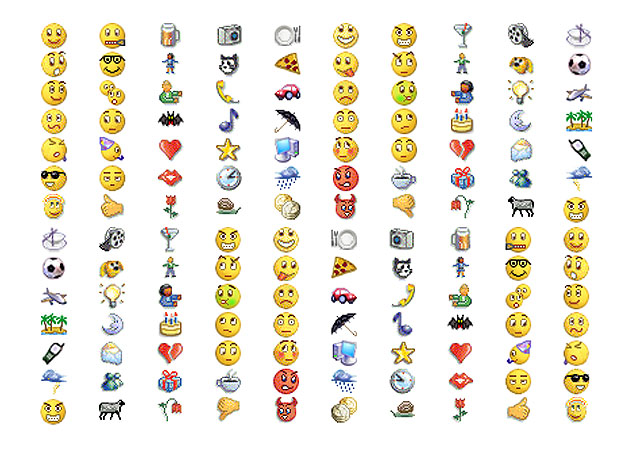
Nevertheless, a lot of us had our first breakups, friend fallouts and heart-to-heart confessions over MSN. That, I guess, is where a lot of the nostalgia comes from. Staying up into the small hours on a Friday night having a moan about life to someone, or helping them through something they were going through. You could send them helpful web articles or songs to cheer them up (it might take 2 hours for the song to arrive though), or a funny picture (memes were growing popular). Emoticons back then weren’t the loathsome ‘emoji’ phenomenon they are now (god I sound like an old woman) – they were generally small and unobtrusive (unlike Apple updating your iPad and putting in an emoji keyboard without telling you…) and often served as a welcome substitute from =] or ‘lol’ being added to the end of every message. And then if you were going on holiday you could put the little tropical island or plane symbol in your personal message, and people would know that you were now an exotic thing talking to them from the imaginary world of some hotel abroad (with dodgy WiFi connections).

img25
emoticons! all the emoticons!

MSN was in some ways an endlessly frustrating service, but in a way that’s what made it so good. The game of how to talk to someone you fancied without making yourself look like a stalker (wait at least ten minutes before talking to them after they’ve signed in), of working out whether your matter was urgent enough to disturb someone whose status was ‘Busy’. There was always that weirdo online at 4am who you sometimes wanted to speak to and ask what the hell was up with their sleeping pattern. Then there were the endless difficulties with connection that left you kicking the desk underneath your computer and wishing you had one of those newfangled Macbooks or something (I guess this is where the ease of the latest messaging services comes in). I kept a notepad next to my keyboard for a while and it was amazing the amount of doodling I could do in the time I spent waiting for MSN to load; sometimes it was as bad as waiting for a 3GB installation of the Sims!

Source: Urban Dictionary

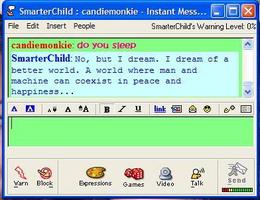
Yes, MSN was great for killing time. If you had friends round, chances were you’d end up on MSN, talking to (berating, more like) SmarterChild. SmarterChild was an instant messaging chatbot, a robot who replied to your message with a complex(ish) formula of responses. You’d send it (him?) lewd messages and he’d scold you for being inappropriate. You could ask him a question about your homework and he’d do his best to look up some (mostly irrelevant) answer. He’d do your times tables, and give you dictionary definitions. If you were in a bad moon, you could take it out on SmartChild. Talking to SmarterChild felt that you were outsmarting all those academic people who were worrying about the effects of inhuman interaction on us children. We were outsmarting the robots here.

There’s a lot of talk nowadays about the dangers of the Internet for young people. Schoolchildren are supposed to be educated about staying safe online, about not talking to strangers or giving out personal information. I don’t really remember getting much (if any) education on this at school, other than, ‘don’t give anyone your phone number’. Remember that familiar acronym which haunted every MSN conversation you had with a stranger: ASL? Standing for ‘Age, Sex, Location’, it was (is?), as Urban Dictionary puts it, ‘what stupid people say on chats to learn who you are and where you live so they can come to your house with a chainsaw and kill you.’ Most of the time I would reply ’99, Cat, the moon’, and then block them, but then that’s just me…I always felt MSN was totally safe. It was so easy to block people (the satisfaction of seeing their little icon turn red!) or appear offline so they couldn’t start a conversation with you. The fact that it was a separate console and not embedded within your browser felt more private somehow, and less like your every word was being tracked with cookies, or sucked into the black hole of some governmental data archive. Facebook exposes a lot more information about you than MSN ever did. All you’d get from the average person’s MSN profile was some kooky screen name, a jumble of symbols and song lyrics and maybe a blurry/’arty’ webcam shot of the side of their face.

One of the earliest academics to properly study the effects of online communication on people’s identities was Sherry Turkle. Her book Life on the Screen: Identity in the Age of the Internet (1995) looked at how people interact via MUDs (role playing games and forums on the the internet), through which they communicated in fictional worlds. I suppose the fantasy-scape of something like Dungeons and Dragons is an example here, but someone with more expertise in what is evolving into online cos-play would surely be able to list many more. Well in this book, Turkle basically argued that such online interactions, which involved the play of masks and multiple identities, were allowing people to develop a postmodern mode of knowledge – they came to see reality itself as a play of surface signifiers, a swirling universe of simulations. Think Baudrillard here, only, Baudrillard getting serious research application (not just armchair academia or The Matrix). Identity becomes a game, a game in which you have some control; as Turkle points out, “One player says, ‘You are what you pretend to be…you are what you play.’”. Simulations basically infect out reality, and allow us to enjoy it like a game, playing out the selves we have created online.

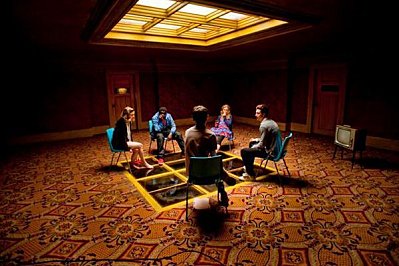
Scene from Chatroom

There are of course, many film and literary representations of the dangers of forging online identities: the thriller Chatroom (2010) stages chatrooms as anonymous hotel rooms, in which teenagers encourage each other to do increasingly disturbing actions in reality, culminating in the most psychopathic character trying to manipulate someone to commit suicide. Jeanette Winterson’s The Power.Book (2000), named after an old Mac computer, delves into the fantasy realm enabled by the Internet, with its chimerical portrayal of a dialogue between two selves (whose names and identities shift). For Winterson, the computer functions as a way of exploring the multiplicity of narratives, the instantaneity of their communication and transformation. Her chapters have names like ‘New Document’ and ‘Search’. Whether she creates a credible Internet Romance (could this be a genre? The Guardian (2000) reviewed it as ‘a virtuoso trip into virtual reality’ ) or a gimmicky spin on vaguely plausible computer jargon is up to the reader. Still, it does link in to Turkle’s ideas about how the Internet has fabricated a postmodern reality of play and possibility.

I’m not sure exactly how much scope MSN offered for that sort of thing. Often, we just used it to chat to our friends as we would in real life. We’d have ‘group convos’ which contained as much shouting (CAPITALS), annoying nudges and confusing dialogue as such a conversation would play out in real life. Sure, maybe we’d open up a bit more online, with the safety of the computer interface. We could tell our secrets to complete strangers, who wouldn’t know our real name and so couldn’t track us down later via Facebook to wreck our lives. We could just block them. So maybe there was a bit of identity ‘play’ there, but mostly it was just an extension of the interactions we had in the park, on the bus, in the playground. It wasn’t a simulated, enclosed environment in the same way a chatroom online is; it wasn’t a specific ‘zone’ – it was a console that you opened up, a kind of tool as opposed to a virtual reality. That’s how it felt to me anyway.

Throughout my teens, Piczo, MySpace and Bebo would come and go, fading into the recesses of an Internet shadow-world that secretly archives every scrap of your self that was once uploaded online. But MSN was faithful, erasing every conversation into the imaginary ether, so that only you could read over previous conversations (if you had ‘chat logs’ switched on; but they certainly weren’t searchable online in the same way your dreadful Piczo account was). MSN was the gateway for many friendships, a forum to vent frustration and a place to play chess with a stranger from America who added you because his cousin knew your friend or something. A place where you got a pleasant kick from signing on and seeing the ghost message of someone who’d tried to talk to you when you were offline. You felt that important. A place of horrific fonts: ‘яσ¢кιи ιи нєανєи, 2кαιι7’ and fondly irritating screennames (my own include ‘Whatsername’ (yes, a riff on Green Day’s American Idiot – I was a twelve-year-old-wannabe-goff) and Maria Magickk (I promise you, I knew people with worse ‘scene’ names than that; also, I thought the double k was a clever reference to the ‘kk’ which everyone substituted for ‘okay’ on MSN. Oh dear.). Now that MSN has been shut down for good in its final resting place and we all have to migrate to Skype (never!), I guess all that’s left for us Generation Y people is the WhatsApps and Snapchats and other gimmicky chat applications that smartphones have brought us. Conversation these days is less about talking and more about sending emoticons and stupid pictures (bah humbug!). For the rest of us, there’s always the excellent nostalgia trip that is the MSN Memories Twitter account: https://twitter.com/MSNmesenger (enjoy).

the dreaded Troubleshoot message

***

Kellaway, Kate, 2000. ‘She’s got the power’ in The Guardian. Available at: <http://www.theguardian.com/books/2000/aug/27/fiction.jeanettewinterson> [Accessed 3.11.14].

Nakata, Hideo, 2010. Chatroom [DVD].

Neopets(!) www.neopets.com [just cause you have to try it]

Turkle, Sherry, 1995. Life on the Screen: Identity in the Age of the Internet (New York: Simon & Schuster).

Winterson, Jeanette, 2000. The Power.Book (London: Vintage).