Falling through Glass


3746713882_eb3e039a09
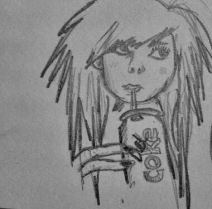
self-portrait//circa 2008

[An essay on anorexia, femininity, adolescent pain & writing the body]

I distinctly remember the first time I watched someone apply liquid liner to their eyes. We stood in the Debenhams toilets before a sheet of unavoidable mirror. She emptied her rucksack of trinkets and tools, drew out a plastic wand with a fine-tip brush and skimmed the gooey ink skilfully over her lids, making curlicues of shimmering turquoise. Her irises were a kind of violent hazel, whose flecks of green seemed to swim against the paler blue. She was very tall and for a while, very thin. She had a nickname, a boyfriend and sometimes she shoplifted; in my head, she was the essence of teenage success. Only later, in the maelstrom of a drunken night out down the beach, do I discover she’s heavily bulimic.

A year or so passes since this first incident, watching my friend slick her eyes with electric blue. I have since learned to ink my own eyes, draw long Egyptian lines that imitate that slender almond shape I long for. My makeup is cheap and smudges. I have grown thinner and people are finally starting to notice.

My mother goes quiet when we do the shopping. She tells me to move out the aisle and I ask what’s wrong. People are staringshe says. I turn around and there they are by the stacks of cereal, mother and daughter, gesturing at my legs and whispering: stick insect, skeleton. A feel a flush of hot pride, akin to the day in primary school when I got everyone to sign my arms with permanent marker—this sudden etching of possession. I am glad I lack this conspiratorial relationship with my own mother, reserving comments on others for the page instead, for my skin. My pain and frustration are communicated bodily: I slink into the shadows, sleeping early, avoiding meals. When people stare, they imbue me with a visibility I desire to erase. I should like better to float around them intangibly, diaphanous, a veil of a name they can’t catch. Instead it rests on everyone’s tongue, thick and severe: anorexic.

It took a week for all the names to fade from my arms; it takes much longer to erase a single label.

In the television series Girls, Lena Dunham’s character reveals that she got tattoos as a teenager because she was putting on weight very quickly and wanted to feel in control of her own body, making fairytale scripture of her skin. In Roald Dahl’s short story, ‘Skin’, an old man gets a famous artist to tattoo the image of a gorgeous woman on his back, the rich pigment of ink like a lustrous ‘impasto’. Years later, art dealers discover his fleshly opus and proceed to barter, literally, on the price of his skin. The story reveals the synecdochical relations between the body, the pen and the value of art. Everything is a piece of something else, skin after skin after skin. In Skins, Cassie Ainsworth gazes into the camera: I hate my thighs. With black marker, she scrawls her name onto her palm; she’s got a smile that lights up, she’s in love. Everyone around her rolls cigarettes, swaps paper skins like scraps of poetry. It feels dirty, the chiaroscuro mood of sunshine and sorrow. Her whole narrative purpose is the spilling of secrets, of human hurt turned to vapour, smoke. Wow, lovely.

For a while, my name mattered less than my skin. There were levels of weight to lose, dress sizes which signified different planes of existence. Over and over, I would listen to ‘4 st. 7lbs’ by the Manic Street Preachers, Richey Edwards’ lyrics spat over a stomach-churning angst of guitar: ‘Self-worth scatters self-esteem’s a bore / I’ve long since moved to a higher plateau’. That summer, ten years ago now, I would walk for hours, the sun on my skin. All the fields stretched out before me like fresh pages of impossibility; my life was a mirage on the flickering sea. I thought of liquid turquoise ink, the friend in the mirror. I started to forget the details of her face, so she blurred into the impressionist portraits I wrote about in school.

Midsummer’s eve; I laid down in one of those fields. With bone-raw fingers, I counted the notches of my spine. Even in free-fall you never feel quite free.

I was obsessed with Richey’s ghost. He disappeared decades ago and they never found evidence of his body. I wanted to evaporate like that, leave my abstracted car somewhere along the motorway; step into the silence of anonymity. Richey wrote screeds of furious notes: ‘I feel like cutting the feet off a ballerina’. There it was: the dark evaporation of resentment and envy. Around this time, Bloc Party released A Weekend in the Citya record that uses Edwards’ lyric to express the racial frustration of being made Other by a racist society. I was acutely aware that the figure of a ballerina, the doll-like white girl, was a divisive source of symbolic desire. We inscribe such societal alignments on the female body, and shamefully I was more than ready to fall into place, to shed the necessary weight. But what I wanted was less the bloody violence of a crippled ballerina, and more the success of erasure.

In Zelda Fitzgerald’s only novel, Save Me the Waltz,the protagonist Alabama trains to be a ballerina late in her twenties, too late to ascend to any real career success. Here was ballet, the pre-adolescent world of waif-thin bodies and she was a mother, a woman—someone who once gave birth, who was strong in flesh. She reaches this frenzied state of beautiful prudence, honing her body to the point where every movement and thought is guided by the waltzing beat, the perfect arabesque: ‘David will bring me some chocolate ice cream and I will throw it up; it smells like a soda fountain, thrown-up, she thought’. I could attest to that. Ben and Jerry’s, swirls of it marbling the toilet bowl, clots of sweetness still clear in your throat. Fitzgerald’s sentences stream towards endless flourish. Alabama makes herself sick with the work, her desire is lustily bulimic. She gets blood poisoning, finds herself hospitalised with tubes in her body, drip-fed and cleansed by the system. I thought of how I wanted to photosynthesise, survive on nothing but air and light. Like a dancer, I was honing my new ascetic life.

Sometimes at night, the old ticker would slow to such a crawl and I thought it would stop in my sleep, sink like a stone. A girl I met on the internet sent me a red-beaded bracelet in the post and in class I’d twirl each plastic, pro-ana ruby, imagining the twist of my own bright sinew as later I’d stretch and click my bones.

I was small, I was sick. I used to write before bed, write a whole sermon’s worth of weight-loss imperatives; often I’d fall asleep mid-sentence and awake to a pool of dark ink, flowering its stain across my sheets. Nausea, of one sort or another, was more or less constant. Waves would dash against my brain, black spots clotting my vision. I moved from one plane or scale to another, reaching for another diuretic. I tried to keep within the lines, keep everything in shape.

Often, however, I thought about water, about things spilling; I drank so much and yet found myself endlessly thirsty. Esther Greenwood in Sylvia Plath’s The Bell Jar, trying to drown, being spat back out by the sea: I am I am I am.

 I’m fine I’m fine I’m fine. The familiar litany.

Something buoyed up, started showing on the surface. People could read the wrongness in the colour of my skin, all that mottled and purpling blood like a contrast dye my body had been dipped in. Against my pallid aquatic hue, I used to envy the warm and luxurious glow of other people’s skin. I sat on a friend’s lap and he freaked out at the jut of my bones. Someone lifted me and we ran down the road laughing and they were like, My god you’re so light. The sycamores were out in full bloom and I realised with a pang it would nearly be autumn. Vaguely I knew soon I would fall like all those leaves.

Anorexia is an austerity of the self. To fast is to practice a refusal, to resist the ideological urge to consume. To swap wasteful packs of pads and tampons for flakeaway skin and hypoglycaemic dreams. Unlike with capitalism, with anorexia you know where everything goes.

The anorexic is constantly calculating. Her day is a series of trades and exchanges: X amount of exercise for X amount of food; how much dinner should I spread around the plate in lieu of eating? It was never enough; nothing ever quite added up. My space-time melted into a continuous present in which I constantly longed for sleep. The past and future had no bearing on me; my increasingly androgynous body wasn’t defined by the usual feminine cycles—life was just existing. This is one of the trickiest things to fix in recovery.

Dark ecologist Timothy Morton says of longing: it’s ‘like depression that melted […] the boundary between sadness and longing is undecidable. Dark and sweet, like good chocolate’. Longing is spiritual and physical; it’s a certain surrender to the beyond, even as it opens strange cavities in the daily. The anorexic’s default existential condition is longing: a condition that is paradoxically indulgent. Longing to be thin, longing for self, dying for both. The world blurs before her eyes, objects take on that auratic sheen of desire. Later, putting myself through meal plans that involved slabs of Green & Black’s, full-fat milk and actual carbs, the dark sweet ooze of depression’s embrace gradually replaced my disordered eating. I wondered if melancholia was something you could prise off, like a skin; I saw its mise-en-abyme in every mirror, a curious, cruel infinitude.

In Aliens and Anorexia, Chris Kraus asks: ‘shouldn’t it be possible to leave the body? Is it wrong to even try?’. What do you do when food is abstracted entirely from appetite? What happens when life becomes a question of pouring yourself, gloop by gloop, into other forms? What is lost in the process?

I started a diary. I wrote with a rich black Indian ink I bought from an art supplies store. The woman at the counter ID’d me, saying she’d recently had teenagers come in to buy the stuff for home tattooing, then tried to blame her later when they all got blood poisoning. Different kinds of ink polluted our blood; I felt an odd solidarity with those kids, remembering the words others had scored on my skin for years. Tattooing yourself, perhaps, was a way of taking those names back. In any case, there was a sense that the ink was like oil, a reserve of energy I was drawing from the deep.

Recovery was trying to breathe underwater; resisting the urge of the quickening tide, striving for an island I couldn’t yet see.

(…What I miss most, maybe, is the driftwood intricacy, the beauty of the sternum in its gaunt, tripart sculpturing. Thinned to the bone, the body becomes elegiac somehow, an artefact of ebbing beauty…)

I think about beef and milk and I think about the bodies of cows and the way the light drips gold on their fields sometimes and how I’d like to curl up in some mossy grove and forget that all of this is happening. Sometimes I worry that my body is capable of making milk, making babies; its design is set up for this nourishing. Hélène Cixous insists women write ‘in white ink’ but I don’t want to be that plump and ripe, that giving. I want scarification, darkness, markings. I want Julia Kristeva’s black sun, an abyss that negates the smudge of identity.

I try to find loveliness in femininity, but my hands are full with hair barrettes, pencils, laxatives, lipstick—just so much material.

As Isabelle Meuret puts it, ‘starving in a world of plenty is a daring challenge’. Anorexia has the highest mortality rate of any mental illness. Recently, I logged onto my Facebook to find an old friend, a girl I’d known vaguely through an online recovery community, had died in hospital. Her heart just gave up in the night. People left consolatory messages on her wall; she was being written already into another existence. Another girl I used to know posts regular photos from her inpatient treatment. She’s very pretty but paper-thin, almost transparent in the flash of a camera. Tubes up her nose like she’s woven into the fabric of the institution, a flower with its sepals fading, drip-fed through stems that aren’t her own. She’s supposed to be at university. I think of Zelda Fitzgerald, of broken ballerinas. A third girl from the recovery forum covers herself in tattoos, challenging you to unlock the myriad stories of symbol. Someone I know in real life gets an orca tattoo in memory of her sea-loving grandfather; she says it helped to externalise the pain. My own body is a pool of inky potential; I cannot fathom its beginning and ending. I wish I could distil my experience into stamps of narrative, the way the tattoo-lovers did. I am always drawing on my face, only to wash the traces away. I must strive for something more permanent.

Recovery, Marya Hornbacher writes in her memoir Wasted,

comes in bits and pieces, and you stitch them together wherever they fit, and when you are done you hold yourself up and there are holes and you are a rag doll, invented, imperfect.
And yet you are all that you have, so you must be enough. There is no other way.

Every meal, every morsel that passes the lips, we tell ourselves: You are okay. You deserve this. Must everything be so earned? Still there is this girl underneath: the one that screams for her meagre dreams, her beautiful form; her starlight and skeletons, her sticks of celery. I try to bury her behind sheet after sheet of glass, lose her in shopfronts, the windows of cars and bathrooms; I daily crush out the bloat of her starched hyperbole, keeping the lines plain and simple. Watching others around me, I try to work out other ways of feeling full, of being free. There is an entry from 2009, scratched in a hand I barely recognise in the final page of a diary: ‘Maybe we are only the sum total of all our reflections’. I wonder what kind of sixteen-year-old wrote this, whether she is happy now and if that matters at all.
“World War III just broke out. And it’s wearing kneesocks”: Power, Privilege, Plotting and the Panopticon in Gossip Girl

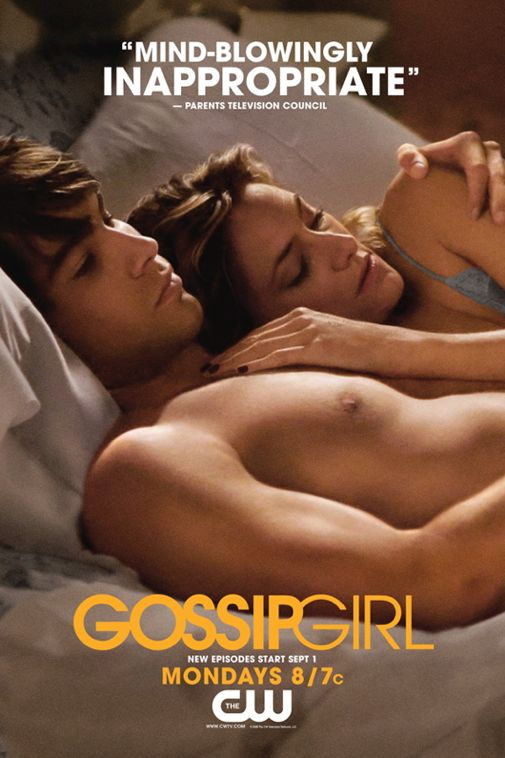
Sex Sells?
Sex Sells?

‘Power floats like money, like language, like theory.’

(Baudrillard, Simulacra and Simulation)

Something happened to me recently and I found myself drifting into the glossy paradise of the Upper East Side; more specifically, that alluring tab on Netflix entitled ‘Gossip Girl’. It’s been a while. I used to watch the show when I was about fifteen, in its heyday. I guess it just slipped away from me and I kind of passed by the whole finale hype back in 2012, but something brought me back to it a few weeks ago. Maybe it was the absence of real-life summer and the promise of a sun-drenched pavement in Manhattan, or maybe it was just Dan Humphrey with his dark mop of curls and deceptively earnest eyes. Maybe it was the cracking soundtrack. Either way, I was struck again by how entrancing the show is, even while it’s kind of terrible.

Déjà vu? I’ve already written an article on Made in Chelsea.

***

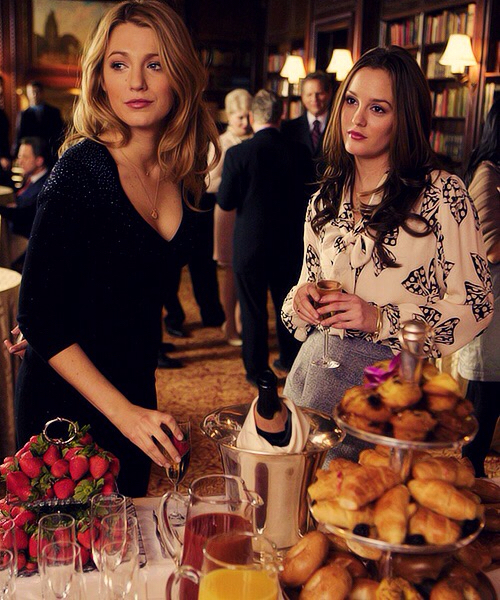
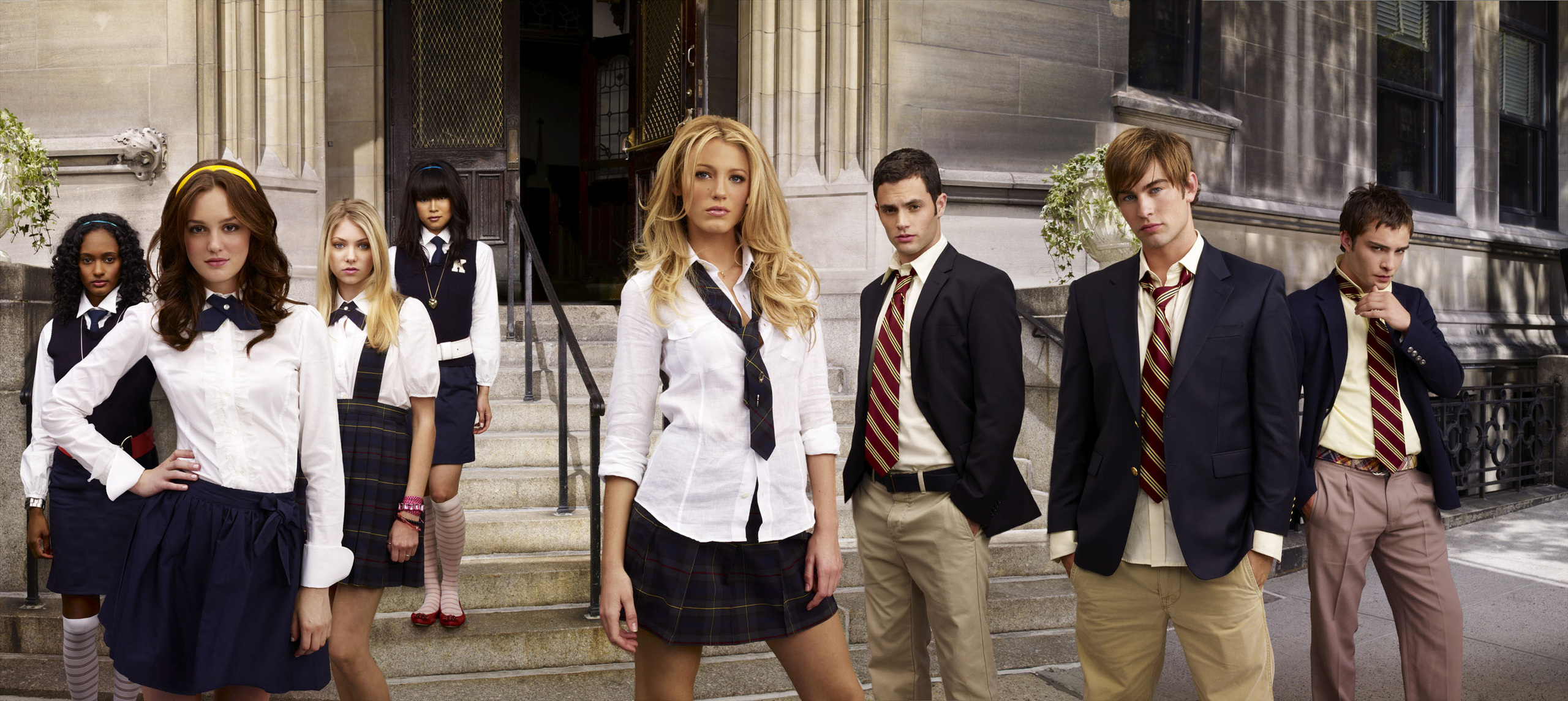
Gossip Girl: The Early Years. | Source: www.thatdesigirl.com
Gossip Girl: The Early Years. | Source: http://www.thatdesigirl.com

Gossip Girl is a show about power. It follows the privileged, glitzy lives of a group of Upper East Siders, from high school into the land of careers and more sophisticated scheming. There is a point round about the end of Season 2 which most critics concede to be the end of ‘good’ Gossip Girl; all subsequent seasons were just a bit daft. We’ve gone from credible high school bitching and scheming to absurdities on a Skins series 5 & 6 scale. How did we get from petty teen drama and pregnancy tests to Bart Bass falling from a roof and Chuck and Blair rushing themselves through a (gorgeously shot) emergency wedding? From Dan Humphrey as amateur school poet to successful penman of a Roman a clef exposing the ‘scandalous lives of Manhattan’s elite’, as Kristen Bell so enticingly describes it at the start of each episode. The link in all this chaos is power. Power and simulacra.

‘You’re nobody until you’re talked about’. That’s the mantra that seems to crop up again and again, haunting the minds of Gossip Girl’s characters like they’re stuck in some bizarre virtual reality where rumour precedes being, scandal precedes survival (see Sartre, ‘existence precedes essence’) – Mean Girls meets Black Mirror, if you will. What distinguishes Gossip Girl from other teen dramas (The O.C, 90210 and so on) is its centring around the concept of ‘Gossip Girl’. Like Foucault’s ‘panopticon’, Gossip Girl is a technology of power. The panopticon was a kind of prison design, created by Jeremy Bentham in the eighteenth century. It was intended to institute the force of surveillance not just on the individual but on society as a whole, so that in a prison each inmate is invisible to others, but visible to the guard station placed in the centre of the prison building. The point is that at any moment, the individual knows he or she is being watched, and will thus adjust their behaviour accordingly. A panoptic way of disciplining is one in which people are controlled through constant surveillance.

It seems pretty obvious that the outcome of Gossip Girl is constant surveillance. Every remotely meaningful action taken by the big-shot Upper East Siders (Serena, Blair, Chuck, Nate, their friends and family) is sent to the Gossip Girl server via anonymous reporters (anyone within or outside of the elite circle) and is then posted as a ‘blast’ which is then communicated straight to everyone’s phones. You know, if it wasn’t so familiar it would sound like something straight out a sci-fi novel. Throughout the show, Gossip Girl doesn’t just record and publish the intimate details of the characters’ lives (think dark secrets, slander and sex tapes) but indeed anticipates things that might happen. Sometimes, characters act a certain way because they are aware of the presence of Gossip Girl, of the probability that their actions will end up exposed through her blasts.

It doesn’t take much to link Gossip Girl to the Twitter generation. The Age of Snapchat, or WhatsApp, or whatever you want to call it. Created in 2007, the show suddenly tapped into a massive cultural shift among young people, whereby our entire lives become archived online, with or without our permission. Yet back in the mid-noughties, we were using Bebo and MySpace to spread gossip and create profiles of ourselves and others. These platforms were still relatively slow, especially as many of us still accessed them via a dialup connection, or by slyly hacking through content blockers at school while the teacher wasn’t looking. Gossip Girl anticipated the sort of instantaneous, life-shattering exchange of information that creates a panopticon effect on our lives. It’s a great plot device (the unravelling of a secret to everyone instigates some serious character crises) but now, in real life, it’s an uncomfortable truth that a nude selfie or a sneaky picture of say your neighbour doing cocaine can indeed be spread around with the ‘blast’ of a single Snapchat message, unravelling reputations in its wake. If, as Baudrillard argues, ‘power floats like money’ it does so because, like money, it is transferable, easily shifted, lost and dissolved. Instant, mass communication arguably makes power more diffused: in one minute it’s in Blair’s hands, then Serena’s and then HEY – Georgina Sparks steps in outta nowhere and suddenly it’s all gone wrong again. These days, you might say similar things about power and global politics.

Dan at his desk... Source: digitalspy.co.uk
Dan at his desk… Source: digitalspy.co.uk

But is it really diffused? Couldn’t you argue that although different people post in to Gossip Girl, ultimately it’s the Wizard of Oz, the soul behind the screen, that controls the gates – isn’t it that one person that has all the power? Just as Mark Zuckerberg ultimately frames all our communications via Facebook? In the end, we discover that (surprise surprise) Dan Humphrey, the main ‘author’ figure, is Gossip Girl. Dan Humphrey, the ‘impoverished’ outsider, exiled in his trendy Brooklyn loft, banished from full membership and relegated to the limbo world where messenger bags meet the glamour of Blair’s Marc Jacobs and Serena’s Prada. Dan started the Gossip Girl site as a way of literally writing himself into the closed world of the Upper East Siders, fashioning the role of ‘Lonely Boy’ within a fairy-tale, Fitzgerald-esque world of vicious scheming, stinking money and glittering mythology. In the end, Dan gets the girl: as the ‘5 Years Later’ epilogue of the final episode so indulgently shows, Dan marries Serena in a beautiful wedding (interestingly enough, his Brooklynite ex-rockstar father gets with – the actual – Lisa Loeb).

You could argue that there is something ‘queer’ about Gossip Girl. An almost Beckettian obsession with repetition and the endless possible combinations of relationships you can achieve within a group (OK, so maybe that’s more Made in Chelsea – or perhaps Sade?).  In a way, Gossip Girl is obsessed with binaries: good girl vs. bad girl; Golden Boy vs. Bad Boy; virgin vs. whore and, perhaps most importantly, truth vs. falsity/appearance vs. reality. Yet these binaries are never sustained, and in fact the show repeatedly reveals the inherent insecurity of these binaries. The innocent Little J is really just the protective adolescent cocoon from which raccoon-eyed rebel Jenny emerges (more dramatically in real life, with Taylor Momsen becoming a risqué rock princess). There is a whole convoluted storyline about Ivy Dickens, who impersonates Charlie Rhodes (Lily Bass’s niece?) who herself is acting as someone else – ‘Lola’. Ivy, now her ‘authentic’ self, enters a relationship with Lily’s husband Rufus, but little does he know that Ivy is actually sleeping with William Bass (Lily’s ex and Serena’s father) who, it turns out, is only in a relationship with Ivy to get (in a roundabout way) back to his ‘true love’ Lily and the kids. The storylines get so elaborate and implausible (Blair meeting and marrying the Prince of Monoco; Bart returning from the dead) that you lose track of what’s real and what’s really happening; you become dissociated from the notion that any of this is really part of ‘our’ world. Even Penn Badgley, the actor who plays Dan Humphrey, admitted that the revelation that Dan was Gossip Girl ‘doesn’t make sense at all’, but that’s kind of okay because (in his words) Gossip Girl doesn’t make sense!’ Sure, New York is always there, in those beautiful, sweeping shots of the city: embracing the characters in its warm glow, looking fantastic in summer, spring, autumn and winter; but the lives of the characters are as twisted, repetitive and as confusing as Samuel Beckett’s television play Quad.

[Imagine this as a symbolic representation of Gossip Girl’s plot. It’s the mesmerising that’s key, not the accurate rendering of reality.]

The queerness, then, (I’m using the term ‘queer’ tenuously, in a more generalised sense – the show can hardly be a banner for LGBT) is in Gossip Girl’s shameless disregard for certain old-school, heteronormative notions of ‘morality’, its distortion of conventional character arcs and its indulgence in various strange sexual affairs which often border on the incestuous (and then there’s that old problem of Serena and Dan and their parents being married for most of the show…). It’s in the fact that characters’ lives seem to follow more of a cyclical than linear path, as they repeat the mistakes of their parents, fall strangely in and out of love while maintaining they were in love the whole time they were also in hate. The whole Blair/Dan/Serena triangle.

Unlike some other shows which run for the length of Gossip Girl, Gossip Girl keeps more or less the same core cast throughout the six seasons, and in doing so transforms its characters into weirdly intangible signifiers rather than ‘real people’. So much of them is based on the need to manipulate the reportage of their lives that we can’t be sure how much we know of their ‘real’ selves. I would like to think that Baudrillard would approve of Gossip Girl much more than The Matrix, because in my opinion, the way Serena, Blair et al plan their lives around the panopticon of Gossip Girl fits pretty well with Baudrillard’s idea of the simulacra as the ‘map that precedes the territory’, the ‘reality’ dependent upon representation. Most of the characters’ actions are driven by and shaped around Gossip Girl: the virtual voice who ‘maps’ the lives of Manhattan’s elite.

There is a point in most TV shows where you are able to gage the protagonists’ motivations, but with several key players, Gossip Girl leaves us endlessly guessing, as some very weird choices leave you baffled about who or what is this person who you thought you knew from Season 1. Chuck, for example, is sometimes romantic softie, sometimes nonchalant alcoholic, sometimes downright psychopath. But that’s the fun of it, the not-knowing, the rollercoaster effect of plot after spiralling plot. A show about scheming; that could be another tagline.

tumblr_nsqdc98osT1qmomweo1_500

A love letter to New York; that could be another tagline. The city is so lovingly rendered throughout the show that even the actual New York mayor got involved with the set of its 100th episode, and declared January 26thGossip Girl Day’. I wonder how I can start incorporating that into my life…perhaps I’ll start with one of those glorious pastry and fruit-filled brunches and then spend all day sipping scotch a la Chuck, kissing boys in classy bars a la Serena and ending up at some expensive party where everything around me is basically the flashbulb remnant of a photograph…or maybe I’ll just live tweet my actual everyday Glasgow observations  – Spotted: Man with a Farmfoods Bag Disappears into the Bookies. It’s hardly Manhattan amidst golden, burnished fall, but it might just have to do.

***

In the final episode, Serena tries to defend Dan’s (pretty immoral) behaviour in acting as Gossip Girl by claiming that his salacious discourse amounts ultimately to a ‘love letter to all of us’. It’s true: all that reporting of all that scandal, all those razor-sharp character assassinations were a form of mythologising which we can recognise not just in celebrity culture, but now in our everyday online lives. Being mean doesn’t just keep ‘em keen, it creates drama, which is what makes any good slice of fiction. And what is life without fiction?  

For all its raciness, Gossip Girl falls into a pretty comfortable conclusion. Two weddings, a (very cute) baby, a potential political career for Nate; it’s all very white, upper-class and generally heterosexually perfect. But that’s what Gossip Girl’s always been shamelessly about: sure, there’s Blair’s ever-present maid, Derota, but she functions more as a Shakespearean comedy sidekick than as a serious addition to the plot. Gossip Girl has never claimed, unlike say Lena Dunham’s Girls, to be ‘the voice of a generation’; it has always zoomed in on the narrow world of a handful of privileged characters. This is its flaw as well as its strength: there is, sadly, little racial/sexual/religious diversity, but when it does touch on such matters, it does so with its own quirky ease, meaning that it doesn’t trip over itself trying to take everything too seriously. There are nuggets of genuine, ‘emotionally truthful’ storylines in there, and real teen issues like losing your virginity, finding yourself stuck in family feuds and trying to make friends are handled sometimes with poignancy, sometimes with juicily gratuitous melodrama. Blair Waldorf’s bulimia is, in a way, a symbolic symptom of the culture she finds herself in: endlessly consuming, lusting for more information, gossip, power, but simultaneously being unable to contain it, needing to purify, purge, rewind the cycle. Dan longs to be part of the world, but at the same time it repels him; he is part of that societal wastage, the baggage once used then left behind – but he uses his limbo position to his advantage. In a way, the American Dream in all its distorted glory is right there, at the heart of Gossip Girl her(him)self.

tumblr_nt01upQpP71t823i1o1_500

What’s great about Gossip Girl, then, is its ability to take us on a whirlwind of artifice, of phony drama for phony characters, but through the falsity it reveals some hideous truths about contemporary society. The network of New York, as a series of public spaces, of upper and lower ‘sides’, is an inverse parallel to the non-hierarchical communications enabled by the Web, where power ‘floats’ more easily as hackers and smart kids from Brooklyn find themselves running the system. There is, in real life, an economy of gossip, whereby what’s been said about you determines your whole place in the world, perhaps even more so than money (sometimes). It runs in the workplace, the playground, the spidery webs of social networks. There’s a line in the final song which plays at the end of the last episode (‘Kill Me’ by The Pretty Reckless, the band headed by Taylor Momsen, aka Jenny Humphrey): ‘someone get me outta the sun’. I read this not just as a statement of Momsen’s goth/vampire credentials, but as an appropriate nudge to The Sun newspaper and by extension the world of gossip, the sunlit limelight which holds the (un?)lucky few up to fame and fortune and ruin.

There will always be an outsider wanting to get inside, Bell narrates provocatively as the last scene drifts over a street of smartly-dressed school kids, the next generation of Gossip Girl victims. It’s classic Gossip Girl: reminding us that even within the cherry sweet containment of its happy ending, there’s a bitter worm still at work. We’re now in an age where you can never live free of the media, of surveillance and all it entails. An unequal age where even the rich in their isles of bliss are never quite free of the rest of us, the outsiders, the mass exiles of our bulimic society – drawn to the alluring world of the beautiful and damned and then expelled because we can’t afford to be there, we don’t belong. And if that’s the end of Gossip Girl’s rollercoaster, then it’s not just a fairground of pure escapism, but also a biting satire on our actual IRL society.

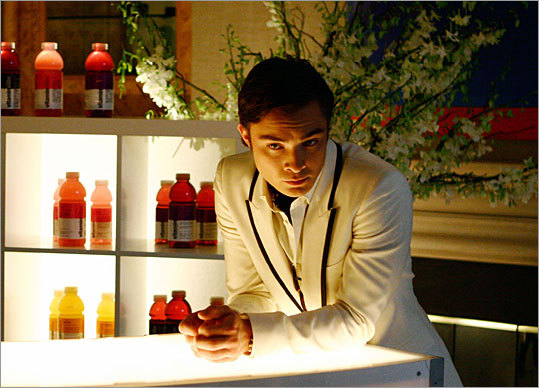
—A satire which, I might add, trickles right down to the shameless flaunting of product placement:

Chuck Bass and some Vitamin Water. Source www.boston.com
Chuck Bass and some Vitamin Water. Source http://www.boston.com

All the Love for Little Comets

Paddington coats are just wonderful, you know?

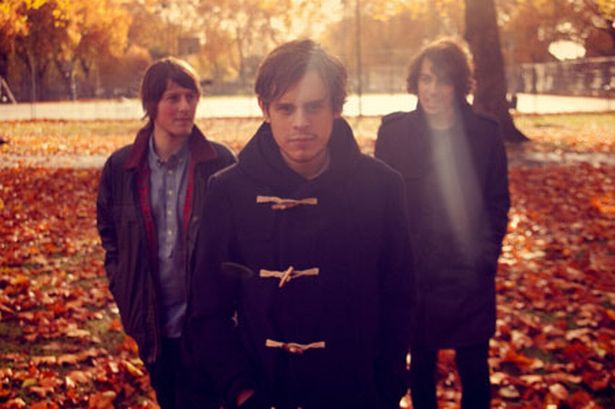
I first saw them at Wickerman Festival, god knows how many years ago now, and we went to see them on recommendation of my brother. It was probably raining a bit but maybe there was sunshine coming out there from behind us as we stood at the stage. I think they were on before or after Fenech Soler, who you should check out if you like electropop, Friendly Fires, White Lies and all things with synths. Anyway, the band in question who we were watching are called Little Comets, and they play what can only really be described with any accuracy as ‘kitchen sink indie’. I’ve seen them so many times since – basically any time they come to Scotland, which is usually twice a year.

A cold windy Glasgow Monday and I’m sitting in Slouch on Bath Street, watching the snow fall down behind a window of fairylights. We’re discussing what songs they might play. We’re reminiscing about old festivals and terrible and great music from the past. The walk to King Tuts is short from here.

I’ve been to King Tuts many a time before. Embarrassing to admit though it is, the first gig I saw there was You Me At Six. There’s an energy to the place that seems to billow about like the dust off the walls. It’s a wonderfully tiny basement venue with clean toilets and a decent bar and lots of posters from bands that have played there before. There’s Belle & Sebastian and The White Stripes and Pulp on the wall. We go down the stairs and the air is close and thick and hot. We watch two support acts, one of which was the Dundee band Model Aeroplanes, who have a nice amount of energy and lots of lovely, floppy, sweaty hair and bouncy guitar riffs. Oh, and we sussed that the bassist looks kind of like Adam Driver from Girls. 

Reasons why I love Little Comets: 

  • They sing about so many different subjects, from adultery to love to fatherhood to sadness and hope and sorrow and domestic violence and corrupt politicians and poverty and girls named Joanna, Matilda and Jennifer.
  • They tour the U.K all the time and always come to Scotland.
  • They write lovely little blog posts about their lyrics.
  • They seem to genuinely care about the music over everything else and even founded their own record label to avoid being sucked into corporate pressures.
  • There are little snippets of poetry which adorn their songs: ‘tension in the twisted silence of our sheets’ (Isles). They like to talk about metaphors and similes and often their songs tell stories.
  • After gigs they sometimes give out cards for fans and they write nice silver messages on EPs when you order them.
  • They sound so tight live, with amazing harmonies and clear, bouncy percussion.
  • ‘Dancing Song’ is just the best thing ever to jump around too, even if it means you’ll get trodden on and elbowed in the ribs by teenage boys.
  • They write political lyrics without being remotely sanctimonious about their status as musicians writing about politics.
  • Their artwork is really cool and they do it themselves.
  • They are maybe the best male feminists in the music industry of this period, at least as far as lyrical content goes. I don’t know, show me anyone better.

LC_bigcartel_sanguine_EP

Well last night they opened with a track off their new album, ‘The Gift of Sound’, which in a corny kind of way was appropriate because that’s what musicians do, give us the gift of sound. They moved through a few new songs off of Hope is Just a State of Mind and also I was pleased to hear them play ‘Isles’ off the first album because it’s been a while since I’ve heard it. The gig was over-14s and standing there behind rows of fourteen-year-old girls and far-too-tall fourteen-year-old guys, listening to those opening lines ‘Economic downturn you can get a job | Apologetic parents you can get a job’ and I’m thinking god I’m so old that when the economic downturn was happening back in 2008 I was about fourteen and probably discovering Little Comets for the first time.

The last couple of Scotland gigs have been in Edinburgh and you could definitely tell that this was a Glasgow crowd. There were a bunch of lads around us who were giving it the ‘oggy-oggy’ football-match style chanting in imitation of the songs which was actually quite sweet (and funny and annoying) and the band looked sort of bemused and taken-aback; Rob at one point finished the song (can’t remember exactly but I think it was ‘Little Italy’) then said in wonder, “nobody’s ever done that before”. I spent half the gig sort of laughing at the absurdity and magic of it all, that strange reaction people have. I mean, it’s amazing to listen to ‘burly’ (haha) young (and middle-aged) guys with tribal tattoos shout out lyrics like: ‘And like for every victim | It seems the pain will not subtract or even calm | All this protracted by a state | In which the poor conviction rate for rape | Can often leave a woman feeling | More at blame than able’. And even if it’s just words being thrown out, at least they’re being thrown out into a room full of likeminded people who believe in the words that the band are singing; even if just for the melodies being woven, even if just because it plants that tiny seed of thought in their heads. It feels empowering, somehow.

Well they fired into well-loved tracks like Joanna and Dancing Song which got everyone jumping about like crazy. One of my favourite things about Little Comets gigs is that you get gorgeous ballads and also songs you can jump about and dance to. I saved my Converses from being pulled off, survived a mosh pit and did my fair share of hair swooshing. It wasn’t all that pleasant being flung against guys who stank of sweat and cheap aftershave and hair that reeked of Chilli Heatwave Doritos, but that’s just a gig curse and the music makes it worth all the stitches.

A highlight was everyone singing along to ‘Coalition of One’, which is probably my favourite track off their last couple of EPs. It’s a song that opens with the lines: ‘food banks spring open | like jaws dropping in time | the weight of man is measured | by the depths of a carrier bag’. It’s simple and powerful and it hits you and makes you think how wrong everything is in the world right now; specifically in Britain. In comparison to the heartbreak-heavy lyrics of other ‘indie’ bands, Little Comets are genius. In fact, you get the sense that people can’t believe they’re singing along to it. It’s almost like a surrealist image, dragging up some common found object and assigning a kind of tragic beauty to it, and then getting such a mix of people to sing it back to you, to throw it out into the air like a lost plastic bag drifting in the wind. There’s a frailty to many of Little Comets’ images: you only have to look at songs like ‘Waiting in the Shadows in the Dead of Night’ (It’s like barbed wire, this crucial touch | That holds me here, expects so much) and ‘Early Retirement’ (‘the promises you sew are | shallow footsteps in the snow | that you cover up’) to feel their concern with the beautiful ephemerality of experience, the soft alliteration that slips between their words. Watching Rob, lead singer and guitarist, standing over his keyboard, drenched in stage smoke and blue light, singing ‘The Blur, the Line, and the Thickest of Onions’, is enchanting and inspiring. I don’t mind throwing those cosy words around because these guys deserve it, they’re so dedicated and passionate. What other band has the guts to take on Robin Thicke-style sexism in the industry with lyrics like this:

But this filth stands on a quicker sand

Next to cold hard fear and the deeds of man

The abuse of body image as a form of control

And the typical portrayal of the feminine role

I have never been more appalled.

Pick me up with rhythms and waveform

That can symbolise a culture lost

Sing about the future like you mean to

I’m never going to count costs

Question the agenda of an industry

That only can objectify

You write about a non-existent blurred line

But not about abortion rights.

OK, so this might not be Mary Wollstonecraft or Virginia Woolf, but for an all-male band to write these lyrics and perform them gig after gig with heartfelt expression is a victory for any kind of feminism in the modern age. It’s questioning an industry from within and writing about issues that are hugely important to women and men – abortion, media objectification and so on – without framing them in a kind of gratuitous ‘pity’ narrative or ignoring them altogether. Music can be political without a band having to tie politics to their t-shirts, and Little Comets demonstrate this perfectly.

Indeed, the feminist content of their lyrics is also evident in ‘Violent Out Tonight’, which I would argue is a masterpiece of a song. With elegant, soaring harmonies (performed so well onstage too), a thumping, emphatic heartbeat of a drum rhythm, and haunting sliding guitar, it conjures a dark story that follows a brutal encounter between a man and a woman on a lonely street. It’s filled with poetry that shifts between the subtle and stark and by the end we too are left bruised and battered by the sad narrative it tells:

As they step into the dark

Only moonlight hides his treason

And the shadows skip like sharks

Through the gasps of air between them

She says: ‘Becalm your hands boy I thought

restraint was now your sentiment of choice?’

But as his fingers strike her blouse

All the words that he espoused

Lie deftly scattered on the ground amidst

the buttons he’s torn open

When sung aloud, the rhyming works here in a really interesting, disturbing and dissonant way. It’s a song that can silence a rowdy crowd into awed absorption. You let the sounds slide through you and you listen, as Rob’s voice ranges from painful constraint to effortless flowing notes. There is a tension and a release. You feel this release with more uplifting songs like the opening track from Hope is Just a State of Mind, ‘My Boy William’, which Rob describes on the Little Comets blog  as ‘really the most emotionally honest song that I’ve ever written, and also one of the simplest – it is just a message to my little boy William: my hopes for him’. You could tell the crowd loved every minute of the gig from all the clapping and shouting and singing along and jumping (might I remind you how rare it is to see people actually dancing at all at an ‘indie’ gig), but especially with these numbers you could tell how much everyone really respected these songs for what they were and the sort of joyful simplicity of innocence they evoke. It’s all fuzzy and you get that great feeling when you’re in a crowd and lots of other people are experiencing similar things to you and even though you might not be a father or mother yourself, you still feel that raw sort of love shine through, in a way that feels uniquely authentic rather than cheesy or sentimental. As the hard-looking bald guy with the tattoos chanted at the end of ‘My Boy William’: ‘he’s going to be a superstar when he grows up, just like you Rob!’. And well, if that’s not cute I don’t know what is.

One of my favourite parts of the night was when they were chatting between songs and Rob said that Matt (the bassist) had just noticed some wires on a bar above the stage which were still there from years ago when they last played. The band used to bring an assortment of pots and pans with them which they hung above the stage and used with their percussion, which I suppose justified the ‘kitchen sink indie’ label in addition to the soap-like drama and domesticity of songs like ‘Adultery’ and ‘One Night in October’ (I’m never going to get over the lines: ‘So I sit her down | And say this must stop | ’Cause all we do | Is argue and shop | She goes to Boots | I go to Argos | Complete with deceit | We stalk each aisle’). Well I thought it was very sweet that this little mark of days gone past was still there, even though King Tuts (mostly the bar) has undergone some renovation since. I remember that gig very vividly; I was in second year at uni and had just finished my horrible essay on The Tempest and Heart of Darkness and I was drinking Jack Daniels alone in my room and doing cartwheels I was so excited. My favourite album so far is the second one, Life is Elsewhere. I think it works best as an album (I need to give the new one some more listening to judge though) and the lyrics are sweetly dark and just the right level of mournful, joyful and sentimental. And I like the line: ‘I’d rather starve than become a member of your old boys’ club’ in a dig at Oxbridge culture which permeates the top levels of governance in Britain. All these songs have a double layered nostalgic quality for me now, reminding me of feeling a bit more lost and hopeful and innocent as I stumbled through my first years at uni. Now I’m coming to the end it feels right that there should be more songs to form associations with. It’s actually pretty weird because they tend to release a new EP with every semester, so it’s almost like a kind of diary where I remember things through Little Comets releases. Oh well, if you’re going to support your memory with techne then maybe it’s better that it’s music from one of your favourite bands rather than just shallow social media statuses…oh well, just my two cents to future generations… (and I should stop trying to understand Heidegger).

It’s also fitting that before their last song (well, I think it was their last song unless there was an encore – which they usually resist doing due to the arrogance and cheesiness of encores – we had to leave early so the troops could get the last train home), Rob was telling the audience that he likes this song because it reminds him of their early days of playing. ‘In Blue Music We Trust’ is one of my favourites off Life is Elsewhere: again it has that haunting, nostalgic quality that builds and swells as the song progresses and proves the perfect ending to an awesome gig. How magical too that it was so cold and crisp outside, and that I walked home through Finnieston in a snow storm with all those swirling flakes glowing orange under the lamplight, and feeling so calm and serene and dreamy because it’s rare that things in life can make you so happy, but I guess good music can, and feeling fresh and freezing after a steaming hot gig.

‘I suppose the thing I am proud of with our music is the fact that we’ve always followed our hearts and stayed true – we do what we love, and we work very hard but we’ve never compromised ourselves for it. If I could pass one message onto my little boy, other than how much we love him, is just to be true to himself and keep an open mind – there’s always more to learn…’ (Little Comets blog).