Thinking about Exams

11205987_10206431692461531_6584269533734853547_n

Exams and I have a fair degree of history together. From that fateful first day in third year when I waited anxiously outside a gym hall to sit my Standard Grade English, to desperately scouring the labyrinth that is Glasgow Uni, trying to find my Honours English Literature exams, or waiting in the rain outside the OTC building, trying not to get run over by passing cars as rain splashed onto my notepad, exams and I have gone through hell and back together.

And they’re a funny thing, exams. Subject to much controversy too, especially in recent years with the dominance of technology over almost all other forms of learning and examination (who hands in a handwritten essay these days? is it even allowed?). Exams suddenly seem awfully old-fashioned. Individual (wobbly) desks, ink spilling everywhere, people writing with fury in an echoey hall. It seems a strange idea, to sit you in a room at the end of the year, thrust a piece of paper in front of you and force you to desperately pour out something resembling an essay in response to a set of unseen questions. I’ve thought about them long and hard over my time at school and college and uni, and come up with some pros and cons:

Pros: 

  • The fear forces you to study, to recap the information learned over your course.
  • The early stages of studying can be fun. You’re relearning and rereading, and in the process making interesting connections between texts, based on a more mature understanding of the course gained from reflection.
  • It can be an opportunity to shine, to show that you can come up with something original in a very short space of time.
  • You learn the value of concision.
  • If the questions are well-designed, the exam can be a true test of your analytical abilities and skill for quick-thinking – there are not many other times when you have the adrenaline necessary to formulate a coherent piece of writing in such a short period.
  • It’s nice to realise that you’ve learned chunks of poetry by heart. Even if they begin to slip away fairly quickly once you’ve left the exam…

Cons: 

  • Risk of being a memory test. While remembering and recalling information is important for lots of subjects from law to physics, English Lit and other humanities subjects is often about critical thinking skills rather than just remembering ‘data’ aka quotes. Lots of students memorise whole essays and go into the exam, then shoehorn and regurgitate what they’ve stored in their head. Sometimes this works, other times it ends badly. Either way, it isn’t testing much more than your ability to write fast and repeat.
  • Anxiety. This is a real problem for some people and can really hinder their performance in an exam, even if they’ve studied hard.
  • Breadth vs. depth. In an essay, with the advantage of time and access to material, it’s a lot easier to formulate a response which balances careful close reading and discussion of relevant secondary criticism and theory. In an exam, it’s too easy to fall back into the trap of plot summaries, even though you’re perfectly capable of analysis. Exams don’t always reflect your ability to synthesise material, or the extent of the research you’ve done.
  • Too much weighting. In my degree, exams are worth 50% of each course grade. There’s a lot of stake in those two hours, and if you have a brain freeze or something goes wrong, you can really drag down all that hard work you put in during the semester.

There are probably lots more, but here are the ones that immediately spring to mind. My solution would be not to scrap exams entirely, but to use them more effectively. Perhaps have mid-term close reading tests, which would examine your ability to respond ‘naturally’ to a text and your critical skills, rather than just your memory. Maybe also a 25% end of term exam, replacing the other 25% with another 3000 word essay. Maybe it will go that way in the future with credit standardisation; some universities don’t have exams for English Literature at all. The problem of course is that unlike subjects such as law and medicine and business, exam conditions are more unlikely to be part of any aspect of a future career sprung from a literary subject. While some jobs will require you to do set tests e.g. solving financial problems as part of the interview process, you are unlikely to encounter something like that in journalism, academia, publishing and so on. An essay with a deadline seems more akin to the work English Lit tends to lead to.

I can’t remember the worst thing that’s ever happened to me in an exam. There’s always that brief five minute panic when ‘your questions’ haven’t come up, and you have to radically rethink your answers and quickly choose a question; but usually in turns out in the end, and often the most spontaneous answers get the best mark. I guess one of the hardest exams I’ve ever done is Higher Music Listening. I mean, it shouldn’t be, but it just seems to be this horrible trail of riddles, where you have to discern different instruments out of tangles of sound in a very short space of time before the clip stops playing. Also, because you have to maintain concentration as a room of people listening to the same tape, your brain gets pretty muddled. And you can get distracted: I was so excited when the tape played The Strangler’s ‘Golden Brown’ that I made such a hasty decision about which rhythm change it contained that I put the wrong answer down. The coding sections of Higher Computing were also tricky, and writing four essays in an hour and a half for Higher Modern Studies is always the bane of your fifth year existence. Every student in Scotland who did languages will probably remember the terrifying voice that blasted the announcement about this being the STANDARD GRADE FRENCH LISTENING exam through the crackly stereo at the back of a gym hall, with all the aggression of someone holding you up in an armed robbery.

***

There was a golden moment towards the end of my last exam, when I realised there was less than ten minutes to go, and I was onto the conclusion, and soon that would be me – done forever. I definitely wouldn’t say that I’ll miss exams (hopefully, I’ll never have to do one again unless I decide to take up driving), but there’s something completely rewarding about the adrenaline rush and the nerves and the exhausting release afterwards that seems pretty unique. A bit like doing the Olympics, but for your brain (and your wrist). To anyone who still has exams to sit, good luck and remember it’s not the end of the world; and ultimately, they are always going to be a somewhat artificial test of your ability!

(Also, I’d love to hear your thoughts on whether exams are a good means of assessment or not for literature-based subjects).
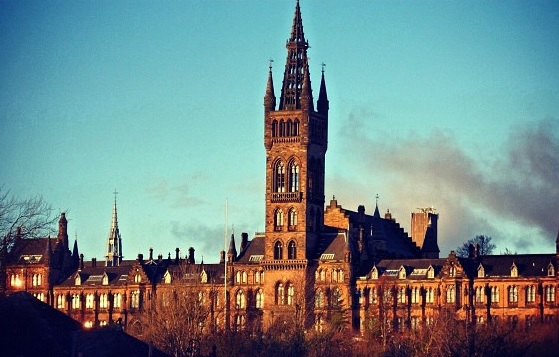
On Finishing University

2

Well yesterday I handed in my final essays: the last pieces of coursework ever in my undergraduate degree. I expected to feel triumphant but instead I felt a little empty and sad and probably nostalgic. After all those years and sleepless nights and thousands of words painstakingly wrought out on laptop screens, it all boils down to two more essays and three exams. And then it’s over.

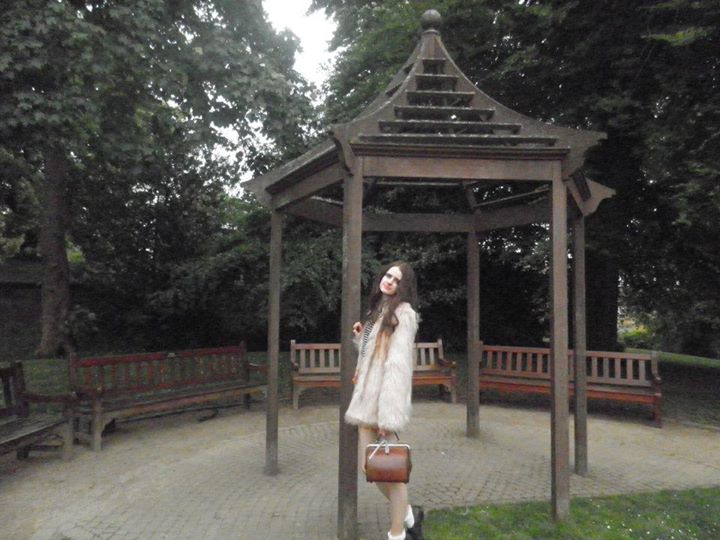
Photo from Fresher's Week!
Photo from Fresher’s Week!

It’s difficult to know where to begin with reflecting about my university experience. Everything is usually divided between academic and social life. Employers and scholars, politicians and journalists all frequently debate which of the two is most useful for getting a job. Any careers event you attend will churn out the hackneyed refrain that ‘university isn’t just about academia’. They encourage you to get involved in societies, sports clubs, volunteering, student media. And all this is great, but we mustn’t completely neglect the whole reason we’re at university – some of us paying thousands of pounds a year to do so – to learn. And this learning isn’t all about getting a job (not for me at least), but about learning for education’s sake – for widening your perspective on the world.

The first essay I had to write was on Descartes for Level 1 philosophy. I believe the question was something like ‘Should we be worried by Descartes’ scepticism?’. This kind of question was a whole new ball-game for me. I was used to plain old terminology like ‘Discuss’, ‘to what extent’ and ‘examine/evaluate’. Not should we be worried? Should we? Are philosophical thought experiments really that important? Of course, the essay question was roundly subjected to confusion and piss-take amongst my fellow first year students, but I suppose it was a good way into a career in philosophy. You know, it was the kind of question that makes you think, that challenges your assumptions about what an essay should do. It’s easy to say that now, but at the time I was pulling my hair out. I remember maybe the worst library session I’ve ever had was one rainy Saturday afternoon, where I stared at a blank screen for four hours straight, glancing from book to book and desperately Google searching everything I meticulously typed up, in case it was similar to something else that had been written.

First years are constantly subjected to sermons on the sins of plagiarism. Whilst this is of course a vital academic lesson, it also makes essay-writing for the paranoid nigh on impossible. I remember for my English Literature essay, I decided to scour the internet for every form of critical interpretation available on my primary texts, just to check that I wasn’t repeating the same arguments as everyone else. I had still to learn that plagiarism is more about intellectual integrity, about learning to reference properly and using existing sources in an original way, than coming up with something that is wholly unique. One thing you learn from English Literature – in fact, probably any arts subject – is that the notion of pure originality is somewhat a myth. And that’s actually liberating, because it takes away the equation of creative genius; you’re suddenly allowed to see how authors frequently influence/borrow/steal/subvert one another’s ideas, and you no longer have to imagine essay-writing as an outpouring of wonderful, effortless analysis. It’s allowed to be a difficult process, built up from hours of reading, planning and collated note-taking. Not just something you fire out in an hour at the back of a high school English class.

To the eighteen-year-old me, that Saturday in the library, I wasn’t quite acquainted with all this. I was sitting next to a boy who was typing away furiously, producing what looked like three essays in the space of a few hours (the time it took me to write one paragraph that I eventually cut from the essay).

Philosophy, to be fair, is a subject notoriously confusing when it comes to essays. It shouldn’t be; it’s just that a philosophy essay is distinct from other kinds of critical analysis that I was familiar with through my hitherto social-sciency background. That tutorial we had, waiting to get our essays back, was really hellish. Everyone was telling each other how badly their friends in other tutorials had done. How harsh the marking was. Nobody knew what a philosophy essay was meant to be. We all expected D’s.

When my tutor read out my student number and I went up to collect my essay, I have never been so pleasantly surprised at a grade. An A3! I can tell you, that was the first and hardest earned A3 I have ever received at university.

The end of first year

Looking back, I think I probably spent most of my first two years at university in a vague state of panic. The thing is, most of the time you have no idea what you’re doing and what’s expected at you (I still don’t, but that’s now a good thing – again, liberating). There are rarely any rigid guidelines, especially in a subject like English Literature, and initially that seems terrifying. You are suddenly surrounded with all these people who went to better schools, all these people who’ve read The Complete Works of Shakespeare and can quote Byron and Shelley off the top of their heads. I would spend whole days in my little dorm room trying to get my head around basic terminology like iambic pentameter, chiasmus, ode, Ottava Rima, trochees, lyrics. I’m still terrible at counting metre in poetry, even though I have a background in music and am perfectly capable of keeping time when there are notes and staves involved. But I like to think that I’ve finally found some kind of ‘footing’ in the mountainous landscape of centuries of literature that I was first confronted with that sunny September in 2011.

As with anything, a big part of university is trial and error. You are going to do better under the guidance of some tutors more than others. You are going to write essays that you aren’t very sure of, and sometimes this will pay off, and sometimes it won’t. There are essays that you feel genuinely proud of, not even for the grade but because you know that all the research that went into them widened your intellectual horizons, and all that editing really did pay off in terms of style. It’s nice when you can read back an essay and not cringe at your choice of phrasing, or all those hiccups in grammar and punctuation. There are going to be nights in the library where you get the fright of your life from the tannoid telling you the reception desk is closing. There are going to be times when the library makes you sick, stressed, exhausted. Like when I had to sit next to a man who was eating raw, mud-covered mushrooms straight from the punnet and dipping them in hummus; or the time when the only computer I could find was next to someone who was licking and slurping the oily remains of his spaghetti from the bottom of a massive plastic tub. Times when there are tears involved; either yours or someone else’s. Fights witnessed and blows exchanged; where else but in the sleep-deprived environment of a university library would two people start brawling over a grubby old Dell with a greasy keyboard?

But then there are the best times, the late nights and early mornings and holidays when the library is lovely and quiet. You are free to roam the endless shelves and pick the desk on level 11 that looks out over a beautiful city view. When you finish an essay and print it and the paper is still warm in your hands as you leave to hand it in. When you stumble across a book that you weren’t exactly looking for, but it’s on long-term loan and looks very interesting.

I guess the semesters go so quickly that you hardly notice the time slipping. Sometimes, they seem like little footnotes to a long and formidable summer, with nothing to do but work and plough through the reading list and wish you had more money. If I could go back and do one thing I guess it would be making more use of my time. But then, I don’t regret all the evenings I spent immersed in journal articles and books, because that’s what’s shaped my mind. Sure, I might not have a degree with immediate career prospects beyond journalism or teaching, but I wouldn’t swap my education for the world. And I’d recommend Glasgow Uni English Lit to anyone, especially because it’s so steeped in critical perspectives and literature beyond the obvious canon. Where else would you start off a second-year semester reading Martin McDonagh’s gruesome play The Pillowman, or have a fourth-year seminar on Gone Girl and a course on Urban Spaces which divides its programme under mysterious headings like ‘Airport’ and ‘Shopping Mall’ rather than the tired titles you see across typical course Moodles. My degree (well, let’s hope I actually get it!) hasn’t just been about Shakespeare and Dickens and Austen, though they have all quite rightly featured. It’s about expanding the canon, and helping you sharpen as well as complicate and reflexively challenge your critical approach to all literature.

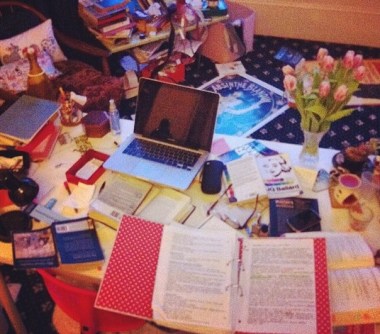
Last year’s exam revision
If anything, I've learned to keep a slightly tidier desk.
If anything, I’ve learned to keep a slightly tidier desk.

On Tuesday morning, it was spring all of a sudden. I walked to campus feeling warm and happy, remembering the first spring I spent in the city. All those daffodils and the cherry blossoms around Hillhead, and the cheerful experience of the semester ending, everyone gathering for picnics at Botanic Gardens. Optimistically sleeveless, I sat on a stone by the Kelvin River reading Keats, feeling like this is what university is best at. The kind of magical experience unfortunately made cliché by campus films. When you’re in the sunshine reading poetry and you’re about to go in for one of your last tutorials. Sure, I still have three nasty exams to get through, but once they’re over, I’ll hopefully come out a little bit smarter, a little bit happier and a tad more employable. University, both at the academic, social and creative level, has definitely been the best experience of my life. I swear I won’t get sentimental; I’ll come back and do a Masters instead. (Let’s hope; if only).

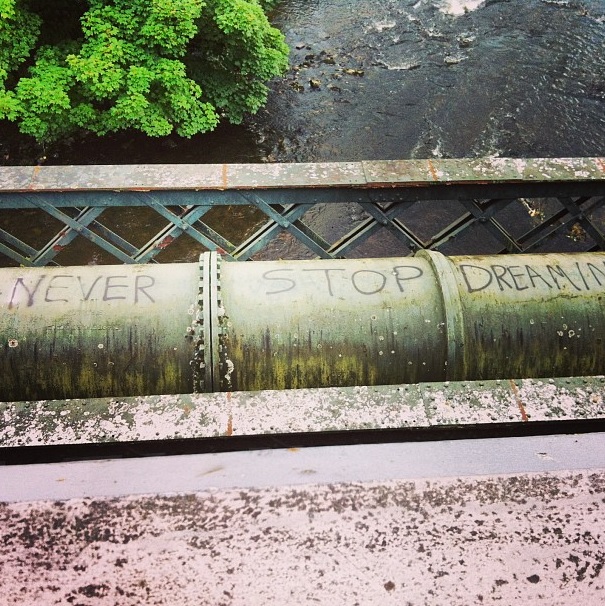
Inspirational Finnieston Pipe (!)