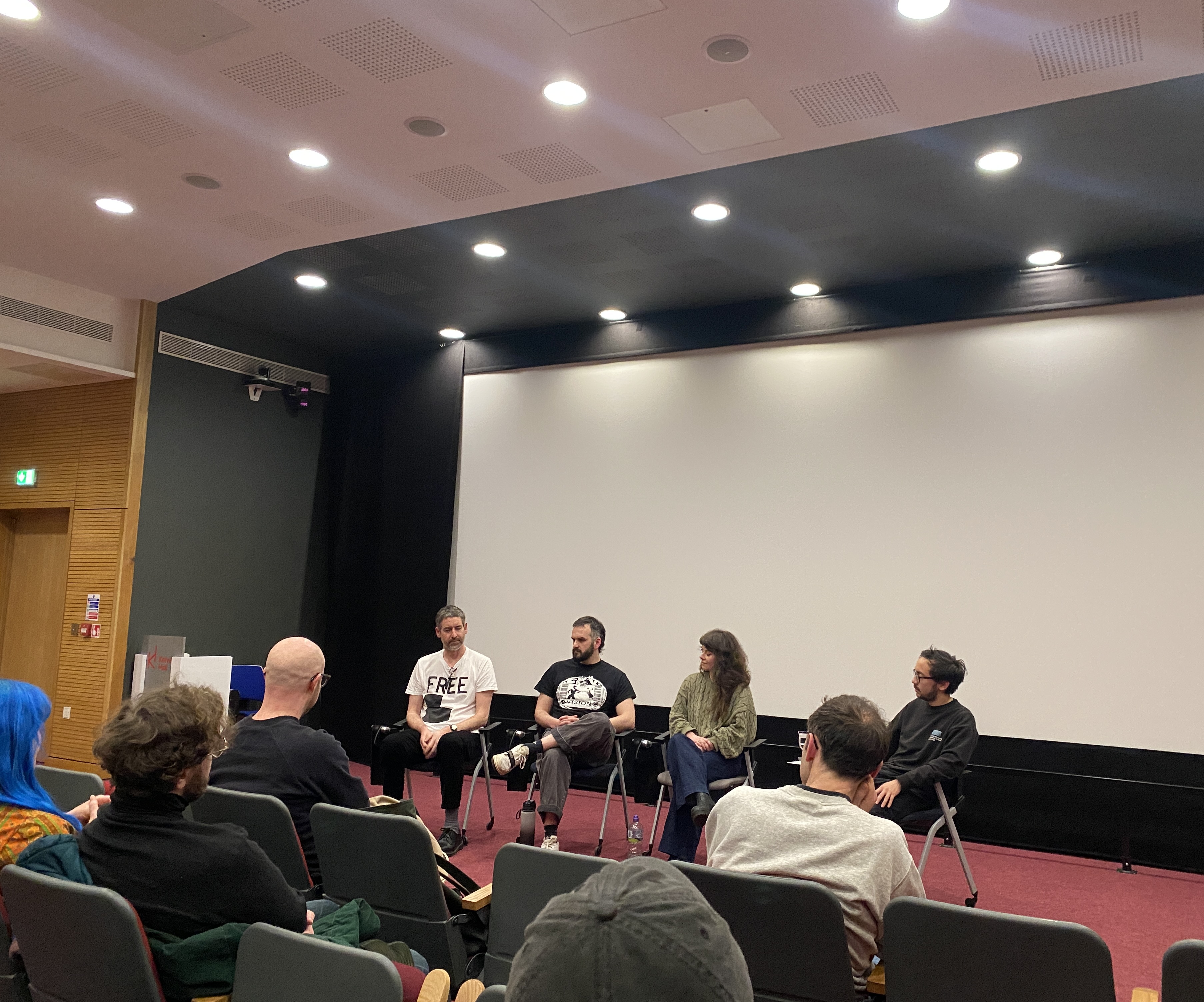
Bringing in the Chaos: I Dream of Wires event with Thinking Culture 19/2/25

(From left, Scott Myles, Lewis Cook, Suzi Cook, Kevin Leomo)

Last night I went to the Thinking Culture event: ‘I Dream of Wires – Film Screening and Panel Discussion’. It’s this film about modular synthesisers and the people who build, use and ultimately love them. Some people collect dozens of these instruments and get scared to record. The studio assemblages are like hyperobjects. It goes from being a musical thing to a techy thing, or this sublime encounter with wires. Some of the talking heads did say they were more like engineers, or more into hardware or just playing around. I found the film inspiring and charming. It was so great to hear from unabashed enthusiasts, some of whom comically shit-talked the digital in a way that was deeply satisfying. Anyone from Trent Reznor to Gary Newman, Legowelt, Doepfer and Modcan. You start seeing the tech itself as this circuitboard for attuning people globally who love something niche in a powerful way. That attunement is also to possibility. The circuitboard after all is an instrument. I loved watching guys hot wire stuff, or whatever it’s called, kind of moving around intricate cables, sparks, connections. It’s one of my favourite things, to let people go off on something they adore in this totally nerdy way. For the love of technicality. The way that the modular synths are more than vintage revivals. 

Afterwards, there was a panel chaired by Kevin Leomo with artist Scott Myles and musicians Suzi Cook and Lewis Cook of the band Free Love, who now run Glasgow Library of Synthesized Sound (GLOSS), the UK’s first electronic musical instrument library. Myles has this exhibition, Head in a Bell, finishing up at GoMA right now, containing the Instrument for the People of Glasgow, a social sculpture made up of donations he blagged from Eurorack synthesiser manufacturers across the world. One of the things that struck me again and again in the film and the discussion was this notion of the social, especially in terms of the civic — that which relates to the duties or activities of folks living in a particular locale. Obviously much of this is urban, but I’m curious about the rural life of the synth (remote cabin studios notwithstanding). 

One thread of the discussion I latched onto was around what is creativity and why does this question matter in the age of AI. Pretty soon, Lewis said, we’re going to have software that can simulate very well a track that sounds like it was recorded on tape in say, 1984. So why bother to make the track. What is the ‘worth’ in that labour, everyone ponders. Lewis, and I’m paraphrasing here, said he likes to come at instruments more as a wilful amateur than from a position of mastery. He talked about ‘approaching an instrument with a kind of naivety’. It would kind of get in the way if he knew everything an instrument does with that technical oversight. I was thinking about the relationship between creativity, play and amateurism (or what we might call newly coming to the thing, being a dabbler, a devotee etc) in terms of the vernacular possibilities of the modular synth. This is all very raw and speculative thinking, as a blog befits. Towards the end of I Dream of Wires, we have a lovely slowed-down shot of children interacting with a modular synthesiser which is placed outside. The effect is almost pastoral: sunlight on young faces, their curiosity blatant, the different colours of their little outfits standing brightly against the cool palette of the tech. The idea being: what would it be like to come at this as children? As well as: what will the musicians of tomorrow do with this tech?

This idea of the vernacular is one I nab from poetry. In Nilling (2012), Lisa Robertson writes:

a vernacular loosely gathers whatever singular words and cadences move a given situation, a given meeting, as it is being lived by its speakers. Characterised […] by wit, excess, plasticity, admixture, surge, caesura, the wildness of a newly turned metaphor, polylinguality and inappropriateness, the vernacular is the name for the native complexity of each beginner as she quickens.

What does it mean to ‘meet’ the technology of the past in the present? We could swap ‘singular words and cadences’ for samples, patches, presets and think about how improvisation turns a kind of ‘wildness’ into the surprise of new genres. Confronting the interface of a modular synthesiser is intimidating but also freeing because it is a machine that gives. And it will make a sound if you physically interact with it. And you keep building on that. In the film, social connection was mentioned again and again. Whether in shots of happy clubbers dancing away, the hands-on interactions of the Superbooth trade fair or in the social hub of Schneidersladen, a legendary synth store in Berlin, the film circles back to the idea that while there is a collector’s market for this stuff, it’s not always locked away. Even the hoarders like to come out and play sometimes, swap tricks or demonstrate. I like Robertson’s phrase ‘the native complexity of each beginner as she quickens’ as a description for what it means to come at an instrument, face on, learning through doing. Quickening. 

The opening question for the panel was ‘When did you first get into electronic music?’ and the answers were a delightful mix of classical training, chance and play. I remember being fourteen trying to play Enter Shikari songs on my friend’s microKORG and this particular instrument being legendary in her self-mythology, like something that landed out of the sky. I remember raucous chiptune gigs, energy drinks, GBX anthems, nineties industrial and the explosive synths of happy hardcore with their Koonsian sheen and total west coast of Scotland Id. I remember how all of this was mediated through hardware: specifically, the Sony Ericsson phone, crackling home computer speakers or the way things sounded IRL massive so much to ring in our ears for days. 

When we think about the transitional moment we are living through, with the accelerated capacities and tentacular reach of artificial intelligence, we should consider what we as human beings want from our creativity. This was a resounding proposition from the panel. The importance of social connection, spontaneity: how just being here at this event was also making me think and write again. The kinds of energy, power, connection you get from being in the room. Scott talked beautifully about how the modular synth was a way of ‘shaping electricity’; that could also form the plasticity of a certain musical vernacular. I thought about whether presets could serve as chronotopes hailing us back and forth in deterritorialised place and time. Again, remaking the vernacular. How creativity doesn’t always need efficiency. Lewis said something interesting about convergence of divergent thought. How you work with the practical and the abstract, sometimes needing a bit of one to go into the other. Efficiency can get in the way of meaning and feeling. You have auto-generated the perfect 2010s Eurobeat song. Now what? Slowing down the process can also quicken the senses. It’s how we get excited. Figuring it out. Connecting. 

Lewis mentioned that some of the guys on the film had a ‘model railway’ vibe about them, the way they collected and connected synths and narrated that practice. It made me think about how that model railway art of making these insular sonic worlds allows for imagination and mind-wandering play, but you then have to actually connect it to the social to get the extra utopian jolt. This can sometimes be intimate and personal: the ‘ecstatic companionship’ (Scott) of listening to drone music. It could also be energising and collective. The music could stay boutique in the studio or it could be this charge, this conduit to reaching others. I like to think about everyone listening to drone in their bedrooms as tuning into some field of collective frequencies, the oceanic feeling of being apart, together. 

Lewis said that one of the goals of GLOSS was to think through how to make a ‘luxury instrument’ available in a wider context, especially in such a divided city as Glasgow. When asked what piece of advice might you give to people interested in making their own electronic music, this is what the panel said (again, paraphrasing):

Suzi: celebrate your changing self and don’t be afraid of warping and letting that shape your practice

Lewis: don’t take yourself too seriously

Scott: always be doing, making sound and music, do it and don’t always try to understand it; keep making stuff and also redoing the thing; don’t be intimidated

Someone, I think Suzi, said ‘part of the balance is bringing in the chaos’. So I will go about my day with that Robertsonian wildness and celebrate indeterminacy, chance encounters, happy accidents.

~

This event was hosted by Thinking Culture. There will be a related gig at QMU in April.

Playlist: August 2019

IMG_8216.JPG

I felt the only thing to do was to write a Book of Rain. I was reading all these San Francisco poets. Sure, you can get detailed climate data on more or less whatever you like, but it meant nothing on its own to me. I looked at the annual hours of sunshine, average precipitation. How many days of rain. I mean you could say Glasgow was like 329 or something. How many days in a year again. I have never been to San Francisco, let alone lost my mind there. Or maybe I have, the latter I mean. I googled what’s a box of rain and it started relaying info on radio access networks, because I’d left out the ‘i’ in rain. Access all radio until the signals run streams in your mind forever. We ran out of the box and into the street. I had a dream someone was coming for me in the bathroom of a restaurant and I had to escape but the floor was ridden with rats. They were beautiful rats made of iridescent glass, and I was nervous about shattering them. Beautiful soundless rats all around. You could drop a box and break them all. The waitress was crying outside because the boss had discovered her glass menagerie. “How beautiful it is and how easily it can be broken” I was murmuring to her, quoting Williams in some echo of what I had wrote in some essay, forever ago. Not for Emma. She was like, “But what is that it of which you speak?” She had a thick Polish accent and the tone of her breath was like full-fat butter, melting inside me, running down the side of the walls of the box. Animal ashes. I tried to give her a key, a single silver key to my office. I was like, you can hide in here and bring all the plants. The plants were also made of glass. There were avocado glasses, lemon glasses, aloe glasses, spider glasses. I’m not saying it was “unrealistic”. She carried them with such tenderness I remembered the names of many friends I’d abandoned to youth. Everything we said in the street outside was set to music. These kind of Vivaldi swoons of violin, with pizzicato flutes from the boys by the roadside, doing parkour. I felt stupid and reached for my cello. She was like, “do you not have a viola d’amore” and I had to demure I did not know. “It’s okay,” she said, “summer is in G minor.” I took off my dress and walked down the street, shrinking. I was waiting for a bracket to scoop me up. Something of her molten voice had shattered the glass heart trembling inside me. But where, but where! Where would I go. Summer is so stressful, those bloody erratic strings. I needed something that felt more like the rain. Soft rain pouring a chord inside me. What they say of the viola d’amore: with sympathetic strings. Whose love are we even soft for. The extra resonance of the rain lent weight to the future. The future auxiliary is. What did he die for. At the end of the rain, the air is composed of cinders. I missed Edinburgh before the Fringe. I was in a bathtub drained of water, lighting cigarette after cigarette and letting the ash pop the bubbles of thought. When I ask the internet of cinders, People also ask: ‘How did Derrida die?’, ‘How many languages did Derrida speak?’.  I want the resilient self-presentation of all this nothing. My mother goes out in relentless rain. I composed a sonnet of the city, it went like All devices lying down and already I’d fucked up the iambs. So I googled it properly, what’s a box of rain. Any morning, any evening, any day. The box of rain is what this is not. I put pressure on the ash to summon a dormitory, the many-bedded archives of sleep. The world is a box of rain. The world is as fugitive as the bubbles of a sad geometry. Whose idea to play. They blew of our world a glass with walls and lid and corners. The rainbowed edges of slender aporia. Container for rain. You could prise open the box, its sticky lid, as though inside you’d find the most opulent yoghurt in the world. Imagine a yoghurt that would fill your belly with billions of tiny, glassy eels. I made of my guts the Hudson River. A lyrical gesture of elements came to count. I can’t listen to the song that makes me so happy I am instantly sad, like being stuck in a dream of a dream where all you can touch is reflection. I had all these stupid lines about gemstones, trying to hold that feeling. Cleavage. It’s existence, you idiot. ‘The reflection / itself’ (Cedar Sigo). They were all swimming inside me and I had a dream about swimming and chlorine depression and all the red sucked clean from my hair. The water would leave me a mousy self to crawl into her former corner. I would let the glass mice eat me like sugar. In the aquarium a sea mouse is pushed quite cruelly towards the water filter by a petulant scampi. Nobody puts baby in the corner but scampi. He was cute though, bug-eyed and orange-pink. Crustaceous slice of sunset, all feelers and limbs. They sometimes add colour to salmon, there’s a whole gradient of petrochemical pellet effects. A dark wild salmon is best. Dark a wildness, swimming. Pure aesthetic pigments. In the café, she spoke of how octopuses feel with colour and then I remembered everything. Everything I loved of your ruddy shade. Politics talking. Glass rats and pint glasses brimming with gold. A clip of the soft, panicky salt of the dark. Then morning relief. I sensed the light through my skin which was also glass, shaved glass reformed into something more convincingly epidermal. I was camouflaged, cold-blooded, cuttled into daily life. I cradled a corner. The eels propelled to the surface and left tiny blots like shingles. I’ve let them swum. I felt sick with all that had happened. In the salon, I read Plath’s Letters Home with my hair in shiny, sci-fi foils. ‘I plan to build up into the lovely creature I really am during the next two weeks’. First blush of ‘“champagne ambrosia”’. The herbal tea in Largs was better. Everyone crusted with salt & waves & exhaustion. Little roses among the leaves, expenses. The silver quality of island light fell on a speech. Someone recited the seasons in tiny, seed-like stanzas. I was handed a hazelnut shaken from the roadside fresh, cracked at the back of my mouth a green sort of sweetness. Yes, Sylvia, it all ‘bear[s] a whirl’. August is almost over. The sympathy of your cephalo-strings. A low kind of aching tremolo, plows through the intertidal zone, the reef, the abyssal depths of later. Paradise froze on a brooch. I had opened the blinds to nothing like light. Your diamonds are studded on tentacles, prodding their way through the window. They were sticky with yesterday’s circadian tears. When I dream, I wake up wanting to see the person. Palm oil on toast. My cutlery grief. People are having sex in swimming pools at Christmas. Tinsel of lindens lining the parks where cats enjoy their kill. A river runs into the sea. I am touched by a terrible language, the jellyfish trying to erase me. There was this wasp, we were trying to eat lunch. My fingers were black with tapenade and wine. You cannot swat this call away. I was a lover in the telephonic sonnet. I need a scholarship to write my Book of Rain. The kind of money that weeps from a nourishing prairie, melts like chocolate. I needed a whole milk scholarship. How to prove I was worth it. There was a green banana, a frazzled conscience, island jealousy. False green money, emoji, insomnia. There was all this ink on my sheets, like an oil spill. I was nobody’s refinery in the dead of the night where life was a story poured out on my shoulder. Oh you are lovely. We have our boxes of rain now, so many. I had not thought the rain would undo so many. Rain overflows its glass. Once again, sand again. It is a crisp apple rain. Held in the ampersand between days. I drew one on my wrist to mark that night where the colours were heavy inside me. I singed the fledgling arrivals of chorus, red-skinned greens. After ‘The Gilded Cunt’, I never looked at a bin-man the same. They are doing the rubbish in the garden in sync. I flung syrup from the window to tint the rain, and all the black bags would glow with gold. We had too much, it was sodden. Woke up at 8:am to find my laptop was streaming a video on pyramids. I watched Lana Del Rey step out of the screen and shake up the car where the cheats make out. Everything became an off-peak day return to the sea. Sunday of twenty-seven degrees. Triangulate clouds to a future point. In my Book of Rain, it’s stopped raining. ‘It’s stopped raining. My fingers graze the yellow flowers beneath my window as I turn back to my desk and write. These past two years have been difficult. I keep thinking of the time I’ve wasted. I was the undergrowth—always underneath taller trees, always wanting’ (Rae Armantrout). I was wearing white and not crying. If you could see my bones underneath. The order mattered not like an emptiness. A sculpted classic of ashes. The rat let out in singular, rain afresh. On your mother’s instruction I hiked in the wild farmland around your dreamhouse to find the Marsh Library, the Library of Marshes. The air smelled of opium incense and late summer pollen and I sat with my brushes, painting false dreams inside the dreams of the movies, and then the dream that held me melted. Directive. Natalie says, I felt cheated. I missed the marshes, required an Air. The broken hyperlink became a book by Nicholas Royle about the plaza of bootleg pdfs and I opened the book which was a sandwich, leaking sweet potato mush onto brown lunch paper. That was so disappointing. I would feed it to the rats; the rain had melted the words into gluten. End of the box of the endless rain. How do we say an object is ‘teeming’. I would bite the brittle stars of September. 


~

Angel Olsen — All Mirrors

Björk — Virus 

Tropic of Cancer — I Woke Up And The Storm Was Over

The Velvet Underground — Venus in Furs (Demo)

Cat Power — Blue (Joni Mitchell cover)

Leonard Cohen — Master Song 

Fionn Regan — Riverside Heights 

Silver Jews — Room Games and Diamond Rain

Sufjan Stevens — All Delighted People

Four Tet — She Moves She

Gross Net — Of Late Capitalism 

Slowdive — Changes (Demo version)

DIIV — Taker

Black Country, New Road — Sunglasses 

Swans — Blind

The Grateful Dead — Box of Rain

Anna Meredith — moonmoons

Big Thief — Not 

Pinegrove — Moment

(Sandy) Alex G — Southern Sky

Nick Drake — Northern Sky 

Lana Del Rey — Bartender 

Red House Painters — Medicine Bottle

Jeff Buckley — Sky Blue Skin

Weyes Blood — Away Above