1993: the birth of the Web

Daily writing prompt
Share what you know about the year you were born.
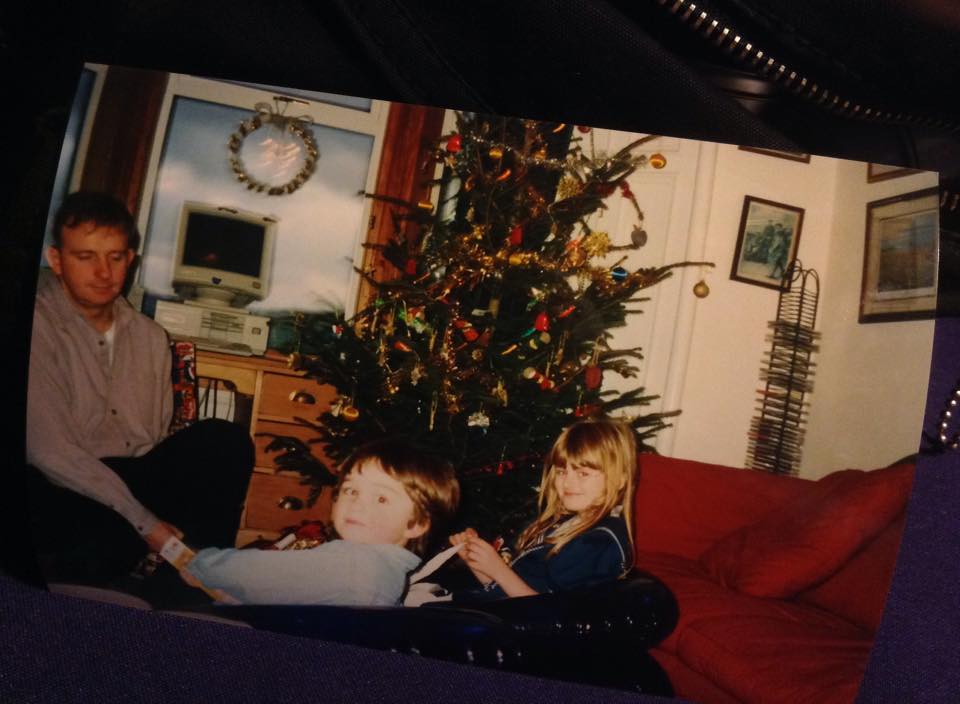
My dad, brother and I at home in the 1990s, overlooked by a magisterial PC

In 1993, the World Wide Web was released into the public domain. There are many histories of the internet and this one is pretty idiosyncratic. I like asking people when they got their first desktop computer. The internet of 1993 could be navigated through bright blue hyperlinks and you would drift between websites. You would type stuff into AskJeeves and have no idea what to expect. At school we had a ‘passport to the Web’ certificate that could be obtained by completing numerous training activities on a twee little software whose name I forgot. It was something like ‘CyberKids’ though surely that is a New York City raver subculture from a time not yet captured by the sleazification of all things indie 2000s. I imagine it was superior to the present Cyber Security Training on offer, in which actors pretend to discover pen drives in the street, gleefully insert them into work desktops only to find their screen literally blowing up in front of them. Nowadays, cyber security training is less about don’t talk to strangers and more about change your passwords regularly. I have a lot of floaty metaphors for the password changing which seem to all include underwear or car parts. Passwords though are pretty boring, clunky things but they’re also gauzy ephemera. Pieces of secret unlocking. Recently I spent an entire Sunday trying to unlock a 2011 MacBook. The password, when I found it again, accessing the deepest recesses of abstract memory, was unforgivably cherishable. I’ll keep it forever like a pet (I’ve already forgotten it).

I keep thinking about ressentiment as a sensation produced by the internet. I mean the internet’s failure. When I was a child, I adored the internet. Once we’d upgraded from dial-up, I would spend upwards of 12-14 hours almost nonstop on forums, games, LiveJournal, websites. I gravitated naturally from the virtual worlds of the Game Boy to the bigger screen of the laptop. Before I was even allowed internet access, I would simulate them by making endlessly complicated Powerpoints and Microsoft Publisher pages which connected to one another like a crude open world. I was beset by RAM crashes and Wi-Fi outages. We didn’t have broadband for a very very long time. My dad was one of the first in the village to have it. I would write letters to the broadband guy pretending to be my dad complaining about the speed of the internet. When I go back to the Shire now, I say things like ‘the internet here is ass’. I can’t get 4G at the semi-demolished and barely functioning station. We can’t find out if our train will come or not. We communicate as a brooding micro crowd, frowning and looking anxiously towards digitised screens whose flicker says only ‘delay’. There are no staff. The staff hide in a crisis. I can relate.

Ressentiment – deep hostility combined with powerlessness. The promise of an open world, a generous future, seems rotten. We hate it. It’s failed us. The sheen of that; it keeps nicking us like a pen knife writing sentences on the skin of our hard-worn feet. We can’t even quit the platforms, can we? The implied ‘we’ of a web community is now an absurdity. What have we seen of the Web in thirty years? Unimaginable horrors. Nevertheless, the perambulations continue.

Right now, I’m deeply interested in the dissonance between how we feel the internet ought to be structured, how it almost was, and what it’s become. The dream metaphors we might use for how it once felt to drift between websites, stumbling upon weirdness after weirdness, unlocking more zones of reality. This versus the algorithmic governmentality and corporate monopolies, ‘technofeudalism’ (Varoufakis) and the appification of it all. I think I got interested in poetry right around the time I fell out of love with the internet (2015). I would memorise passages of Charlotte Smith’s sonnets and learn to swoon over Keats. I felt there was something in the shifting stanzas, the intricacies of form, the dazzling surprises it produced and the infuriating difficulties of grasping the source code — a connection.

I still use the term ‘post-internet’ because I want to believe you can take what Tavi Gevinson in 2018 called ‘The utopian ideal of the internet’ and polish its ‘antiquated’ remains. You can still feel the affective charge of every Web-related signifier that has brushed your life. You can be desensitised to ‘internet discourse’ through the media proliferation of tales of digitality, its foreclosures of democracy, its moral flops, its proliferating conspiracies. But there are parts of you irrevocably brought alive by the internet. I am haunted by digital solastalgia. As a child who felt out of place, abjected from the beginning, I sought the Web as a place not for social belonging exactly but something more like beauty, information, elsewhere. I found little pockets of home all over the place. The web (I’ll stop capitalising now and step out of History) was an extension of the fictional landscapes I found in my dreams or when walking around, making up novels in my head which I did every day until I hit puberty and hormones ruined my brain forever (or whatever). I don’t really know where to find those places any more. They weren’t just artefacts and I know this because you can’t produce a screenshot of a website from 2003 and experience a sweet pleasing nostalgia in the way you could with say, a beanie baby. It was something about the world of it all, the navigation, the desire paths forged to get there. The post-internet, for me, is a lifelong quest in understanding that melancholia and homesickness of what comes after. What do I do with the feeling of ‘we can’t go back there, where do we go now?’. All this time, have I used the web itself as some elaborate metaphor for wanting more than a hostile, futile reality? It’s why I like infrastructure, databases, libraries: the promises of systems which take you somewhere. Which transit something. I also love loops, links and non-linearity.

What was the poetry that got me into poetry? It was Romantic in flavour, sometimes in era. Something between the locatedness and dislocatedness, the attention to daily life, the catapulting scale logic of the sublime, the dogged attempt to render the brain on Nature, the melancholy and mourning, the quiet adoringness, the slow accumulation of elements, the sense of quest, pilgrimage, the unexpected visitor at the door. The everpresence of something more mysterious than could easily be folded into waking life. The delicious fug of opium and promise of a language capable of killing pain. The shimmering excess. The imaginative extremities and morbid dullness of Romanticism were necessary supplements to what the web had done for my childhood.

I’ve been dwelling on this quote awhile, from a Spike article about ‘What’s after Post-Internet Art?’:

The technoromantic reimagines posting as liturgy, algorithms as messengers, and artists as saints. They reach into a glorified past for motifs and meaning that invoke the aura of life before memes.Their aesthetic flirtation with the materiality of technology is a double-edged sword, however, that blurs the lines between critique and commodity fetishization. The stakes for this ambivalence are high at a time when capitalist technology is threatening human dignity and agency. Do we really want to engender an emotional attachment to the internet?

Is the function of art to engender the emotional attachment or to transmute its energies into something other? In my day job, I spend almost a whole day a week dealing with academic misconduct cases relating to the plagiarism and hallucinations of Generative-AI. I am supposed to come up with ethical and interesting ways to engage new technology in the classroom, but I fantasise about whole server forms blowing up or quietly being sucked back into the toothpaste tube of Silicon Valley, as if none of this ever happened. At the same time, with two close family members currently undergoing heavy duty cancer treatment, I marvel at the wonders of modern medicine. I think about what Tracey Emin said when asked by Louis Theroux what she thought of AI, or whether there was room for AI art in the world. She says ‘thanks to robots […] that’s another reason why I’m still sitting here’ [presumably due to AI’s role in innovations in cancer treatment and her own recent experience of this]. She’s also like, ‘In terms of art, AI doesn’t really sit well with me, especially when I’m a compulsive, passionate, hot-blooded person who paints’. The contradictions of my feelings about machines get more extreme by the week. I feel born into this contradiction. It’s maybe why my former work twin Nigel would always leave old copies of Wired at my desk.

Does all poetry written after the ‘post-internet moment’ also risk the commodity fetishisation mentioned above? Insofar as it betrays its own lovingness towards the technology it otherwise seeks to critique? Do we want an archness of superior distance or can we do something else with that self-awareness? I think the affect touched upon by Kat Kitay’s piece in Spike is Romantic irony, you know when you realise the narrator is caught up in the situation being described. The Romantic poet speaker discovers they are also a character in the poem. There’s a kind of turn. Timothy Morton uses Blade Runner as a classic example of this, you know when Deckard realises he’s a replicant. Being asked the question, what do you know about the year you were born, for me is like being asked what do you know about what happened to the web? My life is a character in the web’s and the web is a character in my life. What’s the poem here? The continuous mess of everything enmeshed, written, performed, dialogued, deleted, drawn and coded in my lifetime. I have a hot-blooded relationship to the internet. It makes my fucking eyes twitch.

Is transmutation an alternative to merely engendering feeling? I like the word transmutation because I learned it from the great poet Will Alexander. It’s also used by Ariana Reines a lot. We’re thinking here about alchemical transformations in the realm of language, feeling, sensing. I want a poetry that is able to metabolise impossible feelings and in doing so, fuel its reader to think anew. Do I reassign the pain of childhood, the loss of some otherworldly dream, onto the external scapegoat of an enshitified internet? Is that okay? I think about all the times our art teacher made us sit at PCs unconnected to WiFi writing about the design of vintage radios and speaker technology. We had no access to books, the web or other resources to find out more about the designs displayed to us. So in lieu of history or context, we wrote acute, proliferating descriptions of what we saw. What it reminded us of. We found endless vocabularies for edges, colours, surfaces, affordances. This mind-numbing two hours a week was a little oasis from digital supplementarity. A cool, replenishing retreat from external stimulation. We sat on hard, tall stools and typed on clacky keyboards. A tiny little art factory. I had only my brain and the image. I didn’t know it at the time but I was learning that ekphrasis can have a communicative and transformative function. I wrote through the notion of writing about radios to escape the moment where I was supposed to be writing about radios. This did not prepare me for my Art & Design exam so much as it prepared me for poetry.

What do I do with my hatred of the internet? My yearning for it? I write poetry because poetry is a cheap form of that dream architecture I so longed for, all of my life, and I felt good making/using/playing. Marie Buck has a poem that says ‘The point of reading is asynchronous intimacy, and hopefully it works forever’. I said this to my colleague Rodge last week, when we were having one of our regular moments of private despair, and he prints it out and now it’s on the wall of my office. When I look at it I think about all the books out there and all the interesting things I’ve read on the internet and how connected I feel to other worlds. I just have to keep that connection going. I will never know what it’s like to have not been online.

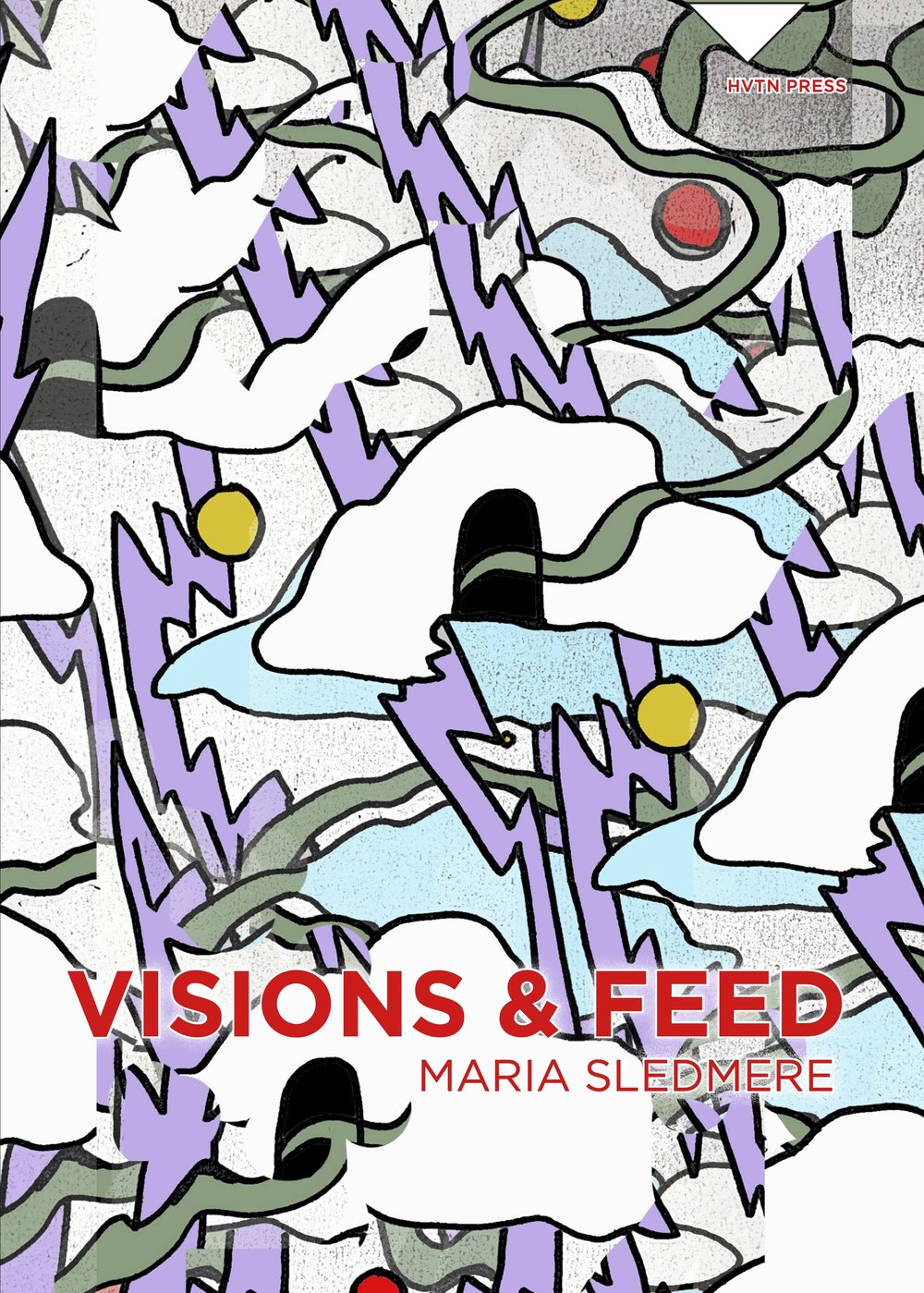
Visions & Feed preorder

£10.99

Coming December 2022 with HVTN Press

Visions & Feed is a collection that spans over two years of work brought together under the mirror phase of an anthropocene lyric filtered through crises of femininity, disordered eating, dysmorphia, labour and loss.

Sledmere asks: what does it mean to be a body in one of many dying worlds, what forms of work are done to endure it, what desires and pleasures are still possible and which are breaking down? Adopting playful and associative registers of ascent, while exploring devotion, metabolism, magic, domesticity and the ambience of dream forms, this is an intimate poetics of song and hormone, isolation and longing, fashion and pop, colour and vision in the saturated live feed of post-internet lyric. Amidst the reverb of climate melancholia and oestrogen blues, the speakers of Visions & Feed morph between depth and surface, film and music, myth and play to weather the days. Between epistolary, elegiac, confessional, ekphrastic, prose-poetic, processual, discursive and long-form cascades, the book offers iterative, experimental and fractal modes for exploring ecological entanglement within daily life.

PREORDER NOW 🙂

This is my second full-length collection, following 2021’s The Luna Erratum. Many of these poems were written during lockdown or in the stretch of long afternoons at the tail end of big critical work that had occupied me for several years. I was immersed in dream and the idea of symbolic disclosure in poetry, lyrical shatterings and seeing oneself forever through glass, never clearly. Through a glass redly, purply, wrong. It begins with an epigraph from Maggie O’Sullivan’s Palace of Reptiles (2003): ‘A glazier walks through the earth calling the ruins strapped / on his back an angel’. How can poetry fit ruins into any transcendent firmament when the shards are still stuck in its back? I was admiring the glazier from afar wanting him to fix me. Suzanna Slack writes in The Shedding (2022) of ‘trying to have angel surgery’. In this book, my speaker seems to want a stomach replaced by clouds and to rain forever, why is that? I was born in a lightning storm with a lilac tongue and ate the suns like smarties. Fine. Very mild, even warm. To become glint in general felicity. Giving a zoo charm. Zooming.

New website!

At long last, I built a website: kaleidoscopic arcadia for keeping up-to-date with current work in the terrain of the written and visual. It’s still under construction, perhaps in a permo state of flux, but otherwise functional. I’ll keep the website updated with records of publications, workshops, teaching and the like. It’s also the home of a micro-publisher, Mermaid Motel, and various prints, publications and other artworks will be available for sale there. I’ll still be using this blog for BLOGGING PURPOSES (<3) but please check out the website for other things. :’)

Visit me: mariasledmere.com 🌐

Meadow Fractals for A Soft Landing

Sam Williams’ project, A Soft Landing, is ‘an online resource inspired by the activity of communal gardens and city allotments. It is a space where volunteers are invited to share, learn, contribute and care for themselves and others, through the sharing of material that could be used for nourishment, growth, pleasure, education or healing’.

I like this website because it’s what I want from the internet, a place to share and graft and cut and paste, to nourish and discover something unexpected. You tend a little plot and see what grows from it. I used to live near Woodlands Community Garden and loved seeing the flora and fauna change throughout the seasons, people volunteering, pulling out weeds and planting. Something of A Soft Landing is in this spirit: you might get asked to respond or contribute, you might volunteer yourself. You never really know what might crop up in the meantime, which is why there’s a satisfying ethic to ‘checking back’.

I’m happy to find a home for an ongoing and incomplete series, Meadow Fractals, among the leaf matter and stems of other makers. It features a sestina after Kevin Killian (and isn’t the sestina the most fractal traditional form?), plus some weird and tessellating meadow illustrations done on an MS Paint simulator. Long live Paint. You can find the full selection at a-soft-landing.com (look for the dark grey tendrils).

In recent months, I’ve also been reading Sean Roy Parker’s Fermental Health substack, which has got me excited about blogging, and even food again. Do have a read! 🌱

A Breath

A BREATH


Writing in the gloaming I would even call meadow, its scorched-out centre you can probably see from a helicopter, a drone, should you choose the option of aerial photography and remote capture in a time of social distancing. Should you have access to that tech, perhaps in a speculative way; should you have access, the way children have access because they discuss so thoroughly the possibilities, and they do this illicitly into the night. My excellent stenography skills, if we are calling this shorthand, were honed from adolescent hours on Microsoft Instant Messenger, affectionately known as MSN. Any one of us born in that particular bracket of the fin de siècle will understand what it means to spend time in one’s room alone, not quite as in ‘Adam’s Song’, but touching the void through sign-ins, statuses, emoticons, nudges. To live in the delirium of many glimmering windows. I wanted to call you up from my bower, listening to ‘Lime Tree’ on repeat because it carries me away; I wanted to call you up, but could I bear to put down my pen for this. You will never know if I am writing or typing; ‘this kind of thing’ bears no performative ellipsis. Had I known anyway what you would say, as someone who needs access to their own face to talk, something is coming away for free. We have been watching each other watch our own expressions: as with emoticons, each manner of the face feels curated. Some of us collapse on the phone. In the fractal reality of self-isolation, I divvy up zoomy contingencies of speech. When was the last time I talked without seeing my own face. Deleuze and Guattari argue that faces ‘define zones of frequency or probability’: the face ‘constructs the wall that the signifier needs in order to bounce off of’. Hoping to give you a meadow — multifarious and mysterious plenty — I yet give you the wall or the screen. A zoomy contingency that you are happy, that you had signed out of the chat. Against it I file down my voice to its lower registers, taking the edge off an earnestness. If you could measure the frequency of sleep, perhaps architects of the dream-state would salve the true riddles of twenty-first century expression. I wanted to call you up with a slow, perfected drawl, relay how I was hanging upside down from my bower. How I imagine the song to end is a very beautiful flower, floating down the river, but that is only how the song begins. It really ends with a daydream, ‘now that living is no good’, and the singer is lost and found as they enter the woods, barefoot like a child. Why am I telling you all this, barefoot like a child, now that I cannot tell the woods from the trees in my nameless life. And Coleridge sings, this lime tree my prison, my prison / feels like prism. If a wood haloed the meadow, if a moat, if a liquid loop — arboreal, molten, stupid. Walking in the scorched-out meadow an hour or more to be here, sometimes dreaming of this place, needing to be here — no longer a meadow for having been burned. What occurred to ruin the centre. I want to bounce, bounce, bounce with it. All my friends active now and forever. I stumble on the grammar of an instant; are you online, are you online in the meadow, I am calling you up to say this. I am checking-in, the way people used to on Facebook. What is the name of this place? The meadow goes undocumented. What is the probability that your face means the shape of a grassland, a patch of unruly narcissi, a noticing gesture that I would say I have been here before. At least in dreams. Someone is trying to brand the meadow. In quarantine, my old longing for those messaging days recurs. We all talked on that singular platform, confessed under pseudonyms, and ever since I have been lost in the trees of each channel — their foliage concealing the one true thing. Someone is trying to sell the meadow. Infinite recursion of memes and secrets and finance. There was a purity to MSN, something about its frequency. Namelessness. You see what I mean? Sometimes in the poem, I mean the scorched-out cindering middle of the poem, you take grace enough to say fuck it, hiya, wait, no, I can’t hear you. You hold ‘us’ in brackets. If I could timestamp the start to end of that, like debt. One time C. messaged me on Instagram to ask what is really meant by the gloaming. What time of day was this asked, did that matter? I think gloaming would be different at four in the morning to noon; but what did I give as reply? A quick skim of the platforms comes up with nothing. Besides, soon my battery will die in the old archaeology of dissolving thought. There was a purpose in calling you up for this, and now ants are crawling all over my notebook. Nothing has touched me for weeks. I want to say I have a lascivious craving for seaweed flakes, tousled hair, disco kisses, regular breakfasts, offline status, cetirizine, romance and saffron cakes. I have been touching nothing; lately asking myself what is it we do that makes us fruit. The blossoms are stirring on Montague Street. And you click and collect, you drag us backwards. I know that faceless, somewhere you construct the wall. Last night I ran down Great Western Road, my Spotify shuffling back to ‘Adam’s Song’, ‘Tomorrow holds such better days’. I felt burdened by the days inside the days, their seeming neon-fold, ‘the time goes by’ in the flicker of your eyelid. Because my eyes are screen-burned, hot-taken, hypothetical, exhausted; because my eyes looked too long at the meadow. Its torrified heart reduced to this logo. Because your eyes held green astride creamy lindens, to only open the same elsewhere, ‘No sound is dissonant which tells of Life’, etc. I was overwhelmed by the sweetness of power chords, the lines about apple juice spilled in the hall, harmony, the burden of a loss the size of adolescence itself. St. John’s Wort doled in the morning, soft-bitter ersatz taste of the sunlight and sensitive. I have no heart for war but air. How did I get here, on the brink of my phone battery’s untimely death, filling my notebook in the moonless April? Otherwise it would happen, haze, my father posting endless on his wall, unbeknownst to the standard quota expected on the book of the face. This feels so banal and yet I am telling you the grass is beautiful, endless, strange. Marigolds cluster around glitching trees, impossible to reach. If I could I would give you a pool of marigolds. Only just realised pool is loop backwards. Yellow and / I drag into blue and backwards to call you. I’m sorry I’ve been listening to ‘Lime Tree’ again — it’s just that this song came out in 2007, I was only fourteen, yellow + blue make green, I was starving and ever since then I’ve thought of this story. Something you could cut out from inside you, could burn from the meadow. A little kernel of narrative you tap with your tongue and your teeth, you give to me slowly. I want to leave the message to assure you, ‘It’s done’. Would you know I was talking about the disease? I was coming down from my bower, coming down, breezeless and sleepy, wishing I could call you up and quote the line, ‘Don’t be so amazing / Or I’ll miss you too much’. I wish I could climb through a window to see you, smooth myself right through the glass. Could I miss what I had not yet touched, in April’s middling haze of something receding. All those years you had told me to eat. Oh you know and you know and you don’t. Remember those hours? If we could give them back, little gifts of death, as Derrida says, like an ethics. It’s only me. I’m sorry if calling freaked you out from inside the machine. What I wanted to say was, it made me ecstatic, on GWR, zoomy the song and the voice and I could see Venus so bright in the sky. And the sky was rich as ganache, thick filled with more sky; Matty would say like chocolate, or saffron, or debt. Such a spooky ecstasy! (<3) The calorific night…I write you this so as to cut into it, hazy, reflecting, give you a slice of my dreams. Whatever anyone says feels charged with history, so I want this to be utterly redundant, depletable, delectable, careless as crossing the road without cars in the city that now never wakes or sleeps, but only deletes. The adventitious device, zoning close to us, is taking a photo. Is this a kind of labour. There are such archives beyond access they try for. Here, I will be always the small green light in lieu of a meadow, the lyrical unfinishing of cringe to know this. A breath I took / You can just call me up. 

— 17th April 2020

Mining the Light: My Time in Orkney


IMG_3289.JPG

I always have this sensation, descending the steps at Edinburgh’s Waverley Station, of narratives colliding. It’s a kind of acute deja vu, where several selves are pelting it down for the last train, or gliding idly at the end point of an evening, not quite ready for the journey home. The version that is me glows inwardly translucent, lets in the early morning light, as though she might photosynthesise. I remember this Roddy Woomble song, from his first album, the one that was sorrow, and was Scotland, through and through as a bowl of salted porridge, of sickly sugared Irn Bru. ‘Waverley Steps’, with its opening line, ‘If there’s no geography / in the things that we say’. Every word, I realise, is a situation. Alighting, departing; deferring or arriving. It’s 08:28 and I’m sitting at Waverley Station, having made my way down its steps, hugging my bag while a stranger beside me eats slices of apple from a plastic packet. I’ve just read Derek Jarman’s journal, the bit about regretting how easily we can now get any fruit we want at any time of year. He laments that soon enough we’ll be able to pick up bundles of daffodils in time for Christmas. The apples this girl eats smell of plastic, of fake perfume, not fruit. I’m about to board a train that will take me, eventually, to Thurso and then on via ferry to Orkney. I wonder if they will have apples on Orkney; it’s rumoured that they don’t have trees. Can we eat without regard to the seasons on islands also?

I needn’t have worried. Kirkwall has massive supermarkets. I check my own assumptions upon arrival, expecting inflated prices and corner shops. I anticipated the sort of wind that would buffet me sideways, but the air is fairly calm. I swill a half pint of Tennents on the ferry, watching the sun go down, golden-orange, the Old Man of Hoy looming close enough to get the fear from. Something about ancient structures of stone always gives me vertigo. Trying to reconcile all those temporal scales at once, finding yourself plunged. A panpsychic sense that the spirit of the past ekes itself eerily from pores of rock. Can be read in a primitive braille of marks and striations. We pick our way through Kirkwall to the SYHA hostel, along winding residential streets. I comment on how quiet it is, how deliciously dark. We don’t see stars but the dark is real, lovely and thick. Black treacle skies keep silent the island. I am so intent in the night I feel dragged from reality.

Waking on my first day, I write in my notebook: ‘the sky is a greyish egg-white background gleaming remnant dawn’. In the lounge of the hostel, someone has the telly on—news from Westminster. Later, I’m in a bookshop in Stromness, browsing books about the island while the Radio 2 Drivetime traffic reports of holdups on motorways circling London. Standing there, clasping Ebban an Flowan, I feel between two times. A slim poetry volume by Alec Finlay and Laura Watt, with photographs by Alastair Peebles, Ebban an Flowan is Orkney’s present and future: a primer on marine renewable energy. Poetry as cultural sculpting, as speculation and continuity: ‘there’s no need to worry / that any wave is wasted / when there’s all this motion’. New ideas of sustainability and energy churn on the page before me, while thousands down south are burning up oil on the London orbital.

When we take a bus tour of Mainland Orkney’s energy sources, we play a game of spotting every electric car we see. Someone on the bus, an academic who lives here, knows exactly how many electric cars there are on the island. There’s a solidarity in that, a pride in folk knowledge, the act of knowing. On the train up to Thurso, I started a game of infrastructure bingo, murmuring the word whenever I spotted a pylon, a station or a turbine. Say it, just say it: infrastructure. Something satisfying in its soft susurration, infra as potential to be both within and between, a shifting. Osmosis, almost. The kinesis of moving your lips for fra, feeling a brief schism between skin and teeth. A generative word. Say it enough times and you will summon something: an ambient awareness of those gatherings around you, sources of fuel, object, energy.

The supermarkets in Kirkwall seem like misplaced temples. This was me idealising the remoteness of islands, wanting to live by an insular, scarcer logic. The more we go north, the more scarcity we crave—a sort of existential whittling. Before visiting, I envisioned the temperature dropping by halves. On the first night, warm in my bed, I write: ‘To feel on the brink of something, then ever equi-distant’. The WiFi picks up messages from home. Scrolling the algorithmic rolls of Instagram, I feel extra-simultaneous with these random images, snapshots of happenings around the world. Being on an island intensifies my present. In Amy Liptrot’s The Outrun (2016)a memoir of recovery and return on Orkney, Liptrot writes of ‘waiting for the next gale to receive my text messages’. On the whims of billowing signal, we wait for news of the south to arrive. Maybe I was an island and I wanted my life elsewhere to vanish, disappear in a wall of wind; I wanted to exist just here, in a hullabaloo of nowness.

I say an island, but of course Orkney is more an archipelago. And I’m on the Mainland, home to the burghs of Stromness and Kirkwall. Here for the ASLE-UKI conference, there wasn’t time to visit the harbour at Scapa, or the neolithic village of Skara Brae or the stone circle Ring of Brodgar. I spend most of my time in the town hall opposite Kirkwall’s impressive, sandstone cathedral, aglow by night with fairy lights strung in surrounding trees. Yes, trees. Orkney has trees. They are often gnarled-looking and strange, stripped by wind or held up inside by steel plinths. Anthropocene arboreal hybrids. But still they are trees. Using my plant identification app, I find hazels and birches. Autumn is traceable in the swirls of thin leaves that skirt the pavement, tousling our sense of a general transition.
IMG_3285

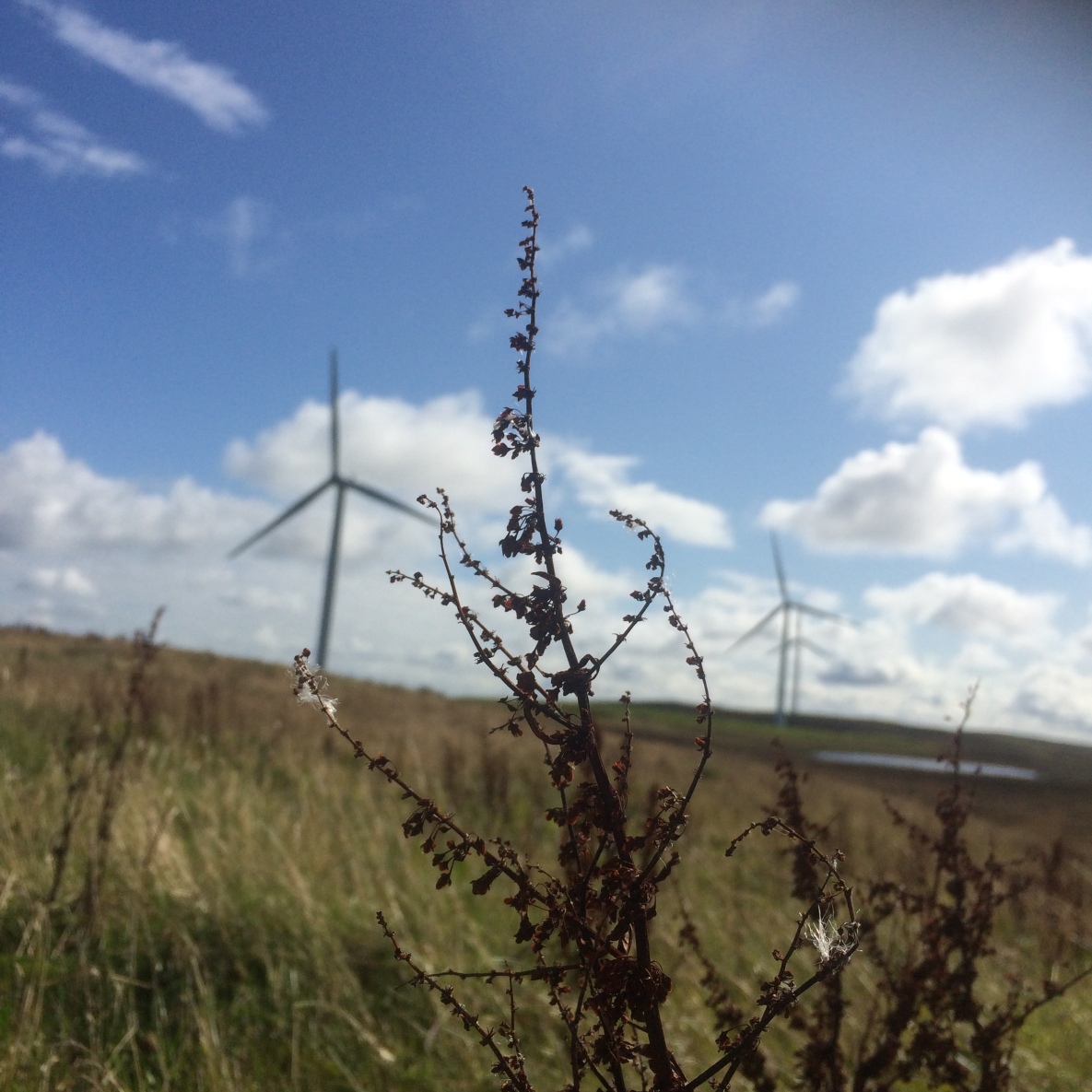
At one point in the trip, we visit the Burgar Hill Energy Project in Evie, alighting from the bus to stand underneath several massive turbines. The sound is wonderful, a deep churning whirr that feels like the air pressed charge on repeat. Under the chug chug chug of those great white wings we gathered, listened, moved and dispersed. I watch as our tight knit group begins to fragment; we need time apart to absorb this properly, little cells bouncing off and away from each other, quietly charged, loosening dots of pollen. Some of us finding the outer reach of the hill, looking for a view or panorama, leaning back to snap a photograph. I film the shadows windmilling dark the rough green grass. Capturing the turbines themselves seemed almost obscene. I don’t know why I was making them into idols, afraid to reduce them to pictures. It was easier to glimpse them in pieces, a flash of white, synecdoche. My friend Katy and I agreed the best photos were the ones out of focus, a bird-like blur against the blue.

Places I have been hit by wind:

  • The cloisters at the University of Glasgow, a wind-tunnel roar to blast out your thoughts post-exam.
  • The hills of Aviemore, my first and last time attempt to ski.
  • Ayrshire beaches in winter, icy particles of hail cast into my eyes and ears.
  • The last day of the Wickerman Festival, wrestling with tents that needed drying and folding, the wind blasting against my cliff of a hangover.
  • On the deck of a ferry, mascara stinging the black black veil of my lashes.

I am an air sign, Gemini, and there is something about losing your breath to elemental forces. I think I once finished a poem with a phrase like, ‘lashing the planetary way of all this’. We used to stand in the playground at school, brandishing our jackets like polyester wings, letting the wind move us forward, staggering in our lightweight bodies, our childish intuition of the way of the world. The pleasure in surrendering. Making of your body a buffeted object. Returning to Glasgow, I soon find myself hit with a cold, preemptive fresher’s flu; a weight on my chest, a diaphragm lag. A sense of my body heaving against itself.

On Orkney, I can smell the salt from the sea. Earlier in the summer, I was struck with wisdom tooth pain, the kind that requires salt-water rinses every half hour, not to mention agonised gargles of whisky. Wasting my precious bottle of Talisker. Amid the haze of those painkiller days, I felt closer to an elemental heat. Metonymically, I was inhaling islands. The taste of self-preservation, of necessary self-sustenance, is never as strong and unwanted as when you want a part of yourself to be wrenched out of you. Pulling teeth is an easy metaphor for lost love, or other forms of psychic distress. Breaking apart, making of the self an archipelago. There’s that song by The National, ‘I Should Live in Salt’, which always sticks in my head in granular form, occasional line. Refrain of refrains, ‘I should live in salt for leaving you behind’. I never knew whether Matt Berninger was singing about preservation or pain, but I saw myself lying down in a kelp bed, child-size, letting the waves lap over my body, salt suffusing the pores of my skin. Begin again, softer.  
IMG_3256

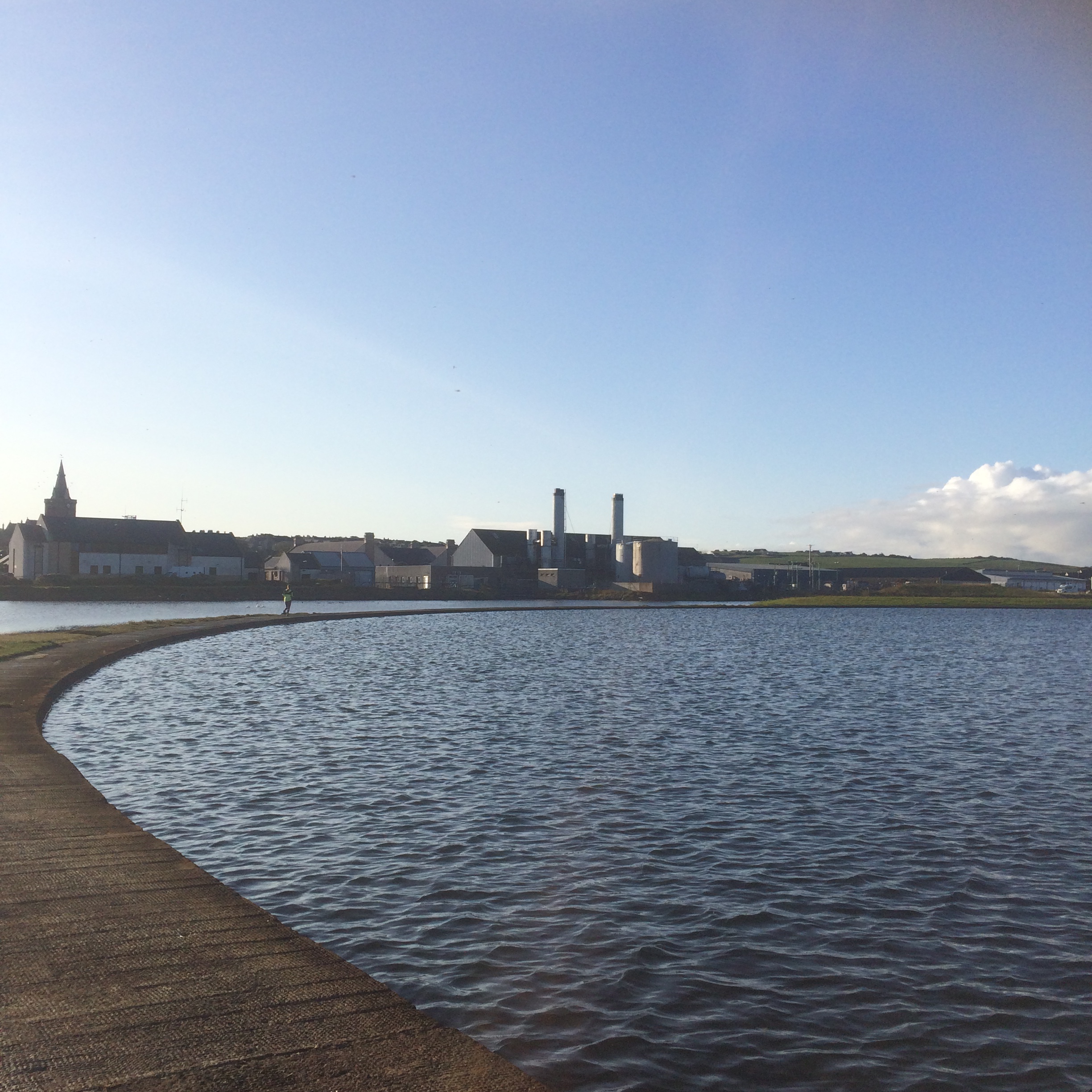
The rain here is more a tangential shimmer. I wake up to it, dreaming that my window was broken and no-one would bother to fix it. Fear of boundaries loosened, the outside in. The future as a sheet of glass, a shelf you could place your self on and drink. Salt water rinse and heat of whisky. We leave the hostel early and wander beyond the Kirkwall harbour, to the hydrogen plant bordering an industrial estate. Katy and I discussed our fondness for industrial estates as homely reminders. She would go running, and wherever she ran the industrial zones were inevitable. As if in any city you would reach that realm, it called you in with its corrugated fronts and abrasive loneliness. My love for the canal, biking up through Maryhill where the warehouses watch serenely over you, loom behind trees, barely a machinic rumble disturbing the birds. We traced the edge of a man-made waterfront, a crescent curving lip of land. The way it curled was elliptical, it didn’t finish its inward whorls of land upon water, but still I thought of Robert Smithson’s Spiral Jetty, or the cinnamon buns I bought from the Kirkwall Tesco. Finding a bench, we ate bananas for breakfast, looking out at the grey-blue sea, our fingers purpling with the cold. I like to think of the banana, Katy said, as a solid unit of energy. Here we were, already recalibrating reality by the logic of pulse and burn and calories. Feeling infra.

I love the words ‘gigawatt’, ‘kilocal’, ‘megabyte’. I like the easeful parcelling up of numbers and storage and energy. I am unable to grasp these scales and sizes visually or temporally, but it helps to find them in words.
IMG_3304.JPG

We learn about differences between national and local grids, how wind is surveyed, how wave power gets extracted from the littoral zone. My mind oscillates between a sonar attentiveness and deep exhaustion, the restfulness gleaned from island air and waking with sunrise. I slip in and out of sleep on the bus as it swerves round corners. I am pleasantly jostled with knowledge and time, the precious duration of being here. Here. Here, exactly. This intuition vanishes when I try to write it. A note: ‘I know what the gaps between trees must feel like’. Listening to experienced academics, scientists and creatives talk about planes, axes, loops and striations, ages of ages, I find myself in the auratic realm of save as…, dwelling in the constant recording of motion, depth and time. Taking pictures, scribbling words, drawing maps and lines and symbols. We talk of Orkney as a model for the world. Everything has its overlay, the way we parse our experience with apps and books and wireless signals. Someone takes a phone call, posts a tweet. I scroll through the conference hashtag with the hostel WiFi, tracing the day through these crumbs of perspective, memories silently losing their fizz in the night.

I grew up by the sea, in Maybole, Ayrshire (with its ‘blue moors’, as W. S. Graham puts it), but a lot of my thalassic time was spent virtually. I loved video games like The Legend of Zelda: The Wind Waker, where the narrative happened between islands, where much of the gameplay involved conducting voyages across the sea. The interstitial thrill of a journey. There were whirlpools, tornados, monsters rising from the deep. On Maidens Harbour, I could hardly reach that volcanic plug of sparkling granite, the Ailsa Craig, or swim out to Arran; virtually, however, I could traverse whatever limits the game had designed. The freedom in that, of exploring a world already set and scaled. Movement produced within constraint. In real life, mostly our bodies and minds constrain. What excites me now is what I took for granted then: the salt spray stinging my lips, the wind in my hair, the glint of shells bleached clean by the sea; a beautiful cascade of cliches that make us.

‘To wake up and really see things…passages from a neverland.’ Back in Glasgow, fallen upon familiar nocturnal rhythms, I find myself craving the diurnal synchrony I achieved in Orkney. Sleepy afternoons so rich in milky light. The vibrational warmth of the ferry’s engine, activating that primitive desire for oil, the petrol smell at stations as my mother filled up the car for journeys to England. My life has often been defined by these journeys between north and south, born in Hertfordshire but finding an early home in Ayrshire. Swapping that heart for air, and all porosity of potential identity. Laura Watt talked of her work as an ethnographer, interviewing the people of Orkney to find out more about their experiences of energy, the way infrastructural change impacts their daily lives, their health, their business. Within that collaboration, she tells us, there’s also a sense of responsibility: stories carry a personal heft, something that begs immunity from diffusion. Some stories, she says, you can’t tell again. The ethics of care there. I wonder if this goes the same for stone, the stories impregnated within the neolithic rocks we glimpse on Orkney. Narrative formations lost to history’s indifferent abstraction, badly parsed by present-day humans along striated lines, evidence of fissure and collision. All that plastic the ocean spits back, co-evolutions of geology and humans. Plastiglomerates along the shore. But Orkney feels pure and relatively litter-free, so goes my illusions, my sense of island exceptionalism. I become more aware of the waste elsewhere. The only person I see smoking, in my whole time there, is a man who speeds his car up Kirkwall’s high street. Smoke and oil, the infinite partners; extraction and exhaustion, the smouldering of all our physical addictions. Nicotine gives the body a rhythm, a spike and recede and a need.

We learn of a Microsoft server sunk under the sea, adjacent to Orkney. There’s enough room in those computers, according to a BBC report, to store ‘five million movies’. And so the cloud contains these myriad worlds, whirring warm within the deep. Minerals, wires and plastics crystallise the code of all our text and images. Apparently the cooler environment will reduce corrosion. I remember the shipyard on Cumbrae, another island; its charnel ground of rusted boats and iron shavings. The lurid brilliance of all that orange, temporal evidence of the sea’s harsh moods, the constant prickle of salt in the air. The way it seems like fire against all those cool flakes of cerulean paint. I wrote a blog post about that shipyard once, so eager to mythologise: ‘Billowing storms, sails failing amidst inevitable shipwreck. It’s difficult to imagine such disasters on this pretty island, yet there is an uncanny sense to this space, as if we have entered a secret porthole, discovered what was supposed to be invisible to outsiders…The quietness recalls an abandoned film set’. Does tourism lend an eerie voyeurism to the beauty we see, conscious of these objects, landscapes and events being photographed many times over? Perhaps the mirage of other islands and hills glimpsed over the blue or green is more the aura of our human conceptions, archival obsession—the camera lights left buzzing in the air, traced for eternity.
IMG_3328.JPG

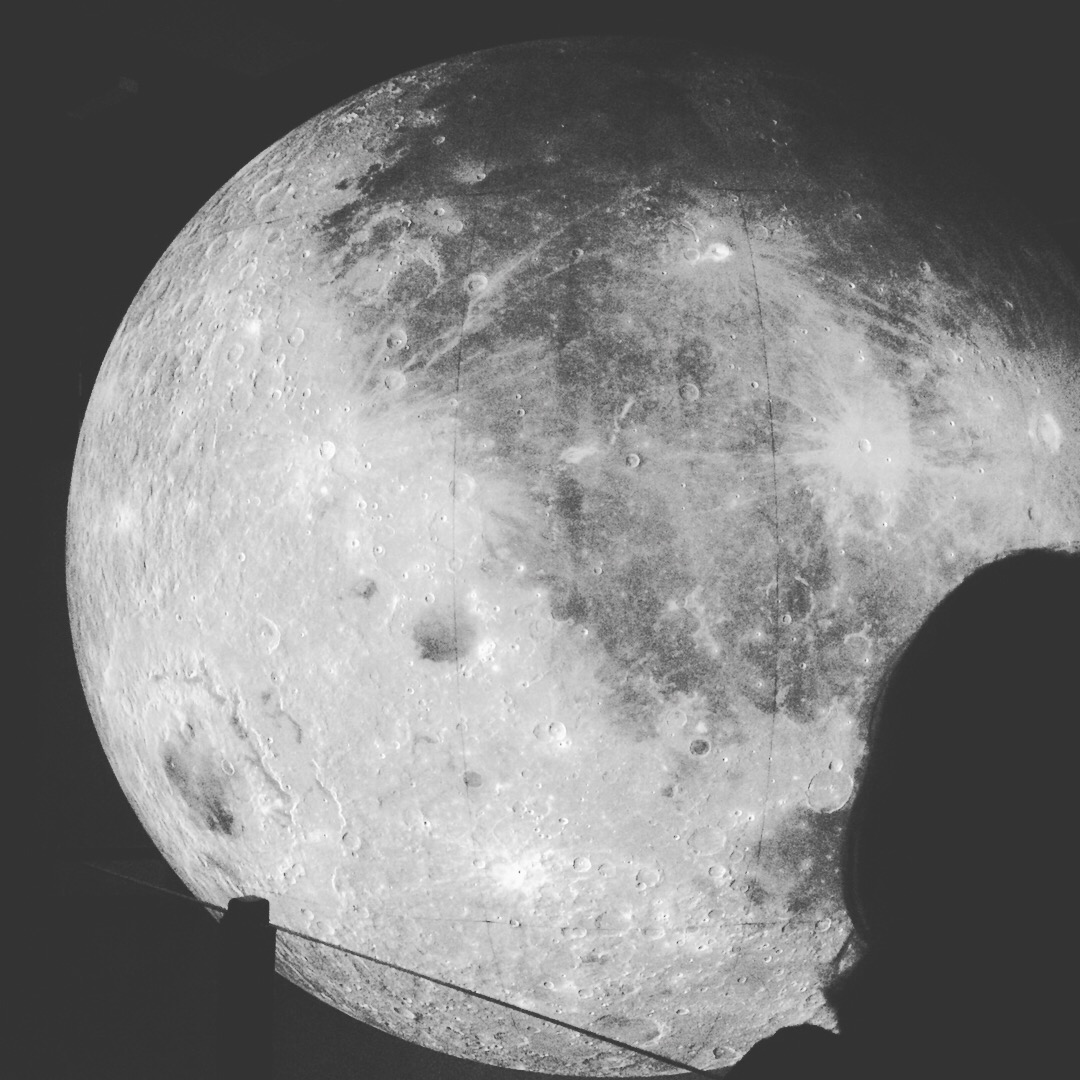
I come to Orkney during a time of transition, treading water before a great turn in my life. Time at sea as existential suspension. There have been some departures, severings, personal hurts, burgeoning projects and new beginnings. A great tiredness and fog over everything. ‘Cells of fuel are fuelling cells’. At the conference, my brain teems with this rich, mechanical vocabulary: copper wires and plates and words for wattage, transmission, the reveries of innovation. There is a turning over, leaf after leaf; I fill up my book with radials, coal and rain. My mind attains a different altitude. I think mostly about the impressions that are happening around me: the constant flow of conversation, brought in again as we move between halls and rooms, bars and timelines in our little human estuaries. We visit Stromness Academy, to see Luke Jerram’s ‘Museum of the Moon’: a seven-metre rendition of lunar sublimity, something to stand beneath, touch, lie under. I learn the word for the moon’s basaltic seas is ‘Maria’, feel eerily sparked, spread identity into ether. We listen, quietly, in the ambient dark, taking in composer Dan Jones’ textures of sound, the Moonlight Sonata, the cresting noise of radio reports—landings from a future-past, a lost utopia.
IMG_3348.JPG

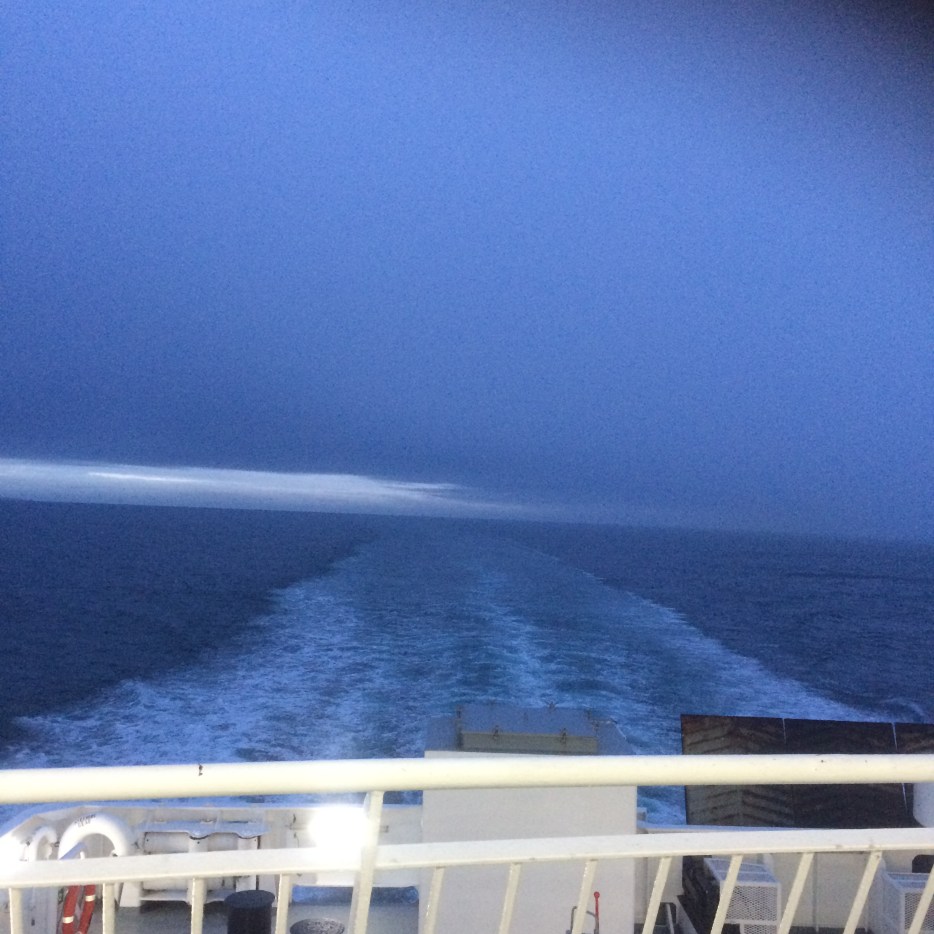
On Friday night, Katy and I catch the overnight ferry back to Aberdeen. Sleep on my cinema seat has a special intensity, a falling through dreams so vivid they smudge themselves on every minute caught between reading and waking. Jarman’s gardens enrich my fantasy impressions, and I slip inside the micro print, the inky paragraphs. I dream of oil and violets and sharp desire, a pearlescent ghost ship glimmer on a raging, Romantic sea. Tides unrealised, tides I can’t parse with my eyes alone; felt more as a rhythm within me. Later, on land I will miss that oceanic shudder, the sense of being wavy. I have found myself like this before, chemically enhanced or drunk, starving and stumbling towards bathrooms. We share drinking tales which remind me of drowning, finding in the midst of the city a seaborne viscosity of matter and memory, of being swept elsewhere. Why is it I always reach for marinal metaphor? Flood doors slam hard the worlds behind me. There are points in the night I wake up and check my phone for the time, noticing the lack of GPRS, or otherwise signal. I feel totally unmoored in those moments, deliciously given to the motioning whims of the ferry. Here I am, a passenger without place. We could be anywhere, on anyone’s ocean. I realise my privilege at being able to extract pleasure from this geographic anonymity, with a home to return to, a mainland I know as my own. The ocean is hardly this windswept playground for everyone; many lose their lives to its terminal desert. Sorrow for people lost to water. Denise Riley’s call to ‘look unrelentingly’. I sip from my bottle, water gleaned from a tap in Orkney. I am never sure whether to say on or in. How to differentiate between immersion and inhabitation, what to make of the whirlwinds of temporary dwelling. How to transcend the selfish and surface bonds of a tourist.

The little islands of our minds reach out across waves, draw closer. I dream of messages sent from people I love, borne along subaquatic signals, a Drexciya techno pulsing in my chest, down through my headphones. My CNS becomes a set of currents, blips and tidal replies. A week later, deliriously tired, I nearly faint at a Wooden Shijps gig, watching the psychedelic visuals resolve into luminous, oceanic fractals. It’s like I’m being born again and every sensation hurts, those solos carried off into endless nowhere.
IMG_3389.JPG

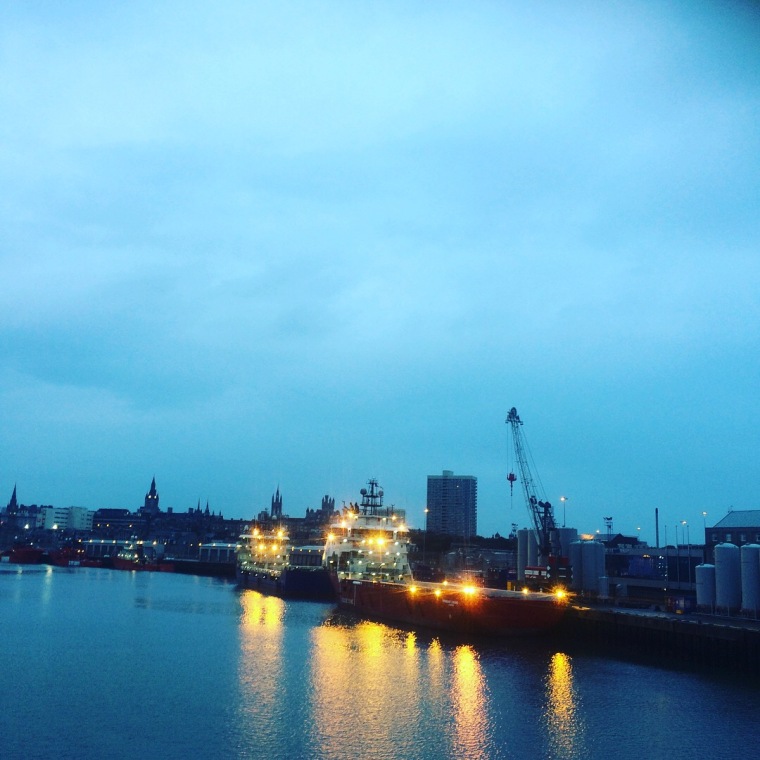
Time passes and signal returns. We wake at six and head out on deck to watch the sunrise, laughing at the circling gulls and the funny way they tuck in their legs when they fly. These seabirds have a sort of grace, unlike the squawking, chip-loving gulls of our hometowns, stalking the streets at takeaway hour. The light is peachy, a frail soft acid, impressionist pools reflecting electric lamps. I think of the last lecture of the conference, Rachel Dowse’s meditations on starlings as trash animals, possessing a biological criticality as creatures in transition. I make of the sky a potential plain of ornithomancy, looking for significant murmurations, evidence of darkness to come. But there is nothing but gulls, a whey-coloured streak of connected cumulus. The wake rolls out behind us, a luxurious carpet of rippling blue. We are going south again. The gulls recede. Aberdeen harbour is a cornucopia of infrastructure, coloured crates against the grey, with gothic architecture looming through morning mist behind.

Later I alight at the Waverley Steps again. Roddy in my ear, ‘Let the light be mined away’. My time on the island has been one of excavation and skimming, doing the work of an academic, a tourist, a maker at once. Dredging up materials of my own unconscious, or dragging them back again, making of them something new. Cold, shiny knowledge. The lay of the heath and bend of bay. I did not get into the sea to swim, I didn’t feel the cold North rattle right through my bones. But my nails turned blue in the freezing wind, my cheeks felt the mist of ocean rain. I looked at maps and counted the boats. I thought about what it must be like to cut out a life for yourself on these islands.

Home now, I find myself watching badly-dubbed documentaries about Orkney on YouTube, less for the picturesque imagery than the sensation of someone saying those names: Papay, Scapa, Eday, Hoy. Strong names cut from rock, so comforting to say. I read over the poems of Scotland’s contemporary island poets, Jen Hadfield for Shetland, Niall Campbell for Uist. Look for the textures of the weather in each one, the way they catch a certain kind of light; I read with a sort of aggression for the code, the manifest ‘truth’ of experience— it’s like cracking open a geode. I don’t normally read like this, leaving my modernist cynicism behind. I long for outposts among rough wind and mind, Campbell’s ‘The House by the Sea, Eriskay’: ‘This is where the drowned climb to land’. I read about J. H. Prynne’s huts, learn the word ‘sheiling’. Remember the bothies we explored on long walks as children. There’s a need for enchantment when city life churns a turbulent drone, so I curl into these poems, looking for clues: ‘In a fairy-tale, / a boy squeezed a pebble / until it ran milk’ (Hadfield, ‘The Porcelain Cliff’). Poetry becomes a way of building a shelter. I’m struck with the sense of these poets making: time and matter are kneaded with weight and precision, handled by pauses, the shape-making slump of syntax. Energy and erosion, elemental communion. Motion and rest. My fragile body becomes a fleshwork of blood and bone and artery, hardly an island, inclined to allergy and outline, a certain porosity; an island only in vain tributary. I write it in stanzas, excoriate my thoughts, reach for someone in the night. I think about how we provide islands for others, ports in a storm. Let others into our lives for temporary warmth, then cast ourselves out to sea, sometimes sinking.

Why live on an island? In Orkney we were asked to think with the sea, not against it. To see it not as a barrier but an agential force, teeming with potential energy. Our worries about lifestyle and problematic infrastructure, transport and connection were playfully derided by a local scholar as ‘tarmac thinking’. Back in a city, I’ve carried this with me. The first time I read The Outrun was in the depths of winter, 2016, hiding in some empty, elevated garrett of the university library. I’d made my own form of remoteness; that winter, more than a stairwell blocked me off from the rest of existence. Now, I read in quick passages, lively bursts; I cycle along the Clyde at night and wonder the ways in which this connects us, its cola-dark waters swirling northwards, dragged by eventual tides. I circle back to a concept introduced by anthropologists at Rice University, Cymene Howe and Dominic Boyer, ‘sister cities of the Anthropocene’: the idea that our cities are linked, globally, by direct or vicarious physical flows of waste, energy and ecological disaster. This hydrological globalisation envisions the cities of the world as a sort of archipelago, no metropolis safe from the feedback loops of environmental causality, our agency as both individuals and collectives. On Orkney, we were taught to think community as process, rather than something given. I guess sometimes you have to descend from your intellectual tower to find it: see yourself in symbiosis; your body, as a tumbled, possible object: ‘All arriving seas drift me, at each heartbreak, home’ (Graham, ‘Three Poems of Drowning’).


Vegetarian Weather

IMG_3958

Short story written over the past three days in a bout of illness, in-between working Christmas shifts that veered between the hectic and dead, drinking quantities of whisky and waking up to sunlight and ice-beams.

The waves here are not like other waves, on other shores. They seem to billow backwards, suck lines of bright froth back into themselves. This town is bordered by a self-consuming ocean, so there’s no other way to go. A bulimic rhythm of prolonged fulfilment; nourishment interrupted. You try to look out but the horizon devours what darkness might lie beyond as within. Everything is overcast. Even in summer, people lick pastel ice-creams to a backdrop of failed, VHS-flicker grey. The sky shivers and glitches with rain. I was on a train once and a drunk man had slept through the changeover and there were no more trains to the city till morning. He asked how to get back from the port, what time the last bus was, was there still time to get a cab from my town, and I said there was no time here. No time at all.

People have been stringing up lights for weeks, but now we are used to the change it’s as if they’ve been here forever. Blue and red, mostly, like sirens; like morse code blinking in darkness. When I was a kid, I used to lean against the harbour wall and watch the lights, spotting a pattern that made sense. I’d write out words with sticks in the sand, trying to parse the lights. Now I see the decorations, the decorative function, and it’s more or less fully tasteless. I have seen how the city looks at this time of year, the city where silver and gold are everywhere. Then there is the town, the red and blue; the spent fire and the melancholy.

Mother washes dishes until her skin blisters. I have bought her gloves for Christmas, year after year, but she refuses to use them. She enjoys some sort of searing, primitive contact with soap and water. They say she is the best kitchen porter the hotel has ever known, and even when there was a corporate takeover, they let her keep her job. She sings festive carols to piss off the chefs, who love her so much they say nothing. Every year, a bottle of ginger wine for a bonus. She hates ginger wine, but accepts graciously. I’ll admit, I inherited little from my mother.

I am guilty of staring at the sign on the church: CHRIST DIED FOR YOUR SINS. One time the minister caught me and he tried to hold my wrist and look up with me, like we were having A Moment of Glory. I remember his stories from school, trite morality tales about betrayal and friendship. Blood trumps all. My mother once had him for tea, and I mean this pretty much literally. She ate him up with her eyes while my father supped lentil soup in silence. She wanted him to say, I suppose, you are all good people. But the minister merely thanked her, politely, letting breadcrumbs sift through his fingers into the soup, like this was a perfectly normal thing to do. I don’t suppose it’s right to crave forgiveness or bliss from a minister. At least my sins are pure, like the sharp silver of restaurant cutlery.

When people pass each other on the street, they nod. Sometimes, a thrusting remark about the weather, a painful stab at some petulant vegetable. The chat doesn’t stick. But still in its smallness I polish it.

The grocery store is selling handmade Christmas wreaths, which smell of true pine. I don’t know what truck brought them in from the forest, came west with the logs and the spindling needles, the twigs of fir and gauze of twine. It’s maybe a job I’d want when I’m older. The driven coastline, the smell of the pine. For now, I gather up trash from the beach, all the stuff people forget about. I glue it together, leave sculptures in the community arts centre for the children to prise apart with sticky fingers. Father once mumbled something about college but never mentioned it again. Sometimes I can sell them, in tourist season. You lay down a blanket and drunk people will come talk to you, like you’re some sort of guru. I imagine my tacky statuettes in homes across the district, mournful little symbols of emotional debris. Luke used to walk along with me, picking up odd bits. We shared a vision, which is more than you can say about most brothers and sisters. I hope people smash them, my sculptures, in the middle of arguments; I hope they instate a sort of catharsis.

Sin. Waves. Sky. Signs. I used to work in a café serving Battenberg cake to gossiping pensioners, whose tongues would loll out like soft bits of dough, even when they were catatonic and staring at the lashing waves, crumbling onto their laps the pink and yellow. The town devours itself, sloshed and watered by endless tea. Scandal is rare and thin, mostly a case of mystery fire, a missing dog or crooked insurers. Once, two men moved in together as lovers but that was diffused by the presence of their pekinese, who used to come snuffling into the café so even the old folks were won over, nursing their social phobias for other occasions. All these dogs kept coming from nowhere.

I feel the presence of others as generally tepid, unwanted. I went to school a couple towns away, got that bus every morning or walked out before it had even reached my door. I’ve never needed eduction to remind me of a world beyond. I only had to look in the weathered face of my father as he returned each time from fishing, the crinkles in his eyes like a tiny clam had nestled in each pupil and was sucking the skin in for energy. Anemone. The way he plodded in the door with such reluctance, trailing sand and silt in his wake, interrupting my mother’s ordered domesticity with the thick, ineluctable lore of the sea.

“Heavy waves out west,” he’d say mysteriously, chewing a lump of bread as if in each crusted pore was the bloom of an oracle. Mother would shuffle a deck of cards, clink the dishes. Oh baby don’t make me cry. She attended bridge nights on Wednesdays at the Schooner, she kept herself busy. Our tiny bungalow was always polished to a sparkle, as if she was afraid the deceased grandparents could tell whether there was tarnish to the silverware. Father doesn’t talk much, doesn’t touch our lives. He helped assemble the tree with usual obligatory gruffness, then retired to his almanack and chewing tobacco. When Luke died, he didn’t say a word for months. He disappeared on trips that got longer and longer, as if trying to make his reckoning with the sea. If I drain you, will revenge be complete? Do fishermen respect the sea? Great shivering nets of metallic shoals looped in and deported up north, a great operation exchanged between strangers with a fetish for the slivery, salty heaps of lamé. He used to keep a logbook of all the good stuff he’d caught, would bring home glistering samples of mussels and carp for tea, but now he throws it all back, unless it’s for work. Does the minimum necessary, but still brushes with death. Don’t we all…

I sometimes think, god if I went away would I miss this place? I picture myself stepping off the train with the arrogant smile of the rest that leave for places east, for the city. Coming home in summer wearing neat tight suits and smart-person glasses. How small the town would seem, a dolls house of trivial troubles compared to the vast expanse of the city, where I’d make my fortune studying law or medicine or working in some department store where all the women wear Chanel and talk as if talk were merely unfettering. The delicate unravelling of a silken scarf, the spritz of expensive everything. In contrast to such gauzy dreams, the town, I fear, is inscribed with too much of me; I need to keep an eye on it. The sedimentary deposits of my human existence, time made language. All the rocks with my name scratched deep by shards of flint and granite. If I came back, this would all seem impossibly empty. The cave where I gave my first handjob, to a boy who smelt of liquor and mint. I still remember how slowly his breath synchronised with the rhythmic lisp of the sea, quickening with the gulls that squawked and circled ever closer, concealing each blood-warming grunt.

I stopped eating meat after Luke died. The smell of fish near enough killed me, so I slept in deliberately each day to avoid the hour when the men came onto the docks with their morning haul. I burned so much incense in my room that Mother was concerned I was having a religious awakening. I grew what they call lithe and thin; I honed my time to a solitary point. Luke used to run along the beach at dusk, but he’d always bang the sand out of his trainers before stepping in the house. He shared Mother’s sense of boundaries, territory. He used to talk about the nesting patterns of gulls. Recursion, he said, was the order of birds. They knew to come home, and when. There was something magnetic, a tiny program inside their skulls.

We still don’t have his body. It never washed up; the sea hasn’t returned it, the police packed in the case a year ago now. The other boys talk solemnly and seriously about moving away: getting out of it all, the mess and the memories. I’ve drank with them down the Schooner many a time, matching them pint for pint as we flick peanuts across the table and wish we were children again, reminiscing our games on the lips of the bay. When Adam kissed me in the freezing sea mist of six in the morning, clutching me like a piece of driftwood that had wound up on his porch, I felt as though I were pressing into the deepest history, its secret flesh. I felt that final capsize, that upsurge of tide. I was glimpsing what I had missed, the darkest moment of shock and extinction. He pinned back my hair, deftly, when I vomited onto his mother’s petunias. He said ‘good girl’ after we slept together, and I was a waif in his tangle of sheets, hardly the siren I supposed myself to be. He said ‘good girl’ but he was only two years older. It was like none of us knew what to do anymore. When I asked him what the last thing Luke said was, Adam couldn’t tell me. He said they were quiet, they were fishing—that was all. They didn’t talk much at sea, like that was unlucky. The focus was always upon the catch. I stopped visiting that house on the border of town, stopped going anywhere beyond my room. I was folding myself inward, like the waves that brushed the skin of the shore. I pictured twenty black pills like black bits of bladderwrack and swallowing my mother’s precious tonic. Every day felt like a new kind of bruising. I’m not there yet. 

I still remember my first lobster. How I had slipped apart the lock of the cage, the lobster pot, to see this gangrenous thing with terrible black eyes that twitched erratically from side to side. Mother used to tell me the chef at her work would go around clacking lobster pincers near all the waitresses’ bums, until one day a woman called Meggie, the old restaurant manager, thumped him in the face and he had to finish service with his nose bleeding into the sauce. “Be more like Meggie,” she’d say sometimes, scrubbing a wine stain out of Father’s trousers, like that was lust itself. You have to twist off the legs, the claws, break at the joints, scoop out the meat from each fat claw. Iron-rich. I watched the blood-red thing die a death in boiling water, could hear a sharp hiss that sounded like more than steam. What else you had to scoop out: the long dark intestinal tract, its tangled, bedraggled remains of a life. An Escheresque recursion, a spiralling fold into self. I wonder what lobster hunger feels like, the in-suck of clams and asterisk starfish. How it feels to enter that deep, freezer sleep, among the ice cubes and packets of plastic-wrapped, soldered meat? Father clapped me on the back when I held out the shell; when later, tactfully, I stuck my fork in, needling around for the richest flesh. My body knew appetite, knew what to look for. It tasted good and strong. Now I see those orange buoys and I wonder what starving thing is perishing underneath, ready for consumption. I reset my computer because the internet never works. We are out at sea here, lost in our mutual devouring. Nobody comes to fix the signal. Nobody questions my diet at all.

My breath still sours on the windowpanes of strangers. There is no time in this town, not even at Christmas where the hours bleed together like the masses of plastic that gather along the shore. I pass the minister, who quips about the weather. Overcast as the darkness that meets us all. He doesn’t understand the patterns, the names of the clouds.

Sometimes I still see Adam. He stripped me till I was thin as cirrus, in smoky entrails of evening light. Boxing Day and I looked out with the blankets scratching my shoulders, the horizon grey and wasted. I could see Father’s boat trailing in at the dock, the shape of his cap against the grey. My skin looked grey. Something a teacher explained once, glassels: those stones that look shiny and lovely under the water, but dry a dull, disappointing matte on land. I was back in the house on the border of town. I left a little ornament, a piece with old speakers, all copper wires twanged into ersatz smiles. It’s the creepiest thing I ever made, maybe. Luke would’ve hated it; would’ve snapped it apart, made food for the waves. Sometimes we go backwards, return to the place. I think of him most when splitting vegetables, drinking Mother’s ginger wine, scrolling through Facebook on delayed connections. It’s different, now that you’re not around. I grow fragile with anaemia, spend time trying to name your fate. There’s a toast to be made to the absent, a manner of feedback; but all of that pain was already in the weather. You just had to notice.


The General Synopsis at Midnight

IMG_2009.jpg

To the best of my memory, I have only ever been on a sailing boat once. Or, I have only been happily in control of a sailing boat once (there was a time we had to try windsurfing in primary school, a time whose details have, thankfully, long been repressed).  It was 2005, I was twelve years old, and had won a competition through the local youth club to go on a sailing trip to Oban. I don’t remember anything about what I must’ve learned regarding sailing, but I do recall a beautiful suite of seafaring terms: a special vocabulary which transformed previously mundane structural features into curious artefacts of mysterious potential: cleat, keel, stem, rudder, transform, tiller, clew, boom, shroud, telltale, jib, winch, deck and spreader. The man in charge was a hardened fisherman type; I don’t recall his name, but we called him the skipper. He was dismayed to learn I was a vegetarian, having packed little in the way of vegetables for our journey. I was happy to live off Ovaltine, jam rolls and digestives for the following days. It was such an odd combination of children—were we still children?—on that trip. No popular kids, but a few of the scarier misbehaviours (probably not okay to still call them neds), the freaks and geeks—then me, wherever I fit in. ‘Goth’, which in the case of my school was generally singular. Somehow, we all bonded rather than fought in the tiny space of that boat.

One boy, who would always be in fights, bullying and hunking his weight around, was so sweet to me. He saw I had eaten barely anything and gave me a whole bar of Cadbury Mint Chocolate, insisting I had all of it. It was such a kind gesture that I remember it still. Everyone was different at sea: softer, more honest. We were willing to admit our social vulnerabilities; there was no-one, no context, to perform for. A boy I’ll call L. opened up to me about his love for 2Pac, and when Coldplay came on the skipper’s stereo (it was their first truly mehhhh album, X&Y), we shared a little rant about how cheesy it was. We ate fruit out of tins, pulled scarves over our faces on deck and watched the coloured houses of Tobermory loom closer. The skipper let us all have a go at the tiller; he told us stories from previous trips, about how the weather had turned nasty and they’d had to pull themselves through miniature hurricanes. I found myself craving the wild mad weather, even as I was shivering in some inadequate waterproof jacket (I have a history of coming ill prepared to such outings). The skipper and I sort of oddly bonded, since I was usually the first one up in the group. He’d put the kettle on and we’d go out on deck to watch the sky. He’d point out things to look for in the cloud patterns, the colours that bloomed on the horizon. It’s this kind of practical knowledge that I thirst for. Chefs talking to me about how to sharpen knives, bake brownies; motorcyclists betraying the secrets to keeping your speed; engineers talking about formulas and team rivalries and how to build a bike wheel. I’m completely incapable of almost anything practical, so it’s always a magic alchemy to me. When people ask what I want to be when I grow up, I say shepherdess, even though I have little idea of what that entails, beyond reading the excellent The Shepherd’s Life by James Rebanks and occasionally listening to The Archers. I think I’d just be content to wander around hills.

Red sky at night, shepherd’s delight…

I awake to steady rainfall, first day of November. I have been thinking a lot about that sailing trip recently, mostly because I’ve been doing writing workshops in Greenock, and the nature of the place as a harbour town has everyone often turning back to boats and fishing topics. I talk to a chef at work about fishing, not because I’m all that interested in fish but because there’s something about its psychology that reminds me of times gone by. Once, I took myself out to Cardross on the train, following the road up to Ardmore to sit on the point which was a good spot for anglers. It was so quiet and still, the beaches strewn with lumps of quartz. I sat there for an hour or so, listening to the steady lap of the estuary, then slowly made my way home, tearing my skin on all the brambles. It had the feeling of a secret, overgrown place. A little out the way, a nest you could curl into: an almost island. I recall those tiny islands on the Swan Pond at Culzean Castle, where we used to leap across to. As a kid, I’d hide among the bamboos and rushes and feel entirely in my own little world. The pathways and grasses were lit with secret creatures, this 12th World I’d created—it was over a decade prior to Pokemon Go, but here I was in my augmented reality. I’d sit up on the top of the stairs reading for as late as possible, imagining that I was on top of a waterfall, and all before me was water cascading instead of carpet. I’d lie upside down and the ceiling became the first planes of a new universe. I’d wake up early and write it all down; but those pages are lost to whatever antique sale of the past stole my youth.

Now I am adult, less governed by diurnal rhythms. I find myself lost in the long bleed of night into day, up far too late in the bewildering recesses of the ocean online, the oceanic internet. Far corners where articles smudge their HEX numbers in true form down the page and I am rubbing my eyes to see beyond light. Time, perhaps, to rehash that old metaphor, surfing the web. Occasionally, some page would bring me crashing back down in the shallows; I’d wake up, ten minutes later, groggy on my keyboard. Press the refresh key. Instagram has me crossing continents at bewildering speed, lost in Moroccan markets, Mauritian beaches and Mexico City. In the depths of some nightclub then the heights of a Highland peak. So many fucking faces. Closeups of homemade cakes, delicious whisky. Memories. Oscillations I can hardly breathe in, watching my thumb make its onward scroll without my direction. The rhythms become flow, become repetition. I need an anchor. It’s been hours and hours and maybe I’m hungry.

On the boat, whose name I have sadly lost, we slept by gender in two separate cabin rooms. They were tiny, low-ceilinged, and we were just a handful of slugs pressed tight in our sleeping bags. It was better than a sleepover, because there was no pressure to stay up all night and we were all too exhausted from the sea air to talk much. I’d close my eyes and feel the steady rock of the boat’s hull as it bobbed on the water. There was a deep throb of something hitting against the walls outside, maybe a buoy or rope; it felt like a heartbeat. Sleeping in many strange places, the floors of friends’ flats and houses, in tents and on trains, I try to revisit that snug tight room where sleep was difficult to separate from consciousness itself. It was all of a darkness. Something Gaston Bachelard says in The Poetics of Space:  ‘We comfort ourselves by reliving memories of protection. Something closed must retain our memories, while leaving them their original value as images.’ There was no mirror in that boat, so all I remember are smells and objects. No sign of my own pale and windswept face. Everything we ate was an old-fashioned brand; it made me think of rationing and traditional values. I wasn’t quite sure what that even meant.

I need an anchor. A place to dock in.

Governed by some primordial instinct, I go to make my dinner around the same time most nights—which happens to be one in the morning. The shipping forecast used to be the last thing on the radio, before a sea of white noise till dawn. When cutting veg, my fingers weak from another long day, I switch on the radio and there are the familiar intonations. I listen as I would a poem or a shopping list, a beautiful litany of place names, nouns, directives. I have no idea what any of it signifies. It’s been a double shift, perhaps, or an extreme stint in the library, a walk across the city. My mind is full of words and sounds, so many conversations. The debris of the day threatens to spill out as a siren’s cry, and how easily I could slump against the kitchen cupboards, wilt upon the floor. Make myself nothing but driftwood, no good turning till morning. But instead I chop veg, listen to the shipping forecast. It’s difficult to think you deserve food, even when your body’s burning for it and you haven’t eaten for hours. But there are so many other things to read or do! You need an anchor, a reason.

The general synopsis at midnight.

Many of my childhood lost afternoons, bleeding to evenings, were spent playing The Legend of Zelda: The Wind Waker on a GameCube I shared with my brother—avoiding the narrative quests and dungeons in favour of epic ventures across that cobalt ocean. What I wanted was that rousing sense of the wind’s spirit, the freedom to glide and find new islands. Whirlpools, tornados and Chtlulu-like creatures hurled me out to stranger lands. It was all so beautifully rendered, an expansive thalassic field of possibility; with each route I was fashioning some lovelorn story for my lonely hero. The ocean has always represented for me some point of erasure where reality dissolves into imagination. I think maybe it’s this perceptive meshing that we need to attune to in order to make sense of the vast scale effects of the Anthropocene. How else to grasp those resonant shockwaves of consequence, whose manifestations often transcend our human grasp of time and space?

Headache, Viking, southwesterly veering. The same refrain, moderate or good. When occasionally poor at times, do I picture the sailors with rain lashing their faces, rising through mist towards mainland? Is that even where they want to head? Rain at times, smooth or slight, variable 3 or 4. The dwelling conditionals; always between, never quite certain. The weather being this immense, elusive flux you can guess at, the way paint might guess at true colour. Cyclonic 4 or 5. In Fitzroy are there storms circling around the bay? Very few of these places could I point to on a map. I like the ambiguity, the fact of their being out there, starring the banks and shores and isles of Britain and beyond: Shannon, Fastnet, the Irish Sea. There’s a sense of being ancient, from Fair Isle to Faeroes.

I went to a talk last week for Sonica Fest where a girl from Fair Isle talked about climate change, how her home island would probably one day be swallowed by the sea. I can’t help picturing a Cocteau Twins song when she says it. She dropped handmade bronze chains in different oceans so you could see the divergent levels of oxidation, relative to saline content. It was beautiful, this abstract material rendering of elemental time. The world rusts differently; we are all objects, exposed to variant weathers. Her name was Vivian Ross-Smith and she talked about ‘islandness’, a project which connects contemporary art practise with locality and tradition. The term for me also conjured some sense of the world as all these archipelagos, whose land mass is slowly being ravaged by warming waters. The pollutants we put in. Islandness betrays our vulnerability, the way we were as 12-year-olds at the mercy of the tides, the weather and our gruff skipper. I had little conception of what climate change was, but even then I didn’t set a division between humankind and nature.

Back on the boat, I traced my own moods in the swirls of those mysterious currents, dipping my fingers in the freezing North Sea. Who are we before puberty, pure in our childish palette of pastel moods? When I think about how that sea spreads out to become the Atlantic, so vast and impossibly deep, I grow a bit nauseous. Maybe that’s the sublime; an endless concatenation of seasickness, feeling your own weakness and smallness in the face of great space, matter, disaster. How easy you too could become debris.

Increasingly, that waltzing Cocteau Twins song feels more like an elegy, haunted by the shrill of soprano, those shoegaze guitars resounding like notes through a cataract. A line from Wordsworth’s  ‘Tintern Abbey’* I always remember, ‘The sounding cataract / Haunted me like a passion’. Interplay between feeling and form, sound and vision. The ocean warming, the beat steady and mesmerising. Are we sleepwalking into the Anthropocene, over and over again, a lurid repetition compulsion? Why we keep burning up fossil fuels, emitting our plumes of carbon, senseless in the face of a terrible sensorium? I crave solid objects that show up the archives of history, those plastiglomerates of Frankenstein geology, the warped materials of the Earth’s slow and drawn-out hurting. Liz Fraser’s operatic howls are maybe the mourning of the land itself, begging to be swallowed by the sea. A saving? If originally we came from water, hatched out of amniotic sacks or evolved from subaquatic origins, then maybe we return to its oceanic expanse, its blue screen of death. When I’m anxious and needing to write furiously, write against the tides of exhaustion or time, I listen to Drexciya—Detroit-based techno that harks back to Plato’s mythology of Atlantis, via Paul Gilroy’s Black Atlantic. There’s this crazed evocation of diaspora, drowning, a mysterious race of merpeople. What evolves below water, what is spawning in the recesses of subculture; what resists the mainstream, the violent currents of everyday life. This subterranean city is a ‘sonic third space’. I can’t help but think of my own other planet, that 12th World separate yet attached to daily reality; somewhere distant but still impossibly intimate. That resonant intensity that drives you from sleep and into midnight discos of the mind, all pulsation of lights, wonder, horror.

There’s a sense that sound itself can be physically embracing. This is maybe how it crosses over into sonic third space, where embedded mythologies flourish in resonant affect. Where sound becomes tangible, making vibrational inscriptions of code upon the body like transient hieroglyphs of an assemblage’s trellising energy. In Tom McCarthy’s novel C (2010), the protagonist Serge is obsessed with hacking the radio to tune into the ether. Alongside the obvious supernatural connotations, there’s a more pressing suggestion that Serge is able to make his entire being become channel for sound. He lays on a ship as I once lay on a boat, listening to the warm stirs, the conversational blips and signals of objects:

The engine noise sounds in his chest. It seems to carry conversations from other parts of the vessel: the deck, perhaps, or possibly the dining room, or maybe even those of its past passengers, still humming through its metal girders, resonating in the enclosed air of its corridors and cabins, shafts and vents. Their cadences rise and fall with the ship’s motion, with such synchronicity that it seems to Serge that he’s rising and falling not so much above the ocean per sea as on and into them: the cadences themselves, their peaks and troughs…

McCarthy’s lyrical clauses accumulate this notion of sound as spreading, seeping into words and orifices, surfaces. Presences, absence. A lilting simultaneity between the movements and pulses of objects. Sound becomes material; is spatialised as cadence, lapping the edge of Serge’s senses with lapidary, enticing effect—always tinged, perhaps, with a lisping hint of danger. The sounds, after all, also evoke the dead. There’s a radio drama by Jonathan Mitchell, where the protagonist has developed a device which allows you to extract sound from wood. There’s the idea that wooden surfaces absorb sounds from their surroundings, and the time and quality of storage depends on the type of wood. It’s a brilliant sci-fi exploration of what would happen ethically if we could extract auditory archives from material surroundings—the problems and possibilities of surveillance, anamnesis and so on. Consequences for human and nonhuman identity, the boundaries between life and death, silence and noise.

https://soundcloud.com/jonathan-mitchell-1/the-extractor

Do the walls hear everything? I think of rotting driftwood, how porous and light it is. How its every indent, line and scar marks some story of the tides, the stones and the sea. Robinson Crusoe, chipping the days away as notches on wood. I think of the hull of that boat, perhaps coated in plastic, sticky with flies and algae.

On the last day of our sailing trip, we were sitting round the table of the cabin, docked in Oban harbour, reading the papers and having a cup of tea. Our youth club leader got a text from a friend back home. She was informing us of the London 7/7 bombings. This was a time prior to having internet on our phones. We weren’t so wirelessly in tune with everything everywhere always. But that little signal, a couple words blipped through the ether, brought the sudden weight of the world crashing back down upon our maritime eden. I had family in London who escaped the attack by the skin of their teeth, a fortuitous decision to take that day a different route. How everything was at once the dread of hypotheticals. I did not understand the vast arterial networks of terror that governed the planet; these things happened in flashbulb moments, their ripple effects making what teachers called history. Somehow it didn’t seem real. Bombs went off all the time on tv; I grew up with the War in Iraq and Afghanistan. Those televised wars were the ambient backdrop to everything on the news. Later, my friends would wile away their teens shooting each other on Call of Duty. It was all logistics, statistics, the spectacle of bodies and explosions. Nobody explained it. We were distracted by MSN Messenger, then those boys with their controllers tuning in and out of conversation, signing online then drifting away into present-absence. X-Box (Live). Signifier: busy. It was good to be away from the telly in the relative quiet of the boat, startled instead by foghorns and seagulls. But even then, we remained connected.

⚓️

The Shipping Forecast has been issued, uninterrupted, since 1867. Its collation of meteorological data provides a map of sorts, a talismanic chart of patterns and movements, currents, pressures, temperatures—something that helps millions of sailors out at sea. I look at such visual charts and truly it boggles me. I prefer grasping such data as sound, delivered in the hypnotic lilt of that voice: its clear diction and poetic pace, calling me home. I think of the west coast, the bluish slate-grey of the sea. Becoming variable, then becoming southerly, rain or showers, moderate or good. Always between things’ becoming, becoming. There’s the pitch-black womb of a cabin again, the childlike promise of dreams and sleep, a genuine rest I’ve forgotten entirely. Listening makes it okay to be again, buoyed up halfway between where I am and where I’ve been. A constellation of elsewheres to placate insomnia’s paranoia; to be in winter’s dark heart or the long nights of summer, endlessly tuning to atmosphere, cyclonic later, slowly veering from the way. My present tense is always eluding, like ‘In Limbo’ with Thom Yorke’s seaward crooning, the morse code of emotion in whirlpool arpeggios, closing and bleeping and droning on a wave far away, the spiralling weather, the fantasy…Another message I can’t read.

*Full title, of course, being ‘Lines Composed a Few Miles above Tintern Abbey, on Revisiting the Banks of the Wye during a Tour, July 13, 1798’.

IMG_2735.jpg