The Luna Erratum, Maria Sledmere’s debut poetry collection, roams between celestial and terrestrial realms where we find ourselves both the hunter and hunted, the wounded and wounding. Through elemental dream logics of colour, luminosity and lagging broadband, this is a post-internet poetics which swerves towards the ‘Other Side’: a vivid elsewhere of multispecies relation, of error and love, loss and nourishment. Its leitmotif of Luna, a shapeshifting feline of satellite proportion, waxes and wanes through poems which move beyond the twilight moods of left melancholia, sad hospitality and ecological crisis towards a fugitive imaginary that lingers in the ‘Flirtation Device’ of lyric and its many echolocations.
Taking cue from Jenny Boully’s ‘erratum’ — ‘the text of what is and the text of what should have been’ — Sledmere writes with failure, friction and fractal attention, with a yearning for intimacy, shelter and ongoing ways of bearing the im/possible. She offers poems of mystery, refusal and pain at personal, political and planetary scales, tracing the desire-lines of the everyday and its glitching encounters. The Luna Erratum is a book of memory and friendship in the so-called anthropocene, of bodily disorder, painterly gesture, quantum kissing, rodent sisterhood, open world intervention, technology, tenderness, shimmer and song.
☆
Praise for The Luna Erratum:
How do you explain yourself to yourself when you suspect that actuality – your experience of it – is provisional and full of error? You come up with your own poetics, your own tense and mode of address, which is a lunar one, and which involves speaking in crushed, frothy mouthfuls to a terrifyingly silent, unpredictable and generous friend (celestial objects, an indifferent lover, &c.).
The Luna Erratum offers no truth except in things – colours, materials, beings, dreams, schemes of language, human artefacts and locations – and their known convergences, all of which hold as much affective weight and capacity for transformation as the events that precipitated this profoundly graceful, unsettling and mesmerising book.
— Sophie Collins, author of Who is Mary Sue? (Faber, 2018)
☆
A glittering universe, Maria Sledmere’s first poetry collection is both lyrical and electric, both video game and watercolour. Reading these poems feels like ingesting semantic MDMA, the ectoplasm of a Victorian ghost trying to reach her lover through an unstable wifi connection. Sledmere’s words ooze a desire that is part animal, part human, part astral body. Let them transfix you.
— Nadia de Vries, author of I Failed to Swoon (Dostoyevsky Wannabe, 2021)
☆
In Maria Sledmere’s The Luna Erratum, rivulets of neon daylight stream through the ever-quickening fibre-optic cables of the soul. Beneath ‘morphine clouds’ climates change as human groans crosspollinate in the moon’s tread. Sledmere concentrates the neural pathways on the world spirit, crossmatching the matters of attention. The lines grasp at what repositories of sentiment might be made secure for poetic memory, as the pleasure of every experience is threatened by its immediate disappearance, like Bernadette Mayer reciting Keats in the abandoned sea life centre. And yet, for the poet’s eye, the sumptuous bounties of the world are still all up for grabs; the human squats on top of the non-human and: ‘you can take bites from the sun’. This book is a hot tub full of Tamagotchi frogs’ spawn glistening in the light of the full moon atop the Yggdrasil skyscraper.
— Ed Luker, author of Other Life (Broken Sleep, 2020)
☆
If you would like a copy for review, or to stock in your bookshop, please email mariasledmere [at] outlook [dot] com. 🙂
The word odyssey, like journey, is of course a literal and figurative force. We might have many journeys in our lives, real or imagined, actual or wished for, but how many attain the status of odyssey? What memories, eras and changes must pass for a thread of narrative to thicken as odyssey? Joyce, in Ulysses, showed us we can have an odyssey of everyday life. If you scale things close enough, the simple act of going out to buy a bar of soap is rich with the complexities and diversions and conflictions of odyssey. Wandering the city streets, akin to being lost at sea. Perhaps odyssey itself is more about a sustained act of noticing, looking backwards while intently in the present. Dwelling in memory’s rich oscillations; when we are aware of our lives having epic proportions, imbuing our actions with this freight of consequence. Maybe the more aware we are of our fragile world, or our fragile existence on this world — how proximate we are to a world without us! — even the simple life, so-called, seems massive, significant, difficult.
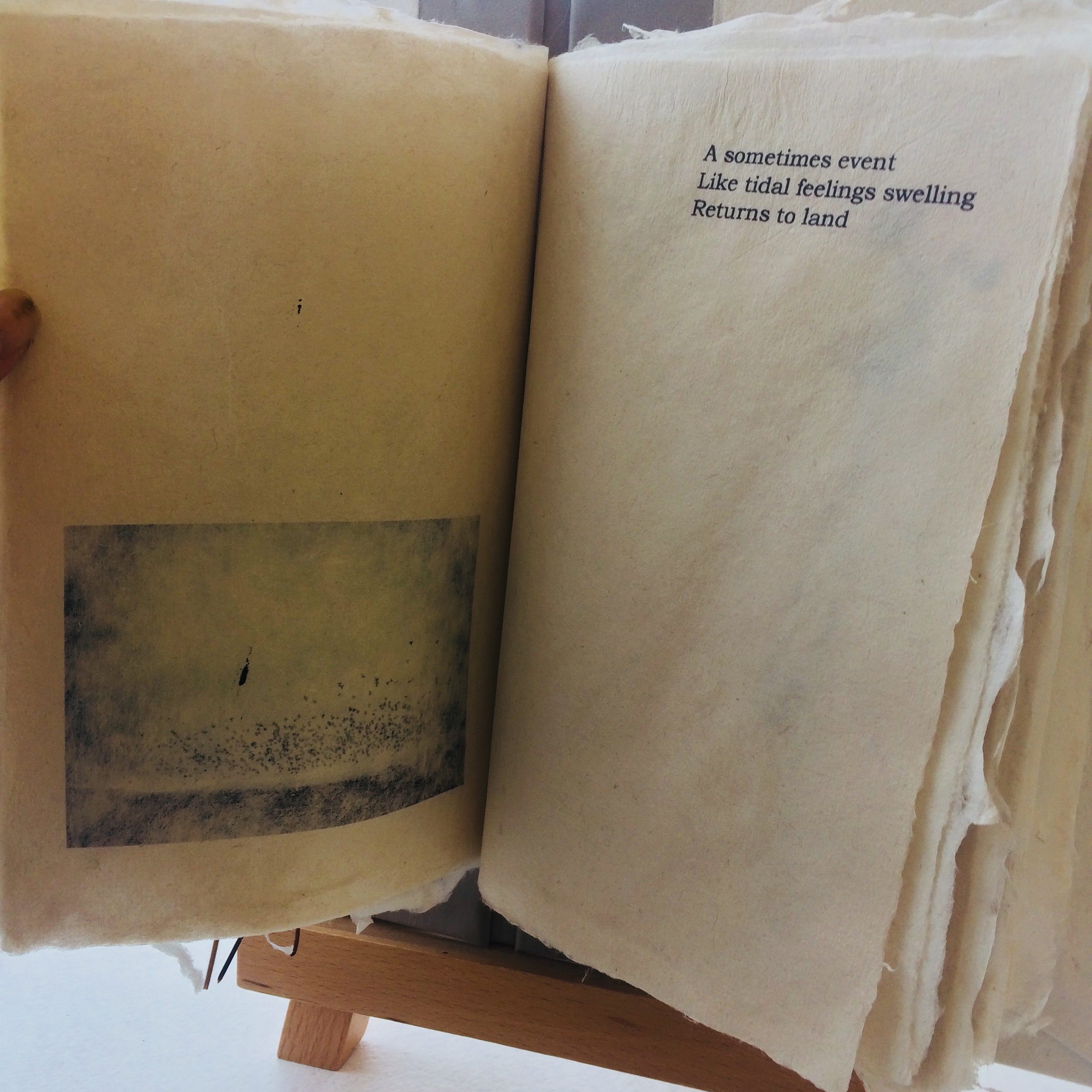
But I am not here to talk about the Anthropocene, which we are already passing through, wearing within our skin. Finding the label as though a sticker on an apple, formerly known as, familiar variety almost forgotten through ubiquity — well pressed on various surfaces, deferred. It was a Thursday, the day after Storm Ali wreaked havoc on Glasgow, tearing down trees and scattering leaves, stealing what green of summer was left of leaf and letting it blow forth upon roads of concrete — you might say free, if leaves have an internal stammer for separation, a need for self-definition. I’m not sure the beautiful, connected things do. A foliate thought unfinished. I guess I needed to be free as well, there was a lot of text, swimming around me all morning I couldn’t quite fathom. A thicket of text. Dwell upon ellipsis and offline symbols. So I slathered oil on my creaking bike chain, cycled along the Clyde and found myself at South Block studios for a new exhibition, An Orkney Odyssey, by the CAIM Collective.An Orkney Odyssey features the multi-disciplinary works of Ingrid Budge (photographer), Alastair Jackson (haiku), Moira Buchanan (handmade booklets) and John Cavanagh (sound installation). I recently returned from my first trip to Orkney and was eager to immerse myself in something of those islands again.
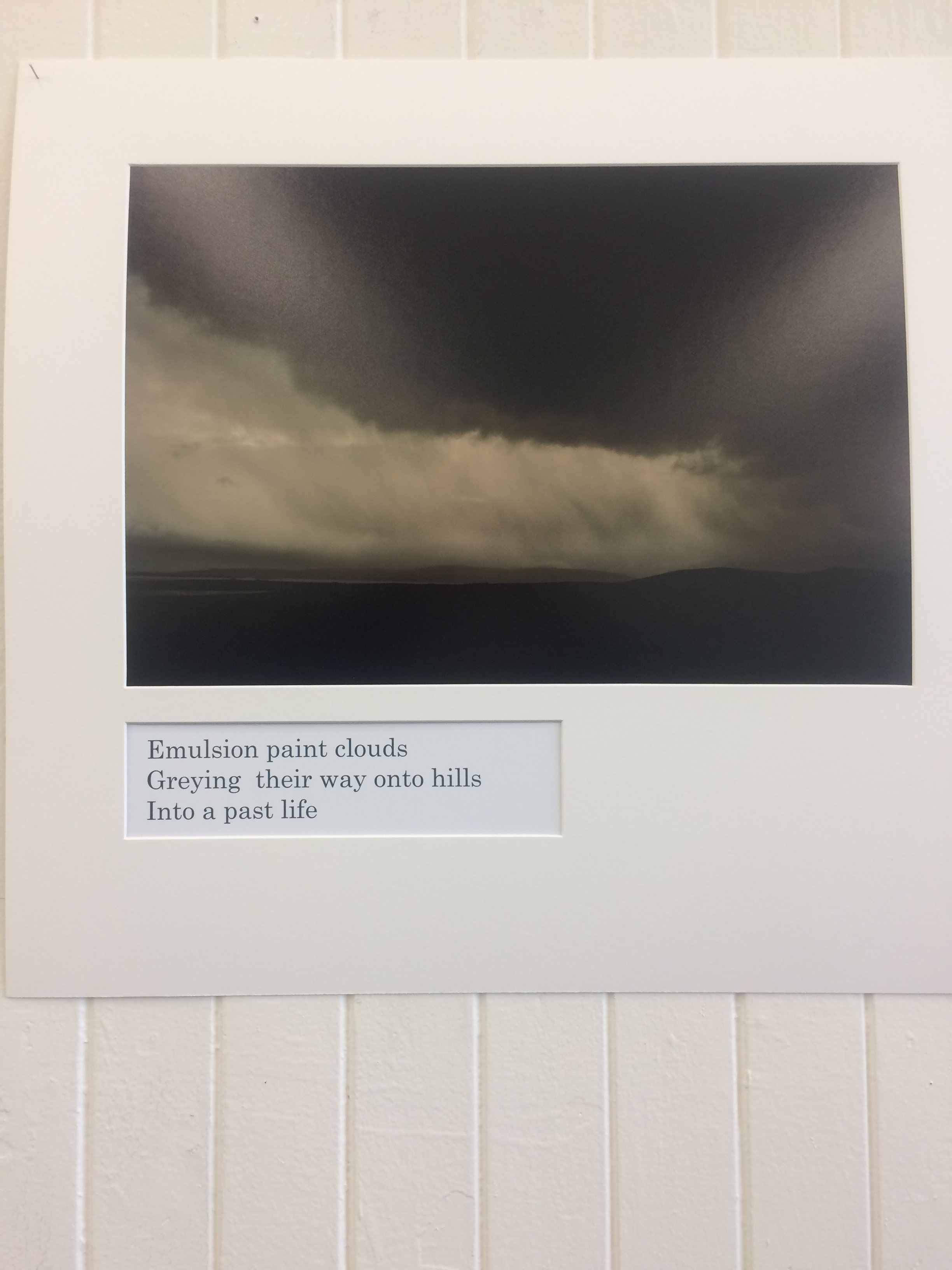
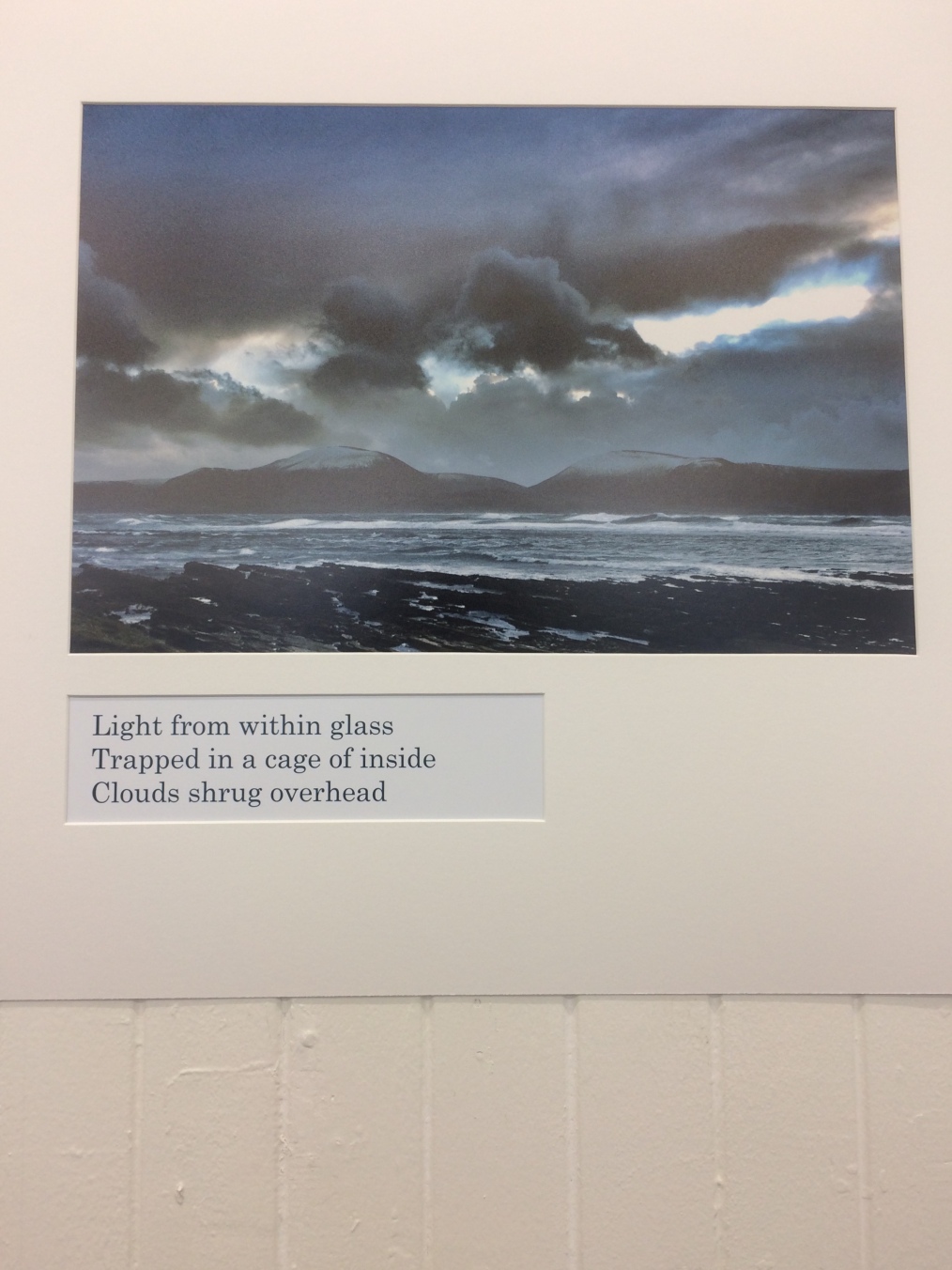
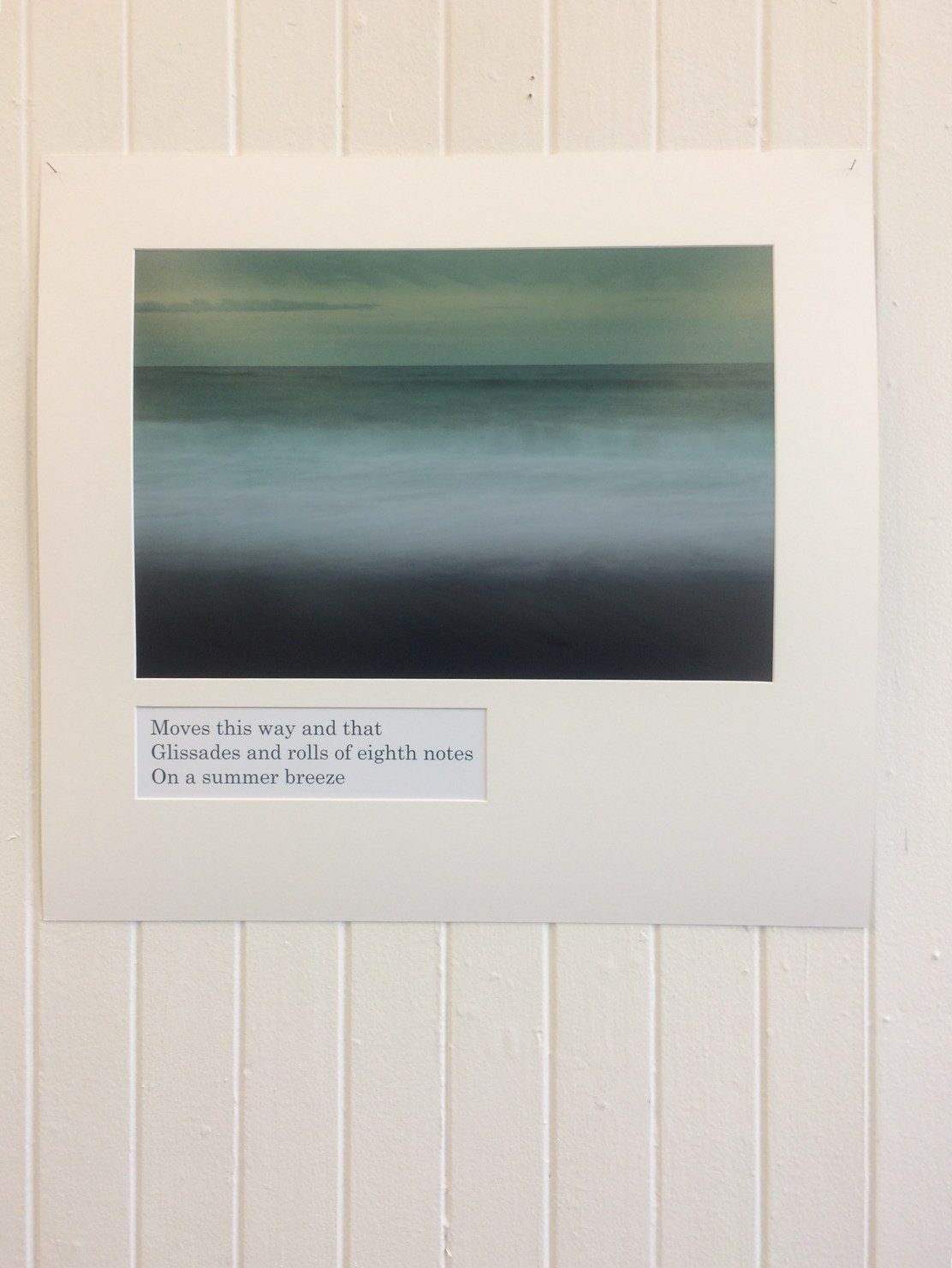
South Block studios is a white room, part café, a place smelling pleasantly of coffee. The rest stop between things, east of town. I’ve been here before with a friend, when we were discussing the early days of a new publication. It feels clean, airy, a place of potential. The exhibition consists mostly of Budge’s photographs, presented along the wall with Jackson’s poetic snippets beneath. I say snippets, because one gets the sense that all these impressions and snapshots are fragments of a broader story, a grander drama. My own time on the Orkney islands was limited to the mainland, but as the ferry curved round past Hoy, I sensed that to really experience life here, you have to think in archipelagos, rather than discriminate, bounded islands. A multiplicity of coastlines connected, reflected, glimpsed across these strips of tide. I experience each piece as both separate and connected: they resemble a sort of Instagram post, the supplementary clue to a world elsewhere, a stop beyond. The possible scroll, the anticipatory mirage of other places, beckoning like hyperlinks.
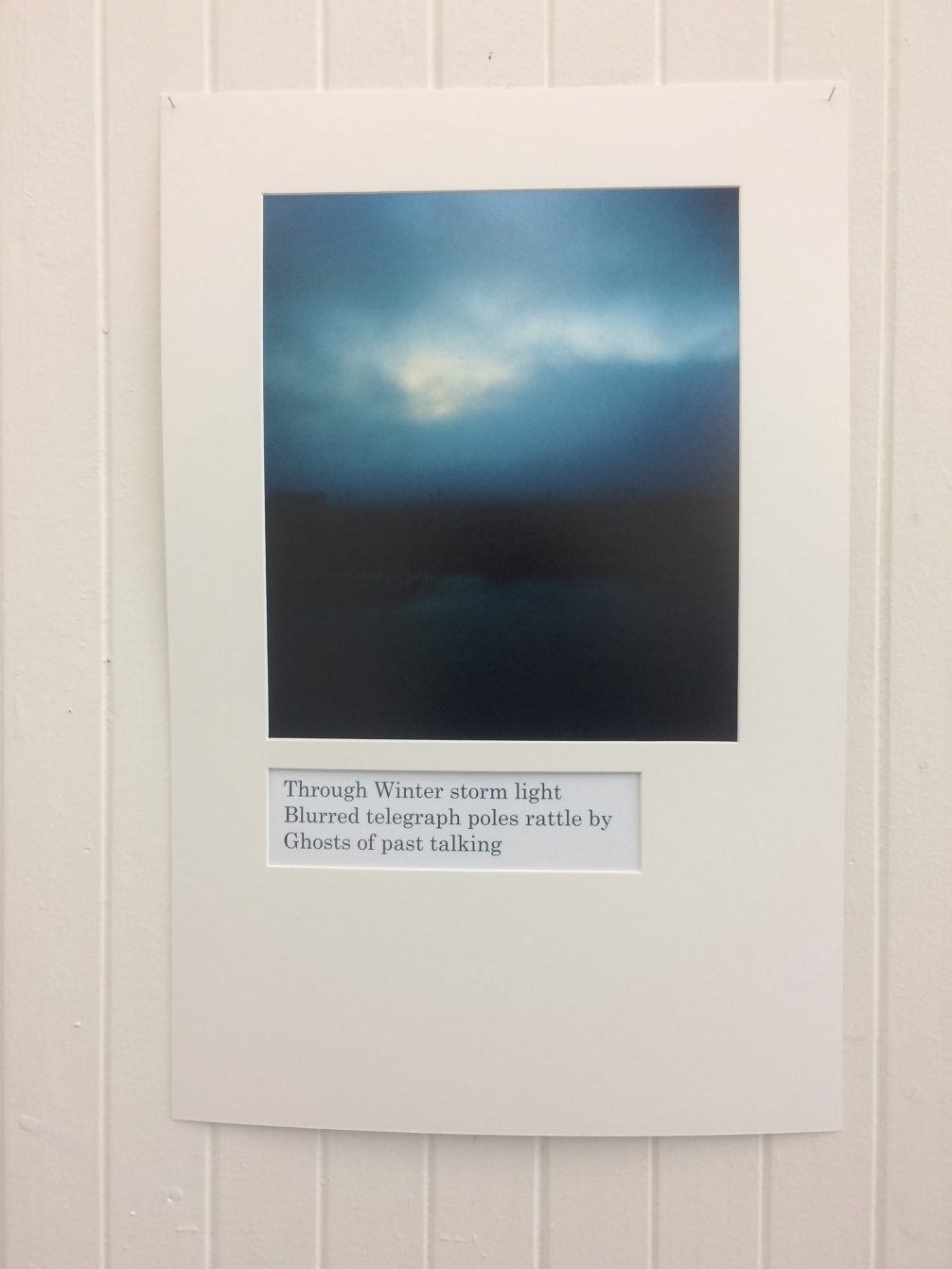
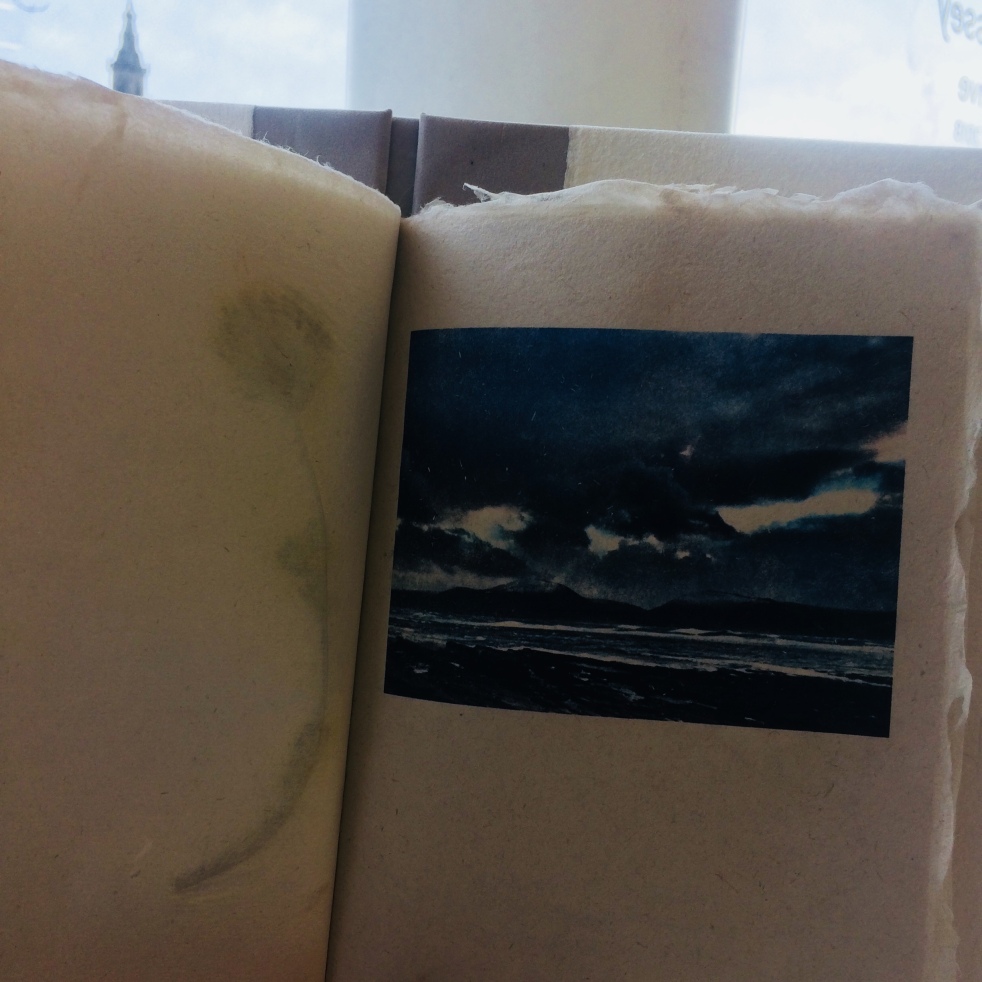
Looking at these images, I’m reminded of one of my favourite quotes from Susan Sontag’s On Photography: ‘to take a photograph is to participate in another person’s mortality, vulnerability, mutability. Precisely by slicing out this moment and freezing it, all photographs testify to time’s relentless melt’. Many of these photographs capture landscapes from a skewed perspective, a step away from anthropo-familiarity. We may be unsure where to place our gaze, looking for a horizon or coastline. Sometimes there is a blur, a smudge of cloud and beam of light; a looming mass of weather. An almost unnatural colouring. We are forced to think in terms of diurnal shifts, glitches in time, moments of elemental transition. They are nothing like the picturesque of the brightly saturated tourism brochure, the pamphlets I flicked through idly as I waited for the ferry to Stromness. These images are ghostly, strange, a little ‘off colour’. They challenge my own memories of the unique, misty and windswept atmospheres of Orkney. Budge experimented with different cameras — digital film, iPhone, pinhole — and various chemical processes to capture a sensuous, personal perspective on her native island. She exploited the apparitional potentials of lumen printing, in which objects are positioned on light-sensitive paper and exposed for hours, never quite fully developed. Rather than ‘capturing’ or stilling, rendering her subjects, Budge allows them to unfold in their own way, symbiotically in tune with their luminous environment: stealing its shadows, imprinting a smudge, a glow of time in process. It is almost as though, in taking those photos, she performs a material empathy with climatic change on the island: the shifts in light, all external markings of geologic time and the time of seasons. I am allowed to read into this, because the images abstract from subject, they ask us to find psychic states amid landscape, they do not fetishise the specifics of locality. They do not simply state: here is a field of sheep as we, as humans, see it. They challenge us to rethink perspective, authority, subject and photographic temporality.
Jackson’s poems, which each accompany one of Budge’s images, really draw out this elemental drama of perspective, time and abstraction. Instances of familiar infrastructure become the tuning posts or sounding board for the dead, ‘Ghosts of past talking’ through telegraph poles. Attuned to the nuance of island soundscapes and landscapes, Jackson deftly parses the aesthetic reactions of one object to another, using anthropomorphism in the strategic way suggested by Jane Bennett in her book Vibrant Matter: ‘We need to cultivate,’ she argues, ‘a bit of anthropomorphism – the idea that human agency has some echoes in nonhuman nature – to counter the narcissism of humans in charge of the world’. Anthropomorphism can draw out the multiplicities of sensory experience, crossing the phenomenological ‘worlds’ or ‘zones’ of various enmeshed beings and species.
The haiku might be an appropriate form for ‘capturing’ the Anthropocene because it flickers into being like a sound-bite, it contains a certain authorial anonymity, less of the singular lyric ‘I’ than the lyric I’s environed chorus. Not to mention its traditional association with ‘nature’ as such. Presented like a sort of Instagram caption beneath these images, each haiku seems a transmission from elsewhere, sparking into presence. There are several kinds of aesthetic overlay, a synaesthetic experience of scenes: ‘Glissades and rolls of eighth notes / On a summer breeze’. The smooth legato of wind stuttering up into quavers, could this be birds or the stammering tide where it sloshes in breakwater, interrupts all smoothness of lunar rhythm? I’m reminded of Kathy Hinde’s 2008 work Bird Sequencer, where she worked with Ivan Franco to scan videos of birds resting on telegraph lines into music, after noticing how much the positioning of the birds on the lines resembled a musical score. Each bird would trigger a note or audio sample from a music box and prepared piano, in the manner of a modern step-sequencer: Hinde was literalising a form of nonhuman aesthetic attunement, surrendering compositional control to the whims of the birds themselves, their arts of arrangement. That Jackson’s poetic vision parses the elemental landscape through musical metaphors says something of our ecological inclinations towards attunement. As Timothy Morton puts it:
Since a thing can’t be known directly or totally, one can only attune to it, with greater or lesser degrees of intimacy. Nor is this attunement a “merely” aesthetic approach to a basically blank extensional substance. Since appearance can’t be peeled decisively from the reality of a thing, attunement is a living, dynamic relation with another being.
Since music is our strongest metaphoric apparatus for noticing strategies of ‘attunement’, its poetic invocation allows us to access those processes of intimacy, coexistence and agency at an aesthetic level. The aesthetic level where, as Morton puts it, causality happens: an operatic voice shatters a wine glass, a match smoulders and eats up a piece of paper, the BPA in plastic seeps into the water, alters its chemical makeup, affects the food chain.
This is a fairly minimalist exhibition, despite its multisensory components. It opens space. I can take almost whatever time I want in front of the plainly mounted images and text, the white card a sort of beach I can linger on, skirting the image. These are dark and striking scenes, mostly of nonhuman subjects. I get to share in ‘time’s relentless melt’ as it happens at the pliant, archipelagic scales of an island, stripped away from the carnivalesque rhythms of urban leisure, or capitalist imperative.
Crucial to all this, of course, is Cavanagh’s sound piece. Keen to avoid the bland oceanic ambience of New Age relaxation CDs, Cavanagh makes things weirder. This is the sea but not quite the sea, nature more than nature. Composing or rendering ecological soundscapes requires more imagination these days, a keen ear towards plurality: as every ocean is inflected with both danger and precarity, a poetics of toxicity thanks to our dumping of marine plastics, there has to be an affective current underneath, a mixing of human and nonhuman rhythms, forces, pleasures and tragedies. A force of both presence and loss. Place is no longer one thing, but stamped with the stains of elsewhere. ‘Here’, as Morton puts it, ‘is shot through with there’. Living in a time of hyperobjects means that we can’t think of, say, the seas around Orkney without thinking about the pollution that comes from mainland cities, the energy generated in these waters subject to political decision-making further south, the marine populations around these coastlines affected by agricultural, infrastructural and consumption processes going on elsewhere.
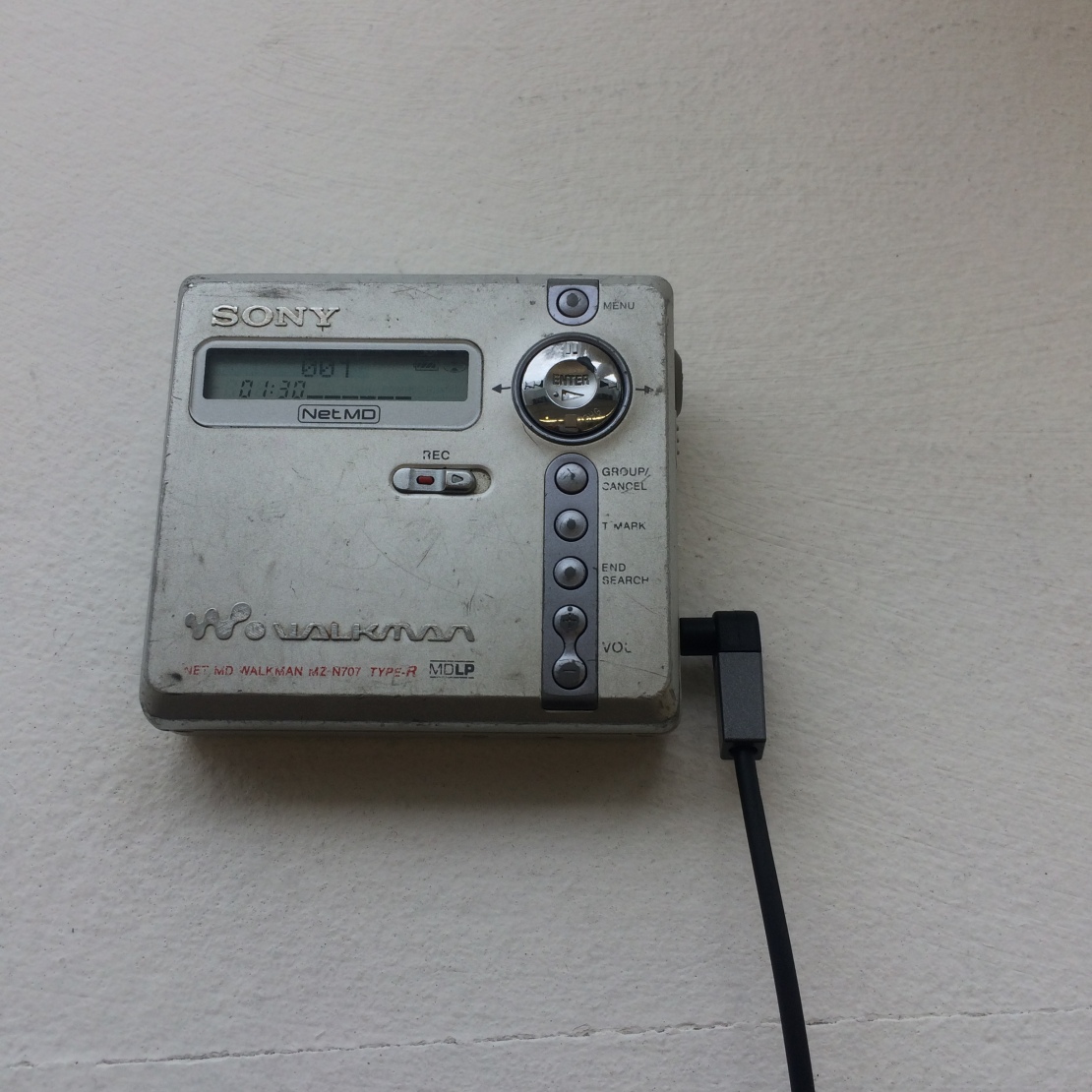
Upon entering the exhibition, I’m handed this beautiful piece of hardware
It would be easy to respond to this collision of times, spaces and places with a sort of abrasive, dystopian mix of disorder. Cavanagh, however, responds to the sonic challenge with degrees of beauty, humour and playfulness. His soundscapes swirl around the spoken words of Jackson’s poems, anchoring us vaguely to a sense of present as we pass round the room, viewing the images and poems. Sure, I can hear the waves, the howl of the wind, but these are mixed with a certain distortion akin to kitsch, electronic warp and reverie that glistens with past times, feels retro. This operative aesthetic is achieved with the piece’s main component, an EMS VCS3 synthesiser from 1973: a model familiar to fans of Pink Floyd, Brian Eno and Tangerine Dream. Cavanagh’s music literally ‘translates’ Jackson’s poems and Budge’s images, themselves translations of Orkney scenery, by plugging the syllabic layout of Jackson’s haiku and the locational map data accorded to Budge’s photographs into a patchbay which generates from number sequences a variety of different rhythms, instruments and delay effects. Cavanagh’s ‘authentic’ or ‘raw’ field recordings from Orkney’s landscapes are thus programmed around the audiovisual, semantic stimuli of Budge’s and Jackson’s work. The act of remixing nature in this way exposes nature’s very artifice, a cultural construction dependent upon our aesthetic representations. I think of a very beautiful line quoted in a recent Quietus review of Hiro Kone’s new album, ‘“Nature sounds without nature sounds”’. As a challenge to passive eco-nostalgia, there is an active pleasure in this exposure, in realising the multiplicity and material vibrancy of a term we once took for background and static, mere sonic wallpaper for mindfulness meditations.
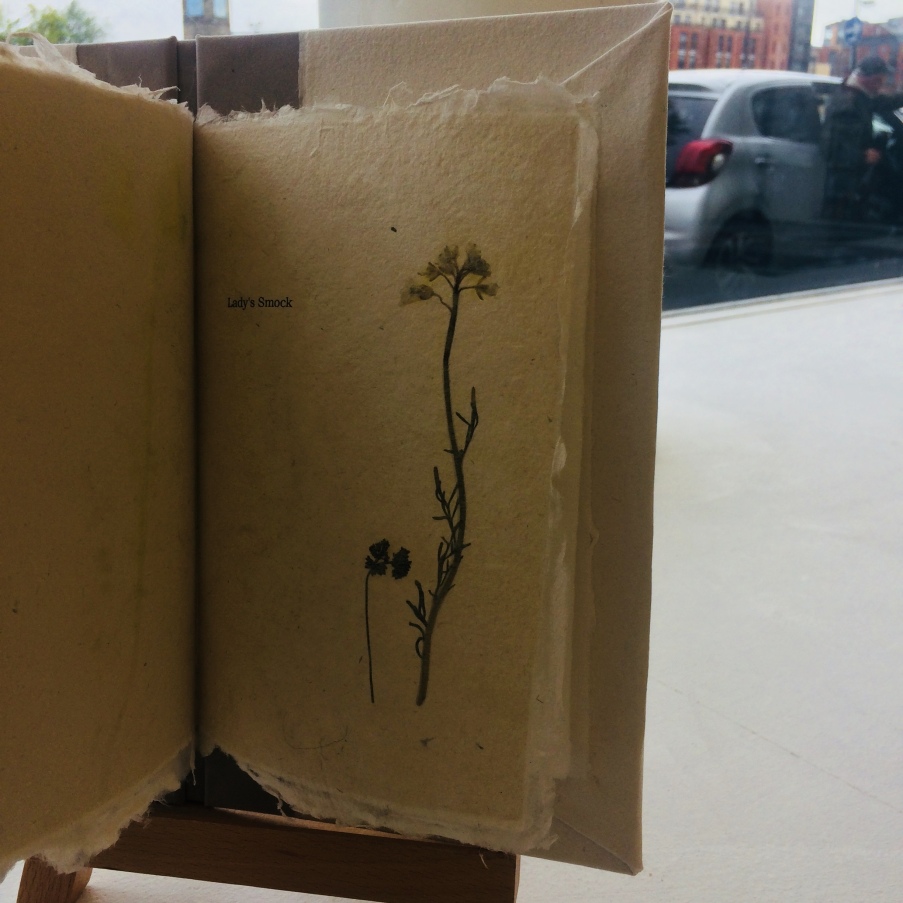
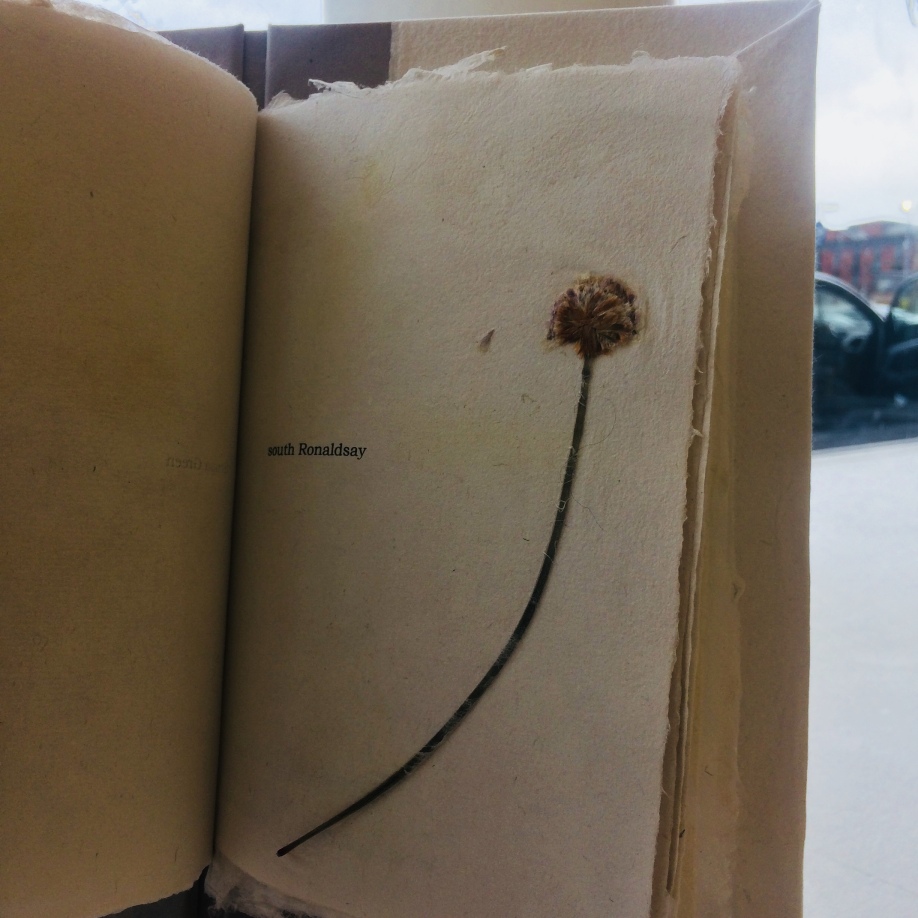
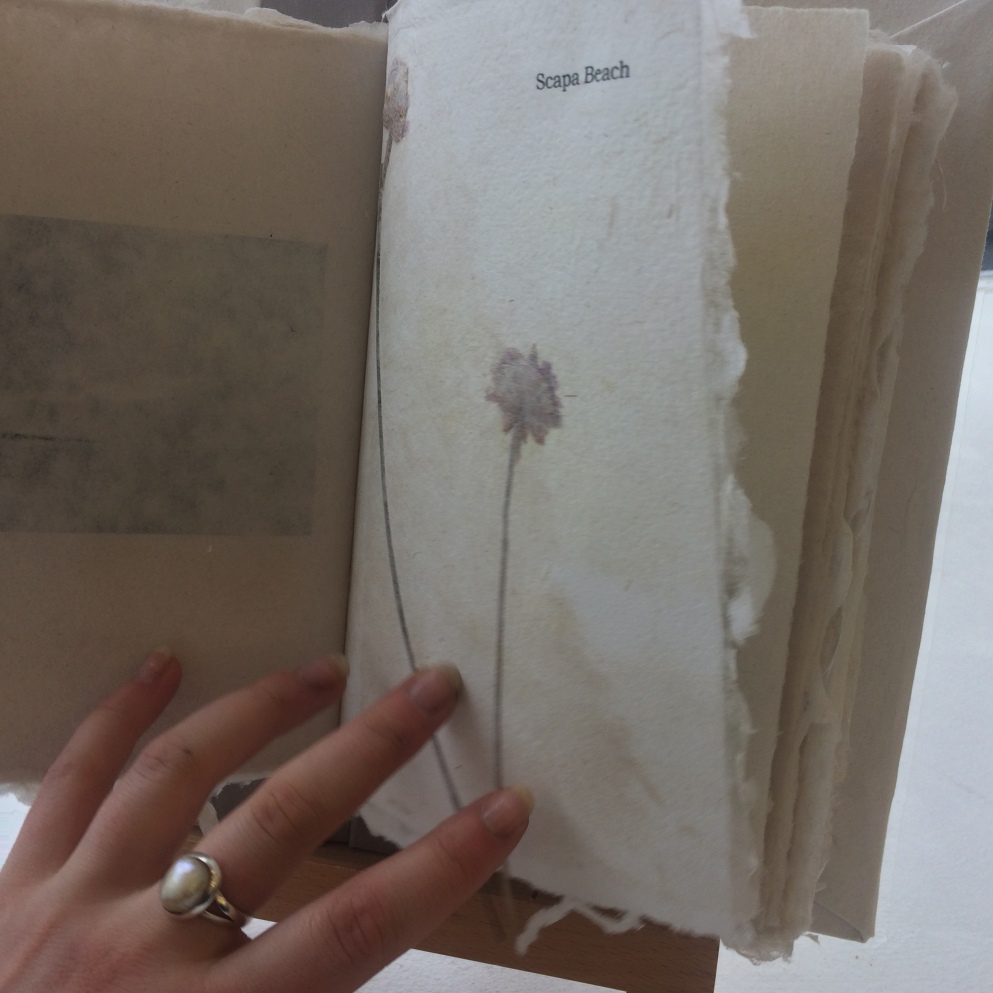
Faced with something as ineffable as the Anthropocene, we often respond, ironically, with lyric excess. The Anthropocene, it gets in edgeways, it knows we are porous. Whose odyssey is this anyway? Exhibitions like this are important because collaboration and innovation are vital means of tapping into the processes by which we, as human observers, might access nonhuman processes, glimpse the scales of time and place in a world where our significance dwindles into material trace. The fossils of future capital, always already fossils. What might a sonic fossil look like, sound like, a ghost trace of retroactive reverie, a broken sonogram, an elegiac bleep of machine or sea? An Orkney Odyssey, for all its portent towards the epic, is actually a rather humble exhibition. It offers the human perspective of memory and affect, holding wonder for these geographies and scenes, but there’s nothing too showy or sublime about it. And the micro focus is important too. Moira Buchanan’s handmade booklets draw us back to the beautiful details of wildlife around us, the simple pleasures in the act of binding and stitching the evidence of our everyday ecologies. She names in her booklets various species and places, prints poems and photos, mingles materials. There’s a real material enchantment here. Rather cutely, I wrote of these booklets before in a post on Buchanan’s 2016 exhibition, All Washed Up:
I think in today’s world, where global warming feels like something vast, incomprehensible, beyond our understanding, it’s so important to focus on the little things. The material details that remind us that we are part of this environment, that the ocean gives back what we put into it. There’s a feeling of salvage to the pieces, whose composition seems to perfectly balance the artful openness to chance at the same time as reflecting a careful attention to arrangement and applied form and texture.
I was still grappling with the Anthropocene with a sort of innocence then. I mean, I was still calling it global warming. The booklets in South Block catch the light of a late September afternoon, luminous in the window. Taking pictures of them, I can’t get the angle or the light right. I can’t quite translate, my iPhone proximate to its physical extinction, stubbornly refusing photographic clarity. During my trip to Munich this year, I was given a five-leaf clover picked from a lovely Bavarian meadow. I pressed it between the pages of Lisa Robertson’s The Weather. That, I suppose, was an act of salvage also. Symbolic recycling. A little token of some unspoken odyssey.
Unsure of the rest of the night, what to do, awaiting replies, I cycle through rush hour, heading south with only vague destination. Peddling hard, I cross the water as though crossing the sea. Later I will fall asleep with electronic sounds rasping my headphones, mixing with the wind outside which batters the window, until sleep becomes its own causality…
***
Exhibition Details:
Venue: South Block, 60-64 Osborne Street, Glasgow, G1 5QH
Exhibition Continues: 14th September – 5th October 2018 (Mon Fri 9-5).
She laughed at that, her maraschino heart would sweeten the moment with its tender syrup of lies.
“It’s just a door,” he said. The pair of them made a couple of magpies. She was green-hued, he was jewelled with blue.
They made their way through the suburbs, so easy the way they rolled along concrete with those slender legs. I have made a pinball of their trajectories. Soon they realised their mistake.
“We have to go back for the door,” she said. She was insisting. He admitted her this.
They carried the door along many streets. It was painted the colour of duck eggs, a pale blue paint that flaked in places. People stared, assuming they were a lovely young couple setting up their new home. Sometimes, she patted her pocket to make sure the stuff was still there. Later, they would huddle under the lilac in the rich person’s garden and count their dreams beneath panoplies of blackbirds. For now, there was the door.
“What shall we do with it?” he asked.
“It has a purpose.” She propped it up against the red brick wall of the old agora. It had beautiful windows, the kind of windows you imagine on doors in twee country houses, where nice mothers served sugar-bread to doorstep strangers.
“We could do anything with it.” They flirted with the idea of hacking it to bits, chopping for firewood. The forest was not far away; though really it was just a copse of trees, the undergrowth littered with cigarettes, sweet wrappers, needles. Not enough space to get lost in. You could hardly build a fire without alarming the neighbours.
When we are drawn out of nothing we are drawn into possibility. The couple knew the door was their portal, knew it as sure in their blood as they knew their daily hunger. Sometimes at night, she would let him scratch the sores on her skin, sending her off to sleep. She knew he spent those nights awake, scraping the bark off any hide he could, clotting the soil in his nails. They borrowed a suitcase, abandoned at a bus stop. An old lady’s worldly possessions treated them briefly to cardigans, palma violets, little nips of hip-flask whisky. They were warm for weeks, till the wool unravelled in winter’s first storm, till the liquor ran out one cold dark night.
Combustion or invitation. He gripped her arms and tried to shake her from every undulate leafy trembling. Her blood was beyond human; she had set up her fix long before sundown and this was wrong. He stayed with her through the worst of it, the 4am rattles and the toothache. If only the medicine worked, if only. Night-blooming flowers made cheap companions. An amazing array of skinny women would pass through the copse, the side alley that led to the 24 hour Spar, the petrol station. Cars would always pass regardless. The wholeness of the city was a great sprawl of this transitive passing.
And then the door.
She twisted the brass handle. The screw screamed in its lock, but nobody heard it.
(Can we always be stuck like this, honeycombing our bodies?)
It felt magnificent, holding him in the darkness as she always did, the frost forming rime on the skin of their lips. Somehow they knew the door was a separation. A transmutation of the flesh would occur in its fold, the way the pull-back of a hinge would sweep away time as they knew it. This was okay somehow, almost reassurance.
In Michelangelo Antonioni’s 1964 film Red Desert, loosely inspired by Rachel Carson’s groundbreaking ecological text, Silent Spring (1962), one of the characters complains that he was at a restaurant and the ‘eel tasted of petroleum’. This is a film landscaped by oil rigs, the persistent murmur of a dull grey dying sea, industrial structures whirring with eerie electricity. While there is a distinct sense of disconnection between characters, between humans and their environment, one connection that persists is between excess, waste and the body. While nowadays fish change genders due to oestrogen from the Pill being excreted and pumped from sewage into rivers, in Antonioni’s film, haunted by the apocalyptic backdrop of the Cold War, the characters worry about their food getting cloaked in some essence of what gets dumped and yet is also extracted from the sea. A perverse cycle of waste, energy, wasted energy.
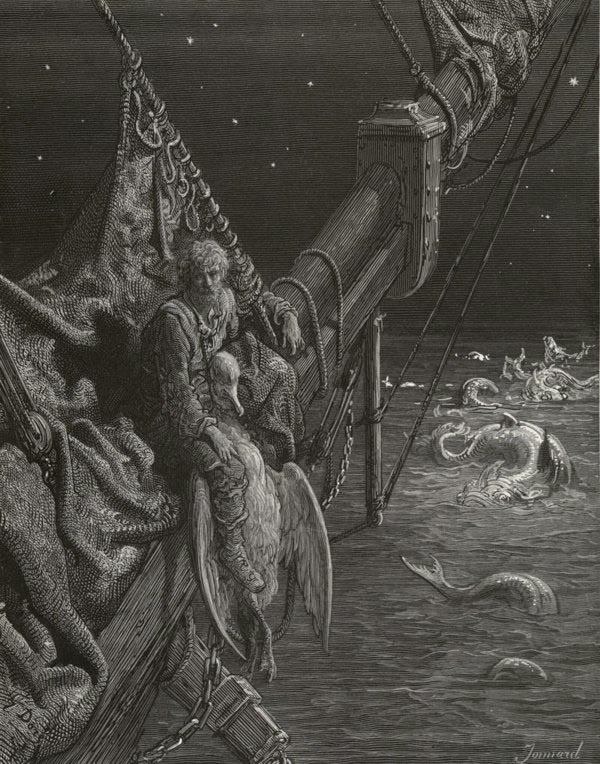
The mariner shoots the albatross, plate by Gustave Doré
This early expression of ecological disaster as embedded in a fear of contamination, of sliminess mixing with toxic sliminess, has its roots even further back, in Samuel Taylor Coleridge’s poem The Rime of the Ancient Mariner (1798). After shooting the albatross and overcoming a terrible, supernatural (super as in extra nature, nature made unnatural by being its full strong self) storm, the mariner finds himself suspended in the aftermath, ‘as idle as a painted ship / Upon a painted ocean’ (Coleridge 2015). This sense of time frozen, of the environment refusing to yield to human command, is uncanny, a reminder that the land isn’t just something we can divide and conquer. The image of idleness and a ‘painted ocean’ recalls the experience of a crashed computer screen, hung or ‘frozen’ as the mariner is in the sheets of ice ‘green as emerald’ (Coleridge 2015). Think of a typical glitch, that which overlaps colour, blends unrelated materials together in a random, patchwork image. The ice is the colour of grass, yet still we are in the ocean. This is an environment without location, an ‘anywhere’ of strange displacement. This is the place of the ecological glitch.
Rosa Menkman describes a glitch as ‘a (actual and/or simulated) break from an expected or conventional flow of information or meaning within (digital) communication systems that results in a perceived accident’(2011: 9). While we are dealing in poems like Coleridge’s with a ‘natural’ system as opposed to a digital one, the strange effect of ‘accident’ persists. ‘Nature’ is never as it seems, never ‘natural’ but always unexpected, strange. Systems follow patterns which glitch; the patterns themselves, like evolution, proceed often by a logic of chance, randomness. The weather in The Ancient Mariner is not just climate, a conventional flow of data to be charted and forecasted; but it is positively weird. Weird in the etymological sense identified by Timothy Morton as ‘a turn or twist or loop, a turn of events’, the ‘flickers [of] a dark pathway between causality and the aesthetic dimension, between doing and appearing’ (2016: 5). We question whether the crime of shooting the albatross instigates this ecological horror, which culminates in the monstrous appearance of ‘a million million slimy things’ which the mariner sees surrounding the ship. Like Antonioni’s petroleum eels, these slimy things are stuck with the human character, they have by proximity or digestion become enmeshed, to borrow another term from Morton, the idea that ‘nothing exists by itself, and so nothing is fully “itself”’ (2010: 15). The mariner realises his own surprising mortality, just as the slimy things ‘liv’d on – so did I’. His attempt to lump the slimy things as one gelatinous mass of gross matter leaves him realising that he can’t distance himself from the ugly parts of nature, because he himself is part of the mass, that mesh of beings.
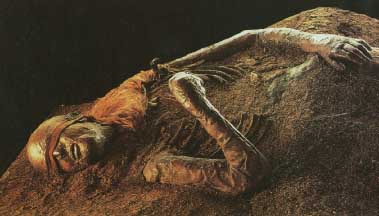
We might now describe Coleridge’s flirtation with the supernatural as a kind of magical realism, and the trend of using such weird elements to render ecological themes continues in a short story written by Karen Russell and published in the New Yorker in 2016. ‘The Bog Girl’ tells the story of a fifteen-year-old boy, Cillian, who works as a turf-cutter in the peatlands of some ambiguous ‘green island off the coast of northern Europe’, inflected with hints of Heaney’s hardy Irish pastoralism. Cillian falls in love with a young girl pulled from the bog; she is ‘whole and intact, cocooned in peat, curled like a sleeping child’ with ‘lustrous hair’ dyed ‘wild red-orange’ by the ‘bog acids’ (Russell 2016a). Crucially, there is a noose round her neck. She is young in appearance but probably 2000 years old; her flame-haired and gaunt appearance recalls Celtic/Pictish origins as well as a ragged Pre-Raphaelitism, which hints at Cillian’s weird fetishisation of her beauty. The story that unfolds can be read as a love story, a tale of caution against projecting your ideal fantasies onto ‘the mask of another person’s face’ (Russell 2016b); but here I will read it as a tale of ecological horror that warns of the dangers of industry and celebrates the sensuous mysteries of the peatlands as something that deserves preserving.
Our current era, the Anthropocene, is one of distorted scale, where constantly we deposit chemicals into the atmosphere and earth whose afterlife beyond our own we can barely even gauge as mortal humans. Russell’s story explores this (im)possible meeting of temporalities through an encounter with strangeness which allows us to mull upon our relationship with the earth, to realise our absolute enmeshment with the environment. No matter the narratives we construct through history and science, all human theory is at best the ‘most speculative fiction’; while improvements in science (‘radiocarbon dating, DNA testing’) allow us to trace the ‘material fragments’ as ‘clues’ about our ancestors’ experience, ‘their inner lives remain true blanks’ (Russell 2016b). At one point, Cillian decides it’s time he met the Bog Girl’s family, so he takes a ferry from the island to a museum. He scans the museum’s labels, which attempt to give context to the ‘pickled bodies from the Iron Age’, but is unsatisfied by these attempts to ‘surmise’ details about the ancestors’ lives based on material detail alone (Russell 2016:a). Their bodies are ‘fetally scrolled’ (Russell 2016a), suggesting that screeds more of history are inscribed on their skin like ink upon scrolls, a literal blending of flesh and text. The inadequacy of the museum labels allows Cillian to continue his fantasy that the Bog Girl appeared for him alone, that she ‘was an alien from a planet that nobody alive could visit—the planet Earth, in the first century A.D.’ (Russell 2016a); none of the other ancestors stir the same emotion as the Bog Girl. Love becomes a token, a talisman of magical power: ‘He told no one his theory but polished it inside his mind like an amulet: it was his love that was protecting her’ (Russell 2016a).
Russell’s narrative sustains this fantasy, resisting the natural outcome which would be the Bog Girl’s rapid decomposition upon exposure to air. This commitment to a magical realist effect allows her to explore problems of intimacy and otherness, which relate deeply to ecological issues. Take the bog itself. Russell describes it as a primitive hole, the ‘watery mires where the earth yawns open’, a place where time is suspended by a ‘spell of chemical protection’ which prevents the decomposition of matter: ‘Growth is impossible, and death cannot complete her lean work’ (2016a). Her rendering of the bog is crucial to the story for its associations with the suspended temporality embodied in the Bog Girl. We are told that much of the peat is cut away to turf, a key energy source still used by the islanders, and ‘nobody gives much thought to the fuel’s mortuary origins’ (Russell 2016a). Death, a haunting presence seemingly without telos, lingers in the earth, in the home; the Bog Girl weirdly embodies our paradoxical relationship to natural fuel sources: we consume them to produce energy, but our consuming instigates the loop of destruction—de-energising the earth—pumping poisons and coagulating into new forms of deadly matter. The peat bogs are a kind of charnel ground, already containing the detritus of bodies and time in a ‘disturbing intimacy […] that exists beyond being and non-being’ (Morton 2009: 76). The bogs are both ‘shit’ and ‘fuel’ (Russell 2016a), embodying the waste we must expel to maintain presence and order; but also refusing this separation, stickily gluing us through interdependence (the islanders need it for fuel) just like those slimy things reminding the mariner of mortality.
Moreover, the introduction to the bog includes the narrator’s address to the reader, the only such address in the story. The narrator remarks of the island, ‘it’s unlikely that you’ve ever visited. It’s not really on the circuit’. This seemingly throwaway comment interpellates (in Althusser’s sense of the word as a ‘hailing’ of subjectivity within ideology) the reader as a global consumer, whose ‘circuit’ references a sort of capitalist freeway (the places we drift through for pleasure) as much as it slyly hints at the cycles of life/death which are interrupted in the text. From the start, we are made to feel as outsiders in this community, which is self-consciously established as a wasteland of sorts, off the circuit, the beaten track; a charnel ground for exploring the mystical possibilities of strangeness and ecological intimacy.
What’s more, her association with primitivism and death links the Bog Girl to the past in a way that is queer, that disrupts the reproductive logic of heteronormative capitalism, a disruption that Cillian welcomes. Cillian ‘imagined, with a strange joy, the narrow life’ he and the Bog Girl ‘would lead. No children, no sex, no messy nights vomiting outside bars, no unintended pregnancies […] no promises’ (Russell 2016a). Note again that word, ‘strange’. The Bog Girl’s body is bounded; she will never consume nor produce waste, will never reproduce to bring more consumers upon the earth; with her, Cillian shrugs off the lusty masculinity of the ‘mouth-breathers’ (Russell 2016a) who help dig up the Bog Girl, he deviates from the established gender norms. Indeed, Cillian’s docility, his placid detachment from the rugged rural manliness of those who surround him (personified most perfectly in his uncle, who refers to the Bog Girl as a ‘cougar’ and has ‘a thousand beers’ laid out for himself at dinner) renders Cillian a queer figure, ‘so kind, so intelligent, so unusual, so sensitive—such an outlier in the Eddowis family that his aunts had paid him the modern compliment of assuming that he was gay’ (Russell 2016a).
Yet while the Bog Girl embodies a queer backwardness, more specifically she offers an openness of temporality, a strange oscillation between past and future rather than an obsessional projection towards the future. Derrida (1994) explains the promise as bound up in the logic of messianism, the guarantee of the future to-come of some saving force that would sweep up history. Remember the religious breathlessness which narrates Cillian’s discovery of the Bog Girl: ‘The bog had confessed her’ (Russell 2016a), as if she were a message passed on from a Neolithic age. Yet Cillian is oblivious to the fact that his love is itself the promise of an (unspeakable) secret, a promise of a present without future, a seamless overlapping of present and a past that can never again be as time demands its rupture, the Event of her eventual, unexpected awakening. The silence between them, the Bog Girl’s inability to speak, indicates his sense that love can be their pre-linguistic communication, an avowal without trace; but this originary language is impossible:
Invented for the genealogy of what has not happened and the event of which will have been absent, leaving only negative traces of itself in what makes history, such a pre-originary language does not exist. It is not even a preface, a foreword, a lost language of origin. It can only be a language of arrival or rather of the future (une langue d’arrivée ou plutôt d’avenir), a promised sentence, a language of the other, again, but entirely other than the language of the other as language of master or coloniser [and now I emphasise], although the two of them can sometimes announce between them, keeping them in secret or holding them in reserve, so many troubling resemblances.
(Derrida 1998: 61)
This ‘language of the other’ breaks down the classically patriarchal imposition of telos and closure upon the Bog Girl: she will be his forever faithful silent Angel in the House; that is, until she starts speaking. Cillian’s aphasia, ‘a stutter that had been corrected at the state’s expense’ (Russell 2016a), hints at his own problematised presence in the text, since commonly we associate speech with presence. He lacks the authoritative Word, is himself described as a queerish glitch in (human) nature, a ‘thin, strange boy’, ‘once a bug-eyed toddler’, whose grownup, ‘celery-green eyes’ (Russell 2016a) bely an inherent connection to both land and water—there’s a suggestion of his slightness, his precarious and translucent appearance in the world. The mutuality of recognised love he comprehends with the Bog Girl is this ‘secret’ which excludes his mother and friends, which makes others jealous; and yet it is also a source of troubling disruption, the threat that emerges in the master/servant dynamic symbolised by the noose round the Bog Girl’s neck, which Cillian tightens as his ‘fantasy life’ grows deeper (Russell 2016a). And what is ‘the language of arrival’? It is the Bog Girl’s coming-to-life, her messianic resurrection into present existence.
The irony of the story is that Cillian and indeed all the human characters in the story failed to predict this resurrection. The Bog Girl is adored or feared precisely because she skims with death; the body-conscious girls at Cillian’s school are ‘jealous of how little she ate’, the vice-principal sees her as shedding ‘an exciting new perspective on our modern life’ through her contrasting connection to the past (at this moment, the Bog Girl ‘had slumped into his aloe planter’), the fear among Cillian’s mother and aunts is that she will drag him away from the safety net of respectable surveillance: ‘“I’m afraid,”’ Gillian, the mother, confesses, ‘“if I put her out of the house, he’ll leave with her”’ (Russell 2016a). There is no suggestion of the Bog Girl’s autonomy here; rather, she is seen as embodying a terrifying strangeness that might contaminate ‘innocent’ Cillian. But then she wakes up. Her ‘radish-red’ lashes are vegetable (in the sense of passivity and organic matter) companions to Cillian’s ‘celery-green eyes’ (Russell 2016a); she too is an earthling, bound to the bog in an inexplicably deep, mournful way. Her awakening is erotic, marked by ‘a blush of primal satisfaction’; it is only at this point that their relationship emerges fully into what Donna Haraway calls that of companion species, whose interdependence is based on mutuality, in ‘forbidden conversation’ (Haraway 2008: 16). Haraway says of her relationship to her canine friend:
I’m sure our genomes are more alike than they should be. Some molecular record of our touch in the codes of living will surely leave traces in the world, no matter that we are each reproductively silenced females, one by age and choice, one by surgery without consultation. […] We have had forbidden conversation; we have had oral intercourse; we are bound in telling story on story with nothing but the facts. We are training each other in acts of communication we barely understand. We are, constitutively, companion species. We make each other up, in the flesh. Significantly other to each other, in specific difference, we signify in the flesh a nasty developmental infection called love. This love is a historical aberration and a naturalcultural legacy
(Haraway 2008: 16).
It is only when the Bog Girl awakens that the relationship becomes properly ‘in the flesh’; she has learned the communion of erotic love, is ‘tugging at his boxers’, but at this point Cillian is tipped into the abyss of signifying rupture: ‘something truly terrifying had happened: she loved him back’ (Russell 2016a). The nasty developmental infection called love’ rips apart his perfect communion of static silence. The Bog Girl’s language ‘was no longer spoken anywhere on earth’, it is a primitive cry from the depths of the peatlands, which Cillian cannot answer because he is indifferent to the Other as anything more than his own anthropocentric projection: ‘The past, with its monstrous depth and span, reached toward him, demanding an understanding that he simply could not give’ (Russell 2016a). We might think of the title from Jonathan Bate’s crucial ecological polemic, The Song of the Earth (2000), or a strange, aberrant passage from Virginia Woolf’s Mrs Dalloway (1925), where a vagrant woman whose ‘rude’ mouth is a ‘rusty pump’ (signifying, perhaps, the decay of industry, its material crudeness) singing a song of ‘love which has lasted a million years’ (Woolf 2004: 70-71). The idea of song suggests an ambient music that stretches onwards without climax and fall, echoing past and future in its rasping cry. The eerie, anthropomorphic crackles, growls, roars and howls that come from the ice in The Ancient Mariner. What would the earth sound like, speaking back? Surely it would be our own cry, endlessly deferred; the echolalia of life forms caught in this experience together, entangled in the rendering of a dark and dying world.
In many ways, the Bog Girl is animal, Other; she is not quite human. Better then to think of her as someone who embodies the terrifying intimacy of all life-forms, which brush up against one another, bearing their various sensations and temporalities. While the mariner comes to admire those gross ‘slimy things’, noting their ‘rich attire’ and blessing them with a whiff of Romantic kitsch as ‘happy living things!’ (Coleridge 2015), Cillian finds himself caught between the Bog Girl’s world and his own, ‘struggling to pay attention to his droning contemporaries in the cramped classroom’ (Russell 2016a). Referring to his classmates as ‘contemporaries’ reinforces their association with the present; juxtaposing with Cillian’s mournful retracing of steps, back ‘to the lip of the bog’ (Russell 2016a), the word ‘lip’ suggesting both spatial liminality and the erotic possibility of the temporal and primordial lacuna that lies within. We can think of the Bog Girl as what Morton (2010: 41) calls the ‘strange stranger’, a word for all life-forms which encapsulates the way that even those closest to us are inherently weird, because they remind us that we are not wholly ourselves, that we too are composites of life-forms, viral code, enmeshments of DNA.
Although the Bog Girl always seems close—we get vivid details of her ‘rhinestone barettes’, her ‘face which was void of all judgement’ (Russell 2016a))—indeed she becomes a vital component of Cillian’s life, ultimately he is forced to realise her absolute strangeness. Unlike the mariner he is unable to overcome that gap of Otherness and make peace with the uncanny experience of the ecological mesh. He goes down, enticed by the ‘lip’ of the bog, listening for the ‘primitive eloquence’ of ‘the air-galloping insects continu[ing] to speak the million syllables of [the Bog Girl’s] name’ (Russell 2016a). At the end, the narrative becomes ambient, with a distortion of inside/outside, self/other:
“Ma! Ma! Ma!” That night, Cillian came roaring out of the dark, pistoning his knees as he ran for the light, for his home at the edge of the boglands. “Who was that?”
(Russell 2016a)
My immediate assumption here is that Cillian is calling “Ma!” for his mother, a riff on the Irish references of the piece which are probably a nod to Seamus Heaney’s Bog Poems (1975). However, it’s not clear; elsewhere she is usually referred to with the Americanism, “Mom”. Cillian himself has adopted a primitive roar, which rips through the resonant chorus of insects as if refusing their incantations of the Bog Girl’s presence. The call for the mother seems vaguely directed, a generalised cry for help rising from pure terror as he runs for the light. ‘“Who was that?”’, embedded in the same line, seems to come from Cillian, but equally it could come from his mother back home, or even the boglands themselves, watching this skinny boy run off from the darkness. A mutual sharing of strangeness. This is an affective, fleshly and sensuous experience of horror that the written texts, the museum labels, cannot document. There is always a possible slippage, which Russell literalises in the Bog Girls’ figure. Nature has betrayed its accident, the glitched intrusion of the prehistoric past upon a modern present. While Red Desert more overtly projects the ecological breakdown of the external world through the increasingly disordered mind of its female protagonist, ‘The Bog Girl’ leaves us with an unsettling vision of lingering presence: the insects singing the elegy of her name, a name which tremors, sends nightmares to Cillian, which resonates with the bog, itself a microcosm of a wasting, gurgling, plundered world. Is this a haunted logic for future coexistence? We’ll have to take the plunge to find out…it’s going to be dark, sticky and maybe dangerous…
I looked upon the rotting sea, and drew my eyes away ~ Gustave Doré.
Bibliography
Bennington, Geoffrey, 2004. Other Analyses: Reading Philosophy (Bennington Books).
Derrida, Jacques, 1994. Spectres of Marx: The State of the Debt, the Work of Mourning, & the New International, trans. by Peggy Kamuf,(London: Routledge).
Derrida, Jacques, 1996. Le monolinguisme de l’autre ou le prothèse d’origine (Paris: Galilée). [The translations I use from this text are Geoffrey Bennington, cited in Bennington, 2004.
Haraway, Donna J., 2008. When Species Meet (Minneapolis: University of Minnesota Press).
Menkman, Rosa, 2011. The Glitch Moment(um) (Amsterdam: Institute of Network Cultures).
Morton, Timothy, 2010. The Ecological Thought (London: Harvard University Press).
Morton, Timothy, 2013. ‘Thinking the Charnel Ground (The Charnel Ground Thinking): Auto-Commentary and Death in Esoteric Buddhism’, Glossator, Vol. 7, pp. 73-94.
Morton, Timothy, 2016. Dark Ecology: For a Logic of Future Coexistence (New York: Columbia University Press).
Red Desert, 1963. Directed by Michelangelo Antonioni [Film] (Milan: Rizzoli).




 mariaology