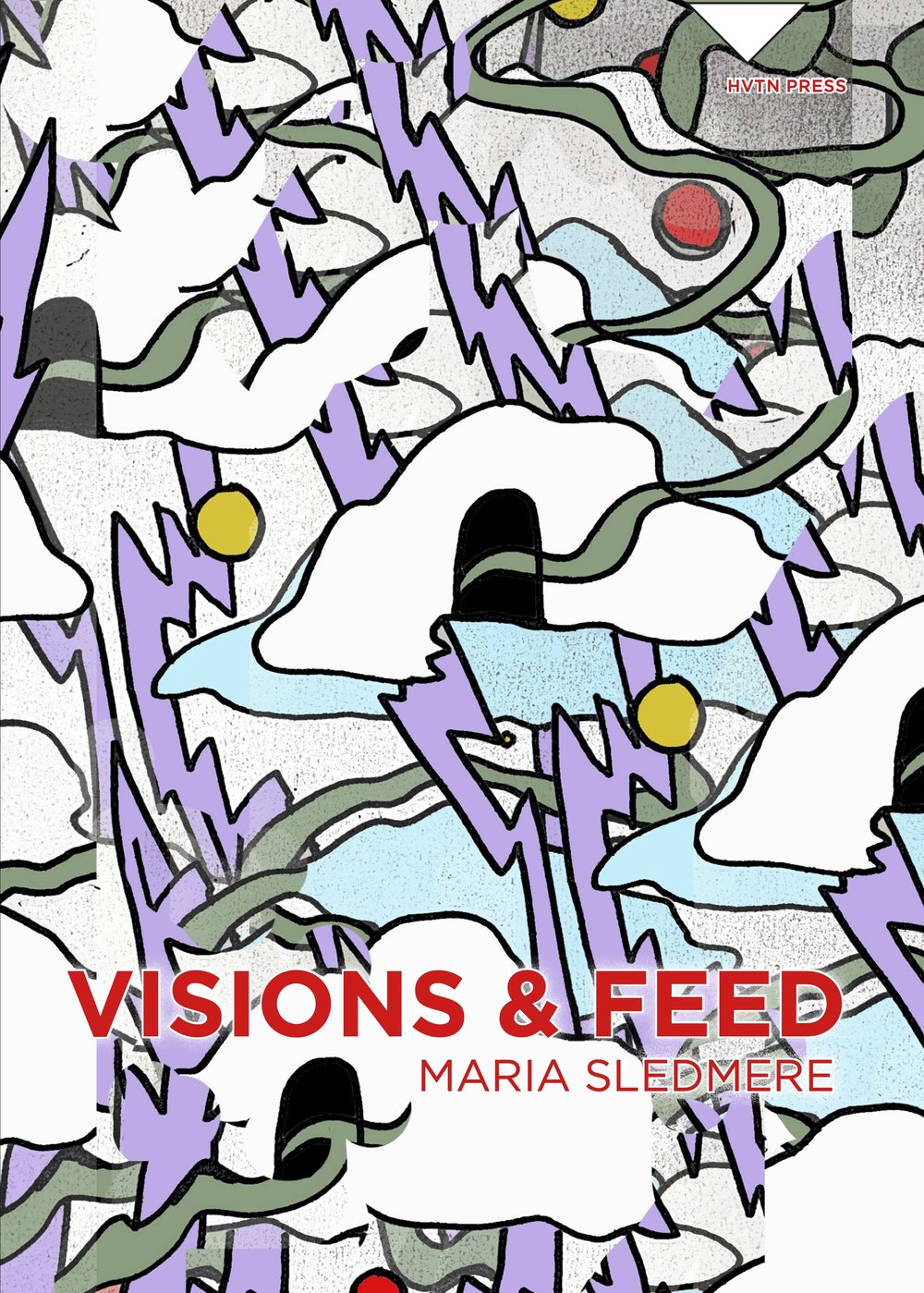
Visions & Feed is a collection that spans over two years of work brought together under the mirror phase of an anthropocene lyric filtered through crises of femininity, disordered eating, dysmorphia, labour and loss.
Sledmere asks: what does it mean to be a body in one of many dying worlds, what forms of work are done to endure it, what desires and pleasures are still possible and which are breaking down? Adopting playful and associative registers of ascent, while exploring devotion, metabolism, magic, domesticity and the ambience of dream forms, this is an intimate poetics of song and hormone, isolation and longing, fashion and pop, colour and vision in the saturated live feed of post-internet lyric. Amidst the reverb of climate melancholia and oestrogen blues, the speakers of Visions & Feed morph between depth and surface, film and music, myth and play to weather the days. Between epistolary, elegiac, confessional, ekphrastic, prose-poetic, processual, discursive and long-form cascades, the book offers iterative, experimental and fractal modes for exploring ecological entanglement within daily life.
This is my second full-length collection, following 2021’s The Luna Erratum. Many of these poems were written during lockdown or in the stretch of long afternoons at the tail end of big critical work that had occupied me for several years. I was immersed in dream and the idea of symbolic disclosure in poetry, lyrical shatterings and seeing oneself forever through glass, never clearly. Through a glass redly, purply, wrong. It begins with an epigraph from Maggie O’Sullivan’s Palace of Reptiles (2003): ‘A glazier walks through the earth calling the ruins strapped / on his back an angel’. How can poetry fit ruins into any transcendent firmament when the shards are still stuck in its back? I was admiring the glazier from afar wanting him to fix me. Suzanna Slack writes in The Shedding (2022) of ‘trying to have angel surgery’. In this book, my speaker seems to want a stomach replaced by clouds and to rain forever, why is that? I was born in a lightning storm with a lilac tongue and ate the suns like smarties. Fine. Very mild, even warm. To become glint in general felicity. Giving a zoo charm. Zooming.
‘Notes on Lyric Solarity’ at Summer in the Way, Birkbeck University of London, 9th July 2022.
Video of a creative-critical paper delivered over the weekend at Birkbeck, as part of an ongoing collaboration between the87press and the Contemporary Poetics Research Centre. Below is an extract from the first half of the paper. A lot of this thinking is developed more fully in a forthcoming academic article.
As flowers turn toward the sun, by dint of a secret heliotropism the past strives to turn toward that sun which is rising in the sky of history. – Walter Benjamin, Illuminations.
Today, I’m going to move fluidly between poetry and essay to present some nascent thoughts on lyric solarity. I want to suggest lyric solarity is a poetics in which solar imaginaries are linguistically mediated and refracted through the close rhythms, affects, sensoria and arts of noticing associated with the focalised energies of lyric poetry. Lyric solarity enacts an embodied poetics of dissolve, exposure, surplus, saturation and excess/residue: it offers a way of turning towards the sun, while helping us make, in the words of Imre Szeman, ‘commitments to reshaping’ the ‘existing infrastructures’ which underpin access to and distribution of energy. While the anthropocene, a contested epoch defined by humankind’s ascendance as geological agent, is often understood as an issue of scale, attending to the solar helps us think about planetary crisis in terms of distribution and density of harm, resources and changes to climate or energy. I take energy to mean both the power derived from physical or chemical resources, the property of matter and radiation manifest as a capacity to perform work, but also in the sense of an organism’s energy – their metabolism, vitality, ongoingness within the world, and its working demands or desires. What follows is less of an argument than a set of propositions and possibilities, a selection of field notes in search of lyric solarity.
Sans Soleil
In Chris Marker’s film Sans Soleil, often translated into English as sunless, we begin with a quote from T. S. Eliot’s ‘Ash-Wednesday’: ‘Because I know that time is always time / And place is always and only place’. It begins again with an image of three children in Iceland, ‘an image of happiness’ accompanied by black film leader. The voiceover suggests that if viewers can’t find happiness in the image of the children ‘at least they’ll see the black’. The film is itself a kind of lyric documentary on human memory, how memory is fragile and so our recall of personal and political histories – especially on a global or even planetary scale – is inflected or reworked in the present. In the spring of 2020, I approached the film as a kind of memory place. I had never seen such spring sun in Glasgow, but due to Covid I was locked down inside my own sunless temple, or tenement. What follows violates, perhaps, Eliot’s insistence on the essential containment of space and time. Eliot, I guess, never used the internet.
I was messaging the poet fred spoliar, and suddenly it was the solstice and we wanted to mark it. We began this remote collaboration, not in response to Marker’s film so much as through it, or some residue within it, a blemish or shine. A bright spot, a blind spot, a kind of fleck on its vision. We wrote remotely, wrote ‘live’ and in those hours of shared writing, we existed in a solar time: where solarity was a quality of memory, its absence our absence, and yet also speculation towards something better – waiting for rays of arrival. In that sense, the poem is about the uses and abuses of pastoral; about an ‘elsewhere’ to be written around, glimpsed, squinted at, but never quite accessed. It’s also about the temporal alignment of two people writing together. Lyric as a thought device for telecommunicating something of a paraworld hidden in language. I’d fall asleep with our phrases like film credits flashing behind my eyes. We wrote between the summer and winter solstices of 2020, we split lines with sun-cloud emoji. Here’s some of the opening sequence of the poem:
Ultraviolet rose us
spilled into formless
unration of atoms
and we spend ourselves back, the day
extends pause,
folding up
in luxe ellipsis
hills and hills
of recessional cloud, cast debt
between us, rolling one-sided
to release it, all of I’m rain
cast thru fierce aureate
disquietude, to not say
hope this finds you, or
nearest the soft motif of yr hair
bright spots around the antisolar point
balayage of except champagne
never sets. In a forest image / I cannot touch you
or notify through light that drowsy reminder
we are many. Something
decorative / in the cold soak of sylvanshine
gives up its entrance, the long day
composed of such stills is lying
back from its voyage. To say
all of the land escapes / an exorbitant teardrop
a teardrop. I have these ambient hands.
I wring the leaves…
2. Solar Apocalypse
In Etel Adnan’s poetry sequence, The Arab Apocalypse (1989), the sun is variously a shapeshifting trickster, a totalising energy, an authority, a marker of time, a blinding force, a monster, a pool of blood. Here are some of Adnan’s lines taken from across the book:
I took the sun by the tail and threw it in the river. Explosion. BOOM…
the sun is contaminated by the city
the sun has eaten its children
a sun rotten and eaten by worms floats over Beirut silence is sold by the pound
eat and vomit the sun eat and vomit the war hear an angel explode
The brain is a sun STOP the sun is an eye
the sun’s atoms are incarnating in my flesh STOP STOP
The sun is a kind of virus, pulsing and multiplying, changing form and colour, nourishing and deadly, making things grow or die; a kind of white noise in the context of war, a vulnerable body, a weapon, a machine of surveillance, a carnal threat. In the American Book Review, Barbara Harlow says of Adnan’s poem that it ‘invokes a mythic past […] to presage a present that resists narration’. To presage is to be a warning sign, a prediction, typically of something unpleasant; in archaic meaning, presage is an omen, a feeling of foreboding. In The Arab Apocalypse, Adnan writes back and forward to historical crises: as Aditi Machado points out in an essay for Jacket2, the poem was begun in January 1975 in Beirut, two months before the outbreak of the Lebanese Civil War. But there is also a generalised economy of violence, exposure and replenishment which speaks to the twentieth century at large and indeed to the explosions, contaminations and environmental atrophying of the twenty-first century. As Harlow identifies, the simultaneous, coagulating, geopolitical crises of the times, what we might call the ~Anthropocene, are often resistant to narrative. The recurrent, modulating figure of the sun has more of a lyric quality, beaming and seeping, punctuated by telegraphic lines and signals of stop, break, transition. Language garners a lyric intensity which is elemental, saturating, overspilling the traditional bounds of a human ‘I’. Impressive and god-sized dramas of the stars and planets play out in a mythopoetics of Beirut, of Gilgamesh, of ‘grass snakes hiding in the texture of TIME’ (Adnan, The Arab Apocalypse).
3. More sun to consider in lyric
Julia Kristeva’s Black Sun
The music of Sun Ra
Sean Bonney’s ‘solar cop’
The shine sprites in the video game, Super Mario Sunshine
Georges Bataille’s ‘solar love’
David Schwartzmann’s ‘solar communism’
Alli Warren’s Sun Dial
The photographic process of the ‘anthotype’
Björk’s song ‘Sun in My Mouth’
Catherine Wagner’s line ‘If everything is from the Sun why praise it’
In Paul Klee’s painting, Castle and Sun (1929) the castle is line-drawn in myriad geometry: its surface is of different coloured shapes, set underneath a bright orange sun. In proximity, the colours shimmer and vibrate. If there was a patchwork made of Adnan’s poem, it might be this; or indeed one of Adnan’s own geometric, brightly-coloured abstractions. Shimmer is to shine with a soft, wavering light. It offers a coming-to-knowledge distinct from the Enlightenment regime of ‘shining a light’ on your subject; it is a way of making contact, of existing in non-linear, non-narrative – that is to say, lyric – timespace. In her 2018 book Surge, Adnan writes ‘We came to transmit the shimmering / from which we came’. In this shimmering tautology we yet cross a line, continue transmission. Shimmer is instrumental in what I call ‘hypercritique’: a poethical form of writing which orients not to the capture of time, meaning or ecological reality, but to a beyond.
Pleased to announce I’ll be working with Aaron Kent in editing an anthology of poetry and prose in response to Frightened Rabbit. I’m anticipating this as a really special project, and a chance to make something collaborative in celebration of the work of a band that touched the lives of so many. I love music! The pandemic knocked some of that out of me for a while, but it sounds good again. Music! I want to write about it all the time. Send us your best odes, ekphrasis, reflections, fiction, mini essays, lyrics etc.
~
I went looking for a song for you — Frightened Rabbit, ‘The Oil Slick’
Edited by Maria Sledmere & Aaron Kent
From the release of their debut album, Sing the Greys (2006), Frightened Rabbit were a phenomenal presence in the lives of many. To be at a Frabbit show, to read the liner notes, to belt the words back at your friends was to feel if not release then solidarity in suffering. To catch love from the greys and live in colour. The band’s inimitable singer Scott Hutchison (also a talented illustrator) penned lyrics that captured the weight and heat of adolescence and its wreck, of joyous chaos and loneliness, of growing into a person, falling in and out of love. Frabbit helped many of us nurture a voice in the woodpile of the dark, and to embrace what happens when it sparks.
This anthology is a celebration of Frightened Rabbit’s work in both music and community. Their songs inspired many of us to pick up a pen and write, or share our stories and inner lives with others. We are looking for work that engages with the themes of the Frabbit discography: work that takes its cue from a quoted line, a song, a title, a particular performance. Work that processes the memories filtered through music, that delves into the landscapes, emotional topographies and rich imaginaries of the Frabbit world. Work that shows us how the band’s immense legacy continues through our words, and makes tiny changes.
As Tom Johnson, founder of the magazine GoldFlakePaint writes in a heartfelt tribute to Scott, not long after his passing: ‘The songs are right there anyway; they will always be there’. This is an invitation to carry on the songs. Send us your poems, send us your words.
It was the morning I had decided to stop living as if dust wasn’t the primary community in which I sobbed and thrived, daily, towards dying. I spent Tuesday night in a frenzy trying to discern what particular dust or pollen (animal, vegetable, floral) had triggered my allergies anew, what baseline materiality had exploded in my small room its abysmal density. All recommended air filters had sold out online in the midst of other consumers’ presumably asthmatic dust panics; the highly desirable Vax filter seemed sold out across all channels, and I eyed up the pre-owneds of eBay with lust and suspicion, through a fug of beastly sneezes. A friend recommended the insufflation of water as a temporary remedy: ‘I drop some drops on my chopping board, get a straw and snort it up like a line of Colombian snow’, he texts me. I sneeze at the thought, but have to admit that the promise of clearing one’s nasal cavities with water is somewhat appealing. For isn’t water, like sneezing, a force in itself? Some kinds of sneeze come upon you as full-body seizures of will; so that to sneeze repeatedly you must surrender an hour or so, sometimes a full day, to the laconic state of being constantly taken over by this brute, unattractive rupture. ‘Sneezing’, writes Pascal, ‘takes up all the faculties of the soul’. My soul is in credit to the god dusts, who owe me good air. It’s why I am always writing poems (the word air meaning song/composition). But maybe I need good water, a wave of it.
In Syncope: The Philosophy of Rapture (1990), the philosopher Catherine Clément characterises sneezing as an instance of ‘syncope’: a kind of ‘“cerebral eclipse,” so similar to death that it is also called “apparent death”; it resembles its model so closely that there is a risk of never recovering from it’. My muscles ache; I eclipse myself with blood, cellular juices and water. What kind of spiritual exhaustion results from being cast into eclipse repeatedly? Quite simply, one becomes ghost: blocked, momentarily or otherwise, from the light of consciousness. One becomes lunar and attached to the dark bright burn, the trembling red of their inflammation. Those who suffer respiratory allergies might better glimpse what Eugene Thacker calls ‘a world-without-us’. I sneeze myself to extinction. It is the hyperbole of a felt oblivion. I do this on random days of the year, at random times; it is beyond my control. But can I derive pleasure from it, as one does the other varieties of syncope (orgasm, swoon or dance)?
From Spirited Away (2001)
Let me admit, I have always had a fetish for those moments on television and film where a character is administered, or self-administers, an intravenous dose of painkill so sweet as to enunciate this ecstasy simply by falling to a sweet slump, their eyes rolled back accordantly. The premise of silencing the body’s arousal so completely to blissful inertia (suspending the currency of insomnia, hyperactivity, anxiety and attention deficit) is delicious. The calmness of snowfall, as if to swallow the durée of its full soft melt. From quarantine, I fantasise about having adequate boiler pressure as to run a bath and practice the khoratic hold of hot water’s suspension. This is not what I text my landlord.
Recently, my partner spent several hours unpacking boxes from the attic of their parent’s house, in preparation for moving belongings to a new flat. The next day, I found myself suffused in the realm of allergy: unable to think clearly, or articulate more than three words without the domination of a sneeze. On such days, I am held on the tight leash of my own sensitivity: I tremble pathetically, my blood temperature rises; my nose glows reindeer and no amount of fresh air, hydration or sinus clearance will appease it. I am not ‘myself’. The body has enflamed itself upon contact with the ambient and barely visible. I feel an intimate, but non-consensual relation to the ghost trace, the dust trace, of all boxed things — finally been given the attention they so summoned or desired in dormancy. I mourn with objects the passage of time and neglect so betrayed on their surface; I never ask for this, but my body is summoned. Dust presses itself upon you, even as you produce it. I’m scared to touch things because of the dust. What is it but the atmospheric sloughing of something volatile, mortal — the grammatology of our darkest spoiler, telling the story of how bodies are not wholly our own, or forever.
Sneezing disrupts and spoils nice things; it is an allergic response to both luxury and decay. Cheap glitter, rose spores, Yves Saint Laurent. Sneeze sneeze. ‘When a student comes to class wearing perfume’, admits Dodie Bellamy, ‘my nose runs, my eyes tear, I start sneezing; there’s nowhere to move to and I don’t know what to do. When the sick rule the world perfume will be outlawed’. Often I have this reaction too. It prompts a fury in me: Why can’t I have nice things, as I used to? During my undergraduate finals, I developed phantosmia: a condition in which you smell odours that aren’t actually there (olfactory hallucination). Phantosmia is typically triggered by a head injury or upper respiratory infection, inflamed sinuses, temporal lobe seizures, brain tumours or Parkinson’s disease. Often I have tried to conjure some originary trauma which would explain my condition: did some cupboard door viciously slam my head at work (possibly), did I fall over drunk (hm), was I subject to some terrible chest infection or vehement hayfever (often)? Luckily, my phantosmia was a relatively benign and consistent scent: that of an ersatz, fruity perfume. It recalled the pink-tinted Poundland scents I selected as a twelve-year-old to vanquish the horror of body odour raised by the spectre of Physical Education, before graduating to the exotic spices of Charlie Red. I was visited by this scent during intervals of increasing frequency as I served customers at work, cooked or studied; I trained myself to ignore them by pinging a rubber band on my wrist, or plunging my nose into scented oils I kept on my person. Years later they returned at moments of stressful intensity; the same cryptic, sickly smell.
More recently, phantosmia, under the umbrella of a general ‘parosmia’ (abnormality in the sense of smell) is associated with Covid-19. Not long ago I realised I hadn’t been smelling properly for months, despite not testing positive until very recently. Had I, like many others, a ghost Covid that went undetected by symptom or test? Drifting around, deprived of olfactory sense, I felt solidarity with the masses of others in this flattened condition. I eat, but when was the last time I truly enjoyed food? My body doesn’t register hunger like other people’s; unless it is a ritualised mealtime summoned in company, I eat when I get a headache. Pacing around the flat, I plunge my nose again into jars of cinnamon, kimchi, mint tea bags, bulbs of garlic. Certain things cut through the fug: coffee, bleach, shit. I remember a friend, who was born without a sense of smell, telling me long ago that the absence of that sense made her a particularly spicy cook. Often she wouldn’t notice the over-firing of a chilli until her nose started running. What does scent protect us from? What does it proffer? Surely it is the unsung, primal gateway to corporeal desire itself: the gross and indescribable comfort of a lover’s sweaty t-shirt, the waft of woodsmoke from a nearby village, the coruscation of caramelised onion to whet your appetite. Scent is preliminary in the channel of want. Without it, I feel cast adrift into anhedonia. I begin chasing scent. Still, I sneeze.
Dust gathers. Is it yours or mine? Can we really, truly, smell our dust? How does dust manifest as material trace or evidence? In Sophie Collins’ poem ‘Bunny’, taken from the collection Who Is Mary Sue? (2018), the speaker interrogates an unknown woman on the subject of dust:
Where did the dust come from and how much of it do you have? When and where did you first notice the dust? Why didn’t you act sooner? Why don’t you show me a sample. Why don’t you have a sample? Why don’t you take some responsibility? For yourself, the dust?
It would be perhaps an act of bad naturalisation to read the dust allegorically, or metonymically, as a figure for all kinds of evidence we are expected to produce as survivors of violence and harm. This evidence is to be quantified (‘how much’, ‘a sample’) and accounted for temporally in terms of cause, effect and responsible agency (‘first notice’, ‘act sooner’). The insistent repetition of dust produces a dust cloud: semantic saturation leaves us unable to discern the true ‘meaning’ of the dust. That anaphora of passive aggression, ‘Why don’t you’, coupled with the where, when and why of narrative, insists on a logical explanation for the dust that is apparently not possible. For anyone summoned to account for their trauma, the dust might be a sort of materialised psychic supplement: the particulate matters of cause and effect, unequally distributed and called for. It seems as though the speaker’s aggression, by negation wants to produce the dust while ardently disavowing the premise of its existence. The poem asks: is it possible to have authority over one’s experience when others require this authority to take the form of an account, a story, with appropriate physical corroboration? The more I read the poem, the more ‘dust’ becomes Covid. But it could be many things; dust always is.
‘Bunny’ also reveals the process by which testimony is absorbed into a kind of white noise, a dust storm repugnant to those called upon to listen. As Sara Ahmed puts it in Complaint! (2021), ‘To be heard as complaining is not to be heard. To hear someone as complaining is an effective way of dismissing someone’. Collins’ poem performs the long, grim thread of being told to ‘forget’, bundling us into a claustrophobia whose essence, the speaker implores, is ‘your own / sense of guilt’. Does this not violently imply (from the speaker’s perspective): as producers of dust, we take responsibility, wholly, for what happens to our bodies? I take each question of the poem as a sneeze: it is the only answer I have. I feel compelled to listen.
As she is asked, ‘Why don’t you take some responsibility? / For yourself, the dust?’, the addressee of the poem becomes conflated with the dust itself. I often think of this quote from Sylvia Plath’s The Bell Jar (1963), where erstwhile sweetheart Buddy Willard announces to budding poet Esther Greenwood, ‘a poem is […] A piece of dust’. Poems can be swept away; they are miniscule in the masculine programme of reality. They are stubborn, perhaps, but easily ignored by the strong and healthyy. In ‘Bunny’, the addressee’s own words are nothing but dust, ‘these words, Bunny’: the name ‘Bunny’ hailing something beyond the colloquial term, dust bunny — a ball of dust, fibre and fluff. The invocation of the name a kind of violent summons: you, the very named essence of you, are nothing but words and dust; there is no proof. The more I say the word ‘bunny’ aloud, the more I become aware of a warm and tender presence; this entity who has lived so long in the house of language — under the stairs, on the mantel’s sentence. Bunny, bunny, bunny. Clots in syntax. Dust can be obliquely revealed to all who notice; it coats the surface of everything. It is in the glow of wor(l)dly arrangement, the iterative and disavowed: a kind of ‘paralanguage’ Collins writes of in her nonfiction book small white monkeys (2017):
similar to ours but that is not ours […] when a writer manages — nearly, briefly — to access this paralanguage, we get a glimpse of what could be expressed if we were able to access this other, more frank (but likely bleak, likely barbaric) reality.
Running parallel to, or beneath ‘Bunny’, is the addressee’s reply, or lack of: the dust of her permeable silence, or inability to speak. It catches as a dust bunny in the throat. So how do we speak or listen, when faced with the aporetic knots of a hidden, ‘barbaric’ reality that is glimpsed in various forms of testimony and written expression? ‘Citation too can be hearing’, writes Ahmed. The title of Collins’ poem cites implicitly Selima Hill’s collection Bunny (2001), which she writes of extensively in small white monkeys as a book ‘I am in love with’. This citation opens ‘Bunny’ through a portal to the household of trauma that is Bunny: documenting, as Hill’s back cover describes, ‘the haunted house of adolescence’ where ‘Appearances are always deceptive’ and the speaker is harassed by a ‘predatory lodger’. Attention (and reading between texts) offers us openings, exits, corridors of empathy, solidarity and recognition. Its running in the duration of a poem or conversation might very well relate to the ‘paralanguage’ of which Collins speaks, in the oikos of trauma, grief and counsel. If poems are dust, then to know them — to write them, read them aloud and listen — is to disturb the order of things, one secret speck at a time. But the sight of each speck belies the plume of many.
The morning I tested positive for Covid on a lateral flow, having assumed my respiratory problems were accountable to generalised allergies, I decided to blitz my one-bedroom flat of dust. In the hot panic of realising my cells were now fighting a virus, I vacuumed my carpet and brushed orange cloths over bookshelves. I was really getting into it. Then my hoover began making a petulant, rasping noise. I turned off the power and flipped it upside down. To my horror, in the maw of the hoover’s rotating brush, I saw what can only be described as dust anacondas: huge strings of dense grey matter attached to endless, chunky threads of hair. Urgently donning a face mask, I began teasing these nasty snakes out with a pencil, as clumps of dust emitted from the teeth of the hoover and gathered on my carpet, thickly. All this time I was crying hysterically at the fact of my having Covid less than two weeks before my PhD thesis was due, the hot viral feeling in my head, and of having to deal with the dust of my own flesh prison: the embarrassment, shame and fail of it all, presented illustriously before me.
From My Neighbour Totoro (1988)
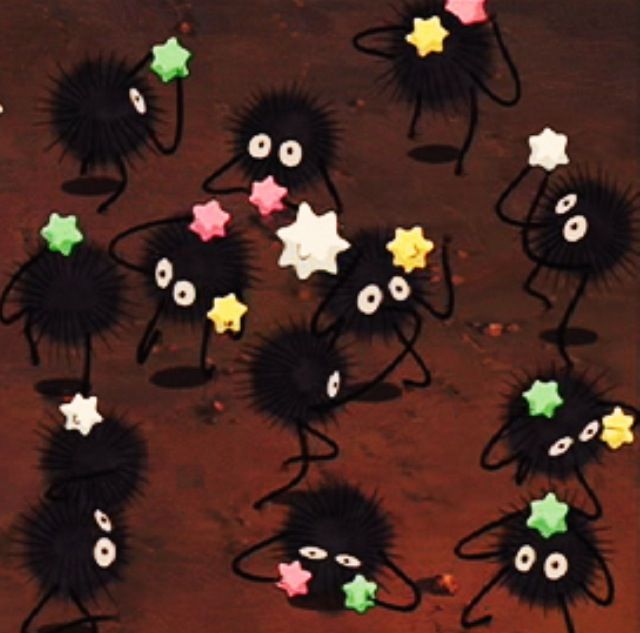
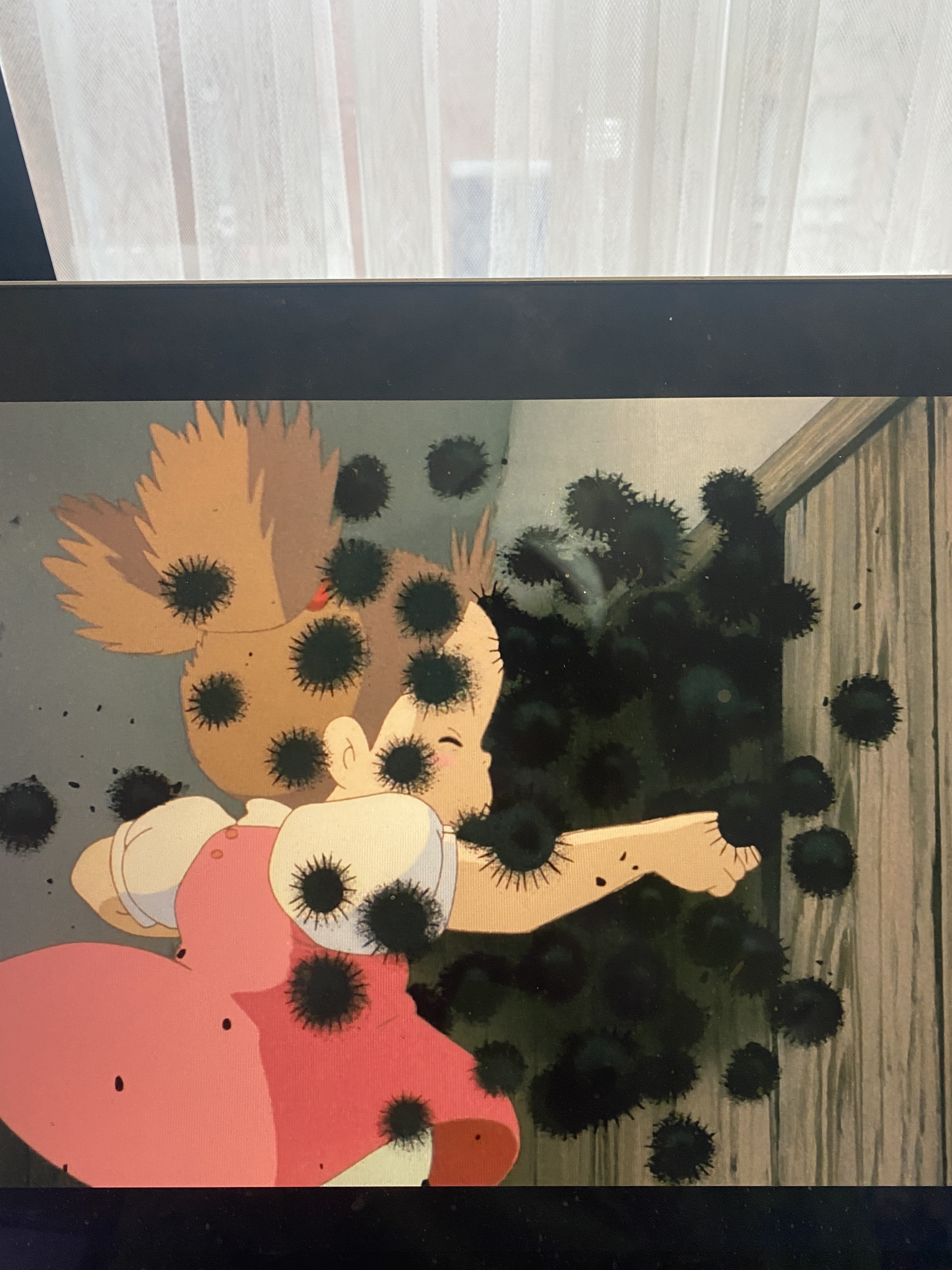
If only I could have purified my air! Forced to confront my body’s invasion (this time coronavirus, not just dust), I try to settle into the ‘load’. I make lists of the smells I miss, research perfumes online (aerosols glimpsed from the safe distance of text). I sneeze a lot, cry a lot, wheeze a lot; and then my sinuses go blank. Is this breathing? I imagine the cells of my body glowing new colours from the Omicron beasties. I re-watch one of my favourite Studio Ghibli movies, My Neighbour Totoro (1988), which features anthropomorphic dust bunnies known as susutarawi, or ‘soot sprites’ (which also appear in Spirited Away (2001)). The girls of Totoro, Noriko and Mei, initially encounter these adorable demon haecceities as ‘dust bunnies’, but later they are explained as ‘soot spreaders’ (as per Netflix’s Japanese-to-English translation). When the younger girl, Mei, gingerly prods her finger into a crack in the wall of the old house she has just moved into, a flurry of the creatures releases itself to the air. She catches one in her hands, and presents it proudly to Granny, a kind elderly neighbour who reassures her the soot sprites will leave if they find agreeable the new inhabitants of their house. When she opens her palms, the sprite is gone, leaving just a smudge.
An absent-presence in My Neighbour Totoro is Noriko and Mei’s mother, Yasuko, who is in hospital, recovering from an unexplained ‘illness in the chest’. Mei’s confrontation with the animated dust mites, or soot sprites, acts out the wound of her mother’s absence. With curiosity and panic, she and her sister delight in the particulate matters of the household, of more-than-human hospitality. What is abject about history then, or even the family, its hauntings, is evoked trans-corporeally through the trace materials of a powdery darkness, dark ecology (see Timothy Morton’s 2016 book of this name) that is spooky but sweet. (S)mothering in the multiple. My sense of smell now is consumed entirely by a kind of offbeat metallic ash; I’m nostalgic for cheap perfume. I’m not sure if this essay is a confession or who is speaking; it seems increasingly that I speak from a cloud of unknowing coronaviruses. And so where do I end or begin, hyperbolically, preparing my pen or straw? The ouroboros of my dust anacondas reminding me that I too was only here, alive and in this flat, by tenancy and to return from my current quarantine having prodded the household spirits for company, with nothing for show for it these days, except these, dust, my words.
Miss Anthropocene(Mermaid Motel) a selection of short lyric, ‘ethereal nu metal’ poems responding to the Elon Musk/Grimes complex.
Sonnets for Hooch – with Mau Baiocco and Kyle Lovell (Fathomsun Press) An ongoing pamphlet series of sonnets attuned to the weirding seasons: what started as an internet joke about alcopops and longing as a keystone for exploring adolescent malaise, nostalgia and resilience thru civic space and Friendship. Current editions available are Lemon Bloom Season and Summertime Social. Two more instalments are forthcoming in association with Rat Press and Mermaid Motel.
Polychromatics (Legitimate Snack) A pamphlet-length poem about colour, cetaceans and cosmic twilight, inspired by Walter Benjamin and a sculptural and textile works by the artist Anna Winberg.
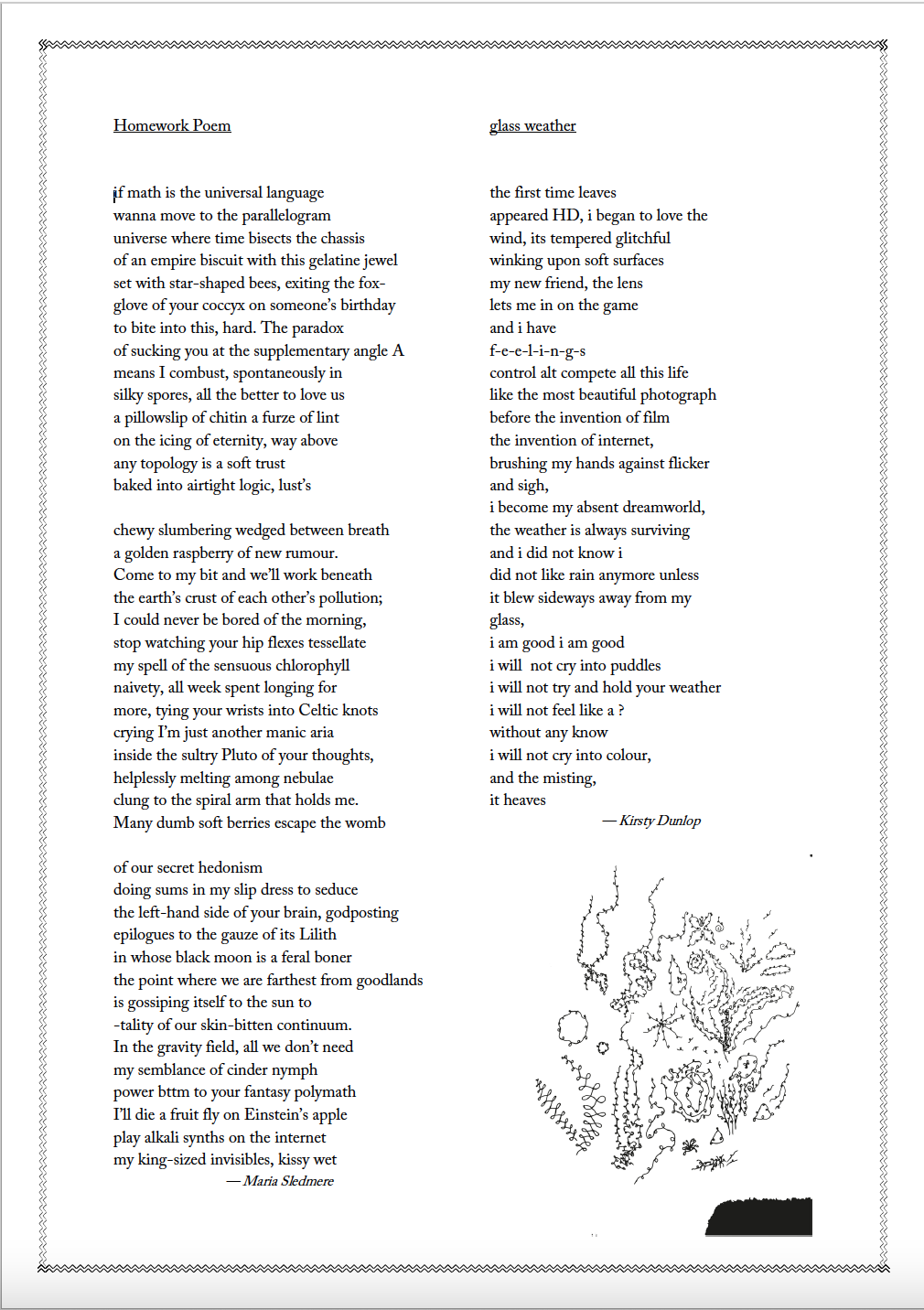
Soft Friction– with Kirsty Dunlop (Mermaid Motel) Soft Friction is an intimate gathering of dreams from 2018, written during a summer of ‘existential soup’, fainting at gigs, pulling all-nighters and panic surrealism. Extracted from a longer diary, these fragments wear the sensuality and sass of an active dream life shared between two people getting high on each others’ brains.
The Palace of Humming Trees(Sundays) Edited and typeset by Katie O’Grady with visual identity by Paul Smith, this book-length poem features illustrations by Jack O’Flynn plus a curator’s word from Katie O’Grady and collaborative mixtapes. Set in the speculative locale of The Palace of Humming Trees, the poem is a jaunt through weird nature’s arc of glass, following the desire lines of hyperfoxes, sunburst melancholia and corona correspondence. Also available as a free pdf.
The Luna Erratum(Dostoyevsky Wannabe) The Luna Erratum, Maria Sledmere’s debut poetry collection, roams between celestial and terrestrial realms where we find ourselves both the hunter and hunted, the wounded and wounding. Through elemental dream logics of colour, luminosity and lagging broadband, this is a post-internet poetics which swerves towards the ‘Other Side’: a vivid elsewhere of multispecies relation, of error and love, loss and nourishment.
ARTIST COLLABORATIONS
‘The Rosarium’ for Zoee’s album, Flaw Flower (Illegal Data) A lyric sequence responding to the glistening pop garden of Zoee’s debut record Flaw Flower. Available as an A6 booklet as part of the limited edition album bundle.
The Palace of Humming Trees with Jack O’Flynn and Katie O’Grady (French Street Studios) A collaborative project with artist Jack O’Flynn and curator Katie O’Grady which took place April to August 2021 and was showcased at French Street Studios in Glasgow. Featuring new works of poetry, sculpture, illustration and multisensory dreamscapes (from mixtapes to Tarot readings), we offered a ‘tenderly crumbling foliage’ of visual and sonic otherworlding.
The Dream Turbinewith A+E Collective and The NewBridge Project This online installation explores the relationship between sustainability and dreaming, offering a space to collectively share dreams and promote discussions surrounding these broader topics. The Dream Turbine was conceived by A+E Collective in collaboration with Niomi Fairweather and Jessica Bennett, as part of the Overmorrow Festival. I contributed to a preparatory DreamPak of resources and the curation of a Dream Vault and associated ‘Lost in the Dreamhouse’ workshop on Zoom.
Cauliflower Love Bike Episode 1: Playwith A+E Collective While play might be co-opted for capitalism, true play is that which exceeds instrumentalism and commodification. This episode reclaims play from its dialectical relation with work, exploring play as a practice and thought-mode that is capable of radical sensing, temporal sabotage, tenderness, sociality and a joyous excess that is also low-carbon. The podcast series was launched at COP26 in the Rachel Carson Centre’s pop-up exhibition at New Glasgow Society.
ACADEMIC ARTICLES
Article: ‘Hypercritique: A Sequence of Dreams for the Anthropocene’ in Coils of the Serpent Issue 8 An in-depth venturing through the possibilities of hypercritique, featuring readings of Billie Eilish, Sophia Al-Maria, Ariana Reines and more; plunging through dream, fire and the heartwood of anthropocene imaginaries.
‘I, Cloud: Staging Atmospheric Imaginaries in Anthropocene Lyric’, Moveable Type, Issue 13 Tracing the possibilities of ‘cloud writing’ in anthropocene lyric by way of Brian Eno, Mary Ruefle, Anna Gurton Wachter and more, asking what kinds of reading are possible or desirable in a medial world of thick atmospheres.
There is a place where these supermassive roses might be planted. A harsh place that exists at thin resolution, we have to resample; I am doing the maths to know how 100gb permits her entrance. The process slows because this behaviour is not natural. Her entrance with the roses bundled in giant’s arms, and the long tresses of foam and seven neat words she has tucked in a satchel of crocheted pea proteins. She is attuned to a certain instant where it works that she plants the roses. They are gnarly, monstrous, thirsty. The roses are not sober. And the girl? She stumbles on her third negroni, abstracted, poured by the silent one who inhabits the hedgerows. Vermouth of sun, gin of moon, aperitif of the bitterwort and marshes, garnished with wedges of orange from overseas. These seven neat words I will not tell you with her lips sealed blood sugar, femme confection, a certain rain, a squall.
The clarity is lost a little when we adjust figures. But the girl is still there, in the corner maybe, bundled from sight with impossible flowers. What do we know of a girl and her flowers? She could be a waitress, a bridesmaid, a funeral attendant — but no, this is extravagance to belie all such professions. The flowers won’t fit in the picture this is. It is not merely to carry. Some say they are hyperobjects, but if so, what of the girl? She is also beyond human proportion; she would live a thousand years. Sprinkle hundreds and thousands of leap years merely upon breakfast, and yet at nineteen does she not look a million? If you were to splay the fine skin between her thumb and forefinger, you would begin to see the star stuff which flows in human capillaries. But at such resolution!
Of her face since nineteen, the narrator of Marguerite Duras’ The Lover [L’Amant] (1984) writes: ‘But my face hasn’t collapsed, as some with fine features have done. It’s kept the same contours, but its substance has been laid waste. I have a face laid waste’. So when the girl lay down for another of her size; they were a cloud, it rained, the girl awoke with child. But she gave birth to nothing but roses. She was a fixture of the processing plant. Initially, sealed in mousseline baubles, they were not even roses but rosehips clustered among thorned vines. And you would imagine these vines entwined with her spine, climbing them as if the destiny was always her neck. She would speak at night, tapping the fine glass, warming them as eggs. Give everything away: the rose-meat of petals and their pale, inward jam, hatching saps, their crying.
A cloud always passes, it creases the sky. Cars go in and out at night.
~
The fruit of rose, especially a wild kind when I write of a Mary Sue or brush her teeth, when she is more tall than willow and yet I have set her colours inverse so in reaching for rosehips she must reach into shadow and isn’t that all in the working day of dreams is deferral of Edenic cinema, she grows in wilderness also known as the fortress of lossy compression where trees are shaky with original pixels and her clothes are torn as mine would be crying forever by the sea with my dairy allergy for twilight ‘The blues are because you’re getting fat and maybe it’s been raining too long’ and if she is me then I am she rehearsing definitions for litany via prayer, supplication, complaint am I a melt vector on cutting board you call me aslant with the knife tucked close to cupid’s bow of my lips ‘she was noted for her command of dialogue’ but no one said anything lipsticks: sweet chestnut, amarena red tender rose and orange delight shaking the rosehips all night for Roman god of erotic love is just rare labour of the shepherds in pleasantview, saying sorry or what colour your blouse is, mine is damask you could press to make attar so I know how I love is mother puts glitter on a wreath of ivy and dying hydrangeas to hang on the door, entrance Mx I give you generally acceptable apples the shop called jazz, they are wrapped in plastic we look up to see the planets ‘almost touching’ but they are something else entirely easy, lucky or free. These green diamonds don’t occur in the wild; she makes them from slices of apple glitch effect plumbob oil of rose is condensation a playable simulation novelist in decline as I lick the sea wall cast this upwards to where another hour is ravished you start to read.
PART TWO: SACRED PORRIDGE
Perhaps this would be enough of the rose-girl if she would stop haunting me. I dreamed Bernadette Mayer wrote a novel overnight, it was midsummer, she was 27 and had a fountain pen the size of the Eiffel Tower. Tell me what she was smoking, was it Marlboro or lemongrass? Maybe cloves? I get mixed up, I’m darks and pastels, nobody likes me. Open a beer to share regardless / Crude oil streams from her words. I became suspicious the rose-girl was a fiction of Bernadette’s, that I was stuck in the internet fiction and whittled away. There was a poem called ‘Thorn’ about a penis. Brexit or no Brexit, I was anyway hoarding tins of beans in the hope they would get me somewhere – a similar purpose to breakfast. Recite to me from memory these stats about lactose, creatine, muscle enhancement. I lift my arms to reach you, I am hauled to the new wall painted mint to match the green iris tea of your eyes, it’s Greenwich Park / I am spent with apple pips and cauliflower hallways. I want to be hurled across continents sprightly / put acorn in pocket. I am not her but she is me, here, in a harsh place. You are the smoothest nut! What was the novel? I don’t know, I have this line: ‘the negative capability of raisins’. Don’t kill the squirrels! Sunday you make porridge with peanuts, sour cream, biscuit, honey, drops of chocolate, muscovado sugar, extra milk of oat – why not acorns? The rose-girl watches. Her breath is a draught.
She is so huge you would miss her. All December the faint scent of her pea satchel follows me so I know I couldn’t possibly have corona. Plunge my nose in vegetal folds. I would be the aura of plasma around her sun, that’s all and merely. Does it rot? The size of these roses, really, is impossible to measure. Expect several hundred metres or miles, stumbling in the world of error where we go to buy bread. Is it for months you have been a tile, a talking head? You are very delicate and I stroke your nice hair, which loosens through the screen to meet me waterfall. I climb to the top of the beanstalk we braided from eating well. We read Lee Harwood in the rain, As Your Eyes are Blue, and drink mulled wine. I guess I am riding horses to catch up with the size of these roses, blue ones also, fat and mellow. Jackie Wang calls this ‘outlaw jouissance’; a phrase I wrote in my notebook, quickly. The line gets whipped! I think about Cy Twombly. The horses are all kinds of colours, but mostly the pearlescence of inside seashells, or mollusc aurora’d in a way that seems Björk or genital. I suppose the rose-girl arranges them nightly as saints do, genial; I suppose it is like Sylvanian families. Sometimes from copses of rowans, the tops of the miniature or minotaur trees, red-berried painted I read her SylviaPlath. My poison voice must catch the wind exact, ‘The water I taste is warm and salt, like the sea / And comes from a country far away as health’, as health shall be a human dimension, unrhymed, the rose-girl considers. She is the only one of us who has seen a corpse flower, in a third-floor apartment where somebody important had smuggled the seeds from Chicago, where was she. The corpse flower is not a singular flower but a cluster of blooms, and so is she. It all stinks, I say, so I don’t have corona. If you touch the flanks of these horses so smooth your hands will vanish in gossamer, they become other materials, still smell like hay. This viscosity to friction feels good, it’s lush with endorphins — why don’t you try it. The water is warmly you and me, like the sea; it comes from the eyes of the rose-girl, crying.
~
There’s still time to shop, you collect from store towards a possible come on let’s go of the literal it stings, who you would be in the dream not the enemy’s eye or the unripe banana I stayed in bed til mid-afternoon writing feel-thesis, correcting citations of Clarice Lispector it’s Christmas, you know I don’t have corona on the phone to Avanti the songs are played in such intervals of 45 seconds as to make you hate the very nature of a chord progression is desire’s deferral and will you secure a seat for us at motion sickness what is necessity feels like Velocity is I am washing my hair with tar shampoo and cider vinegar. Come close, wish soon, revese December. Should I call someone? It might be you, explaining multiplication to me, you carry the one and the two, and then I never do read my old diaries smelling of blood and sleep deprivation acrid bulimia, spray of A7 garlic mussels, scarlet muscles my brother says he will donate his plasma for medical causes, have I fear of needles? Lady bird shell collect bathroom dust, antibodies, I am clean and typeset like the stars. You open my coat because of this Reynauds, too cold to unbutton. My anhedonia is cyclical, I stick little poems to the wall they go like
once upon a midnight weary came the lovers on a ferry they were drunk and very old but never had they had a cold over the hills and overseas they could be you or even me
It’s like the Friday of 2019 I read Hannah Weiner’s clairvoyant journals from low-res pdf festive darkness crying in trashland and couldn’t stop tasting purple for a week of otherwise phantosmia, what I smelled was the crushed illustrious rose of infinity pinned to my bittersweet nasal cavity as I am to watch corpse flower time-lapse resemble green diamond, they erect an umbrella and a rare titan arum bloom beneath you typing at the library am I bike spoke, a concept strike for closing the erstwhile windows? Click to know mood… We keep going We leap in a pool of pure negroni and my lungs keep coming up blossom of orange and call you “Hey everyone welcome back to the room, you can open your eyes now” Like probably I have told you before about the band I am starting, a synth-punk deathcore revivalist outfit called Yoga with Adriene I have her permission, she says May all beings be happy Move from a place of connect Present and awake Love your neighbour Things get better, they have to It’s a revolution of the muscular laxation of the life you find cored If you have apple belly thick-skinned of futurity, there will be a chorus and verse for this that goes like scream Motive, Trust, Floor, High, Kindle, Salve, Soften, Strength & Harmony My thighs are burning brightly, it’s the end friend of my Norwich or Brighton, Manchester, Glasgow and some kind of New York resemblance is ‘cracking America’ at the top of your list I have never been to the south coast of an average celestial body yet watering your houseplants I won’t go viral in the night with pills and tweets There’s no cheating in yoga, you make it your own as I do cartwheels on a leap day of acid comedown they say I do it too fast the flight gets in and distant cat miaows as I do kiss you a lot they say catharsis is found in the blues and green laps up the rest is stretching if you can only find it like the sweet spot asana with arm across chest I am become rowan tree, flexing queen of the prom you pluck fruit pastilles from inside me the sea, first try is easy.
PART THREE: TENDER ALPHABET
A. will write in the time of commute B. prefers spearmint toothpaste C. is inside of me D. the size of Paris cumulus E. is all you can eat, ecstasy F. who I love G. has grown H. the hendecasyllabic I fail to write I. doesn’t rightly exist J. sends endless emails K. is a joke L. for loosening jewellery M. with dark sweet cherries and doubles N. conspicuous passionate weekend O. checks the notification P. of classical pleasure Q. minds the gap R. is a rising rat-souled singer S. supposes the cognitive deficit T. exists in lyric saloon U. then driving me up the highway V. to frangible lust I am W. of shimmer lamb X. into cowbell rhythms we go Y. yellow warning of wind has been issued Z. is a property of citrus
PART FOUR: FLOWER SHOW
In The Besieged City (1948) by Clarice Lispector, ‘the flower was showing off […] it too was untouchable, the indirect world’, ‘exhausted’, ‘What is the flower made of if not of flower itself’.
OPEN LOOP ( BOUQUET ( ) !!!!!!!!!!!!!!! ) )
The flower exclaimed a soft orchestral impression of breathing. Adults no longer snack in movies. Spent five hours on a train, six on Zoom, three in the outside air is nice. A time-lapse corpse flower, the music being used, pace of light. Heat syncope of the sea, we dive. Someone is hired to recover her pearls or pears. My skin is peeling from sanity gels.
A fault language of shiningly happy teenagers. Rosettes for the nuclear pony. It’s all total showers today. Condensery of lemonade gemstone, sertraline, the lapwing massacre in a Sufjan track / so I am endlessly sorry.
PART FIVE: NATAL SMUDGE
When everything started to wilt, the moon was too late. Untouchable stem of a name, yet the rose-girl knew what to do. She swallowed the world like a gobstopper, a lightbulb, a tulip. The arrogance of sundown was only that it knew how to try.
Turning over, see the supermassive rose in her belly.
Superstitious gemstones include violets and opals, sleepflower, nightshade; don’t @ me if you think they are cruel or kind. Marlene drops cranberries from the wall and you piss twice as hard in Scarborough Fair, are you sad, buy me blue cheese, there is vigilance in the dead. Rosemary for memory, thyme for a life you led, who sells it. Marlene says she misses Alisha, that’s not-me. Pray you arrive here safely, smudge of tarragon, mushroom photography, lines of flight.
We, after Sophie, after Frank, say Ask for everything!
Regarding conjunction, something about publishing, spirituality, knowledge and authority figures. There will be tension with Aquarius principle. A slip of paper. I was born at 06:20, in a thunderstorm.
[Oh yes! x]
The rose-girl had an overture: she tore wedding pearls from her branch-sized clavicle, let them scatter from the tub where she lay and the tub was a cloud, the pearls were snow. At the great conjunction of Jupiter and Saturn, she was a divorce child with her hair in two plaits we would climb up to kiss at the nape of her neck, that’s it, I play all my aces so we won’t die. These cards are beautiful, we turn them away. There will be no dying, not here or now. I thresh the rest of my skyluck, lager, my skylark. I’m lucky the mirror is showing up nowhere. Sometimes it is Freud’s voice, or an oil pastel. The foam from her brushed-down hair. Of the past you have given me everywhere, Andromeda, minipops, electronic renaissance. In writing the poem I am playing the cello, I am playing the cello of poem to death, why not?
It’s up to you It’s down to you
Don’t be so mournful…
PART SIX: SCENTED AND GENEROUS
I had a dream about the diary with the days mixed up. Each day had its own fragrance:
Cognac, cannabis, dill pickle, mown grass, libido enhancer, sweet vanilla, jasmine, ylang ylang, who shares all, heart notes of shrub, blackcurrant, oak moss, popcorn, peppermint candy, lavender, ginger castoreum, chypre, neroli, understory, wooded and tonka, ambery, orris, top note, emily brontë rose, cinnamon, hot shit, gold dust, brine of ocean, roast aubergine cologne near airstrip pheromone, oil pipe explosion, special cinders, vetiver, slots into psyche, balsam, absinthe, cassie, frangipani, saffron, strawflower aka immortelle, black liquorice, lactones, myrrh, sassafras, fruit loops, chocolate ice, pamplemousse or french for grapefruit martini and rockrose, peony, tobacco, peppercorn, petitgrain, scottish myrtle and soft fir, nutmeg, new car, coffee brew, pine needles, indole, musk of course.
Pitseleh means little one. Elliott Smith sings, ‘no one deserves it’.
I’m turning a petal to see you better / that I am someone’s difference.
Dear Alisha,
If we were to wed in the childhood memory where you circle the prairie with diet cola and you always know what to do, I see the cherryade reds in you, sanguineous of first degree and alacrity pitching your letter. The post office is closed. I eat more peanut butter than Elvis and nobody stops me, I get it from Aldi. The day feels closure and we edge towards lockdown, I’m texting, Starbucks is open on Christmas Day, will you bring me something? Again, like the time we ordered starlit capitalist fuck lattes and dusted methamphetamine before shift; we were exquisite, fruit toast, the nourishing glitter in our hair was ace; we served 200 covers, sixty quid in tips, and you were scarlet in the uniform poem called A Scarlet Letter. Not the one or the many, just any. I knew this already. We had written them all! You have to have dashes of green to make red, tell Hilary, which is why I am writing to you from my rowan tree, fred asks is this a rowan bush, I say a rosehip, I don’t know what to do; the inchplant is coming up fast, it will ingest the television, I look forward to it. Brockley Station, Nina Simone, stomach cramps, star flood. Must learn how to climb / the branches brightly.
Write to me of conspicuous passions, such as aging, or the fairy fountain with permissible agelessness. Crystal arpeggio. The various glacés of Rome, ornamental corpse flowers, pistachio and your deep, carnal desire to dance. I brush all the sea-foam from the rose-girl’s hair and she would collapse in panic. What the heck is in this carpet. Can you send me again the dimensions, dots per inch in terms of the plant, or planet? There is much to do. I am sewn a yellow word and kissing you cherries to lemonade, black to blues. Needing earth for it, rich stuff, thoughts on allotments. Omnidawn is the word, when the camera pans out and one million people have streamed this song, the credits come up. O blush, Love’s refrain in summer! 500,000 ampersands, can you imagine it? My new grand dreams of porny conjunction…
You taught me how to shoplift the various accessories of girlhood; I’ve given it up. See how my brows disapprove!
December is cruel, the dark green foliage of tinsel and shrubbery, poinsettias, it’s kitsch. I learn a blue-grey song on guitar but it sucks. Mum makes paella for xmas eve etc. Pantone named yellow-grey the colours of 2021, Katy is raging as I might too; I had a poem about this from before f-sharp, it was all about cycling, snapped ankles, absolute melt. Get to you. The way you arc your arms just so is centrepiece: everything will be the same as the sum of it was, serving us dinner. Cryptocurrency, wrong-name, Tony Blair of bad air was trending, you do it last-minute, pronounce it soft, you wear a blue velour lace thing, fka misty. These are the suburbs where doors were slammed, and these were offered cookies. Fuck a lawn. But you dip your feet in scant oasis, you break off a piece of the dark chocolate donut. I have dreamed of this. Stillnesses are not without purchase. Another spam mail arrives, dear pal—
I am going out to buy us blowsy hours, belong and casual distortion. Black forest gateau and log of the roasted poem, emitting steamiest lines, pleasure days, no breaks just ganache is that thick language. We lay together, birthday of shadow work, wrote sunlessness. I draw dark green liner on their eyes like vines. Wish holidays longer. We enter the alone wood with natural lights they are strung they are simple, leafage pressed between them. 1800 dpi, virus gone, unmute the sea. You are warmly invited.
~
Mermaid Chunky – Gemini Girls
‘Til Tuesday – Voices Carry
God Help the Girl – Down and Dusky Blonde
Sunflower Bean – Moment in the Sun
Phoebe Bridgers – Graceland Too
M83 – Karl
Tomberlin – Hours (Katie Dey remix)
Gia Margaret – apathy
Felicia Atkinson, Jefre Cantu-Ledesma – And The Flower Have Time For Me
hope is a dangerous thing for a woman like me to have…
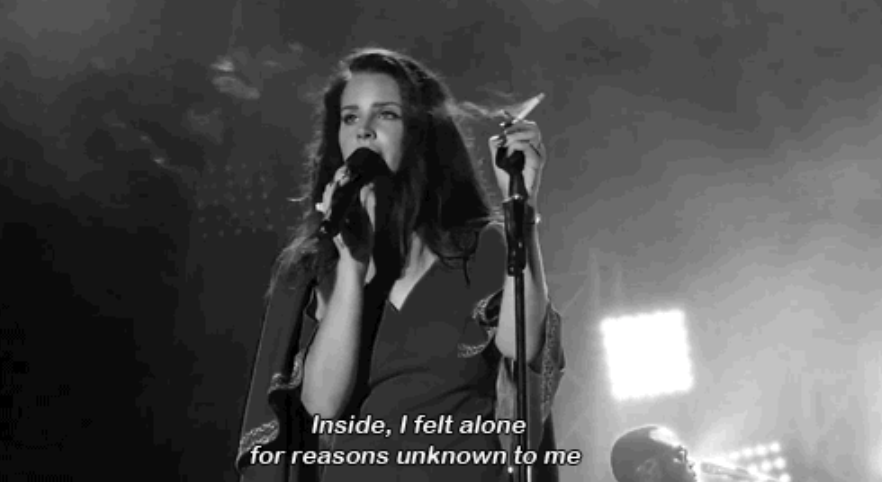
She walks through the monochrome film like its skin were a gauze, but as she walks, nay drifts, the film acquires technicolour, it flushes. You see there is a mirror, a chokepoint where the lipstick comes off or else thickens, the crater fills with lavic fluid, the watery eyes well up with green. And she speaks, the wax sticks words to red and pink. It is what it is to be utterly possessed by lust, lost in the Himalayas where chasms of location push the self from itself. This is the film Black Narcissus but it is also the new Lana song, which plays on the meaning of black as the word for depression, and the void we draw into with insucking chorus, YouTube wormhole. The title names hope as the treacherous entity {}. Hope is a dangerous thing in a world which makes of hope a scornful pharmakon at the centre of living, its molten centre that elides wherever you bite too hard and bleed a little. Is it dangerous to the self or the world, something wielded or something wounding? Can I anticipate the narrative arc of Lana’s new album? Closing my eyes for Gemini affect, pure intuition, telepathy maybe. Butterfly smudge of your lipstick is the end of the movie. This is the first small caps Lana; it bears the modesty of a b-side even, but it is so much more, lost ballad preempted. She delivers it for her fans, who eat into the brocade of its soft, fragile fabric like so many moths. I cannot help my own devouring.
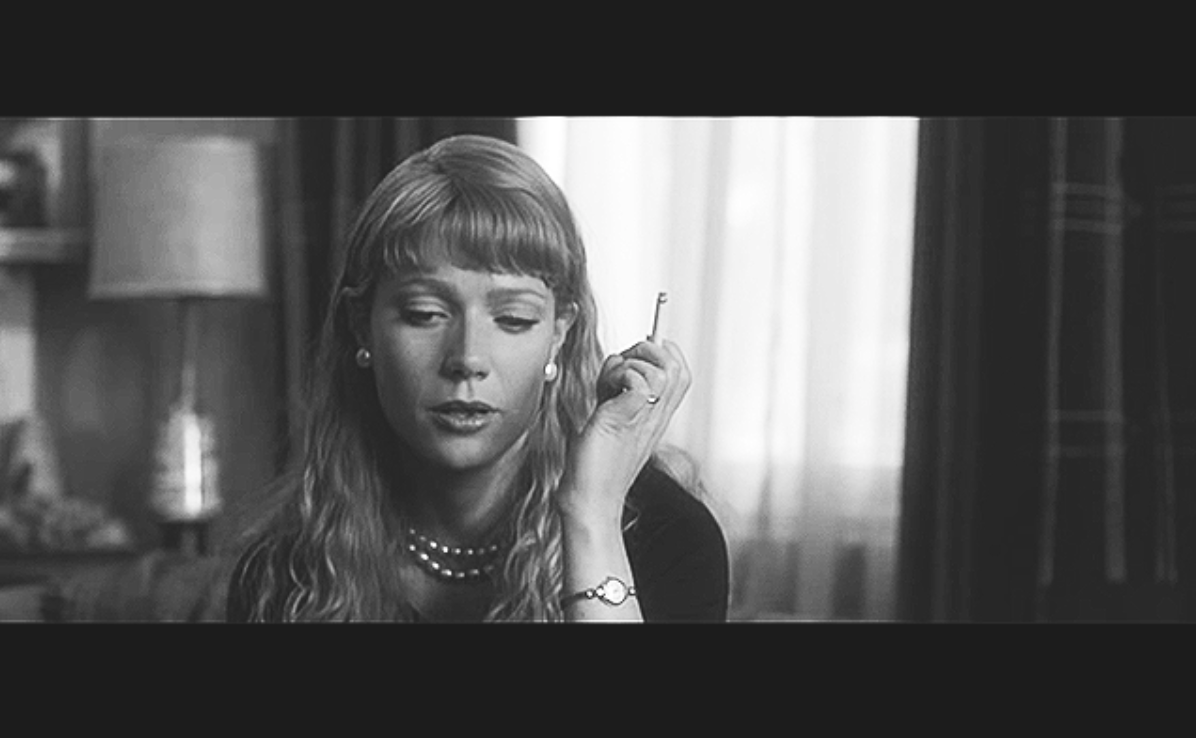
I’ll say that Lana’s piano is smooth and minimal, it belongs in the country, to a realm of only ardent followers. Perhaps I meant flowers. It is the piano you imagine at the concert arena where the scale of the concert itself is a country, because it is contained just there, because everyone breathes on the equal pause forever. There will be an inevitable release and collapse. And silent adoring. Her song is ‘for a woman like me to have’, and who is the woman like, a woman with ‘my past’, a woman who is only like a woman, not the ur-woman, sad girl of ‘quiet collusion’ who sits in her gender wanting to weep with the sleep monsters under her sleep. What does it mean to have a song? Somewhere in my heart the possession. ‘I’ve been tearing around in my fucking nightgown / 24/7 Sylvia Plath’. This Plath that Lana summons is, I can’t help thinking, the Plath portrayed by Gwyneth Paltrow in Christine Jeffs’ Sylvia (2003): sex scene Plath in all-American drag among pale English ghosts; Plath in Cambridge plus satchel; screaming Plath with the hairband and honeyed curls and all the fat cakes in the oven, the jealousy and gild. Pearl necklace and cigarettes, essentialism. Plath as product. This woman we have.
This hope Lana sings of, she sings between I have it, I had it, I have. What is the tense of this hope. It is less to-come than simultaneous. We have been waiting all winter for our powers to return. To have and to hold this hope, to taper off into quiet. People are calling it her NEW MINIMALIST TRACK, and the replicated figures in white dresses, yes the turquoise yacht continuum, the usual LDR aesthetic; poolside photography of Slim Aarons, who gets name dropped in line one with the insouciance of The Bell Jar’s opening line, of course, ‘It was a queer, sultry summer, the summer they electrocuted the Rosenbergs…’ which still gives me chills, like a midsummer comedown, like strangling yourself in the sheets again, each of memory’s creased reflections, a separate sleep. I didn’t know what I was doing in New York, in Maryhill, in Hyndland, Woodlands, insitu. She wants this to be country and century and certainly there is sufficient polish, and I think of all the new soft songs on vinyl, and sharing her old stuff, the MermaidMotel fan vids that we share in small hours via WhatsApp convos. Collage of all flickering source image, coverlet for my painted dreams.
Grief is the thing, hope is the thing. If Lust for Life was a compendium of hope, the happiness turn in Lana’s career, now we have a fresh reflexivity. At the bridge she sings of revolution, evolution; it’s a generational awakening and all that jazz, and all that messy spirit she tried to conjure before, and yet being a modern day woman, the one we all want. The producer says ‘listen at night alone’, I walk home from the south side listening, listening. Single beautiful vocal take: ‘Don’t ask if I’m happy, you know that I’m not / But at best, I can say I’m not sad’. This is the Disney lyric, the princess in the tower relaying her liminal condition, the Angela Carter heroine forever admitting her addiction to poisoned love and morphine dreams that keep her buoyant, baby blue. She writes in blood on the walls and scorns her notepad, like all the ink in the world had run out of work. It is not nearly enough to contain us.
A womanly scream from the body, akin to the way it feels up all night screaming with menstrual cramps, unable to scream to enact one word of how it feels, like to just write is to tweeze the remnant congealing of pain. This little ink blot, this little image. But also like simply the imperative to write everything repressed that goes on in the body, especially desire, yes, Molly Bloom of Ulysses in her writhing array of yesses, Hélène Cixous’ beautiful écriture féminine: ‘woman must write her self: must write about women and bring women to writing, from which they have been driven away as violently as from their bodies’ (‘The Laugh of the Medusa’, 1975). We require pop heroines that bring women, those who identify as such, to writing. Cixous says we should write in white ink, mother’s milk; Lana says she writes on the walls in blood. Well, if anything, it makes things pop.
Sorrow, for Lana, was always ever a semiotic affair. It was always of the body, always of culture, culturation; it was that which is written on the skin, something you cover with luxury but you can’t uncontinue. That grows among things. So she paints herself a gothic heroine, ‘fucking white gown’, Plath on heroin, Plath on the painkilling charge of writing, domestic dwelling. This painkiller is different to the heavy, sweet-dreaming Topanga one on Lust for Life, the one described in ‘Heroin’: ‘I’m flying to the moon again / Dreaming about marzipan / Taking all my medicine / To take my thoughts away’. If there’s anything that happens in ‘hope is a dangerous thing…’ it’s the grim certitude of domesticity, beautiful microcastle in which the heroine dwells, circling platitudes of hope you can mull in repetition of lyric. Quiet collusion in all that contains us, we secrete our mutual conspiracy. It’s not the silver needle that opens sidereal blooms of the future, it’s ‘Servin’ up God in a burnt coffee pot’, recalling both AA meetings and fraternising in practical terms with gangsters, ‘for the triad’.
When I said Grief is the thing, I was of course kinda referring to Max Porter’s Grief is the Thing with Feathers (2015), which is a book about the unbearable melancholy of losing your mother at a young age, and follows the father’s attempt to console his motherless boys and himself. The father is a Ted Hughes scholar. This is one half of whatever pairing we make of the starcored twentieth-century literati, the Plath/Hughes mythos that enters into the strip of a Hollywood drama, fifty years later (I think of that Neutral Milk Hotel lyric, talking to Anne Frank, ‘Will she remember me, fifty years later / I wish I could save her in some sort of time machine’). In ‘Edge’, Plath begins: ‘The woman is perfected’. What woman is she, with her coiled dead children and ‘Pitcher of milk, now empty’? What bodily fluids do we still have to write with, do we wither in toxic futures? Reproduction’s entangled chemical reality. A woman like me, a woman like me. Is Lana asking for empathy? She is the model unto herself, while the woman as such continues.
She sings ‘Hello, it’s the most famous woman you know on the iPad / Calling from beyond the grave, I just wanna say “Hi Dad”’. This simple admission for a longing for connection indicates a state of grief, but it’s also the crisis of adulthood, and it’s this distilling of all the daddy issues Lana ever sung about into something beautiful, quotidian, sweet. Pick up the call say hi now. We are moving towards a wholesome turn in Lana’s career, where yes she pens songs about flower-crowned girls at commercial festivals trying to survive another shitty year, but she still sings about heroin, there is this chiaroscuro texture through all her paeans to hope, the darkness remains, it is modern America, it is the fault lines in lyric we might claw for resolution but will yet slip with our fingernails gleaming. ‘Hello’, well of course it is Adele in 2015 with her flip phone, her heartbreak. The soft piano is the size of a stadium or a bedroom at once, this tardis expressiveness of porous emotion. The dust comes off when you shout loud enough. But the irony is there are no phones, just the smooth texture of screens, she is dead and she talks through pixels, she is always already the perishing heroine, and would that be Sylvia haunting the walls, Emily Dickinson maybe; or some actress’s paltry impression, best attempt yes, linen and pearls. Words can dry up like milk, but as long as they are sung this way they are syrup, they are golden, soft-popping inside starry-eyed imbibed celestials, celebrity. I think of Marianne Morris’ gorgeous, golden poem ‘KO’:
Gold falls out of my bra when I stoop to pick up the gold that fell out of my hair. My skin is gold, my fingernails, ideas are gold my refusal is gold, my refusal is gold, it goes from rock to gold to golden, the path I am walking along is golden
This constant slippage and shift between noun and quality, adjective yearning in the gilding of language, wanting to become all form, preservation, sheen of riches and health. Golden girls, the ideal image of Plath in her beach bikini, Lana draped over a motorbike, gold California sunrise. Katy Perry on holiday. Do you say gold or golden, do you say hello this way, when you speak is your voice of cash or of credit, does it jangle? What is it Jay Gatsby said about Daisy, her voice is ‘full of money’? She was a golden girl as well. But all this gold we can’t contain, we women, we leak, we are weeping gold, it falls out of our bras, we bronze and burn, we are darker than you could ever imagine; it is the gold iPhone lost under our pillows, the gold in our voices we wanted to convey to you, molten in the night; our skins are multiple; gold multiplicity of time that watches in furnished piece; it is the beam of hope on the path that is golden; it is Dorothy’s Kansas; it tries to resist shadow, it refuses; it is so different from the gilded palaces of the Trumpocene, it is not the same capitalist gold as all that, it is solidarity, gold as solid, it is not white by any necessity; it is what, as Morris puts it, ‘leads to gold’, it is mineral transformation everywhere; it is the liquid qualities we need to be strong in this world that would crush us. I would say every chord is sprayed with gold, and then it is knock out.
Lying down splicing the self on a morphine dream, which is the infinite conjurations of a possible future, which is the way you feel drunk and beside someone in a sleep that feels truly like falling, consciousness making a latticework of itself through indigo hours; this most beautiful sleep is golden also. Seek an equation to the crying that occurs in the sheen of gold, which is the climate at limit, the climactic lyric. Remember Ariel was light as heat, fever 103 degrees. Forever young and young forever. I pick over the lines that define the figure, like the body of a woman made perfume bottle, glissando of scent and curve. Spritzing us back to originary innocence. Tasting whole rainbow memory futures. Skittle the knockout, KO over.
Someone on YouTube writes: ‘Lana Del Rey makes me mourn for childhood memories I literally do not have’. Someone else is crying while high as they type. To admit this, to just write it. We exist simultaneous upon the bright webpage, acquiring a million plus. I literally lack, I lack the literal memory. So Lana is always conjuring; I’m dying everyday, I wanted to say thank you for everything. Fall through the comments section until you hit the beautiful loophole. Hope hope hope is a hope and I have it the hope. Hope is a thing that I have and it has me. It is a Steinian ring that you wear like a rose round the finger long scarred by the rose again. It it it, it shifts. To say hi to the father but turn towards self, to just make the gesture, and home is performance, is hope from the stage; hope seen from the stage, the lights shone back at you; the photographic as one capturing of rainbow to the next, liquid and light, resolved on the glass of the iPad, which is fairy-tale portal, twenty-first century, FaceTime continuum. Summon one memory as sleep paralysis, suspend, end song. This could sting. To light this, smoke, the wisps around your eyes are time. It is just a little descent of piano, it is sweet and sore at once.






 mariaology