We arrive at the bus station. It’s four in the morning and god knows why people are still here. Where I’m from, people are in their beds at this hour; the old folk know the truth of properly impenetrable slumber, even mothers draw brief glimpses of sleepy solace amidst the screams of their babies. Chimneys may shudder, walls may fall, but people will sleep. No, the folk where I’m from don’t haunt train stations, unless they’re homeless and know the secret places where you can hide from the rain. Benches scratched with ink and tip-ex, territorial markings. Nowhere to buy spray cans. Nothing interesting to hang around for. Here, I look around and all the same places flash in the ugly strip lights: a Starbucks, a sandwich bar, a Marks & Spencers. Nothing open, except some stand selling donuts, which smell fucking lovely even though I hate donuts. It’s that hot promise of oozy sugar, mouth-melting jam and fluffy fatty dough. Chewy. I can taste it, just as the guitars kick in, clean as the stars which god knows in this city you can’t see.
It’s cold. It’s the beginning of August and I’m homesick like the kid stuck at space camp.
It’s dark as hell in my head, that little sleep on the plane still safe, hovering over my thoughts like a shroud. It’s not all that dark outside; traffic passes, the neon from bars still aglow. Signs reflect back in headlights. I blink, rub my eyes. I have this sense of something vast and black. I want to close my eyes, imagine this spreading, seeping oil spill, disseminating its viscosity out over every surface, every gloss or gleam of grease, the echoes of footsteps melting, the pavements dissolving to nothing. I dream of an oil that is precisely that: nothing. It is matter as nothing, it is fat and black and coats everything, inevitably, inexorably. The chorus builds. I can hear something pulsing, a faint chime that cuts through all the sirens; when you pay attention, the littlest things cut through. You just have to pay attention, I’m telling you.
No water, no sound. I’m following someone else’s footsteps. People are everywhere, bumping and jostling, bags clattering on the vinyl floor, the cold stone steps, the deplorable concrete. Wouldn’t the oil flood over all of this, covering even the star speckled whiteness of gum? There is a lull, there is a slow progression of chords. There is a sense that…no. The sleep will not come back. I fall into it; I’m on the bus now, it’s slow thumping rhythm echoing the song. People get on and off; it goes and stops. I don’t know this place, or that. The high-rises are imprints, no longer there. Innumerable blurrings of nameless shops, bars, boutiques. You wouldn’t recognise them. It is all glass, sharp-cut and brilliant. In it, I see the bus. I don’t see my face. I never see my face…
And yet there is a crushing. The smoothness compresses back upon itself, like someone scrunching an aluminium can. I dream of a Diet Coke, fresh from some fridge-freezer, the snap of its top, crack, clack; the way the fizz bubbles fast in your throat. Mmmm, aspartame. I am in a room that is someone else’s. So sweet, so lonely. When they are gone to the bathroom, I get up to look out the window, a foreign sheet wrapped round my shoulders. I see more of the glass buildings, endlessly reflecting. I cannot see the window, nor my face. I’m waiting to return. It’s like vertigo, all the glass and all the lights. I miss the darkness. Sometimes when I’m in a room like this, lying on the crooked bed with my head far away, I think I hear the meteor showers. They come back again, silvers and silvers of them, lilting and sprinkling like the softest, most intangible fireworks. I have this memory of November 5th, ten years ago maybe, spinning round and round on a roundabout in a park in the middle of nowhere, the sky shattering above me but even then I’m so indifferent, just whirling, singing something very random, the scattering mess of everything swirling in my head. And I could fly off to the soft dark ground and let the darkness fall over me and god I wouldn’t mind, wouldn’t mind one bit, just the last gasp of a drowned sailor and that promise of a ————————-
My degree programme requires you to take at least one ‘pre-1800’ course – i.e., anything that’s not Victorian or Modern, anything that stretches back into the depths of distant history. For some people, the prospect of reading up on Shakespeare or Medieval literature is a dream, but I chose a course which was dated 1660-1785 – the most modern dates I could get my hands on. I was at first pretty worried about studying the eighteenth-century, possibly sharing Esther Greenwood’s view in Sylvia Plath’s The Bell Jar: ‘I hated the very idea of the eighteenth century, with all those smug men writing tight little couplets and being so dead keen on reason’. When my copy of Samuel Richardson’s Pamela arrived, reading one paragraph of the heroine’s gushing account of her virtue left me exhausted. I looked at the fat Collected Works of Samuel Johnson and my heart sank. However, with some surprise, I soon found myself enjoying the books I was supposed to read. The truth is that the eighteenth-century has a lot more to offer than stuffy old men and their commitment to reason. Of course, it was the time of the Enlightenment, but it was also the time of radical social upheaval: of the expansion of empire, changing gender roles, political turbulence, religious opposition, the loosening of sexual mores and of course literary innovation. The renewed critical interest in eighteenth-century post-Reformation literature in recent decades has meant that the canon is no longer confined to Alexander Pope, Jonathan Swift and Samuel Johnson, as I feared it might be. I’ve had the chance to study more ‘obscure’ works by women novelists, parodies, life-writing, vicious epistles and pastoral poetry that does more than merely sentimentalise the countryside. ‘Tight little couplets’ neatly encapsulates the idea of formal restriction, but the eighteenth-century was actually a period of literary experimentation, facilitated by the shift from a system of patronage to individual publication, and the more general rise in literacy which meant there was a wider market for more writing. It produced the phenomenon of the ‘peasant poet’, as well as the likes of Lady Mary Wortley Montagu, an aristocrat and ‘woman of letters’; it saw the merchant Daniel Defoe becoming a successful novelist in his sixties after years of prolific journalism, and Jonathan Swift penning sharp satirical pamphlets that criticised government policy (suggesting that the problem of poverty in Ireland could be solved by fattening up the starving babies and feeding them to rich landowners…ah, never mind, just go read A Modest Proposal – but bear in mind the irony). So yeah, I’m going to give you a walking tour of what I’ve learned from studying literature in the eighteenth-century. It’s funny how much we already know about eighteenth-century literature, often without realising it. Reading Samuel Johnson’s Rasselas, for example, I was struck by how many of Johnson’s aphoristic statements have been absorbed into our general consciousness, such as that hardened phrase of pessimism: ‘Human life is everywhere a state in which much is to be endured, and little to be enjoyed’ or the wisdom of ‘do not suffer life to stagnate; it will grow muddy for want of motion’ (these terms acquired greater significance to me proportionate to the amount of time I was spending in the library, where life certainly grows muddy for want of motion). I was struck too by Alexander Pope, whose poetry is generally written in heroic couplets, which makes them snappy and easy to remember. So many couplets from An Essay on Criticism and An Essay on Man will strike most people as familiar:
‘Good-Nature and Good-Sense must ever join; | To err is human, to forgive, divine.’
‘True ease in writing comes from art, not chance, | As those move easiest who have learned to dance.’
‘Hope springs eternal in the human breast: | Man never is, but always to be blest.’
At first, Pope’s couplets do sound smug, especially in poems where he’s satirically tearing shreds from literary critics, other writers and the artifice of dress and manner which ‘ladies’ must shroud themselves with in ‘Epistle to a Lady’. But you start to get a feel for them, and the neat syntax and rhyme scheme quickly becomes pretty satisfying, especially in his Pastorals and Windsor Forest. Windsor Forest is an interesting poem because it’s a panegyric (a poem written to commemorate a public event) written to celebrate the Treaty of Utrecht (which was basically a deal allowing Britain freer access to the slave trade), but its attitude to slavery is ambivalent, and with his vivid images of animals being cruelly hunted, Pope via synecdoche (‘if small things we may with great compare’) invites us to compare the treatment of the pheasant to the foreign subject, the slave:
‘Short is his joy! he feels the fiery wound / Flutters in blood, and panting beats the ground’.
I’m quite happy I remember this quote from my exam. Anyway, it’s a fairly distressing image, with all the assonance of flutters and blood stirring up this sense of entrapment and terror, raising our sympathy for this humble piece of ‘game’. The poem is a good one to start with because you learn a lot about history from it, and the poetry itself is enjoyable to read. Pope definitely falls into pompous patriotism, especially towards the end, but because it’s framed through delicious images of silver and gold and rushing rivers, it’s hard to put the poem down purely because of it’s subject matter. And there’s always a sense of unease to Pope’s ideology, as it’s filtering through mythical allusions always adds an ambiguous, extra dimension to the meaning. This is the sort of thing you have to grapple with: not only ‘getting’ the mythical and historical references, but being able to trace their ambiguities through a poetic tradition you’re not quite familiar with.
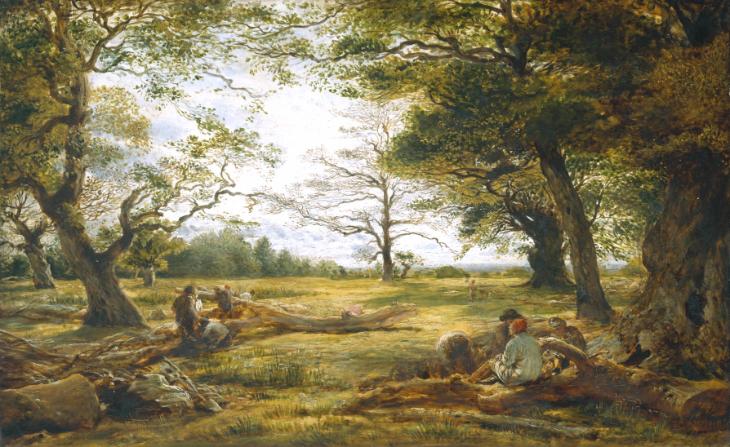
Windsor Forest (‘Wood-Cutting in Windsor Forest’) 1834-5, exhibited 1835 John Linnell 1792-1882 Presented by Robert Vernon 1847 http://www.tate.org.uk/art/work/N00438
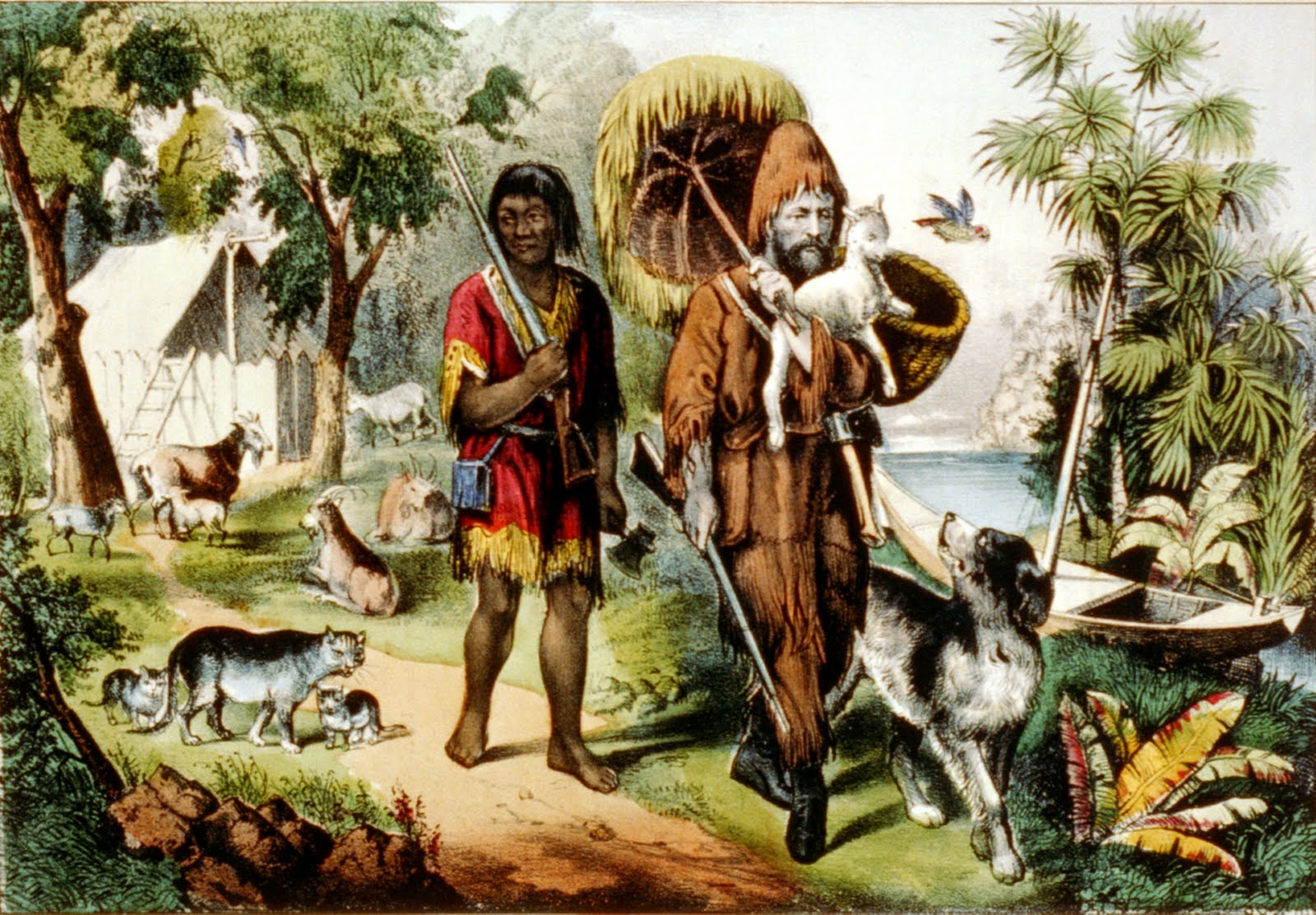
Then there’s Pamela, Samuel Richardson’s novel about a young servant girl who falls prey to her master’s endless and increasingly insistent attempts to seduce her, becoming more violent every time. While she does not suffer the terrible rape that Clarissa endures in Richardson’s much longer novel, Clarissa, Pamela goes through a lot and chronicles every scrap of it in her letters home to her parents. Pamela can seem a slog, especially with all those self-justifying lines about how pure she still is and virtuous in spite of everything. It’s frustrating that she never seems to do anything but weep and write and swoon. Still, there are some funny moments, like when she tries to escape but mistakes two innocent wee cows for scary bulls, adding a dab of Freudian psychodrama to the otherwise relatively static action. I guess the main thing we can take from this novel is its intense focus on the individual (something that wasn’t really available before in fiction, because romances were interested in characters as archetypes – princess, villain, hero – rather than real people), and the process of introspection, the attention to everyday detail. The same goes for Robinson Crusoe: part of what’s seductive about Defoe’s novel is not just the adventure and pirates, but all those long passages about how he sets up his little domestic fortress on the island; how he learns to cure raisins, build boats, grow corn. He goes into so much detail you think you’ll go mad, but when you go back and read it, there’s a certain satisfaction to it. You can imagine yourself in his position – Samuel Taylor Coleridge famously claimed that Robinson Crusoe’s success was that he represented human nature in general – and the novel becomes a sort of survival guide to living on a lonesome tropical island.
Incidentally, Crusoe’s story was loosely based on that of Alexander Selkirk, a Scottish man who ran away to sea to escape punishment for bad behaviour back home. When he got into an argument with the captain of his ship, he asked to leave and go ashore on one of the South Pacific islands they were close to. Selkirk thought some ship would come and find him soon enough, but instead he was stranded there for over four years. Crusoe, by contrast, is on his island for twenty eight years. Part of the wonder of the story is how sane he stays. Crusoe rediscovers religion and his spiritual devotion is essential to giving his life order and meaning on the island. It’s the little things that matter, that give him a sense of self: carving the days into a wooden cross, having dinner with his ‘family’ of animals and writing in his diary. The whole novel basically celebrates the power of human reason and endurance, as Crusoe notes that ‘by making the most rational judgments of things, every man may be in time master of every mechanic art’. I guess in this way it’s very typical of the Enlightenment attitude of the time, but there’s also a very strong capitalist motive for Crusoe’s actions and attitudes. As Ian Watt points out in The Rise of the Novel, many of Crusoe’s behaviours prefigure that of the canny venture capitalist: his restless travels for more trade, his saving of supplies and investing of crops, his careful planning of time and stock, and the mythological story of the individual’s capacity for survival. In fact, it could even be read as a kind of Puritan spiritual autobiography, because Crusoe has all his capital successes rewarded supposedly by ‘Providence’ as a blessing for his religious (re)awakening. It’s funny how a lot of eighteenth-century texts like Robinson Crusoe are perhaps best known for their adaptations into children’s literature (NOT as the rather awful film versions which insist on adding an irrelevant romance plot to everything). I suppose it’s because Defoe’s novel is also an adventure narrative, encountering pirates and ‘educating’ his ex-cannibal slave ‘Friday’ with Western values (another problematic but critically rich part of the story is Defoe’s relationship to ‘my man Friday’, which sheds light on the colonial context of the time). Another example of an eighteenth-century novel being famous as a children’s book is of course Gulliver’s Travels, by Jonathan Swift. The irony here is that Swift wrote this tale about fantastic worlds with tiny people, floating islands, people who could extract sunlight from cucumbers, giants and talking horses (Houyhnhnms) to deliver a harsh satire on the politics and Enlightenment culture of the period. Unless you have a canny eye or an edition rich with footnotes, you might miss all these references, and so revel along in Gulliver’s story and thus fall prey to the kind of naivety Swift critiques in Gulliver himself. Indeed, because the book was so cleverly prefaced and presented as a true account of a man’s travels, many people thought that the events and the strange places described were all true. In addition to lashing the follies of man’s claim to reason and pursuit of enlightened knowledge, Swift was attacking travel writing itself, albeit with lesser gall. He parodies the supposed objectivity of travel writing, and its attention to seemingly inane details. He gives very precise numbers, showing the reader how he cleverly carves up the worlds he encounters, noting ‘three hundred tailors’, ‘six of his majesty’s greatest scholars’ and so on. He also feels the need for self-justification, as when he describes how his excrement has to be taken away by two wheelbarrows by the tiny Lilliputians:
I would not have dwelt so long upon a Circumstance, that perhaps at first sight may appear not very Momentous; if I had not thought it necessary to justify my Character in Point of Cleanliness to the World, which I am told, some of my Maligners have been pleased on this and other Occasions, to call in Question.
Swift’s writings had been previously critiqued for their lewdness, as in A Tale of a Tub and ‘The Lady’s Dressing Room’, where the human body becomes a site of grotesque revelry and disgust. Swift, therefore, is here fashioning his own self-defence with thick layers of irony, inviting critics to judge him against his own self-protection, his free reign expression on matters abject and bodily. Travel writing was a big thing in the eighteenth-century, what with the growth of the British trade empire and the trend for the ‘Grand Tour’. While they didn’t have access to a railcard, undergraduate (men) would often take the Grand Tour of Europe, learning about refined French manners and Greek culture to more fully develop their education. This of course also involved a lot of drinking and probably visiting prostitutes, but then again, such matters were perhaps necessary to a gentleman’s education – he could ‘get it out of his system’ overseas and come back to Britain enlightened and satisfied and ready to be a ‘good’ citizen. Hm. One of my favourite pieces of travel writing is James Boswell and Samuel Johnson’s account of their journey to the Western isles of Scotland. Their approach was slightly different, as they each wrote separate accounts of the time. Boswell focused mainly on Johnson himself (as he tends to do in his writing!) whereas Johnson spent much time critiquing the dreariness of the scenery and observing the primitive lives of the locals with some disdain, though respect for their hospitality. You can read A Journey to the Western Isles of Scotland for free online via Project Gutenberg, and I think it’s worth a gander, if only to take a brief lunch-break holiday into the wilds of eighteenth-century Scotland. There is also a rather humorous article in The Telegraph detailing the author’s attempts to retrace the steps of Boswell and Johnson’s tour, though I am somewhat uncomfortable with his complaints about encountering a range of ethnicities rather than ‘native’ Scots on his tour…can Scottishness not finally now be defined as authentic through multiculturalism, as everywhere else in Britain, or must it still be hailed as a land of blood and soil nostalgia, pale skin and tartan…? just a wee grumble! I have only skimmed over the stuff we covered in our course on the eighteenth-century. Other things worth reading are the hilarious parodies of Pamela, which cast severe doubt on the veracity of Pamela’s ‘virtue’ and burlesque Richardson’s prose style – some good ones include Eliza Haywood’s Anti-Pamela and Henry Fielding’s Shamela. Also, Raymond Williams’ The Country and the City is a marvellous book which looks at how the countryside was often falsely represented in various examples of pastoral and Georgic poetry through the ages as an idealised contrast to the corruptions of the city. Millenium Hall by Sarah Scott is a very intriguing epistolary novel which has been dubbed a ‘feminotopia’, an early representation of a utopian community run by women on a country estate. I suppose what really strikes you about this period is the sheer diversity of works, and the strong political ties most of the literature displays. It was a time of experimentation, but because the novel in particular was still a nascent form, it’s possible to perceive all the strange incoherences, the little faults and cracks which allow us to reflect on the form in general and its relationship to ideology. Edward Said, after all, has argued that the novel is by definition born out of colonialism: it is ‘fundamentally tied to bourgeois society […] it accompanies and indeed is a part of the conquest of Western society […] the novel, as a cultural artefact of bourgeois society, and imperialism are unthinkable without each other’. The novel’s representation of social authority in the hands of the British, its focus often on middle-class life and relentless individualism are all part of this bourgeois basis of the novel. Whether we agree entirely with Said’s statement, it’s a compelling argument that challenges us to rethink how we consider what is probably the most popular form (other than celebrity biography) in the contemporary literary market. And I guess that’s one of the thing’s I enjoyed most about this course: returning to origins, understanding how modern literature came into being out of the cultural circumstances and experimentations of the long eighteenth-century. It is rather ironic that while Samuel Johnson characterised the typical novel reader as ‘the young, the ignorant and the idle’, reading novels is now one of those activities that mark you out as ‘cultured’, ‘educated’, perhaps even ‘bourgeois’. Not only in its form, but also in its critical reception, the novel has come a long way. Some extra info:
Pope’s Grotto. Source: popesgrotto.org.uk
Alexander Pope was a dissenting Catholic during the time of Protestant monarchy, which meant he was barred from participating in many societal institutions, like university. In 1719, he retreated to Twickenham in the rural outskirts of London, building himself a villa and a grassplot garden whose verdant beauty was to imitate the Arcadian landscapes of much of his poetry. Pope’s residence is notable and pretty cool because he constructed a tunnel under the road connecting his garden to his villa. It led to the basement of his villa in which he fashioned his own grotto. He wrote a rather beautiful description of his delight in a letter to Edward Blount:
When you shut the Doors of this Grotto, it becomes on the instant, from a luminous Room, a Camera Obscura, on the walls of which all the objects of the River, Hills, Woods, and Boats, are forming a moving Picture…And when you have a mind to light it up, it affords you a very different Scene: it is finished with Shells interspersed with Pieces of Looking-glass in angular Forms…at which when a Lamp…is hung in the Middle, a thousand pointed Rays glitter and are reflected over the place.
One of the first things you notice when you come to university in Glasgow is the building that passed you by on the open days: Boyd Orr. Orr…ore…or? With such connotations of alchemy, alternation and mechanical process – the extraction of mineral from rock – you’d be forgiven for thinking this building might have that rare quality of metallic extraction. The glint of some loveliness got from the mined core of the earth – or at least some relic of its crust. Boyd Orr himself, as Wikipedia tells me, was a Scottish teacher, doctor, biologist and politician, who also bagged himself the Nobel Peace Prize for work relating to wartime nutrition. Fitting, perhaps, that this man who dabbled in the arts of healthy eating would give his name to a building that some have found physically repulsive and ugly – if anything, unhealthy.
Still, nutrition involves mining particles of food for their usefulness. Finding all the vitamins as a geologist might take ore from a rock. There is something abject about all this: wrenching nature inside out, textually taking apart her insides with the bland incisiveness of a knife (the linguistic thrills of science course-books). The molten loveliness of erosion, rocks, temporal process – we can reduce them to names and building blocks. And so we have Boyd Orr, that building of much usefulness and much disgust. The beast of a building that somehow you find yourself in, day after day, traipsing up the stairs for lectures, waiting for someone to give you their jewels of information. You came here thinking you’d be living the Harry Potter high-life in the extravagantly gothic main building, chased by ghosts and granted with turret views. Instead, you end up four floors up in a building that sends its gross sneer across the otherwise lovely architectural landscape of the West End.
Source: theglasgowstory.com
Whatever you might say about Boyd Orr – with its dirty-white panels, greying windows and greyer walls, with the greenish mould that creeps up its underside like seaweed on a rock and the ugly stark jut of its body against the surrounding skyline – you must say that it is a fine example of Brutalist architecture. The heyday of Brutalism was the period between 1950 to the mid-1970s, a reaction to the modernism of the early twentieth-century. Most examples of Brutalism tend to be found in governmental or institutional buildings (university libraries, shopping malls, high-rise housing), whilst corporate buildings have always favoured a more glassy, futurist chic. The thing that strikes you first about a Brutalist building is its sheer expression of, well, concrete. It hits you with the blunt materiality of a prison or fortress, and you know, it does take a while to get used to going inside. Sometimes it seems impossible that such a monolithic block is carved out inside with such things as canteens and toilets and classrooms. Part of its statuesque aura relates to its positioning: right on the corner of University Avenue and Byres Road, where the surrounding buildings are much smaller or indeed older (and prettier for that matter). There’s no getting away from this eyesore, this monument to an industrial modernity that seems now to be receding in the mise-en-abyme of contemporary metallic panelling, plexi-glass and plastic coating.
Like the rest of Glasgow’s culture, its architecture is a tale of two cities. There’s the legacy of our colonial history, with flourishes of opulence on every corner; but there’s also the leftovers of 1970s ‘slum’ housing, the crumbling tenements where once upon a time (and, unfortunately, perhaps still today) a whole family would share a bedroom and washing was done at the ‘steamie’. In one street you might have a bizarre Art Deco number next to some crumbling sandstone tenements, or a gleaming new-build sprung up alongside Victorian houses with massive (single-glazed and listed) bay windows. There’s the black-and-white nostalgia of the Gorbals and then there’s the grandiose Park Circus, sat atop Kelvingrove Park looking out with picturesque views over the city. There’s the famous Carpet Factory, the Rennie Mackintosh Art School, the various churches, mosques and synagogues with their unique homage to Roman and Eastern styles. There’s the uncomfortable fact that much of Glasgow’s beautiful marmoreal and sandstone glory is built on the slave trade. We also have the bug-like SECC resting next to the Clyde as if we were in Sydney, the Royal Concert Hall that crowns the top of Buchanan Street, the new Hydro that more than anything resembles a UFO. It’s definitely a city of eclectic architecture. While we might not have the equivalent architectural (and indeed financial) notoriety of Edinburgh’s Scottish Parliament building (which in my family alone has been called ‘horrible’, ‘interesting’, ‘a waste of money’, ‘too modern’ and ‘more of an art gallery than a parliament’), we were in 1999 designated the UK City of Architecture and Design, beating the likes of London, Liverpool and of course, Edinburgh. You only have to reflect on the response to last year’s Art School fire to recognise how seriously we take our physical landscape and architectural heritage (even if it is often covered with ad posters and graffiti).
Anyway, back to Brutalism. The key word related to its style, aside from concrete, is perhaps ‘function’. Stripped to its core elements, Brutalist architecture involves repeated ‘modular elements’ which are grouped together to form the whole. This is the raw fragmentation of modernism, here transformed into something with instrumental purpose, something solid that seeks to counteract the airy dissolution of modernity. ‘All that is solid melts into air’, Marx said. With Brutalism, the response is to make things as solid as possible. How ironic that Marx predicted a revolutionary dissolution of oppressive social structures, whilst the ‘proletariat’ in question remain literally trapped inside buildings which encase them in a physical manifestation of the very (metaphoric) solidity which binds them socially – the hard class structure, the poverty cycle and so on. And perhaps also ironic that some of these buildings were erected at a time when industrial labour was entering its decline in Britain and elsewhere, especially in Glasgow towards the end of the 1970s, as Thatcher came to power and that mineral source of wealth and opportunity (going back to ore of course) – mining – was dissolved from the national economy.
There is also the uncanniness of paradox attached to the fact that when one observes a Brutalist building, it is often difficult to discern its function due to the sheer vastness of its functionality. This relates back to what Edmund Burke in 1757 defined as ‘the sublime’:
The passion caused by the great and sublime in nature […] is Astonishment; and astonishment is that state of the soul, in which all its motions are suspended, with some degree of horror. In this case the mind is so entirely filled with its object, that it cannot entertain any other.
Burke was talking about the sublime as it was caused by scenes of nature: mountains, chasms, forests that seem to stretch on forever. However, as urban landscapes increasingly eat into our countryside, it seems fitting that we might consider the vastness of their proportions – or indeed, their ugliness – a kind of sublime in themselves. What else do we feel than a kind of passionate ‘horror’ as we find ourselves faced for the first time with buildings like London’s Trellick Tower and Barbican Centre or India’s Palace of Assembly? All those pattern-like repetition of squares resembling a Kantian ‘mathematical sublime’, whereby an overflow of signifiers stretching out into tedious infinity bears the threat of all meanings, distinctions and associations collapsing into one long metonymic chain leading to nothing but more signifiers. It’s enough to give you a headache, and quite ironic that Boyd Orr is next to the equally hideous though somewhat-smaller Mathematics Building.
Central to Burke’s idea of the sublime is the notion of the pleasure associated with terror: as we gaze at something which overwhelms us, we find ourselves staring into the abyss of meaninglessness, on the sheer precipice where representation itself collapses. St. Augustine suggested that the ugly was that which embodied formlessness in its lack of beauty. This aesthetics of excess or hideous terror appears curiously inappropriate for a style of building whose very purpose was built on form as function. We might think of Frankenstein’s monster, whose ugliness stems not only from the fact that he is composed of the flesh of dead cadavers, but also his sheer pointlessness – the fact that he is a ‘blot upon the Earth’, as Mary Shelley has him lament. Might we consider the likes of Boyd Orr a horrible, monstrous ‘blot’ upon our sacred streets? Or is this more than a question of mere aesthetics?
As Romantic poets readdressed the Neoclassical distaste for the gross pointlessness mountains (favouring, as Alexander Pope’s Windsor Forest perhaps best exemplifies, a view of nature as ordered and harmonious) by fetishising the psychologically disruptive experience of the sublime (in the way that Coleridge, de Quincey et al also favoured the psychologically disruptive experiences of opium), today’s generation are raising Brutalism to idolised status rather than rejecting it as a mere eyesore. Sure, you will have the many students who moan about Boyd Orr’s appearance on their campus, but you will have an equal number of enthusiasts on the likes of Tumblr posting Brutalist architecture onto their blogroll, alongside your Banksys and softcore erotica and fan-fiction all that other Tumblr jazz. Stark black and white photographs record an almost antiquarian fascination with the aesthetics of these buildings and their value as some relic of a solid past we can’t quite get back to in our shiny era of crazy postmodern architecture.
But is there an ethical problem underlying this fetishising of some Brutalist buildings? They are, after all, often the homes of many people living in relative poverty. Sometimes, these buildings are just down the road from areas of affluence and architectural extravagance. I don’t need to mention specific areas for you to think of places in Glasgow, because there are certainly many. It’s a problem related to the way that urban decay is appropriated as a kind of dark backdrop upon which a white, middle-class guy sorts his life out. There’s always been the ethnographer’s dilemma of how ethical it is making a living out of describing poor conditions without doing anything about it politically or practically. I suppose what I’m getting at though is that there’s something a bit more uncomfortable about using these buildings as ‘cool’ aestheticism, a mere viewing-spot on the blasé scroll of online photography. Still, I don’t think there are clear answers to this; and maybe it’s good to share images, because sharing raises awareness. You just have to keep in mind the whole problem of ‘poverty porn’, and the notion that by glorifying certain buildings you are also glorifying a particular experience of poverty, however unintentional your actions.
Indeed, this perhaps is what made me so uncomfortable about last year’s plans to demolish the iconic Red Road tower blocks and transmit the demolition live as part of the Opening Ceremony of the Commonwealth Games. While it is of course good that the Games involved building new, much more accommodating and safer houses to replace these crumbling relics of Glasgow’s past, I don’t agree that it should’ve been broadcast to add a ‘bang’ to the Opening Ceremony. London gets magnificent fireworks for the Olympics, we get…glorified demolition? Destroying a symbol of poverty doesn’t destroy poverty itself, however easy it makes it look. Luckily, these controversial plans were scrapped in the end after much public opposition (which just shows again how much Glaswegians care about their physical environment and the social consciousness within it). Regeneration is underway with the Games’ legacy and of course it is a great thing, but there is no need to sanctimoniously erase history in front of the world to show that you’re doing it.
This points to the whole issue of Brutalism’s somewhat brutal decline since the 1980s, especially in Britain. Vocalised distaste from public figures, the association with urban decay, problems with graffiti, cramped living conditions and its starkly cold, almost totalitarian appearance, all contributed to this decline. Another contribution to this decline perhaps came from British Literature’s concrete guru, J. G. Ballard, as his novel High Rise (1975) documents a dystopian, Lord of the Flies situation where the closed conditions of a high-rise building lead to a swift degeneration of the residents lives. The enclosed spatiality of place itself gives rise to a carnival of savagery and violence, where primitive desires are unleashed in this isolated environment. The opening line perhaps gives you a good indication of where Ballard is going with this novel: ‘Later, as he sat on his balcony eating the dog, Dr Robert Laing reflected on the unusual events that had taken place within this huge apartment building during the previous three months.’ There is a strain of dark humour running through the text, as well as the shock value of its exposure of human nature placed in its urban limits. You get the sense that Ballard secretly revels in both the sheer surreal ugly inhumanity of it all, whilst critiquing the politics of urban planning that might one day lead to such a scenario.
Overall, I’m not sure where my position on Boyd Orr lies. There are days where I’m walking to uni along Highburgh Road and when Boyd Orr looms out of a cloudy winter sky my spirits sink like a puddle of snow slush. But there are times when you can’t help but notice the strange beauty of copper-coloured sunlight flashing upon its windows at dusk, as if a thousand eyes were staring out of those cold, impersonal walls. I think there’s value in preserving these buildings, not just because they possess a kind of chic urban sublime, but because they remind us of the ideals our society once held, even if they were misguided, flawed or impossible. I suppose I’d rather stare at the stark reality of an ugly monster, a decrepit Boyd Orr, than lose myself in the illusory surfaces of the glassy Wolfson Medical School, or the kitsch blue and green panels of the neo-Brutalist Fraser Building. I’d rather a chunk of dull glowing ore than a perfect rhinestone…
It was the morning after the busy Black Friday weekend at work, and, predictably, I slept in. The rain was pouring down thick and fast and Glasgow was a gloomy vat of grey. There was a need for something warm and enchanting in this mist that overshadowed Christmas.
Every year, my Mum, brother and I try to find something to visit – it’s become a kind of tradition. An acoustic gig, a play or a film, usually. In past year’s, we’ve seen the likes of Pearl and the Puppets, Great Expectations; a long time ago, it would be Maybole Bazaar or the Carrick Christmas Show. Sometimes it’s true that the older you get, the better things are. There was a year when I was supposed to go see Frightened Rabbit at The Arches with some friends, but a heavy snowdrift cancelled out all the trains and so I had to content myself with a night at home studying Higher Sociology…
Anyway, this year I found myself on the train to Edinburgh on Sunday morning. Since the weather was a gloomy storm of wind and rain, we decided to go to the cinema. I always like the thrill of going to a cinema I haven’t been before – even if it’s got the same pick and mix, popcorn machine and seats, there’s still something exciting about navigating the screen doors and the dark staircases. We went to the VUE cinema. Mum was keen on going to see Paddington. I was pretty sceptical; I mean, I’m not too keen on animated films, and I agreed with my brother that it might end up being a bit…childish. Probably like going to see Frozen, although I wouldn’t dare to be so controversial as to comment on that film, and anyway I haven’t seen it. Certainly, when we sat down to watch the adverts, there were a lot of commercials for toys and cereal and films that come with a ‘U’ certificate. A baby behind us intermittently crying. We exchanged Sibling Glances. What was this going to be?
I suppose in my mind I’ve always lumped Paddington in with Winnie the Pooh, The Wind and the Willows, Watership Down and Beatrix Potter: fuzzy, anthropomorphic children’s tales which hold prime place in the history of children’s literature. Yet all these tales tend to have a hidden dark side: like all traditional fairytales, their simple stories of adventure are interwoven with commentaries on the likes of family, love, violence and perhaps even racism. So I wasn’t sure what to expect from Paddington, but as I waited for the adverts to roll out, I was imagining that perhaps this would be more than just a plain old children’s film. Maybe it would reach the stature of one of the only children’s films I like, the (I think) highly symbolic Bug’s Life.
Paddington begins in the midst of ‘darkest Peru’, recounting a colonial tale whereby an English explorer named Montgomery Clyde makes friends with two bears and tells them upon his return to England that they will always be welcome in London if they ever visit Britain. The whole film holds a self-conscious ironic mockery of British colonialism, like some postmodern update of Conrad. Imperial knowledge is held by the ‘Geographical Society’ who cruelly banish Clyde for his benevolent approach to the ‘natives’.
Soon after, we witness fantastical elements of the bears’ lives as they live alongside their nephew in the wilds of darkest Peru. These lives are remarkably sophisticated, featuring an intriguing marmalade-making machine and a radio crackling with the sharp tones of BBC R.P. informing distant listeners about life back home on the streets of London. There are also some very nice hats. The simple harmony of the forest is disrupted one day by a violent earthquake, which leaves the female bear Lucy effectively a widow as the other bear Pastuzo disappears. Lucy sends her poor bereft nephew away to London to seek adventure and fortune by sneaking him onto a ship, and retires peacefully to a retirement home for bears.
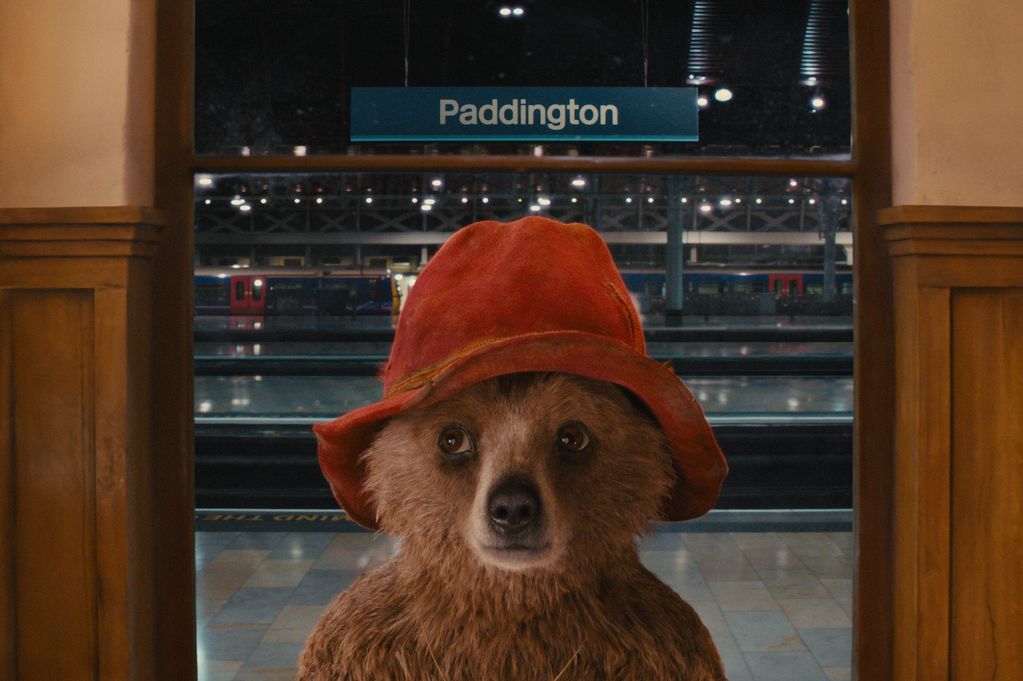
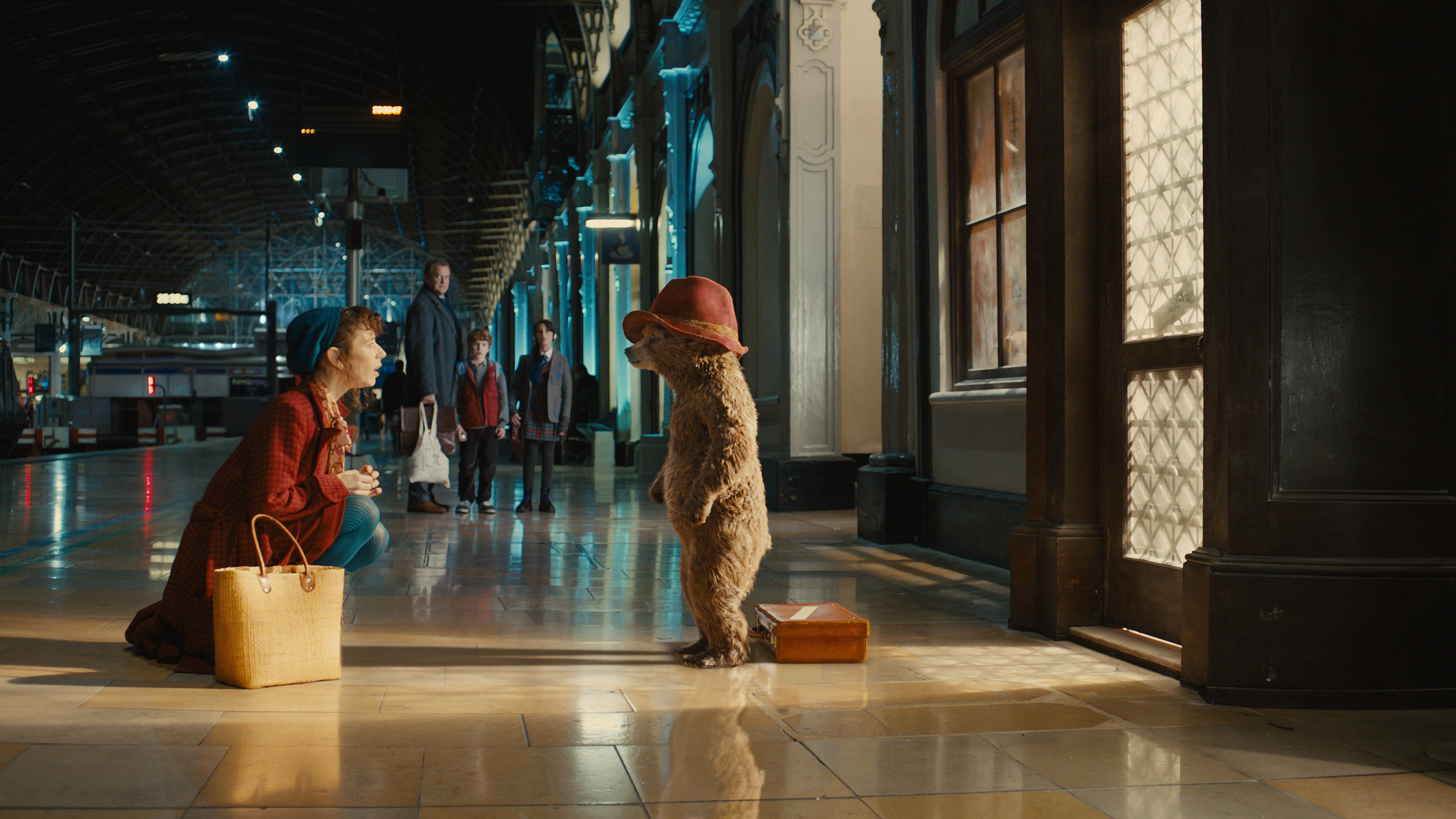
After this, the film follows a somewhat bizarre but delightfully heartwarming immigrant narrative. The young bear finds himself alienated in a strange city, acquires himself a ‘British’ name (Paddington, after the train station he arrives at), and then a suitably quirky and very English family to adopt him. The Browns (with Downton Abbey’s Hugh Bonneville as the dad and Made in Dagenham’s Sally Hawkins as the mum) embody that kind of slightly dysfunctional, messy and a bit bizarre middle-class family that holds mythological status at the heart of our culture. Yes, there is the threat of stereotype, but the film carries off these qualities generally well as they mould perfectly into warm, fairytale figures that chime in various ways with cultural caricatures without becoming too flat or prescriptive. The stern, paranoid father and the liberal, empathetic mother; the boy obsessed with building things; the girl choked on embarrassment and fear of seeming ‘weird’ to her friends. The Scottish and slightly alcoholic housekeeper, Mrs Bird, who can predict things with her knees and saves the day towards the end of the film by distracting a security guard with copious shots of whisky.
We might compare this play on well-loved family archetypes it to the likes of TV comedies My Family or Outnumbered, which features semi-improvised scripts depicting the chaos of modern family life. The overly-inquisitive little sister Karen, the perpetually-stressed mum, the wearied father, the embodied chaos of Ben, the youngest brother, the sulky teenager. What makes Paddington shine above any TV drama is the simple humour of its script and the cinematic magic of its costumes: Nicole Kidman’s sharp heels and trench as she stars as the villainous taxidermist who seeks to capture and stuff our beloved bear for the Museum of Natural History, Sally Hawkin’s outfits (all marvellous colour-clashing, woolly hats and embroidered cardigans), and that iconic blue duffle coat and red hat that Paddington wears himself. Let’s hope sales of said duffle coat go up in the aftermath of this film because I’m more than happy to see it everyday, especially in that lovely cobalt colour that Paddington sports so well:
Then there’s the magic of the house itself, which features a giant spiral staircase and walls painted with a Japanese cherry blossom tree, the blossoms of which bloom or fade beautifully according to the emotional tone of the story.
As Paddington adjusts himself to (human) family life, the audience goes through scenes of low-level cognitive estrangement, as Paddington explores everyday human life and tries to make sense of it, with amusing consequences: flooding the bathroom, using a toothbrush as an ear-cleaning cotton-bud, mastering how to use the escalators at the tube station. As I said at the beginning, I’m not generally a great fan of animated films, but Paddington carries off its loveable animal protagonist flawlessly, down to the details of individual water droplets shaking off each strand of his fur. Originally, Colin Firth was set to play the voiceover for Paddington, but he stepped down after worrying that his voice didn’t sound quite ‘open’ enough for the young bear. Instead, Ben Whishaw got the part and the sweet dulcet tones that so charmed us in his portrayal of Romantic poet John Keats in Jane Campion’s Bright Star are here perfect for the innocent wide-eyed charisma of Paddington. It’s a remarkably technical process; Whishaw had to wear a kind of helmet so that the animated Paddington bear could match the facial expressions and head movements of his kindred (human) spirit.
London is a dream in this film. From the grand corridors of the museum to the polished floors of Paddington Station (I imagine a much-needed plug for Network Rail…) and the snowy streets, it provides a romantic backdrop to Paddington’s adventures that makes us fall in love with the old city all over again. Sometimes I get very sick of London, especially the way it always flickers through media as this glassy corporate giant full of rich people with perfect lives (I’m thinking of the sweeping shots that open The Apprentice or basically every shot in Made in Chelsea that isn’t an awkward closeup of someone’s glakit face). The London of Paddington is a city of nostalgia, drenched in snow and old antique shops and red telephone boxes and a Dickensian wallet thief. Peter Capaldi playing an archetypal nosy old neighbour with a cockney accent and Doctor Who scarf. The family portrayed at the heart of the film are at once old-fashioned (the boring, distant father that perhaps echoes the banker father of Mary Poppins?) but deal with relatively modern issues: the presence of technology, the moodiness of teenagers. It’s this blend of the nostalgic and contemporary that really adds magic back to London itself, that spins a fairytale of visual beauty and enough narrative suspense to keep you hooked to the end (there is the encroaching threat of Kidman’s cold cyborg of a villain coming to kill and stuff our beloved protagonist).
Aside from the lovely visuals and fairytale storyline of good vs. evil, there’s the narrative of the Other which I already touched upon. Paddington experiences both alienation and welcome, and simultaneously the audience goes through the motions of heartbreak and compassion. Initially, he finds himself spurned by Mr Brown for his clumsy inability to fit into the household without making a mess of everything. In the cold rain he wanders the streets, and finds shelter with one of the Queen’s Guards who kindly offers him an emergency sandwich that he has stuffed under his enormous hat. Paddington is of course perfect for Christmas time: there is the message of family love, compassion and understanding, but also that simple narrative of sharing food that means so much in the shared gluttony of the festive season. There’s a reason we buy a tin of Roses or Heroes or Quality Street and it’s not just because it offers choice, but also because it’s a shared pleasure. Much like the film itself (I recommend everyone sees it on the big screen where the glorious visuals can really come to life).
You can look to the likes of Derrida or Donna Harraway to academically unpick the importance of understanding animality and other species for recognising the animal in us. By the end of the film, we realise that species shouldn’t divide us or cause fear or hatred or hierarchy. It’s wrong to treat another being as an instrumental object: something to be prized and displayed and stuffed. Go to Peter Singer for some philosophy too; I recommend ‘All Animals Are Equal’ (1974). It’s wrong to treat the Other with anything less than the respect you’d give to your own ‘species’. If bears and humans can become family, then can’t we all as humans get along in the turbulent times of the terrorism and threat and anti-immigration rhetoric of the 21st century?
What draws the immigrant narrative out from this Every(bear’s)man’s tale of immigration is the interspersed classic calypso songs which a band play throughout the action. Michael Bond’s children’s books were written, as Tim Masters (BBC 2014) points out, around the time when a new immigrant community were settling in Notting Hill – the place where Paddington himself finds a home. The songs are all positive and cheery, telling a story of endurance in the face of hardship and rippling with a fresh, hopeful spirit. The kind we need for 2015. By invoking the positive narrative of the Caribbean settlers in the mid-twentieth century (who came to help rebuild post-war Britain), the film implicitly critiques our contemporary societal stance on immigration. All the fear-mongering rhetoric that gets whipped up by the likes of UKIP is exploded in this heart-warming tale of love and discovery and acceptance of difference. It’s a classic tale of the journey of the Outsider that could be applied to anyone who has had the experience of settling into a new community as some kind of racial/ethnic/sexual/physical Other. And perhaps this, more than anything else, is the enduring magic of Paddington. So I’m glad I went to see it.
(On a side note, the only thing I was sceptical about was the heroic pigeons who essentially save Paddington at the film’s climax – not to put to fine a point on spoilers – I can’t see pigeons ever acting so benevolently. But then maybe that’s a terrible species bias that I should work on myself).
Bibliography:
Masters, Tim, 2014. BBC News Online. http://www.bbc.co.uk/news/entertainment-arts-30196290



 mariaology