The Greatest Loss: Lana Del Rey’s Anthropocene Softcore 

Screenshot 2019-09-08 at 11.26.09.png

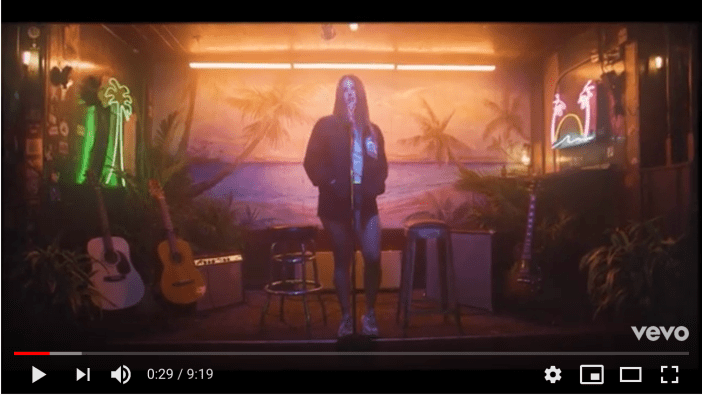
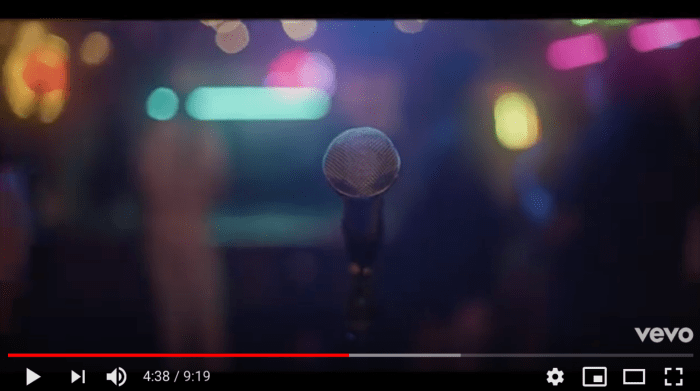
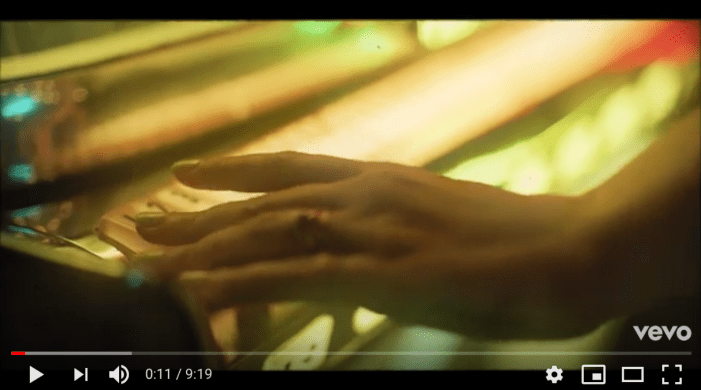
There is a scenario in which the jukebox is equivalent to the poet and some elaborate analogy is to be made between intertextuality and the limited catalogue whose selectional form produces play. The scenario only survives in video. It needs this urge of duration, not to mention the tenderness of a touch. Where fingers brush keys like notes, there is something to add to the story. A social space in demand of ambience; on flickering alongside off. When Lana is alone on stage, hands stuffed into a bomber jacket, singing ‘Fuck it, I love you’, swaying almost nervously, I want to think about what she is doing there and who she is speaking to and from where she is speaking. She is not really speaking but singing. The lone girl on the stage is the open mic dreamer, with nothing but lines. She is scattered across june-dreams of multiple personality: ‘The I which speaks out from only one place is simultaneously everyone’s everywhere; it’s the linguistic mother of rarity but is always also aggressively democratic’ (Riley 2000: 57-58). We mother our solipsism with words but in doing so there’s an opening. So to say fuck it and state the interruption with syncope, sincerity. Lana Del Rey was born on the cusp of Gemini and Cancer season, which more than explains that statement: ‘Fuck it, I love you’. With her sails to the wind. To say it over and smooth into plural refrain, you could even say chorus. For a chorus wants to be shared. It is a commodious mother, fed by the keys of the jukebox baby. There is a constant reversal of nourishing; the democracy of lyric utterance, the milky feed that streams.

Denise Riley argues that any ‘initial “I love you” is barely possible to enunciate without its implicit—however unwilled—claim for reciprocation’ (2000: 23). But what is reciprocation in a song? Is it just the urge to be sung with? And this ‘fuck it’, the pervasive millennial injunction to just be, to move on, as the tag which erases the expectant price of the utterance? Riley argues that I love you ‘must at once circulate as coinage within the relentless economy of utterance as exchange’ (2000: 24), but in a pop song it bears the leaden weight of so many prior expressions. The irony is that to cut through that with a simple fuck it, Lana can attain something like sincerity in the very pop mode whose lineage of commercialised love would surely undermine her feeling. Fuck it, in spite of saying I love you I really do. The pop song becomes this space for the staged epiphany of repeated assurance, I really do. It is a softcore admission of the self in its burning limit. 
Screenshot 2019-09-08 at 11.26.37.png

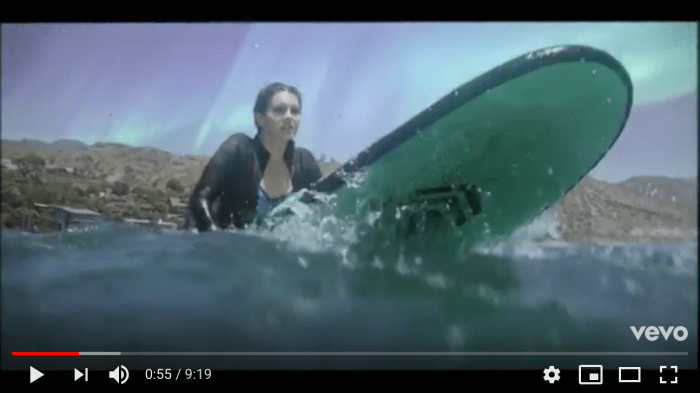
‘Fuck it I love you’ is soaked in lights, but they’re fading. ‘I like to see everything in neon’, is the line that opens the song. To see everything in neon is to fluoresce what is haunted and gone. I think of Sia dragging rainbow dust down her tearful cheeks in the video for ‘The Greatest’ — tragedy’s shimmer as fugitive mark on the body. Lana offers herself up as sugar dust, cliché in honour of Doris Day: ‘Dream a little dream of me / Make me into something sweet’; she acknowledges ‘dancing to a pop song’, but it’s not clear if this is her or the character or the one she loves. ‘Turn the radio on’ could be a reflection or an imperative. The reader is hailed between these positions of love and the loved and the effect is saturating, warm, delirious. Separation is that ‘it’, the spacing. In the video, we watch Lana painting and then suddenly she’s surfing with the aurora borealis in the background. She’s on a swing, her jean shorts caressed by the camera, she’s the sexualised pop icon again. She’s on a surfboard, green-screened, young. She’s choosing a shade of yellow from the palette, singing ‘Killing me slowly’. What is this ‘it’, killing her slowly: 

I’ll return to the unknown part of myself and when I am born shall speak of “he” or “she.” For now, what sustains me is the “that” that is an “it.” To create a being out of oneself is very serious. I am creating myself. And walking in complete darkness in search of ourselves is what we do. It hurts. […] a thing is born that is. Is itself. It is hard as a dry stone. But the core is soft and alive, perishable, perilous it. Life of elementary matter.

(Lispector 2014: 39)

I want slyly to argue that this is a kind of anthropocene existentialism. Recognition of the self as this ‘hard’, ‘dry stone’ thing of geologic mattering, reflexive species. This is what it is to be ‘Human’ right now. And yet the agential spark within, the ‘core’ that is being alive in a world where we have deposited those sedimentary layers. Creating ourselves in the stone, often with the tarnish of the very products we chose and developed to beautify, excoriate and cleanse ourselves, to remain forever young. So there is this oscillating temporality at work between desired infinity and the trace of our fugitive place on earth. The very earth minerals that would ruin humanity, mine our bodies of endless labour. But to go back to the song, with its idea of a gradual dying. I want to call this something like anthropocene softcore: the unnamed presence of species being within Lispector’s slender novel from the early seventies, or the Mamas and the Papas brand of late-sixties ‘sunshine pop’ whose solarity derives from the perishability of that energy, utopian commons, cascade of flowers — that serotonin glow of selves in streams and streams. 

Lana’s anthropocene poetics are not of the hardline, direct call to action. You would not say of her cultural presence, eco-warrior or nature goddess. You would not brand her Miss Anthropocene in a kind of demonic marketing gimmick. You would say most often she is a siren, per se, leisurely supplicating us towards death on the rocks. Desirous flow. This is anthropocene softcore. This is what it is to challenge the act of self-description itself, and in doing so questioning those generalisations that arise from the ‘we’ of humankind, not to mention the ‘I’ of pop’s delectable, mainstream lyric. Alchemically, Clarice Lispector and Lana make of these malleable pronouns the ‘perilous it’. The it, the feeling, the speaking self which is nothing much more than a bundle of affects, sensations, atoms. To be cast over and crested by the wave. Significant that ‘Fuck it I love you’ ends with the rising bubbles of this wave, the one that spills us through the fourth wall and into the studio. This song slams together pop’s saccharine mythos of California as dreamland, a late-summer song as the former was written, surely, for autumn. California: ‘it’s just a state of mind’. She could be talking about the self or the state, or the state of the self. 
Screenshot 2019-09-09 at 20.44.25.png

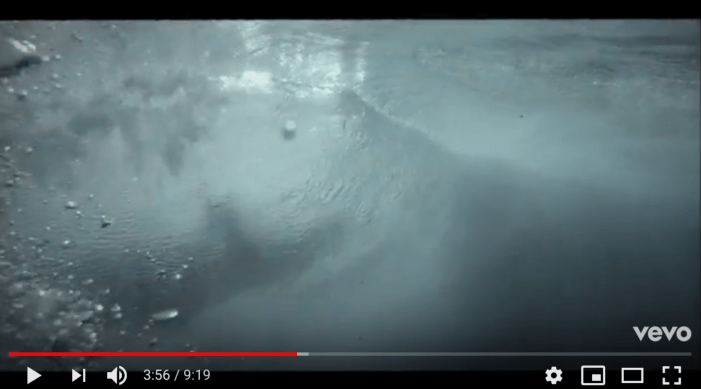
What happens next? The shot drifts over the cliffs, the coast, to a strip of palms and a distant view of the LA skyline. That shining love in the previous track is replaced by a minor key, a glimpse of the jukebox whose songs include The Eagles, Bon Iver, The National. Artists whose Americana is the melancholy of generations moved from political despair to something like the glitch of the times as a basic fact of intimacy. One of the Bon Iver songs shown in the video is ‘22 (OVER S∞∞N)’, and if that title was not rife with implicit apocalypse, what is, what is. A stammering into language, pitch-shifting the fragile space of utterance. There’s a spiritual glimpse to the sky and the infinite quality of the stars: 

There I find you marked in constellation (two, two)
There isn’t ceiling in our garden
And then I draw an ear on you
So I can speak into the silence
It might be over soon (two, do, two, do, two)

(Bon Iver, ‘22 (OVER S∞∞N)’)

I don’t know what the maths is doing. I don’t want to know that the song ‘was inspired in part by Bon Iver mainman Justin Vernon’s unsuccessful attempt to find himself during a vacation’. I am however interested in the hubris within this term ‘vacation’ at all. Do we now live in a world where you can take ‘time out’? There is nothing of the world we know that could be switched off. There is no ‘away’ of complete erasure or original presence. Deconstruction caught up with our living. Vernon describing this song as a gesture towards what might end of his emptiness could just as easily be flipped: its relief is equal to a mortal sense of loss. The impending erasures. It ‘does’ or acts the accretional event of extinction that is speaking into the silence, to those who could not speak back. 

Fragments and snatches: the neon green lining Lana’s eyes, the aurora borealis, the neon green palm in the club where she sings alone. A season by yourself. The love of the couple together surfing is cardboard, Hollywood. It is a trembling symbol. It is almost ridicule.
Screenshot 2019-09-08 at 10.27.46.png

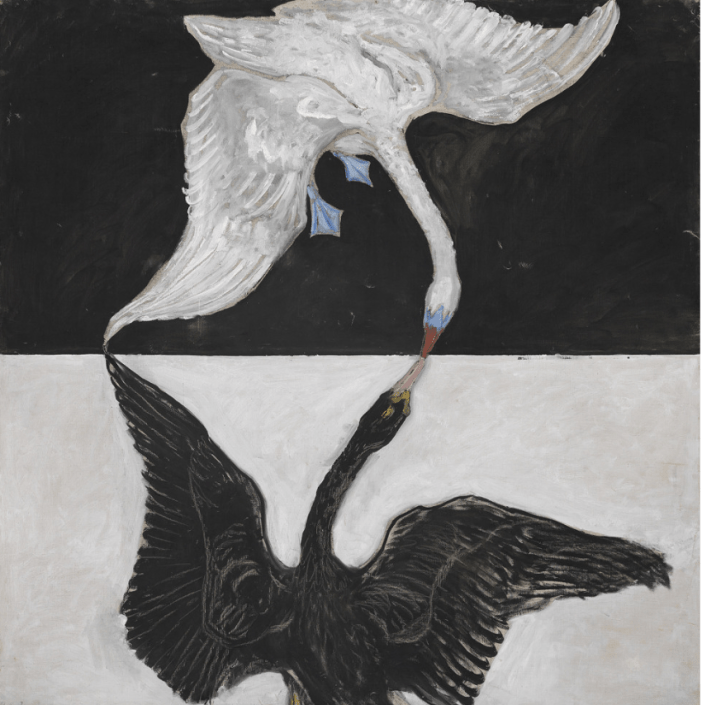
What is Justin Vernon looking for in the constellation? When he sings ‘two two’ I think of Hilma af Klint’s nose-touching swans, or the hours of the day chipped at the edge — two of them stolen by tragic event. I think of a mic check, two, two, ch, ch. Click. Near-enough-presence of speech. A white swan on black background; a black swan on white background. Flip. The swans are geometry, signets of signature, they move towards abstraction. Growth. I love them. Fuck it I love them. The way they are just it. Inversions of colour and a monochrome mood splashed with cornflower blue, the tiny excess we can treasure. It is the cornflower blue, the little webbed feet, which make the swan in question unique. So we can care for it, figuratively as it swells through grey-white waters of memory. The swans we have lost in our shit. Royal iterations freed from belonging. This painting is from af Klint’s series Paintings for the Temple, works derived from spiritual communication. The abstraction of the swan / renders us stark in frame / for we were Lana or Leda / before we were animal. Sufjan Stevens’ ‘Seven Swans’: ‘All of the trees were in light’, ‘a sign in the sky’; ‘My father burned into coal’. And all of our sadness was carbon neutral before this. We plunge into whatever remains of the water, its plasticky thickness.

I keep pausing the video as it transitions. ‘Fuck it I love you’ twinned with ‘The greatest’. When The National sing It’s a terrible love and I’m walking with spiders, what exactly is the ‘quiet company’ of the ‘it’? It could just as well be spiders. Maybe it’s the web itself, the web between the human and the more than human, the gossamer moment where metaphoric articulation becomes more than feeling and gleams material. ‘It’s a terrible love that I’m walking with spiders’ — what is the grammatical transition done by that ‘that’ and who is to blame. Walking with spiders might just be that love. Transitional, subject/object logic is reversed in this song: ‘Wait til the past?’ is sung, then ‘It takes an ocean not to break’ when surely the ocean itself would break you. Soon the ‘terrible love’ is a substance, something ‘I’m walking in’ — to feel it is an act of immersion. It is to let that wave crest over, the ‘lyric auto-explosion’ (Moten 2017: 3) of the wave that would break you. 

In ‘The Greatest’, Cat Power sings of former ambition now cast to nostalgic regret. There is a sense of time slowing to delay, laconic strings, relaxed drums, the balladic sleep of a once-held fault. It is a parade slowing down in the rain. To say ‘Once I wanted to be’ is to hold this question of ‘the greatest’ as a generalised desire itself. The hunger we lose in time, whose primary colours soften. I hold to that precious, cornflower blue of a swan’s foot. ‘Two fists of solid rock / With brains that could explain / Any feeling’. This solid rock that would box you into the future, that would harden the edges of self. A thing is born, as Clarice puts it, ‘hard as as dry stone’. This is the thing born ‘that is’. To exist is to be this hard thing, protein ligament, to kick out in lines; but then in time there is the plasmatic self inside that, like some fatty animal byproduct, sticks to the others it loves, it needs, it leaks. Gelatinous, softly sticky love. The ‘it’ that needs saving. Anthropocene softcore; soapy inside of all geologic agency. Who we are and what we regret. The turning of the outside-in, the inside-out. Kathleen Jamie, in Sightlines, asks: ‘What is it that we’re just not seeing?’ (2012: 37). 

A sightline is a hypothetical line, from someone’s eye to what is seen. Is it clear or blurred, bad or good? Anthropos recedes in its very own scene as the ocean continues and we howl in the dark like a lossy-compressed version of species. We are the sirens and wolves. We are at the great concert of the Earth. We have to resist what Bernard Stiegler calls the ‘proletarianization of the senses’ (2017); we have to find longform ballads of what’s happening, pass them down the line, resist the short-circuiting of thought that occurs between screens and machines. We have to send letters back to our consciousness, our elders and children. This is the work of lyric. It could be the work of dance. I think of Zelda Fitzgerald’s protagonist, Alabama, learning to be a ballerina too late in her life: ‘Her body was so full of static from the constant whip of her work that she could get no clear communication with herself. She said to herself that human beings have no right to fail’ (2001: 180). Alabama barely eats; her energy is all the zeal of will. The dance of lyric as reduction, lack, as static and chased success whose collapse lands as Alabama will eventually do on the event of inevitable break. Grapefruit squeezed on the gritty turmeric shot of the future. And a brake, a screech. And yet we write, we cast out limbs and materials, we work towards this loss; we imbibe it. 

This is an ugly type of writing in which the outside is always imagined from the inside. Horizons are fictional and buildings are barred. I have no sightlines. I’m fucking cutting the corners of someone else’s desire. All paths are the continuation of a pre-existing line. This is a city from which I send myself postcards wherein I wish I was here. Flying letters. Words stolen from myself. I refuse to recognise that I have not composed them unintentionally

(Bolland 2019: 78).

The videos for Lana’s ‘Fuck it I love you’ and ‘The greatest’ swerve between inside and outside. We find ourselves in rooms we don’t remember entering. Writing the anthropocene has an ugly, masturbatory quality of fucking yourself with the rush of elaborate doom. Okay, so. Constructing fortresses of lines which would make a valiant destination. When I listen to Lana, I’m accessing shortcuts to ‘someone else’s desire’ which is the opening up of presence. ‘This is a city’; ‘I wish I was here’. I have never been to LA. We plagiarise our very own diaries to get back that sense of the once-intentional, the greatest declaration on Earth. That we were here, and we loved. She wrote that lit, forgot. The papers curled up and rolled away in a sultry air that was summer, 2012. The year of failed apocalypse, the year Lana released her debut album, Born to Die. We saw her campaign of fashion smoking through plexiglass bus shelters. Remember all ‘horizons are fictional’: they tell a narrative, they bleed and tilt and set like ice. Towards them we stupidly drift: the lived throb of our softcore skins, our hungers and rhythms.
Screenshot 2019-09-09 at 20.44.50.png

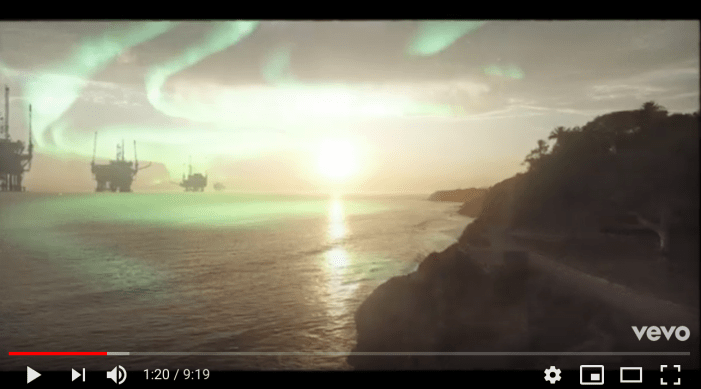
Drifting in colour like H.D.’s Leda, the rape of the land and the body and bodies engendering bodies. Worlds ending around us. And so I could say, but this is just one song, a phrase, a white woman of fame lamenting her world. But this self-conscious cinematics is a gesture towards the western world itself as this haunted, tragic protagonist: ‘The culture is lit and if this is it, I had a ball / I guess that I’m burned out after all’ (‘The greatest’). So you could say, anthropocene softcore speaks to the lyric I in its state of orphaned exception, which in turn is the loss felt by us all unequally. If we make of Lana a sort of anthropocenic siren, we must recognise the distinctions within our longing. For we all lose worlds differently; harm is striated along lines of class, gender, race, ethnicity, geographical distribution — of course. That wave that closes the video could elsewhere be a tsunami. I like to think its place on the edge is a deliberated hint to what could or is even already happening here or elsewhere. And maybe the colour, the aurora, is this streak of need for an excess beyond static blank, ‘human’ planet, standardised canvas; the need to splash something more of blur and blue. Flood the structure. 

When we say something is ‘lit’, we mean it is hot, on fire. We mean it is turned on, ignited, intoxicated, drunk, excellent. Lit is the past simple and past participle of light. Isn’t that line alone just lit? Maybe we are in the twilight of a former Enlightenment, recognising our species hubris as this alien green that tinges every familiar horizon, upsets the normalised green of pastoral. Is it toxicity, the elsewhere within ourselves? It is a radar showing who we are and where we have been. Those material metaphors cook on a smoulder, and this is the softcore coming to knowledge about what is happening.
Screenshot 2019-09-08 at 11.27.08.png

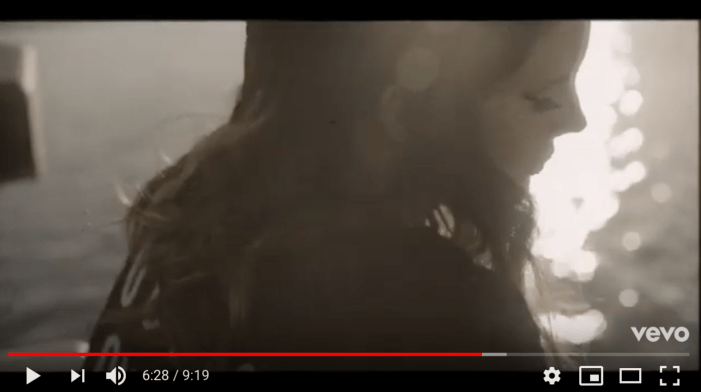
What does it mean to sing: ‘I’m facing the greatest / The greatest loss of them all’. To sing this on the brink of a hyperreal sunset, to chase a solar excess among loss. This loss could be a love but it is more like a culture; it is more like a voice and the condition from which to speak or sing it. The loss of lyric, its possibilities of address, and the loss or deferral or ruination of place itself. Maybe this is Lana’s lyric maturity, a generational acceptance that ‘young and beautiful’ is no longer the apex state of what we should strive for. Absence tenders complexity. Is this, as Roy Scranton puts it, Learning to Die in the Anthropocene? This question of mutability, the green-winged eye that sees a darkening world, a lack of birds along the bay, an edge. In the video for ‘The greatest’, Lana’s jacket reads LOCALS ONLY on the back. I google the phrase and find a hipster restaurant in Toronto with the slogan, LET’s PRETEND THIS NEVER HAPPENED. There’s a kind of parochial nihilism that glisters like the light on the sea, but the sea can never be local only. There’s a boat in the video whose name is WIPEOUT. It’s all happening; the signals are obvious. How we are practicing the absent-presence of the name’s erasure. My tongue gets twisted when I say anthropos; I want to say mess, I fall into ‘guest’ and ‘gesture’. With its glaring cinematics, LA offers the hospitality of light. But it is an exclusionary light. For now, only some of us get lit, get to the mic.
Screenshot 2019-09-09 at 20.46.01.png
Lana sings from within the metallic architectures of LA’s coastal infrastructure, the port. In the bar, she throws a dart and misses her target by a nonchalant smidge, knocks the 8-ball towards its pocket. I keep thinking about exports and imports, what we put out, take in and trade. Economies of luck and depth and surface. Maybe Lana is a hydrofeminist, her soaring lyric gesture recalling a hauntology of America as that dreamscape of what lies beyond or in the deep. And now we know it is further extinction, precarity, hardened borders. What do we do with that looming closure? Lana has shrugged off her jacket now, she’s smoking in the kitchen where the lid slides off the pan to let the steam out. I’m not saying we’re sitting on a pressure cooker here. There’s simply work to do, mouths to feed, ears to fill. This is a ballad, a paean to the transient, fragile beauty of everything. The songs shown again on the jukebox are songs of a type of blues specific to oceanic or cosmic consciousness, to hunger, the time of lost summer or that of a broken love:

Janis Joplin — ‘Kozmic Blues’

Dennis Wilson — ‘Pacific Ocean Blue’

Sublime — ‘Doin’ Time’ 

David Bowie — ‘Ashes to Ashes’

Jeff Buckley — ‘Last Goodbye’

Leonard Cohen — ‘Chelsea Hotel #2’

I’ve spoken before of what ‘anthropocene sadcore’ might look like in poetry. I’m still working through that. It comes from the common phrase used to describe Lana’s music, ‘Hollywood sadcore’. I’m interested in how that emphasis on mediation, transmission and cinema plays out in our understanding of ecological emergency, but more generally the existential condition of the anthropocene, which places us as geologic agents under the generalised, gendered rubric of Man. Maybe Anna Tsing’s feminist work on the ‘patchy Anthropocene’ could be applied to the cut scenes of a glossy Los Angeles caught on video. A patch is also a software update, where comprised code is ‘patched’ into the code of an executable program. Maybe the patchy anthropocene involves this kind of cultural patchwork: the lament to a love or a culture is patched to include this bug of ecological consciousness — the patch is a kind of coded pharmakon, poison and cure for apocalypse blues. But Lana paints in shades of yellow too. Blue and yellow making aurora borealis green. A cosmic gesture to what lies beyond thought. And what of those oil rigs in the distance, glistening. They form an audience to the siren’s lament; they are part of this story, and we are mutually complicit. Where the magnetism of the male gaze is often part of Lana’s canon, here it is mostly replaced by oil rigs — supplementary Man as the infrastructure of anthropos, looking back at its melancholic, warning siren. Softcore is less affective than sadcore; it is the ambient hum of climax coming. Its cousin is the slowcore, luminous melancholia of a band like Red House Painters, perhaps: Purple nights and yellow days / Neon signs and silver lakes / LA took a part of me / LA gave this gift to me’. 
Screenshot 2019-09-09 at 20.43.42.png

In Bluets (2009), Maggie Nelson writes of a restaurant she used to work in, where the walls were ‘incredibly orange’. After each shift, collapsing exhausted in her own home, ‘the dining room’ of the restaurant ‘reappeared in my dreams as pale blue’:

For quite some time I thought this was luck, or wish fulfilment— naturally my dreams would convert everything to blue, because of my love for the colour. But now I realise that it was more likely the result of spending ten hours or more staring at saturated orange, blue’s spectral opposite. 

(Nelson 2009: 43)

Orange and blue, water and flame. The mind’s alchemical transformations reveal the way colour works chiastically upon us. I think of Freud’s mystic writing pad, the waxen surface of memories allowing for palimpsest versions of stories that trace and erase. ‘This is a simple story’, Nelson writes, ‘but it spooks me, insofar as it reminds me that the eye is simply a recorder, with or without our will. Perhaps the same could be said of the heart’ (2009: 43). ‘Fuck it I love you’, sung to the blue-orange wall until something comes off that surface like a static or fizz. Irn bru, ironed blue. There is quinine in my dreams of hungover labour. Surely there is a violence to this particular love, that is staring, necessary. The love of what must be limitless hurts.

Screenshot 2019-09-08 at 11.27.23.png

Janis Joplin’s ‘Kozmic Blues’ rises to a swell, a jostling of guitar licks and urgent, assured vocals. A sonic thickening. ‘So mastered by the brute blood of the air’, H.D. writes in ‘Leda and the Swan’. Held in that vascular shudder that acclimatises to a manmade world, what happens next is a loosening, a shimmer, a shrug of the garment. In the poem or song, in the painting or film, in the collapse of that wave into a bluer future. To incur a kind of erosion and yet live on in those terminals. ‘There’s a fire inside of everyone of us’, Joplin sings, and I think not of flames but of cinders. ‘At what temperature do words burst into flame?’, asks Ned Lukacher in the introduction to Derrida’s Cinders (1987), ‘Is language itself what remains of a burning? Is language the effect of an inner vibration, an effect of light and heat upon certain kinds of matter?’ (Lukacher 1987: 3). I know if I did not write I would smoke. These acts of temporality in its material extinguishing. What makes the remembered restaurant blue, not orange, is something of this transmogrified smoulder — an inversion akin to af Klint’s swans, demanding that splash of blue. When I write, am I pursuing the absent space of that skyward blue?Blue is the colour of the planet from the view above, Lana swoons in a song (‘Beautiful People Beautiful Problems’) from her previous album, Lust for Life (2017). But in Norman Fucking Rockwell, Lana’s California album for 2019, it’s less of this ‘above’ we see. We are held within the infrastructure, cinema, the end of summer. The dreamlike logic of How did she get on that boat? When did she enter that room? Who put that song on the jukebox, baby?

I want to say:

It takes an ocean not to break a planet.
It takes not a planet to break a species. 

Lana’s voice grows wispier as she sings of that burnout. There’s this imperative that okay we could enjoy this with American flags, we could pour communal Jack and go down in flames. We could riff the history of our culture in archives of song, gestures and nods of reference. Ladies of the Canyon, Cinnamon Girl, Norman Fucking Rockwell. We could keep laughing or dancing while the world is or was at war. Lana is both behind and at the bar, the sightline of where we go to be ‘served’. Intoxication is the order of the day and we call it ‘fun’ to put the fucking of other people’s desires under erasure, strikeout, as Bolland does.

If this is it, I’m signing off
Miss doing nothing, the most of all
Oh I just missed a fireball
L.A. is in flames, it’s getting hot
Kanye West is blond and gone
“Life on Mars” ain’t just a song
Oh, the lifestream’s almost on

(Lana Del Rey, ‘The greatest’)

Miss doing nothing’: post-recessional ennui becomes the paradoxical happiness of living in static, not working as a kind of work that resists the future as set out by capitalist horizons of accumulation. We used to just ‘hang out’ and several other dreams of youthful nostalgia. Kids of today can’t even touch that innocence. We know so much; maybe or probably they know more. We are all variously entranced by the softcore unfold of this happening; we are all variously called upon to be complicit, to recycle, act, resist. To speak or not-speak. To be in one of many different levels of rising heat. The conditional state of being’s value, ‘If this is it’, in the anthropocene raises its pitch to a charge. To sign off is a form of surrender that gives up the name for the blur of species. I think of Lars von Trier’s Melancholia, the planet that would smash us and yet somehow Lana dodges it, that

The audience in the bar where she sings are mostly men, but their gaze is not sexual, as in much of Lana’s prior visual oeuvre. Rather, their longing gaze, often filtered through further glass, is something like the profound melancholy of a multi-generational sense of this loss. These old men have lost the planet, the one they grew up with, just like Lana’s siren, come from some other time, a life ahead of her steered by the changing climate, the hurt and vengeful seas. The camera holds close ups on their staring faces. The song holds the long durée of a loss that spans generations, damages and is damaged by elders, sparks in the present-tense of cultural tendency. In Lana these men look to a future hurt whose cause was partly theirs, as inheritors of industry: she is both victim and heroine, singing and swinging. The shot opens out to reveal her smiling with younger friends, her own generation. These intimacies are what we have left. The next shot shows some kind of factory or refinery leaking smog into a cloudy, overcast skyline, sulphured yellow. Once again the boat appears with its title, WIPEOUT. Lana is supine on the bow at sunset. She is golden, angelic, silhouette. It’s like she missed the fireball but melted it, cooked it up for tea, apocalypse syrup. Things are going down around us. She hugs her arms, later standing, laughing with a dreamlike intimation of imagined elsewhere, closing her eyes. Be hospitable to yourself and others. The reel of the jukebox keeps ever turning: this is our ever faith in culture. We have to take care of what’s left in whatever space we can make of song, duration. 

But the mainstream disciples and idols of Hollywood are failing, Kanye West is ‘gone’. Surely a reference to Elon Musk’s plans to save us by colonising Mars, ‘“Life on Mars” ain’t just a song’ is sung with a melancholy matter-of-factness, a kind of sigh which implies the banality of techno-utopia in a time of extinction. The thrill of such dreams is lost now. We lost our faith in Hollywood, lost our faith in the movies and the scale of those solutions. In a world without books, we’d be ‘bound to that summer’, addicted to one of many narcissistic ‘counterfeit[s]’ to make love to nightly in futile repetition — that would be, as Weyes Blood sings, the ‘Movies’. 
Screenshot 2019-09-08 at 16.56.01.png

What we look back with: 

The trauma is not, in the Freudian lexicon, this or that violation from the world (such as war), but the ill and trauma of this originary installation of “the cave”—what could properly be called the cin-anthropocene epoch, particularly given that the era of modern cinema is to be regarded merely as an episode: that of the machinal exteriorization of the cinematic apparatus, given that it coincides with the era of oil (artefacted “light”), given that its arc coincides with that hyperconsumptive acceleration leading to mass extinction events, ecocide, and an emerging politics of (managed) extinction

(Cohen 2017: 246)

The trauma of greatness as such is this accelerated promise of the dream, the event, capitalist growth, the movie itself — whose imperative is towards scene, closure, episodic narrative in demand of the next. But the drinks in this video are barely drunk; they are more like props. Everyone is aware of their place in the tableau vivant of the anthropocene, even in its softcore, consumerist pop expression: the iconography of oil rigs, downbeat affect and intergenerational longing. Not a violation from the world so much as the stream, and where its accumulative logic would eventually come to crisis, even as corporations beyond our imagining were already plotting that logic of a break within archival excess: the feverish incineration of the present, the smoulder and melt that smogs and spreads and streams. 

Fire is there or it is not there. […] But surely there is a word for that moment when a fire log, beneath its bark, has become one immanent ember, winking like a City or a circuit board; for that moment when you know only the desire, no, the need to stir it up. What is on fire, you ask yourself, staring into that waiting. What is that moment. What is that word. 

(Lennon 2003: 434)

The nights ‘on fire’ that Lana sings of are those of the Beach Boys, reprieve of the sixties; the bar on Long Beach that served as a ‘last stop’ before the tiny island retreat of Kokomo. Frank O’Hara died on Fire Island. Fire is presence or absence, but there is a moment before it is both. A slippage between the extinct and extinguished. And the world was lit up as before. I wonder if the word Brian Lennon looks for is simply ‘sleep’, the title of his essay which I first read in John D’Agata’s anthology, The Next American Essay — with intimations of that Lana song, ‘The Next Best American Record’. What is with America and the positioning of the next. A constant state of pressurised imminence that streams and streams: ‘We lost track of space / We lost track of time’ (‘The Next Best American Record’). We sleep into death or spirit. My first legal drink was a fireball whisky, in a pub by the sea they built in a church. That moment when you know only the ‘need to stir it up’, fanning the flames. That impulse towards blitz feels extra political in these contexts. We need something of relief that would stream, and in that flow be more than a question. Something of cinders, drifting. 

In Lana’s song, I’m interested in this word ‘lifestream’, which seems like a slippage from the more familiar internet-lingo, the ‘livestream’: the coming live that seems provisional to digital retro-future, the promise of satellites beaming the present, simultaneously. Lifestream, instead, is a vascular imaginary of bodies flowing together. ‘LifeStream’ is actually the name of a blood bank serving the Inland Empire and its surrounding areas. Lifestreaming is, Wikipedia tells me, ‘the act of documenting and sharing aspects of one’s daily social experiences online’. It is the flow of the timeline, akin to the wall, the blogroll, the feed. But here, at the end of the song, the promise of information’s overflow is in a liminal state — ‘almost on’. Extinction’s monetised data cast as the simultaneity of thick presence spread by millioning participants. We are here and we said something, our words were atoms, splashes of blue. We stream towards a life, cut ourselves short on the fragments of others’ desires. Mortality’s softcore contingent. The fear of missing out is assuaged by the narcotising work of cinema. And if this is it, Lana has already signed off. It’s something more like her spirit that’s here for us, the stream of an echo, fold of a song that we could replay, continue voicing. Hope lies in the circadian rhythm, the lived time of a pause in the anthropocene’s ceaseless, cinematic duration — that which we see and drown our hearts in. As Jean Rhys’ drunken, depressed protagonist of Good Morning, Midnight (1939 – the year WWII began) muses, ‘Well, sometimes it’s a fine day, isn’t it? Sometimes the skies are blue. Sometimes the air is light, easy to breathe. And there is always tomorrow….’ (Rhys 2000: 121). And what if tomorrow was the greatest loss of them all? 

~

Screenshot 2019-09-08 at 11.56.26.png

All screen grabs taken from here (Director: Rich Lee) and here (Director: Natalie Mering). 

~

Works Cited: 

Bolland, Emma, 2019. Over, In, and Under (Manchester: Dostoyevsky Wannabe). 

Cohen, Tom, 2017. ‘Arche-Cinema and the Politics of Extinction’, boundary 2, Vol. 44, No. 1, pp. 239-265.

Fitzgerald, Zelda, 2001. Save Me the Waltz (London: Vintage). 

Jamie, Kathleen, 2012. Sightlines (London: Sort of Books). 

Lennon, Brian, 2003. ‘Sleep’, The Next American Essay, ed. by John D’Agata, (Minneapolis: Gray Wolf Press), pp. 427-234.

Lispector, Clarice, 2014. Agua Viva (London: Penguin). 

Lukacher, Ned, 1987. ‘Introduction: Mourning Becomes Telepathy’, Cinders, trans. by Ned Lukacher, (Lincoln: University of Nebraska Press), pp. 1-18. 

Moten, Fred, 2017. Black and Blur (consent not to be a single being) (Durham: Duke University Press). 

Nelson, Maggie, 2009. Bluets (Seattle: Wave Books). 

Rhys, Jean, 2000. Good Morning, Midnight (London: Penguin). 

Riley, Denise, 2000. The Words of Selves: Identification: Solidarity, Irony (Stanford: Stanford University Press). 

Scranton, Roy, 2015. Learning to Die in the Anthropocene: Reflections on the End of a Civilisation (San Francisco: City Lights Books).

Stiegler, Bernard, 2017. ‘The Proletarianization of Sensibility’, boundary 2, Vol. 44, No,. 1, pp. 5-18. 


The Dreamlike Nihilism of Bret Easton Ellis’ Less than Zero

IMG_3393

There’s something about Bret Easton Ellis. Whether it’s the alluring cool of a literary ‘Brat Pack’, the frisson implied by a 1980s enfant terrible or the fact that he published his first novel while still in college, aged 21 (the canny bastard), I find myself drawn to his presence both as a cultural persona and simply as a man of interesting writerly craft. I have been listening obsessively to his podcast for a few weeks now, engrossed in his attacks on the millennial ‘cult of likability’, on the pop cultural salivation over a tv ‘golden age’ and on the lack of context which accompanies the bandying around of quotes online (and the accompanying Twitterstorm). Part of it, I guess, is the perspective of a millennial (me) feeling they have something to learn from a Gen-Xer. Part of it is simply that Ellis does have his own particular brand of pop cultural and authorial genius. This article hopes to delve into this genius by looking at Ellis’ debut novel, Less than Zero, which I recently reread. 

5492920817_dda5b315ec_z
‘Fast Lane’ – Photo of Los Angeles by Neil Kremer

Turn up the TV. No one listening will suspect,
even your mother won’t detect it,
no your father won’t know.
They think that I’ve got no respect
but everything means less than zero

(Elvis Costello, ‘Less than Zero’).

See above the chorus from Elvis Costello’s song, ‘Less than Zero’, released in 1977 on the My Aim is True album. Costello has written that the song is about totalitarianism and fascism. What does it mean for Ellis to take this song as the title for his novel? – a novel which doesn’t exactly exude the anarchic spirit of 1970s punk, nor does it make any overt political critique. Nevertheless, Less than Zero is a political text on some level, in so far as it deals with the subject/self under late capitalism. Costello sings about something secret, an inner feeling that you can drown out with the static sound of television. What kind of secret is concealed here? The absolute flatness of existence, the alienating depression that creeps and inhabits your bones? I’ve got no respect. For what – the world? What do your parents matter in this life without boundaries, where morality thins to a flimsy image, where selfhood is nothing but the label on your trainers? This is a world of regression, degeneration, of falling from grace, redefining what the hell grace is. It’s the secret inner disgust for all that surrounds you. The sadness bursting in your brain, the endless lines of cocaine…

So goes the life of Clay, the protagonist from Bret Easton Ellis’ debut novel, Less than Zero. Published in 1985, it’s often lumped together with the likes of Tama Janowitz’s Slaves of New York and Jay McInerney’s Bright Lights, Big City as an exemplary work of the 1980s literary Brat Pack: writers who encapsulated the alienated experience of Generation X, often influenced by journalism and the movies as much as that elusive category of literature known as the Great American Novel. Less than Zero follows Clay’s return to his family home in Los Angeles after his first semester at college. Yes, it could be considered a Gen X Catcher in the Rye, where the apathetic perception of cultural phoniness plays out against a backdrop of sex, drugs and snuff films. However, while Salinger’s novel exposes the adult world as darkly sham and shallow, Ellis’ turns its attention to the synthetic lives of Clay and his fellow adolescents. Unlike a traditional bildungsroman, it lacks plot and narrative and that most perjured and celebrated of terms: humanist subjectivity. The question of character development in the novel is mostly a non-issue, as Clay ‘grows’ only in the sense of growing more detached from the world around him, more aware of his own indifference.

In a way, Clay is the perfect model of a disillusioned teenager, and Ellis nails the setting. Where better to lose all sense of self and reality than in LA, the city where dreams and visions are spun on film reel and everyone’s an actor, or at least the spawn of one. Clay and his friends live hollow lives, gorging themselves at the playgrounds of consumerism offered by the city: fancy bars and clubs, endless bottles of Perrier and expensive therapy. The novel more or less follows a repetitive structure, the narrative moving in a series of vignettes as Clay moves around, calls a friend from a payphone, drops by people’s houses, goes to a club, takes drugs, gets laid, hangs out by the pool, smokes a joint. Little else happens. It’s all in the accumulation.

I’m not saying this is an avant-garde novel, working through ‘accumulation and repetition’ in the way that Zadie Smith said of Tom McCarthy’s debut, Remainder (2005) in her famous NY Times essay, ‘Two Paths for the Novel’. Ellis is less interested in ripping apart the contemporary consumerist (and humanist) literary establishment than in using this establishment, its obsession with pulp (check out the noirish drug/snuff/pimp plot) and branding to unravel the vacuous experience of being young and glitteringly rich in the 1980s. Part of the novel’s point is questioning whether Clay ever really had a sense of selfhood or reality in the first place – whether such things exist at all. The wastefulness of contemporary culture trickles out of Ellis’ minimalist prose, which is just as effective as Joan Didion’s was in capturing the strange alienation of the mid-twentieth century. We are left longing for something more in the gaps between his sparse paragraphs, his dull and vacuous dialogue. This is all culture. This is all politics. Only, you wouldn’t know it from the novel itself.

No, the world of Less than Zero couldn’t be more insular. Its only connection to the world outside Los Angeles is through the brand names, the song lyrics and movie references which trail through the narrative as often as Clay’s car trails along the LA freeways. Yet if literature is about subjectivity, than the subjectivity explored in Less than Zero is irrevocably damaged, fractured and, if you’re a fan of Deleuze & Guattari, schizophrenic. It’s dispersed along the various signifiers that constitute culture. All of Clay’s perception is whittled down to tiny details: the catalogue of brand names, the repeated references to physical appearance (always tan, always blonde) and the drinks that people are cradling, the glamorous food pushed uselessly round a plate. It’s a highly cinematic narrative, which sometimes resembles a screenplay. Sections of prose often begin with brief indications of time and space, the opening words in bold to quickly situate the reader in a social setting, neglecting any poetic descriptions to set the scene in favour of blunt ‘headlines’: ‘It’s a Saturday night’; ‘At Kim’s new house’ ; ‘It’s Christmas morning’; My house lies on Mulholland’.

Perhaps, indeed, it’s not all that far (stylistically) from Made in Chelsea; except take away the tv show’s sparkling jouissance (its soaring indie pop and glorious Instagram-worthy visual filtering) and replace it with the endless merging of barren surfaces which make up Ellis’ novel. Replace the easily sweet pleasures of Made in Chelsea’s gin bars and contorted gossip and romance plots with sleazy LA mansions, snuff films, heroin and bodily dismemberment…While the lack of affect in Made in Chelsea contributes to a kind of narcotic addictiveness, in Ellis’ novel it creates a sheen of unsettling detachment.

brett

People are afraid to merge on freeways in Los Angeles.’ So goes the opening line of Less than Zero. It was only when I first picked up this book, about three years ago, that I realised the connection to Bloc Party’s ‘Song for Clay (Disappear Here)’. The song, an homage of sorts to Ellis’ novel, repeats several phrases, including ‘complete disdain’, ‘live the dream’ and ‘won’t save you’. It’s a song which builds slow and sparse and then suddenly thunders with a sharp guitar riff and pounding drums. It’s sort of the experience of reading Ellis’ novel: the headache, the endless migraine of details, the food and coke and insomniac joints in the early morning. People are afraid to emerge on freeways. What does it mean? Why does it repeat in the text like some fragment from a litany? I guess you could say it’s about the fear of opening yourself to someone else, of sharing problems, being personal and ‘genuine’. You know, take this interchange between Clay and his on/off girlfriend, Blair:

“Clay?” she whispers loudly.

I stop but don’t turn around. “Yeah?”

“Nothing.”

What the hell is genuine though? Even in the privacy of his narration, Clay struggles to admit any emotional depth. His focus is always on cool detail:

I’m sitting in the main room at Chasen’s with my parents and sisters and it’s late, nine-thirty or ten, on Christmas Eve. Instead of eating anything, I look down at my plate and move the fork across it, back and forth, and become totally fixated on the fork cutting a path between the peas. My father startles me by pouring some more champagne into my glass. My sisters look bored and tan and talk about anorexic friends and some Calvin Klein model and they look older than I remember them looking, even more so when they hold their glasses up by the stem and drink the champagne slowly; they tell me a couple of jokes that I don’t get and tell my father what they want for Christmas.

It’s the immediate present tense. It’s (in)tensely detailed. The sentences drag with repetition, long and slow, heavy and stoned. Clay replaces what would typically occur in such a scene with the mundane reality, pulling out the grotesque from the shiny film of appearance. Sure, to an outsider, Clay and his family would seem like any good looking LA clan out for a fancy meal. Yet it’s immediately clear that Clay feels very distant: not just from the image but from the family themselves. His fixation on cutting a path between his peas is a bit like the cars which won’t merge on the freeway: another symbol of separation, of dividing lines. The self in its shell, stunted. He splits the peas up into meaningless scattered matter. The novel is full of meaningless scattered matter, the endless push and pull of desire, ‘back and forth’. Anorexia is mentioned several times in the novel (Blair’s friend Muriel is hospitalised for it) and the consumption of food and drink is of course central to much of the action (settings; family lunches, dinners, expensive bars). Anorexia, you could argue, is the simultaneous consumption of culture (absorbing absolutely and indeed making literal the beauty of the image, thinness and surface) but also its rejection (literally refusing to consume, to accept the consuming impulse). It provides another symbol of the contradictory imperatives of postmodern culture.

So we have branding, so we have mental illness, disturbed appetites, boredom and beauty and the annual climax of consumerism: Christmas. So far so adolescent bildungsroman. Yet unlike Esther Greenwood in Sylvia Plath’s The Bell Jar (1963), Clay is quite content to sit around in a hullabaloo, watching the world swirl meaninglessly on by around him:  ‘No one talks about anything much and no one seems to mind, at least I don’t’. The fact that he has to qualify ‘no one’ to refer mainly to himself indicates how easily the micro reflects the macro, the self reflects the culture. Clay feels like his experience of boredom and alienation is pretty much endemic, therefore uninteresting. Ellis doesn’t exactly depict a special snowflake, a depressive uniquely at odds with his society. Sure, there are times where Clay feels particularly ill at ease with what goes on around him (he sometimes leaves the room when his friends’ sex games and suchlike get too unsavoury), but never makes an effort to stop what’s going on.

One way of looking at this aspect of Clay’s personality is by comparing him to Patrick Bateman, the serial-killer protagonist who narrates Ellis’ later novel, American Psycho. While Bateman is an active assailant, Clay is relatively passive. Stuff happens to him; he drifts through life. He never has much of an opinion, openly admits to not enjoying anything. Why does this make him interesting? Maybe he resonates the dullness of culture in such a way as to provide incisions that cut apart the surface sheen of everyday LA life…

Yet we cannot easily develop a ‘cool’ relation to Clay’s narration in the way that we can in American Psycho. The sheer volume of violence and repetition of brand names and daily routines that make up American Psycho’s narrative perhaps forces us to become desensitised to Bateman’s narrative, even to the point of distrusting its ‘veracity’. Is this an effect of Ellis’ intoxicating cataloguing or a defence mechanism to deal with the acts of extreme violence the narrator describes? Either way, there is a lacing of satire in American Psycho, a cynicism perhaps, which is far less, if at all present in Less than Zero. Indeed, amidst the bored, sparse descriptions of similar social encounters, there are moments of genuine poignancy which peek through the narrative. We get these mostly in the italicised ‘flashbacks’ where Clay relates stories about his childhood, about his holiday with Blair in Palm Springs; where he recalls these things with a flatness of affect, yet the sadness of these scenes sheds a kind of melancholy over the rest of the novel, which would otherwise mostly lack in emotion. About halfway through, Clay recalls a time when he thought he saw a child burning alive in a car crash, and how afterwards he started obsessively collecting newspaper clippings about violent accidents and crimes:

And I remember that at that time I started collecting all these newspaper clippings one about some twelve-year-old kid who accidentally shot his brother in Chino; another about a guy in Indio who nailed his kid to a wall, or a door, I can’t remember, and then shot him, point-blank in the face, and one about a fire at a home for the elderly that killed twenty and one about a housewife who while driving her children home from school flew off this eighty-foot embankment near San Diego, instantly killing herself and the three kids and one about a man who calmly and purposefully ran over his ex-wife somewhere near Reno, paralysing her below the neck. I collected a lot of clippings during that time because, I guess, there were a lot to be collected.

Clay’s involvement with the violent world of LA youth, then, has a root. It’s cultural, it’s endemic. Violence is rife in the media, spreading through the collective Gen X psyche. They grew up realising that they wouldn’t necessary be better off than their parents; that the economy did not owe them the same opportunities it did previous post-war generations. They grew up into a world of job insecurity, of decentred, fragmented wars. They grew up against the backdrop of the War on Drugs and the War on Terror, though perhaps millennials are more affected by the latter. In short, a globalised world of messy, liquid or late modernity (depending on whether you prefer your Bauman or your Giddens).

In the above passage, Ellis’ prose garners an almost incantatory sense of endless, meaningless violence being related through the media. All the place names he describes end in the same vowel sound (‘o’), creating an accumulating effect of repetition that desensitises us to the specificity of crime and instead forges a sense of its ubiquity. There is no emotional reaction which accompanies these stories; Clay merely describes them in a matter-of-fact tone. This emotional sparseness (characteristic of the entire novel) leaves an even more chilling sense of our culture’s paradoxical obsession with and indifference to violence. Ellis sums this up neatly with the tautological final sentence: ‘I collected a lot of clippings during that time because, I guess, there were a lot to be collected.’ No personal, subjective or cultural explanation is given for Clay’s interest in collecting the clippings; the habit becomes one of recursive, self-justifying meaninglessness. The explanation pans out onto Ellis’ novel as a whole, which also constitutes a kind of collection of clippings: vignettes from Clay’s brief stay back in LA, the cataloguing of brands, names, places; scenes of darkness and violence, the lack of a strong narrative thread to connect them.

Yet the kind of cultural and existential emptiness implied by such passages does not preclude the presence of some poignancy to Clay’s narrative. Sure, there’s a lot of violence, a lot of banality; but there are also moments which almost reach the level of personal reflection. We can compare this to American Psycho’s comparatively cold satire and lack of character ‘depth’ by looking at two very parallel scenes in each book. In these scenes, Clay and Bateman go to visit their mothers, who each ask them what they want for Christmas.

American Psycho: 

My mother and I are sitting in her private room at Sandstone, where she is now a permanent resident. Heavily sedated, she has her sunglasses on and keeps touching her hair and I keep looking at my hands, pretty sure that they’re shaking. She tries to smile when she asks what I want for Christmas. I’m not surprised at how much effort it takes to raise my head and look at her.

Less than Zero: 

My mother and I are sitting in a restaurant on Melrose, and she’s drinking white wine and still has her sunglasses on and she keeps touching her hair and I keep looking at my hands, pretty sure that they’re shaking. She tries to smile when she asks me what I want for Christmas. I’m surprised at how much effort it takes to raise my head up and look at her.

Aside from a few situational details (Bateman’s mother is in a residential home, Clay’s meets her son in a fancy LA restaurant), these passages are virtually identical. Except, perhaps, for one crucial line. In American Psycho, Bateman is not surprised by ‘how much effort it takes to raise my head and look at her [his mother]’, whereas in Less than Zero, Clay is ‘surprised’ by the effort. Thus while Bateman fits some kind of definition of psychopathy, utterly indifferent and lacking empathy for his mother, Clay is surprised at his own indifference, his struggle to display some kind of emotion or human connection. To merge on the familial freeway (to use a horrible phrase!). As readers, we can empathise with Clay far more than with Bateman, who locks us out with his construction of a cold and clinical world (see more about this here – an article I wrote a few years ago). Less than Zero is a novel more obviously filled with human pain, perhaps, than Ellis’ later novel, where the pain is certainly there, only more coded, buried inside violence, surface and image in an even more complex way.

Take, for example, the passages towards the end of the novel where Clay revisits his old school:

I used to pass the school often. Every time I drove my sisters to their school, I would always make sure to drive past and I would watch sight of small children getting onto yellow buses with black trim and teachers laughing to each other in the parking lot before classes. I don’t think that anyone else who went to the school drives by or gets out and looks around, since I’ve never seen anyone I remember. one day I saw a boy I had gone to the school with, maybe first grade, standing by the fence, alone, fingers gripping the steel wire and staring off into the distance and I told myself that the guy but live close by or something and that was why he was standing alone, like me.

We can imagine Clay glancing at this other boy, still trying to justify his presence there by means other than a shared moment of sentimentality. The only reason they have visited, Clay tries to say, is purely down to physical proximity. A meaningless walk. LA, then, is made up of intersections, connections and disconnections. Freeways that nobody merges on. You don’t just wander and end up somewhere significant, you drive places. The two could be friends, could’ve been friends, but Clay can only gaze at him from afar, as the boy too gazes on, seemingly at nothing. At distance. The core of the novel: absence. Always caught between meaning, between human connection, lost in the swamp of cultural signifiers that supersede any ‘deep’ emotion.

Clay’s attention to little fragments of visual memory here give us a sense of his warped nostalgia for childhood. His younger sisters are never described as having the innocence that Clay has lost: they steal his cocaine, idly watch porn and greedily snatch cheques from Daddy on Christmas Day. There’s the sweet yellow school bus, the laughing teachers, the familiarity of routine. Those rose-tinted things. You don’t get that kind of sentiment in American Psycho. It’s emotionally painful to read because this passage is sort of an interlude in the midst of the noir plot elements (Clay trying to get his money back from Julian, who is being brutally pimped; the rape of a pre-pubescent girl, foreshadowed by a horrible porno tape). It’s a burst of curious innocence amongst the ugly detritus of Gen X’s consumer lifestyle. Yet the classroom sweetness of yellow has become something altogether too bright, too painful for Clay to deal with. In an early scene in the novel, Clay describes the walls of a diner, Fatburger, as: ‘painted a very bright, almost painful yellow’. The colour of happy childhood has soured. It’s the colour of the Valium pills by his bedside. There’s the ‘grotesquely yellow’ moon that hangs ominously in the sky as Clay looks out over the business district, woozy from too many gin and tonics. As Clay returns to his former school, it soon becomes the yellowing of age, of moral decay:

I go to another bungalow and the door’s open and I walk in. The day’s homework is written on the blackboard and I read it carefully and then walk to the lockers but can’t find mine. I can’t remember which one it was. I go into the boy’s bathroom and squeeze a soap dispenser. I pick up a yellowed magazine in the auditorium and strike a few notes on a piano. I had played the piano, the same piano, at a Christmas recital in second grade and I strike a few more chords from the song I played and they ring out through the empty auditorium and echo. I panic for some reason and leave the room. Two boys are playing handball outside and leave the room. Two boys are playing handball outside. A game I forgot existed. I walk away from the school without looking back and get into my car and drive away.

Clay retraces his childhood steps, literally. He’s like a ghost, haunting the corridors of his youth, idly attempting to recreate the simple universe he once inhabited, squeezing the soap dispenser, reading the day’s homework from the blackboard. However he literally cannot locate/identify his former self, as he fails to find his old locker. Throughout the novel, we are given very little indication of Clay’s interests; he never even talks about what subject he studies out in New Hampshire. Yet here we have a snippet of something he once did: playing piano. There is something slightly uncanny about the older Clay standing at the same piano and striking a few notes, as if he were trying to summon up that younger self, the fragile doppelgänger. He even remembers the same chords. Funny how he remembers the music but not the game of handball. The fact that Clay panics is telling: he is literally allergic to his feelings, unable to deal with the sudden pain that comes from memory, from realising the loss brought on by time. His alienation is complete as he drives away, escaping his feelings as readily as all the times before, where he snorts coke to deal with a problematic or potentially emotional situation. The narrative also trails off, moving to another scene, another jump cut. There is nothing left to say, no coherence, no self-development.

This lack of narrative and self development or ‘growth’ is exemplified in Clay’s personal lack of futurity. Towards the novel’s end, Clay meets Blair for a drink and they skirt around the issue of their relationship. In a way, Blair sums up what we have come to learn of Clay: ‘You’re a beautiful boy, Clay, but that’s about it’. Yet we are left yearning for something more than beautiful surface. Sure, Clay as the narrator has given us many beautiful surfaces, but he has also exposed the rot beneath the surface, the absolute black nothing inside each person. Blair asks him up front: ‘“What do you care about? What makes you happy?”’ and his reply is explicitly telling: ‘“Nothing. Nothing makes me happy. I like nothing. […] I don’t want to care. If I care about things, it’ll just be worse, it’ll just be another thing to worry about. It’s less painful if I don’t care.”’ This is something we don’t really get in American Psycho. Clay actually admits his feelings, or lack of, and the way it’s expressed doesn’t come across as cold or psychopathic, but human and genuinely sad, a classic case of depression. We get this sort of emotional ‘revelation’ towards the end, after Ellis has carefully laid out the social context of Clay’s psychological and emotional numbness. Unable to think about the future, Clay seems to put off its existence, or anything that might change things as ‘another thing to worry about’. He cannot think positively, cannot be active in his likes or interests.

The question of futurity and passivity is also interesting in American Psycho, as an insight into what Bateman values in his killings. There’s a classically disturbing scene where seemingly at random Bateman fatally injures a young child at a zoo. His reflections follow thus:

Though I am satisfied at first by my actions, I’m suddenly jolted with a mournful despair at how useless, how extraordinarily painless, it is to take a child’s life. This thing before me, small and twisted and bloody, has no real history, no worthwhile past, nothing is really lost. It’s so much worse (and more pleasurable) taking the life of someone who has hit his or her prime, who has the beginnings of a full history, a spouse, a network of friends, a career, whose death will upset far more people whose capacity for grief is limitless than a child’s would, perhaps ruin many more lives than just the meaningless, puny death of this boy.

This view is obviously at odds with the overriding sentimentality and regret publicly voiced in the wake of a child’s death. We put great meaning on the futurity of the child, its association with a new life, with possibilities and an open future, a pure blank slate. Lee Edelman, in No Future: Queer Theory and the Death Drive, has written on how the child is held up as a glorified symbol of the future, of the onward march of heteronormative culture. We are ideologically forced to take the side of the child and the future because ‘the child remains the perpetual horizon of every acknowledged politics, the fantastic beneficiary of every political intervention.’ Edelman asks what it would mean not to be ‘fighting for the children’, and in a way, Ellis’ novel points towards this. Bateman doesn’t care about what the child stands for as a symbol of pure innocence and possibility to come, of what Edelman calls ‘reproductive futurism’. The queer, Edelman argues, is always pitted against this social conscience of reproductive futurism, as contrastingly selfish, narcissistic, antisocial and backward-looking – in short, the opposite of a collective drive towards development, progress and the future. Bateman, while hardly a queer hero by any means, interrupts the privileged ideology of futurity.

Indeed, he questions the value of the child because he lacks history. Without a record of decisions, mistakes, actions and memories, the child is reduced to pure matter, ‘small and twisted and bloody’ – he is animal, inhuman. This could obviously be taken as a moment of the novel’s token existentialism, the fact that, as Sartre put it, existence precedes essence: there is no inherent self, but only the values and meaning the human has created for herself through actions. It is also, however, a crucial component of the novel’s critique of various ideologies underpinning the yuppie world of consumerism which Bateman inhabits. Suddenly, a life can be described as worthless, ‘puny’. Bateman takes far greater pleasure in ravishing lives whose deaths entail a broader sweep of social impact. It’s as if he takes pleasure in destroying narratives, the networks of associations a person acquires through life. In doing so, he creates meaning: by destroying, Bateman has the pleasure of interrupting the consistency of social worlds, asserting his power. It’s the venture capitalist gone mad, staking his claim in all sorts of places, schemes and, well let’s face it, bodies.

So I guess I’d argue that part of Clay’s central pain is this disconnect with the future, his queer relationship to temporality. The sense that he’s drifting, which is pretty much now a ubiquitous social phenomenon among young adults, both from Gen X and millennials living in a post-recession world. When Clay’s friends ask each other what they’ve been up to, where they’ve been, the answers are always flat and vague: ‘“Not too much”’, ‘“I don’t know”’, ‘“Like hanging around”’, ‘“Shopping”’. Sometimes they simply repeat the question back to the questioner. One of the phrases that repeats a lot throughout the text is ‘Disappear Here’, which Clay reads off a roadside billboard. In a way, the phrase represents the limit point, the blind spot, the aporia into which meaning is deferred, the space of emotion where Clay cannot go. On a sunny Friday after Christmas, Clay hangs around the beach club, waiting for his friends: ‘I sit on a bench and wait for them, staring out at the expanse of sand that meets the water, where the land ends. Disappear here.’ It’s as if the phrase is dragged up in avoidance of interior reflection; its repetition supplements the kind of psychological detail that would appear in a classic realist or bildungsroman novel. The self has dissolved into the sign: the world of surfaces, of signs referring only to signs described by Baudrillard in Simulacra and Simulations, but also literally the billboard sign, the symbol of capitalism’s flattening of the self. Not unlike the billboard advertising Eckleberg’s eyes in The Great Gatsby. Disappear here: you pour your own meaning into the sign; sign after sign constitutes self. What is it that the eyes see?

And indeed there’s something uncanny about this. Clay’s repetition of disappear here throughout the novel only adds to its temporal sense of an unending present, with the run-on sentences and disjointed dialogue creating the impression of not only a stunted self, but also a stunted world. The more you repeat something, the more it becomes meaningless. The characters’ lives stop and start: plots about drugs and sex climax brutally then fizzle to nothing. As the narrative draws to an end, it doesn’t move towards closure, but leaves the reader with an empty feeling of being lost in the world of LA. Ellis really amps up the gothic elements which have been woven in and out of the text so far. Take, for example, Clay’s description of the Ellis Costello poster at the beginning:

It’s the promotional poster for an old Elvis Costello record. Elvis looks past me, with this wry, ironic smile on his lips, staring out the window. The word “Trust” hovering over his head, and his sunglasses, one lens red, the other blue, pushed down past the ridge of his nose so that you can see his eyes, which are slightly off centre. The eyes don’t look at me, though. They only look at whoever’s standing by the window[…].

The Costello poster substitutes for the spooky portrait which hangs traditionally in a gothic heroine’s bedroom. Presumably, Clay once had an interest in this poster, bought it for a reason – but now it seems eerie. The homely has become unhomely. Clay refers to the hypothetical subject ‘standing by the window’, the ghost who meets the gaze. Clay admits to being too exhausted to even be that subject, to even be the observed – ‘I’m too tired to get up and stand by the window’ – perhaps this is an early hint at his drive (conscious or otherwise) towards disappearing altogether. The elements of gothic which colour some of Clay’s narration give an expressionist tinge to his descriptions, externalising some of the inner fear and turmoil, the hollow sense of fear and emptiness at returning to a place that is no longer home, even when Clay gets his tan and starts to fit in. At a party in Malibu later on in the novel, Clay observes:

There are mostly young boys in the house and they seem to be in every room and they all look the same: thin, tan bodies, short blond hair, blank look in the blue eyes, same empty toneless voices, and then I start to wonder if I look exactly like them.

Is fitting in the same as disappearing? The boys appear strangely inhuman, little more than mannequins; uncannily voiced with the same dull monotone. It’s Clay’s sudden identification and self-realisation that startles here. Looking at the boys is like looking in the mirror and seeing many horrible doppelgängers surround you. There’s an opportunity for him to freak out about it, but instead he ‘tr[ies] to forget about it and get[s] a drink’. In short, he dissolves even deeper into the thick glaze of surfaces, spreads himself thinner as an image. When Clay first observes his bedroom poster, he’s feverish and ill, like the heroine in a gothic novel. We may not have the moors of Yorkshire, a la Wuthering Heights, but we do have the desert, the Hollywood hills and the accompanying coyotes.

As the novel starts to close, we get some spooky vignettes. Clay relates how his sister’s kitten disappears, leaving behind only ‘pieces of matted fur and dried blood’. He talks about the coyotes which sometimes come down from the hills:

On some nights when the moon’s full and the sky’s clear, I look outside and I can see shapes moving through the streets, through the canyons. I used to mistake them for large, misshaped dogs. It was only later I realised they were coyotes. On some nights, late, I’ve been driving across Mulholland and have had to swerve and stop suddenly and in the glare of the headlights I’ve seen coyotes running slowly through the fog with red rags in their mouths and it’s only when I come home that I realise that the red rag is a cat. It’s something one must live with if you live in the hills.

That final sentence almost seems un-Claylike in its resonating wisdom. It suggests the tone of a social commentator, reflecting on the environmental conditions of LA and lending a metaphorical weight to his words. The brutally devouring coyotes thrive on instinct; the youths of LA pursue physical gratification out of sheer boredom. How easily for the ‘red rag’ to become a slaughtered domestic pet. There is a surrealist vibe to this transformation of objects. In American Psycho, the transformation of the child into something ‘twisted and bloody’ is more classic horror, whereas there is a perhaps darker, eerier atmosphere to Less than Zero. The sense of emptiness, the canyons at night and the fog. Clay’s description has a slow-motion feel to it, drawing the reader into his stoned-out world. These frequent killings, we are reminded, keep happening against the backdrop of Clay’s friends, endlessly circling the freeways, making calls, popping corks, snorting coke.

7939193574_cf69153d46_z
Sunset over LA — photo by Neon Tommy

Clay himself, as I have already suggested, is a kind of ghost. He recalls the previous Christmas in Palm Springs, sweating in bed and struggling to sleep. The vaporous heat seems to cloy his mind, cloy the narrative. Think of the many references to the palms in Less than Zero: their shadows, their fragmented remains after storms and car crashes, their wildly shaking branches. It’s creepy and atmospheric in the way the swaying pines and Douglas Firs are in Twin Peaks. There’s the omnipresence of MTV, its serial carnival of flashing images, the humming numbness of Valium. Clay describing the ‘strange sounds and lights next door’, ‘visions of driving through town and feeling the hot winds on [his] shoulder and watching the heat rise up out of the desert’. In all the emphasis on Ellis’ interest in sex, drugs and violence, it’s easy to forget the importance of atmosphere. You can tell that the novel is influenced by film, self-consciously soundtracking itself (Squeeze, INXS, U2, the Psychedelic Furs), laying out scenes, drawing us in with its snippets of visual detail. The heat is stifling and everyone is sleepless, wired or stoned. The novel slowly moves towards Clay’s return to New Hampshire, like a fade to black at the end of a film: the final sections each start with some temporal marker in relation to his actual leaving: ‘The last week’, ‘Before I leave’, ‘Blair calls me the night before I leave’, ‘When I left’. In leaving, Clay seems to dissolve. His narrative closes with reference to a song called ‘Los Angeles’. A kind of montage of memories, of visual images stolen from another cultural source. Clay feeds on these images after leaving. The temporality is important. Has he broken into some other dimension, or is this a reference to how memory burns right through you (even memories that aren’t your own, memories from visual media – images and film)? My impression (and I have not yet read the sequel, Imperial Bedrooms), is that Clay is not moving into a new, open future; necessarily he still defines everything in relation to the past, to the dream world of LA, its perpetual, glittering, trashy present:

There was a song I heard when I was in Los Angeles by a local group. The song was called ‘Los Angeles’ and the words and images were so harsh and bitter that the song would reverberate in my mind for days. The images, I later found out, were personal and no one I knew shared them. The images I had were of people being driven mad by living in the city. Images of parents who were so hungry and unfulfilled that they ate their own children. Images of people, teenagers my own age, looking up from the asphalt and being blinded by the sun. These images stayed with me even after I left the city. Images so violent and malicious that they seemed to be my only point of reference for a long time afterwards. After I left.

After I left. After I left. The insistence on the posterior. The sense of grotesque sublimity, the reference point of LA contained in these almost unspeakable images of ‘people being driven mad by living in the city’. They ate their own children. Isn’t this the ultimate violation of linear temporality: literally consuming symbols of the future, one’s own legacy? Hypercapitalism, perhaps, creates its own kind of queerness.