Thinking about this song over and over as I prepare something to say about Peter Gizzi’s Sky Burial (2020) at a colloquium on Friday.
Lyric refrain: the gig that was meant to happen and didn’t. The poem that was meant to be and wasn’t. The soul that was to be given. Ellipsis of what’s left. Diminuendo. Poem thank you kindly.
In 2018, I started a Doctorate of Fine Arts in Creative Writing at the University of Glasgow. I also started a new diary. In October, the month it all started, I wrote about duplicate footsteps and permanent landfills. I wrote of lacking the energy to dance, being lost in the forest, looking for safety among swirling leaves. Can’t remember if the forest was real or metaphorical. I wrote seemingly in lieu of being able to actually venture beyond the confines of my working life. Over three years and three months, I went through multiple iterations of research focus. I looked at foam, clouds, technicity, glitter, quotidian measures, fire and cinders. I fell asleep on coaches circling lochan sunsets. I produced a list of figures for how we might conceptualise this project. It was a sort of Escherian dollshouse, a self-deconstruction of building this place to think. I thought about Bhanu Kapil dropping her book in the river. I thought about doing a writer’s residency within the confines of a square-shaped digital platform. I wrote of ‘An angel tossing her gunpowder sequins’ and ethical eating, ‘how so often you are so paralysed between two choices that you just don’t eat at all’. I wondered what kind of home this work would make for me. This was a material question: thanks to the Scottish Graduate School of Arts & Humanities, it was a funded period. It paid me through Covid-19.
These were my original research questions:
How can creative and critical writing interrogate and depict the apparent tensions between the Anthropocene’s deep-time and the quotidian context of our ecological orientations?
What hybrid critical-creative forms might open up possibilities for a future ecological art, one which builds productive ways of ‘tuning in’ to a non-anthropocentric experience, with reflexive attention to the artistic and technological media involved in this process?
How might ‘the everyday’ provide a temporal and formal mode through which to develop a critical, interdisciplinary Anthropocene aesthetics, negotiating ecological questions of affect, sensory relations, ethics and responsibility at scales both macro and micro, human and nonhuman?
It is up to the reader to decide how far the end result fulfilled or strayed from these lines of enquiry.
Six years on, having graduated from being a baby scholar-poet, I am really thrilled this project has found a dream home with No University Press, a new imprint from Tenement Press. The ‘no’ of refusal feels appropriate to this project, which very much concerns the affordances and limits of an academic and institutional mode when thinking through (im)possible questions of ecological thought and living on. Working with Benjamin Pickford and Dominic Jaeckle, editors at Tenement, I was able to bring the project’s creative detours and modalities to life in its final book form: Midsummer Song (Hypercritique). This is definitely the most ambitious work of my life. It’s 469 pages of critique, poetics, meadow work, illustration and elegy. I see the whole book as a big song, a study, an architectural attempt at making an ecological home in lyric.
Somewhere between an academic monograph and performative dreamwork, poetry and poetics, conceptualism and the commonplace.
You can order the book direct from Tenement here or from Asterism here.
You can read a full description of the book and access endorsements, sample poems and other materials here.
I will be touring the book at some upcoming dates in Glasgow, Edinburgh, Manchester and London:
09.11.24 Peter Barlow’s Cigarette / with Maria Sledmere, Harriet Tarlo & Lucy Wilkinson The Carlton Club, Whalley Range Manchester See here.
05.11.24 Midsummer Song / Readings & Discussion Maria Sledmere, David Farrier & Colin Herd Fruitmarket Gallery, Edinburgh See here.
26.10.24 Midsummer Song / Readings & Discussion Maria Sledmere, Chris McCabe Small Publishers Fair Conway Hall, London See here.
22.10.24 Midsummer Song / Readings & Discussion Maria Sledmere, Carl Lavery & Colin Herd Advanced Research Centre, University of Glasgow / (Online via Zoom) See here.
Al Filreis, Sophia DuRose, Lee Ann Brown, Irene Torra Mohedano, Laynie Browne, Christie Williamson, Maria Sledmere, and Tessa Berring convene on Calton Hill in Edinburgh to discuss the poem “The Way to Keep Going in Arcadia (after Bernadette Mayer)”, which was published in Cinders(Krupskaya, 2024). You can read the whole poem over at trilobite. For more information visit modpo.org.
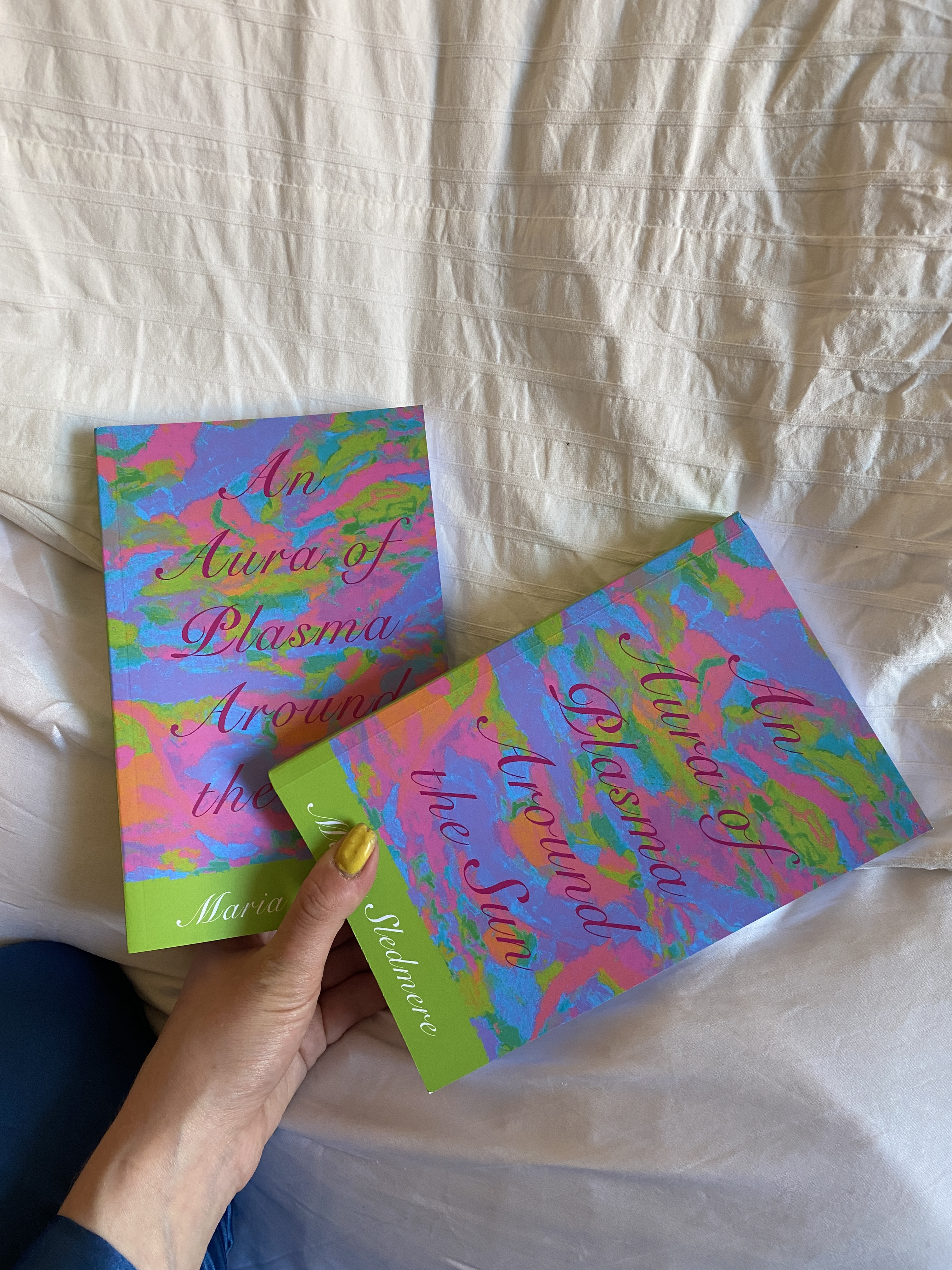
Blending oneiric memoir, experimental fiction and glitched verse, An Aura of Plasma Around the Sun swirls narratives of adolescence, occulted textual topographies and Scotland’s pandemic lockdown. Sweet, funny, heartbreaking, clever and ridiculous, often sentence-by-sentence, Maria Sledmere doesn’t guide readers through these whirlwinds so much as throw them in. Yet her spliced reveries and decadent languages are always underpinned by a celebration of community, as radiant and permeating as the sun.
198 x 129 mm / 254 pages with illustrations and photographs
Technology is harvesting our attention away from each other. We all have a “Grapevine” entwined around our past with unresolved wounds and pain.
— Natalie Mering
Of course, the flesh of the body and the flesh of the world are one.
— Catherine Malabou
Morning brings indigo gluttony of the night’s dim prizes. I remember a night in February of 2019, the brightest stars in my life we saw above a kirkyard eating chocolate for all the stars. Looking for tickets to see you again, star stuff for popcorn synecdoche of eating the bones of what you believe at the movies, infinity pool, the liminal alimony of the heart you have. I pay it all back which is why skylines exist. At this time of year, we make our own light. I text you all day and all night the text pings resonate without me, though I’m still conscious. This is how I listen to music. Harvest the ricochets until my synapse nozzles are ripe and sweet.
“It’s too difficult”
the beautiful song in my ear The Butterfly splitfin will go extinct this year
“My plastic girlhood obligatory wrote a novel you’d never know elemental love for the noise of horses”
Electra pastel of giving the lecture
Its voice never falters
Spotify should hire poets to replace the algorithm with iambs
A perfect way to respond?
The album cover of Weyes Blood’s And in the Darkness, Hearts Aglow features a glowing heart which is the idiosyncrasy of love song, gentle and melodic and good and wrong. There is something we say at breakfast about the inexplicable intimacy of an interval, this bit in the song where the chords do this or that and suddenly your heart’s aflutter. Why is that? I feel vulnerable and unclasped by music like the locket of a promise necklace snapped open, opulent. When are you gonna feel okay?
I like it best when I don’t expect it.
/
Designing the conditions for crying is easy these days. A tiny fly lands on my wet nail polish and departs as lavender.
I used to wander the abandoned golf course and around the monument to see the snowcapped hills and feel it.
Perished by screaming clouds in my brain.
I am in love with the music of Weyes Blood, we share the same birthday.
At a recent gig the singer said “thank you all for being alive”. Some people describe these songs as hymns. Last year in the climate rush of COP26 I was cycling around with my bones on fire and freezing. I would show up to the job being stared at, horrible mess of myself couldn’t hide, what do you think of this poem I said it’s a lot to unpack. Why don’t we leave those tools in the box? He says toolbox isn’t so bad. You could just improvise. I don’t look to these men to be mentors but menthols were my first cigarettes, a clothing brand called MEN is like SHEIN you could have MENOUT or menagerie, mispronounced as shine, a giraffe made of glass or a tiny glass seal with whiskers of onyx, weeping. MELATONIN or MENACING, MENDACITY / my avuncular muses of more money have outraged, they will never understand candida. A spanner in the works. No more lies. I’m most men when in lingerie maybe or styling my old surprise, the giant window in a dream wouldn’t close after I’d opened it so I had to go looking for a man to help me, high-vis or high waters our time would come to close it, not until I had escaped. Fled is that happiness. Look at it hardcore. No more lies, no more dying. Your arms in the air.
I heard catastrophe on the grapevine which was snipping guitar strings all the better to hear the lyre underneath, the union makes us strong, picket-cold and trellises our kitten hearts are growing, Natalie as in a new flower or the Minecraft roses coming up fast this year to be eaten by the dreams of spiders. Nicky Melville poem says if you’re a soft person you just get squashed, Sarah once read it aloud at the picket. I pictured a soft orange in the principal’s pocket. Roses last forever even when past their superlative. Shedding their petals to cover our eyes. Bunny put them in cubes to exhibit. Smooth wax skin.
Violet roses.
Ever since my friend with the purple aura died I’ve worn so much purple to find a flame of them, purple flame of my Raynaud’s and holy flux of traumas. What’s the point of poetry, it’s purple. I lilac therefore I lamb. I am on the lamb, I am lambing seasons, turn me into a leaf on the riptide, for I am lost. The clouds are glamorous, in pursuit of beauty’s excreta, a bad era, the best
negentropy saves us from losing everything
Secret blue note.
Wine-dark reverie of the quiet escapade, my late heart blooms for the red, the read receipt staining your tongue.
Catherine Malabou says ‘The body becomes worthy of philosophical examination when it is no longer a question of the body but of my body’. Descartes dripping wax on his robes, a lecturer pouring a pan of boiling pasta over his hand in rehearsal; the red welts between two moments, my horrible bleeding thumb. Scarlet clustering of old blood. Say it feels personal, say it is orange or purple. When it started inside me I felt the glow in my chest handed down by hyleticism of data from song: the body electric or incarnate. Menstrual tripping, I saw Kate Winslet literally on fire in fantasy after watching Romance & Cigarettes but she was invincible, what’s this script, literally the fire coming out of her in waves was my love of music. I harboured desires to stub cigarettes out on the wrists of saplings, light them and throw them barely smoked on the street; imagine my child self, scurrying around to collect them, smoking wholeheartedly the barely unsmouldered, especially rose ones. Lemonade’s infinity sunflower. I was so guilty in my treehouse for getting high, higher, highest of them all to bioluminesce in lieu of sunsets, fuck it. The cruelty displayed to our cousins was a lonesome one. What’s that word for when a word is hinged between two things, like flesh stitches that keep skin together and then dissolve inside you — a word that makes sentences make sense in this precious knitted way. What’s Latin.
Butterfly notifications in my dopamine receptors.
Coffee luxuriance and pillowslips ink-stained with diary slumbering. There are too many images trying to bed us. A stage whisper for the saints. I was born from a chrysalis of synths swaddled in melody all the better to tell you.
The discourse is banana-bruised and overly ripe in your bag.
Perfect oracle rosehip tea.
You can’t fully vanquish chaos but on the phone at a planetary scale your mouth an aquarium, spilling numbers.
It’s okay that I died, and you died a little bit that night we all did, really.
A friend is on the phone trying to renew medication. The record-breaking temperatures have lost their meaning, as in a lost glom of mercury swallowed by me. The Butterfly splitfin is in jeopardy. I have never fixed on a form for these cramps in language. The males intensify in colour when excited. The young are entirely silvery. I want to go on the profiles of the gentle ones and swim with them; you don’t need these comments, you didn’t need these things. The internship of being elegant more insect is fading. At some point
I wanted to drive. I was a girl toy and thought of many plastic cassette cases filling up the doors, the backseats with sugar. The idea of analogue as shadow, scrolling magnetic and stopping. I’m glitched by the ache which is lightening, gloss, disquietude, gelid. Girl drivers filling the roads, pouring concrete from their jars of face creams into the sea and beckoning
to make love on the white lines, almost drifting
you were there, you were swimming,
our worlds elided
I wanted to drive you to the sea cliffs of skyward to breakfast on blue.
Natalie and Lana sing of the body California incarnate, plasticity glowing emails, eyeshadow blue as in Bowie
my exospore of the hokum knowhow, excessive sentiment, hearts aglow
That house over there. That home over there. A palm. Analgesia of the sea.
Ghost for your thot
organology of a negative situationship
Catharsis polaroid still develops in my purse of us, you’re blowing out blue smoke in the dream, I’m bowing out. The eye emoji, heart stun soft mote.
And in the darkness…
It’s good to be soft when they push you down
[…]
Such a curse to be so hard
Lightning bolt award for being born at all.
I used to chew beads and often swallow them
C. said so inside you it’s like the anthropocene
many plastiglomerate organ marias
menstruating rainbows
What someone called my emotional Teflon was melted by your white-hot non-logic, almost like heroin of the pain I was in, as if to have a little blister polishing her oysters. Why is there no word for girl-come
or the tragedy of icepacks.
Kept panic-crying at the idea of sleeping
and did it until the blood vessels burst around my eyes
which are sea-coloured and colourless, unseeing.
Divine & oversized teardrop:
I bought this not on etsy but via the estuary, quartz time, I dreamt a skipped ad and heard myself in the rearview mirror bound in leather. Here is a lilac wine and the name of that bone in your chest, flagrant sternum of the lonely highway, pulling your jacket to keep warm
picking pearls off your shoulders, all the better to lick this neck
in the flesh of the road
Bernard Stiegler says the relation entropy/negentropy is really the question of life par excellence
a pair of glowing red eyes
Buying more dreams at the pharmacy
of lurid blue
your poor wee cold sore
sky porn falls into humming. It’s free, it has to be.
Anything lost at the point of service.
There’s so much I wanna say about this album
holding me tight
I wanna tie the lights
and go off to hear it shimmering beneath the moon, whose memory
bruises
rosemary
real blood from your forehead
and the shadow of the one who
was yours
a long plague
season of neutral sensation
new motor neurons at the cosmic dawn
tripping cured my parosmia somewhat I could smell sauerkraut, frying onions, coffee, kerosene my only name the body odour of the shadow you loved
I can’t tell the trees from the shape of lightning
in subtitles
spiralise my love for the seventies
in edible language
flares in the highlands
the problem is not being affectless
but totally loving too much
all the tautology of stardust
let’s take the motorway route to ride our souls
under sunblock and metal sculpture
you feel balmy here, less exposed, fear of
merging
what we are
white hot collision
emotional whiplash
Emerging triumphant the dawn is a fog machine it is only October, none of us a sweetheart neckline could finish the sentence
swishing our way to ceremony
music makes sense
instead: a down & dirty musical set in the world of italicised starlings
which are assholes
because of radiance
for the love of original mud which connotes the whole story
they had to take flight
The body of both selves is ochre like in Husserl the real world is everything
a dialectician of starlight
Morning gluttony. Grasping. A worm in your blessing
fragile apples on the counter / collect to rot.
The real era was gradient and dependent on what Merleau-Ponty calls illness, ‘a complete form of existence’. I lost a normal form but what I found was the shimmer conundrum of the shape of you, California, a rice harvest of shiny red-blue tears to grow a purple flower, you guessed it.
Possession.
Pearly beads, the slasher heartfire of a bold new vision
touching me soft jealous of cornfields
Hellbound in egress, dark glow, December’s acupuncture of clouds.
How can something so big feel so cosy?
The creature is god.
Told myself I’d scrub mould from the bathroom today. Flux glow from the dirt that is given us to know the worst.
A given thing: music is grieving.
I wrap the vine around me in the hope of fruiting, or any violet outcome is fine. You bake a good pastiche like an electric goddess, cancelling plans all the better to scream at the stars. Loop trope. Hold yourself soft or hard, by the collar or hand, by moonlight tripping in Finnieston and in Yorkhill and by the masticated night which is always online in the digest of even the worst ‘The Flower Called Nowhere’
Mothering the subgenre of oblong buildings, bliss our heart this hurt. You essay your way to music but is it not your allergies that crystallise accomplice to the throat of time? Thank you, thank you for the mystery. It’s so late.
And we love this crescent moon
for all intelligence is the art of rupture
Falling asleep at the movies
And I am choking for a sweetness that really sees me.
~
Some italics are lyrics taken from Weyes Blood’s And in the Darkness, Hearts Aglow (2022).
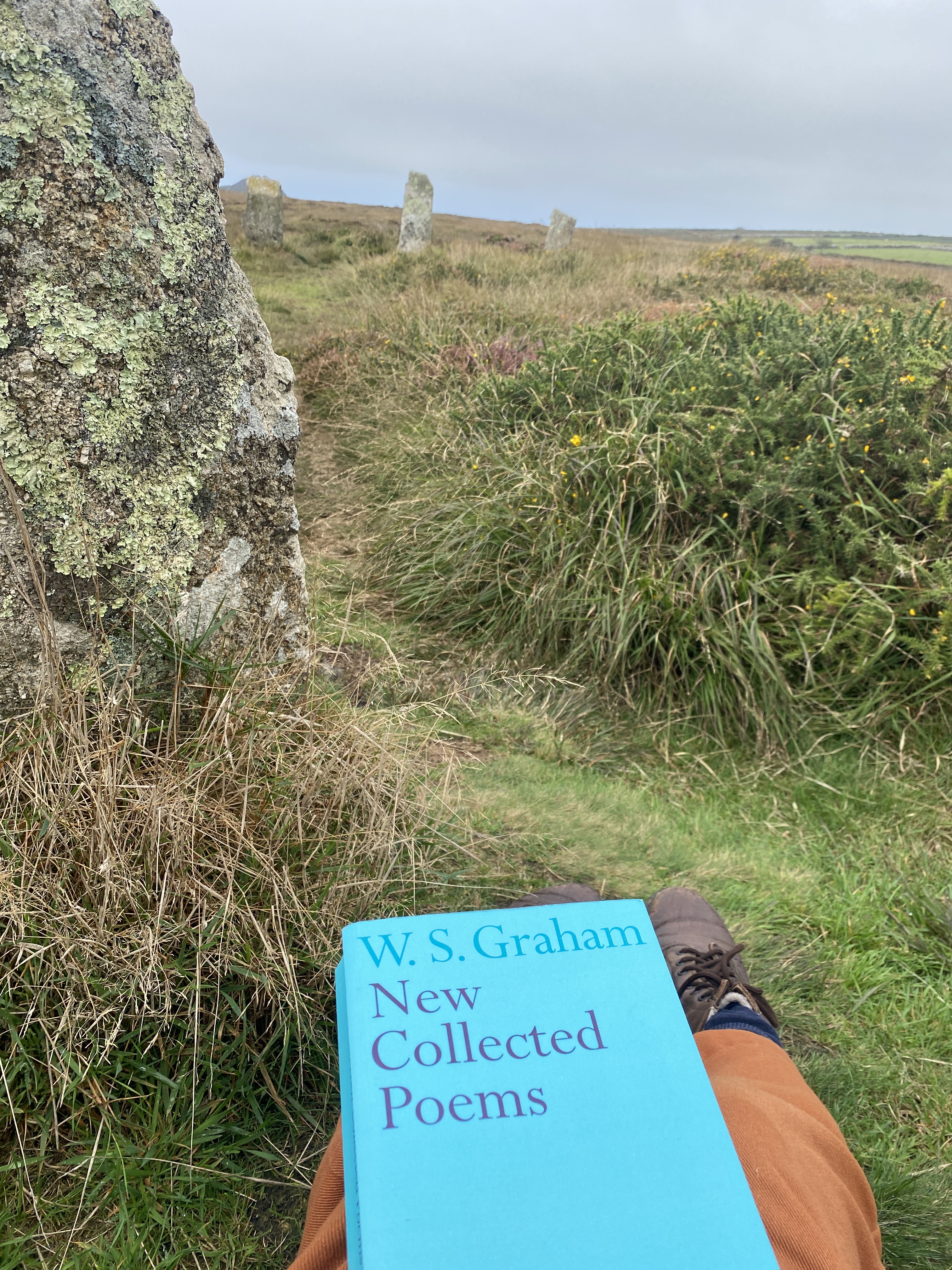
I’m on the twelve-hour CrossCountry from Penzance to Edinburgh. Penzance is the most westerly town in Cornwall and being this close to the edge of something calms me. I always sleep better by the sea. On my way here, on the Great Western Railway, a woman gifted me a glass sculpture with a rainbow inside it, as thanks for helping with her bags at Truro. ‘It’s for stirring your drinks’. For the past week, I’ve been writer in residence at The Grammarsow: a project which brings Scottish poets to Cornwall in the footsteps of WS Graham, who was born in Greenock but spent much of his life down here, making a home of Madron, of Zennor, of the moors. To say this has been a magical week is to say it changed me. I first came across Graham when the poet Dom Hale sent me a voice note of his elegy, ‘Dear Bryan Wynter’, out of the blue; I immediately went out and bought another bright blue, the Faber New Collected Poems. There was something about that foxglove on the wall and the hum of some memory in childhood, watching the bees.
Graham grew up in Greenock, on the Inverclyde estuary. A town where I used to teach writing workshops at the Inverclyde CHCP, taking weekly, then fortnightly trains with our chitty from Glasgow. That time in my life is a blur of shift work, seasonal overhaul, hopeless crushes. I’d get there early to look at the lurid flowers in Morrisons with Kirsty, my co-tutor, or visit the docks alone. Sometimes, I brought my little heartaches to the docks because the air felt smelted, or salt-rinsed, excoriating. The nature of these workshops was that people would share their life stories of such intensity we’d bear them home. I remember one woman writing a story about the moon, ‘we share the same moon’: the one thing connecting her, unconditionally, to her estranged daughter. Many people with stories of recovering from addiction through returning to childhood pursuits: the fishing taught by their fathers, the harbour walks, the musical grammar of language. Graham was trained as an engineer and spent some time on fishing boats, but dedicated most of his life full-time to poetry. The more I learn about this, the more I pine for the shabby romance of that clarity of pursuit. Not as a sacrifice but a great generosity from him, like a penniless rock star.
I’m sure it took a toll on his friends. Graham sent many a letter pleading neighbours and pen pals for the loan of a pound or a pair of boots, once thanking the artist Bryan Wynter for a pair of second-hand trousers. His letters are documents of a life lived in gleaning, bracing the elements, enjoying his wife Nessie’s lentil soup and of course, drinking. On a ‘bleak Spring day’ in 1978, by way of a quiet apology, he pleads with Don Brown, ‘I was flippant in the drink when you came with your news […]. Please let me still be your best friend’. He was often full of fire, a real zeal, taking poetry so seriously but life a strange lark, ‘speak[ing] out of a hole in my leg’. He wrote to his contemporaries — artists such as Ben Nicholson and Peter Lanyon, Edwin Morgan, along with family and friends — with bags of personality, a man self-fashioning in the long blue sea of ‘I miss yous’. As he wrote to Roger Hilton:
We are each, in our own respective ways, blessed or cursed with certain ingredients to help us for good or bad on our ways which we think are our ways. What’s buzzin couzzin? Love thou me? When the idea of the flood had abated a hare pussed in the shaking bell-flowers and prayed to the rainbow through the spider’s web. I have my real fire on. I am on.
The real fire may have been a woodburner, sure, but it’s something lit within him. The letter as a turning on, turning towards: we see this spirit of openness and address in the poems. The real commitment to Lyric. I love the hare that shakes in the flowers with its rainbow religion. I love the flush of arousal from walking uphill at speed. I saw many a spiderweb and two hares chasing each other on dawn of Thursday. On the train home texting many friends as if to have the rush of being held again, ‘Love thou me?’, could I be so vulnerable. A foxglove shook in the wind. The line as a tremble is lesser felt in the steady verse. Clearly, Graham wasn’t afraid of sincerity, though he always took pains to remind his addressees of his roots. ‘No harder man than me will you possibly encounter’, he assures Hilton; elsewhere, after the death of Wynter, he writes to his Canadian friend Robin Skelton of the coming funeral: ‘Give me a hug across the sea. […] I am not really sentimental. I am as hard as Greenock shipbuilding nails’. In a way, the infrastructure of space inflects the language as its face. I’m reminded of a quote by Wendy Mulford which Fred Carter shared at the recent ASLE-uki conference in Newcastle, where she talks about ‘attempting to work at the language-face’. I wear the face of the land, Graham seems to say, and the build of it. At West Penwith, we face the end of the land, literally Land’s End to our west. It is sometimes a silver gelatine, other times a bright blue, a fog grey thicker than thought. A granite-hard land that nonetheless sparkles. I recall a rock on the beaches of Culzean, in South Ayrshire, we’d come across as kids. Mum called it a ‘moonrock’ or a ‘wishrock’. It was a perfectly huge dinosaur egg of white granite. I find this particular rock showing up in my dreams, even now; as if having touched it, I become complicit in a deep time that doesn’t so much store the past as bear its promise. What could hatch from within a rock like that? What could move it, or hold it?
Graham had the idea of poetry’s ‘constructed space’, what I’d call a lyric architecture for reassembling something sensuous in memory or emergence. That this space isn’t just designed (as in my idea of architecture) but constructed points to that emphasis on building. What kinds of muscle, time, effort of spirit and will go into this? The poet Oli Hazzard writes that one of the effects of Graham’s poetry is ‘that I feel like it allows me—or, creates a space in which it becomes possible—to see or to hear myself’. Graham’s poem ‘The Constructed Space’ opens with the line ‘Meanwhile surely there must be something to say’. I always hear it in the lovely vowels of his Inverclyde accent, assuring. Like he’s sitting with you in the poetry bar, two pints between yous, and the poem gives this permission to talk or make space to listen. I think of Denise Riley’s ‘say something back’. My own need always to blurt, interrupt, muse out loud what mince is in my head. It continues:
[…] at least happy
In a sense here between us whoever We are.
As I write this, light dances on the opposite wall of my tenement flat and it’s prettier than anything given to me by the window. Sometimes my love says I am harsh when they need delicacy, and so I soften the heather of my voice to listen. It’s true that I was happy while reading that poem, a happiness or lightness in the brain as precarious as the light is. Changeable and easily blown further west to let in what fog, or dimness. I don’t mind my brain when I’m in Graham’s poems. By which I mean, it’s no longer a drag to be conscious or sad; things move again, their metaphors in process. There’s a lightness to quietude, its intimate premise, that holds me. Nothing extreme is promised here, ‘whoever / We are’: lyric address sent through ether to find that ‘you’, held in the future’s new ‘us’. It’s better than a page refresh, reading the poem to think something Bergsonian of the self’s duration. I’m more snowball than the first maria who read this. It’s a kind of exhale, in a sense, like Kele Okereke singing ‘So Here We Are’ from an album named suitably Silent Alarm. Imagining my loves at the same time, out in Stirlingshire lying tripping by the loch, their eyes skyward, the high or low. I cherish that wish you were here / so here we are. I can look out from inside the constructed space of the poem. Wheeeeeeeeesht, you. You’ll find constructed spaces everywhere in Cornwall. The lashing blue skyscapes of Peter Lanyon, the abstract panoramas of Ben Nicholson, the ambient plenitude of Aphex Twin (especially ‘Aisatsana’ and most things from Drukqs). I want ambient or abstract art to give me the clouds in my head back to myself, with the light of it. Colours, gestures, fractals, lines.
~
I’ve spent the past week schlepping around the moors and lanes, reading Sydney Graham’s poems and letters, cooking veg on my wee stove and eating simple marmite and butter sandwiches. I have this grandparent on my mum’s side who shared his name, who died of cancer before I was born. Sydney was the name Graham tended to go by, signing letters. It’s not that I’m looking for literary fathers but I stumble into their charismatic arms all the same. Is it guidance I look for, or perspective? I love the rolling enthusiasm, pedantry and chiding of his letters, as well as their cheekiness and charm. His dedication to writing and reading, his swaggering or boastful tendencies after an especially successful performance (coupled with an irresistible gentleness and warmth). His big sweet expressions ‘THE MILK OF HUMAN KINDNESS IS CONDENSED – TTBB)’, ‘IMPOSSIBLE TALK’. TTBB is the slogan of Grammarsow and a familiar exhortation in Grahamworld, meaning Try To Be Better (the title of an excellent anthology of Graham-inspired poems, edited by Sam Buchan-Watts and Lavinia Singer). I summon my voices, I try to be; used to be; want us to be.
There’s a quietude I love about the work, which suits the land and mind. After a summer of working three paid jobs, and two voluntary, I was ready for a gearshift into something relaxed and focused. I’d had enough of my own ‘impossible talk’. Being here was like being given permission to play and explore. Quickly I realised my time didn’t need to be ‘dedicated’. I lived by the cruising whim of the big sky, its scrolling clouds and moodswings. Saw the moon at two o’clock in the afternoon. I watched dragonflies dart between the lanes, listened to my neighbourly ravens at night. Watched big jenny long-legs make flickery silhouettes on the walls. Slept peacefully with spiders above me and the ravens being craven. I wanted all these things in my poemspace, and the poems themselves were initially scarce, then they began a familiar elongation that was comforting, with the swerves of a bus but also the tread of a walk. Some poems wanting to hide themselves between logs where I might later try and find them.
~
A grammarsow is the Cornish name for a woodlouse, or what we’d call in Scots a slater. I remember growing up and having this internal argument about language: was I to go with what my English mum said, or everyone at school? Aye or nay, yes or no. At some point I realised it wasn’t a question of scarcity and elimination, but abundance. The words became barnacle-stuck from all over the sloshes of life, swears and all, and I cherished their stubbornness. Even those gnarly, uncommon words and spicy portmanteau like ‘haneck’, ‘gadsafuck’, ‘blootered’ and ‘glaikit’. And yous: the juicy, plural form of you. Addressing the crowd, the swarm or many. A woodlouse is a terrestrial crustacean drawn to damp environments. I grew up with woodlice crawling out from under cracked kitchen tiles, unearthing raves of them hidden under rotten logs, finding them in tins of old paintbrushes or sometimes a bag of flour or sugar. I always liked the way their little legs seemed translucent, a little alien, and was especially seduced by their darling tendency to curl up into a ball, for protection, like Derrida’s idea of the poem as hedgehog.
Across the English language, there are many amazing names for the humble woodlouse, not limited to:
armadillo bug
billy button
carpet shrimp
charlie pig
cheeselog
chisel pig
doodlebug
hardback
hobby horse
hog-louse
jomit
menace
pea bug
pennysow
pill bug
roly-poly
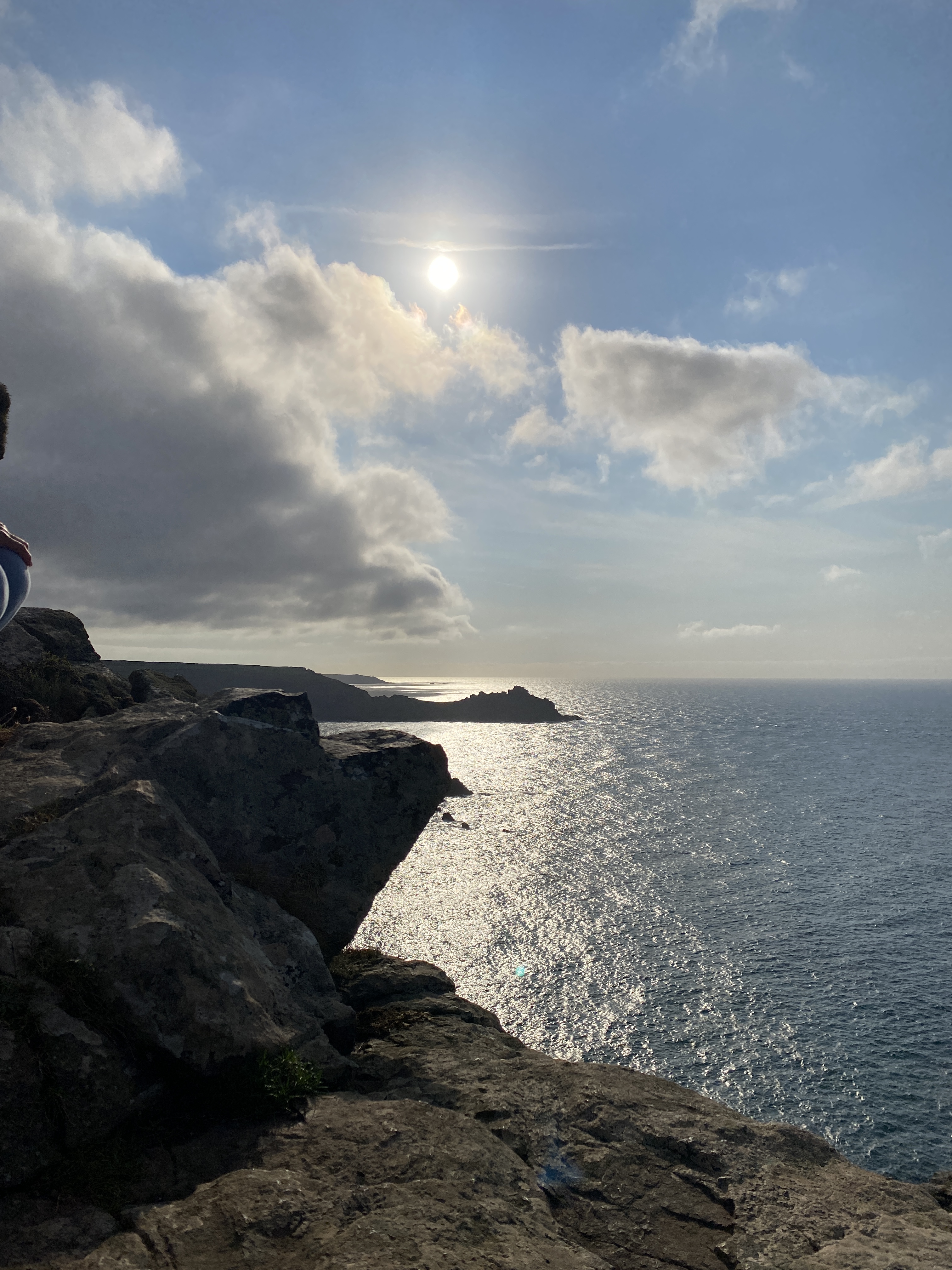
What is this penchant for lists I share with Graham? I want abundance from something other than products. I’m dumbly monolingual and lists are one of the few ways I can accumulate nuances of meaning. My attention-disordered brain collects lists as procrastination for the Thing itself, what is it I should be doing, always on the tip of some other event horizon bleeding through the last and first, so nothing is really finished. I like that in West Penwith, to look at the Atlantic you don’t see any islands, so there doesn’t have to be an end. You have the illusion that there can always be more time. The sea as this list of limitless light, colour shift, unbearable senses of depth. You are here.
~
The grammarsow crops up in Graham’s letters. In a missive to Robin Skelton, he muses:
And what are we now? Maybe better to have been an engine-driver in the steam-age. A sportsman a shaman a drummer a dancer rainmaker farmer smith dyer cooper charcoal-burner politician dog bunsen-burner minister assassin thug bird-watcher poet’s-wife queer painter alcoholic ologist solger sailer candlestick-maker composer madrigalist explorer invalid cowboy kittiwake graamersow slater flea sea-star angel dope dunce dunnick dotteral dafty prophesor genius monster slob starter sea-king prince earl the end.
Again the ‘steam-age’ of other infrastructures interfacing language. Better to have been a wave engineer in the renewable(s) era. I find myself somewhere between the ‘ologist’ and the ‘angel dope’, strung out on critique, measure and the promise of sensuous oblivion. Not sure if the dope is connected to the dunce or angel, but I’ll claim it spiritually as something good: an enhanced performance. As in, those are dope lines I’m reading. Do you want some? ‘And what are we now?’ not who, but what. A question I want always to ask — it’s almost Deleuzian — with someone in my arms or the sea swishing up to waist height, a sea-star clung to the hollows behind my knees. What’s possible when shame is gone. I love tenderly Graham’s list of possible existences and wonder how many I might retrain as (O genius monster), keeping in mind Bernadette Mayer’s old quip that all poets should really be carpenters. I love the raggedness of letters, which is why I love blogs (letters to the idea of being read). Who are they for? We’re so lucky to have these old ones, bound for us, evidence to the material conditions for our wild imaginaries.
~
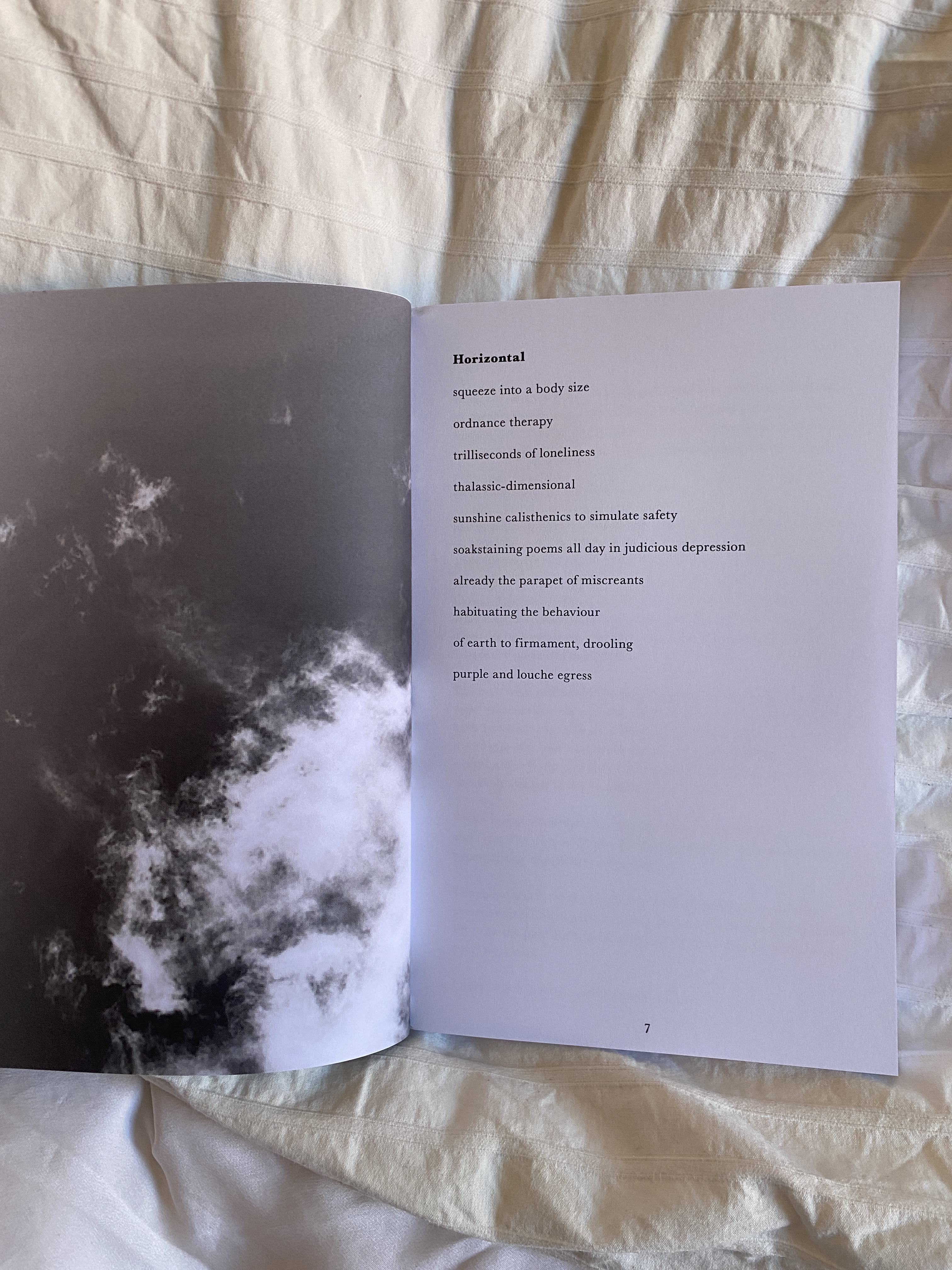
In Cornwall, I love falling asleep. I love falling for new poems, stumbling a little on the rugged paths, falling for the air and water, for a little more mermaid’s ale or Bell’s, a blackcurrant kombucha or 100g of coconut mushrooms. In his essay for Poetry Foundation, ‘This Horizontal Position’, Oli Hazzard writes about a time Graham ‘went for a walk on Zennor Hill in Cornwall and fell into a bramble bush’. This falling was a repeat pattern: in 1950 he drunkenly fell off a roof and complained of his three-month hospital stay, ‘I hate this horizontal position’. In my DFA thesis I wrote extensively about lying down as a beginning for writing, the horizontal as a form of refusal when it comes to the upright requirements of an assertive ‘I’. It’s no secret that I prefer poetry in the mode of dreamtime, but that’s not to say I’m also a rambler. It’s a poetry of breath and of steps (of vigour!) I enjoy in Graham. Zigzagging and winding down well-trodden moor paths, stumbling upon bridleways that lead around the hills from holy shrines.
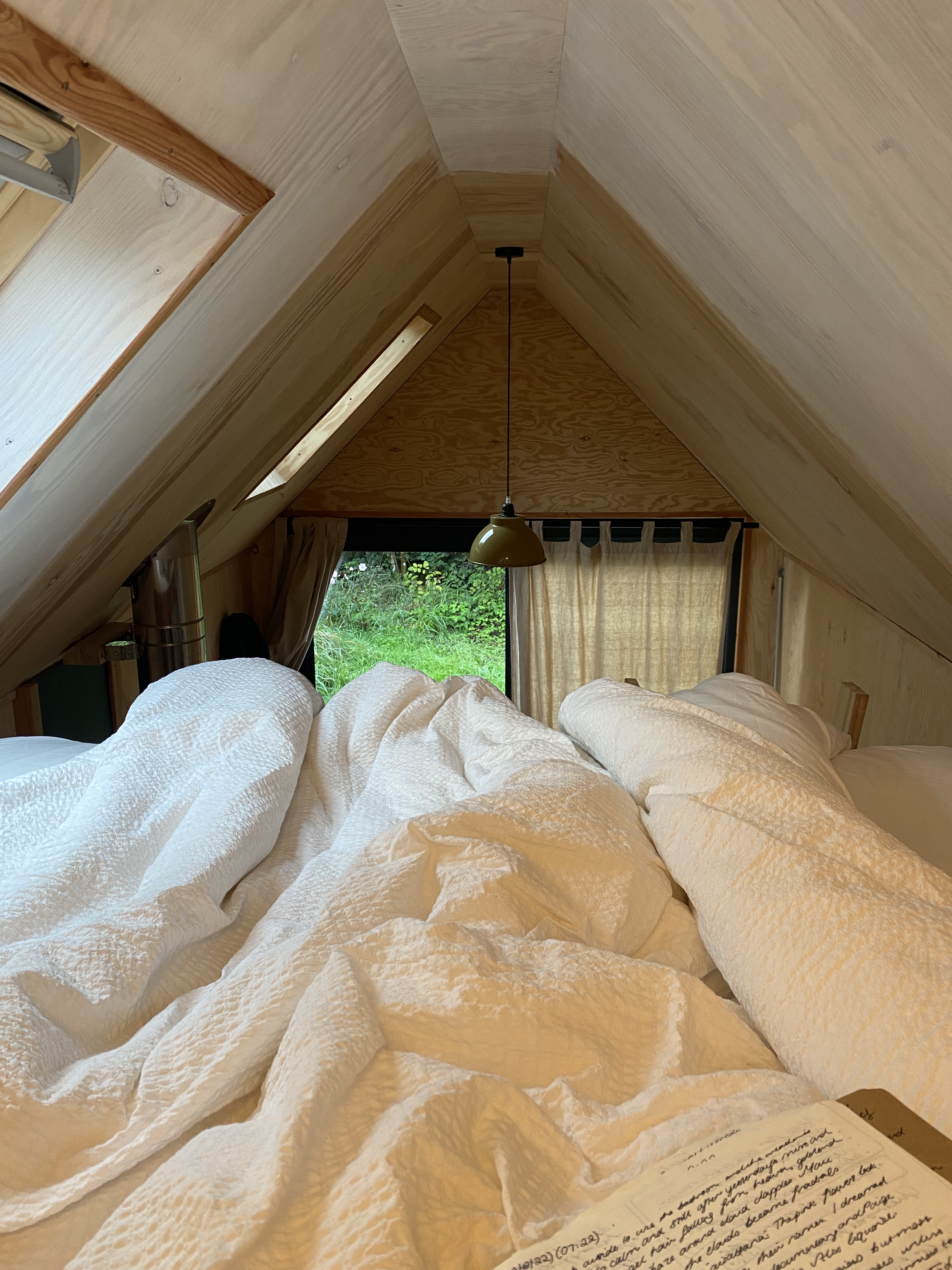
I was the lucky poet to first bless a new writer’s cabin that my host, Rebecca, built on some land near the Ding Dong Mine. From the garden, you can see right out over Mount Bay. The skies are huge here. I’ll say that a lot. I saw a seal down by one of the zawns on the north coast, felt the fear of losing the moon in you, let my lips chap on the telepathy of remote secrets. I try to be better, regardless. My poems become languorous obscurities. All of the land has hidden depths.
~
There was a summer before secondary school when we were gifted an unlimited pass to Historic Scotland, meaning our holidays involved camping across Dumfries and Galloway, the Trossachs, the Highlands, in search of abbeys, monasteries, castles and holy sites in various states of decay. I was turned off by leaflets documenting the actual details of history, emerging sleepy-eyed from the car where I’d been navigating the turgid sentences of fantasy novels or playing platform games like Super Mario. There’s a particular form of carsickness that produces electrolytic effects conducive to imaginative ventures. What I mean to say is, instead of vomiting I overlaid the real world with the promise of portals to elsewhere. In Penwith, I walk off my city sickness and sit by the standing stones, quoits and old ruins of industry. What do I imagine but a ‘news of no time’, still to come? Zennor Hill is both poem and place. The more I’m here, the more a sort of aura thickens.
Swap Zoom for the view from Zennor
On my last morning, I wake to sunrise over the sea. Dew shimmers the rosehips. The air is earthsweet as ever and I don’t know how I’ll go home. Travelling is an experience of dislocation: here, I find home again in language, its caught habits, Graham’s words sluicing Clydewards. There’s a poise to his poetry, steadfastly composed as ‘verse’ and often by iambic measure. Making perfect prosody with the chug of the train. I was pleased to roll into Glasgow having bumped into my friend Kenny, the whisky god of the Hebrides, attuned to the flight-pulse of conversing again. Hungry, ‘putting this statement into this empty soup tin’ to say cheerio as Sydney would, lighting up poetry to finish it, the best thing of all, a warm scaffold to hold up how we missed each other. A quiet disintegration of cloud. What are we now?
With thanks to Andrew Fentham, David Devanny and Rebecca Althaus for kindness and hospitality. Long live The Grammarsow!
‘Notes on Lyric Solarity’ at Summer in the Way, Birkbeck University of London, 9th July 2022.
Video of a creative-critical paper delivered over the weekend at Birkbeck, as part of an ongoing collaboration between the87press and the Contemporary Poetics Research Centre. Below is an extract from the first half of the paper. A lot of this thinking is developed more fully in a forthcoming academic article.
As flowers turn toward the sun, by dint of a secret heliotropism the past strives to turn toward that sun which is rising in the sky of history. – Walter Benjamin, Illuminations.
Today, I’m going to move fluidly between poetry and essay to present some nascent thoughts on lyric solarity. I want to suggest lyric solarity is a poetics in which solar imaginaries are linguistically mediated and refracted through the close rhythms, affects, sensoria and arts of noticing associated with the focalised energies of lyric poetry. Lyric solarity enacts an embodied poetics of dissolve, exposure, surplus, saturation and excess/residue: it offers a way of turning towards the sun, while helping us make, in the words of Imre Szeman, ‘commitments to reshaping’ the ‘existing infrastructures’ which underpin access to and distribution of energy. While the anthropocene, a contested epoch defined by humankind’s ascendance as geological agent, is often understood as an issue of scale, attending to the solar helps us think about planetary crisis in terms of distribution and density of harm, resources and changes to climate or energy. I take energy to mean both the power derived from physical or chemical resources, the property of matter and radiation manifest as a capacity to perform work, but also in the sense of an organism’s energy – their metabolism, vitality, ongoingness within the world, and its working demands or desires. What follows is less of an argument than a set of propositions and possibilities, a selection of field notes in search of lyric solarity.
Sans Soleil
In Chris Marker’s film Sans Soleil, often translated into English as sunless, we begin with a quote from T. S. Eliot’s ‘Ash-Wednesday’: ‘Because I know that time is always time / And place is always and only place’. It begins again with an image of three children in Iceland, ‘an image of happiness’ accompanied by black film leader. The voiceover suggests that if viewers can’t find happiness in the image of the children ‘at least they’ll see the black’. The film is itself a kind of lyric documentary on human memory, how memory is fragile and so our recall of personal and political histories – especially on a global or even planetary scale – is inflected or reworked in the present. In the spring of 2020, I approached the film as a kind of memory place. I had never seen such spring sun in Glasgow, but due to Covid I was locked down inside my own sunless temple, or tenement. What follows violates, perhaps, Eliot’s insistence on the essential containment of space and time. Eliot, I guess, never used the internet.
I was messaging the poet fred spoliar, and suddenly it was the solstice and we wanted to mark it. We began this remote collaboration, not in response to Marker’s film so much as through it, or some residue within it, a blemish or shine. A bright spot, a blind spot, a kind of fleck on its vision. We wrote remotely, wrote ‘live’ and in those hours of shared writing, we existed in a solar time: where solarity was a quality of memory, its absence our absence, and yet also speculation towards something better – waiting for rays of arrival. In that sense, the poem is about the uses and abuses of pastoral; about an ‘elsewhere’ to be written around, glimpsed, squinted at, but never quite accessed. It’s also about the temporal alignment of two people writing together. Lyric as a thought device for telecommunicating something of a paraworld hidden in language. I’d fall asleep with our phrases like film credits flashing behind my eyes. We wrote between the summer and winter solstices of 2020, we split lines with sun-cloud emoji. Here’s some of the opening sequence of the poem:
Ultraviolet rose us
spilled into formless
unration of atoms
and we spend ourselves back, the day
extends pause,
folding up
in luxe ellipsis
hills and hills
of recessional cloud, cast debt
between us, rolling one-sided
to release it, all of I’m rain
cast thru fierce aureate
disquietude, to not say
hope this finds you, or
nearest the soft motif of yr hair
bright spots around the antisolar point
balayage of except champagne
never sets. In a forest image / I cannot touch you
or notify through light that drowsy reminder
we are many. Something
decorative / in the cold soak of sylvanshine
gives up its entrance, the long day
composed of such stills is lying
back from its voyage. To say
all of the land escapes / an exorbitant teardrop
a teardrop. I have these ambient hands.
I wring the leaves…
2. Solar Apocalypse
In Etel Adnan’s poetry sequence, The Arab Apocalypse (1989), the sun is variously a shapeshifting trickster, a totalising energy, an authority, a marker of time, a blinding force, a monster, a pool of blood. Here are some of Adnan’s lines taken from across the book:
I took the sun by the tail and threw it in the river. Explosion. BOOM…
the sun is contaminated by the city
the sun has eaten its children
a sun rotten and eaten by worms floats over Beirut silence is sold by the pound
eat and vomit the sun eat and vomit the war hear an angel explode
The brain is a sun STOP the sun is an eye
the sun’s atoms are incarnating in my flesh STOP STOP
The sun is a kind of virus, pulsing and multiplying, changing form and colour, nourishing and deadly, making things grow or die; a kind of white noise in the context of war, a vulnerable body, a weapon, a machine of surveillance, a carnal threat. In the American Book Review, Barbara Harlow says of Adnan’s poem that it ‘invokes a mythic past […] to presage a present that resists narration’. To presage is to be a warning sign, a prediction, typically of something unpleasant; in archaic meaning, presage is an omen, a feeling of foreboding. In The Arab Apocalypse, Adnan writes back and forward to historical crises: as Aditi Machado points out in an essay for Jacket2, the poem was begun in January 1975 in Beirut, two months before the outbreak of the Lebanese Civil War. But there is also a generalised economy of violence, exposure and replenishment which speaks to the twentieth century at large and indeed to the explosions, contaminations and environmental atrophying of the twenty-first century. As Harlow identifies, the simultaneous, coagulating, geopolitical crises of the times, what we might call the ~Anthropocene, are often resistant to narrative. The recurrent, modulating figure of the sun has more of a lyric quality, beaming and seeping, punctuated by telegraphic lines and signals of stop, break, transition. Language garners a lyric intensity which is elemental, saturating, overspilling the traditional bounds of a human ‘I’. Impressive and god-sized dramas of the stars and planets play out in a mythopoetics of Beirut, of Gilgamesh, of ‘grass snakes hiding in the texture of TIME’ (Adnan, The Arab Apocalypse).
3. More sun to consider in lyric
Julia Kristeva’s Black Sun
The music of Sun Ra
Sean Bonney’s ‘solar cop’
The shine sprites in the video game, Super Mario Sunshine
Georges Bataille’s ‘solar love’
David Schwartzmann’s ‘solar communism’
Alli Warren’s Sun Dial
The photographic process of the ‘anthotype’
Björk’s song ‘Sun in My Mouth’
Catherine Wagner’s line ‘If everything is from the Sun why praise it’
In Paul Klee’s painting, Castle and Sun (1929) the castle is line-drawn in myriad geometry: its surface is of different coloured shapes, set underneath a bright orange sun. In proximity, the colours shimmer and vibrate. If there was a patchwork made of Adnan’s poem, it might be this; or indeed one of Adnan’s own geometric, brightly-coloured abstractions. Shimmer is to shine with a soft, wavering light. It offers a coming-to-knowledge distinct from the Enlightenment regime of ‘shining a light’ on your subject; it is a way of making contact, of existing in non-linear, non-narrative – that is to say, lyric – timespace. In her 2018 book Surge, Adnan writes ‘We came to transmit the shimmering / from which we came’. In this shimmering tautology we yet cross a line, continue transmission. Shimmer is instrumental in what I call ‘hypercritique’: a poethical form of writing which orients not to the capture of time, meaning or ecological reality, but to a beyond.
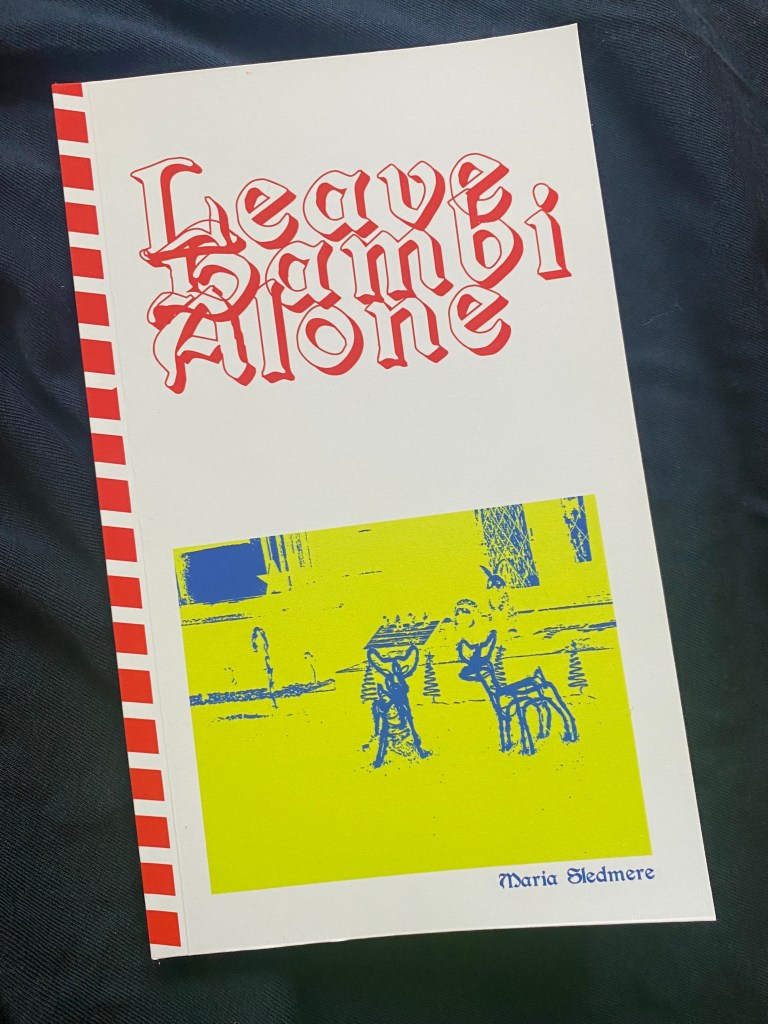
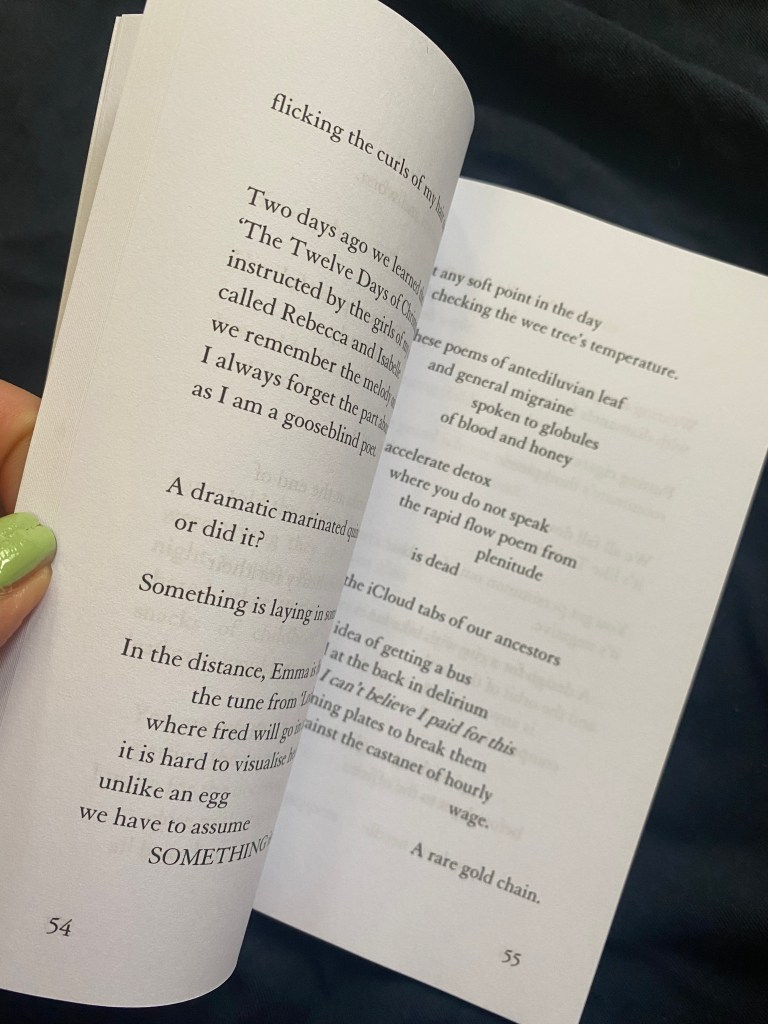
Over xmas & boxing day I kept a small notebook and wrote a meandering poem because I couldn’t get the phrase LEAVE BAMBI ALONE out my head. Anyway, it’s one of those ad hoc stream poems of no coherence or consequence. Available now via Lulu & Mermaid Motel. link in bio 🍕🧜♀️🏨
Documenting the festive habits of a special cat, the early career of Björk, champagne pageantry and calorie paradise, the wearing of acid berets, childhood whims and ‘the iCloud tabs of our ancestors’, this is a bad poem written in defence of shy animals who love in the livid dream their tiny world.
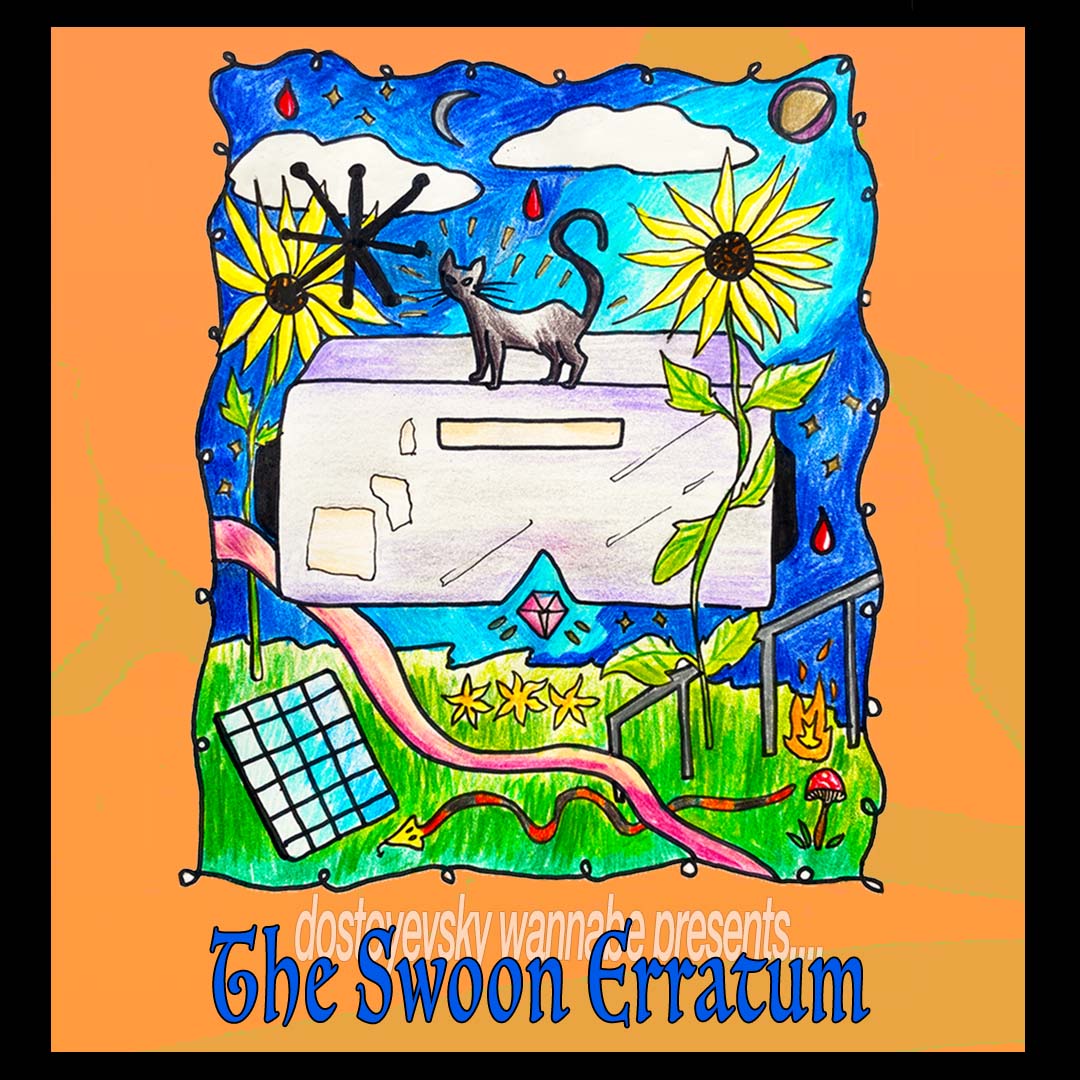
The Luna Erratum, Maria Sledmere’s debut poetry collection, roams between celestial and terrestrial realms where we find ourselves both the hunter and hunted, the wounded and wounding. Through elemental dream logics of colour, luminosity and lagging broadband, this is a post-internet poetics which swerves towards the ‘Other Side’: a vivid elsewhere of multispecies relation, of error and love, loss and nourishment. Its leitmotif of Luna, a shapeshifting feline of satellite proportion, waxes and wanes through poems which move beyond the twilight moods of left melancholia, sad hospitality and ecological crisis towards a fugitive imaginary that lingers in the ‘Flirtation Device’ of lyric and its many echolocations.
Taking cue from Jenny Boully’s ‘erratum’ — ‘the text of what is and the text of what should have been’ — Sledmere writes with failure, friction and fractal attention, with a yearning for intimacy, shelter and ongoing ways of bearing the im/possible. She offers poems of mystery, refusal and pain at personal, political and planetary scales, tracing the desire-lines of the everyday and its glitching encounters. The Luna Erratum is a book of memory and friendship in the so-called anthropocene, of bodily disorder, painterly gesture, quantum kissing, rodent sisterhood, open world intervention, technology, tenderness, shimmer and song.
☆
Praise for The Luna Erratum:
How do you explain yourself to yourself when you suspect that actuality – your experience of it – is provisional and full of error? You come up with your own poetics, your own tense and mode of address, which is a lunar one, and which involves speaking in crushed, frothy mouthfuls to a terrifyingly silent, unpredictable and generous friend (celestial objects, an indifferent lover, &c.).
The Luna Erratum offers no truth except in things – colours, materials, beings, dreams, schemes of language, human artefacts and locations – and their known convergences, all of which hold as much affective weight and capacity for transformation as the events that precipitated this profoundly graceful, unsettling and mesmerising book.
— Sophie Collins, author of Who is Mary Sue? (Faber, 2018)
☆
A glittering universe, Maria Sledmere’s first poetry collection is both lyrical and electric, both video game and watercolour. Reading these poems feels like ingesting semantic MDMA, the ectoplasm of a Victorian ghost trying to reach her lover through an unstable wifi connection. Sledmere’s words ooze a desire that is part animal, part human, part astral body. Let them transfix you.
— Nadia de Vries, author of I Failed to Swoon (Dostoyevsky Wannabe, 2021)
☆
In Maria Sledmere’s The Luna Erratum, rivulets of neon daylight stream through the ever-quickening fibre-optic cables of the soul. Beneath ‘morphine clouds’ climates change as human groans crosspollinate in the moon’s tread. Sledmere concentrates the neural pathways on the world spirit, crossmatching the matters of attention. The lines grasp at what repositories of sentiment might be made secure for poetic memory, as the pleasure of every experience is threatened by its immediate disappearance, like Bernadette Mayer reciting Keats in the abandoned sea life centre. And yet, for the poet’s eye, the sumptuous bounties of the world are still all up for grabs; the human squats on top of the non-human and: ‘you can take bites from the sun’. This book is a hot tub full of Tamagotchi frogs’ spawn glistening in the light of the full moon atop the Yggdrasil skyscraper.
— Ed Luker, author of Other Life (Broken Sleep, 2020)
☆
If you would like a copy for review, or to stock in your bookshop, please email mariasledmere [at] outlook [dot] com. 🙂
Excited to be reading with Max Parnell, Nadia de Vries and Jane Goldman to celebrate four new books from Dostoyevsky Wannabe. Please come and feel free to ask us questions. Zoom events are sort of underground now, and I miss a lot of ppl I only really see at them. Am I doomed to be a lil zoom fish forever. Put on yr VR goggles or like, consult the mystic feline, fractal sunflower, swoon.





 mariaology